What Is Israel Trying to Hide?
By Barbara Erickson | TimesWarp | March 7, 2016
A delegation of seven lawmakers from the European Parliament arrived in Israel last month to visit Gaza, but one day before they were due to enter the enclave, Israeli authorities refused to give them access. Officials gave no reason for this ban, and The New York Times was equally silent, making no mention of the event in its pages.
This past week a group of six Belgian members of parliament, representing a range of political parties, also traveled to Israel, planning to meet with representatives of non-governmental organizations in Gaza. Israeli authorities blocked their entry to the coastal strip, sparking an outraged reaction from the MPs. Once again, the Times had nothing to say.
Three days later, however, the Times ran a story on page 3, informing us that India has denied visas to a group monitoring religious conflicts. The story, “India Denies Visas to Group Monitoring Religious Freedom,” appears online and in print, and it tells us that the delegates had hoped to assess the state of religious liberties in India and were “deeply disappointed” in the outcome.
This isn’t the only time the newspaper has found such state actions newsworthy. When China refused entry to a delegation from the United Kingdom, for instance, the Times ran a story under the headline “China Says It Will Deny British Parliament Members Entry to Hong Kong.”
And then there was Iran and the matter of inspecting its nuclear facilities, all very much part of the lengthy negotiations that led to an historic agreement and the lifting of sanctions. The concern over inspections took up many column inches in the Times. Would Iran allow access? How much and when?
Meanwhile, the newspaper had nothing to say about Israel’s nuclear weapons program and its refusal to allow entry to inspectors. (See TimesWarp 6-2-15.)
With the India visa story last week, the newspaper reveals once again that such affairs are fit to print—if the offending state is not Israel—and that the Times continues to maintain a double standard. This policy has left its readers ignorant of Israel’s lengthy record of denying entry to monitoring groups and international officials.
Less than two weeks ago, Israeli officials refused to allow Kenyan President Uhuru Kenyatta to visit Palestinian leader Mahmoud Abbas in Ramallah. The request was made too late, the officials said. Kenyatta was on a three-day state visit, the first from a Kenyan president since 1994. No mention was made in the Times.
Sinn Fein leader Gerry Adams, also on a three-day visit to Israel in December of 2014, did manage to meet with Abbas, but he was denied entry to Gaza. Adams, who had been instrumental in reaching a peace agreement in Ireland, said the refusal to allow him access ran “contrary to the needs of the peace process.” Israel (and the Times) made no comment.
During and after the attacks on Gaza in the summer of 2014 Israel denied repeated requests from Amnesty International and Human Rights Watch to enter the enclave and investigate charges of war crimes against both sides. Two months later Israeli officials also denied representatives of the United Nations Human Rights Council the right to enter Gaza for the same purpose.
The Times failed to run stories on either of these occasions, but it was forced to reveal the fact that the UN Human Rights Council special rapporteur in the Palestinian territories, Makarim Wibisono, resigned over just this issue, saying that despite repeated requests, Israel denied him entry to the West Bank and Gaza.
The story, however, was relegated to the World Briefing section and the author, Isabel Kershner, took care to give the Israeli pretext for its refusal: that the UN Human Rights Council is “biased” and “hostile” to Israel’s interests.
The Times would rather not take up such stories, it seems. To do so might create doubts in the minds of readers, upsetting the carefully cultivated impression that Israel and Palestine are two equal parties at the negotiating table and on the ground.
Such news would make it uncomfortably clear that Israel is in full charge of the borders and that there is nothing equal about the conflict between Israel and Palestine. It also raises the question, which an Irish delegate raised in reacting to the recent ban on EU parliament members travel to Gaza: “What does the Israeli government aim to hide?”
The Times is willing to raise this question—even if by implication—in regards to India or China or Iran, but it has no interest in prompting such doubts when it comes to Israel. Readers, therefore, might want to ask the Times a similar question: In censoring numerous stories of Israeli bans on travel to the occupied territories, just what is the newspaper trying to conceal?
‘Human rights abusers’ invited to ‘non-lethal’ weapons show, condemned by activists
RT | March 7, 2016
Activists have denounced a Home Office sponsored security fair, warning that Britain is selling tear gas and other crowd control tools to some of the world’s most oppressive regimes.
Among the governments invited to take part in the fair in Farnborough, Hampshire, 30 miles southwest of London, are Bahrain, Saudi Arabia, Israel, United Arab Emirates (UAE), Egypt and Turkey, the Guardian reported on Saturday.
Police and security officials from 79 countries are expected to participate in the fair later this week, according to the list, which was released under a Freedom of Information request.
Since Prime Minister David Cameron took office in 2010, the UK has approved 126 licenses connected with the sale of tear gas and other irritants, according to the Campaign Against the Arms Trade (CAAT).
Also approved were 75 licenses for crowd control ammunition such as rubber bullets, 79 for “acoustic” crowd control – known as sound grenades – and 259 licenses for riot shields.
CAAT spokesman Andrew Smith told the paper: “There are serious questions to be asked about the impact of the so-called ‘non-lethal’ arms industry. These risks become even more important when these weapons are being sold to human rights abusers and dictatorships.”
“A number of the countries in attendance routinely practice torture, arbitrary detention and other appalling acts of violence. The UK should not be arming these regimes and selling them the means to oppress and kill.”
“[The event] undermines the UK’s claims to be promoting human rights while strengthening the position of repressive regimes.”
Defending the trade show, the Home Office said: “A thriving security industry is vital to help cut crime and protect the public and so it is important these products and services can be showcased and expertise shared.”
Described by organizers as “the perfect place to see the latest security equipment and technology in a secure environment,” the Security and Policy fair will be held behind closed doors, with all visitors “pre vetted to strict Home Office criteria.”
Homeless Man Owes Government Over $110,000 In Fines For Being Homeless
By John Vibes | TrueActivist | March 4, 2016
The recent case of a homeless man racking up massive fines has exposed the widespread police practice of fining homeless people for being homeless.
Émilie Guimond-Bélanger, a social worker at the Droits Devant legal clinic in Montreal spoke to the media about a case that she worked on where a homeless man racked up over $110,000 in tickets.
“It was shocking. We’ve never seen someone with so many tickets,” Émilie told CBC.
The man had over 500 tickets, which amounted to over $110,000 in fines. The fines were mostly for things that homeless people can’t control, such as sleeping in the subway or asking people for money.
“He had received around 500 of them [tickets]. I could see that most of the time he would receive many in the same week, sometimes by the same officers as well,” she said.
“It’s very common, to a point where I would say it’s a systematic experience for homeless people,” she added.
On a daily basis, Émilie deals with at least two cases where people owe at least $10,000 for the crime of being homeless.
According to a study published in 2012, the homeless population of Montreal owe over $15 million in fines.
“It’s a huge amount of money that would stress out anyone who has that as a burden. So you can just imagine how it’s difficult for a person to then think about rehabilitation in society when they have such a heavy debt,” she said, “it affects them a lot. Some of them feel like there are good citizens in society — and then there’s them,” Émilie said.
It was recently reported that politicians in Los Angeles are seeking to ban homeless people from sleeping in their cars, and even RV’s.
As we reported late last year, Florida police arrested a group of charity workers for breaking a newly-imposed law against feeding the homeless. Among those charged was a 90-year-old homeless advocate.
FBI asks high schoolers, teachers to watch for signs of student terrorism
RT | March 7, 2016
High school students and teachers across the US are being encouraged to watch their peers for any telltale signs that might indicate they are about to commit an act of terror.
In an advice booklet entitled ‘Preventing Violent Extremism in Schools’, the FBI says students are “ideal targets” for terrorist recruiters aiming to carry out violent attacks on US soil.
While not as blatant as the ‘Red Scare’ US loyalty review boards or the neighborly snooping fueled by McCarthyism in the 1950s, the 28-page intelligence pamphlet does suggest young US citizens keep a close eye on one another’s activities – even to the extent of monitoring student artwork and essays.
“Many times, fellow students or educators observe behaviors or are privy to another student’s communications and commitment to a violent ideology that may be indicative of future intentions,” the document states.
The booklet advises educators and students on the importance of identifying “leakage”, which it explains as “clues prefacing a violent act”. The phrase “leakage” was previously used in an FBI study called ‘The School Shooter’, which sought to instruct people on how to identify a future assailant.
These clues include “boasts, innuendos, predictions or ultimatums” conveyed in diary entries, drawings and even essays that could point to a criminal or violent activity before it has even been committed.
The guide also recommends high schools incorporate two-hour blocks of “violent extremism awareness training” into curricula.
The booklet follows other recently published FBI guidelines on teenage surveillance. A new FBI website, designed to stop teenagers from being radicalized, urges people to inform on peers using several private messaging apps; talking about traveling to places that “sound suspicious”, or engaging in “unusual language”.
It also suggests that taking pictures of a government building might be a sign that a terrorist plot is underway.
Read more FBI unveils ‘violent extremism’ video game to educate teenagers
Ethnic cleansing of Shuhada Street in occupied al-Khalil (Hebron)
International Solidarity Movement | March 6, 2016
Hebron, occupied Palestine – Since the 1994 Ibrahimi Mosque Massacre, the majority of Shuhada Street – once the thriving Palestinian market and main thoroughfare connecting north and south al-Khalil (Hebron) – has been closed to Palestinians. They are completely barred from accessing it, except for a small stretch in the Tel Rumeida neighbourhood.

Photos of the same portion of Shuhada street – a thriving market before 1994, now an empty street where no Palestinians are allowed to enter (published by B’Tselem)
This tiny strip that is legally still accessible for Palestinians is restricted by the recently ‘renovated’ Shuhada checkpoint at the beginning of the street and ends where the street begins to border the illegal settlement of Beit Hadassah, beyond which Israeli forces assure that no Palestinians exist. Further down Shuhada street, clearly marked with yet another military post barring anyone who might attempt to enter the street, are even more Israeli settlements – all illegal under international law – located directly in the city center of al-Khalil.
The settlements on Shuhada Street are connected via a settler-only road to the much larger settlement of Kiryat Arba on the outskirts of al-Khalil; settlers can also reach the illegal Tel Rumeida settlement easily by traversing the tiny stretch of Shuhada Street still open to some Palestinians and the road leading up into Tel Rumeida from Shuhada checkpoint, now encompassed within the closed military zone. While Palestinians are allowed to walk on this part of Shuhada Street, Palestinian vehicles, including ambulances, are forbidden from driving there. Since Israeli authorities declared the area part of a closed military zone on 1st November 2015, the already barely existent access has been further restricted – Isreali forces only allow entry to Palestinians registered with them residents, while any Israeli settler, regardless of whether they are residents or not, can pass freely and without ever being harassed, stopped, detained, arrested, or threatened by the ever-present military forces.

Map of the city center of al-Khalil including Shuhada Street (the longest street marked in red) by B’Tselem
At the line demarcated by Daboya checkpoint (Checkpoint 55), where the illegal settlements on the street begin and Palestinians are no longer allowed, a steep flight of stairs leads up to Qurtuba school and into the Tel Rumeida neighbourhood. These stairs, the only way for Palestinians to continue traveling in the same direction above the street as they are not allowed to continue down Shuhada Street itself, have been closed by the Israeli forces with a metal gate since November 2015.

Stairs with the closed gate leading down to Shuhada Street
Even though this gate is currently not locked, Israeli forces deny any Palestinian, except for the students and teachers of Qurtuba school during school-time, to use these stairs. As a result Palestinian residents of this neighbourhood, once they have passed Shuhada checkpoint – an ordeal that can take several hours – have been denied to reach their homes by walking down Shuhada Street and the stairs leading up to Qurtuba school, forcing them instead to take a much longer detour around. With yet another way denied for Palestinans, navigating the maze of Israeli military-enforced checkpoints, complete bans on travel, roads where Palestinians cannot drive, settler-only roads, closed military zones and new arbitrary closures has become even more arduous.
Israeli forces are thereby also clearly working to minimise the number of Palestinians who will actually use this last portion of Shuhada Street – now a complete dead-end – as they bar Palestinians not only from going farther down the closed street but also declare the stairs, formerly an alternate route, yet another closed zone. This illustrates the Israeli attempts to rid Shuhada Street entirely of Palestinians. Ethnic cleansing in al-Khalil, and all across Israeli-occupied Palestinian lands is not a sudden, headline-grabbing event; it progresses gradually as Palestinians are restricted in certain areas, barred from driving there, prohibited from even being there, forced out to facilitate the expansion of the illegal settlements. Ethnic cleansing happens slowly, by erecting new and ‘fortifying’ existing checkpoints, advancing one more closure at a time.
Texas’ Annual Roundup of the Working Poor
By Trisha Trigilio | ACLU of Texas | March 4, 2016
March 5th marks the beginning of the annual Great Texas Warrant Roundup. It sounds like quite a lot of fun, another cowboy extravaganza from a state famous for its stock shows and rodeos.
But what it is, in practice, is a shakedown of Texas’s working poor.
The Great Texas Warrant Roundup is an annual statewide collaboration of courts and law enforcement agencies. Their goal is to collect payment of overdue fines and fees from Texans who have outstanding warrants for unpaid traffic tickets and to arrest and jail those who can’t pay. What little press is dedicated to the Roundup focuses on praising cities for the so-called “amnesty” period that precedes it.
The state’s unreasonable traffic ticket scheme and the devastation it can wreak on low-income Texans receive considerably less attention.
Depending on the jurisdiction, a ticket for failing to signal a lane change — the trooper’s justification for Sandra Bland’s tragic traffic stop — will cost you around $66. But the state tacks on $103 in court costs and a host of fees, some bordering on Kafkaesque. Texas will charge you a public defender fee, even though courts refuse to appoint a public defender for traffic ticket cases. If your fine is already too expensive to afford, Texas charges a fee to put you on a payment plan. You’ll even pay an “administrative fee” for the privilege of handing money over to the court. For people who are too poor to pay their traffic fines, a $66 fine can balloon to over $500 because of these court costs and fees, as well as late fines and warrant fees when towns try to arrest the poor (at times illegally) to collect money they simply do not have.
If you can’t afford to keep up with these fees, the state will suspend renewal of your driver’s license (add another $30 for the License Renewal Suspension Fee), and you’ll be unable to register your car, making it illegal for you to drive to the job you need to take care of your kids and pay off your spiraling debt. An expired registration means you’re certain to be pulled over and put back at square one, with new tickets, new fines, new fees, and no hope.
Case in point: Valerie Gonzales, one of the original plaintiffs represented by the Texas Fair Defense Project in a class action lawsuit against the City of Austin. Valerie is a 31-year-old mother of five children with disabilities. She and her family live in poverty. After receiving two traffic tickets nine years ago, not only had Valerie’s tickets multiplied and her fines ballooned into the thousands of dollars, she lost a job after she was unconstitutionally jailed without the benefit of a court-appointed attorney.
When people like Valerie are arrested in the coming warrant roundup, judges across Texas will follow their usual plan of demanding a payment in exchange for liberty. Without asking questions about financial circumstances, judges literally order people to turn over all the money they happen to be holding when they are arrested. “Give me what’s in your pockets” is not a phrase that should be uttered in a courtroom. What’s worse, when the working poor don’t have enough money to hand over, judges send them to jail without a fair hearing or a second thought.
Jailing people for debt is both unjust and profoundly counterproductive. Not only does it deprive people of their liberty and separate them from their children and families, it also renders them incapable of paying off their fines and costs the taxpayer (by conservative estimates) $51 per person per day of incarceration. It’s in everyone’s best interests to keep Texans with their families and out of jail.
There are sensible alternatives. Courts can consider ability to pay before assessing unmanageable fines or waive debts for people who have made a genuine effort to pay what they can. So why don’t they?
This is what makes the roundup so nefarious. Courts are hoping that the threat of jail will frighten people into turning over whatever they can scrape together in exchange for protection from arrest. Rather than praising amnesty, we should address the systemic injustices that keep low-income Texans in perpetual debt to the state.
1st edition of Turkish Zaman daily after govt takeover sees smiling Erdogan on front page
RT | March 6, 2016
The editorial policy of Turkey’s best-selling Zaman newspaper, formerly critical of the government, has apparently gone through a change. The Sunday edition, under a newly appointed administration, now appears to support the official line.
President Recep Tayyip Erdogan can be seen on the new Zaman daily’s front page, smiling in an article announcing a presidential reception on upcoming Women’s Day (March 8). A costly governmental project of a new bridge to be built across Istanbul’s Bosphorus Strait was also headlined, as well as reports on the funerals of “martyrs” killed in clashes with the Kurds.
More articles supporting the government could be found in the Sunday edition of the paper that has an estimated circulation of 650,000, AFP reported. Containing just 12 pages, the paper is a slimmer version of its previous self, and the content is sparse, according to Reuters.
Protests that erupted following what was widely seen as the seizure of Zaman’s headquarters in Istanbul by the government were glossed over in the new edition, Reuters reported. On Saturday, police used tear gas, water cannon and fired rubber bullets to disperse hundreds-strong crowds of Zaman readers.
Police also raided Zaman’s building, forcefully imposing a Turkish court order to put the media under administration. The newspaper’s editor-in-chief Abdulhamit Bilici was fired by the new trustees.
“The Sunday edition was not produced by Zaman’s staff,” one of the newspaper’s journalists told AFP, adding, “internet has been cut off, we are unable to use our system.”
“It’s impossible to continue to work at Zaman daily because the trustees who were assigned by the government will fire us a couple of days later. All of us will be fired from the newspaper. But if they don’t, of course we will resign, because it’s impossible to work with the government, we will not write what they want,” Emre Soncan, a journalist from Today’s Zaman newspaper, an English version of Zaman daily, told RT on Saturday.
Zaman’s website has been offline, while Today’s Zaman online services have not been updated since Saturday. Government affiliates have also taken control of and blocked access to the outlet’s Cihan news agency, Today’s Zaman earlier reported.
The Zaman newspaper’s former team has launched a new paper of their own, Yarina Bakis (Look to Tomorrow), local media reported, saying that journalists had decided to remain in line with their previous editorial policy. The new paper reported on the weekend protests in Istanbul.
Turkish Prime Minister Ahmet Davutoglu denied any links between the government takeover of the paper and changes in its editorial policy, saying the seizure had nothing to do with the paper’s criticism of the authorities.
“There are many media outlets in Turkey that criticize our government. None of them are subjected to legal procedures,” Davutoglu told A Haber television on Sunday, as quoted by AFP. “What’s in question here is not merely press activity, but rather an operation targeting a legitimate government that came to power with popular support,” he added, referring to Zaman’s affiliation with now US-based cleric Fethullah Gulen, a fierce critic of President Erdogan, who was put on a “most-wanted terrorist list” by Ankara.
Marshall Islands take on nuclear powers at UN court
RT | March 6, 2016

© atomcentral / YouTube
The Marshall Islands launch a legal campaign against the UK, India and Pakistan this week in a David versus Goliath battle to achieve the goal of a “nuclear free universe”.
The islands accuse the nuclear states of failing to halt the nuclear arms race, and are urging the UN’s highest court, the International Court of Justice (ICJ), to pursue a lawsuit against all three.
The Pacific Ocean territory, used as a US nuclear testing site for 12 years, filed applications with the ICJ in April 2014 accusing the world’s nine nuclear-armed states of not respecting their nuclear disarmament obligations under the 1968 Nuclear Non-Proliferation Treaty (NPT) and customary international law.
The nine nations possessing nuclear arsenals are the US, the UK, France, Russia, China, India, Pakistan, North Korea, and Israel – though Israel is the only one which never acknowledged holding nuclear weapons.
The court admitted the cases brought against the UK, India and Pakistan because the three states have already recognised the ICJ’s authority.
The islands’ former Minister of Foreign Affairs Tony de Brum said they commenced “this lawsuit with the greatest respect and the greatest admiration for the big countries of the world, but we think it must be done”.
Hearings will take place in The Hague Monday to examine whether the International Court of Justice (ICJ) is competent to hear the lawsuits against India and Pakistan. Another hearing will take place on Wednesday to examine “preliminary objections” raised by London in the case against Britain, according to AFP.
De Brum has said the people of the Marshalls suffer quietly but they take this suit in “the cause of a nuclear free universe”.
“We are fighting for what we believe is the only solution in terms of peace and prosperity in the world.”
Olivier Ribbelink, senior researcher at the TMC Asser Institute in The Hague says “the case is in a very preliminary stage at this point”, but added: “Either way the outcome, the case has certainly sharply refocused attention on the dangers of nuclear proliferation.”
De Brum and the Marshall Islands legal team have been nominated for the 2016 Nobel Peace Prize.
US nuclear test ground
De Brum was nine years old when the Castle Bravo hydrogen bomb was dropped by the US on Bikini Atoll on March 1, 1954 during the Cold War nuclear arms race.
The 15-megatonne bomb was the largest US nuclear test on record at 1000-times more powerful than the bomb dropped on Hiroshima.
The resulting characteristic mushroom cloud reached a diameter of 7km (4.5 miles) and a height of almost 40,000 meters (130,000ft) within six minutes of detonation.
The US carried out 67 nuclear tests in the Marshall Islands between 1946 and 1958.
Bikini Islanders lived in exile since they were moved for the first US weapons test, though some returned in the early 1970s after government scientists declared Bikini safe for resettlement.
However, residents were removed again in 1978 after ingesting high levels of radiation from eating local foods grown on the former nuclear testing site.
The Marshall Islands is appealing to the US Supreme Court after its case against the country was dismissed by a US federal court last year.
‘Everyone is being framed’, journalist deported from Turkey tells RT amid govt media takeover
RT | March 5, 2016
The latest government takeover of the Zaman media outlet in Istanbul is “not a surprise at all,” a journalist who had been working in the country told RT, adding that “the press has never been free in Turkey.”
“Everybody who opposes them [the government], every journalist who is against the government is being framed. I was framed as a terrorist supporter and Zaman is linked to the Gulen movement – which is a movement of a religious Turkish leader [Sunni cleric Fethullah Gulen] who is based in the US, and they say he is trying to stage a coup against the government. So now Zaman journalists and people who read Zaman are being framed as coup supporters, that’s how the government is doing it,” Frederike Geerdink, Dutch freelance journalist who was deported from Turkey last year, told RT.
On Friday, the Istanbul-based Turkish-language Zaman newspaper, which has been sharply critical of President Recep Tayyip Erdogan, was ordered into administration by a court decision. Following the order, which the outlet journalists proclaimed an “unlawful takeover,” the paper’s editor-in-chief Abdulhamit Bilici was fired by trustees, while police put barbed wire around the headquarters.
“All content management systems at Zaman” have also been blocked by the new administration, Zaman’s sister publication in English, Today’s Zaman, said, with its journalists covering the situation via social media and posting updates on Twitter.
“All internet connection is cut off at the seized Zaman building by police raid,” they posted, adding that after the takeover of the headquarters in Istanbul, the Ankara office has also “lost access to company internal servers.”
Government affiliates have also taken under control and blocked access to the outlet’s Cihan news agency, Today’s Zaman reported, adding that it is “the only news agency that was monitoring elections besides state-run Anadolu.”
“It’s not a surprise at all. Several of the government newspapers have in the last couple of weeks hinted at this [takeover] already, and other media who are linked to the Gulen movement have come under the same procedure with trustees,” Frederike Geerdink, who has herself been prosecuted in Turkey “for making propaganda for a terrorist organization,” said.
The journalist told RT that she has been in contact with one of Zaman’s employees, who told her weeks ago that they had been “having a difficult time” because of government pressure. Zaman was losing advertisers and readers, “because if you work for the state you cannot be seen with Zaman under your arm, as it can lead to losing your job,” the Dutch journalist was told by her Turkish colleague.
“Zaman was being attacked for months,” she said, but added that the current situation with the media in the country “is not something new.”
Two years ago, one of Today’s Zaman journalists, Azerbaijan national Mahir Zeynalov, was deported from Turkey after having worked at the Turkish newspaper for years. The reporter was facing prosecution related to a tweet, his employers said, adding that a complaint against Zeynalov was filed by then PM Erdogan, accusing the journalist of “defamation and inciting public to hatred.”
“People now think that Erdogan invented the lack of press freedom in Turkey – which is totally not true. He takes it to extreme heights – that’s definitely true, but the press has never been free in Turkey,” Geerdink told RT. “For example, 20 years ago nobody could go to the southeast to report on the realities there. At the time it was the army that was censoring the press, and now Erdogan is using the same mechanisms to silence opponents,” she said.
Not only government-owned media outlets are being biased in Turkey, the Dutch journalist said. Some are under indirect, economic pressure.
“Most of the big papers and big channels, also the ones we call ‘mainstream’ which are not necessarily total mouthpieces of the government, have economic ties to the government, because they are part of big companies, and have to report in line with general government policy. [Otherwise] these companies lose contracts in the telecom market,” Geerdink said, adding that CNN Turk – which hasn’t been covering the Zaman protests, is one example.
“CNN Turk cancelled two rather popular talk shows of people who are not really in line with the government – and that is another problem in Turkey,” she said.
Anti-truther witch hunt fizzles at Oberlin College

By Kevin Barrett | Veterans Today | March 3, 2016
A rabid little Fox is drooling and gnashing its teeth.
But that hasn’t stopped Oberlin College from respecting the academic freedom of Professor Joy Karega, who is being witch-hunted by the neocon-Zionist network for speaking honestly about 9/11 and the two 2015 Paris false flags.
According to the outraged Likudnik tabloid the New York Post:
Karega … wrote on numerous Facebook posts that she believes Israel was the mastermind behind numerous terrorist attacks around the world including 9/11 and the Charlie Hebdo slaughter in Paris.”
In a written statement, Oberlin President Marvin Krislov offered an obligatory denunciation of “anti-Semitic conspiracy theories,” while at the same time defending academic freedom:
“I am a practicing Jew, grandson of an Orthodox rabbi. Members of our family were murdered in the Holocaust. As someone who has studied history, I cannot comprehend how any person could or would question its existence, its horrors and the evil which caused it. I feel the same way about anti-Semitic conspiracy theories. Regardless of the reason for spreading these materials, they cause pain for many people — members of our community and beyond … I am also the son of a tenured faculty member at a large research university. My father instilled in me a strong belief in academic freedom. I believe, as the American Association of University Professors says, that academic freedom is ‘the indispensable quality of institutions of higher education’ because it encourages free inquiry, promotes the expansion of knowledge, and creates an environment in which learning and research can flourish.”
On Monday, I had emailed a debate challenge to the Oberlin student newspaper, Krislov and 17 other key Oberlin professors and administrators. Perhaps it had helped sway Krislov. Here it is:
To the administrators, faculty, staff and students of Oberlin College (emailed 2/29/2016)
It has come to my attention that a member of the Oberlin faculty, Professor Joy Karega, is being witch-hunted by the same forces that drove me out of the University of Wisconsin-Madison in 2006. Specifically, Professor Karega is being hounded for suggesting that the Charlie Hebdo attacks may have been a false flag event, and that Israel and its extremist Prime Minister may have helped orchestrate the crime.
Such views may sound odd or unusual to uncritical consumers of Western mainstream media. But in fact they are both widespread and well-supported by considerable evidence.
Globally, a substantial majority of Muslim intellectuals, as well as those non-Muslim intellectuals who follow alternative media, would tend to agree with Professor Karega. Their interpretation is supported by evidence presented in a book I edited, We Are NOT Charlie Hebdo: Free Thinkers Question the French 9/11.
In that book, which features 22 leading public intellectuals representing a wide variety of backgrounds and viewpoints, bestselling Israeli author and investigative journalist Barry Chamish – a right-wing Zionist himself – suggests that Netanyahu should be considered a key suspect in the apparent false flag attack on the Charlie Hebdo offices. Evidence for that interpretation is presented in several of the essays.
As the editor of We Are NOT Charlie Hebdo and its follow-up volume ANOTHER French False Flag? I would be happy to visit Oberlin to participate in a debate or symposium about these critically-important issues. Those who disagree with me (and with 40 leading public intellectuals represented in the two books) should be eager to defend their views using logic and evidence rather than ad hominems.
If Professor Karega’s critics are not willing to participate in a free and fair debate, their hysteria and name-calling ought to be of no concern to educated people, including the Oberlin College community.
Student groups interested in sponsoring such a debate or symposium may contact me by email at kbarrett(at)merr[dot]com.
Also, I would like to offer copies of We Are NOT Charlie Hebdo and ANOTHER French False Flag at half price to members of the Oberlin community. If you’d like a copy, simply email me at kbarrett(at)merr[dot]com from an Oberlin.edu address.
Sincerely
Dr. Kevin Barrett
As of Thursday, I had not heard back from any of the 19 Oberlin recipients. So I decided to compose another missive, this one directed to Marvin Krislov:
To Oberlin University President Marvin Krislov,
Thank you for standing up for academic freedom in your recent statement implicitly referring to the witch-hunt of Professor Joy Karega.
As a human being, and the son and grandson of human beings, who has studied history, I cannot comprehend how anyone could question the existence of that Holocaust known as World War II, in which more than sixty million of our fellow humans were murdered. Nor can I understand how anyone can question the evil which caused that war, namely British imperialism, with lesser contributions from other imperialisms. (All realist historians acknowledge that the two World Wars were essentially the same war, launched by the British to pre-emptively destroy a rising German empire.)
Nor can I understand why anyone would single out some World War II victims as more worthy of remembrance than others due to their ethnicity. And I certainly cannot understand why the debate over various details about World War II outlined in Thomas Dalton’s Debating the Holocaust has been criminalized in many European countries and rendered taboo in the American academy.
You write that you are similarly nonplussed by “anti-Semitic conspiracy theories.” Are you referring to the theory that 19 young Semites, led by an older Semite on dialysis in a cave in Afghanistan, blew up the World Trade Center by using box-cutters to kindle minor office fires?
I, too, am outraged by anti-Semitic conspiracy theories. Today virtually all of the world’s Semites are the speakers of Arabic. (“Semite” is a linguistic category, not a racial one.) And I am outraged by the way Arabic Semites have been falsely blamed for the controlled demolition of the World Trade Center, the murders of innocents by large white paramilitary professionals in Paris and San Bernadino, and many similar false flag incidents. These false flag public relations stunts have triggered the murder of more than 1.5 million people and the destruction of the homes and lives of tens of millions more. THIS is the real, indisputable and ongoing Holocaust; you and your colleagues are perpetrating it right now with your tax money, your silences and your lies. The blood of more than a million innocents is on your hands.
So while I appreciate your support for academic freedom, I respectfully request that you take the next step and sponsor a debate or symposium on false flags in general and 9/11 and the 2015 Paris attacks in particular. If you or anyone else believes they can defend the 9/11 Commission Report, or the official versions of the Paris attacks, in a debate, they should be not just willing but actually eager to put the “conspiracy theories” to rest.
I will be happy to travel to Oberlin at my own expense to participate in any such debate. Meanwhile, I am sending my three books Questioning the War on Terror, We Are NOT Charlie Hebdo, and ANOTHER French False Flag as a gift to the Oberlin College Library, where faculty and students can refer to them to understand the positions of Professor Karega and the hundreds of millions of people around the world who share her interpretations of current events.
Sincerely,
Kevin Barrett
Honduran protesters clash with police over activist killing
Press TV – March 5, 2016
Fresh protests have broken out in Honduras during a mourning ceremony for an indigenous environmental activist who was recently shot dead after receiving numerous death threats.
More than 1,000 people converged on Friday at the memorial service for renowned environmentalist Berta Caceres as her coffin was turned over to her family at a labor union headquarters.
The ceremony, however, turned into a protest rally, with the participants shouting “Justice!”
Reports say clashes erupted between the protesters and security forces, who intervened to disperse the crowd.
The demo came less than a day after rock-throwing students clashed with riot police at the University of Honduras in the capital Tegucigalpa amid outrage over the government’s failure to protect the high-profile activist who had repeatedly been threatened with assassination.
She was shot dead in the early hours of Thursday at her home in the western town of La Esperanza.
A 45-year-old mother of four, Caceres gained prominence for leading the indigenous Lenca people in a struggle against a hydroelectric dam project that would have flooded a massive region of native lands and cut off water supplies to hundreds of local people.
She continued with her efforts against the project despite receiving numerous death threats, winning the 2015 Goldman Environmental Prize.
The family of Caceres has accused government officials of trying to mask her death as a random murder, insisting that she was assassinated due to her efforts against environmental destruction by major mining and hydroelectric companies.
Meanwhile, the Civic Council of Indigenous and People’s Organization (COPINH), which was founded by Caceres, revealed that other members had received death threats from “hit men” allegedly hired by energy company DESA, whose hydroelectric project is being opposed by the group.
“In the past six months, Berta had been the target of constant, intensifying threats, shots fired on her car, and verbal and written threats from the army, the police, the mayor (in the project site) and DESA,” the COPINH said.
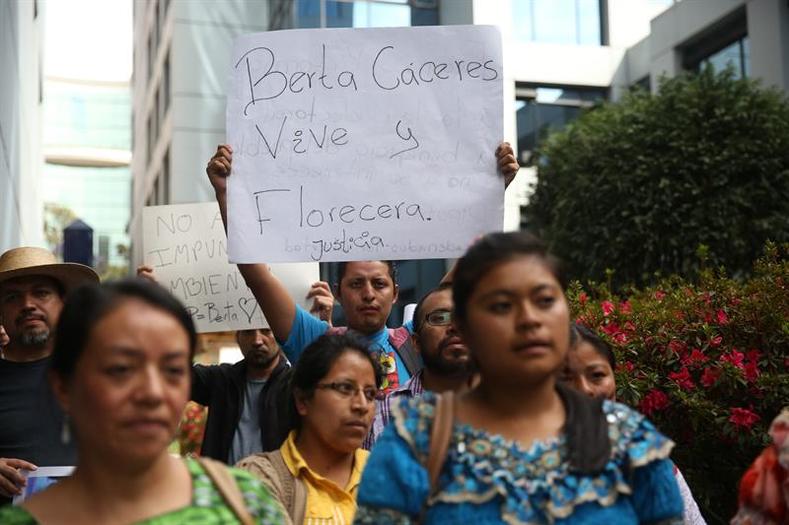
Demonstrators in Guatemala City carry a sign reading “Berta Caceres lives and will flourish” after news of her assassination and in solidarity with Honduran movements on March 3, 2016. Photo:EFE
OCHA condemns Israel for declaring W. Bank areas “firing zone”

Palestinian Information Center – March 5, 2016
OCCUPIED JERUSALEM – The UN Office for the Coordination of Humanitarian Affairs (OCHA) has strongly denounced Israel for declaring 18 percent of the West Bank territory, particularly in Area C, “a shooting zone.”
38 Palestinian communities are located in this area, where the Israeli army continually demolishes homes.
OCHA also warned that the expansion of this Israeli shooting zone would considerably affect the lives of marginalized and disadvantaged groups (Bedouins) in these areas.
The UN organization underlined that international law and humanitarian law prohibit such Israeli practices in the occupied Palestinian territories.
It noted that the Israeli army had demolished, since the start of 2016, 323 Palestinian homes and structures in different areas of the West Bank, most of them in Area C.
Those demolitions led to the displacement of about 440 Palestinians, more than half of them children, and rendered about 17,000 without any means of livelihood.
Copyright © The Palestinian Information Center
Featured Video

Saudi Led Destruction of Yemen’s heritage
or go to
Aletho News Archives – Video-Images
From the Archives
Israel: Strategic Ally or Liability?
By Stephen Sniegoski | My Catbird Seat | June 12, 2010
The claim that Israel serves as a valuable ally for the United States is made by both pro-Zionists and much of the anti-war and anti-Zionist Left that is influenced by Noam Chomsky. As a result of the Gaza flotilla massacre, which has caused a world-wide uproar against Israel, the value of Israel to the United States is being publicly questioned in more mainstream foreign policy forums. … continue
Blog Roll
 Aletho News
- West’s death cult in a theater near you
- How the Yandex ‘Russian bots’ lie fell apart
- Burnham’s ‘Russia did Brexit’ ruse crumbles
- Estonia making movies and games to encourage war against Russia
- Four in five new UK jobs taken by foreigners – report
- Here’s what Trump’s latest U-turn really means for Russia and Ukraine
- The Houthis Are Not an Iranian Proxy
- Europe’s Energy Hypocrisy, Russian LNG Profits and US Dependence
- ICC ignored ‘very well-documented’ NATO crimes – ex-Libyan minister
- SNSC secretary dismisses US response to Iran’s conditions as ‘inadequate’
- If Americans Knew
- Activists Abused By Israel Return to New Freedom Flotilla Mission
- 60 Minutes won’t tell the full truth about Israeli settler violence
- Nearly 50,000 women, girls killed or severely injured in Gaza since October 2023: UN Women
- ADL is working with AI companies to suppress alleged ‘antisemitism’
- Israeli occupation forces using social media surveillance unit to target hundreds of Palestinians in the West Bank
- Israel’s New – and Terrifying – Security Doctrine
- Israeli Attacks Kill Five in Gaza, Including a four-year-old and a woman
- Air Force Major Who Called for Trump’s Impeachment Held in Solitary Confinement
- It’s a Genocide, I’m Into It’: Seinfeld Mocks Protest over Palestinian Children Killed
- Universities fire dozens amid pressure from Zionist billionaires
- No Tricks Zone
- New Study Suggests Large Regions Of The Pacific Ocean Have Been Cooling For The Last 80 Years
- Germany’s Green Energy Debacle: High Energy Costs Force Kahla Porzellan to Close After 182 Years!
- New Study: 50 Years Of The Most Aggressive ‘Net Zero’ Policies Can Only Affect The Global Climate By 0.03°C
- US September “Heat” Was No Record…Many Records Set Decades Ago
- Latest European Green Energy Debacle; Portugal’s Largest Flagship Solar Park Insolvent!
- Green Energy Debacle: German Expert Professor Fritz Vahrenholt Warns Of Severe Economic And Social Consequences
- Two More Paleo Reconstructions Affirm Meters-Higher Sea Levels Across Ireland, Brazil 7000-6000 Years Ago
- New Study: Earth And Venus Surface Warmth Largely Explained By Convection And Lapse Rate, Not CO2 Or Radiation
- 2025 Nature Paper Claiming Worsening Global Drought Gets RETRACTED …Heavily Flawed
- New Study: ‘Global Drought Shows No Detectable Recent Acceleration Under Climate Warming’

