Continued harrassment of the Nasser family in Madama
International Solidarity Movement | January 27, 2013
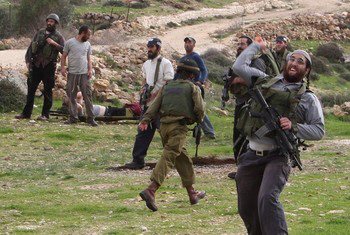
Madama, Occupied Palestine – A month after unprovoked settler and army attacks, the victim of severe violence Mamun Nasser remains in Israeli prison. The arrest of yet another member of the Nasser family shows Israeli army’s continued harassment in Madama.
On December 18th the notorious security guard charged with the protection of the illegal settlement of Yizhar, Jacob, attacked Mamun Nasser while he was tending to his flock of sheep in a hill outside the settlement. Mamun was handcuffed and beaten in front of his entire family, who desperately tried to intervene.
The Israeli army arrived on the scene, who responded by firing live ammunition on the Nasser family and others who tried to help, quickly ending their attempt to stop the vicious assault. One round passed through Mamun’s sisters clothing narrowly missing her while another one hit his brother, Amir, in the leg. His mother told us “They wanted to kill him [Amir]. I heard the officer giving that order. He was lucky that he was only shot in his leg.” Severely beaten, Mamun was then arrested and taken away by the Israeli military into custody. One month later he remains detained in Majdou Prison.
On January 23rd at 4 pm, the Israeli army followed up the harassment by raiding the Nasser family home in Madama, arresting Mamun’s brother Amir who was still recovering from the gunshot wound he received only a month prior. This is another episode in the continued harassment of villagers surrounding Yizhar which is described as the West Bank’s most violent settlement by the United Nations.
Video taken by settlers during the incident on December 18th
Related articles
- Palestinian facing charges after settler violence in Madama (palsolidarity.org)
- Madama attack – Harrowing account from the Nassar family (palsolidarity.org)
- Qusra settler attack, two hospitalised (alethonews.wordpress.com)
- Jewish settlers commit vehicular assaults with impunity at peaceful roadblock protests in the West Bank (alethonews.wordpress.com)
- This Week in Palestine, January 25th, 2013 (indybay.org)
Re-militarization gives rise to new tensions and violence in Guatemala
By Kelsey Alford-Jones | Upside Down World | January 25, 2013
On October 6, the Guatemalan army gunned down six indigenous protesters in Totonicapán and injured at least 30 more. Thousands had gathered to oppose unpopular government reforms, and while the police held their distance, the military advanced and shot into the crowd.
The event was a tragic manifestation of one of the public’s worst fears since President Pérez Molina took office in January 2012: that the Guatemalan armed forces would resort to deadly force in order to repress and silence dissent, an experience all too familiar in the nation´s collective historic memory.
Pérez Molina has made no secret of his intention to deploy the armed forces in ever-greater numbers and ever-expanding roles – the military now overwhelmingly dominates citizen security initiatives. Whether walking down Guatemala City’s central avenue, the “Sexta,” or driving on any major highway, Guatemalans are once again likely to encounter soldiers patrolling with semi-automatic rifles or checking papers at military roadblocks.
The government has opened at least five new military bases and outposts since the beginning of 2012, and has sent soldiers to fight drug cartels, to protect historic sites and nature reserves, and to back up the police during evictions and protests. Soldiers have also been deployed en masse to reduce crime in Guatemala City´s poorest neighborhoods.
Seeing soldiers on the streets may not be new in Guatemala, but under Pérez Molina, it has become symbolic of his administration’s approach to governance; and for the first time in over 15 years, current and former military personnel permeate the leadership of civilian institutions and dictate the administration’s approach to governance.
This swift re-militarization is deeply controversial, and the reasons behind it are much more complex than first meet the eye. In fact, some argue that the motivation for militarization has little to do with providing security for Guatemalan citizens – instead, it is about protecting the status quo, ensuring impunity for the armed forces and defending multinational economic investments. The US government has been eager to offer support to the Guatemalan military, despite the problematic implications.
The Military’s Past Atrocities
In1996, Otto Pérez Molina was a General in the Guatemalan military, and was one of their representatives at the peace negotiations that would put an end to the armed conflict. The Peace Accords, signed by Pérez Molina himself, emphasized the importance of strengthening civilian governance: the number of soldiers would be vastly reduced and a new, civilian, police force would be created. The Accords stipulated that the “National Civilian Police shall be under the direction of the civil authorities.” In contrast, the role of the armed forces was to “[defend] Guatemala’s sovereignty and territorial integrity; they shall have no other functions assigned to them, and their participation in other fields shall be limited to cooperative activities.”
The Accords placed limitations on the military not just to strengthen democracy, but also as a response to the atrocities the military had committed against its own people. In 1999, the UN-sponsored Commission for Historical Clarification (CEH) established that during the 36-year internal armed conflict, 200,000 people were killed, mostly civilians, including an estimated 45,000 who were forcibly disappeared. The Guatemalan state (through its military and paramilitary forces) was responsible for 93% of all human rights violations committed during the conflict, and had committed acts of genocide against the Mayan people.
The Military Creeps Back into Citizen Security Initiatives
Neither the Peace Accords nor the CEH report outlined steps to hold individual soldiers and high-level military officials accountable for the egregious war crimes committed, and many remain in positions of power to this very day. Internal reforms of military institutions were superficial at best, and government officials have been quick to re-engage the military with the justification that it is necessary to provide security to the Guatemalan public.
– In 2000, only four years after the signing of the Peace Accords, a bill was passed legalizing the military’s collaboration with the police to combat common and organized crime, as well as deforestation, kidnapping, and other crimes.
– In 2006 (under the direction of then Presidential Commissioner for Security Pérez Molina), President Berger mobilized reserve troops to maintain internal security, fight crime and distribute humanitarian aid.
– From 2007-2011 President Colom continued to expand the military’s role, reopening military bases and increasing the number of troops, while Congress created a minimum requirement for spending on the Defense Ministry’s budget.
When Pérez Molina assumed the presidency in January 2012, he became the first career military official to hold that office in 25 years. He immediately called on the army to collaborate in “neutralizing illegal armed groups by means of military power.” In September, Pérez Molina inaugurated the Maya Task Force in Zone 18 of Guatemala City, with 1,200 soldiers and 100 police. He initiated a similar operation in Zone 12 in November.
The Re-militarization of Guatemalan Institutions
The dramatic images of thousands of heavily armed soldiers in Guatemala City are shocking and troublesome, yet the re-militarization of Guatemala today isn’t simply about more soldiers on the streets. It also refers to something much less visible –an institutional culture disturbingly similar to the counter-insurgency model that dominated during the internal armed conflict.
Numerous governmental agencies are now run by former military, including the Interior Ministry and offices within the National Civilian Police and intelligence services. According to Guatemalan security analysts, upwards of 40% of security-related positions are held by former military, including many who were directly involved in the counter-insurgency campaigns; some have even been named in cases before Guatemalan courts for their role in crimes against humanity during the conflict.
Many of these policymakers, including Pérez Molina himself, hail from the generation of armed forces that was active during genocide campaigns such as Operation Sofia; a generation that participated in the extermination of entire villages, that used rape as a tool of war, and justified the use of torture and brutality in their campaigns against civilian, mostly indigenous, communities. This is the generation taught to believe that anyone who rejected existing structures of racism, economic dominance by a minority elite, and political exclusion, were “subversives”, “guerrillas,” “terrorists” and “internal enemies.”
The administration’s approach to policy-making, according to human rights groups, reflects this culture of discipline and obedience rather than democratic governance and dialogue. Any social conflict that disrupts the established order is addressed as the military has always dealt with perceived “threats” from its own citizens: intimidation, defamation, repression, and the use of force — sometimes with deadly consequences.
The tragic massacre in Totonicapán momentarily ripped through the curtain of government propaganda to expose the ever-present threat of violence. The international and diplomatic communities reacted strongly, and President Pérez Molina quickly assured the public that his administration would no longer deploy the military at protests and evictions. Only hours later, however, he had reversed his statement and later came out with a new protocol for the military’s collaboration with the police – a protocol that did not, in fact, reduce the military’s role at all.
The Military and the ‘War on Drugs’
The Guatemalan government has attempted to justify the military’s expanded presence due to the country’s high rates of violence linked to organized crime, gangs and common crime. The US has been quick to accept this argument.
“The military must provide security where the police have failed,” is an easy sell in the context of the US war on drugs andis an argument readily repeated by the US State Department. (Meanwhile, the much-needed reform of Guatemala’s police force languishes without the resources or political support to move forward).
The Department of Defense and US Drug Enforcement Agency (DEA) have provided ongoing support and training to the Guatemalan Armed Forces. This collaboration persists despite a decades-long Congressional ban on direct funding to the army due to the atrocities committed by the Guatemalan military against its own people, and the lack of reform within the institution.
Operation Martillo (Hammer) is the newest in a series of US-Guatemala joint operations, although it is also coordinated amongst other countries in Central America and Europe. The operation began in early 2012 and in July, President Pérez Molina signed off on an expansion of the operation. The new agreement permitted US marines and military contractors to be stationed in Guatemala for 120 days and collaborate directly on counter-narcotics missions. It granted US marines the right to be uniformed, to carry weapons, and to enjoy complete diplomatic “privileges, exemptions, and immunity.” Despite regulations requiring approval from the Guatemalan Congress, the document signed by the US and President Pérez Molina attempted to circumvent the process simply by stating: “It is understood that these activities […] do not constitute the passing of a foreign military through Guatemalan territory.”
The operation was not popular among many in civil society. “Drug trafficking in Guatemala shouldn’t be combated by the Guatemalan military, much less by the US military,” commented analyst Sandino Asturias in an interview with GHRC.
Helen Mack, executive director of the Myrna Mack Foundation and former Police Reform Commissioner, commented to the AP at the end of August: “Rural communities in Guatemala are fearful of the military being used to combat drug traffickers because the same techniques are applied that were used in (counterinsurgency) warfare. The historical memory is there and Guatemalans are fearful of that.”
There are other complications in using the military to combat organized crime. The military can’t carry out a criminal investigation, nor can it (legally) detain suspects of a crime. And while the US and Guatemalan armed forces collaborate on high-profile (often unsuccessful) attempts to capture narco-bosses, the Guatemalan Public Prosecutor’s Office has quietly had them arrested, many for extradition to the US. Furthermore, the Guatemalan military has documented ties to drug trafficking organizations and other criminal structures – the very groups they are sent to combat.
What does re-militarization achieve?
Soldiers train for battle, not to police the streets. Not surprisingly, increasing involvement of the military in police work has not only re-traumatized communities and survivors of the armed conflict, but it has also failed to reduce crime and violence in Guatemala. In fact, Sandino Asturias confirms that the homicide rate began to rise dramatically after the military reengaged in matters of internal security in 2000.
The military’s remarkable failure to address security concerns over the last 12 years doesn’t faze policy makers; in fact, the security of Guatemalan citizens doesn’t seem to be the primary concern at all.
Instead, increasing militarization has often functioned as a means to provide protection for the economic interests of transnational corporations.
The administration has constructed new military bases near existing or planned development projects such as mines, cement factories, and hydroelectric power plants. Military forces – in coordination with the police and private security guards – have consistently been mobilized to guarantee that “development” projects aren’t disrupted by local protests. This occurs despite the fact that, in the majority of cases, the government failed to consult local communities about the project and actively ignores threats, attacks, intimidation and other illegal acts committed by persons linked to the international corporations.
Public officials have instead branded those who organize against these unwanted development projects as “terrorists” and “guerrillas,” a strategy similar to the psychological warfare tactics utilized during the conflict. The government’s use of States of Siege in conflict zones has given the military free reign to terrorize indigenous families and detain “suspects.” Dozens of community leaders have been arrested on trumped up charges simply for their rejection of the administration’s development policies, giving rise to a new movement in solidarity with Guatemala’s first generation of political prisoners.
The international diplomatic community has been just as willing as the Pérez Molina administration to overlook commitments laid out in the 1996 Peace Accords – partially implemented at best – in favor of political and economic ties that promote investment, trade and “stability.”
Finally, for an entire generation of military officials and their civilian allies, the re-militarization of public institutions is not just about maintaining control, but about ensuring impunity.
As Guatemalan courts at long last – and against all odds – move forward with indictments against the military high command from the 1980s, accountability and incarceration for war crimes is suddenly a concrete possibility. The threat of judicial action has resulted in a policy of denial of the military’s involvement in war crimes and genocide, even as exhumations and court cases add to voluminous evidence against the military. An ongoing exhumation at a military base in Coban, Alta Verapaz has already unearthed over 500 bodies in mass graves, many bound, blindfolded, and showing evidence of torture.
In response, Pérez Molina has methodically dismantled public institutions that worked to promote human rights, historical clarification and justice, seeking to . During first half of 2012, the administration gutted the Peace Archives Directorate (DAP). The office had opened in 2008 to compile and analyze military (and other) archives in order to establish human rights violations committed during the internal armed conflict. Archive staff published numerous reports on the conflict and acted as expert witnesses in key human rights cases. The closure of the DAP took place as the government was further weakening the Presidential Human Rights Office (COPREDEH) and consolidating it under the Secretary of Peace, Antonio Arenales Forno, a genocide-denier and long-time ally of the military.
The administration has made repeated attempts to limit or dismiss its regional and international human rights obligations that would jeopardize members of the military. At the beginning of 2013, Pérez Molina issued a presidential decree that refused to recognize the jurisdiction of the Inter-American Court on Human Rights in cases prior to 1987, even when they are “continuing crimes” such as forced disappearance and other crimes against humanity. Public outcry by national and international human rights organizations forced Perez Molina to annul the decree. Meanwhile, the Defense Ministry further limited access to information that relates to human rights violations from the early 1980s, which, according to Guatemalan groups, should be part of the public domain.
Emboldened by the administration’s fierce pro-military stance, retired members of the military and other ultraconservative and fanatically nationalistic groups have launched their own campaigns in the press and social media, sending direct,and very public, threats to those who seek justice and defend human rights.
As Guatemala spirals back into a reality frighteningly reminiscent of the 1980s, those who have become the intentional or collateral victims of re-militarization find themselves with little support from state institutions. Nevertheless, indigenous communities, activists and other civil society organizations –despite fear of repression or retaliation –continue to denounce re-militarization in all its forms. They recognize that the way forward for Guatemala is not to be found by returning to the nefarious practices of the past.
Kelsey Alford-Jones is the Director of the Guatemala Human Rights Commission/USA, a non-profit, grassroots, solidarity organization dedicated to promoting human rights in Guatemala and supporting communities and activists who face threats and violence. GHRC documents and denounces abuses, educates the international community, and advocates for policies that foster peace and justice.
Related article
- Does Guatemala Include “Extrajudicial Executions” in its Calculation of National Murder Rates? (alethonews.wordpress.com)
Witness: Israeli soldier killed woman ‘in cold blood’
Ma’an – 25/01/2013

Suad Jaara was shot in the hand by an Israeli soldier who killed her
friend Lubna al-Hanash near Hebron on Jan. 23. (MaanImages)
HEBRON – “I saw an Israeli soldier on the main road firing gunshots haphazardly, so I put my left hand on Lubna’s back, and grabbed her to try and run backward. A gunshot hit my hand, and I shouted as I ran.
“I thought Lubna was running behind me until I reached the security guards of Al-Arrub College who took me to a clinic in the camp before an ambulance arrived and took me to hospital.”
This, says Suad Jaara, 28, is what she witnessed Wednesday afternoon when Israeli officers near al-Arrub refugee camp shot her and her friend Lubna al-Hanash. Lubna, 22, died hours later.
Speaking to Ma’an, Jaara said Thursday that she and Lubna were walking on the campus of Al-Arrub College about 100 meters from the main road when they came under fire.
“An Israeli soldier was shooting from his rifle while a white car was parked on the roadside. There was nobody in the area except Lubna and I. He was a criminal … yes, a criminal who opened fired at us in cold blood killing Lubna and injuring me.”
Jaara’s testimony contradicts claims by the Israeli army’s chief of central command on Channel 10 Wednesday evening that the woman was trying to hurl a Molotov cocktail at an Israeli vehicle.
An army spokeswoman also told Ma’an on Wednesday that “soldiers were attacked by Palestinians who hurled multiple firebombs at them while they were traveling near al-Arrub. Soldiers returned fire and the circumstances of the incident are currently being reviewed.”
But Jaara says she and her late friend were the only ones in the area, walking around and enjoying the scenery.
“Lubna arrived two days ago to visit her sister, who is married to my brother. She had heard about Al-Arrub College and she wanted to visit it. I accompanied her to campus and she admired the area because it’s in a charming natural landscape. When we decided to leave campus, a criminal fired at us and Lubna died a martyr.”
Jaara is an employee at the Ministry of Prisoners Affairs. Her brother Jihad was a gunman in Fatah’s al-Aqsa Brigades in the Bethlehem area. He was deported to Ireland after the Nativity Church siege in 2002.
The broken truce
International Solidarity Movement | January 21, 2013
Beit Lahiya, Gaza Strip, Occupied Palestine – A ceasefire was announced on 21st November, ending eight days of horrific bloodshed in Gaza. Has the delicate truce held over the past two months? It depends who you ask. Israelis or Gazans, each going about their daily lives on opposite sides of a border fence.
There has not been a single report of a rocket fired out of Gaza since 21st November. In contrast, four Palestinians have lost their lives and over 80 have been injured by Israeli forces since then. Yet these violations have received little or no coverage in the mainstream media. Palestinian civilians, whose only crime is to live in the border areas, are terrorized on a daily basis by the Israeli army. This is what everyday life under the ceasefire has meant for them.
Beit Lahiya, in the far north of the Gaza Strip is one such place. A week ago it saw the brutal murder of 20 year-old Mustafa Abu Jarad. Today, it was the site of another Israeli violation. Abdullah Marouf, 18, was in the west of Beit Lahiya, near the coast, when he was shot in the right leg by Israeli forces, fracturing both his tibia and fibula.
 Abdullah Marouf in hospital. (Photo by Desde Palestina)

At about 9.00 on the morning of 21st January, Abdullah was in an area approximately 250 metres from the border fence, catching birds with his two brothers. A group of five or six Palestinians they were unaquainted with were also in the vicinity, closer to the fence than they were. Abdullah had been under the impression that he would be safe, however he noticed an Israeli soldier in a watchtower on the border and others on the ground. The soldiers began firing live ammunition towards them and Abdullah was shot.
Two local farmers brought him to Kamal Adwan hospital where surgeons performed percutaneous pinning of his lower leg which had sustained damage from an entry wound and a significantly larger exit wound. He requires subsequent surgery in a couple of months to fit internal wires. His recovery is estimated to take at least 12 months.
Abdullah, who is engaged to be married, had been working with his two brothers selling scrap metal. Now they will have to support a family of nine without his help. It is unsurprising that he expressed a lack of faith in the ceasefire agreement.
One can only expect that the Palestinian resistance has also lost faith and is fast losing patience. If a response is provoked it will appear to be in a vacuum – despite this being far from the case – due to the shameful silence maintained by the international community throughout the ongoing Israeli atrocities. It is for people of conscience to protest this injustice and prevent a further escalation of Israel’s attacks on Gaza.
Google Releases Transparency Report Showing US Surveillance Requests Up 33% in the Last Year
Two Out of Every Three US Demands to Google Come Without A Warrant
By Trevor Timm | Electronic Frontier Foundation | January 23, 2013
This morning, Google released their semi-annual transparency report, and once again, it revealed a troubling trend: Internet surveillance around the world continues to rise, with the United States leading the way in demands for user data.
Google received over 21,000 requests for data on over 33,000 users in the last six months from governments around the world, a 70% increase since Google started releasing numbers in 2010. The United States accounted for almost 40% the total requests (8,438) and the number of users (14,791). The total numbers in the US for 2012 amounted to a 33% increase from 2011. And while Google only complied with two-thirds of the total requests globally, they complied with 88% of the requests in the United States.
Admirably, Google expanded their transparency report this time around, providing more detailed information about what kind of requests they get from the US government—specifically the type of requests they get under the main email privacy law in the US, the Electronic Communications Privacy Act (ECPA).
EFF has long criticized ECPA for not providing email with the same warrant protection as the Fourth Amendment gives to physical letters and phone calls. The Justice Department believes that it doesn’t need a warrant for emails over 180 days. Google’s lawyers, to their credit, have criticized the law as well, saying just this week, “our view is that [ECPA] is out of compliance with the Fourth Amendment because the government can call for the production of your data without a search warrant.”
Related article
Israeli Authorities Change Route Of Wall To Fully Annex Jerusalem For Israel
By Saed Bannoura | IMEMC & Agencies | January 21, 2013
The Israeli Defense Ministry announced on Sunday that they will re-route a section of the Wall east of Jerusalem in order to close off an existing gap and fully annex the city of Jerusalem into Israel. The new route means the complete encirclement of the Palestinian village of Al-Zaim, with the Wall to the West and a security fence to the east.
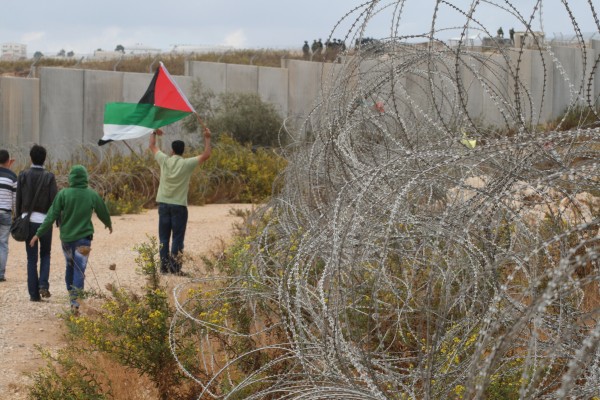 Other Palestinian towns are also completely isolated and encircled into ghettoes, including the town of Sheikh Sa’ed and the city of Qalqilya. Israeli authorities isolated these towns in order to create Palestinian-free zones and routes throughout the West Bank to allow Israeli settlers to travel unencumbered without either having to stop at checkpoints or to drive on the same roads as Palestinians. But in order to do that, Israeli forces have had to maintain over 600 checkpoints throughout the West Bank, and to force Palestinians off their own roads and onto dirt roads or trails.
The new route of the Wall will put the settlement of Ma’ale Adumim on the Palestinian side of the Wall, along with dozens of other Israeli settlements constructed in violation of international law all over the West Bank. But Israeli officials have assured the residents of these settlements that they will construct other Walls and fences to allow them to access Jerusalem without having to go through Palestinian areas.
These additional fences and barriers will, like the Annexation Wall itself, be constructed on land seized from Palestinian owners by Israeli authorities who claim that they have the right to take the land ‘for security reasons’. All Israeli settlements on Palestinian land are considered illegal under international law and the Fourth Geneva Convention, which forbids an occupying military power from settling its civilian population on land occupied by military force.
The announcement is seen as a response to the Palestinian encampment Bab Al Shams, which was established on the land in question, known to Israeli officials as ‘E1’, last weekend, then demolished by Israeli forces. The Palestinian non-violent activists who established the encampment entered the area through the village of Al-Zaim.
Israeli Prime Minister Binyamin Netanyahu has openly declared his intention to build a settlement on the ‘E1’ land, and completely enclose the eastern edge of Jerusalem, thus effectively annexing the city of Jerusalem to the state of Israel. This renders any peace agreement with the Palestinian Authority impossible, since one of the Palestinian Authority’s base demands is sharing the city of Jerusalem. The base demands, which Palestinians have asked Israel to recognize time and again to no avail, are: the recognition of a Palestinian state with east Jerusalem as its capital, the right of return of Palestinian refugees and the release of the thousands of Palestinian political prisoners being held in Israeli prison camps.
Related articles
- The long road to Bab al-Karama (alethonews.wordpress.com)
- Israeli politician: Palestinian ghettos were always the plan (sott.net)
The long road to Bab al-Karama
International Solidarity Movement | January 20, 2013
Bab al-Karama, Occupied Palestine – The road to Bab al-Karama, the new tent neighborhood created by Palestinians on land that will be separated from the village of Beit Iksa by the Apartheid wall, exposes a landscape of Apartheid.
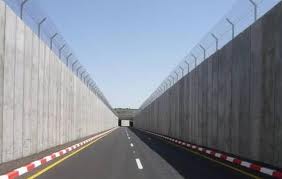 To reach Bab al-Karama from Occupied Ramallah one needs to take the “Palestinian only” road that runs under the “Israeli only” 443 Highway between Ramallah and Beir Naballah.
Beir Naballah used to be a suburb of Jerusalem. Affluent Jerusalemites built their homes in Beir Naballah to escape from the housing crisis imposed on Palestinians by Jerusalem’s municipality housing polices. It sits on a road that connected the villages in the area with Jerusalem and continued on to Latrun. Now Beir Naballah is completely surrounded by an Israeli wall. The old road was widened and transformed into an Israeli highway called 443. The highway now connects Jerusalem to Tel Aviv and the Palestinian residents of the area are barred form using it. The Jerusalemite residents were forced to abandon their homes and many businesses dependent on clientele from Jerusalem have closed.
We exit Beir Naballah through a second tunnel that connects the Beir Naballah enclave to another enclave where 8 Palestinian villages are also isolated by Israeli walls. This tunnel is even more surreal than the first. Not only does it run under two Israeli only roads but as well as under the Apartheid wall and through the Givaat Zeev settlement bloc. High cement walls with razor wire on top of them hug the sides of the road.
We drive in Biddu and drive through the villages that had been since their creation connected to Al Quds but are now cut off from it and artificially connected to Ramallah. True to the Orwellian tradition of Israel’s military language they call the Palestinian network of roads they have built under their highways “fabric of life roads”. The landscape is beautiful and almost idyllic. Goats grazing on green hills, old stone houses…, but this ideal setting is surrounded by walls, gates and settlements.
The last village we reach, the one closest to Jerusalem is Beit Iksa. But to enter it we need to pass a military checkpoint. At the edge of the village we finally reach Bab al-Karama overlooking a network of Israeli highways and the city of Jerusalem. In the valley right below Bab al-Karama one can see two tunnels that will be connected by a bridge on which a fast track train connecting Jerusalem to Tel Aviv will run. The train will run on the village’s land but not only will the villagers be barred from accessing it, Israel’s Apartheid wall will be built between the village and the train separating the villagers from over 4500 dunams (60%) of their agricultural land. More than 1300 dunams had already been taken in the 70s for the construction of Ramot Allon settlement.
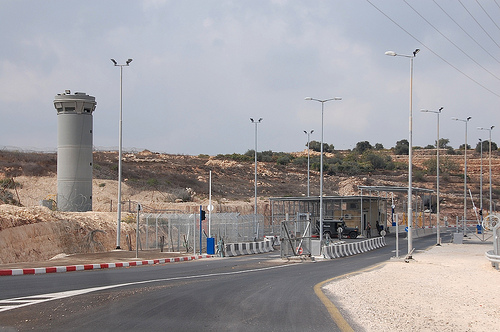
Checkpoint at the entrance of Beit Iksa
Related articles
- ‘Gate of Dignity’ built on lands of Beit Iksa north of Jerusalem (alethonews.wordpress.com)
- Army Invades Bab Al-Karama (imemc.org)
- Palestinians Establish a new Village, Bab Alshams, in Area E1 (alethonews.wordpress.com)
Former mayor put in administrative detention
Ma’an – 20/01/2013
 NABLUS – A former Palestinian mayor detained by Israeli forces this week will be held in administrative detention for six months, a prisoners group said Sunday.
Sheikh Jamal Tawil, who had held the mayoral post in al-Bireh, a neighborhood of Ramallah in the central West Bank, was detained on Tuesday.
The Solidarity Foundation for Human Rights said Ofer military court gave the former mayor six months in detention without charge.
Tawil was arrested by Israeli forces during the first intifada and held for several months under administrative detention at the time.
As of December, 178 Palestinians were being held without charge in Israeli jails, including seven elected members of the Palestinian parliament, according to prisoners rights group Addameer.
Related articles
- Prisoner Omar Barghouti: A Story of a Life Behind Bars (occupiedpalestine.wordpress.com)
- Detainees In Eshil Go On Hunger Strike (altahrir.wordpress.com)
How the Media First Reported Abdulrahman Al-awlaki’s Assassination
By David Kretzmann | July 22nd, 2012
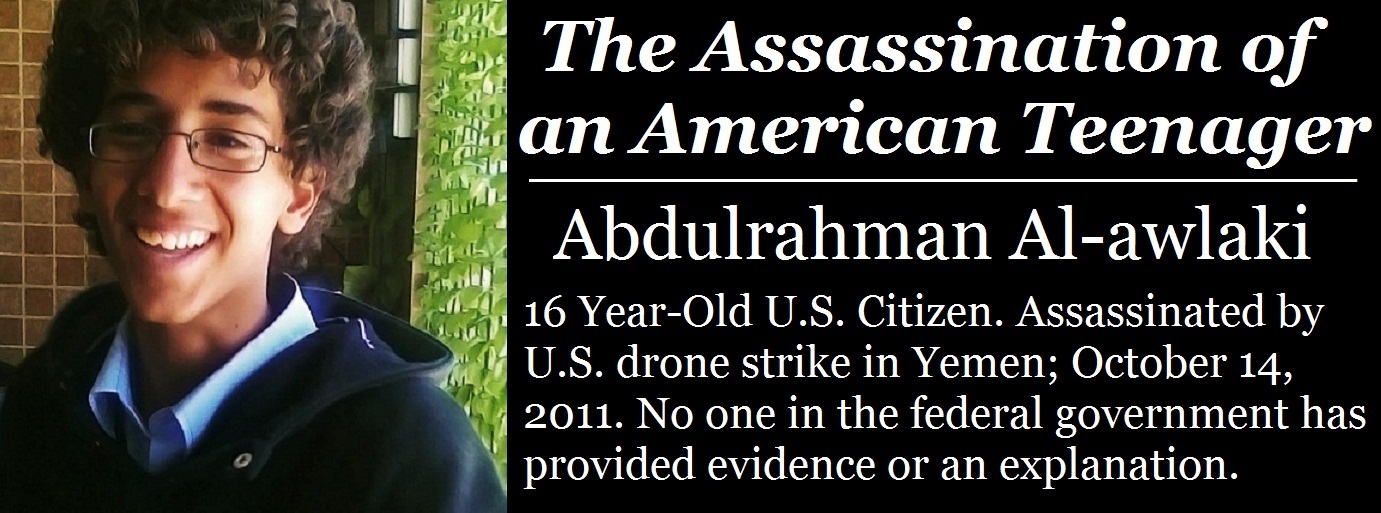
How was Abdulrahman’s targeted assassination initially reported in the media? Some quotes that sound very familiar with the usual semantics of all media coverage on drones and suspects:
“Yemeni officials told reporters that nine members of Al Qaeda in the Arabian Peninsula were killed in the strike near the town of Azzan in southeastern Yemen, including Awlaki’s 21-year-old son…” – LA Times, October 15, 2011
“Report: Al-Awlaki’s son among dead in U.S. airstrike on Yemen al-Qaida militants” – headline from Haaretz, October 15, 2011
“Official: Drone attack kills Al-Awlaki’s son in Yemen… The attacks, carried out in the Shabwa district, killed seven suspected militants, the defense ministry said.” – CNN, October 15, 2011
“Awlaki’s son is also among the 24 militants killed in air strikes targeting al-Qaeda in Yemen, local officials said.” – Al Arabiya News, October 15, 2011
“Three drone attacks in Yemen Friday night killed seven suspected militants including Anwar Al-Awlaki’s son, a security official said. Carried out in the Shabwa district, where the younger Awlaki had been holed up for more than eight months” – Business Insider, October 15, 2011
“U.S. drone strike in Yemen kills nine jihadis, including Awlaki’s son” – Hot Air, October 15, 2011
Lie #1: Abdulrahman is a 16 year old American teenager, not a 21 year old militant.
Lie #2: U.S. claimed al-Banna was the actual target. The problem with that excuse is that al-Banna is alive and well, and was never at that site. Since that revelation, the Obama Admin. simply states there is no official record of the death of Abdulrahman, and sweeps the story under the carpet so it doesn’t even have to take accountability that the crime even happened.
Lie #3: The media says Abdulrahman was hiding in the mountains for months. Actually, he left his home a couple weeks before to find out about his father, and even during that time he was living and moving around in the open, far from hiding.
It seems that being a suspected militant is enough to make you a viable target. And the criteria for determining what makes you a suspect is easily adjustable to their convenience it seems.
Barack Obama: the first U.S. president to use targeted assassination against a child.
Taken from: Abdulrahman Anwar Alawlaki – A crime we’ll never forget
Israeli soldiers violently break into two houses in Nablus, Kidnapping one person
International Solidarity Movement | January 15, 2013
Occupied Palestine – Last night more than forty Israeli soldiers invaded the city of Nablus and raided two homes looking for two young men. One of them was arrested Emad’s Motherduring the raid and the other one avoided arrest as he was working at the time of the raid.
At 2.30 am, dozens of Israeli soldiers with several dogs broke into Mead Nijad’s house breaking the door with a hammer and violently interrupting the family’s sleep. As the soldiers entered the house, they ordered everyone to have their hands up; they asked for Emad, blindfolded, handcuffed and arrested him. Immediately after, they took the ID’s of all family members and locked them outside the house on a cold winters night. In the meantime, the soldiers ransacked the whole house causing widespread destruction. They also took with them the young boy’s working tools. As Emad’s mother explains, “if they come with dogs, why do they have to destroy everything? If there is something in the house, the dogs would find it”. Furthermore, no reasons for why they arrested Emad were given; the commander just said “your son has caused problems to the Israelis, if you want to know where your son is, come to Huwwara”. The family still does not know the fate of their son.
In the case of Moaz Darduk (19), dozens of only Hebrew speaking soldiers arrived in his house at 3 am while he was at work and woke his parents up. As they asked for him and his father told the soldiers he was not at home but working, they locked his mother in a room and took his father to his other son’s house just in the next building. The commander, who was the only one speaking Arabic, kept saying to his father “do you know who I am? I am Haroun and I came here to kill your son”. When the commander went back to Moaz’s house he told to his parents “I want you to remember who I am, I am Haroun and I am here to kill your son. If you do not bring your son to Huwwara tomorrow morning at 9.30, we will kill him and return him to you in a coffin”.
Night raids and home searching are common tools used by the Israeli Occupation Forces to arrest Palestinian youth for no reason and as a collective punishment to scare Palestinian families.
Related articles
- Israeli forces arrest cancer patient in Nablus, locals say (altahrir.wordpress.com)
- Soldiers Kidnap Nine Palestinians In The West Bank (imemc.org)
Honduras: Two More Campesinos Murdered in Aguán
Weekly News Update on the Americas | January 13, 2013
Two campesinos were shot dead on Jan. 11 in the Lower Aguán Valley in the northern Honduran department of Colón as they were walking out of an estate which they and other campesinos had been occupying for two months. A long-standing conflict between campesino groups and large landowners in the area has resulted in the deaths of some 80 campesinos since the groups began occupying estates in December 2009 to dramatize their demands for land [see Update #1154]. According to Wilfredo Paz Zúniga, spokesperson for the Permanent Human Rights Monitoring Center for the Aguán, the victims were José Luis Reyes and Antonio Manuel Pérez. He said unidentified people shot them at close range from a moving automobile.
The Unified Campesino Movement of the Aguán (MUCA), one of the main campesino groups in the region, identified the campesinos as Luis Antonio Ramos Reyes, originally from the Tepusteca de Olanchito Yoro community, and Manuel Antonio Pérez, originally from Remolino on the Aguán river’s left bank. MUCA said the two men were members of another group, the Campesino Movement for the Recovery of the Aguán (MOCRA), whose 600 families began occupying estates on July 20, 2012. According to Paz, the campesinos had been occupying land claimed by the National Autonomous University of Honduras (UNAH); MUCA said the land was owned by UNAH’s Atlantic Coast Regional University Center (CURLA), which had abandoned it. (AFP 1/12/13 via Terra.com; Anncol (Colombia) 1/13/13 via Rebelión (Spain))
Related article
- Honduras: Another Campesino Murdered in Aguán (alethonews.wordpress.com)
Featured Video

Liberty Cannot Exist Inside a Panopticon
or go to
Aletho News Archives – Video-Images
From the Archives
Left-leaning despisers of 9/11 Truth movement: Do you really believe in miracles?
David Ray Griffin | Global Research | 06 Jul 2010
An Open Letter to Terry Allen, Noam Chomsky, Alexander Cockburn, David Corn, Chris Hayes, George Monbiot, Matthew Rothschild, and Matt Taibbi.
[1]According to several left-leaning critics of the 9/11 Truth Movement, some of its central claims, especially about the destruction of the World Trade Center, show its members to be scientifically challenged. In the opinion of some of these critics, moreover, claims made by members of this movement are sometimes unscientific in the strongest possible sense, implying an acceptance of magic and miracles. … Full article
Blog Roll
 Aletho News
- EU sending ‘biased’ observers to interfere in Serbian election – president
- White House envoy declares kinetic action against Yemen ‘fruitless’
- Ukraine deployed thousands of microdrones in Iraqi Kurdistan: Tasnim
- Iran calls for emergency UNSC meeting over Trump’s ‘brazen’ bomb talk, Israeli threats
- Iranian sources reveal details of Russia-China Hormuz proposal
- Plan for more US-Israel integration puts our military tech at risk
- Another Round Against Iran Will Break What Is Left of the Gulf
- SVR Report on Ukraine’s Mexican Drug Gang Links Could Pressure Zelensky, Won’t Change US Policy
- British Government Employees Were Fact-Checking the News at the BBC. Nobody Told You.
- Albania on fire: who’s behind the riots?
- If Americans Knew
- Mysterious bot accounts reportedly spread fake ‘man on the street’ videos for Michigan Senate candidate
- Israeli Defense Minister Katz Says Over 60 Lebanon Villages Have Been Destroyed
- Why Is Israel Running TV Ads in Iowa Ahead of the Midterms?
- Hind Rajab’s Alleged Killer Is in the United States. HRF Demands His Arrest.
- US Officials Face Fresh Pressure After Another American ‘Brutalized’ by Israeli Settlers in West Bank
- Israel-Backed Palestinian Militias Terrorize Displaced Families in Gaza
- FBI subpoenas pro-Palestine activists over Israeli weapons plant disruption
- Fourth winter arrives in wartorn Gaza, too early – Daily Update
- More on how Bari Weiss is using CBS on behalf of Israel
- What the UK Is Doing to Pro-Palestine Novelist Sally Rooney Is an Act of Orwellian Villainy
- No Tricks Zone
- Predictions Made By Renowned Climate Proifessor Over Past Decades Have Been Proven To Be Poor
- New Study Suggests Large Regions Of The Pacific Ocean Have Been Cooling For The Last 80 Years
- Germany’s Green Energy Debacle: High Energy Costs Force Kahla Porzellan to Close After 182 Years!
- New Study: 50 Years Of The Most Aggressive ‘Net Zero’ Policies Can Only Affect The Global Climate By 0.03°C
- US September “Heat” Was No Record…Many Records Set Decades Ago
- Latest European Green Energy Debacle; Portugal’s Largest Flagship Solar Park Insolvent!
- Green Energy Debacle: German Expert Professor Fritz Vahrenholt Warns Of Severe Economic And Social Consequences
- Two More Paleo Reconstructions Affirm Meters-Higher Sea Levels Across Ireland, Brazil 7000-6000 Years Ago
- New Study: Earth And Venus Surface Warmth Largely Explained By Convection And Lapse Rate, Not CO2 Or Radiation
- 2025 Nature Paper Claiming Worsening Global Drought Gets RETRACTED …Heavily Flawed

