India takes part in first ever military drill with Israel
MEMO | November 14, 2017
Indian troops took part in the first ever joint military exercise with their Israeli counterparts yesterday.
Elite Indian pilots and rescue soldiers from the Garud Unit, which is said to be the equivalent of Israel’s 669 Unit, took part in the biannual Blue Flag drill at the Palmachim air base in central Israel. Over 70 aircraft from seven countries took part, including India for the first time in its history.
The military drill, which included over 1,000 personnel, was billed as having a “profound strategic meaning” said Col Itamar, commander of the Ovda base in Israel. Holding the exercise in Israel, according to Ovada was a major diplomatic achievement.
India’s decision to take part in the drill is another sign of New Delhi’s blossoming ties with Israel under Prime Minister Narendra Modi. Earlier in the year Modi visited Israel, making a historic break from its support for the Palestinians. Previous Indian Prime Ministers, including the country’s founder and revered leader Mahatma Gandhi, had opposed the Zionist state, believing it to be a colonial enterprise. The leader of the Indian independence movement against the British was strongly opposed to the idea of a Jewish national home in Palestine.
Gandhi’s opposition to the idea of an ethno-religious nation state was widely known. His towering presence directed India’s tradition of supporting Palestinian self-determination, which continued late into the 20th century where New Delhi could be seen voting against Israel frequently at the UN.
Under Modi, however, India has taken a different course. The right wing Hindu nationalist, alleged to have been the mastermind behind the massacre of Muslims in Gujarat while serving as the chief minister of the state, has cemented a deep alliance between Tel Aviv and New Delhi. His bond with Netanyahu is described by critics as a political marriage between two men who harbour virulent nationalism tinged with racism and bigotry.
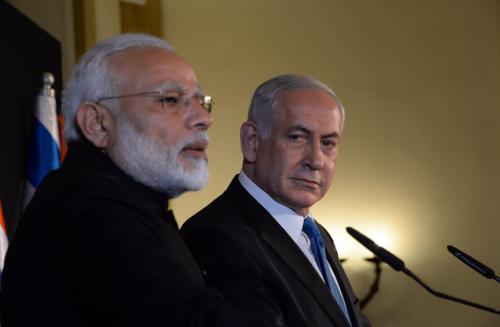
Benjamin Netanyahu and Narendra Modi hold a joint press conference following their meeting in Jerusalem on 5 July 2017 [Haim Zach/GPO / Handout /Anadolu Agency]
Israel’s ability to forge such relationships also highlights its status as being the global leader in the military industry. Israel’s culture of deep militarism and years of experience supressing the political rights of the Palestinians has enabled it to export its technology of control and domination to others. Its unique experiences have also made the country an invaluable asset to governments around the world that too are confronted with new security challenges.
Despite its status as a relatively small arms dealer compared to the likes of the USA and Russia, Israel’s security exports are unmatched in terms of quality. Israel has managed to carve out a niche in the security industry, selling its experience and expertise in policing, urban warfare, surveillance, intelligence. Analysts describe this as “full spectrum domination”.
Israel’s unique role in security – what some would call suppression – can be seen from the Contras in Latin America, to the riots in Ferguson, North America; from the massacres in Bosnia and Rwanda to the killings of Rohinga Muslims in Burma. There are numerous instances in which Israel and Israeli security companies have led the way in the pacification of the people through the export of arms, surveillance technology, intelligence and security advice.
Trust is crucial to India-Russia defence ties
By M K Bhadrakumar | Indian Punchline | November 9, 2017
The influential Russian daily Kommersant reported today on an intriguing development with ominous overtones for long-term India-Russia defence cooperation. It seems that Indian authorities gave access to a US Navy delegation of “well-trained technical specialists” to enter the top secret Russian nuclear submarine under the rubric “Project 9711″, which is on lease to Indian Navy within the framework of the so-called “special and privileged strategic partnership” between the two countries.
Apparently, the incident took place when the submarine was docked at the naval base at Vishakhapatanam while undergoing repairs. (The Indian Navy has christened the super secret Russian nuclear submarine as ‘Chakra’.) The Russian daily reported that this has been the second such serious breach of confidentiality that traditionally existed between Russia and India in defence cooperation with regard to the sharing of military technology with third parties.
In an earlier incident, a US Navy team was apparently allowed to visit the Russian-built aircraft carrier with the Indian Navy, Vikramaditya. Upon knowing about the security breach, the Russian side lodged a protest with the Indians. Obviously, that had no effect, as the latest incident involving the nuclear submarine suggests.
Unnamed Russian officials have described the Indian behavior as “outrageous.” According to Kommersant, the incident threatens to “seriously complicate negotiations both on the lease of the second nuclear submarine, and on other projects” in the field of military-technical cooperation between the two countries.
Given the high likelihood – nay, virtual certainty – that the Kommersant report is based on official Russian briefing, this must be taken as a warning from Moscow. Without going into details, Kommersant quoted Russian officials as pointing out that the incident involving the nuclear submarine is of a piece with several recent “unfriendly acts towards Russia” by the concerned Indian authorities.
It is unclear whether the paper was insinuating that such Indian behavior may be taking place without the knowledge of the political leadership in Delhi. If so, the Russian media leak could be intended to draw the attention of the Defence Ministry and the PMO. Of course, the officer corps of the Indian armed forces would have a fair share of lobbyists for American arms manufacturers. It is well-known that retired military officials have been retreading themselves at times as dalals of foreign vendors of weaponry eyeing the Indian market.
The Russian daily underscored that this whole string of incidents could have a very adverse impact on defense cooperation between the two countries, which has been successfully developing over the past five years. Interestingly, it disclosed that “specialized Russian structures are preparing retaliatory measures against their Indian partners. “Very difficult conversations are on the horizon, we have a lot of questions,” a source said. Some who spoke to Kommersant believe that, in particular, the negotiations on leasing the second nuclear submarine, which the Indian Navy planned to obtain from Russia, will be seriously complicated.”
The big question is whether the two governments are at the parting of ways as regards the sharing of cutting edge Russian military technology. At the level of the Indian political leadership, this is most certainly not the thinking. Prime Minister Modi himself is known to be a staunch believer in the raison d’etre of India-Russia strategic ties. It will be interesting to see how far India’s “natural partner” Donald Trump steps in to follow up on the US Navy team’s visit to INS Chakra. Will the Pentagon agree to lease to the Indian Navy a nuclear submarine?
There is already a cloud hanging low over the much-touted futuristic Russian-Indian collaboration to create a fifth-generation fighter aircraft. A concerted campaign has been appearing in India from time to time deliberately running down the project. (here and here.) Even foreign publications began floating the rumor that India wants to get out of the Russian deal. (National Interest, Diplomat ). The preference of lobbyists in Delhi seems to be for the American prototypes. But then, for backing out of the ‘Make in India’ venture, they must find some credible argument. Even with the best Indian ingenuity, this has not been possible so far. Funnily enough, TASS felt obliged to carry a report a few days ago (here) simply to set the record straight.
To be sure, Russian Deputy Prime Minister Dmitry Rogozin’s expected visit to Delhi next month is invested with much importance. India-Russia defence cooperation has been traditionally based on great mutual trust and confidence. Therefore, the recent trends are disturbing. The Indian think-tankers and media analysts keep whining and complaining about Russian weapons going to China and Pakistan. On the other hand, some of them also happen to be lobbyists for the US interests. Testing times are ahead, for sure, as the US-Russian rivalry may also surface on the Indian strategic landscape. (See may earlier blog US strikes at India-Russia defence ties.)
Red star over Nepal
By M K Bhadrakumar | Indian Punchline | October 8, 2017
The Communist Party of Nepal-UML led by KP Oli, Communist Party of Nepal (Maoist Centre) led by Prachanda and the breakaway Naya Shakti Nepal led by Baburam Bhattarai have announced on October 3 the formation of a grand leftist alliance for the forthcoming provincial and federal elections in Nepal on November 26 and December 7 under the new constitution. The polarization of Nepal’s fragmented political spectrum on ideological lines makes the forthcoming elections a watershed event.
In reaction to the unexpected development, the Nepali Congress is reportedly planning to assemble a motley coalition of right-wing forces with some smaller parties to counter the grand leftist alliance. Interestingly, the constituents of the right-wing alliance may include the Rastriya Janata Party Nepal, which was formed in April with the merger of six “pro-India” Madhesi parties on the advice of their mentors in India. Even more interesting is the prospect of the Hindu right-wing, cultural conservative and royalist Rastriya Prajatantra Party Democratic – a veritable clone of India’s Bharatiya Janata Party – joining the Nepali Congress-led alliance.
It doesn’t require much ingenuity to figure out that the leitmotif of the polarization into two grand alliances lies in their respective disposition toward India. The announcement of the formation of the leftist alliance on October 3 seems to have taken not only the Nepali Congress but Delhi also by surprise. The Nepali Congress is scrambling to come up with a credible contestation – conceivably, with some encouragement from Delhi.
The polarization in Nepali politics is a good thing to happen since it presents a clear-cut choice to the electorate. The blurring of the ideological divide through the period of democratization in Nepal had been a major factor breeding the politics of expediency resulting in instability in the past. The big question is whether political stability as such guarantees good governance and can deliver on growth and development. India’s current experience speaks otherwise.
To be sure, the Leftist alliance is ideologically motivated and can be trusted to be far more cohesive and capable of offering a stable government. It will be campaigning on the plank of social justice, egalitarianism and Nepali nationalism. The alliance hopes to secure a two-thirds majority in the new Parliament which will strengthen their hands to steer future amendments to the Constitution smoothly, unlike in the past. During the general election, 165 members of the National Parliament will be elected by simple vote, while another 110 will be appointed through a system of proportional representation.
Based on the performance of the two main communist parties in the elections for the constituent assembly in 2013 and this year’s local polls, the leftist alliance has a distinct chance of winning a majority in the forthcoming elections. (The communists also have a strong party machinery all over the country.) If so, Nepal will be coming under communist rule – an unprecedented political feat not only for Nepal’s fledgling democracy but for the South Asian region as a whole. Importantly, based on the leftist alliance’s performance in the November elections, they intend to form a united Nepal Communist Party. It will be a big rebuff to the Indian establishment, which succeeded so far in splintering the Left in Nepal by fuelling internecine feuds and personality clashes.
These are early days but a communist government in Nepal will profoundly impact the geopolitics of South Asia. It is useful to factor in that Nepal took a neutral stance on the India-China standoff in Doklam. India’s capacity to influence Nepal’s foreign policies under a communist government will be even more limited. Equally, it remains to be seen how Nepal’s ‘defection’ from the Indian orbit might have a domino effect on Bhutan.
A ‘tilt’ toward China may well ensue under a communist government in Nepal. The country may embrace China’s Belt and Road Initiative unequivocally. Chinese investments can phenomenally transform Nepal. And comparisons will be inevitably drawn with the neighboring impoverished regions of Bihar and UP, which are run by India’s ruling party.
The forthcoming elections in Nepal assume great importance for India’s neighbourhood policies under the Modi government. The right-wing Hindu nationalist forces mentoring the Modi government will have a hard time in accepting the prospect of a communist government ruling the abode of the god Shiva. Will they attempt to interfere in the elections? Any overt Indian interference risks a furious backlash, given the pervasive anti-India sentiments in the country.
On the other hand, while the BJP is unable to tolerate a communist government even in the tiny southern state of Kerala, ironically, the Modi government may have to drink from the chalice of poison by doing business with a sovereign communist government in next-door Nepal. Read, here, an interview by Baburam Bhattarai, the well-known Marxist ideologue of Nepal, on the dramatic political developments in the country.
Iran, India seem to be parting ways on long coveted giant gas field
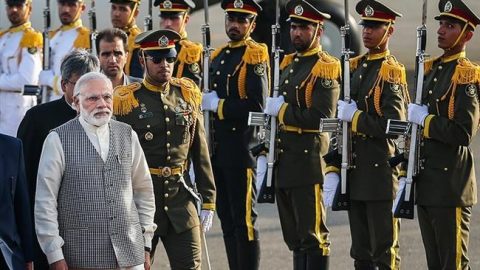
Indian PM Narendra Modi
Press TV – September 5, 2017
Iran’s Ministry of Petroleum says it has started preliminary talks with Russians to develop Farzad B but negotiations also continue with the Indians who have long coveted the giant gas field.
“For the development of the Farzad B field, we are pursuing three separate paths in parallel, but none of the options is definite yet,” director of the integrated planning at the National Iranian Oil Company (NIOC) Karim Zobeidi said on Monday.
The third path is the implementation of a development study plan in cooperation with a foreign consultant and Iran’s Petropars company, the official explained.
Zobeidi said negotiations with the Indians have not achieved satisfactory results but they have not stopped either and that Iran was pursuing preliminary talks with a Russian company as the second path.
“Along these two routes, the study of the development of Farzad A and B and the feasibility of the injection of gas from these fields into Aghajari (oil field) in cooperation with a foreign consultant and Petropars company is in progress,” he added.
Indian companies discovered the Farzad B gas field in Iran in 2008 and have bid several times for the development rights.
The Indians were supposed to develop the field after its exploration, but they stopped their activities after the West intensified sanctions on the Islamic Republic in 2012.
With the lifting of the sanctions, India once again called for the development of Farzad B by ONGC Videsh which is the overseas investment arm of the country’s biggest energy exploration firm.
According to an agreement, the Indians were first to submit a technical plan and then a financial proposal for the development of the field, but Iran did not agree with the other side’s financial proposals.
In the absence of an agreement between Iran and India, the development plan for Farzad B will be put to international tender.
In May, Minister of Petroleum Bijan Zangeneh announced that Iran had signed a basic agreement with Russia’s energy giant Gazprom over the development of Farzad B.
Indians shift attention to Israel
On Monday, Reuters cited India’s Oil Minister Dharmendra Pradhan as saying that state-run Oil and Natural Gas Corp planned to bid for disputed Israeli offshore oil-and-gas exploration blocks.
A high-ranking Indian delegation visited Israel last month to discuss taking part in the tender for blocks in the Mediterranean Sea, the news agency reported.
“We will definitely bid for Israel’s oil-and-gas blocks,” Reuters quoted Pradhan as saying.
New Delhi has deep military ties with Tel Aviv but they reportedly seek to expand their relationship to other sectors such as energy and technology following Prime Minister Narendra Modi’s visit to Israel in July.
According to Reuters, Israeli officials were pleased with the visit by the Indian economic team, while many oil majors have been hesitant to enter the Israeli market, fearing a backlash from oil-rich Arab states.
Lebanon has a long-standing dispute with Israel which stands accused of stealing Arab resources.
Lebanese Parliament Speaker Nabih Berri has said Israel was overtly stealing Lebanon’s underwater oil and gas reserves off the coast of south Lebanon. Hezbollah has warned that it would use force to protect Lebanon’s resources.
The gas discoveries have created a new source of friction between Lebanon and Israel, which have clashed repeatedly.
Lacking in natural resources, Israel has said it had discovered two fields thought to contain about 24 trillion cubic meters of natural gas, enough to make it energy self-sufficient for decades. Lebanese leaders have said the reserves were a “golden opportunity” for Lebanon to service its huge debt and rebuild its economy.
The Betrayal of India: Revisiting the 26/11 Evidence
By Ludwig Watzal | American Herald Tribune | August 14, 2017
 Perhaps the FBI needs guys like Elias Davidsson to solve the circumstances of the 9/11 attacks. Could he have been successful within such an organization? Usually, the FBI investigators can only go so far as their superiors want them to go. That’s why a highly qualified researcher such as Davidsson would have gone nowhere within the FBI.
In the 9/11 community, Davidsson is no blank sheet. He has published books on 9/11 and the follow-up terrorist attacks that set the world on fire. “Hijacking America’s Mind on 9/11“, followed by “Psychological Warfare and Social Denial: The Legend of 9/11 and the Fiction of Terrorism” (Psychologische Kriegsführung und Gesellschaftliche Leugnung: Die Legende des 9/11 und die Fiktion der Terrorbedrohung) presented a different narrative. An English translation of a condensed version would be very informative and highly useful for the English speaking public.
The elucidation of a terrorist offense suffers from the fact that governments clean up only as much as it benefits them politically. Such an approach also holds true for the Mumbai attacks. The impression given by the Indian government that all facts were on the table, is, according to Davidsson, false. As with the “9/11 Commission Report”, which pretends to present the real events and the backgrounds, the same holds true for the processing of this heinous crime of 26/11, 2008. In both cases, statements of witnesses, which didn’t support the official narrative were glossed over or brushed aside.
That’s why Davidsson’s book is so important. In 25 chapters he unravels not only the motivations and the cover-up of the Indian government but also the multifaceted interests of international actors such as Pakistan, the U.S., and possibly Great Britain, Germany, Israel, Iran, Russia, China, and even Australia.
“The book is about the betrayal of the Indian nation by a corrupt, greedy and ruthless elite for whom the lives of ordinary Indians are expendable when power and profit are at stake,” writes the author. From day one, a particular part of the official account was questioned, namely, the circumstances surrounding the deaths of three senior police officials and their assistants. Many Indians voiced their suspicion that the authorities were covering-up facts and called for an independent and impartial investigation of the events.
To understand 26/11, the reader must not work one’s way through the whole book sequentially because the author has attempted to render individual chapters independent of each other. All chapters close with a summary or conclusions. Davidsson’s book is always very well documented by many footnotes. Additionally, all sources used are accessible using the following URL; http://aldeilis.net/mumbai/
The author presents three definite conclusions; firstly, India’s major institutions are suppressing the truth on 26/11; secondly, India’s judiciary has failed its duty to seek truth and render justice; thirdly, Business, political and military circles profited from 26/11. Furthermore, entities in the U. S. and Israel also gained from the attack. The author could not find any benefits for the Pakistani government, military or businesses. The main profiteer seems the Hindu nationalist constituencies by the “elimination” of Hemant Karkare, “who was on the verge of exposing Hindutva terrorist networks.
Davidsson calls on the Indian Civil society to ask for the establishment of a National Truth Commission on 26/11 mandated to establish the facts on the attacks of 26 November 2008. The Civil society itself should demand the creation of an International Commission of Inquiry on the previous terrorist attacks under the authority of Chapter VII of the U.N. Charter, including those committed in the U. S. on 11 September 2001.
With this study, the Indian Civil society has a document at its disposal to challenge the official narrative. The overall objective of the author, however, is the exposure of all the key terror attacks, especially 9/11, which lacks to this day any evidence that 19 Muslims were the perpetrators.
This very compact but exciting book should contribute to the solving of the 26/11 crime. A must read for everybody interested in the truth.
Modi revisits Iran ties
By M K Bhadrakumar | Indian Punchline | August 6, 2017
The decision by Prime Minister Narendra Modi to depute the minister of transport Nitin Gadkari to represent India at the inaugural ceremony of Iran’s president Hassan Rouhani on his second term is a most appropriate, timely and thoughtful decision. ‘Appropriate’ – because it is a signal that India attaches high importance to relations with Iran. Gadkari is a senior figure in the cabinet – all but prime ministerial material, one might say. ‘Thoughtful’ – because of two reasons. One, Gadkari is also the government’s point person with regard to the strategic Indian project to develop a transit route to Afghanistan and Central Asia via Iran’s Chabahar Port.
Two, it is an assertive statement that India’s cooperation with Iran will not be buffeted by ‘Trumpspeak’. This is timely because the Iran-US engagement has run into difficulties and US officials have spoken of a preposterous ‘regime change’ agenda vis-à-vis Iran. A confrontation seems improbable but a showdown cannot be ruled out, either. If there is a confrontation / showdown, Modi government will come under pressure not only from the US but also from Israel, and India will be in the unhappy position of having to stand up and be counted. Strategic ambivalence, which comes easy to the Indian DNA, may no longer be an option. The previous UPA government of course simply opted to pull down the shutter and fall in line with the US diktat. It will be interesting to see how much spunk the present nationalist government would show to resist pressure on its regional policies, if push comes to shove.
However, India is in good company if it views Iran as a major partner. The presence of the European Union Foreign Policy chief Federica Mogherni at Rouhani’s inaugural underscored that EU does not go along with the US’ sanctions bill against Iran. So, indeed, the presence of Russia’s Deputy Prime Minister Dmitry Rogozin, a close aide confidante of President Vladimir Putin, signals that Moscow has a big agenda to expand and deepen the cooperation with Iran. The Chinese President Xi Jinping deputed He Lifeng, head of China’s National Development and Reform Commission, to represent China. Of course, He is the principal driver of the Belt and Road Initiative in the Chinese government.
Indeed, if the inaugural ceremony was a litmus test of Iran’s integration with the international community, the result is positive and impressive. Nineteen presidents, vice-presidents and prime ministers as well as 18 heads of parliaments attended the ceremony. It is virtually impossible for the Trump administration to ‘isolate’ Iran over its missile development programme or its regional policies. By the way, the participants at the ceremony in Tehran included a high-powered delegation from Hamas and a cabinet minister from Qatar.
Gadkari has promised that the Chabahar transit route will be operational by next year. The country must hold the government to its word. There shouldn’t be any slip-ups. This can be the first significant footfall in an Indian variant of ‘Belt and Road’ initiative. More importantly, perhaps, India must now resuscitate the plans of investments in the Chabahar region for industrial collaboration. The enthusiasm with which we spoke about it two years ago has petered out. Again, a major push is needed to realise the much-talked about North-South Corridor via Iran.
In political terms, a visit by Rouhani to India is overdue. The visit will give an overall verve to the relationship and add momentum to the bilateral cooperation. The Farzad-B gas field project has proved elusive. The revised $11 billion investment offer by ONGC Videsh is pending for a decision in Tehran. The Iranian side has driven a hard bargain, which is understandable since oil is a major source of income for its economy. But then, Tehran must also realize that Farzad-B will be a ‘game-changer’ for the entire relationship with India. Perhaps, this is the single biggest investment offer India has ever made to a foreign country. The business spin-off in the downstream, if the Farzad-B project takes off, will be massive.
Iran says Europe not on agenda of gas exports
Press TV – July 7, 2017
Iran says it has removed an old plan to export natural gas to Europe and is instead focusing on exports to its neighbors as well as India.
Amirhossein Zamaninia, Iran’s deputy minister of petroleum for trade and international affairs, said Europe’s gas market was already saturated with excessive supplies and had thus lost its priority in Iran’s gas export plans.
“Iran’s key priority should be exports to the neighboring states as well as India,” Zamaninia told Iran’s IRNA news agency.
He further emphasized that the landmark nuclear agreement that Iran had sealed with the five permanent members of the Security Council plus Germany in 2015 and the subsequent removal of sanctions against the Islamic Republic had already provided an appropriate opportunity to pursue plans to export natural gas to the neighboring states.
Iran had for years pursued plans to export natural gas to Europe. A tentative scheme that was developed in cooperation with Nabucco – a consortium led by Austria’s OMV – envisaged piping Iranian natural gas from the southern energy hub of Assaluyeh to Turkey and thereon to Europe. However, Nabucco eventually abandoned Iran in 2008 after complications grew the most important of which were US-engineered sanctions against the Iranian energy sector.
A parallel plan to export Iranian gas to Europe – again through Turkey – has been pursued by Switzerland’s EGL, also known as Elektrizitaetsgesellschaft Laufenburg,
Based on the EGL scheme, the Iranian natural gas would be taken to Greece and Albania through Turkey. It would thereon flow to Italy through a pipeline under the Adriatic Sea before reaching Switzerland. However, this scheme had a fate similar to that of Nabucco.
Over the past few years, Iran had been pursuing exporting natural gas to Kuwait, Oman and Iraq.
In late June, the country started exporting gas to Iraq by virtue of an agreement that was signed in 2013.
Talks over exports to Kuwait and Oman have been presently stalled over technical issues.
An ambitious project to pipe gas to India through Pakistan – that had been in the offing for almost two decades but delayed due to disputes over pricing and the related technicalities – has also been recently revived.
Iran is further exporting about 30 million cubic meters of gas to Turkey which before Iraq was its only export destination since 2001.
India’s Electricity Transformation
By Paul Homewood | Not A Lot Of People Know That | June 25, 2017
Renewable proponents are getting excited about the latest news from India:

The Indian energy market transformation is accelerating under Energy Minister Piyush Goyal’s leadership.
The most recent and most persuasive evidence is the collapsing cost of solar electricity—a collapse that has gone beyond anyone’s expectations, and the results are in: solar has won.
The global energy market implications are profound.
Recent events have given manifest life to Mark Carney’s landmark 2015 speech in which Carney, the governor of the Bank of England, warned of stranded-asset risks across the coal industry. This month alone has seen the cancellation of 13.7 gigawatts (GW) of proposed coal-fired power plants across India and an admission that US$9bn (8.6GW) of already operating import-coal-fired power plants are potentially no longer viable.
To put an Australian and a global seaborne thermal coal-trade perspective on it, these development strike at the very viability of the Carmichael export thermal coal proposal. They speak as well to a worldwide transition in progress.
India solar tariffs have been in freefall for months. A new 250MW solar tender in Rajasthan at the Bhadla Phase IV solar park this month was won at a record low Rs2.62/kWh,[i] 12 percent below the previous record low tariff awarded across 750MW of solar just three months ago at Rs2.97/kWh.
The Bhalda Phase record lasted two days, with a more recent 500MW Indian solar auction coming in at Rs2.44/kWh, 7 percent below Bhalda Phase.
We see solar pricing continuing to become even more competitive over time.
Several forces are at work.
In December 2016, India released its 10-year Draft National Electricity Plan, calling for the installation of a cumulative 275GW of renewable energy capacity by 2027, as well as 97GW of other zero emissions capacity (primarily large scale hydro, but also nuclear). Relative to a planned total system capacity of 650GW, the plan sees thermal power capacity falling from 69 percent of India electricity-generation mix in March 2016 to 43 percent by 2027.
http://ieefa.org/ieefa-asia-indias-electricity-sector-transformation-happening-now/
We are supposed to believe that solar power is going to rapidly replace coal. But, in fact, the news is not really new at all, and simply confirms what we knew already from India’s Draft National Plan, published in December 2016, and covered here.
But first, some basic facts.
The National Plan called for:
1) An increase in capacity of wind/solar by 2027 of 215 GW, plus 8 GW and 27 GW of nuclear and hydro respectively.
2) Total electricity requirement would rise from the current level of 1400 TWh, to 2132 TWh by 2027.
3) 50 GW of coal capacity was already under construction.
4) Non fossil fuel capacity would account for 56.5% of total capacity by 2027.
5) Wind/solar/bio would provide 24.2% of total generation by 2027.
The renewable commitment simply mirrored that contained in India’s INDC, although that only specified the period up to 2022.
The IEEAFA report acknowledged that the plan looks ambitious but absolutely feasible.
If we plug these capacities in and extrapolate from current load factors (based on BP data), we can take a look at what electricity generation will look like come 2027.
( The figure for fossil fuels is the balancing number).
| Capacity | Load | Twh | Twh | |
| 2027 | Factor % | 2027 | 2016 | |
| Hydro | 73 | 32 | 205 | 129 |
| Nuclear | 14 | 72 | 88 | 38 |
| Wind | 60 | 19 | 100 | 45 |
| Solar | 205 | 19 | 341 | 12 |
| Bio | 10 | 41 | 36 | 16 |
| Sub Total Low Carbon | 362 | 770 | 240 | |
| Fossil Fuels | 279 | 1362 | 1160 | |
| Total Electricity | 641 | 2132 | 1400 |
In other words, under the Plan, there will still be a big increase in power from fossil fuels, nearly all of which will be coal.
Indeed, the Plan itself states this clearly:

So what about all of these cancellations of coal plants? I’m afraid this is all rather fake news.
As the National Plan also states, there is already a surplus of power capacity in the pipeline, from all sources, and this is naturally putting the squeeze on new projects.
But as the Global Coal Plant Tracker revealed, there is nearly three times as much capacity in the pipeline but not started, as there is under construction. Given that the 50 GW under construction is already more than is needed, it is hardly surprising that projects not even started yet are being shelved.
Indeed, as the table shows, a total of 430 GW has already been cancelled or shelved since 2010.
There is simply nothing unusual at all about recent cancellations.

http://et-advisors.com/wp-content/uploads/ETA-Asia-Coal-Juggernaught_final.pdf
But isn’t solar now cheaper than coal?
Unfortunately, we aren’t comparing like with like. Whilst solar power, particularly in a sunny country like India, has a niche role, it cannot provide power reliably as coal does. As such, it can never play a dominant role.
It is worth bearing mind that we aren’t simply talking about day and night here. For three months every summer, most of India sits under the monsoon, beneath thick cloud and heavy rain.
While some solar power will still be generated, output will be much lower than the rest of the year, and at a time when demand tends to be greatest.
The Indian government is well aware of this, and will continue to ensure that sufficient coal power is always available. Indeed the National Plan also builds in enough coal capacity to cover a 30% reduction in Hydro generation, in case of a failure of the monsoon.
However, just as we are seeing here, coal power plants are suffering financially from competition from renewable energy with little or no marginal costs. Coal plants can only be viable if they are allowed to run at economic load factors.
One of the big problems with India’s electricity market is its curious mix of Central Government, State Government and Private power provision.
Just as in the UK, if India’s electricity system had been designed by electrical engineering experts, rather than developed on an ad hoc basis with conflicting objectives, it would not look like it does now.
And it would also be a lot more efficient!
How RCEP affects food and farmers
GRAIN | June 19, 2017
The Regional Comprehensive Economic Partnership (RCEP) is a mega-regional trade deal being negotiated among 16 countries across Asia-Pacific. If adopted, RCEP will cover half the world’s population, including 420 million small family farms that produce 80% of the region’s food. RCEP is expected to create powerful new rights and lucrative business opportunities for food and agriculture corporations under the guise of boosting trade and investment. Several RCEP countries are also part of the Trans-Pacific Partnership (TPP), another mega-regional agreement setting some of the most pro-big business terms seen in trade and investment deals so far. While the fate of the TPP is uncertain, these two agreements may have to co-exist and there is pressure to align them on numerous points. What will this mean for food and farmers in the region?
1. Land will be grabbed
Most RCEP countries do not allow foreigners to buy farmland. Instead, foreign investors can get leases, permits or concessions with varying types of restrictions. The stakes behind this issue are high because companies and investment funds have been aggressively buying up farmland as a new source of revenue in the last years. In the RCEP countries alone, 9.6 million hectares of farmland have been acquired by foreign companies since 2008. Ownership provides corporations far more control than use rights, but it also drives up land prices and speculation, pushing small farmers out.
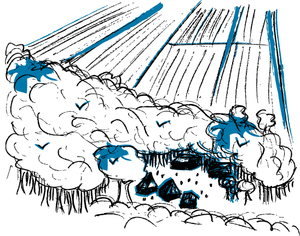
Two chapters of RCEP could have a decisive impact on access to land. According to leaked drafts, the investment chapter proposes a rule that each government must give investors from other RCEP states the same treatment as domestic investors (‘national treatment’). That means they should have the same rights to purchase farmland as domestic investors, unless the government carves out a special exception for this. The draft chapter also contains proposed ‘standstill’ and ‘ratchet’ clauses which, if adopted, would mean that governments have to lock in their current levels of liberalisation, and if they liberalise more than they commit to in RCEP they cannot go back down to the level set by RCEP. The services chapter draft also proposes that foreign service suppliers not be treated less favourably than domestic companies (‘national treatment’). This includes the ability to own farmland for a service-related purpose. Again, countries may be able to squeeze in an exception for agricultural land, but any such exception would be subject to negotiation and have to be agreed to by all parties.
If governments do not make reservations on these provisions for farmland, RCEP could seriously aggravate land grabbing in the region and sabotage agrarian reform processes that are currently under way in some countries. Currently, farmers asserting their rights to land are being subjected to human rights abuses, criminalisation, incarceration and even assassination. For this reason, there are deep fears that if RCEP is adopted, it will intensify militarisation in rural communities.
2. Seeds will be privatised, GMOs may proliferate
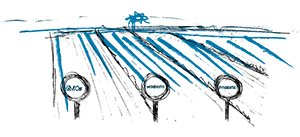
Farmers regularly save seed from one harvest to plant a new crop. Big seed and agrochemical companies like Monsanto and Bayer want to end this practice and force farmers to buy seed each season, so they can boost sales. They do this by lobbying governments to extend intellectual property laws to cover plants and animals. The global seed industry is highly concentrated today with three companies representing more than 60% of global commercial sales. ChemChina is currently in the process of buying Syngenta, one of the world’s top three seed firms. This means that China has a new vested interest in seeing seed laws strengthened under RCEP.
Leaked drafts of RCEP’s intellectual property chapter show countries like Japan and South Korea pushing for all RCEP states to adopt “UPOV 1991”, a kind of patent system for seeds. Under UPOV 1991, farmers are generally not allowed to save seeds of protected varieties. Where limited exceptions are permitted, farmers must pay the seed companies royalties on farm-saved seed. Depending on the country and the crop, royalties can represent a markup of 10-40% over the price of regular commercial seeds, which are already more expensive than farmers’ seed. Civil society groups estimate that UPOV 1991 would raise the local price of seed by 200-600% in Thailand and by 400% in the Philippines.
It could get worse if RCEP moves closer to what was negotiated in the TPP, something which four RCEP states have already agreed to. TPP requires states to allow patents on inventions “derived from plants”, which means genetically modified organisms (GMOs). Right now, GMOs are illegal in all RCEP member countries except for Australia, India, Myanmar and Philippines, plus several provinces of China and Vietnam. And while it’s likely that RCEP will have a chapter aiming to harmonise food safety standards, we have not seen any drafts and do not know how it will regulate GMOs. All of these moves would lead not only to higher seed prices but a loss of biodiversity, greater corporate control and a possible lowering of standards for high risk products such as GMOs.
3. Small dairy and other farmers will go out of business

India is home to 100 million small farmers, most of whom keep livestock. Up until now they have been the backbone of India’s dairy sector, but that situation is now changing. Costs of production are going up while prices paid to farmers are going down, driving many small farmers into dire straits.
RCEP will make things much worse. Frustrated with New Zealand’s failure to conclude a bilateral trade deal with India, NZ dairy giant Fonterra — the world’s biggest dairy exporter — is now looking to RCEP as a way in to India’s massive dairy market. It has openly stated that RCEP would give the company important leverage to open up key markets that are currently protected such as India’s, where it would go head to head with India’s dairy cooperative Amul. As a result, many people fear that Indian dairy farmers will either have to work for Fonterra or go out of business. They will not be able to compete. Similar concerns face dairy farmers in Vietnam, where Fonterra has been investing heavily to increase its presence.
At the same time, some RCEP members like Japan and Australia not only subsidise their farmers tremendously, they also have food safety standards that are incompatible with the small-scale food production and processing systems that dominate in other RCEP countries. This may lead to the growth of mega food-park investments that target exports to such high value markets, as is already happening in India. These projects involve high tech farm-to-fork supply chains that exclude and may even displace small producers and household food processing businesses, which are the mainstay of rural and peri-urban communities across Asia.
4. Fertiliser and pesticide use will go up

Fertiliser and pesticide sales are expected to rise sharply in Asia-Pacific in the next few years, from $100 billion to $120 billion per year by 2021. Agrochemical use is heaviest in China and growing rapidly in India, while imports by the Mekong sub-region are also on the rise. China’s acquisition of Syngenta, the world’s top agrochemical company with more than 20% of the global pesticide market, puts the country in a particularly sensitive position within RCEP.
Beijing will want high levels of ‘market access’, being negotiated under the trade in goods chapter of RCEP, to capitalise on its new position. In January 2017, China already announced that it will scrap export tariffs on nitrogen and phosphorus fertiliser in order to boost its market share abroad. RCEP trade ministers have promised to deliver a deal that immediately cuts tariffs to zero on 65% of trade in goods, followed by a second phase to cut the rest. Farm chemicals are bound to be part of this, resulting in increased residues in food and water, more greenhouse gas emissions and further depletion of soil fertility.
Furthermore, if leaked intellectual property drafts are adopted, RCEP may increase the patenting of other inputs like veterinary medicines, farm machinery, microorganism-based products and agricultural chemicals, and extend their patent terms, making them more expensive.
5. Big retail will wipe out local markets
Over the past five years, Asia-Pacific accounted for more than half of the world’s new food retail sales. Japan is leading this trend, with 7-Eleven and Aeon at the top of food retail sales in the region. Aeon Agri Create, the agriculture production arm of Aeon, has been establishing farms in Japan and Southeast Asian countries like Vietnam. Aeon even aims to push ‘ICT farming’: the use of computers and communication technologies to manage farm operations. In India, the opening up of food retail, including e-commerce, to foreign direct investment (FDI) is almost complete, although many states are yet to adopt FDI in multibrand retail. RCEP would strengthen these trends further.
According to leaked drafts, RCEP’s services chapter may make it impossible for governments to limit the operation of supermarket chains that hail from other RCEP states (‘market access’). Furthermore, the trade agreement may make it illegal for a member government to require a service supplier like Alibaba or Aeon to have a ‘local presence’ in its country or to source food from local producers.
If precedents set by TPP are followed, ICT farming may be boosted under RCEP measures aimed at promoting regional supply chains and e-commerce. China’s Alibaba has just invested $1.25 billion in an online food delivery service, which will rely on more and more high tech facilities that are disconnected from seasons and from local markets. All of these developments pose a real threat to small traders and retailers in Asia.
What to do?
RCEP will usher in a wave of corporate concentration and take over of Asia’s food and agriculture sector. Corporate concentration, as experience in the other regions shows, brings less real choice and higher prices for consumers. In the food sector, it also brings important health and environmental costs from pesticides, excessive processing and chemicals, as well as downward pressure on wages and prices paid to farmers.
The answer is not to reform RCEP but to reject it because it relies on and pushes a corporate model of agriculture that no amount of tweaking will change. Instead, we need to implement policies and initiatives that enable people-led food and agricultural systems to flourish. Only then can trade policies be drawn up to serve these systems – not the other way around.
ACT NOW!
- Get more informed and organise discussions and debates about RCEP in your communities. One resource to check out is the collective open-publishing site http://bilaterals.org/rcep.
- Support the people’s call to stop RCEP and fight for a pro-people trading system that responds to people’s needs not to corporate elites. Contact groups in your country that also signed the call and join forces.
- Go to the RCEP meetings. Demand the public release of negotiating texts to better analyse and build awareness of how the agreement affects the livelihood of people in RCEP member countries. Voice your concerns, as groups have done over several rounds the past months in Perth, Jakarta, Kobe and Manila. The next rounds will be held in Hyderabad (July 2017) and Seoul (later this year).
- Join the region-wide people campaign on RCEP and trade justice, and participate in collective mobilisations like regional days of action
- Keep an eye on http://rceplegal.wordpress.com/, http://keionline.org/ and http://www.bilaterals.org/rcep-leaks for leaked texts and analysis of RCEP chapters.
GRAIN is a small international non-profit organisation that works to support small farmers and social movements in their struggles for community-controlled and biodiversity-based food systems.
Featured Video
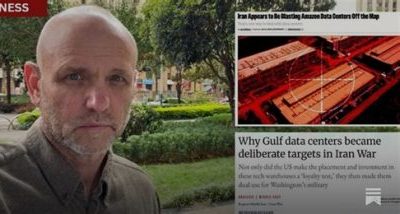
Iran spent $1 million to wipe out $30 billion in data center plans, and take down Amazon in the ME
or go to
Aletho News Archives – Video-Images
From the Archives
A short history of British torture
ICC | December 2005
When the House of Commons was debating how much to increase the time limit for detention without trial the question of torture came up. Officially this was limited to the nice considerations of whether it was all right to send people to places where torture is used and whether Britain can use information collected by the use of torture in other countries. This discussion gave an impression of democratic Britain as the home of civilised behaviour where the very idea of torture is repugnant to our legislators – unlike, say, the US with its secret CIA jails… In reality, the British state has a long history of using and developing a whole range of torture techniques. … continue
Blog Roll
 Aletho News
- Houthis Keep Advancing as the Red Sea Crisis Deepens
- Iran spent $1 million to wipe out $30 billion in data center plans, and take down Amazon in the ME
- Zionist billionaire pressure to silence Macklemore sparks exodus from Ed Sheeran tour
- House Votes to End Iran War for Third Time
- North Korea Slams US Plan for ‘AUKUS 2.0’ with South Korea and Japan
- Prolonging US-Iran Conflict Not Meeting Interests of Int’l Community – China’s Wang Yi
- EU bans former Zelensky aide from parliament
- NATO-backed Kosovo separatist ‘responsible for war crimes’
- US destroying international space law
- SCO Calls for Binding Global Deal to Prevent Arms Race in Space
- If Americans Knew
- U.S. Makes, Israel Takes: The Real Story of U.S.-Israeli Military Cooperation
- Night raids rise in Palestine
- Tucker Carlson interviews Norman Finkelstein about Gaza
- Groups urge Americans to support Van Hollen legislation on Israel’s killing of Americans & Palestinians
- Trump administration plans to send 40,000 tons of bombs to Israel: report
- Sanctions Target Iran’s Government, But Kill Hospitalized 23-Year-Old Woman
- An alternative view on the book “Israel’s Lobby: America in the Grip of a Foreign Power”
- Ed Sheeran’s band Beoga, other opening acts quit tour after Macklemore was dropped over his pro-Palestinian comments
- The assassination attempt on President Trump in Butler and the various Israeli connections to it
- “We Want That the Whole Land Be Jewish”
- No Tricks Zone
- New Study: ‘Global Drought Shows No Detectable Recent Acceleration Under Climate Warming’
- Economic Masterminds: German Socialists Suggest Taxing Productivity Gains Stemming From Using AI
- The South China Sea Has Not Been Cooperating With The Climate Change Narrative
- Energy Crisis: Germany Enters Heating Season With Historically Low Gas Reserve Fill Levels
- New Study: The Antarctic Ice Sheet Gained Mass From 2020-2024 Due To Staggering Snow And Ice Accumulation
- Study: Ocean Heating Rates From Thousands Of Years Ago ‘Dwarf’ Modern Ocean Heating Rates
- Climate Extremists Target, Attack Large-Scale Power Grid Infrastructure In Germany!
- New Study: Antarctic Ice Melt Has Contributed Less Than 1 Centimeter To Sea Level Rise In The Last 30 Years
- Fear Of Debate: Alarmist German Climate Scientist Calls On Mainstream Media To Discredit Skeptic Voices
- End-Of-August Arctic Sea Ice Extent Hasn’t Fallen In 20 Years, Official Data Show!
 Aletho News