Hiding the Indonesia Massacre Files
By Jonathan Marshall | Consortium News | April 29, 2016
Now that the Indonesian government has officially opened a probe into what the CIA called “one of the worst mass murders of the 20th century,” it’s time for the U.S. government to come clean about its own involvement in the orchestrated killing of hundreds of thousands of Communists, ethnic Chinese, intellectuals, union activists and other victims during the mid-1960s.
President Joko Widodo this week instructed one of his senior ministers to begin investigating mass graves that could shed light on the slaughter of more than half a million innocents by soldiers, paramilitary forces and anti-Communist gangs.
That orgy of violence followed the killing of six generals on Sept. 30, 1965, which the Indonesian military blamed on an attempted coup by the Indonesian Communist Party (PKI). It marked the beginning of several decades of military dictatorship and further mass murders in East Timor and West Papua.
The PKI, which had some three million members, and millions more sympathizers, was by the early 1960s the strongest political force in the country aside from the military and the revered father of Indonesia’s independence, President Sukarno.
As one CIA adviser warned in 1963, “If the PKI is able to maintain its legal existence . . . Indonesia may be the first Southeast Asia country to be taken over by a popularly based, legally elected communist government.” Two years later, the military-led bloodbath put an end to that threat.
Indonesia’s government, whose leaders include military veterans of that era, still refuses to open criminal investigations into the mass murder, as called for in 2012 by Indonesia’s National Commission on Human Rights.
But some survivors nonetheless welcome the chance to expose truths that have been vigorously suppressed over the years by mass political arrests, press censorship, and pervasive indoctrination programs in the country’s schools.
Hiding Secrets
To help tell the whole story, Indonesia’s human rights commission and major international human rights organizations have called on the Obama administration to declassify U.S. government documents related to the massacres, as it did recently with respect to Argentina’s “dirty war” from 1976-83.
But President Obama, like his predecessors, has so far been reluctant to shed light on tragic events in Indonesia more than half a century ago.
“The extent of America’s role remains hidden behind a wall of secrecy,” complained Joshua Oppenheimer, maker of two acclaimed documentaries about the massacres: “The Act of Killing” and “The Look of Silence.”
“C.I.A. documents and U.S. defense attaché papers remain classified. Numerous Freedom of Information Act requests for these documents have been denied,” he observed. “If the U.S. government recognizes the genocide publicly, acknowledges its role in the crimes, and releases all documents pertaining to the issue, it will encourage the Indonesian government to do the same.”
It’s easy to guess why Washington is so reluctant to bare the truth. The limited number of documents that have been released suggest that U.S. officials goaded Indonesia’s military into seizing power in 1965 and then liquidating PKI supporters throughout the archipelago. The full record could look even uglier.
Indonesia became a focus of U.S. strategic concerns as far back as 1940, when Imperial Japan threatened its immensely valuable rubber plantations, tin mines, and oil wells. President Franklin Roosevelt’s showdown with Tokyo, which culminated in the Pearl Harbor attack, stemmed from his determination to resist the loss of the islands’ strategic resources. Years later, Richard Nixon would call Indonesia “by far the greatest prize in the South-East Asian area.”
Prompted by its appreciation of Indonesia’s value, the Eisenhower administration financed a full-scale but unsuccessful military rebellion in 1958 against the neutralist Sukarno government. The Kennedy administration tried to patch up relations, but President Lyndon Johnson — angered at the regime’s threat to U.S. rubber and oil companies as well as Sukarno’s friendly relations with the PKI — cut off economic aid while continuing training and assistance to the anti-Communist military.
As one senior State Department official testified in executive session before Congress just a few months before the 1965 coup, explaining the administration’s proposal to increase military aid, “When Sukarno leaves the scene, the military will probably take over. We want to keep the door open.”
Prompting the Slaughter
To prompt the army to act against Sukarno, U.S., British, and Australian intelligence operatives planted phony stories about PKI plots to assassinate army leaders and import weapons from Communist China to launch a revolt — elements of a “strategy of tension” that would later be used in Chile.
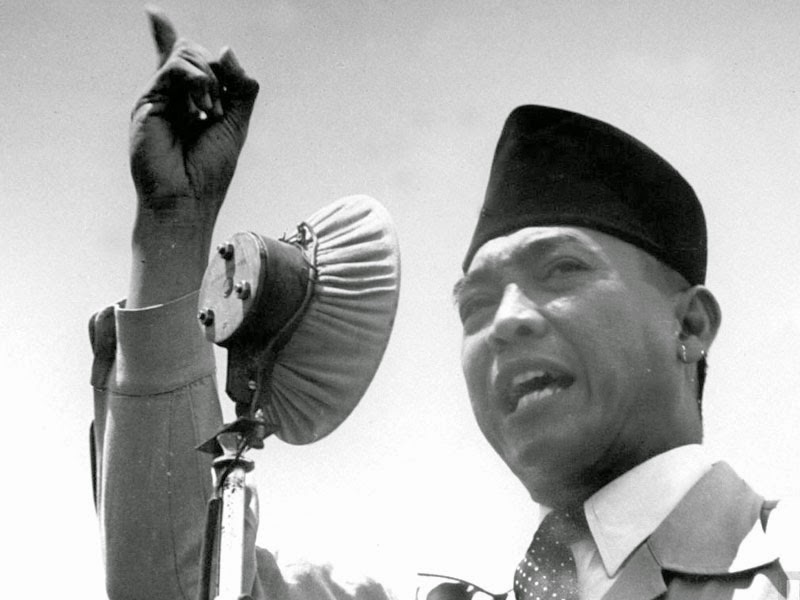
Indonesian President Sukarno.
According to former CIA officer Ralph McGehee, the CIA “was extremely proud” of its campaign and “recommended it as a model for future operations.”
Months after the bloodbath began, the well-connected associate editor of the New York Times, James Reston, would write, “Washington is being careful not to claim any credit” for the coup “but this does not mean that Washington had nothing to do with it.”
The events that triggered the military takeover remain murky even today, thanks to the regime’s systematic suppression of evidence. What seems clear, however, is that the PKI was largely caught unprepared when a group of junior officers — acting either on their own or as part of a “false flag” operation mounted by the anti-Communist General Suharto — killed six generals in the name of stopping a right-wing coup against Sukarno.
Suharto and his colleagues quickly arrested the killers, blamed the PKI for the atrocity, and aroused popular outrage by spreading false stories that the murdered generals had been sexually mutilated.
They also charged that Indonesia’s Communists were targeting Islamic leaders. In response, the country’s largest Muslim organization issued an order to “eliminate all Communists.”
On Oct. 5, 1965, U.S. Ambassador to Indonesia Marshall Green informed Washington that Muslin groups were “lined up behind” the army, which “now has opportunity to move against PKI if it acts quickly. . . Momentum is now at peak with discovery of bodies of murdered army leaders. In short, it’s now or never.”
Green was hopeful: “Much remains in doubt, but it seems almost certain that agony of ridding Indonesia of effects of Sukarno . . . has begun.” To help make sure that came to pass, Green advised telling coup leaders of “our desire to be of assistance where we can,” while remaining in the shadows.
Fanning Flames
Green proposed fanning the flames of popular anger through covert propaganda: “Spread the story of PKI’s guilt, treachery and brutality (this priority effort is perhaps most-needed immediate assistance we can give army if we can find way to do it without identifying it as solely or largely US effort).”
To that end, he later instructed to U.S. Information Agency to use all its resources to “link this horror and tragedy with Peking and its brand of communism; associate diabolical murder and mutilation of the generals with similar methods used against village headmen in Vietnam.”
By mid-October, Green reported that the embassy had discussed strategy with Army and Muslim contacts for a “step-by-step campaign not only against PKI but against whole communist/Sukarno clique.”
Soon he was reporting the good news: the army had executed hundreds of Communists and arrested thousands of PKI cadre, with help from Muslim death squads.
“I, for one, have increasing respect for [the army’s] determination and organization in carrying out this crucial assignment,” he wrote.
To help the army succeed, Green endorsed Washington’s decision to bankroll the military’s clean-up operations against the PKI, adding that “the chances of detection or subsequent revelation of our support . . . are as minimal as any black bag operation can be.”
In addition, by December 1965 the U.S. embassy began sending the Indonesian military lists of PKI leaders — facilitating their liquidation.
“It really was a big help to the army,” said Robert J. Martens, a former member of the U.S. Embassy’s political section. “They probably killed a lot of people, and I probably have a lot of blood on my hands, but that’s not all bad. There’s a time when you have to strike hard at a decisive moment.”
In a December 1965 story, Time magazine offered the first significant account in the American media of the scope of the killing:
“Communists, red sympathizers and their families are being massacred by the thousands. Backlands army units are reported to have executed thousands of Communists after interrogation in remote jails. Armed with wide-bladed knives called ‘parangs,’ Moslem bands crept at night into the homes of Communists, killing entire families and burying the bodies in shallow graves.
“The murder campaign became so brazen in parts of rural East Java, that Moslem bands placed the heads of victims on poles and paraded them through villages. The killings have been on such a scale that the disposal of the corpses has created a serious sanitation problem in East Java and Northern Sumatra where the humid air bears the reek of decaying flesh.
“Travelers from these areas tell of small rivers and streams that have been literally clogged with bodies. River transportation has at places been seriously impeded.”
By February 1996, the U.S. embassy was estimating that at least 400,000 people had already been killed across the country — more than died from the atomic bomb attacks on Hiroshima and Nagasaki.
Media Approval
C.L. Sulzberger of The New York Times remarked in April that “the killing attained a volume impressive even in violent Asia, where life is cheap.”
Speaking for official Washington, in a column titled “A Gleam of Light in Asia,” the New York Times’ James Reston called this bloodbath one of “the more hopeful political developments” in Asia, one that could not have “been sustained without the clandestine aid it has received indirectly from here.”
The full extent of that clandestine aid remains a contested question, but historian Bradley Simpson, in a 2008 study of U.S. relations with Indonesia in the 1960s, observed that “declassification of just a fraction of the CIA’s records demonstrates that the agency’s covert operations in Indonesia were more widespread and insidious than previous acknowledged. These records also reveal that the Johnson administration was a direct and willing accomplice to one of the great bloodbaths of twentieth-century history.”
New Mexico’s Tom Udall declared last year as he introduced a Senate resolution to promote reconciliation on the 50th anniversary of the Indonesian massacres, “the United States and Indonesia must work to close this terrible chapter by declassifying information and officially recognizing the atrocities that occurred. . .
“The United States should stand in favor of continued democratic progress for our vital ally Indonesia and allow these historical documents to be disclosed. Only by recognizing the past can we continue to work to improve human rights across the globe.”
The world is still waiting on President Obama to heed that call.
Jonathan Marshall is author or co-author of five books on international affairs, including The Lebanese Connection: Corruption, Civil War and the International Drug Traffic (Stanford University Press, 2012).
Indonesia snubs Saudi ‘anti-terror’ coalition… then its capital gets hit
RT | January 15, 2016
Indonesia joins a growing list of countries beyond the Middle East region reportedly hit by the Islamic State group or its affiliates. Is it a case of IS simply going global, or is there something else to the latest incident in Indonesia?
On the face of it, the attacks this week in downtown Jakarta – the Indonesian capital of 10 million people – are similar to those carried out in Paris last November, albeit with much less deadly results. Both involved a team of suicide bombers and gun attacks.
In the Paris attacks, some eight armed men killed 130 people when they struck at various public venues on November 13. This week in Jakarta up to 15 assailants armed with explosives and rifles managed to kill only two civilians; the other five reported dead were attackers who were shot by police or blew themselves up.
From the terrorists’ point of view, the Jakarta operation was a failure. That failure was partly due to the vigilance of Indonesian police, who had increased security across the capital in recent weeks due to what they said was the interception of terror communications.
Jakarta deputy police chief Budi Gunawan was quoted by The Wall Street Journal as saying that a homegrown Islamist network in the Java city of Solo had been plotting terror attacks with jihadists based in Syria.
“We detected communications between a Syria group and the Solo group,” said Gunawan. Following the Jakarta violence, the IS group reportedly claimed responsibility.
The question is: what’s behind the uptick in IS-affiliated activity in Indonesia? Police reportedly made several arrests against suspected IS operatives in recent weeks.
Indonesia is no stranger to terrorism carried out by Islamist groups. Between 2000 and 2009, there were six major terrorist atrocities. The biggest one was the bombings in the tourist resort of Bali in 2002 which killed over 200 people. But for the past five years, the country has enjoyed relative peace.
Author and expert on Indonesia Jeremy Menchik told France 24 in an interview Thursday night that the relative quiet in the world’s fourth largest nation has been achieved because of the country’s relatively democratic transition having been able to co-opt dissident Islamist groups.
With a population of over 240 million, Indonesia is the world’s most populous Muslim country. While the country suffered from a brutal dictatorship under Suharto from 1965 until the late 1990s, it has since managed to steer a more benign, inclusive and secular political path.
Under President Joko Widodo, elected in 2014, Indonesia has managed to contain its erstwhile radical Islamist problem.
Saudi revenge for Indonesia’s PR snub?
One month ago, on December 17, Saudi Arabia launched a 34 Islamic nation “anti-terror” coalition, with an ostentatious announcement in the Saudi capital Riyadh. The surprise initiative was welcomed by Washington and London, although it was greeted with skepticism by many observers given the documented role that the Saudi rulers have had in funding and arming terror groups, including the Islamic State and other Al Qaeda-linked militants.
Skeptics noted that the Saudi-led coalition of 34 Islamic nations appeared to be hastily cobbled together, with some of the nominal member countries later saying that they had not been consulted by the Saudis in its formation. Not included in the Saudi initiative of the “anti-terror” Islamic bloc were Iraq and Iran, perhaps unsurprisingly given the Saudi antagonism with these mainly Shiite countries.
Even more pointedly, two major Islamic nations, Algeria and Indonesia, explicitly declined to participate in the Saudi-led alliance.
Given the prominence of Indonesia as the world’s biggest Muslim country, the Saudi initiative was thus dealt a severe public relations blow by Jakarta’s refusal to sign up.
It is believed that Saudi Arabia has been behind the funding of radical Islamist groups within Indonesia going back several years, according to the Financial Times.
With that in mind, the Indonesia authorities most likely snubbed the Saudi “anti-terror” coalition last month for precisely the same reasons that many analysts dismissed it. Seeing it as a cynical public-relations gimmick by the Saudis who are trying to burnish their badly tarnished international image over suspected links with terrorism, particularly in Syria’s five-year conflict.
That raises the plausible conjecture that the terror attacks this week in Jakarta by an IS-connected group may have been orchestrated as a form of retaliation against the Indonesian government for its embarrassing snub against the Saudis last month.
If the Saudis and Western intelligence are indeed in some murky way driving jihadist terrorism for their geopolitical agenda, then it stands to reason that such terror groups could be manipulated by these same protagonists in Indonesia – or anywhere else for that matter.
A terror attack in the heart of Jakarta apparently carried out by the IS group would serve as a sharp warning to Indonesia over its derisory put-down of the Western-backed Saudi “anti-terror” coalition.
The sudden uptick in Islamist terror activity in Indonesia and the failure of the attackers in Jakarta to inflict greater damage suggest that the assault was hurriedly planned. As in the orders to the operatives were hastily dispatched and acted on.
That would fit with the theory that the Saudi sponsors of terrorism were looking for a quick counter to Indonesia undermining their anti-terror charade last month.
Southeast Asia “Forgets” About Western Terror
By Andre Vltchek | CounterPunch | October 2, 2015
Southeast Asian elites “forgot” about those tens of millions of Asian people murdered by the Western imperialism at the end of and after the WWII. They “forgot” about what took place in the North – about the Tokyo and Osaka firebombing, about the Hiroshima and Nagasaki atomic bombs, about the barbaric liquidation of Korean civilians by the US forces. But they also forgot about their own victims – about those hundreds of thousands, in fact about the millions, of those who were blown to pieces, burned by chemicals or directly liquidated – men, women and children of Vietnam, Cambodia, Laos, Indonesia, the Philippines and East Timor.
All is forgiven and all is forgotten.
And once again the Empire is proudly “pivoting” into Asia; it is even bragging about it.
It goes without saying that the Empire has no shame and no decency left. It boasts about democracy and freedom, while it does not even bother to wash the blood of tens of millions off its hands.
All over Asia, the “privileged populaces” has chosen to not know, to not remember, or even to erase all terrible chapters of the history. Those who insist on remembering are being silenced, ridiculed, or made out to be irrelevant.
Such selective amnesia, such “generosity” will very soon backfire. Shortly, it will fly back like a boomerang. History repeats itself. It always does, the history of the Western terror and colonialism, especially. But the price will not be covered by the morally corrupt elites, by those lackeys of the Western imperialism. As always, it will be Asia’s poor who will be forced to pay.

After I descended from the largest cave in the vicinity of Tham Pha Thok, Laos, I decided to text my good Vietnamese friend in Hanoi. I wanted to compare the suffering of Laotian and Vietnamese people.
The cave used to be “home” to Pathet Lao. During the Second Indochina War it actually served as the headquarters. Now it looked thoroughly haunted, like a skull covered by moss and by tropical vegetation.
The US air force used to intensively bomb the entire area and there are still deep craters all around, obscured by the trees and bushes.
The US bombed the entirety of Laos, which has been given a bitter nickname: “The most bombed country on earth”.
It is really hard to imagine, in a sober state, what the US, Australia and their Thai allies did to the sparsely populated, rural, gentle Laos.
John Bacher, a historian and a Metro Toronto archivist once wrote about “The Secret War”: “More bombs were dropped on Laos between 1965 and 1973 than the U.S. dropped on Japan and Germany during WWII. More than 350,000 people were killed. The war in Laos was a secret only from the American people and Congress. It anticipated the sordid ties between drug trafficking and repressive regimes that have been seen later in the Noriega affair.”
In this biggest covert operation in the U.S. history, the main goal was to “prevent pro-Vietnamese forces from gaining control” over the area. The entire operation seemed more like a game that some overgrown, sadistic boys were allowed to play: Bombing an entire nation into the Stone Age for more than a decade. But essentially this “game” was nothing else than one of the most brutal genocides in the history of the 20th century.
Naturally, almost no one in the West or in Southeast Asia knows anything about this.

I texted my friend: “What I witnessed a few years ago working at the Plain of Jars was, of course, much more terrible than what I just saw around Tham Pha Thok, but even here, the horror of the US actions was crushing.” I also sent her a link to my earlier reports covering the Plain of Jars.
A few minutes later, she replied: “If you didn’t tell me… I would have never known about this secret war. As far as we knew, there was never a war in Laos. Pity for Lao people!”
I asked my other friends in Vietnam, and then in Indonesia. Nobody knew anything about the bombing of Laos.
The “Secret War” remains top-secret, even now, even right here, in the heart of the Asia Pacific region, or more precisely, especially here.
When Noam Chomsky and I were discussing the state of the world in what eventually became our book “On Western Terrorism – From Hiroshima to Drone Warfare”, Noam mentioned his visit to the war-torn Laos. He clearly remembered Air America pilots, as well as those hordes of Western journalists who were based in Vientiane but too busy to not see and to not ask any relevant questions.
***
“In the Philippines, the great majority of people is now convinced that the US actually ‘liberated’ our country from the Japanese”, my left-wing journalist friends once told me.
Dr. Teresa S. Encarnación Tadem, Professor of Political Science of University of the Philippines Diliman, explained to me last year, face to face, in Manila: “There is a saying here: “Philippines love Americans more than Americans love themselves.”
I asked: “How is it possible? The Philippines were colonized and occupied by the United States. Some terrible massacres took place… The country was never really free. How come that this ‘love’ towards the US is now prevalent?”
“It is because of extremely intensive North American propaganda machine”, clarified Teresa’s husband, Dr. Eduardo Climaco Tadem, Professor of Asian Studies of University of the Philippines Diliman. “It has been depicting the US colonial period as some sort of benevolent colonialism, contrasting it with the previous Spanish colonialism, which was portrayed as ‘more brutal’. Atrocities during the American-Philippine War (1898 – 1902) are not discussed. These atrocities saw 1 million Philippine people killed. At that period it was almost 10% of our population… the genocide, torture… Philippines are known as “the first Vietnam”… all this has been conveniently forgotten by the media, absent in the history books. And then, of course, the images that are spread by Hollywood and by the American pop culture: heroic and benevolent US military saving battered countries and helping the poor…”
Basically, entirely reversing the reality.
The education system is very important”, added Teresa Tadem. “The education system manufactures consensus, and that in turn creates support for the United States… even our university – University of the Philippines – was established by the Americans. You can see it reflected in the curriculum – for instance the political science courses… they all have roots in the Cold War and its mentality.”
Almost all children of the Asian “elites” get “educated” in the West, or at least in so-called “international schools” in their home countries, where the imperialist curriculum is implemented. Or in the private, most likely religious/Christian schools… Such “education” borrows heavily from the pro-Western and pro-business indoctrination concepts.
And once conditioned, children of the “elites” get busy brainwashing the rest of the citizens. The result is predictable: capitalism, Western imperialism, and even colonialism become untouchable, respected and admired. Nations and individuals who murdered millions are labeled as carriers of progress, democracy and freedom. It is “prestigious” to mingle with such people, as it is highly desirable to “follow their example”. The history dies. It gets replaced by some primitive, Hollywood and Disney-style fairytales.

In Hanoi, an iconic photograph of a woman pulling at a wing of downed US military plane is engraved into a powerful monument. It is a great, commanding piece of art.
My friend George Burchett, a renowned Australian artist who was born in Hanoi and who now lives in this city again, is accompanying me.
The father of George, Wilfred Burchett, was arguably the greatest English language journalist of the 20th Century. Asia was Wilfred’s home. And Asia was where he created his monumental body of work, addressing some of the most outrageous acts of brutality committed by the West: his testimonies ranged from the first-hand account of the Hiroshima A-bombing, to the mass murder of countless civilians during the “Korean War”. Wilfred Burchett also covered Vietnam, Laos, Cambodia, to name just a few unfortunate places totally devastated by the United States and its allies.
Now his books are published and re-printed by prestigious publishing houses all over the world, but paradoxically, they do not live in sub-consciousness of the young people of Asia.
The Vietnamese people, especially the young ones, know very little about the horrific acts committed by the West in their neighboring countries. At most they know about the crimes committed by France and the US in their own country – in Vietnam, nothing or almost nothing about the victims of the West-sponsored monsters like Marcos and Suharto. Nothing about Cambodia – nothing about who was really responsible for those 2 millions of lost lives.
The “Secret Wars” remain secret.

With George Burchett I admired great revolutionary and socialist art at the Vietnam National Museum of Fine Arts. Countless horrible acts, committed by the West, are depicted in great detail here, as well as the determined resistance struggle fought against US colonialism by the great, heroic Vietnamese people.
But there was an eerie feeling inside the museum – it was almost empty! Besides us, there were only a few other visitors, all foreign tourists: the great halls of this stunning art institution were almost empty.

Indonesians don’t know, because they were made stupid!” Shouts my dear old friend Djokopekik, at his art studio in Yogyokarta, He is arguably the greatest socialist realist artist of Southeast Asia. On his canvases, brutal soldiers are kicking the backsides of the poor people, while an enormous crocodile (a symbol of corruption) attacks, snaps at, and eats everyone in sight. Djokopekik is open, and brutally honest: “It was their plan; great goal of the regime to brainwash the people. Indonesians know nothing about their own history or about the rest of Southeast Asia!”
Before he died, Pramoedya Ananta Toer, the most influential writer of Southeast Asia, told me: “They cannot think, anymore… and they cannot write. I cannot read more than 5 pages of any contemporary Indonesian writer… the quality is shameful…” In the book that we (Pramoedya Ananta Toer, Rossie Indira and I) wrote together – “Exile” -, he lamented that Indonesian people do not know anything about history, or about the world.
Had they known, they would most definitely raise and overthrow this disgraceful regime that is governing their archipelago until these days.
2 to 3 million Indonesian people died after the 1965 military coup, triggered and supported by the West and by the religious clergy, mainly by Protestant implants from Europe. The majority of people in this desperate archipelago are now fully conditioned by the Western propaganda, unable to even detect their own misery. They are still blaming the victims (mainly Communists, intellectuals and “atheists”) for the events that took place exactly 50 years ago, events that broke the spine of this once proud and progressive nation.
Indonesians almost fully believe the right wing, fascist fairytales, fabricated by the West and disseminated through the local mass media channels controlled by whoring local “elites”… It is no wonder: for 50 nasty years they have been “intellectually” and “culturally” conditioned by the lowest grade Hollywood meditations, by Western pop music and by Disney.
They know nothing about their own region.
They know nothing about their own crimes. They are ignorant about the genocides they have been committing. More than half of their politicians are actually war criminals, responsible for over 30% of killed men, women and children during the US/UK/Australia-backed occupation of East Timor (now an independent country), for the 1965 monstrous bloodletting and for the on-going genocide, which Indonesia conducts in Papua.
Information about all these horrors is available on line. There are thousands of sites carrying detailed and damning evidence. Yet, cowardly and opportunistically, the Indonesian “educated” populace is opting for “not knowing”.
Of course, the West and its companies are greatly benefiting from the plunder of Papua.
Therefore, the genocide is committed, all covered with secrecy.
And ask in Vietnam, in Burma, even in Malaysia, what do people know about East Timor and Papua? The answer will be nothing, or almost nothing.
Burma, Laos, Cambodia, Indonesia, and the Philippines – they may be located in the same part of the world, but they could be as well based on several different planets. That was the plan: the old divide-and-rule British concept.
In Manila, the capital of the Philippines, a family that was insisting that Indonesia is actually located in Europe once confronted me. The family was equally ignorant of the crimes committed by the pro-Western regime of Marcos.
***
The western media promotes Thailand as the “land of smiles”, yet it is an extremely frustrated and brutal place, where the murder rate is even(on per capita basis) higher than that in the United States.
Thailand has been fully controlled by the West since the end of the WWII. Consequently, its leadership (the throne, the elites and the military)have allowed some of the most gruesome crimes against humanity to take place on its territory. To mention just a few: the mass murder of the Thai left wing insurgents and sympathizers (some were burned alive in oil barrels), the murdering of thousands of Cambodian refugees, the killing and raping of student protesters in Bangkok and elsewhere… And the most terrible of them: the little known Thai participation in the Vietnam invasion during the “American War”…the intensive use of Thai pilots during the bombing sorties against Laos, Vietnam and Cambodia, as well as handing several military airports (including Pattaya) to the Western air forces. Not to speak about pimping of Thai girls and boys (many of them minors) to the Western military men.
***
The terror that the West has been spreading all over Southeast Asia seems to be forgotten, or at least for now.
Let’s move on!” I heard in Hanoi and in Luang Prabang.
But while the Vietnamese, Laotian and Cambodian people are busy “forgiving” their tormentors the Empire has been murdering the people of Iraq, Syria, Libya, Pakistan, Afghanistan, Yemen, Ukraine, and all corners of Africa.
It was stated by many, and proven by some, particularly in South America, where almost all the demons have been successfully exercised, that there can be no decent future for this Planet without recognizing and understanding the past.
After “forgiving the West”, several nations of Southeast Asia were immediately forced into the confrontation with China and Russia.
When “forgiven”, the West does not just humbly accept the great generosity of its victims. Such behavior is not part of its culture. Instead, it sees kindness as weakness, and it immediately takes advantage of it.
By forgiving the West, by “forgetting” its crimes, Southeast Asia is actually doing absolutely nothing positive. It is only betraying its fellow victims, all over the world.
It is also, pragmatically and selfishly, hoping for some returns. But returns will never come! History has shown it on many occasions. The West wants everything. And it believes that it deserves everything. If not confronted, it plunders until the end, until there is nothing left – as it did in the Democratic Republic of Congo, in Iraq or in Indonesia.

Renowned Australian historian and Professor Emeritus at Nagasaki University in Japan, Geoffrey Gunn, wrote in this essay:
“The US wields hard power and soft power in equal portions or so it would appear. Moving in and out of East Asia over the last four decades I admit to being perplexed as to the selectivity of memories of the American record. Take Laos and Cambodia in the 1970s where, in each country respectively, the US dropped a greater tonnage of bombs than dumped on Japanese cities during World War II, and where unexploded ordinance still takes a daily toll. Not so long ago I asked a high-ranking regime official in Phnom Penh as to whether the Obama administration had issued an apology for this crime of crimes. “No way,” he said, but then he wasn’t shaking his fist either, just as the population appears to be numbed as to basic facts of their own history beyond some generalized sense of past horrors. In Laos in December 1975 where I happened to be when, full of rage at the US, revolutionaries took over; the airing of American crimes – once a propaganda staple – has been relegated to corners of museums. Ditto in Vietnam, slowly entering the US embrace as a strategic partner, and with no special American contrition as to the victims of bombing, chemical warfare and other crimes. In East Timor, sacrificed by US President Ford and Secretary of State Henry Kissinger to the Indonesian generals in the interest of strategic denial, and where some 30 percent of the population perished, America is forgiven or, at least, airbrushed out of official narratives. Visiting the US on a first state visit, China’s President Xi Jinping drums up big American business deals, a “new normal” in the world’s second largest economy and now US partner in the “war against terror,” as in Afghanistan. Well, fresh from teaching history in a Chinese university, I might add that history does matter in China but with Japan as an all too obvious point of reference.”
“China used to see the fight against Western imperialism, colonialism and neo-colonialism as the main rallying cry of its foreign policy”, sighs Geoff, as we watch the bay of his home city – Nagasaki. “Now it is only Japan whose crimes are remembered in Beijing.”
But back to Southeast Asia…
It is all forgotten and forgiven, and the reason “why” is clear, simple. It pays to forget! “Forgiveness” brings funding; it secures “scholarships” just one of the ways Western countries spread corruption in its client states and in the states they want to draw into their orbit.
The elites with their lavish houses, trips abroad, kids in foreign schools, are a very forgiving bunch!
But then you go to a countryside, where the majority of Southeast Asian people still live. And the story there is very different. The story there makes you shiver.
Before departing from Laos, I sat at an outdoor table in a village of Nam Bak, about 100 kilometers from Luang Prabang. Ms. Nang Oen told me her stories about the US carpet-bombing, and Mr. Un Kham showed me his wounds:
“Even here, in Nam Bak, we had many craters all over, but now they are covered by rice fields and houses. In 1968, my parents’ house was bombed… I think they dropped 500-pound bombs on it. Life was unbearable during the war. We had to sleep in the fields or in the caves. We had to move all the time. Many of us were starving, as we could not cultivate our fields.
I ask Ms. Nang Oen about the Americans. Did she forget, forgive?
“How do I feel about them? I actually can’t say anything. After all these years, I am still speechless. They killed everything here, including chicken. I know that they are doing the same even now, all over the world…”
She paused, looked at the horizon.
“Sometimes I remember what was done to us… Sometimes I forget”. She shrugs her shoulders. “But when I forget, it is only for a while. We did not receive any compensation, not even an apology. I cannot do anything about it. Sometimes I wake up in the middle of the night, and I cry.”
I listened to her and I knew, after working for decades in this part of the world: for the people of Laos, Vietnam, Cambodia, and East Timor, nothing is forgotten and nothing is forgiven. And it should never be!

Andre Vltchek is a philosopher, novelist, filmmaker and investigative journalist. He covered wars and conflicts in dozens of countries. His latest books are: “Exposing Lies Of The Empire” and “Fighting Against Western Imperialism”.
Latin American Revolutions Under Attack
By ANDRE VLTCHEK | CounterPunch | June 26, 2015
Do not take the Latin American revolutions for granted.
They inspired the entire Planet. They brought hope to every corner of our scarred Earth. But now they are themselves in need of our support.
If left alone, they would thrive for decades and centuries. But the Empire is once again on the offensive. It is shaking with fury. It is ready to invade, to smash, burn to ashes all the hopes, all that which had been achieved.
Don’t believe in the “common wisdom” which proclaims that the rulers of the world simply “closed their eyes” more than a decade ago; that George W. Bush was “too busy” ravishing the Middle East, therefore “allowing” most of the Latin American countries to “sneak away” from the iron grip of the Empire.
Such “analyses” are as patronizing as they are false. The Empire never sleeps! What Latin America now has was built on its daring, its sweat, its genius and its blood – it fought against the Empire, courageously, for decades, losing its best sons and daughters. It fought for freedom, for justice and socialism.
The Empire was not “looking the other way”. It was looking straight south, in fury, but for some time it was too confused, too astounded, too shocked at what it was witnessing. Its “slaves” had risen and taken power back into their own hands. They showed to the entire world what freedom really is.
For some time, the Empire was paralyzed by rage and unable to act.
The Empire’s undeniable property, Latin America, inhabited by “un-people” born only in order to supply cheap labor and raw materials to the rich part of the world, was suddenly, proudly and publicly, breaking its shackles, declaring itself free, demanding respect. Its natural resources were now used to feed its own people, to build social housing, create public transportation systems, construct hospitals, schools and public parks.
But after the first wave of panic, the Empire began to do what it does the best – it began the killings.
It attempted to overthrow Venezuelan government in 2002, but it failed. The Venezuelan people rose, and so did the Venezuelan military, defending then President Hugo Chavez. The Empire tried again and again, and it is trying until now. Trying and failing!
“We are at war”, I was told by one of the editors of Caracas-based television network, TeleSUR, for which I made several documentary films. “We are literally working under the barrel of cannon”.
***
Ms. Tamara Pearson, an Australian revolutionary journalist and activist, who recently moved from Venezuela to Ecuador, explained the difficult situation in Venezuela, a country that is under constant attack from both the US, and the local comprador elites:
“People are suffering a lot. Basic food prices are high, much medicine is unavailable, and various services aren’t working. On one level, people are used to this – the business owners would cause shortages and blame the government before each of the many elections. But usually it’s less intense and lasts just a few months. But this has been going on and getting worse, since Chavez died – over two years now. There is no doubt that the US, and more so, Venezuelan and Colombian elites and business owners are a huge or even the main factor…”
All of revolutionary Latin America is “screaming”.
As I described in two of my recent books, “Exposing Lies Of The Empire” and “Fighting Against Western Imperialism”, the Empire is using similar destabilization strategy against all countries that are resisting its deadly embrace.
Its propaganda is mighty and omnipresent. CNN and FOX TV are beamed into almost all major hotels and airports of Latin America, even in some revolutionary countries like Ecuador. Almost all major newspapers of the continent, including those in Venezuela, Ecuador, Chile and Argentina, are controlled by the right wing business elites. Almost all of the foreign news coverage comes from European and North American sources, making the Latin American public totally confused about Islam, China, Russia, South Africa, Iran, even about their own neighbors.
The local elites continue to serve foreign interests, their loyalties firmly with North America and Europe.
Every left wing Latin American government has been facing bizarre protests and subversion actions conducted by the elites. Destabilization tactics have been clearly designed in far away capitals. They were mass-produced and therefore almost identical to those the West has been using against China, Russia, South Africa, and other “rebellious” nations.
Propaganda, disinformation and spreading of confusion have been some of the mightiest tools of the fascist right wing.
“Economic uncertainty” is an extremely powerful weapon. It was used first in Chile, in the 1973 coup against socialist President Salvador Allende. Pro-Western Chilean elites and businessmen created food shortages, and then blamed it on the socialist government, using El Mercurio and other daily newspapers as their propaganda tools.
Peter Koenig, former World Bank economist and now prominent dissident and critic of the world neoliberal regime, wrote for this essay:
Today Madame Bachelet, the socialist President of Chile has a hard time fighting against the Mercurio inspired Chilean oligarchs. They will not let go. Recently they invited the World Bank to assess the school reform package proposed by Bachelet, basically to return universities to the public sector. Of course, the ‘upper class’ of Chileans knew that the World Bank would come up with nothing less than predicting an economic disaster if the reform is approved. As a result, Bachelet made concessions – which on the other hand are not accepted by professors and teachers. It’s the first step towards chaos – and chaos is what the empire attempts to implant in every country where they strive for ‘regime change’.
But one of the “dirtiest” of their weapons is the accusation of corruption. Corrupt pro-Western politicians and individuals who misused tens, even hundreds of millions of dollars of the peoples money and destroyed the economies of their countries by taking unserviceable loans that kept disappearing into their deep pockets, are now pointing their soiled fingers at relatively clean governments, in countries like Chile and Argentina. Everything in “Southern Cone” and in Brazil is now under scrutiny.
Peter Koenig (who co-authored a book “The World Order and Revolution!: Essays from the Resistance” with leading Canadian international lawyer Christopher Black and me) shows how important it is, for the Empire, destabilization of Brazil, one of the key members of BRICS:
Brazil being a member of the BRICS is particularly in the crosshairs of the empire – as the BRICS have to be destabilized, divided – they are becoming an economic threat to Washington. Brazil is key for the non-Asian part of the BRICS. A fall of Brazil would be a major blow to the cohesion of the BRICS.
There are totally different standards for pro-Western fascist politicians and for those from the Left. The Left can get away with nothing, while the Right has been getting away literally with mass murder and with the disappearance of tens of billions of dollars.
It is, of course, the common strategy in all the client states of the West. For instance, one of the most corrupt countries on earth, Indonesia, tolerates absolute sleaze and graft from former generals, but when progressive socialist Muslim leader, Abdurrahman Wahid, became the President, he was smeared and removed in a short time, on “corruption” charges.
After centuries of the Monroe Doctrine, after mass murder committed in “Latin” America first by Europeans and then by North Americans and their rich local butlers, it will take long decades to fully eradicate the corruption, because corruption comes with the moral collapse of the colonial powers and the local elites. Financial greed is only its byproduct.
The great pre-colonial cultures of what are now Peru, Ecuador and Bolivia did not have corruption. Corruption was injected by Western colonialism.
And now, corruption under left wing, revolutionary governments still exists, since it is difficult to root out all the rats at once, but it is incomparably smaller than under the previous fascist right wing cliques!
***
The rich in Latin America are heartless, servile (to the Empire) and greedy in the extreme. Latin America has still the most unequal distribution of wealth on earth. True, it is much richer (and even its poor are richer, with some exceptions of Central America, Peru or Paraguay) than Africa or even in Southeast Asia, but this cannot be used as an excuse.
Even the most progressive socialist governments now in power would ever dare to touch, to slap the private enterprises too hard. From this angle, China with its central planning and controlled economy is much more socialist than Ecuador or Bolivia.
A few days ago, as I was flying from Ecuador to Peru, I read that the number of multimillionaires in Latin America was actually increasing, and so is the social gap between the rich and the rest of the societies. The article was using some anecdotal evidence, saying that, for instance, in Chile alone, now, more Porsche sports cars are sold than in the entirety of Latin America few years ago. As if confirming it, I noticed a Porsche auto dealership next to my hotel in Asuncion, the capital of the second poorest country in South America. I asked for numbers, but the Porsche manager refused to supply them, still proudly claiming that his company was “doing very well”.
So what do they – the “elites” – really want? They have money, plenty of money. They have luxury cars, estates in their own countries, and condominiums abroad. What more?
As in Thailand, Philippines, Indonesia or Kenya, and all over the West, they want power. They want to feel unique. They want to be admired.
The Socialist governments allow them to stay rich. But they force them to share their wealth and above all, they shame them. They are also trying to minimize the gap – through education, free medical care and countless social projects.
That is, of course, unacceptable to the elites. They want it all, as they always had it. And to have it all, they are ready to murder, to side with the darkest foreign interests, even to commit treason.
***
Increasingly, the interests of the local elites are very closely linked to foreign interests – those of the Empire and those of the private sector.
As I was told in Ecuador, by Ms. Paola Pabón, Assembly Member representing Pichincha area:
Behind the involvement of the US, are some ex-bankers such as Isaiah brothers, who lost power here, escaped courts and went to live in the United States, but there are also huge economic powers such as Chevron. It means that there are not only political interests of the US, but also private, economic ones.
Predominantly, the local elites are using their countries as milking cows, with very little or zero interest in the well being of their people.
That is why their protests against Latin American revolutions are thoroughly hypocritical. They are not fighting for improvements in their countries, but for their own, selfish personal interests. Those shouts and the pathetic hunger strikes of the “opposition” in Venezuela may appear patriotic, but only thanks to propaganda abilities to the Western mass media.
The elites would do anything to make all revolutions, all over Latin America, fail and collapse. They are even spending their own money to make it happen.
They know that if they manage to remove progressive forces from power, they could rule once again, totally unopposed, as their counterparts do in all other client states of the West – in the Middle East, Africa, South and Southeast Asia, and Oceania.
The temptation is tremendous. Most of the elites in Latin America still remember well, how it feels, how it tastes – to control their countries unopposed, and with full support from the West.
***
Eduardo Galeano, the great Uruguayan writer and revolutionary thinker, once told me: “I keep repeating to all those new leaders of Latin America: “Comrades, do not play with poor people’s hopes! Hope is all they have.”
It appears that hope has finally been takes seriously, in Bolivia, Uruguay, Venezuela, Ecuador, Chile, Argentina, Brazil, Nicaragua and elsewhere.
It was also taken seriously in Honduras, but hope was crushed by the US-orchestrated coup. In Paraguay, under a semi-progressive priest who preached liberation theology, hope was taken semi-seriously, but even that was too much in the country that had been ruled, for decades, by fascist cliques. In 2012, a constitutional coup followed by an appalling massacre of predominantly indigenous people, and fascism returned.
After these two setbacks, Latin America shook, but kept moving forward. Hugo Chavez died, or was murdered by the North, depending which theory you subscribe to. His demise was a tremendous blow to the entire continent, but still, the continent kept moving. “Here, nobody surrenders!” Chavez shouted, dying, but proud.
“President Correa of Ecuador is one of very few leaders of the “original project””, said Paola Pabón. “Lula in Brazil will not be able to stand for reelection, anymore, mainly due to corruption scandals. Mujica is not in power, anymore, and Cristina Fernandez will be retiring. Evo Morales does not have regional influence, and even Maduro does not have… For this reason, Ecuador is so important, strategically. If ‘they’ hit us, if there is a successful coup, it would be tremendous victory for them, to destroy a President with regional importance; who speaks for the region… and also, because Ecuador is one country where the government actually functions well.”
Walter Bustos, who used to work for this government, is alarmed by developments in Ecuador and the entirety of Latin America. Both he and Paula Pabón realize how fragile the Latin American revolutions are. While driving with me to an indigenous area of Riobamba, Walter lamented:
In case there is a military coup in Ecuador, the difference between here and Venezuela would be enormous: while in Venezuela, Chavez incorporated the military into his revolution, in case of citizens revolution in Ecuador, we have no security; we cannot count on support of the military in case there is some armed, political or economic attack against us.
Hugo Chavez was not only a great revolutionary, but also a tremendous strategist. He knew that any great revolution has to be fought, won, and then defended. Winning the battle is never enough. One has to consolidate forces, and uphold the victory. Chavez was first thinker, and then soldier.
Correa, Morales, Fernandez go forward, brave, proud but unprotected. Under their governments, the lives of ordinary people improve tremendously. That is what matters to them. They are decent and honest beings, unwilling to dirty themselves with intrigues, speculations and conspiracy theories.
But their great success will not gain them any recognition from the Empire, or from their own elites. The success of socialism is the worst nightmare for rulers of the world and their local butlers.
This is how President Salvador Allende died in 1973. He dismissed all rumors, and then all warnings that the coup was coming. “I am not going to arrest people just because of some suspicion that they may do something”, he used to say. After the coup took place, he died proudly, a true hero, committing suicide by marching towards the helicopter gunships and fighter jets that were bombarding the Presidential Palace of La Moneda. But he was not the only victim. As a result of the coup, thousands of Chilean people died, and tens of thousands were savagely tortured and raped. Chile did not die, but went into a horrific coma, from which it only recently manages to recover.
Henry Kissinger summarized the moral corruption/collapse of his country’s regime when he uttered his memorable phrase:
I don’t see why we need to stand by and watch a country go communist due to the irresponsibility of its people. The issues are much too important for the Chilean voters to be left to decide for themselves.
Despite his great intentions, President Salvador Allende failed his people. He underestimated the bestiality of the Empire, and the result were millions of broken lives.
Since then, the Empire’s selfishness and brutality only evolved. The more successful leaders like Correa become, the more real is the danger of a coup – of a devastating, deadly attack from the North, and subversion from within.
The fragility of Latin American revolutions is obvious. The elites cannot be trusted. They showed on many occasions how far they are willing to go, committing treason, collaborating with the West against their own nations: in Chile, Peru, Colombia, Mexico, Honduras, Venezuela, Paraguay and Bolivia, to name just a few cases.
Appeasing both the elites and the Empire, while fighting for social justice and true independence, is impossible. The elites want to have full control of their countries, while the Empire demands full submission. No compromise could be reached. The history speaks clearly about that. And the Empire demonstrated on countless occasions that Latin American democracy would be respected only if the people vote the way that suits Washington.
Latin America has to learn how to defend itself, for the sake of its people.
Its closer and closer cooperation with China and Russia is essential. A coherent regional defense agreement should follow.
The next few years will be crucial. The revolutions have to be institutionalized; they cannot depend only on charisma of its leaders.
Constant sabotages and coup attempts, like those in Venezuela, should not be tolerated. They lead to chaos and to uncertainty. They break countries economically and socially.
It is clear what the Empire and its servants are doing: they are trying to push Latin American revolutionary countries against the wall, as they pushed, in the past, North Korea. They are trying to make them “react”, so they could say: “You see, this is true socialism, this defensive, hermitic and paranoid system.”
The path will not be easy. It will be dangerous and long.
Latin America can only survive through international cooperation and solidarity. It would also have to fight legally, at home and abroad. Those who are committing treason and those who are interrupting development of the country should face justice.
The left wing governments that are ruling South American countries won democratic elections: much more democratic than those in Europe and the United States. If the individuals and groups act against the expressed will of their own people, they should be taken to courts.
If a powerful country tortures other countries and shows total spite for their people, it should face an international legal system. The United States demonstrated, countless times, that it considers itself well above the law. It even forced several government in Latin America and elsewhere, to give its military personnel immunity. One of these countries is Paraguay, historically flooded with CIA, DEA and FBI agents.
In order to legally restrain the Empire, huge international pressure would have to be built. Like in the case of Managua, which legally sued the US for many acts of terror committed against Nicaragua. The Empire will most likely refuse to accept any guilty verdict. But the pressure has to be on!
All this would be meaningless without dedicated, constant coverage of the events by independent or opposition media, be they huge new state-funded networks like RT, TeleSur, CCTV or Press TV, of progressive independent media like Counterpunch, VNN, or ICH. It is essential that Latin Americans demand information from these sources, instead of consuming the toxic lies spread through CNN en Español, FOX, EFE and other right wing Western sources.
The battle for the Latin American people and for their freedom is on. Do not get fooled, it has been on for quite some time, and it is very tough fight.
Latin America is one of the fronts of the integrated fight for the survival of our Planet.
People who admire this part of the world, all those who have been inspired by Latin American revolutions, should participate in the struggle.
The best sons and daughters of this continent are now fighting in their own, quixotic way, as they always did: frontally, with exposed heart, totally unprotected. But their fight is just, and they are in this battle in order to defend the people.
Their opponents are rich, deceitful and brutal. But they are also selfish and they fight only for their own interests. They are not loved by their nations. If they lose, Latin America will win!
Those countries defending themselves against the Empire should unite, before it’s too late. Now as Latin America is rising from its knees, it becomes clear who are its foes and who are real friends, real brothers and sisters!
This scarred but stunning continent of courageous poets, of dreamers and revolutionaries should not be allowed to fall. In Caracas, Quito and La Paz, they are fighting for entire humanity.
Andre Vltchek is a philosopher, novelist, filmmaker and investigative journalist. He covered wars and conflicts in dozens of countries. His latest books are: “Exposing Lies Of The Empire” and “Fighting Against Western Imperialism”.
“Security” In the West’s Client States
By ANDRE VLTCHEK | CounterPunch | November 21, 2014
Perhaps you thought that the security at the Atlanta or Newark, or Dallas airports is bad, obnoxious, the worst in the world… Think twice… Of course it all began there, in the United States, from the first glory days of that hypocritical and deranged “War On Terror”: the humiliation of people, especially Arabs, especially Muslims, especially all those who are not white, but eventually everybody, at least to some degree.

But it did not just stay there. The allies joined in almost immediately, and then the ‘client’ states jumped on the bandwagon, competing in tactics and strategies of how most to humiliate those confused and helpless passengers, by censoring internet sites, digging into emails, monitoring mobile phone communications, and relentlessly spying on both citizens and foreigners.
I have travelled all over the world, to some of the most imaginable and unimaginable places. All the while being monitored and harassed, threatened and periodically attacked, even physically, I have also spread many counter-punches: I have observed, recorded, and published, who does what to whom, who is the most diligent, methodical, and ruthless bully?
Unsurprisingly, the toughest surveillance comes from Western allies and ‘client’ states, all over the world – from places that Washington, London and Paris routinely call ‘thriving democracies’.
Countries that have collapsed socially strive to impress their Western neo-colonial masters, by imposing increasingly harsh security and surveillance measures against their own people. At the same time, they are full-heartedly and enthusiastically signing up to the bizarre, ‘War on Terror’. It gives the local rulers many privileges. If they play it right, their gross human rights violations, and even their killing of the opposition, is not scrutinized.
***
When I recently worked in South Africa, I was told that the country is now one of the freest on earth. It has nothing to hide and it is not particularly afraid of scrutiny.
“You can photograph here, whatever you want, and nobody will tell you anything”, many of my South African friends explained to me, in Cape Town, Pretoria, Johannesburg, as well as by those living abroad.
It is true. In fact, after few days there, you can easily forget that there are any restrictions, like a ban on filming or photographing police stations or navy ships. Nobody would ever stop you from taping, for instance, battleships at the Simon’s Town base.
South Africa is a proud BRICS country, a left-wing beacon on the African continent and, together with neighboring Zimbabwe, a target of an aggressive negative Western propaganda campaign.
Just as in South Africa, not once was I stopped from filming or photographing in Zimbabwe. And not once was I intimidated, harassed or humiliated by their immigration or customs at the airports.
That is in stark contrast with the West’s allies on the continent – Rwanda, Uganda, Djibouti, Kenya, Ivory Coast or Senegal, to name just a few.
It is not just that ‘everything is forbidden’ there, but ‘violators’ can easily be arrested, harassed, even ‘disappeared’.
When making my film, “Rwanda Gambit”, about Paul Kagame’s monstrous regime, and about the genocide it had been committing (on behalf of the Western powers) in the Democratic Republic of Congo, I tried to film with a small Leica, at the border between Rwanda and DR Congo, at the Gisenyi/Goma crossing. Within a few seconds later, an enormous Congolese soldier grabbed me and began pulling me towards the border post. I have been arrested in Goma once before, and I knew what it amounts to – what it is to rot in the underground intelligence bunker cut off from the outside world.
I was almost certain that, that time, I would not make it out alive. And so I screamed for help in the direction of the Rwandese soldiers who were watching the scene from the other side of the borderline. It is not that they were really eager to help, but the disappearance of a US citizen, an investigative journalist at that, would be an extra, and unnecessary ‘annoyance’. And so they went to work, grabbing my free hand and pulling me back towards Rwanda. The enormous Congolese man in the end lost, and I survived.
All of this over just a few shots! Nobody would ever even think about preventing me from filming on, say the border between Argentina and Chile, or Vietnam and China!
In Rwanda itself, absolutely everything is forbidden, and everybody snitches on everybody. It is forbidden to photograph the streets, the hospitals, and museums, even the genocide memorial! It is strictly banned to photograph or to film their villages, In order to film military installations or prisons, I had to attach a Drift camera to the undercarriage of my car.
In Rwanda and Uganda, everything is under the surveillance. Walls have ears and eyes, so to speak. It is not like surveillance in London, done with high-tech cameras (although these are also beginning to appear); people simply spy on each other, at an unimaginable rate, and the security apparatus appears to be present absolutely everywhere, omnipresent.
But for the West, that is all fine. Both Rwanda and Uganda are plundering DR Congo of Coltan and uranium. The 10 million lives lost there, appears to be just a token price, and the horrors that are occurring in these countries are just some tiny inconvenient episodes not even worth mentioning in the mainstream press.
Security is ‘needed’, in order to maintain ‘order’ – our order.
The humiliation of travellers at Kigali, Kampala or Nairobi airports is indescribable. It is not about security at all, but about a power game, and plain sadism. In Kigali, there are at least 8 ‘security checks’, in Nairobi 6 to 7, depending on the ‘mood’ at the airport.
Three years ago, on behalf of the West (mainly US, UK and Israel), Kenya attacked the oil-rich part of Somalia, where it is now committing atrocities. Its state apparatus also perpetrated several attacks against its own civilian targets, blaming all of them on the al-Qaida linked movement, al-Shabaab. It was done in order to justify the ‘security measures’.
Now there are metal detectors in front of every department store, hotel or office-building in Nairobi. When I, earlier this year, photographed the entrance to a prison, I was literally kidnapped, thrown into the jail and informed: “We will treat you as a terrorist, as an al-Shabaab member, unless you prove that you are not.”
The slightest argument with the Kenyan military forces, or with the corrupt and outrageously arrogant police, leads to detention. And there are cases of people being harassed, sexually molested, even tortured and killed in detention.
The security forces in East Africa cooperate, as the security forces cooperated in the dark years of the fascist military dictatorships in South America.
As I was walking with my friends through Kampala, a huge lone figure slowly walked towards us.
“That is one of the butchers and he comes from Kenya”, I was told. “He tortures and kills people that pose a danger to this regime… He does things no local person would dare to do. Our countries exchange the most sadistic interrogators; ours go to Kenya, Kenyans come here.”
I recalled that even Paul Kagame, now the President of Rwanda, used to serve as the Chief of the Military Intelligence in Uganda.
Yes, the Newark and Houston airport security is bad, and the surveillance in the West is outrageous, but it is being taken to insane extremes in the ‘colonies’.
In Djibouti, which is basically a military enclave of the French Legionnaires, the US air force and other European armed forces (Somalia, Yemen, Eritrea and Ethiopia are all just a stone-throw away), I once complained at the airport that my passport was being checked twice within a distance of 10 feet. As a result, a huge soldier grabbed me, tore my shirt, threw me against the wall, and then smashed my professional camera against a concrete wall. All this happened in front of the horrified passengers of Kenya Airways. That, I found somehow intolerable. It pissed me off so much that I got up, ready to confront the soldier, no matter what. But the horrified voice of a Kenya Airways’ manager stopped me: “Sir, please leave it at this… They can just kill you, and nothing will happen to them. They can do anything they want!”
In Ivory Coast (Côte d’Ivoire), which is yet another French military dependency, and generally a loyal servant to Western interests in West Africa, ‘security’ is the main excuse for keeping undesirable elements, like myself, away from the country. Earlier this year I embarked on a journey there to investigate the chocolate empire activities of the Ukrainian President Poroshenko. Ivory Coast is the biggest producer of cocoa in the world, and ‘the Chocolate King’ is apparently involved in many unsavory practices there.
The authorities were tipped off in advance that I was coming, and the charade began from the moment I landed. I was ordered to produce my yellow fever certificate, which was inside my bag. As I began searching for it, I was roughly ushered into a small room full of sick people quarantine – and informed that I was to be vaccinated again. I found the certificate just a few seconds later, and went out to present it to the authorities. “Back!” they shouted at me. Wait inside for your turn, and tell the doctor that you have found it. The wait turned out to be 2 hours long. Later, I was told that a visa on arrival is no longer available. For days I had to go to the immigration office, from morning to the evening. For days I was fingerprinted and photographed. I clearly saw that wires were disconnected from their computer, every time my turn came round. “Your fingers are not good for fingerprinting! Go to the hospital and bring a certificate that they are not good!” Going there costs US$100 a time, and another wasted day in Abidjan. The hospital said that my fingers were just fine. I had to bribe them to write that they were not.

The US embassy was clearly aware of what was happening. They even sent an officer to ‘assist me’. I showed him that the wires had been pulled out from the computer. “We cannot interfere in other country’s internal affairs”, he explained.
Then, on the last day, when my visa was finally issued, a lady from the US embassy whispered into the phone: “Well, if you write what you do, you must be ready for the consequences”. ‘Honest person’, I thought.
I am almost ‘embarrassed’ to write this, but I have driven on many occasions, all over China (PRC), around at least 8,000 kilometers, but have never been prevented from photographing or filming anything. I have hours and hours of footage and thousands of photographs from many corners of the nation.
A stark, almost grotesque contrast is India, the ‘largest democracy on earth’, according to the Western assessment.
There, nothing is allowed. Forget about filming the battleships near Mumbai (even the Soviet Union does not care – they would put their battleships on the Neva river in Leningrad during celebrations, for everyone to admire and to photograph them, which I did, as a child, when visiting my grandmother). You cannot even photograph that idiot Clive, inside the Victoria Monument in Calcutta.
In India, surveillance is everywhere. It is the perfect police state.
You need a local SIM card in Beijing? Even in the middle of the night, you just go to any kiosk and buy one, no questions asked, no paperwork.
In India, to get a SIM card is one tremendous saga, monstrous bureaucracy, spiced by demands for all sorts of documents and information.
You want to use the internet at New Delhi airport? You have to provide your name, your telephone number, and your email address! I invent names, like Antonio Mierdez or Amorsita Lopez; sometimes it works, sometimes not. In China, you just stick the front page of a passport onto a scanner, and get password within ten seconds. In South Africa, there is not even need for that – the internet is open and free.
And then, those legendary, those epic security checks in India!
The Indian state appears to be thoroughly paranoid, scared of anyone trying to document the reality.
It has developed an allergy to writers, investigative journalists, film-makers and photographers, especially those that happen to be ‘independent’, therefore ‘unpredictable’ and potentially capable of challenging the clichés fabricated in Washington, London and New Delhi, that depict the country as the ‘largest democracy on earth’.
To fight against such threatening elements, the Indian regime, which consists of the moneyed elites, feudal lords, religious fanatics and the military brass, have become pathologically obsessed with security, with surveillance, with relentless checking on things, and people. I have never witnessed such security zeal, even in countries that are under a direct threat from the West: such as Cuba or China.
Even domestic flights in India, from smaller cities like Varanasi or Jaipur, require an entire chain of security steps. Your passport or ID is checked on at least 10 occasions. As you enter the airport, a few steps later, before you are allowed to check in, when you are checking in, as you are entering the departure area, when you are in the departure area (that one is grand – you are forced to step on a platform and everything is checked), when you are entering the departure gate and when you are leaving it for the plane door. Sometimes there are additional checks. It is all, mostly, very rude.

In Turkey, everything is censored. From my official website to ‘Sitemeter’, even the Hong Kong MTR and Beijing and Shenzhen subway maps (maybe just in case someone wants to compare those pathetic subway developments in Istanbul and Ankara, to those in China).
When I called the guest relations supervisor at the four star ‘Kalyon Hotel’ in Istanbul, where I was staying in November 2014, I was told that she “does not know what internet provider is used by the hotel”, but that censorship is actually part of a “security program”, which in turn is part of “the hotel policy”, or vice versa.
How honest!
She actually kindly suggested that I bring my Mac ‘downstairs’, so the IT manager could “do something with it”. I very politely, declined, remembering an experience two years earlier, at the Sheraton in Istanbul, where the ‘IT manager’ actually installed some spy wear, which totally and immediately corrupted my computer, my email addresses, turning my operating system into something that has since been insisting on functioning almost exclusively in the Turkish language. When I complained over the phone, he, the IT manager, went upstairs, kicked my door, rolled up his sleeves and he let me know that this matter could be settled most effectively, outside the hotel, most likely in the street.
***
It may sound bizarre, but in the countries literally besieged by hostility from the Empire, like Cuba or even North Korea, security appears to be much more lax than in the nations where the elites are terrified of their own poor majority.
I don’t remember going through any security, in order to enter a theatre or a hotel in Havana. In Pyongyang, North Korea, there are no metal detectors at entrances to shopping centers, or subway stations.
It goes without saying that one is monitored more closely by the security cameras and armies of cops in London or New York, than in Hanoi or Beijing.
The most common mode of modern communication – the mobile phone – is regulated much less or monitored in Vietnam, China or Venezuela, than in India, Japan, or Europe. In fact, Japan recently even discontinued the sale of pre-paid SIM cards; every number has to be meticulously registered and issued only after signing an elaborate contract.
As I keep reporting, the world is full of stereotypes and clichés. Countries are not judged by rational analyses and comparisons, but by chimeras created by commercial mass media, especially those in the West.
Three countries in Latin America are still living the nightmare of the ‘Monroe Doctrine’: Honduras, Paraguay and Colombia. In Paraguay and Honduras, the West basically managed to overthrow progressive governments and installed fascist regimes, not unlike those that reigned all over the continent during Ronald Reagan and Otto Reich’s days. Colombia has been, for decades, a US ‘client’ state.

Surveillance in all three countries is monstrous, and so are gangs and death-squads.
But you would not guess it. If you read Western reports, including those produced by Reporters Without Borders, you would think that the true villains are actually countries like Venezuela and Cuba. But then, you look closely, and see who organizations like Reporters Without Borders are playing with… And surprise-surprise: you will discover names like Otto Reich among them!
When Thailand, another staunch ally of the West and a shamelessly servile state, began photographing people at the airports and borders, I asked an immigration officer in Bangkok, where all the data goes. She answered, without any hesitation: “To your country!” That is, to the United States.

Malaysia and its immigration used to be quite different – relaxed and easy. But then, earlier this year, Obama came aboard his diplomatic tank. I landed in Kuala Lumpur just an hour after his Air Force One had touched town. What did I encounter? A fingerprinting machine at KLIA! Obama left, but the machines are still there. To spy on people, to fingerprint and photograph them, is apparently one of the conditions of being a good friend of the West. That would never have happened in the era of Dr. M!
Even Japan now photographs and fingerprints people arriving from abroad! Japan where one can even easily and freely photograph combat air force bases (some of them, including those in Okinawa, have viewing terraces for tourists, all around them) is now also spying on people! That is, obviously, one of the rules laid down by the gang that is ruling the world.
Of course the Western allies of the United States are not much better.
Do you still remember how Europeans were bitching about having to take of their shoes at US airports? What has happened now? They do it, without protesting, at their own airports, in London, Paris, Munich, everywhere.
In fact, the most repulsive security I have ever encountered in the West was at CDG, in Paris. I was taking a night flight on Asiana Airlines, from Paris to Seoul. The flight was full of Korean tourists in their seventies and eighties. The tables were set up, sadistically, far away from the X-ray machines, so the poor old people had to carry their bags and belongings quite a long distance. Security personnel were yelling at them, insulting them. I protested, on behalf of the Koreans. A tough French dude came up to me and began insulting me. I asked for his name. He turned around and mooned me, in public. He took down his pants and showed me his hairy ass. “My name is Nicolas Sarkozy”, he said. In a way he was right…
Once I arrived very early in the morning, in Darwin, Australia, after working in East Timor. My electronic travel authorization was for ‘tourism’. The unfriendly immigration officer was clearly on her power trip: “What are you going to do in Australia?” I told her I would be meeting some of my academic friends in Sydney.” “That is work, academic exchange!” she barked at me. “You requested a tourist permit.” I explained that we would just have dinner together, perhaps get pissed”. That was the typical Aussie-type of tourism, I thought. The interrogation began and went on for 2 hours. As the sun was rising, I had had enough: “Then deport me!” Of course she did not. Humiliating people was simply a form of entertainment, or how to kill a couple of boring hours. Or how to show people where they really belong!
How free and proud one should feel entering that great world of Western democracies!
One has to lie, of course. Once I was held for 4 hours by the Canadian immigration services, entering from the US by car. Why? I told the truth, that I was coming to interview Roma (Gypsy) people fleeing from persecution in the Czech Republic (a staunch ally of the West).
Leaving Israel is beyond anything that I have ever experienced elsewhere in the world. Especially once Mossad realized that I had come to trash Israel for its treatment of Palestinian people, and for its foreign policy.
We commonly end up discussing my grandparents, my books, and my films. I have already commented: no woman in my life, not even my own mother, wanted to know so much about all the details of my existence, as Mossad agents at the airport! And none of them has ever listened so attentively!

I am totally exhausted from all that freedom given to me by the West and its allies.
My email addresses are corrupted and I don’t even know which publication or television network is actually receiving my stuff. There is absolutely no way to tell. I have no idea which immigration service will screw me next, and how.
I have already got buggered about by the security in Colombia, Canada, Indonesia, Kenya, Djibouti, Ivory Coast, DR Congo, Kenya, the US (entering from Mexico), Bahrain and Australia… I can hardly remember, there is much more…
It is all turning into a game of Russian roulette.
My African, Indian, Arab and Latin American friends and colleagues are, of course, going through much deeper shit.
The question that I keep asking myself is very simple: “What are they all so afraid of?” I don’t mean the US and Europe – those are control freaks and they simply don’t want to lose their control of the world… There, it is all transparent and clear.
But it is not as clear elsewhere: what about those regimes in India and Turkey, in Honduras and Kenya, in Indonesia (you have to show your passport or the national ID, even to board a long distance train!) and Bahrain?
What are they fighting for or against? Who is their enemy?

They are fighting against their own people, aren’t they?
Their ‘War on Terror’ is their war against the majority. The majority are the terror. The West is the guarantee of the status quo.
They – the elites and their masters in the West – watch in panic that in many parts of the world, the people are actually winning.
That is why the security in the West’s ‘client’ states is on the increase. The war against the people goes on. This war is one of the last and brutal spasms of feudalism and imperialism.
Check everything and spy on everybody, so nothing changes, nothing moves. But things are moving, and fast! And all those lies, and surveillance cameras, fingerprints and the ‘disappearing’ of people will not be able to prevent progress. They will never manage to smash the people’s dreams of living in societies free of fear!
The Act of Killing
As a major new documentary about the Indonesian genocide goes on national release, an AHRC film looks at the research behind ‘The Act of Killing’
To mark the national release of the film ‘The Act of Killing’, the AHRC is today releasing a film of an interview with Professor Joram ten Brink of the University of Westminster, Principal Investigator of the AHRC-funded Genre and Genocide research project, of which the new documentary is a major output.
‘The Act of Killing’ depicts a group of unrepentant former members of Indonesian death squads being challenged to re-enact some of their many murders in the style of the American movies they love. The film focuses particularly on one individual, Anwar Congo, whose initial enthusiasm for the re-enactments slowly gives way to outward expressions of unease and remorse.
When the government of Indonesia was overthrown by the military in 1965, Congo and his friends were promoted from small-time gangsters who sold movie theatre tickets on the black market to death squad leaders. They helped the army kill more than one million alleged communists, ethnic Chinese and intellectuals in less than a year. As the executioner for the most notorious death squad in his city, Congo himself killed hundreds of people with his own hands.
‘The Act of Killing’ is a journey into the memories and imaginations of the perpetrators, offering insight into the minds of mass killers. The film is a nightmarish vision of a frighteningly banal culture of impunity in which killers can joke about crimes against humanity on television chat shows, and celebrate moral disaster with the ease and grace of a soft shoe dance number.
The Act of Killing CLIP
The Act of Killing Director’s Cut — Clip 1
The Act of Killing Director’s Cut — Clip 2
The Act of Killing – final scene

Indonesia recalls its Australian ambassador alleging phone-taps on President Yudhoyono
RT | November 18, 2013
Indonesia is recalling its ambassador to Australia over allegations that Canberra listened in on phone conversations of the Indonesian president.
Indonesia said the ambassador was being called to Jakarta for “consultations”.
The move by Jakarta comes as the Australian Department of Defence and the Defence Signals Directorate, or DSD, (now known as the Australian Signals Directorate), has been accused of monitoring the phone calls of Indonesian President Susilo Bambang Yudhoyono, his wife Kristiani Herawati, as well as eight other high-ranking officials, including the vice president, Boediono.
The latest leak, provided in May 2013 by NSA whistleblower Edward Snowden, was released jointly by The Guardian newspaper and the Australian Broadcasting Corporation on Monday, and will likely aggravate another diplomatic firestorm between Canberra and Jakarta.
The top secret material from the DSD is in the form of a slide presentation, dated November 2009, and divulges information on the monitoring of mobile phones just as 3G technology was being introduced in Asia.
In one of the presentations, entitled Indonesian President Voice Events, a graphic of calls is given on Yudhoyono’s Nokia handset over a 15-day period in August 2009. The data provides CDRs – call data records – which record the numbers called, the duration of communications, and whether the transmission was a voice call or SMS.
The Australian spy agency “appears to have expanded its operations to include the calls of those who had been in touch with the president,” the report indicated. Another slide, entitled Way Forward, gives the simple command: “Must have content,” perhaps a reference to encrypted material.
Attached to the bottom of each slide in the 2009 presentation is the DSD slogan: “Reveal their secrets – protect our own.”
Also named in the surveillance slides are Dino Patti Djalal, then-foreign affairs spokesman for the president, who recently resigned as Indonesia’s ambassador to the US and is seeking the candidacy in next year’s presidential election for Yudhoyono’s Democratic party, and Hatta Rajasa, current minister for economic affairs and potential presidential candidate for the National Mandate party. Hatta served at the time of the surveillance as minister for transport; his daughter is the wife of the president’s youngest son.
Other high-level officials on the list of “IA Leadership Targets” are: Jusuf Kalla, the former vice-president who ran as the Golkar party presidential candidate in 2009; Sri Mulyani Indrawati, then a reforming finance minister and since 2010 one of the managing directors of the World Bank Group; Andi Mallarangeng, who was at the time the president’s spokesman, and later minister for youth and sports; Sofyan Djalil, who served until October 2009 as minister for state-owned enterprises; Widodo Adi Sucipto, a former head of the Indonesian military who served until October 2009 as security minister.
Another slide, entitled DSD Way Forward, acknowledges that the Australian spy agency’s must “capitalise on UKUSA and industry capability”, apparently a reference to assistance from telecom and internet companies, the same method that the NSA used to collect data on millions of individuals around the planet.
News of Australia’s high-level snooping on the Indonesian president and his top aides is certain to provoke a harsh response from Jakarta, especially considering this is not Australia’s first breach of trust between the Pacific Rim countries.
Tensions between Canberra and Jakarta began in October when top secret files revealed by the German newspaper Der Spiegel and published by Fairfax newspapers showed that Australian diplomatic posts across Asia were being used to intercept communications.
Marty Natalegawa, the Indonesian foreign minister, issued a harsh response and threatened to review bilateral initiatives on issues important to Australia, including people smuggling and terrorism.
During a visit last week to the Australian city of Perth, Vice president Boediono – not yet privy to information that his own Blackberry device had been compromised by Australian spy agencies – briefly mentioned the long-standing spying controversy.
“I think we must look forward to come to some arrangement which guarantees that intelligence information from each side is not used against the other,” he said. “There must be a system.”
Yudhoyono is the latest in a growing list of global leaders who have had their personal communications listened to by the American intelligence service.
It has recently been reported that the leaders of Germany, Brazil and Mexico have been listened to by the so-called Five Eyes, the collective name for the intelligence agencies of the United States, Britain, Australia, Canada and New Zealand, who share information.
German Chancellor Angela Merkel in late October demanded a personal explanation from US President Barack Obama as to why the NSA had tapped her mobile phone. The White House attempted to reassure the chancellor that her phone was “not currently being tapped and will not be in the future”.
It will be interesting at this point to see if the diplomatic backlash in wake of the recent wave of revelations will curb the Five Eyes’ surveillance program, or if it will just go deeper underground.
The Guardian then reported that the DSD worked together with the NSA to stage a massive surveillance operation in Indonesia during a UN climate change conference in Bali in 2007.
On Monday a spokesman for Australian Prime Minister Tony Abbott said: “Consistent with the long-standing practice of Australian governments, and in the interest of national security, we do not comment on intelligence matters.”
Holland apologizes for Indonesia killings

A mural at the Rawagede monument in West Java province depicts a 1947 massacre by Dutch troops
Press TV – September 13, 2013
The Netherlands has publicly apologized for mass killings carried out by Dutch troops in its former colony of Indonesia.
Dutch ambassador to Indonesia Tjeerd de Zwaan offered a state apology during a ceremony held at the Netherlands’s embassy in Jakarta on Thursday for the “excesses committed by Dutch forces” in the 1940s war of independence.
Several relatives of the victims also attended the ceremony.
Dutch troops carried out thousands of summary executions between 1945 and 1949 in Indonesia.
The Netherlands had previously apologized to the people of Indonesia for the colonial-era atrocities, but it had never before offered a public apology for all the summary executions.
“On behalf of the Dutch government, I apologize for these excesses,” said the Dutch ambassador.
“The Dutch government hopes that this apology will help close a difficult chapter for those whose lives were impacted so directly by the violent excesses that took place between 1945 and 1949,” he added.
No Dutch officials or soldiers went on trial over the executions.
Indonesia was under the Dutch occupation from the 19th century until World War II, when the Japanese army forced the Netherlands out.
After the defeat of Japan in 1945, the Dutch attempted to recapture Indonesia, but met fierce resistance from the people of the sprawling archipelago.
Finally, the Dutch recognized Indonesia’s independence in 1949.
Angry Papuan leaders demand Jared Diamond apologizes
Survival | February 4, 2013
 Benny Wenda, a Papuan tribal leader, says what Jared Diamond is writing about his people is ‘misleading’. © freewestpapua.org / Survival
Leaders across West Papua have demanded controversial author Jared Diamond apologizes for describing them in his new book as warlike, and strengthening the idea that indigenous people are ‘backwards’.
The West Papuan leaders attack Diamond’s central arguments that ’most small-scale societies (…) become trapped in cycles of violence and warfare’ and that ‘New Guineans appreciated the benefits of the state-guaranteed peace that they had been unable to achieve for themselves without state government.’
Mr Diamond makes no mention of the brutality and oppression suffered by the people of West Papua at the hands of the Indonesian occupation since 1963, which has led to the killing of at least 100,000 Papuan tribal people at the hands of the Indonesian military.
Benny Wenda, a Papuan tribal leader, said to Survival, ‘What he (Jared Diamond) has written about my people is misleading (…) he is not writing about what the Indonesian military are doing (…) I saw my people being murdered by Indonesian soldiers and my own Auntie was raped in front of my eyes. Indonesia told the world that this was ’tribal war’ – they tried to pretend that it was us that was violent and not them – this book is doing the same. He should apologize.’
Markus Haluk, a senior member of the Papuan Customary Council, added, ‘The total of Dani victims from the Indonesian atrocities over the 50 year period is far greater than those from tribal war of the Dani people over hundreds of thousands of years.’
 Jared Diamond’s book has come under attack for portraying tribal people as warlike and ‘living in the past’. © Survival
Matius Murib, Director of the Baptist Voice of Papua, condemned Diamond’s assertion that tribal peoples live in a ‘world until yesterday’. He said, ‘This book spreads prejudices about Papuan people (…) that indigenous Papuans still display a way of life from hundreds of years ago. This is not true and strengthens the idea that indigenous people are ’backwards’, ‘live in the past’ or are ‘stone age.’
Reverend Socratez Yoman, Head of the West Papuan Baptist Church, has also demanded an apology from Mr Diamond to the Papuan people.
Dominikus Surabut, currently jailed for treason for peacefully declaring West Papuan independence, described the relationship of indigenous West Papuans and the Indonesian state as political apartheid. In a statement smuggled out of his jail cell, he said, ‘This is the very nature and character of colonial occupation of indigenous peoples, where they are treated as second class citizens whose oppression is justified by painting them as backwards, archaic, warring tribes – just as suggested by Jared Diamond in his book about tribal people.’
Survival International and TAPOL received the messages of outrage following condemnation of the book by Survival last week. The book has since been the subject of heated debate during Mr Diamond’s visit to the UK.
Featured Video
US Marines Seized Panama in 1903
or go to
Aletho News Archives – Video-Images
From the Archives
Precedents for Pizzagate
Marc Dutroux, Belgian pedophile, sadist, and serial killer with friends in high places
By Aedon Cassiel | Counter – Currents | December 23, 2016
To reiterate a point that should be clear to the more astute reader, my goal in this series (part 1, part 2) has not been to defend “Pizzagate” as such. My goal has been to defend the people who want to investigate it against specific accusations levied against them by people who think Pizzagate has revealed no intriguing information at all—for a specific reason, which I will be honing in and focusing on much more directly in this closing entry.
Whereas the mainstream critics of Pizzagate would have you believe that the dividing line is between paranoid conspiracy theorist followers of “fake news” and level-headed people who follow trustworthy news sources and rely on cold, hard reason to determine the truth, my goal has been to show that—whatever is or is not happening with Pizzagate itself—this framing of the issue is arrogant, insulting, and the product of extremely narrow tunnel vision. … continue
Blog Roll
 Aletho News
- Israeli firms transform cars into intelligence devices: Reports
- Zionist-controlled companies to surveil British citizens
- THE CHILDREN GAMBIT
- A note on comment posting at Alethonews
- Trump stalls over Iran strike plan, Iran holds all the aces
- Zelensky’s Ceasefire for Elections is Strategic Gambit, Not Democratic Move
- US and Dutch pilots flying F-16s for Ukraine – Western media
- West’s Claims of Non-Involvement in Ukraine Conflict ‘Epitome of Hypocrisy’ – Expert
- Putin aide urges retaliation to ‘Western piracy’
- The Depth Charge in the Womb
- If Americans Knew
- Israel ceased firing on Gaza for just 15 days of the “ceasefire” – Not a ceasefire Day 130
- In Gaza, “rats run over our faces” – Not a ceasefire Day 129
- Israel-backed border guards, GHF-linked aid – Not a ceasefire Day 128
- Israel battles Palestinian right of return, one Palestinian at a time – Not a ceasefire Day 127
- Noor’s short life of unimaginable suffering
- Israel Destroyed Gaza’s Hospitals. Now It’s Banning Doctors Without Borders.
- Is Spite of What Zionists Say, It’s a Good Thing to Criticize Governments
- Palestinian mother, daughter recount strip searches, harsh conditions in Israeli detention
- Israel used weapons in Gaza that made thousands of Palestinians evaporate
- ADL’s Stats Twist Israel’s Critics Into Antisemites
- No Tricks Zone
- New Study: A 4°C Warmer Beaufort Sea Had ‘No Sea Ice’ 11,700 – 8200 Years Ago
- Unfudging The Data: Dutch Meteorological Institute Reinstates Early 20th Centruy Heat Waves It Had Erased Earlier
- German Gas Crisis…Chancellor Merz Allegedly Bans Gas Debate Ahead of Elections!
- Pollen Reconstructions Show The Last Glacial’s Warming Events Were Global, 10x Greater Than Modern
- Germany’s Natural Gas Storage Level Dwindles To Just 28%… Increasingly Critical
- New Study Rebuts The Assumption That Anthropogenic CO2 Molecules Have ‘Special’ Properties
- Climate Scientist Who Predicted End Of “Heavy Frost And Snow” Now Refuses Media Inquiries
- Polar Bear Numbers Rising And Health Improving In Areas With The Most Rapid Sea Ice Decline
- One Reason Only For Germany’s Heating Gas Crisis: Its Hardcore-Dumbass Energy Policy
- 130 Years Later: The CO2 Greenhouse Effect Is Still Only An Imaginary-World Thought Experiment
 Aletho News