US, UK Did Not Discuss Russian UNSC Statement on Attack on Iranian Consulate – Envoy
Sputnik – 03.04.2024
UNITED NATIONS – The United States and the United Kingdom refused to discuss a draft statement of the UN Security Council proposed by Russia on Israel’s attack on the Iranian consulate in Damascus, Russian Deputy Ambassador to the UN Dmitry Polyansky said on Wednesday.
“Following the results of the Security Council meeting on April 2 on the Israeli attack on the consular department of the Iranian Embassy in Damascus, Russia prepared a draft Security Council Statement for the press with a standard text for such cases. However, the United States and Great Britain did not even want to discuss it, citing the fact that during the meeting there was no unity in assessments of what happened,” Polyansky wrote on his Telegram page.
He recalled that at that time only these two delegations, together with the French, did not condemn this obvious violation of international law, “but engaged in a verbal balancing act, from which it could be concluded that Iran itself is to blame for everything.”
“This is the best illustration of the double standards of the Western “troika” and it’s real, and not declarative, attitude towards law and order in the international context,” the diplomat emphasized.
Strike on Iranian Consulate Sign of Status Quo as US, Allies Let Israel ‘Cross All Red Lines’
By Ian DeMartino – Sputnik – 03.04.2024
On Monday, Iran said that Israeli warplanes struck the Iranian embassy in Syria, killing seven military advisers, including two generals. On Tuesday, Iranian leader Ayatollah Ali Khamenei vowed revenge.
As the US and its allies have continuously allowed Israel to “cross all red lines” in the past, it should be no surprise that it attacked an Iranian consulate in Damascus, Dr. Seyed Mohammad Marandi told Sputnik’s The Critical Hour on Tuesday.
“The Israeli regime is only able to carry out these attacks because the United States, the Europeans, the Canadians, the British, the Australians allow them to cross all red lines. When they’re allowed to commit a genocide, when they’re allowed to carry out a Holocaust, in the words of the president of Brazil, then, obviously, attacking an embassy shouldn’t be unexpected.”
However, the United States and Europeans continue to parrot Israel’s lies, Marandi said, noting Israeli forces have attacked Al-Shifa hospital twice now, and the first time they falsely claimed it contained a tunnel network and Hamas command center.
“Now, they still try to repeat their lies even though it’s much more difficult,” Marandi explained. “They’ve wrecked all the hospitals. They’ve wrecked all the infrastructure. They shoot people carrying white flags.”
“There’s so much documentation that there’s no way for the Americans and Europeans to escape the reality that this is a genocidal and criminal regime from top to bottom. Yet still, they behave as if this is a normal country, as if this is a country that’s exercising its right and that it may be making mistakes.”
Marandi and co-hosts Wilmer Leon and Garland Nixon acknowledged the unlikelihood of the US not having advance notice about the attack; however, Marandi postulated it would showcase Israel’s lack of respect for the US if they didn’t.
“If the Americans didn’t know, then it just shows that the Israelis have no respect for the United States, that the Israelis don’t care what the implications are for the United States in this region and globally, because there is no doubt that the Iranians are going to respond. This is no ordinary attack.”
Unlike the US and Europeans that allow Israel to “get away with anything,” this attack is a red line “that the Iranians cannot ignore.”
“The Iranians are going to hit back hard. And if the Americans didn’t know, then that means the Israelis are putting the Americans at risk of a very complicated situation, but they don’t care.”
With the protests against Israeli Prime Minister Benjamin Netanyahu ongoing, and some US politicians calling for elections in Israel, Marandi stressed the importance of remembering that he is not alone in carrying out the genocide in Gaza. “Let’s not allow the Americans to pin the blame on Netanyahu. Overwhelmingly people in Israel support the genocide, and, apparently, more than half believe it should be even more intense.”
“The problem goes way beyond Netanyahu.”
How do Iranians ‘Boil a Frog’? Slowly and methodically.
Iran’s apparent restraint in the face of Israeli aggression should not be mistaken for weakness. Tehran steadily applies pressure on Tel Aviv through its own methods, setting the stage carefully for Israel’s unravelling.

By Shivan Mahendrarajah | The Cradle | April 3, 2024
A strategy in asymmetrical warfare is expressed by the “boiling frog” theory:
Legend has it that a frog placed in a shallow pot of water heating on a stove will remain happily in the pot of water as the temperature continues to climb, and will not jump out even as the water slowly reaches the boiling point and kills the frog. The change of one degree of temperature at a time is so gradual that the frog doesn’t realize he is being boiled until it is too late.
While the story is an apologue – a pretty fable meant to convey a meaningful lesson – it is one frequently invoked by militaries and geopoliticians to describe the “long game” of reaching strategic objectives.
Today, it is Iran and its regional allies who are using a measured approach to increase temperatures in West Asia until the water boils the US and Israeli ‘frogs’ to death. Strategy, discipline, and rare patience – the antithesis of western short-termism – will bring Iran victory. To quote the Taliban: “Americans have watches, but we have the time.”
Time is now on the side of Iran’s Islamic Revolutionary Guard Corps (IRGC) and its regional allies. Two connected examples show how the IRGC is calibrating temperatures like scientists in a laboratory.
The Yankee Frog
Following the launch of the Hamas-led resistance operation Al-Aqsa Flood on 7 October of last year, US President Joe Biden deployed US Navy assets to the Persian Gulf and Mediterranean Sea to “defend” Israel.
On 26 November, the USS Eisenhower and its escorts navigated through the Straits of Hormuz, anchoring in the Persian Gulf on the Saudi Arabian side. Yemen’s Ansarallah-aligned naval forces initially targeted Israeli ships and Eilat Port with their first shots on 19 October. But by 29 November, their attacks escalated to include vessels bound to or from Eilat, irrespective of flag or ownership.
This pattern culminated in the Pentagon’s announcement of “Operation Prosperity Guardian” on 18 December, aimed at safeguarding Israel’s economic interests at the expense of US military personnel. Subsequently, the Eisenhower and its naval escorts relocated from the Persian Gulf to the Red Sea and the Gulf of Aden, purportedly to “defend” the occupation state.
Instead, the positioning of US Navy assets in the Red Sea and Gulf of Aden has left them susceptible to potential attacks from Iranian or Iranian-supplied weaponry, including cruise missiles, ballistic missiles, and drones.
Despite efforts from the US Navy (USN) and the US Air Force (USAF), Ansarallah remains undefeated. Previous Anglo–American airstrikes in Yemen have proven ineffective, while the ongoing pace and expanding scope of Yemeni operations are straining naval resources and dampening morale.
Unlike ‘Hollywood guns,’ US Navy vessels do not have unlimited interceptor missiles, nor can they be reloaded at sea. As for the morale of American personnel, it will break in the long run, particularly since many, if not most, sailors and marines are simply not invested in a fight for Israel.
Last month, Captain Chris Hill, the commanding officer of the USS Eisenhower, said: “People need breaks, they need to go home.”
While sailors, marines, and airmen are getting antsy dodging Ansarallah’s drones and missiles on a daily basis, the ‘Yankee Frog’ is merrily paddling about his Washington hot tub, believing the ‘might’ of the USN will defeat the pesky ‘Houthis.’
This was arguably a well-calibrated move supported by Iran that accomplished two objectives: First, it got the carrier battle group out of the Persian Gulf, and second, it sucked the US into an escalatory trap. The Yankee Frog is in the Red Sea/Gulf of Aden hotpot. It cannot win.
It will either jump out and flee in humiliation, further destroying the credibility of the US armed forces following its humiliating 2021 debacle in Afghanistan; or it will remain in the hotpot and be boiled to death—with the loss of ships and lives.
With either outcome, Iran wins. Relatedly, an Iranian defeat of the US will be welcomed by China, Russia, and scores of US adversary states, particularly across the global south. As noted by one astute Twitter/X user, Armchair Warrior (describing Russia’s likely responses to Ukrainian provocations), by its actions, Iran has demonstrated “reflexive control” over Washington’s actions. By this, he means, “If every military action you take gets a symmetrical reaction, then you can control the nature, venue, and tempo of the conflict to your benefit.” This is precisely what the IRGC is cleverly doing.
The Israeli Frog
The wee ‘Israeli Frog,’ meanwhile, somnolent in the warm water, is dreaming of his ‘new Israel’ – the Israel that he will create once he has ethnically cleansed Gaza. He has plans to develop Gaza, build luxury condos along the beachfront, and build housing units for new settlers.
Architects are now drawing up plans. Former President and current Republican contender Donald Trump’s son-in-law, Jared Kushner, a Netanyahuist and Likud Party benefactor, is measuring drapes for his Gaza waterfront condominium.
However, the Israeli military has not defeated Hamas, which continues to inflict significant damage to Israeli military hardware and human assets. By one estimate, Hamas has only been degraded by 15–20 percent. The occupation army wholly depends on the US and its European vassal states for armaments since its domestic production capacities are limited.
According to one estimate, some 500,000 settlers have returned to their homelands; most will not return. Since 7 October, conscription is no longer a safe yet inconvenient three-year requirement: parents are afraid for their daughters and sons.
The dormant refusenik movement that emerged from the 1982 Israeli invasion of Lebanon has re-awakened. Draftees are refusing to serve and being jailed as a result. The conscription exemption for ultra-Orthodox Jews expired on 1 April; they are threatening to flee Israel, whose very survival is dependent on Jews moving there.
If representatives of ultra-Orthodox Jews quit Prime Minister Benjamin Netanyahu’s coalition, it could bring down his extremist government. Internal tensions within Israeli society are escalating, fueled by socio-economic pressures and disillusionment with the government’s handling of the war.
The Israeli economy is in shambles. The shekel is declining. Budget deficits and borrowing have skyrocketed. Moody’s downgraded Israel’s credit from A1 to A2 on 9 February. Israel’s tourism industry has collapsed into crisis. Most major airlines no longer fly to Israel. Israel’s manufacturing and agricultural bases are small. Israel has limited access to natural resources and energy; it depends on overland lifelines to Jordan and Egypt, with Azerbaijani oil and gas coming to Haifa from Turkey.
Iran is doing to Israel just what Israel did to it with economic sanctions. But unlike Israel, Iran has abundant supplies of oil and gas, 85 million literate and educated people who are not planning to flee, and formidable agricultural and manufacturing bases.
Tehran is methodically throttling Israel’s economy. Haifa port is on Hezbollah’s target list. If Haifa is shut down alongside Eilat, Israel will only have overland lifelines for food and energy supplies. Ben Gurion International and other airports may be targeted in the future.
Turning up the heat, one degree at a time
The recent Israeli attack on the Iranian diplomatic mission in Damascus, purportedly in response to an Iraqi drone striking Eilat, mirrors Netanyahu’s apprehensions and frustrations – that “the whole world is ganging up on us.”
Netanyahu’s strategy appears to be to goad Iran into escalating tensions, potentially prompting them to target American military assets in the region, thereby drawing the US into the Gaza War. However, it’s uncertain whether Tehran will take the bait.
While the IRGC is likely to respond, they will look to avoid falling into Netanyahu’s trap. Instead, Iran may opt to tighten its economic stranglehold on Israel, possibly by targeting strategic locations such as Eilat, Haifa, and Ben Gurion Airport.
The IRGC understands that Israel’s economy cannot sustain a prolonged conflict. Therefore, their strategy might involve a gradual escalation – effectively boiling the Israeli frog slowly – through coordinated actions involving Hezbollah, Ansarallah, and various Syrian and Iraqi-based factions.
As the economist Herbert Stein noted, “If something cannot go on forever, it will stop.” While Israel is far from being on the brink of collapse, the disciplined and calculated actions of the IRGC are steadily increasing regional tensions. If left unchecked, this could lead to significant repercussions for Israeli society and its economy – all without it realizing, like the wee boiling frog.
Israel’s Attack on Iranian Consulate Highlights Netanyahu’s Pending Defeat in Gaza
Sputnik – 02.04.2024
Tel Aviv launched a strike against the Iranian diplomatic compound in the Syrian capital of Damascus this week, killing several Islamic Revolutionary Guard Corps officers in the process.
Israel’s attack on the Iranian consulate in Syria suggests that it is trying to “widen” the ongoing conflict in the Gaza Strip by drawing Iran into it, said Foad Izadi, an associate professor at the University of Tehran’s Department of American Studies.
“They have been trying to start a military confrontation between the United States and Iran for many years. And they think that they have an opportunity to have this done fighting Iran using American soldiers,” he told Sputnik, apparently suggesting that the US would be quick to leap to Israel’s defense if the latter were threatened by Tehran.
Izadi also remarked that Israel displayed a blatant disregard for international law by attacking a diplomatic compound, which is a violation of the Vienna Convention.
“That is what Israelis are trying to do. Netanyahu realizes that he has lost the war in Gaza. He has managed to kill more than 30,000, mostly women and children, without achieving any goals except killing these people and ruining their homes,” Izadi said.
“They say that they want to destroy Hamas, but that’s not a goal they can achieve. Obviously, they would have done that if they could. That’s why criminal acts and genocide in Gaza continue. And Netanyahu realizes that sooner or later this war needs to end. And that would be the end of his prime ministership. And so he’s trying to prolong the war, he’s trying to widen the war,” Izadi added.
Noting that Iran’s attempt to seek justice via the UN Security Council may be unsuccessful due to the likelihood of the US vetoing a resolution critical of Israel, Izadi suggested that Tehran may opt to “cause pain for the Israelis so that these types of actions are not repeated.”
“Because Iranian officials realize that if there is no pain in engaging in this type of activity, then they will continue,” he elaborated. “So I think Iran’s response would be two-fold in a manner that is not satisfying the Israeli aim of widening the war. I think that’s what Iranian leaders will do.”
Israeli attack on Damascus was terrorist act – Moscow
RT | April 2, 2024
The head of Russia’s Foreign Intelligence Service (SVR), Sergey Naryshkin, has described Monday’s airstrike on the Iranian Consulate in the Syrian capital as a terrorist attack committed by the Israeli government.
Speaking to reporters after a meeting with his Belarusian counterparts on Tuesday, the spy chief condemned the strike, which reportedly killed several Iranian diplomats as well as seven officers of Iran’s Islamic Revolutionary Guard Corps (IRGC), including two generals – Mohammad Reza Zahedi and Mohammad Hadi Haji Rahimi.
Naryshkin described the attack as “an ugly and criminal step in relation to the sovereign state of Iran, and in relation to the sovereign state of Syria, on whose territory this terrorist act was committed.”
He added that the SVR has received additional information about the incident, and reactions from various countries, but did not provide further details.
Russia’s Foreign Ministry has also condemned the bombing of the Iranian compound in Damascus, stressing that any attacks on diplomatic missions, which are protected under the Vienna conventions on diplomatic relations, are unacceptable.
The ministry noted that the strike posed a high risk to Syrian civilians, as the building is located in a residential area, and warned that such brazen acts by Israel could trigger a major escalation in the region.
Israel has yet to comment on the attack, but officials have previously admitted to targeting Iran-linked forces on the territory of Syria.
Senior IRGC commander, his deputy assassinated in Israeli attack on Iran Embassy’s consular section in Syria
Press TV – April 1, 2024
A commander of the Quds Force of Iran’s Islamic Revolution Guards Corps (IRGC) in Syria and Lebanon has been martyred in an Israeli attack on the Iranian consulate in the Syrian capital of Damascus.
Brigadier General Mohammad Reza Zahedi and his deputy, Mohammad Hadi Haji Rahimi, were killed in the Israeli attack on Monday on the Consular Section of the Embassy.
Syria’s official news agency, SANA, said the strikes were carried out by “the Israeli enemy” and targeted the Mezzeh neighborhood in Damascus on Monday afternoon.
Iran’s Ambassador to Damascus Hossein Akbari confirmed the reports of the Israeli attack and said the regime had targeted the consular building with six missiles.
Akbari said seven people were martyred in the Israeli aggression but the names and the exact number of martyrs have yet to be specified. He also noted that several Iranian military advisors and diplomats were also martyred in the missile attack, whose names would be announced later.
According to the ambassador, the Consular Section of the Embassy was targeted by F-35 fighter jets and six missiles.
Born in 1960, Zahedi joined the IRGC in 1980 and was a commander of the elite force during the Iraqi-imposed war in 1980-88.
He was the commander of the IRGC Air Force from 2005 to 2006. Later he served as the IRGC Ground Force Commander from 2006 to 2008.
Zahedi served as a commander of the IRGC Quds Force from 2008 to 2016.
Consular Section of Iranian Embassy in Damascus comes under missile attack
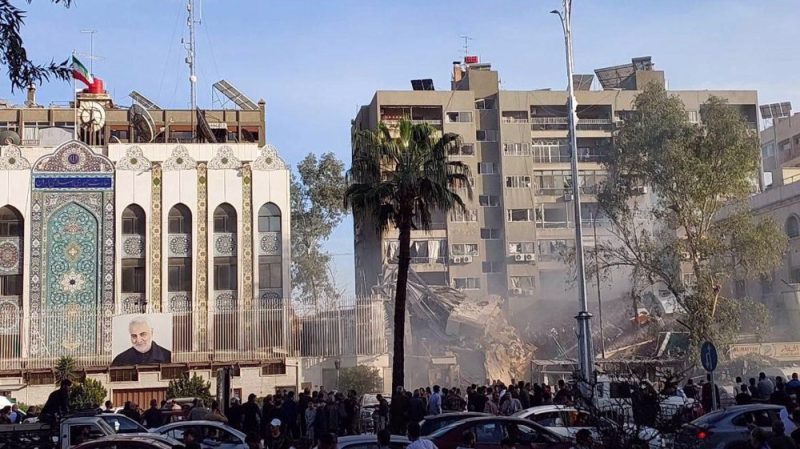
A building next to the Iranian Embassy in the Syrian capital of Damascus comes under a missile attack on April 1, 2024. (Photo by Sputnik)
Press TV – April 1, 2024
The Consular Section of the Iranian Embassy in the Syrian capital of Damascus has come under a missile attack, with immediate reports of casualties as a result of the act of aggression.
Syria’s official news agency, SANA, said the strikes were carried out by “the Israeli enemy” and targeted the Mezzeh neighborhood in Damascus on Monday afternoon.
“At approximately 00:17 p.m. today, the Israeli enemy launched an air aggression from the direction of the occupied Syrian Golan, targeting the Iranian consulate building in Damascus,” SANA said, citing a military source as saying.
“Our air defense media responded to the aggression’s missiles and shot down some of them. The aggression led to the destruction of the entire building and the martyrdom and injury of everyone inside, and work is underway to recover the bodies.”
SANA, citing one of its correspondents, said the Israeli aggression also caused major destruction to “neighboring buildings.”
Unconfirmed reports said several people had lost their lives in the occupying regime’s airstrikes.
Iranian sources added that members of the Iranian diplomatic mission in Damascus, including the ambassador, are unharmed, but the consulate building was destroyed.

The Photo shows the Consular Section of the Iranian Embassy in the Syrian capital of Damascus that came under a missile attack on April 1, 2024. (Via Tasnim News Agency)
Meanwhile, Syrian Foreign Minister Faisal Mekdad has visited Iran’s Embassy following the missile attack.
Condemning the Israeli aggression, Mekdad said, “The Israeli occupation entity will not be able to influence the relations between Iran and Syria.”
US threatens sanctions if Pakistan continues gas pipeline project with Iran
By Ahmed Adel | March 28, 2024
Despite Pakistan dealing with a crippling economic situation, the US has shown little concern for its strategic ally’s issues and, instead of offering support, has threatened tough sanctions if Islamabad decides to continue with the Pakistan-Iran gas pipeline project. Ironically, though, such an action will only push Pakistan closer to China, which the US views as a greater threat to its hegemony than Iran.
“We always advise everyone that doing business with Iran runs the risk of touching upon and coming in contact with our sanctions, and would advise everyone to consider that very carefully,” a US State Department spokesperson told reporters in a press briefing on March 26.
“We do not support this pipeline going forward,” the spokesperson added.
Washington continually emphasises that Pakistan is one of its closest allies and a partner in the fight against terrorism, making the sanctions threat a major development in their bilateral relations. For this reason, Pakistan Petroleum Minister Musadik Malik said on March 27 that Islamabad would seek an exemption from US sanctions over the gas pipeline project.
The Pakistan-Iran gas pipeline, known as the Peace Pipeline, will transport natural gas from Iran to Pakistan. Despite the pipeline’s several years of delays and funding challenges, Pakistan and Iran signed a five-year trade plan in August 2023 with a target of $5 billion. Tehran is evidently desperate for the project to be completed, which had an original deadline of 2015, since it signed the trade plan and overlooked Pakistan not laying the pipeline when Iran has already completed the laying of its 900-kilometre pipeline.
Islamabad claims it could not lay the pipe due to the US sanctions imposed on Iran, but Tehran rejects this excuse. Pakistan is now in a difficult position with the latest US sanction threat when recalling that Tehran issued a third notice in January to Islamabad and announced intentions to go to arbitration court to receive $18 billion for breach of contract.
The threat of US sanctions or paying a huge fine to Iran is only compounding Pakistan’s difficult economic situation, especially as the country is seeking a 24th bailout from the International Monetary Fund.
Pakistani Prime Minister Shehbaz Sharif said on March 26 that his country needs another IMF loan programme to stabilise its fragile economy. An IMF mission that visited Islamabad for five days earlier this month said Pakistan had to meet IMF conditions, including revising its budget and raising interest rates, generating revenue through more taxes, and hiking electricity and gas prices.
Effectively, ordinary Pakistanis are going to suffer a lot more than they already are.
Islamabad and Washington have had longstanding relations rooted in their opposition to the Soviet Union. After the Cold War, the US became dependent on the South Asian country for supplies during its long occupation of Afghanistan. Due to the US’s double standard of using Pakistan as a security partner but also threatening to worsen the country’s economic situation, China has been able to fill the financial void.
Pakistani Foreign Minister Mohammad Ishaq Dar met with Chinese Vice Premier Zhang Guoqing on March 22 in Brussels, where the latter emphasised Beijing’s commitment to aiding Pakistan in addressing its financial challenges. However, just like the Pakistan-Iran gas pipeline, Islamabad continues to stall the implementation of the China-Pakistan Economic Corridor (CPEC), a flagship project of the China-proposed Belt and Road Initiative launched in 2013 to link the Gwadar port in southwestern Pakistan with China’s Xinjiang Uygur Autonomous Region.
Worsening the situation for CPEC is the constant stream of terror attacks against Chinese workers and nationals.
In the latest attack, on March 26, a suicide bomber in the Shangla district of Khyber Pakhtunkhwa rammed an explosive-laden car into a vehicle, killing five Chinese workers and engineers and their Pakistani driver heading to the Dasu Dam, the biggest hydropower project in Pakistan. Less than a week before the suicide attack, Pakistani security forces killed eight Balochistan Liberation Army separatist militants who opened fire on a convoy carrying Chinese citizens outside Gwadar port in the southwestern Balochistan province.
Given that Pakistan is facing a dire economic situation and needs to turn to the IMF and seek more funding from China, US sanctions would be a devastating blow. Sanction threats are especially contradictory for the US since it not only considers Pakistan an ally but overlooks the fact that India invests in the Iranian port of Chabahar, located only 170 kilometres from Gwadar port. Washington overlooks this contradiction since Chabahar rivals the China-funded Gwadar, signalling that the US views China as a much larger threat to its hegemony than Iran, which makes sanction threats more confusing since it will only push Pakistan to be even closer and more aligned with China.
Ahmed Adel is a Cairo-based geopolitics and political economy researcher.
US ‘principal defendant’ for human rights abuse in world: Iran
Press TV – March 15, 2024
Iran has censured the United States’ use of human rights as an instrument, saying Washington is the main defendant of violations of rights in the world and in Israel’s months-long crimes against Palestinians in the besieged Gaza Strip.
Foreign Ministry spokesman Nasser Kan’ani made the statement in a post on his X social media account on Friday following a recent US-instructed report by the United Nations that accused the Islamic Republic of committing what it claimed to be “crimes against humanity” during foreign-backed riots in Iran in 2022.
The report came as the brutal war in the Gaza Strip and the occupied West Bank by the Israeli regime, which enjoys Washington’s untrammeled support, has lingered for more than five months with no end in sight.
“By preemptively activating their propaganda machine concerning human rights in Iran, American authorities will not be able to expunge the stain of oppression and the US complicity in the genocide and mass murders inflicted upon the oppressed Palestinian population in Gaza and the West Bank,” Kan’ani said.
“In the collective conscience of humanity and global public opinion, America stands as the principal defendant for the violation of various human rights and humanitarian laws, owing to its involvement in the provision of equipment and arms to the Zionist regime,” he added.
The spokesman also underlined that Washington’s move to airdrop humanitarian aid into Gaza would not compensate for its unflinching support to the occupying regime’s crimes in the besieged Palestinian territory.
“The ostentatious and hypocritical display by the United States regarding its endeavors to supply and deliver food to the Palestinians fails to mitigate the undeniable reality of its unwavering support for the war crimes committed by the Zionist regime,” Kan’ani said.
“The politicization and instrumentalization of human rights and international human rights mechanisms constitute an inherent aspect of American foreign policy reality.”
Since the start of Israel’s genocidal war following Operation al-Aqsa Storm by Gaza-based resistance movements on October 7, 2023, more than 31,300 Palestinians, including many women and children, have lost their lives.
The Israeli military offensive has left a trail of destruction in Gaza, leaving hospitals in ruins and displacing around half of its 2.4 million residents.
Tel Aviv has additionally enforced a comprehensive blockade on the territory, severing the supply of fuel, electricity, sustenance and water to the population of over two million Palestinians residing there.
Iranian firms turn the page with $20 billion gas deals
Press TV – March 11, 2024
Iranian companies have signed contracts worth $20 billion to boost gas pressure at the giant South Pars (SP) field in the Persian Gulf, in a plan which is expected to generate $900 billion in revenue.
This is the most strategic project in the history of Iran’s oil and gas industry and its long-sought empowerment of domestic entities, under which 90 trillion cubic feet of gas and two billion barrels of gas condensates will be available for use.
Top Iranian companies Petropars, Oil Industries Engineering and Construction (OIEC), Khatam al-Anbiya Construction Headquarters, MAPNA Group, and a consulting company are the contractors of the megaproject.
They inked the contracts in Tehran on Sunday in a ceremony attended by Minister of Petroleum Javad Owji and National Iranian Oil Company (NIOC) Managing Director Mohsen Khojastehmehr.
The world’s biggest gas field is shared between Iran and Qatar which is also installing platforms to boost pressure in the field.
The massive project has created an opportunity to kickstart economic prosperity and employment in the face of sanctions. It has also allowed Iranian producers and companies to proactively engage in the economic growth and industrial development of the country and neutralize the sanctions.
Inattention to domestic companies in various sectors in the past and overreliance on foreign expertise and knowhow undermined their growth and expansion, but the accruing exponential costs on a macro level cascaded on the country which found itself in the lurch for the execution of major projects as foreign firms withdrew in the face of sanctions.
This is while the Iranian companies had always proven their mettle through shouldering grave responsibilities in the most difficult times from eight years of the war on Iran in the 1980s to unfair Western sanctions imposed intermittently since the Islamic Revolution in 1970.
If domestic companies are trusted and engaged in industrial projects, not only will it provide an opportunity to take advantage of their power, capacity and experience, but it will also protect and generate jobs and help achieve the high economic goals of the country.
Every project ceded to domestic companies means providing employment for a number of young people and professionals in the country. This is especially important in provinces such as Khuzestan, where employment does not match the capacities and facilities available in the region.
Therefore, supporting domestic companies – which, of course, does not mean financial support, but giving them a share in industrial projects – will have an irreplaceable effect in the country’s economic growth, job creation, national production jump, economic prosperity and neutralization of sanctions.
Domestic companies, if supported and trusted, can dispense us from the need to foreign firms and provide for their growth and expansion, enabling them to undertake projects overseas and win honor for the region.
While sanctions have forced the governing bodies to change their attitude towards domestic companies and entrust them with tasks which normally they would have not, it should be noted that Iranian producers are not perennial supporters of sanctions. Rather, they would like to interact and acquire world-class technologies from foreign companies to empower themselves.
In sum, many Iranian companies have the ability to produce the equipment needed for projects with the lowest cost and the highest quality and provide it to the applicants, provided that officials continue to put their trust in their capabilities both during the times of sanctions and in their absence.
Iran: A New US-Israeli Provocation
By Viktor Mikhin – New Eastern Outlook – 07.03.2024
In an exclusive interview with Tehran Times, the deputy head of the Atomic Energy Organization of Iran (AEOI), Pejman Shirmardi, rejected claims that his country’s nuclear program is not fully transparent. “From day one, we have made it clear that our nuclear activities are exclusively peaceful. Every time the IAEA has asked us for clarification, we have given them answers. Nothing has changed. Tell us what part of our nuclear program isn’t transparent, and we will prove that it is. As the leader of the Islamic Revolution once said, ‘The West knows very well that it is lying about our nuclear activities,’” the Iranian said.
Condoning Israel’s Nuclear Policy
Pejman Shirmardi made the remark after IAEA Director General Rafael Mariano Grossi, during a summit earlier this month, accused Iran of not being fully transparent about Iran’s relationship with his agency. Even the Western press, however, has picked up on the background to this opinion, writing that the IAEA director general’s reaction is most likely that he chose to ignore Israel’s alarming nuclear threats against the Palestinians in recent months and to shift the focus, as usual, to Iran. Israeli National Heritage Minister Amihai Eliyahu has twice since the beginning of the Gaza war proposed destroying the Strip and the Palestinian civilians living there with nuclear weapons. According to Russian Foreign Ministry spokeswoman Maria Zakharova, the Israeli minister’s statements clearly confirm that Israel has nuclear weapons.
“Against the background of Israel’s historical policy of uncertainty about possessing nuclear weapons, these statements not only explicitly confirm the country’s possession of such weapons, but also demonstrate a willingness to seriously consider their use in completely inadequate scenarios,” the diplomat said.
“This is a very serious reason to think about where the extremist representatives of Israel may be led by the realization of their permissiveness in the conditions of virtually unlimited patronage from the West,” she stressed. In this regard, many noted that IAEA inspectors have never attempted to inspect Israel’s nuclear facilities, despite repeated calls from countries in the region that do not feel safe because of the warmongering policies of the Israeli regime and the West behind it.
It should be noted that experts estimate that the Israeli regime has between 200 and 400 nuclear warheads in its arsenal because of its deliberate ambiguity regarding its nuclear policy. It has repeatedly refused inspections of its military nuclear facilities, not to mention its refusal to sign the Treaty on the Non-Proliferation of Nuclear Weapons (NPT). Yet Iran, as a decent and responsible member of the global community, is a party to the NPT and has consistently maintained that its nuclear program is exclusively civilian in nature and subject to the strictest UN oversight in the world. The policy of double standards is crystal clear. When it comes to stopping the proliferation of nuclear weapons, Israel is absolved of responsibility. As a signatory to the NPT, Iran has a peaceful program for energy and medical purposes, yet it is subject to the most stringent inspection program in IAEA history. And it is against the Islamic Republic, not its counterpart, that the West has imposed the most painful sanctions regime. Israel, with hundreds of nuclear warheads, is not subject to any punitive measures. On the contrary, the regime is endlessly rewarded with more military weapons (paid for by US taxpayers), more money, and more diplomatic and political support.
Grossi’s Hypocritical Policy
The policy of hypocrisy and double standards is clearly seen in the behavior of the Western proxy, IAEA Director General Grossi, which was clearly manifested in his repeated statements on inspections of Iran’s peaceful nuclear program. Anytime inspections were conducted in Iran and official reports confirmed Iran’s compliance with its obligations, Grossi spoke in Tehran and said that everything was going on normally, giving no cause for concern. However, upon his return from Iran and after accusations were made against Iran by the West and especially the US, he consistently changed his viewpoint without proper explanation. He began proclaiming Iran to be a violator, accusing it of not following rules that no one seemed to know. A number of media publications, especially Israeli media, mentioned Grossi’s changing narrative after his return from Iran, noting that he suddenly started criticizing the Iranian side, contrary to previous statements, accusing them of violating international rules.
Thus, based on relevant publications in media all over the world, it is clear that Grossi has repeatedly changed his point of view after the inspections in Iran. He, being a supporter of dialog and cooperation, suddenly started accusing Iran of violating the rules without explaining his position in sufficient detail. This raises serious questions about his integrity and objectivity.
This ambivalent behavior has its own underlying causes, which can be interpreted in various ways. Perhaps political or economic factors influenced Grossi to change his position on Iran. He may have been subjected to pressure or manipulation, causing him to change his point of view. In general, Grossi’s dislike of Iranian inspections is based more on political bias than on facts. However, the change in his position after his visit to Tehran raises questions about his true motives and possible reasons for his ambivalent attitude.
The complicated state of relations between the IAEA and Grossi personally with Iran is a relevant and complex issue in today’s geopolitical arena. Although Grossi, as a professional, is supposed to be objective in his assessments, his harsh bias against Iran can be explained by several factors. First, Grossi, as a security and political expert, is aware of the many factors negatively affecting the stability and security of the region. Iran, in his opinion, is playing an active role in the Syrian conflict by supporting the Assad government and engaging in hostilities. In addition, Iran is suspected by the West of developing nuclear weapons, although there is no evidence to that effect. In light of these circumstances, Grossi probably sees Iran as a potential threat to stability in the region. Second, Grossi may likely be influenced by a number of domestic factors that affect his personal beliefs and interests. For example, he may have strong ties to states and regions that have strained relations with Iran. This connection is extremely personal and may be for historical, religious, or commercial reasons. Such ties may make him more likely to deny or exaggerate Iran’s vulnerability. Finally, Grossi, as the person responsible for communicating information and analysis, may face public and political pressures that may affect his objectivity.
However, despite these factors, as a professional, Grossi must constantly strive for objectivity and carefully weigh all facts and arguments. As a result, Grossi’s subsequent analyses and assessments should be based on facts, taking into account a variety of viewpoints and striving for objectivity as an international UN official serving the interests of the world, not just the whims of the United States.
Provocations of the United States and Israel
With the Israeli regime bogged down in Gaza, the Israeli and US intelligence communities are busy planning a new nuclear crisis with Iran that will overshadow the catastrophic humanitarian crisis currently unfolding in the Palestinian enclave. It has been a relatively long time since Iran’s nuclear program last made global headlines. The last instance of constructive diplomacy between Tehran and Washington occurred when the two sides successfully negotiated a deal to exchange prisoners and release Iranian assets frozen in South Korean bank accounts. The deal was a kind of temporary détente, partly aimed at preserving the status quo and preventing escalation. The unexpected operation by Palestinian resistance groups in the Gaza Strip on October 7 and the Israeli atrocities that followed seemed to further set back the already stagnant nuclear diplomacy.
Now things are changing again, but not in the direction of problem-solving, but towards creating a new nuclear crisis, the consequences of which are expected to make the whole drama in Gaza trivial. While there is nothing new in Iran’s nuclear activities, there is a growing trend on Israel’s part to increase diplomatic pressure on Iran ahead of the next meeting of the Board of Governors of the International Atomic Energy Agency scheduled for March 6. Articles are appearing in the Western media suggesting that Israel, together with the US, is pushing the world toward a new nuclear crisis, this time accusing Iran of enriching uranium to 90 percent, the weapons-grade purity level. By making such dangerous accusations against Tehran, they seek to create a hostile atmosphere with the ultimate goal of censuring Iran at the IAEA Board of Governors meeting.
According to information obtained by the Tehran Times, Israeli Prime Minister Netanyahu has personally approached the Central Intelligence Agency (CIA) about the matter, saying he will advance the planned crisis through hype and convince the CIA at some point in the future. Mired in the quagmire of Gaza, Netanyahu feels increasingly isolated domestically and internationally given his disastrous war in the Strip. As the turmoil over Rafah continues to plague Tel Aviv, Netanyahu has floated the idea of igniting a nuclear crisis with Iran, a scheme designed to divert world attention away from Gaza and undermine the Biden administration by portraying it as weak and unable to deal with Iran’s nuclear program.
Whether the Israeli regime will succeed in provoking a global crisis with Iran through machinations remains to be seen. Iran has so far refrained from any strong negative initiatives and, most recently, even expressed hope that the now defunct Joint Comprehensive Plan of Action (JCPOA) would come back to life. In addition, Iran has begun preparations for the upcoming visit of IAEA Director General Rafael Grossi to Tehran, during which a number of issues of mutual interest are expected to be addressed. The planned escalation of tensions at the next IAEA Board of Governors meeting, however, could derail ongoing efforts to strengthen nuclear de-escalation.
Featured Video

HE SAVED LIVES. NOW HE FACES PRISON.
or go to
Aletho News Archives – Video-Images
From the Archives
NATO Sanctions and the Coming Global Diesel Fuel Disaster
By F. William Engdahl – New Eastern Outlook – 11.04.2022
Amid the ongoing global inflation crisis, NATO heads of state and mainstream media repeat a mantra that high energy prices are a direct result of Putin’s actions in Ukraine since end of February. The reality is that it is the western sanctions that are responsible. Those sanctions including cutting SWIFT interbank access for key Russian banks and some of the most severe sanctions ever imposed, are hardly having an impact on the military actions in Ukraine. What many overlook is the fact that they are increasingly impacting the economies of the West, especially the EU and USA. A closer look at the state of the global supply of diesel fuel is alarming. But Western sanctions planners at the US Treasury and the EU know fully well what they are doing. And it bodes ill for the world economy.
While most of us rarely think about diesel fuel as anything other than a pollutant, in fact it is essential to the entire world economy in a way few energy sources are. The director general of Fuels Europe, part of the European Petroleum Refiners Association, stated recently, “… there is a clear link between diesel and GDP, because almost everything that goes into and out of a factory goes using diesel.” … continue
Blog Roll
 Aletho News
- Trita Parsi: Middle East Unraveling — Are We on the Path to World War?
- Iran FM meets with US envoy on UN meeting’s sidelines at American side’s insistence: Report
- Qatar PM calls for Gulf security framework with Iran, says war must be ‘wake-up call’
- China condemns US extortion of Iranian airlines, rejects Washington’s ‘illegal’ sanctions threats
- Italy to move military personnel from Taif base after missile strike
- Finland’s Stubb tells European leaders to calm down
- Defeating Russia on battlefield impossible – Fico
- Finland’s Gender Clinic Reversal
- Massachusetts Wants Mental Health Visits, Why Does Government Use ‘Health’ to Enter Our Homes & Families?
- US lawmaker admits American people footing bill for Trump’s failed aggression against Iran
- If Americans Knew
- Sanctions are collective punishment: immoral and self-defeating
- Phosphorus Munitions Fired by Israel Burn Groves, Orchards in Southern Lebanon
- Israel Carries Out New Ceasefire Violations Across Gaza
- AI – Emphasis on the ‘I’: Israel Is Funding AI Chatbot Propaganda
- Israel Blocking Hundreds of Wheelchairs for Injured Children From Entering Gaza
- Israel Is Expanding and Upgrading Compounds for Palestinian Militias in Gaza
- The Palestinian-American Residents of This West Bank Town Are Wondering: Where Is Trump?
- Gaza desperately needs tents, wheelchairs, fuel… and everything else (Israel blocks it all) – Daily Update
- Israeli Attacks in Gaza Kill at Least Seven Palestinians Over Three Days, including Woman and Child
- Trump’s militarization of Washington DC as he pursues Israel’s war against Iran
- No Tricks Zone
- New Study: Earth And Venus Surface Warmth Largely Explained By Convection And Lapse Rate, Not CO2 Or Radiation
- 2025 Nature Paper Claiming Worsening Global Drought Gets RETRACTED …Heavily Flawed
- New Study: ‘Global Drought Shows No Detectable Recent Acceleration Under Climate Warming’
- Economic Masterminds: German Socialists Suggest Taxing Productivity Gains Stemming From Using AI
- The South China Sea Has Not Been Cooperating With The Climate Change Narrative
- Energy Crisis: Germany Enters Heating Season With Historically Low Gas Reserve Fill Levels
- New Study: The Antarctic Ice Sheet Gained Mass From 2020-2024 Due To Staggering Snow And Ice Accumulation
- Study: Ocean Heating Rates From Thousands Of Years Ago ‘Dwarf’ Modern Ocean Heating Rates
- Climate Extremists Target, Attack Large-Scale Power Grid Infrastructure In Germany!
- New Study: Antarctic Ice Melt Has Contributed Less Than 1 Centimeter To Sea Level Rise In The Last 30 Years

