Iranian Navy Detains US Oil Tanker in Gulf of Oman
Press TV – January 11, 2024
The Navy of the Islamic Republic of Iran has announced the seizure of an American oil tanker with a court order in the Sea of Oman.
The United Kingdom Maritime Trade Operations (UKMTO) identified the tanker Marshall Islands-flagged St Nikolas, saying it was boarded at about 7:30 am (0330 GMT) off Sohar in Oman and changed course towards Bandar-e-Jask in Iran.
Ambrey, a British maritime risk company, said the recently renamed tanker was previously prosecuted and fined for carrying Iranian oil, which was confiscated by US authorities.
“Iran has previously taken action against those it has accused of cooperating with the US,” it added.
The vessel had been loaded with 145,000 tonnes of crude oil in Basra, Iraq and was destined for Aliaga in Turkey via the Suez Canal, the tanker’s Greece-based management company Empire Navigation said.
Last August, the US Navy unloaded a tanker of stolen Iranian oil worth around $56 million off the Texas port, despite warnings from Iran and after American oil firms had resisted the temptation of touching the 800,000-barrel tanker for fear of Iranian retaliation in the Persian Gulf waters.
The decision came as Iran was marking the 70th anniversary of the CIA-engineered military coup against Iran’s then-PM Mohammad Mosaddeq.
The Marshall Islands-flagged Suez Rajan tanker carrying Iranian oil was illegally seized by Washington in April 2023 under the guise of “a sanctions-enforcement operation” and guided toward the Texas port.
It came days after a group of US senators and House representatives, at the behest of the Israeli lobby in Washington, began mounting pressure on the Joe Biden administration to unload the tanker, without considering its possible repercussions.
It was not the first time the US had resorted to the unconventional step of seizing a sovereign country’s cargo in international waters.
In May 2022, the US seized a Russia-operated ship, the Pegas, carrying Iranian oil off the shore of Karystos near Greece to dispatch the oil cargo to the US but the Greek court ruled against the move.
In February 2021, Washington seized a tanker carrying Iranian oil off the coast of the Emirati city of Fujairah and sold more than a million barrels of oil confiscated from it for $110 million, or $55 a barrel.
The Unite States has also regularly stolen Syrian oil in recent years under the guise of anti-terror operations in the Arab country. In August 2022, the Syrian oil ministry accused the US and its mercenaries of stealing 66,000 barrels of oil per day, accounting for almost 80 percent of the country’s oil production.
Gaza destroys western divide-and-rule narratives
By Sharmine Narwani | The Cradle | January 4, 2024
It could be a clean sweep. Decades of western-led narratives crafted to exploit differences throughout West Asia, create strife amid the region’s myriad communities, and advance western foreign policy objectives over the heads of bickering natives are now in ruins.
The war in Gaza, it transpires, has blown a mile-wide hole in the falsehoods and fairytales that have kept West Asia distracted with internecine conflicts since at least the 1979 Islamic Revolution in Iran.
Shia versus Sunni, Iran versus Arabs, secular versus Islamist: these are three of the west’s most nefarious narrative ploys that sought to control and redirect the region and its populations, and have even drawn Arab rulers into an ungodly alliance with Israel.
Facts are destroying the fiction
It took a rare conflict – uncooked and uncontrolled by Washington – to liberate West Asian masses from their narrative trance. Israel’s genocidal assault on Gaza also brought instant clarity to the question of which Arabs and Muslims actually support Palestinian liberation – and which do not.
Iran, Hezbollah, Iraqi resistance factions, and Yemen’s Ansarallah – maligned by these western narratives – are now visibly the only regional players prepared to buttress the Gaza frontline, whether through funds, weapons, or armed clashes that aim to dilute and disperse Israeli military resources.
The so-called ‘moderate Arabs,’ a misnomer for the western-centric, authoritarian Arab dictatorships subservient to Washington’s interests, have offered little more than lip service to the carnage in Gaza.
The Saudis called for support by hosting Arab and Islamic summits that were allowed to do and say nothing. The Emiratis and Jordanians trucked supplies to Israel that Ansarallah blockaded by sea. The mighty Egypt hosted delegations when all it needed to have done was to open the Rafah Crossing so Palestinians can eat. Qatar – once a major Hamas donor – now negotiates for the freedom of Israeli captives, while hosting Hamas ‘moderates,’ who are at odds with Gaza’s freedom fighters. And Turkiye’s trade with the Israeli occupation state continues to skyrocket (exports increased 35 percent from November to December 2023).
Palestine, for the pro-west ‘moderate Arabs,’ is a carefully handled flag they occasionally wave publicly, but sabotage privately. So, they watch, transfixed and horrified today, at what social media and tens of millions of protesters have made crystal clear: Palestine remains the essential Arab and Muslim cause; it may ebb and flow, but nothing has the power to inflame the region’s masses like this particular fight between right and wrong.
The shift toward resistance
It is early days yet in the battle unfolding between the region’s Axis of Resistance and Israel’s alliances, but the polls already show a notable shift in public sentiment toward the former.
An Arab barometer poll taken over a six-week period – three weeks before and three weeks after the Al-Aqsa Flood operation – provides the first indication of shifting Arab perceptions. Although the survey was restricted to Tunisia, the pollsters argue that the country is “as close to a bellwether as one could imagine” and that it represents views similar to other Arab countries:
“Analysts and officials can safely assume that people’s views elsewhere in the region have shifted in ways similar to the recent changes that have taken place in Tunisia.”
The survey results should be of paramount concern to meddling western policymakers: “Since October 7, every country in the survey with positive or warming relations with Israel saw its favorability ratings decline among Tunisians.”
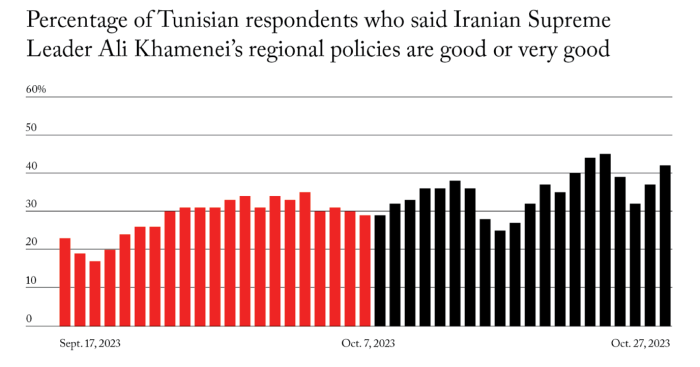
The US saw its favorability numbers plummet the most, followed by West Asian allies that have normalized relations with Israel. Russia and China, both neutral states, experienced little change, but Iran’s leadership saw its favorability figures rise. According to the Arab barometer:
“Three weeks after the attacks, Iranian Supreme Leader Ali Khamenei has approval ratings that matched or even exceeded those of Saudi Crown Prince Mohammed bin Salman and Emirati President Mohammed bin Zayed.”
Before 7 October, just 29 percent of Tunisians held a favorable view of Khamenei’s foreign policies. This figure rose to 41 percent according to the conclusion of the survey, with Tunisian support most notable in the days following the Iranian leader’s 17 October reference to Israel’s actions in Gaza as a “genocide.”

The Saudi shift
Prior to the 7 October operation by the Palestinian resistance to destroy the Israeli army’s Gaza Division and take captives as leverage for a mass prisoner swap, the region’s main geopolitical focus was on the prospects of a groundbreaking Saudi normalization deal with Tel Aviv. The administration of US President Joe Biden flogged this horse at every opportunity; it was seen as a golden ticket for his upcoming presidential election.
But Operation Al-Aqsa Flood ruined any chance for Saudi Arabia – home to Islam’s holiest sites – to seal that political deal. And with Israeli airstrikes raining down daily on Palestinian civilians in Gaza, Riyadh’s options continue to shrink.
A Washington Institute poll conducted between 14 November and 6 December measures the seismic shift in Saudi public sentiment:
A whopping 96 percent agree with the statement that “Arab countries should immediately break all diplomatic, political, economic, and any other contacts with Israel, in protest against its military action in Gaza.”
Meanwhile, 91 percent believe that “despite the destruction and loss of life, this war in Gaza is a win for Palestinians, Arabs, and Muslims.” This is a shockingly unifying statement for a country that has adhered closely to western narratives that seek to divide Palestinians from Arabs, Arabs among themselves, and Muslims along sectarian lines – geographically, culturally, and politically.
Although Saudi Arabia constitutes one of the few Arab states to have designated Hamas as a terrorist organization, favorable views of Hamas have increased by 30 percent, from 10 percent in August to 40 percent in November, while most – 95 percent – do not believe the Palestinian resistance group killed civilians on 7 October.
Meanwhile, 87 percent of Saudis agree with the idea that “recent events show that Israel is so weak and internally divided that it can be defeated some day.” Ironically, this is a long-stated Resistance Axis refrain. Hezbollah Secretary General Hassan Nasrallah was famously quoted as saying “Israel is weaker than a spider’s web,” upon its defeat by the Lebanese resistance on 25 May, 2000.
Prior to 7 October, Saudis had strongly favored economic ties with Israel, but even that number dropped dramatically from 47 percent last year to 17 percent today. And while Saudi attitudes toward the Resistance Axis remain negative – Saudi Arabia, after all, has been the regional epicenter for anti-Iran and anti-Shia propaganda since the 1979 revolution – that may be largely because their media is heavily controlled.
Contrary to the observations of the Arab masses, 81 percent of Saudis still believe that the Axis is “reluctant to help Palestinians.”
The Palestinian shift
Equally important to the discussion of Arab perceptions is the shift seen among Palestinians themselves since 7 October. A poll conducted by the Palestinian Center for Policy and Survey Research (PSR) in both the occupied West Bank and Gaza Strip between 22 November and 2 December mirrors Arab views, but with some nuances.
Gazan respondents, understandably, displayed more skepticism for the ‘correctness’ of Hamas’ Operation Al-Aqsa Flood, which triggered Israel’s genocidal assault on the Strip in which over 22,000 civilians – mostly women and children – have so far been brutally killed. While support for Hamas increased only slightly in the Gaza Strip, it tripled in the West Bank, with both Palestinian territories expressing near equal disdain for the western-backed Palestinian Authority (PA), which governs from Ramallah.
Support for acting PA President Mahmoud Abbas and his Fatah party was hit hard. Demands for his resignation are at nearly 90 percent, while almost 60 percent (the highest number recorded in a PSR poll to date in relation to this matter) of those surveyed want a dissolution of the PA.
Over 60 percent of Palestinians polled (closer to 70 percent in the West Bank) believe armed struggle is the best means to end the occupation, with 72 percent agreeing with the statement that Hamas made a correct decision to launch its 7 October operation, and 70 percent agreeing that Israel will fail to eradicate the Palestinian resistance in Gaza.
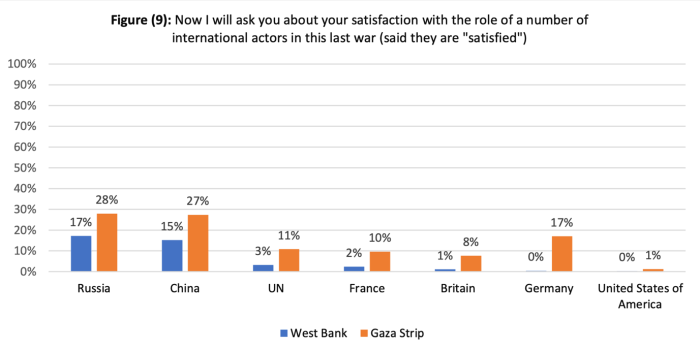
Palestinians have strong views about regional and international players, who they largely feel have left Gaza unprotected from Israel’s unprecedented violations of international law.
By far the country most supported by respondents is Yemen, with approval ratings of 80 percent, followed by Qatar (56 percent), Hezbollah (49 percent), Iran (35 percent), Turkiye (34 percent), Jordan (24 percent), Egypt (23 percent), the UAE (8 percent), and Saudi Arabia (5 percent).

In this poll, the region’s Axis of Resistance dominates the favorability ratings, while pro-US Arab and Muslim nations with some degree of relations with Israel, fare poorly. It is notable that of the four most favorable countries and groups for mostly-Sunni Palestinians, three are core members of the “Shia” Axis, while five Sunni-led states rank lowest.
This Palestinian view extends to non-regional international states, with respondents most satisfied with Resistance Axis allies Russia (22 percent) and China (20 percent), while Israeli allies Germany (7 percent), France (5 percent), the UK (4 percent), and the US (1 percent) struggle to maintain traction among Palestinians.
The numbers depend on the war ahead
Three separate polls show that Arab perceptions have shifted dramatically over Israel’s war on Gaza, with popular sentiment gravitating to those states and actors perceived to be actively supporting Palestinian goals, and away from those who are perceived to support Israel.
The new year starts with two major events. The first is the drawdown of Israeli reservists from Gaza, whether because Washington demands it, or due to unsustainable loss of life and injury to occupation troops. The second is the shocking assassination of Hamas leader Saleh al-Arouri and six others in Beirut, Lebanon, on 2 January.
All indications are that Israel’s war will not only continue, but will expand regionally. The new US maritime construct in the Red Sea has drawn other international actors into the mix, and Tel Aviv has provoked Lebanon’s Hezbollah in a major way.
But if the confrontation between the two axes escalates, Arab perceptions will almost certainly continue to tilt away from the old hegemons toward those who are willing to resist this US-Israeli assault on the region.
There will be no relief for Washington and its allies as the war expands. The more they work to defeat Hamas and destroy Gaza, and the more they lob missiles at Yemen, Iraq, and Syria, and besiege the Resistance Axis, the more likely Arab populations are to shrug off the Sunni-versus-Shia, Iran-versus-Arab, and secular-versus-Islamist narratives that have kept the region divided and at odds for decades.
The swell of support that is mobilizing due to a righteous confrontation against the region’s biggest oppressors is unstoppable. Western decline is now a given in the region, but western discourse has been the first casualty of this war.
Two terrorist blasts in Iran’s Kerman leave at least 103 dead, 188 injured
Press TV – January 3, 2024
Hundreds of people have been killed and injured in two terrorist blasts near the burial site of Iran’s General Qassem Soleimani in the city of Kerman during a ceremony marking his fourth martyrdom anniversary.
Iran’s emergency organization said that the explosions left 103 people dead and 188 more injured.
Medical services said the death toll is expected to rise as ambulances were taking the wounded to hospitals, with Babak Yektaparast, deputy head of Iran’s Emergency Organization, saying that some of the injured are in critical condition.
According to IRNA, the first explosion occurred some 700 meters from the grave of General Soleimani and the second one about one kilometer away.
Tasnim news agency cited unnamed sources as saying that two bags loaded with explosives which were remotely detonated caused the explosions. IRNA also quoted an informed source as saying two bombed bags detonated by remote control caused the explosions.
The first explosion occurred at 14:50 local time. The second one took place 10 minutes later, according Kerman Mayor Saeed Tabrizi, ISNA reported.
Iran’s Red Crescent Society said three rescuers were killed by the second blast.
Some people were injured during a crowd crush following the first explosion. Officials say all the injured have been transferred to hospitals and the situation is under control.
There was no immediate claim of responsibility for the attack.
Meanwhile, the Iranian cabinet of ministers has announced a day of national mourning on Thursday.
Iran’s Interior Minister Ahmad Vahidi told the Islamic Republic of Iran’s News Network that a crushing response will soon be given to the culprits.
He said the bombing attacks were a continuation of various plots to kill innocent civilians at ceremonies across the country, many of which had been foiled by Iranian security services.
He said the situation is now under the control of security forces.
According to the minister, most of the fatalities were caused by the second blast. The blast is under investigation and further details will be announced by officials as soon as possible.
Iran’s Judiciary Chief Gholam-Hossein Mohseni-Ejei vowed the perpetrators and those responsible for the attack will be swiftly hunted down and brought to justice.
He blamed the attacks on terrorists backed by the world arrogance who harbor deep grudges against General Soleimani, saying they’ve chosen to take revenge on the people after their various plots against the country’s security were foiled.
General Soleimani, commander of the Quds Force of Iran’s Islamic Revolution Guards Corps (IRGC), and Abu Mahdi al-Muhandis, the second-in-command of Iraq’s Popular Mobilization Units (PMU), and their companions were assassinated in a US drone strike authorized by then-US President Donald Trump near Baghdad International Airport on January 3, 2020.
Both commanders were highly revered across the Middle East because of their key role in fighting the Daesh Takfiri terrorist group in the region, particularly in Iraq and Syria.
In less than a week after the attack, Iraqi lawmakers approved a bill that required the government to expel all US-led foreign forces from the country.
The IRGC also targeted the US-run Ain al-Asad base in Iraq’s western province of Anbar with a wave of missile attacks in retaliation for the assassination of General Soleimani.
The enabler of our two concurrent world wars: Washington
By Gilbert Doctorow | January 2, 2024
It is only the second day of the New Year, but you turn on the morning news with a feeling of trepidation. Here in Western Europe, the lead stories are death and destruction reported from the front lines of the two conflagrations that some commentators have identified as ‘world wars,’ given the way countries across the globe have aligned themselves with or against the protagonists in each conflict. The outstanding commonality between these two world wars is the position of the United States as their enabler in terms of delivery of essential military and financial support to one side, as well as real-time military intelligence, tactical and strategic counseling by high level officers positioned on the ground and in nearby seas. From the perspective of Washington, these are proxy wars which put at risk very few of its own men at arms, though some do come home in body bags without word to the press, while preparations proceed apace for the launch of a third proxy war in the South China Sea. The Philippines are the latest recruits to the prospective encirclement and assault on China.
On their talk shows, the Russians speculate on when a mutual defense pact with Iran, China and North Korea will be announced. This will not be a bloc, like NATO, but will enshrine the key principle of ‘one for all and all for one’ in case of attack by outside forces. To its backers in Moscow, this formulation would ensure that NATO generals understand they are up against an enemy of over two billion if we include a few other fellow travelers, not just the 145 million Russians whom they see across the border.
But that is what they say on talk shows. It is not the official voice of the Kremlin, which we find on Vesti television. Vesti maintains a near blackout of news on the Israel-Hamas war in broadcasts to its home audience. Why? Because Russia does not want to get embroiled in that war when it needs all its human and materiel resources to defeat the Ukrainians and their NATO backers. Moreover, Russia can be satisfied that the Iranians and their Houthi proxies have the situation in the Middle East under control, restraining the United States from region-wide escalation by engaging directly on Israeli’s side.
For that matter, Iran is doing just fine in shoring up Russia’s southern borders in the Caucasus. For more than a year, Armenia’s prime minister Nikol Pashinyan has been sitting on two stools: holding consultations with the French and intermittently attending gatherings of the Former Soviet Union republics called by Moscow. A week ago, Iranian leaders issued a direct warning to Armenia not to even think about pursuing the military and political rapprochement that France’s president Macron has been proposing. Said President Raisi: ‘No powers from outside the region are welcome in the Caucasus.’ This warning serves Russian security very well, though it is surely motivated by self-interest in Teheran, because any future French military presence in Armenia could also threaten them.
In Russian news, all attention is on the one conflict in which the Russians are themselves deeply engaged, and there news from the line of contact, news from the home front which a day ago experienced a murderous attack on the border town of Belgorod that killed 25 civilians and gravely injured another fifty or so, news from the United Nations Security Council deliberations of the same, more than fill the time allotted to 14.00 o’clock and 20.00 o’clock wrap-ups.
Anyone following developments of the Ukrainian war these past few days will note the tit for tat nature of the strikes dealt out by the warring parties day after day. The chain of events began early on the morning of Wednesday, 26 December, when the Ukrainians deployed air-launched Storm Shadow cruise missiles to destroy the Novocherkassk, a large landing ship of Russia’s Black Sea Fleet parked in the harbor of Feodosia, on the eastern shores of the Crimea. The ship was said to be loaded with drones and the missile strike set off a fire and explosions that may have killed as many as 74, both on the ship and in the port.
However, the outstanding feature of the attack was not the numbers of the dead or the loss of the ship itself: it was the demonstration that Kiev had now been given a Storm Shadow variant with much greater flight range than the initial shipments from the U.K. and France.
From the perspective of the Russian high command, this new ability of the Ukrainians to strike far deeper into Russian territory represented a serious escalation of the conflict which required mirror-image escalation from Russia. The Russian response was not long in coming: on the 27th, Russia launched the largest missile attack on Ukraine since the start of the Special Military Operation, more than 150 ballistic missiles, cruise missiles and armed drones, directed at cities across the Ukraine, including Kiev. Some of these were shot down by Ukrainian air defense, but the Zelensky regime admitted that all 20 Russian ballistic missiles evaded their fire and hit their targets.
From the partial information released by the Russian military, it would appear that their main interest was to destroy caches of the Storm Shadow and also the most advanced Western ground to air missiles. They claim to have destroyed a Patriot complex in the Lvov region, killing a substantial number of French military who were in charge of the installation. This is the sort of information which flits by in a second and is not repeated, so I can say no more.
The Ukrainian response the next day was a concentrated attack on the Russian border city of Belgorod, capital of an oblast of the same name. Belgorod is not more than 20 km from Ukraine’s second largest city, Kharkiv, and it first made international news about six months ago when a Ukrainian team of saboteurs claiming to be anti-Putin Russians crossed into the oblast and attacked residential neighborhoods. This time missiles were sent into apartment blocks and other civilian structures, killing some 25 Russians and gravely wounding perhaps 50 more, some of whom were evacuated to Moscow by plane on life support.
Yesterday and today the Russians avenged this serious loss by renewed missile attacks, now concentrated on Kharkiv, whence the attack on Belgorod had come. They demolished the headquarters of military intelligence in the city, claiming to have killed many foreign advisers, probably British and Americans, who were guiding the attacks. They also struck air fields across Ukraine which could be used to service planes carrying the Storm Shadow.
I end this overview with the remark that American-British escalation of the weaponry deployed against Russia was at the start of what we have witnessed these past six days. And that can be no accident. It follows from the news of the war in the immediately preceding period, which unequivocally demonstrated that on the ground, along the line of contact, the Russian forces were moving steadily to overrun Ukrainian positions and force a retreat. The storming of Mariinka was emblematic in this sense. The overall impression was depressing for the Ukrainian cause at the very time that Congress was in recess after rejecting efforts by the Administration to pass legislation ensuring continued financial and military aid to Kiev. Now these Ukrainian missile attacks on the Black Sea fleet in the Feodosia harbor and the attack on civilians in what is properly speaking Russian Federation territory of Belgorod oblast would give luster to the Ukrainian cause while prodding the Russians to escalate and perform what Washington would showcase as war crimes.
Escalation is the game Washington is playing. In Ukraine. In the Red Sea. In the Eastern Mediterranean off the coast of Lebanon. Washington seems oblivious to the possibility that the proxy wars it is fanning may yet invite a Russian, or Iranian, or North Korean strike directly on U.S. assets, whether overseas or on the Continental United States.
Iran Deploys Cruise Missile-Armed Warship in Red Sea Amid US-Houthi Standoff

By Ilya Tsukanov – Sputnik – 01.01.2024
The Alborz, an Iranian Navy Alvand-class frigate armed with long-range anti-ship missiles and anti-submarine warfare equipment, entered the Red Sea after passing through the Bab al-Mandab Strait, Iranian media reported on Monday.
Pointing to the nation’s record of operations in regional waters since the late 2000s fighting piracy and securing international shipping lanes, Iranian media indicated that the warship’s deployment to Red Sea now comes amid an “increase of tensions” in the wake of the Gaza crisis, Houthi operations against Israeli-owned and -bound commercial cargoes, and US attacks against the Yemeni militia.
Commissioned in 1971 and named after the Alborz mountain range, the Alborz is classified as a destroyer by Iran, but classed a frigate by many foreign military observers. The 1,100 ton, 94.5 meter long vessel has a 9,000 km range, a complement of over 125 officers and crew, and is fitted with Noor anti-ship sea-skimming turbojet-powered cruise missiles, which have a range of up to 220 km and can accelerate to up to Mach 1.4 in their terminal stage.
The warship underwent major capital repairs and the installation of new equipment in 2018, and was equipped with indigenously-developed combat systems in 2020, including new close-in air defense weapons, as well as electronic warfare and target detection and tracking systems.
The Alborz took part in the Iran-Iraq War of 1980-1988. In 2021, the ship successfully fought off a pirate attack against an Iranian oil tanker in the Indian Ocean. The warship has also taken part in joint exercises with Russian and Chinese warships in recent years.
The vessel’s deployment in the Red Sea comes amid the continued deterioration of the security situation in the region, with the US military drawing first blood in its campaign against Yemen’s Houthi militants (who are attempting to close the body of water to Israeli-owned or affiliated commercial shipping) on Sunday, destroying three Houthi boats and killing ten fighters. The Houthis warned of “repercussions,” signaling the possibility of direct attacks against the warships of the US and its allies.
Earlier, UK media reported that British and US naval forces were planning “direct action” against the Houthis after issuing the militia with a “verbal final warning” about its Red Sea anti-shipping campaign.
Washington and its allies have repeatedly accused Iran of supporting the Houthis militarily. Tehran and Sanaa have each separately dismissed these claims, with Iranian officials insisting that their assistance for the Yemeni militia have been limited to moral support as part of the loose regional ‘Axis of Resistance’ anti-US, anti-Israeli coalition, and the Houthis saying their decision to launch operations against Israel in solidarity with the Palestinians were taken independently.
Israel provokes Iran with assassination in bid to draw the US into war
By Trita Parsi | December 25, 2023
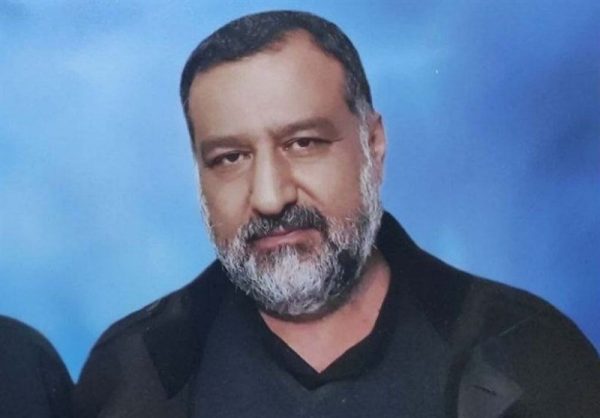
Some brief analysis of the implications of the assassination of Iran’s top commander in Syria, Radhi Mousavi, presumably by Israel.
Bottom line: Israel either killed Mousavi as a warning to Iran, given Tehran’s support for the Houthis’ targeting of ships in the Red Sea, as a provocation to beget an Iranian response that would give Israel the pretext to enlarge the war, or as a preparatory move to enlarge the war regardless of Iran’s response.
It is very likely that Israel is behind the assassination of Mousavi since it is the only power with both a motive and capacity to pull off such a killing – not to mention a long history of assassinating Iranian operatives. The US has the capacity but not necessarily the motive. The analysis below rests on the rather safe assumption that Mousavi was assassinated by Israel.
US intelligence believes that Iran has been actively involved in the Houthi movement’s targeting of ships in the Red Sea, which has effectively closed the Bab el-Mandeb Strait for Israel and cost the Israeli economy billions of dollars. The Houthis insist they will continue the attacks – despite threats of retaliation from the US – until Israel ceases its bombardment of Gaza. Israel, of course, refuses and Biden is loath to press Israel for a ceasefire. From Israel’s perspective, Iran is not paying a price for its alleged role in the Red Sea attacks. The assassination may, as a result, be a warning to Iran that Israel has the capacity and willingness to exact a price from Iran – even in areas where the Iranians may have presumed that they are safe.
In a second scenario, the assassination may be a deliberate provocation to beget an Iranian response that would give Israel the pretext to enlarge the war. While the Biden administration has given Israel a complete green light to bomb Gaza to smithers, Biden opposes an expansion of the war since that very likely could drag the US into it. The debate inside the Israeli government is increasingly leaning toward expanding the war – they have already mobilized +300,000 troops and there is a growing belief in Israel that it simply is intolerable for Israel to live next to Hezbollah. They thought they could manage the threat from Hamas – and they couldn’t. Even though it wasn’t Hezbollah that attacked Israel on Oct 7, the Israeli argument is that next time it might be Hezbollah, and as a result, Israel has no choice but to expand the war. But unless there is an attack from Iran or Hezbollah itself, the US may continue to oppose such a move.
But the assassination of Mousavi may cause Iran to retaliate against Israel via Hezbollah, the reasoning goes, and Israel can then use Hezbollah’s action as a pretext to not only expand the war to Lebanon – but also force the US to go along with it.
There is also a third explanation. According to Amwaj Media, Mousavi was in charge of facilitating the entry of Iran-led forces and arms shipments to Syria as well as Lebanon’s Hezbollah movement. If Israel intends to attack Lebanon, taking out Mousavi could be a logical first step to disrupt the arming of Hezbollah as well as its supply lines. As such, the assassination may be a preparatory move to enlarge the war regardless of Iran’s response to the killing of Mousavi.
All of these scenarios point to one undeniable reality: As long as Biden refuses to pressure Israel to accept a ceasefire in Gaza, tensions in the region will continue to rise and the Middle East will gravitate towards a regional war that very likely will engulf the US as well. Biden may think that he can control these events and allow Israel to slaughter the people in Gaza while keeping a lid on the escalation risk. He is likely wrong – and the American people may soon find themselves in yet another unnecessary war in the Middle East because of Biden’s strategic incompetence.//
India deploys warships to Arabian Sea following attack on Israeli-linked ship
The Cradle | December 26, 2023
The Indian Navy has deployed three guided missile destroyers to the Arabian Sea in response to an alleged drone attack on an Israeli-linked chemical tanker last week.
New Delhi also uses long-range maritime patrol aircraft for “domain awareness,” the defense ministry reported Monday night.
On Saturday, the Liberian-flagged MV Chem Pluto, a Japanese-owned tanker traveling 370km off the coast of India, was reportedly hit by a kamikaze drone, according to the Pentagon.
The Israeli-linked tanker had been on its way from Saudi Arabia to India, according to maritime security firm Ambrey.
The Indian Navy says they are examining the specifics of the attack on the MV Chem Puto, which managed to anchor in Mumbai on 26 December.
Although Indian officials say a preliminary evaluation suggests a drone strike, they emphasize that additional forensic and technical examinations are necessary to determine the exact method of attack.
Washington blamed the attack on Iran, saying the drone had been launched “directly” from the Islamic Republic.
“We declare these claims completely worthless,” said Nasser Kanaani, spokesman for the Iranian foreign ministry, on Monday.
“Such claims are aimed at projecting, distracting public attention, and covering up for the full support of the US government for the crimes of the Zionist regime in Gaza,” he added.
Saturday’s drone attack came less than a week after the US announced the formation of the so-called Operation Prosperity Guardian, described by US officials as a new “coalition of the willing” that seeks to counter the threat posed by Yemen in the Red Sea.
Although the Yemeni armed forces have been conducting the attacks against Israeli-linked vessels of their own accord, the Pentagon insists Iran is somehow involved.
“The [Yemeni] resistance has its own tools […] and acts by its own decisions and capabilities,” Iran’s Deputy Foreign Minister Ali Bagheri told Mehr News Agency on Saturday.
“The fact that certain powers, such as the US and the Israelis, suffer strikes from the resistance movement […] should in no way call into question the reality of the strength of the resistance in the region,” he added.
IRGC’s veteran military advisor in Syria martyred in Israeli strike
Press TV – December 25, 2023
A veteran member of Iran’s Islamic Revolution Guards Corps (IRGC), who was serving as a military advisor in Syria, has been martyred in an Israeli airstrike in the Sayyeda Zeinab neighborhood of Damascus.
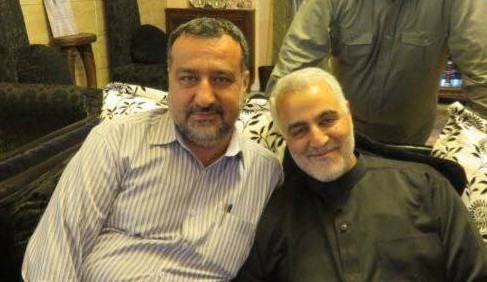
The senior IRGC commander, Seyyed Razi Mousavi, was martyred by the Israeli regime on Monday while on an advisory mission, Press TV’s correspondent in Damascus reported.
Mousavi was one of the companions of Iran’s top anti-terror commander, Lieutenant General Qassem Soleimani, who was assassinated by the US in Iraq four years ago.
General Soleimani, commander of the Quds Force of the IRGC, and his Iraqi trenchmate Abu Mahdi al-Muhandis, the second-in-command of Iraq’s Popular Mobilization Units (PMU), were martyred along with their companions in a US drone strike on January 3, 2020.
The Israeli regime has for years targeted what it calls Iran-linked positions in Syria.
In a statement, the IRGC said Mousavi was martyred in a criminal missile attack by the “fake and child-killing Zionist regime” adding that the usurping and savage Israeli regime would undoubtedly pay the price for this crime.
Attacking Yemen Is a Waste of Time, Money and Resources
By Declan Hayes | Strategic Culture Foundation | December 22, 2023
What to do with a problem like Yemen and its 2,000 km (1,200 mile) long Red Sea coastline? And indeed with Eritrea, Djibouti and Somali, all three of which share maritime borders with Yemen.
The issue is that Yemen’s Houthi have decided that all ships using the Red Sea that have any connection, near or far, with Israel, are legitimate targets for its batteries of missiles some of which, as previously discussed, are almost unstoppable ballistic missiles.
The problem is how to sail Israeli and other targeted ships through the Bab el-Mandeb Strait and thence onwards to pay the $500,000-$1,000,000 toll to sail through Egypt’s Suez Canal. This problem is compounded by (Russia’s) dark and grey fleets, which transfer embargoed oil, being allowed free passage and the Chinese, which have a major naval base in nearby Djibouti, playing schlump about the whole matter. NATO’s problem is how to deal with the Houthi, whilst also marginalising China, Iran and Russia, all three of which have very big dogs in this very important fight.
Although diplomacy would seem an obvious candidate to help resolve matters NATO, in its wisdom, long ago discarded that card and China is, in any event, playing a totally different and far more incendiary global game.
On top of all that, NATO’s major shipping lines have their own profiteering demands, which further complicate matters. In essence, those major companies want NATO to escort all its ships, and not just those flying NATO flags, in convoy through the Red Sea. Although that would benefit them, NATO is primarily obliged to protect its own fleet and not the 40% of the world’s ships that fly the flags of open registry countries like Panama, Liberia and the Marshall Islands or, heaven forbid, that transport dark or grey cargo on behalf of Russia and its partners. And, if that were not enough, many non-eligible ships carry military ordnance for NATO and, most likely, Israel as well.
Even if NATO were, like Tom Hanks in Greyhound, to convoy some or all of those ships through the Red Sea, there is no guarantee that they would not be hit there or further up the chain, say in the Suez Canal itself. Although convoys are a risk those large shipping companies should probably run, their extreme risk aversion means they instead prefer to detour past the entire African continent and thereby weaken NATO’s already weak supply chains by needlessly extending them. NATO’s shipping companies are divided on how best to respond and, of course, a house divided cannot stand.
The second and third options are to plonk NATO armadas off the Yemeni coast, to send marines and French legionaries ashore and to bomb the living shit out of the Yemeni, to poke the Houthi hornet’s nest, in other words and make them bleed, something they are long inured to.
Although these are scenarios NATO’s High Command has yet to fully war game out, retired US Vice Admiral James Stavridris, who now fronts the Carlyle Group, summarises the main issues in this revealing article, where he points to the domino effect on global supply chains, where combatting swarms of cheap Houthi (and, later Iranian?) drones is a very expensive proposition and where alternative options to obliterate the Houthi threat are haram.
These other options include arming merchant shipping with appropriate weaponry, a solution that would be unacceptable to any neutral port the ships might like to dock in. Stavridris’ solution, unsurprisingly for NATO’s former military commander, is to bomb the living shit out of Yemen, “to carry out offensive strikes against targets ashore, perhaps using Tomahawk missiles and attack aircraft from the carrier USS Eisenhower, now patrolling the Gulf of Oman.”
All well and good but the Houthi are mobile and they have a lot of real estate to play about in, not only in Yemen itself but in contiguous countries. And that is before we consider Iran’s plans to have giant flotillas of small but highly armed speedboats causing mayhem in nearby waters, should the need arise. You can swat all the Houthi and Iranian mosquitoes you like but you will still get badly bitten.
Stavridris is undeterred by any of that. He believes that if saturation bombing does not work, “it would be entirely appropriate to strike the sponsor — Iran — especially its maritime infrastructure in the north Indian Ocean and the Gulf. This could include oil and gas platforms, port facilities and patrol vessels of the Islamic Revolutionary Guard Corps.”
All of which makes eminent sense if the problem is a solitary nail and NATO’s navy is, as it always seems to be, a hammer capable of hammering down only one defenceless group of people at a time.
The issue here is that the Houthi, perhaps in cahoots with Iran, have shown that global supply lines are easily interdicted and Stavridis, Hanks and their Hollywood armadas notwithstanding, NATO and its merchant marine fleet can no longer ride roughshod over even marginal players like the Houthi, Hezbollah and Hamas, never mind Russia and, with regards to Asian waters, China, whose Fishing Militia has helped inspire Iran to form its own Maritime Militia of some 55,000 voluntary forces with 33,000 vessels.
And then there is NATO’s very odd toehold of Djibouti, which is home to military bases belonging to Germany, Spain, Italy, France, the United States, Britain, China, and Saudi Arabia, with Russia and India also being eager to set up shop there. Not only does Djibouti depend on the rents from these bases to stay afloat but Djibouti’s growing national debt is such that she can have no independent diplomatic leverage. Djibouti’s increased debt to China, which promised to make it another Dubai, means that it is a “black box” of a looming danger in the region – a danger that arises from the competition over military bases that goes much beyond the Houthi’s pinpricks.
If the Houthi were not already sufficiently riled up, NATO’s plans to build a Ben Gurion Canal from the Gulf of Aqaba via a flattened Gaza to the Mediterranean is sure to really get up their noses. Leaving all other considerations aside, Aqaba is best known in the West from Lawrence of Arabia, where Hollywood heart throb Peter O’Toole led Arab tribesmen to a famous victory over the Turks embedded there, even though that assault put the infamous Sykes-Picot Agreement to carve up Ottoman Arabia in jeopardy.
Though the consequences of the Sykes Picot Agreement and the related Balfour Declaration still have the noses of the Houthi and very many others out of joint, it seems NATO is prepared to play this game through to the end not only in the Gulf of Suez, the Gulf of Aqaba and the other West Asian choke points the Houthi and their allies have a presence in but much further afield to the Strait of Malacca and the Taiwan Strait as well. And, though the hammer happy US Vice Admiral James Stavridris no doubt has a solution for them factored around Tomahawk missiles, US marines and French paratroopers, one can only surmise that NATO’s adventurism in the Red Sea is the latest of several nails it is hammering into its own coffin.
Israel complicity in passing anti-Iran resolution, moral, political scandal for West: Spokesman
Press TV – December 20, 2023
The Iranian Foreign Ministry spokesman has strongly condemned the Israeli regime’s complicity in drafting and approving the human rights resolution against the Islamic Republic, saying the move is nothing but a big political and moral scandal for Western countries.
Nasser Kan’ani made the remarks in a statement on Wednesday, noting that the action of some Western countries in drafting and approving a resolution against Iran in the United Nations General Assembly on the issue of human rights “is a clear example of the double standard and the use of human rights as a tool for illegitimate political purposes.”
He said the human rights resolution against Iran was proposed by some Western countries while these nations are turning a blind eye to the Israeli war crimes and genocide in Gaza and the occupied West Bank, and some of them are fully supporting the criminal regime.
“This regime is a criminal, and even more ridiculous is that it is also one of the co-founders of the resolution against Iran,” Kan’ani added, emphasizing that the Israeli collusion devalues the concept of human rights.
He further stressed that countries that have a long history of systematically violating human rights all over are not in a position to give human rights recommendations to the government and people of Iran, while reiterating that the resolution lacks any legitimacy or validity.
The Islamic Republic of Iran is a system based on religious democracy and has always been very serious about promoting human rights and fulfilling its international obligations, he said.
On December 19, a resolution dubbed “Situation of human rights in the Islamic Republic of Iran” was adopted in the third committee of the UN General Assembly, condemning what it claimed as “rights abuses against women” in the country.
The resolution was adopted by 80 votes in favor, 29 against, and 65 abstentions.
Iran ready to further strengthen all-out ties with Kuwait: Foreign minister
Press TV – December 17, 2023
Iranian Foreign Minister Hossein Amir-Abdollahian says Tehran is ready to further improve relations with Kuwait in various fields.
Amir-Abdollahian made the remark in a meeting with new Kuwaiti Emir Sheikh Mishal al-Ahmad al-Jaber al-Sabah in Kuwait City on Sunday.
He offered condolences of the Iranian president and nation to Kuwait over the passing of former Emir Sheikh Nawaf al-Ahmad al-Jaber al-Sabah and congratulated Sheikh Mishal on his appointment as the new Emir of the country.
The top Iranian diplomat reiterated Tehran’s support for Kuwait City.
The new Kuwaiti Emir, for his part, said he has instructed foreign minister and other cabinet members of the government to put the expansion of all-out ties with Iran on their agenda.
Sheikh Nawaf died at the age of 86 on Saturday.
Featured Video

HE SAVED LIVES. NOW HE FACES PRISON.
or go to
Aletho News Archives – Video-Images
From the Archives
NATO Sanctions and the Coming Global Diesel Fuel Disaster
By F. William Engdahl – New Eastern Outlook – 11.04.2022
Amid the ongoing global inflation crisis, NATO heads of state and mainstream media repeat a mantra that high energy prices are a direct result of Putin’s actions in Ukraine since end of February. The reality is that it is the western sanctions that are responsible. Those sanctions including cutting SWIFT interbank access for key Russian banks and some of the most severe sanctions ever imposed, are hardly having an impact on the military actions in Ukraine. What many overlook is the fact that they are increasingly impacting the economies of the West, especially the EU and USA. A closer look at the state of the global supply of diesel fuel is alarming. But Western sanctions planners at the US Treasury and the EU know fully well what they are doing. And it bodes ill for the world economy.
While most of us rarely think about diesel fuel as anything other than a pollutant, in fact it is essential to the entire world economy in a way few energy sources are. The director general of Fuels Europe, part of the European Petroleum Refiners Association, stated recently, “… there is a clear link between diesel and GDP, because almost everything that goes into and out of a factory goes using diesel.” … continue
Blog Roll
 Aletho News
- Trita Parsi: Middle East Unraveling — Are We on the Path to World War?
- Iran FM meets with US envoy on UN meeting’s sidelines at American side’s insistence: Report
- Qatar PM calls for Gulf security framework with Iran, says war must be ‘wake-up call’
- China condemns US extortion of Iranian airlines, rejects Washington’s ‘illegal’ sanctions threats
- Italy to move military personnel from Taif base after missile strike
- Finland’s Stubb tells European leaders to calm down
- Defeating Russia on battlefield impossible – Fico
- Finland’s Gender Clinic Reversal
- Massachusetts Wants Mental Health Visits, Why Does Government Use ‘Health’ to Enter Our Homes & Families?
- US lawmaker admits American people footing bill for Trump’s failed aggression against Iran
- If Americans Knew
- Sanctions are collective punishment: immoral and self-defeating
- Phosphorus Munitions Fired by Israel Burn Groves, Orchards in Southern Lebanon
- Israel Carries Out New Ceasefire Violations Across Gaza
- AI – Emphasis on the ‘I’: Israel Is Funding AI Chatbot Propaganda
- Israel Blocking Hundreds of Wheelchairs for Injured Children From Entering Gaza
- Israel Is Expanding and Upgrading Compounds for Palestinian Militias in Gaza
- The Palestinian-American Residents of This West Bank Town Are Wondering: Where Is Trump?
- Gaza desperately needs tents, wheelchairs, fuel… and everything else (Israel blocks it all) – Daily Update
- Israeli Attacks in Gaza Kill at Least Seven Palestinians Over Three Days, including Woman and Child
- Trump’s militarization of Washington DC as he pursues Israel’s war against Iran
- No Tricks Zone
- New Study: Earth And Venus Surface Warmth Largely Explained By Convection And Lapse Rate, Not CO2 Or Radiation
- 2025 Nature Paper Claiming Worsening Global Drought Gets RETRACTED …Heavily Flawed
- New Study: ‘Global Drought Shows No Detectable Recent Acceleration Under Climate Warming’
- Economic Masterminds: German Socialists Suggest Taxing Productivity Gains Stemming From Using AI
- The South China Sea Has Not Been Cooperating With The Climate Change Narrative
- Energy Crisis: Germany Enters Heating Season With Historically Low Gas Reserve Fill Levels
- New Study: The Antarctic Ice Sheet Gained Mass From 2020-2024 Due To Staggering Snow And Ice Accumulation
- Study: Ocean Heating Rates From Thousands Of Years Ago ‘Dwarf’ Modern Ocean Heating Rates
- Climate Extremists Target, Attack Large-Scale Power Grid Infrastructure In Germany!
- New Study: Antarctic Ice Melt Has Contributed Less Than 1 Centimeter To Sea Level Rise In The Last 30 Years

