Iran, China, Saudi Arabia urge swift action to stop Israel’s war machine in Gaza
Press TV – December 15, 2023
Iran, China and Saudi Arabia have jointly demanded urgent action to end Israel’s atrocities in the besieged Gaza Strip, and provide sustainable relief to the Palestinians.
China’s Deputy Foreign Minister Deng Li hosted Deputy Foreign Minister for Political Affairs Ali Bagheri Kani of Iran and Saudi Vice Minister of Foreign Affairs Waleed bin Abdulkarim El-Khereiji in Beijing on Friday for the first time within the framework of the joint committee of the three countries.
In a statement, the trio expressed opposition to the forced displacement of the Palestinians, and underscored that any future arrangement about Palestine must embody the will of its people and support their right to establish their state and self-determination.
The diplomats also voiced concern about the current critical circumstances in Gaza.
The three officials agreed on the next meeting to be held in Saudi Arabia in June.
Also in the meeting, the diplomats discussed the progress in relations between Saudi Arabia and Iran, including the reopening of the respective embassies in Riyadh and Tehran.
The Iranian and Saudi diplomats expressed appreciation for China’s influential part in the rapprochement between Tehran and Riyadh and reaffirmed their full commitment to implementing the Beijing Agreement.
US warns Ansarallah against attacking Israeli ships
The Cradle | December 15, 2023
The White House has sent back-channel messages to Yemen’s Ansarallah warning them to stop their attacks on ships in the Red Sea and against Israel, Axios reported on 15 December.
US special envoy for Yemen, Tim Lenderking, recently visited the Gulf to meet his Saudi, Omani, and Qatari counterparts to discuss the attacks by Ansarallah and convey a message to the Yemeni group.
The Axios report said that Lenderking emphasized that the “US is highly concerned about Houthi attacks that threaten freedom of navigation in international waters.”
However, the warnings sent by the US to Ansarallah against the actions that the group is taking in the Red Sea have not done much to deter the solidarity of the Yemeni resistance group with the Palestinian people.
In a statement from the Yemeni Armed Forces yesterday, spokesman Yahya Sarae said that the Yemeni Armed Forces Navy “carried out a military operation against the container ship Maersk Gibraltar, which was headed to the Israeli entity. It was targeted by a drone, and it was directly hit.”
“The targeting operation came after the ship’s crew refused to respond to the calls of the Yemeni Naval Forces,” Sarae added. “The Yemeni Armed Forces have successfully prevented several ships headed to the Israeli entity from passing through in the last 48 hours.”
Sarae affirmed Yemen’s continued efforts to prevent ships heading to Israeli ports from navigating in the Arabian and Red Seas until necessary food and medicine are allowed to enter the Gaza Strip.
In response to the attacks and seizures of commercial vessels by Ansarallah, the US envoy for Yemen has told Reuters that the US wants to form the “broadest possible” maritime coalition to protect ships in the Red Sea and send an “important signal” to Yemen that these attacks will not be tolerated.
“There’s a very, very active assessment going on in Washington about the steps necessary to get the [Ansarallah] to de-escalate,” Lenderking said, while also calling on Ansarallah to release the crew of the Galaxy Leader, a ship seized on 19 November.
In response to the US Red Sea coalition proposal, Iran’s Defense Minister Mohammed Reza Ashtiani said that Washington and its Gulf allies would face “extraordinary problems.”
“If they make such an irrational move, they will face extraordinary problems. Nobody can make a move in a region where we have predominance,” Ashtiani told Iranian media.
Israel’s National Security Council has ordered ports to hide their shipping schedules in response to Yemen’s attacks against Israeli ships and vessels headed toward Israel.
Yemen’s refusal to allow these Israeli-linked ships to pass the Bab al-Mandab strait has forced companies to change course and take the long route around Africa, further increasing Israel’s war costs.
Iran: EU sanctions others, looks the other way on Gaza genocide, ethnic cleansing
Press TV – December 12, 2023
Iran has denounced the EU’s recent sanctions on its defense industry over “baseless” allegations of drone delivery to Russia, slamming the block for turning a blind eye on Israel’s “genocide” unfolding in the Gaza Strip.
In a statement on Tuesday, Iran’s Foreign Ministry spokesman Nasser Kan’ani “strongly condemned” European Council’s “destructive actions” and imposing sanctions against 6 persons and 5 entities involved in Iran’s development and production of unmanned aerial vehicles (UAV).
“The desperate efforts of some malicious actors with political motives in order to use the inefficient sanctions and spread of false information only create more self-made obstacles in the path of relations between the Islamic Republic and Europe and prove ineffective,” he said.
Kan’ani said the EU talks about international law and the United Nations Charter, while it is “practically turning a blind eye on Israel’s war crimes” and violation human rights and international humanitarian laws.
He further criticized EU for not making any tangible efforts to stop Israel’s “unquestionable genocide and ethnic cleansing” against the “oppressed Palestinians in Gaza and the West Bank.”
Kan’ani also reaffirmed the Islamic Republic’s supports for efforts aimed at finding a solution to the Ukraine military conflict through peaceful means.
Tehran says it reserves the right to retaliate after the European Union imposed new sanctions against Iran in connection with the allegation, he concluded.
The European Union and the US have long accused Iran of supplying drones to Russia for use in Ukraine.
The Council’s sanctions, announced on Monday, imposed restrictive measures against the Shahed drone-maker Shakad Sanat Asmari, its CEO, deputy CEO and chief scientist.
The other companies hit were the Baharestan Kish Company, Saad Sazeh Faraz Sharif, the Sarmad Electronic Sepahan Company and the Kimia Part Sivan Company.
The US has also imposed similar sanctions on a number of entities and individuals based in Iran and other countries, accusing them of supporting Tehran’s drone development.
Iran has repeatedly rejected the West’s claim, saying it has not sold any weapons to Russia for the the war against Ukraine, and asked the West to offer evidence for the allegation.
Iran, Cuba must form coalition to counter US, West bullying: Ayatollah Khamenei
Press TV – December 4, 2023
Leader of the Islamic Revolution Ayatollah Seyyed Ali Khamenei says great political and economic capacities of Iran and Cuba should be used to form a coalition against bullying of the United States and its Western allies.
Ayatollah Khamenei made the remarks in a Monday meeting with Cuban President Miguel Díaz-Canel, who is in Tehran on a historic visit. Iranian President Ebrahim Raeisi was also present in the meeting.
Ayatollah Khamenei pointed to remarkable potentialities of Iran and Cuba and said, “These capacities should be used to set up an alliance and a coalition among those countries that share the same position against the US and Western bullying.”
“With its focus on economic cooperation, this coalition can take a common and effective position on important international issues such as the Palestinian issue,” the Leader stated.
The Leader emphasized that the Palestinian issue is not limited to the recent developments in Gaza and its bombardment as the Palestinian people have been exposed to various types of torture, sufferings and massacre over the past 75 years.
However, Gaza is currently faced with such a big catastrophe that cannot be concealed, Ayatollah Khamenei said, adding that the war revealed the realities on the ground to the world public opinion.
The Leader added that Iran and Cuba share a stance on many international developments, particularly the Palestinian issue.
Referring to Tehran-Havana cooperation in international forums, Ayatollah Khamenei stressed the importance of further promoting mutual relations in various fields, including science.
The Leader expressed hope that the two countries would implement bilateral agreements and memoranda of understanding now that the administration of Iranian President Ebrahim Raeisi, which he described as the “administration of work and activity”, is at the helm.
Ayatollah Khamenei also pointed to his meeting with late Cuban leader Fidel Castro in Tehran 22 years ago, and said Cuba’s revolution and Castro’s personality have always been a fascination for Iranian revolutionaries even before the victory of the 1979 Islamic Revolution because of the sincerity in his revolutionary positions.
The Leader emphasized that “revolutionary sincerity”, “revolutionary resilience” and “revolutionary solemnity” are the common main features of the Cuban revolution and the Islamic Revolution in Iran.
Cuba urges further cooperation with Iran in various fields
Díaz-Canel, for his part, said Ayatollah Khamenei’s positions and statements correspond to concerns and stance of the Cuban government.
The Cuban president added that in his talks with Iranian authorities in Tehran, both sides focused all their efforts on ways to deepen mutual relations, especially in the economic and commercial spheres.
He emphasized that Iran and Cuba can complement each other in various fields, particularly in dealing with interventionist measures and sanctions imposed by the United States and its allies.
Regarding cooperation on global issues, the two countries should further develop their relations and play an influential role in leading developments such as the Palestinian issue, he said.
The Cuban president denounced the ongoing developments in Gaza as “unacceptable genocide” and said international organizations have turned a blind eye to the killing of tens of thousands of civilians, most of them children and women, in the besieged Strip.
He said those who were constantly complaining about the war between Ukraine and Russia and the killing of civilians are now silent vis-à-vis the massacre of tens of thousands of people in Gaza, which indicates the grave state of the world.
UAE hosting Israeli president emboldens regime to commit more crimes: Yemen
Press TV – December 1, 2023
Yemen’s Ansarullah movement has lashed out at the United Arab Emirates for hosting the Israeli president for the UN climate summit, saying this emboldens the regime to commit even more acts of massacre against the Palestinian people.
In a post on X, Muhammad Abdulsalam, a spokesman for the movement, said conferences should be held to address Israeli atrocities, which he said have polluted “the humanitarian climate.”
“The humanitarian climate is polluted by Israel’s crimes and those who encourage, support, and assist it, and this is what requires conferences to confront, combat, and address it by all possible means.”
The Palestinian movement Hamas also denounced the invitation of Herzog to the conference at a time when the occupation forces were committing massacres in their genocidal war against the Palestinian people in Gaza.
“We earnestly urge the friendly state, the United Arab Emirates, as the host nation, to cancel this invitation, irrespective of the conference’s nature,” the movement said in a statement on Friday.
Instead of providing the “criminal” Herzog with a platform, the conference should have boycotted the regime and held Herzog and other Israeli leaders over the heinous crimes perpetrated against defenseless civilians in Gaza, Hamas said.
Iran has also condemned the UAE’s decision to host Herzog for the conference amid Israel’s genocidal war on Gaza, which has left over 15,000 dead so far.
On Thursday, Iran’s government said President Ebrahim Raeisi had skipped the conference due to the invitation of the Israeli president to the summit.
On Friday, Iran’s delegation to the meeting, led by Energy Minister Ali Akbar Mehrabian, left the conference and headed back in protest to the participation of Herzog.
“Iran regards the political and biased presence of the fake Zionist regime in the climate change summit, which aims to evaluate the performance of the international community in facing climate change, as contrary to the objectives of this conference, and vacates the conference venue in protest,” Mehrabian said before leaving Dubai.
An Israeli delegation of 28 officials attended this year’s annual United Nations climate summit COP28, which kicked off Thursday.
Israeli media have reported that the purpose of Herzog’s visit to the UAE was to use the “diplomatic space” available in the international climate summit to consolidate Tel Aviv’s position in the war on Gaza and the release of Israeli captives.
Herzog has held meetings with several world leaders on the sidelines of the summit, including with Emirati President Sheikh Mohamed bin Zayed Al Nahyan.
Henry Kissinger, America’s most notorious war criminal

Press TV – December 1, 2023
The most notorious and hawkish America’s former top diplomat, known more for his war crimes and export of imperialism than diplomacy, died on Thursday. He was 100.
Henry Kissinger, a key architect of America’s Cold War foreign policy during the presidencies of Richard Nixon and Gerald Ford, breathed his last at his home in Kent, Connecticut.
While in the United States, he is often lauded for bringing about rapprochement with China, around the world, he is known as an infamous war criminal with blood of millions of people on his hands.
It is estimated that the victims of his blatant war crimes number from several hundred thousand to several million, from Argentina, Bangladesh, Cambodia, Chile, Cyprus, East Timor, Palestine, South Africa, to Vietnam.
In 1973, quite scandalously, he was handed a Nobel Peace Prize for negotiating a ceasefire deal in the Vietnam War, although the earlier flare-up and spread of the devastating war to neighboring Cambodia was entirely his handiwork.
In the eight years that he was the US Secretary of State, Kissinger shaped America’s interventionist foreign policy, which later became a benchmark for his successors to export American hegemony and imperialism around the world.
Christopher Hitchens, the author of The Trial of Henry Kissinger, in his 2001 book called for the former top US diplomat to be prosecuted for conspiracy to commit murders, kidnappings and torture across the world.
“The US could either persist in averting their gaze from the egregious impunity enjoyed by a notorious war criminal and lawbreaker, or they can become seized by the exalted standards to which they continually hold everyone else,” wrote Hitchens.
What are Kissinger’s main crimes?
One of his most notorious roles was in Cambodia, where he masterminded the expansion of the Vietnam War through a secret bombing campaign in 1969 and ground invasions by US forces for years.
The US is believed to have rained down more than 540,000 tonnes of bombs in a campaign called Operation Menu that was executed without the backing or knowledge of the US Congress.
The deadly military adventure caused an eight-year civil war between the Cambodian government and the Khmer Rouge regime, which led to the killing of around 275,000–310,000 people and displaced millions of others.
In declassified cables in 1970, Kissinger was heard conveying this message to his deputy Alexander Haig after speaking to Nixon: “He wants a massive bombing campaign in Cambodia… It’s an order, it’s to be done. Anything that flies, on anything that moves. You got that?”
Author and TV personality Anthony Bourdain, after visiting Cambodia, wrote in his 2011 book A Cook’s Tour: “Once you’ve been to Cambodia, you’ll never stop wanting to beat Henry Kissinger to death with your bare hands”.
“Witness what Henry did in Cambodia – the fruits of his genius for statesmanship – and you will never understand why he’s not sitting in the dock at The Hague next to Milošević.”
He also played an instrumental role in the massacre of the East Timorese people by the Indonesian forces in the mid-1970s.
Kissinger and President Ford, during a meeting with the Indonesian dictator Suharto in December 1975, gave him instructions to invade East Timor, which triggered a civil war that left at least 200,000 people dead, according to 2001 declassified documents.
In Chile, Kissinger worked behind the scenes to destabilize and undermine the government of Salvador Allende who was seen as a threat to US hegemony in South America at a time when all other Latin American countries had US-installed military dictatorships.
Less than three years into Allende’s rule, amid skyrocketing inflation and massive strikes that were orchestrated by the CIA, a US-engineered coup led by General Augusto Pinochet toppled the democratically-elected government.
A Chilean government report later revealed that over 40,000 people were killed, tortured, or imprisoned during Pinochet’s murderous regime at the behest of the US government and Kissinger.
In Argentina, Kissinger militarily backed junta leader General Jorge Rafael Videla after he toppled the democratically-elected government of President Isabel Perón in March 1976, according to declassified cables.
These actions led to the Dirty War between 1976 and 1983, where Argentina’s military junta killed between 10,000 and 30,000 people. Many of them were subjected to enforced disappearances.
Kissinger was also involved in Bangladesh, previously known as East Pakistan, where he and Nixon backed the genocide of people by West Pakistan.
Following his death on Thursday, Bangladesh’s Foreign Minister AK Abdul Momen said Kissinger backed the Pakistani military regime during the 1971 war and failed to apologize to the people of Bangladesh for his actions.
Kissinger was also responsible for consolidating the US vassal dictatorship in Iran in the 1970s, which had long-lasting unwanted consequences for Washington.
What role did Kissinger play in Iran?
Kissinger’s political opportunism is particularly evident in the example of relations with Iran, which American diplomacy under his leadership saw, in the words of Leader of the Islamic Revolution Ayatollah Seyyed Ali Khamenei, as a “milking cow.”
In the 1970s, accompanying then-US President Nixon, he traveled to Tehran and initiated massive military deals on the export of arms worth billions of dollars to Iran.
In his eyes, the best solution for Iran was a rigid military dictatorship that would spend massively on American weapons and other expensive products, and at the same time play the role of a US proxy against the regional countries that refused to lean toward Washington.
Such an attitude was formed partly as a consequence of the defeat in the Vietnam War, which is why the American authorities did not like the idea of repeating the same scenario in West Asia, with huge American casualties.
In 1975, when he held the position of Secretary of State and National Security Advisor, Kissinger was the key man in signing a $15 billion deal that included $6.4 billion for the purchase of eight US nuclear reactors.
The Shah’s regime then planned to build a total of twenty nuclear power plants with the import of enriched uranium, for which Washington and its allies showed great enthusiasm, seeing it as a lucrative opportunity for their companies.
These treaties collapsed four years later due to mass popular discontent with the West-backed dictatorship and the success of the Islamic Revolution, the prospect of which Kissinger understandably dreaded.
He was among the loudest proponents of providing asylum to the deposed Shah, arguing that it was America’s “moral obligation.”
On the aggression of the Baathist Iraqi regime on Iran, he said “It’s a pity they both can’t lose.”
Three decades later, when Iran announced the continuation of the development of a civilian nuclear program, this time with its own technology and without multibillion-dollar contracts with American and Western companies, Kissinger turned the tables.
In an opinion piece for the Washington Post in 2005, Kissinger wrote that “for a major oil producer such as Iran, nuclear energy is a wasteful use of resources.”
This radical switch once again confirmed that Americans have an essential problem with the technological prowess and progress of independent countries because they believe only the US has the right to a monopoly of advanced technologies.
In the 2000s, Kissinger became an advocate of American interventionism in West Asia and met regularly with then-US President George W. Bush and Vice President Dick Cheney to advise them on the disastrous invasion of Iraq.
The collapse of American imperial ambitions in Iraq and other countries of the region culminated in his intensified anti-Iranian rhetoric.
In 2014, when Iraq and Syria were under the grip of Takfiri terrorism, he stated that “Iran is a bigger problem than Daesh,” arguing that the latter’s fall would open the door to Tehran’s alleged “imperial agendas.”
In addition to giving unequivocal support to anti-Iranian terrorism, he also strongly opposed the 2015 nuclear agreement between Iran and world powers, clinched during the presidency of Barack Obama.
He maintained the same stance after Obama’s megalomaniac successor Donald Trump scrapped the deal, saying any attempts to reinstall the deal are “extremely dangerous.”
Iran holds IAEA accountable for Israel’s atomic threats: Nuclear chief
Press TV – November 29, 2023
The head of the Atomic Energy Organization of Iran (AEOI) says the International Atomic Energy Agency (IAEA) bears responsibility for any nuclear accident caused by Israel amid the regime’s repeated threats to use atomic bombs.
Speaking on the sidelines of a cabinet meeting in Tehran on Wednesday, Mohammad Eslami said that he had raised the issue of nuclear threats made by Israeli officials with IAEA Director General Rafael Grossi before a meeting of the UN nuclear watchdog’s Board of Governors.
“We told the IAEA chief that … it is a violation of international law if you do not take a position against a party that has not signed the Nuclear Non-Proliferation Treaty (NPT), is not committed to the Safeguards Agreement, does not allow the agency’s access to [its nuclear facilities], and clearly declares that it will use nuclear weapons,” he added.
“The responsibility for any [nuclear] accident lies with the IAEA, because the Zionist regime has not signed the NPT and the Safeguards Agreement, and today the regime is threatening the world with atomic bombs.”
Earlier this month, Israel’s so-called heritage minister Amichai Eliyahu said that dropping a nuclear weapon on Gaza was “one of the possibilities” in the ongoing war on the besieged Palestinian territory.
Back in September, Israeli prime minister Benjamin Netanyahu called for a “credible nuclear threat” against Iran in an address to the 78th session of the UN General Assembly. However, the hawkish premier’s office later said that he misread the line and meant to say a “credible military threat.”
Israel, which pursues a policy of deliberate ambiguity about its nuclear weapons, is estimated to have 200 to 400 nuclear warheads in its arsenal, making it the Middle East’s sole possessor of non-conventional arms.
The usurping entity has, however, refused to either allow inspections of its military nuclear facilities or sign the NPT, an international treaty aimed at preventing the spread of nuclear arms.
Also in his remarks, Eslami said that the bloody Israeli war on Gaza has exposed the nature of the Israeli regime.
He expressed hope for a day, when international organizations will be effective and ensure international peace and security.
Russian aircraft for Iran and multipolarity
By Drago Bosnic | November 29, 2023
After months of speculation whether Iran would acquire Russian weapons, particularly advanced fighter jets, on November 28, Deputy Defense Minister of Iran Mehdi Farahi dispelled previous rumors about the deal supposedly falling through and confirmed that Tehran had finally inked the contract to procure Su-35 air superiority/multirole fighters, Yak-130 light fighter/advanced trainer jets and Mi-28 attack helicopters from Russia. The announcement comes amid an enormous increase in the already massive American military presence in the Middle East, which includes everything from carrier strike groups (CSGs) to fighter jets and even strategic bombers. The tensions have escalated significantly in the context of the ongoing Israel-Gaza conflict, prompting Iran to urgently modernize its aging fighter jet fleet.
Speculation about the acquisition has been ongoing since last year, specifically after Egypt withdrew from the deal to buy Russian jets. Cairo’s fear of getting on America’s bad side pushed it to stifle its sovereignty (and security), an opportunity that Tehran took to make a deal that would otherwise take years to finalize. Western sources have been speculating about the Su-35 deal with Iran even before the special military operation (SMO). Rumors about the acquisition continued throughout 2022, followed by speculation about the deal allegedly not going through. However, by September, it became clear that the military cooperation between Moscow and Tehran would include even more than Su-35 fighter jets, particularly after the Yak-130 light fighters/advanced trainers were spotted in Iran.
The Yak-130 can double as both attack jets and advanced trainer aircraft, but their primary role is the latter, meaning they were especially indicative of the deal going through. Namely, the Yak-130 is used as the stepping stone in flight training for pilots preparing to fly the Su-35. Getting advanced fighter jets for the Iranian Air Force (IRIAF) has been a point of contention for decades as the country was under a strict Western arms embargo that prevented any advanced weapons acquisitions. This had its perks, as it forced Tehran to develop a plethora of indigenous industries, including a very robust and highly cost-effective drone production, and now it’s clear that Tehran’s advanced military industry is perfectly capable of going toe to toe with the world’s most powerful countries in terms of developing and deploying unmanned systems.
However, despite these advances that also include a plethora of other weapons, such as surface combatants, transport aircraft and long-range SAM systems (mostly based on Russian designs), Iran is sorely lacking in the manned combat aviation compartment. This is hardly surprising, given that only a handful of countries in the world have fully indigenous aerospace industries. Even Asian giants such as China and India still rely heavily on Russia to acquire top-of-the-line aircraft, although their respective advances in this regard are certainly commendable. By getting the Su-35, Tehran is pushing the capabilities of the IRIAF well into the 21st century. Various reports indicate that at least 24 fighter jets have been ordered to replace the aging F-14 “Tomcats”, while there’s speculation that it would acquire over 60 in follow-up orders.
Almost the same could be said for the Mi-28 attack helicopter. The advanced Russian rotorcraft has very few equivalents abroad and would certainly revolutionize Iranian capabilities. Namely, Tehran currently relies on its ancient Vietnam War-era AH-1 “Super Cobra” attack helicopters which are decades behind technologically, even with the incremental upgrades and overhauls that the Iranian military has been applying. Reports indicate that Iranian forces operating in Syria were impressed by the performance of Iraqi and Russian Mi-28s in both Iraq and Syria, which was a major contributing factor to the decision to acquire them. The superb flight characteristics and armament of this Russian helicopter are rivaled only by the less conventional coaxial rotors-equipped Ka-52 “Alligator”.
It’s important to note that the ongoing procurement is of the utmost importance to the SCO (Shanghai Cooperation Organization) and BRICS+ frameworks. Namely, Iran is already a member of the former, while it’s poised to join the latter in just over a month. With the US escalating tensions in the region, the primary target of which is precisely Tehran, the belligerent thalassocracy is looking to disrupt multiple peace processes in the region. Attacking Iran seems to be a very tempting prospect for Washington DC, as it would effectively “kill two birds with one stone” by making both SCO and BRICS+ look “weak” and unable (or even unwilling) to defend their new members. The US very likely believes this could be a deadly blow to the rapidly emerging multipolar world that will inevitably dismantle the existing “rules-based world order.” By arming Iran, Russia is making sure that any such attack would not only be a costly endeavor, but also a failed one.
Drago Bosnic is an independent geopolitical and military analyst.
Iran finalizes purchase of Russian military aircraft
The Cradle | November 28, 2023
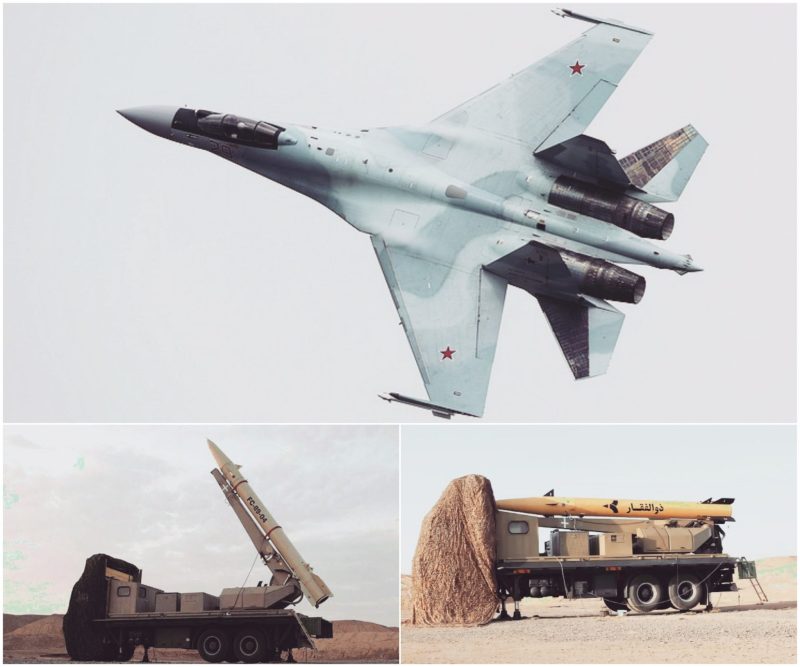
Iran has finalized arrangements to purchase Russian-made fighter jets and attack helicopters, Deputy Defense Minister Brigadier General Mahdi Farahi revealed to Tasnim News Agency on 28 November.
Farahi says the plans for the purchase and process of arrival of Sukhoi Su-35 fighter jets, Mil Mi-28 attack helicopters, and Yak-130 jet trainers to join the combat units of the Iranian Armed Forces have been signed and finalized.
“In some areas, we are among the top countries; in others, we are on the path to maturity. In this way, in addition to the development of endogenous capabilities, we must also use shortcuts to complete the defense capability, and one of these areas is the field of air technology,” Farahi said in the interview with Tasnim.
“We have good capabilities in the field of helicopters; that’s why we are the best in quantity in the region, but the qualitative improvement of helicopters is on the agenda,” Farahi added.
Talks for acquiring Sukhoi Su-35 fighter jets have been ongoing since late last year as part of joint military cooperation efforts between Tehran and the Kremlin.
Despite decades-long sanctions against Iran, the nation is still a major military power in West Asia and has over half a million active personnel.
Defense, trade, and banking ties between Iran and Russia have been growing over recent years despite western sanctions imposed on the two nations.
The central banks of both nations signed an interbank transfer deal earlier this year, allowing 52 Iranian banks to connect and transfer with 106 Russian banks.
Iran is also expected to join BRICS at the start of 2024, a group in which Russia is a key organizer.
Iranian President Ibrahim Raisi said at the 15th annual BRICS summit that the bloc expansion is “a new step towards establishing justice, ethics, and sustainable peace in the world.”
Iran has not made any significant purchases to its fighter aircraft arsenal in recent years besides purchasing a few Russian MiG-29 Fulcrum fighters in the 1990s.
Raisi Calls on BRICS Leaders to Use Economic, Political Opportunities to Pressure Israel
Sputnik – 21.11.2023
TEHRAN – Iranian President Ebrahim Raisi on Tuesday called on BRICS leaders to use all economic and political opportunities to put pressure on Israel.
Amid escalating horrors in the Gaza Strip during the “second phase” of Israel’s conflict with Hamas, the former has intensified its actions, resulting in a rise in civilian casualties. Iranian President Ebrahim Raisi, in response, has called on BRICS leaders to leverage economic and political avenues to exert pressure on the Israeli government.
“The United States has made all international organizations faceless. Iran wants BRICS members and governments to stand up for security, establish justice and fight racial discrimination in the world, as well as use all their political and economic opportunities and power to exert pressure on Israel and its supporters from Western countries,” Raisi at the BRICS extraordinary summit on the Middle East.
Raisi urged the BRICS countries to recognize the Israeli government as a “terrorist regime.”
“Israel’s continuous attacks on hospitals, medical centers and religious sites, as well as the murder of women and children, doctors, nurses and journalists are acts of terrorism, and it is necessary to recognize the Israeli regime as a terrorist regime and its army as a terrorist organization,” Raisi said.
BRICS countries must adopt a resolution at the UN to stop Israel’s crimes in the Gaza Strip, Raisi said.
Imam Khamenei Urges Muslim Countries to Cut Zionist Regime’s Lifeline
Al-Manar | November 19, 2023
Supreme Leader of the Islamic Revolution Ayatollah Sayyed Ali Khamenei has described the Zionist regime as a manifestation of racial discrimination, urging Muslim countries to cut the lifeline of the Zionist regime of Israel.
Ayatollah Sayyed Ali Khamenei made these remarks during his visit to the IRGC Aerospace Forces exhibition on Sunday.
Ayatollah Khamenei said that Zionists consider themselves to be a superior race and consider the rest of human beings to be inferior, and that is why they have killed thousands of children without any remorse.
He described scientific achievements, such as the ones showcased in the exhibition, to be the result of a motivation based on determination and faith.
Whatever field our young people entered with determination and faith, they have been able to do great jobs, he stressed.
The signs of determination and faith were clearly evident in this exhibition, he stated.
The Supreme Leader of the Islamic Revolution referred to innovation as another feature of the event, saying, “We should not be content with the current level of success because various military and civilian sectors in the world are progressing, and we must try not to stay behind.”
Referring to the developments in Palestine and the continuation of the Zionist regime’s crimes in Gaza, Ayatollah Khamenei said that the developments in Gaza revealed many hidden truths to the people of the world, one of which is the support of the heads of Western countries for racial discrimination.
When the US president, the German chancellor, the French president, and the British prime minister aid and abet such a racist regime, it means that they support racial discrimination as the most detestable issue in the world, he noted.
The people of Europe and America should clarify their stance on this situation and show that they are not in favor of racial discrimination, he stressed.
Despite extensive bombings in Gaza, the Zionist regime has failed to achieve its goal of destroying Hamas and the resistance, even after more than 40 days of using all their military power, he stated.
Ayatollah Khamenei described the brutal bombing of hospitals and women and children in Gaza as a sign of the extreme frustration of the Zionist regime’s leader about their defeat, saying that the defeat of the Zionist regime in Gaza is a fact and entering hospitals or people’s houses is not a victory.
Victory means defeating the other party, which the Zionist regime has not been able to achieve so far and will not be able to in the future, he reiterated.
Some Islamic governments apparently condemned the Zionist regime’s crimes in public gatherings, he said adding that some others have not done so yet, which is not acceptable.
He urged Islamic countries to stop exporting energy and goods to the Zionist regime and to cut off their political relationship with the Zionist regime, at least for a limited period.
To Bluff or Not to Bluff
By William Schryver – imetatronink – November 18, 2023
The map pictured below has been circulating:
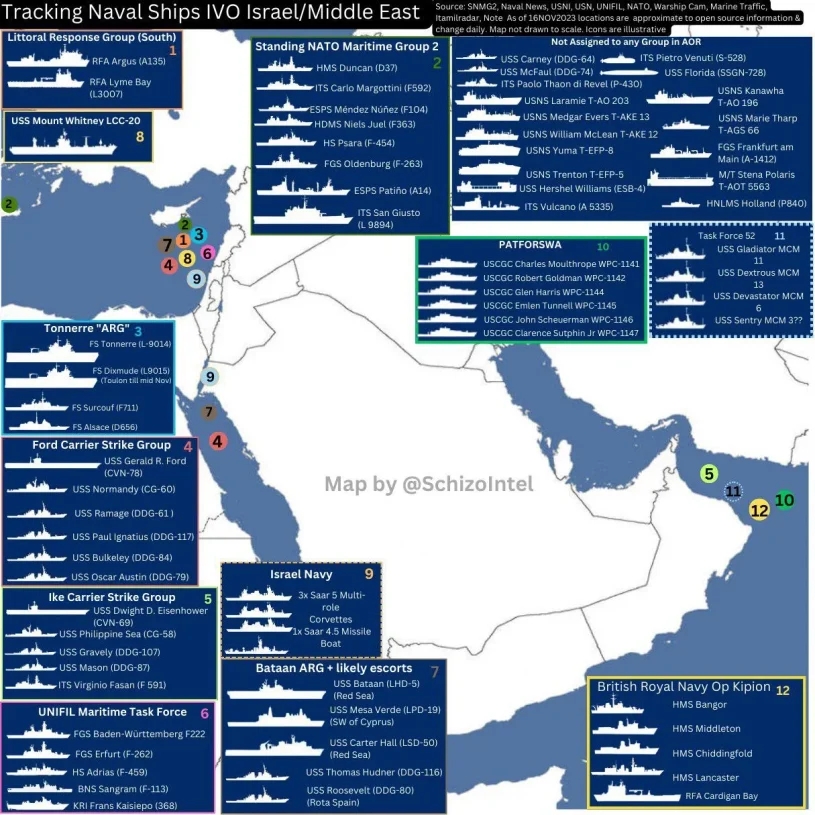
It purports to portray the current positions of the impressive array of US/NATO naval assets in the eastern Mediterranean, Red Sea, and the Arabian Sea / Gulf of Oman.
Maybe most of it is more or less accurate in terms of the positioning it indicates. But I do not, at present, believe it accurately represents the position of the USS Eisenhower Carrier Strike Group, which it suggests is sailing in the far reaches of the Gulf of Oman, more or less at the gates of the Strait of Hormuz.
The Eisenhower CSG is indicated by the bright green number 5 on the map. I am very dubious it has ventured into those dangerous waters.
Many believe the strike group will transit the straits, and take a cruise in the Persian Gulf.
I do not believe that will happen.
It would be, in my opinion, an extraordinary blunder of hubris.
That said, it will be a sure indicator of US intent towards Iran.
If the Eisenhower enters the Persian Gulf, it means the US aims to put it in optimal position to strike Iran — or at least to raise the stakes of its bluff to a level that it will very likely be called.
In other words, if the USS Eisenhower and its escorts enter the Persian Gulf, it will almost certainly compel an engagement with Iranian forces — likely ignited by an Iranian shoot-down of US ISR assets.
If, on the other hand, the Eisenhower remains sailing in the relatively safe deep blue waters of the broad portion of the Gulf of Oman and the Arabian Sea, then you can be sure the US actually has no desire to escalate to war with Iran.
That would be, in my estimation, a very wise course of action.
Featured Video

HE SAVED LIVES. NOW HE FACES PRISON.
or go to
Aletho News Archives – Video-Images
From the Archives
NATO Sanctions and the Coming Global Diesel Fuel Disaster
By F. William Engdahl – New Eastern Outlook – 11.04.2022
Amid the ongoing global inflation crisis, NATO heads of state and mainstream media repeat a mantra that high energy prices are a direct result of Putin’s actions in Ukraine since end of February. The reality is that it is the western sanctions that are responsible. Those sanctions including cutting SWIFT interbank access for key Russian banks and some of the most severe sanctions ever imposed, are hardly having an impact on the military actions in Ukraine. What many overlook is the fact that they are increasingly impacting the economies of the West, especially the EU and USA. A closer look at the state of the global supply of diesel fuel is alarming. But Western sanctions planners at the US Treasury and the EU know fully well what they are doing. And it bodes ill for the world economy.
While most of us rarely think about diesel fuel as anything other than a pollutant, in fact it is essential to the entire world economy in a way few energy sources are. The director general of Fuels Europe, part of the European Petroleum Refiners Association, stated recently, “… there is a clear link between diesel and GDP, because almost everything that goes into and out of a factory goes using diesel.” … continue
Blog Roll
 Aletho News
- Trita Parsi: Middle East Unraveling — Are We on the Path to World War?
- Iran FM meets with US envoy on UN meeting’s sidelines at American side’s insistence: Report
- Qatar PM calls for Gulf security framework with Iran, says war must be ‘wake-up call’
- China condemns US extortion of Iranian airlines, rejects Washington’s ‘illegal’ sanctions threats
- Italy to move military personnel from Taif base after missile strike
- Finland’s Stubb tells European leaders to calm down
- Defeating Russia on battlefield impossible – Fico
- Finland’s Gender Clinic Reversal
- Massachusetts Wants Mental Health Visits, Why Does Government Use ‘Health’ to Enter Our Homes & Families?
- US lawmaker admits American people footing bill for Trump’s failed aggression against Iran
- If Americans Knew
- Sanctions are collective punishment: immoral and self-defeating
- Phosphorus Munitions Fired by Israel Burn Groves, Orchards in Southern Lebanon
- Israel Carries Out New Ceasefire Violations Across Gaza
- AI – Emphasis on the ‘I’: Israel Is Funding AI Chatbot Propaganda
- Israel Blocking Hundreds of Wheelchairs for Injured Children From Entering Gaza
- Israel Is Expanding and Upgrading Compounds for Palestinian Militias in Gaza
- The Palestinian-American Residents of This West Bank Town Are Wondering: Where Is Trump?
- Gaza desperately needs tents, wheelchairs, fuel… and everything else (Israel blocks it all) – Daily Update
- Israeli Attacks in Gaza Kill at Least Seven Palestinians Over Three Days, including Woman and Child
- Trump’s militarization of Washington DC as he pursues Israel’s war against Iran
- No Tricks Zone
- New Study: Earth And Venus Surface Warmth Largely Explained By Convection And Lapse Rate, Not CO2 Or Radiation
- 2025 Nature Paper Claiming Worsening Global Drought Gets RETRACTED …Heavily Flawed
- New Study: ‘Global Drought Shows No Detectable Recent Acceleration Under Climate Warming’
- Economic Masterminds: German Socialists Suggest Taxing Productivity Gains Stemming From Using AI
- The South China Sea Has Not Been Cooperating With The Climate Change Narrative
- Energy Crisis: Germany Enters Heating Season With Historically Low Gas Reserve Fill Levels
- New Study: The Antarctic Ice Sheet Gained Mass From 2020-2024 Due To Staggering Snow And Ice Accumulation
- Study: Ocean Heating Rates From Thousands Of Years Ago ‘Dwarf’ Modern Ocean Heating Rates
- Climate Extremists Target, Attack Large-Scale Power Grid Infrastructure In Germany!
- New Study: Antarctic Ice Melt Has Contributed Less Than 1 Centimeter To Sea Level Rise In The Last 30 Years

