Israel and US hold drills targeted at Iran
RT | December 2, 2022
The Israeli military has conducted joint training operations with the United States, holding a series of air drills to simulate strikes on Iran just days after West Jerusalem pressed US officials to accelerate their “operational plans” against Tehran.
The Israel Defense Forces (IDF) detailed the drills in a statement on Wednesday, saying they practiced “various scenarios in the face of regional threats” while singling out the Islamic Republic by name.
“These exercises are a key component of our two militaries’ increasing strategic cooperation in response to shared concerns in the Middle East, particularly those posed by Iran,” the IDF said.
Four Israeli F-35 fighter jets and four American F-15s took part in the war games, which “simulated a long-range operational scenario and long-distance flights,” the IDF added, noting that a US KC-135 tanker aircraft also refueled a number of Israeli F-16s during the exercise.
The drills follow a visit to the US capital last month by IDF Chief of Staff Aviv Kochavi, who called on American officials to develop new “operational plans” to take on the Iranian military. The two sides also discussed their “commitment to ensuring that Iran never acquires a nuclear weapon,” despite Tehran’s repeated insistence that it is not pursuing the bomb.
Israel has carried out a number of drills specifically targeting Tehran in recent months, including an exercise over the Mediterranean Sea earlier this year which reportedly simulated strikes on Iran’s nuclear facilities. Another similar drill focused on nuclear sites was also conducted last June, involving more than 100 aircraft which practiced long-distance strikes.
While this week’s war games saw midair refueling operations with an American tanker, the Jerusalem Post previously reported that Israel had developed capabilities allowing it to reach Iran without the need to refuel along the way. The outlet suggested the air force had upgraded its US-made F-35 jets to accomplish that feat, but offered few details on the supposed improvements.
Iran, India recalibrating ties amid geopolitical shifts
‘Not a choice, but necessity’
By Zafar Mehdi | The Cradle | December 1, 2022
“Not a choice, but a necessity.” That’s how Iran’s Deputy Foreign Minister Ali Bagheri Kani stressed the importance of closer strategic and economic ties between Tehran and New Delhi during his visit to India in November.
Kani had a message for Prime Minister Narendra Modi from Tehran – strategic synergy is a win-win proposition for the two sides amid the shifting geopolitical and geo-economic landscape in the wake of the Ukraine war and the new world order.
Before the Trump administration reinstated sanctions on Iran in 2018, Iranian oil comprised nearly 11 percent of India’s total oil basket. However, New Delhi buckled under US pressure and stopped importing oil from Tehran in a move that hampered their cooperation in other strategic areas.
Three years down the line, amid rapidly changing geopolitical power dynamics and the end of “the era of the unipolar world,” as announced by Russian President Vladimir Putin in June, India has become keen on recalibrating its ties with Iran, a traditional ally, in the midst of an energy crisis gripping the world.
It is worth noting that Russia became the biggest oil supplier to India in October, supplying 935,556 barrels of crude oil per day, according to energy cargo tracker Vortexa, making up for 22 percent of the energy-dependent country’s total crude imports, ahead of Iraq’s 20.5 percent and Saudi Arabia’s 16 percent.
Iran as an alternative energy supplier
Faced with a burgeoning demand for oil and gas amid the global energy crisis and recent oil cuts by the OPEC+, India now looks poised to resume oil imports from Iran, defying US sanctions, The Cradle learned from sources in Tehran and New Delhi.
Interestingly, India’s petroleum minister Hardeep Puri hinted at it during his visit to Washington in October, saying New Delhi will buy oil from wherever it has to. Russia, as we know, is already shipping oil to India, despite strong US pressures.
Talks are currently underway between India and Venezuela, especially with the US easing oil-related sanctions against Caracas. This, by extension, has opened a window of opportunity for India and Iran to revive their energy trade. The good news is that both sides look interested.
Iran has already expressed its readiness to resume energy trade with India. Last month, newly-appointed Iranian ambassador to New Delhi, Iraj Elahi, announced that Iran is willing to provide low-cost crude oil to India to ensure the country’s energy security, something top Indian officials have in recent months cited as the government’s priority.
A win-win proposition
In 2018-2019, India purchased $12.11 billion worth of crude oil from Iran, which plummeted to zero in May 2019 after the significant reduction exemption (SRE) period ended.
Likewise, trade between the two countries dropped from $17.3 billion in 2018-2019 to $4.77 billion in 2019-2020. Although it has ultimately failed to achieve its objectives, Washington’s “maximum pressure” campaign had a negative impact on India-Iran relations.
However, ties have since markedly improved, as evidenced by Bagheri Kani telling the Indian press that the Islamic Republic is ready to meet the country’s growing energy needs, while India can in turn contribute to Iran’s food security as a major food producer.
This, he asserted, would help in boosting the process of multilateralism in the international system, which essentially means the death of US unilateralism more than three decades after the end of the Cold War and the collapse of the former Soviet Union that paved the way for the era of the unipolar world.
Suhasini Haidar, diplomatic affairs editor at The Hindu and a leading Indian analyst, termed Bagheri Kani’s visit to India as “significant,” saying it “shows a commitment to India-Iran ties by both governments despite geopolitical divides in the world on issues like the Ukraine war.”
Penalized by US sanctions
Haidar described Iranian crude as “sweeter, lighter, cheaper, and easier to transport to India than other options,” calling the Indian government’s decision to cut Iranian imports “irrational.”
“It was irrational of the Modi government to have canceled India’s imports of Iranian oil under threat from the Trump administration, and it would make sense if they decided to restore the oil trade between the two countries,” she told The Cradle.
Haidar said it remains to be seen if the Modi government will be willing to resume oil imports from Iran, “despite several signals that both sides are exploring their options,” especially after the latest sanctions on an Indian company transporting Iranian oil.
Mumbai-based Tibalaji Petrochem Private Limited was sanctioned in late September for shipping Iranian petrochemical products to China. It was the first time an Indian company was sanctioned by the US for dealing with Iran.
In his meeting with his Indian counterpart Vinay Mohan Kwatra, Bagheri Kani pointed to the “necessity” of regional cooperation between the two countries, which he said would “take away the opportunity from foreigners to exploit the lack of cooperation.”
The sentiments were mutual as India’s foreign ministry spokesman, in a statement following Bagger Kani’s meeting with Kwatra, said the two officials “discussed bilateral relations, including the development of Chabahar Port” and “regional and international issues of mutual interest.”
Time to shore up ties
According to observers, the time is now ripe for the two sides to shore up bilateral ties and multilateral cooperation, with Tehran set to become a full member of the Shanghai Cooperation Organization (SCO) as well as the BRICS group, given its close ties with Russia and China.
Notwithstanding existing challenges, Iran and India share mutual interests in trade and connectivity. Iran’s full SCO membership could prompt the two sides to focus more on connectivity projects like the Chabahar Port, which links with the International North-South Transport Corridor (INSTC), the multi-mode network of ships, rail and roads for moving freight between India and Iran, among other countries.
“India and Iran have important trade needs, including in wheat, pulses and commodities, as well as oil reserves. And the connectivity engagement is very important for India through Chabahar and through the INSTC,” Haidar explained.
Importantly, in recent years, Chabahar Port in Iran’s southeastern Sistan-Baluchestan province has emerged as a key area of cooperation between Tehran and New Delhi, which will provide India access to Afghanistan and Central Asia through Iran, ending its reliance on arch-rival Pakistan.
Rezaul Hasan Laskar, the foreign affairs editor at Hindustan Times, says the strategic port has “become more important following its growing use” but that “it needs to be connected to Iran’s railway network.”
While the first section of the Zahedan-Chabahar railway line is nearing completion, official sources in Tehran said the agreement between the two sides to construct the 628-kilometer (390 miles) railway line had faced “serious impediments” due to New Delhi’s reluctance to start work fearing US sanctions.
“Despite India’s close ties with the US and Israel, its decision to build strategic ties with Iran, and Iran’s according special projects to India like Chabahar Port despite its ties with China are a constant reminder of this special relationship,” Haidar told The Cradle.
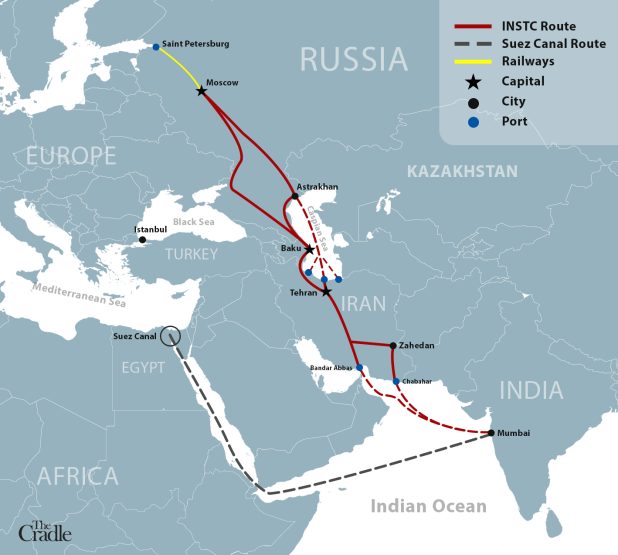
Map of the International North-South Transport Corridor (INSTC)
Joint cooperation with Beijing and Moscow
Sources in Tehran and New Delhi said the use of rupee-rial trade was also “seriously considered” during Bagheri Kani’s New Delhi visit, with both sides agreeing that a banking mechanism that is not tied to the west is key to strengthening the process of multilateralism, and paving the way for the resumption of trade.
Laskar of Hindustan Times confirmed that the senior Iranian diplomat “reiterated Iran’s offer to resume oil supplies and raised the issue of trade in national currencies.”
The changing geopolitical landscape in the wake of growing anti-western mechanisms, including SCO and BRICS, led by China and Russia, is also likely to propel increased cooperation between Tehran and New Delhi.
Laskar, however, believes that the SCO has not been a particularly crucial grouping for India in recent years, “largely because of the tensions with China,” adding that India’s biggest concern about the expansion of BRICS is that “it shouldn’t become a China-centric grouping,” underlying Sino-India tensions.
Meanwhile, Russia remains a common ally of India and Iran, which is evident in Moscow and New Delhi looking to ramp up trade via Tehran along the INSTC – the strategic route that has assumed tremendous significance since the start of the Ukraine war.
The decision to boost INSTC trade, according to reports in Indian media, was high on the agenda during Bagheri Kani’s India visit, as Russia now looks set to invest in the Chabahar Port. According to sources, the war in Ukraine also figured prominently in Bagheri Kani’s talks with Indian officials. Both sides agreed on maintaining a “neutral stance” on the war and increased engagement with Moscow.
“Russia is the new game-changer in the region, especially after the realignment of power centers, and that is good news for India-Iran ties,” an Iranian diplomat stationed in South Asia told The Cradle.
Russian Foreign Ministry: No Evidence That Tehran Wants to Develop Nuclear Weapons
Samizdat – 30.11.2022
MOSCOW – There is no evidence that Tehran intends to develop nuclear weapons, reviewing its participation in the Nuclear Non-Proliferation Treaty (NPT), Vladimir Yermakov, director of the Russian Foreign Ministry’s Non-Proliferation and Arms Control Department, said in an interview with Sputnik.
“Iran has been and remains a conscientious participant in the Treaty on the Non-Proliferation of Nuclear Weapons. The conclusion of the JCPOA in 2015 helped to finally and irrevocably remove all the questions that the [International Atomic Energy Agency] had to Tehran at that time.”
“After that, for several years Iran remained the most verified state among agency members. No deviations from its obligations were identified,” Yermakov said. “There is no evidence that would indicate Tehran’s intention to ever reconsider its participation in the NPT and start developing a nuclear explosive device.”
Yermakov’s remarks come as the US undertakes joint military drills with Israel, complete with fighter jet simulations on strikes against Iran’s nuclear program infrastructure. Earlier announcements detailed the drills would be held in the Mediterranean Sea starting November 29, and lasting through December 1.
At the time, Israeli Defense Minister Benny Gantz stressed that the drills were needed in order for Israel to “prepare” its service members for any “possibility.”
Days before the drills kicked off, US media reported that Tehran was inching toward achieving a weapons-grade enrichment, paving the way for Iran to acquire the technology to assemble nuclear weapons.
However, it’s worth noting that Iran has repeatedly indicated it has no intention to create nuclear arms; in fact, Iranian leadership imposed a fatwa in 2003 on the production or usage of any form of nuclear weapons.
Tension between Iran, Israel and the US has remained high for years. Under the Trump administration, however, escalations were at near-boiling after the US withdrew from the 2015 Joint Comprehensive Plan of Action, reimposed past sanctions and continued on a “maximum pressure” campaign against Tehran.
Talks to restore the agreement under the Biden White House have remained stalled for months. Iran earlier dispatched a “constructive” response to Washington’s proposals but was ultimately shut down by administration officials who deemed the messages “not constructive.”
US-Turkiye brinkmanship won’t reach a point of no return
Conflict between Ankara and Washington over Syria will likely see the two drift apart, with Turkiye aligning more closely with Eurasian powers.
By MK Bhadrakumar | The Cradle | November 28, 2022
The series of airstrikes against Kurdish militants in northern Syria by Turkish jets in the past week come amid heightened concerns over Ankara’s threat to launch a ground operation. Such actions are not without precedent, yet have thus far achieved little in terms of eradicating the security challenges posed by US-backed Kurdish fighters.
Turkiye is today addressing an existential challenge to its national security and sovereignty, stemming from the United States’ quasi-alliance with Kurdish groups in Syria over the past decade – with whom Ankara has been battling for far longer.
However, this issue is playing out within a much broader regional backdrop today. Russia now has a permanent presence in Syria and is itself locked in an existential struggle with the US in Ukraine and the Black Sea. Iran-US tensions are also acute and President Joe Biden has openly called for the overthrow of the Iranian government.
Opposing the US occupation of Syria
Suffice to say, the Syrian government, which has demanded the removal of illegal US troops from one-third of its territory for years, enjoys a congruence of interests with Turkiye like never before, particularly in opposing the American military presence in Syria.
For the US, on the other hand, continued occupation of Syria is crucial in geopolitical terms, given that country’s geography on the northern tier of the West Asian region which borders Iran and the Caucasus to the north and east, Turkiye and the Black Sea to the north, Israel to the south, and the Eastern Mediterranean to the west.
All of that would have a great bearing on the outcome of the epochal struggle for the control of the Eurasian landmass – the Heartland and the Geographical Pivot of history as Sir Halford J. Mackinder once described it in evocative terms – by Washington and NATO to counter Russia’s resurgence and China’s rise.
China’s involvement in the Astana process
A curious detail at this point assumes larger-than-life significance in the period ahead: Beijing is messaging its interest in joining the Astana process on Syria. Moscow’s presidential envoy for Syria, Alexander Lavrentiev, stated recently that Russia is convinced that China’s involvement as an observer in the Astana format would be valuable.
Interestingly, Lavrentiev was speaking after the 19th international meeting on Syria in the Astana format with his counterparts from Turkiye and Iran on November 15.
“We believe that China’s participation in the Astana format would be very useful. Of course, we proposed this option. The Iranians agreed with this, while the Turkish side is considering it and has taken a pause before making a decision,” he explained.
Lavrentiev noted that Beijing could provide “some assistance as part of the Syrian settlement, improve the lives of Syrian citizens, and in reconstruction.”
The Chinese Foreign Ministry promptly responded to the Russian invitation, confirming that Beijing “attaches great importance to this format and is ready to work with all its participants to restore peace and stability in Syria.”
Lavrentiev didn’t miss the opportunity to taunt Washington, saying: “Of course, I believe that if the Americans returned to the Astana format, that would also be very useful. If two countries like the United States and China were present as observers in the Astana format, that would be a very good step, a good signal for the international community, and in general in the direction of the Syrian settlement.”
However, there is no question of the Biden Administration working with Russia, Turkiye, Iran, and China on a Syrian settlement at the present time. Reports keep appearing that the US has been transferring ISIS fighters from Syria to Ukraine to fight Russian forces, and to Afghanistan to stir up the pot in Central Asia.
The Astana troika are in unison, demanding the departure of US occupation forces from Syria. Moscow knows fully well too that the US hopes to work toward shuttering Russian bases in Syria.
Turkiye’s pursuit of the US’s Kurdish allies
In fact, the aerial operations in Syria that Ankara ordered last Sunday followed a terrorist strike in Istanbul a week ago by Kurdish separatists, killing at least six people and injuring more than 80 others. President Recep Tayyip Erdogan has said the air strikes were “just the beginning” and that his Armed Forces “will topple the terrorists by land at the most convenient time.”
Turkish security agencies have nabbed the bomber – a Syrian woman named Ahlam Albashir who was allegedly trained by the US military. White House Press Secretary Karine Jean-Pierre hurriedly issued a statement to calm that storm: “The United States strongly condemns the act of violence that took place today in Istanbul, Turkiye.”
But Turkiye’s Interior Minister Suleyman Soylu reacted caustically to the American missive, saying that Washington’s condolence message was like “a killer being the first to show up at a crime scene.”
Conceivably, with Erdogan facing a crucial election in the coming months, the Biden Administration is pulling out all the stops to prevent the ruling AKP party from winning another mandate to rule Turkiye.
The Turkish “swing state” is crucial for US plans
The US feels exasperated with Erdogan for pushing ahead with independent foreign policies that could see Turkiye joining the BRICS and Shanghai Cooperation Organization (SCO), and deepening his strategic ties with Russia and China – and most important, steadily mark distance from Washington and NATO’s containment strategies against Russia and China.
Turkiye has become a critically important “swing state” at this stage in the post-cold war era. Erdogan’s effort to bolster the country’s strategic autonomy lethally undermines the western strategy to impose its global hegemony.
While Erdogan keep’s Washington guessing about his next move, his airstrikes in northern Syria hit targets very close to US bases there. The Pentagon has warned that the strikes threaten the safety of American military personnel. The Pentagon statement represents the strongest condemnation by the US of its NATO ally in recent times.
Russian diplomacy forestalls Syria ground incursion
Unsurprisingly, Russia is acting as a moderating influence on Turkiye. Lavrentyev said last Wednesday that Moscow has tried to convince Ankara to “refrain from conducting full-scale ground operations” inside Syria. The Russian interest lies in encouraging Erdogan to engage with Syrian President Bashar al-Assad and pool their efforts to curb the activities of Kurdish terrorists.
Indeed, the probability is low that Erdogan will order ground incursions into Syria. This also seems to be the assessment of local Kurdish groups.
US-backed Syrian Democratic Forces (SDF) Commander Mazloum Kobane Abdi, who is the Pentagon’s key interlocutor in northern Syria, has been quoted as saying that while he has received intelligence that Turkiye has alerted its local proxies to prepare for a ground offensive, the Biden administration could still convince Erdogan to back off.
That said, Erdogan can make things difficult for the US and eventually even force the evacuation of its estimated 900 military troops, shutting down the Pentagon’s lucrative oil smuggling operation in Syria and abandoning its training camps for ex-ISIS fighters in northern and eastern Syria.
But the US is unlikely to take matters to a point of no return. A retrenchment in Syria at the present juncture will weaken the US regional strategies, not only in West Asia, but also in the adjoining Black Sea region and the Caucasus, in the southern periphery of the Eurasian landmass.
From Erdogan’s perspective too, it is not in his interest to burn bridges with the west. A bridge in disrepair remains a bridge nonetheless, which would have its selective uses for Erdogan in the times of multipolarity that lie ahead.
Iran retaliates against UN nuclear resolution – media
RT | November 22, 2022
Tehran has for the first time started enriching uranium to 60% fissile purity at the Fordow facility, Iranian media reported on Tuesday. Such a move would be seen as a response to a critical resolution adopted by the UN’s nuclear watchdog last week.
Iran is already enriching uranium at Natanz, its other major production site, to below weapons-grade 90% enrichment, but well above the 3.67% limit specified in the 2015 Iran Nuclear Deal, or JCPOA. The US abandoned the deal with Tehran during the administration of Donald Trump, leading to its erosion and effective collapse.
Other reported moves by Iran include upgrading cascade lines with more advanced gas centrifuges to boost production capacity at Fordow, as well as firing up additional chains at Natanz.
Tehran’s action was described as retaliation for a resolution passed last Thursday by the Board of Directors of the International Atomic Energy Agency (IAEA). The document, which was drafted by the US, Britain, France and Germany, decried “insufficient substantive cooperation by Iran” on the issue of uranium traces found in 2019 by inspectors at three undeclared sites. It demanded “credible explanations” and full cooperation from Tehran.
The four sponsoring nations are also signatories of the JCPOA. China and Russia, two other participants of the landmark deal, reportedly voted against the draft document during the closed-door session last week.
The Iranian Foreign Ministry rejected the resolution, calling it a form of political pressure by the US and its allies. Spokesman Nasser Kanaani said on Monday that the country had taken “initial measures” in response to it on Sunday night.
“The implementation of these measures was realized today in the presence of IAEA inspectors in the Natanz and Fordo enrichment complexes,” the diplomat added, without specifying what had happened.
The JCPOA was meant to exchange an Iranian commitment to limit its nuclear program for relief of economic sanctions imposed on the country. The goal was to prolong the time Tehran would need to create a nuclear weapon, an ambition that Iran officially denies fostering in the first place.
The Trump administration unilaterally pulled out of the Iran Nuclear Deal as part of its “maximum pressure” campaign against Tehran. President Joe Biden has been negotiating a possible revival of the JCPOA, but no breakthrough has been achieved so far.
A Very Different Global State of Affairs Takes Hold
By Alastair Crooke | Strategic Culture Foundation | November 21, 2022
How the world appears all depends on whether your gaze is firmly focussed on the hub of the wheel, or alternatively, were you to watch the wheel’s rotation around the hub – and the bearing it follows – you would see the world differently.
Looked at from a DC-centric perspective, all is still: Nothing (as it were), is moving geo-politically. Was there an election in the U.S.? Well, certainly there is no longer an ‘Election Day’ event as the new mechanics of ballots vs in-person voting, commencing up to 50 days earlier, and ploughing on, weeks after, has become far removed from the old notion of having ‘an election’, and an aggregate macro outcome.
From this ‘centric’ viewpoint, the Midterms change nothing – stasis.
So many of Biden’s policies were already in stone anyway – and beyond the ability of any Congress to change in the short run.
New legislation, if there were any, could be vetoed. And should the election ‘month’ end with the House controlled by Republicans and the Senate controlled by Democrats, there might not be any legislation at all, because of partisanship and an inability to compromise.
More to the point, Biden anyway can rule for the next 2 years through Executive Order and bureaucratic inertia – and not need the Congress at all. In other words, the composition of Congress may not matter that much.
But now, turn your gaze to the rotation around the ‘hub’, and what do you see? The rim spinning wildly. It seizes more and more traction on the ground and has clear directionality.
The biggest pivot around the hub? Well probably, President Xi of China travelling to Riyadh to meet Mohammad bin Salman (MbS). The wheel rim here digs deep for a firm grip on bedrock, as Saudi Arabia makes its pivot toward the BRICS. Xi likely is going to Riyadh to seal the details of Saudi’s accession to the BRICS and the terms of China’s future ‘Oil Accord’ with Saudi Arabia. And that may be the beginning to the end to the petrodollar system – as whatever is agreed in terms of the Chinese mode of payment for oil will mesh with Russo-Chinese plans eventually to move Eurasia onto a new trading currency (far away from the dollar).
Saudi Arabia gravitating BRICS-wards means other Gulf and Mid East – states such as Egypt – leaning BRICS-wards also.
Another pivot: The Turkish Interior Minister Süleyman Soylu said after this week’s explosion in Istanbul: “We do not accept the condolence message of the U.S. Embassy. We understand the message that was given to us, we received the message that was given to us”. Soylu then dismissed the U.S. condolence as akin to “a killer being first to show up at a crime scene”.
Let’s be clear: The minister just told the U.S. to go sc**w itself. This unleashing of raw anger comes just as Turkey has agreed to join with Russia to establish a new gas hub in Turkey and is participating with Russia in a massive oil and gas investment and co-operation deal with Iran. Turkey too, is veering BRICS-wards.
And, as Turkey veers away from one ‘hub’, much of the Turkic sphere will take Turkey’s lead.
These two events – from Xi’s meeting with MbS’ thumbing his nose at the U.S., to Turkey’s fury at the terrorism in Istanbul – clearly dovetail together to mark a strategic Middle East pivot – both in terms of energy and monetary frameworks, towards the unfolding Eurasian free trade sphere.
Then comes the news from last Thursday: Iran says that it has developed a high-precision hypersonic missile. General Hajizadeh said the Iranian hypersonic ballistic missile can reach more than five times the speed of sound and, as such, it will be able to breach all present systems of anti-missile defence.
Simply put: Iran essentially already is a nuclear threshold state (but not a nuclear weapons state). The remarkable technical achievement of producing a hypersonic high-precision missile (which still eludes the U.S.), is a paradigm-changer.
Strategic nukes make no sense in a highly mix-populated, small Middle East – and now, there is no need for Iran to move towards becoming a weapons state. So, what would be the point to a complicated containment strategy (i.e. the JCPOA), oriented towards hindering an outcome that has become overtaken by new technology? A hypersonic ballistic missile capacity makes tactical nukes redundant. And hypersonic missiles are more effective; more easily deployed.
The problem for the U.S. and Israel is that Iran has done it – it has leaped beyond the JCPOA containment cage.
On top of that, a few days earlier, Iran also announced that it had launched a ballistic missile, carrying a satellite into space. If so, Iran now has ballistic missiles capable of reaching, not only Israel, but Europe too. Furthermore, Iran is reported to soon receive 60 SU-35 aircraft, as just one part to its rapidly evolving relationship with Russia, sealed last week with Nikolai Patrushev (Russia’s Security Council Secretary) in Tehran.
Again, to be clear, Russia has just acquired a highly potent kinetic force multiplier; access to Iran’s sanctions-busting rolodex of contacts and strategies, and a full partner to Moscow’s big play of Eurasia becoming a commodities super-oligopoly.
Simply put, as Iran enlists as a force multiplier to the Russia-China axis, so too will Iraq, Syria, Hizbullah and the Houthis slip along a somewhat similar trajectory.
Whilst the European ‘security architecture’ remains still frozen in a tight NATO, anti-Russian grip, West Asia’s security architecture is dissolving away from the old U.S. and Israeli-led hard polarisation of a Sunni sphere vs Shi’i Iran (i.e. the so-called Abraham Accords), and is re-forming around a new security architecture being shaped by Russia and China.
This makes sense. Turkey prizes its Turkic civilisational heritage. Iran clearly is a civilisational state, and MbS plainly wants his kingdom to be widely accepted as one, too (and not as just a U.S. dependency). The point of the SCO format is that it is ‘pro-autonomy’ and is opposed to any singularity of ideology. In fact, by being civilisational in concept, it becomes anti-ideological and opposed to tight binary (with us, or against us) alliances. Membership does not require endorsement of each other partner’s particular policies, provided they do not impinge on others’ sovereignty.
In effect, the whole of West Asia – to one degree or another – is being lifted up into this evolving Eurasian economic and security paradigm.
And, simply said, since Africa is already enlisted into the China camp, the African component to MENA is trending strongly Eurasia-wards, as well. The Global South’s affiliation too, largely can be taken for granted.
Where does this leave the old ‘hub’? It has Europe fully in its control. For now, yes…
However research published by France’s École de Guerre Economique suggests that whilst Europe has, since WW2, “lived in a state of the unspoken” in respect to its full-spectrum dependency on Washington, as Russia sanctions take their catastrophic effect on Europe, “a very different state of affairs takes hold”. Consequently, politicians, and the public alike, struggle to identify “who truly is their enemy”.
Well, the collective view, based on interviews with French intelligence experts (i.e. the French Deep State) is very clear: 97% percent consider the U.S. to be the foreign power that “most threatens” the “economic interests” of France. And they see it as a problem that must be resolved.
Of course, the U.S. will not easily let Europe go. Nonetheless, if parts of the Establishment can speak thus, then something is moving and afoot, beneath the surface. The report underlines naturally that the EU might have a trade surplus of 150 billion euros with the U.S., but the latter would never willingly allow this to translate into ‘strategic autonomy’. And any gain in autonomy is achieved against the constant backdrop of – and more than offset by – “strong geopolitical and military pressure” from the U.S. at all times.
Could the Nord Stream sabotage have been the straw that broke the camel’s back? In part, it was a trigger, but Europe hides its diverse old hatreds and long-nursed vindictiveness under ‘a Brussels lid of easy money’. But this pertains only so long as the EU remains a glorified ATM – states insert their debit-cards and withdraw cash. The concealed animosities are repressed, and monetarily lubricated into quiescence.
The ATM however, is in trouble (economic contraction, de-industrialisation and austerity cometh!); and as the ATM withdrawals’ window winnows down, so too the lid holding down the old animosities and tribal feelings will not hold for long. Indeed, the demons are rising – and are readily visible even now.
And finally, will the Washington ‘hub’ hold? Does it retain the resources to manage so many stress-test events – financial, systemic and political – all arriving synchronistically? We must wait to see.
In retrospect, the ‘Hub’ is not ‘on the move’. It has moved already. It is just that so many are stuck seeing an ‘empty space’ that once was occupied by something past, but which somehow still somehow lingers on, in visual memory, as a ‘shade’ of its earlier solidity.
Iran bans imports of French cars unless damage redressed
Press TV – November 21, 2022
Iran has banned the imports of French cars until France’s automobile manufacturers, namely Renault, Peugeot and Citroen, compensate the damage caused by leaving the Islamic Republic.
The withdrawal imposed a lot of costs on Iran’s automobile and parts manufacturing industry and left many investments in ruins after the US imposed new sanctions in August 2018, targeting the Islamic Republic’s car industry, trade in gold and other precious metals, and purchases of US dollars.
Although the withdrawal forced Iranian manufacturers to pool their resources and produce locally-made cars, compensation for the damage caused by the pullout is a central demand.
The ban announced by Ministry of Industry, Mining and Trade spokesman Omid Qalibaf comes as Iran is reintroducing foreign car imports in order to both improve the pool of quality automobiles and meet consumer demand.
Iran prohibited the import of Western cars in 2017 to counter the impending reimposition of US sanctions. The idea was part of Tehran’s efforts to develop a “resistance economy” that could both serve Iranians’ demands for cars, lessen dependence on foreign technology, and potentially boost export revenue.
“Those in the process of importing cars are dealing with the related issues and are concluding their contracts one by one, with the first cars expected to enter the country with the conditions that have been announced to the importers.
“However, what is certain is that French cars will not find a way to our market for now, because French companies such as Renault and Peugeot do not have a good history during the time of sanctions, when they easily left our country despite having committed to joint ventures and investments,” Qalibaf said.
Before the sanctions, French carmaker PSA Group had signed a framework deal with Iranian counterpart SAIPA to produce and sell vehicles for its Citroen brand in the country.
Under the agreement, Citroen and its Iranian partner would invest 300 million euros ($330 million) over five years in manufacturing, research and development, with the first of three planned new Citroen models due to be launched in Iran in 2018.
PSA Group, the maker of Peugeot and Citroen cars, had finalized a similar production deal with major Iranian automaker Iran Khodro under a 50-50 joint venture to invest up to 400 million euros ($451 million).
Renault had signed a new joint venture deal that included an engineering and purchasing center to support the development of local suppliers as well as a plant with an initial production capacity of 150,000 vehicles a year.
“In the middle of the road, however, they left the Iranian automakers alone and caused a lot of damage to our country’s automobile industry,” Qalibaf said.
“As long as the French car manufacturers do not compensate for these damages, they will not have any share in the large car market of our country, and the import of any car from France will be prohibited,” he added.
The ban, however, will not include South Korea, Japan and other countries, because they were not involved in any joint projects with Iranian industrialists when the new sanctions were imposed, Qalibaf stated.
The auto industry forms the second biggest sub-sector of the economy behind oil, accounting for some 10 percent of the gross domestic product and 4 percent of employment.
When the former Trump administration reimposed sanctions on Iran in August 2018, it reserved Washington’s first hammer blow for the car industry to hurt as many Iranians as possible.
However, the US pressures forced domestic manufacturers to mobilize their resources to fulfill some of the tasks which were an exclusive competence of foreign companies.
Last week, Venezuelan Minister of Transport Ramón announced the shipment of 1,000 cars built in Iran to Venezuela, stating that they were among 80,000 requests registered for the products of an Iranian car manufacturer in his country.
“We have a very high demand for Iranian car products, where we were able to register about 80,000 requests in the first stage,” he said in Tehran where he was at the head of a large delegation.
With the exports, Iran is staking out a niche in South America’s automotive marketplace which has a lot of space for growth and expansion, given the uneasy relationship of some of the countries of the region with the United States.
It followed the Iran-Venezuela 2022 Expo Fair held on Sept. 14-18 in Caracas where President Maduro announced the assembly of four Iranian models at Venirauto car manufacturing plant, a joint venture between the Venezuelan government and Iran Khodro.
Interview with US Ambassador Peter Ford
Free West Media | November 18, 2022
Steven Sahiounie of MidEastDiscourse interviewed Ambassador Peter Ford to hear his expert analysis of important issues developing in the region.
Israel, Lebanon, Syria and Turkey are neighbors in an increasingly unstable Middle East, in which Saudi Arabia plays a key role.
The US has meddled in the Middle East for decades and is responsible for the destruction of several countries who have not recovered from failed American policies.
Peter Ford served as the British ambassador to Bahrain from 1999 to 2003 and Syria from 2003 to 2006, and is currently the London-based Co-Chairman of the British Syrian Society. He is an Arabist with long established expertise in the Middle East.
Benjamin Netanyahu and his allies recently came back to power in “Israel”. In your opinion what does this mean for the Palestinians?
It makes no difference. Those who believe that one Israeli government is different from another are fools. Every Israeli government supports the occupation and practices repression. Any differences are purely optical.
That said, the participation of overt racists in Netanyahu’s government increases the chances that the US will distance itself from Israel in matters of secondary importance.
Lebanon is in the midst of a financial and social collapse. In your opinion, will the Israeli regime take advantage of the crisis and attack Lebanon?
Israel is already viciously attacking Lebanon – economically. The Israeli/US strategy is to avoid war, which they would lose, but instead to create enough suffering in Lebanon to make the Lebanese people turn against Hezbollah. In particular, they are trying to block oil reaching Lebanon from Iran. This is similar to their strategy towards Syria.
The UN Special Rapporteur has called for the end of sanctions on Syria because of the continuing suffering. Do you think there is any hope in removing the sanctions which are crippling the daily life of Syrians?
Sadly I see no prospect of sanctions on Syria being lifted or eased in the foreseeable future. It costs the US nothing to apply them and the US against all evidence persists in believing that sanctions weaken popular support for the Syrian government, or pretending to believe they weaken the government simply because it would be embarrassing to lift them. Lifting sanctions would look like an admission of failure and a concession to Russia and Iran.
Sanctions on Syria cannot be analyzed without taking the geopolitical situation into account. To some degree Syria is paying part of the price for US mishandling of its relations with Russia and Iran.
Saudi Crown Prince Mohammed bin Salman has not bowed down to pressure by US President Joe Biden. In your opinion, what will be the cost that Saudi Arabia has to pay?
The cost will be zero. On the contrary, Saudi defiance of the US over oil prices shows that the balance of power between the two has shifted and that the US is a paper tiger where Saudi Arabia is concerned. Let us not forget that the US arms industry has become highly dependent on sales to the Gulf, and the US has invested heavily in keeping Saudi Arabia away from rapprochement with Iran. Its leverage is minimal. It was different when MBS was an international pariah over Khashoggi, but time has done its work of prompting amnesia if not forgiveness. I expect to see more Saudi defiance of the US.
For the past few months, we have been hearing reports from the Turkish side of overtures at repairing the relationship between Turkey and Syria. In your opinion, will this have an effect on ending terrorist control in Idlib?
I am more optimistic about Idlib today than I have been for ages. Time is also doing its work here – demonstrating to the Turks that their Syria policy has been a total failure. That policy has failed to remove the Syrian government, failed to establish stability on Turkey’s border and failed to create conditions for the return of Syrian refugees. The burden of those refugees is felt especially acutely with the approach of presidential elections in Turkey. Whether Erdogan is serious about rapprochement with Syria remains however to be seen.
Steven Sahiounie is a two-time award-winning journalist
Israel, CENTCOM blame Iran for drone attack on oil tanker near Oman
The Cradle | November 16, 2022
The head of the US Central Command (CENTCOM) claims Iran is behind a suicide drone attack on a Liberian-flagged oil tanker off the coast of Oman.
“This unmanned aerial vehicle attack against a civilian vessel in this critical maritime strait demonstrates, once again, the destabilizing nature of Iranian malign activity in the region,” General Michael Erik Kurilla told the Wall Street Journal.
These remarks came during a visit to Tel Aviv, where he announced that the US and Israel are “developing joint military capabilities at an accelerated rate” against Iran and other threats in West Asia.
Similarly, an unnamed Israeli official told AP that “it appeared Iran carried out the attack with a Shahed-136 exploding drone.”
“It is an Iranian attack, there is a consensus on this in the Israeli intelligence and defense community,” the official added.
Neither official provided evidence to support their claims.
Late on 15 November, the ‘Pacific Zircon’ oil tanker was hit by an explosive-laden drone off the coast of Oman, creating a hole in the ship but causing no injuries or deaths.
The Pacific Zircon is owned by Idan Ofer, an Israeli billionaire who founded Singapore-based Eastern Pacific Shipping, the company tasked with operating the Pacific Zircon.
In a statement, Eastern Pacific Shipping said the Pacific Zircon had been “hit by a projectile” some 240 kilometers off the coast of Oman.
“We are in communication with the vessel and there are no reports of injuries or pollution. All crew are safe and accounted for,” the company said in a statement. “There is some minor damage to the vessel’s hull but no spillage of cargo or water ingress.”
In July of 2021, Israel, the US, and the UK blamed Iran for an attack against the Israeli-owned ‘Mercer Street’ oil tanker off the coast of Oman, which left two crew members dead.
At the time, Tehran strongly denied any involvement in the attack, and warned against any “adventurism” from western powers.
The attack on the Pacific Zircon, and ensuing accusations against Iran, come at a time when the Islamic Republic is being targeted by a far-reaching propaganda campaign from the west, as well as the growing threat of foreign-backed separatist groups being trained in the Iraqi Kurdistan Region (IKR).
Iran confirms it released Greek tankers after Athens did same
Press TV – November 16, 2022
Iran has confirmed reports it released two Greek-flagged tankers that had been confiscated in the country’s waters in the Persian Gulf in May after an Iranian-flagged tanker was allowed to leave Greece.
In a statement issued on Wednesday, the Iranian Foreign Ministry said the Greek tankers had left Iranian waters earlier in the day based on an understanding reached between maritime authorities of Iran and Greece.
The statement indicated that Iranian-flagged tanker Lana had set sail from Greece hours earlier and seven months after it was seized in the country because of US pressure.
Tanker tracking services said on Wednesday that Lana was underway from Greece and Istanbul was listed as its destination.
Data from those services showed Greek tankers Delta Poseidon and Prudent Warrior were underway from Iran and were sailing to ports in the United Arab Emirates for inspections before returning to Greece.
The Iranian Foreign Ministry said in its statement that Iranian and Greek maritime authorities had signed a memorandum of understanding to increase their cooperation in order to improve maritime security.
It said the agreement came following months of intensive negotiations between the two countries and allowed the confiscated vessels to leave on the same day.
The statement highlighted the fact that the United States had sought to confiscate an oil cargo on Lana under false accusations that it violated the unilateral American sanctions on Iran.
It described the move as a piracy and said it was in line with previous US attempts to confiscate Iranian oil in international or territorial waters.
To curb Iran’s influence, Washington and Tel Aviv are preventing alleviation of Lebanon’s economic crisis
By Robert Inlakesh | RT | November 16, 2022
Despite the recent signing of a historic maritime border agreement between Tel Aviv and Beirut, tensions continue to remain high, with both Israel and the United States attempting to force Lebanon into compliance with their regional agenda.
Although Israeli and Lebanese leaders signed letters of intent earlier this month ending their long-standing maritime border dispute and averting a major escalation in their ongoing conflict, the two sides still remain technically at war. Beirut refuses to recognise Israel, maintaining the stance that first the Palestine issue must be resolved, as Tel Aviv maintains control over the Shebaa Farms area which Lebanon claims to be its territory.
Last week, drone strikes were reported to have killed up to 25 people after targeting a fuel aid convoy that had just passed the Al-Qaim crossing into Syria from Iraq. There are conflicting reports on who actually carried out the attack, with both Israel and the United States accused of having been behind it. The US military instantly distanced themselves from the incident, by denying they had carried out any strikes, whilst the Israeli government refused to comment and is now widely assumed to be culpable. According to Iraqi authorities, the fuel trucks, numbering 22 according to Iranian state-media, were approved for heading out of the country and seemed to be part of Iran’s new agreement with Lebanon to provide free fuel.
Despite opposition from top US officials, in August Lebanese Prime Minister Nijab Mikati accepted an offer from Tehran to supply Lebanon with fuel free of charge. Although the US ambassador to Lebanon, Dorothy Shea, had warned Beirut not to take the offer from Iran, it was decided that going ahead with receiving the Iranian gift was in the Lebanese national interest. It is likely that the temporary US silence following this was in large part to do with the then-ongoing maritime border dispute between Tel Aviv and Beirut. The US has repeatedly attempted to counter Iranian influence in Lebanon, even going as far as claiming Beirut is not in need of the Iranian fuel, whereas the country is clearly in a state of economic collapse and suffers a shortage.
After Hezbollah, one of Lebanon’s most popular political parties, organized Iranian fuel shipments in 2021, Washington quickly took to countering any future attempts for Tehran to come to the aid of the Lebanese economy. A deal was then organized in September of 2021, under US supervision, for Egypt to supply natural gas through Jordan and Syria into Lebanon, in order to ease the energy crisis. However, the US government had pledged to amend its Caesar Act sanctions that it currently implements against Damascus to allow for the deal to go ahead, but has so far failed to do so. Although the Lebanese State is now quickly taking to exploring and, it hopes, extracting natural gas from the offshore Qana prospect, which it secured its rights to under its maritime border agreement with Israel, this process could take years to bear fruit.
In the short term, Beirut needs a solution to its energy crisis and Iran is offering free fuel to supplement part of its needs. Washington and its close ally Tel Aviv see this as a plot between Hezbollah and Tehran to take control over the Lebanese State. Although Lebanon is technically an independent state, the reality is that France, the US and the Gulf States, particularly Saudi Arabia, hold huge shares of influence in the political and economic affairs of the country, and none of them feel comfortable with the idea of Tehran having a significant influence.
The regional strategy of the United States government, which Israel is also in lockstep with, is to combat the influence of the Iranian government. Part of this strategy is to pressure more Arab States to normalize ties with Tel Aviv and to give up on the consensus amongst Arab League States to adhere to the Arab Peace Initiative. The initiative maintained that recognition of Israel by Arab states, along with the establishment of military, economic and political ties, could not come without the realisation of a Two-State solution under which the creation of a viable Palestinian State would be established. So far the UAE, Bahrain, Morocco, Egypt, Sudan and Jordan have all normalized ties with Tel Aviv, abandoning the Palestinian cause for Statehood. The US Biden administration is clearly seeking to add Saudi Arabia to the list, but eventually wants to go further than that.
At the recent COP27 climate meeting, held in Egypt’s Sharm el-Sheikh, Lebanese, Iraqi and Israeli representatives were all photographed standing near each other and had agreed to a distant cooperation on combating climate change. In Israeli and US media, this has been framed as somewhat of a breakthrough, despite being officially undermined by both Baghdad and Beirut. What is certain, however, is that the US and Israel are continuing to send a message to Lebanon, that they will not let it simply go about its business and thrive without adhering to their own agenda. Hence the US has not allowed for the Egypt-Jordan-Syria deal for transfer of fuel into Lebanon.
The most insidious part of the stance maintained by the US government is that Lebanon cannot simply leave the Iranian sphere of influence altogether and Washington is well aware of this. As long as Lebanese Hezbollah remains a popular force in the country, there will always be a link between Tehran and Beirut. This means that the US policy is designed to punish the Lebanese people for not getting rid of Hezbollah, something that neither the US nor Israel will dare try to do themselves. If Israel and the US are both in lockstep about preventing Iranian fuel from reaching Lebanon, then this means that they are simply depriving Lebanon of its ability to get back on its feet, all in the name of combating Iran and Hezbollah. In their eyes, if the Lebanese people perceive the Iranian fuel imports to be their saving grace, this runs counter to US hegemony and, together with the latest perceived victory for Hezbollah in forcing the Israelis to negotiate a maritime border settlement, Tehran would come off with greater support in Lebanon.
The US and Israel are proving incapable of allowing the Lebanese people to achieve a greater standard of life, due to the fact that Hezbollah and Iran are still there. Meanwhile, getting rid of Hezbollah would not only be militarily impossible, but there is also no evidence that such a move would actually bring stability – as evidenced with the case of Sudan, which normalized ties with Israel and earned itself a place in the good books of the US government, but the West is yet to aid the country, which endures a continuous state of crisis.
Robert Inlakesh is a political analyst, journalist and documentary filmmaker currently based in London, UK. He has reported from and lived in the Palestinian territories and currently works with Quds News. Director of ‘Steal of the Century: Trump’s Palestine-Israel Catastrophe’.
Fact check – Iran has not sentenced ‘15,000’ protesters to death
The Cradle | November 15, 2022
In the past few days, social media has been flooded with unsubstantiated reports alleging that the Islamic Republic of Iran sentenced 15,000 protesters to death in the wake of street protests and violent riots sparked by the death of Mahsa Amini.
The misleading allegations largely stem from a 6 November report by the UK-based and Saudi-funded Iran International news outlet regarding a letter signed by a majority of Iranian lawmakers.
In this letter, 227 out 290 lawmakers urged the judiciary to consider severe punishments for those involved in the riots.
“We, the representatives of this nation, ask all state officials, including the Judiciary, to treat those, who waged war [against the Islamic Republic] and attacked people’s life and property like [ISIS terrorists], in a way that would serve as a good lesson in the shortest possible time,” they said.
Within just a few days, western outlets like Newsweek chose to misconstrue this story, outright turning it into fake news by alleging the Iranian parliament “voted overwhelmingly in favor of the death penalty for protesters.”
Many western public figures – including celebrities like Peter Frampton, Sophie Turner, Viola Davis, and Canadian Prime Minister Justin Trudeau – poured fuel on the fire, shamelessly spreading the latest piece of fake news against Iran.
In reality, no such vote has taken place in Tehran, as signing a letter does not constitute passing a law. Moreover, the Iranian parliament does not issue sentences, as the judiciary is laid out as a separate branch of government in the Iranian Constitution.
Chapter 11 of the constitution further lays out the judiciary’s role as an independent power.
Further muddying the waters, the figure of 15,000 protesters detained by Iranian authorities originates from the Human Rights Activists News Agency (HRANA).
US-based HRANA is the media arm of the Human Rights Activists in Iran (HRAI), a group that receives funding from the National Endowment for Democracy (NED) – a CIA soft power front that has for decades funded regime-change efforts across the globe.
Officially, Iran has so far sentenced one protester to death on charges of “disturbing public peace and order, assembly and conspiracy to commit a crime against national security and corruption on earth,” state news agency IRNA reported on 14 November.
The person reportedly set a government center on fire in Tehran province.
Five others were given between five to 10 years in prison under charges of “assembly and collusion to commit crimes against national security and disruption of public order and peace.”
Late last month, Iran’s Judiciary announced that 1,000 people would be tried in public in Tehran for their participation in the riots.
Iranian authorities have blamed foreign powers for inciting street violence in a heavy-handed attempt at forcing the revolutionary government out of power. Even former US officials have admitted that separatist groups in western Iran are being trained and armed in the Iraqi Kurdistan Region (IKR) for this very purpose.
Featured Video
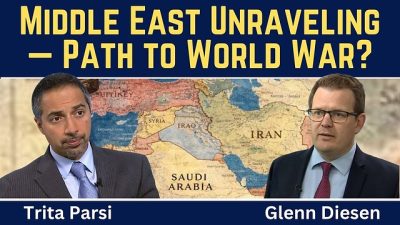
Trita Parsi: Middle East Unraveling — Are We on the Path to World War?
or go to
Aletho News Archives – Video-Images
New Book
Trans agenda is ‘normalization of sadism’ – US author

RT | September 23, 2026
The US Democratic Party has embraced a transgender agenda that amounts to “the normalization of sadism,” author A.J. Rice has said, warning that radical trans policies would return if the party is allowed to regain power.
Speaking to RT’s America First host Scotty Nell Hughes about his new book, ‘The Curse of the Bearded Lady: How the Trans Mafia Whacked American Sanity’, Rice argued that activists have gained significant influence in schools, medicine, and corporate America while people who questioned the agenda have faced pressure to stay silent.
The author described the “trans mafia” as the sprawling network of people and institutions that have helped the movement gain influence. He singled out parts of academia, wealthy backers, and corporations, and stated that providers of transition-related treatment also have a financial incentive to keep young people in their care indefinitely.
Rice argued that the consequences of these policies ultimately fall on children who are being drawn toward gender-affirming medical treatments and on girls who are expected to share locker rooms or compete in sports with biological males.
He noted that while voters rejected the Democrats’ approach to gender in 2024, the party, which has been “captured by madness,” has since only doubled down and is seeking what is effectively “the normalization of sadism.” … Full report
Blog Roll
 Aletho News
- Israeli election committee bars candidate from Knesset race over Gaza war opposition
- French-Lebanese man files war crimes complaint over Israeli attacks
- Mahan Air Flight Lands in China Despite US Threat against Iranian Airlines
- US eyes $10bn fund to rebuild war-battered Gulf infrastructure
- Trump meets Rodríguez near Maduro’s prison as Venezuela’s oil flows to US
- Trita Parsi: Middle East Unraveling — Are We on the Path to World War?
- Iran FM meets with US envoy on UN meeting’s sidelines at American side’s insistence: Report
- Qatar PM calls for Gulf security framework with Iran, says war must be ‘wake-up call’
- China condemns US extortion of Iranian airlines, rejects Washington’s ‘illegal’ sanctions threats
- Italy to move military personnel from Taif base after missile strike
- If Americans Knew
- Winter could turn Gaza’s treacherous, war-damaged buildings into deathtraps
- Majority of Democratic Voters Want to Prosecute Both Biden and Trump Administration Officials Over Gaza
- As Gaza languishes, world leaders gather at the UN – Daily Update
- Sanctions are collective punishment: immoral and self-defeating
- Phosphorus Munitions Fired by Israel Burn Groves, Orchards in Southern Lebanon
- Israel Carries Out New Ceasefire Violations Across Gaza
- AI – Emphasis on the ‘I’: Israel Is Funding AI Chatbot Propaganda
- Israel Blocking Hundreds of Wheelchairs for Injured Children From Entering Gaza
- Israel Is Expanding and Upgrading Compounds for Palestinian Militias in Gaza
- The Palestinian-American Residents of This West Bank Town Are Wondering: Where Is Trump?
- No Tricks Zone
- New Study: Earth And Venus Surface Warmth Largely Explained By Convection And Lapse Rate, Not CO2 Or Radiation
- 2025 Nature Paper Claiming Worsening Global Drought Gets RETRACTED …Heavily Flawed
- New Study: ‘Global Drought Shows No Detectable Recent Acceleration Under Climate Warming’
- Economic Masterminds: German Socialists Suggest Taxing Productivity Gains Stemming From Using AI
- The South China Sea Has Not Been Cooperating With The Climate Change Narrative
- Energy Crisis: Germany Enters Heating Season With Historically Low Gas Reserve Fill Levels
- New Study: The Antarctic Ice Sheet Gained Mass From 2020-2024 Due To Staggering Snow And Ice Accumulation
- Study: Ocean Heating Rates From Thousands Of Years Ago ‘Dwarf’ Modern Ocean Heating Rates
- Climate Extremists Target, Attack Large-Scale Power Grid Infrastructure In Germany!
- New Study: Antarctic Ice Melt Has Contributed Less Than 1 Centimeter To Sea Level Rise In The Last 30 Years

