Iranian scientist assassinated with help of SATELLITE-CONTROLLED hardware – IRGC
RT | December 6, 2020
The assassination of senior Iranian military researcher Mohsen Fakhrizadeh involved sophisticated electronic equipment controlled via satellite link, a senior official said. The scientist was gunned down in an ambush last week.
This piece of information comes from General Ramezan Sharif, spokesman for the powerful Islamic Revolution Guards Corps (IRGC), whose remarks during a Saturday event commemorating Fakhrizadeh were reported on Sunday by Iranian media.
“The assassination of a scientist on the street with a satellite device can not undermine our security,” he was cited as saying.
Last week the secretary of Iran’s Supreme National Security Council, Ali Shamkhani, said a remotely controlled weapon was used in the ambush that claimed the scientist’s life. The operation was “very complicated” and didn’t require human presence on the site at the time of the attack.
Iranian officials believe that Fakhrizadeh’s assassination was masterminded by Israel. Iranian media reported that the remains of the weapon that killed him, which was recovered from the scene, indicated that it originated from the Israeli military.
Israeli Intelligence Minister Eli Cohen said his government had no idea who killed Fakhrizadeh, but added that whoever did made the world a safer place because the Iranian physicist took “an active part in creating a nuclear weapon.” Iran denies ever trying to militarize its nuclear research, saying it’s purely civilian in purpose.
‘Weapon used in nuclear scientist’s assassination made in Israel’
Press TV – November 30, 2020
The remains of the weapon used in the Friday assassination of senior nuclear scientist Mohsen Fakhrizadeh show that it was made in Israel, an informed source has told Press TV.
The source made the revelation on Monday, saying the weapon collected from the site of the terrorist act bears the logo and specifications of the Israeli military industry.
Iran’s Ministry of Intelligence also said it had obtained “new leads” on the identity of the perpetrators and that the information “will be publicized very soon.”
A former head of the Defense Ministry’s Organization of Defensive Innovation and Research, Fakhrizadeh was targeted in an attack involving at least one explosion and machinegun fire in the town of Absard near Tehran.
Foreign Minister Mohammad Javad Zarif tweeted on Sunday that the assassination bears all the hallmarks of the Israeli regime.
The history of Tel Aviv’s sabotage targeting Iran’s nuclear energy program is as old as the program itself.
Many observers believe Israel is not able to carry out such dangerous operations without the prior information and support of the United States which left a landmark nuclear deal with Iran in 2015.
Israel possesses the Middle East’s sole nuclear arsenal estimated to contain at least 200 warheads. The occupying regime maintains a policy of ambiguity concerning its nuclear weapons, neither confirming nor denying publicly that it has the capability.
Unlike Iran, it also refuses to join the Nuclear Non-Proliferation Treaty (NPT) and does not allow any international inspection of its nuclear weapons program.
MPs demand Iran restrict IAEA inspections after scientist assassination
Press TV | November 29, 2020
Iranian lawmakers have issued a statement demanding that the country respond to the recent assassination of a senior nuclear scientist near Tehran by restricting the United Nations’ regulatory mandate regarding Iran’s nuclear program.
Members of Majlis (Iran’s Parliament) offered the proposal in a statement that was read out at the legislature on Sunday.
“Such atrocity entails an immediate and regret-inducing response,” they said, stressing that the best means of retaliation is through “the revival of the country’s brilliant nuclear industry by ending its voluntary adherence to the Additional Protocol” and restricting the UN nuclear watchdog’s unprecedented inspection regime.
Iran undertook to adhere to the Additional Protocol of the Nuclear Non-Proliferation Treaty (NPT) as part of its 2015 nuclear agreement with world countries. Under the protocol, the International Atomic Energy Agency (IAEA), the UN nuclear watchdog, is allowed to carry out “more intrusive” inspections of the country’s nuclear work.
Iran’s nuclear activities and the deal, officially known as the Joint Comprehensive Plan of Action (JCPOA), have frequently been the target of sabotage by the United States and the Israeli regime.
The US left the JCPOA in 2018, and its allies in the accord – the UK, France, and Germany – subsequently failed to secure Iran’s interests guaranteed by the deal, under Washington’s pressure.
Two of the most recent acts of sabotage — where the Islamic Republic strongly suspects Israel to have acted with US intelligence – include a July incident at the central Natanz nuclear site that caused material damage to the facility and the Friday assassination of nuclear expert Mohsen Fakhrizadeh.
Fakhrizadeh, the head the Defense Ministry’s Organization of Defensive Innovation and Research, was targeted in a multi-pronged terrorist attack by a number of assailants in Absard city of Tehran Province’s Damavand County.
Qalibaf: Enemies should be made to regret this
Majlis Speaker Mohammad-Baqer Qalibaf also urged a “strong response” to the assassination, saying the country’s enemies would not be made to regret their atrocity in any other way.
A response, he said, has to both avenge the assassination and deter the enemies from repeating such atrocities in the future.
The assassination showed that the adversaries have been frustrated by Iran’s rising power and therefore have resorted to eliminating its scientists, he noted.
The senior parliamentarian, however, expressed certainty that the nation would be able to weather the loss as it has in countless other cases since the 1979 victory of its Islamic Revolution and “pursue the path of its martyrs more strongly than before.”
Four Iranians on trial in Belgium over suspected France bomb plot in European first
RT | November 27, 2020
An Iranian diplomat and three of his compatriots go on trial in Belgium on Friday after being accused of plotting to bomb an opposition rally outside Paris in 2018, in the first such proceedings in Europe.
The diplomat, Assadolah Assadi, who was formerly based in Vienna, and the three others have been charged by prosecutors in Belgium with planning an attack on a meeting of the National Council of Resistance of Iran (NCRI). The exiled opposition group is headquartered in the French capital.
The trial is scheduled to be held on Friday and then Thursday next week, and if convicted, Assadi, 48, faces life in prison. The diplomat, who has not commented on the charges, was arrested while on holiday in July 2018 in Germany, where he had no immunity from prosecution and was handed over to Belgium.
This is the first time an Iranian official has been put on trial in an EU member state for terrorism.
Two of his suspected accomplices, a couple living in Belgium, had also been arrested Belgium, with police saying they had half a kilo of the explosive TATP and a detonator.
Another alleged accomplice, Mehrdad Arefani, 57, is an Iranian poet who had lived in Belgium for several years. He was arrested in France in 2018.
Belgian authorities said in June 2018 that they had thwarted an attempt to “smuggle explosives” to France to attack the meeting, and later that year, French officials accused Tehran’s intelligence service of being behind the operation. Jaak Raes, head of the Belgium’s state security service (VSSE), said in a letter to the prosecutor in February this year that “the attack plan was conceived in the name of Iran and under its leadership.”
France also accused Iran’s intelligence ministry of planning the plot and reportedly expelled an Iranian diplomat in retaliation in October 2018.
The assets of an Iranian intelligence unit and officials were frozen in the European Union.
The Islamic Republic has denied the allegations, saying that the “plot” was a stunt by the NCRI, which is labeled a terrorist group in Iran.
‘Must Leave’: Iran Slams Presence of US Forces in Syria, Calls for Immediate Withdrawal
By Oleg Burunov – Sputnik – 26.11.2020
In October 2019, President Donald Trump announced that the US would be withdrawing its forces from Syria, but eventually backtracked, saying that a “small” American contingent would stay behind to allegedly “keep” the Syrian oil from being seized by Daesh.
Iran’s permanent ambassador to the United Nations (UN) Majid Takht-Ravanchi has called for the immediate and full-fledged withdrawal of US troops from Syria.
“All foreign forces whose presence is not permitted by the Syrian government must leave Syria”, the diplomat told a UN Security Council meeting on Wednesday, in an apparent nod to the US. He questioned American forces’ current role in Syria, insisting that instead of fighting terrorism, they “continue supporting UN-designated terrorist groups such as al-Nusra Front as well as looting the oil and wealth of the Syrian people”.
Iranian Foreign Minister Mohammad Javad Zarif earlier noted that Tehran would work to strengthen economic cooperation with Syria amid Washington’s restrictive measures under the US Caesar Act, which stipulates sanctioning almost all Syrian economic and trade activities, as well as government officials.
He was echoed by Iran’s Supreme Leader Ayatollah Ali Khamenei who voiced hope in May that the “Americans won’t stay in Syria and will be [finally] expelled.”
Senior US Official Boasts About Lying to Trump to Keep US Troops in Syria
Ambassador Takht-Ravanchi’s statement comes a few weeks after Jim Jeffrey, outgoing US special representative for Syria and special presidential envoy for the western coalition against Daesh, told the news outlet Defence One that he and members of his staff deliberately covered up the true size of the US military footprint in Syria from President Donald Trump.
“What Syria withdrawal? There was never a Syria withdrawal”, Jeffrey said, referring to Trump’s repeated orders in late 2018 and then again in 2019 to bring US troops home. “When the situation in northeast Syria had been fairly stable after we defeated ISIS, [Trump] was inclined to pull out. In each case, we then decided to come up with five better arguments for why we needed to stay. And we succeeded both times. That’s the story”, the US envoy added.
He argued that the actual number of US troops in Syria is “a lot more” than the estimated 200-400 that POTUS agreed to leave behind in 2019 to “secure” the country’s oil fields and prevent them from falling into the hands of the Syrian government or terrorists.
American troops, jointly with the Arab-Kurdish Syrian Democratic Forces (SDF), maintain control over a part of northeastern Syria as the US-led coalition of more than 60 nations has been carrying out airstrikes and other operations against terrorists in Syria since September 2014.
The coalition operates in Syria without the approval of the Assad government or any UN Security Council authorisation. Damascus, in turn, sees the US presence on Syrian soil as a violation of national sovereignty and an attempt to seize the country’s natural resources.
Iran hawks Pompeo, Bolton made rich by Israeli lobby: Pentagon adviser
Press TV | November 14, 2020
A top adviser at the Pentagon says prominent US officials, including Iran hawks Secretary of State Mike Pompeo and former national security advisor John Bolton, have been taking money and getting rich from the Israeli lobby.
Washington’s support for Tel Aviv is the result of Israeli lobby money, said retired Army Colonel Douglas Macgregor, who was appointed this week as senior adviser to newly installed acting Defense Secretary Christopher Miller, in two media appearances back in 2012 and 2019.
“You have to look at the people that donate to those individuals,” he said in a September 2019 interview when asked if Bolton and Republican Senator Lindsey Graham wanted war with Iran.
“Mr. Bolton has become very, very rich and is in the position he’s in because of his unconditional support for the Israeli lobby. He is their man on the ground, in the White House. The same thing is largely true for Mr. Pompeo, he has aspirations to be president. He has his hands out for money from the Israeli lobby, the Saudis and others,” he added.
In another interview in 2012, Macgregor stressed that the Israel lobby in the US has “enormous influence” on Congress and that it wanted to instigate “military strikes” with Iran.
“I think the American Israeli Public Affairs Committee (AIPAC) and it’s subordinate elements or affiliated elements that represent enormous quantities of money that over many years have cultivated an enormous influence in power in Congress,” he told Russia’s state media network RT.
“I think you’ve got a lot of people on the Hill who fall into two categories. One category that is interested in money and wants to be re-elected, and they don’t want to run the risk of the various lobbies that are pushing military action against Iran to contribute money to their opponents.”
AIPAC is known for being the main architect of US policies throughout the Middle East, and has been criticized repeatedly for wielding disproportionate influence in Congress.
The US State Department declined to comment on behalf of Pompeo in response to Macgregor’s remarks.
Bolton, however, reacted to the disclosure through a spokesman, saying, “I don’t respond to anti-Semites.”
This is while his financial disclosures show he earned thousands of dollars for speaking to pro-Israel groups prior to his appointment as the White House national security adviser in 2018.
New IAEA Report Proof of Iran’s Continued Cooperation: Envoy
Al-Manar | November 12, 2020
Iran says the International Atomic Energy Agency’s latest report proves the country’s continued cooperation with the UN’s nuclear watchdog and the suspension of commitments under a 2015 deal.
Kazem Gharibabadi, Iran’s permanent representative to Vienna-based international organizations, told reporters on Wednesday that the new report shows the IAEA’s continued verification of the country’s nuclear program.
According to the report, he said, in addition to heavy water production and storage, Iran has exported more than 2.2 tons of its heavy water and also utilized 1.3 tons in line with its research and development activities.
He said the report states that Iran has continued its uranium enrichment activities in Natanz and Fordow sites, using new machines, and enriching uranium up to 4.5% purity, which is beyond the 3.67% limit set in the nuclear agreement, which is officially known as the Joint Comprehensive Plan of Action (JCPOA).
In addition, he added, the report mentions Iran’s recent decision to relocate its R&D centrifuges underground in Natanz and states that the country has declared it will consider safeguard requirements.
According to Gharibabadi, “the IAEA report has announced the amount of Iran’s uranium reserves is about 2,442.9 kg as of November 2, which is equal to about 3,600 kg of low-enriched uranium.”
He also pointed to the report’s reference to the results of the IAEA’s inspection of one of the country’s sites in 2018, and said that despite the differences in Iran’s technical views with the IAEA, interactions in that area are still ongoing between the two sides with the aim of resolving the issue.
Separately, Iran’s Ambassador to the United Nations Majid Takht-Ravanchi told a meeting of the UN General Assembly that Tehran believes the IAEA must fulfil its verification duty in a way that it does not overshadow the member states’ inalienable right to reinforce their peaceful use of nuclear energy.
Even the non-proliferation concerns should not limit the member states’ rights, he said, adding that the international community must reject any attempt to restrict peaceful use of nuclear energy.
He said over the past year, 22 percent of all the IAEA’s inspections have been carried out in Iran, and the watchdog’s activities have not stopped in the Islamic Republic even at the peak of the coronavirus outbreak.
Iran signed the JCPOA with six world states — namely the US, Germany, France, Britain, Russia and China — in 2015.
However, Washington’s unilateral withdrawal in May 2018 and subsequent re-imposition of sanctions against Tehran left the future of the historic agreement in limbo.
Iran remained fully compliant with the JCPOA for an entire year, waiting for the co-signatories to fulfill their end of the bargain by offsetting the impacts of American bans on the Iranian economy.
But as the European parties failed to do so, the Islamic Republic moved in May 2019 to suspend its JCPOA commitments under Articles 26 and 36 of the deal covering Tehran’s legal rights.
Iran took five steps in scaling back its obligations, among them abandoning operational limitations on its nuclear industry, including with regard to the capacity and level of uranium enrichment.
All those measures were adopted after informing the IAEA beforehand, with the agency’s inspectors present on the ground in Iran.
Iran ready to play leading role in Syria reconstruction/ Shalamcheh-Basra-Latakia railway; The most important economic joint project
Mideast Discourse | November 6, 2020
Steven Sahiounie, a Syrian-American journalist, believes that while Western and European sanctions prevent the import of replacement parts needed by Syria in infrastructure projects, the ability of Iranian industrial engineers to build what is needed could be a vital path around and behind Western sanctions.
Sahiounie tells the Bazaar in an exclusive interview that the prospects for continuing bilateral relations between Iran and Syria are good.
“They both share the same dedication to peaceful relations with countries in the Middle East region while holding firmly to the ideal of resistance to the occupation of Palestine, and demanding that the rights of the Palestinian people be restored without delay”, he said.
Steven Sahiounie is an award-winning journalist, and chief editor of MidEastDiscourse. He has appeared on RT, PressTV, Syrian News, as well as international TV and radio programs. As a Syrian-American journalist and political commentator, he is often sought out concerning currents events facing Syria and the region.
Following is the text of the interview:
Bazaar: How do you predict the prospects for bilateral relations between Iran and Syria?
Sahiounie: The prospects for continuing bilateral relations between Iran and Syria are good. They both share the same dedication to peaceful relations with countries in the Middle East region while holding firmly to the ideal of resistance to the occupation of Palestine, and demanding that the rights of the Palestinian people be restored without delay.
Bazaar: What are the current economic relations and volume of trade between Iran and Syria?
Sahiounie: The trade officials of both Syria and Iran have worked toward establishing industrial and economic free trade zones jointly, with an emphasis on the private sector.
Iran and Syria are slated to boost bilateral trade volume from $500 million to $1 billion within the next year.
Bazaar: What is the major part of Syrian exports?
Sahiounie: The top exports of Syria are Pure Olive Oil, Spice Seeds, Other Nuts, Apples, Pears, and Calcium Phosphates.
Syria shipped an estimated $462 million worth of goods around the globe in 2019. That amount reflects a -46% decrease since 2015 and a -36.2% drop from 2018 to 2019.
The US-NATO attack on Syria beginning in 2011 has devastated lives, the infrastructure, and the economy. The continuing sanctions by the US and EU are designed to keep the war against the Syrian people going, even though the battlefields are silent, except for Idlib, which is under the military occupation of Al Qaeda.
The data from 2010 shows that 81.1% of products exported from Syria were bought by importers in Iraq, Italy, Germany, Turkey, Saudi Arabia, France, Lebanon, Jordan, United States, Netherlands, Egypt, and Spain. Due to the US-EU sanctions against Syria and the Arab monarchies of the Persian Gulf region boycotts, the markets for Syrian goods were closed due to political ideology. Iraq, Lebanon, and Jordan have maintained some trade with Syria in defiance of the western bullies.
The Syrian government is working with a comprehensive plan for agricultural development and expansion of agricultural and food industries to enhance the Syrian economy in the face of the sanctions and the unfair siege on the livelihood of the Syrian people.
Bazaar: What is the most important economic project of the two countries at this present?
Sahiounie: The project to build a railroad connecting Iran’s Shalamcheh border crossing, to the Iraqi port of Basra, and finally to reach Syria’s Mediterranean port city of Latakia is the most important economic project between Syria and Iran.
The project has been on the drawing board for years and is now in the beginning stages. The mammoth railroad line will be linked to the New Silk Road, also known as China’s Belt and Road Initiative, which in turn is also linked to the Russian railroad system. Once completed, western sanctions on Syria and Iran will be thwarted.
Bazaar: What is the most important tool to protect the continuation of bilateral economic relations?
Sahiounie: The most important tool for Iran and Syria to use to protect their continuing bilateral economic relations is in supporting the two countries’ private sectors, both in trade and industry, for the benefit of investment opportunities in the free zones. The bartering system of exchanging goods and services without the use of currency is another tool that can be effective.
Bazaar: The trade between the two countries is set to reach $ 1 billion by next year. What are the plans for expanding bilateral trade? What ?is your opinion?
Sahiounie: Plans to expand bilateral trade include mechanisms to enhance commercial exchange and develop cooperation in the field of research laboratories and medical equipment and infrastructure projects, development, and investment.
The agreement is known as “long-term strategic economic cooperation”, which includes industrial, trade, and agricultural cooperation. Education, housing, public works, railroads, and investments are covered in other agreements.
An important banking agreement between Iran and Syria has been reached, which sends a message to the international community about the depth of Syrian-Iranian cooperation and will benefit Iranian companies wishing to invest in Syria and participate in reconstruction.
Syria and Iran signed several agreements worth $142.5 million, involving Iranian companies involved in the restoration of more than 2,000 MegaWatts of power production capacity, and additional projects by the dozens in the oil and agricultural sectors.
Bazaar: What is your opinion about the impact of Caesar’s law and resulting US sanctions on Iran-Syria trade?
Sahiounie: The impact of Caesar’s sanctions is psychological. To instill fear into the minds of all Syrian people, as well as all countries which would conduct business with Syria.
Layer, after layer of sanctions, has been applied to Syria, to destroy the Syrian government, and installing a US puppet to be the ultimate ‘yes-man’ to Washington.
As Syria and the entire world grapple with the COVID-19 pandemic, the imposition of such inhumane sanctions has increased the suffering of the Syrian people. Instead of coming to the aid of people inside Syria with medical supplies to cope with the pandemic, the sanctions prevent medical companies abroad from doing business with merchants in Syria in the medical supplies industry, for fear of being tracked down and fined by the US Treasury Department.
Horror stories have been heard of companies in Europe who sent medicines and supplies to Syria, only to be tracked down in their own offices in Europe by US authorities enforcing the sanctions against anyone who would dare to throw a lifeline to anyone in Syria.
Bazaar: What is your assessment about Iran’s role in Syria`s reconstruction?
Sahiounie: Since 2017, Iranian companies have participated in rebuilding expos in Syria, and in 2019, the Syrian–Iranian Joint Chamber of Commerce held its first meeting. Iran is poised to play a leading role in the reconstruction of Syria. Projects include residential buildings, power stations, agriculture, telecommunications, oil, and mining.
In 2018, Iran signed a Memorandum of Understanding with Syria to construct 200,000 housing units near Damascus alongside other large projects. Iranian companies are participating in several major projects in Syria’s energy industry, including a gas-fired power plant project in Aleppo. Iran’s largest energy construction company, MAPNA Group, is engaged in the construction of the 540-MegaWatt combined-cycle power plant in Latakia.
Over 95 percent of the power plant equipment and much of the equipment in the Iranian electricity and water industry are domestically manufactured and can repair steam, natural gas, combined-cycle, incineration, and turbines of generators, as well as make strategic parts for power plants.
While the US-EU sanctions prevent Syria from importing much-needed replacement parts for infrastructure projects, the ability of the Iranian industrial engineers to manufacture what is needed can be a vital path around and behind the back of the western sanctions.
With an Eye on China, India Cuts Iran Loose & Embraces the US
By Salman Rafi Sheikh – New Eastern Outlook – 06.11.2020
India, tied as it to the US apron strings, has suffered a major strategic set-back in Iran where not only has it potentially lost exclusive development rights and control of the strategically important port of Chabahar, but has also been kicked out of Farzad-B gas field project. This has potentially meant a physical death of the ambitious 2013 ‘Tehran Declaration’, which had supposedly tied India and Iran in a strong strategic relationship. While India’s deliberate move away from Iran has taken place against the backdrop of US sanctions on Iran, imposed in the wake of Trump’s decision to force-scrap the JCPOA, these moves are fundamentally rooted in a strategic consensus with the US over Iran. It is for this reason that India has not pumped enough money even into the Chabahar port, which otherwise is exempted from US sanctions.
For India, getting close to the US was/is more important in the wake of its on-going military tensions with China than pursuing relatively low-level strategic interests in Iran. The path that the Indian policy makers chose to confront China at a broader level required sacrificing their interests in Iran. As it stands, Indian companies previously involved in Farzad-B are now engaged in a similar gas exploration project in Israel, indicating how India has largely moved to the anti-Iran camp.
India’s move away from Iran has allowed it to deepen its strategic relations with the US. Indeed, the immediate result has been the signing of “Basic Exchange and Cooperation Agreement” (BECA), the third so-called “foundational pact” after the “Logistics Exchange Memorandum Of Agreement” (LEMOA) and “Communication Compatibility and Security Agreement” (COMCASA) which collectively improve these countries’ military interoperability.
As an Indian news report explained, the BECA will help India get real-time access to American geospatial intelligence that will enhance the accuracy of automated systems and weapons like missiles and armed drones. Through the sharing of information on maps and satellite images, it will help India access topographical and aeronautical data, and advanced products that will aid in navigation and targeting.
While one may think that India’s close ties with the US have roots in Trump’s own aggressive China policy, the US policy towards India and India’s relevance for the US against China are unlikely to change even if Trump loses and Biden wins. Let’s not forget that Biden, when he was Obama’s vice president, was one of the main architects of the so-called “Asia Pivot” policy. India was as relevant to the “Asia Pivot” as it is to Trump’s “Indo-Pacific” strategy. “Indo-pacific” strategy is very much a continuation of “Asia Pivot” in as much as it aims at confronting and containing China and Russia in Asia and beyond.
According to Indian defense experts, the agreement signed will directly help India fight China in Ladakh, and Pakistan in Kashmir. Indian experts have been reported to have said that if the deal had been signed earlier, the situation at the Northern border of India could have been different.
Indeed, Mark Esper said that defense agreements between the US and India call for military cooperation and is a check on ‘Chinese aggression’, adding that “Based on our shared values and common interests, we stand shoulder-to-shoulder in support of a free and open Indo-Pacific for all, particularly in light of increased aggression and destabilizing activities by China.”
“Our leaders and our citizens see with increasing clarity that the [Chinese Communist Party] is no friend to democracy, the rule of law, transparency, nor to freedom of navigation, the foundation of a free and open and prosperous Indo-Pacific,” said Pompeo.
Pompeo further categorically said that America would “stand by India” in the fight against China, and paid tribute to the soldiers killed in Ladakh.
With China, rather than Modi-Trump bromance, being the central pillar of US-India strategic relations, it is, therefore, unlikely that the prevalent spirit of deep direct defense ties will die out even if Trump is voted out of the White House.
As India’s former army chief General Nirmal Chander Vij explained, “Over this period we have realized that Indian interests and American interests are [going] in the same direction and for the same purpose – and for that very reason, India has gone ahead and signed the foundational military agreements.”
What is more important for India in the wake of its on-going military tensions with the US is the realization about its lack of military preparedness vis-à-vis China. With no significant arms industry at home, the Indian policy makers see in the US a natural anti-China ally, one they would not find in Russia or anywhere else, and a key source of advanced military hardware.
To maintain and even deepen this alliance and to further the scope of the so-called 2+2 dialogue, Indian policy makers were not reluctant to tell Iran that their country wouldn’t be able to maintain the spirit of the ‘Tehran Declaration.’ It is for this reason that two consecutive visits of India’s foreign and defense ministers to Iran were quickly followed by Iran’s decision to kick India out of the Farzad-B gas project, realizing that India’s strategic realities are clearly at odds with its previously widely propagated and ambitious ‘look East’ policy, an idea that imagined a greater Indian reach to Central Asia and Afghanistan via Iran.
Salman Rafi Sheikh is a research-analyst of International Relations and Pakistan’s foreign and domestic affairs.
Iran finally brings desalinated Persian Gulf water to its arid desert
Press TV | November 5, 2020
Iranian President Hassan Rouhani has opened a mega project for transferring desalinated sea water to arid deserts in the Iranian Plateau, the first in the history of a country where water shortage has always been a major impediment to economic development.
Rouhani used a video conference call on Thursday to supervise the start of water transfer from desalination facilities off the Persian Gulf in southern Hormozgan province to water-intensive industries in southeastern province of Kerman.
The transfer line, which includes dozens of tunnels, pumping stations and storage facilities, takes desalinated water some 305 kilometers to one of Iran’s largest mining and metals plants in Sirjan.
The first phase of the project has cost nearly 165 trillion rials (over $600 million). The Iranian Energy Ministry said that around a third of the total water desalinated in the project, some 150 million m3 per year from a total of 450 million m3 of sea water, would be purchased on a guaranteed basis for household consumption in two coastal cities.
The transfer line is planned to continue another 500 kilometers in the next phases of the project to take water to copper smelters in Sarcheshmeh, in north of Kerman, and further into the heart of the Iranian desert in Yazd province where the sprawling Chadormalu mining complex, the largest iron ore producer in the Middle East, is located.
The desalinated water will also be consumed for irrigation, said Rouhani during the inauguration ceremony, as he insisted that the project would relieve a huge burden from underground water resources and would boost environmental conditions in the Iranian Plateau and along the Persian Gulf coast.
“This project had been deemed unimaginable and it materialized in the Government of Discretion and Hope,” Rouhani said making a reference to a phrase routinely used to distinguish his two four-year terms in office that began 2013.
The Iranian president hailed the launch of key infrastructure projects in recent years in Iran as a sign that a series of unprecedented sanctions imposed by the United States have failed to dent the country’s resolve for development.
“We have managed to take these big steps despite sanctions, despite the pressure and despite the fact that a terrorist government was in office in America” he said.
Sorry, Google and World Bank, but Middle Eastern Crops Keep Thriving
By H. Sterling Burnett | ClimateRealism | November 4, 2020
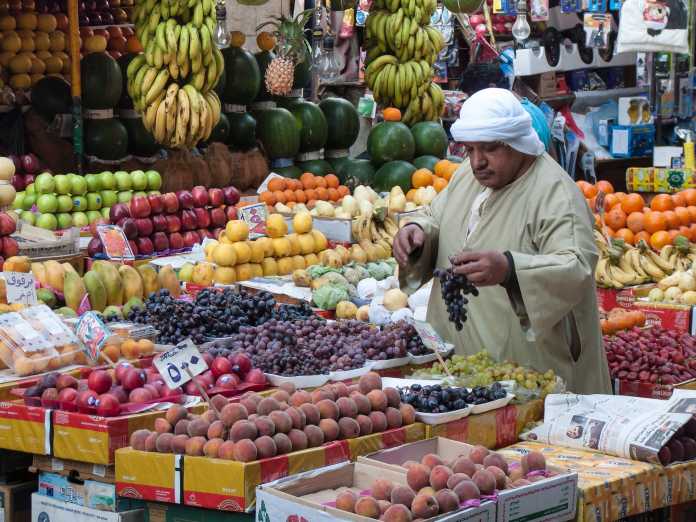
Google News today is promoting articles (see the Google-promoted PhysOrg article here, for example) about a speculative World Bank “study” claiming climate change is threatening crop production in the Middle East. The World Bank study is full of speculation but short on facts. Real-world data show crop yields per acre and total crop production are consistently and dramatically rising in each of the Middle East countries examined by the World Bank study.
In its study, titled “Water in the Balance,” the World Bank says, “[w]hile information about water scarcity at present and in the future is available there is little knowledge of what this increasing scarcity means for Middle Eastern … food security. Agriculture will suffer because of climate change and water scarcity….”
In particular the World Bank asserts water scarcity caused by climate change will reduce farm production in Iran, Iraq, Jordan, Lebanon, Syria, and Turkey. The available evidence strongly suggests that will not happen.
Had the study’s authors examined real-world data concerning crop production in the Middle Eastern countries, they would have found, even amidst substantial strife in the region, crop yields and overall production have increased dramatically. More food is being produced even as thousands of acres of agricultural lands have been abandoned during regional conflicts.
Data from the U.N. Food and Agriculture Organization show during the period of modest warming since 1989:
- Cereal crop production in Iraq increased 91 percent, even as the acreage being harvested fell 5 percent.
- Cereal crop production in Iran increased 187 percent, while the acreage harvested increased by just 2.6 percent.
- Cereal Crop production in Jordan increased 15 percent, even as the acreage harvested declined 30 percent.
- Cereal Crop production in Lebanon increased 115 percent, while acreage harvested increased 30 percent.
- Cereal Crop production in Syria increased 22 percent, even as acreage harvested declined 66 percent.
- Cereal Crop production in Turkey increased 46 percent, even though acreage harvested declined 19 percent.
It is clearly good news – and not a climate crisis – that Middle Eastern countries have increased crop production despite the fact that many of them have been embroiled in internal political strife, outright civil warfare, and external conflicts. That good news is ignored in the World Bank’s doom-and-gloom report.
Global warming lengthens growing seasons, reduces frost events, and makes more land suitable for crop production. Also, carbon dioxide is an aerial fertilizer for plant life. In addition, crops also use water more efficiently under conditions of higher carbon dioxide, losing less water to transpiration. The latter fact should have allayed the World Bank’s concern about climate change induced water shortages leading to crop failure.
The benefits of more atmospheric carbon dioxide and a modestly warming world have resulted in 17 percent more food being available per person today than there was 30 years ago, even as the number of people has grown by billions. Indeed, the last 20 years have seen the largest decline in hunger, malnutrition, and starvation in human history.
Sorry, World Bank, Google, and PhysOrg, but that does not equate to a climate crisis.
H. Sterling Burnett, Ph.D. is managing editor of Environment & Climate News and a research fellow for environment and energy policy at The Heartland Institute. Burnett worked at the National Center for Policy Analysis for 18 years, most recently as a senior fellow in charge of NCPA’s environmental policy program. He has held various positions in professional and public policy organizations, including serving as a member of the Environment and Natural Resources Task Force in the Texas Comptroller’s e-Texas commission.
Featured Video

Trita Parsi: Middle East Unraveling — Are We on the Path to World War?
or go to
Aletho News Archives – Video-Images
New Book
Trans agenda is ‘normalization of sadism’ – US author

RT | September 23, 2026
The US Democratic Party has embraced a transgender agenda that amounts to “the normalization of sadism,” author A.J. Rice has said, warning that radical trans policies would return if the party is allowed to regain power.
Speaking to RT’s America First host Scotty Nell Hughes about his new book, ‘The Curse of the Bearded Lady: How the Trans Mafia Whacked American Sanity’, Rice argued that activists have gained significant influence in schools, medicine, and corporate America while people who questioned the agenda have faced pressure to stay silent.
The author described the “trans mafia” as the sprawling network of people and institutions that have helped the movement gain influence. He singled out parts of academia, wealthy backers, and corporations, and stated that providers of transition-related treatment also have a financial incentive to keep young people in their care indefinitely.
Rice argued that the consequences of these policies ultimately fall on children who are being drawn toward gender-affirming medical treatments and on girls who are expected to share locker rooms or compete in sports with biological males.
He noted that while voters rejected the Democrats’ approach to gender in 2024, the party, which has been “captured by madness,” has since only doubled down and is seeking what is effectively “the normalization of sadism.” … Full report
Blog Roll
 Aletho News
- ‘We don’t seek permission to defend our country’: Snippets from President Pezeshkian’s UNGA address
- NATO chief wants Europeans to fight American wars [for Israel]
- German chemicals giant reveals details of downsizing
- Refaat Al-Areer Was The Canary In The Coal Mine In Israel’s War On The Truth
- Israeli election committee bars candidate from Knesset race over Gaza war opposition
- French-Lebanese man files war crimes complaint over Israeli attacks
- Mahan Air Flight Lands in China Despite US Threat against Iranian Airlines
- US eyes $10bn fund to rebuild war-battered Gulf infrastructure
- Trump meets Rodríguez near Maduro’s prison as Venezuela’s oil flows to US
- Trita Parsi: Middle East Unraveling — Are We on the Path to World War?
- If Americans Knew
- An error has occurred; the feed is probably down. Try again later.
- No Tricks Zone
- New Study: Earth And Venus Surface Warmth Largely Explained By Convection And Lapse Rate, Not CO2 Or Radiation
- 2025 Nature Paper Claiming Worsening Global Drought Gets RETRACTED …Heavily Flawed
- New Study: ‘Global Drought Shows No Detectable Recent Acceleration Under Climate Warming’
- Economic Masterminds: German Socialists Suggest Taxing Productivity Gains Stemming From Using AI
- The South China Sea Has Not Been Cooperating With The Climate Change Narrative
- Energy Crisis: Germany Enters Heating Season With Historically Low Gas Reserve Fill Levels
- New Study: The Antarctic Ice Sheet Gained Mass From 2020-2024 Due To Staggering Snow And Ice Accumulation
- Study: Ocean Heating Rates From Thousands Of Years Ago ‘Dwarf’ Modern Ocean Heating Rates
- Climate Extremists Target, Attack Large-Scale Power Grid Infrastructure In Germany!
- New Study: Antarctic Ice Melt Has Contributed Less Than 1 Centimeter To Sea Level Rise In The Last 30 Years

