Netanyahu tells Biden how to deal with Iran
By Philip Giraldi • Unz Review • February 2, 2021
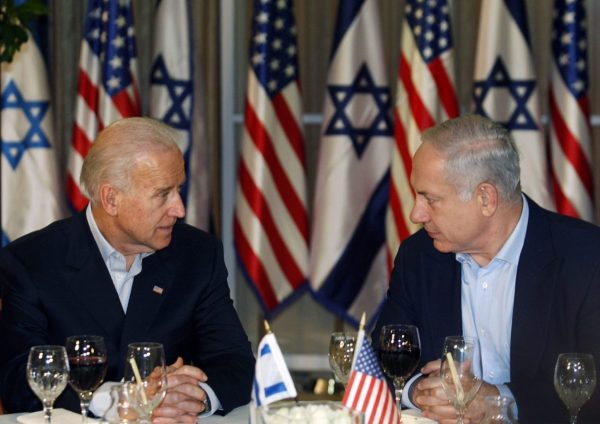
Anyone who persists in believing that the United States is not Israel’s poodle should pay attention to the comedy that is playing out right now. Joe Biden was [proclaimed] president for less than a week when the Prime Minister Benjamin Netanyahu government announced that he would soon be receiving a possibly unwelcome visitor in the form of the Israeli foreign intelligence service Mossad’s chief Yossi Cohen, who will be flying to Washington in February to explain the correct policy when dealing with Iran. And lest there be any confusion on the issue, the Israel Defense Force chief of staff Lieutenant General Aviv Kochavi also announced that any Biden attempt to mend fences with the Islamic Republic will have to meet certain conditions or Israel will exercise other options. He said “In light of this fundamental analysis, I have instructed the Israel Defense Forces to prepare a number of operational plans, in addition to those already in place. It will be up to the political leadership, of course, to decide on implementation but these plans need to be on the table.” Another government minister clarified that the options would include “an attack” on Iran, though there has been no indication whether or not Israel would possibly contemplate deploying its tactical nuclear weapons to prevent retaliation by Iranian forces.
There is no limit to Israeli hubris. A leading Rabbi in Israel is predicting that as the United States is in decline it is up to the Jewish state to take over the role of “guiding civilization forward.” And that kind of thinking shapes how Israel treats the United States with condescension, acting as if it is the knowledgeable elder statesman whose guidance must be respected. In this case the Zionist solution to the Iran problem will by design be unpalatable for the government in Tehran if it intends to remain sovereign. For Israel the correct policy for dealing with Iran is to effectively disarm it and make it impossible to establish any sphere of influence in the countries adjacent to it, to include Iraq, Syria, and Lebanon. That would be to concede Israeli dominance over the entire region and if the Iranians do not play ball the next step would be to convince the United States to attack it on some pretext, possibly to include an Israeli “false flag” to start the process going.
The Times of Israel sums up the Israeli official position as “… Iran must halt the enriching of uranium; stop producing advanced centrifuges; cease supporting terror groups, foremost Lebanon’s Hezbollah; end its military presence in Iraq, Syria and Yemen; stop terror activity against Israeli targets overseas; and grant full access to the IAEA on all aspects of its nuclear program.” Completing the disarming of Iran would also include requiring Tehran to abandon its ballistic missile program.
The irony is, of course, that it is Israel that has a secret nuclear arsenal that it created by stealing uranium and triggers from the United States and it is also the leading regional supporter of terrorist groups, to include al-Qaeda and ISIS. Iran’s presence in Syria is due to its lending assistance to the Damascus government’s resistance to the insurgencies supported by Israel and the United States. And Iran has not targeted Israeli citizens and groups overseas, but Israel and the U.S. have assassinated Iranian officials while also bombing both government and civilian targets in Syria, Iraq and Lebanon. And all of the kinetics occur in a context where Israel continues its illegal occupation of Palestine and ethnic cleansing of the Palestinian people replete with both war crimes and crimes against humanity. Iran is also a signatory to the Nuclear Non-Proliferation Treaty, which Israel is not, so who is the rogue state?
Biden will likely fold like a cheap suit when confronted by the force majeure of Cohen. The new American president has assembled a national security team for dealing with the Middle East that is nearly all Jewish and all Zionist, an affliction that he himself claims to suffer from. The Biden nominee for secretary of state Tony Blinken said at a confirmation hearing last week that the new administration would “consult with Israel” before any possible return to the 2015 Joint Comprehensive Plan Of Action (JCPOA) nuclear deal and he also made clear that there would be additional conditions for Iran. It was an odd comment for a government official who is supposed to support American interests, but it was predictably what Congress wanted to hear. As Iran has already indicated that it is unwilling to abandon its defenses and its role in the region, the Biden proposal will be a non-starter in any case, though Israel will be prepared to apply its own veto if anything undertaken by the State Department moves beyond the talking stage.
Currently there is credible speculation that Israeli intelligence has been able to compromise most if not all of the U.S. government’s information systems as well as those of major corporations. As the Jewish state is the most active in spying against the United States, that should surprise no one. For Israel to interfere in U.S. politics or government blatantly is not exactly new, though it is rare to have anyone in the mainstream media or in government say anything about. That is because Israel’s ability to wage war against critics is second to none, having at its back nearly unlimited financial resources and easy access to the media as well as active supporters from among the nearly six hundred Jewish organizations that exist in the United States.
Indeed, Israel has been involved in American politics frequently, one might even argue incessantly, even if it is predictably never held accountable. To cite only one well known example, it has been suggested that Russiagate was really Israelgate based on what actually took place shortly after the 2016 election. The contact with Russia was set up by Prime Minister Benjamin Netanyahu, who was at the time seeking to kill an anti-Israeli vote in the United Nations. He sought to do so by lobbying Donald Trump son-in-law Jared Kushner on the matter shortly after the 2016 election. Netanyahu was particularly close to the Kushner family, having on at least one occasion slept overnight at their mansion in Manhattan.
Prompted by Netanyahu, Kushner dutifully contacted Trump National Security Advisor-designate Michael Flynn and asked him to privately call Russian Ambassador Sergei Kislyak to lobby Moscow to vote against the bill. There were two phone calls but Kislyak refused to cooperate. It should be noted that while all of this was taking place Barack Obama was still president and his intention to abstain on a vote on Israel’s illegal settlements is what provoked Netanyahu to act, so Netanyahu-Kushner-Flynn were subverting their own elected government and were definitely in the wrong. Flynn was subsequently thrown under the bus by his Jewish friends without any mention in the media of the Israeli role, thereby becoming the first casualty of “Russiagate.” He was subsequently forced to resign from his post in disgrace in February 2017.
The whole issue of the U.S.-Israel relationship constitutes one of the most formidable “red lines” in American politics as part of its power comes from the fact that the media and political classes pretend that it does not even exist. Israel’s power was poisonous enough prior to the election of Donald Trump, but Trump, “advised” by a gaggle of orthodox Jews, dramatically shifted the playing field to favor Israel in ways that will define the relationship for years to come. Biden’s team is little better and the president will be taking his orders from Jerusalem and saluting as long as he stays in the White House. Will it lead to a totally unnecessary and unwinnable war with Iran? That is what Israel demands above all, and Israel always gets what it wants.
Philip M. Giraldi, Ph.D., is Executive Director of the Council for the National Interest, a 501(c)3 tax deductible educational foundation (Federal ID Number #52-1739023) that seeks a more interests-based U.S. foreign policy in the Middle East. Website is https://councilforthenationalinterest.org address is P.O. Box 2157, Purcellville VA 20134 and its email is inform@cnionline.org
Iran-Turkey railway aims for 1M tons of cargo in 2021
MEMO | January 27, 2021
Roughly 1 million tons of cargo are to be transported via rail between Turkey and Iran this year, Turkish authorities said Tuesday, reports Anadolu Agency.
The Transport and Infrastructure Ministry said in a statement that a recent memorandum of understanding signed in a gathering of railway representatives in Turkey’s capital Ankara on January 12-13 would open a new era for the transit railway.
Despite the novel coronavirus pandemic, three train services were run daily between Turkey and Iran in 2020, transporting 564,000 tons of cargo, according to the statement.
The statement also announced that freight trains would also run between Turkey and Pakistan via Iran on a common tariff between the three countries. It added that talks are still ongoing to set this tariff.
With a recently completed railway between Iran and Afghanistan, it will now also be possible to transport freight between Turkey and Afghanistan.
“After the railway connection between Iran and Afghanistan was completed on December 10, 2020, it became possible for a wagon loaded in Turkey to transit Iran to Afghanistan.”
The railway administrations of Turkey, Iran, and Afghanistan will come together in the coming months to set a course for rail transport between Turkey and Afghanistan.
The statement added that efforts were underway for a cargo transportation corridor through Iran between Europe and China.
The US and Israel Playing their Cards in the Middle East
By Viktor Mikhin – New Eastern Outlook – 26.01.2021
Former US Secretary of State Henry Kissinger, now 97 years old and having long lost his sense of the reality of international affairs, recently unleashed a new idea, menacingly declaring that a return to the “spirit” of the 2015 Iran nuclear deal would lead to weapons spread throughout the Middle East. These comments came during an interview with Dennis Ross, who has advised several US presidents on the Middle East, at an online event hosted by the Jewish People Policy Institute.
In this regard, the former US Secretary of State may be reminded, if he has forgotten, that it is not Iran but Israel that has long brought the entire region to the brink of nuclear catastrophe, with the obvious guidance and assistance of the West in possessing nuclear weapons and their means of delivery. Iranian Foreign Minister Javad Zarif called Israel the only regime in the region with a secret and undeclared nuclear weapons program that includes an actual nuclear arsenal, and called on Tel Aviv not only to recognize this fact, but also to abandon the deadly weapons that threaten all the peoples of the Middle East.
The possession of nuclear weapons gives the Israelis a phantom sense of military superiority in the Persian Gulf region and the entire Middle East, which allows them to carry out terrorist acts against Arab countries and Iran. Suffice it to recall the brazen assassinations of Iranian scientists and military leaders planned and carried out jointly by the United States and Israel in violation of all international laws.
And they still continue to engage in their filthy terrorist activities, without regard for the interests of other nations. The world has just learned of intense Israeli airstrikes on targets in eastern Syria in the areas of Deir ez-Zor and Albu Kamal. They were the latest in a long series of reports of Israeli attacks aimed at thwarting the Islamic Republic’s attempts to build a war machine in Syria. The airstrikes, however, stood out in light of extraordinary comments made by a senior US intelligence official, who told the Associated Press that the successful raids were due to intelligence provided to Israel by the United States. There seems to be no reason to doubt this version of events, noting the seemingly unusual recognition of the close level of cooperation between US and Israeli defense agencies in combating the Iranian presence in Syria.
The second reason these strikes stand out is an unconfirmed report by the Syrian opposition war monitoring group that at least 57 military personnel were killed, including 14 Syrian regime soldiers, in addition to Iran-backed militias, as well as dozens more wounded. Although this claim is unconfirmed, it represents a much higher number of casualties than those that usually follow such strikes.
The attack is part of an unmistakable increase in airstrikes against Iranian targets throughout Syria, the fourth known such incident in the past three weeks. These incidents include reports of a missile attack on the Syrian Research Center, also known by the French acronym CERS, north of Damascus. This center was also subject to bombing in 2018 and 2019.
In such a complex environment of this highly turbulent region, the question of establishing a nuclear-weapon-free zone in the Middle East is increasingly being raised, which is naturally a daunting task, and success will be impossible without the goodwill of all states in the region. Experts note that one of the main obstacles to the establishment of a zone free of weapons of mass destruction in the Middle East is the position of Israel – the country refuses to sign the Nuclear Non-Proliferation Treaty, citing threats from Iran and other Middle Eastern countries. Tel Aviv believes that many threats come from a variety of countries in the region, so if it does not possess nuclear weapons, according to Israeli politicians, this would threaten the very existence of the state. Israel has unconditional US support on this issue, and accordingly, their positions will be united. In other words, both of these states will do everything they can to ensure that Tel Aviv, with its nuclear weapons, dominates the military field of the region.
As an example, in the past, Israel has destroyed nuclear facilities in the Middle East with targeted airstrikes, assuming that they would be used for weapons production, such as the Osirak nuclear reactor in Iraq, destroyed by the Israeli Air Force in 1981. The Israeli military also claims to have destroyed a suspected nuclear reactor in the Syrian province of Deir ez-Zor in an air raid in 2007. It is the aggressive stance of Israel, which is invariably supported by the United States — quite often to the detriment of its national interests — that makes other countries in the region, such as Iran, unwilling to give up their nuclear programs in order to somehow defend their freedom and independence and their ability to pursue their national course.
In one of his last acts, on the eve of the end of his term, President Donald Trump ordered Israel to be included in CENTCOM, the US military’s central command in the Middle East, The Wall Street Journal reported. The expansion of US CENTCOM to include Israel is the latest reorganization initiated by pro-Israel supporters to encourage strategic cooperation against Iran, US officials told the newspaper. For decades, Israel has been part of the European Command of the US Armed Forces, mainly because of historical friction between Israel and Arab countries, which are also American allies in the region covered by CENTCOM.
The move is the latest in a series of policy changes by the Trump administration before Joe Biden took office, which include increasing sanctions against Iran and declaring the Iran-backed rebel forces in Yemen a terrorist organization. A former CENTCOM commander said there is good reason to move Israel into its military command, where it becomes the 21st country in the sphere of activity, along with Qatar, Bahrain, the UAE, Saudi Arabia, Kuwait, Oman, Jordan and Egypt.
But the new Joe Biden administration will also, by all appearances, take a strongly pro-Israel stance. There’s rumours that the Biden team is going to consult with Tel-Aviv before any strategy on the Iran nuclear deal is formulated. Israel’s Channel 12 lifted the veil on the fact that the new administration has already begun informal talks with Iran and is keeping Israel informed of these discussions. The new president, this source confirmed, is seeking an agreement that would prevent the Islamic Republic from producing nuclear weapons. But the question is whether it will agree to Iran’s demand to return to the original 2015 agreement, which includes lifting most restrictions on uranium enrichment by 2030.
Thus, it appears that even though Israel will not officially participate in the talks with Iran, it will determine the future agenda and the course of the discussions. On this basis, negotiations will focus entirely on the Iranian position, and Israel’s possession of nuclear weapons, on which the future of the Middle East depends, will not even be brought up. This, in turn, means that peace and tranquility is unlikely to return to the region, thanks to the aggressive and selfish policies of the West, and it will be a long time before the turbulence in the countries of the area subsides.
Iran Will Reportedly Issue Seven Demands to President Biden Before Re-Entering Nuclear Deal Talks
By Jason Dunn – Sputnik – 24.01.2021
United States President Joe Biden has expressed his support for reversing the Trump administration’s withdrawal from the Joint Comprehensive Plan of Action (JCPOA), and officials within the new government are reported to already be holding quiet discussions with Iranian representatives.
Diplomats from Tehran have spoken to officials within the Biden administration over resuming talks on Iran’s nuclear program and have reportedly set out seven preconditions, an unnamed Iranian government source told a Kuwaiti newspaper on Sunday.
Speaking to Kuwait’s al-Jarida newspaper, the anonymous official from Iranian President Hassan Rouhani’s office said that contacts began prior to President Joe Biden’s ascension to office, and implied that they are continuing but unofficial.
According to the Kuwaiti report, the Iranian ambassador to the United Nations Majid Takht Rawanji was called to Tehran to arrange contacts with the new administration in Washington before returning to New York with a series of seven conditions for Iran’s involvement in the resumption of talks over its nuclear program.
The first condition is reportedly that Iran will not accept partial sanctions alleviation, as Tehran considers the Joint Comprehensive Plan of Action (JCPOA) to be indivisible. The report says that Iran will reaffirm its demands that the US maintain all aspects of the deal, including the total lifting of sanctions, as an essential precondition to returning to the agreement.
Secondly, any disagreements over the accords must be discussed within the framework of the official negotiating committees. One of these anticipated disagreements is Tehran’s demand for compensation for financial losses it incurred due to the Trump administration’s exit from the deal, notably the financial impact of the sanctions.
The third condition, according to the report, is that Tehran will not approve of using the terms of the nuclear deal to address separate issues, such as its missile program and activities abroad.
As a fourth condition, no new members will be permitted to enter into the deal aside from the existing P5+1, including any Gulf Arab countries.
Fifthly, concerns over other regional states must be discussed as a separate matter, and not included in the negotiations over nuclear enrichment. The next point is said to be that despite not being willing to discuss its missile system, Iran would find it acceptable to talk about arms control on a regional level with United Nations supervision, raising particular concern over Israel’s missiles and illegally-held nuclear stockpile.
Finally, Iran will not allow a two-state solution for Israel and Palestine, and instead demands a UN referendum that includes Jewish Israelis and Palestinians over the “land” issue. No further details on the content of the potential referendum were outlined, according to the report.
Rouhani will be issuing these conditions to the Biden administration directly, the report also said.
Iranian Foreign Minister Mohammad Javad Zarif said in a Foreign Affairs article on Friday that Iran will not accept any further demands, terms, or state signatories added to the original deal proposed by Washington in 2015. Zarif said that if Washington began by “unconditionally removing, with full effect, all sanctions imposed, re-imposed, or relabeled since Trump took office”, Iran would reverse the steps it has taken since the US withdrew its signature from the deal in 2018.
Channel 12 News reported last week that the Biden administration has already begun largely undisclosed talks with Iranian officials over a return to the agreement and has also updated Israel of their contents.
This comes amid reports that Israeli Prime Minister Benjamin Netanyahu will send Mossad chief Yossi Cohen to Washington next month to issue Israel’s demands before any new version of the Iran nuclear deal is agreed to. According to reports, Cohen will be the first senior Israeli official to meet with President Biden and is also expected to meet with the CIA director.
Even before his election last year, Biden openly expressed his desire for the US to rejoin the accord, while Israel has said that a return to the deal must include new restrictions on Iran’s ballistic missile program and alleged support for terror activity internationally.
The JCPOA, which limits Iranian development of uranium in return for sanctions relief, was signed by Tehran as well as six world powers in 2015. In 2018, former President Donald Trump withdrew the US signature from the deal and introduced harsh sanctions against the nation, claiming that Tehran was not in compliance with its terms, despite international observers and the European Union claiming that Tehran was acting in full accordance with the treaty.
Netanyahu to dispatch Mossad chief to meet Biden & outline Israel’s demands for Iran nuclear deal overhaul
RT | January 24, 2021
Mossad chief Yossi Cohen may become the first top Israeli official to meet new US president Joe Biden amid concerns in Tel Aviv that his administration is set to revive the Obama-era international nuclear pact with Iran.
The head of Israeli secret service and one of PM Benjamin Netanyahu’s most trusted allies, Cohen, is heading to Washington sometime next month to brief the Biden administration on a set of terms regarding any potential nuclear deal with Tehran, Channel 12 reported on Saturday, citing “communications” between Israel and the new US administration.
Cohen is also expected to meet with the CIA chief and once again present an intelligence assessment of Iran’s nuclear program, which according to Israelis is secretly aimed at obtaining nukes.
Cohen’s team is reportedly set to demand a “radical overhaul” of the agreement, far more strict for Tehran, including a full halt of uranium enrichment and production of advanced centrifuges. On top of that, Israel wants Iran to stop “supporting terror groups” and “end its military presence in Iraq, Syria and Yemen.”
Iran’s president this week reiterated his country’s willingness to return to the terms of deal, but said it’s up to the Biden administration to make the necessary concessions. Cohen’s team is reportedly set to demand a “radical overhaul” of the agreement, with far more strict commitments from Tehran.
The Joint Comprehensive Plan of Action (JCPOA) was signed between Iran and the six major global powers in 2015 and put constraints on Tehran’s nuclear ambitions [the Western signatories never honored their commitments since 2015]. Israel lobbied the Obama administration hard against joining the JCPOA, and once Donald Trump took office, continued this effort, this time succeeding in getting Trump to withdraw and reintroduce crippling sanctions against Iran.
Since then, amid ever-escalating tensions with the US while criticizing other JCPOA signatories for their failure to bring Washington to its senses, Tehran chose to gradually renege on their side of the deal too.
In January, Iran began enriching uranium to 20 percent, drifting further away from the parameters of the deal. While higher than the 3.67 percent level agreed in the 2015 pact, the new figure is still below the 90 percent level that is considered weapons-grade.
Iran has also issued a symbolic ultimatum, with an Iranian spokesperson stating that the Biden administration will have one month, until February 21 to reverse sanctions. The director general of the International Atomic Energy Agency, which is tasked with monitoring Iran’s compliance, warned that time is running out with “only weeks left” to save JCPOA.
Western animosity towards Iran due to its support for Palestinian cause, Yemeni PM says
Press TV | January 8, 2021
The prime minister of Yemen’s National Salvation Government has denounced attempts to form an anti-Iran front as part of a joint Israeli-Arab-US project, emphasizing that such bids aim to counter Tehran’s untrammelled support for the Palestinian cause and oppressed Palestinians.
“The normalization of relations between some regional rulers and the Zionist regime (Israel) is part of the Zionist-Arab-American scheme, and they are now seeking to form an alliance against Iran because it has stood with Palestine,” Abdulaziz bin Habtoor said on Thursday.
He added, “The project of partitioning Arab and Muslim world was drawn more than one hundred years ago in the service of the Zionist plan and the occupation of Palestine.”
Habtoor highlighted that any move that resists the Zionist project in the region will be met with fierce Western opposition.
He said Saudi Arabia and the United Arab Emirates (UAE) have a specific and shared goal to disintegrate Yemen, besides certain plots to cement their dominance and influence in Yemen.
“The UAE seeks to wrest control over a number of Yemeni cities, islands and bases, and Saudi Arabia wants to dominate other sectors,” Habtoor noted.
The Yemeni prime minister then dismissed attempts by the Saudi-led coalition member states to present a united front as “a big lie,” stating they will turn on each other and clash in the future due to profound differences existing among them.
‘Appointment of Iranian ambassador to Sana’a broke Saudi diplomatic siege’
Separately, a member of the Yemeni Supreme Political Council on Thursday welcomed the appointment of Iranian Ambassador to Sana’a, Hassan Irloo, stating that the step broke the diplomatic embargo that the Saudi-led coalition had imposed on the country.
Major General Sultan al-Samaei pointed to the deeply historical ties between Yemen and Iran, underlining that the Yemeni nation’s resistance embodies the axis of resistance that the Islamic Republic of Iran and Yemen are part of and their common stance against colonial powers, spearheaded by the Israeli regime and its allies.
Irloo, for his part, said Iran will not hesitate to support Yemeni people by transferring its capabilities in all fields.
The Iranian envoy stressed that relations between Tehran and Sana’a will witness broader cooperation in various spheres.
Irloo has recently been appointed as Iran’s ambassador to Yemen. In early November, he submitted his credentials to Mahdi al-Mashat, president of the Supreme Political Council of Yemen. Since then he was in the US and its regional allies’ crosshairs.
On December 8, the US slapped sanctions on the ambassador on allegations that Irloo was “linked” to Iran’s Islamic Revolution Guards Corps (IRGC), without providing any proof.
Sergey Lavrov’s Reality Check
By Stephen Lendman | January 4, 2020
Lavrov and Iranian Foreign Minister Mohammad Javad Zarif are the preeminent diplomats of our time.
Respected for their straight talk candor and support for the rule of law and cooperative relations with other countries, their agendas are polar opposite how their Western counterparts operate.
Lavrov stressed that Russia “has a peaceful and predictable foreign policy,” adding:
“We remain open to joint efforts, based on mutual respect, with anyone who is willing to reciprocate.”
“We are not playing zero sum geopolitical games, and we are not acting in the spirit of an archaic concept of spheres of influence.”
“Quite the contrary. We are taking practical action to implement the idea that large-scale trans-border problems can only be settled through joint efforts based on the principle of solidarity.”
The above is worlds apart from politicized actions by the US and its imperial partners in pursuing their interests at the expense of nations they seek dominance over.
Russia’s higher standard based on the rule of law and multi-world polarity rejects their war on humanity, their diabolical hegemonic aims.
Russia is open to dialogue with all nations, including the US if it ceases “lecturing and the policy of blackmail and ultimatums,” said Lavrov.
Clearly it’s not in the cards. Notably it won’t happen when [or if] Biden/Harris replace Trump.
Russia strongly favors extending New START to halt Washington’s reckless arms race that threatens world peace and stability.
Trump regime hardliners rejected what the vast majority of nations support.
Despite Biden’s rhetorical support for extending New START, it’s unclear if he’ll pursue it responsibly when taking office.
Little time remains. New START expires on February 5 if not renewed.
Lavrov explained that Republicans and Dems are hellbent for ensuring military superiority over other nations — no matter the cost and risk to world peace and stability.
“The arms control system has fallen victim to (Washington’s) destructive policy,” Lavrov stressed, adding:
“The Americans have destroyed a number of vital agreements and are doing their best to promote initiatives that would benefit them alone.”
“At the same time, they have shown complete disregard for the security interests of other countries.”
New START is the last remaining Russia/US arms control agreement.
It limits “the nuclear missile potential of the world’s two largest nuclear powers and ensures predictability and verifiability of their activities in this sphere,” said Lavrov.
Russia responsibly addresses vital geopolitical issues in stark contrast to Washington’s hegemonic aim for unchallenged global dominance by whatever it takes to achieve it.
Notably it includes transforming sovereign independent nations into pro-Western vassal states — wars, sanctions, color revolutions, and old-fashioned coups its favored strategies.
The US in cahoots with its imperial partners use “the divide-and-conquer approach,” said Lavrov.
“Russia will continue to promote peace, security and stability” in stark contrast to how imperial USA operates.
Commenting separately on US and other Western sanctions, Lavrov said the following:
Russia rejects “aggressive, unfriendly actions or whims” in pursuit of national interests at the expense of targeted nations and the rule of law.
On Libya, Lavrov explained that after US-led NATO raped and destroyed the country in 2011, Russia has gone all-out to restore its peace and stability diplomatically.
In late December, Russian Foreign Ministry spokeswoman Maria Zakharova slammed EU foreign policy chief Josep Borrell’s unacceptable comparison “between Russia’s efforts to combat (covid… aka seasonal flu) and the unwarranted terrorist activities of” (US-created-and-supported) ISIS.
“Spreading ‘fake information,’ ” Borrell unacceptably “demonise(d) the Russian media and journalists.”
“By calling for fighting media manipulation, he himself appears to be showing clear symptoms of the infodemic infection.”
He’s an imperial tool for the diabolical interests that Washington and its hegemonic EU partners in high crimes pursue.
Iran’s IRGC impounds South Korean-flagged tanker in Persian Gulf over environmental violations
Press TV | January 4, 2021
The naval force of Iran’s Islamic Revolution Guards Corps (IRGC) has impounded a South Korean-flagged tanker in the Persian Gulf waters for repetitive violation of maritime environmental law.
The IRGC Navy said in a statement on Monday that the tanker HANKUK CHEMI had departed from the Petroleum Chemical Quay in Saudi Arabia’s Jubail port before being impounded earlier in the day for polluting the Persian Gulf waters with chemicals.
The statement added that the ship, which carried 7,200 tonnes of ethanol, is now being held at Iran’s southern Bandar Abbas port city.
The IRGC further stated that the vessel’s crewmembers, who hail from South Korea, Indonesia, Vietnam and Myanmar, have been detained, adding that the case will be handed over to Iran’s judicial officials for further investigation.
The IRGC said the ship was impounded at the request of Ports and Maritime Department of Hormogzan Province and upon judicial order of the provincial prosecutor.
The IRGC Navy has been diligently countering contamination of the Persian Gulf’s maritime environment in past years, and in line with its duties in this area, has impounded various ships found to be violating the Persian Gulf’s environmental regulations.
It confiscated a foreign oil tanker in the Persian Gulf in August 2019 that was smuggling fuel to some Arab countries.
A commander with the IRGC, Ramezan Zirahi, said that patrols from the IRGC’s Naval District 2 had seized the ship near the Persian Gulf island of Farsi after intelligence gathering.
The IRGC seized the Panamanian-flagged Riah tanker for smuggling one million liters of Iranian fuel south of Larak Island in the Persian Gulf on July 14, 2019.
The IRGC also impounded the 30,000-tonne UK-flagged Stena Impero tanker on June 19, 2019 as it was passing through the Strait of Hormuz en route to Saudi Arabia “for failing to respect international maritime rules.”
The vessel was involved in an accident with an Iranian fishing boat and had ignored its distress call, changing its route.
Iran has prepared initial plan for gas exports to Afghanistan
Press TV | November 9, 2020
Head of the National Iranian Gas Company (NIGC) says the country has a plan in place for launching gas exports to neighboring Afghanistan.
“The initial plan has been prepared and diplomatic negotiations are ongoing,” said Hassan Montazer Torbati on Monday as he briefed reporters on the latest situation of Iran’s gas exports to neighboring countries.
Torbati said gas exports to Afghanistan would be commissioned to private contractors although he insisted that the government has already provided the full infrastructure needed for transfer of gas to its eastern neighbor.
Afghanistan is increasingly relying on Iran for its energy needs as the landlocked country moves to expand economic activity through opening a new trade route that passes through Iran to the Indian Ocean.
However, Iranian energy supplies, including electricity, are mostly available to western parts of Afghanistan where the security of transfer infrastructure can be properly guaranteed.
Iran has increased both the output and exports of natural gas in recent years despite a series of US sanctions that have specifically targeted the country’s energy sector.
Nearly a tenth of Iran’s current output of more than 700 million cubic meters of gas is exported, mainly through pipelines to Turkey and Iraq.
On exports to Turkey, where authorities have touted the discovery of a new gas reserves in the Black Sea, Torbati said Ankara would still need to import gas from Iran to respond to its growing energy demand.
He said talks on renewing a 25-year export agreement with Turkey that is set to expire in several years’ time would start in the near future.
Iran, Pakistan open 2nd border crossing for trade surge
Press TV | December 19, 2020
Iran and Pakistan have inaugurated the second official border crossing for the transfer of goods and passengers.
The border point opened during a ceremony on Saturday, with Iran’s Minister of Roads and Urban Development Mohammad Eslami and the Pakistani Minister for Defense Production Zubaida Jalal attending the event.
The gateway connects Rimadan, located in Dashtyari country of Iran’s southeastern Sistan and Baluchestan Province, with Pakistan’s Gabd.
The Rimadan border crossing has a capacity for exporting and importing goods and transporting Pakistani pilgrims and tourists.
The border’s 70-kilometer distance with Gwadar port also enables Pakistani citizens to reach Iran’s strategic Chabahar port, from where they can travel by plane or train to Iran’s religious cities and tourist sites.
The connection of the Rimadan border with Pakistan’s Karachi port would pave the way for linking China and Southeast Asian countries to Eastern Europe.
In an interview with IRNA news agency, Iran’s Ambassador to Pakistan Mohammad Ali Hosseini said there was only one crossing, Mirjaveh-Taftan, on the 900-kilometer border between the two neighboring states.
So, he added, Iranian and Pakistani officials decided to open two more border gateways, Rimadan-Gabd and Pishin-Mand.
The envoy also stressed that the inauguration of Rimdan-Gabd border point will increase economic and trade cooperation between Tehran and Islamabad, reduce smuggling and improve the livelihood of border residents as well as the security situation along the common frontier.
Iran calls for end to development, testing of nuclear weapons: Envoy
Press TV | December 16, 2020
Iran’s permanent representative to Vienna-based international organizations has called for an end to the development and testing of nuclear weapons, saying such a move is the first step toward total nuclear disarmament.
Kazem Gharibabadi made the plea at the 55th Session of the Preparatory Commission for the Comprehensive Nuclear-Test-Ban Treaty (CTBT) in the Austrian capital on Tuesday and underlined Iran’s long-standing position on the need for the complete elimination of all nuclear weapons.
“Iran supports the objectives stipulated in the Nuclear Non-Proliferation Treaty (NPT) with the ultimate goal of disarmament, as well as general and complete disarmament under strict and effective international control,” he said.
“We also strongly believe that stopping all explosive tests of nuclear weapons and other nuclear explosions, as well as ending the quantitative development and qualitative improvement of these weapons, is the first necessary step towards nuclear disarmament,” Gharibabadi added.
The Iranian envoy censured Washington’s approach on the non-proliferation regime and expressed concern over the possibility of the US conducting nuclear test explosions, saying the move undermines international peace and security.
Gharibabadi stressed that a possible resumption of the tests would breach a treaty on the moratorium on such practices, and also violates the nuclear disarmament and non-proliferation efforts.
Elsewhere in his remarks, Iran’s permanent representative to Vienna-based international organizations touched on Saudi Arabia’s nuclear program and called on the kingdom to join the NPT.
Saudi Arabia’s nuclear ambitions have prompted worries in the global community over the past few years, especially after Saudi Crown Prince Mohammed bin Salman hinted in 2018 that the kingdom may go for nukes.
Widespread reports of Saudi Arabia’s undeclared nuclear activities were confirmed in August, when satellite images revealed a large compound in a suspicious location in the heart of the desert.
The Wall Street Journal, citing Western officials, reported that Saudi Arabia had built a facility, with foreign aid, for extraction of yellow cake from uranium ore near the remote town of al-Ula.
IAEA only authorized to monitor, verify Iran’s nuclear work under JCPOA: Envoy
Press TV – December 11, 2020
The International Atomic Energy Agency (IAEA) is authorized to only monitor and verify Iran’s voluntary measures in accordance with the 2015 nuclear agreement, says the Iranian permanent representative to Vienna-based international organizations, stressing that the agency has no right to assess the Iranian nuclear work.
“@iaeaorg sole role is to monitor and verify the voluntary nuclear-related measures as detailed in the JCPOA and to provide regular updates in this regard,” Kazem Gharibabadi said in a post on his Twitter account on Friday, referring to the Joint Comprehensive Plan of Action.
Any assessment or analysis is out of the IAEA’s mandate, he said.
The Iranian diplomat’s tweet came in response to remarks made by the IAEA Director General Rafael Mariano Grossi, who told Sky News that Iran should not follow through on threats to increase uranium enrichment and throw out inspectors.
In the wake of the assassination of top Iranian nuclear scientist Mohsen Fakhrizadeh in late November, the UN nuclear agency chief warned against any further escalation after lawmakers at Iran’s Parliament overwhelmingly endorsed the outlines of a strategic action plan which aims to counteract sanctions imposed on the Iranian nation and safeguard its interests.
“If implemented,” Grossi told Sky News, “these measures would be an even further deviation from the commitments that Iran entered into when it joined the agreement.
On December 1, 251 out of 260 Iranian lawmakers present at the Parliament voted ‘yes’ to the outlines of the draft bill, which will require the Iranian administration to suspend more commitments under the JCPOA.
The plan, among other things, requires the Atomic Energy Organization of Iran (AEOI) to produce at least 120 kg of 20-percent enriched uranium annually and store it inside the country within two months after the adoption of the law.
It also urges the AEOI to start the installation, gas injection, enrichment and storage of nuclear materials up to an appropriate enrichment degree within a period of three months using at least 1,000 IR-2m centrifuges.
France, Germany and Britain, the three European signatories to the JCPOA, said on December 7 that they are worried by the Iranian plan to install additional, advanced uranium-enriching centrifuges at Natanz nuclear facility.
“Iran’s recent announcement to the IAEA that it intends to install an additional three cascades of advanced centrifuges at the Fuel Enrichment Plant in Natanz is contrary to the JCPOA and deeply worrying,” the three governments, dubbed the E3, claimed.
US President Donald Trump unilaterally pulled Washington out of the JCPOA in May 2018, and unleashed the “toughest ever” sanctions against the Islamic Republic in defiance of global criticism.
Since the much-criticized exit, Washington has been attempting to prevent the remaining signatories – Britain, France, China and Russia plus Germany – from abiding by their commitments and thus kill the historic agreement, which is widely viewed as a fruit of international diplomacy.
Iran remained fully compliant with the JCPOA for an entire year, waiting for the co-signatories to fulfill their end of the bargain by offsetting the impacts of American bans on the Iranian economy.
But as the European parties failed to do so, the Islamic Republic moved in May 2019 to suspend its JCPOA commitments under Articles 26 and 36 of the deal that cover Tehran’s legal rights.
Featured Video

Trita Parsi: Middle East Unraveling — Are We on the Path to World War?
or go to
Aletho News Archives – Video-Images
New Book
Trans agenda is ‘normalization of sadism’ – US author

RT | September 23, 2026
The US Democratic Party has embraced a transgender agenda that amounts to “the normalization of sadism,” author A.J. Rice has said, warning that radical trans policies would return if the party is allowed to regain power.
Speaking to RT’s America First host Scotty Nell Hughes about his new book, ‘The Curse of the Bearded Lady: How the Trans Mafia Whacked American Sanity’, Rice argued that activists have gained significant influence in schools, medicine, and corporate America while people who questioned the agenda have faced pressure to stay silent.
The author described the “trans mafia” as the sprawling network of people and institutions that have helped the movement gain influence. He singled out parts of academia, wealthy backers, and corporations, and stated that providers of transition-related treatment also have a financial incentive to keep young people in their care indefinitely.
Rice argued that the consequences of these policies ultimately fall on children who are being drawn toward gender-affirming medical treatments and on girls who are expected to share locker rooms or compete in sports with biological males.
He noted that while voters rejected the Democrats’ approach to gender in 2024, the party, which has been “captured by madness,” has since only doubled down and is seeking what is effectively “the normalization of sadism.” … Full report
Blog Roll
 Aletho News
- NATO chief wants Europeans to fight American wars [for Israel]
- German chemicals giant reveals details of downsizing
- Refaat Al-Areer Was The Canary In The Coal Mine In Israel’s War On The Truth
- Israeli election committee bars candidate from Knesset race over Gaza war opposition
- French-Lebanese man files war crimes complaint over Israeli attacks
- Mahan Air Flight Lands in China Despite US Threat against Iranian Airlines
- US eyes $10bn fund to rebuild war-battered Gulf infrastructure
- Trump meets Rodríguez near Maduro’s prison as Venezuela’s oil flows to US
- Trita Parsi: Middle East Unraveling — Are We on the Path to World War?
- Iran FM meets with US envoy on UN meeting’s sidelines at American side’s insistence: Report
- If Americans Knew
- An error has occurred; the feed is probably down. Try again later.
- No Tricks Zone
- New Study: Earth And Venus Surface Warmth Largely Explained By Convection And Lapse Rate, Not CO2 Or Radiation
- 2025 Nature Paper Claiming Worsening Global Drought Gets RETRACTED …Heavily Flawed
- New Study: ‘Global Drought Shows No Detectable Recent Acceleration Under Climate Warming’
- Economic Masterminds: German Socialists Suggest Taxing Productivity Gains Stemming From Using AI
- The South China Sea Has Not Been Cooperating With The Climate Change Narrative
- Energy Crisis: Germany Enters Heating Season With Historically Low Gas Reserve Fill Levels
- New Study: The Antarctic Ice Sheet Gained Mass From 2020-2024 Due To Staggering Snow And Ice Accumulation
- Study: Ocean Heating Rates From Thousands Of Years Ago ‘Dwarf’ Modern Ocean Heating Rates
- Climate Extremists Target, Attack Large-Scale Power Grid Infrastructure In Germany!
- New Study: Antarctic Ice Melt Has Contributed Less Than 1 Centimeter To Sea Level Rise In The Last 30 Years

