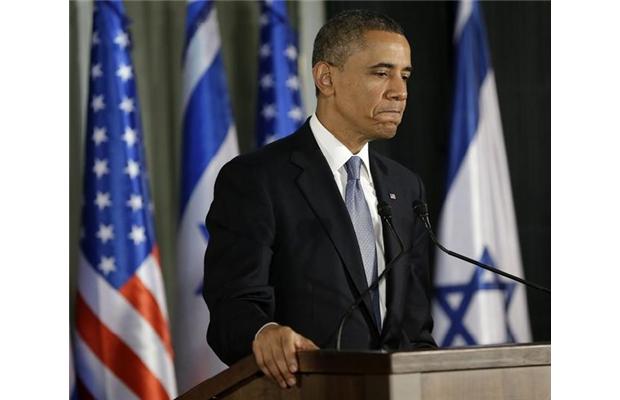
Obama’s visit to Israel and Jordan has brought joy to no one but the Israelis. The US president practically swore an oath of fealty to Israel, speaking not just as a friend and faithful ally, not as a head of state, but as a humble subordinate.
He waxed lyrical on Israel as a land of dreams, then advised the Palestinians to ignore the settlements being built on their land and issued stern warnings to Syria, Iran and Hizbullah.
So eager was Obama to court the Israelis that he suddenly started calling Netanyahu — the very man who supported his rival, Mitt Romney, in the elections — “Bibi”. Tensions between the US president and the Israeli prime minister seemed to evaporate as Obama wandered from one Biblical reference to another while praising Israel for its “shining future”.
Dressed in the colours of the Israeli flag, a blue tie over a white shirt, Obama spared the Israelis no compliment, saying that it was his honour to visit them on Israel’s 65th “independence day”.
“It is good to be in this land,” Obama said in Hebrew, before applauding Israel for being the land of kibbutz that made the desert bloom. His rhetoric was reminiscent of that of a century ago, when the promise of a “land without a people for a people without a land,” launched decades of Palestinian suffering.
Obama didn’t neglect to remind his listeners that he had introduced Passover as a White House celebration.
“After enjoying Seders [Passover] with family and friends in Chicago and on the campaign trail, I’m proud that I’ve now brought this tradition into the White House. I did so because I wanted my daughters to experience the Haggadah and the story at the centre of Passover that makes this time of year so powerful.”
After mentioning the long history of the Jewish people and their years in exile, the sad memories of the Jewish holocaust, Obama showered the Israelis with praise for their many successes.
Then, he lashed out at Iran. Iran’s nuclear programme, he said, is “not simply a challenge for Israel. It is a danger to the entire world, including the United States. A nuclear-armed Iran would raise the risk of nuclear terrorism. It would undermine the non-proliferation regime,” he stated.
Reiterating US commitment to Israeli security, Obama made a pledge: “The security of the Jewish people in Israel is so important. It cannot be taken for granted. But make no mistake. Those who adhere to the ideology of rejecting Israel’s right to exist, they might as well reject the earth beneath them and the sky above, because Israel is not going anywhere.”
The Israeli website Walla! pointed out that in his speech, the US president mentioned the word “Israel” 82 times and the word “Palestinian” only 21 times.
Obama also visited the tombs of Herzl and Rabin, then the Yad Vashaem Holocaust Memorial. But he declined to visit the tomb of Yasser Arafat. And he refused to meet the daughter of one of the political prisoners held in Israel’s detention camps.
The whole thing seemed as if the US president was telling the Palestinians and Arabs, “This is the land of the Jews; so go look for your land elsewhere!”
Now the writing is on the wall. Those who had taken the US president for a moderate should take note.
March 30, 2013
Posted by aletho |
Ethnic Cleansing, Racism, Zionism, Progressive Hypocrite, Timeless or most popular, Wars for Israel | Hezbollah, Iran, Israel, Obama, Palestine, Syria, United States, Yasser Arafat, Zionism |
Leave a comment
Deutsche Bank is bracing for more than 300 million euros (256 million pounds) in charges linked to suspect violations of U.S. sanctions on Iran, a German weekly reported on Sunday.
Deutsche Bank, Europe’s biggest bank by assets, on Wednesday increased its provisions for litigation by 600 million euros to 2.4 billion euros, citing mortgage-related lawsuits and other regulatory investigations, Reuters reported.
Without specifying its sources, magazine Der Spiegel said the money set aside could be a sign U.S. investigations of possible Iran-linked transactions had reached an advanced stage.
Deutsche Bank on Wednesday declined to lay out in detail why it had increased provisions. On Sunday, it would not comment on the magazine report.
The U.S. government is cracking down on foreign banks it accuses of undermining its effort to throttle Iran’s economy. In the most prominent case, London-based Standard Chartered last year agreed to pay $667 million (437 million pounds) to settle charges it violated sanctions against Iran and other countries.
Other lenders in the crosshairs of U.S. investigators include Commerzbank , Unicredit division HVB, and HSBC in Britain.
Der Spiegel said that apart from the Iran probe, Deutsche Bank’s 2.4-billion-euro legal provisioning included 500 million for a probe of suspected manipulation of interbank lending rates.
Several sources familiar with the investigation told Reuters on Thursday that German markets watchdog Bafin is set to rebuke Deutsche Bank over how it supervised its contribution to the setting of the lending rates.
March 28, 2013
Posted by aletho |
Economics, War Crimes, Wars for Israel | Deutsche Bank, Iran, Sanctions against Iran, Standard Chartered, Unicredit |
Leave a comment
The comprehensive economic sanctions imposed on Iraq by the UN Security Council in the 1990s fundamentally changed the way we think about sanctions. Sanctions had been seen as a middle route, which was nonviolent, yet more robust than diplomacy. But in Iraq, the humanitarian impact was devastating: child mortality spiked, malnutrition was widespread, the middle class disappeared, and critical infrastructure, such as electricity and water treatment, declined precipitously and never recovered. As the humanitarian crisis continued, activists, practitioners and scholars questioned the ethical legitimacy of sanctions.
The response was the development of targeted “smart” sanctions, which would ostensibly harm only the political or military leadership of the targeted state, or block prohibited goods, without impacting the civilian population. Targeted sanctions included arms embargoes, asset freezes of individual persons and companies, visa denials, and targeted trade sanctions, such as conflict diamonds. There were still unilateral measures that were patently indiscriminate, most prominently the U.S. embargo against Cuba. But by the late 1990s, the Security Council was no longer imposing new measures that were comprehensive.
In the last couple of years we have seen a return to aggressive, deeply damaging measures that are designed to cripple the target nation’s economy as a whole, particularly in the case of Iran. The U.S. sanctions on Iran have been extreme, broadly prohibiting trade, shipping, banking transactions, and investment in Iran’s energy sector. In the last few years we’ve seen the U.S. expand these prohibitions, to restrict not only American companies, but foreign banks and companies as well. The U.S. has aggressively prosecuted major global financial institutions for violations of U.S. sanctions law, and in the last two years there have been a number of cases where banks paid penalties on the order of half a billion dollars each.
Unsurprisingly, the result has been a considerable chilling effect: it is now common to see companies refusing to engage in any transactions at all with Iranian nationals, even for clearly legal purposes. For example, a Swiss organization, the GAVI Alliance, provides vaccines to developing countries. The GAVI Alliance is not subject to U.S. law, but its efforts to provide medical goods to Cuba and Sudan are hampered by U.S. restrictions on shipping companies. Canada’s TD Bank summarily closed down the accounts of Iranians residing legally in Canada. In the U.S., there are growing reports that Iranian-Americans, who in principle are permitted to send remittances to family members in Iran, cannot find any bank in the U.S. or elsewhere that will transfer the funds.
No one could plausibly claim that the U.S. sanctions on Iran are “smart” sanctions. They have crippled Iran’s ability to export oil, to buy gasoline, to import goods of all kinds, to extract and refine oil and natural gas, and to manufacture pharmaceuticals. The irony is that the UN Security Council measures on Iran are perceived to be narrowly crafted to avoid exactly this outcome. The Security Council resolutions only require member states to address cargo, technology, or financial transactions that could contribute to Iran’s nuclear program or ballistic missiles. No one would think that such a specific mandate could have humanitarian consequences—how can depriving a country of nuclear weapons affect education and food security?
But the resolutions contain “hooks” that are then invoked by U.S. allies to impose measures that mirror those of the United States, in a kind of dance of mutual deniability. The Security Council resolutions invite nations to “exercise vigilance” in their dealings with Iran, specifically with Iran’s Central Bank, and with two of its leading banks, Bank Saderat and Bank Melli. It is hard to imagine a term that is more vague and less informative than “exercise vigilance.” After all, we exercise vigilance every time we cross a street or lock a door. But a number of U.S. allies, known as the “like-minded” countries—the European Union, Canada, Australia, Japan, and South Korea—have invoked the call to “vigilance” as justification for imposing broad, damaging measures on Iran, approaching the blanket nature and severity of the U.S. sanctions. Last year, the EU cut off gasoline sales to Iran, and blocked Iranian access to European ports and shipping lines. SWIFT, the global hub for financial messaging critical for international commercial transactions, cut off access to Iran last year.
This disconnect between a seemingly narrow mandate and its broad application is far from a coincidence; it is a deliberate strategy that affords the international community mutual deniability. The EU and the “like-minded” countries can claim that they are not acting unilaterally; they are just being vigilant, as the Security Council has asked them to. At the same time, the Security Council can maintain that it has not imposed unreasonable measures on Iran; its sanctions only concern nuclear weapons and are meant to minimize the humanitarian damage.
In the end, the result is not so different than what we saw in Iraq two decades ago. If you cripple a nation’s access to shipping, energy, and banking, that will cripple its ability to provide health care, food security, electricity, transportation, and other basic needs of its population. The dance of mutual deniability may mean that it’s harder to see how the sanctions work. But that doesn’t mean they’re doing any less harm.
March 28, 2013
Posted by aletho |
Deception, Timeless or most popular, War Crimes | European Union, GAVI Alliance, Human rights, Iran, Iraq, Sanctions against Iran, United States |
Leave a comment
Ankara – In the ugly panorama that is the contemporary Middle East a light hardly flickers on the horizon. Iraq has been destroyed as a unitary Arab state and jihadis unleashed in Syria are burning out another room in the Arab house. Lebanon has again been brought to the brink of implosion through the intrigues of outside governments and local proxies incapable of putting the interests of their country ahead of their sectarian and power intrigues. The Palestinians are divided between those who live under the authority of one man who has bound himself to Israel and the US and two others who have bound themselves to Egypt and Qatar. Fitna – the spreading of division and sowing of hatred amongst Muslims – is being fanned across the region by governments brazen enough to call themselves Muslim. Whether in Iraq, Lebanon, Syria and Iran, Shiism is the enemy. Ceaselessly stirring this pot from the outside are governments that feast on division in the Arab world.
There are those who loathe Bashar so much that they are willing to commit or tolerate any crime in the name of getting rid of him, including the deliberate bombings of civilians, one taking the lives of a leading Sunni Muslim scholar and 48 other worshippers in a Damascus mosque only recently and another killing 100 people, amongst them children waiting for their school bus. A country Gamal abd al Nasir once described as the ‘beating heart of Arabism’ is being destroyed. Its enemies have their hands inside the body and they intend to rip the heart out. The cooperative at work on this venture includes the US, Britain, France, Saudi Arabia, Qatar, Turkey and the local and foreign-born jihadis who are their tools whether they realize it or not.
That the Syrian system needs changing goes without saying. In Syria possibly no-one understands this better than the much reviled Bashar al Assad. He could go tomorrow but that would solve nothing because the system would stay the same; for those who hate him, someone worse might take his place. Bashar has made serious mistakes, including the adoption of free market policies which have enriched the merchant class while further impoverishing the peasantry, who are now said to be many of the foot soldiers of the armed groups, but Syria is an easier place than it was under his father. The abolition of the Baath as the central pillar of state and society and the multi-party elections held last year were a start to political reforms. The elections were not perfect but if anyone is looking for perfection in the Middle East, they should look somewhere else. These are threads that could have been teased out if the collective calling itself ‘The Friends of the Syrian People’ had any serious interest in the best interests of the Syrian people. A process of national dialogue has begun in Damascus but this has been ignored, too, because these ‘friends’ want nothing less than the destruction of a government which is a strategic ally of Iran and Hezbollah and forms with them the ‘resistance axis’ to US-Israeli hegemony.
The achievements of this axis need to be set against the record of collaboration of those Arab governments who are now bent on destroying it. Iran and Syria have been solid in their support for the Palestinians, hosting resistance movements and working together to provide Hamas with the weapons it needed to defend Gaza. No weapons came from the direction of Saudi Arabia or Qatar. It was Hezbollah, the non-state partner in this alliance, that finally drove Israel from occupied southern Lebanon after nearly two decades of struggle involving not just the bravery of part-time soldiers but the mastery of electronic warfare, enabling Hezbollah to penetrate Israeli communications, including drone surveillance, as was made clear when Hasan Nasrallah produced intercepted film showing that an Israeli drone had been shadowing Rafiq Hariri for three months and was overhead when he was assassinated in February, 2005. When Israel tried to take revenge in 2006 it was humiliated. Hezbollah stood firm, destroyed its supposedly invincible Merkava tanks, disabled one of its warships in a missile attack and prevented its ground forces from advancing north of the Litani river. At the time, it might be remembered, both Egypt and Saudi Arabia vilified Hasan Nasrallah for bringing on this war, as they saw it.
It was Hezbollah which scored another triumph by breaking Israel’s spy network in Lebanon, now in the public eye because of the revelations that an Australian-born Mossad agent, Ben Zygier, had provided it with the names of two of its agents. The official Israeli version of the Zygier affair is that he handed over this information with the ultimate intention of setting up the assassination of Hasan Nasrallah. However, as the case is regarded as one of the most serious threats to national security in Israel’s history, much more might be involved than the collapse of a spy network. It is hard to imagine any agent who was not in fact a double agent doing what Zygier is reported to have done. What other information he might have passed on is a matter of conjecture but Israel’s nervousness about this affair could be a sign that far darker secrets are involved than the exposure of two spies.
Both Iran and Syria have been targeted with economic sanctions because of their disobedience. Iran has been threatened with military attack ever since the invasion of Iraq in 2003 and now that the attempt to destroy the government in Damascus through armed proxies has clearly failed, if more than two years of trying qualifies as failure, the US is sending out signals that it is prepared to intervene directly despite the regional and global risks. The collapse of the Syrian National Council last year has now been followed by the disintegration of the Syrian National Coalition, with ‘president’ Mu’adh al Khatib resigning and the chief of its military wing refusing to recognize the authority of new ‘prime minister’ Ghassan al Hitto. Riad al Assad, the displaced former commander of the self-styled Free Syrian Army, has just been carried back across the border into Turkey with only one leg, the other having been blown off by a roadside car bomb. Some sources say it was only a foot but either way he is out of action for a long time to come. As the leading armed groups do not recognize the authority of Mr Assad or the squabbling coalition of which the FSA is supposed to be the military arm, his absence from the scene is not going to make a great deal of difference.
For Muadh al Khatib to be given the Syria seat at the recent summit of the Arab League in Doha is farcical in more than one respect. Al Khatib is no longer even a member of the group Qatar is trying to set up as an alternative government. The group itself is in a state of complete collapse, with al Khatib walking out and other members rejecting the appointment of Hitto, a Syrian-born American who has not visited the country of his birth for decades. That Al Khatib should demand that his ragged, motley crew be given Syria’s seat at the UN goes beyond preposterous. The government of Syria sits in Damascus, not Doha, and Bashar al Assad is still its president, not the former imam of the Umayyad mosque. Compounding this theatre of the absurd, it was the ruler of Qatar who directed that Al Khatib be given the Syrian seat at the Doha summit, underlining the degree to which the Arab League has become no more than an instrument of this gentleman’s drive for regional dominance. That King Abdullah should have stayed away from Doha is a sign of the deepening rivalry between Qatar and Saudi Arabia, especially over how to manage Syria. The determination of the ruler of Qatar to persevere with this chaotic bunch of exiles is the measure of his determination to destroy the government in Damascus.
On the ground the armed groups are taking a beating at the hands of the Syrian army but like an irresponsible trainer sending a punched-out boxer out from his corner for the next round, their outside sponsors are pouring arms into Syria to keep them on their feet. The tactics of these groups include bombings aimed at civilians that in other circumstances their backers would not hesitate to call terrorism but steadfastly refused to call terrorism when Syrians are the victims and their proxies are the perpetrators. Al Khatib’s dissatisfaction with his ramshackle coalition was possibly brought to a head by the assassination in Damascus of Sheikh Muhammad Said Ramadan al Bouti, a former colleague and a man he greatly admired. Al Bouti and close to 50 other worshippers were murdered in the Iman mosque by a suicide bomber. Two days earlier an armed group had loaded CL 17 chlorine – an ingredient normally used in swimming pool cleaner – into the warhead of a small missile and fired it at a Syrian army checkpoint, killing 26 people. Soldiers were among the dead and the army was there to look after the survivors, so the claims of activists that ‘the regime’ was responsible had even less traction than usual. Having warned of direct intervention in Syria should chemical weapons be used, the US had little to say now that such a weapon had been used, not by the Syrian army, but by the ‘rebels’ it has been supporting.
Hezbollah, Syria and Iran’s record of resistance has to be compared with the long Saudi and Qatari record of collaboration with the US and Israel. Having deserted Damascus in its hour of need, what does Khalid Mishaal think he is going to get from the ruler of Qatar besides money and somewhere to stay? What is Ismail Haniyeh expecting from Muhammad Morsi, who began his presidency by blocking off the tunnels into Gaza and confirmed where he intends to take Egypt with his letter calling Shimon Peres ‘my dear friend’? Is it forgotten already, apart from his record in violence and destruction going back to 1948, that it was Peres who authorized the attack on southern Lebanon in 1996 which took the lives of more than 100 people sheltering inside the UN compound in Qana? If the friend of my enemy is my enemy, where does that leave Haniyeh, Misha’al and Abbas?
The beneficiaries of intervention in Iraq, Libya and Syria are outside and regional governments who have combined forces to reshape the Middle East in their own interests. As Ibrahim al Amin has remarked (‘Partitioning Syria at the Doha summit’, Al Akhbar English, March 25, 2013), they are fighting a global war against Syria in the name of bringing the people freedom and justice. In truth, western governments only intervene in their own interests and the people always end up being sliced and diced on the chopping board of their grand designs. There has been no exception to this rule. Civilization, liberation, freedom, democracy, the rights of the people and the responsibility to protect are the unctuous phrases that have rolled off the lips of western prime ministers, foreign ministers and presidents for two centuries. This is the rhetorical buildup to a self-assigned ‘duty’ to intervene: the only real difference between intervention in the 19th century and intervention in the 21st lies in the vastly increased killing power of western governments and the development of weapons that would have been regarded as science fiction until only recently.
As they always get away with it, there is no reason for them to stop. Iraq was a terrible crime but while the UN Security Council or the International Criminal Court points the finger at Robert Mugabe, Umar al Bashir or Saif al Islam al Gaddafi it never points the finger at western politicians whose crimes are infinitely greater. Slobodan Milosevic was a rare exception but even his crimes do not measure up to what George Bush and Tony Blair authorized in Iraq in and after 2003 – not to speak of the horrors that Bush senior, Clinton and Blair authorized through the decade of sanctions which followed the attack of 1991. Because they are protected by a world system which is highly selective about who it punishes, the politicians who follow them feel free to repeat the experience. They know that whoever suffers, whoever is bombed, whoever has to look at the faces of dead parents, children, aunts, grandfathers and neighbors being dug out of the rubble of bombed cities and towns, it is not going to be them. William Hague is perfectly comfortable in his desire to give more weapons to the ‘rebels’ because he knows that the calamitous consequences of decisions he takes are never going to bounce back on his own doorstep.
It is obvious but needs to be said anyway that the first priority of people across the Middle East should be solidarity rising above ethnic and religious divisions. No problem can be solved without it and certainly not the core issue of Palestine. In his recent Edward Said memorial lecture, Noam Chomsky drew attention to what is going on while the world’s attention is diverted by the ‘Arab spring.’ In 1967 the Jordan Valley had a Palestinian population of 300, 000. The policy of ‘purification’ pursued by the Israeli government has now reduced that population to 60,000. On a smaller scale the same policy has had the same results in Hebron and elsewhere in the occupied territories. There is nothing accidental or incidental about this. Netanyahu is no more than faithful to the racist policies set in motion by Theodor Herzl and David Ben-Gurion. Continuing without letup for 65 years these policies are neither forgettable nor forgivable.
It is not surprising that Israel’s strongest supporters always have been similar colonial settler states. There are no exact parallels but the Zionist settlers in Palestine and the American colonists both turned on the mother state while setting out to crush the native people. Thomas Paine had much to say about the American ‘war of independence’ that is relevant to Palestine. First of all, it was an ‘independence war’ being fought on land long since inhabited by another people. The colonists wanted to be independent of the mother country, which planted them in this foreign soil in the expectation that they would maintain it as part of the king’s domains. A loyal colony was what the British also sought in Palestine but the American settlers and later the Zionists had other ideas. The war between Britain and the American colonists was brutal, generating deep hatreds on both sides, just as the Zionist war against the British did in Palestine.
Paine was writing of settler feelings towards the savagery of the mother country but the words equally apply to the people who were the victims of double colonialism in North America or, nearly two centuries later, in Palestine:
‘Men of passive tempers look somewhat lightly over the offences of Great Britain and still hoping for the best are still apt to call out come, come, we shall be friends against for all this. But examine the passions and feelings of mankind; bring the doctrine of reconciliation to the touchstone of nature and then tell me whether you can hereafter love, honor and faithfully serve the power that hath carried fire and sword into your land. If you cannot do all these then you are only deceiving yourself, and by your delay bringing ruin upon posterity. Your future connections with Britain, whom you can neither love nor honor, will be forced and unnatural and being formed only on the plan of present convenience, will in a little time fall into a relapse more wretched than the first. But if you say you can still pass the violations over, then I ask hath your house been burnt? Hath your property been destroyed before your face? Are your wife and children destitute of a bed to lie on or bread to live on? Have you lost a parent or child by their hands and yourself the ruined and wretched survivor? If you have not, then you are not a judge of those who have. But if you have and can still shake hands with the murderers, then are you unworthy the name of husband, father, friend or lover; and whatever may be your rank or title in life you have the heart of a coward and the spirit of a sycophant.’
Paine was a democrat within the limitations of his time. He was writing for the settlers and had no thought of admitting the indigenous people of North America to representation in the colonies. Except for the passage of almost 250 years Paine might be a Zionist today, but the two and a half centuries make all the difference. Israel was an anomaly from the beginning, a colonial state arising at the tail end of colonialism. It would be no more possible to imagine Thomas Paine supporting an America in which native and Afro-Americans did not have the vote now than it would be to imagine him supporting a situation where a people not only did not have the right to vote but had been denied the right to live on the land where they or their forebears had been born.
In today’s world Paine could not support an Israel built on blatantly racist and discriminatory lines. Everything he says in the passage quoted above applies to Israel. The wounds it has inflicted have gone deep and far from making any attempt to heal them Israel has endlessly inflicted new wounds. The state of Israel – to be differentiated from those pockets of its citizens who oppose its brutal mindset – is not interested in any kind of genuine settlement with the Palestinians. It is not interested in them as a people. It is not interested in their stories of suffering. It is not interested in its own guilt because it is blind to its own guilt. It has no humility and would scoff at the idea of penance for crimes it refuses to admit it has committed, like the worst recidivist offender hauled before a court. It is interested in the Palestinians only as a problem to be solved and the solution is for them somehow to disappear or to be made to disappear. Hence the ‘purification’ in the Jordan Valley and the daylight oppression of the Palestinians in Hebron and the racist demographic war being waged in East Jerusalem. These are crimes against humanity.
If we substitute Israel and the Oslo process for the reconciliation proffered by the British monarch the result is the same: the policy, wrote Thomas Paine, is there ‘in order that he may accomplish by craft and subtlety in the long run what he cannot do by force and violence in the short one’. His conclusion that ‘reconciliation and ruin are nearly related’ sums up the consequences for the Palestinians of the Venus fly trap known as the ‘peace process.’ Violence works but ‘peace’ has a deadly potency of its own: whatever the means employed, the Zionist aim of reducing the Palestinians to dust that will eventually be whirled away by history has not changed in 100 years.
By themselves, however bravely they have resisted, the Palestinians have never had the power to fend off the forces arrayed against them. This has been true from the time Britain implanted the Zionist project in Palestine until the present day. Britain and the US were not just any countries but the two most powerful states of their time and with their support both Zionist success and Palestinian failure were assured. Never have the Palestinians been able to draw on anything like such sources of strength despite the immense potential in their own backyard. Israel’s dominance as a regional power is still sustained by the US while being continually replenished by Arab weakness: Arab weakness is built on chronic Arab disunity, now being promoted in sectarian form by Saudi Arabia and Qatar. As long as there is no way out of this trap the Palestinians will remain stuck in their trap.
Sectarianism is a powerful weapon but would be useless if people were not susceptible to it. A people divided are doomed to be dominated. George Antonius prefaced The Arab Awakening with a quote from Ibrahim Yaziji: ‘Arise Arabs and awake!’ That was in 1938. An Arab awakening did follow and while it would be tempting to say the Arab world has gone back to sleep, in reality what is happening is far worse than sleep. A fire is raging and it is hard to see how and when it will be put out.
– Jeremy Salt is an associate professor of Middle Eastern history and politics at Bilkent University in Ankara, Turkey.
March 28, 2013
Posted by aletho |
Ethnic Cleansing, Racism, Zionism, Timeless or most popular, Wars for Israel | Arab League, Bashar al-Assad, Hezbollah, Iran, Iraq, Lebanon, Middle East, Qatar, Saudi Arabia, Syria, United States, Zionism |
Leave a comment
The British oil giant, British Petroleum (BP), may be forced to close down the Bruce natural gas field in the UK North Sea ahead of schedule as a result of the sanctions imposed against Iran.
Dow Jones reported on Tuesday that without gas from the adjoining Rhum field, of which the National Iranian Oil Company is a joint owner, BP might have to close down the Bruce field.
The British oil company halted operations at Rhum field in November 2010 after the West imposed illegal sanctions against Iran’s energy sector.
“The long-term future of the Bruce facilities is very closely tied to the ability to produce from Rhum. Given the uncertainties, we are considering what a decommissioning project would entail and how long it would take to execute,” a BP spokesman was quoted as saying.
Closing down the Bruce field would undermine the UK government’s attempts to strengthen its energy sector, which has been experiencing inflation due to “cold weather, and unexpected production and pipeline outages.”
Since the UN Security Council’s fourth round of sanctions against Iran in June 2010, the United States and its European allies have also separately imposed unilateral illegal sanctions against the Islamic Republic’s energy sector.
At the beginning of 2012, the United States and the European Union imposed new illegal sanctions on Iran’s oil and financial sectors with the goal of preventing other countries from purchasing Iranian oil and conducting transactions with the Central Bank of Iran. The sanctions came into force in early summer 2012.
The illegal US-engineered sanctions have been imposed based on the unfounded accusation that Iran is pursuing non-civilian objectives in its nuclear energy program.
Iran rejects the allegation, arguing that as a committed signatory to the Treaty on the Non-Proliferation of Nuclear Weapons (NPT) and a member of the International Atomic Energy Agency (IAEA), it has the right to use nuclear technology for peaceful purposes.
March 27, 2013
Posted by aletho |
Economics, Wars for Israel | Iran, Sanctions against Iran |
Leave a comment
India’s Petroleum and Natural Gas Minister M. Veerappa Moily has emphasized that his country will not halt imports of Iranian crude oil, rejecting recent Western news reports to the contrary.
While noting that unilateral anti-Iran sanctions by the US and the European Union have caused some difficulties for India in terms of insuring Iranian oil shipments, Moily told reporters in New Delhi that his country intends to establish a special fund for insuring oil imports originating from the Islamic Republic, IRNA reported on Tuesday.
The remarks by the Indian official came in response to the Western media reports on New Delhi’s decision to halt its Iranian oil purchases, which he strongly denied.
Meanwhile a deputy petroleum minister in India further reiterated that details of an insurance fund for Iranian oil shipments will be outlined in the near future, noting that the country’s national insurance companies, Oil India Development Board as well as major players in the nation’s oil industry will contribute funds to the insurance fund.
According to the report, Western media outlets, particularly Reuters have cited unnamed and unofficial sources in recent weeks who pointed to the possibility that India will soon halt its crude imports from Iran.
Indian officials, however, have insisted on continued oil imports from Iran while reiterating that they will not submit to the Western pressures on the issue, the report further adds.
India is among Asia’s major importers of energy, relying on the Islamic Republic to satisfy a portion of its energy requirements.
March 26, 2013
Posted by aletho |
Economics | European Union, India, Iran, Press TV, Sanctions against Iran, United States, Veerappa Moily |
Leave a comment
NATO’s cyberwarfare center says cyber attacks launched against the Islamic Republic of Iran by the US and Israel constituted “an act of force” and were illegal under international law.
According to The Tallinn Manual on the International Law Applicable to Cyber Warfare, commissioned by NATO’s Cooperative Cyber Defense Center of Excellence in Estonia, “Acts that kill or injure persons or destroy or damage objects are unambiguously uses of force,” The Washington Times reported on Sunday.
Michael D. Schmitt, the manual’s lead author and professor of international law at the US Naval War College in Newport, said the group of researchers who wrote the manual all agreed that the use of Stuxnet virus, that attacked Iran’s cyber structures in 2009, was an act of force.
Washington and Tel Aviv are believed to have jointly developed the malware, although neither has accepted responsibility for the attack.
Iran has been the target of several cyber attacks over the past few years.
In June 2012, a report by the Washington Post said the US and the Israeli regime had cooperated in creating the computer virus Flame to spy on Iran. US National Security Agency, the CIA and the Israeli military worked together to create the Flame virus, the paper added.
In addition, the New York Times also revealed in the same month that US President Barack Obama secretly ordered a cyber attack with the Stuxnet computer virus against Iran in 2010 to sabotage the country’s nuclear energy program.
“From his first months in office, President Obama secretly ordered increasingly sophisticated attacks on the computer systems that run Iran’s main nuclear enrichment facilities, significantly expanding America’s first sustained use of cyber weapons,” the report said.
In response to such attacks, Iran launched a cyber defense headquarters tasked with preventing computer worms from breaking into or stealing data from the country’s maximum security networks, including nuclear facilities, power plants, data centers, and banks.
March 25, 2013
Posted by aletho |
Militarism, Progressive Hypocrite, Timeless or most popular, War Crimes | Cyberwarfare, Flame, Iran, Israel, NATO, Obama, United States |
Leave a comment
From talk of “red lines” and cartoon bombs to having “all options on the table”, an undeniably delusional logic emanates from leadership in Washington and Tel Aviv regarding the alleged threat posted by Iran’s nuclear program. When Israeli Prime Minister Benjamin Netanyahu famously took to the stage of the UN General Assembly with his doodled explosive, he claimed that Iran would soon have the capability to enrich uranium to 90 percent, allowing them to construct a nuclear weapon by early-mid 2013. In his second administration, Obama, who recently said a nuclear-Iran would represent a danger to Israel and the world, appears to be seeing eye-to-eye with Netanyahu, despite previous reports of the two not being on the same page. For whatever its worth, these two world leaders have taken the conscious decision to entirely ignore evidence brought forward by the US intelligence community, as well as appeals from nuclear scientists, policy-advisers, and IAEA personnel who claim that the “threat” posed by Iran is exaggerated and politicized.
It’s common knowledge that Washington’s own National Intelligence Estimate (NIE) on Iran, which reflects the intelligence assessments of America’s 16 spy agencies, confirmed that whatever nuclear weapons program Iran once had was dismantled in 2003. Mr. Netanyahu has not corrected his statements insinuating that Iran was nearing the red line of 90 percent enrichment, even when recent UN reports that show Tehran has in fact decreased its stockpiles of 20 percent fissile material, far below the enrichment level required to weaponize uranium. Hans Blix, former chief of the International Atomic Energy Agency (IAEA), has challenged previous IAEA reports on Iran’s nuclear activities, accusing the agency of relying on unverified intelligence from the US and Israel. Flynt Leverett and Hillary Mann Leverett, former Washington insiders and analysts in the Clinton and Bush administrations, recently authored a book titled “Going to Tehran”, arguing that Iran is a coherent actor and that evidence for the bomb is simply not there.
Clinton Bastin, former director of US nuclear weapons production programs, has commented on the status of Iran’s capacity to produce nuclear weapons, stating:
“The ultimate product of Iran’s gas centrifuge facilities would be highly enriched uranium hexafluoride, a gas that cannot be used to make a weapon. Converting the gas to metal, fabricating components and assembling them with high explosives using dangerous and difficult technology that has never been used in Iran would take many years after a diversion of three tons of low enriched uranium gas from fully safeguarded inventories. The resulting weapon, if intended for delivery by missile, would have a yield equivalent to that of a kiloton of conventional high explosives”.
Bastin’s assessments corroborate reports that show Iran’s nuclear program is for civilian purposes; he further emphasizes the impracticality of weaponizing the hexafluoride product of Tehran’s gas-centrifuges, as the resulting deterrent would yield a highly inefficient nuclear weapon.
The fact that Iran’s Supreme Leader Ayatollah Ali Khamenei issued several fatwas (a religious prohibition) against the production of nuclear weapons doesn’t seem to have helped much either. An unceasing combination of Islamophobia-propaganda, a repetitive insistence that Tehran is edging closer to the threshold, and devastatingly negligent misreporting of Iran and its pursuit of domestic nuclear power has created a situation where the country is viewed as an irrational actor. In the court of Western mainstream opinion, Iran is grouped in the same category as bellicose North Korea, despite the fact that it is a law-abiding signatory to the Nuclear non-Proliferation Treaty (NPT) that has consistently cooperated with the IAEA while publically renouncing the use of nuclear weapons. This leads to the current scenario, where Iran and its people are punished under an unethical barrage of economic sanctions for possessing a weapon that they do not possess.
The severity of economic sanctions against Iran and the fabricated allegations of it possessing nuclear weapons serve as a disturbing parallel to the invasion and destruction of Iraq during the Bush administration. From the perspective of this observer, the US does not actually want to go to war with Iran – such an ordeal would bring about an array of overwhelmingly negative ramifications that Obama would probably want to avoid. What the US does want to do however, is to dismantle the foundations of the Islamic Republic by completely destroying its economy through sanctions, prompting the population to rise up and overthrow the regime – so basically, Obama is happy to conduct war by other means. Ayatollah Khamenei’s recent proclamations of the US holding a gun to the head of the Iranian nation can only be perceived as entirely accurate.
Its easy to see why the Supreme Leader has doubts over the prospect of negotiations with the US; the deal put forward at the most recent meeting of the P5+1 essentially argued that the US would roll back sanctions that prevent Iran from trading gold and precious metals in exchange for Iran completely shutting down its uranium enrichment plant at Fordo. The substance of this offer appears like it was deliberately drafted to be rejected by the Iranian side, given the fact that it would mandate Iran to shutdown one of its main facilities while keeping in place the most punishing sanctions that have destroyed the Iranian currency and made life-saving medications unaffordable for most – its more of an insult than an offer. For the average Iranian business owner and worker, US-led sanctions and currency devaluation have affected everyday transactions that provide paychecks and economic viability for millions of people.
From urban shopkeepers to rural restaurant owners, many have been forced to close their businesses because they are unable to profit from reselling imported goods purchased with dollars. Isolation from the global banking system has made it increasingly more difficult for Iranian students studying abroad to receive money from their families. Sanctions targeting Iran’s central bank aim to devastate the Iranian export economy, affecting everyone from oil exporters to carpet weavers and pistachio cultivators. By crippling Iranian people’s livelihoods and hindering their ability to pursue education and afford necessities, the Obama administration believes such measures will erode public confidence in the government and challenge its legitimacy. It is important to recognize that these sanctions are not only aimed against Iran’s government, but at its entire population, especially to the poor and merchant population. An unnamed US intelligence source cited by the Washington Post elaborates, “In addition to the direct pressure sanctions exert on the regime’s ability to finance its priorities, another option here is that they will create hate and discontent at the street level so that the Iranian leaders realize that they need to change their ways.”
These sanctions, which are Obama’s throwback to ham-fisted Bush-Cheney era policies, must be seen as part of a series of measures taken to coax widespread social discontent and unrest. US sanctions have broadened their focus, targeting large swaths of the country’s industrial infrastructure, causing the domestic automobile production to plummet by 40 percent, while many essential medical treatments have more than doubled in price. Patients suffering from hemophilia, thalassemia, and cancer have been adversely affected, as the foreign-made medicines they depend on are increasingly more difficult to get ahold of. Over the past two years, general supermarket goods have seen a price hike between 100 to 300 percent. For the first time in the world, a media ban has been imposed, on PressTV, Iran’s state-funded English language international news service. Ofcom, a UK-based communications regulator linked to the British government, spearheaded the prohibition. The European Union has also imposed a travel ban on Press TV CEO Mohammad Sarafraz and eight other officials.
While editorials and commentators in the New York Times and Washington Post regularly accuse Iran of violating international law, the editors of these papers have shown no willingness to scrutinize the US and Israel by holding them accountable when they violate international law, namely, a prohibition of “the threat or use of force” in international relations unless a nation is attacked or such force is authorized by the UNSC, as embodied in the United Nations Charter. It is undeniable that by failing to question the brutal tactics meted out by Washington and Tel Aviv, these papers and the commentators affiliated with them, endorse policies that intimidate and coerce civilian populations in addition to employing terrorist tactics such as targeted cyber-strikes and extrajudicial assassinations – all of which the Iranian nation has been subjected to in utter defiance of the standards and rules of international law and their fundamental bedrock of protecting civilians.
The facts have been proven time and time again, Iran seeks economic development, technological advancement, and energy independence – it wants domestic nuclear power and the freedom to enrich uranium to 20 percent for the medical development of radiopharmaceuticals and industrial isotopes, as it is entitled to as an NPT signatory. Washington’s threats to impose “secondary” sanctions against third-country entities doing business with the Islamic Republic represents a mafia-mentality so characteristic of the unipolar reality in which the US sees itself. Washington has recently threatened energy-hungry Pakistan with sanctions over its partnership with Tehran in a $7.5-billion gas pipeline between the two nations, a project that would do infinite good by promoting regional stability and delivering energy to poverty stricken regions in Pakistan. Washington’s sanctions regime will collapse if the US Congress insists that China sharply cut its energy trade and relations with Iran. China will not adhere to such stringent foreign interference into its trade relationships, and Washington is in no position to sanction China because it buys oil from Iran.
If Beijing calls Washington’s bluff, other growth-focused non-Western economies like India, Malaysia, and South Korea will be less fearful of conducting business and buying oil from Tehran. Obama has taken some cues from the revolutionary students of 1979 and his administration has come up with a hostage crisis of its own, involving holding captive the civilian population of Iran – and Washington looks keen to let the sanctions bite until either the regime bows down, or the people rise up. One of the best examples of the perverted logic behind the US position on Iran comes from Vice President Joe Biden, who recently stated, “We have also made clear that Iran’s leaders need not sentence their people to economic deprivation”. Such a statement embodies the upside-down logic of Washington policy-makers who claim the moral high ground while enabling terrorism and engaging in unethical campaigns of economic and military warfare – the present state of affairs simply cannot continue.
Nile Bowie is an independent political analyst and photographer based in Kuala Lumpur, Malaysia. He can be reached at nilebowie@gmail.com
March 19, 2013
Posted by aletho |
Economics, Progressive Hypocrite, Timeless or most popular, War Crimes | Benjamin Netanyahu, International Atomic Energy Agency, Iran, Israel, National Intelligence Estimate, Obama |
Leave a comment

According to official estimates, the Islamic Republic of Iran is now roughly a year away from acquiring a nuclear bomb. Well, that is, if it were actually building a nuclear bomb. Which it’s not.
“Right now, we think it would take over a year or so for Iran to actually develop a nuclear weapon, but obviously we don’t want to cut it too close,” President Barack Obama told an Israeli television station on March 14, 2013. In order to stop Iran, Obama vowed to “continue to keep all options on the table,” a euphemism for engaging in an unprovoked military attack, thus initiating a war of aggression, the “supreme international crime.”
Obama’s statement came just two days after his own Director of National Intelligence told a Senate committee that the Iranian government had not made a decision to weaponize its legal, safeguarded civilian nuclear energy program. “We do not know if Iran will eventually decide to build nuclear weapons,” DNI James Clapper said. Even if it did, he added, Iran wouldn’t be able to secretly divert any of its stockpiled and safeguarded enrichment uranium to a weapons program.
The American president failed to make this distinction in his interview, instead saying only that a nuclear-armed Iran would be “dangerous for the world. It would be dangerous for U.S. national security interests.”
Repeating his administration’s main talking point, Obama told his Israeli interviewer, “What I have also said is that there is a window, not an infinite period of time, but a window of time where we can resolve this diplomatically and it is in all of our interests.”
But this window has already been open for decades and Iran has supposedly been only a year away from a bomb for the past ten years.
In November 2003, then Mossad chief Meir Dagan told the Knesset Foreign Affairs and Defense Committee that Iran’s nuclear program would be at a “point of no return” within the next year and would then “have the potential to produce 10 nuclear bombs a year.” Israeli Defense Minster Shaul Mofaz repeated the one year “point of no return” timeline in early 2005, a claim reinforced by other Israeli officials throughout that year.
Similar estimates were made in 2006, 2007 and 2008. Oh, and 2009.
In April 2010, Ronald Burgess, director of the U.S. Defense Intelligence Agency, told the Senate Armed Services Committee that the “general consensus” was that Iran could develop a single nuclear bomb within a year if the leadership decided to do so, despite maintaining that Iran didn’t have an active nuclear weapons program.
As the years have passed, this assessment has held fast.
In late January 2011, Aviv Kochavi, director of Israeli Military Intelligence, admitted Iran was not actively working on a nuclear weapon, but claimed it could build one in “a year or two” once “the leader decides to begin enriching at 90 percent.”
A year later, in January 2012, Defense Secretary Leon Panetta told 60 Minutes, “The consensus is that, if they decided to do it, it would probably take them about a year to be able to produce a bomb.”
Just few days later, Kochavi told a panel at the Herzliya security conference that “Iran has enough nuclear material for four bombs,” adding, “We have conclusive evidence that they are after nuclear weapons. When Khamenei gives the order to produce the first nuclear weapon – it will be done, we believe, within one year.”
Last week, addressing the very same conference, Kochavi was back with a new prediction – actually, it was the same one as before. He claimed that, in the coming year, the Iranian “leadership would like to find itself in the position of being able to break out to an atomic weapon stage in a short period of time, according to the IDF’s intelligence assessments. However, he said that Iran has not yet decided to build the bomb.”
Greg Thielmann, a former U.S. intelligence analyst now with the Arms Control Association, recently explained that “calculating such a time line involves a complicated set of likely and unlikely assumptions,” telling journalist Laura Rozen, “If Iran decided today to build nuclear weapons, it would require years, not weeks or months, to deploy a credible nuclear arsenal.”
Meanwhile, with Obama set to visit Israel this week, Reuters now notes that “Netanyahu has not publicly revised the spring-to-summer 2013 dating for his ‘red line’,” the stated point at which the Iranian nuclear program advances far enough to automatically trigger an Israeli attack, a threat laid down by the Israeli Prime Minister last September. “But several Israeli officials privately acknowledged it had been deferred, maybe indefinitely,” Reuters adds before quoting an anonymous official: “The red line was never a deadline,” he said.
Clearly, when it comes to propagandistic prognostications about the imminence of an Iranian bomb, they never really are.
March 19, 2013
Posted by aletho |
Militarism, Progressive Hypocrite, Timeless or most popular, Wars for Israel | Iran, Israel, Meir Dagan, Obama, United States, United States Senate Committee on Armed Services |
Leave a comment
After a brief respite from incessant warmongering nonsense following the reelection of Barack Obama in November 2012, it appears old rhetorical devices have reemerged. With a vengeance.
Israeli Prime Minster Benjamin Netanyahu, addressing his minions at AIPAC via video chat on March 4, spent a bunch of his time saying supposedly scary things about “Iran’s pursuit of nuclear weapons” and dismissing negotiations.
“I have to tell you the truth,” he told the fawning crowd. “Diplomacy has not worked. Iran ignores all these offers. It is running out the clock.” He continued:
Iran enriches more and more uranium. It installs faster and faster centrifuges. It’s still not crossed the red line I drew at the United Nations last September. But Iran is getting closer to that line, and it’s putting itself in a position to cross that line very quickly once it decides to do so.
Netanyahu deliberately ignored the fact that Iran’s stockpile of enriched uranium remains far from weapons-grade and that Iran has, for over a year now, been systematically converting much of its 19.75% enriched stock to fuel plates that precludes the possibility of being diverted to military purposes.
Of course, the fact that Iran has an inalienable legal right to a fully-functioning nuclear energy program – including the indigenous mastery of the nuclear fuel cycle – was not addressed at all. For Netanyahu and his acolytes, any Iranian nuclear program is synonymous with a weapons program – and not only that, but a weapons program designed to “exterminate” Israel’s “Jewish people.” Facts remain irrelevant. Hasbara reigns.
Netanyahu once again demonstrated his complete disregard for the tenets of the United Nations Charter by calling for Iran to be explicitly threatened with a military attack if it doesn’t comply with absurd Israeli demands. He insisted “with the clarity of my brain” (whatever that means) that “words alone will not stop Iran. Sanctions alone will not stop Iran. Sanctions must be coupled with a clear and credible military threat if diplomacy and sanctions fail.”
Addressing the same audience, Vice President Joe Biden also spoke at length about “Iran’s dangerous nuclear weapons program,” which the U.S. intelligence community and its allies, including Israel, have long assessed doesn’t exist.
The consensus view of all 16 American intelligence agencies has maintained since 2007 that Iran ceased whatever research into nuclear weaponization it may have conducted by 2003, and has never resumed that work. The NIE has been consistently reaffirmed ever since (in 2009, 2010, and again in 2011).
In early 2012, James Clapper, Director of National Intelligence, stated in testimony before the Senate Armed Services Committee, “We do not know…if Iran will eventually decide to build nuclear weapons.” The same day, Defense Intelligence Agency Director Ronald Burgess said that “the agency assesses Iran is unlikely to initiate or intentionally provoke a conflict” and maintained that Iran’s military doctrine is defensive in nature and designed only for deterrence.
Clapper repeated this conclusion verbatim just last week before the Senate Intelligence Committee.
Moreover, the IAEA itself continually confirms that Iran has no active nuclear weapons program and has stated it has “no concrete proof that Iran has or has ever had a nuclear weapons program.”(emphasis added)
Undeterred by facts or reason, Biden continued to tell the AIPAC fanatics that “Iraq’s [sic] acquisition of a nuclear weapon not only would present an existential threat to Israel, it would present a threat to our allies and our partners — and to the United States. And it would trigger an arms race — a nuclear arms race in the region, and make the world a whole lot less stable.” Biden made sure to repeat the mantra that “all options, including military force, are on the table” when it comes to Iran.
First, Biden’s Iraq/Iran slip wasn’t merely Freudian. Since the Iraq script from a decade ago is nearly identical to the Iran script now, it’s unsurprising that Biden can’t keep his manufactured threats straight. One need only recall Biden’s claims on Meet The Press in August 2002 that Saddam Hussein constituted “a long term threat and a short term threat to our national security” and “an extreme danger to the world.” Consequently, said Biden, “We have no choice but to eliminate the threat.”
Years later, on the same program, Biden stood by his statements. When asked by Tim Russert about weapons of mass destruction that didn’t exist, Biden blithely insisted that “everyone in the world thought he had them. The weapons inspectors said he had them. He catalogued—they catalogued them. This was not some, some Cheney, you know, pipe dream. This was, in fact, catalogued. They looked at them and catalogued. What he did with them, who knows?”
Biden was lying, of course.
International weapons inspectors had been perfectly clear about what “he did with them.” After losing the Gulf War in 1991, Iraq’s weapons programs were subject to intrusive inspections and international sanctions. By 1998, the IAEA concluded that “there is no indication that Iraq possesses nuclear weapons or any meaningful amounts of weapon-useable nuclear material.” The next year, the UN Security Council affirmed that UN weapons inspectors “have been effective in uncovering and destroying many elements of Iraq’s proscribed weapons programmes,” adding, “The bulk of Iraq’s proscribed weapons programmes has been eliminated.”
In 2000, UN inspector Scott Ritter explained that “as early as 1997” it was possible “to determine that, from a qualitative standpoint, Iraq had been disarmed. Iraq no longer possessed any meaningful quantities of chemical or biological agent…and the industrial means to produce these agents had either been eliminated or were subject to stringent monitoring. The same was true of Iraq’s nuclear and ballistic missile capabilities.”
In July 2002, as calls for war grew louder, Ritter wrote in the Boston Globe that “the Bush administration provides only speculation, failing to detail any factually based information to bolster its claims concerning Iraq’s continued possession of or ongoing efforts to acquire weapons of mass destruction. To date no one has held the Bush administration accountable for its unwillingness – or inability – to provide such evidence.”
When, days later, then Senate Foreign Relations Committee chairman Joe Biden convened hearings to assess the threat posed by Iraq and implications of a potential U.S.-led attack, Ritter called the hearings a “sham” and said the Delaware Senator and “most of the Congressional leadership have pre-ordained a conclusion that seeks to remove Saddam Hussein from power regardless of the facts, and are using these hearings to provide political cover for a massive military attack on Iraq.”
Such is Joe Biden’s penchant for telling the truth. Returning to his comments at AIPAC, Biden’s recent fear-mongering hypotheticals about Iran are also wrong.
Beyond being obvious that Iran poses literally no threat to the United States, numerous Israeli military and intelligence officials openly reject the notion that a nuclear-armed Iran would “present an existential threat to Israel.” Former Mossad chief Ephraim Halevy recently told the UK Zionist Federation that Israel’s existence “is not in danger and shouldn’t be questioned.”
Furthermore, Biden’s axiomatic contention that an Iranian nuclear bomb would spark a regional arms race has also been rejected for years by less hysterical analysts. In fact, Biden made his comments soon after the publication of a new report by the Center for a New American Security which judged the scenario extremely unlikely.
For obvious reasons, Biden claimed that the United States is “not looking for war” and prefers “a diplomatic solution” to the impasse over Iranian nuclear program. Still, he said, the “window is closing” for a negotiated outcome, after which military action would be taken.
This formulation has been echoed by senior Obama officials of late, including both Secretary of State John Kerry and Secretary of Defense Chuck Hagel.
The window has apparently been closing for some time now and yet, incredibly, Iran never gets any closer to actually having the nuclear weapon it isn’t building and that it constantly insists it doesn’t want.
In early June 2009, Israeli Defense Minister Ehud Barak privately told a visiting Congressional delegation in Tel Aviv that there was an estimated “window between 6 and 18 months from now in which stopping Iran from acquiring nuclear weapons might still be viable.” A month later, Joint Chiefs chairman Mike Mullen warned that the “window is closing” on preventing Iran from acquiring a nuclear weapon. He declared that Iran was only one to three years away from successfully building a nuclear weapon and “is very focused on developing this capability.”
With history repeating itself (remember in early 2001 when the Department of Defense reported, that “Iraq would need five or more years and key foreign assistance to rebuild the infrastructure to enrich enough material for a nuclear weapon”?), it remains crucial to assess facts rather than blindly accept propaganda, to recall the lessons of the past in order to avoid future blunders and to know – unequivocally – that the implications and consequences of the pathological Iraqization of Iran inevitably lead to the commission of murderous war crimes, not merely Freudian slips.
March 18, 2013
Posted by aletho |
Deception, Mainstream Media, Warmongering, Timeless or most popular, Wars for Israel | AIPAC, Iran, Iraq, Israel, Joe Biden |
Leave a comment
The US has renewed the exemptions for Japan and ten European Union countries from tough sanctions imposed on countries buying Iranian oil.
Japan and the 10 European Union countries, including Belgium, the Czech Republic, France, Germany, Greece, Italy, Netherlands, Poland, Spain, and the UK are on the list.
“I will report to the Congress that exceptions to sanctions will apply to financial institutions based in these countries for a potentially renewable period of 180 days,” US Secretary of State John Kerry said in a statement.
“The United States and the international community remain committed to maintaining pressure on the Iranian regime until it fully addresses concerns about its nuclear program,” Kerry said.
“The message to the Iranian regime from the international community is clear: take concrete actions to satisfy the concerns of the international community, or face increasing isolation and pressure,” he said.
Under the law, putting pressure on Iran over its contested nuclear program, Washington bars banks from countries buying Iranian oil from doing business in the US.
The European Union completely cut imports from Iran from July 1, 2012. However, financial institutions in the EU still have non-petroleum transactions with the Central Bank of Iran.
Japan has also reduced imports despite energy shortfalls in the wake of the tsunami and nuclear incident two years ago.
A total of 20 countries have “continued to significantly reduce the volume of their crude oil purchases from Iran,” John Kerry stressed in a statement.
India is expected to get another exemption from sanctions too. The country’s refineries have said that they will stop importing crude oil from Iran because they will not get the necessary insurance.
According to the IEA, Iran lost an estimated $40bn in oil export revenues in 2012 as the West tightened sanctions, while the country’s oil production in January hit a 30 year low.
However, Iran is finding new ways to circumvent the sanctions by increasing its exports to Asian countries, specifically China. In the last few months, Iran bought second-hand tankers to take more oil to China, the IEA said, citing industry reports.
March 16, 2013
Posted by aletho |
Economics, Wars for Israel | Iran, John Kerry, United States |
Leave a comment
Away from the region’s headlines and wars, plans are being methodically put in place that could redraw the strategic map of the Middle East, erasing one of the region’s key colonial-era features.
Recent moves by Iran and Iraq to press ahead with the construction of a series of new oil and gas export pipelines could be attributed to Iran’s bid to counter international sanctions. The planned pipelines could also reflect Iraq’s economic recovery or perhaps pressure from oil companies for new export routes.
There may be some truth to these explanations. But a closer look makes clear that these schemes are related.
The short-term aims are evident. They include trying to lure Jordan into the region’s “resistance” axis and reducing American influence on Iran’s eastern neighbor Pakistan.
But the long-term objective is more ambitious: to connect the Middle East by way of a web of economic ties that binds them into a regional partnership whose mainstays are Iran and Iraq.
Baghdad is making it increasingly clear where it stands in terms of its regional alignment. In recent months, it has openly supported Syrian President Bashar al-Assad’s regime in Damascus, clashed with Ankara, reached out to Cairo, and been at odds with Riyadh and Doha.
The pipeline schemes also underscore Iraq’s chosen course. The country has opted to assume a role consistent with its historical legacy and its economic and strategic clout.
Iran Lures Pakistan
The latest move in this regard was Monday’s pipeline inauguration by Iranian President Mahmoud Ahmadinejad and Pakistani President Asif Ali Zardari. The pipeline will transport Iranian natural gas to Asian markets via Pakistani territory, providing Pakistan with desperately needed energy supplies.
Negotiations between the two countries began almost a decade ago, but were frequently stalled due to opposition from the US. Washington has long sought to thwart any scheme for transporting oil and gas from or through Iran.
During that period, Iran completed its section of the pipeline from the Pars gas field in the south of the country to the Pakistani border town of Multan. It has a capacity of 750 million cubic meters per day.
Tehran has undertaken to cover a third of the $1.5 billion cost of the 780-km Pakistani section of the pipeline, with the Pakistani government funding the rest.
Wooing Jordan and Egypt
Meanwhile, Iraq and Jordan have begun work on building parallel oil and gas pipelines connecting southern Iraq to the Red Sea port of Aqaba, with the possibility of extending the link to Egypt.
The 1,690-km line, which will take two to three years to complete, is to run from Basra to Haditha west of Baghdad then into Jordanian territory and south to Aqaba. Contracts for the Jordanian portion are to be awarded to companies on a build-operate-transfer basis, with ownership reverting to the Iraqi government after 20 years.
Under the agreement, the oil pipeline will provide Jordan with 150,000 barrels of Iraqi oil per day for domestic use at preferential prices (around $20 dollars per barrel below market). Apart from putting an end to Jordan’s chronic fuel crises, the scheme is expected to benefit the country to the tune of $3 billion per year.
A planned second phase of the project envisions the building of a western spur from Haditha through Syrian territory to pump 1.25 million barrels of oil per day to the Syrian Mediterranean port of Banias.
Sustaining Syria
Meanwhile, plans are being developed for a 5,000-km link to transport Iranian gas to Iraq and Syria and on into Europe, providing Iran with an export route that bypasses the Gulf.
Iran and Iraq are due to sign an agreement on the first phase of the project on 20 March. This would enable Iran to pump 25 million cubic meters of gas a day to Iraq. Proposed extensions to the line envision it supplying Jordan and Lebanon with gas.
Iran shares the Pars field – the world’s largest gas field with an estimated 14 trillion cubic meters of gas, around 8 percent of total proven world reserves – with Qatar. The emirate recently unveiled its own plans for a pipeline to carry gas through Saudi, Jordanian, Syrian and Turkish territory to Europe.
March 14, 2013
Posted by aletho |
Economics | Asif Ali Zardari, Iran, Iraq, Middle East, Pakistan, Pipeline transport, Syria, United States |
Leave a comment


 Aletho News
