Former Insiders Criticize Iran Policy as U.S. Hegemony
By GARETH PORTER | CounterPunch | February 27, 2013
“Going to Tehran” arguably represents the most important work on the subject of U.S.-Iran relations to be published thus far.
Flynt Leverett and Hillary Mann Leverett tackle not only U.S. policy toward Iran but the broader context of Middle East policy with a systematic analytical perspective informed by personal experience, as well as very extensive documentation.
More importantly, however, their exposé required a degree of courage that may be unparalleled in the writing of former U.S. national security officials about issues on which they worked. They have chosen not just to criticise U.S. policy toward Iran but to analyse that policy as a problem of U.S. hegemony.
Their national security state credentials are impeccable. They both served at different times as senior coordinators dealing with Iran on the National Security Council Staff, and Hillary Mann Leverett was one of the few U.S. officials who have been authorised to negotiate with Iranian officials.
Both wrote memoranda in 2003 urging the George W. Bush administration to take the Iranian “roadmap” proposal for bilateral negotiations seriously but found policymakers either uninterested or powerless to influence the decision. Hillary Mann Leverett even has a connection with the powerful American Israel Public Affairs Committee (AIPAC), having interned with that lobby group as a youth.
After leaving the U.S. government in disagreement with U.S. policy toward Iran, the Leveretts did not follow the normal pattern of settling into the jobs where they would support the broad outlines of the U.S. role in world politics in return for comfortable incomes and continued access to power.
Instead, they have chosen to take a firm stand in opposition to U.S. policy toward Iran, criticising the policy of the Barack Obama administration as far more aggressive than is generally recognised. They went even farther, however, contesting the consensus view in Washington among policy wonks, news media and Iran human rights activists that President Mahmoud Ahmadinejad’s election in June 2009 was fraudulent.
The Leveretts’ uncompromising posture toward the policymaking system and those outside the government who support U.S. policy has made them extremely unpopular in Washington foreign policy elite circles. After talking to some of their antagonists, The New Republic even passed on the rumor that the Leveretts had become shills for oil companies and others who wanted to do business with Iran.
The problem for the establishment, however, is that they turned out to be immune to the blandishments that normally keep former officials either safely supportive or quiet on national security issues that call for heated debate.
In “Going to Tehran”, the Leveretts elaborate on the contrarian analysis they have been making on their blog (formerly “The Race for Iran” and now “Going to Tehran”) They take to task those supporting U.S. systematic pressures on Iran for substituting wishful thinking that most Iranians long for secular democracy, and offer a hard analysis of the history of the Iranian revolution.
In an analysis of the roots of the legitimacy of the Islamic regime, they point to evidence that the single most important factor that swept the Khomeini movement into power in 1979 was “the Shah’s indifference to the religious sensibilities of Iranians”. That point, which conflicts with just about everything that has appeared in the mass media on Iran for decades, certainly has far-reaching analytical significance.
The Leveretts’ 56-page review of the evidence regarding the legitimacy of the 2009 election emphasises polls done by U.S.-based Terror Free Tomorrow and World Public Opinon and Canadian-based Globe Scan and 10 surveys by the University of Tehran. All of the polls were consistent with one another and with official election data on both a wide margin of victory by Ahmadinejad and turnout rates.
The Leveretts also point out that the leading opposition candidate, Hossein Mir Mousavi, did not produce “a single one of his 40,676 observers to claim that the count at his or her station had been incorrect, and none came forward independently”.
“Going to Tehran” has chapters analysing Iran’s “Grand Strategy” and on the role of negotiating with the United States that debunk much of which passes for expert opinion in Washington’s think tank world. They view Iran’s nuclear programme as aimed at achieving the same status as Japan, Canada and other “threshold nuclear states” which have the capability to become nuclear powers but forego that option.
The Leveretts also point out that it is a status that is not forbidden by the nuclear non-proliferation treaty – much to the chagrin of the United States and its anti-Iran allies.
In a later chapter, they allude briefly to what is surely the best-kept secret about the Iranian nuclear programme and Iranian foreign policy: the Iranian leadership’s calculation that the enrichment programme is the only incentive the United States has to reach a strategic accommodation with Tehran. That one fact helps to explain most of the twists and turns in Iran’s nuclear programme and its nuclear diplomacy over the past decade.
One of the propaganda themes most popular inside the Washington beltway is that the Islamic regime in Iran cannot negotiate seriously with the United States because the survival of the regime depends on hostility toward the United States.
The Leveretts debunk that notion by detailing a series of episodes beginning with President Hashemi Rafsanjani’s effort to improve relations in 1991 and again in 1995 and Iran’s offer to cooperate against Al-Qaeda in Afghanistan and, more generally after 9/11, about which Hillary Mann Leverett had personal experience.
Finally, they provide the most detailed analysis available on the 2003 Iranian proposal for a “roadmap” for negotiations with the United States, which the Bush administration gave the back of its hand.
The central message of “Going to Tehran” is that the United States has been unwilling to let go of the demand for Iran’s subordination to dominant U.S. power in the region. The Leveretts identify the decisive turning point in the U.S. “quest for dominance in the Middle East” as the collapse of the Soviet Union, which they say “liberated the United States from balance of power constraints”.
They cite the recollection of senior advisers to Secretary of State James Baker that the George H. W. Bush administration considered engagement with Iran as part of a post-Gulf War strategy but decided in the aftermath of the Soviet adversary’s disappearance that “it didn’t need to”.
Subsequent U.S. policy in the region, including what former national security adviser Bent Scowcroft called “the nutty idea” of “dual containment” of Iraq and Iran, they argue, has flowed from the new incentive for Washington to maintain and enhance its dominance in the Middle East.
The authors offer a succinct analysis of the Clinton administration’s regional and Iran policies as precursors to Bush’s Iraq War and Iran regime change policy. Their account suggests that the role of Republican neoconservatives in those policies should not be exaggerated, and that more fundamental political-institutional interests were already pushing the U.S. national security state in that direction before 2001.
They analyse the Bush administration’s flirtation with regime change and the Obama administration’s less-than-half-hearted diplomatic engagement with Iran as both motivated by a refusal to budge from a stance of maintaining the status quo of U.S.-Israeli hegemony.
Consistent with but going beyond the Leveretts’ analysis is the Bush conviction that the U.S. invasion and occupation of Iraq had shaken the Iranians, and that there was no need to make the slightest concession to the regime. The Obama administration has apparently fallen into the same conceptual trap, believing that the United States and its allies have Iran by the throat because of its “crippling sanctions”.
Thanks to the Leveretts, opponents of U.S. policies of domination and intervention in the Middle East have a new and rich source of analysis to argue against those policies more effectively.
Related article
Iraq: No Agreement with US on Imposing Sanctions against Iran
Fars News Agency | February 28, 2013
TEHRAN – The Iraqi foreign ministry in a statement underlined the importance of bilateral relations with Iran for the country, and announced that Baghdad will not impose the US-sponsored sanctions against Tehran.
Iraq opposed Washington’s request to comply with the US-led sanctions imposed against Iran over its nuclear energy program.
“Our relations with Iran are more important than all other issues or benefits,” the Iraqi Foreign Ministry said in a statement on Wednesday.
Referring to the meetings held between the Iraqi government and US Undersecretary for Terrorism and Financial Intelligence David Cohen, the statement said that the two sides had not reached any agreements on enforcing sanctions against Iran.
The Iraqi Foreign Ministry added that Baghdad has requested an exemption from the US-led sanctions imposed against Iran.
“Our economic relations with Iran will continue and are not in conflict with international resolutions,” an Iraqi official said. … Full article
Related articles
- The collective punishment of anti-Iran sanctions (alethonews.wordpress.com)
- Pakistan risks sanctions over Iran gas deal: WSJ (dawn.com)
- Netanyahu urges ‘military sanctions’ threat against Iran (dailystar.com.lb)
- The Coming Collapse of Iran Sanctions (theuglytruth.wordpress.com)
Oscar Prints the Legend: Argo’s Upcoming Academy Award and the Failure of Truth
By Nima Shirazi | Wide Asleep in America | February 23, 2013
One year ago, after his breathtakingly beautiful Iranian drama, “A Separation,” won the Academy Award for Best Foreign Film, writer/director Asghar Farhadi delivered the best acceptance speech of the night.
“[A]t the time when talk of war, intimidation, and aggression is exchanged between politicians,” he said, Iran was finally being honored for “her glorious culture, a rich and ancient culture that has been hidden under the heavy dust of politics.” Farhadi dedicated the Oscar “to the people of my country, a people who respect all cultures and civilizations and despise hostility and resentment.”
Such grace and eloquence will surely not be on display this Sunday, when Ben Affleck, flanked by his co-producers George Clooney and Grant Heslov, takes home the evening’s top prize, the Best Picture Oscar, for his critically-acclaimed and heavily decorated paean to the CIA and American innocence, “Argo.”
Over the past 12 months, rarely a week – let alone month – went by without new predictions of an ever-imminent Iranian nuclear weapon and ever-looming threats of an American or Israeli military attack. Come October 2012, into the fray marched “Argo,” a decontextualized, ahistorical “true story” of Orientalist proportion, subjecting audiences to two hours of American victimization and bearded barbarians, culminating in popped champagne corks and rippling stars-and-stripes celebrating our heroism and triumph and their frustration and defeat. Salon‘s Andrew O’Hehir aptly described the film as “a propaganda fable,” explaining as others have that essentially none of its edge-of-your-seat thrills or most memorable moments ever happened. O’Hehir sums up:
The Americans never resisted the idea of playing a film crew, which is the source of much agitation in the movie. (In fact, the “house guests” chose that cover story themselves, from a group of three options the CIA had prepared.) They were not almost lynched by a mob of crazy Iranians in Tehran’s Grand Bazaar, because they never went there. There was no last-minute cancellation, and then un-cancellation, of the group’s tickets by the Carter administration. (The wife of Canadian ambassador Ken Taylor had personally gone to the airport and purchased tickets ahead of time, for three different outbound flights.) The group underwent no interrogation at the airport about their imaginary movie, nor were they detained at the gate while a member of Iran’s Revolutionary Guard telephoned their phony office back in Burbank. There was no last-second chase on the runway of Mehrabad Airport, with wild-eyed, bearded militants with Kalashnikovs trying to shoot out the tires of a Swissair jet.
One of the actual diplomats, Mark Lijek, noted that the CIA’s fake movie “cover story was never tested and in some ways proved irrelevant to the escape.” The departure of the six Americans from Tehran was actually mundane and uneventful. “If asked, we were going to say we were leaving Iran to return when it was safer,” Lijek recalled, “But no one ever asked!…The truth is the immigration officers barely looked at us and we were processed out in the regular way. We got on the flight to Zurich and then we were taken to the US ambassador’s residence in Berne. It was that straightforward.”
Furthermore, Jimmy Carter has even acknowledged that “90% of the contributions to the ideas and the consummation of the plan was Canadian [while] the movie gives almost full credit to the American CIA… Ben Affleck’s character in the film was only in Tehran a day and a half and the real hero in my opinion was Ken Taylor, who was the Canadian ambassador who orchestrated the entire process.”
O’Hehir perfectly articulates the film’s true crime, its deliberate exploitation of “its basis in history and its mode of detailed realism to create something that is entirely mythological.” Not only is it “a trite cavalcade of action-movie clichés and expository dialogue,” but “[i]t’s also a propaganda movie in the truest sense, one that claims to be innocent of all ideology.”
Such an assessment is confirmed by Ben Affleck’s own comments about the film. In describing “Argo” to Bill O’Reilly, Affleck boasted, “You know, it was such a great story. For one thing, it’s a thriller. It’s actually comedy with the Hollywood satire. It’s a complicated CIA movie, it’s a political movie. And it’s all true.” He told Rolling Stone that, when conceiving his directorial approach, he knew he “absolutely had to preserve the central integrity and truth of the story.”
“It’s OK to embellish, it’s OK to compress, as long as you don’t fundamentally change the nature of the story and of what happened,” Affleck has remarked, even going so far as to tell reporters at Argo’s BFI London Film Festival premier, “This movie is about this story that took place, and it’s true, and I go to pains to contextualize it and to try to be even-handed in a way that just means we’re taking a cold, hard look at the facts.”
In an interview with The Huffington Post, Affleck went so far as to say, “I tried to make a movie that is absolutely just factual. And that’s another reason why I tried to be as true to the story as possible — because I didn’t want it to be used by either side. I didn’t want it to be politicized internationally or domestically in a partisan way. I just wanted to tell a story that was about the facts as I understood them.”
For Affleck, these facts apparently don’t include understanding why the American Embassy in Tehran was overrun and occupied on November 4, 1979. “There was no rhyme or reason to this action,” Affleck has insisted, claiming that the takeover “wasn’t about us,” that is, the American government (despite the fact that his own film is introduced by a fleeting – though frequently inaccurate1 – review of American complicity in the Shah’s dictatorship).
Wrong, Ben. One reason was the fear of another CIA-engineered coup d’etat like the one perpetrated in 1953 from the very same Embassy. Another reason was the admission of the deposed Shah into the United States for medical treatment and asylum rather than extradition to Iran to face charge and trial for his quarter century of crimes against the Iranian people, bankrolled and supported by the U.S. government. One doesn’t have to agree with the reasons, of course, but they certainly existed.
Just as George H.W. Bush once bellowed after a U.S. Navy warship blew an Iranian passenger airliner out of the sky over the Persian Gulf, killing 290 Iranian civilians, “I’ll never apologize for the United States of America. Ever. I don’t care what the facts are.” Affleck appears inclined to agree.
If nothing else, “Argo” is an exercise in American exceptionalism – perhaps the most dangerous fiction that permeates our entire society and sense of identity. It reinvents history in order to mine a tale of triumph from an unmitigated defeat. The hostage crisis, which lasted 444 days and destroyed an American presidency, was a failure and an embarrassment for Americans. The United States government and media has spent the last three decades tirelessly exacting revenge on Iran for what happened.
“Argo” recasts revolutionary Iranians as the hapless victims of American cunning and deception. White Americans are hunted, harried and, ultimately courageous and free. Iranians are maniacal, menacing and, in the end, infantile and foolish. The fanatical fundamentalists fail while America wins. USA -1, Iran – 0. Yet, “Argo” obscures the unfortunate truth that, as those six diplomats were boarding a plane bound for Switzerland on January 28, 1980, their 52 compatriots would have to wait an entire year before making it home, not as the result of a daring rescue attempt, but after a diplomatic agreement was reached.
Reflecting on the most troubled episodes in American history is a time-honored cinematic tradition. There’s a reason why the best Vietnam movies are full of pain, anger, anguish and war crimes. By contrast, “Argo” is American catharsis porn; pure Hollywood hubris. It is pro-American propaganda devoid of introspection, pathos or humility and meant to assuage our hurt feelings. In “Argo,” no lessons are learned by revisiting the consequences of America’s support for the Pahlavi monarchy or its creation and training of SAVAK, the Shah’s vicious secret police.
On June 11, 1979, months before the hostage crisis began, the New York Times published an article by writer and historian A.J. Langguth which recounted revelations relayed by a former American intelligence official regarding the CIA’s close relationship with SAVAK. The agency had “sent an operative to teach interrogation methods to SAVAK” including “instructions in torture, and the techniques were copied from the Nazis.” Langguth wrestled with the news, trying to figure out why this had not been widely reported. He came to the following conclusion:
We – and I mean we as Americans – don’t believe it. We can read the accusations, even examine the evidence and find it irrefutable. But, in our hearts, we cannot believe that Americans have gone abroad to spread the use of torture.
We can believe that public officials with reputations for brilliance can be arrogant, blind or stupid. Anything but evil. And when the cumulative proof becomes overwhelming that our representatives in the C.I.A. or the Agency for International Development police program did in fact teach torture, we excuse ourselves by vilifying the individual men.
Similarly, at a time when the CIA is waging an illegal, immoral, unregulated and always expanding drone execution program, the previous administration’s CIA kidnappers and torturers are protected from prosecution by the current administration, and leaked State Department cables reveal orders for U.S. diplomats to spy on United Nations officials, it is surreal that such homage is being paid to that very same organization by the so-called liberals of the Tinsel Town elite.
Upon winning his Best Director Golden Globe last month, Ben Affleck obsequiously praised the “clandestine service as well as the foreign service that is making sacrifices on behalf of the American people everyday [and] our troops serving over seas, I want to thank them very much,” a statement echoed almost identically by co-producer Grant Heslov when “Argo” later won Best Drama.
This comes as no surprise, considering Affleck had previously described “Argo” as “a tribute” to the “extraordinary, honorable people at the CIA” during an interview on Fox News.
The relationship between Hollywood and the military and intelligence arms of the U.S. government have long been cozy. “When the CIA or the Pentagon says, ‘We’ll help you, if you play ball with us,’ that’s favoring one form of speech over another. It becomes propaganda,” David Robb, author of “Operation Hollywood: How the Pentagon Shapes and Censors the Movies” told The Los Angeles Times. “The danger for filmmakers is that their product — entertainment and information — ends up being government spin.”
Awarding “Argo” the Best Picture Oscar is like Barack Obama winning a Nobel Peace Prize: an undeserved accolade fawningly bestowed upon a dubious recipient based on a transparent fiction; an award for what never was and never would be and a decision so willfully naïve and grotesque it discredits whatever relevance and prestige the proceedings might still have had.*
So this Sunday night, when “Argo” has won that coveted golden statuette, it will be clear that we have yet again been blinded by the heavy dust of politics and our American mantra of hostility and resentment will continue to inform our decisions, dragging us closer and closer to the abyss.
***** ***** *****
* Yes, in this analogy, the equivalent of Henry Kissinger is obviously 2004’s dismal “Crash.”
*****
1 The introduction of “Argo” is a dazzingly sloppy few minutes of caricatured history of Iran, full of Orientalist images of violent ancient Persians (harems and all), which gets many basic facts wrong. In fact, it is shocking this intro made it to release as written and recorded.
Here are some of the problems:
1. The voiceover narration says, “In 1950, the people of Iran elected Mohammad Mossadegh, the secular democrat, Prime Minister. He nationalized British and U.S. petroleum holdings, returning Iran’s oil to its people.”
Mossadegh was elected to the Majlis (Iranian Parliament) in 1944. He did not become Prime Minister until April 1951 and was not “elected by the people of Iran.” Rather, he was appointed to the position by the representatives of the Majlis.
Also, the United States did not have petroleum interests in Iran at the time.
2. After briefly describing the 1953 coup, the narrator says Britain and the United States “installed Reza Pahlavi as Shah.”
Wow. First, the Shah’s name was not Reza Pahlavi. That is his father’s (and son’s) name. Furthermore, Mohammad Reza Pahlavi was not installed as Shah since he had already been Shah of Iran since September 1941, after Britain and the Soviet Union invaded and occupied Iran and forced the abdication of his father, Reza Shah Pahlavi.
During the coup in 1953, the Shah fled to Baghdad, then Rome. After Mossadegh had been forced out, the Shah returned to the Peacock Throne.
This is not difficult information to come by, and yet the screenwriter and director of “Argo” didn’t bother looking it up. And guess what? Ben Affleck actually majored in Middle East Studies in college. Unsurprisingly, he didn’t graduate.
The rest of the brief intro, while mentioning the torture of SAVAK, glosses over the causes of the revolution, but lingers on the violence that followed. As it ends, the words “Based on a True Story” appear on the screen. The first live action moment we see in “Argo” is of an American flag being burned.
Such is Affleck’s insistence that “Argo” is “not a political movie.”
Still, as Kevin B. Lee wrote in Slate last month, “This opening may very well be the reason why critics have given the film credit for being insightful and progressive—because nothing that follows comes close, and the rest of the movie actually undoes what this opening achieves.”
He continues,
Instead of keeping its eye on the big picture of revolutionary Iran, the film settles into a retrograde “white Americans in peril” storyline. It recasts those oppressed Iranians as a raging, zombie-like horde, the same dark-faced demons from countless other movies— still a surefire dramatic device for instilling fear in an American audience. After the opening makes a big fuss about how Iranians were victimized for decades, the film marginalizes them from their own story, shunting them into the role of villains. Yet this irony is overshadowed by a larger one: The heroes of the film, the CIA, helped create this mess in the first place. And their triumph is executed through one more ruse at the expense of the ever-dupable Iranians to cap off three decades of deception and manipulation.
And brilliantly concludes,
Looking at the runaway success of this film, it seems as if critics and audiences alike lack the historical knowledge to recognize a self-serving perversion of an unflattering past, or the cultural acumen to see the utterly ersatz nature of the enterprise: A cast of stock characters and situations, and a series of increasingly contrived narrow escapes from third world mobs who, predictably, are never quite smart enough to catch up with the Americans. We can delight all we like in this cinematic recycling act, but the fact remains that we are no longer living in a world where we can get away with films like this—not if we want to be in a position to deal with a world that is rising to meet us. The movies we endorse need to rise to the occasion of reflecting a new global reality, using a newer set of storytelling tools than this reheated excuse for a historical geopolitical thriller.
Related articles
Israel instructs Obama: “Iranian and Syrian sanctions are not painful enough!”
… impose an international blockade now!
By Franklin Lamb | Al-Manar | February 23, 2013
On 3/26/2013 Iran is expected to meet other world powers in Astana, Kazakhstan to discuss its nuclear program. Discussions that the occupiers of Palestine fervently hope will not be successful. It is toward this end that their key demand this week to the US Congress, the White House and the European Union is “to cast responsibility on the Iranians by blaming them for the talks’ failure in the clearest terms possible.”
According to the Al-Monitor of 3/19/13, Israel also demands that the countries meeting in Kazakhstan “make it perfectly clear that slogans such as ‘negotiations can’t go on forever’ are their marching orders to the White House, and they want the Kazakhstan attendees to act “so severely that the Iranians realize that they face a greater threat than just Israeli military action.” “The message must be that this time the entire west, behind Israel’s leadership, is contemplating the launch of a massive military action.” Unsaid is that “the entire West” is expected to confront Iran militarily while Tel Aviv’s forces will mop up Hezbollah, Hamas, Islamic Jihad and Syria if necessary.
Pending the above arrangements, Israel this week is further demanding that the Obama White House issue another Executive Order dramatically ratcheting up the US-led Sanctions against Iran and Syria while it prepares for a hoped for “game changing international economic blockade, including no-fly zones enforced by NATO”.
To achieve yet another layer of severe sanctions, and at the behest of AIPAC, a “legislative planning” meeting was called by Congressman Eliot Engel, who represents New York’s 17th District (the Bronx) and who is the Ranking Member of the House Foreign Affairs Committee, and Rep. Ros-Lehtinen (Florida’s 27th District), Chair of the House Subcommittee on the Middle East and North Africa. The session was held in a posh Georgetown restaurant and participants included representatives from AIPAC, Israel, Saudi Arabia and Bahrain plus half a dozen Congressional staffers.
Congressman Engel has co-sponsored virtually every anti-Arab, anti-Islam, anti-Palestinian, anti-Iran, and anti-Syrian Congressional broadside since he entered Congress a quarter-century ago. His campaign literature last fall stated: “I am a strong supporter of sanctions against those who repeatedly reject calls to behave as responsible nations. [Israel excepted-ed]. I have authored or helped author numerous bills which have been signed into law to impose sanctions against rogue states including Iran and Syria.” Ros-Lehtinen and Engel led all members with AIPAC donations on the House side in last fall’s Congressional elections. They are ranked number one and two respectively as still serving career recipients of Israel-AIPAC’s “indirect” campaign donations.
Some Congressional operatives accuse Rep. Ros-Lehtinen of being a bit lazy and neglecting the bread and butter needs of her Florida constituents. But others argue that it depends on which constituents one has in mind. Her election mailings and her Congressional website claim that the Congresswoman “led all Congressional efforts tirelessly to generate votes to block what she views as anti-Israel resolutions offered at the former UN Commission on Human Rights.”
A big fan of US-led sanctions against Iran and Syria, Rep. Ros-Lehtinen introduced the Iran Freedom Support Act on January 6, 2005, which increased sanctions and expanded punitive measures against the Iranian people until the Iranian regime has dismantled its nuclear plants. Rep. Ros-Lehtinen also introduced H.R. 957, the Iran Sanctions Amendments Act, which she claims “will close loopholes in current law by holding export credit agencies, insurers, and other financial institutions accountable for their facilitation of investments in Iran and sanction them as well.” In addition, H.R. 957 seeks to impose liability on parent companies for violations of sanctions by their foreign entities. She also co-sponsored H.R 1357 which requires “U.S. government pension funds to divest from companies that do any business with any country that does business with Iran.” Her campaign literature states that, “She was proud to be the leading Republican sponsor of H.R. 1400, the Iran Counter-Proliferation Act. This bill applies and enhances a wide range of additional sanctions.”
In addition, last year Illeana introduced H.R. 394, which enlarges US Federal Court Jurisdiction regarding claims by American citizens their claims in U.S. courts. Unclear is whether she realizes that one consequence of her initiative would be to open even wider US courtroom doors to Iranian-Americans and Syria-Americans who today are being targeted and damaged by the lady’s ravenous insatiable craving for civilian targeting economic sanctions.
But Ileana and Elliot appear to be fretting.
So is Israel.
The reasons are several and they include the fact that the US-led sanctions have failed to date to achieve the accomplishments they were designed to produce. These being to cripple the Iranian economy, provoke a popular protest among the Iranian people over inflation and scarcity of food and medicines, weaken Iran as much as possible before adopting military measures against it, and, most essentially, achieving regime change to turn the clock back to those comfortable days of our submissive, compliant Shah.
Zionist prospects for Syria aren’t any better at the moment. Tel Aviv’s [schemes] to intimidate the White House into invading Syria have not worked. Plan A has failed miserably according to the Israeli embassy people attending the Engel-Ros Litinen’s informal confab. Neither did the “how about we just arm the opposition” plan that originated last year with David H. Petraeus and was supported by Hillary Clinton while being pushed by AIPAC. The goal was to create allies in Syria that the US and Israel could control if Mr. Assad was removed from power. Moreover, the White House believes that there are no good options for Obama. It has vetoed 4 recent Israeli proposals including arming the rebels and is said to believe that Syria is already dangerously awash with “unreliable arms.”
The recent shriveling in Israeli prospects for a dramatic Pentagon intervention in Syria reflect White House war weariness. And also Israel’s predilection to bomb targets itself in Syria, as it did recently to assassinate a senior Iranian officer in the Quds force of the Revolutionary Guards, Gen. Hassan Shateri. Contrary to the false story that Israel attacked a missiles convoy, some unassembled equipment was damaged but that was not the primary target according to Fred Hof, a former U.S. State Department official. Gen. Shateri was.
Making matters worse for Tel Aviv, the Israeli military is reportedly becoming skittish due to its deteriorating political and military status in the region and its troops have recently completed subterranean warfare drills to prepare them for a potential clash with Hezbollah in southern Lebanon, the Jerusalem Post reported on 2/20/13. “Today during training, we simulated a northern terrain, that included what we might encounter,” Israeli Lt. Sagiv Shoker, commander of a military Reconnaissance Unit of the Engineering Corps, based at the Elikim base in northern Israel near the border with Lebanon explained. Shoker added that his units spent a week focused on how to approach Hezbollah’s alleged underground bunkers and tunnels in South Lebanon and the Bekaa Valley quietly and quickly. Israeli forces commander Gantz has been complaining recently to the Israeli cabinet that Hezbollah Special Forces are gaining much valuable experience in Syria fighting highly skilled and motivated al Nusra jihadists and his troops may not be prepared to face them on the battlefield if a conflict erupts. It has been known since 2006 that Israeli soldiers “are having motivation deficits” as Gantz and others have complained.
Iran-Iraq-Syria Gas Pipeline Project Agreement Finalized
Fars News Agency | February 20, 2013
TEHRAN – Implementation of the Friendship Gas Pipeline project which is due to take Iran’s rich gas reserves to Iraq and Syria was agreed by the Iraqi government, an Iraqi cabinet statement announced.
A Tuesday Iraqi cabinet statement said that Iraq’s Minister for Petroleum Abdel Kareem Luaibi had been authorized to sign the “framework of the agreement” on setting up the strategic pipeline that would also prepare the ground for exporting Iranian gas to Europe through Syria in the future.
The statement added that Luaibi had recently held talks with his Iranian counterpart Rostam Qassemi and Managing Director of the National Iranian Oil Company (NIOC) Ahmad Qalebani in Tehran regarding the issue.
Late in January, Iranian Oil Ministry Spokesman Alireza Nikzad Rahbar said the country will start exporting natural gas to Baghdad by next summer via an under-construction pipeline between the two countries.
He said that the “friendship” pipeline project between Iran, Iraq and Syria is the most important project currently pursued by the ministry.
The official said if the project is carried out according to schedule, the gas pipeline between Iran and Iraq will be completed next summer, adding that tripartite talks are underway to extend the pipeline to Syria.
He noted that the pipeline would be designed in such a way that it would be able to deliver gas to other Muslim countries like Jordan and Lebanon in the future.
The oil ministers of Iraq, Iran and Syria had signed a preliminary agreement for a $10 billion natural-gas-pipeline deal on July 25, 2011, in Assalouyeh industrial region located in the Southern province of Bushehr.
Iranian oil officials then said Syria would purchase between 20 million to 25 million cubic meters a day of Iranian gas while Iraq had also already signed a deal with Tehran to purchase up to 25 million cubic meters a day to feed its power stations.
The main project, 1,500 km length of piping Assalouyeh gas to Damascus requires $10 billion investment.
The pipeline will transfer a capacity of 110 million cubic meters of natural gas a day to Damascus.
The gas will be produced from the Iranian South Pars gas field in the Persian Gulf, which Iran shares with Qatar, and holds estimated reserves of 16 trillion cubic meters of recoverable gas.
Iranian officials have said that Tehran also aims to extend the pipeline to Lebanon and the Mediterranean to supply gas to Europe.
Related article
Venezuelan arms maker to continue Iran trade despite US bans
Press TV – February 17, 2013
Venezuelan officials say the state-owned weapons manufacturer, CAVIM, will keep on trading with Iran in defiance of the US sanctions imposed on the company, Press TV reports.
“We think that it is logical for Venezuela to have trade and economic relations with all countries in the world. We are exercising our sovereignty,” Venezuelan Envoy to international rights bodies German Saltron said.
“We feel it is an abuse of power that the United States’ government is trying to block Iran from trading with other countries,” he added.
On February 11, the US State Department imposed sanctions on CAVIM allegedly for violating the so-called Iran Nonproliferation Act of 2000, which aims to prevent Tehran from acquiring weapons of mass destruction.
According to the US State Department website, sanctions on the Venezuelan weapons manufacturer will be in place until February 2015.
The US, the Israeli regime and some of their allies have repeatedly accused Iran of seeking to produce an atomic bomb under the cover of its nuclear energy program, a claim Iran has categorically rejected.
In 2011, Washington imposed sanctions on Venezuela’s state-owned giant oil company, PDVSA, for having oil deals with Iran’s energy industry and as part of its campaign to tighten sanctions on the Islamic Republic over its nuclear energy program.
Under the sanctions, PDVSA is denied US government contracts and banned from Washington’s export financing.
The administration of President Barack Obama is alleging that Iran is using its close economic relationship with Socialist President Hugo Chavez’s government to establish a military presence in Latin America.
In December 2012, the US president enacted a law “aimed at countering Tehran’s alleged influence in Latin America.”
Strategically dubbed as ‘Countering Iran in the Western Hemisphere Act of 2012’, the act calls for the State Department to develop a plan within 180 days to “address Iran’s growing hostile presence and activity.”
However, Iran and Venezuela have continued to expand their trade ties despite these sanctions.
More than 100 bilateral agreements have been signed between the two countries over the past decade, while last year Iranian firms signed a USD2.5 billion contract to build 17,000 houses for underprivileged people in Venezuela.
The Islamic Republic has been seeking to expand relations with Latin American countries over the past years, describing the endeavor as one of its major foreign policy strategies.
Iran’s growing popularity in Latin America has raised major concerns in Washington, which regards the region as its strategic backyard and traditional sphere of influence.
Related articles
- Venezuela wants best of relations with the US based on ‘mutual absolute respect’ (alethonews.wordpress.com)
- US probes Swiss medicine giant for trade with Iran (alethonews.wordpress.com)
Double Standards for Prisoners Vanished In Israel

By Yahya Dbouk | Al-Akhbar | February 15, 2013
The case of Ben Zygier, known as “Prisoner X,” has opened the door to questions about the possibility of Israel secretly detaining other prisoners and abductees.
Zygier, a Jewish-Australian citizen, died in an Israeli prison two years ago, in a case Israel went to extreme lengths to cover up, imposing media gag orders.
This is not the first time Israel has hidden information related to the whereabouts and conditions of prisoners. Consider, for example, reports of the three Iranian diplomats kidnapped by the Lebanese Forces during the Israeli invasion of Lebanon in 1982, who were reportedly moved to prisons in occupied Palestine.
Then consider the case of Lebanese prisoner Yahya Skaf. In addition to a wealth of reporting on his case, testimonies by other detainees all aver that he is still alive and being held in an Israeli prison. It’s a claim that Tel Aviv denies, maintaining that it lost Skaf’s body.
In the same vein, reports from various sources assert that Iranian General Mohammed Reza Asgari, who was kidnapped in Turkey in 2007, is being held in Israel.
Until recently, the global norm was to accept that Israel is a state where the rule of law is paramount. Any reports that questioned Israel’s democratic credentials were considered prejudiced or even anti-Semitic.
Yet if Tel Aviv was able to conceal the truth about Zygier for so long – the fact that he had committed suicide more than two years ago – then it’s entirely fathomable that Israel is withholding the truth about other prisoners like Skaf, Asgari, and the above-mentioned Iranian diplomats.
The answer is now clear and backed up by damning evidence: Israel has both the capability and the willingness to engage in such acts.
A simple hypothetical exercise. Let’s say the kidnapping, detention, and subsequent suicide of the Australian Prisoner X had happened to another detainee of a different nationality. How would the global media reaction differ? Would it have been as fervent as with the Australian Prisoner X?
Just look to the cases of the Lebanese and Iranian detainees, specifically with the three Iranian diplomats and General Asgari. Iran repeatedly declared that it had evidence as to their whereabouts, and the Iranian press reported extensively on the matter. Yet Israeli denials were enough to refute the Iranian account. Western and Israeli reports did not stop there, and Iran was even mocked as a source of fabricated news.
The same applies to cases involving Lebanese citizens, such as Skaf. Israel cannot possibly deny it has him, and that he had entered occupied Palestine. For one thing, Tel Aviv’s claims about Skaf and his lost body make little sense. If he had been a citizen of Australia, or other nations of similar stature, Israel’s account would have differed.
Israeli assertions that Tel Aviv had kept the Australian government in the loop on Prisoner X created more – not less – ramifications. Indeed, Israel is not only able to hide the facts and detain people in secret, but also to involve Western governments in the cover-up.
Diplomat Once Again Denies Claims about Iranian Arms Shipment to Yemen
Fars News Agency | February 15, 2013
TEHRAN – A senior Iranian diplomat once again categorically denied the recent accusations about Iran’s arms shipment to Yemen as “baseless”.
In a letter to President of the United Nations Security Council (UNSC), Zhang Yesui on Thursday, Iran’s Permanent Representative to the UN Mohammad Khazayee said initial investigations showed that the ship intercepted by the Yemeni government does not belong to the Islamic Republic.
The ship had been registered in a European country and sailed under the flag of Panama, Khazayee said, adding that none of the vessel’s personnel were Iranian.
Referring to similar accusations leveled against Iran by Yemen, a number of which were later rejected by Yemeni officials, Khazayee said no proof about the latest allegation has yet been presented.
Iranian Foreign Ministry Spokesman Ramin Mehman-Parast categorically denied the accusations about arms shipment to Yemen as baseless, and reiterated that Tehran respects the regional stability and security.
Mehman-Parast’s remarks came after several Yemeni officials, including the country’s Interior Minister Abdel-Qader Kahtan, and the Saudi-led Yemeni media claimed that an Iranian ship seized by the Yemeni military contained weapons destined for Yemen’s Houthi Community in the North of the country or as other Yemeni officials claimed for rebels in Somalia fighting the central government.
“We have announced several times that we prioritize the region’s stability and security, and underline the rights and national sovereignty of (other) countries,” the Iranian diplomat said.
Last week, Yemen’s President Abd-Rabbu Mansour Hadi accused Iran of smuggling arms into the Arab country. The Yemeni government asked the United Nations to probe a seized ship it claims contained Iran-made weapons.
Iranian officials on different occasions have strongly refuted Yemeni officials’ allegations, saying that Iran attaches importance to maintaining security and stability of regional countries, specially Yemen.
PBS Goes to Israel and Palestine–Mostly Israel
By Peter Hart | FAIR | February 12, 2013
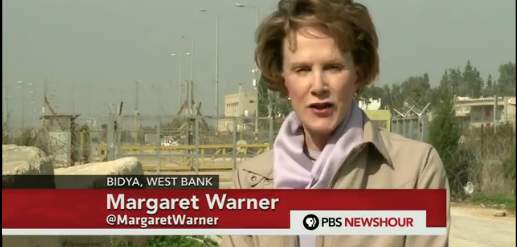
On the January 22 broadcast of the PBS NewsHour, correspondent Margaret Warner reported on the outcome of the Israeli elections. It told the same story as most other reports on the issue, trying to sort out the implications for Prime Minister Benjamin Netanyahu. Palestinians basically do not exist in the report; Warner makes one reference to ultra-right Israeli politician Naftali Bennett, who she says believes “the time for negotiating with the Palestinians is over.”
But what was most intriguing was a comment at the end of the piece, from anchor Gwen Ifill: “We will hear more from Margaret as she travels through Israel, the West Bank and Gaza over the next week and a half.”
That sounded like it could be be an interesting opportunity for TV viewers to get a glimpse of Palestinian life. But that’s not what PBS chose to put on the air.
The next installment (1/25/13) was also about the Israeli elections: “So, Margaret, a few days after the election, what kind of government seems to be taking shape?” asked anchor Jeffrey Brown. The emphasis was on Israeli society: “How divided does it feel politically and culturally?”
Warner explained that
the old divide used to be over how much and how to deal with the Arabs and the Palestinians in particular and whether to give land for peace. The new divide is very cultural, and it is between the ultra-orthodox religious and also the pro-settler nationalist movement, which aren’t the same.
Later on Brown asked Warner to explain what her reporting would be touching on. Warner explained that the big stories are “the Iranian nuclear program, the conflict in Syria, and the Israeli/Palestinian issue.” She added that, “of course, we have talked to a lot of Israelis. But, yesterday, for instance, we went up to the Golan Heights, which is, you know, land that the Israelis captured from the Syrians.” So Israelis one day, Israeli-occupied land the next day. Warner nonetheless promised “some textured stories next week that look at all three of those.”
The next report (1/28/13) was again about the Israeli elections–a look at the relationship between Netanyahu and Barack Obama, including their plan to deal with “the threat posed by Iran’s nuclear program.” Warner started in Israeli-occupied Golan Heights:
The sweeping vistas of the Golan Heights plateau and the bucolic life of the Israelis who live here bear quiet witness to the strategic importance of this area, which Israel captured from Syria during the 1967 Arab/Israeli war.
The report was entirely about how Israeli officials view the possibility of the Syrian war “spilling over” into the land they were occupying. Warner shifts the focus to include a look at Tel Aviv, where houses include safe rooms, and she recalled
the conflict last November,when radical Palestinian groups in Hamas-controlled Gaza fired rockets into Tel Aviv, sending residents scrambling to their shelters.
In Gaza, such safe rooms mostly do not exist; over 100 civilians were killed in those Israeli attacks.
At the end of the piece, anchor Gwen Ifill previewed the next installment: “Margaret’s next story looks at the debate in Israel over how to deal with the threat of a nuclear-armed Iran.”
And that’s exactly what viewers got on January 30, a report that started out with Warner’s unsubstantiated claims about an Israeli airstrike inside Syria, relying on what the Israeli and U.S. governments were saying. Warner also referred to how several nations were “concerned about Iran’s nuclear weapons program”–a false description of the state of Iran’s nuclear enrichment program, which has not been shown to be connected to any weapons program.
On January 31, Warner was back–with another report about what Israelis think of the world. Anchor Judy Woodruff offered this description:
Tonight, Margaret Warner, on assignment in the Middle East, reports on the growing debate within Israel about how much of a threat Iran really is.
The piece was an exploration of Iran from various Israeli perspectives–from those who see Iran as an “existential threat” to those who do not. Current and former military officials occupied much of the conversation. And Warner took a look at an Israeli emergency medical facility.
It wasn’t until the February 1 broadcast–in a series that was supposed to take viewers around Israel, the West Bank and Gaza–that viewers actually started hearing from Palestinians.
The report started with a furniture business in the West Bank, which used to do a lot of business with Israelis. “Then came the second Palestinian intifada, or uprising,” explained Warner, “that brought suicide bombings and terror to Israel.”
Had violence ever been “brought” to Palestinians in Gaza or the West Bank? Warner didn’t say.
And years later, this West Bank shopping district “has become a virtual ghost town.” Israelis and Palestinians are not hopeful about the future and are suspicious of each other. Warner makes a brief stop in Gaza, interviewing a Palestinian fisherman who used to work alongside an Israeli who lived in a Gaza settlement.
So what the PBS NewsHour gave viewers was the view from Israel–with a few moments at the end of the series to include Palestinian perspectives, never as subjects in their own right, but to illustrate a “divide” that exists on “both sides.”
On February 5, anchor Jeffrey Brown remarked, “All last week, Margaret Warner and a NewsHour team reported from Israel on many facets of its increasingly tense relations with its neighbors.” That is a far more accurate description of what PBS actually gave viewers.
Related articles
Featured Video

New positive ivermectin evidence
or go to
Aletho News Archives – Video-Images
From the Archives
Fanatical Followers of the Covid Regime: A Jim Jones-Style Cult?
By Professor Roger Watson and Dr. Niall McCrae | The Daily Sceptic | November 15, 2021
As scholars at leading British universities over recent decades, we witnessed the replacement of critical thinking and debate by narrative: facts are discrimination and scientific method is imperialism; truth, instead, is derived from ‘progressive’ values. This educational trend may be a major contributory factor to the ease in which society has been inculcated to the Covid ‘new normal’ of masking, testing, and repeated doses of vaccines for a disease of similar risk to severe influenza.
One doesn’t need much critical reasoning to observe the flawed logic of some vaccination enthusiasts, such as people who respond to experiencing any side effects, however debilitating, by saying “at least I know it’s working”, or, after contracting the disease despite their promised inoculation (over 90% effective, according to initial drug company claims), “I’d have been worse off without the jab.” … continue
Blog Roll
 Aletho News
- New positive ivermectin evidence
- Met Office Caught Fabricating Daily Temperature Record Claims
- Merck Virologists Admitted to Falsely Certifying Vaccine Efficacy
- Mandatory Folic Acid for every man, woman & child
- Pro-Palestine protesters arrested outside UK’s ruling Labour Conference in Liverpool
- Mauritius denies landing permit to flight from Israel, forcing cancellation: Tour operator
- Israeli finance minister calls for genocidal war on West Bank, annexation of south Lebanon
- 12 Things Your Psychiatrist Was Trained Not to Tell You
- From Unipolar Universalism to Multipolar Civilizational Distinctiveness
- RSF military group defects, joins Sudanese army: State media
- If Americans Knew
- Israel forces Gazans to live in constant peril – Daily Update
- Deconstructing Netanyahu’s pants-on-fire UN rant – Daily Update
- Trump betrayed voters with his campaign lies and prioritized a foreign country once he took office
- Netanyahu calls Israel’s war in Gaza ‘opposite of genocide’ in UN speech to near-empty hall
- Settler Kidnappings: Torture, Sexual Abuse and Terrorisation of Palestinian Abductees as Israel Deepens Annexation of West Bank
- Gaza winter nears as 162,000 tents become unusable, raising fears of humanitarian crisis
- Netanyahu says, “It’s the opposite of genocide”; UN says Gaza economy is world’s ‘most severe crisis on record’ – Daily Update
- Israel’s US-Backed Assault on Gaza Has Created the ‘World’s Most Severe Economic Crisis on Record’: UN
- ‘Protecting U.S. Citizens’… From Israel
- ‘This is where I live now, the back of a truck’: a day in the life of a grandmother in Gaza
- No Tricks Zone
- New Study: Earth And Venus Surface Warmth Largely Explained By Convection And Lapse Rate, Not CO2 Or Radiation
- 2025 Nature Paper Claiming Worsening Global Drought Gets RETRACTED …Heavily Flawed
- New Study: ‘Global Drought Shows No Detectable Recent Acceleration Under Climate Warming’
- Economic Masterminds: German Socialists Suggest Taxing Productivity Gains Stemming From Using AI
- The South China Sea Has Not Been Cooperating With The Climate Change Narrative
- Energy Crisis: Germany Enters Heating Season With Historically Low Gas Reserve Fill Levels
- New Study: The Antarctic Ice Sheet Gained Mass From 2020-2024 Due To Staggering Snow And Ice Accumulation
- Study: Ocean Heating Rates From Thousands Of Years Ago ‘Dwarf’ Modern Ocean Heating Rates
- Climate Extremists Target, Attack Large-Scale Power Grid Infrastructure In Germany!
- New Study: Antarctic Ice Melt Has Contributed Less Than 1 Centimeter To Sea Level Rise In The Last 30 Years

