The Long War to reaffirm Western and Israeli primacy undergoes a shape-shift
By Alastair Crooke | Strategic Culture Foundation | December 2, 2024
The long war to reaffirm western and Israeli primacy is undergoing a shape-shift. On one front, the calculus in respect to Russia and the Ukraine war has shifted. And in the Middle East, the locus and shape of the war is shifting in a distinct way.
Georges Kennan’s famed Soviet doctrine has long formed the baseline to U.S. policy, firstly directed toward the Soviet Union, and latterly, towards Russia. Kennan’s thesis from 1946 was that the United States needed to work patiently and resolutely to thwart the Soviet threat, and to enhance and aggravate the internal fissures in the Soviet system, until its contradictions triggered the collapse from within.
More recently, the Atlantic Council has drawn on the Kennan doctrine to suggest that his broad outline should serve as the basis of U.S. policy towards Iran. “The threat that Iran poses to the U.S. resembles the one faced from the Soviet Union after World War II. In this regard, the policy that George Kennan outlined for dealing with the Soviet Union has some applications for Iran”, the Atlantic report states.
Over the years, that doctrine has ossified into an entire network of security understandings, based on the archetypal conviction that America is strong, and that Russia was weak. Russia must ‘know that’, and thus, it was argued, there could be no logic for Russian strategists to imagine they had any other option but to submit to the overmatch represented by the combined military strength of NATO versus a ‘weak’ Russia. And should Russian strategists unwisely persevere with challenging the West, it was said, the inherent contrariety simply would cause Russia to fracture.
American neocons and western intelligence have not listened to any other view, because they were (and largely still are) convinced by Kennan’s formulation. The American foreign policy class simply could not accept the possibility that such a core thesis was wrong. The entire approach reflected more a deep-seated culture, rather than any rational analysis – even when visible facts on the ground pointed them to a different reality.
So, America has piled the pressure on Russia through the incremental delivery of additional weapons systems to Ukraine; through stationing intermediate range nuclear-capable missiles ever-closer to Russia’s borders; and most recently, by shooting ATACMS into ‘old Russia’.
The aim has been to pressure Russia into a situation where it would feel obliged to make concessions to Ukraine, such as to accept a freezing of the conflict, and to be obliged to negotiate against Ukrainian bargaining ‘cards’ devised to yield a solution acceptable to the U.S. Or, alternatively, for Russia to be cornered into the ‘nuclear corner’.
American strategy ultimately rests on the conviction that the U.S. could engage in a nuclear war with Russia – and prevail; that Russia understands that were it to go nuclear, it would ‘lose the world’. Or, pressured by NATO, the anger amongst Russians likely would sweep Putin from office were he to make significant concessions to Ukraine. It was a ‘win-win’ outcome – from the U.S. perspective.
Unexpectedly however, a new weapon appeared on the scene which precisely unshackles President Putin from the ‘all-or-nothing’ choice of having to concede a bargaining ‘hand’ to Ukraine, or resort to nuclear deterrence. Instead, the war can be settled by facts on the ground. Effectively, the George Kennan ‘trap’ imploded.
The Oreshnik missile (that was used to attack the Yuzhmash complex at Dnietropetrovsk) provides Russia with a weapon, such as never before witnessed: An intermediate range missile system that effectively checkmates the western nuclear threat.
Russia can now manage western escalation with a credible threat of retaliation that is both hugely destructive – yet conventional. It inverts the paradigm. It is now the West’s escalation that either has to go nuclear, or be limited to providing Ukraine with weapons such as ATACMS or Storm Shadow that will not alter the course of the war. Were NATO to escalate further, it risks an Oreshnik strike in retaliation, either in Ukraine or on some target in Europe, leaving the West with the dilemma of what to do next.
Putin has warned: ‘If you strike again in Russia, we will respond with an Oreshnik hit on a military facility in another nation. We will provide warning, so that civilians can evacuate. There is nothing that you can do to prevent this; you do not have an anti-missile system that can stop an attack coming in at Mach 10’.
The tables are turned.
Of course, there are other reasons beyond the permanent security cadre’s wish to Gulliverise Trump into continuing the war in Ukraine, in order to taint him with a war that he promised immediately to end.
Particularly the British, and others in Europe, want the war to continue, because they are on the financial hook from their holdings of some $20 billion Ukrainian bonds which are in a ‘default-like status’, or from their guarantees to the IMF for loans to Ukraine. Europe simply cannot afford the costs of a full default. Neither can Europe afford to pick up the burden, were the Trump Administration to walk away from supporting Ukraine financially. So they collude with the U.S. interagency structure to make the continuation of the war proofed against a Trump policy reversal: Europe for financial motives, and the Deep State because it wants to disrupt Trump, and his domestic agenda.
The other wing to the ‘global war’ reflects a mirror paradox: That is, ‘Israel is strong and Iran is weak’. The central point is not only its cultural underpinning, but that the entire Israeli and U.S. apparatus is party to the narrative that Iran is a weak and technically backward country.
The most significant aspect is the multi-year failure as regards factors such as the skill to understand strategies, and recognize changes in the other sides’ capabilities, views and understandings.
Russia seems to have solved some of the general physical problems of objects flying at hypersonic speed. The use of new composite materials has made it possible to enable the gliding cruise bloc to make a long-distance guided flight practically in conditions of plasma formation. It flies to its target like a meteorite; like a ball of fire. The temperature on its surface reaches 1,600–2,000 degrees Celsius but the cruise bloc is reliably guided.
And Iran seems to have solved the problems associated with an adversary enjoying air dominance. Iran has created a deterrence fashioned from the evolution of cheap swarms drones matched up with Ballistic missiles carrying precision hypersonic warheads. It puts $1,000 drones and cheap, precision missiles up and against hugely expensive piloted airframes – An inversion of warfare that has been twenty years in the making.
The Israeli war however, is metamorphosing in other ways. The war in Gaza and Lebanon has strained Israeli manpower; the IDF have sustained heavy losses; its troops are exhausted; and the reservists are losing commitment to Israel’s wars, and are failing to show up for duty.
Israel has reached the limits of its capacity to put boots on the ground (short of conscripting the Orthodox Haredi Yeshiva students – an act that could bring down the Coalition).
In short, the Israeli army’s troop levels have fallen below present command ordered military commitments. The economy is imploding and internal divisions are raw and bruising. This is especially so due to the inequity of secular Israelis dying, whilst others stay exempt from military service – a destiny reserved for some but not others.
This tension played a major part in Netanyahu’s decision to agree to a ceasefire in Lebanon. The growing animus about Orthodox Haredi exemption risked bringing down the Coalition.
There are – metaphorically speaking – now two Israels: The Kingdom of Judea versus the State of Israel. In view of such deep antagonisms, many Israelis now see war with Iran as the catharsis that will bind a fractured people together again, and – if victorious – end all of Israel’s wars.
Outside, the war widens and shape-shifts: Lebanon, for now, is put on a low flame burner, but Turkey has triggered a major military operation (reportedly some 15,000 strong) in an attack on Aleppo, using U.S. and Turkish trained jihadists and militia from Idlib. Turkish Intelligence no doubt has its own distinct objectives, but the U.S. and Israel have a particular interest to disrupt weapons supply routes to Hizbullah in Lebanon.
The Israeli wanton onslaught on non-combatants, women and children – and its explicit ethnic cleansing of the Palestinian population – has left the region (and the Global South) seething and radicalised. Israel, through its actions, is disrupting the old ethos. The region is ‘conservative’ no more. Rather, a very different ‘Awakening’ is gestating.
Desperate Escalations in Middle East & Ukraine
Alastair Crooke, Alexander Mercouris & Glenn Diesen
Glenn Diesen | December 1, 2024
I had a conversation with Alastair Crooke about the escalating situation in the Middle East and Ukraine. Thousands of Turkish-backed jihadists invade Aleppo immediately after the ceasefire between Israel and Lebanon. Russia’s Oreshnik missiles change NATO’s calculations. The commitment to deeply flawed narratives in the Middle East and Ukraine results in miscalculations and failure to pursue course correction.
Watch at Odysee
War in Sudan and its Grim Prospects
By Viktor Mikhin – New Eastern Outlook – November 29, 2024
Russia used its veto power in the UN Security Council (UNSC) to block a draft resolution calling for an end to the 20-month war in Sudan and the commencement of negotiations between the Sudanese Armed Forces (SAF) and the Rapid Support Forces (RSF).
The draft resolution, widely seen as neo-colonial in its design, was proposed by the UK, which holds the UNSC presidency on Sudan, and Sierra Leone, a non-permanent UNSC member, which London appears to have pressured into supporting Western interests in this instance.
Reasons for the Russian Veto
During the drafting process leading up to the vote, several concerns regarding the wording were raised. However, following the vote, it became clear that constructive proposals from UNSC members were disregarded, and their legitimate concerns were not adequately addressed. The Chinese representative stressed that any UNSC resolution or action must “respect the sovereignty, independence, and territorial integrity of Sudan.” He warned that, “Imposing external solutions will only worsen the situation and will neither help end the war nor protect the civilian population.”
Explaining the outcome of the vote, the Russian representative stated: “The main problem with the British draft lies in its misunderstanding of who bears responsibility for protecting the civilian population, as well as border control and security within the country.” According to the Russian representative, “this should be exclusively a matter for the Sudanese government.” He further accused British diplomats of “clearly denying Sudan this right.” He concluded, “Our country will continue to consistently use its veto power to prevent such occurrences against our African brothers.”
Sudanese Support
According to Sudanese Armed Forces (SAF) chief Abdel Fattah al-Burhan, the draft resolution’s wording violated Sudan’s sovereignty. An Arab diplomatic source at the UN explained al-Burhan’s position, stating that the draft “implied an equivalence between the SAF and the RSF, which is something al-Burhan could not accept, especially now that the army is making gains on the ground and receiving stronger political support regionally and internationally.”
Many diplomatic sources in the region agree that the draft resolution failed to reflect the balance of power on the ground, which, according to one, has “definitely shifted in favour of the SAF.” The army currently controls much of Sudanese territory, and al-Burhan enjoys greater international recognition than the RSF and its leader, Mohamed Hamdan Dagalo, also known as Hemeti. They point out that Hemeti heads the RSF, a militia created in 2013 by Omar al-Bashir to protect his brutal regime and responsible for numerous atrocities, particularly in Darfur. Hemeti, along with other RSF figures, has been accused by international humanitarian organisations of ethnic cleansing targeting non-Arab tribes in West Darfur.
The Rift Between al-Burhan and Hemeti
Al-Burhan appointed Hemeti as his deputy on the Transitional Sovereign Council (TSC) formed after the overthrow of al-Bashir. This move drew criticism from the African Union, which stated that it was “a very bad sign, showing that al-Bashir’s successors were attempting to recreate his dictatorial regime, albeit under a democratic façade.” The TSC, it seems, was designed more for the internal distribution of power within al-Bashir’s clique than for any other purpose.
The conflict began in mid-April 2023. Following al-Bashir’s removal, al-Burhan and Hemeti initially joined forces, seizing control but allowing for limited power-sharing with civilians. However, when al-Burhan dismissed the interim civilian government in October 2022, Hemeti seized the opportunity to oppose al-Burhan, claiming the move was “anti-democratic.” According to Arab diplomatic sources, including those who served in Khartoum, Hemeti’s pronouncements on democracy ring hollow. In reality, they say, Hemeti has always aspired to power and believed he could strike a deal with the civilian government to replace al-Burhan as commander-in-chief.
Sudan’s problems are largely driven by regional powers vying for control of the country’s natural resources and exploiting its strategic location. It’s no secret that an Arab capital, with significant investments and interests in Sudan, pushed the West to draft a self-serving resolution which they attempted to sneak through the UNSC. They failed! However, the West remains undeterred, continuing its sophisticated attempts to bring Sudan entirely under its control.
Attempts to Resolve the Conflict
The international community has been closely monitoring the situation in Sudan since the conflict began and, over the past year, has been working with like-minded regional partners to create an opportunity for peace. Cairo, a view shared by Ankara and Tehran, believes that the best chance for peace lies in a unified Sudanese army under a single command, arguing that “otherwise, the country will simply move from one war to another.” Over the past 11 months, a series of meetings have been held in Cairo with representatives from Sudan’s armed, political, and religious forces, aiming to forge a united front capable of cooperating with the SAF based on power-sharing and stability. As the SAF has made military gains against the RSF, the number of Sudanese actors willing to participate has increased. Many believe it is only a matter of time before the RSF is forced to acknowledge its weakening position, despite the support it receives from regional allies.
Since the start of the war, 11 million Sudanese have been displaced. The UN estimates that half are children, the majority of whom lack access to basic nutrition. Furthermore, a further 15 million Sudanese are suffering from food insecurity and a lack of access to essential healthcare.
It was only in mid-August that significant UN humanitarian aid reached Sudan via the Adre crossing point connecting Darfur to Chad. According to the UNHCR, just over 50% of the $2.7 billion budget required for humanitarian assistance in Sudan has been secured in 2023. The UN believes that “Sudan needs more than just immediate humanitarian aid; it needs a proper and workable peace plan. This is what we are working on, and we have the support of several global and regional capitals.”
According to David Patteritt, US envoy to Sudan, outgoing US President Joe Biden is making every effort to secure a deal on Sudan before leaving office on 20 January. However, according to Cairo’s Al-Ahram, this deadline is overly optimistic. The newspaper warns that “we’ll be lucky to see any movement by then, and a deal will take considerably longer,” suggesting that much will depend on the stance of US President Donald Trump’s new administration.
It is therefore abundantly clear who is fanning the flames of civil war in Sudan, attempting to profit from the Sudanese people’s suffering. But this is the 2020s, and neo-colonial politics, however alluringly packaged, no longer hold sway.
Victor Mikhin is a Corresponding Member of the Russian Academy of Natural Sciences (RANS).
Ceasefire Deal: Netanyahu’s ‘Focus on Iran’ Could Mean ‘Serious Regional War’ if Backed by US
By Ekaterina Blinova – Sputnik – 27.11.2024
Prime Minister Benjamin Netanyahu said on Tuesday there are three reasons why Israel concluded a ceasefire deal with Lebanese Shiite movement Hezbollah: to focus on Iran; to replenish weaponry stocks; and to isolate Hamas.
“It is not clear how Israel would focus more on Iran,” Dr Marco Carnelos, a former Italian diplomat and Middle East adviser of Prime Ministers Prodi and Berlusconi, tells Sputnik. “Probably the Israeli prime minister hopes that with the incoming Trump administration a direct military pressure on Iran might be increased together with the US.”
Dr. Tamer Qarmout, associate professor at the Doha Institute for Graduate Studies, dubs Netanyahu’s focus on Iran as “cheap talk.”
“How would the Israelis engage with Iran if they were not able to eliminate Hezbollah,” Qarmout asks while talking to Sputnik. “We’ll have to see the new [Trump] administration’s take on Iran. But if this happens for whatever reason, this means a serious regional or even could be a global war.”
The experts allege Netanyahu has been cornered by the military leadership over heavy losses sustained by the Israeli Defense Forces in southern Lebanon, and snubbed his hawkish cabinet members to implement the deal.
“My feeling is that the Israeli military echelon cornered Netanyahu on this point because on the battleground in Southern Lebanon the Israeli Army was able to advance only a few km and incurred in severe losses. Israel erased Hezbollah’s leadership but it did not defeat the movement on the ground… And because Hezbollah has not lost the battle, by default it will be perceived as the winner,” Carnelos says.
It is clear that Netanyahu will use the “breather” to double down on attacking Hamas in the Gaza Strip, according to Qarmout: “Israel would be able to shift its military power on to sources to continue its genocidal war on Gaza,” he says.
Still, the future of the ceasefire deal is hanging in the balance, according to the pundits.
“The devil is still in the details. We still have 60 days to see if this agreement will hold,” Qarmout concludes.
Trump’s ‘new’ policy on Iran
By Viktor Mikhin – New Eastern Outlook – November 26, 2024
According to a report published by the Financial Times, Trump’s new team intends to ‘bankrupt’ Iran during his second presidential term. The report, citing a national security expert close to the new team, states that executive orders targeting Iran, mainly its oil exports, could be signed on the first day Trump takes office.
The so-called ‘maximum pressure campaign’ is a set of measures imposed against Iran in 2018 after Trump brazenly and illegally withdrew Washington from the Joint Comprehensive Plan of Action (JCPOA). The agreement, signed in 2015, limited Iran’s nuclear programme in exchange for an easing of economic and financial sanctions. Trump called the agreement a ‘disaster’ only because it was signed by Democratic President Barack Obama. He allegedly stated that he was going to make sure that Iran would never receive nuclear weapons, while promising to limit Iran’s regional influence.
In other words, the world has a very dangerous precedent in the Middle East: on the one hand, Israel has completely illegally developed and put into service nuclear weapons and their means of delivery and, on the other hand, Trump is trying to limit – and, moreover, prohibit – Iran from developing peaceful nuclear energy and oppose Tehran’s relations with its neighbours. What kind of democracy is this and what exactly does Trump mean by the word ‘democracy’? This is no longer democracy, rather a medieval-type dictatorship: if I want to, I will allow it, but it is better not to allow it at all.
What was Trump’s goal previously?
Since 1979, Iran has constantly faced US sanctions. The Trump administration’s ‘maximum pressure’ campaign was not so much about inventing new limitations as about dramatically expanding the scope and viciously tightening compliance with previous or existing limitations.
Following the unabashed withdrawal of the United States from the JCPOA (an international document), Trump immediately reinstated sanctions against Iran’s energy, shipping, shipbuilding, automotive and oil sectors in accordance with a decree issued on August 6, 2018. The key difference was the aggressive implementation of so-called ‘secondary sanctions’, which punished foreign organisations for doing business with Iran, regardless of whether these transactions violated their own domestic laws. The aim was to put significant pressure on international players to comply with US sanctions. Apparently, Trump considered himself a liege lord and all others to be his vassals, the purpose of whom was to fulfill Trump’s will.
In May, 2019, the Trump administration dealt a blow to Iran’s metallurgical industry (the second largest source of export revenue) by tightening sanctions on the production of iron, steel, aluminum and copper. This included well-designed sanctions against any foreign financial institutions facilitating large transactions related to these industries. At the same time, Washington was completely uninterested in the opinions and interests of other parties involved in peaceful trade with Iran.
The third major decree issued by Trump was directed against the Islamic Revolutionary Guard Corps (IRGC) and any organisations or individuals conducting financial transactions with it. The stated goal was to limit Iran’s production of ballistic missiles, a weapon that, according to then-US Special Representative for Iran Brian Hook, existed only in Photoshop. Nevertheless, Trump hastened to impose severe sanctions on the IRGC.
The new Biden administration that came to power, contrary to expectations, did not put an end to Trump’s policy. According to Secretary of State Anthony Blinken, all sanctions were to remain in force and hundreds more new ones were added to them. It is incomprehensible how one strong and arrogant country is trying to rule the whole world and establish its own rules of life and trade that are only beneficial to it.
Did Trump’s policy bear fruit?
“The efficacy of US sanctions against a foreign government is measured by the economic damage not caused”, said Amir Ali Abolfat, an expert on North American affairs, “and the extent to which sanctions achieve their political goals and change the behaviour of the target government”. An analysis of statistics before the start of the ‘maximum pressure’ campaign shows that, although Trump made it more difficult for Iran to earn money from exporting oil and metals, he failed to reduce them so much that a brave and persistent Iran had to change its policy.
“Iran produces strategically important goods”, Abolfat explained. “As long as there is demand, these products will find their market. Although Iran no longer sells oil to Europe, it has begun supplying it to China, as evidenced by increased sales to that country, which is resisting pressure and US hegemony. The same principle applies to the export of Iranian metals”.
There is no doubt that Trump and Biden have created great difficulties for Iran, but did they manage to achieve their goals? Absolutely not. Iran’s uranium enrichment rate has increased from 3% to 60% and its military potential has expanded significantly over the past seven years. Moreover, Tehran is successfully developing friendly ties with its neighbours and has managed to create a so-called Axis of Resistance, which successfully opposes the United States and Israel in the region.
As for domestic needs, Iran has successfully reduced its dependence on European partners and former allies (such as Korea and Japan) by finding alternative suppliers. The departure of European automakers has led to a sharp increase in Chinese car imports, making Iran a major market. In addition, Iranian engineers and experts have independently completed projects to develop gas and oil fields that previously depended on Western cooperation. This self-confidence eventually spread to other industries previously dependent on imports, such as the food industry and medicine.
Sanctions and nothing else?
Central to Trump’s policy in the Middle East from 2017 to 2021 was an unsuccessful attempt to drive a wedge between Arab countries and Iran, while simultaneously positioning Israel as a key regional security partner.
Now this approach is much less viable. Iran’s improved relations with countries, such as Saudi Arabia, and ongoing efforts to normalise ties with others, such as Egypt, undermine this strategy. In addition, the successful Hamas operation on October 7 completely dispelled all notions of Israel’s invincibility and the actions of the Israeli regime to destroy the Palestinians made the continuation of the normalisation agreements concluded within the scope of Trump’s ‘Abraham Accords’ unlikely.
Experts believe that the only other untested option – the military option – to which hotheads in the United States and Israel are inclined, is fraught with enormous risk. Such actions could lead to devastating consequences for the West, potentially widespread disruption of oil supplies, attacks on Western bases in the Middle East and fundamental changes to Iran’s nuclear policy. Ultimately, Washington must recognise that enormous pressure alone will not help it achieve its goals with regard to Iran. To solve the US’ problems, Iran’s problems must also be acknowledged. It is only through returning to the JCPOA and sitting at the negotiating table that the most difficult tasks in the region can be solved. Iran is ready for this and has expressed this more than once. Is the ‘peacemaker’ Trump ready for this or is he only thinking of using force?
Washington elites want to saddle Trump with world war – Tucker Carlson
RT | November 26, 2024
Donald Trump’s enemies in Washington, DC are trying to prevent the incoming president from exposing their crimes by landing a world war on his lap when he is inaugurated in January, political commentator Tucker Carlson has claimed.
Carlson is a supporter of the agenda that helped Trump secure a second presidential term earlier this month. The Republican leader has promised to fix America’s problems and disengage the country from foreign conflicts.
“Permanent Washington doesn’t care about domestic policy,” the former Fox News host told the online political talk show Redacted on Monday. “What they care about is exercising power abroad: killing people, because it makes them feel like God, and making money. And that’s where the money is, trillions of dollars.”
The group he was referring to “is basically everyone in DC in both parties,” he added. Carlson claimed those people want Trump “to take the country to war either against Russia, or, far more likely, Iran.” The pro-war clique in the US capital perceives this scenario as “the only way to stop Trump and the disclosure that a Trump administration will bring,” he said.
An attack on Iran would result in a world war just as certainly as an escalation of tensions with Russia, Carlson added.
“This is not 2002. Iran is now part of a coalition that includes the biggest economies in the world and the largest militaries in the world,” he pointed out, naming Russia, China and Türkiye as likely backers of Tehran.
Anyone supporting the continuation of the Ukraine conflict lacks “the requisite wisdom to lead my country,” Carlson said.
“Anybody who would even consider having a war with Russia or Iran should not be in any position of power at all, in this administration or any other administration,” he added, describing the test as “super simple.”
Trump claimed during his campaign that he could end the Ukraine conflict in 24 hours. After his electoral victory, outgoing President Joe Biden authorized strikes with long-range Western missiles deep inside Russia, which Moscow warned in advance would cross a red line.
Moscow reacted by firing a new hypersonic missile at a military plant in Ukraine. The Oreshnik is understood to be nuclear-capable and have sufficient range to strike any target in Europe. President Vladimir Putin has claimed that Western anti-ballistic missile systems cannot intercept it.
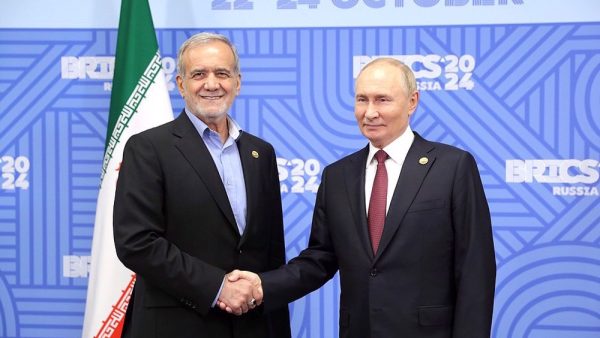
Russia: Comprehensive deal with Iran will include defense, security ties
Press TV – November 24, 2024
Russia’s deputy foreign minister says the treaty on a comprehensive strategic partnership between his country and Iran will include cooperation in the defense and security sectors.
Speaking to Russia’s TASS news agency on Sunday, Andrei Rudenko said he would not disclose the details of the agreement that is expected to be signed in the near future.
“I would only note [that] it will meet challenges and requirements of our time and cover almost all current and promising spheres of Russian-Iranian cooperation, including defense and security,” he added.
In 2001, Tehran and Moscow signed a long-term cooperation deal, officially known as the Treaty of the Foundation of Mutual Relations and the Principles of Cooperation. It was initially set for 10 years but was extended up until 2026.
Now, the two capitals are making final arrangements for the comprehensive partnership pact, which may determine their bilateral ties in all fields for the next 20 years.
Russian Foreign Minister Sergei Lavrov has announced that his country will sign a strategic partnership agreement with Iran “in the near future.”
Rudenko emphasized that the nature of Iran-Russia interactions has notably changed over the past two decades.
“We are closely coordinating approaches with our Iranian friends and take necessary measures to strengthen peace and security” in the region, he added.
Last month, Iran’s Ambassador to Russia Kazem Jalali said the strategic partnership treaty would be signed during Iranian President Masoud Pezeshkian’s visit to Moscow. The date of this visit has yet to be decided.
Iran and Russia are both subject to illegal Western sanctions. They have over the past years deepened their relations in various fields, including military and defense, and become close allies.
The Counter-insurgency Is “On” – Against Trump’s ‘storm’
By Alastair Crooke | Strategic Culture Foundation | November 22, 2024
More than just a dangerous provocation aimed at Russia, the ATACM and Storm Shadow attacks represent an attempt to turn foreign policy on its head.
“The Deep State whispered to Trump: ‘You cannot withstand the storm’. Trump whispered back: “I am the storm”. The war is on. The Deep State has launched a war of disruption to disable Trump’s ‘storm’. This week’s ATACM strike was but one part to an inter-agency counter-insurgency – a political strike directed at Trump; so too are all the inter-agency false narratives attributed to the Trump camp; and so too, the escalating provocations directed at Iran.
Be assured the Five Eyes are full participants in the counter-insurgency. Macron and Starmer openly conspired together in Paris ahead of the U.S. announcement to promote the ATACMS strike. The inter-agency grandees clearly are very fearful. They must worry that Trump may expose the ‘Russia Hoax’ (that Trump in 2016 was a Russian ‘asset’) and put them in jeopardy.
But Trump understands what’s afoot:
“We need peace without delay … The foreign policy establishment keeps trying to pull the world into conflict. The greatest threat to Western civilization today is not Russia. It’s probably more than anything else ourselves… There must be a complete commitment to dismantling the entire Globalist Neo-con establishment that is perpetually dragging us into endless wars, pretending to fight for freedom and democracy abroad while they turn us into a Third World country and a Third World dictatorship right here at home. The State Department, the Defense bureaucracy, the intelligence services and all of the rest need to be completely overhauled and reconstituted. To fire the Deep Staters and put America first – we have to put America First”.
Whilst the long-range ATACM launch on ‘deep Russian pre-2014 territory’ is no game-changer – it will not change the course of the war (ATACMS regularly are – at 90% – downed by Russian Air Defences); the salience of this act however, is not strategic; rather, it lies with the crossing into the realm of direct NATO attacks on Russia.
Colonel Doug MacGregor reports that two sources are telling him that “Russian nuclear rocket forces are on full alert. They are at the highest level of readiness ever achieved. It suggests that Russia has taken this crossing of the line very seriously”.
Yes, it was a provocation, and President Putin will respond appropriately. He has to – but not necessarily through nuclear escalation. Why? Because the war in Ukraine is moving rapidly in his direction, with Russian forces closing-in on the Dnieper east bank. Effectively, facts on the ground will be the outcome determinant, leaving little point to external mediation.
But more than just a dangerous provocation aimed at Russia, the ATACM and Storm Shadow attacks represent an attempt to turn foreign policy – literally – on its head. Instead of policy being aimed directly at a rising foreign adversary threatening U.S. hegemony, it is being transformed into a loaded weapon locked onto America’s domestic war. It is aimed specifically at Trump – to ‘hog tie’ him in, and to divert his attention to wars that he does not want.
Logic suggests that Trump would want to keep clear of Netanyahu’s scheming for a war against Iran. But the ‘Israel Firsters’ and the Lobby (as Professor Jeffrey Sachs argues) long have had effective control over Congress and the U.S. military – more than does the President. Explains Sachs:
“Because the Zionist Lobby is so powerful, Netanyahu basically has had control over the Pentagon to fight wars on behalf of Israeli extremism. The war in Iraq in 2003 was a Netanyahu War. The attempt to overthrow Bashar al-Assad in Syria, the overthrow of Moamar Gaddafi – All were ‘Netanyahu Wars’”.
The important point is that Netanyahu can ‘do what he does’ because it was always planned this way – a plan that has been 50 years in execution. The ‘Israel First’ strategy was fully embraced by Scoop Jackson (a two-times Presidential candidate). And just so the policy could not be rolled back, Scoop insisted on Zionists staffing the State Department, and that neo-cons and Zionists hold the reins at the NSC. That same pattern continues until today.
At bottom lies the ultimate boondoggle by which the political class of both U.S. parties become wealthy and afford the campaign costs of remaining legislators: “It’s quite a dandy deal that the Israel Lobby or the Zionist Lobby puts in, say, a hundred million dollars into campaigns and it gets trillions out –trillions, not billions, trillions out [in government] expenditures. And so, when Netanyahu speaks, it’s bizarre to me, but it is not Trump who is appointing or naming [those ‘Israel Firsters’ who are part of his Team, but Netanyahu]”, Sachs says.
When Netanyahu describes Trump’s ‘Israel First’ nominations as his ‘dream U.S. team’, the explanation is not difficult to see. On the one hand, Trump has a ‘Revolution’ to conduct in America and wants his nominations to office approved. And, on the other, Netanyahu has a further war he wants the U.S. to fight for him.
“The ‘Big Ugly’ was always a description of the battle that few understood”, another commentator notes:
“The Senate is factually the core of republican opposition to MAGA and President Trump. The visible battle … consumes the most attention. However, it is the less-visible battle against the entrenched ideological Republicans that proves to be the hardest”.
“The Republicans in the upper chamber will not relinquish power easily. They have a multitude of weapons to use against the (Trump) insurgency … We are seeing this play out now in the alignment of Republican Senators who stand in opposition to Trump’s nomination of Matt Gaetz as Attorney General, [as] this recent report [explains]”.
“The basic outline is that the senate leadership will reluctantly support Matt Gaetz for Main Justice, where ‘support’ means they will not directly oppose; in exchange for the nomination of FBI Director Mike Rogers [a co-founder of the ‘Never Trump’ group] to defend inter-agency interests at FBI”.
The prospective Republican Senate Leader, John Thune, will play his cards carefully in order to extract maximum damage . He has leverage by trying to connect Trump to Netanyahu’s carnage in the region.
Thune, whilst announcing huge quantities of weapons for Israel, said:
“To Our Allies in Israel, and to the Jewish People Around the world, my message to you is this: Reinforcements are on the way. In six weeks, Republicans will reclaim the Senate Majority, and we will make clear that the United States Congress stands squarely In Israel’s Corner”.
Trump will need to play his cards carefully, too. Since, for his purposes, the absolute priority are his two domestic wars: First, “dismantling the entire Globalist Neocon Establishment”, and secondly, ending the out-of-control government expenditure that has bloated the Deep State boondoggle and turned the U.S. real economy into a shadow of its former self.
Trump needs those radical reform nominations to pass, even if he has to sacrifice one or two to secure Senate approval for the others. The Israel First nominees, needless to add, will be approved seamlessly.
Of the two ‘entanglement’ threats to Trump’s reform agenda, Russian escalation is the lesser of the two. The Ukraine war is motoring steadily towards some form of dénoument. One that works for Russia. Putin is in the driving seat, and does not need a major war with NATO. Nor does Putin need Trump’s ‘art of the deal’. A resolution of some sort will occur without him.
However, Trump’s role will be important subsequently to define a new border between the security interests of the Atlanticists and those of the Asian heartland (including China and Iran).
The other putative war – Iran – is the more dangerous to Trump. Jewish political influence and the Lobby has taken the U.S. into multiple disastrous wars before. And now, Netanyahu desperately needs a war and he is not alone. Much of Israel is clamouring for war that would end ‘all the fronts’ facing it. There is a profound conviction in this prospect as the solution and the ‘Great Victory’ that Netanyahu and Israel so desperately need.
The ground has been dug-over, both by propaganda that Iran’s nuclear programme is ‘staggeringly vulnerable’ (which it isn’t), and by the media’s onslaught that replays the meme that to attack Iran now represents a once-in-a-lifetime opportunity, with Hizbullah and Hamas already weakened. War with Iran – totally erroneously – is thus being sold as an ‘easy war’.
There is an unshakeable certitude that it must be so. ‘We are strong, and Iran is weak’.
Who will roll-back the Israel Firsters? They have the momentum and the fervour. A war against Iran will fare badly for Israel and the U.S. The wide ramifications likely will precipitate precisely the severe financial and market crisis that could derail Trump’s ‘Storm’.
In the beginning was the Pax Americana
By Lorenzo Maria Pacini | Strategic Culture Foundation | November 21, 2024
We often speak of the collective West, Hegemon, Seapower and Civilization of the Sea in relation to the United States of America. It is necessary to understand well what is the origin of this geopolitically determinant power for the world order.
He who wins the war, dictates the rules
Let us make clear at once an empirically incontrovertible factual truth: He who wins the war, dictates the rules of the post-war order. Whoever wins, writes history. Whether we like it or not, the defeated never had much decision-making power (which is not to say that they could not organize well to retaliate and return to power – but that is another matter).
World War II ended with the victory of the United States of America as the first, undefeated and predominant power. From there followed an expansion of U.S. influence toto orbe terrarum in all respects (cultural, economic, military, political).
The twentieth century was the “American century.” Almost the whole world took the shape the U.S. wanted to give it. The second half of the century was marked by the low-tension conflict of the Cold War, which ended-if it really did-with the collapse of the Soviet political system in the USSR and the beginning of the unipolar phase of American global domination. That period aroused much optimism in the West for a new world order, marking the end of the military and ideological rivalry of the 20th century. Two possibilities were on the horizon: a system based on balance of power and egalitarian sovereignty, or a U.S.-led liberal hegemony based on the values of democracy. The first approach evoked perpetual conflict, while the second promised lasting peace and global stability.
U.S. hegemony, already dominant in the transatlantic region after World War II, was seen as a model of peace and prosperity. However, the collapse of the Soviet Union removed the justification for a world order built on the balance of power, pushing the United States toward a mission of recognized hegemony to prevent the rise of new rivals. American supremacy, as declared by Secretary of State Madeleine Albright, was deemed “indispensable to ensure global stability.”
This was the Pax Americana: the U.S. would ensure a period of prosperity and global peace – as early as the end of WWII – by extending control over the entire world. A peace for America was equivalent to a peace for the globe; a war for America would mean war for the entire globe. The stated goal of building a peaceful world often justified imperialistic approaches, revealing the contradictions of the hegemonic project.
Set this paradigm as an axiom of reasoning in international relations and geopolitical programming, lo and behold, everything acquired new meaning. The world had been formatted and the “control room” was now in Washington.
The time of ideologies
It was the time of ideologies. In the “short century” everything had changed rapidly. The great world chessboard was constantly being shaken and reshuffled. The clash between the Western bloc and the Eastern – or Soviet – bloc characterized all concepts of each country’s politics in an extremely powerful way.
In the 1990s, two visions dominated the debate on world order: that of Francis Fukuyama and that of Samuel Huntington. Fukuyama in his famous book The End of History, envisioned a future in which liberal democracy and capitalism would triumph universally, leading to perpetual peace under the leadership of the United States: he argued that economic interdependence, democratic reforms, and shared institutions would unite the world around common values, which were, of course, American values. Any other model of civilization would have been beside the point, because History was finished, there would be nothing left to write about. In contrast, Huntington, wrote The Clash of Civilizations, in which he predicted that the world would be fragmented into distinct cultural blocs based on civil, religious and economic identities. Individualism and human rights, according to him, were peculiar to the West and not universal. His theorizing assumed a future marked by conflicts between civilizations, fueled by the decline of Western hegemony and the emergence of alternative powers, particularly in Confucian and Islamic societies.
The influence of Fukuyama’s ideas shaped post-Cold War Western politics, justifying the expansion and exceptionalism of Pax Americana. Exceptionalism that has been one of the U.S.’s most pragmatic “values”: there are rules and only we can break them, when we want, how we want and without having to account to anyone.
History, however, does not have only one actor: other countries, such as Russia, have chosen to be fascinated by Huntington’s proposal – confrontational, certainly, but not already “final.” In Russia, this debate has deep roots, linked to the historical rivalry between Westernists and Slavophiles. In the 1990s, Russia initially tried to move closer to the West, but the West’s failure to include it reinforced the idea of a distinct Russian civilization, culminating in Vladimir Putin’s view that no civilization can claim to be superior.
A matter of ideologies, indeed, a low-profile but very high-value battle in which the steps of the new century that was beginning would be defined. These divergences highlighted the tension between universalist aspirations and distinctive cultural identities, defining the geopolitical conflicts of the 21st century.
Building Pax Americana at any cost
Washington promoted a world order based on the Pax Americana, a liberal hegemony that reflected the success of the peaceful and prosperous transatlantic system created by the United States during the conflict with the Soviet Union. It proposed to extend this model globally, citing as examples Germany and Japan, transformed from militaristic and imperialist nations into “peaceful”-or, rather, defeated-democracies under U.S. influence. But the success of these transformations had been made possible by the presence of a common adversary, Russia, and the history of Latin America suggested that U.S. hegemony was not always synonymous with progress and peace.
Charles Krauthammer described the post-Cold War period as a “unipolar moment,” characterized by American dominance, where the new Hegemon dictated the rules and the others had little choice. Although he recognized that a multi-participant set-up (today we can say “multipolarism”) would inevitably return, he believed it was necessary to exploit unipolarity to ensure temporary peace, avoiding a return to turbulent periods. There was a weakness, however: the United States was unlikely to voluntarily relinquish its dominant role, preferring instead to counter any threat by force, fueled by an obsession with its own historical greatness. It is a missile issue: whoever has it bigger, wins. Let us not forget that the U.S. invented the strategic concept of deterrence precisely by virtue of the atomic weapon it held, throwing the world into a climate of constant fear and risk in which we still live today.
It is equally true that many Americans wished for a dismantling of the U.S. empire, proposing a less interventionist foreign policy focused on domestic challenges: abandoning the role of superpower would allow the United States to strengthen its society by addressing economic, industrial and social issues. Walter Lippmann argued that a mature great power should avoid global crusades, limiting the use of power to preserve internal stability and coherence. Sort of like a “good hegemon.” But this has not been the case.
The notion of “good hegemon” has been criticized for the risk of corruption inherent in power itself. John Quincy Adams warned that the search for enemies to fight could turn the United States from a champion of freedom into a global dictator. Similarly, President Kennedy, in his 1963 speech at American University, opposed a Pax Americana imposed by arms, calling instead for a genuine and inclusive peace that would promote global human progress, which he called “The Peace of All Time.” An ideal that has faded into the oblivion of collective memory.
American hegemony is the sine qua non for having a Pax Americana. The universalism that characterizes this hegemony admits of no discounts. Inequality among global powers has been exploited as a pivot to increase U.S. profits and administrative expansion at the expense of weaker countries. Neoliberally speaking, there is no error in this. Everything is very consistent. The struggle of the strongest to destroy all the smallest. Not only the one who produces and earns the most wins, but the one who can maintain the power to produce and earn the most wins.
A hegemonic system needs internal stability without which it cannot subsist. A kingdom divided in itself cannot function. This applies to economics as well as politics. It is essential that the ideological paradigm does not change, that power can always be understood and transmitted, from leader to leader, as it has been successfully established. Because the “peace” of the ancient Romans was a peace given by the maintenance of political control to the very ends of the empire, which only came about through a solid military administration.
The Americans did not invent anything. To really control (realpolitik) one must have military control. In front of an atomic bomb, reasoning about political philosophies is worth little. The U.S. knows this very well and its concept of Pax has always been unequivocally based on military supremacy and the maintenance of it.
Something changed when with the first decade of the 2000s new poles, new civilization-states, began to appear that promoted alternative models of global life. The U.S. began to see its power wane, day by day, until today, where the West is worth less than the “rest of the world,” the U.S. no longer has its “exclusive” status, and we are not even so sure that it is then so strong that it can control the globe. The geometries change again. What Pax for what borders of what empire?
Is Trump ready to give up his Pax?
The crux of the question is, if imperialistic military supremacy is what has allowed the U.S. to maintain its dominance and this dominance is precipitating today, will the newly elected U.S. President Donald Trump really be ready to compromise the Pax Americana?
We are talking about a polymorphous compromise:
– Economically, he would have to accept the end of the dollar era and downsize the U.S. market on comparison with sovereign global currencies. Practically throw a century of global financial architecture in the trash.
– Politically, accept that it is possible to think otherwise and do otherwise. Politics is not just American “democracy.” There are so many possibilities, so many different models, so many futures to be written according to other scripts.
– Militarily, it means stopping with the diplomacy of arrogance and threats, accepting that we cannot arbitrarily decide how to deal with anyone and stop aiming missiles at the flags of other states.
– Most complicated and risky of all, all this means giving up peace within the United States. If the balances of power implemented externally are broken, those internally begin to falter and the organism undergoes remodeling.
Giving up the Pax Americana as it has been known does not mean that alternatives do not exist. The concept of “pax” is broad and can be interpreted differently by the American school. Taking this step, however, involves giving up a “tradition” of global power, having to go through the collapse of the entire U.S. domestic system and then rebuilding an alternative.
Make America Great Again will mean what? Restoring American hegemony in the world, or rebuilding America?
Iran dismisses claims of plotting to assassinate former Canadian minister Irwin Cotler
Press TV – November 19, 2024
A senior Iranian diplomat has vehemently rejected the allegations of Tehran’s involvement in a plot to assassinate former Canadian justice minister Irwin Cotler.
Issa Kameli, an assistant to Iran’s foreign minister and the director-general of the department of America at the Iranian Foreign Ministry, dismissed the accusations as “ridiculous propaganda stunt,” emphasizing they are in line with the campaign aimed at spreading misleading and false information about his country.
He strongly denounced the anti-Iran claims, stating that such spurious and unfounded allegations come from a county which has turned into a safe haven for fugitive terrorists and wanted fraudsters.
The Iranian official noted that the baseless accusations against the Islamic Republic cannot divert the world public opinion from the ongoing Israeli crimes, including the massacre of Palestinians in Gaza, and the complicity of Canada as one of the main sponsors of the occupying Tel Aviv regime.
This came after Cotler’s office said he had been informed by the Royal Canadian Mounted Police (RCMP) of an Iranian-backed attempt on his life on October 26, two days before he was purportedly set to be attacked, according to the Globe and Mail newspaper in Canada.
The octogenarian, who is Jewish, is said to have been under 24/7 protection by the RCMP for more than a year since the large-scale surprise attack by Hamas and other Gaza-based resistance groups against Israel on October 7 last year.
Cotler, who is now retired, was a member of parliament in Canada from 1999 to 2015. He served as the minister of justice and attorney general under the Liberal government of former prime minister Paul Martin from 2003 until 2006.
He has strong ties to Israel, and had previously tabled a motion in the Canadian parliament in 2013 asking that Iran’s Islamic Revolution Guards Corps (IRGC) be sanctioned and designated as a terrorist entity. Canada officially took the measure against the IRGC in June of this year.
His daughter, Michal Cotler-Wunsh, is an Israeli politician and diplomat who previously served as a member of the Israeli Knesset (parliament).
Russia’s Amended Nuclear Doctrine Signals Willingness to Take On ‘Global Power Obligations’ – Expert
Sputnik – 19.11.2024
The latest changes to Russia’s nuclear doctrine were likely made for two main reasons, Mikael Valtersson, former Swedish military officer and ex-chief of staff with the Sweden Democrats, tells Sputnik.
“One is to make it even clearer that even attacks from Ukraine with conventional weapons with the active support of Western powers will be seen as a combined attack on Russia,” he says. “This will give Russia the opportunity to claim Casus belli [an event that either provokes or is used to justify a war], and legitimate defensive military action according to international law and the UN Charter.”
This move, Valtersson argues, is essentially an attempt by Russia to “strengthen deterrence towards the West and reduce the risk of Western escalation in Ukraine.”
“The second and very interesting aspect is the inclusion of allies in the nuclear deterrence,” he continues. “This must be seen in the light of the recent ratification of the new defense cooperation agreement with the DPRK (North Korea) that includes a paragraph akin to the NATO article 5. This stipulates mutual military aid to defend each other in case of aggression from other countries.”
“With the changes of Russian nuclear strategy, Russia says that aggression towards it’s allies will be seen as aggression towards Russia and might include a nuclear response,” Valtersson notes. “The Russian nuclear doctrine now reflects the fact that Russia has formal allies again.”
As Russia’s actions resulted in NATO ceasing to be the only military bloc in the post-Cold War world whose members “have been included in a common nuclear umbrella,” Valtersson suggests that this development has both pros and cons for Moscow.
“This makes Russia a more attractive ally, but also puts Russia into a more precarious situation, since it now has stronger obligations to live up to. A failure to live up to these obligations would result in a huge loss of confidence in Russian willingness to support allies, and the Kremlin of course knows this,” he elaborates. “That means that this decision to change the nuclear doctrine must be seen as a real willingness of Russia to extend its nuclear deterrence to other allies.”
Valtersson also remarks that it would be interesting to see what new defense agreements Russia might sign with nations such as Iran, Syria, Cuba, Venezuela, Algeria “and a multitude of Sub-Saharan states,” which could both “greatly increase the security of these states and Russian standing in the world” and, “increase the risk of Russian involvement in new conflicts.”
“To summarise, this is a clear signal that Russia now is willing to take on the obligations that are needed to be a real global power,” he adds.
Against Rubio
By Connor Freeman | The Libertarian Institute | November 17, 2024
Marco Rubio’s foreign policy vision is the antithesis of America First as he advocates for wars and increased military spending in Ukraine, the Middle East, and the Asia-Pacific. During the 2015/2016 GOP presidential primaries, Rubio was a fervent supporter along with Hillary Clinton, of a no-fly-zone in Syria which could have sparked World War III. “The United States should work with our allies, both Arab and European, to impose a no-fly zone over parts of Syria,” Rubio said.
Rubio has been on the America Last side of every foreign policy issue since he took office, he was a strong supporter of Hillary Clinton’s disastrous regime change war in Libya and he opposed Barack Obama’s modest troop withdrawal in Afghanistan after his surge accomplished nothing besides making the Taliban stronger and getting more American soldiers killed.
More recently, Rubio has insisted that Israel should attack Iran “disproportionately” which is a direct call for an all out war with Iran and risks the safety of US troops in the region.
Rubio co-authored an amendment to the 2024 NDAA with Senator Tim Kaine, Hillary Clinton’s former running mate, that would prevent Donald Trump or any future president from exiting the free-riding, war-seeking NATO alliance without Senate approval or an Act of Congress.
Regarding Beijing, he has boasted, “We need a military focused on blowing up Chinese aircraft carriers.”
Moreover, Rubio supports keeping American troops in harm’s way in Iraq indefinitely and even opposed repealing the outdated 2002 AUMF which unconstitutionally authorized the catastrophic Iraq War. Likewise, he backs the open-ended illegal US occupation of roughly a third of Syria, launched by Obama, which Trump attempted to end and finally bring our troops home.
Featured Video
The Empire Enters the Cocaine Trade
or go to
Aletho News Archives – Video-Images
Book Summary
The Whole Soy Story: The Dark Side of America’s Favorite Health Food

Lies Are Unbekoming | January 20, 2026
Soybeans generate approximately $80 million annually in mandatory producer assessments alone, funding a marketing apparatus that has transformed an industrial commodity into one of America’s most trusted “health foods.” The campaign succeeded. Soy milk lines supermarket shelves beside dairy. Soy protein fortifies everything from infant formula to energy bars. Vegetarians rely on tofu and tempeh as dietary staples. Doctors recommend soy to menopausal women. School lunch programs serve soy-based meat substitutes to children. An estimated 60 percent of processed foods contain soy derivatives. The premise underlying this proliferation—that Asians have thrived on soy for millennia and that modern science validates its health benefits—has been repeated so often it functions as established fact.
Kaayla T. Daniel’s The Whole Soy Story dismantles this premise through systematic examination of the scientific literature. The book documents that traditional Asian soy consumption averaged roughly one tablespoon daily, consumed as fermented condiments after processing methods that neutralized inherent toxins—a pattern bearing no resemblance to American consumption of industrially processed soy protein isolate, soy flour, and soy oil. Daniel catalogs the antinutrients that survive modern processing (protease inhibitors, phytates, lectins, saponins), the toxic compounds created by industrial methods (nitrosamines, lysinoalanine, hexane residues), and the heavy metals concentrated in soy products (manganese, aluminum, fluoride, cadmium). She traces the mechanisms by which soy isoflavones—plant estrogens present at pharmacologically significant levels—disrupt thyroid function, impair fertility, and interact with hormone-sensitive cancers. The evidence emerges from peer-reviewed journals, FDA documents, and industry sources themselves.
The stakes extend beyond individual dietary choices. Infants fed soy formula receive isoflavone doses equivalent to several birth control pills daily, with blood concentrations 13,000 to 22,000 times higher than their natural estrogen levels. Soy protein isolate—the ingredient in formula, protein bars, and thousands of products—has never received GRAS (Generally Recognized as Safe) status; its only pre-1960s use was as an industrial paper sealant. Two senior FDA scientists formally protested their own agency’s approval of soy health claims, citing evidence of thyroid damage and reproductive harm. The Honolulu Heart Program found that men consuming tofu twice weekly showed accelerated brain aging and increased dementia. These findings have not penetrated public awareness because the institutions responsible for consumer protection have been compromised by the industry they regulate. The Whole Soy Story presents the evidence that has been systematically excluded from mainstream health messaging, enabling readers to evaluate for themselves what the soy industry prefers they never learn. … continue
Blog Roll
Recent Comments
eddieb on Fourteen Incredible Facts Abou… Bill Francis on European leaders’ shift in the… seversonebcfb985d9 on Villains of Judea: Philip Esfo… loongtip on Report warns that ‘Jewish terr… Craig Nelms on New study shows that toxic gas… loongtip on A Funny Thing Happened on the… loongtip on EU free trade pact on hold as… John Edward Kendrick on Regime Change In Iran Is The F… Bill Francis on Australia Passes New Hate Spee… seversonebcfb985d9 on Australia Passes New Hate Spee… Bill Francis on Britain’s AI Policing Plan Tur… loongtip on Miami Beach Resident Questione…


 Aletho News
- A pro-EU regime is moving to suppress this proud nation. Will they be able to withstand it?
- US-Russia Arms Control May Face ‘Very Dark Period’ – Scott Ritter
- Israel moves to restrict Palestinian re-entry to Gaza, ‘encourage outflow’: Report
- Trump aims to create new UN and own it, Brazil’s Lula warns
- UN rapporteur says Israeli demolition of UNRWA compound reflects broader attack on UN system
- From Proxy to Disposable: The US Betrayal of the Syrian Kurds
- Six injured in stabbing spree at Kurdish rally in Antwerp, victims stabbed ‘indiscriminately’
- US pledges to ‘starve’ Iraq of oil revenue if pro-Iran parties join new government
- Is China a threat to Greenland?
- South Korea’s Prime Minister Proposes US Send Special Envoy to North Korea — Report
- If Americans Knew
- Another Gaza baby freezes to death on Netanyahu’s watch – Not a ceasefire Day 106
- Oppose Israel’s Abuses While You Still Can
- UNRWA Heads Tell Ha’aretz: ‘We Don’t Radicalize Palestinians – Their Lived Existence Does’
- Plans Call for “New Rafah” Built in Israel’s Image — Without Palestinians
- Posing as priest, reporter is spat at many times, highlighting anti-Christian sentiment in Israel
- Leaked Documents: “Planned Community” in Rafah Would Force Palestinians Into Israeli Panopticon
- ‘Permits of Humiliation’: How Israel Strangles Christian Education in Jerusalem
- “The world sees death, destruction and injustice – and they see dollar signs” – Not a ceasefire Day 105
- War criminal Netanyahu kills 11 in Gaza, joins Board of Peace – Not a ceasefire Day 104
- Another baby dies of cold in Gaza, as Rafah crossing remains locked down – Not a ceasefire Day 103
- No Tricks Zone
- Germany’s Natural Gas Crisis Escalates … One Storage Site Near Empty …Government Silent
- Polar Colding…Antarctica Saw Its Coldest October In 44 Years!
- New Study: Sea Levels Rose 20 Times The Modern Rate During The Roman Warm Period
- As German Gas Storage Dips Dangerously Low…Shortage Hardly Avoidable
- New Study: Brazil’s Relative Sea Level Was 2+ Meters Higher And SSTs 3-4°C Warmer 6000 Years Ago
- Philosopher Schopenhauer: Climate Science Certainty Stems From Stupidity, Ignorance
- New Study: Species Extinction Rates Declining Since 1980 – ‘Climate Change Is Not An Important Threat’
- Denmark Places Climate Protection Above Animal Welfare, Poisoning And Culling Cows
- New Study: Greenland Was 3-7°C Warmer And Far Less Glaciated Than Today 6000-8000 Years Ago
- German Media Report That Current Frigid Weather Can Be Explained By Arctic Warming!
 Aletho News