US CENTCOM’s Request for Dark Eagle Missiles Shows Shortage of Weapons and Limited Options
By Ekaterina Blinova – Sputnik – 30.04.2026
The request for untested hypersonic missiles for the Middle East arena exposes the US’ failure to neutralize Iran’s launcher network, veteran war correspondent Elijah J. Magnier tells Sputnik.
“The Dark Eagle has reportedly not been declared fully operational in the past,” Magnier says. “So when the US decided to deploy it, it signaled urgency, escalation pressure. And above all, shortage of suitable conventional weapons.”
The request also shows that earlier Pentagon statements that Iran’s launchers were fully destroyed did not match reality, the pundit continues.
“If all key launchers were eliminated, CENTCOM would not need a new system.”
It was previously reported that the US Army intends to deploy Dark Eagle long-range hypersonic missiles against Iran.
Dark Eagle Won’t Change Balance of Power
“Militarily, the Dark Eagle hypersonic would not overturn the balance of power by itself, especially if the available inventory is very limited,” Magnier says. “The value is political and operational.”
- The US aims to keep deeper Iranian missile sites at risk as a tool of pressure
- The request is intended to strengthen coercion while talks remain stalled
- It combines coercive message with operational contingency planning
“By talking about the new type of missiles that obviously doesn’t scare Iran, it shows also that the Americans are lacking options,” he says.
The war correspondent doesn’t believe the US and Israel are in a position to achieve their declared objectives.
Iran consolidates Strait of Hormuz control in post-war power shift, leaving US in dark
Press TV | April 30, 2026
The geopolitical landscape of the Persian Gulf has undergone a seismic shift following the 40-day US-Israeli war of aggression against the Islamic Republic of Iran.
Iran emerged from the imposed war not merely intact but strategically ascendant, holding a decisive upper hand over the world’s most critical energy chokepoint.
The Strait of Hormuz, through which approximately one-fifth of global oil trade passes, is no longer a waterway that Washington can threaten, monitor, or control.
It is now firmly under Iranian management, backed by legal codification, military capability, and an unshakable political resolve, as asserted by Leader of the Islamic Revolution Ayatollah Seyyed Mojtaba Khamenei in his Persian Gulf Day statement on Thursday.
The Leader unveiled a comprehensive strategic vision, which seeks to transform Iran’s relationship with the world’s most critical energy chokepoint from defensive vigilance to active and legally codified management.
This is not a tactical victory or a fleeting advantage. It is a fundamental reordering of power in the region, one that leaves the United States guessing about Iran’s next move while every available path before it leads toward a deepening crisis.
The failed cycle: Trump’s return to discredited pressure tactics
The opening gambit of America’s renewed pressure campaign is itself an admission of strategic bankruptcy. Trump’s insistence on escalating economic pressure through the imposition of maritime piracy and naval blockade represents a return to a cycle that has been tested repeatedly – and has failed repeatedly.
The formula is familiar: apply economic strangulation, incite public discontent in Iran, force Tehran to the negotiating table, and extract strategic concessions in exchange for absolutely nothing from the American side.
This cycle has been attempted before. The critical difference this time is that in previous iterations, the military option still carried some credibility. Washington could imply, however vaguely, that if pressure failed, force remained on the table.
That credibility has now been expended. The 40-day war imposed on Iran consumed the military option, and the failure of that aggression has left it hollowed out. It may not have vanished entirely, but it no longer carries the weight or deterrent value it once did.
A second difference is the remarkable resilience of the Iranian people. America’s entire pressure strategy has been built on the assumption that economic hardship would eventually trigger widespread unrest – that the Iranian people would turn against their leadership, creating the conditions for “regime change” or capitulation.
Yet Iranians have demonstrated extraordinary patience, solidarity with the leadership, and unwavering support for the armed forces. This has made America’s investment in fomenting discontent far more difficult than in previous comparable cycles.
A third and perhaps most decisive difference is that America now faces an Iran with relatively full hands. The management and sovereignty imposed by Iran over the Strait of Hormuz have fundamentally altered the balance of leverage.
Iran is no longer merely a sanctioned nation absorbing blows. It has become a sanctioning country capable of imposing costs, controlling access, and reshaping the rules of engagement at the regional and global level.
America’s new priority: Breaking the strait, not Iran
For the United States, the strategic calculus has shifted in revealing ways. The primary objective is no longer dismantling Iran’s nuclear program or forcing a change in its foreign policy. It is far more urgent and immediate: reopening the Strait of Hormuz.
The closure or effective Iranian management of this strategic waterway has dealt a fundamental blow to American prestige and credibility around the world, including among its allies, a wound that Washington cannot afford to leave untreated.
Indeed, breaking the deadlock in the strait may well have taken precedence over – and gained urgency compared to – the question of Iran’s nuclear rights. This inversion of priorities speaks volumes.
America would rather secure passage for its allies’ tankers than resolve the nuclear file. It would rather salvage its wounded so-called “superpower” image than extract concessions on uranium enrichment.
But Iran’s position is unwavering. The decisive, clear, and emphatic declaration of its irreversible decision regarding sovereignty and control over the Strait of Hormuz carries consequences that extend far beyond economics.
There is the economic dimension, certainly – the ability to toll vessels, generate revenue, and pressure adversaries. But there is also the humiliation of American superpower status and the toppling of its global dominance. Every day that Iran exercises effective control over the strait is a day that American credibility erodes further.
Furthermore, the consolidation of Iranian sovereignty over the strait dismantles America’s decades-old strategic roadmap concerning the deployment and geography of its forces in the region.
The United States had built its Persian Gulf presence around the assumption of freedom of navigation – that its navy could come and go as it pleased, that its bases were inviolable, that its dominance was uncontested. That assumption is now dead.
The veto stronger than the Security Council
The vital role of the Strait of Hormuz in the global economy and development cannot be overstated – and it extends far beyond the mere passage of oil through this waterway.
Global supply chains, energy security, and the economic stability of major powers all depend on uninterrupted transit through this narrow chokepoint.
By applying its own rules for the world’s use of the strait, Iran has placed in its hands an extraordinarily powerful tool – perhaps even stronger than the UN Security Council veto.
In practice, this serves as a preamble to the realization of Iran’s strategic objectives in the region and the world. As the Leader of the Islamic Revolution stated in his Persian Gulf Day message, this great achievement will change the order of the region and the world.
The gains from Iran’s implementation of management over the strait are not limited to collecting tolls from passing vessels. While tolls bring considerable material benefits to Iran – revenue that can be reinvested in development – these financial gains are negligible compared to the broader strategic achievements.
The true prize is structural power. The ability to say yes or no. The capacity to reward allies and punish adversaries. The authority to shape the rules by which the global economy accesses one of its most vital arteries.
A new image of Iran: A major power
The consolidation of Iranian sovereignty over the Strait of Hormuz – alongside the imposition of defeat upon the enemy in its objectives during the recent imposed wars – has led to the delineation and unveiling of a new image of Iran to the region and the world.
These days, much confirmation of this can be heard in the comments and analyses from the world’s leading think tanks, experts, politicians, and reputable media outlets worldwide.
For America’s former and current allies, following this great Iranian achievement, the US will no longer carry the halo of a “superpower” or the capacity for bullying and coercion as before. Many current equations and orders – including NATO – will now be subject to change and revision to America’s detriment.
The decisive and crushing defeat of American dominance in the region and the world is far more severe, costly, and far-reaching than a military or political defeat resulting from the third imposed war.
This is not hyperbole. It is a recognition of structural reality. When a superpower attempts to subdue a regional power and fails – when it expends its military option, exhausts its economic leverage, and still cannot achieve its objectives – the message to every other player is clear. The unipolar moment is over. A new order is emerging, and Iran is one of its main architects and protagonists.
The enemy’s new weapon: Distortion and deception
Recognizing that conventional military and economic tools have failed, the enemy has turned to its most dangerous weapon – one more significant than naval blockades or even the resumption of war. That weapon is distortion, deception, and trickery.
The enemy seeks to use its agents inside Iran and its media mouthpieces to influence Iranian minds, causing the value of the Strait of Hormuz to collapse in public opinion under the weight of economic and military pressure.
Signs of this dangerous and insidious influence can be observed these days in certain opinions and media outlets. This mysterious current – in what is certainly a coordinated movement – is pushing for concessions and the use of the Strait of Hormuz card to end American pressures, alongside nuclear capabilities.
These statements align precisely with the enemy’s desire to strip our country of these instruments of power. The logic is perverse but predictable: if the Iranian people can be convinced that the strait is not worth the cost, that the pressure is unbearable, that compromise is preferable to resistance – then the enemy will have achieved through psychological warfare what it could not achieve through military aggression.
This is why vigilance is essential. The battlefield has shifted from the waters of the Persian Gulf to the minds of the Iranian people. And on this battlefield, the stakes are just as high.
Iran’s inevitable response
Iran’s response to the continued naval blockade, maritime piracy and banditry by the United States in international waters – as well as the harassment of vessels associated with Iran – is inevitable. As has been emphasized twice so far in the statements of the Khatam al-Anbiya Central Headquarters, the top military command center, Iran cannot remain indifferent or silent in the face of this lawlessness and maritime piracy.
The American campaign of maritime banditry – the interception of Iranian oil shipments, the seizure of vessels, the intimidation of crews – is itself an act of war. Iran has every right under international law to respond proportionally – and it will respond.
But the form of that response is what keeps Washington guessing. Will Iran escalate gradually or dramatically? Will it target American vessels directly or focus on allied shipping? Will it employ legal mechanisms, economic instruments, or military demonstrations?
The range of options available to Iran is vast, and the deliberate unpredictability of Iranian decision-making leaves the United States in a perpetual state of uncertainty.
This is the new strategic landscape, one in which Iran holds the upper hand, determines the management of the Strait of Hormuz, and keeps Washington guessing about every move.
A pause, not a ceasefire: Washington stalls, Tehran recalibrates
By Peiman Salehi | The Cradle | April 29, 2026
What is currently being described as a “ceasefire” between Iran and the US is, in reality, something far more fragile and far more strategic: a temporary pause in an ongoing war.
The distinction matters. Because while Washington seeks to frame this moment as a diplomatic opening, Tehran increasingly views it as a recalibration of tempo rather than a resolution of conflict.
This is precisely the point articulated by senior Iranian strategist Mohsen Rezaei, who recently argued that what we are witnessing is not a ceasefire, but a “military silence” within an active war.
Negotiations, in this view, are not an alternative to conflict but something that unfolds within it. The current moment aligns with that doctrine. There has been no political settlement, no structural shift in American objectives, and no evidence that the underlying confrontation has been resolved.
Washington’s failed wager
From the outset, the US objective ran deeper than military containment. At its core, the strategy was ideological. Washington calculated that by removing the leadership of the Islamic Republic, it could trigger a transformation within the Iranian political system itself, replacing it with a more compliant, more “rational” actor aligned with western expectations.
That wager has collapsed.
Rather than producing a liberalizing shift, the outcome has been the opposite. Iran’s internal trajectory has not moved toward de-escalation or ideological compromise. If anything, it has reinforced continuity.
The system has demonstrated that it is capable of reproducing itself under pressure, potentially with figures who are even more hardened, more personally affected by the conflict, and less inclined toward accommodation. The expectation that government pressure would translate into ideological change has proven to be a strategic misreading.
The cost equation shifts outward
Iran’s conduct during the war has introduced a new dimension into the equation: the externalization of costs. Tehran’s strategy has not been to avoid damage, but to redistribute it. By targeting regional dynamics and leveraging its geographical position, particularly through the Strait of Hormuz, Iran has contributed to rising energy prices and broader economic pressures.
The effects have not been confined to the battlefield. They have extended into global markets, impacting fuel prices, transportation costs, and supply chains.
This matters politically in the US.
The timing is critical. US President Donald Trump is approaching the end of a 60-day window in which he can sustain military operations without requiring additional congressional authorization. Within days, that window will close, forcing the administration to seek approval from Congress and the Senate for any continued escalation.
Overlaying this is a convergence of economic and political pressures. Rising energy prices translate directly into domestic dissatisfaction. Higher fuel costs increase transportation expenses, which in turn affect food prices and overall inflation.
At a moment when the US is preparing for major international events, including co-hosting the World Cup, and moving toward midterm congressional elections, the political cost of prolonged instability becomes increasingly difficult to manage.
It is within this context that the current “pause” should be understood. Not as a resolution, but as a temporary adjustment driven by external constraints.
This does not mean that the US is stepping away from confrontation. On the contrary, the logic of pressure remains intact. What appears to be unfolding is a strategic pause designed to create space not necessarily for genuine diplomacy, but for recalibration.
There are clear indications that Washington is attempting to shape internal dynamics within Iran, encouraging segments of the political establishment to view negotiation as a viable path forward.
Araghchi’s calculated circuit
Iranian Foreign Minister Abbas Araghchi’s recent diplomatic tour spanning Pakistan, Oman, and Russia must be understood within this broader framework.
In Pakistan, the objective appears to have been to reinforce Iran’s negotiating boundaries, ensuring that any engagement remains anchored in core national positions.
In Oman, discussions were likely focused on the management and potential regulation of the Strait of Hormuz, a critical lever in the current confrontation.
And in Russia, the emphasis seems to have been on long-term coordination in the event of renewed escalation.
These visits are often interpreted narrowly as diplomatic outreach tied to negotiations with the US. That reading is incomplete. They also function as preparatory steps for a scenario in which the war resumes. The common thread is not negotiation itself, but readiness for multiple outcomes.
Debate without division
Inside Iran, debate is real. But fragmentation is not.
Differences exist over timing and tactics, not over the nature of the conflict. Decision-making remains centralized. The Supreme National Security Council sets the line.
Some argue that current military positioning opens space for negotiation. Others reject any pause that relieves pressure on Washington and Tel Aviv.
From that view, sustained pressure – especially through energy markets – is the only language the US understands.
Both sides agree on one point. The US will not shift without cost. The disagreement is how to impose it.
Araghchi’s continued references to diplomacy with Trump, even in recent statements, reflect this tension. For some observers, such messaging appears out of sync with the broader trajectory of the conflict. Given the historical record of US policy toward Iran, the expectation that diplomacy alone could produce a durable resolution is viewed with skepticism.
The concern is not that negotiation is inherently flawed, but that it risks being misinterpreted as an endpoint rather than a component of a broader strategy.
This is where the concept of “negotiations within war” becomes critical.
If negotiations are conducted in the absence of pressure, they risk reinforcing existing power imbalances. If they occur within an active confrontation, they can function as instruments of leverage. The current pause, therefore, is not neutral. It has distributional effects. It reduces immediate pressure on external actors while creating incentives for internal debate within Iran.
After the pause
The likelihood of renewed escalation remains high because nothing structural has been resolved and the core US objective – reshaping Iran’s ideological direction – remains firmly in place, alongside the same pressure mechanisms that have defined the conflict from the outset.
What has changed is timing, not intent. Washington is deferring decisions rather than abandoning them, managing the political calendar as much as the battlefield itself.
The period after the US midterm elections will be decisive, when domestic constraints begin to loosen and the incentive to reassert pressure returns with fewer immediate political costs.
The key variable, as it has been from the outset, is cost.
So long as the global economic impact of escalation remains manageable, the threshold for renewed confrontation stays relatively low. Only when the cost – particularly in energy markets and domestic political stability – rises to a level that becomes untenable does genuine deterrence begin to take shape.
This is the unresolved equation at the heart of the conflict.
The failure of the US to achieve its ideological objective extends the war and pushes it onto a different trajectory.
This pause reflects a shift in how the conflict is being managed, with pressure shifted rather than reduced.
And in that sense, the war has not ended. It has only entered a new phase.
US blockade crumbles as Iran turns to overland routes
Press TV – April 30, 2026
As the US intensifies its inhuman sanctions and seeks to stifle Iran’s economy through an illegal naval blockade, Tehran has made strategic adjustments.
Pakistan formally activated a new transit corridor through Iran on Friday, announcing that the inaugural shipment including frozen meat bound for Tashkent, Uzbekistan had been dispatched via the China-Pakistan Economic Corridor (CPEC) and Iranian overland routes.
The country designated six transit routes, including multiple key corridors connecting ports and border points inside Pakistan, forming a wide network for overland trade into Iran in a bid to bypass the maritime trade routes in the Persian Gulf.
The order, which took effect on April 25, aims to ease the logjam at Karachi Port and Port Qasim, where more than 3,000 Iran-bound containers have been stuck due to the ongoing US naval blockade of Iranian ports.
By using the new corridor, officials estimate travel time to the Iranian border will drop from 18 hours to just three hours, which in turn will lower logistics costs for regional traders.
The designated routes create a land bridge between Pakistan’s deep-sea ports and the Iranian border, offering a lifeline for third-country goods that would otherwise be vulnerable to US naval piracy at sea.
For China, the world’s largest oil importer and the destination for an estimated 90 percent of Iran’s crude exports before the current war, the opening of overland alternatives carries acute strategic significance.
With the US Navy enforcing an illegal cordon at the mouth of the Gulf of Oman since April 13, the maritime route that once carried one-fifth of global petroleum has been hijacked by an armed naval raid and subjected to systematic plunder.
The blockade’s primary target has always been as much about Beijing as Tehran. China purchases roughly 13 to 15 percent of its crude oil imports from Iran, volumes that before the war exceeded 1.38 million barrels per day.
Iranian crude, often trans-shipped through Malaysia and other intermediaries, feeds China’s independent “teapot” refineries and helps underpin Beijing’s energy security.
The Trump administration has made no secret of its intent to sever this flow. On April 23, Washington imposed sanctions on Hengli Petrochemical’s Dalian refinery, one of China’s largest independent processors, with 400,000 barrels per day capacity, alongside roughly 40 shipping companies and tankers involved in Iranian oil transport.
In a draconian announcement, Treasury Secretary Scott Bessent warned that the US would constrict “the network of vessels, intermediaries and buyers Iran relies on to move its oil to global markets”.
Yet even as the American piracy tightens, the physical blockade is showing gaps. Satellite imagery and tracking data have revealed that several Iranian-flagged vessels under sanctions had sailed out of the Persian Gulf.
While tankers maneuver, Iran’s top diplomat has been building the political architecture for overland alternatives. Foreign Minister Abbas Araghchi embarked on a high-stakes tour on April 23, travelling twice to Pakistan for consultations and to coordinate the corridor activation before heading to Oman and finally to Russia.
In Islamabad, the discussions reportedly focused on key issues, the details of which are not specified. But the tangible outcome was the corridor itself.
Pakistan’s new transit routes, connecting Gwadar, Karachi and Port Qasim to the border crossings of Gabd and Taftan, provide Iran with immediate access to CPEC’s road and rail infrastructure.
Gwadar was built with Chinese loans and Chinese labor precisely as a hedge against maritime chokepoints. Now, with the Sea of Oman effectively closed, goods moving overland from Iran to Gwadar can connect to Chinese markets via the CPEC network, bypassing the US Navy entirely.
On April 27, Araghchi met with President Vladimir Putin in St Petersburg for talks lasting more than 90 minutes. The Iranian foreign minister described the discussions as covering “all issues, both in bilateral relations and regional issues, as well as the issue of war and aggression by the US and Zionist regimes”.
According to media reports, the Russian president said Moscow “will do what it can to support the interests of Iran and other regional countries and help bring peace to West Asia as soon as possible”.
He added that “not only Russia, but now the whole world is admiring the Iranian people for their resistance against America”.
While Russia and Iran signed framework agreements on the International North-South Transport Corridor years ago, the current crisis has given those plans new urgency.
Araghchi used the St Petersburg meeting to reaffirm that Tehran views its relationship with Moscow as a “strategic partnership” that will continue “with greater strength and breadth”.
For China, Russia’s role is complementary. The INSTC offers a route from Mumbai to Moscow via Iranian rail links, a path that, if fully operationalized, would give Chinese goods another overland alternative to maritime shipping.
More immediately, Russia’s diplomatic cover complicates any US effort to pressure Pakistan or other neighbors into closing their borders to Iranian trade.
The central question for Washington is whether maritime piracy can achieve what missiles and airstrikes failed to deliver. After the US-Israeli strikes on Iran on February 28, it became clear that bombing alone would not bring down the country to its knees.
The blockade represents a shift to economic suffocation aiming to squeeze Iran’s oil revenues. But the strategy carries costs. Global oil prices remain elevated near $120 per barrel, stoking inflationary pressures across the US, Europe and beyond.
More fundamentally, the blockade’s success depends on land routes remaining closed. Pakistan’s activation of the transit corridor, Russia’s support, and China’s quiet integration of Gwadar into its supply chain collectively suggest that Tehran is building an overland escape hatch that the US Navy cannot interdict under any circumstance.
“Whenever there are sanctions or blockades, there will also be workarounds, whether informal channels or other flexible arrangements,” Wang Yiwei, director of Renmin University’s Institute of International Affairs, told The Straits Times. “The key question we should be asking is: can this blockade actually be sustained?”
For now, the answer appears uncertain but with each new overland corridor, Iran is proving impossible to seal and China unlikely to be starved.
Iran Will Respond With Long-Term Strikes to US Attack, Even If It Is Short-Term – IRGC
Sputnik – 30.04.2026
TEHRAN – Iran will respond with long-term strikes to the US attack, even if it is short-term, Majid Mousavi, the commander of the aerospace forces of the Iranian Islamic Revolutionary Guard Corps (IRGC), said on Thursday.
“We will respond with long-term strikes to enemy operations, even if they are short-term,” the SNN broadcaster quoted Mousavi as saying.
On Wednesday, Axios reported, citing three sources privy to the matter, that the US Central Command (CENTCOM) prepared a plan to conduct a “short and powerful” wave of strikes on Iran as negotiations for a peace settlement stall.
Israeli military ‘failed on all fronts’: Poll
The Cradle | April 28, 2026
A poll published by Israel’s Public Broadcaster (KAN) on 28 April found that a majority of Israelis believe the state has failed to secure victory in any war since October 2023.
According to the survey, 57 percent of respondents said no victory had been achieved, while 28 percent believed success had been reached in at least one arena, and a further 15 percent said they were unsure.
The findings come after more than two years of Israel’s genocide in Gaza – which Israel threatens to reignite – during which Tel Aviv waged multiple offensive military campaigns against Gaza, Lebanon, and Iran, alongside attacks in Yemen and Syria and a campaign of destruction and displacement in the occupied West Bank.
Confidence levels across all the fronts remain low, with only 17 percent viewing operations in Syria as successful and 16 percent saying the same for Gaza and Iran.
Perceptions dropped further on the Lebanese front at 14 percent, followed by Yemen at 12 percent and the occupied West Bank at 11 percent.
The poll also points to persistent security concerns, with a total of 73 percent of respondents saying the continued armed presence of Hamas and Hezbollah poses a direct threat of a repeat of a 7 October-style event.
Only 10 percent dismissed that possibility, while 17 percent remained uncertain.
On the ground, Israel has reportedly begun withdrawing troops from southern Lebanon. Israeli outlet Maariv described the campaign as ending in “failure” and “bitterness,” as forces pull back under continued Hezbollah attacks, including drone strikes that exposed major gaps in Israeli preparedness.
The poll also showed divisions over Netanyahu’s legal status, with a majority – 56 percent – supporting a pardon for his corruption charges, while 26 percent opposed the move and 18 percent remained undecided.
Netanyahu had requested a presidential pardon on 30 November without admitting guilt or stepping down from office, despite Israeli law requiring an admission of guilt for such a measure.
He is currently facing trial in three separate corruption cases involving fraud, bribery, and abuse of power, with court proceedings ongoing since 2020 after charges were filed in 2019.
Netanyahu’s court testimony was delayed once again on 27 April over a “serious” security incident in southern Lebanon, as the prime minister seeks to prolong the wars to keep his corruption trial from moving forward.
At the same time, the International Criminal Court (ICC) has listed Netanyahu as wanted since 2024, issuing arrest warrants for him and former defense minister Yoav Gallant over their direct involvement and orchestration of the genocide in Gaza, as well as war crimes and crimes against humanity, including the use of starvation as a weapon.
US at a crossroads: Iran’s firm positions leave Trump no option but to capitulate
Press TV | April 29, 2026
A close look at the initial American reactions to Iran’s firm positions – laid out by Foreign Minister Abbas Araghchi during his recent tour of Pakistan, Oman, and Russia – reveals one thing immediately: severe confusion and disarray in Washington.
Iran has drawn its red lines with clarity and precision. According to credible sources, Tehran has communicated its positions to all parties on at least two highly important fronts.
First, the exclusion of any nuclear-related issues from end-of-war negotiations. Second, Iran’s decisive and irreversible determination to exercise full control over the Strait of Hormuz.
These are not negotiating tweaks. They represent fundamental demands that reshape the entire strategic landscape. And these uncompromising demands have placed the United States at a crossroads where both paths lead to definitive losses for President Donald Trump.
The first path: Acceptance
If Trump accepts these Iranian positions, the conclusion is devastatingly simple. It would confirm that the United States has achieved nothing whatsoever – neither on the battlefield nor on the diplomatic front. Not a single victory. Not a single concession.
Far worse, Iran would walk away from the war that was imposed on it with major strategic gains. These include the preservation and consolidation of its nuclear rights and provisions, a direct blow to decades of American policy aimed at rolling back Iran’s nuclear program.
And, perhaps even more significantly, the highly sensitive and strategic Strait of Hormuz would be placed firmly under Iranian control and sovereignty forever.
In other words, acceptance would mean formal, public acknowledgment that America has not only failed to defeat Iran but has actually watched Tehran emerge stronger, more sovereign, and more dominant in one of the world’s most critical maritime chokepoints.
The second path: Resumption of war
If Trump refuses to accept Iran’s conditions, he is left with no choice but to resume the war. And here, the risks are extraordinarily high for him and his war machine.
Iran has already proven its capabilities on the battlefield. The imposed war has shown that American firepower cannot break Iranian resolve. But more worryingly for Washington, Iran still holds unrevealed cards – military and strategic assets that have not yet been deployed.
Given these proven capabilities and the unknown arsenal still in reserve, the likelihood of Iran inflicting an even greater defeat and humiliation on the United States than in the first 40 days is extremely high. This is not hollow bravado. It is a calculation based on evidence.
What does this mean for Trump? A major and terrifying nightmare. If he is not cautious and re-enters a futile war against Iran, he may well be forced in the future to grant Iran far greater and more significant concessions just to extract himself from it.
In other words, resuming the war could lead to an even worse outcome than acceptance.
The third path: The illusion of inaction
Recognizing the impossibility of both options, Washington is now searching for a third way. And the only remaining option – in America’s view, the least risky – is to neither accept Iran’s conditions for permanently ending the war nor restart the new one.
What does this look like in practice? Maintain the current naval blockade in the form of maritime banditry and piracy. Continue harassing Iranian vessels in international waters. Tighten the economic noose around Tehran. Wait for results. And, as the saying goes, hope for a way out by shifting from one failing approach to another.
For the United States, this may be the only possible option. It is a strategy of procrastination – an attempt to freeze the war while seeking to squeeze Iran economically.
The hidden danger
But here lies the great danger that White House strategists may be underestimating. If this option too proves useless and ineffective for Trump, if the economic squeeze fails to break Iran, if the blockade is neutralized, if Iran’s resilience holds, then he would effectively be forced back to the previous two options.
And both of those, from the perspective of any sober strategist, are certainly riskier than the naval blockade. Acceptance brings humiliation and strategic defeat. War brings the terrifying prospect of an even greater humiliation.
What we are witnessing is a president trapped. Iran has structured its demands not as opening bids but as final positions. The nuclear issue is off the table. Hormuz is non-negotiable. Trump can accept, fight, or freeze. None of these leads to victory.
The confusion and disarray in Washington’s initial reactions are not temporary. They are symptoms of a deeper strategic reality: for the first time in decades, the American side faces an adversary that has closed off every good option.
If Trump accepts Iran’s terms, he loses. If he resumes the war, he risks losing even bigger. If he does nothing and hopes the blockade works, he is merely delaying the inevitable return to the first two options – both of which are nightmares.
This is the crossroads. And whichever path Trump ultimately chooses, the writing is on the wall: Iran has turned the ceasefire into a strategic reset, and the US is running out of road.
US maritime banditry
The United States has run out of time. According to a high-ranking security source speaking to Press TV, America’s ongoing “naval blockade,” essentially a maritime piracy and banditry, will soon be met with “practical and unprecedented action.”
Iran’s armed forces have made their position clear: patience has limits. A punishing response is now necessary if Washington maintains its illegal grip on the Strait of Hormuz, he said.
The strategic calculation behind Tehran’s restraint is often misunderstood. According to the source, the pause was never a weakness. It was a deliberate window for diplomacy – a final chance for Americans to learn of and accept Iran’s conditions for ending the war.
It was also meant to give President Trump an off-ramp, an opportunity to pull America out of the quagmire it now finds itself in. That’s precisely what he had been looking for.
If American obstinacy and delusions continue, the source warned, the enemy should expect a very different kind of response. Notably, Iran is fully aware of the economic consequences.
Closing the Strait of Hormuz and maintaining a blockade would affect all countries, including Iran. But Tehran’s decades of experience in circumventing sanctions, its thousands of kilometers of land borders, and its pre-existing measures to counter maritime sieges have made Iran far more resilient to economic pressure than the United States.
Nearly 60 days into the war imposed on Iran, Trump is searching for an exit – having already lost on both the battlefield and at the negotiating table.
But if the illegal and foolhardy blockade continues, even this last option will be discredited like other options. That will be the last nail in the coffin of the dying American Empire.
Iran signals decisive response to end US maritime bullying, piracy
Al Mayadeen | April 29, 2026
A senior Iranian security source has indicated that Tehran is preparing what it describes as a decisive and potentially unprecedented response to ongoing US maritime piracy in the strategic waters surrounding the Strait of Hormuz.
Speaking to Press TV on Wednesday, the source warned that continued US actions, described as a form of maritime blockade, would soon be met with a direct military response. “The continued US acts of piracy and maritime bullying will be met with a practical and unprecedented response,” the source stated, signaling a shift away from restraint toward escalation.
According to the official, Iran’s armed forces, operating under the central command structure of Khatam al-Anbiya Headquarters, now view continued patience as no longer strategically viable. The source emphasized that a “painful response” has become necessary if Washington maintains what Tehran considers an illegal siege around one of the world’s most critical energy corridors.
Iranian officials are increasingly framing US naval actions as “maritime piracy,” an escalation that reflects both legal positioning and signaling. The source reiterated that Tehran no longer sees the United States as confronting a passive or predictable adversary.
He pointed to Iran’s historical experience in “imposed wars,” arguing that past confrontations have reshaped the balance of expectations. Iran, he said, has demonstrated the capacity to neutralize US strategies through resilience, asymmetric tactics, and strategic patience.
The source also credited Iran’s leadership, describing it as “wise, courageous, and decisive,” in steering the country through prolonged pressure campaigns while maintaining internal cohesion and military readiness.
Trump eager for off-ramp in war on Iran, but Netanyahu has him trapped: Former official
By Alireza Kamandi | Press TV | April 29, 2026
Donald Trump is eager to find an off-ramp, declare “victory,” and end the war against Iran – but Benjamin Netanyahu is not, leaving Trump trapped, says a former chief of staff to the US Secretary of State.
In an interview with the Press TV website, Colonel Lawrence Wilkerson – former chief of staff to Colin Powell from 2002 to 2005 – said that as tensions with Iran simmer following the recent US-Israeli war against the country, a complex picture is emerging of a Washington administration caught between tactical necessity and political traps.
He said the central question surrounding the White House’s strategy is whether the Trump administration is using the lull in hostilities to rebuild its military capacity.
“There is an ongoing effort to replace critical munitions, expedite repair of warships in maintenance, and alert and prepare more land forces for possible action,” he said, adding that this logistical surge extends to Tel Aviv, where efforts are underway to replenish munitions and call up more reservists.
As for the Trump administration’s self-declared “maritime blockade” of Iranian ports, the timeline is elastic, Wilkerson said, adding that the US can sustain the pressure indefinitely, but only as long as necessary to secure an agreement with Tehran on what constitutes the end of war.
“However, this is where the internal rift becomes critical. President Trump is eager to find an exit, to declare ‘victory’, and to end the conflict, but Netanyahu is not. So, Trump is trapped,” he said.
The former official noted this dynamic suggests that the duration of the blockade depends heavily on the outcome of upcoming Israeli elections and who ultimately emerges as the winner there.
For now, the US finds itself locked into a maritime strategy whose off-ramp is controlled by Israel with conflicting war aims, he told the Press TV website.
When asked how long Israel could sustain a war against Iran without direct US military intervention, the answer was stark: “Not very long—probably less than a month.”
The reason is not a lack of will, but sheer logistics, he stated.
“The supply of fuel, oil, munitions, and even material not available because of the deterioration of Israel’s economy, would be non-existent,” he remarked.
Wilkerson emphasized that the most profound geopolitical consequence of the US-Israeli strikes on Iran will be felt thousands of miles away, in Asia and the Persian Gulf states.
Asian nations are already reassessing their military cooperation with Washington.
“The perception of the United States as a stabilizing, reliable anchor is fracturing. For the Persian Gulf monarchies that have long relied on the US security umbrella, and for Asian powers concerned about energy security and trade routes,” he noted.
On events unfolding inside the US and the recent shooting during the White House correspondents’ dinner, he said these things happen in the Empire, but more frequently with Trump, as he is “a very controversial president.”
“One wonders as well if one or two of the attempts were not staged, such as the one in Pennsylvania and the one on the golf course. Staged to build sympathy for a president who loves the limelight and being ‘loved’,” he stated.
He attributed the violence to a deeply fractured US administration and the American Empire.
“A great many people loathe Donald Trump, believe him directly involved in the Epstein scandal, and do not care for his style of ‘leadership’, plus, wars overseas tend to come home, i.e., violence in war creates violence at home,” he told the Press TV website.
Nuclear Apartheid: Iran’s Rise Exposes the NPT Fraud and the West’s Israel Exception
By Freddie Ponton – 21st Century Wire – April 29, 2026
The fight over Iran’s vice presidency at the 2026 NPT Review Conference looked procedural only if one ignored the history that walked into the room with it. The United States, the United Kingdom, speaking for France and Germany, Australia, and the United Arab Emirates objected to Iran’s appointment, yet Iran kept the post after a Non-Aligned Movement nomination and no blocking vote was forced, exposing a basic fact that now hangs over the treaty system. The United Arab Emirates did not merely object but formally and unequivocally disassociated itself from Iran’s election, while citing Tehran’s continuous violations of its safeguards obligations.
That moment is crucial because it revealed a shrinking gap between Western power and Western authority. The states that still dominate military alliances, financial coercion, and media narratives could denounce Tehran in New York, but they could not turn denunciation into institutional compliance, and they could not persuade the wider diplomatic field that their understanding of non-proliferation deserved automatic deference. What looked like a dispute over one vice presidency was in fact a public measure of a much deeper revolt against selective enforcement.
The bargain they broke
The deeper story begins in 1995, when the NPT was indefinitely extended on the basis of a broader political package that included the Resolution on the Middle East. That resolution called on all states in the region that had not yet done so to join the treaty and place their nuclear facilities under full-scope IAEA safeguards, and the UN Secretariat background paper explicitly records that the resolution was an essential element of the outcome on which indefinite extension was secured.
The 2010 Review Conference reaffirmed that point in unusually clear language. It said the 1995 resolution remained valid until its goals were achieved, recalled the importance of Israel’s accession to the treaty and the placement of all its nuclear facilities under comprehensive safeguards, and endorsed concrete steps toward a 2012 conference on a Middle East zone free of nuclear weapons and other weapons of mass destruction. The conference never delivered what it promised, and Algeria’s 2026 working paper now states bluntly that Israel’s stance helped render the 1995 resolution “devoid of substance,” while the UN Secretariat paper records that many states saw the failure of implementation as seriously undermining the treaty itself.
The Israeli exception
That is why so much of the Global South reads the current crisis through Israel rather than through Iran alone. The UN Secretariat background paper states in neutral terms that all states of the Middle East except Israel are parties to the NPT and that all states in the region except Israel have undertaken to accept comprehensive IAEA safeguards, giving documentary form to the asymmetry that the Non-Aligned Movement (NAM) and Arab states have been protesting for decades.
NAM’s own recent language is harsher because the political implications are harsher. At the 2024 IAEA General Conference record, Uganda speaking on behalf of NAM warned that a selective approach undermined the viability of the safeguards regime, expressed great concern over Israel’s acquisition of nuclear capability, and called for a total prohibition on nuclear-related transfers and assistance to Israel, while the April 2026 NAM statement to the UN Disarmament Commission again demanded that Israel renounce nuclear weapons, accede to the NPT without precondition or delay, and place all its facilities under full-scope safeguards.
That continuity was reaffirmed in the Kampala Declaration, which carried the same line through 2025 and closed the institutional bridge to the April 2026 NAM position. For the movement, this is not a side file or an ideological hobbyhorse. It is the living proof that the rules are preached as universal and applied as political.
The South’s quiet revolt
Once that history is acknowledged, the so-called silence of NAM and many Global South states on Iran’s vice presidency stops looking like ambiguity and starts looking like discipline. They did not need to issue sentimental declarations of love for Tehran in order to refuse a Western effort to re-police multilateral legitimacy, because the issue before them was larger than Iran’s image and deeper than one nomination. It was whether the same powers that had tolerated, normalized, or materially shielded the Middle East’s only non-NPT nuclear exception would now be allowed to decide who is morally disqualified from procedural office inside the treaty system.
That is why the resistance was institutional rather than theatrical. After dismissing the objections as baseless and politically motivated, Iran disassociated itself from the election of the United States as vice president, and according to one contemporaneous account, from Australia’s as well, turning the confrontation into a mirror held up to the old order. The 2025 report of the sixth session of the conference on a Middle East zone free of nuclear weapons and other weapons of mass destruction said Israel’s refusal to join the NPT and submit all its facilities and activities to comprehensive safeguards undermined the credibility of the non-proliferation regime and imposed additional burdens on regional states, while the same report condemned attacks on Iran’s safeguarded nuclear facilities as a grave threat to the credibility of the NPT and the integrity of the entire IAEA safeguards regime.
In that setting, refusing to let Washington, London, Paris, Berlin, and Canberra define the boundaries of legitimacy was not indulgence toward Iran, but a defense of sovereign equality against a one-sided nuclear order.
What their objection revealed
The objections from the United States, the E3, and Australia therefore boomeranged. They were intended to isolate Iran, but they instead illuminated the moral exhaustion of a bloc that speaks in the language of non-proliferation while presiding over an order in which disarmament obligations are endlessly deferred, nuclear sharing and modernization continue, and Israel’s opaque arsenal remains politically protected from the universality routinely demanded of others. The analysis from the European Journal of International Law (EJIL) long ago captured the pattern by showing how NAM kept international attention on Israel’s nuclear status and how double standards around Israel helped fuel resistance inside the regime, and the documents gathered since then show that this reading did not fade but hardened.
Australia’s place in this picture is revealing precisely because it is less central than Washington or the E3 and yet moved in lockstep with them against Iran’s vice presidency. That choice placed Canberra inside a camp that could still object loudly but could no longer command consent, and it tied Australia to a diplomatic posture that much of the Global South now experiences as selective guardianship rather than principled stewardship. The same is true of the E3, whose claim to defend the treaty sounds increasingly thin when the documentary record shows decades of unfinished obligations on the Middle East file and continued Western insistence that the burden of credibility falls primarily on disfavored treaty members rather than on the region’s protected exception.
A treaty stripped bare
What emerged in New York, then, was not simply a quarrel over Iran. In fact, we all witnessed the exposure of a treaty order whose founding compromise on the Middle East has been repeatedly postponed, diluted, and evaded, until many of the states asked to keep faith with the system now see the system itself as compromised at the core. The 2026 UN Secretariat paper, the 2026 Algeria submission, the April 2026 NAM statement, the 2024 IAEA record, and the 2025 IAEA safeguards resolution all converge on the same underlying reality that Israel’s non-accession, unsafeguarded status, and continuing exceptional treatment have become inseparable from the crisis of NPT credibility.
That is why Iran’s vice presidency is so significant, because it marks the point at which a large part of the non-aligned world stopped pretending that the greatest danger to the treaty’s legitimacy begins and ends in Tehran, and instead used procedure to register a quieter but more consequential judgment that the deeper non-proliferation crisis lies in a regime that punishes some, excuses others, and then demands respect for the imbalance it created.
On April 27th, the West could still denounce, but could no longer decide; and that, more than the vice presidency itself, is the message now being sent from the Global South to Washington, the E3, and Australia.
Continued US maritime piracy will face ‘practical, unprecedented’ response from Iran
Press TV – April 29, 2026
The continued American maritime piracy and banditry in the form of so-called “naval blockade” will soon be met with “practical and unprecedented action,” a high-ranking security source told Press TV on Wednesday.
Iran’s armed forces – operating under the Khatam al-Anbiya Headquarters as the war command – believe that patience has limits and that a punishing response is necessary if Washington maintains its illegal naval blockade around the Strait of Hormuz, the source said.
He further emphasized that Iran has proven in recent imposed wars that the United States no longer faces a passive or predictable adversary.
Through the spirited resistance of its people and armed forces, and the wise, courageous, and decisive leadership of the Leader of the Islamic Revolution, Ayatollah Seyyed Mojtaba Khamenei, Iran has managed to neutralize and discredit all American options on the table.
The source said the restraint shown by armed forces so far has been intended to give diplomacy a chance, allowing the United States to learn of and accept Iran’s conditions for ending the war permanently.
This pause, he hastened to add, was meant to provide President Donald Trump an opportunity to pull the United States out of the current quagmire it finds itself in.
However, if American obstinacy and delusions continue and Iran’s conditions are rejected, the official warned that the enemy should soon expect a different kind of response to the ongoing naval blockade, which is akin to maritime banditry.
He also referred to the economic consequences of closing the Strait of Hormuz and maintaining a naval blockade, which, in essence, is American maritime banditry.
While acknowledging that such actions would affect all countries – including Iran – the source noted that Iran’s decades of experience in circumventing sanctions, its thousands of kilometers of land borders, and its pre-existing measures to counter maritime sieges make the country far more resilient to economic pressure than the United States.
Notably, the high-ranking security source contrasted Iranian public opinion with that of the American people, saying Iran’s population holds the US responsible for the current situation, whereas American public opinion does not side with its own government, instead blaming the incumbent government for the unprovoked war on Iran and its aftermath.
The high-level source further warned that a continued American blockade and closure of the Strait of Hormuz might ultimately harm the US more than Iran and that a decisive response is deemed necessary by the top military command to completely discredit even this remaining American option.
The US-Israeli coalition launched an unprovoked and illegal war of aggression against the Islamic Republic on February 28, amidst nuclear talks, triggering a strong Iranian response.
Nearly 60 days into the war imposed on Iran, the United States is now searching for an off-ramp, having suffered significant losses on both the battlefield and at the negotiating table.
Last week, after the two-week ceasefire ended, Trump unilaterally extended it indefinitely, and his administration has since been in back-channel talks with Pakistan to resume negotiations with the Iranian side, suggesting he wants to exit the quagmire.
No More Bombs for Iran, Economic War Instead?
By Larry C. Johnson | SONAR21 | April 29, 2026
Trump assembled his national security team in Washington on Monday afternoon to figure out how to respond to Iran’s latest missive delivered via Pakistan — i.e., end the blockade and then we’ll talk about other issues. The Wall Street Journal reports that Trump opted for economic warfare against Iran as it carried less risk, instead of resuming bombing or trying to exit the conflict. That’s the good news. However, President Trump also instructed White House aides to prepare for an extended blockade on Iran.
Before I explain why that is a foolish, unworkable policy that will fail, let’s look at what Secretary of the Treasury Scott Bessent had to say:
“The Treasury Department, through Economic Fury, has targeted Iran’s international shadow banking infrastructure, access to crypto, shadow fleet, weapons procurement networks, funding for terrorist proxies in the region, and independent Chinese “teapot” refineries that support Iran’s oil trade. These actions have disrupted tens of billions of dollars in revenue that would be used to fund terrorism.
Under President Trump’s’ maximum pressure campaign, Tehran’s inflation has doubled and its currency has rapidly depreciated.
Kharg Island, Iran’s primary oil export terminal, is soon nearing storage capacity, which will force the regime to reduce oil production, resulting in an additional approximately $170 million per day in lost revenue, and causing permanent damage to Iran’s oil infrastructure. Treasury will continue to exert maximum pressure and any person, vessel, or entity facilitating illicit flows to Tehran risks exposure to U.S. sanctions.”
Notwithstanding the US blockade, Iran continues to fill oil tankers that are sailing out of the Persian Gulf. Iran has continued loading oil onto tankers even as the US blocks their route out. With no large volumes clearly circumventing the blockade, the loaded crude is largely filling up tankers Iran has available in the region. At least two fully laden Iranian tankers — the Hero II and Hedy — sailed out of the Persian Gulf and past the US blockade on April 20, part of a flotilla that has ferried roughly 9 million barrels of oil to market. Most tankers hauling Iranian barrels routinely sail with their automatic position signals disabled.
Since the start of the conflict, at least 52 “ghost fleet” tankers laden with Iranian oil have left the Persian Gulf, some broadcasting their signals and others operating clandestinely. These tankers are en route to Malaysia to conduct ship-to-ship transfers with other vessels bound for China.
Here is the problem the US faces in trying to impose a blockade: If the US stops an Iranian vessel and takes control of it, then the US Navy must assign one ship to accompany it to a location the US controls. The US does not have enough US Navy ships to carry out such a mission on a broad scale. All Iran needs to do is load up 20 tankers and send them to sea simultaneously. The US may be able to stop two or three, but the rest will penetrate the blockade and arrive at their respective destinations.
What about imports for Iran? According to the Fars News Agency, Pakistan has opened six corridors with Iran to bypass the US blockade. More than 3,000 containers bound for Iran are being transited over land.
Ironically, even though it is Iran that effectively closed the Strait of Hormuz, the US bragging about its blockade of the Strait takes the onus off of Iran as the rest of the world begins to suffer a massive economic contraction from the Strait being closed.
Instead of suffering the wrath of nations deprived of oil and LNG from the Persian Gulf, Iran will buy itself some much needed support as it allows ships heading toward friendly nations to pass through the Strait in numbers that will make it impossible for the US Navy to stop them.
If my friend — Alex at Reporterfy — is correct, the global economy is going to face major headwinds that will be more damaging than the economic crisis of 2008. At that point the US will face major pressure to end the blockade, which is more symbolic than substantive, and renew negotiations with Iran. Iran for its part is not going to beg for relief… Iran has the full backing, including economic support, from Russia and China. Scott Bessent is deluding himself and misleading Trump by insisting that his version of economic warfare will force Iran, Russia and China to bend the knee to Washington. Ain’t going to happen. … videos
Featured Video
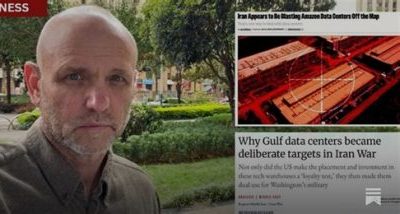
Iran spent $1 million to wipe out $30 billion in data center plans, and take down Amazon in the ME
or go to
Aletho News Archives – Video-Images
From the Archives
What Exactly Was Bin Laden’s Role in 911?
By Tim King | American Herald tribune | March 20, 2017
Osama bin Laden, it’s a name every American knows and loves to hate. After the horrific terrorist attacks on 11 September 2011, former US President George W Bush told his countrymen that this terrorist bin Laden orchestrated the 911 attacks in New York City, Washington DC and Shanksville, Pa. and people believed it. They envisioned his face with a target on it and blamed him for the deaths of thousands of Americans. Why shouldn’t they? No president would lie about something so serious, right?
The real truth may never be known, the Central Intelligence Agency will see to that. But here is what we do know… in the simplest terms: GW Bush told the nation almost immediately that bin Laden was responsible, but Osama bin Laden denied having any involvement in 9/11. Americans are widely familiar with the first part, but almost nobody knows the latter. … continue
Blog Roll
 Aletho News
- Houthis Keep Advancing as the Red Sea Crisis Deepens
- Iran spent $1 million to wipe out $30 billion in data center plans, and take down Amazon in the ME
- Zionist billionaire pressure to silence Macklemore sparks exodus from Ed Sheeran tour
- House Votes to End Iran War for Third Time
- North Korea Slams US Plan for ‘AUKUS 2.0’ with South Korea and Japan
- Prolonging US-Iran Conflict Not Meeting Interests of Int’l Community – China’s Wang Yi
- EU bans former Zelensky aide from parliament
- NATO-backed Kosovo separatist ‘responsible for war crimes’
- US destroying international space law
- SCO Calls for Binding Global Deal to Prevent Arms Race in Space
- If Americans Knew
- U.S. Makes, Israel Takes: The Real Story of U.S.-Israeli Military Cooperation
- Night raids rise in Palestine
- Tucker Carlson interviews Norman Finkelstein about Gaza
- Groups urge Americans to support Van Hollen legislation on Israel’s killing of Americans & Palestinians
- Trump administration plans to send 40,000 tons of bombs to Israel: report
- Sanctions Target Iran’s Government, But Kill Hospitalized 23-Year-Old Woman
- An alternative view on the book “Israel’s Lobby: America in the Grip of a Foreign Power”
- Ed Sheeran’s band Beoga, other opening acts quit tour after Macklemore was dropped over his pro-Palestinian comments
- The assassination attempt on President Trump in Butler and the various Israeli connections to it
- “We Want That the Whole Land Be Jewish”
- No Tricks Zone
- New Study: ‘Global Drought Shows No Detectable Recent Acceleration Under Climate Warming’
- Economic Masterminds: German Socialists Suggest Taxing Productivity Gains Stemming From Using AI
- The South China Sea Has Not Been Cooperating With The Climate Change Narrative
- Energy Crisis: Germany Enters Heating Season With Historically Low Gas Reserve Fill Levels
- New Study: The Antarctic Ice Sheet Gained Mass From 2020-2024 Due To Staggering Snow And Ice Accumulation
- Study: Ocean Heating Rates From Thousands Of Years Ago ‘Dwarf’ Modern Ocean Heating Rates
- Climate Extremists Target, Attack Large-Scale Power Grid Infrastructure In Germany!
- New Study: Antarctic Ice Melt Has Contributed Less Than 1 Centimeter To Sea Level Rise In The Last 30 Years
- Fear Of Debate: Alarmist German Climate Scientist Calls On Mainstream Media To Discredit Skeptic Voices
- End-Of-August Arctic Sea Ice Extent Hasn’t Fallen In 20 Years, Official Data Show!
 Aletho News