Iran sets one-month deadline for end to US-Israeli war, blockade: Report
The Cradle | May 3, 2026
The Islamic Republic has set a one-month deadline for an agreement on the Strait of Hormuz and a full end to the wars on both Iran and Lebanon, sources told US media outlet Axios on 3 May.
Iran “set a one-month deadline for negotiations on a deal to reopen the Strait of Hormuz, end the US naval blockade and permanently end the war in Iran and in Lebanon,” the sources said.
“Per the Iranian proposal, only after such a deal is reached, another month of negotiations would be launched to try and reach a deal on the nuclear program,” they added.
On the same day, the Islamic Revolutionary Guard Corps (IRGC) Intelligence Organization said in a social media post: “Iran sets Pentagon a blockade deadline. China, Russia, Europe shift tone against Washington. Trump’s passive letter to Congress. Acceptance of Iran’s negotiating terms. There is only one way to read this: Trump must choose between ‘an impossible military operation or a bad deal with the Islamic Republic of Iran.’ The room for US decision-making has narrowed.”
Iran had previously proposed setting nuclear issues aside and negotiating a ceasefire and the reopening of the Strait of Hormuz. Trump said on Friday that he was dissatisfied with Tehran’s proposal before saying he would review it on a flight to Miami.
“I’m looking at it. I’ll let you know about it later… They told me about the concept of the deal. They’re going to give me the exact wording now.”
Shortly after the president said he “can’t imagine that it would be acceptable,” adding that Iran “has not yet paid a big enough price for what they have done to Humanity, and the World, over the last 47 years.”
He also said he would resume bombing if Tehran “misbehaves.”
The US president is required to end his war within 60 days or request approval from the US Congress to continue it for another 30 days on grounds of “unavoidable military necessity” for the safety of the military. Trump formally notified Congress of the conflict 48 hours later, making Friday, 1 May, the deadline to request a 30-day extension from Congress or terminate the war.
Trump has claimed the ceasefire has terminated hostilities and that this has rendered the deadline irrelevant and inapplicable. Secretary of Defense Pete Hegseth also claimed that the 60-day clock pauses or stops during a ceasefire.
The US has maintained an illegal blockade on Iranian ports throughout the ceasefire, while also imposing new sanctions. Tehran has repeatedly warned that it may take further military action, following its recent retaliation to the seizure of its vessels by Washington.
According to a report by Israel’s Channel 12, Tel Aviv is “bracing” itself for the collapse of negotiations between Washington and Tehran and the resumption of all-out war against the Islamic Republic.
Axios reported on 29 April that Trump was to be briefed on a series of options for renewed attacks against Iran.
US Central Command (CENTCOM) has readied a “short and powerful” wave of strikes on Iran, “likely including infrastructure targets – in hopes of breaking the negotiating deadlock,” the report claimed.
Tehran has vowed a “crushing response” to any renewed aggression.
At the edge of the Strait: A superpower in a narrow sea
By Mahmood Rehman | Al Mayadeen | May 3, 2026
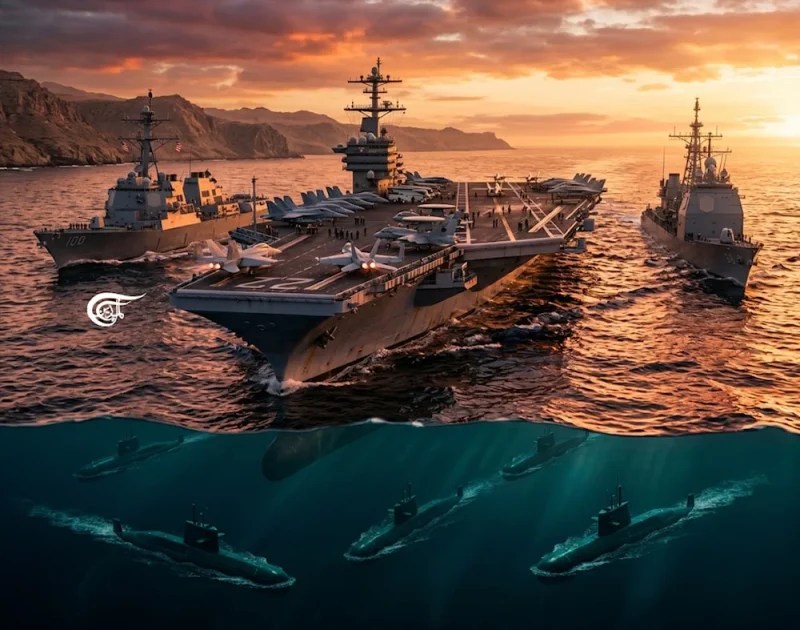
I have spent a good part of my professional life at sea, and I say this without hesitation: there are few waterways in the world as unforgiving, as deceptive, and as strategically consequential as the Strait of Hormuz. It is not just a stretch of water; it is a pressure point of the global economy. When tension rises here, the entire world feels it—from fuel pumps in America to kitchen tables in South Asia.
What we are witnessing today is not merely a regional conflict. It is a strategic impasse in one of the most sensitive maritime corridors on earth. The United States has deployed significant naval power into the region. Carrier strike groups centred around the USS Dwight D. Eisenhower, USS Theodore Roosevelt, and USS Gerald R. Ford are operating alongside cruisers, destroyers, frigates and replenishment tankers. Along with them are nuclear-powered guided missile submarines of the Ohio-class submarine type, carrying formidable strike capability. With over two hundred and fifty aircraft embarked across these platforms, the sheer scale of deployment is impressive by any standard.
Yet, having commanded ships myself, I know that numbers and tonnage do not always translate into control, especially in confined, contested waters.
The stated objective appears straightforward: enforce a maritime blockade of Iranian ports and ensure unhindered passage through the Strait of Hormuz. But here lies the irony. The Strait, by most accounts, was already open before the escalation. What has changed is not the physical state of the waterway, but the political and military environment surrounding it.
Iran’s recent offer has placed Washington in a difficult position. It has indicated willingness to ensure the Strait remains open, on its own terms, provided the United States lifts the blockade and shows flexibility on the timing of nuclear negotiations. Accepting such an offer risks appearing to concede under pressure. Rejecting it prolongs a costly and increasingly unpopular confrontation.
And cost is now becoming the defining factor.
Fuel prices have risen. The ripple effect is visible in everyday commodities. The American public, which never truly supported this war, is beginning to feel the burden directly. Wars fought thousands of miles away eventually find their way into domestic politics, and this one is no exception. The narrative of a swift and decisive operation has long faded. What remains is a grinding reality.
There is also a growing perception (rightly or wrongly) that this was not entirely America’s war to begin with. Many point towards the long-standing position of Benjamin Netanyahu, who has, for decades, articulated a hardline stance against Iran. Previous US administrations, including those led by Barack Obama, Joe Biden, George W. Bush and Bill Clinton, exercised caution in this regard. They understood, perhaps better than most, that Iran is not an easy adversary.
And this is where, in my professional judgement, the conversation must turn towards Iran’s maritime capability, often underestimated, sometimes misunderstood, but very real.
Iran does not seek to match the United States ship for ship. Instead, it has built what we in naval terms would call an asymmetric maritime strategy. Its so-called “mosquito fleet” consists of numerous fast attack craft — small, agile, heavily armed platforms that can swarm larger vessels. Operating from concealed bases along the coastline and from island positions, these units are difficult to detect and even harder to neutralize in large numbers.
Then there are the Ghadir-class submarines, small, quiet, and ideally suited for the shallow waters of the Gulf. These are not platforms designed for long blue-water patrols; they are designed for ambush. In confined waters, that makes all the difference.
Iran unveils new control measures over Strait of Hormuz transit
Al Mayadeen | May 2, 2026
Senior Iranian lawmakers have unveiled a proposed plan to regulate maritime traffic through the Strait of Hormuz, introducing new restrictions on certain vessels and a licensing system that would require ships to obtain authorization from Tehran.
Ali Nikzad, Deputy Speaker of Iran’s parliament, detailed that the initiative includes a 12-point framework aimed at managing transit through one of the world’s most critical oil shipping routes. Under the proposal, vessels linked to “Israel” would be barred from passing through the Strait at all times, while ships from “hostile countries” would be denied transit unless they pay unspecified war reparations.
Nikzad added that all other vessels would be required to operate under a newly established legal framework, obtaining official licenses and authorization from Iranian authorities before entering the waterway. He emphasized that the plan would be implemented “in accordance with international law” and with consideration for the rights of neighboring states, while asserting that Iran would not relinquish what it views as its sovereign rights.
The deputy speaker described the proposed administration of the Strait as comparable in significance to Iran’s historic oil nationalization efforts, signaling the strategic importance Tehran places on the initiative.
Control of the Strait of Hormuz seen as public demand in Iran
Further details were provided by Mohammad Reza Rezaei, head of the Iranian Parliament’s Reconstruction Committee, who outlined how revenues generated under the plan would be allocated. He said that 30% of fees collected from passing vessels would be directed toward strengthening military infrastructure, while the remaining 70% would fund economic development projects and public welfare initiatives.
Rezaei also emphasized the political framing of the proposal, stating that managing the Strait of Hormuz is “more important than obtaining nuclear weapons” and describing control over the waterway as a demand of the Iranian public. He reiterated that Iran would not forgo its right to administer and oversee the Strait.
“Exercising control and administration over the Strait of Hormuz is a demand of the Iranian people, and Iran will not relinquish this right,” he stressed.
War escalation and regional impact
Against the backdrop of escalating regional tensions, the situation in the Strait of Hormuz has escalated following a US-Israeli aggression on Iran, triggering a forceful Iranian response.
The United States has intensified its military and maritime aggression through sanctions enforcement, ship seizures, and a broader blockade targeting Iranian ports and vessels, moves widely viewed by Tehran as unlawful and destabilizing.
In response, Iran has exercised its geographic leverage over the strait to control the maritime traffic, prioritizing vessels not linked to the hostile aggression. The standoff has disrupted one of the world’s most critical energy corridors, through which roughly a fifth of global oil and gas supplies pass, fueling volatility in global markets while limited shipping continues under heightened restrictions.
Trump Taps Israel Lobbyist From Mossad Cutout FDD To Join Iran Negotiations
The Dissident | May 1, 2026
Journalist Alex Marquardt reported recently that , “Amid stalled talks with Iran, President Donald Trump’s negotiators are adding a new member to the team from an outside Washington lobbying group” adding, “Nick Stewart, the Managing Director of Advocacy at FDD Action, the lobbying side of the Foundation for Defense of Democracies think tank, has joined the office of Steve Witkoff, the Special Envoy for Peace Missions”.
This means- as I will demonstrate- that a literal Israel lobbyist is now joining the team negotiating with Iran on behalf of the Trump administration.
The think tank, initially founded by the journalist Clifford May, was initially called “EMET,” the Hebrew word for truth, and was established in order to “provide education to enhance Israel’s image in North America”.
John Judis at the Carnegie Endowment for International Peace documented in 2015 that , “On April 24, 2001, three major pro-Israel donors incorporated an organization called EMET (Hebrew for “truth’). In an application to the Internal Revenue Service for tax-exempt status, (Clifford) May explained that the group ‘was to provide education to enhance Israel’s image in North America and the public’s understanding of issues affecting Israeli-Arab relations.’ But in the wake of the Sept. 11 attacks, May broadened the group’s mission and changed its name to the Foundation for Defense of Democracies. As he explained in a supplement to the IRS, the group’s board of directors decided to focus on ‘develop[ing] educational materials on the eradication of terrorism everywhere in the world.’”
He added that the funding for FDD comes primarily from U.S.-based Zionist donors, writing, “FDD’s chief funders have been drawn almost entirely from American Jews who have a long history of funding pro-Israel organizations. They include Bernard Marcus, the co-founder of Home Depot, whiskey heirs Samuel and Edgar Bronfman, gambling mogul Sheldon Adelson, heiress Lynn Schusterman, Wall Street speculators Michael Steinhardt and Paul Singer, and Leonard Abramson, founder of U.S. Healthcare.”
He also noted that, similar to AIPAC and other Israel lobby groups, the FDD runs propaganda tours of Israel for Americans, noting, “Since its founding, FDD has been running tours of Israel for American academics (with most of their expenses paid) similar to those run for journalists and politicians by AIPAC and other groups. University of Kentucky political scientist Robert Farley, who went on an FDD tour in 2008, says ‘the goal of the trip was to inculcate a particular view of the Israeli security situation and the Israeli-Palestinian conflict.’ FDD’s view, Farley says, was ‘rght-wing Likudnik on the relations between Israel and its neighbors and with the Palestinians.’ The tour leaders took a ‘negative’ view of Palestinian statehood. ‘It was understood that the military occupation of the West Bank was necessary to prevent a terrorist campaign against Israel.’”
Al Jazeera’s 2018 documentary on the Israel lobby further exposed that FDD “is functioning as an agent of the Israeli government”.
Sima Vaknin-Gil, a former Israeli intelligence official and official in the Israeli Ministry of Strategic Affairs, admitted in the documentary that “We have FDD,” adding that “the foundation is ‘working on’ projects for Israel, including ‘data gathering, information analysis, working on activist organizations, money trail. This is something that only a country, with its resources, can do the best.’”
By putting a lobbyist for Israel from a “think tank” that is in reality a cover for an Israeli intelligence cutout, the Trump administration is guaranteeing that Israel will be driving the American side during negotiations with Iran.
Trump’s Blockade Snatches Defeat from the Jaws of Victory
By Trita Parsi | May 1, 2026
It appears Donald Trump once again snatched defeat from the jaws of victory by heeding the hawkish counsel of the warmongers at the Foundation for Defense of Democracies.
As I have argued before, the fragile ceasefire disproportionately favored the United States over Iran: Trump secured his central objective — a swift exit from a costly war — while Iran forfeited its primary source of leverage, namely the inflationary pressure of elevated oil prices. Tehran, by contrast, remained unable to achieve its core objective — meaningful sanctions relief — without entering a difficult diplomatic process with Washington.
The asymmetry was stark: Trump could afford strategic patience, whereas Iran risked squandering the most consequential gains the conflict could have yielded if negotiations faltered or collapsed.
In short, this emerging status quo could have constituted a quiet but decisive victory for Trump. Yes, Iran would retain control over the strategically vital Strait of Hormuz — but it does so today as well and would do so in almost any scenario. But the status quo would have seen oil prices drop as the Iranians would allow tankers to transit in order to collect fees. And as long as oil prices came down, Trump’s position at home and vis-à-vis Iran would have strengthened.
FDD argued that blockading the Persian Gulf would swiftly cripple the Iranian economy and coerce Tehran into capitulation, allowing Trump to achieve through economic strangulation what he had failed to secure through military force. In short, it was sold to him as a silver bullet. More on that later.
According to this logic, the blockade would “effectively zero out” Iran’s export revenues within days, inflicting losses of nearly $500 million per day. With oil exports halted, Iran’s limited storage capacity would be filled within weeks, forcing the costly and technically damaging shutdown of its oil wells. This, FDD claimed, would dramatically reverse the strategic balance — transforming the Strait of Hormuz from a perceived Iranian asset into a crippling Achilles’ heel, while handing Washington the invaluable advantage of time. Pressure on Iran would escalate sharply while pressure on the United States would rapidly dissipate.
Trump was fully on board. His long-sought subjugation of Iran suddenly appeared tantalizingly within reach. “The blockade is genius,” the president told reporters. “Now, they have to cry uncle; that’s all they have to do. Just say, ‘We give up.’” (Notably, an FDD staffer has reportedly since joined Steve Witkoff’s team.)
Predictably, the opposite occurred. FDD’s confident calculations and tidy logic were, as so often, rooted more in wishful thinking than in hard reality. By its own projections, Iran should have exhausted its storage capacity nearly a week ago. Yet satellite imagery shows Tehran still actively loading oil onto tankers at Kharg Island. While the blockade has undeniably increased economic pressure, there is no sign of the acute storage crisis — or the cascading collapse — FDD confidently promised Trump.
But by targeting Iran’s oil exports, Trump did more than complicate an already fragile diplomatic pathway — he tightened global supply and drove prices upward. In fact, thanks to the blockade, oil prices now exceed the levels seen during the war itself.
Exxon’s CEO told shareholders today that gasoline prices are poised to rise even further, noting that “the market hasn’t seen the full impact of [the Iran conflict] yet.” Meanwhile, Joe Kent, Trump’s former director of the National Counterterrorism Center, cautions that “the blockade is now triggering a global fertilizer shortage that will cause major food security crises and potential famines.”
In short: the desperately needed pressure release Trump secured through the ceasefire has been entirely undone by FDD’s vaunted silver-bullet blockade.
The lure of the silver bullet
There is a pathology in U.S. policy on Iran that transcends administrations and party affiliations: The incessant search for an escalatory silver bullet that brings Iran to its knees, forces it to capitulate, and enables the U.S. to assert its superpower dominance and avoid a compromise with the Islamic Republic.
Across 47 years, the hunt for this fabled silver bullet has echoed on — yet nothing answers back. Countless diplomatic opportunities have been sacrificed, and face-saving exit ramps have been burnt in the process. Yet, the quest continues.
The demand for Iranian capitulation and the enduring faith in elusive silver bullets are deeply intertwined. In January, Trump believed that the mere threat of military force would compel Tehran to surrender. After issuing a series of increasingly explicit warnings that Iran pointedly ignored, he proposed a calibrated strike — one to which Tehran should respond symbolically by targeting an empty American base. Iran refused outright, making clear that any attack would trigger a full-scale war.
Interpreting this defiance as a failure of credibility rather than a rejection of coercion, Trump escalated. He ordered a substantial buildup of military assets in the region, convinced that a critical mass of force would finally deliver the decisive breakthrough — the long-sought silver bullet. It didn’t.
Indeed, Witkoff revealed in an interview that Trump was frustrated that, despite his military threats, Iran had still not “capitulated.”
Clearly, more escalation was needed. The next imagined silver bullet was the assassination of Iran’s Supreme Leader, Ayatollah Ali Khamenei. Midway through the war, a GCC official told me that Trump had assured regional leaders the conflict would last no more than 100 hours. Israeli media similarly reported that he told Britain’s Keir Starmer it would be over within three days. The logic was stark: the killing of Khamenei would trigger either the regime’s rapid implosion or its immediate capitulation. It proved to be yet another illusory silver bullet.
Nor did the sweeping bombardment of Iran’s civilian infrastructure deliver the long-sought breakthrough. A Bloomberg analysis found that only 32% of the damaged buildings were linked to military targets — the overwhelming majority were civilian. Even this devastating and indiscriminate campaign failed to produce the decisive outcome its architects had promised.
The blockade-on-the-blockade is merely the latest in a long line of delusional silver bullets that American presidents have chased instead of pursuing far less costly and far more effective diplomacy. I suspect that a stunning number of those silver bullets were cooked up by FDD.
Trita Parsi is the co-founder and Executive Vice president of the Quincy Institute for Responsible Statecraft.
Geopolitics and Geoeconomics of the Strait of Hormuz
Sputnik – 02.05.2026
The reckless reliance on a blitzkrieg to eliminate Iran’s political and military leadership has left Israel and the United States in an extremely precarious situation, where Tehran’s key trump card in the conflict turned out to be control over the Strait of Hormuz.
Alexander Yakovenko, deputy director of Sputnik’s parent company Rossiya Segodnya and head of the Committee on Global Issues and International Security of the Russian Security Council’s Scientific-Expert Board, has addressed the standoff around the Strait of Hormuz.
Analysts in Israel are already writing of a complete failure, with the prospect of “returning to the issue” sometime in the future. Judging by published reports, everything was planned for June this year, but, as the saying goes, the devil intervened, and Benjamin Netanyahu succumbed to the temptation of a final solution through “regime change.” The scapegoats will be the Mossad division responsible for Iran and the military command responsible for Lebanon.
Donald Trump faces a far more difficult predicament: he has been drawn into a war that is neither his own nor in America’s interest. But the main issue is that the Strait of Hormuz problem now rests squarely on his shoulders. Aside from acceding to all of Iran’s demands, there appear to be no viable options for resolving the blockade – including the resumption of military action, which, according to observers, would have catastrophic consequences for the region, the global economy, and the Trump administration.
In terms of the Persian Gulf and the greater Middle East, a complete geopolitical reconfiguration has taken place, including a shift in Turkiye’s role (it was Ankara that effectively killed the plans to bring Iraqi Kurds into the “march on Tehran,” which was intended to bolster the confidence of those whom Israeli intelligence believed were ready to take to the streets of Iranian cities).
The destruction of the region’s extraction and logistics infrastructure prompted the UAE to withdraw from OPEC and OPEC+, which will only intensify Abu Dhabi’s contradictions with Riyadh and accelerate the political realignment of smaller players toward Ankara, Saudi Arabia, or Iran.
Iran’s agency has grown qualitatively: from a pariah state burdened by sanctions, Iran has genuinely become a regional power (in contrast to Netanyahu’s claim that Israel is a regional power and “in some ways even a global one”). Everything now depends on Iran – a fact understood by those at the helm in Tehran, namely, by general consensus, the Islamic Revolutionary Guard Corps (IRGC). And all this is aside from the most pressing issue on the regional agenda: the restoration of extraction and logistics infrastructure, especially given that the damage has a cumulative effect – in other words, “time is money.”
Russia, Pakistan, and China have become even more deeply involved in the affairs of the region, while the United States has demonstrated its inability to provide military protection for its allies. In other words, the role of external players has grown, whereas control over the region had been in American hands since the Baghdad Pact at the beginning of the Cold War. Now it can be said that the entire institutional structure in the region is collapsing – even in the OPEC format – and the region is opening up to an entirely new architecture.
In terms of geoeconomics, Tehran now holds a powerful lever of influence over the global economy and world trade through its control over the Strait of Hormuz. Moreover, this is not only direct control but also the ability to destabilize the situation around the Strait at any point in the future, regardless of any agreements that might be reached regarding its possible reopening as part of a ceasefire. In other words, everyone understands that things will never return to how they were before.
The only thing that matters for the global economy and the international financial system – including the dollar’s linkage to oil trade – is the stability of commercial traffic through the Strait. With no indication of it being reopened, the world is losing between 8 and 15 million barrels of oil and petroleum products per day, as well as up to 20% of global LNG supplies. This also includes a range of industrial goods in the petrochemical sector and derivatives for the agricultural sector. Experts expect a monthly shortfall of 300 million barrels, which amounts to three-quarters of the released strategic reserves of developed countries. Moreover, by early May, both strategic reserves and the advantages of unlocking Russian and Iranian oil, along with the balancing buffer of floating storage, will be nearly exhausted. In short, in every respect, a moment of truth is approaching in a conflict that is difficult to restart now that military action has been paused.
Not only have the United States and Israel handed Iran, on a silver platter, escalation dominance in the conflict – the ability to manage escalation if Washington and Tel Aviv launch another round – but Tehran will also gain additional revenue from selling its 1.5 million barrels of oil per day, which economists estimate at 2–3 billion per month, or 24–36 billion per year. Essentially, even without the unfreezing of Iranian assets in Western countries, Iran will have the resources to rebuild what has been destroyed. To this should be added the fees collected from commercial vessels transiting the Strait of Hormuz.
It is also worth noting a direct geopolitical consequence of the Iranian conflict: the discord within the Western alliance along the line of Trump’s America versus liberal-globalist Europe. The recent visit of the British monarch to the United States, during which he called in his address to Congress for the collective “defense of Ukraine” invoking Article 5 of the Washington Treaty (despite the fact that Kiev is not a NATO member), indicates that the lack of allied support for the Iranian adventure is a clear appeal to restore Western unity specifically on an anti-Russian basis – everything else is secondary. In Europe, they no longer hide the fact that they intend to “wait out” Trump, if that is what it takes, but under no circumstances will they agree to a settlement of the Ukrainian conflict.
As such, it is not denied that Ukraine is merely the opening move in yet another war of the West against Russia, and that Western elites are determined to make it a decisive, final confrontation of a civilizational nature. This presents an interesting situation for Russia, which could be resolved one way or another very soon. If Russia participated in two world wars, in which, albeit in different ways, relations between groups of Western countries were contested, and in the Cold War we faced a united West, then now we see a disunited West, weakened militarily and in terms of domestic political development. Its consolidation is only possible at our expense.
Charles III quite opportunely mentioned the burning of the White House by the British in 1814, as it reminds us – and perhaps Washington – of positive moments in our shared history, including Russia’s support for the American Revolution and the Union side in the Civil War. The decision rests with the Americans, but it is curious how the Middle East references an era before the ideologization of international relations in the 20th Century.
Iran Blockade Complications /Lt Col Daniel Davis & Nima Alkhorshid
Daniel Davis / Deep Dive – May 1, 2026
Minab children massacre not ‘unfortunate situation’ but ‘heinous war crime’: Tehran
Press TV – May 1, 2026
Iran’s Foreign Ministry spokesman has condemned the US war secretary’s attempt to portray the massacre of children in Minab as an “unfortunate incident,” reiterating that the missile strike was “a heinous war crime.”
During hours of tense testimony before Congress on Wednesday, Pete Hegseth described the deadly strike on Shajareh Tayyebeh Elementary School in Iran’s southern city of Minab as an “unfortunate incident,” which according to him remains under investigation.
On the first day of the US-Israeli aggression against Iran on February 28, US Tomahawk missiles struck the school, killing 168 people, most of them children.
In a post on X on Friday, Esmaeil Baghaei said that the attack “was not an ‘unfortunate situation.’ It was a premeditated, heinous war crime.”
Baghaei shared a video of Representative Ro Khanna questioning Hegseth about the cost to American taxpayers “in terms of the strike on the Iranian school where kids were killed, in terms of the missiles we used.”
“To put it plainly,” Baghaei said, “how much did it cost American taxpayers for their secretary of defense to direct the deliberate killing of innocent schoolchildren and their teachers?”
The spokesman added that those responsible for the crime “must be held fully accountable and brought to justice.”
In an address to the UN Human Rights Council in late March, Iran’s Foreign Minister Abbas Araghchi described the incident as “the tip of the iceberg” of systematic violations committed with impunity by the United States and Israel.
The two enemies launched a large-scale, unprovoked war against Iran, assassinating the Leader of the Islamic Revolution, Ayatollah Seyyed Ali Khamenei, and a host of senior commanders while indirect negotiations were underway between Tehran and Washington regarding Iran’s peaceful nuclear program.
Subsequent terrorist strikes on civilian targets have so far killed more than 3,300 people, including children.
Iran can thrive under blockade, the US and its allies cannot
By Robert Inlakesh | Al Mayadeen | May 1, 2026
While officials of the US Trump administration have repeatedly claimed that their blockade on Iran’s blockade of the Strait of Hormuz is a winning strategy, on the contrary, Tehran thrives. Instead of taking the temporary ceasefire as an opportunity to find a viable offramp, Washington has used mental gymnastics to sell the public on a non-existent get out of jail free card.
US Treasury Secretary Scott Bessent has claimed that Iran’s oil industry is creaking under the pressure of the blockade imposed upon its exports, even making rather outlandish comments about the inevitability of oil infrastructure blowing up as a result. While the US seizure of Iran-linked tankers and vessels does evidently have an impact, it is being enormously overblown by an American administration that is out of viable options.
The way US President Donald Trump and his senior officials are speaking, it would lead you to believe that the “uno reverse card,” as it has been mockingly referred to, was going to lead to the freefall of Tehran’s economy. Yet, the US is still adding more sanctions to Iran, attempting to seize and/or freeze more of its assets, while issuing round-the-clock threats. If the US-imposed blockade, which is failing to block all shipping to and from Iran, were so effective, then these other much lesser measures wouldn’t make sense.
Even the pro-war Zionist think tanks, like the Foundation for Defense of Democracies (FDD), have been agitating for more aggressive tactics and to escalate. For example, the Washington-based FDD recently published a Policy Brief article entitled ‘Trump Strikes at China’s Iranian Oil Trade, but It’s Not Enough’. In other words, nobody is convinced by Trump’s strategies, not even the biggest fans of the Iran war.
In the realm of reality, the Islamic Republic of Iran has survived under US sanctions for some 47 years now. Although the sanctions have had varying impacts at different phases of the ongoing conflict with the US, Iran has managed to adapt to its predicament. It survived through 8 years of brutal war with its neighbours, after former Iraqi President Saddam Hussein attacked it for the sake of the United States, and has endured the most brutal sanctions campaigns known to man.
What the US has done over the years is make Iran de facto sanctions-immune. This does not mean that they don’t work at all; clearly, the Iranian economy has taken enormous hits, and the civilian population has borne the brunt of the consequences. But the takeaway here is that the Islamic Republic is not going to buckle in a matter of weeks or months, just because the US is interdicting the passage of some Iranian vessels.
As a matter of record, back in 2018, when President Trump first imposed his maximum pressure campaign – following the decision to unilaterally pull out of the 2015 nuclear deal – the daily Iranian oil exports rapidly declined to 350,000 barrels per day. It remained this way for some 33 months, until Tehran managed to recover. The recovery led Iran back to exporting around 2.5 million barrels per day. Amidst the height of the first round of the current war, Iran even managed to break records for oil revenues generated, not seen since the triumph of the Islamic Revolution in 1979.
In addition to this, the Iranians have established a status quo under which they will not allow the Strait of Hormuz to be transited unless a toll is paid to them first; a move that has not only placed the key global chokepoint under their control, but will inevitably drive enormous profits in the long run.
Iran did not buckle under years of maximum pressure sanctions and the steep decline in their oil exports. Its Gulf neighbours will not fare so well. The damage done to US allies, like the United Arab Emirates (UAE), has already surpassed what is necessary to cause permanent damage. Emirati officials may have even doubled down on their support for the Zionist project and to see Iran destroyed, withdrawing from OPEC, and claiming they will use alternative export routes, but everyone knows those options simply do not exist.
In the end, it was always going to boil down to the US buckling under the weight of an economic fallout, due to the total closure of the Strait of Hormuz, a pressure that only grew worse following Trump’s goofy decision to impose his own blockade.
Therefore, the embarrassing failure of the Trump administration was only ever going to lead to one of two outcomes: a full US backdown or the resumption of war.
Iran slams US leadership, debunking fabrications, false war costs
Al Mayadeen | May 1, 2026
Iranian officials criticized the United States over its leadership and its justification for the US-Israeli war on Iran, debunking Washington’s fabrications and scrutinizing its political coherence and legal rationale.
In reference to the reported cost of the US-Israeli war on Iran, estimated at 25 billion dollars by the US Department of War, Iranian Foreign Minister Abbas Araghchi maintained that “the Pentagon is lying.”
In a post on X, Araghchi asserted that “Netanyahu’s gamble cost America $100b so far, four times what is claimed.”
He further noted that “indirect costs for U.S. taxpayers are FAR higher. Monthly bill for each American household is $500 and rising fast.”
“Israel First always means America Last,” he assertively concluded.
Trump’s contradictions reveal US decision-making made elsewhere
Mohsen Rezaei, a member of Iran’s Expediency Discernment Council, said, also took a swing at the “America first” slogan, asserting that “the contradictory statements of Trump show that real decisions in US are being made somewhere else.”
In a post on X, he argued that key decisions in Washington were being shaped by “behind-the-scenes power networks” that do not align with the “America First” slogan associated with Trump and MAGA.
Rezaei added that this demonstrates “the kind of deadlock America is facing,” emphasizing that Americans “are the ones paying the price.”
‘Self-defense’ against what?: Baghaei
Separately, Iranian Foreign Ministry spokesperson Esmail Baghaei rejected US claims that the US-Israeli war on Iran was launched in “self-defense”.
In a post on X responding to a US claim that the war was launched “at the request of and in the collective self-defense of its Israeli ally,” he questioned the legal basis for such claims, asking, “Was there any ‘armed attack’ by Iran to justify ‘self defense’?”
Baghaei rejected the claim by Washington, emphasizing that the war was “an act of AGGRESSION against the nation of Iran.”
Here’s why Iran is sovereign and Germany is not
By Tarik Cyril Amar | RT | May 1, 2026
Sovereignty, as defined in international law, is both crucial and complex. In the real shark-pool world of geopolitics, it is not hard to spot: if you have the ability to rule at home and resist attack from outside (any outside), then you are sovereign. Otherwise not. No exceptions.
That’s why Iran has sovereignty, but Germany does not. Iran has withstood two months of a devious and brutal war of aggression waged by the US and Israel, which in turn is “merely” the culmination of decades of assaults levied via economic warfare, assassination campaigns, and subversion.
However, Iran has not only successfully foiled the current Israeli-American blitzkrieg-and-regime-change scenario, but also put the attackers on the backfoot. Tehran’s achievement is already historic. It has changed and will change the course of history.
Germany, by contrast, cannot even defend its own vital infrastructure, as the Nord Stream sabotage and its aftermath have demonstrated. What is even worse, its governments have had no will to do so. On the contrary, they have been rewarding the Ukrainian attackers with untold billions to feed Kiev’s ultra-corruption. Their backers – certainly including the US and Poland, and most likely Great Britain, too – need not worry about any trouble from Berlin either.
Case closed: Iran is sovereign, Germany is not. If you are German and find this uncomfortable, complain to Berlin.
Against this backdrop, it is oddly fitting that it is Iran which is now exerting a powerful influence on German politics despite not having any deliberate designs to do so, whereas German calls on Tehran (or, for that matter, Moscow or Beijing) to do this and leave that – as articulated by Foreign Minister Johann Wadephul with an almost comical lack of self-awareness – come across as embarrassing: sad spectacles of an impotence that doesn’t even know itself.
Iran, on the other hand, has now had a palpable impact on what unfortunately remains Germany’s single most important foreign-policy relationship. Indeed, as the current, post-1990 “unification” (really, expansion, and that’s still a polite term) Germany is really the old Cold War West Germany writ large (and going to seeds, too), the relationship with the US is more than just important. Historically, it was literally foundational.
And here we are: It is due to Iran’s resistance that this relationship has entered a deep crisis. Of course, other factors have played (or should have played) a role as well: for instance, Washington’s ferocious, bipartisan economic warfare against its old key client (polite term) in Europe, including at least complicity in destroying vital energy infrastructure and supply options (Biden, Democrats) via massive incentives for German industry to relocate to the US (Biden, Democrats) to devastation by tariffs (Trump, Republicans).
But it is over Iran that things have now come to a head: German Chancellor Friedrich Merz has openly criticized Washington’s conduct of the war, and US President Donald Trump has launched one of his social media rampages, going after Merz and Germany with, as Secretary of War (Crimes) Pete Hegseth would put it, “no quarter” given.
Trump has even threatened, in effect, to withdraw the almost 40,000 US troops from Germany. It would be stupid and self-damaging for the US to do so, but then, this is the Trump administration. Full disclosure: As a German, I hope they go ahead.
Trump has also told Merz off for wanting Iran to have a nuclear weapon (false on two counts: Iran isn’t building one, and Merz is a compliant client leader who would never dare dissent from the US and Israel) and for being bad at running Germany, which must rankle, because most Germans agree. Merz has just earned himself the worst poll ratings of any German chancellor ever.
He has made things even worse – yes, Merz can do that – by releasing an exceedingly masochistically timed interview to complain that, in essence, no one likes him. True, but saying so has only triggered a national tsunami of mockery: now he is not only vastly unpopular but derided as a wimp, who loves to dish out harsh admonishments and mean austerity but can’t take the response.
A short video clip deep-faking Merz performing a satire of MC Hammer’s classic “You can’t touch this” by singing “No one likes me” is going viral. At a town hall-style meeting, the chancellor was openly laughed at. Major mainstream media are beginning to talk about a crisis deep enough to end the current government and, even worse for Merz, about rebellious murmurs inside his own CDU party.
All of this because Merz was making remarks about the Iran War. But make no mistake: Friedrich Merz, still infamous for applauding Israeli “dirty work” (“Drecksarbeit”) in Iran last summer, has not discovered a conscience. Listen attentively to his recent statements, made before a group of high school kids, and you realize, the chancellor’s real beef with America is that Washington hasn’t done its current “dirty work” quickly and, above all, successfully. No one loves a loser, not even, it turns out, Friedrich Merz, whose prior obsequiousness toward Trump had raised eyebrows even in Germany.
Yet whatever Merz’s sordid motives, take a step back and look at this picture from the point of view of history-in-the-making: Here is the German chancellor, who claims to be ready to make his country lead Europe (yes, not a great idea, but let that pass for now), whose government is presiding over the greatest German debt-and-armament splurge since World War Two (and that against a background of profound economic crisis), and he is stumbling over Iran. So much for the rise of multipolarity and the decline of Europe.
Not because that was Tehran’s aim. As a matter of fact, the Iranian leadership probably has very little time to think about Berlin – except noting for the future that, in practical terms, it is serving as a loyal accomplice in the American-Israeli war of aggression. No, the reason Iran now impacts and shakes the American-German relationship is that Tehran has been defeating the US, and so the client state Germany is registering the public “humiliation” of America (Merz’s term) by showing immediate signs of faltering compliance.
Who in this picture is reshaping things? And who is being shaped? Here’s another way to define sovereignty. And Germany still loses.
Tarik Cyril Amar is a historian from Germany working at Koç University, Istanbul, on Russia, Ukraine, and Eastern Europe, the history of World War II, the cultural Cold War, and the politics of memory.
Larry Johnson: U.S. Desperation Grows as Iran Is Winning
Glenn Diesen | April 30, 2026
Trump and Putin speak for 90 minutes as Russia offers its support to Iran, while the US is growing desperate as the war and economic war fail. Johnson is a former CIA intelligence analyst who also worked at the U.S. State Department’s Office of Counterterrorism.
Read Larry Johnson’s Sonar21: https://sonar21.com/
Follow Prof. Glenn Diesen:
- Substack: https://glenndiesen.substack.com/
- X/Twitter: https://x.com/Glenn_Diesen
- Patreon: https://www.patreon.com/glenndiesen
Support the research by Prof. Glenn Diesen:
- PayPal: https://www.paypal.com/paypalme/glenndiesen
- Buy me a Coffee: buymeacoffee.com/gdieseng
- Go Fund Me: https://gofund.me/09ea012f
Featured Video
Iran spent $1 million to wipe out $30 billion in data center plans, and take down Amazon in the ME
or go to
Aletho News Archives – Video-Images
From the Archives
What Exactly Was Bin Laden’s Role in 911?
By Tim King | American Herald tribune | March 20, 2017
Osama bin Laden, it’s a name every American knows and loves to hate. After the horrific terrorist attacks on 11 September 2011, former US President George W Bush told his countrymen that this terrorist bin Laden orchestrated the 911 attacks in New York City, Washington DC and Shanksville, Pa. and people believed it. They envisioned his face with a target on it and blamed him for the deaths of thousands of Americans. Why shouldn’t they? No president would lie about something so serious, right?
The real truth may never be known, the Central Intelligence Agency will see to that. But here is what we do know… in the simplest terms: GW Bush told the nation almost immediately that bin Laden was responsible, but Osama bin Laden denied having any involvement in 9/11. Americans are widely familiar with the first part, but almost nobody knows the latter. … continue
Blog Roll
 Aletho News
- Houthis Keep Advancing as the Red Sea Crisis Deepens
- Iran spent $1 million to wipe out $30 billion in data center plans, and take down Amazon in the ME
- Zionist billionaire pressure to silence Macklemore sparks exodus from Ed Sheeran tour
- House Votes to End Iran War for Third Time
- North Korea Slams US Plan for ‘AUKUS 2.0’ with South Korea and Japan
- Prolonging US-Iran Conflict Not Meeting Interests of Int’l Community – China’s Wang Yi
- EU bans former Zelensky aide from parliament
- NATO-backed Kosovo separatist ‘responsible for war crimes’
- US destroying international space law
- SCO Calls for Binding Global Deal to Prevent Arms Race in Space
- If Americans Knew
- U.S. Makes, Israel Takes: The Real Story of U.S.-Israeli Military Cooperation
- Night raids rise in Palestine
- Tucker Carlson interviews Norman Finkelstein about Gaza
- Groups urge Americans to support Van Hollen legislation on Israel’s killing of Americans & Palestinians
- Trump administration plans to send 40,000 tons of bombs to Israel: report
- Sanctions Target Iran’s Government, But Kill Hospitalized 23-Year-Old Woman
- An alternative view on the book “Israel’s Lobby: America in the Grip of a Foreign Power”
- Ed Sheeran’s band Beoga, other opening acts quit tour after Macklemore was dropped over his pro-Palestinian comments
- The assassination attempt on President Trump in Butler and the various Israeli connections to it
- “We Want That the Whole Land Be Jewish”
- No Tricks Zone
- New Study: ‘Global Drought Shows No Detectable Recent Acceleration Under Climate Warming’
- Economic Masterminds: German Socialists Suggest Taxing Productivity Gains Stemming From Using AI
- The South China Sea Has Not Been Cooperating With The Climate Change Narrative
- Energy Crisis: Germany Enters Heating Season With Historically Low Gas Reserve Fill Levels
- New Study: The Antarctic Ice Sheet Gained Mass From 2020-2024 Due To Staggering Snow And Ice Accumulation
- Study: Ocean Heating Rates From Thousands Of Years Ago ‘Dwarf’ Modern Ocean Heating Rates
- Climate Extremists Target, Attack Large-Scale Power Grid Infrastructure In Germany!
- New Study: Antarctic Ice Melt Has Contributed Less Than 1 Centimeter To Sea Level Rise In The Last 30 Years
- Fear Of Debate: Alarmist German Climate Scientist Calls On Mainstream Media To Discredit Skeptic Voices
- End-Of-August Arctic Sea Ice Extent Hasn’t Fallen In 20 Years, Official Data Show!
 Aletho News