Wheels Down in Tbilisi: Was a Routine U.S. Military Stopover a Deliberate Signal to Iran?
By Seth Ferris – New Eastern Outlook – May 5, 2026
A brief and poorly explained landing of a U.S. military transport aircraft in Tbilisi at the end of March 2026 has become a subject of discussion and speculation about its real significance, fueling suspicions that more complex geopolitical signals may lie behind the official explanation of a “routine flight.”
Let’s pull apart the “routine flight” narrative and read between the lines, asking whether a fleeting stopover was less about logistics and more about sending a message — one that Georgia may end up paying for. If you think geopolitics is all press releases and polite diplomacy, think again. I would suggest that what is going on in the shadows, outside of mainstream coverage, is closer to theater — with Georgia cast in a role it never auditioned for.
Start with the headlines: last month, a US Air Force cargo aircraft made a brief stop in Tbilisi, purpose unknown – and just start reverse engineering, taking it apart, and you come up with what is between the lines as to the possible motivations for the US, a strategic ally of Georgia, to be willing to put Iran, its regional partner, in harm’s way. Moreover, it is interesting to know the news sites where this news first appeared, such as Georgian Today, and its history of paid hired gun articles supporting US policy in the region.
It is not as if Georgia and the US do not know that now is not the most opportune time to be perceived as supporting the illegal American-Israeli war against Iran. And let’s not forget C-130 Turkish Cargo Planes falling out of blue Georgian skies. Providing logistic support in a preempted war of aggression is still a recognized crime under the Nuremberg Codex. That puts the provider of such support in the crosshairs of the party being attacked, as has already been demonstrated by Iranian countermeasures, not to mention ‘protective reaction’ strikes in the Gulf States and Jordan.
What do we know?
A United States Air Force military transport aircraft made a short, unexplained landing in Tbilisi the last week of March, prompting questions and speculations but little official detail about its actual mission. However, multiple reports published on April 1, 2026, said a Boeing C-17 Globemaster III landed at Tbilisi International Airport in the afternoon after departing from the U.S. military hub at Ramstein Air Base in Germany.
It is interesting that the US Embassy provided a ‘most vague’ news release after the incident, telling of a phone call between Secretary of State Marco Rubio and Georgia Prime Minister Irakli Kobakhidze the very next day.
Also vague is the lack of coverage of planes without tail numbers landing at regional airports, such as the one named in honour of the Soviet-Georgian movie “Mimino” in Telavi, East Georgia, supposedly owned by the Aviation University of Georgia. It has operated since 2012 and serves as a training ground for students in the Faculty of Aviation and Engineering.
But it can serve other purposes, as the airport hosts an aircraft technical service enterprise, a navigation tower, a terminal building for passengers, and dormitories for pilot-instructors and engineering-technical staff.
Recent sightings, including of European-looking visitors to the facility, appear a bit too dodgy in terms of standard news release material about a local use and training facility after the landing of the military transport and drones spotted over Georgia – too short and sweet not to be subterfuge.
The U.S. Embassy characterized some flight movement as routine, stating that such flights are “regularly carried out in coordination with partners,” without providing details about cargo, passengers, or final destination.
Flight tracking platforms such as Flightradar24 confirm that C-17 aircraft frequently operate across Europe and the Middle East, typically transporting personnel, equipment, or humanitarian supplies, though specific mission details are not publicly disclosed.
But I am more interested in what was on board, delivering or taking out human cargo! This brings back memories of a Turkish military transport, a C-130. Dropping from the clear blue sky a few months ago, including its crew, all died, and the debris was scattered over a wide area of Georgian territory. The forensic findings of that crash investigation have never been publicly shared to the best of my knowledge.
Wheels Down!
Would the Georgian government, especially now, be so naive as to agree to this touchdown, an unexpected one at that—and of a US military transport plane out of the blue in the middle of a shooting war in the Middle East?
Already there is political blowback. Georgia political analyst Gia Khukhashvili reportedly said that Rubio’s phone call was a “threatening warning”.
Perhaps Rubio was checking how ready Georgia was, and in what form [to what degree] it was ready to help solve America’s logistical problems… I don’t think there have already been any concrete proposals at this stage. But this was logically followed by a threatening warning (for Georgia) from the Iranian ambassador: “Don’t do anything wrong, otherwise you will also become a target,” the Georgian News portal quotes the political scientist.
Gia Khukhashvili believes that there will be no Georgian-American agreements, because “Washington will understand who it is dealing with … and how the Georgian PM Kobakhidze will later say that Rubio threatened him on the phone and demanded to open a second front,” confirmed the Georgian political pundit.
Posting News to Provoke Iran!
Who knows the real motivations and how the news was reported? As one close, trusted Georgian source shared, … just that they post this news to make Iran angry! The UNM, United National Movement, former Saakashvili regime, wants it so VERY much!
Why didn’t they use Turkish or Armenian bases?
That is a good question, and I think you already know the answer. The US wanted to show Iran that Georgia and the US are cooperating, so it provoked Iran to send a drone or make some attack, as Israel has ordered the US to do.
It should be noted that Armenia has a Russian base, and the plane is claimed to have flown over some Armenian and Turkish territory, perhaps touching down in the Kurdish-controlled region of Northern Iraq. It would have been too dangerous to land in Armenia, as secrets could be revealed, and as for Turkey, it shares a similar position as Georgia, it does not want to get involved, or give the impression of being involved, especially since the Americans are openly arming regional Kurds. It can be expected that a substantial part of this ratline is flowing into and through Turkish territory.
I still can’t find any serious discussion on the plane and its real purpose for making a short stopover in Georgia. It appears that the US and Israel would love to put Georgia in the crosshairs of Iran just for the hell of it. It is also interesting that strikes have been carried out by Israel on joint Russian-Iranian port facilities on the Caspian, in the part on the Iranian side.
Possible Motivations for Wheels Down and Vague News Coverage
My first thought was delivering something to put in place for Iran. But if it went to Turkish airspace, it could also be headed to eastern Turkey or Iraq. Or one of the NATO bases in Turkey, although I’m pretty sure those are in the west, and we would not be in the flight path. In any case, if it is at all related to the war, then more EU countries are banning the use of the bases in their countries, so if a plane needs to stop somewhere or refuel, it could be done here. Georgia still wants to stay on good terms with the US, so if it is a brief stop, they would probably allow it. Not much will happen. If the use looks more like staging, it could be dangerous. Moreover, they could use Vaziani. I think NATO supported development of an air base there (which the government now wants to use for a new commercial mega-airport). But there isn’t much of an air force here, so maybe Vaziani lacks fuel in any quantity and other amenities. The motivation was perhaps to deliver some radar equipment, greenbacks, spyware equipment, or perhaps human resources, thinking that Iran will not attack Georgia since it needs it too much as its window to the world.
We’ll have to see; just a thought on it!
In the end, a half-hour touchdown, a vague press release statement, and a conveniently timed diplomatic call say more than any official briefing ever will. Whether it was cargo, coordination, or quiet signaling, the message landed louder than the aircraft itself: Georgia is being watched, tested, and potentially positioned in a conflict it has no desire to join.
And if this was meant as a signal to Iran, then it’s a risky one—because in today’s climate, even a brief stop can turn a bystander into a target. A fleeting military stopover can transform neutral ground into perceived staging areas, risking Iranian retaliation against a nation determined to remain on the sidelines. Sparse public facts and local sources reveal the shadowy interplay of great-power signaling, where a half-hour touchdown may speak louder than any formal briefing—placing Georgia uncomfortably in the crosshairs of a war it wants no part of.
Seth Ferris is an investigative journalist and political scientist, expert on Middle Eastern affairs.
Follow new articles on our Telegram channel
Trump’s second strike on Iran would be suicidal. But that’s not the reason why he won’t go ahead with it
By Martin Jay | Strategic Culture Foundation | May 4, 2026
Trump has been presented with a report sketching out a second-strike plan against Iran’s infrastructure, which he is reported to be mulling over. The media has latched onto terms like “short, powerful” strikes aimed at Iran’s infrastructure – which the author predicted in two previous articles and which, if it were to happen, would occur over the summer period when temperatures reach unbearable levels in the region. But is Trump really serious about it, and does he even understand the extent of Iran’s retaliation? The very fact that Trump has military advisors who are even presenting him with such plans shows, if nothing else, the level of their disconnect from reality and his exaggerated sense of self-importance.
The US already did this the first time round and went through its stocks of ordnance, breaking all records for the volume of missiles used in such a short space of time. It did very little to bring Iran to its knees, rather making it stronger than ever, with greater support. But what it did succeed in doing was giving Iran a dry run with such an attack and allowing it to learn a great deal about how to cope with one. Militarily, Iran has never been stronger, more focused and more technologically advanced. For Trump to believe he has a shot at a second go is not only unrealistic but sheer madness in terms of what the US – and to a lesser extent Israel – is going to have to deal with as a response. Iran will almost certainly reduce Saudi Arabia’s oil infrastructure to dust, which experts estimate would take ten years to rebuild.
If the US opts to go for a second strike, the retaliation against Saudi oil infrastructure and the US military ships themselves being used in the blockade will be unprecedented. Not only could oil easily reach 200 USD a barrel, but the striking of the US armada could be the end of America as we know it.
While the Iranian government presents Trump with their fourteen-point plan, its key officials understand how difficult it is for Trump to walk away. Both sides talk as though they’ve won the war, but in reality Trump is shackled to Netanyahu, who is insisting that the ridiculous blockade continues. What the US media are not reporting about it, though, is that it is only really working for the cameras and not choking Iran of revenues as reported. Many tankers from countries friendly with Iran travel towards the straits while keeping very close to the Iranian coastline – too far for the Americans to strike them, as US battleships would have to come closer.
Meanwhile Iran takes further steps to formalise its legal ownership, which would suggest there is an even stronger case for Tehran to strike the US battleships at some point. Iran is patient and prefers to keep a dialogue going, hoping for Trump to back down at some point while the markets increase pressure on him each day and EU countries drift farther away from Washington’s influence as their own economies face collapse if the situation isn’t resolved soon. Trump has his own way of dealing with the crisis, which, hilariously, is always to place himself first. His recent tantrum about NATO not supporting him, resulting in him pulling US troops out of Germany, is simply a distraction.
Yet the chances of this second strike happening are unlikely. But not for the reasons that seem obvious. In reality, China and Russia are playing an increasingly central role in supporting Iran, and Trump is beginning to understand what this means in practical terms. The low levels of missiles will restrict his options about what kind of strike this second one could be, which is why there’s so much talk about the US using its own hypersonic missiles. It’s not only that the US can’t replenish its stocks – THAAD and Patriot are very low – but the essential raw minerals needed to make them come from China, and Beijing has indicated that this supply is on pause. The other point is that Israel has almost nothing left to even throw into the air, let alone to present so-called journalists with video pictures of a country defending itself. Israel has nothing left. For Trump to go ahead with a second strike would really give Iran the excuse it needs to destroy Trump as a global leader, as hitting Saudi Arabia’s oil would be a wake-up call that Trump would have to take seriously. Iran sees such a strike just as the Americans considered the atomic bombs dropped on Japan at the end of the Second World War: a moment of clarity.
Trump is still confused. But such a strike would put such enormous pressure on him from around the world, from America’s allies, that the sheer noise would be deafening for him. He would have to listen to it and concede defeat. But for the moment, there is still time for distracting the media with utterly stupid statements that portray America as a winner in the war, and we should expect more of them – but some kind of defeat is coming. Creating a massive distraction will be inevitable, and that might come in the form of a new crisis around the world or from the US pulling out of NATO. Iran, right at the last moment, adding that it is now able to include the nuclear issue as part of the talks – that is now on the table. But will Trump seize the moment?
Palantir touts record expansion and ‘battlefield’ AI value
RT | May 4, 2026
Palantir Technologies reported a blowout first quarter, saying revenue rose 85% year on year to $1.63 billion as its US business more than doubled, driven by rapid growth across both commercial and government customers.
The company said in its Q1 report, published Monday, that US revenue jumped 104% to $1.28 billion, with commercial revenue up 133% to $595 million and government revenue up 84% to $687 million. The results beat Wall Street estimates, and the company also raised its full-year guidance, saying it now expects 2026 revenue of up to $7.66 billion, implying annual growth of about 71%.
CEO Alex Karp, who has increasingly framed Palantir’s AI tools as central to Western military and industrial power, said the “twin pistons of our US business are now firing in sync.”
“We believe it is not hyperbolic to say that nearly all AI workflows that actually create value – especially on the battlefield – are built on Palantir,” Karp wrote in an accompanying letter to shareholders, stating that the company “was founded to strengthen US national security, to protect Americans and their freedom.”
Palantir – named after the obsidian seeing-stones from Tolkien’s The Lord of the Rings, through which the dark lord Sauron keeps watch on his underlings – is a software firm primarily serving the defense and intelligence sectors.
Palantir’s flagship product is a system called Gotham, which pulls together and analyzes satellite footage, human intelligence from the CIA, signals intelligence from the NSA, and other data that might otherwise take days to sift through. Gotham and MOSAIC – another Palantir target-identification program that pulls digital data, including surveillance footage and IP addresses, from a target area – use AI to label the most effective targets for military strikes.
The US has acknowledged using these programs to select targets during its ongoing war on Iran, but insists that humans make the final decision to fire. Abroad, Palantir’s technology is used by the British Ministry of Defence, the Israel Defense Forces, and the Armed Forces of Ukraine.
The company’s earnings update came weeks after Palantir drew criticism for a 22-point manifesto summarizing themes from Karp’s book The Technological Republic. The manifesto argued that Silicon Valley has an “obligation” to participate in national defense, that “hard power” will be built on software, and that AI weapons are inevitable. Critics labeled it a blueprint for “technofascism.”
US claim of sinking Iranian boats ‘a lie’, senior military official tells IRIB
Press TV – May 4, 2026
A senior Iranian military official has rejected a claim by the United States military that it has sunk several Iranian boats as part of an attempt to open the Strait of Hormuz, the IRIB News reports.
The statement by the unidentified commander was cited in a Monday report by the IRIB News, where the official reacted to comments by the US Central Command (CENTCOM) about an alleged confrontation between Iranian and US naval forces in regional waters earlier in the day.
“The US claim regarding the sinking of a number of Iranian combat boats is a lie,” said the commander.
Head of CENTCOM Admiral Brad Cooper said earlier on Monday that the US military had destroyed six Iranian small boats and intercepted missiles and drones fired at US warships, as he acknowledged that the Islamic Revolution Guards Corps (IRGC) had acted to stop Washington’s attempts to break Iran’s control over the Strait of Hormuz.
That came after US President Donald Trump announced he had ordered the US military to begin an operation to break Iran’s control over the Strait and allow commercial ships to pass through, after more than two months of being stranded in regional waters because of the US-Israeli aggression against Iran.
The IRGC warned in response that any attempt by US military or commercial vessels to pass through the Strait of Hormuz without coordination with Iranian authorities would be met with swift and decisive action.
Iran has controlled the Strait since the early days of the US-Israeli aggression that began in late February, allowing only ships that are deemed non-hostile and that observe security protocols announced by the Iranian military to transit the waterway.
The control has left nearly 3,000 ships and some 20,000 sailors stranded on both sides of the Strait, while causing a major surge in international oil prices.
The IRIB also quoted the Iranian military official as denying reports that Iran had attacked targets in the United Arab Emirates, saying Tehran had no such plans.
That came after UAE authorities said they had intercepted missiles fired at the Persian Gulf country while failing to stop drones exploding at an oil site.
No commercial ship or oil tanker transited Strait of Hormuz in past hours: IRGC
Press TV – May 4, 2026
No commercial vessels or oil tankers have transited the Strait of Hormuz in the past several hours, the Islamic Revolution Guards Corps (IRGC) said Monday, dismissing recent US claims as “baseless and outright false.”
In a statement issued by the IRGC’s Public Relations Office, the elite force stressed that maritime movements in breach of its declared naval regulations will face serious risks, and that any violating vessel will be stopped forcefully.
“No commercial or tanker vessels have transited the Strait of Hormuz in the past several hours,” the statement read. “US officials’ claims are baseless and outright false.”
The US military said earlier that two US Navy guided-missile destroyers had entered the Persian Gulf and that two American ships had transited the Strait of Hormuz, after the Iranian Navy said it repelled a US warship approaching the strategic waterway, which has remained under Iranian control since the early days of the war.
On Sunday, US President Donald Trump announced the so-called “Project Freedom” to escort ships out of the Strait of Hormuz.
The unified command of Iran’s armed forces responded by warning American forces to stay out of the Strait, lying between the Persian Gulf and the Sea of Oman.
Iran has restricted transit through the vital waterway responsible for a fifth of global oil demand since the early days of the illegal US-Israeli aggression on the country that began on February 28 and halted in a Pakistan-brokered ceasefire on April 8.
Authorities say, however, that coordinated passage through the Strait is allowed for all ships except for those linked to the US and the Israeli regime and associated entities.
How ‘Israel’s’ Iran regime change plot failed – again
By Kit Klarenberg | Al Mayadeen | May 4, 2026
An investigative report by Israeli outlet Ynet has laid bare the embarrassing cataclysm not only of the US-Israeli war on Iran, but the Zionist entity’s effort throughout to end the Islamic Republic via covert and overt military and intelligence operations. Violent Mossad-orchestrated protests, the murder of Leader Sayyed Ali Khamenei, and a Kurdish invasion were intended to produce regime change and “total victory” over Tehran. Yet, as Ynet concludes: “what started as a far-reaching Israeli move, rich in imagination, final in its solution, ends in heartache.”
In granular detail, the investigation tracks how the Zionist entity’s deranged scheme germinated in the minds of Israeli intelligence, military, and political chiefs, before the Trump administration was comprehensively sold on the plot. Along the way, Ynet exposes extraordinary and dangerous levels of delusion and imperial hubris at the highest levels of Tel Aviv and Washington. For example, Benjamin Netanyahu sincerely – and entirely falsely – believed “Israel’s” criminal September 2024 assault of Lebanon, and the June 2025 12-Day War, had decimated Hezbollah and Iran.
This perspective was shared by Mossad, which had been building a vast, dedicated anti-government army in Tehran since 2022. The Zionist entity was delusionally convinced it had the power to collapse the entire Islamic Republic. “Fostering mass protest” and encouraging “armed resistance of minorities” – specifically, Kurds within and without Iran – in “parallel” with assassinating Leader Sayyed Ali Khamenei was part of a three-pronged coup d’etat strategy. Netanyahu believed “total victory” over the Resistance was in grasp in every theatre. Ynet reports:
“Overthrowing the regime was the heart of Israel’s overall war plan.”
The operation was intended to be put into action this June. Yet, in January, with “tens of thousands” of Mossad-directed insurrectionists in the streets of Tehran and other Iranian cities, the Zionist entity believed conditions had sufficiently “ripened” to make a decisive move. Mossad’s “influence organization” was birthed in 2022, reaching “operational maturity two and a half years ago.” Ynet bleakly boasts of the “effort and sophistication” of the Zionist entity’s armed clandestine army of anti-government rioters in Tehran:
“Israel has established its own poison machine. This is a serious weapon system that, if fully operational, can be fatal.”
Mossad pitched its braindead regime change plan directly to the CIA, Pentagon Central Command was informed of it by visiting Zionist Occupation Forces chief of staff Eyal Zamir, while Trump got personally lobbied by Netanyahu. The President – “convinced there were no limits to the capabilities of the military system at his command” after Nicolas Maduro’s January 3rd kidnap – and his administration were a highly receptive audience. Trump indicated his endorsement of the conspiracy on January 13th, publicly informing Iranians “help is on its way.”
A vast US military buildup in West Asia immediately began, while supposed peace talks with Tehran were ongoing. The negotiations were of course a con, intended to lull the Resistance into a false sense of security before the next phase of “Israel’s” intended palace coup commenced. On February 28th, Zionist-American airstrikes rained down on Tehran. “Israel” and the US firmly believed Iran’s leadership had been eliminated or scattered, and the Islamic Republic’s command and control system was “severely beaten.” But then, catastrophe started to erupt.
‘Popular Uprising’
While Sayyed Khamenei was killed – in an assassination demonically celebrated by Western media as “the assassination of the century” – sending Iran’s leadership temporarily underground, “an orderly change of government, in accordance with Khamenei’s will,” was successfully executed. Iran’s command and control system wasn’t significantly disrupted, returning to full capacity within hours. No defections were forthcoming. Still, “euphoria” abounded in Washington and Tel Aviv. Trump – who privately “welcomed the Israeli hit” – issued a video statement urging the Iranian people to take power by violence, warning:
“To the members of the Islamic Revolutionary Guard, the armed forces and all of the police. I say tonight that you must lay down your weapons and have complete immunity, or in the alternative, face certain death.”
Netanyahu joined the insurrectionary call. Problematically though, “the crowd chose to stay home,” in no small part because of genocidal US-Israeli bombardment from the skies. A deliberate strike on a primary school killed 165 young girls, sparking fiery international condemnation, vengeful mourning throughout West Asia, and UN investigations. Iranians instead took to the streets in sizeable numbers to grieve Khamenei, while celebrating his son Mojtaba’s ascension to Leader. Immediately, the IRGC moved to blockade the Strait of Hormuz.
Despite the closure being an absolutely inevitable upshot of criminal Zionist-American aggression against Iran, which Western intelligence assessments universally long-forecast, Ynet reports the US was “not ready for this move and its devastating economic consequences.” Trump’s threats not to blockade the Strait were ignored. The riddle of why Washington was so caught off guard is perhaps best answered by Netanyahu’s assurances to Trump that the Islamic Republic would collapse in mere days. Astonishingly, there was no contingency plan beyond that.
In the meantime, another cog of the Zionist-American regime change operation in Tehran was also fatally faltering. “After 100 hours of air activity… a ground invasion from Kurdish militias based in Iraq” was supposed to commence. An invasion force had been training there over prior weeks, preparing “to reach the Kurdish region of Iran” and link up with fighters locally before a “mass march” to Tehran. For inspiration, Tel Aviv looked to Damascus being overwhelmed by MI6-supported HTS forces in mere days in December 2024.
However, Ynet reports Iranian intelligence quickly learned “in advance about the planned invasion,” and supposedly informed Turkey, prompting Recep Erdoğan to personally demand Trump call it off. The entire proposal was, in any event, manifest insanity. After reports emerged in early March of the CIA working with Kurdish militants “with the aim of fomenting a popular uprising in Iran,” even Zionist think tank pundits and diaspora activists warned such action was a recipe for disaster, which would unite Iranians of every extraction in opposition.
Still, Kurdish invasion remained a fundamental component of “Israel’s” regime change strategy in Tehran during the war. When a tentative ceasefire was struck on April 7th, after 40 days of devastating Iranian strikes, Ynet reports Israeli officials wondered why the invasion never came to pass. Did the US not believe in the operation in the first place? Perhaps Trump changed his mind after Erdoğan picked up the phone? Or was “the whole idea a fantasy, with no chance of being realised?”
‘Inadvertent Effects’
That the Zionist entity was so convinced its self-evidently misguided mission could possibly succeed is all the more damning, given the contents of a July 2025 report from the highly influential, Tel Aviv-based Institute for National Security Studies. A withering appraisal of the 12-Day War, the think tank acknowledged Iranian regime change had been an avowed Zionist objective from the conflict’s inception, which failed spectacularly. Nonetheless, the report still advocated for the Zionist entity to pursue the Islamic Republic’s destruction, via a palace coup.
However, INSS explicitly warned against employing precisely the regime change tactics depended upon by the ZOF and Mossad during the latest Zionist-American war on Iran to achieve that end. For one, the think tank correctly predicted any Israeli military effort – including civilian bombing – intended to ignite mass anti-government protests had no chance of success. Such actions during the 12-Day War had in fact produced an intense “anti-Israel wave” among Iranians, who “exhibited a notable degree” of “rallying around the flag” in response.
Iranians’ determination “to defend their homeland at a critical moment against an external enemy” endured after the 12-Day War ended, to the extent all traces of public dissent in the Islamic Republic “almost completely disappeared” in the conflict’s wake. INSS likewise vehemently cautioned against encouraging “separatist tendencies” in Iran – such as Kurdish militancy. Due to “heightened public sensitivity to any perceived foreign attempts to promote ethnic fragmentation,” separatist insurrection, let alone invasion, would unite “large segments” of the Iranian public “against Israel.”
Moreover, an eerily prophetic portion of INSS’ report explicitly warned against assassinating Leader Sayyed Ali Khamenei, as doing so “would not necessarily result in regime change,” and inevitably backfire. The think tank precisely foretold Tehran “would likely have little difficulty selecting a successor, who could prove to be more extreme or more capable.” INSS likewise predicted the Iranian government instead being strengthened, and anti-Zionist sentiment skyrocketing in Iran and beyond, leaving any subsequent “efforts to destabilize the regime through popular protest” dead on arrival.
All these humiliating outcomes came to pass. As yet, INSS’ forecast that military-driven Israeli regime change efforts in Iran would compel the Islamic Republic to seek nuclear weapons capability “as an existential insurance policy” hasn’t materialised, although Western officials now widely fear it may. Meanwhile, ever since the ceasefire was implemented, talks between Washington and Tehran have been stuck in a seemingly implacable stalemate. While US officials remain committed to imposing sharp limits on Iran’s nuclear research, the Islamic Republic refuses to even negotiate the issue.
Furthermore, Tehran has made clear its chokehold over the Strait of Hormuz will only be loosened when the Empire stops blockading the country, and ends the conflict. While Netanyahu still harbours reveries of shattering the Islamic Republic, the Empire lacks the requisite economic and military muscle. Meanwhile, overextended Tel Aviv has blundered into a colossal trap in Lebanon, and the Resistance is waiting and watching intently. In recklessly seeking self-evidently unattainable regime change in Iran, the Zionist entity has only hastened its own permanent destruction.
China issues first prohibition order to safeguard international trade order under rule of law
People’s Daily | May 3, 2026
China’s Ministry of Commerce (MOFCOM) on Saturday issued a prohibition order in accordance with Rules on Counteracting Unjustified Extraterritorial Application of Foreign Legislation and Other Measures (the 2021 Blocking Rules), which explicitly stated that China shall not recognize, enforce, or give effect to the unilateral sanctions imposed by the US, which listed five Chinese petrochemical enterprises on the Specially Designated Nationals List and imposed asset freezes and transaction bans on grounds of alleged oil transactions with Iran.
This move marks a crucial step for China’s foreign-related legal tools to move from institutional framework to practical enforcement. Leveraging the power of the rule of law, China has delivered a targeted response to US long-arm jurisdiction. The move defends the legitimate rights and interests of Chinese enterprises while heeding the international community’s widespread call to oppose hegemony, injecting justice into efforts to safeguard the international economic order.
China values its relations with the US and emphasizes that the essence of China-US economic and trade relations is mutual benefit and win-win outcomes. China advocates resolving concerns through dialogue on an equal-footing. However, since 2025, the US has imposed sanctions on Chinese refining, shipping and port enterprises under the pretext of “involvement in Iranian oil transactions,” freezing assets and prohibiting transactions. Under such circumstances, China’s issuance of the prohibition order in accordance with the Blocking Rules is a necessary measure to safeguard its national and corporate interests. Meanwhile, the Blocking Rules provide various institutional arrangements to steadily protect the legitimate rights and interests of Chinese citizens, legal persons and other organizations.
The US’ arbitrary imposition of unilateral sanctions and reckless pursuit of “long-arm jurisdiction” constituted hegemonic practices that breach sovereign boundaries and coerce the global market. By placing its domestic law above international law and wantonly interfering in the normal economic and trade activities of enterprises in other countries, such actions completely violate the basic principle of sovereign equality in international relations and have long faced resolute opposition from the international community.
As early as 1996, the European Union adopted the Council Regulation protecting against the effects of the extra-territorial application of legislation adopted by a third country, blocking the extra-territorial application of the US Helms-Burton Act and D’Amato Act, which restricted trade with Cuba, Iran, and other countries. Today, the US has escalated its abuse of secondary sanctions, wielding the sanctions stick against law-abiding Chinese enterprises. This seriously infringes upon the legitimate rights and interests of Chinese business entities and disrupted the stability of the global energy supply chain. In the face of hegemonic pressure, China’s issuance of a prohibition order in accordance with the law conforms to international practice and does not affect China’s assumption and fulfillment of its international obligations.
In recent years, in response to the evolving international economic and trade landscape, China has strengthened the development of its foreign-related legal system. It has established a series of legal tools, including the Anti-Foreign Sanctions Law, the Rules on Countering Foreign States’ Unlawful Extraterritorial Jurisdiction Measures, and the 2021 Blocking Rules. Laws such as the Foreign Trade Law, Export Control Law, and Foreign Investment Law have also been strengthened with provisions to safeguard the international economic and trade order, protect national sovereignty, security, and development interests, and defend the legitimate rights and interests of foreign trade operators. These legal instruments complement one another, each with its own emphasis, working together synergistically.
By issuing the prohibition order, China upholds the approach of countering hegemony with rules and defending fairness with the rule of law. It neither escalated confrontation nor made compromises, but instead negates the extraterritorial effect of the illegal US sanctions through lawful and compliant means, restoring international law to its original principle of sovereign equality. This measure not only provides relief to the affected enterprises and ensures the security of domestic industrial and supply chains, but also offers a practical example for the international community to resist unilateral bullying and oppose “long-arm jurisdiction.” It demonstrates China’s responsibility as a major country in upholding justice and defending order.
China has always advocated resolving international differences through equal dialogue, firmly upholding the multilateral trading system, and promoting inclusive economic globalization that benefits all. In the face of the countercurrent of unilateralism, China will continue to make full use of its foreign-related legal toolkit, remain resolute and be adept at defending its interests. While resolutely safeguarding its own sovereignty, security, and development interests, China will join hands with all peace-loving and rule‑of‑law-abiding countries to resist hegemonic acts and jointly promote the building of a more just, equitable, inclusive, and mutually beneficial global economic governance system.
This was compiled based on an article published in the “Chisu Jinsheng” economic commentary column of the People’s Daily on May 3, 2026. This is the translation of the Global Times English edition.
Iran rejects Trump’s ‘Project Freedom,’ warns US over Hormuz role
Al Mayadeen | May 4, 2026
Iran has strongly rejected United States President Donald Trump’s announcement of a naval initiative dubbed “Project Freedom,” warning that any American involvement in the management of the Strait of Hormuz would be considered a violation of the existing ceasefire framework.
Iran warns US against interference in Hormuz
Head of the National Security and Foreign Policy Committee in the Iranian Parliament, Ebrahim Azizi, issued a sharp warning to Washington, saying that any US interference in the emerging maritime arrangements in the Strait of Hormuz would breach ceasefire understandings.
Azizi stressed that Iran would not accept external control over one of the world’s most strategic waterways, amid ongoing tensions following months of confrontation in the region.
Azizi directly dismissed Trump’s “Project Freedom” initiative, stating that the management of the Strait of Hormuz and the wider Gulf region “would not be dictated by Trump’s delusional posts.”
His remarks reflect Tehran’s firm rejection of US attempts to position itself as an arbiter of maritime movement in the area.
Iran pushes back on US narrative
The Iranian official also criticized “anticipated US narratives” surrounding maritime security, referring to them as “blame game” scenarios.
He said such rhetoric reflects Washington’s attempt to shape the political framing of developments in the Strait of Hormuz, while Iran asserts its own sovereignty over its territorial waters and strategic routes.
Trump earlier announced that Washington will begin a naval operation to escort foreign vessels stranded in the Strait of Hormuz, framing the move as a humanitarian initiative amid ongoing regional tensions.
In a statement posted on Truth Social, Trump alleged that multiple countries had asked the United States for assistance in “freeing” ships that remain unable to transit the strategic waterway.
He said the initiative, dubbed “Project Freedom,” would begin Monday morning West Asia time with US representatives tasked with guiding vessels and their crews safely out of the restricted area.
Trump emphasized that many of the affected ships belong to countries not involved in the ongoing war, describing them as “neutral and innocent bystanders” caught in the crisis.
TRUMP ANNOUNCES OPERATION TO ESCORT SHIPS – Fmr. CIA Analyst Larry Johnson
Mario Nawfal | May 4, 2026
A few observations on Iran’s latest proposal to Trump
By Trita Parsi | May 3, 2026
A few observations on what has been reported as Iran’s three-phase proposal to the United States. I have been able to confirm some elements, though not all.
⏺️Overall, the Iranians appear to be pursuing a grand bargain—without labeling it as such. This is not merely a proposal aimed at securing a ceasefire, or even a formal end to the current conflict, but rather an attempt to resolve the broader U.S.-Iran antagonism that has persisted for the past 47 years. Implicit in this approach is an expectation that both sides would also restrain their respective regional partners and proxies (Israel, Hezbollah, etc.). In many respects, framing the proposal in this way may align more effectively with Trump’s instincts and psychology.
⏺️It is somewhat surprising that the proposal appears to frontload an end to the war before addressing the nuclear issue. If the conflict is fully de-escalated at the outset, Iran risks losing a significant source of leverage over Trump. Iran’s nuclear program alone has not been sufficient to extract meaningful concessions from Washington, as was evident during the recent ceasefire period. This sequencing may reflect a concession to China and other Asian countries, which have grown increasingly frustrated with bearing the economic costs of a conflict initiated by Trump and Israel.
⏺️The call for an international mechanism to guarantee a non-return to war suggests that any final agreement would, at a minimum, need to be codified in a UN Security Council resolution, with Russia and China serving as guarantors. From Tehran’s perspective, Trump’s personal assurances carry no credibility.
⏺️There is also mention of a revised compensation clause within a new framework, indicating that the fees Tehran might seek in the Straits could be modified or reframed. One potentially more acceptable approach for a broad range of states would be to characterize such charges not as tolls, but as maintenance fees shared with Iran and Oman. This could include oversight of environmental and navigational management, particularly given the high volume of maritime traffic that typically transits the Straits.
⏺️The reported proposal for a 15-year enrichment freeze is somewhat surprising. This would make more sense if it remains tied to a needs-based enrichment framework, as outlined in the earlier Geneva proposal. Under that approach, Iran would only enrich uranium sufficient to fuel two reactors: the Tehran Research Reactor (TRR) and another reactor not expected to come online for approximately seven years. Given that the TRR already possesses enough fuel for the next 5–7 years, Iran would not require additional enrichment during that period. This timeline could be extended—potentially to 15 years—either by downblending existing 60% enriched uranium and turning it into fuel pads now, or by securing external fuel supplies (from France or Russia, for example) to cover future needs. In that sense, the arrangement would technically not constitute a moratorium.
⏺️Iran’s proposal to negotiate a comprehensive regional security framework in phase three is not new. It dates back to UN Security Council Resolution 598, which ended the Iran-Iraq War. Tehran has pursued such an arrangement for decades. The United States should view this constructively: any framework that enables a reduction of U.S. military presence while encouraging regional actors to assume greater responsibility for their own security aligns with the stated objectives of the Trump administration.
⏺️What remains unclear in the reporting is the scope of sanctions relief Iran would seek in return. If Tehran is indeed aiming for a grand bargain, it will likely expect the lifting of all sanctions—primary and secondary U.S. sanctions, as well as UN-imposed measures.
Let’s see what happens.
Iran replaces UAE ports with Pakistan corridor to break US blockade
Al Mayadeen | May 3, 2026
Pakistan has officially authorised the transit of goods into Iran through its territory and ports, positioning Karachi, Port Qasim, and Gwadar as key logistical gateways for Iranian trade while Washington’s maritime blockade attempts to strangle the Islamic Republic’s access to global commerce, Tasnim News Agency reported.
Islamabad’s Ministry of Commerce issued the Transit of Goods through Territory of Pakistan Order 2026 on April 25, bringing it into immediate effect. The order, which activates a bilateral road transport agreement signed with Tehran in 2008 but never previously used, opens six overland routes linking Pakistan’s three main ports to two Iranian border crossings, Gabd and Taftan, through Balochistan.
The announcement coincided with Iranian Foreign Minister Abbas Araghchi’s visit to Islamabad for talks with Prime Minister Shehbaz Sharif. The Gwadar-Gabd corridor, the shortest of the designated routes, reduces travel time to the Iranian border to between two and three hours and is projected to cut transport costs by 45 to 55 percent compared with routing cargo through Karachi, according to Pakistani officials.
The move marks a significant shift away from the UAE ports Iran had long relied upon for regional trade access, most notably Jebel Ali.
Ports with room to grow
Pakistan’s ports bring substantial existing capacity to the arrangement. Karachi and Port Qasim together handle approximately 42 million tonnes of cargo annually, with room to absorb significant additional volume.
Since the war began, Karachi alone handled approximately 75 percent of cargo rerouted toward Pakistan, according to industry data. Gwadar, operated by China Overseas Port Holding Company as the anchor of the China-Pakistan Economic Corridor (CPEC), sits roughly 170 kilometres east of Iran’s Chabahar port, making it the most geographically proximate of the three to Iranian territory.
Tasnim framed the new arrangement in terms that extend well beyond immediate wartime logistics. The Pakistan-Iran transit corridor is expected to evolve into a strategic link connecting South Asia with Eurasia through integration with the $60 billion CPEC and China’s broader Belt and Road Initiative, an architecture originally designed to reduce China’s dependence on the Strait of Malacca by shortcutting energy transport routes through Pakistan to Xinjiang.
Blockade tightens, Tehran holds its position
US President Donald Trump announced a maritime blockade on Iran on April 13, with US forces intercepting vessels across Iranian coastal waters. Iranian officials have since warned that its continuation risks undermining ongoing negotiations.
Officials in Tehran have insisted that the blockade is a sign of US weakness, maintaining that Iran retains untapped leverage while highlighting domestic cohesion in the face of mounting external pressure.
A senior Iranian security source told Press TV that ongoing US “maritime piracy and bullying,” carried out under the guise of a blockade, would soon be met with an “unprecedented and tangible military response.”
Featured Video
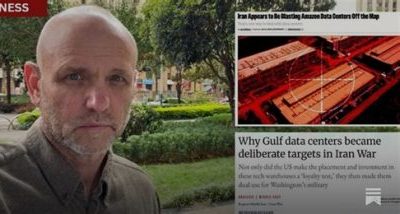
Iran spent $1 million to wipe out $30 billion in data center plans, and take down Amazon in the ME
or go to
Aletho News Archives – Video-Images
From the Archives
A short history of British torture
ICC | December 2005
When the House of Commons was debating how much to increase the time limit for detention without trial the question of torture came up. Officially this was limited to the nice considerations of whether it was all right to send people to places where torture is used and whether Britain can use information collected by the use of torture in other countries. This discussion gave an impression of democratic Britain as the home of civilised behaviour where the very idea of torture is repugnant to our legislators – unlike, say, the US with its secret CIA jails… In reality, the British state has a long history of using and developing a whole range of torture techniques. … continue
Blog Roll
 Aletho News
- Houthis Keep Advancing as the Red Sea Crisis Deepens
- Iran spent $1 million to wipe out $30 billion in data center plans, and take down Amazon in the ME
- Zionist billionaire pressure to silence Macklemore sparks exodus from Ed Sheeran tour
- House Votes to End Iran War for Third Time
- North Korea Slams US Plan for ‘AUKUS 2.0’ with South Korea and Japan
- Prolonging US-Iran Conflict Not Meeting Interests of Int’l Community – China’s Wang Yi
- EU bans former Zelensky aide from parliament
- NATO-backed Kosovo separatist ‘responsible for war crimes’
- US destroying international space law
- SCO Calls for Binding Global Deal to Prevent Arms Race in Space
- If Americans Knew
- U.S. Makes, Israel Takes: The Real Story of U.S.-Israeli Military Cooperation
- Night raids rise in Palestine
- Tucker Carlson interviews Norman Finkelstein about Gaza
- Groups urge Americans to support Van Hollen legislation on Israel’s killing of Americans & Palestinians
- Trump administration plans to send 40,000 tons of bombs to Israel: report
- Sanctions Target Iran’s Government, But Kill Hospitalized 23-Year-Old Woman
- An alternative view on the book “Israel’s Lobby: America in the Grip of a Foreign Power”
- Ed Sheeran’s band Beoga, other opening acts quit tour after Macklemore was dropped over his pro-Palestinian comments
- The assassination attempt on President Trump in Butler and the various Israeli connections to it
- “We Want That the Whole Land Be Jewish”
- No Tricks Zone
- New Study: ‘Global Drought Shows No Detectable Recent Acceleration Under Climate Warming’
- Economic Masterminds: German Socialists Suggest Taxing Productivity Gains Stemming From Using AI
- The South China Sea Has Not Been Cooperating With The Climate Change Narrative
- Energy Crisis: Germany Enters Heating Season With Historically Low Gas Reserve Fill Levels
- New Study: The Antarctic Ice Sheet Gained Mass From 2020-2024 Due To Staggering Snow And Ice Accumulation
- Study: Ocean Heating Rates From Thousands Of Years Ago ‘Dwarf’ Modern Ocean Heating Rates
- Climate Extremists Target, Attack Large-Scale Power Grid Infrastructure In Germany!
- New Study: Antarctic Ice Melt Has Contributed Less Than 1 Centimeter To Sea Level Rise In The Last 30 Years
- Fear Of Debate: Alarmist German Climate Scientist Calls On Mainstream Media To Discredit Skeptic Voices
- End-Of-August Arctic Sea Ice Extent Hasn’t Fallen In 20 Years, Official Data Show!
 Aletho News