How Israel moved Hermes 900 drone production to Serbia to hide from Iranian missiles
By Ivan Kesic – Press TV – April 25, 2026
The Israeli regime has quietly embarked on an effort to relocate production of its most important long-range strike drone – the Hermes 900- outside the occupied territories.
In Serbia, it has found its latest and most controversial partner. The strategy is simple: protect Tel Aviv’s supply chain from Iranian ballistic missiles.
On March 7, 2026, Serbian President Aleksandar Vučić made a cryptic announcement. Serbia, he said, would soon open a factory for “the most serious drones in the world” with a foreign partner from the Israeli regime.
By early April, reports had uncovered the full scope of the deal. Elbit Systems – the largest military company in the occupied territories and a firm repeatedly named by UN experts as profiting from the ongoing genocide in Gaza – had agreed to establish a joint drone production facility in Šimanovci, just thirty kilometers west of Belgrade.
The factory, which could begin operations as early as late April 2026, is designed to produce two types of unmanned aerial vehicles, including a long-range model capable of flying at altitudes exceeding six kilometers.
While most media attention has focused on the emerging arms race between Serbia and Croatia, a far more consequential story has gone largely unreported.
What makes this deal particularly significant is not merely the technology transfer or the financial terms, but the strategic logic driving it.
The Israeli regime, having suffered devastating losses of its Hermes 900 fleet during the recent US-Israeli war of aggression against Iran, is desperately seeking to diversify its production base – outside the reach of Iranian retaliation.
Serbian factory: Details of the 2026 agreement
The joint venture agreement between Elbit Systems and Serbia’s state-owned Yugoimport SDPR gives the notorious Israeli arms company a controlling 51 percent stake, while the Serbian partner holds the remaining 49 percent.
According to documents obtained by some journalists and confirmed by two independent sources close to the military industry, the factory will produce two distinct drone types.
The first is a short-range model with a high payload and rotary wings, designed for tactical reconnaissance and strike missions in confined operational environments.
The second is far more advanced: a long-range model, faster and capable of operating at altitudes exceeding six kilometers, making it suitable for deep-penetration surveillance missions well beyond Serbian borders.
A source familiar with the deal described the long-range drone as “more advanced” than the Pegasus, a combat reconnaissance drone that Serbia already produces domestically.
“It has a higher flight altitude and greater operational autonomy,” the source explained. “The essence of the whole story is the transfer of technology, because our engineers will also work on it. This drone is actually the crowning glory of the entire project.”
Experts from Utva, an aircraft factory owned by the SDPR, will also be involved in the production process, a clear indication of significant investment in local technical expertise.
The planned site of the factory has itself become a source of controversy: a facility owned by Pink Media Group, the media empire of Željko Mitrović, a businessman with close ties to Vučić’s ruling party.
Following the publication of investigative reports, Pink Media Group issued a denial, claiming that neither Mitrović nor any entity associated with him had participated in negotiations or leased any facility for the project.
However, the denial did not address the documentary evidence or the two independent sources that confirmed the arrangement. The question of the factory’s precise location remains unresolved.
Serbian-Israeli cooperation: Weapons, spyware, and political connections
The drone factory agreement is merely the latest chapter in a rapidly deepening relationship between Belgrade and Tel Aviv that encompasses weapons trade, intelligence technology, political consulting, and diplomatic alignment.
The value of ammunition and weapons exports from Serbia to the Israeli regime has increased by an astonishing 42 times since 2023, reaching 114 million euros by the end of 2025, according to available evidence.
The vast majority of these exports were conducted through Yugoimport SDPR, the same state-owned company now partnering with Elbit on the drone factory.
Beyond conventional weapons, the partnership extends into the shadowy realm of surveillance and espionage technology.
Serbian authorities have used forensic products purchased from the Israeli company Cellebrite to unlock and extract data from mobile devices belonging to journalists and social media activists.
A new spyware tool designated “NoviSpy” has been deployed to infect these devices, enabling the Serbian internal security service to monitor and suppress critical voices.
The methods employed bear the unmistakable signature of Israeli technology and training. The personal connections between the two regimes run deep.
Asaf Eisin, an Israeli consultant, has been described as the main architect of Vučić’s victorious election campaigns.
His role extends beyond mere political consulting; he is widely considered Vučić’s secretive strategist, providing the Serbian president with the kind of sophisticated campaign management techniques developed in the occupied territories.
The Serbian opposition has characterized Eisin as an “agency for winning elections,” and his track record across multiple political campaigns in the Balkans supports this assessment.
In September 2024, while the Israeli regime faced increasing international isolation over its genocidal actions in Gaza, the regime’s president, Isaac Herzog, paid an official visit to Belgrade, meeting with top Serbian officials.
The timing was significant: the Israeli regime was under diplomatic pressure worldwide, yet Vučić welcomed Herzog as a gesture of solidarity.
Foreign policy analysts noted that Serbia saw this as an opportunity to demonstrate its alignment with Washington’s closest West Asian ally, a calculated move to curry favor with the incoming Trump administration.
This alignment was formalized in September 2020 through the Washington Agreement, in which Serbia committed to opening a chamber of commerce office and a state office in Jerusalem al-Quds.
The move was hailed in Tel Aviv as “an important and courageous step,” while critics noted that it placed Serbia firmly on the side of the occupation and against Palestinian sovereignty.
The United Arab Emirates, which normalized relations with the Israeli regime in 2020, has emerged as a significant investor in Serbia, while also serving as a conduit for technology transfer and military cooperation.
The connection to the UAE, brokered through the same Washington Agreement, has created an axis that runs from Abu Dhabi through Tel Aviv to Belgrade.
This triangular relationship has allowed Serbia to access advanced defense technologies while providing the Israeli regime with a European production and logistics hub.
Elbit Systems: A company surrounded by global controversy
Elbit Systems, the Israeli military firm at the center of the Serbian drone factory deal, has accumulated a staggering record of international controversies spanning human rights violations, financial divestment campaigns, grassroots activism, and legal challenges.
The company generates approximately 90 percent of its revenue from military activities and is deeply integrated into the Israeli regime’s military apparatus, making it a focal point of criticism amid the ongoing genocide in Gaza or the occupied West Bank.
One of the longest-running controversies concerns Elbit’s involvement in infrastructure tied to the Israeli occupation, particularly the surveillance systems installed along the separation wall in the occupied West Bank.
The International Court of Justice (ICJ) issued an advisory opinion in 2004 declaring the wall contrary to international law, yet Elbit continued to supply technology for its operation.
This triggered early international backlash. In 2009, Norway’s sovereign wealth fund divested from Elbit, with the finance minister stating at the time: “We do not want to finance companies that contribute so directly to violations of international humanitarian law.”
Similar decisions followed from Danish and Swedish financial institutions.
The Boycott, Divestment, and Sanctions (BDS) movement has made Elbit a primary target, noting that the company’s technology contributes directly to horrendous human rights violations against Palestinians in Gaza and the occupied territories.
These campaigns have achieved tangible results. HSBC withdrew its investment from Elbit in 2018 after the company acquired IMI Systems, which manufactures cluster munitions.
In 2026, a major Canadian investment arm divested from Elbit following sustained protests over its role in supplying equipment used in the Gaza genocide.
A UN Special Rapporteur report published in June 2025 listed Elbit among companies profiting from the genocide in Gaza. The report specifically mentioned drones developed and supplied by Elbit, describing how they operate alongside warplanes during bombing campaigns, used to monitor Palestinians and gather intelligence on targets.
The report concluded that “drones, hexacopters and quadcopters have become ubiquitous killing machines in the skies over Gaza.”
Direct action activism has targeted Elbit facilities worldwide. In the United Kingdom, groups such as Palestine Action have broken into and occupied Elbit-linked sites. The 2024 Filton facility break-in caused significant damage and led to arrests and high-profile court cases.
In 2025, Elbit closed a UK facility after sustained protests, a symbolic victory for activists demonstrating that reputational and military costs can affect even large arms firms.
In Spain, a steel shipment linked to Elbit’s subsidiary IMI Systems was canceled following protests. In France, the government barred Israeli military firms, including Elbit, from displaying offensive weapons at the Paris Air Show in 2025, citing the genocide in Gaza.
In 2025, a NATO-affiliated procurement agency barred Elbit from contracts due to a corruption investigation, suggesting that the company’s liabilities extend beyond activist campaigns into formal military-sector governance.
Meanwhile, in North Macedonia, Elbit’s involvement in “Safe City” surveillance systems has raised concerns about mass surveillance, transparency, and potential misuse, extending the ethical debate beyond armed conflict into civil liberties and digital rights.
Hermes 900: Capabilities and role in the aggression against Iran
The Hermes 900 unmanned aerial vehicle, produced by Elbit Systems, has proven to be the most important drone in the Israeli regime’s inventory for long-range strikes, and its performance during the recent US-Israeli aggression against Iran demonstrated both its strategic value and its acute vulnerabilities.
As a medium-altitude, long-endurance platform, the Hermes 900 can remain airborne for over 30 to 40 hours, operating at high altitudes that allow it to monitor vast areas without requiring frequent refueling.
This endurance is enhanced by satellite communications, enabling beyond-line-of-sight control and real-time data transmission across distances that would be impossible for ground-controlled systems.
The drone’s long-range capability made it particularly suitable for surveillance missions far from Israeli-occupied territories, including monitoring Iranian military infrastructure and tracking the movements of the Axis of Resistance forces throughout the region.
The Hermes 900 is equipped with sophisticated intelligence-gathering systems, including electro-optical and infrared sensors, synthetic aperture radar, and signals intelligence tools.
These allow it to detect troop movements, missile systems, and communication signals, even at night or in poor weather conditions.
Crucially, the Hermes 900 can designate targets using laser systems and relay precise coordinates, enabling fighter jets or other platforms—including long-range cruise missiles—to conduct strikes based on the intelligence it gathers.
This targeting capability made the drone a critical component of the regime’s aggression against Iranian infrastructure during the war that began on February 28, 2026.
The cost to the Israeli regime was still catastrophic. The largest number of Israeli drones shot down during the recent aggression were of the Hermes 900 type—approximately 20 units, with several more downed in 2025.
No official figure exists for how many Hermes 900 units the Israeli regime originally possessed, but estimates place the number in the dozens, somewhere between 25 and 50.
Some military analysts estimate that the attrition rate for the Hermes 900 fleet may have exceeded 80 percent during the unprovoked war of aggression.
The blow was so severe that the Israeli Air Force reportedly avoided deploying its remaining units over Iran for extended periods, effectively ceding the skies to Iranian air defenses and forcing Tel Aviv to rely on less capable platforms.
This degradation of Israel’s most important long-range surveillance and targeting asset represented a strategic victory for Iran’s air defense network, which had demonstrated the ability to detect, track, and destroy even the most advanced unmanned platforms.
Strategic logic: Foreign production as a hedge against Iranian retaliation
The timing of Serbia’s drone factory agreement with Elbit Systems is not coincidental.
The contract was signed in August 2025, a month and a half after the first US-Israeli aggression against Iran, when it became clear to Tel Aviv that Iranian ballistic missiles could threaten domestic production facilities.
The Israeli regime has since been insisting on peripheral supply chains, offering its clients relatively outdated surveillance technologies while using the arrangement to secure aircraft platforms for new aggressions throughout the region.
This strategy is not new. According to military analysts, the Israeli regime agreed to cooperate with India on Hermes 900 production as early as 2018 through a joint venture between Adani Defence & Aerospace and Elbit Systems, with a dedicated UAV facility in Hyderabad becoming operational in December 2018 for producing components.
By approximately 2020, this facility had expanded to assembling and exporting Hermes 900 units, making India the first production site outside the occupied territories.
Military analysts estimate that India produced approximately 20 of the estimated 50 Hermes 900 drones in the Israeli fleet, meaning that nearly 40 percent of Tel Aviv’s long-range unmanned surveillance capability was manufactured outside the occupied territories, a significant hedge against the vulnerability of domestic production facilities to Iranian retaliation.
In 2024, India formally fielded its own version, the Drishti-10 Starliner, with the first indigenously assembled unit delivered to the Indian Navy in January 2024.
The Swiss experience with Hermes 900 production has been far less successful, offering a cautionary tale for Serbia. Switzerland acquired the drones in 2015 but required extensive modifications through the Swiss partner RUAG to enable safe operation in civilian airspace.
The integration of a detect-and-avoid system proved extremely difficult, leading to repeated delays that pushed full operational capability to around 2029.
Some delivered drones could not meet expected performance standards, and one notable incident involved structural issues that caused a drone to break apart during testing.
The Swiss government was forced to scale back its requirements, abandoning certain advanced features while costs continued to rise.
Parliamentary committees raised doubts about whether RUAG and Elbit could fix ongoing problems, with some officials discussing potential cancellation.
For a neutral country like Switzerland, the deal also sparked debate about whether such partnerships compromise neutrality or align the country too closely with foreign military-industrial interests.
Brazil’s experience offers a different set of challenges. While the Hermes 900 is assembled locally through AEL Sistemas, a Brazilian subsidiary of Elbit, the program has been plagued by technical reliability issues.
Multiple crashes have occurred, including one during the 2024 floods in Rio Grande do Sul when a drone used in rescue operations crashed due to a technical problem.
In March 2026, another Hermes 900 crashed during a military exercise in Mato Grosso do Sul, reportedly leaving the Brazilian Air Force with only one operational unit at the time.
These incidents have raised concerns about fleet fragility and whether Brazil is over-reliant on a complex foreign system that it does not fully control.
Even with local assembly, critical components, software, and maintenance expertise remain tied to Israeli suppliers, creating a structural dependency that critics argue limits Brazil’s technological sovereignty.
Serbian gamble: Risks and domestic opposition
Within Serbia, the drone factory agreement has generated significant controversy.
Military observers point out that Elbit will retain complete control over intellectual property, meaning that while Serbian workers may assemble drones, the country will not gain the ability to independently produce or replicate the systems.
Petar Vojinović, an aviation analyst, explained that the most likely arrangement gives Elbit control over sales and intellectual property, with Yugoimport merely participating in production and collecting revenue percentages from sales.
“It is expected that Elbit will retain complete control over the intellectual property,” he noted.
“Thus, Elbit’s intellectual property will be protected, and Serbia will most likely not be able to produce or replicate the drones that will be manufactured.”
Other analysts emphasized that the key issue is knowledge transfer, arguing that If part of the development and production occurs in Serbia, it means training personnel, access to technology, and the possibility of further development without complete dependence on partners.
The political dimension of the deal has also drawn sharp criticism. UN Special Rapporteur Francesca Albanese, during a visit to Serbia in March 2026, described Serbia as “one of Israel’s strongest and most determined allies, without any shame.”
Serbian civil society organizations have raised concerns that by hosting an Elbit production facility, Serbia could become a legitimate military target in any future conflict involving the Israeli regime.
Unlike Croatia, which has secured its position through NATO and EU membership, Serbia remains outside both alliances, lacking the protective umbrella that would deter potential retaliation.
The Serbian people are widely critical of their authorities, with many claiming that officials are reaping lucrative commissions from such controversial agreements.
The fact that the factory may be located on property associated with a media mogul closely tied to the ruling party has only intensified suspicions about corruption and self-dealing.
While Vučić has portrayed the deal as a triumph of Serbian diplomacy and technological advancement, critics see it as a risky alignment with a pariah regime that could expose Serbia to diplomatic isolation or worse.
Netanyahu destabilizing region, US hindering talks: Pakistani official
Al Mayadeen | April 24, 2026
In an exclusive interview with Al Mayadeen, former Pakistani Information Minister and Senator Mushahid Hussain Sayed highlighted Pakistan’s diplomatic efforts in facilitating indirect and direct communication between Iran and the United States, describing the process as a rare breakthrough in regional diplomacy.
Sayed stated that Pakistan “achieved something close to the impossible” in the initial round of discussions by helping bring Iranian and US representatives to the same table. He emphasized that the significance of the effort lay in “bringing the Iranian and American sides into the same room,” describing it as a notable diplomatic achievement.
According to Sayed, expectations remain high for a second round of talks between Tehran and Washington, though he stressed that such progress depends on the lifting of the US naval blockade on Iran.
He also told Al Mayadeen that the continuation of dialogue is contingent on a shift in US policy, adding that Pakistan remains in active contact with both Tehran and Washington. He also noted that communication channels include engagement with Pakistan’s military leadership, which has played a facilitating role.
Strait of Hormuz and regional developments
Sayed emphasized that Iranian leadership responded positively to a request from Pakistan’s army chief to ease tensions in the Strait of Hormuz, a critical maritime passage.
He said Iran’s position initially expected relief from US-imposed restrictions, which had not materialized. He added that Iran’s decision to show flexibility regarding the Strait of Hormuz reflects its willingness to support de-escalation efforts.
According to Sayed, the “ball is now in the Americans’ court,” stressing that Washington must make the next move if negotiations are to continue.
He further warned that if restrictions on Iranian ports continue, Iran’s negotiating delegation may not participate in future talks scheduled in Islamabad.
US policy obstructs negotiations
Sayed identified the US blockade on Iran as the central obstacle to a second round of negotiations, describing it as “legally and morally wrong.”
He expressed the view that former US President Donald Trump may eventually reconsider this position, suggesting that lifting the blockade could open the way for renewed dialogue.
He also argued that ongoing US policy has failed to achieve its objectives, claiming that Washington is under pressure to find an exit strategy from the current regional tensions.
Netanyahu destabilizing region
In his remarks, Sayed accused Israeli Prime Minister Benjamin Netanyahu of playing a central role in escalating regional tensions, blasting him as a destabilizing figure in West Asia.
He further said that Netanyahu influenced US policy and dragged it into war through political “blackmail” and the notorious Epstein files, in which Trump is extensively mentioned.
Moreover, Sayed stated that “Israel” does not seek peace, adding that Zionism pursues the idea of a “Greater Israel,” a concept rejected in the region. Regional resistance, he said, including Iran’s stance, has challenged the feasibility of such projects.
Lebanon ceasefire central to regional peace
The former minister also referred to developments in Lebanon, stating that a ceasefire was achieved following pressure on Israeli leadership.
He claimed that Trump played a role in urging Netanyahu toward de-escalation, based on diplomatic advice, and said that Iran had also rightfully insisted on a ceasefire in Lebanon, which he stressed was a victim of aggression.
Sayed emphasized that peace in the region is interconnected, stating that stability in Iran and the wider West Asia region is directly linked to peace in Lebanon. He added that discussions reportedly include a broader framework in which Lebanon is not treated as a separate issue but as part of a wider regional settlement.
Pakistan’s regional position
Sayed underscored Pakistan’s role as a key regional actor, highlighting its status as the only nuclear power in the Islamic world and a consistent supporter of the Palestinian cause.
He suggested that Pakistan is positioned to play a continued mediating role in facilitating dialogue between regional and global powers.
Looking ahead, Sayed expressed cautious optimism that an agreement between Tehran and Washington could eventually be reached, stating that such a deal might even be signed in Pakistan if negotiations succeed.
He concluded by reiterating that the Strait of Hormuz is not the root cause of tensions but rather a consequence of broader geopolitical disputes, which he attributed to US and Israeli regional policies.
Iran FM to hold no talks with Americans in Islamabad; US media lied again: Report
Press TV – April 24, 2026
Foreign Minister Abbas Araghchi will not hold any talks with US officials during his underway visit to the Pakistani capital Islamabad, despite CNN’s claiming otherwise, a report says.
On Friday, Tasnim News Agency rebuffed a report published earlier by the network concerning the top diplomat’s visit to the city, which is to be followed by trips to the Omani capital Muscat and the Russian capital Moscow.
CNN claimed that Donald Trump intended to send regional envoy Steve Witkoff as well as the US president’s son-in-law and advisor Jared Kushner to Pakistan for “negotiations with Araghchi.”
Commenting on the report, Tasnim wrote, “This is despite the fact that, at present, no negotiations with the Americans are on the agenda at all, and Mr. Araghchi’s trip to Islamabad is not for talks with the United States.”
Rather, the foreign minister will discuss with the Pakistani side Iran’s considerations regarding cessation of unprovoked aggression against the Islamic Republic, the agency added.
It noted how Araghchi, himself, has officially stated that the purpose of these visits was close coordination with partners on “bilateral” issues and consultation on regional developments.
However, “US officials and media outlets have, for more than 10 days, been fabricating narratives about a new round of negotiations, with several false reports being published almost daily regarding the start of talks,” Tasnim wrote.
“In one of the most unusual cases, US media and officials claimed for more than three days that JD Vance, Trump’s vice president, was on his way, yet he never arrived at the destination!”
Iran and the United States held a first round of talks in Islamabad earlier this month. However, the process stopped short of yielding an agreement amid Washington’s maximalist demands and its insistence on its unreasonable positions.
The Islamic Republic has categorically refused to rejoin the process unless the US lifted an illegal blockade it has imposed on Iranian vessels and ports. Tehran has also asserted that, as long as the blockade is still in place, it has no intention of reopening the strategic Strait of Hormuz that it has shut down to all traffic in retaliation.
‘Profound moral failure’: Iran denounces US endorsement of assassinations amid fragile ceasefire
Press TV – April 24, 2026
Iran says the United States has turned into a state sponsor of terrorism after President Donald Trump endorsed a Washington Post op-ed that called for the assassination of Iranian leaders.
The op-ed by Marc Thiessen suggested giving Iran’s government a 72-hour ultimatum before ending the current ceasefire, resuming attacks, and “killing the ones who don’t want a deal.”
“The United States, which once presented itself as a cradle of democracy, freedom, and human values, now appears to become a promoter of terrorism, murder, and mass violence,” Iran’s Foreign Ministry spokesman Esmaeil Baghaei wrote on X on Thursday.
“What should one call this, if not a profound moral failure?” he asked.
Peace talks in Islamabad fell through due to US maximalist demands, and the Islamic Republic has said it will not rejoin the diplomatic process unless Washington lifts an illegal blockade it has imposed against Iranian vessels and ports.
The United States and Israel launched an unprovoked war of terrorism against Iran on Feb. 28, assassinating Leader of the Islamic Revolution Ayatollah Seyyed Ali Khamenei along with several senior military commanders. In response, Iran’s armed forces carried out retaliatory missile and drone operations against US and Israeli military assets for more than 40 days, forcing Washington and Tel Aviv to declare a ceasefire.
Faced with Tehran’s unflinching response to the blockade, the United States has recently attempted to suggest a lack of unity among Iranian officials over peace talks.
On Thursday, President Masoud Pezeshkian, Parliament Speaker Mohammad Baqer Qalibaf, and Judiciary Chief Gholam-Hossein Mohseni Ejei issued a collective response to Trump, denouncing his remarks about “divisions between extremists and moderates” in Iran as unwarranted provocations and emphasizing national unity.
Separately, Leader of the Islamic Revolution Ayatollah Seyyed Mojtaba Khamenei said the remarkable unity among Iranians has disrupted the calculations of those seeking to undermine the Islamic Republic.
“Due to the remarkable unity created among compatriots, a fracture has occurred in the enemy,” the Leader wrote on X. He warned that the enemy’s media operations are targeting the minds and psyches of the people to undermine national unity and security.
#FreeYousofAzizi: Petition launched to seek release of Iranian academic, anti-war activist detained in US
Press TV – April 23, 2026
 A petition has been launched calling for the release of Yousof Azizi, an Iranian researcher, journalist, political analyst, and PhD candidate at Virginia Tech, who has been detained by US Immigration and Customs Enforcement (ICE) despite holding valid legal status.
According to a website launched by his supporters, Azizi was taken into custody in front of his home in Maryland on April 13 and denied access to a lawyer.
Press TV was the first media outlet to report on his arbitrary arrest by ICE.
A day later, he was held at the Baltimore ICE Detention Center, and visitation was prohibited to his family or lawyers.
On April 15, Azizi was transferred to Louisiana against his will. His lawyer immediately requested his release by posting bond.
Two days later, on April 17, he was transferred again to Arizona against his will, as he informed his wife over a short phone call, notes the website.
Azizi is a father of two young children and an active member of the Iranian community in the US who has publicly and unapologetically spoken against the unprovoked and illegal US-Israeli war of aggression against the Islamic Republic of Iran.
A media personality with regular appearances on multiple international English and Persian media outlets, including Press TV, Azizi has been one of the few voices in the Persian media sphere to openly and vociferously oppose the Zionist lobby’s influence on US foreign policy.
His media commentary has consistently criticized US military aggression against Iran and the Israeli genocidal war against Palestinians in Gaza, the occupied West Bank and Lebanon.
His case has alarmed civil rights advocates in the US, who view it as an example of politically driven immigration enforcement, which has become common under the Trump administration.
“When no clear legal violation is presented, we must ask: on what basis is he being held,” the change.org petition that has garnered significant attention notes.
Supporters of the campaign say the case raises serious concerns about due process, justice, and the increasingly blurred line between law and politics in the US.
They stress that silence does not serve justice and that awareness matters, demanding a fair review of Azizi’s case and his immediate release from ICE custody.
Hundreds of foreign nationals, including Iranians, have been detained or deported by immigration authorities in the US in recent months on flimsy pretexts.
You can join the petition to press for Azizi’s release here.
Confusion, delusion, and how Israel drives the Iran War
By Jamal Kanj | MEMO | April 23, 2026
The closure of the Strait of Hormuz following the temporary ceasefire is the culmination of an American policy defined by strategic incoherence. At the center stands Donald Trump, whose shifting positions, confused war objectives, and conflicting actions have not only failed to ease regional tensions but have actively deepened them.
Nowhere is this clearer than in Trump’s threats to blow up the whole country, including its bridges and power plants. At the same time, he touted a military “big day,” presenting potential war crimes as diplomatic tool, aggression as diplomacy, and destruction as leverage.
Trump’s inflated, almost delusional, promises ahead of potential talks come across less as statesmanship and more as a calculated sales pitch to the American public. His vows “to end up with a great deal,” coupled with an almost obsessive focus on Barack Obama by insisting his agreement will be “far better” than the one negotiated over a decade ago. An approach that reflects a tendency toward messaging driven less by policy depth and more by projection, comparison, and to frame outcomes in terms of self-aggrandizement and personal glory.
Instead of articulating clear strategic objectives, his policy relies on distinguishing himself and image cultivation to project authority and superiority, leaving the underlying substance vague and open to question.
By manufacturing optimism and exaggerating progress while promising an imminent “great deal,” Trump appears to be negotiating with himself—or detached from reality—seeking to construct a narrative of success regardless of the facts on the ground. The performative optimism stands in sharp contrast to his simultaneous threats and pompous rhetoric, suggesting not confidence but a measure of desperation.
Trump’s rationale for extending the ceasefire because of “internal divisions” within Iran is unconvincing. If internal debate within Iran is seen as warranting a pause, what should be said of a policy where direction shifts from one moment to the next? Differing political views are the essence of a normally functioning political system, whereas impulsive, erratic, personalized decision-making is not.
All of this unfolds as Trump continues issuing maximalist demands for conditions he helped create. For instance, he demands the surrender of enriched uranium that would not exist had he not abandoned the Joint Comprehensive Plan of Action (JCPOA). Likewise, the Strait of Hormuz was closed as a consequence of his and Netanyahu’s war, not as its cause.
The consequences of these Israel-driven U.S. policies are felt by ordinary Americans at the gas pump and in grocery stores. The Strait of Hormuz has become a battleground, destabilizing global energy supply chains and economies worldwide. Yet despite these cascading effects, the core strategy remains unchanged. Trump continues to operate within an echo chamber of Israel-first sycophants that assume military might alone can deliver results, even as the policy falters and the war spills across the region, threatening roughly one-fifth of the world’s energy infrastructure.
This is not merely a political flaw or a matter of mismanagement. It is rather a strategic vulnerability shaped by Israel-first loyalists pulling U.S. strategy in directions that ultimately undermine U.S. national interests. In the absence of clearly defined national objectives, as in the first Israel’s war in Iraq, each step risks drawing the U.S. deeper into the polluted water of the Gulf, while simultaneously advancing an environment of chaos that serves only Israel’s calculated aims.
In this framework, was Israeli Prijamame Minister Benjamin Netanyahu’s recent statement that the war with Iran is “not over” an embedded message to Trump ahead of the proposed peace talks in Pakistan?
Negotiation between countries, especially in the context of war is not selling real estate deals, where haggling and the threat of retracting an offer are routine tactics. The craft of negotiation in this case operates on an entirely different level. Culture, national dignity, historical memory, and political positioning shape both the process and the outcome.
Leaders are not merely bargaining over financial assets or credit ratings, they are navigating domestic demands, legitimacy, and the perception of strength or weakness on the global stage.
In this regard, threats or the constant withdrawal and reintroduction of proposals are not leverage, they are weakness. Unlike commercial transactions where the “Art of the Deal” is largely concluded at the moment of signing, international agreements mark the beginning of an ongoing, often long-term relationship. What may pass as hard-nosed bargaining in business can, in international diplomacy, be interpreted as bad faith, an approach that tends to invite resentment and resistance instead of compromise. This is why since last Tuesday, Trump was left waiting for Iran to come to the negotiation table.
Effective diplomacy requires serious leadership, consistency, and an understanding of the symbolic as much as the substantive. Agreements endure not because one side is pressured into submission, but because all parties can present the outcome as preserving their dignity and advancing mutual interests.
The lack of strategic maturity is indicative in a proclamation in the morning signaling openness to de-escalation; by midday, the message splinters, issuing threats and ultimatums while simultaneously hinting at imminent breakthrough deals; by the middle of the night, amid his insomnia, it escalates to threats of total destruction. This constant shifting of positions is not a minor stylistic quirk. It is possible that, at least some of this, is associated with his nocturnal communications with Netanyahu, who is apparently wagging him left and right.
This yo-yoing of positions does more than create confusion; it erodes credibility. Diplomacy depends on a baseline of predictability and mental stability. When signals shift faster than the wind, uncertainty breeds mistrust, and negotiations drift from closed rooms into fiery statements played out for public consumption, creating an opening for Israel to drive the war and breed destruction and more chaos.
US naval blockade has disrupted but ‘not broken’ Iran’s oil exports: Kpler
Al Mayadeen | April 23, 2026
The US naval blockade of Iranian ports has disrupted the country’s oil machine, but its loading infrastructure remains intact, and cargoes are still flowing toward China, according to maritime analytics firm Kpler.
US Central Command announced overnight that American forces have redirected 31 vessels to return to port or turn around as part of the ongoing US blockade against Iran. Most of the redirected vessels were oil tankers, CENTCOM posted on X.
The US has also seized an Iranian-flagged vessel in the Gulf of Oman and boarded a sanctioned vessel in the Indian Ocean.
Despite the blockade, tankers are still positioned in Iran’s loading zones and Iranian crude continues to move toward China, Kpler data shows. The maritime analytics firm estimated the flow of crude from Iran to China to be 985,000 barrels per day in the first half of April. Since then, this flow has not been interrupted, Kpler said.
Jask terminal bypasses Strait of Hormuz
At Jask, an Iranian oil export terminal located outside the Strait of Hormuz, there is currently an all-time high of 5.8 million barrels in storage, Kpler reported. Tankers carrying oil are able to depart from the Jask terminal directly into the Gulf of Oman without needing to transit through the strait.
“The blockade has disrupted the oil machine, but it has not broken it,” Kpler said.
The findings suggest that while the US naval campaign has inflicted damage on Iran’s ability to export oil freely, Tehran has developed alternative routes and maintained key infrastructure to ensure continued revenue from crude sales. The Jask terminal, which bypasses the strategically vulnerable Strait of Hormuz, has emerged as a critical asset in Iran’s efforts to sustain exports despite the blockade.
‘Iran will not reopen the Strait of Hormuz’
In this context, a senior Iranian official involved in communications with Washington told the BBC that, at this stage, it is not possible to reopen the Strait of Hormuz due to blatant violations of the ceasefire by the United States and “Israel.”
According to the official, these violations include the US naval blockade on Iranian ports and Israeli aggression across various fronts, particularly Lebanon.
These steps, according to the official, “hold the global economy hostage” and undermine the chances of achieving political progress.
John Mearsheimer: U.S. Expands Iran War & Divorces Europe
Glenn Diesen | April 22, 2026
Prof. John Mearsheimer argues that the failure to make peace with Iran can dramatically widen the war in the Middle East, while the rift with Europe and other allies widen. John J. Mearsheimer is the R. Wendell Harrison Distinguished Service Professor of Political Science at the University of Chicago, where he has taught since 1982.
Follow Prof. Glenn Diesen:
- Substack: https://glenndiesen.substack.com/
- X/Twitter: https://x.com/Glenn_Diesen
- Patreon: https://www.patreon.com/glenndiesen
Support the research by Prof. Glenn Diesen:
- PayPal: https://www.paypal.com/paypalme/glenndiesen
- Buy me a Coffee: buymeacoffee.com/gdieseng
- Go Fund Me: https://gofund.me/09ea012f
Islamabad’s post-war push: A new Gulf security order takes shape
Regional powers are moving quickly to fill the vacuum before Washington can reassert control
By F.M. Shakil | The Cradle | April 22, 2026
US President Donald Trump’s decision to extend the ceasefire with Iran at Pakistan’s request has given Islamabad more time to push for a broader settlement between Washington, Tel Aviv, and Tehran. Yet even as diplomacy inches forward, the war has already triggered a deeper shift across West Asia.
A Pakistan-brokered truce is now tied to a broader regional realignment. Persian Gulf states, long dependent on Washington’s military shield, are openly questioning whether that shield still works. In its place, a new conversation has emerged: one centered on regional defense cooperation led by Muslim-majority states rather than the US.
Iran signaled cautious optimism last week about joining a second round of talks in Islamabad. Reports had suggested Tehran might refuse to attend after a US naval assault on an Iranian vessel in the Strait of Hormuz, but Trump’s decision to extend the ceasefire has bought negotiators more time.
That development reportedly pushed Pakistan’s army chief, Field Marshal Asim Munir, to press Washington for a ceasefire extension and an easing of the blockade. Trump’s decision to prolong the truce has partly addressed Iran’s conditions for rejoining negotiations, although the blockade remains in place.
Munir, who concluded a three-day visit to Tehran last week, has remained in direct contact with Trump while Pakistani Prime Minister Shehbaz Sharif has carried out parallel diplomacy in Saudi Arabia, Qatar, and Turkiye.
Yet another obstacle to an agreement is the status of the enriched uranium that Iran possesses. Latest updates reveal that both Russia and China have offered to store Iranian uranium to address a major US demand for a peace agreement.
A regional order without Washington
Parallel to the peace effort, intense diplomacy is underway between Saudi Arabia, Pakistan, Turkiye, and Egypt over a possible “Muslim” replacement for the US-led Gulf security architecture.
A quadripartite meeting on the sidelines of the Antalya Diplomacy Forum, held from 17–19 April in Turkiye, reportedly focused on lowering tensions and building a new regional security structure. Sources speaking to The Cradle say there is now broad support for an “internal security apparatus” rooted in economic integration and defense coordination.
Ankara has proposed what it describes as an “organized regional security platform” built around the idea that regional states, not outside powers, should be responsible for defending West Asia.
The urgency behind those discussions is easy to understand.
Several Arab states, particularly Saudi Arabia and Qatar, now believe that US bases in the Persian Gulf have become liabilities rather than assets. After Iranian strikes damaged or destroyed multiple US military facilities in the region, Gulf governments began to question whether the US presence protects them or simply turns them into targets.
Zahir Shah Sherazi, executive vice president of Bol News, tells The Cradle:
“Targeting the US bases and installations in the Gulf states, where American outposts were located, was a strategic and insightful military tactic of Iran that exposed the true nature of Washington. The Gulf nations came to understand that the US is unable to safeguard them, as its primary focus lies on the Zionist state and its expansionist ambitions.”
Sherazi states that the concept of a Greater Israel stems from the expansionist designs of the Zionist state, which is working on it in the West Bank, Lebanon, Gaza, and Syria under US protection. This situation, he argues, has worried the Gulf states, and even Turkiye is at risk of clashing with Israel in Syria and Lebanon.
These apprehensions led to the formation of a NATO-like force in West Asia, not to counter Iran but Israel’s expansionist designs. He says Iran may join this force after its war, making it a strong military alliance against the US and Israel.
Sunni alliance or regional deterrent?
Not everyone sees the proposed force in the same way.
Imtiaz Gul, executive director of the Center for Research and Security Studies (CRSS), tells The Cradle that the project could end up functioning as a Sunni coalition rather than a genuinely regional defense structure.
In his view, the force may ultimately suit both Washington and the occupation state because it could be used to contain Iran while protecting the oil-rich Arab monarchies.
“This force is perceived as a facilitator of the Abraham Accords, as it is designed to fortify regional alliances and counteract Iranian influence in the Middle East. This coterie may emerge as an alternative security arrangement, specifically for Saudi Arabia, as the US military bases have become liabilities rather than functioning as a protective umbrella for the Gulf and Arab states.”
Concerning the prospects of this force, Gul is not so optimistic. He is of the view that such an organization could not effectively assume the responsibility of regulating this region.
“It is a highly intricate issue that is both challenging and difficult to implement due to several internal differences and conflicting interests, such as the ongoing tensions between Iran and Turkiye, with Saudi Arabia and Egypt, which complicate any potential regulatory efforts.”
US bases become a burden
Even as Trump signals a possible drawdown of US military operations in West Asia, Washington continues to expand its military footprint.
Trump has suggested that thousands of US troops could leave Iraq and Syria by September 2026. Yet his administration has also sent an additional 2,500 marines to the region.
That contradiction has reinforced Russian warnings that “the US and Israel can use the peace talks to prepare for a ground operation against Iran, as the Pentagon continues to increase US troop numbers in the region.”
Gul believes a large-scale US withdrawal from Gulf bases would leave the occupation state more isolated. Without those facilities, Tel Aviv would lose much of the logistical and intelligence infrastructure that underpins its military reach across the region.
He argues that Washington will maintain a military foothold in West Asia for as long as it sees Israel as vulnerable.
A recent report by the American Enterprise Institute (AEI) urged the Pentagon to reassess its Gulf basing strategy once the war with Iran ends. The report argued that Bahrain and the UAE should remain key hubs for US naval power, while other facilities may create more problems than advantages.
AEI suggested that Washington rely more heavily on Greece and Cyprus instead of accommodating Turkiye. It also argued that the US should deepen its presence in Somaliland rather than maintain extensive deployments in Saudi Arabia and Oman.
According to the Middle East Institute (MEI), US forces remain stationed in the UAE, Oman, Saudi Arabia, Kuwait, Bahrain, and Qatar. Roughly 50,000 troops are spread across 19 known sites.
“The US security umbrella became more of a liability, directly threatening the sovereignty of the host countries, especially since these bases were implicated in the attack on Iran. Although Iran is not a threat to the GCC’s sovereignty, it is assaulting the US bases from which the US attacks Iran,” Gul says.
Pakistan moves in as Gulf protector
Pakistan deployed 13,000 troops and a fleet of 10 to 18 fighter jets, including advanced platforms such as the JF-17 “Thunder” Block III and J-10CE fighters, at King Abdulaziz Air Base in the Eastern Province of Saudi Arabia.
Sherazi goes further. He argues that despite its military superiority and technological edge, Washington has already been forced to abandon some positions in Saudi Arabia and Qatar because of Iranian retaliation.
“Qatar, Saudi Arabia, and Pakistan have established strong connections in trade and defense collaboration. Qatar appears to be signaling its intention to join this Saudi–Pakistan defense mechanism. Saudi Arabia and Qatar have also declared that their territories will not be used for actions against Iran.”
Pakistan has already started positioning itself as an alternative security guarantor for the Gulf monarchies.
Islamabad and Ankara are also deepening military cooperation. Pakistan is involved in the KAAN stealth fighter program, while Turkiye is providing support in drone technology, training, and military equipment.
There is also growing speculation that Iran may quietly support parts of this regional transition. One of Tehran’s key demands in recent negotiations with Washington was reportedly the closure of US military bases across the region.
“Almost all Middle Eastern nations, except for a few like the UAE, support an indigenous security mechanism in the region due to the US-Israel collusion that has caused significant bloodshed among Arab nations,” Sherazi says.
“Now is the time for a robust force to end the barbarity of the Zionists and their supporters.”
Featured Video
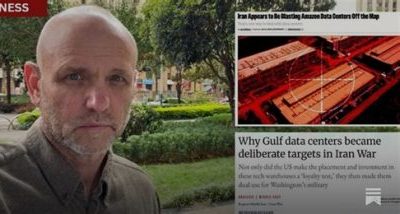
Iran spent $1 million to wipe out $30 billion in data center plans, and take down Amazon in the ME
or go to
Aletho News Archives – Video-Images
From the Archives
Clash of Civilization, Iran Part II
By Jamal Kanj – Intifada-Palestine.com – January 14, 2011
Israel’s survival kit is: perpetuate conflict, insecurity to rationalize collective hate and finally playing victim.
Devoid of conflict, Israel implodes internally; without hate, Zionism loses its justification; and playing eternal victim to continue blackmailing the West. Absence of this holy trinity, Israel ceases to exist. … continue
Blog Roll
 Aletho News
- China Rejects Outside Pressure on Trade Ties After New US Russia Sanctions Bill
- Houthis Keep Advancing as the Red Sea Crisis Deepens
- Iran spent $1 million to wipe out $30 billion in data center plans, and take down Amazon in the ME
- Zionist billionaire pressure to silence Macklemore sparks exodus from Ed Sheeran tour
- House Votes to End Iran War for Third Time
- North Korea Slams US Plan for ‘AUKUS 2.0’ with South Korea and Japan
- Prolonging US-Iran Conflict Not Meeting Interests of Int’l Community – China’s Wang Yi
- EU bans former Zelensky aide from parliament
- NATO-backed Kosovo separatist ‘responsible for war crimes’
- US destroying international space law
- If Americans Knew
- U.S. Makes, Israel Takes: The Real Story of U.S.-Israeli Military Cooperation
- Night raids rise in Palestine
- Tucker Carlson interviews Norman Finkelstein about Gaza
- Groups urge Americans to support Van Hollen legislation on Israel’s killing of Americans & Palestinians
- Trump administration plans to send 40,000 tons of bombs to Israel: report
- Sanctions Target Iran’s Government, But Kill Hospitalized 23-Year-Old Woman
- An alternative view on the book “Israel’s Lobby: America in the Grip of a Foreign Power”
- Ed Sheeran’s band Beoga, other opening acts quit tour after Macklemore was dropped over his pro-Palestinian comments
- The assassination attempt on President Trump in Butler and the various Israeli connections to it
- “We Want That the Whole Land Be Jewish”
- No Tricks Zone
- New Study: ‘Global Drought Shows No Detectable Recent Acceleration Under Climate Warming’
- Economic Masterminds: German Socialists Suggest Taxing Productivity Gains Stemming From Using AI
- The South China Sea Has Not Been Cooperating With The Climate Change Narrative
- Energy Crisis: Germany Enters Heating Season With Historically Low Gas Reserve Fill Levels
- New Study: The Antarctic Ice Sheet Gained Mass From 2020-2024 Due To Staggering Snow And Ice Accumulation
- Study: Ocean Heating Rates From Thousands Of Years Ago ‘Dwarf’ Modern Ocean Heating Rates
- Climate Extremists Target, Attack Large-Scale Power Grid Infrastructure In Germany!
- New Study: Antarctic Ice Melt Has Contributed Less Than 1 Centimeter To Sea Level Rise In The Last 30 Years
- Fear Of Debate: Alarmist German Climate Scientist Calls On Mainstream Media To Discredit Skeptic Voices
- End-Of-August Arctic Sea Ice Extent Hasn’t Fallen In 20 Years, Official Data Show!
 Aletho News