Rather than rivals, Iran and Russia are partners against US energy order
Press TV – January 19, 2022
Iran and Russia are thought to have conflicting interests in the economic field, especially in energy, but that’s not the case.
The public opinion has been shaped in such a way to believe that Iran and Russia have conflicting interests in the economic field, especially in energy, but this article is arguing that it is not the case.
Iran’s Minister of Petroleum Javad Owji and his Russian counterpart Nikolay Shulginov on Tuesday discussed energy cooperation in a meeting in Moscow which is hosting President Ehrahim Raisi on his most important visit abroad since taking office in August.
Oil and gas cooperation, the OPEC+ agreement, and transfer of technology featured in their discussions.
Owji planned to discuss options for shipping Iranian natural gas to Pakistan and India with the participation of Russian companies, and manufacturing of oil industry equipment. He will also hold talks with Russia’s main OPEC+ representative, according to deputy prime minister and former energy minister Alexander Novak.
The two sides further discussed preparation and the agenda for the next meeting of the Russian-Iranian government commission on trade and economic cooperation, the Russian energy ministry said in a statement.
Iran’s foreign, petroleum and economy ministers are accompanying President Raisi in his two-day visit to Moscow.
The two sides plan to discuss a whole gamut of bilateral cooperation. The economic topics could be the fate of a promised $5 billion Russian loan, supplying some Iranian oil to global markets through Russian companies, devising new oil-for-goods deal, increasing the current record $3 billion bilateral trade to $5 billion and doing business in national currencies.
Iran’s Foreign Minister Hossein Amir-Abdollahian wrote in Russia’s Sputnik news agency that the two sides are determined to update a 20-year cooperation treaty they signed in 2001.
They plan “a new road map based on a balanced, active, dynamic and smart foreign policy, which lays an emphasis on cooperating with all neighbors, especially the Russian Federation, and advancing economic diplomacy”, he said.
“For their bilateral relations, the two countries are determined to update the Treaty on the Basis of Mutual Relations and Principles of Cooperation between Iran and Russia in harmony with global developments,” Amir-Abdollahian said.
The agreement, signed in March 2001, was originally meant to last four 10 years, but it has twice been extended for five years.
The visit comes as Iran and the remaining signatories to a 2015 nuclear deal which include Russia are working strenuously to revive the JCPOA agreement which has been on life support since the US abandoned it in 2018.
Among Russian energy companies, Lukoil has already said it would be “happy” to return to talks to develop Iran’s Ab Teymour and Mansouri oil fields, which were put on hold in late 2018 after the US reimposed sanctions on the country’s oil industry in the wake of its withdrawal from the nuclear deal.
President Raisi, however, has signaled hedging its bets on the success of the Vienna talks and instead pushed for maximum engagement with Iran’s neighbors and the countries which are less at Washington’s beck and call.
Iran and Russia are interchangeably estimated to hold the first and second largest gas reserves in the world. The two countries are also major oil producers, meaning both countries are energy superpowers in terms of their hydrocarbon reserves combined.
According to the head of the Iranian Ministry of Petroleum’s Institute for International Energy Studies, Iran, Russia and the countries supplying hydrocarbon resources will suffer from the new American order in the energy market, and as a result the great interests of Russia and Iran in the energy market will be in working together against this order.
“Unfortunately, the former officials of the country have shaped the mentality of public opinion in such a way that Iran and Russia are thought to have conflicting interests in the economic field, especially in energy. As a result, according to this analysis of the conflict of interests of the two countries, no effective action has been taken so far to increase economic cooperation with Russia,” Mohammad Sadeq Jokar told Fars news agency.
To prove the conflict of interests between Iran and Russia, he said, it is always argued that the two countries compete in the European gas market and that Russia does not want to lose its monopoly on the European market and share it with Iran.
“This analysis has a fundamental drawback. In fact, the question is whether the targeted markets of Iran and Russia are still common markets. Given the developments in the energy market, the answer to this question is no, and it must be said that at present the two countries do not have a common target market in which to compete,” Jokar said.
According to the energy specialist, those defending Iran’s gas exports to Europe justify the trade for its political benefits, arguing that they would make Europe dependent on Iranian gas.
“My first question is what market share Iran can gain from such exports,” he said, noting that Russia plans to export 200 billion cubic meters of gas a year. “Do they really think that, for example, with the annual export of 10 billion cubic meters, Europe will become dependent on Iranian gas?”
Given that 90 percent of the gas produced in Iran is consumed domestically and the fact that the country currently does not have any LNG plants, its best option is to export its surplus output to neighbors through pipelines.
“If Iran has gas for export, the priority is definitely to export gas to Oman, for example. When the Oman gas market is available to Iran, why should we export gas to Europe, which has a lower price and we have to pay transit fees to Turkey” Jokar asked.
“Why should we take gas to Europe when the Iraqi and Kuwaiti gas markets are available to Iran for export? This is not economically viable at all,” he said.
“If Iran, according to its economic and political priorities in the gas market, moves to own the market in Pakistan and the southern Persian Gulf, Russia will not have a fundamental issue with that. Of course, in some markets there is still competition between Iran and Russia – in the Turkish gas market, for example.”
Jokar touched on the legacy of the “America first” agenda initiated by former president Donald Trump aimed at transforming the US into a global energy superpower.
Like other international economists, Jokar believers the global energy system is in transition to a new energy order characterized by the emergence of the United States as a net oil exporter, the shale revolution and the gradual shift towards low-carbon sources and renewables.
“This will hurt traditional suppliers of hydrocarbon resources such as Iran, Russia and Saudi Arabia,” he said. “This is where it can be seen that the greater interests of Russia and Iran in the energy market lie in standing together against this new order.”
The economist touched on some of the grounds for cooperation between Iran and Russia, citing the mini-LNG technology which the Russians have recently acquired.
“Also after the sanctions, Rosneft has localized more than 70% of the required oil import services. Due to the technology sanctions of Western companies against the two countries, Iran and Russia can also exchange technology in this field,” he said.
Jokar also cited leading Iranian industrial group Mapna, saying it has a high capacity to overhaul Russian power plants.
“Or we have achieved some successes in some upstream technologies that can be exchanged with the Russians. Some Iranian companies cooperated with the Russians on the Nord Stream 2 pipeline. This means that we also have capabilities to offer to the Russians, and it is not the case that the game is one-sided.”
Moreover, the Russians have good experience in “clean coal” projects which include capturing carbon emissions from burning coal and storing them under the Earth.
“It is not clear why we do not pay attention to the use of coal at all. Coal can be used to generate electricity in some areas that do not have air pollution problems, and the Russians, and especially the Chinese, have good experience in this area,” Jokar said.
US, Israel blocking elimination of chemical weapons worldwide: Iran
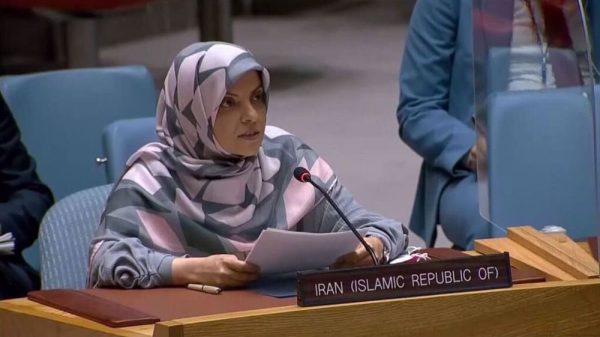
Iran’s Deputy Permanent Representative to the UN Zahra Ershadi
Press TV – January 6, 2022
An Iranian envoy to the United Nations has raised concerns about the possession of chemical weapons by the United States and Israel, describing the pair as the main obstacles to the elimination of such arms across the world.
Zahra Ershadi, deputy permanent representative of Iran to the UN, made the remarks on Wednesday at the Security Council briefing on chemical weapons in Syria.
She said that the elimination of all chemical weapons worldwide was the prime objective of the Chemical Weapons Convention (CWC), and that this goal could be realized only through the treaty’s full, balanced, effective and non-discriminatory implementation, as well as its universality.
It is therefore a source of serious concern that due to non-compliance by the United States, this objective has yet to be realized, she added.
Ershadi also stressed that the Israeli regime must be compelled to join the CWC without any precondition or further delay.
Warning against the serious impact of politicization on the CWC’s credibility, the Iranian envoy called for de-politicization of the work of the Organization for the Prohibition of Chemical Weapons (OPCW).
Iran reiterates its long-standing and principled position on the need to strongly condemn the use of chemical weapons by anyone, anywhere and under any circumstances, she said.
The only absolute guarantee that chemical weapons will not be used again is the total destruction of all chemical weapons across the globe, she said, adding that all necessary measures should be taken to ensure that such weapons will not be produced and used in the future.
Citing significant efforts by Syria to carry out its obligations under the CWC, including the complete destruction of all its 27 chemical facilities as verified by the OPCW, Ershadi said the holding of monthly Security Council meetings to consider the Syrian file is unjustified.
Syria surrendered its entire chemical stockpile in 2013 to a mission led by the United Nations and the OPCW.
It believes that false-flag chemical attacks on the country’s soil have been staged by foreign-backed terrorists in a bid to pressure the government amid army advances.
Syria slams West’s disinformation campaign
Speaking at Wednesday’s Security Council briefing, Syria’s Permanent Representative to the UN Bassam Sabbagh condemned any use of chemical weapons, emphasizing that the Damascus government has never employed such prohibited arms, despite the threats posed by terrorist groups and their sponsors on its territory.
Since joining the CWC in 2013, Syria has cooperated with the United Nations to eliminate its stockpiles and production facilities, a process that was completed in record time, in mid-2014, he added.
Sabbagh also rejected the disinformation campaign launched by some Western countries, which have adopted a hostile policy against Syria and created the OPCW Investigation and Identification Team, he said that reports by the body have become part and parcel of the hostile Western campaign.
He further urged the UN not to “drag its feet” in investigating the use of chemical weapons by terror outfits and cautioned that certain Western states often jump to conclusions before the end of the probe.
EU’s top court allows European firms to scrap Iran deals
Press TV – December 22, 2021
The EU’s supreme court has intervened to protect European companies against legal action by Iran for failing to fulfill their contractual obligations.
The European Court of Justice (ECJ) in Luxembourg has ruled that EU companies can end contracts with Iranian firms if upholding the deals would lead to “disproportionate economic loss” as a result of US sanctions.
The ruling was prompted by a lawsuit from the German branch of Iran’s Bank Melli against Deutsche Telekom after the telecommunications provider terminated a contract with the bank in 2018 prior to its expiry.
The decision effectively neutralizes a “blocking statute” that prohibited individuals and companies in the European Union from complying with US sanctions imposed in 2018 by then US president Donald Trump after he decided to withdraw unilaterally from the Iran nuclear deal.
As per their obligations under the nuclear deal, the Europeans issued the statute in order to keep Iran in the agreement, but companies in the bloc quickly severed ties rather than risk running afoul of the US.
Under the blocking statute, European firms must seek a legal exemption for withdrawing from Iran due to US sanctions and those failing to do so could be penalized by their governments. Firms, however, can twist the law if they claim that their withdrawal is a business decision.
The court on Tuesday paid lip service to the EU blocking statute in its ruling, saying “the prohibition imposed by EU law on complying with secondary sanctions laid down by the United States against Iran may be relied on in civil proceedings”.
But the judges also said the rules of the blocking statute “cannot infringe the freedom to conduct a business by leading to disproportionate economic loss”.
The Higher Regional Court in Hamburg will have to decide whether upholding the contract with Bank Melli would expose Deutsche Telekom to such a disproportionate economic loss.
Observers believe the decision is a foregone conclusion, given that Deutsche Telekom makes about half of its turnover with its US business.
The ECJ said the Hamburg judges must take into account that Deutsche Telekom did not apply for an exemption from the EU blocking statute’s rules.
Other European measures taken to maintain open trade channels with Iran have equally proven to be empty shells.
For example, Iranians have got almost nothing from the Swiss Humanitarian Trade Agreement (SHTA) since it was launched in January 2020 with the support and consent of the US.
The Swiss trade channel much publicized by Washington as a purportedly secure way of delivering humanitarian assistance to Iran at a time of sanctions has failed to process even a single deal on Iranian medicine imports.
The channel was meant to find a way around the US sanctions to use Iranian funds deposited abroad to buy food and medicine for the country via the Swiss bank BCP.
However, companies seeking to participate in the scheme have found it very difficult to comply with the criteria set by the US government to avoid violating the general rules governing the sanctions, said the report.
Fabian Maienfisch, a spokesman for Switzerland’s State Secretariat for Economic Affairs (SECO), which oversees the channel, has admitted in the past that the initiative had effectively failed to meet its objectives.
Such failures and the ECJ’s ruling prove statements by the Iranian government that the Europeans are disingenuous in dealing with the Islamic Republic.
The ruling comes as Iran and the Europeans continue negotiations in Vienna to find a way to remove the US sanctions.
A possible revival of the agreement would require the European companies to return to Iran and fulfill their obligations, but the EU court decision appears to be intentionally timed to provide them a leeway for further violations.
‘US is Utterly Dishonest’: Why Tehran Won’t Accept Partial Removal of Sanctions by Washington
By Ekaterina Blunova | Sputnik | December 16, 2021
Partial removal of sanctions by the US is not enough to facilitate the revival of the Iranian economy, hurt by the Trump administration’s “maximum pressure” policies, say Iran affairs experts, adding that under the new government Tehran is set to protect the country’s national interests more determinedly.
The United States signalled on 14 December that it is fully prepared to lift those sanctions against Iran that are inconsistent with Washington commitments under the 2015 Joint Comprehensive Plan of Action (JCPOA). That “would allow Iran to receive the economic benefits of the deal,” remarked Linda Thomas-Greenfield, US ambassador to the United Nations, during a UN Security meeting.
For his part, Iran’s Permanent Representative to the United Nations Majid Takht Ravanchi stressed that Washington should lift all sanctions slapped on Tehran and provide guarantees that it would not withdraw from the accords again and it would not abuse the procedures set out in the JCPOA and Resolution 2231.
‘All Anti-Iran Sanctions Have to be Lifted’
“The United States is being utterly dishonest,” says Seyed Mohammad Marandi, a professor at Tehran University, who was part of the Iranian delegation that helped to negotiate the 2015 nuclear deal. “All the sanctions are inconsistent with the 2015 nuclear deal. The maximum pressure campaign was targeting innocent women and children. It was an act of war and the objective was to force Iran to accept changes to the nuclear deal.”
The Trump administration unilaterally withdrew from the JCPOA in May 2018 despite Tehran observing all the provisions of the nuclear accords. Subsequently, the US slapped sanctions on major spheres of the Iranian economy, including the country’s petroleum industry, under the so-called “maximum pressure” campaign.
“Through the maximum pressure campaign, the United States imposed sanctions under all sorts of different names: missile defence, terrorism, Iran’s regional allies, the nuclear programme, human rights and everything except global warming was included, when all of these sanctions had one objective, and that was to force Iran to appease the United States and the Europeans,” Marandi emphasises.
Although the White House changed the rhetoric, in reality, it is trying to cheat Iran and violate its commitments by lifting only those sanctions that were labelled under the nuclear programme, according to the academic.
Moreover, while “the US has a range of sanctions on Iran and President Biden has not removed any since coming to office,” notes Professor Shahram Akbarzadeh from Deakin University in Melbourne, Australia.
Even though the partial removal of sanctions sounds like a positive sign, it will not make a big difference to Iran’s access to the global economy, according to Akbarzadeh. He explains that “many international corporations will continue to be reluctant to invest in Iran because of the extreme uncertainty surrounding the future of talks and the prospects of Iran’s entry into the international market.”
“The Iranian leadership is unlikely to see partial sanctions removal as enough to assuage their concerns,” Akbarzadeh believes. “It insists on an unconditional return to that deal, and Washington has been reluctant to ‘give-in’ to that demand.”
According to the professor, this dynamic may hinder the progress of the Vienna talks over the revival of the JCPOA.
Ebrahim Raisi gives a news conference after voting in the presidential election, at a polling station in the capital Tehran, on June 18, 2021. – Raisi on June 19 declared the winner of a presidential election, a widely anticipated result after many political heavyweights were barred from running. – Sputnik International, 1920, 21.06.2021
‘US is Not in Strong Position in Vienna Talks’
While the US is not present at the table in Vienna, American diplomats are taking part in indirect talks with their Iranian counterparts. Washington does not have an upper hand in the ongoing talks, according to Seyed Mohammad Marandi:
“The Iranians see that the United States has huge problems at home,” he notes. “Political, social and economic problems are causing major issues inside the United States. The United States is increasingly losing ground to a rising China and the re-emerging Russia, and Iran and its allies across the region are growing stronger and American allies are growing weaker.”
In response to Trump’s unilateral withdrawal from the nuclear deal, the Islamic Republic started to gradually loosen the JCPOA restrictions on uranium enrichment starting from July 2019. “The Iranian peaceful nuclear programme is developing and it’s a leverage [in the talks],” according to the professor.
It’s the Americans who need the deal right now and the Iranians know that, Marandi notes, adding that Tehran will see “if the Americans will become reasonable enough to do what is good for themselves.”
At the same time, Washington and its European allies have apparently overlooked the damage their policies inflicted on the Iranian economy and the country’s population, the professor highlights, adding that “the issue of compensation is always on the table.”
The new Iranian government led by President Ebrahim Raisi has adopted a more robust approach in protecting Iranian national interests, according to Marandi. Even though the new Iranian government is critical of the JCPOA deal, it will not tear it apart, unlike the US government, but will observe its commitments. At the same time, Tehran will demand “that what has been signed, the JCPOA, be fully respected by the United States and the Europeans,” the professor underscored.
The Vienna negotiations between Iran and other signatories to the 2015 deal, including the UK, France, Germany, Russia, and China resumed in December after a five-month hiatus caused by the election of a new government in Tehran.
At the beginning of this month, the White House voiced its dissatisfaction with proposals by the new Iranian government. According to European diplomats, Tehran has demanded changes to a set of compromises agreed upon a few months ago with the previous Iranian administration. The E3 group of Britain, France and Germany went so far as to accuse the Iranian leadership of “walking back almost all of the difficult compromises crafted after many months of hard work.”
Iran’s chief negotiator Ali Bagheri Kani tweeted on 14 December that the E3 and Washington “persist in their blame game habit, instead of real diplomacy”: “We proposed our ideas early, and worked constructively and flexibly to narrow gaps; diplomacy is a two-way street. If there’s a real will to remedy the culprit’s wrongdoing, the way for a quick good deal will be paved.”
For his part, Iran’s Permanent Representative to the UN Majid Takht Ravanchi told a UN Security Council meeting on Tuesday that Iran does not impose any preconditions or new conditions in the negotiations to revive the JCPOA and only wishes to see the restoration of the initial terms of the nuclear accord.
“We call for the full, timely, unconditional and verifiable implementation of the JCPOA. No more, no less,” Ravanchi underscored.
Iran says has still not received any initiative from other side in Vienna talks
By Homa Lezgee – Press TV – December 13, 2021
Vienna – Iran’s lead negotiator at the Vienna talks aimed at reviving the Joint Comprehensive Plan of Action, the JCPOA, says his team has not yet received any proposal or initiative from the other side to help resolve the outstanding issues.
In the past days questions have arisen about the drafts being discussed and whether the Iranian team’s amendments and proposals, offered in the form of two written drafts at the beginning of the seventh round, are still on the table.
Iran says it will only go back to full compliance after the full and verifiable removal of US sanctions and while some sources say the Iranian demands are stalling progress, others like Russia’s lead delegate maintain that the atmosphere is positive amid intensive dialogue.
On Sunday, a third Working Group focusing on the sequencing of compliance by all parties was held for the first time during the seventh round of the talks. That was followed by a trilateral meeting between Iran, Russia and China. There’s still no official word on the duration of the current round of negotiations.
US and Iran are getting ever closer to war. Washington has only itself to blame
By Scott Ritter | RT | November 9, 2021
A tense US-Iranian naval standoff appears to be related to the US enforcement of unilateral oil sanctions targeting Iran. Iran’s response suggests that Tehran may not be willing to play this game for much longer.
Amid growing tensions in the region, the United States and Iran carried out tit-for-tat naval exercises in the Persian Gulf designed to send a signal to the other – mess around at your own risk. The US exercises comprising six coastal patrol boats, supported by an expeditionary mobile base platform ship and a guided-missile destroyer, involved live fire exercises using surface-to-surface missiles. Iran followed this display of US military prowess with a demonstration of its own in the form of the annual Zolfaqar military exercise, which included live-fire drills involving anti-ship missiles, drone swarms, and submarine-launched torpedoes.
The dueling drills come nearly two weeks after a confrontation in international waters between the Iranian Revolutionary Guard and the US Navy. While the specific circumstances surrounding this confrontation remain unclear, with both Iran and the US providing competing narratives, one thing is for certain – on October 24, 2021, Iranian and US naval forces faced off in a tense environment, loaded weapons pointed at one another, while Iranian forces boarded and took control of a Vietnamese-flagged oil tanker, which was then sailed into Iranian territorial waters, ending the face-off.
The Iranians claim that the US was engaged in an act of “piracy,” trying to seize a shipment of Iranian oil that was loaded onto the MV Southys, owned by the Hanoi-based OPEC Petroleum Transport Company. Iran was compelled to board the vessel, using helicopter-borne commandos, and then sail the ship and its 26-person crew to the Persian Gulf port city of Bandar Abbas. The US denies the Iranian accusations, instead claiming that US Navy vessels in the region responded to reports of a ship in distress and were simply monitoring the situation.
History suggests that the Iranian version of events is closer to the truth. The US has a reputation for seizing Iranian petroleum shipments on the high seas, part of what it claims to be the lawful enforcement of US sanctions targeting Iran (it should be noted that the sanctions in question are unilateral in nature, and have no enforceable status under international law.) In August 2020, the US seized four Liberian-flagged vessels (the M/T Bella, M/T Bering, M/T Pandi and M/T Luna) carrying approximately 1.116 million barrels of fuel. No military force was used by the US in the seizure of the cargo. Instead, the US worked with the assistance of foreign partners to threaten ship owners, insurers, and captains with sanctions to force them to surrender their cargo to US control. In the case of the four Liberian-flagged tankers, the ships sailed to the US port of Houston, where their cargo was offloaded.
On the same day that the US affected the seizure of the four Liberian-flagged tankers, the Iranian Revolutionary Guard Corps boarded another Liberian-flagged tanker, the M/T Wila, off the coast of the United Arab Emirates, using tactics which mirrored those that had been used against the MV Southys – a special forces team was inserted onto the deck of the tanker using a helicopter, while Iranian patrol boats circled nearby. After five hours, the Iranians departed the ship. The US confirmed that the Iranian seizure of the M/T Wila was related to the US seizure of the four tankers. “They [the Iranians] were looking for their gas,”a US spokesperson noted.
According to Iranian sources, the boarding of the MV Southys was related to the August 2020 seizure of the four tankers carrying Iranian oil. An analysis of the events leading up to the seizure of the MV Southys by Iranian forces suggests that this indeed may be the case. According to an anti-Iranian advocacy group, United Against Nuclear Iran (UANI), satellite imagery from June 2021 shows the MV Southys engaged in what is known as ‘ship-to-ship’ transfer of oil from an Iranian tanker, the Oman Pride. In August 2021 the US Treasury Department named the Oman Pride as an asset of the Iranian Revolutionary Guards Corps Quds Force, which was part of a larger scheme to raise funds for the Quds Force by selling Iranian oil in violation of sanctions. According to UANI, most of this oil ends up being sold to China.
According to the Tankers Trackers website (affiliated with UANI), the MV Southys was supposed to make a delivery of some 700,000 barrels of crude oil to a Chinese port. For some reason, the shipment was rejected, and the MV Southys headed back to the port of Sohar, Oman. The timing of the rejection of the MV Southys’ cargo coincides with a letter sent by UANI to the Vietnam Maritime Administration, which detailed its analysis of satellite photos it claimed showed the MV Southys received a ship-to-ship transfer of oil from the Oman Pride. Given the high-profile composition of the leadership of UANI, which includes many former US government officials and heads of foreign intelligence services, it is likely that this letter was sent in conjunction with outreach by UANI to the US government, which in turn could have put the Vietnamese government on notice that it could be subjected to sanctions for doing business with the Iranian Revolutionary Guard Corps. If this scenario is accurate, the Vietnamese government could have ordered the MV Southys not to offload its cargo, leaving it no choice but to return to the Persian Gulf.
When the MV Southys approached Iranian waters, it was shadowed by a US guided-missile destroyer, the USS Sullivans. Perhaps fearing that the US would seek to take control of the MV Southys and its contents, and uncertain as to the loyalty of the vessel’s captain, the Iranians opted to take control of the tanker and divert it to Bandar Abbas, where its contents could be offloaded. By taking control of the MV Southys in this manner, Iran also avoided the logistical difficulties of attempting a ship-to-ship transfer of oil to an Iranian tanker while under the watchful eyes of the US Navy.
The truth about what transpired with the MV Southys will undoubtedly emerge in the weeks to come. What is certain, however, is that the Iranians have long classified US sanctions against them as violations of international law, and US efforts to seize Iranian oil shipments acts of piracy. The seizure of the MV Southys by Iranian forces, and the aggressive way the US Navy was confronted by Iranian patrol boats, suggests that Iran is determined to forcefully confront any future attempts by the US to enforce its unilateral sanctions. One of the major roadblocks to restarting the Iran nuclear deal, also known as the Joint Comprehensive Plan of Action (JCPOA), is the issue of the US ending its sanctions regime against Iran. If anything, the delay in restarting the JCPOA has shown that there is a military risk attached to the political, and that any continued delay in the negotiations could result in war.
Scott Ritter is a former US Marine Corps intelligence officer and author of ‘SCORPION KING: America’s Suicidal Embrace of Nuclear Weapons from FDR to Trump.’
Drone attack on Iraqi PM ‘must be traced back to foreign think tanks’ – Iran
RT | November 7, 2021
The alleged assassination attempt of Iraqi Prime Minister Mustafa al-Kadhimi was orchestrated by a foreign power seeking to destabilize the country, a senior Iranian security official said.
The apparent attempted assassination of the Iraqi prime minister was “a new sedition that must be traced back to foreign think tanks,” according to Ali Shamkhani, the secretary of the Supreme National Security Council of Iran.
In the past, foreign instigators “have brought nothing but insecurity, discord & instability to oppressed Iraqi people through creation & support of terrorist groups & occupation of this country,” he tweeted.
Al-Kadhimi’s residence in Baghdad’s heavily fortified Green Zone was reportedly targeted by a drone rigged with explosives. The official said he was not hurt in the incident.
The reported attack occurred in the aftermath of protests in the Iraqi capital over the outcome of last month’s parliamentary election, which pro-Iranian Shia parties claim was rigged. Demonstrations were mired by violent clashes with police, which resulted in multiple injuries on both sides and allegedly a handful of deaths among the protesters.
Earlier on Sunday, Mahmoud al-Rubaie, a spokesman for the Shia political coalition al-Sadiqoun Bloc, suggested that the attack on the prime minister’s home was fabricated, saying the US air defenses in the Green Zone would have intercepted any incoming drones. The incident is a plot to distract the public, al-Rubaie said.
Nuclear States Unwilling to Live up to Disarmament Commitments: Iran Envoy
Al-Manar – October 29, 2021
Iran’s permanent Ambassador to the United Nations Majid Takht-Ravanchi slammed the states and regimes who hold nuclear weapons while seek justifications for not abiding by their commitments.
Takht-Ravanchi made the comments after the UN Disarmament and International Security (First Committee) approved the resolution presented by Iran on Thursday, according to IRIB.
“Unfortunately, nuclear weapons holders are unwilling to live up to their nuclear disarmament commitments and only try to justify that the necessary ground is not ready for nuclear disarmament,” the Iranian envoy said, as quoted by Mehr news agency.
He said that their justification cannot be bought and added, “They committed themselves to nuclear disarmament in 1970, and this is not justifiable.”
The Islamic Republic of Iran proposed a resolution the follow-up on the implementation of the agreements reached at the NPT Review Conferences of 1995, 2000 and 2010″, and was adopted with the support of a majority of the members of the UN Disarmament and International Security (First Committee).
In part of the resolution proposed by Iran, the implementation of the decision of the NPT Review Conference in 1995 to establish a nuclear-weapon-free Middle East is emphasized. The decision calls on Israeli regime to join the NPT and accept the International Atomic Energy Agency’s monitoring of its nuclear facilities.
US continues to defy International Court of Justice’s orders in cases filed by Iran
Press TV – October 28, 2021
Iran’s permanent ambassador to the United Nations says the US administration continues to disregard orders issued by the International Court of Justice (ICJ), which have been handed down in cases filed by Iran against US and vice versa.
Majid Takht-Ravanchi made the remarks in an address to the UN General Assembly on Thursday, emphasizing that Iran acknowledges “the vital role of the ICJ in the prevention of hostilities and mitigation of crises through peaceful settlement of disputes as well as in strengthening the rule of law, preserving international order and tackling unilateral measures.”
“Due to adoption of a number of legislative and executive acts in the United States in flagrant violation of international law, the immunity of states and their properties from suit before US courts as well as immunity from jurisdiction and enforcement have been removed against Iran,” he added.
Takht-Ravanchi noted that as a result of the filing of cases in the US courts against Iran as well as its officials and the Central Bank (CBI), “the assets of the CBI have been subjected to execution in order to satisfy a default judgment.”
“The Islamic Republic of Iran believes that such asset blocking and enforcement proceedings against the CBI and certain Iranian companies and banks in the US is in violation of provisions of ‘Treaty of Amity, Economic Relations, and Consular Rights of 1955’ between the two countries,” Iran’s UN envoy said.
Takht-Ravanchi said following the unilateral withdrawal of the US from the 2015 Iran nuclear deal and the unlawful re-imposition of sanctions against Tehran, Iran filed an application instituting proceedings against the US with regard to violations of multiple provisions of the Treaty of Amity.
He said on October 3, 2018, the ICJ issued an order unanimously requiring the US to remove any impediments on the importation of foodstuffs as well as medicines and medical devices to Iran and also ordered Washington to ensure that the licenses and necessary authorizations are granted and that payments and other transfers of funds are not subject to any restriction in so far as they relate to the aforementioned goods and services.
“Regrettably, the United States has not only failed to comply with the Court’s Order but, by imposing new sanctions, especially during the outbreak of the COVID-19 pandemic, has also deliberately defied that Order,” Takht-Ravanchi said.
Iran, he noted, has on several occasions brought the US non-compliance with the Order to the Court’s attention and the answer provided by the US in this regard has always been a repetition of its previous contentions; that humanitarian transactions are exempt from its sanctions.
However, Takht-Ravanchi added, “through tightening the grip of sanctions after the Court’s Order, the US … violated this Order which requires that ‘Both parties shall refrain from any action which might aggravate or extend the dispute before the Court or make it more difficult to resolve’.”
Tehran has on multiple occasions called on the United Nations court to order the immediate lifting of the sanctions, and demanded compensation for damages incurred in their wake.
Sanctions had been lifted under the 2015 nuclear agreement between Iran and world powers- the US, Germany, France, Britain, China and Russia.
Former President Donald Trump unilaterally pulled the US out of the deal with Iran in May 2018 and reimposed draconian sanctions as part of the so-called maximum pressure campaign against the country.
Earlier this year, the ICJ ruled that it can take on Iran’s bid to overturn illegal US sanctions re-imposed by Trump after he pulled Washington out of the nuclear deal.
The United States had tried to argue that Iran could not base claims at the ICJ on the 1955 Treaty of Amity, Economic Relations, and Consular Rights between the two countries. However, a majority of a panel of 16 judges found the treaty could be used as a basis for the ICJ’s jurisdiction.
The new US administration said it is “disappointed” by the ruling, despite President Joe Biden’s criticism of his predecessor for reinstating the bans on the Islamic Republic after leaving the landmark accord.
Israel to Attack Iran? Washington Gives the Green Light to the ‘Military Option’
By Philip Giraldi | Strategic Culture Foundation | October 28, 2021
Some might recall candidate Joe Biden’s pledge to work to rejoin the Joint Comprehensive Plan of Action (JCPOA) which was a multilateral agreement intended to limit Iran’s ability to develop a nuclear weapon. The JCPOA was signed by President Barack Obama in 2015, when Biden was Vice President, and was considered one of the only foreign policy successes of his eight years in office. Other signatories to it were Britain, China, Germany, France, and Russia and it was endorsed by the United Nations. The agreement included unannounced inspections of Iranian nuclear facilities by the IAEA and, by all accounts, it was working and was a non-proliferation success story. In return for its cooperation Iran was to receive its considerable assets frozen in banks in the United States and was also to be relieved of the sanctions that had been placed on it by Washington and other governments.
The JCPOA crashed and burned in 2018 when President Donald Trump ordered U.S. withdrawal from the agreement, claiming that Iran was cheating and would surely move to develop a nuclear weapon as soon as the first phase of the agreement was completed. Trump, whose ignorance on Iran and other international issues was profound, had surrounded himself with a totally Zionist foreign policy team, including members of his own family, and had bought fully into the arguments being made by Israel as well as by Israel Lobby predominantly Jewish groups to include the Foundation for Defense of Democracies (FDD) and the American Israel Public Affairs Committee (AIPAC). Trump’s time in office was spent pandering to Israel in every conceivable way, to include recognizing Jerusalem as the country’s capital, granting Israel the green light for creating and expanding illegal settlements on the West Bank and recognizing the occupied Syrian Golan Heights as part of Israel.
Given Trump’s record, most particularly the senseless and against-American-interests abandonment of JCPOA, it almost seemed a breath of fresh air to hear Biden’s fractured English as he committed his administration to doing what he could to rejoin the other countries who were still trying to make the agreement work. After Biden was actually elected, more or less, he and his Secretary of State Tony Blinken clarified what the U.S. would seek to do to “fix” the agreement by making it stronger in some key areas that had not been part of the original document.
Iran for its part insisted that the agreement did not need any additional caveats and should be a return to the status quo ante, particularly when Blinken and his team made clear that they were thinking of a ban on Iranian ballistic missile development as well as negotiations to end Tehran’s alleged “interference” in the politics of the region. The interference presumably referred to Iranian support of the Palestinians as well as its role in Syria and Yemen, all of which had earned the hostility of American “friends” Israel and Saudi Arabia.
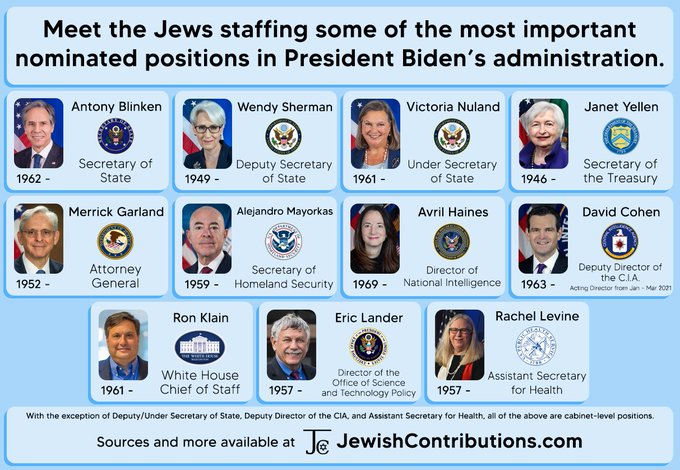 Israel inevitably stirred the pot by sending a stream of senior officials, to include Foreign Minister Yair Lapid, Defense Minister Benny Gantz and Prime Minister Naftali Bennett to discuss “the Iranian threat” with Biden and his top officials. Lapid made clear that Israel “reserves the right to act at any given moment, in any way… We know there are moments when nations must use force to protect the world from evil.” And to be sure, Biden, like Trump, has also made his true sentiments clear by surrounding himself with Zionists. Blinken, Wendy Sherman and Victoria Nuland have filled the three top slots at State Department, all are Jewish and all strong on Israel. Nuland is a leading neocon. And pending is the appointment of Barbara Leaf, who has been nominated Assistant Secretary to head the State Department’s Near East region. She is currently the Ruth and Sid Lapidus Fellow at the Washington Institute for Near East Policy (WINEP), which is an AIPAC spin off and a major component in the Israel Lobby. That means that a member in good standing of the Israel Lobby would serve as the State Department official overseeing American policy in the Middle East.
At the Pentagon one finds a malleable General Mark Milley, always happy to meet his Israeli counterparts, and Secretary of Defense Lloyd Austin, an affirmative action promotion who likewise has become adept at parroting the line “Israel has a right to defend itself.” And need one mention ardent self-declared Zionists at the top level of the Democratic Party, to include Biden himself, Speaker of the House Nancy Pelosi, House Majority Leader Steny Hoyer and, of course, Senate Majority Leader Chuck Schumer?
So rejoining the JCPOA over Israel objections was a non-starter from the beginning and was probably only mooted to make Trump look bad. Indirect talks including both Iran and the U.S. technically have continued in Vienna, though they have been stalled since the end of June. Trita Parsi has recently learned that Iran sought to make a breakthrough for an agreement by seeking a White House commitment to stick with the plan as long as Biden remains in office. Biden and Blinken refused and Blinken has recently confirmed that a new deal is unlikely, saying “time is running out.”
And there have been some other new developments. Israeli officials have been warning for over twenty years that Iran is only one year away from having its own nukes and needs to be stopped, a claim that has begun to sound like a religious mantra repeated over and over, but now they are actually funding the armaments that will be needed to do the job. Israel Defense Force Chief of Staff Aviv Kohavi has repeatedly said the IDF is “accelerating” plans to strike Iran, and Israeli politicians to include former Prime Minister Benjamin Netanyahu have regularly been threatening to do whatever must be done to deal with the threat from the Islamic Republic. Israeli media is reporting that $1.5 billion has been allocated in the current and upcoming budget to buy the American bunker buster bombs that will be needed to destroy the Iranian reactor at Bushehr and its underground research facilities at Natanz.
In the wake of the news about the war funding, there have also been reports that the Israeli Air Force is engaging in what is being described as “intense” drills to simulate attacking Iranian nuclear facilities. After Israel obtains the 5000 pound bunker buster bombs, it will also need to procure bombers to drop the ordnance, and one suspects that the U.S. Congress will somehow come up with the necessary “military aid” to make that happen. Tony Blinken has also made clear that the Administration knows what Israel is planning and approves. He met with Israeli Foreign Minister Yair Lapid on October 13th and said if diplomacy with Iran fails, the U.S. will turn to “other options.” And yes, he followed that up with the venerable line that “Israel has the right to defend itself and we strongly support that proposition.”
Lapid confirmed that one of Blinken’s “options” was military action. “I would like to start by repeating what the Secretary of State just said. Yes, other options are going to be on the table if diplomacy fails. And by saying other options, I think everybody understands here … what is it that we mean.” It must be observed that in their discussion of Iran’s nuclear program, Lapid and Blinnken were endorsing an illegal and unprovoked attack to prevent Iran from acquiring a nuclear weapon that it is apparently not seeking, but which it will surely turn to as a consequence if only to defend itself in the future.
In short, U.S. foreign policy is yet again being held hostage by Israel. The White House position is clearly and absurdly that an Israeli attack on Iran, considered a war crime by most, is an act of self-defense. However it turns out, the U.S. will be seen as endorsing the crime and will inevitably be implicated in it, undoubtedly resulting in yet another foreign policy disaster in the Middle East with nothing but grief for the American people. The simple truth is that Iran has neither threatened nor attacked Israel. Given that, there is nothing defensive about the actions Israel has already taken in sabotaging Iranian facilities and assassinating scientists, and there would be nothing defensive about direct military attacks either with or without U.S. assistance on Iranian soil. If Israel chooses to play the fool it is on them and their leaders. The United States does not have a horse in this race and should butt out, but one doubts if a White House and Congress, firmly controlled by Zionist forces, have either the wisdom or the courage to cut the tie that binds with the Jewish state.
Featured Video
Epidemic of fake videos
or go to
Aletho News Archives – Video-Images
From the Archives
Inside Job? Inside What?
By Prof. Tony Hall | American Herald Tribune | July 28, 2016
The Kevin Barrett-Chomsky Dispute in Historical Perspective – Sixth part of the series titled “9/11 and the Zionist Question”
In his chapter on “Left Gatekeepers” and the “Shame of Noam Chomsky,” Barrie Zwicker refers to the the “New World Order” as the “diaboligarchy’s” directing agency. Less compelling is Zwicker’s reference to the “New World Order” as the “diaboligarchy’s” directing agency. To me this unfortunate choice of words is much too closely associated with the often crude and chauvinistic populism of Alex Jones and his Infowars media network. Many have come to see Jones’ lucrative media operation as a limited hangout set in place by handlers trying to hold the activities of the 9/11 Truth Movement within manageable constraints.
Due to the important findings over fifteen years of the citizens’ investigation into 9/11, the culprits most deeply implicated in the crime can be identified with much more specificity than an entity vaguely described as a “New World Order.” As Kevin Barrett and many others insist, the time has come to name the names of the probable culprits, Noam Chomsky prominent among them.
While Alex Jones ultimately serves the same masters as Chomsky, the former’s media product is often much closer to the mark of what is really going on than the content of Noam Chomsky’s more magisterial pronouncements. Jones goes at least part of the way into realities of the deep state politics of the twenty-first century. Chomsky, however, sacrificed his capacity to contribute cogently to sensible discourse on contemporary geopolitics by making himself a primary instrument of the most consequential deep state deception of recent times. As a leading agent of disinformation in the psychological trenches of the ongoing Global War of False Flag Terrorism, Chomsky has reduced himself to the level of skeptic pretender Michael Shermer. In the style of Shermer, the elder Chomsky has become an establishment TV professor readily available on Netflix. … continue
Blog Roll
Recent Comments
Coronistan on EU member to sue bloc over ‘su… loongtip on Vicious loongtip on EU turns to India for defense… Coronistan on Donald Trump Is No Peace … seversonebcfb985d9 on French court jails pro-Palesti… eddieb on Fourteen Incredible Facts Abou… Bill Francis on European leaders’ shift in the… seversonebcfb985d9 on Villains of Judea: Philip Esfo… loongtip on Report warns that ‘Jewish terr… Craig Nelms on New study shows that toxic gas… loongtip on A Funny Thing Happened on the… loongtip on EU free trade pact on hold as…


 Aletho News
- Exposed – How the UAE Became Central to Gaza’s Concentration Camp Plot
- How South Korea’s gas ambitions sustain the occupation of Gaza
- “Leaked document” exposes US blueprint for total control over Gaza
- Trump wanted to play peacemaker, Netanyahu made sure he failed
- Idea of limited, fast strike on Iran misjudges our capabilities: IRGC
- US Military Buildup on Land, Air, and Sea Raises Fears of Imminent Attack on Iran – Expert
- Russia reiterates demand to Germany over Nazi crimes
- France and EU clash over UK missiles for Ukraine – Telegraph
- EU member to sue bloc over ‘suicidal’ ban on Russian gas
- WEF Calls for ‘Cultural Revolution’ to Promote Lab-Grown Meat
- If Americans Knew
- Violence against hundreds of Gazan remains to find one Israeli – Not a ceasefire Day 109
- Greenpeace Demonstrator Exposes Folly of Protest Restrictions
- From CBS to TikTok, Pro-Israel Ellison is now in the driver’s seat
- Israel pays for UK advertisements attacking Doctors Without Borders
- Israel accused of extracting billions from Gazan people to pay for their own genocide
- ‘Deliberate Assassination’: 3 Journalists Among 11 Killed by Israeli Forces in Gaza
- In Gaza, We’re Struggling to Reintroduce Foods to Bodies Adjusted to Starvation
- Will Rafah crossing be opened at last? – Not a ceasefire Day 108
- Israeli drone strike kills two children collecting firewood in Gaza – Not a ceasefire Day 107
- Another Gaza baby freezes to death on Netanyahu’s watch – Not a ceasefire Day 106
- No Tricks Zone
- New Study Affirms Rising CO2’s Greening Impact Across India – A Region With No Net Warming In 75 Years
- Germany’s Natural Gas Crisis Escalates … One Storage Site Near Empty …Government Silent
- Polar Colding…Antarctica Saw Its Coldest October In 44 Years!
- New Study: Sea Levels Rose 20 Times The Modern Rate During The Roman Warm Period
- As German Gas Storage Dips Dangerously Low…Shortage Hardly Avoidable
- New Study: Brazil’s Relative Sea Level Was 2+ Meters Higher And SSTs 3-4°C Warmer 6000 Years Ago
- Philosopher Schopenhauer: Climate Science Certainty Stems From Stupidity, Ignorance
- New Study: Species Extinction Rates Declining Since 1980 – ‘Climate Change Is Not An Important Threat’
- Denmark Places Climate Protection Above Animal Welfare, Poisoning And Culling Cows
- New Study: Greenland Was 3-7°C Warmer And Far Less Glaciated Than Today 6000-8000 Years Ago
 Aletho News