‘Iran’s electricity exports to four neighboring countries up by 40%’
Press TV – May 26, 2012
An Iranian Energy Ministry official says Iran’s electricity exports to four neighboring countries have increased by 40 percent since the beginning of the current Iranian calendar year (started March 20, 2012).
Abdolhamid Farzam, the Energy Ministry official in charge of foreign exchanges, said Sunday that Iran’s power exports to Afghanistan, Pakistan, Iraq and Turkey have seen a major boost in the past two months.
The official stated that new power transfer lines and installations have become operational for exporting electricity to Iraq, raising Iran’s electricity exports to its western neighbor to 1,200 megawatts (MW).
Farzam added that electricity exports to Pakistan have been more than doubled in the same period, saying Iran’s capacity to export electricity to Pakistan has increased from 30 MW in winter to 70 MW right now.
He said Iran is exporting an average of 30 MW of electricity to Afghanistan, while power exports to Turkey have increased from 110 MW to more than 170 MW.
The official stated that Iran will increase its power export capacity to Turkey to 500 MW in the next few days.
On May 10, Iran’s Energy Ministry published a report saying that the country’s electricity exports to its neighboring countries have increased by more than 38 percent since the beginning of the current Iranian calendar year compared to the previous year.
The report added that Iran has exported a total of 1,347 gigawatts per hour (GW/h) of electricity to the neighboring countries during the aforementioned period, up by 38.57 percent compared to the previous Iranian calendar year (ended March 19, 2012).
Iran, which seeks to become a major regional exporter of electricity, has attracted more than USD 1.1 billion in investment to build three new power plants.
Related articles
- Pakistan to buy 1,100 MW of electricity from Iran: Gilani (alethonews.wordpress.com)
- Iran to supply Lebanon with electricity next week: report (dailystar.com.lb)
Madeleine Albright and Iraq Genocide Memorial Day
By Felicity Arbuthnot | Palestine Chronicle | May 18, 2012
‘Get some new lawyers.’ — 1999: Then US Secretary of State Madeleine Albright to UK Foreign Secretary Robin Cook on his assertion that the bombing of Balkan States was illegal under international law.

In this sixteenth anniversary year of Madeleine Albright stating her endorsement of half a million child sacrifices at the altar of the UN Embargo on Iraq as a “price worth it”, this silent holocaust is to be commemorated annually.
In New Haven, Ct., On 12th May, marking the day of Albright’s infamous broadcast, a banner was unfurled and a minute’s silence held as the Middle East Crisis Committee, the Council on American-Islamic Relations (CT), the Tree of Life Education Fund and We Refuse to be Enemies, inaugurated the first Iraq Genocide Memorial Day.
Stanley Heller, Chair of the Middle East Crisis Committee commented: “This horrific loss of life was ignored for six years until the US Ambassador to the UN appeared on ’60 Minutes’ and admitted the deaths of half a million children … We in the Middle East Crisis Committee call for May 12th to be marked as Iraq Genocide Memorial Day.”
Iraq’s children of course, continued to die at an average of six thousand a month until the illegal 2003 invasion wrought further apocalyptic disaster. Currently many hospitals are assessed as even more woeful than under the embargo, thus they continue to die in a near forgotten tragedy of UN-US-UK making. Soaring cancers and birth deformities linked to weapons used in the 1991 bombings, twelve years of subsequent bombings, 2003 and the following years have exacerbated and compounded a tragedy of enormity.
As others accused of crimes against humanity and the peace end up at the International Criminal Court (but so far, only if black or Eastern European, it seems) Albright gathers a bizarre collection of “humanitarian” awards.
One of the strangest is surely the Freedom Award from the International Rescue Committee, initiated by Albert Einstein which: “responds to the world’s worst humanitarian crises and helps people survive and rebuild their lives (offering) lifesaving care and life-changing assistance …” Endorsing infanticide hardly falls within the IRC’s lofty stated aspirations.
Two years after her statement on disposable children, Albright, now having abandoned further tarnishing the United Nations fine founding aspirations, to become US Secretary of State, declared (February 1998) : “Iraq is a long way from (here), but what happens there matters a great deal here. For the risks that the leaders of a rogue state will use nuclear, chemical or biological weapons against us or our allies is the greatest security threat we face.”
A year later, the 1999 razing of much of the Balkans became known as “Madeleine’s war.” The largely unrecognized nation of Kosova, carved from that decimation is now rated one of the most corrupt and lawless countries in the region and high in world ranking, according to December 2011 findings by Transparency International.
Talking after the virtual destruction of Iraq as a nation state, it’s records, government institutions bombed, looted, stolen, she told Jim Lehrer in September 2003: “ … I think we actually … kept him (Saddam Hussein) in a strategic box. We bombed very much if you remember all the maps, always in terms of North and South — covers a great portion of Iraq. I think we had him in the box.” No mention that both the bombing and the “box” were comprehensively illegal.
As ever, the majority of “bombed” victims were Iraq’s children for whom her contempt was seemingly boundless: small rural shepherds and goat herders tending the family flocks on the vast flat tundra, with no place to hide.
One politician with whom she had sparred did take a stand in vast contrast. Robin Cook, Britain’s Foreign Secretary resigned in protest two days before the invasion. His resignation speech in Parliament on 18th March 2003 was a searing indictment of stark double standards on dealing with Iraq. Deliberate selective perception which could now equally apply to threats to Iran:
“I have heard it said that Iraq has had not months but twelve years in which to complete disarmament, and that our patience is exhausted”, he began.
“Yet it is more than thirty years since (UN) Resolution 242 called on Israel to withdraw from the occupied territories.
“We do not express the same impatience with the persistent refusal of Israel to comply.”
He talked of: “ … the strong sense of injustice throughout the Muslim world at what it sees as one rule for the allies of the US and another rule for the rest.”
Britain’s credibility was not: “helped by the appearance that our partners in Washington are less interested in disarmament than they are in regime change in Iraq.
“That explains why any evidence that inspections may be showing progress is greeted in Washington not with satisfaction but with consternation: it reduces the case for war.
And as Iran now, he pleaded that: “Inspections be given a chance (that the UK was) “being pushed too quickly into conflict by a US Administration with an agenda of its own.
He asked for the halt of: “commitment of troops in a war that has neither international agreement nor domestic support” and ended: “I intend to join those tomorrow night who will vote against military action. It is for that reason alone, and with a heavy heart, that I resign from the government.”
On the first anniversary of the invasion he stated in Parliament: “It seems only too likely that the judgment of history may be that the invasion of Iraq has been the biggest blunder in British foreign and security policy in the half century since Suez. “In truth we would have made more progress in rolling back support for terrorism if we had brought peace to Palestine rather than war to Iraq.”
Robin Cook died of a heart complication whilst hill walking on remote Ben Stack in Scotland, coincidentally within a swathe of land owned by the Duke of Westminster, a Major General and at the time Assistant Chief of Defence Staff, who visited British held Basra a number of times after the invasion.
His death was on the 6th August, 2005, Hiroshima Day and the fifteenth anniversary of the imposition of the all denying embargo on Iraq. A price Robin Cook had clearly not thought “worth it.”
It has to be hoped that Iraq Genocide Memorial Day spreads worldwide both in memory of those abandoned by the inspiring words committed to in the UN Charter, the numerous hidden casualties, dead and alive – and as a reminder that for a great swathe of the world, mortifyingly, it is the West which appears to be increasingly despotic.
– Felicity Arbuthnot is a journalist with special knowledge of Iraq. Author, with Nikki van der Gaag, of Baghdad in the Great City series for World Almanac books, she has also been Senior Researcher for two Award winning documentaries on Iraq, John Pilger’s Paying the Price: Killing the Children of Iraq and Denis Halliday Returns for RTE (Ireland.)
Embedded NYT Reporter Boosts US War in Honduras (and Why We Shouldn’t Listen)
By Dawn Paley | Upside Down World | May 9, 2012
Sunday’s edition of the New York Times featured a front page story by Thom Shanker about how the US is waging an “Iraq-style” war on drugs in Honduras.
Shanker, a former Senior Writer in Residence with the Centre for New America Security (which the WSJ called a “farm team” for Obama’s national security advisors), has also been the NYT’s Pentagon correspondent, was embedded in Afghanistan, and has reported from Iraq.
The piece, which ran online as US carries lessons of Iraq into Honduras drug war is your classic bit of embedded journalism. The dateline is a U.S. military base (ahem, forward operating location), the sources are soldiers and marines, and the Hondurans — which are included in photos only — are soldiers.
Hey, world, the U.S. is at war with the bad guys in Honduras! Is the gist of the article, but Shanker’s pro-establishment/embedded bias does little to give readers an informed perspective about what is actually taking place in the Central America.
First off, Shanker does his best to set the story up as being all about drugs, even though it is common knowledge that U.S. militarization doesn’t decrease drug production or trafficking. “Forty years of increasingly violent efforts to stamp out the drug trade haven’t worked,” reads a recent piece in Foreign Policy magazine.
Then Shanker slips into a description that is perhaps a little more indicative of the U.S. role in Honduras:
This new offensive, emerging just as the United States military winds down its conflicts in Iraq and Afghanistan and is moving to confront emerging threats, also showcases the nation’s new way of war: small-footprint missions with limited numbers of troops, partnerships with foreign military and police forces that take the lead in security operations, and narrowly defined goals, whether aimed at insurgents, terrorists or criminal groups that threaten American interests.
Is this about drugs, or is it about securing U.S. sweatshops in Honduras? Is it about drugs, or is it about seeing the entire population of Honduras as a latent “criminal” group that could, at any moment, become “illegal” immigrants? Is it about drugs, or is it about controlling insurgents (aka rebels or revolutionaries), namely the members of a massive popular movement that has risen up since the illegal coup d’etat in Honduras in 2009?
You’d be forgiven for reading this piece and not knowing about the coup: Shanker left out that, ahem, little detail in his piece. The U.S. media don’t like to talk about how the coup, carried out by the Honduran army and supported by Honduras’ tiny transnational elite, has sparked a massive popular movement all across the country. But acknowledging that there is a huge (and generally peaceful) popular movement in Honduras makes war boosterism more complicated. Better to stick to the fighting drugs and bad guys, you know the quasi criminal terrorist line…
The re-militarization of Honduras isn’t just about Honduras — it is about the entire region.
Shankar mentions that US anti-drug teams developed in Afghanistan are now active in Honduras to “plan interdiction missions in Central America.” He makes passing reference to how Honduras was used for staging the war against the Sandinistas in Nicaragua, but leaves out the fact that Honduras was also the staging area for the 1954 CIA backed coup in Guatemala, and for US backed wars against the FMLN in El Salvador later on (and on, and on). Looks like the bad old days of the “USS Honduras” are coming back in a big way – this, in a country that already has one of the highest murder rates in the world.
The fact that the New York Times is sending embedded journalists to Central America is gross. Instead of talking to, um, Hondurans, Shanker quotes the Council on Hemispheric Affairs* as a sort of “critical” voice. Check this quote, from Larry Binns of the COHA:
“We know from the Reagan years that the infrastructure of the country of Honduras — both its governance machinery as well as its security forces — simply is not strong enough, is not corruption-proof enough, is not anti-venal enough to be a bastion of democracy.”
The Reagan years!? Excuse me? What about the freaking military coup during Obama’s administration? Sigh.
The implication that what the US did/learned in Iraq was a success alone is obviously beyond problematic for reasons that others can explain far better than I.
Finally, Shanker ends off paraphrasing a money quote from an ex-Navy SEAL, writing “There are ‘insidious’ parallels between regional criminal organizations and terror networks.” I can’t bring myself to unpack this here, but the immediate implication (more war) is obvious, no matter how you understand the world.
Anyhow, some folks might argue that this piece is useful because it reveals the US mission in Honduras. I don’t agree — I think this piece is useful to the Pentagon and the US elite. There’s so little factual, contextual or historical information in here that this piece is near useless even for a critical reader.
Related articles
- Honduras and the Obama Administration (alethonews.wordpress.com)
- Honduras – Journalist and rights activist found dead (en.rsf.org)
Bad Losers’ Conference: Syrians Pay the Price
By Jeremy Salt | Palestine Chronicle | April 3, 2012
Ankara – The ‘Friends of Syria’ conference in Istanbul ended with a pledge of qualified support for the Annan plan while agreeing on concrete measures to undermine it. Saudi Arabia and other gulf states are going to stump up the money to turn the so-called Free Syrian Army into a fully-fledged mercenary army. Saudi Arabia and Qatar had previously said that they intended to spend millions of dollars arming the ‘rebels’ and at the ‘Friends of Syria’ conference, the US, Britain and the gulf states agreed to spend millions more on providing the armed groups with unspecified ‘humanitarian’ assistance and ‘communications equipment’. The gulf states are also hoping their money will lure Syrian soldiers into defecting.
Saudi Arabia and Qatar operate on the basis of human cupidity and greed. They must be surprised on those occasions when they discover that not everyone has a price. Late last year the Qatari Prime Minister, Hamad bin Jasim al Thani, was reported to have offered Syrian Foreign Minister Walid al Muallim $100 million and permanent residence in Qatar if he would defect. The occasion was a meeting of the Organisation of the Islamic Conference in Jeddah. Muallim declined, asking in return, rhetorically of course, how much money Qatar had spent so far internationally and regionally to deepen the crisis in Syria. This follows on from the money Qatar spent on the destruction of the Libyan government.
In February eight million Syrians voted for political reform that will usher in a multi-party political system and will remove the Baath party as the central pillar of state and society. The armed gangs have been chased out of the cities where they had dug themselves in. Human rights groups and the media are finally drawing attention to what they have wilfully ignored for months, the extreme violence of the FSA and other groups of armed men, directed against soldiers and civilians. Recently Der Spiegel, rightwing and openly hostile to the Assad government, ran an article on the executioners of Homs, the men who were taking the captives of the FSA to a burial ground and cutting their throats. Interesting that none of the correspondents smuggled across the border into Homs seem to have picked this up before.
If there is a role for any outside party surely it should be to help wind down the conflict in Syria, not wind it up, yet this is precisely what the ‘Friends of Syria’ are doing. Will Ban Ki-Moon or Kofi Annan have anything to say about this? They have a peace plan which cannot possibly work as long as its ostensible supporters are working to undermine it. Syria has accepted the Annan plan but has made the obvious point that it cannot pull its soldiers and tanks off the streets unless the armed gangs lay down their weapons. Here we have Saudi Arabia and Qatar shelling out money to ensure they keep fighting, with the backing of the other ‘Friends of Syria’. We can see what this is intended to produce, a situation in which every time the Syrian army is involved in conflict with armed groups it will be blamed for violating the Annan plan. All the ‘rebels’ have to do is keep shooting. This is exactly what their peace-loving supporters meeting in Istanbul want them to do.
If there is a proper name for the group that met in Istanbul it should be the Bad Losers’ Conference. These people have thrown everything into the struggle to bring down the Syrian government. They have plotted and conspired. They have used their media and they have thrown money and weapons at the ‘rebels’ but they have failed. Assad – abused and insulted by them – is still there and more on top of the situation than he was a little while ago. It should be ‘game over’ but Saudi Arabia and Qatar, in particular, are determined to play on irrespective of the cost in human lives and destruction to Syria and its people.
Hillary Clinton or her public relations machine tried to give the impression that she was in Saudi Arabia to talk the Saudis out of doing anything rash. More likely she was there to frame how the next steps would be taken, with Saudi Arabia stepping out in front and the US appearing to follow on behind. There is no point in saying anything about Clinton. She is what she is and no comment is needed. The Saudis are driven by their own agenda, which is to set up a Sunni Muslim wall against Iran and Shi’ism across the Middle East. Does anyone seriously think they have the best interests of the Syrian people at heart?
As for Turkey, its relationships with near neighbors have been transformed in the space of a year from good to bad. Insofar as Syria is concerned, the Turkish Prime Minister and his Foreign Minister have burnt their bridges. It is either them or Assad from now on. Certainly there can be no resumption of good relations as long as he or they remain in government. Someone has to go and they are determined it is going to be him. Alienating Syria has meant alienating Iran and raising the suspicions of the Shia-dominated government in Iraq, which has strongly opposed Turkey’s line on Syria. In January the two countries exchanged harsh words over the warrant for arrest issued against Iraqi Vice President Tariq al Hashimi, a Sunni Muslim accused of organising death squads used against Shia Muslims. Fleeing to Kurdistan, Mr Hashimi has now turned up as a guest of the ruler of Qatar. He denies being ‘part of Turkey’s geopolitical project’ but admits to receiving ‘advice’ from Turkey and has stated that he feels ‘indebted’ to the Turkish Prime Minister, Recep Tayyip Erdogan, for ‘making statements on my case’.
These amounted to the view that Mr Hashimi was being pursued because he was a Sunni Muslim. At a party meeting in Ankara, the Turkish Prime Minister, responding to Iraqi accusations of meddling, said that ‘Mr Maliki [Iraqi Prime Minister Nuri al Maliki, a Shia] should know very well that if you initiate a period of clashes in Iraq based on sectarian strife it is impossible for us to remain silent’. The refusal of the Kurdish governorate to hand Mr Hashemi over to the government in Baghdad deepens the divide between these two centres of power in Iraq. The warm welcome Mr Hashimi was given in Qatar is further evidence of the broader divide that is taking shape in the Middle East, with the US, the EU, the Gulf states and Turkey standing on one side and Iran, Syria, Lebanon, Iraq, Russia and China on the other.
After the meeting of the ‘Friends of Syria’ in Istanbul, Nuri al Maliki strongly condemned the decision of Saudi Arabia and Qatar to give further support to the armed groups in Syria. ‘We reject any arming [of Syrian rebels] and the process to overthrow the regime because this will leave a greater crisis in the region. The stance of these two states is very strange. They are calling for sending arms instead of working to put out the fire and they will hear our voice, that we are against arming and against foreign interference. We are against the interference of some countries in Syria’s internal affairs and those countries that are interfering in Syria’s internal affairs will interfere in the internal affairs of any country’.
His position is shared by Egypt, whose Foreign Minister, Muhammad Kamal Amr said after the Istanbul meeting that ‘arming the Syrian opposition, as Egypt sees it, will increase the rate of killings and will transform the situation in Syria as a whole to full-scale civil war’. Egypt’s misgivings are certain to be shared by other Arab governments, suggesting that in their single-minded pursuit of the Syrian government and their continued support for armed ‘resistance’ the gulf states and Turkey are very much in a regional minority.
In confronting Syria, Turkey inevitably alienated Iran and further exacerbated relations by agreeing to give the US the right to install an anti-missile radar station on its soil. Its only possible use could be to forestall missile retaliation in the event of an attack on Iran by the US or Israel (or both). Turkey has tried to placate Iran but insofar as Syria is concerned Iran is standing firm. It knows full well that it is next on the chopping block.
A perceptible nervousness about the actions of the government is beginning to appear in the Turkish media. In confronting Syria in such a belligerent manner and giving support to an armed group carrying out attacks in a neighboring state, the government has opened a new chapter in Turkey’s foreign policy. The legal dimensions of this policy are now coming up for scrutiny. Writing in Hurriyet Daily News, Yusuf Kanli made the following observation: ‘In the absence of a declaration of war or authorisation by parliament, it is a crime under Turkish law to allow Turkish territory to be used for hostile purposes against any neighboring country. Turkey is hosting scores of rebel commanders and there are serious claims that the rebel forces are receiving arms through Turkish territory. With almost 50 per cent electoral support, the current Turkish government can escape all kinds of accountability but as electoral support cannot last forever, tomorrow may be bleak, particularly if the effort to change the Syrian regime fails’.
Well, up till now it has failed and the continued attempt to drive Bashar al Assad out of office is going to cost more lives than the thousands who have died so far. As Syria is not just the will of one man, contrary to the image projected by the media, what would this achieve anyway? Rather than back off and throw their weight behind a peaceful solution, the ‘Friends of Syria’ decided to continue their campaign of support for the armed men at the precise moment Kofi Annan is calling on everyone to lay down their arms. The logic is Macbeth’s. They have gone so far in this venture that ‘returning were as tedious as go o’er’ but it is Syria and Syrians who will have to pay the price for their decision to keep going.
– Jeremy Salt is an associate professor of Middle Eastern history and politics at Bilkent University in Ankara, Turkey.
Related articles
- The belligerent “friends” of Syria in Istanbul (alethonews.wordpress.com)
- Saudi Arabia to recognize, fund Syrian National Council; Russia rejects Syria resolution (alethonews.wordpress.com)
- Syria blames terrorist gangs for massacre in Homs (alethonews.wordpress.com)
Is it an Israeli False Flag Again?
By Gilad Atzmon | March 22, 2012
Israeli press reported this evening that French gunman Mohamed Merah had been on a trip to Israel in the past.
According to the report, Merah’s passport had Israeli stamps in it. The purpose of his visit is unknown. Israeli analysts suspect he was either trying to visit the Palestinian territories or preparing for a terror attack.
However, I won’t rule out the possibility that Merah was actually trained by Israeli forces. Marah may have conducted a false flag operation. By way of deception is, after all, the Mossad’s motto.
Read the story of Naeim Giladi, an Israeli agent operating in Iraq in the late 1940’s.
“On May 10, at 3 a.m., a grenade was tossed in the direction of the display window of the Jewish-owned Beit-Lawi Automobile Company, destroying part of the building. No casualties were reported.
On June 3, 1950, another grenade was tossed from a speeding car in the El-Batawin area of Baghdad where most rich Jews and middle class Iraqis lived. No one was hurt, but following the explosion Zionist activists sent telegrams to Israel requesting that the quota for immigration from Iraq be increased.
On June 5, at 2:30 a.m., a bomb exploded next to the Jewish-owned Stanley Shashua building on El-Rashid street, resulting in property damage but no casualties.
On January 14, 1951, at 7 p.m., a grenade was thrown at a group of Jews outside the Masouda Shem-Tov Synagogue. The explosive struck a high-voltage cable, electrocuting three Jews, one a young boy, Itzhak Elmacher, and wounding over 30 others. Following the attack, the exodus of Jews jumped to between 600-700 per day.
Zionist propagandists still maintain that the bombs in Iraq were set off by anti-Jewish Iraqis who wanted Jews out of their country. The terrible truth is that the grenades that killed and maimed Iraqi Jews and damaged their property were thrown by Zionist Jews.”
American Morlocks: Another Civilian Massacre and the Savagery of Our Soldiers
By Nima Shiraz | Wide Asleep in America | March 11, 2012
“Great shapes like big machines rose out of the dimness, and cast grotesque black shadows, in which dim spectral Morlocks sheltered from the glare…there was an altogether new element in the sickening quality of the Morlocks — a something inhuman and malign…I wondered vaguely what foul villainy it might be that the Morlocks did under the new moon.”
– H.G. Wells, The Time Machine, 1895
Nearly eight years ago, on April 1, 2004, former speech writer and Special Assistant to Ronald Reagan, Peggy Noonan wrote an article for the Wall Street Journal, where she was a contributing editor. It began like this (emphasis in original):
The world is used to bad news and always has been, but now and then there occurs something so brutal, so outside the normal limits of what used to be called man’s inhumanity to man, that you have to look away. Then you force yourself to look and see and only one thought is possible: This must stop now. You wonder, how can we do it? And your mind says, immediately: Whatever it takes.
The brutal, inhuman event she was referring to was the killing in the Iraqi city of Fallujah of four American civilian contractors, whose SUV was ambushed by rocket-propelled grenades the day before. The four men, all employees of the infamous mercenary outfit Blackwater, were shot, their bodies burned, mutilated, and dragged through the streets in celebration. The charred corpses of two of those killed that day were strung up on a bridge over the Euphrates River. The news, and accompanying photographs, sent shockwaves of horror and disgust through the United States and prompted endless editorials from coast to coast.
Noonan described “the brutalization of their corpses” as “savage, primitive, unacceptable” and decried that the “terrible glee of the young men in the crowds, and the sadism they evinced, reminds us of the special power of the ignorant to impede the good.” She wrote that the Iraqis responsible for such gruesome actions “take pleasure in evil, and they were not shy to show it. They are arrogant. They think barbarity is their right.”
White House spokesman Scott McClellan condemned the killings as “despicable, horrific attacks” and “cowardly, hateful acts,” saying, “it was inexcusable the way those individuals were treated.” He called those responsible for the deaths “terrorists” and “a collection of killers” and vowed that “America will never be intimidated by thugs and assassins.”
A few days later in the San Diego Union-Tribune, editor Robert J. Caldwell wrote of the “grisly horror,” the “shocking slaughter,” the “barbarism” and “butchery,” the “homicidal hatred,” and insisted that “if we permit atrocities like the one in Fallujah to drive the U.S.-led coalition into retreat and premature withdrawal” and “[i]f we falter in Iraq, we let the mob in Fallujah win.” Similarly, Noonan suggested,
It would be good not only for elemental justice but for Iraq and its future if a large force of coalition troops led by U.S. Marines would go into Fallujah, find the young men, arrest them or kill them, and, to make sure the point isn’t lost on them, blow up the bridge.
Whatever the long-term impact of the charred bodies the short term response must be a message to Fallujah and to all the young men of Iraq: the violent and unlawful will be broken. Savagery is yesterday; it left with Saddam.
In fact, in retaliation, savagery returned with a vengeance as United States Marines immediately bombarded Fallujah, killing over 600 Iraqis, most of them women, children, and the elderly in the very first week of the assault in early April 2004, eleven months after George W. Bush declared “Mission Accomplished.” By the end of the year, after two massive assaults on the city by the U.S. military, over 2,000 Iraqis, including hundreds of women and children, had been killed by American soldiers, thousands more injured and at least 300,000 displaced.
Such is the American capacity for blood-thirsty revenge.
Nowhere has this vengeance been more tragically demonstrated than Afghanistan and upon an innocent and terrorized civilian population that bares absolutely no responsibility for the events that led the United States to invade and occupy the country over a decade ago.
According to the official U.S. government story, the attacks of September 11, 2001 were carried out by 19 hijackers, none of whom were from Afghanistan. Fifteen were from Saudi Arabia, two from the United Arab Emirates, one from Egypt and another from Lebanon. None of them lived in Afghanistan. They lived in Hamburg, Germany. They didn’t train in Afghanistan, but rather in Sarasota, Florida. They didn’t attend flight school in Afghanistan; their school was in Minnesota. The attacks were reportedly planned in many places, including Falls Church, Virginia and Paris, France, but not in Afghanistan.
Soon after the 9/11 attacks, the Taliban leadership in Afghanistan offered repeatedly “to hand bin Laden over to a neutral Islamic country for trial, if there is proof of his crimes.” In response, George W. Bush replied, “We know he’s guilty. Turn him over.”
On October 1, 2001, the Taliban repeated their offer, telling reporters in Pakistan, “We are ready for negotiations. It is up to the other side to agree or not. Only negotiation will solve our problems.” The next day, when Bush was asked about this offer at a press conference, he replied: “There’s no negotiations. There’s no calendar. We’ll act on our time.” Refusing to provide any evidence of bin Laden’s guilt, U.S. officials stated that the Taliban offer was “inadequate” and instead “dispatched war planes and ships towards Afghanistan,” beginning its illegal bombing campaign on October 7, 2001.
By early December 2001, over 6,500 tons of munitions had been dropped on Afghanistan by US-led NATO forces, including approximately 12,000 bombs and missiles. By the end of March 2002, over 21,000 bombs and missiles had been dropped, murdering well over 3,000 Afghan civilians in air strikes. In the first two months alone, Afghan civilians were killed at an average rate of 45 per day.
The killing has continued unabated for over ten years and is routinely ignored by the mainstream media, which choose instead to praise American soldiers for their duty, their heroism, and their sacrifice.
Just last month, on February 8, 2012, a NATO air strike killed several children in the eastern Kapinsa province of Afghanistan, with “young Afghans of varying ages” identified among the casualties. Similar strikes were responsible for the murders of nearly 200 civilians last year alone. Furthermore, in less than ten months from 2010 to early 2011, well over 1,500 Afghan civilians were killed by U.S. and NATO forces in night raids, a brutal occupation tactic that has been embraced – along with drone attacks – by Barack Obama. According to a September 2011 study by the Open Society Foundation, “An estimated 12 to 20 night raids now occur per night, resulting in thousands of detentions per year, many of whom are non-combatants.” These raids produce heavy civilian casualties and often target the wrong people.
And earlier today, Sunday March 11, 2012, Reuters reported,
Western forces shot dead 16 civilians including nine children in southern Kandahar province on Sunday, Afghan officials said, in a rampage that witnesses said was carried out by American soldiers who were laughing and appeared drunk.
One Afghan father who said his children were killed in the shooting spree accused soldiers of later burning the bodies.
Witnesses told Reuters they saw a group of U.S. soldiers arrive at their village in Kandahar’s Panjwayi district at around 2 am, enter homes and open fire.
The New York Times reported that “a United States Army sergeant methodically killed at least 16 civilians, 9 of them children,” after “[s]talking from home to home.”
Residents of three villages in the Panjwai district of Kandahar Province described a terrifying string of attacks in which the soldier, who had walked more than a mile from his base, tried door after door, eventually breaking in to kill within three separate houses. At the first, the man gathered 11 bodies, including those of four girls younger than 6, and set fire to them, villagers said.
The Guardian added, “Among the dead was a young girl in a green and red dress who had been shot in the forehead. The bodies of other victims appeared partially burned. A villager claimed they had been wrapped in blankets and set on fire by the killer.”
The mainstream media was quick to follow the lead of “U.S. military officials” who “stressed that the shooting was carried out by a lone, rogue soldier, differentiating it from past instances in which civilians were killed accidentally during military operations.”
While Reuters noted that, while ” U.S. officials” asserted “that a lone soldier was responsible,” this conflicted with “witnesses’ accounts that several U.S. soldiers were present.”
“I saw that all 11 of my relatives were killed, including my children and grandchildren,” said a weeping Haji Samad, who said he had left his home a day earlier.
The walls of the house were blood-splattered.
“They (Americans) poured chemicals over their dead bodies and burned them,” Samad told Reuters at the scene.
Neighbors said they had awoken to crackling gunfire from American soldiers, who they described as laughing and drunk.
“They were all drunk and shooting all over the place,” said neighbor Agha Lala, who visited one of the homes where killings took place.
“Their (the victims’) bodies were riddled with bullets.”
A senior U.S. defense official in Washington rejected witness accounts that several apparently drunk soldiers were involved. “Based on the preliminary information we have this account is flatly wrong,” the official said. “We believe one U.S. service member acted alone, not a group of U.S. soldiers.”
“Some villagers reported that more than one US soldier was involved,” wrote Emma Graham-Harrison, The Guardian‘s Kabul-based correspondent, “but Afghan officials and the NATO-led coalition said they believed the killer worked alone.”
The Washington Post quoted Fazal Mohammad Esaqzai, deputy chief of the Kandahar provincial council, as saying, “They entered the room where the women and children were sleeping, and they were all shot in the head. They were all shot in the head.” Esaqzai was “doubtful of the U.S. account suggesting that the killings were the work of a lone gunman…About an hour later, residents in a nearby village heard gunshots, and they later discovered the corpses of five men inside two houses located near each other, Esaqzai said.”
A reporter for The New York Times “inspected bodies that had been taken to the nearby American military base counted 16 dead, and saw burns on some of the children’s legs and heads. ‘All the family members were killed, the dead put in a room, and blankets were put over the corpses and they were burned,’ said Anar Gula, an elderly neighbor who rushed to the house after the soldier had left. ‘We put out the fire.'”
One of the survivors from the attack, Abdul Hadi, 40, said he was at home when a soldier broke down the door.“My father went out to find out what was happening, and he was killed,” he said. “I was trying to go out and find out about the shooting, but someone told me not to move, and I was covered by the women in my family in my room, so that is why I survived.”
U.S. officials were also quick to express their “deep sadness” as they described the “individual act” as an “isolated episode.” Lt. Gen. Adrian J. Bradshaw, deputy commander of the international coalition in Afghanistan, called the murders “callous.” Secretary of Defense Leon Panetta told Afghan president Hamid Karzai, “I condemn such violence and am shocked and saddened that a U.S. service member is alleged to be involved.” U.S. President Barack Obama declared, “I offer my condolences to the families and loved ones of those who lost their lives, and to the people of Afghanistan, who have endured too much violence and suffering. This incident…does not represent the exceptional character of our military and the respect that the United States has for the people of Afghanistan.”
These isolated incidents and that kind of respect have been obliterating the lives of Afghan civilians for over a decade. Such exceptional character was responsible for the premeditated murders of at least three Afghan civilians in Kandanhar in the first half of 2010. Between January and May 2010, members of a U.S. Army Stryker brigade, who called themselves the “Kill Team,” executed three Afghans, staged combat situations to cover-up the killings, took commemorative and celebratory photographs with the murdered corpses, and took fingers and teeth as trophies. To date, eleven soldiers have been convicted in connection to the murders. Last year, one of the soldiers, Specialist Jeremy Morlock of Wasilla, Alaska was sentenced to 24 years in prison for his role in the killings. One of the leaked Kill Team photos shows “Morlock smiling as he holds a dead man up by the hair on his head.” At the beginning of his court-martial, Morlock bluntly told the judge, “The plan was to kill people, sir.” Nevertheless, he may be eligible for parole in less than seven years.
Last month, a video posted online showed four giddy U.S. Marines urinating on the bodies of three slain Afghan men while saying things like “Have a good day, buddy” and “Golden like a shower.” One of the soldiers was the platoon’s commanding officer. Just a few weeks later, American troops at Bagram Air Base deliberately incinerated numerous copies of the Qur’an and other religious texts, sparking mass riots across Afghanistan and leading to a rash of killings of U.S. and NATO soldiers by Afghans armed and trained by NATO. Just two days ago, in the eastern Afghan province of Kapisa, “NATO helicopters apparently hunting Taliban insurgents instead fired on civilians, killing four and wounding three others.”
A 2011 military report determined – shockingly – that the treatment of Afghans by the occupying armies was one reason why members of the Afghan National Security Force sometimes kill their NATO comrades. The report credited such actions to “a crisis of trust and cultural incompatibility.” One would hope that night raids, drone strikes, the willful execution of men, women, and children, mutilating, desecrating and pissing on corpses would be “incompatible” with any “culture.”
In the wake of the Qur’an burnings, White House spokesman Jay Carney told reporters, “We can’t forget what the mission is – the need to disrupt, dismantle and defeat al-Qaeda remains,” and stressed that “the overall importance of defeating al-Qaeda remains.”
Carney said this despite the fact that, in late June 2010, then-CIA Director Leon Panetta judged that the number of al-Qaeda militants in Afghanistan was “at most…maybe 50 to 100, maybe less.” In April 2011, General David Petraeus told reporters in Kabul that al-Qaeda’s total strength in Afghanistan is “generally assessed at less than 100 or so” combatants, of whom only “a handful” were seen to pose a threat to Western countries. Months later, in November 2011, The Washington Post quoted a “senior U.S. counterterrorism official” as saying, “We have rendered the organization that brought us 9/11 operationally ineffective.” The official also stated that al-Qaeda’s entire leadership consisted only of two top positions and described the group as having none of “the world-class terrorists they once had.”
As such, the U.S. military and its coalition partners have been waging a war against a civilian population, allegedly in pursuit of what remains of a leaderless and powerless band of potential terrorists affiliated with the group accused (but never charged, tried or convicted) of planning and executing the 9/11 attacks.
To make matters even more appalling, hardly any Afghans even know the “reason” why foreign armies have invaded and occupied their land and have been killing their family and friends for years. A survey released by the International Council on Security and Development in November 2010 revealed that, “in Kandahar and Helmand provinces, the two provinces currently suffering the most violence” and where Obama had recently sent thousands of American soldiers, “92% of respondents in the south are unaware of the events of 9/11 or that they triggered the current international presence in Afghanistan,” after being read a three-paragraph description of the attacks. Furthermore, of those interviewed (one thousand Afghan men ages fifteen to thirty), 40% “believe the international forces are there to destroy Islam, or to occupy or destroy Afghanistan.” Chances are, incinerating their holy scripture and bombing their villages don’t help challenge this perception.
Consequently, when American missiles and bullets tear through villages, rooftops, windshields, and the living, breathing bodies of Afghan men, women, boys and girls, the carnage is devoid of “context” – not that a deadly attack on U.S. soil over a decade ago can possibly, in any conceivable, legal, or human way, justify the atrocities, trauma, terror, dehumanization and devastation that have befallen the Afghan people at the orders and hands of American soldiers, officers, and commanders-in chief.
Such criminal brutality is obviously not limited to Afghanistan. Sunday’s massacre of 16 human beings in Kandahar recalls the massacre in Haditha, Iraq on November 19, 2005. Following the death of one soldier (and wounding of two others) by a roadside bomb, a squad of Marines killed 24 unarmed Iraqi civilians, including women, an elderly man, children, some of them toddlers.
Led by Staff Sergeant Frank Wuterich (who told his men to “shoot first and ask questions later”), Marines ordered a taxi driver and four students at the Technical Institute in Saqlawiyah out of their car and shot them dead in the street, the Marines raided three nearby homes, slaughtering everyone they came in contact with.
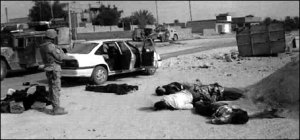
Haditha Massacre, Iraq, 2005

Along with his 66-year-old wife Khamisa Tuma Ali, three grown sons, a 32-year-old woman and a four-year-old child, 76-year-old, wheelchair-bound Abdul Hamid Hassan Ali was killed in his own home after having his chest and abdomen riddled with bullets. Nine-year-old Eman Walid witnessed the slaughter of her family. “First, they went into my father’s room, where he was reading the Koran and we heard shots,” she said. “I couldn’t see their faces very well—only their guns sticking into the doorway. I watched them shoot my grandfather, first in the chest and then in the head. Then they killed my granny.”
Younis Salim Khafif, 43, his wife Aida Yasin Ahmed, 41, their 8-year-old son Muhammad, 14-year-old daughter Noor, 10-year-old daughter Sabaa, 5-year-old daughter Zainab, 3-year-old daughter Aisha and a one-year-old baby girl who was staying at their home were all attacked with hand grenades and shot to death at close range. In the third house, four adult brothers, Jamal, Marwan, Qahtan and Chasib Ahmed were all killed by the Marines. Another brother, Yousif, who survived the attack, recalled, “The Americans gathered my four brothers and took them inside my father’s bedroom, to a closet. They killed them inside the closet.” The soldiers then took photos of the dead and desecrated their bodies by urinating on them.
Despite overwhelming evidence, only a single solider, Wuterich, stood trial for these murders. All charges against the other Marines who committed these atrocities were dropped or dismissed. Wuterich, whose own charges of assault and manslaughter were also dropped, was convicted on January 24, 2012 of only negligent dereliction of duty. He got a demotion and a pay cut. His sentence did not include any jail time.
This kind of American impunity is hardly surprising.
Over the past decade, the United States military has invaded and occupied two foreign countries (illegally bombing and drone striking at least four others), and has overseen the kidnapping, indefinite detention without charge or trial, and the physical and psychological torture of thousands of people, including at places like Guantanamo, Bagram, and Abu Ghraib, where detainees were raped by their American captors. Prisoners held by the United States in Afghanistan and Guantanamo, in addition to being “chained to the ceiling, shackled so tightly that the blood flow stops, kept naked and hooded and kicked to keep them awake for days on end,” have also been beaten to death by their American interrogators. Of the fifteen soldiers charged with detainee abuse ranging from “dereliction of duty to maiming and involuntary manslaughter,” all but three have been acquitted. Those three received written reprimands and served, at most, 75 days in prison for their war crimes and crimes against humanity.
In response to the lethal rampage in Kandahar today, the Taliban condemned the “sick minded American savages” and vowed to “take revenge from the invaders and the savage murderers for every single martyr.” The official Taliban statement continued,
A large number from amongst the victims are innocent children, women and the elderly, martyred by the American barbarians who mercilessly robbed them of their precious lives and drenched their hands with their innocent blood.
The American terrorists want to come up with an excuse for the perpetrator of this inhumane crime by claiming that this immoral culprit was mentally ill.
If the perpetrators of this massacre were in fact mentally ill then this testifies to yet another moral transgression by the American military because they are arming lunatics in Afghanistan who turn their weapons against the defenceless Afghans without giving a second thought.
The words could be Peggy Noonan’s. One would assume, as the victims of this latest massacre were not trained, uniformed combat troops, heavily-armed and armored, serving in a military occupation of an invaded and destroyed foreign country, but rather innocent civilians, many of them children, that the Noonans of the world would similarly cry out for justice, for vengeance, for retribution.
But don’t hold your breath.
Their silence – or worse, equivocation – will be thunderous.
Related articles
Insinuation as War Propaganda
By Anthony Gregory | The Independent Institute | February 23, 2012
In 2002 and early 2003, the Bush administration made its case for war with Iraq. There were assertions given about Saddam’s maintenance of weapons of mass destruction and ties to al-Qaeda. What was never said explicitly, however, was that Saddam Hussein was behind 9/11. Yet by late 2003, seventy percent of polled Americans thought Saddam Hussein was personally behind 9/11. Bush’s Republican voters were especially convinced of this.
Yet Bush and his officials never said this. And after the multiple disasters of the Iraq war began to present themselves with great clarity, the Bush officials were questioned about their pre-war intel. Yet they could say, strictly speaking, one thing they never claimed was Saddam was behind 9/11.
Condoleezza Rice had said something about the attacks originating in the same region or area as Iraq. There was all sorts of insinuation that Saddam might have been involved. And surely the Bush team never put an ounce of effort into disabusing the American people of the completely false notion that Saddam was behind 9/11. The vast majority of Americans believed it—indeed, at times, more Americans thought Saddam was behind the attacks than believed the Iraq War was just!—yet it was not only completely untrue, but not directly rooted in any explicit assertion given by the administration. Various pro-war commentators had said it, but Bush, Cheney, Rumsfeld, Rice, Powell—none of them ever did.
Fast forward a decade to the current day. Seventy-one percent of Americans—almost exactly the percentage that thought Saddam was behind 9/11—think that Iran has nuclear weapons. It’s a small sample, but it is consistent with polls over the last couple years, each one showing a majority believing Iran already has nukes, and almost nine out of ten Americans sure that Iran is seeking them.
Indeed, talking with “respectable” liberals—the type who listen to NPR and watch Jon Stewart—I find repeatedly that even folks who don’t want to go to war assume that every reasonable American knows that Iran is on the brink of having nukes, if the regime doesn’t already have them.
What’s bizarre about this, other than the fact that there is no credible evidence that Iran has nuclear weapons, is that no one in a position of official authority is claiming it either! Every report from the International Atomic Energy Agency, even when framed in a way to make Iran seem ominous, confirms the “non-diversion” of nuclear materials to weaponization purposes. The CIA and intelligence community have consistently stood by the National Intelligence Estimate findings that Iran has not sought a nuclear weapon since 2003 (and Iran doing so back then is only suspected based on very scant evidence produced by the Israeli government).
What’s more, in the last week or so, Defense Secretary Leon Panetta stressed that not only does Iran not have nuclear weapons; there is no evidence that Iran even wants nuclear weapons!!
Even if Iran wanted to make nuclear weapons, it would probably take three or more years. Iran is reportedly attempting to enrich its uranium to 19.75% LEU. Nuclear weapons require 95%—and there is no evidence that Iran has the means to do this. It is even more dubious to believe a nuclear-armed Iran would be some sort of unprecedented threat for the United States, but that’s neither here nor there.
So what’s the deal? The Obama administration (and the Bush administration, and the UN) have all had the same official position: Iran doesn’t have nukes, and the Iranians probably aren’t looking to get them. Yet seven out of ten Americans think Iran already has them. Meanwhile, every Republican presidential candidate except Ron Paul warns about the unparalleled threat of a nuclear Iran, and the Obama White House punishes the country with tighter sanctions and ever more threats.
Indeed, Obama has thrived on the insinuation that Iran has nukes. When he acted tough back in 2009 because Iran had been caught red-handed with its fledgling nuclear facility at Qom—a civilian nuclear facility that Iran readily alerted the international community to, consistent with its continuing adherence to the Non-Proliferation Treaty to which Iran is a signatory—he did so against a backdrop of insinuation that of course everyone knows Iran wants nuclear weapons. He did this even though all that existed at Qom, according to an IAEA official, was a “hole in a mountain.” Why didn’t the president remind the public instead that there is little to worry about, since the entire Defense Department and intelligence community confirm that Iran has no nuclear weapons program?
If a war begins with Iran, it will largely be on the basis of propaganda believed by the public, propaganda that the government has never officially articulated. In the past, the U.S. thrived on outright lies for war: the Gulf of Tonkin Incident, Kuwaiti babies being ripped from incubators, and so forth. There has long been a fair share of unsubstantiated allegations involved behind major U.S. wars—the USS Maine being sunk by the Spanish, the Zimmerman Telegram posing an actual threat to the United States, the Serbians committing genocide of ethnic Albanians, killing many tens of thousands of civilians in the late 1990s, and so on.
Yet today lies and unproven allegations are not enough. The U.S. warfare state appears to thrive on insinuation in its war propaganda. The U.S. war machine’s top brass never outright declare the most provocative claims about U.S. enemies. That way, when the war goes south and people begin accusing the political class of misleading them, the empire’s defenders can easily say (accurately in word if not in spirit): “Bush never claimed Saddam was behind 9/11! Obama never claimed Iran had nuclear weapons!”
But don’t think for a moment that our rulers aren’t glad the American people believe what they do. It makes wars so much easier to wage when the public buys into all sorts of nonsense. The plausible deniability that insinuated propaganda gives the ruling class is just icing on the cake.
Related articles
- US spooks say no Iranian nukes (rt.com)
Featured Video

Thomas Fazi: NATO’s Hybrid Warfare – Deception & Permanent War
or go to
Aletho News Archives – Video-Images
Book Review
UAE tortured, killed journalist for opposing Israel normalization
The Cradle | October 31, 2026
UAE security officers detained, tortured, and killed Emirati poet and news editor Habib al-Sayegh in August 2019, shortly after he published a column opposing UAE normalization with Israel, according to a newly published book.
“Princes and Thieves,” a book by investigative journalist Matthew Cole published on 25 October, alleges that UAE security officers raided Sayegh’s Abu Dhabi home shortly after the publication of the column, hooded him in front of his wife and took him to a detention facility where he was tortured to death.
His interrogators reportedly pulled out several of his teeth with pliers and beat him repeatedly with a sharp metal object.
On 11 August 2019, Sayegh criticized the UAE’s plan to normalize relations with Israel as part of the Abraham Accords in his weekly column for Khaleej newspaper. The column was titled “Israel Is Our Real Enemy and A Dangerous Project.”
Sayegh described Israel as “a real and natural enemy” while questioning “who authorized the normalizers to speak on behalf of everyone?”
Nine days after the column was published, Emirati state media announced his death, without stating a cause. … continue
Blog Roll
 Aletho News
- ‘The Arab Vote’: How Israeli Racism Has Ruined Their Elections
- Israel forces Palestinians in Gaza to choose between assassination alone or death with their families: Report
- US Approves Sale of 500 Patriot Missiles to Ukraine, Deliveries May Take Years
- German Imperialism: An Urgent Explainer
- Backed by AAP, West Virginia Proposal Would Allow Dental Hygienists to Give HPV Vaccine to 9-Year-Olds
- Poland Is the Symptom and Europe Is the Patient
- UAE security forces tortured, killed journalist for opposing Israel normalization: Report
- They Compared the Spice to the Drug. The Spice Won — Again. (Part 2)
- Thomas Fazi: NATO’s Hybrid Warfare – Deception & Permanent War
- Wrong, AP and NPR: Europe’s 50,000 Heat Deaths Are a Computer-Model Estimate, Not a Real Body Count
- If Americans Knew
- DAILY UPDATE: Latest essential news on Palestine, Israel, & region
- 1,300 will gather in Palo Alto on Nov. 1 for Z3 Conference on Zionism
- DAILY UPDATE: Latest essential news on Palestine, Israel, & region
- The Long Arm of AIPAC
- Genocidal intent behind Hebron assault, rights group says
- This week, Israel killed 8-year-old who survived bombing that wiped out her family
- DAILY UPDATE: Latest essential news on Palestine, Israel, & region
- Israeli soldier poses at damaged Lebanon church, sparking anger
- New Report. Manufacturing the Great Replacement: Is Israel behind one of the largest racist influence campaigns ever documented?
- ‘Arab voice doesn’t count’: Jewish Israeli blocs reject Palestinian support
- No Tricks Zone
- Germany’s Green Energy Transition Becoming Increasingly Expensive…Another 6 Trillion Euros!
- Sudden Stratospheric Warming, Powerful El Niño Combination May Lead To Extreme Europe Cold, Energy Crisis!
- Two New Studies Find Thwaites Glacier Melt Cannot Be Driven By Human Activity Or A Warming Ocean
- E-Cars Reduce CO2 Emissions By Only 41% Compared To Internal Combustion Engine Vehicles
- Predictions Made By Renowned Climate Professor Over Past Decades Have Been Proven To Be Poor
- New Study Suggests Large Regions Of The Pacific Ocean Have Been Cooling For The Last 80 Years
- Germany’s Green Energy Debacle: High Energy Costs Force Kahla Porzellan to Close After 182 Years!
- New Study: 50 Years Of The Most Aggressive ‘Net Zero’ Policies Can Only Affect The Global Climate By 0.03°C
- US September “Heat” Was No Record…Many Records Set Decades Ago
- Latest European Green Energy Debacle; Portugal’s Largest Flagship Solar Park Insolvent!

