Aletho News

ΑΛΗΘΩΣ

US-Russia rivalry surges in Syria

By M K Bhadrakumar | Indian Punchline | February 20, 2018

A major speech by Russian Foreign Minister Sergey Lavrov on Monday at an international conference on the Middle East turned into the strongest Russian denunciation to date of the shift in the US policies under the Trump administration towards Syria, where the Pentagon now intends to keep a military presence indefinitely. (here and here)

The overall impression Lavrov conveyed is three-fold. One, in immediate terms, a spurt in fighting in Syria can be expected, as the US attempts to create new facts on the ground by using local proxies — Kurdish militia plus al-Qaeda affiliates and ISIS fighters — as well as to push back at Russia, Iran and the Syrian government.

Two, Russia concludes that the shift in the overall US strategy aims at balkanizing Syria. (Later on Monday, while speaking to the media in Moscow, Lavrov also drew attention to the presence of mercenaries and the Special Forces of France and Britain in northeastern Syria working in league with the US forces in implementing the American agenda to create zones of influence.)

Three, the conversation between Moscow and Washington regarding Syria is at a dead end. Lavrov specifically warned Washington that it is “playing with fire” in Syria, implying that the US strategy will run into resistance.

Two other features of the Moscow conference in Moscow are that, first, Iran’s Foreign Minister Mohamad Javad Zarif took part in it, and, second, the event also talked up a Russian mediatory role to calm down the tensions between Iran and Saudi Arabia.

Zarif told Lavrov at a meeting in Moscow on Monday that Tehran seeks Russia’s help in resolving the intra-regional rifts in the Muslim Middle East. Later, Zarif posted on his official Tweeter account: “With Russia’s sober strategic perspective and its growing influence in West Asia, it can play an instrumental role to help a paradigm shift in the Persian Gulf to one based on dialogue and inclusion.”

The conference was attended by non-official delegates from several Middle East countries, including Saudi Arabia. Meanwhile, King Abdullah of Jordan had paid a ‘working visit’ to Moscow on February 15 and met Putin. On the previous day, Lavrov had spoken to his Egyptian counterpart Sameh Hassan Shoukry on phone. Yesterday, Putin also telephoned Turkish President Recep Erdogan. The focus was on Syria in all these exchanges.

The Russian strategy will be to persuade important regional states who have been the US’ key regional allies – Saudi Arabia and Jordan, in particular – not to rejoin the conflict in Syria by fueling a new round of fighting. If the approach succeeds, the US may find itself at a disadvantage in lacking regional support for pressing ahead with the military track.

However, although Russia’s ties with Saudi Arabia have appreciably strengthened in the recent years, Moscow’s capacity to mediate a Saudi-Iranian rapprochement remains to be seen. Syria continues to be a major source of rivalry between Saudi Arabia and Iran. And, the irony is that, finally, the Trump administration is doing what Saudi Arabia had wanted the previous Obama administration to do by pushing upfront the ‘regime change’ agenda in Syria through coercive methods.

In the Saudi perception, Russia suffered a series of setbacks in Syria recently. Summing up the Syrian situation, Ghassan Charbel, editor-in-chief of the influential Saudi establishment daily Asharq Al-Awsat wrote on Monday, “ Never before have all these flags, interests, dangers, armies, militias, internal divisions and regional and international clashes come together on its (Syria’s) territories. From the South to Idlib to Hmeimem to Afrin, Syria is like a powder keg. It is at the heart of a complex and vast geo-strategic conflict that is impossible to resolve with force and where losses and rewards will be difficult to predict… The regional and international circumstances do not appear ripe for… talks to happen. The Syrian tragedy is open to the most dangerous possibilities.”

The Saudi inclination will be to wait and watch which way the winds are blowing. On the other hand, the war in Yemen remains Saudi Arabia’s number one priority today and Riyadh seeks a Russian role in ending the war in Yemen by leveraging its influence with Iran.

February 20, 2018 Posted by | Illegal Occupation | , , , , , , , , , | Leave a comment

The US-ISIS Nexus in Afghanistan Becomes Hot Topic

By Melkulangara BHADRAKUMAR | Strategic Culture Foundation | 06.02.2018

Tehran has begun highlighting in loud decibel its hitherto-low key voice of disquiet that the United States is transferring the Islamic State* fighters from Syria and Iraq, where they have been defeated, to Afghanistan.

On January 30, Iran’s Supreme Leader Ali Khamenei said: “The US goal of transferring the ISIL terrorists to Afghanistan is aimed at creating the justification for its continued deployment in the region and for buttressing the security of the Zionist regime.” Indeed, any statement at the level of the Supreme Leader invariably draws attention as signaling an authoritative policy directive based on careful decision taken in the light of relevant intelligence inputs.

The point is, three days before Khamenei spoke, Islamic Revolutionary Guards Corps (IRGC) had an encounter with ISIS terrorists infiltrating Iran’s western province of Kermanshah from Iraq. By all accounts, it was a major encounter in which three IRGC personnel were killed, including an officer of the rank of major. According to the commander of the IRGC’s ground forces, Gen. Mohammad Pakpour, as many as sixteen ISIS terrorists were captured. Incidents of this nature are happening with increasing frequency along Iran’s borders and Iranian security agencies are busting large caches of explosives and arms smuggled across the border, but this is the first time such a big encounter took place.

Significantly, the senior foreign policy advisor to the parliament speaker, Hossein Amir Abdollahian, who is an influential voice in the Iranian diplomatic circuit, raised the issue of the US’ covert transfer of ISIS fighters to “northern Afghanistan” at a meeting with Jan Kubis, chairman of the United Nations Assistance Mission for Iraq on January 28.

Kubis, a Slovak career diplomat, has previously served as UN special envoy to Tajikistan (during the transitional period following the civil war in the late 1990s), Secretary-General of the OSCE (1999-2005), EU’s special envoy to Central Asia (20015-2006) and, most recently, as UN Special Representative and Head of the United Nations Assistance Mission in Afghanistan (2011-2015). Abdollahian couldn’t have chosen better his interlocutor for making such a sensitive demarche. The message would have reached the intended quarters in no time.

Two days after that, Khamenei spoke. Given the above backdrop, it needs to be noted carefully that Iran has since listed the topic of US-ISIS nexus as a bilateral issue between Tehran and Kabul. On February 4, Iran’s Defense Minister Brigadier General Amir Hatami made a phone call to his Afghan counterpart Tariq Shah Bahrami and warned that Washington is “implementing plots to transfer the ISIL terrorist group to Afghanistan.” General Hatami spoke on the lines of Khamenei’s remarks, and, importantly, warned against the US’ plans to increase its military deployment to Afghanistan. He underscored that security in Afghanistan is going to be possible only in harmony with the regional states and by pooling their resources to fight terrorism.

Gen. Hatami stopped just short of warning that Tehran may have to act to counter the perceived threat to its national security interests from Afghan soil. It is conceivable that his phone call to Kabul reflected the threat perceptions in Tehran following the interrogation of the 16 ISIS terrorists in the IRGC’s custody.

Iran has reason to feel perturbed that western Afghanistan is also witnessing a political vacuum lately similar to what has been happening in northern Afghanistan in the Amu Darya region during the past several weeks. The Afghan President Ashraf Ghani has destabilized the entire northern region bordering Central Asia by his abrupt dismissal of the governor of Balkh province, Atta Mohammad Noor in November. It is improbable that Ghani took such a precipitate step on his own volition. Atta is a powerful figure, popularly known as the ‘King of the North’. Noor, by the way, is also the head of the Jamiat-i-Islami and happens to be an aspirant to contest the presidential election in 2019.

No doubt, the US concurred with Noor’s removal – if not outright sought it. Curiously, the Trump administration has since voiced support for Ghani’s move. The US Vice-President Mike Pence made two phone calls to Ghani in January to express solidarity. On January 24, the White House took an extraordinary step to issue a statement that it “has been closely following the current dispute” and demanding a quick resolution to the Ghani-Noor standoff, virtually forewarning the latter to capitulate. But Noor hit back on February 3, naming the Kabul regime as puppets of the Americans and stoking the fires of Afghan nationalism.

Of course, the prolonged power vacuum in Balkh has created favorable conditions for the ISIS terrorists to establish presence in northern Afghanistan. Similarly, Rashid Dostum, the Uzbek strongman, who has been a bulwark against terrorist groups in the northern provinces, is on enforced exile in Turkey. The US, which controls Afghan air space, twice refused permission to his aircraft to land. (Interestingly, Turkish President Recep Erdogan since had a one-on-one with Dostum in Ankara.)

The heart of the matter is that a situation similar to Balkh is also on cards in the western province of Farah bordering Iran, where the provincial governor Mohammad Aref Shah Jahan abruptly “resigned” from the post ten days ago, citing as reasons “the worsening security situation in Farah” and “interference in my responsibilities from various individuals.” From all appearances, he decided to quit under duress. (In recent months, US made fresh deployments to Farah.)

What becomes an enigma wrapped in mystery is that Jahan, a Pashtun, and Noor (a Tajik) also happen to enjoy reputation as staunch Afghan nationalists. The conclusion becomes unavoidable that for reasons of its own, Washington desires ‘regime change’ in these two crucially important border provinces (Balkh and Farah), which border Central Asia and Iran respectively. Suffice to say, Tehran would wonder, “Who stands to gain?” Of course, it can only be the ISIS.

February 6, 2018 Posted by | Timeless or most popular | , , , | Leave a comment

The Top 10 Outrageous Things About ISIS the Western Mainstream Media Ignores
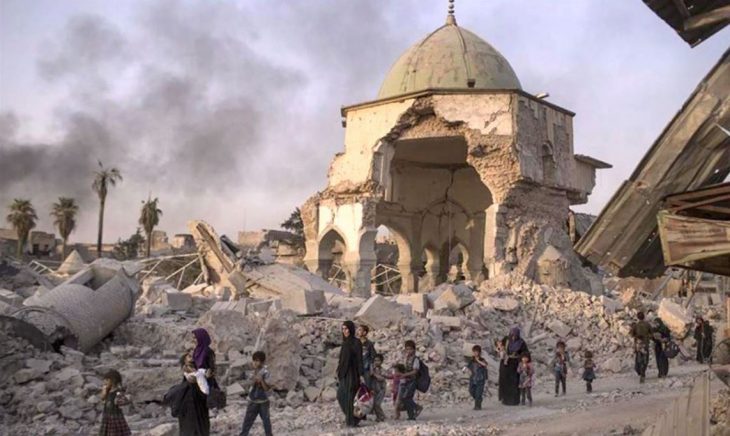
By Robert BRIDGE | Strategic Culture Foundation | 31.01.2018

Last week, the US said it was working to create “alternative government authorities” on Syrian territory. This latest move, aside from demonstrating once again that the US has no respect for Syria’s territorial integrity, indicates we may be seeing more from that group of mercenaries known as Islamic State.

Thus, it seems to be an appropriate time to reflect upon a set of very strange circumstances that led to the rise of this loathsome terrorist group. Here are the top 10 reasons, in no particular order, as to why we should be very suspicious about this group.

10. Convenient Timing

In late August 2013, the United States was on the verge of initiating a massive attack on the government of Syrian President Bashar Assad over a deadly chemical attack that had occurred in the town of Ghouta just days earlier. Although it would have made no sense for Assad to have resorted to such dirty tactics, Washington had found its casus belli. It should be noted that at this time the so-called Islamic State of Iraq and the Levant was largely unknown. That would change soon enough.

Meanwhile, a terrible thing happened on the way to this jolly little war. UK Prime Minister David Cameron suffered a stunning defeat in the House of Commons, voting down his effort to join the Americans in Syria. Apparently the British were America’s obedient poodle no longer.

The setback had an apparent sobering effect on Barack Obama, who suddenly – in a feigned nod to democratic procedure and all that – called for Congress to decide whether or not to use military force against Syrian. Tellingly, that vote never materialized.

What did materialize, however, and with alarming speed and viciousness, was a terrorist group that rose up like a phoenix from the ashes of Iraq known as Islamic State (ISIS), with evil designs to create an Islamic caliphate across a wide swath of Iraq and Syria.

In other words, the perfect casus belli for the US in Syria that would require no need for a vote from Congress.

9. Journalist Killings

As if to draw gratuitous attention to itself more than anything else, the Sunni terrorist group ISIS, under the leadership of one Abu Bakr al Baghdadi, began to grab world headlines not by its battlefield exploits, but by carrying out videotaped executions of Western journalists, as well as destroying cultural heritage sites. I still can’t help wondering: Why didn’t the group just let its fighting skills speak for itself? Why the apparent need for such outrageous publicity stunts? Was this compensation for something the group was desperately lacking?

In any case, starting in August 2014, almost one year to the day that Obama was forced to put the brakes on his Syrian attack, the beheadings began in earnest.

On August 19, US journalist James Foley, seen kneeling on the ground in some undetermined location next to his apparent executioner, ‘Jihadi John,’ reads out a short statement before being beheaded by his captor. However, Islamic State spared its audience the gore by not showing the moment of the actual beheading; the video only shows a head lying on a body following the purported act.

Even Western mainstream publications admitted that something didn’t seem quite right.

Under the headline, ‘Foley murder video may have been staged’ the Telegraph, a reputable British newspaper, interviewed forensic experts who called into question the moment in the video when Foley is allegedly being beheaded by his captor.

“After enhancements, the knife can be seen to be drawn across the upper neck at least six times, with no blood evidence to the point the picture fades to black,” the expert said.

Another expert who examined the video for the newspaper said: “I think it has been staged. My feeling is that the execution may have happened after the camera was stopped.”

Incredibly, every subsequent beheading video put out by Islamic State attracted the same amount of scepticism – not just from alternative websites, who were also noticing the many irregularities contained in the videos, but from mainstream media news sources.

Following the release of the video purported to show the beheading of Steve Sotloff, a journalist who worked with the Jerusalem Post, The Australian newspaper reported that “the apparent beheading on camera of a second US hostage by a man with a British accent was again staged, according to forensic analysis.”

Then there was the video of 21 Egyptian Coptic Christians, dressed in impeccably clean orange jumpsuits, being led along a Libyan beach by black-clad members of ISIS, all of whom appear to be members of some NBA basketball team.

Veryan Khan, editorial director of the Florida-based Terrorism Research & Analysis Consortium, told Fox News that “the speaker, “Jihad Joseph” is much larger than the sea in both the close up and wide shots, and his head is bizarrely out of proportion, meaning he was filmed indoors and the sea added behind him… In addition, the jihadists featured in the film look to be more than 7 feet tall, towering as much as two feet above their victims…”

In July 2015, yet another strange report emerged, CyberBerkut, a Ukrainian group of hackers, said it hacked John McCain’s laptop while he was on an official visit to Kiev around the first week of June 2015. In a report by TechWorm, what they purported to find was a fully staged production of an ISIS execution video, with an actor portraying an executioner who is holding a knife in preparation to behead the prisoner.

The authenticity of this video has not been independently verified.

None of this proves that the individuals in all of the ISIS beheading videos did not go on to meet some grisly fate. However, it seems worth noting that so many forensic experts have spoken out on the “staged” nature of these videos, and that the actual moment of execution during these film productions is never actually shown. Why would such a barbarous group of villains like ISIS need to script and censor their videos?

8. ISIS freedom of movement

Despite employing state-of-the-art fighter jets, like the F-16 Fighting Falcon and A-10 Warthog, the US campaign to destroy Islamic State was largely an exercise in utter futility. There is no other way to explain it. In June 2014, a convoy of hundreds of ISIS fighters drove through 200 km of the Syro-Arabian Desert in fresh-off-the-lot Toyota pickup trucks on the way to Syria. For any modern military, eliminating such a target would have been the equivalent of a lazy afternoon at the shooting range, or shooting fish in a barrel. The fact that these terrorists made it to Syria unmolested tells us everything we need to know about America’s real agenda.

“With state of the art jet fighter aircraft … it would have been – from a military standpoint – ‘a piece of cake’, a rapid and expedient surgical operation, which would have decimated the Islamic State convoys in a matter of hours,” Michel Chossudovsky wrote in Global Research.

“Instead what we have witnessed is an ongoing drawn out six months of relentless air raids and bombings, and the terrorist enemy is apparently still intact.”

“And we are led to believe that the Islamic State cannot be defeated by a powerful US led military coalition of 19 countries,” he added.

The only reasonable conclusion to make from all of this is that the air campaign was not designed to eliminate Islamic State.

7. SITE Security Group

In 2002, Rita Katz and Josh Devon founded Search for International Terrorist Entities Institute (SITE), which, according to its website, is “the world’s leading non-governmental counterterrorism organization specializing in tracking and analyzing online activity of the global extremist community.”

In 2006, in a New Yorker article entitled, “Private Jihad: How Rita Katz got into the spying business,” it was mentioned how SITE spoke directly with jihadists via various message boards:

“Katz has a testy relationship with the government, sometimes acting as a consultant and sometimes as an antagonist. About a year ago, a SITE staffer, under an alias, managed to join an exclusive jihadist message board that, among other things, served as a debarkation point for many would-be suicide bombers.

For months, the staffer pretended to be one of the jihadis, joining in chats and watching as other members posted the chilling messages known as “wills,” the final sign-offs before martyrdom. The staffer also passed along technical advice on how to keep the message board going.

When Katz called officials in Washington, she was reportedly met with resistance: ‘Oh, Rita, I’m not sure you should even be communicating with them—you might be providing material support!,” they told her.

In an interview with CNN, Katz admitted that her group was able to “beat [ISIS] with a release” of a video before it had even been disseminated.

https://www.youtube.com/watch?time_continue=68&v=5aNUm0Z_lXs

In 2007, SITE came under fire for obtaining an alleged Bin Laden video a month prior to its formal release.

Some have raised questions as to how this small group is able to do what the government has not been able to: track ISIS and other terrorist groups with uncanny efficiency.

6. Toyota Trucks

Watching mainstream media reports detail the adventures of Islamic State as they speed carefree across wide-open desert, beards blowing in the wind, one would be forgiven for thinking they were watching a Toyota commercial.

The Times of Israel went so far as to ridicule the leaders of the West for expressing such fear over these militants in their Toyotas like hell raising teenagers speeding around the parking lot of McDonald’s on a Friday night to impress their friends.

“It’s almost unbelievable,” Avi Issacharoff wrote. “They used to say in the IDF that ‘the man in the tank will win,’ justifying the preference for armor over infantry. Now we hear that, from a US source no less, ‘the man in the Toyota’ will defeat the West.”

Somehow we are expected to believe that these shiny new trucks, along with over 2,000 Humvee vehicles, fell into the terrorists’ control by winning some battles in Iraq, like in Mosul and Palmyra. That absurd explanation falls very wide of the mark and needs far more inquiry.

5. Drone attack on Russia

On New Year’s Eve and on January 6, 2018, Russia’s Khmeimim Airbase in Syria was attacked. The first incident involved militants armed with mortars that resulted in the death of two Russian soldiers and damage to several aircraft. The second attack involved a swarm of 13 drones armed with bomblets, which Russian forces countered by means of electronic warfare and air-defense systems. Around half of the drones were electronically hijacked by Russian forces, while the others were shot down without incident. Nevertheless, the attack required a high level of expertise from a “technologically advanced country,” according to Russia.

The United States countered the claim, suggesting that such technology can be easily purchased. Pentagon spokesman Maj. Adrian Rankin-Galloway said the “devices and technologies can easily be obtained in the open market.”

Meanwhile, however, President Putin never mentioned Islamic State when he discussed the incident with the media.

“Those aircraft were only camouflaged – I want to emphasize this – to look like handicraft production. In fact, it is quite obvious that there were elements of high-tech nature there,” the Russian leader said.

So are we expected to believe that Islamic State terrorists were able to buy these UAV drones, or is it more realistic to believe, along with the Russians, that some outside major power was needed to provide the know-how?

4. Never attacked mainland Israel

In March 2016, the warriors of Islamic State picked up their pens in an effort to explain away a question that has been perplexing many observers: why don’t they ever attack Israel?

In the article, translated by a group called MEMRI, the group said it holds to the position that the Palestinian cause does not take precedence over any other jihadi struggle.

“If we look at the reality of the world today, we will find that it is completely ruled by polytheism and its laws, except for the regions where Allah made it possible for the Islamic State to establish the religion…. Therefore, jihad in Palestine is equal to jihad elsewhere,” the article said.

“The apostate [tyrants] who rule the lands of Islam are graver infidels than [the Jews], and war against them takes precedence over war against the original infidels,” the article said, as reported in the Times of Israel.

Whatever the case may be, this seems to be the first time in modern history that a radical jihadist group has had no reason to quarrel with Israel.

3. Oil Export Business

After Islamic State managed to make it across the vast desert between Iraq and Syria without attracting so much as a damaged fender, it managed to do the unthinkable: it set up a very lucrative oil-export business practically overnight in the north of the country. And this was not some small-time operation.

According to one estimate, the motley crew of mercenaries was generating profits of more than £320million a year from oil exports, or about 40,000 barrels of crude every single day.

Are we really expected to believe that a 19-member military organization led by the United States was powerless to put this rag-tag operation out of business?

The reason why the story is so utterly preposterous is that Russia, in a matter of several days, was able to do what this multinational outfit could not do in over a year. In mid-November 2015, Russia had announced that it had destroyed in a matter of days some 500 fuel trucks – and there is plenty of videotape of the Russian attacks for the naysayers who doubt the Kremlin’s claim.

According to Russian General Staff spokesman Colonel General Andrey Kartapolov: “In just the first few days, our aviation has destroyed 500 fuel tanker trucks, which greatly reduced illegal oil export capabilities of the militants and, accordingly, their income from oil smuggling.”

2. Islamic State’s Israeli medical plan

In March 2015, The Wall Street Journal reported a rather stunning revelation that Israel was treating “Al-Qaeda fighters wounded in the Syria civil war.”

Since the outbreak of the Syrian civil war, Israel has provided medical assistance to nearly 2,000 Syrians.

The Wall Street Journal quoted “an Israeli military official” who said no questions were asked of the patients.

“We don’t ask who they are, we don’t do any screening,” the official said. “Once the treatment is done, we take them back to the border and they go on their way.”

Amos Yadlin, the former military intelligence chief, told the Journal that Hezbollah and Iran “are the major threat to Israel, much more than the radical Sunni Islamists, who are also an enemy.”

“Those Sunni elements who control some two-thirds to 90% of the border on the Golan aren’t attacking Israel. This gives you some basis to think that they understand who is their real enemy – maybe it isn’t Israel.”

The Jerusalem Post repeated a joke allegedly told by Syrian President Bashar Assad to Foreign Affairs, ‘How can you say that al-Qaida doesn’t have an air force? They have the Israeli air force… They are supporting the rebels in Syria. It is very clear.”

1. The Pentagon report that speak volumes

In May 2015, a declassified Pentagon document provided shocking evidence that the US-led campaign in Syria not only contributed directly to the rise of the Islamic State (IS), but that Washington was perfectly satisfied with such an outcome.

The US Defence Intelligence Agency (DIA) report, obtained by Judicial Watch, dated August 2012, states that the “major forces driving the insurgency in Syria” comprise “the Salafist, the Muslim Brotherhood, and AQI [al-Qaeda in Iraq].”

Furthermore, it states, these forces are being supported by a Western-led coalition – “The West, Gulf countries and Turkey support the opposition.”

It went on to predict that the takeover of Hasaka and Deir Ezzor would possibly create a militant Islamist political entity in eastern Syria:

“If the situation unravels there is the possibility of establishing a declared or undeclared Salafist Principality in eastern Syria (Hasak and Der Zor), and this is exactly what the supporting powers want, in order to isolate the Syrian regime, which is considered the strategic depth of the Shia expansion (Iraq and Iran).”

According to Nafeed Ahmez from Middle East Eye, “This extraordinary passage confirms that at least three years ago, the Pentagon anticipated the rise of a ‘Salafist Principality’ as a direct consequence of its Syria strategy – and that the ‘supporting powers’ behind the rebels ‘wanted’ this outcome ‘to isolate the Syrian regime,’ and weaken Shiite influence via Iraq and Iran.”

Let that sink in for a moment. The US-backed coalition, which seemed so inexplicably lacklustre in its fight against Islamic State, to the point where this group was actually able to open an oil export business, not to mention drive its Toyota trucks across wide-open desert unmolested, was more content to let a band of terrorists occupy Syria than the legitimate government in Damascus.

It seems safe to say, based on the findings of this incredible document, that such a rationale is exactly what guided Washington’s hand not only in Syria, but in other regime-change war zones, like Iraq and Libya. Democracy building was not the desired result in these fated places, but absolute chaos.

January 31, 2018 Posted by | Deception, Fake News, False Flag Terrorism, Mainstream Media, Warmongering, Timeless or most popular | , , , | Leave a comment

Destroying Syria

Why does Washington hate Bashar al-Assad?

By Philip Giraldi • Unz Review • January 23, 2018

The Donald Trump administration is planning to install a 30,000 strong armed “security force” in northern Syria along the borders with Turkey and Iraq. This presumably will tie together and support the remaining rag-tags of allegedly pro-democracy rebels and will fit in with existing and proposed U.S. bases. The maneuver is part of a broader plan to restructure Syria to suit the usual crop of neocon geniuses in Washington that have slithered their way back into the White House and National Security Council, to include renewed demands that the country’s President Bashar al-Assad “must go,” reiterated by Secretary of State Rex Tillerson last Wednesday. He said “But let us be clear: The United States will maintain a military presence in Syria, focused on ensuring ISIS cannot re-emerge.” Tillerson also claimed that remaining in Syria would prevent Iran from “reinforcing” its position inside Syria and would enable the eventual ouster of al-Assad, but he has also denied that Washington was creating a border force at all, yet another indication of the dysfunction in the White House.

A plan pulled together in Washington by people who should know better but seemingly don’t is hardly a blueprint for success, particularly as there is no path to anything approximating “victory” and no exit strategy. The Syrians have not been asked if they approve of an arrangement that will be put in place in their sovereign territory and the Turks have already bombed targets and sent troops and allied militias into the Afrin region, also a U.S. supported Kurdish enclave on the border. President Recep Tayyip Erdogan has indicated clearly that Ankara will disrupt any U.S. devised border arrangement. From the Turkish point of view the border security force, which reportedly will largely consist of Kurdish militiamen, will inevitably work in cooperation with the Kurdish terrorist group PKK which is active on the Turkish side of the border, in seeking to create an autonomous Kurdish state, which Turkey reasonably enough regards as an existential threat.

And then there is one other little complication, which is that the United States presence in Syria is completely illegal both under international law and under the U.S. government’s War Powers Act. Syria is a sovereign state with a recognized government and there is no U.N. or Congressional mandate that permits Washington to station its soldiers, Marines and airmen within the country’s borders. The argument that the recent Authorizations to Use Military Force (AUMF) permitted the activity because groups linked to al-Qaeda were active there and the local government was unable to expel them is only thinly credible as the U.S. has also attacked Syrian Army forces and the militiamen linked to Syria’s ally Iran. That constitutes a war crime.

Trump can under the War Powers Act take military action to counter an imminent threat, which was never the case from Syria in any event, but after 60 days he has to cease or desist or go to Congress for authorization up to and possibly including a declaration of war. The military offensive against Syria began under President Barack Obama and it is far beyond that two-month window already, so egregiously in violation that some Congressmen are actually beginning to take notice. Democratic Senator Tim Kaine of Virginia has demanded that no military initiatives in Syria be undertaken without a Senate vote. He said on Thursday that“I am deeply alarmed that yet again, the Trump administration continues to raise the risk of unnecessary war, disconnected from any firm policy objectives and core national security interests. To be clear, neither the 2001 or 2002 AUMFs provide authority to target Assad or Iranian proxies in Syria, and it is unacceptable for this action to be taken absent a vote and approval of Congress.”

The animus against Syria runs deep, to include questionable claims from generally hostile sources that al-Assad has deliberately massacred hundreds of thousands of his own people as well as dubious assertations about the use of chemical weapons that led to a U.S. cruise missile attack on a Syrian airbase in Shayrat. A perfect example of how brain dead the western media is over the issue was provided by last week’s article by David Brunnstrom of Reuters on the Tillerson speech, where he wrote “U.S. forces in Syria have already faced direct threats from Syrian and Iranian-backed forces, leading to the shoot-down of Iranian drones and a Syrian jet last year, as well as to tensions with Russia.” The uninformed reader would assume that Americans were the victims of an attack and aggression by Moscow whereas the reality is quite different. Iran and Russia are allies of the legitimate Syrian government that are in the country by invitation to help in its fight against groups that everyone acknowledges to be terrorists. The United States is there illegally and is as often as not using its proxies to fight the Syrian Army.

Syria-phobia goes back to the George W. Bush Administration in December 2003, when Congress passed the Syria Accountability Act, House Resolution 1828. Syria at that time was already in the cross-hairs of two principal American so-called allies in the region, Israel and Saudi Arabia. Both were actively working to destabilize the regime, though for different reasons. The Saudis were fearful of Iranian influence over Damascus but also had a religious agenda in that the secular Syrian regime was protective of religious minorities and was itself an offshoot of Shi’a Islam referred to as Alawites. The Saudis considered them to be heretics.

The Israelis for their part were enamored of the Yinon Plan of 1982 and the Clean Break proposals made in 1996 by a team of Jewish American neocons. Their intention was to transform most of Israel’s neighboring Arab states into warring tribes and ethnicities so they would no longer be a threat. Israeli leaders have stated openly that they would prefer continued chaos in Syria, which remains a prime target. Israel is, in fact, currently bombing Syrian Army positions, most recently near Damascus, while also supporting the ISIS and al-Nusra Front remnants.

The Syrian Accountability Act does indeed read at times like the completely bogus indictment of Saddam Hussein that had led to the invasion of Iraq earlier in 2003. It cites development of weapons of mass destruction and missiles, but its main focus is related to the alleged support of terrorist groups by Damascus. It “Declares the sense of Congress that the Government of Syria should immediately and unconditionally halt support for terrorism, permanently and openly declare its total renunciation of all forms of terrorism, and close all terrorist offices and facilities in Syria, including the offices of Hamas, Hizballah, the Popular Front for the Liberation of Palestine, and the Popular Front for the Liberation of Palestine-General Command.”

One might note that the groups cited by name are not identified as being a threat to the United States. Rather, they are organizations hostile to Israel, which suggests that the motivation for the bill was the usual dominant pro-Israeli sentiment in Congress. The bill’s sponsor was Eliot Engel of New York, a passionately pro-Israeli legislator.

Be that as it may, the drive to “get” Syria has remained a constant in American Foreign Policy to this day. When the U.S. still had an Embassy in Damascus, in December 2010 President Barack Obama maladroitly sent as Ambassador Robert Ford. Ford actively supported the large demonstrations by anti-regime Syrians inspired by the Arab Spring who were opposed to the al-Assad government and he might even have openly advocated an armed uprising, a bizarre interpretation of what Ambassadors are supposed to do in a foreign country. He once stated absurdly that if the U.S. had armed opponents of the regime, al-Qaeda groups would have been “unable to compete.” Ford was recalled a year later, after being pelted by tomatoes and eggs, over concerns that his remaining in country might not be safe, but the damage had been done and normal diplomatic relations between Damascus and Washington have never been restored.

The desire to bring about regime change in Damascus gathered considerable steam in 2011. Harsh government efforts to repress the demonstrations that did take place inevitably led to violence in both directions and the United States, Saudis and the Gulf States subsequently began to arm the rebels and support the formation of the Free Syrian Army, which Washington assured the American public consisted of only good people who wanted democracy and fundamental rights. To no one’s surprise many of the fledgling democrats accepted U.S. training and weapons before defecting to the al-Qaeda affiliate al-Nusra Front or to ISIS.

Currently, the reconstruction of Syria is proceeding. The Syrian Arab Army is wiping out the last few enclaves controlled by ISIS in Idlib Province and the so-called Syrian Civil War will soon be over but for the mopping up. Many internal refugees have returned to their homes after the government reasserted control and also thousands who fled overseas have reportedly come back. Note that they are returning to areas where the al-Assad government is firmly in charge, perhaps suggesting that, while there were legitimate grievances among the Syrian people, the propaganda insisting that most Syrians were opposed to the regime was grossly overstated. There is considerable evidence that Bashar al-Assad is actually supported by a large majority of the Syrian people, even among those who would welcome more democracy, because they know the alternative to him is chaos.

One would like to think that Syria might again be Syria but Washington is baying for blood and clearly would like to see a solution that involves a fragmentation of the state enabling containment and rollback of Iranian influence there while also satisfying both its clients Israel and the Saudis as well as creating a possible mini-state for the Kurds. The destruction of Syria and the Syrian people will just be regarded as collateral damage while building a new Middle East. Hopefully the Syrians, backed by Iran, Russia and China will prevent that from happening and as the U.S. did not directly engage in much of the hard fighting that destroyed ISIS, it thankfully has little leverage over what comes next.

Whether it is Riyadh or Tel Aviv leading Washington by the nose is somehow irrelevant as the blame for what is taking place is squarely on the White House. The United States has no coherent policy, nor any actual national interest in remaining in Syria, but the strange political alignments that appear to be playing out in and around the Oval Office have generated a desire to destroy a country and people that in no way threaten the U.S. Someone should remind the president that similar scenarios did not turn out very well in Afghanistan, Iraq and Libya. No one should expect that Syria will be any different.

January 23, 2018 Posted by | Illegal Occupation, Timeless or most popular, War Crimes, Wars for Israel | , , , , , , , , , | Leave a comment

Monbiot Is a Hypocrite and a Bully

By Jonathan Cook | Dissident Voice | January 15, 2018

It is time for George Monbiot’s legion of supporters to call him out. Not only is he a hypocrite, but he is becoming an increasingly dangerous one.

Turning a blind eye to his behaviour, or worse excusing it, as too often happens, has only encouraged him to intensify his attacks on dissident writers, those who – whether right or wrong on any specific issue – are slowly helping us all to develop more critical perspectives on western foreign policy goals than has ever been possible before.

I do not lightly use such strong language against Monbiot, someone I once admired. But his column this week drips with hypocrisy as he accuses the right wing media of being the real villains when it comes to “no-platforming”. Monbiot writes:

But perhaps the real discomfort is that the worst no-platforming of all takes place within our newspapers. In the publications most obsessed with student silliness, there is no platform for socialism, no platform for environmentalism, no platform for those who might offend the interests of the proprietors. …

I believe that a healthy media organisation, like a healthy university, should admit a diversity of opinion. I want the other newspapers to keep publishing views with which I fiercely disagree. But they – and we – should also seek opposing views and publish them too, however uncomfortable this might be.

What free speech advocate would disagree with that? Except it is Monbiot himself who has been using his prominent platforms, at the Guardian and on social media, to discredit critical thinkers on the left – not with reasoned arguments, but by impugning their integrity.

Denied a platform

It started with his unsubstantiated claim that scholars like Noam Chomsky and the late Ed Herman, as well as the acclaimed journalist John Pilger, were “genocide deniers and belittlers”. It now focuses on childish insinuations that those who question the corporate media’s simplistic narrative on Syria are Assad apologists or in Vladimir Putin’s pay.

But worse than this, Monbiot is also conspiring – either actively or through his silence – to deny critics of his and the Guardian’s position on Syria the chance to set out their evidence in its pages.

The Guardian’s anti-democratic stance does not surprise me, as someone who worked there for many years. I found myself repeatedly no-platformed by the paper – even while on its staff – after I started taking an interest in the Israel-Palestine conflict and writing about the discomforting issue of what a Jewish state entails. My treatment is far from unique.

Now the paper is denying a platform to those who question simplistic and self-serving western narratives on Syria. And Monbiot is backing his employer to the hilt, even as he professes his commitment to the publication of views he fiercely disagrees with. That’s the dictionary definition of hypocrisy.

‘Selfless’ White Helmets?

The latest installment of the Guardian and Monbiot’s long-running battle to silence Syria dissidents arrived last month when Olivia Solon, the paper’s technology writer living in San Francisco, developed a sudden and unexpected expertise in a controversial Syrian group called the White Helmets.

In the western corporate media narrative, the White Helmets are a group of dedicated and selfless rescue workers. They are supposedly the humanitarians on whose behalf a western intervention in Syria would have been justified – before, that is, Syrian leader Bashar Assad queered their pitch by inviting in Russia.

However, there are problems with the White Helmets. They operate only in rebel – read: mainly al-Qaeda and ISIS-held – areas of Syria, and plenty of evidence shows that they are funded by the UK and US to advance both countries’ far-from-humanitarian policy objectives in Syria.

There are also strong indications that members of the White Helmets have been involved in war crimes, and that they have staged rescue operations as a part of a propaganda offensive designed to assist Islamic extremists trying to oust Assad. (Solon discounts this last claim. In doing so, she ignores several examples of such behaviour, concentrating instead on an improbable “mannequin challenge”, when the White Helmets supposedly froze their emergency operations, in the midst of rescue efforts, apparently as part of a peculiar publicity campaign.)

Guardian hatchet job

Whatever side one takes in this debate, one would imagine that Monbiot should have a clear agenda in support of hearing evidence from all sides. One might also imagine that he would want to distance himself from Solon’s efforts to tie criticism of the White Helmets to a supposed “fake news” crisis and paint those critical of the group as Putin-bots. According to Solon:

The way the Russian propaganda machine has targeted the White Helmets is a neat case study in the prevailing information wars. It exposes just how rumours, conspiracy theories and half-truths bubble to the top of YouTube, Google and Twitter search algorithms.

Those are the same algorithms that have been changed in recent months to make sure that prominent leftist websites are increasingly difficult to find on internet searches and their writers’ views effectively disappeared.

Yet Monbiot has been using social media to promote Solon’s cheerleading of the White Helmets and her hatchet job against on-the-ground journalists who have taken a far more critical view of the group.

As set out by Prof Tim Hayward, the Guardian’s response to criticism of Solon’s piece has been typical. The comments section below the article was hastily closed after many criticisms were voiced by readers. The journalists who were singled out for attack by Solon were denied a right of reply. A group of concerned academics led by Hayward who submitted their own article, which detailed publicly available evidence to counter Solon’s simplistic account of the White Helmets, were ignored. Meanwhile, the Guardian’s editors and the reader’s editor have ignored all efforts by these parties to contact them.

Given his claim to be an uncompromising defender of free speech and a fierce advocate of providing platforms to those who can back up their arguments with evidence, however discomforting, one might have assumed that Monbiot would at the very least have lobbied on behalf of Hayward and his fellow scholars. But not a bit of it. Yet again he has joined the dogs of the corporate media baying for blood. Instead he turned to Twitter to claim Hayward and Piers Robinson, an expert on propaganda, had “disgraced” themselves.

Undermining climate concerns

The many tens of thousands of leftists who defend Monbiot, or turn a blind eye to his hypocrisy, largely do so because of his record on the environment. But in practice they are enabling not only his increasingly overt incitement against critical thinkers, but also undermining the very cause his supporters believe he champions.

Climate breakdown is a global concern. Rewilding, bike-riding, protecting bees and polar bears, and developing new sustainable technologies are all vitally important. But such actions will amount to little if we fail to turn a highly sceptical eye on the activities of a western military-industrial complex ravaging the planet’s poorest regions.

These war industries fill their coffers by using weapons indiscriminately on “enemy” populations, spawning new and fiercer enemies – while often propping them up too – to generate endless wars. The consequences include massive displacements of these populations who then destabilise other regions, spreading the effect and creating new opportunities for the arms manufacturers, homeland security industries, and the financial industries that feed off them.

A true environmentalist has to look as critically at western policies in Iraq, Libya, Syria, Ukraine, Venezuela and many other areas of the globe as he does at UK policy in the Welsh hills and the Lake District.

All indications are that Monbiot lacks the experience, knowledge and skills to unravel the deceptions being perpetrated in the west’s proxy and not-so-proxy wars overseas. That is fair enough. What is not reasonable is that he should use his platforms to smear precisely those who can speak with a degree of authority and independence – and then conspire in denying them a platform to respond. That is the behaviour not only of a hypocrite, but of a bully too.

January 16, 2018 Posted by | Deception, Environmentalism, Mainstream Media, Warmongering, Progressive Hypocrite | , , , , , | Leave a comment

US, Israel step up hybrid war in Syria

By M K Bhadrakumar | Indian Punchline | January 9, 2018

The Russian airbase in Syria, Hmeimim, and the naval base at Tartus came under simultaneous drone attack on Saturday. The advanced Russian air defence system thwarted the attack. A wave of 13 drones was involved, and, interestingly, three of them were brought down intact.

After forty-eight hours of careful analysis of the incident, the Russian Defence Ministry in Moscow came out with a statement on Monday:

  • During the hours of darkness Russian air defense facilities made clear 13 remoted unknown small-sized air targets approaching the Russian military assets. Ten combat UAVs were approaching Russia’s Hmeymim air base and three more — the logistics center of Tartus.
  • Engineering solutions used by terrorists when attacking Russian facilities in Syria could have been received only from a country with high technological potential on providing satellite navigation and distant control of firing competently assembled self-made explosive devices in appointed place. (TASS )

The countries with such “high technological potential” and capability for “Satellite navigation and distant control” which are involved in the proxy war in Syria are just two in number – United States and Israel. Take your pick. To my mind, it is improbable that Israel, despite its bravado, would dare to attack Russia.

In sum, there was a spiteful American attack on Russian “assets” on the Christmas Day of the Russian Orthodox Church. The statement in Moscow was made after evaluation of the 3 drones that have been captured. Its fairly explicit tone is meant for the folks in Pentagon. To be sure, Pentagon suo moto came out with a pre-emptive statement deflecting the blame to Syrian rebels. That is an act of plausible deniability, since there are rebel groups operating in northern Syria. But they are al-Qaeda affiliates, who are American and Israeli proxies. The RT has a tongue-in-cheek rejoinder, here, to the Pentagon disclaimer.

Why is the US contesting the Russian bases in Syria? The point is, these Russian bases are located in Latakia province along the Mediterranean coast. And the US military objective is to gain access to the Mediterranean coast for the Kurdistan enclave it is creating in Syria without which the enclave will be landlocked and dependent critically on supply routes via Turkey or Iraq, apart from being economically unviable (although it is an oil-rich region of Syria.)

The Saudi establishment daily Asharq Al-Awsat reported on Monday that the Trump administration is planning to grant diplomatic recognition to the Kurdistan enclave in northern Syria (which is of the size of Lebanon.) The idea is to create a permanent foothold for the US and Israel in a strategic, economically self-sufficient independent Kurdistan where the borders of Turkey, Iraq and Syria meet, and which may eventually reach Iran’s western border with northern Iraq.

But the US-Israeli strategy will remain a pipedream if the Kurdistsn is land-locked and continues to be challenged by Turkey, Iran, Iraq and Syria. Hence the criticality of creating an access route to the Mediterranean via Latakia province.

Russia and Turkey understand the US intentions perfectly well. That explains their latest move to clear the al-Qaeda affiliate groups that are ensconced in the Idlib province adjacent to Latakia. The Syrian government forces and its allied militia with Russian air support are advancing on Idlib in an operation that began last week. Idlib is a fairly big province and some protracted fighting is needed to vanquish these al-Qaeda groups. On Sunday, Syrian government forces captured a strategic town, Sinjar, which brings them within 20 kilometers of the sprawling air base at Abu Zuhour in Idlib. By the way, the highway connecting Damascus and Aleppo also passes through eastern Idlib.

Turkey is cooperating with Russia in clearing Idlib of the al-Qaeda groups. (Idlib borders Turkey.) Indeed, Turkey is staunchly opposed to the US efforts to create a Kurdistan in northern Syria. President Recep Erdogan openly threatened last weekend that Washington will “never be able to turn northern Syria into a terror corridor,” vowing to “hit them (US) very hard. They should know that we are determined on this. Areas that they consider as part of the terror corridor could turn out to be their graves.”

Conceivably, the recent attempts by the US and Israel to stir up turmoil within Iran is linked to all this. The US-Israeli game plan is to get Iran bogged down in internal issues. The Syrian and Iraqi governments are dependent on Iran and Hezbollah to do the heavy lifting in the war against the US-backed al-Qaeda and ISIS groups.

Tehran understands the US-Israeli strategy. The Iranian regime is highly experienced in defeating the US and Israel covert operations. The Supreme Leader Ali Khamenei understands that the Syrian conflict is also an existential battle for Iran. The Islamic Revolutionary Guards Corps commanders are on record that the choice is between fighting the US-Israeli proxies in Syria and Iraq or fighting them on Iranian soil.

How will Moscow react to the US-backed drone attack on its bases? A permanent solution lies in retaliating against the American forces and inflicting heavy casualties – like in Beirut in 1983. If a few dozen American body bags arrive in Washington from Syria, President Trump is sure to say, ‘Enough is enough, boys, come home.’

But the problem is that the US is fighting a “hybrid war”, embedded within the Kurdish militia and cannot be targeted easily. Pentagon has also inserted “contractors” (American mercenaries) so that political risk is minimized.

Therefore, Russia’s option will be to step up the operations to cleanse Idlib province of the al-Qaeda groups backed by US and Israel once and for all. Indeed, Nikki Haley will begin howling in the UN on Israeli instructions alleging “war crimes.”

Of course, as they say, all is fair in love and war and there is another option open to the Russians or Iranians, too – equipping the Afghan Taliban with drones. But they are unlikely to go that far — as of now, at least.

January 10, 2018 Posted by | Aletho News | , , , , , , , | Leave a comment

Did BBC team responsible for faked footage of Syrian chemical attack travel under terrorist protection?

 By Catte | OffGuardian | January 6, 2018

Most of our readers are now more than familiar with the bizarre events surrounding the BBC Panorama program Saving Syria’s Children. We’ve already returned to this story several times. The possibility that this program presented faked footage of a non-existent chemical attack by government troops on a school in Syria has been meticulously documented by independent researcher Robert Stuart over several years.

But a further twist to the story seems to show that the crew who filmed this questionable footage were being escorted and protected during their sojourn in Syria, by members of a jihadist terrorist group affiliated to Jabhat al-Nusra, al-Qaeda and ISIS.

The evidence, on the face of it, seems damning.

Ten minutes, 18 seconds into the program (which can be seen here) the film crew record a car journey, with the two British doctors featured in the program, to “see what medical care is available for children closer to where the fighting is”. At one point the journalist Ian Pannell can be heard in voice over saying:

Western journalists have been targeted in Syria, so I have to travel with my own security. The doctors are able to be more low key and take their own vehicles.

As he speaks we see Pannell himself, presumably filmed by his cameraman Darren Conway, in a car, part of a convoy, accompanied by armed men. We also see the hood of one of the cars in the convoy several times and pretty clearly. It has a logo on it. This is it:

The inset on the right is the logo of Ahrar-al-Sham.

In case you’re wondering, this is the same Ahrar-al-Sham identified by a Human Rights Watch report in October 2013 as participants in the killing of women and children (see “You Can Still See Their Blood” – Executions, Indiscriminate Shootings, and Hostage Taking by Opposition Forces in Latakia Countryside.). The report details the slaughter of nearly 200 civilians “including 57 women and at least 18 children and 14 elderly men” by opposition forces including Ahrar al-Sham on August 4 2013.

It was just 19 days after this massacre – on August 23 – that Ian Pannell and cameraman Darren Conway (now an OBE) apparently decided Ahrar-al-Sham were the go-to ’security’ guys for them. The documentary further shows Pannell, Conway and their chums being waved through ISIS road blocks without a hitch. This is the same ISIS who – allegedly – had declared war on all westerners and were prone to cutting off their heads (though in 2013 this hadn’t become the media meme it later became). Our boys are apparently welcome deep in ISIS territory, with no worries about repercussions.

This is probably explained by the fact Ahrar-al-Sham, according to Stanford University’s Mapping Militant Program, “worked with the Islamic State (IS) until January 2014″.

But maybe the contact with terrorists was fleeting and almost accidental? Well, below are two images that tell a story. The top one is a screencap from Saving Syria’s Children. The man outlined in red is the “Fixer/Translator” for the program, Mughira Al-Sharif, and he is shown driving Pannell’s convoy car (Pannell himself can be seen second from right next to the window in the back). Mughira is seen again in the bottom image in a photograph taken the same day and shared on Instagram. Also with him in this pic, and looking remarkably chummy, are two members of the Ahrar-al-Sham security detail who can be seen in Pannell’s car. Mughira described these men in his Instagram post as ‘friends’. That post was subsequently deleted.

(Above) Fixer/Translator Mughira Al-Sharif driving Ian Pannell’s convoy saloon car in Saving Syria’s Children. Pannell is second from right. (Below) Al Sharif poses with two of the Ahrar al-Sham men in an Instagram post of the same day, describing them as “friends”. The post was subsequently deleted.

Let’s be clear – these “friends’ of Mughira’s could well have taken part in the recent slaughter discussed above, and must, at very least, be assumed to support the mass murder of innocent people. And this man Mughira is employed by Pannell as his guide and helper in making their documentary.

Why are a supposedly distinguished and professional BBC journalist and his crew working with allies of ISIS? Why are they using them as their ‘security’? Why are they comfortable tooling round Syria in a car festooned with jihadist logos? Why did they end up producing a documentary using highly questionable footage to promote UK intervention against the elected government of Syria?

Did neither they nor their employers at the BBC realise what they were doing?

Or did they know and think it was just dandy?

When is the BBC – and Ian Pannell and Darren Conway(OBE) – going to answer these and the many other questions hanging over this program and their credibility?

January 6, 2018 Posted by | Deception, Fake News, Mainstream Media, Warmongering, Timeless or most popular | , , | Leave a comment

US, Israel in ‘covert’ deal to counter Iran after it defeats their extremist groups

Sputnik – December 30, 2017

A US National Security Council (NSC) source has confirmed to Sputnik that Tel Aviv and Washington have worked out a plan to counter “malign Iranian activities.” Speaking to Radio Sputnik, Mohammad Marandi, a political analyst and professor at the University of Tehran, explained why the US and Israel are so hostile towards Iran.

Sputnik: What is your take on the so-called Iranian threat that Israeli Prime Minister Benjamin Netanyahu and US President Donald Trump are looking to confront now? What could they be truly trying to achieve by demonizing Iran?

Mohammad Marandi: They have always been demonizing Iran; they have always [harbored] hostility towards the country. When the Israeli regime occupied Lebanon and the Iranians supported the national liberation movement which ultimately led to the creation of Hezbollah, that led to the ultimate defeat of the regime and its withdrawal from the country. And Iran took support for Palestinian people and Iran’s opposition from the beginning of the revolution to apartheid, whether in apartheid South Africa or in Palestine. That was also an enormous reason to show antagonism towards Iran.

I think more recently, though, Israeli support for extremist groups in Syria, this was carried out alongside countries like Saudi Arabia. Even now we see that al-Qaeda, the al-Nusra Front, is still [located alongside] the Syrian-Israeli border and the Israeli regime continues to treat their wounded militants. And on that part of the joint border we still have ISIS (Daesh) and as we all know the Israelis have never attacked the ISIS (Daesh) coalition alongside its border.

So, the Israelis have been trying to weaken Syria and I think that over the last couple of years with the help of Hezbollah, Russia, Iran and others the gradual defeat of the extremist groups both in Syria and Iraq have led to a situation where the Israelis feel weakened. But I don’t think that any meetings between the United States and Israel will come up with anything new because they have been cooperating all along alongside with Saudi Arabia for many years now.

Sputnik: The plan also aims to target Iran’s activities across the Middle East. So, if implemented, what consequences could it entail for the region in local conflicts?       

Mohammad Marandi: Yes, this is again, I think, a very important point because it’s contrary to what we see in the Western media, which is usually either silence or a very misleading representation. US allies in the region, alongside the United States, supported ISIS [Daesh]. Even though, I still speak to some Americans [and they express] outrage. If you look at the Defense Intelligence Agency (DIA) documents of 2012 that were partially released by Judicial Watch, they speak about US allies in the region supporting extremist groups in Syria and [they] have had the upper hand according to that document, from almost the very beginning of the fighting. And these groups were focused on the border between Syria and Iraq.

We know that later on, those groups were named ISIS, or they called themselves even after that Islamic State. And the United States, according to General [Michael] Flynn [former DIA director and former national security adviser to President Trump] who was the head of that organization [DIA] — later in an interview with Al Jazeera he admitted — that the United States took a willful decision to support its allies in the region. And there is a host of other evidence as well, such as WikiLeaks documents and emails which stated that Saudi Arabia and others supported ISIS in 2014. So then, of course, we have the admission of former US Secretary of State [John] Kerry who had a secret meeting with Syrian opposition activists admitted that the United States allowed ISIS to advance on Damascus in order to put pressure on President Assad.

So, the United States is deeply involved in allowing ISIS to rise; they were deeply involved in, of course, al-Qaeda, the al-Nusra Front, […] And, of course, Israel, as I’ve pointed out, has been involved in supporting al-Qaeda and has been silent regarding the presence of ISIS on its border. So, Iran has helped the Syrian government to defeat extremist groups. Of course, the Russians, Hezbollah, all of these countries, all of these groups together [won] this victory over extremism and if Syria had fallen, without any doubt Iraq would had fallen.

Iraq was on the verge of falling despite the fact that ISIS had a large number of troops fighting the Syrian government. If they had defeated the Syrian government, they would have sent a lot more troops into Iraq and it would have fallen. And of course Lebanon would have faced a very new and dangerous situation with these extremists. So Iran’s support for the Iraqi government and the Syrian government helped defeat these extremist groups and this is a major point of contention between Iran, Israel and Saudi Arabia and, of course, the United States. […]


December 30, 2017 Posted by | Timeless or most popular, War Crimes, Wars for Israel | , , , , , , | Leave a comment

Who Are the Leading State Sponsors of Terrorism?
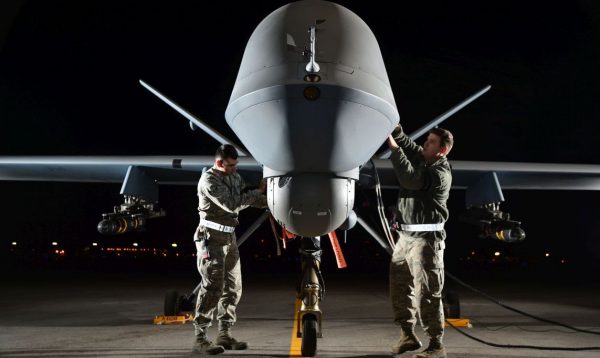
By Philip M. GIRALDI | Strategic Culture Foundation | 28.12.2017

As 2017 draws to a close, it is difficult to be optimistic about what will be coming in the new year. The American President, whose margin of victory was certainly based on his pledge to avoid unnecessary wars, has doubled down on Afghanistan, refuses to leave Syria even though ISIS has been defeated, and is playing serious brinksmanship with a psychopathic and unpredictable regime in Pyongyang. The White House has also bought into the prevailing largely fabricated narrative about a Russia and has decided to arm Ukraine with offensive weapons, which has already resulted in a sharp response from Moscow and will make détente of any kind between the two leading powers all but impossible in the upcoming year.

But, as I have observed before, the red hazard light that continues to be blinking most brightly relates to Washington’s relationship with Iran, which has unnecessarily deteriorated dramatically over the past year and which brings with it collateral problems with Russia and Turkey that could trigger a much wider conflict. I say unnecessarily because all the steps taken to poison the relationship have come out of Washington, not Tehran. The Trump administration refused to certify that the Iranians had been in compliance with the nuclear agreement negotiated in 2015 and has since escalated its verbal attacks, mostly at the United Nations, claiming that the regime in Tehran is the major source of terrorism in the world and that it is seeking hegemony over a broad arc of countries running westward from its borders to the Mediterranean Sea.

The only problem with the allegations being made is that none of them is true and, furthermore, Iran, with limited military resources, poses no serious threat to gain control over its neighbors, nor to attack the United States or Europe. The invective about Iran largely derives from Israel and Saudi Arabia, which themselves have hegemonic ambitions relating to their region. Israel’s friends in the US Congress, media and White House have not surprisingly picked up on the refrain and are pushing for military action. Israel has even threatened to bomb any Iranian permanent presence inside neighboring Syria.

A recent detailed analysis by former US intelligence officers has demonstrated just how the claim that Iran is the world’s leading sponsor of terrorism is almost completely fabricated. The analysis explains how these false narratives are contrived and how they become part of the Washington background noise. The White House’s recent National Security Strategy Report for 2018 stated that “Iran, the world’s leading state sponsor of terrorism, has taken advantage of instability to expand its influence through partners and proxies, weapon proliferation, and funding.” But another US government report, the annual Country Reports on Terrorism 2016 cites no actual terrorist incidents initiated by Iran in that year. In fact, the most recent terrorist incident attributed to Tehran was in 2012, and that was retaliatory against Israel, which was at the time assassinating Iran’s scientists and technicians and attacking its computer systems.

America’s UN Ambassador Nikki Haley’s has recently claimed that it is hard to find a “terrorist group in the Middle East that does not have Iran’s fingerprints all over it.” But in reality, the overwhelming majority of terrorist groups in the region, to include ISIS, Al-Qaeda and al-Nusra, are Sunni Muslims, who believe Iran’s Shi’ism is heretical, and are both tied to and funded by Qatar, Saudi Arabia and the United States. The Mujahedin-e-Khalq (MEK) is indeed an ethnic Iranian terrorist group, but it has been funded and supported by Washington and Tel Aviv to carry out attacks inside Iran.

The reality is that terrorism, defined by the United Nations as “criminal acts intended or calculated to provoke a state of terror in the general public,” is most employed at the state level by the United States and its allies Israel and Saudi Arabia, not by Iran. All have used violence directed against civilians in places like Afghanistan, Iraq, Syria, Yemen and Lebanon, and all three have supported organizations that fit the definition of terrorists. Iran may indeed be guilty of actions that much of the world disapproves of, but it is not the world’s leading state sponsor of terrorism as has been alleged.

December 28, 2017 Posted by | Timeless or most popular, War Crimes | , , , , , , , | Leave a comment

US runs training camps for Syria militants: Russian general

Press TV – December 27, 2017

The Russian military top brass says militants, including those with the Takfiri Daesh terror group, are receiving training in US bases in Syria, adding the terrorists have been instructed to “destabilize” the Arab country.

In an interview with Russia’s Komsomolskaya Pravda daily on Wednesday, Chief of the General Staff of the Russian Armed Forces Valery Gerasimov said the US had turned its military base near the town of al-Tanf in southeastern Syria into a training camp for militants.

Asked about the situation at the US-run al-Tanf base, he replied, “According to satellite and other surveillance data, terrorist squads are stationed there. They are effectively training there.”

General Gerasimov also accused the US of using a refugee camp outside the town of Shaddadah in Syria’s northeastern Hasakah Province as a training center for the Daesh remnants, including those evacuated from the terror outfit’s former stronghold of Raqqah.

“This is essentially ISIS (Daesh),” he said. “They change their colors, take different names – the ‘New Syrian Army’ and others. They are tasked with destabilizing the situation.”

On December 16, Russia’s Reconciliation Center for Syria revealed Washington’s training activities for members of the so-called New Syrian Army, composed of various terrorist groups, at the Shaddadah camp.

Elsewhere in his remarks, Gerasimov estimated that there are currently some 350 militants in al-Tanf and about 750 others in al-Shaddadah,

He further noted that the Russian military had been watching the US training activities at the al-Tanf base “for several months.”

The official also stressed that the Pentagon has so far failed to provide any explanation for its military presence at the al-Tanf base after Daesh’s defeat, saying, “So far, their answers have been ambiguous.”

The town of al-Qaryatayn in Syria’s Homs Province risked falling into the hands of the anti-Damascus militants if the Russian forces had not intervened, according to Gerasimov.

“We took timely measures… They have suffered a defeat, these forces were destroyed. There were captives from these camps. It is clear that training is underway at those camps,” he added.

Nusra terrorists to be wiped out next year

Meanwhile, the Russian general predicted that the operation to eliminate members of the al-Nusra Front militant group in Syria will be completed in 2018.

Next year’s developments in Syria will include “the completion of eliminating militants from Jabhat al-Nusra and its affiliates,” he pointed out.

After losing all the territories under their control in Syria and Iraq, the Daesh terrorists have fled to Libya and southwestern Asia after being defeated in Syria, Gerasimov added.

“Some of them return to countries, from which they illegally arrived. The bulk of them flee to Libya, to southwestern Asian countries,” he said.

Russian Foreign Minister Sergei Lavrov also commented on the issue, saying the main part of the anti-Daesh battle in Syria was over.

“Now, of course, the main anti-terrorist objective is the defeat of Jabhat al-Nusra,” Lavrov said at a meeting with Ahmad Jarba, leader of Syria’s opposition Tomorrow movement.

He warned that the al-Nusra terrorsits have been “are still resisting … because they have been receiving assistance from abroad” to fight against the Syrian government forces.

“We are seeing positive changes in Syria. A decisive blow has been dealt on the IS [Daesh]. And although some militants who have fled the battlefield are trying either to regroup in Syria or to flee abroad,” he added.

Russia, Syria in close defense cooperation

General Gerasimov said the Russian military advisers assist nearly all units of the Syrian forces in planning counter-terrorism operations.

“We cooperate closely with the Syrian government troops, our advisers are attached to nearly all units,” he said.

Russian jets have been conducting air raids against Daesh and other terrorist outfits inside Syria at the Damascus government’s request since September 2015.

President Vladimir Putin said on Monday that Moscow now sees no need for a heavy military presence in Syria, but it will continue its counter-terrorism battle in the Arab state “if necessary.”

December 27, 2017 Posted by | Timeless or most popular, War Crimes | , , , , , | Leave a comment

Did Obama Arm Islamic State Killers?

By Daniel Lazare | Consortium News | December 21, 2017

Did Barack Obama arm ISIS? The question strikes many people as absurd, if not offensive. How can anyone suggest something so awful about a nice guy like the former president? But a stunning report by an investigative group known as Conflict Armament Research (CAR) leaves us little choice but to conclude that he did.

CAR, based in London and funded by Switzerland and the European Union, spent three years tracing the origin of some 40,000 pieces of captured ISIS arms and ammunition. Its findings, made public last week, are that much of it originated in former Warsaw Pact nations in Eastern Europe, where it was purchased by United States and Saudi Arabia and then diverted, in violation of various rules and treaties, to Islamist rebels seeking to overthrow Syrian President Bashar al-Assad. The rebels, in turn, somehow caused or allowed the equipment to be passed on to Islamic State, which is also known by the acronyms ISIS or ISIL, or just the abbreviation IS.

This is damning stuff since it makes it clear that rather than fighting ISIS, the U.S. government was feeding it.

But CAR turns vague when it comes to the all-important question of precisely how the second leg of the transfer worked. Did the rebels turn the weapons over voluntarily, involuntarily, or did they somehow drop them when ISIS was in close proximity and forget to pick them up? All CAR will say is that “background information … indicates that IS [Islamic State] forces acquired the materiel through varied means, including battlefield capture and the amalgamation of disparate Syrian opposition groups.” It adds that it “cannot rule out direct supply to IS forces from the territories of Jordan and Turkey, especially given the presence of various opposition groups, with shifting allegiances, in cross-border supply locations.” But that’s it.

If so, this suggests an astonishing level of incompetence on the part of Washington. The Syrian rebel forces are an amazingly fractious lot as they merge, split, attack one another and then team up all over again. So how could the White House have imagined that it could keep weapons tossed into this mix from falling into the wrong hands? Considering how each new gun adds to the chaos, how could it possibly keep track? The answer is that it couldn’t, which is why ISIS wound up reaping the benefits.

But here’s the rub. The report implies a level of incompetence that is not just staggering, but too staggering. How could such a massive transfer occur without field operatives not having a clue as to what was going on? Was every last one of them deaf, dumb, and blind?

Not likely. What seems much more plausible is that once the CIA established “plausible deniability” for itself, all it cared about was that the arms made their way to the most effective fighting force, which in Syria happened to be Islamic State.

This is what had happened in Afghanistan three decades earlier when the lion’s share of anti-Soviet aid, some $600 million in all, went to a brutal warlord named Gulbuddin Hekmatyar. Hekmatyar was a raging bigot, a sectarian, and an anti-western xenophobe, qualities that presumably did not endear him to his CIA handlers. But as Steve Coll notes in Ghost Wars, his bestselling 2004 account of the CIA’s love affair with Islamic holy war, he “was the most efficient at killing Soviets” and that was the only thing that mattered. As one CIA officer put it, “analytically, the best fighters – the best-organized fighters – were the fundamentalists” that Hekmatyar led. Consequently, he ended up with the most money.

After all, if you’re funding a neo-medieval uprising, it makes sense to steer the money to the darkest reactionaries of them all. Something similar occurred in March 2015 when Syrian rebels launched an assault on government positions in the northern province of Idlib. The rebel coalition was under the control of Jabhat al-Nusra, as the local branch of Al Qaeda was known at the time, and what Al-Nusra needed most of all were high-tech TOW missiles with which to counter government tanks and trucks.

Arming Al Qaeda

So the Obama administration arranged for Nusra to get them. To be sure, it didn’t provide them directly. To ensure deniability, rather, it allowed Raytheon to sell some 15,000 TOWs to Saudi Arabia in late 2013 and then looked the other way when the Saudis transferred large numbers of them to pro-Nusra forces in Idlib. [See Consortiumnews.com’sClimbing into bed with Al-Qaeda.”] Al-Nusra had the toughest fighters in the area, and the offensive was sure to send the Assad regime reeling. So even though its people were compatriots with those who destroyed the World Trade Center, Obama’s White House couldn’t say no.

“Nusra have always demonstrated superior planning and battle management,” Yezid Sayigh, a senior associate at the Carnegie Middle East Center in Beirut, said a few weeks later. If the rebel coalition was successful as a whole, it “was entirely due to their willingness to work with Nusra, who have been the backbone in all of this.”

Scruples, assuming they existed in the first place, fell by the wayside. A senior White House official told The Washington Post that the Obama administration was “not blind to the fact that it is to some extent inevitable” that U.S. weapons would wind up in terrorist hands, but what could you do? It was all part of the game of realpolitik. A senior Washington official crowed that “the trend lines for Assad are bad and getting worse” while The New York Times happily noted that “[t]he Syrian Army has suffered a string of defeats from re-energized insurgents.” So, for the master planners in Washington, it was worth it.

Then there is ISIS, which is even more beyond the pale as most Americans are concerned thanks to its extravagant displays of barbarism and cruelty – its killing of Yazidis and enslavement of Yazidi women and girls, its mass beheadings, its fiery execution of Jordanian fighter pilot Moaz al-Kasasbeh, and so on.

Yet U.S. government attitudes were more ambivalent than most Americans realized. Indeed, the U.S. government was strictly neutral as long as ISIS confined itself to attacking Assad. As a senior defense official told the Wall Street Journal in early 2015: “Certainly, ISIS has been able to expand in Syria, but that’s not our main objective. I wouldn’t call Syria a safe haven for ISIL, but it is a place where it’s easier for them to organize, plan, and seek shelter than it is in Iraq.”

In other words, Syria was a safe haven because, the Journal explained, the U.S. was reluctant to interfere in any way that might “tip the balance of power toward Syrian President Bashar al-Assad, who is fighting Islamic State and other rebels.” So the idea was to allow ISIS to have its fun as long as it didn’t bother anyone else. For the same reason, the U.S. refrained from bombing the group when, shortly after the Idlib offensive, its fighters closed in on the central Syrian city of Palmyra, 80 miles or so to the east.  This was despite the fact that the fighters would have made perfect targets while “traversing miles of open desert roads.”

As The New York Times explained: “Any airstrikes against Islamic State militants in and around Palmyra would probably benefit the force of President Bashar al-Assad. So far, United States-led airstrikes in Syria have largely focussed on areas far outside government control, to avoid the perception of aiding a leader whose ouster President Obama has called for.” [See Consortiumnews.com’sHow US-Backed War on Syria Helped ISIS.”]

Looting Palmyra

The United States thus allowed ISIS to capture one of the most archeologically important cities in the world, killing dozens of government soldiers and decapitating 83-year-old Khalid al-Asaad, the city’s retired chief of antiquities. (After looting and destroying many of the ancient treasures, ISIS militants were later driven from Palmyra by a Russian-backed offensive by troops loyal to President Assad.)

Obama’s bottom line was: ISIS is very, very bad when it attacks the U.S.-backed regime in Iraq, but less so when it wreaks havoc just over the border in Syria. In September 2016, John Kerry clarified what the administration was up to in a tape-recorded conversation at the U.N. that was later made public. Referring to Russia’s decision to intervene in Syria against ISIS, also known by the Arabic acronym Daesh, the then-Secretary of State told a small knot of pro-rebel sympathizers:

“The reason Russia came in is because ISIL was getting stronger.  Daesh was threatening the possibility of going to Damascus and so forth, and that’s why Russia came in, because they didn’t want a Daesh government and they supported Assad. And we know this was growing. We were watching. We saw that Daesh was growing in strength, and we thought Assad was threatened. We thought, however, we could probably manage, that Assad might then negotiate. Instead of negotiating, he got … Putin in to support him. So it’s truly complicated.”  (Quote starts at 26:10.)

“We were watching.” Kerry said. So, by giving ISIS free rein, the administration hoped to use it as a lever with which to dislodge Assad. As in Afghanistan, the United States thought it could use jihad to advance its own imperial interests. Yet the little people – Syrian soldiers, three thousand office workers in lower Manhattan, Yazidis, the Islamic State’s beheading of Western hostages, etc. – made things “truly complicated.”

Putting this all together, a few things seem clear. One is that the Obama administration was happy to see its Saudi allies use U.S.-made weapons to arm Al Qaeda. Another is that it was not displeased to see ISIS battle Assad’s government as well. If so, how unhappy could it have been if its allies then passed along weapons to the Islamic State so it could battle Assad all the more? The administration was desperate to knock out Assad, and it needed someone to do the job before Vladimir Putin stepped in and bombed ISIS instead.

It was a modern version of Henry II’s lament, “Who will rid me of this meddlesome priest?” The imperative was to get rid of Assad; Obama and his team had no interest in the messy details.

None of which proves that Obama armed ISIS. But unless one believes that the CIA is so monumentally inept that it could screw up a two-car funeral, it’s the only explanation that makes sense. Obama is still a congenial fellow. But he’s a classic liberal who had no desire to interfere with the imperatives of empire and whose idea of realism was therefore to leave foreign policy in the hands of neocons or liberal interventionists like Secretaries of State Hillary Clinton and John Kerry.

If America were any kind of healthy democracy, Congress would not rest until it got to the bottom of what should be the scandal of the decade: Did the U.S. government wittingly or unwittingly arm the brutal killers of ISIS and Al Qaeda? However, since that storyline doesn’t fit with the prevailing mainstream narrative of Washington standing up for international human rights and opposing global terrorism, the troublesome question will likely neither be asked nor answered.


Daniel Lazare is the author of several books including The Frozen Republic: How the Constitution Is Paralyzing Democracy (Harcourt Brace).

December 21, 2017 Posted by | Timeless or most popular, War Crimes | , , , , , , | Leave a comment

SYRIA: US War Crime in Jabal Al Tharda, Deir Ezzor and the Implausible Denials

By Prof. Tim Anderson | 21st Century Wire | December 17, 2017

On 17 September 2016 a carefully planned US-led air raid on Jabal al Tharda (Mount Tharda), overlooking Deir Ezzor airport, slaughtered over 100 Syrian soldiers and delivered control of the mountain to DAESH / ISIS. After that surprise attack, the terrorist group held the mountain for almost a year, but did not manage to take the airport or the entire city. US-led forces admitted the attack but claimed it was all a ‘mistake’. However uncontested facts, eye witness accounts and critical circumstances show that was a lie. This article sets out the evidence of this crime, in context of Washington’s historical use of mercenaries for covert actions, linked to the doctrine of ‘plausible deniability’.

Syrian eyewitness accounts from Deir Ezzor deepen and confirm this simple fact: the US-led air raid on Syrian forces at Jabal al Tharda on 17 September 2016 was no ‘mistake’ but a well-planned and effective intervention on behalf of the terrorist group ISIS (DAESH in Arabic). After days of careful surveillance a devastating missile attack followed by machine gunning of the remaining Syrian soldiers helped ISIS take control of the strategic mountain, that same day.


Colonel Kanaan on the mountain. October 2017. (Photo: Tim Anderson)

Mercenary forces – like ISIS and the other jihadist groups in Iraq and Syria – were a staple of US intervention during the early decades of the cold war, deployed in more than 25 conflicts, such as those of the Congo, Angola and Nicaragua. Whatever their claimed aims and ideologies, they allowed for the ‘multiplication’ of US power and were associated with the doctrine of ‘plausible deniability’, where the ‘formal’ denial of the mastermind role in covert operations minimised damage to domestic public opinion and international relations (Voss 2016: 37-40).

That doctrine was discussed during the 1976 Church Committee hearings into CIA covert operations (especially assassinations and coups) and resurfaced during the Iran-Contra scandal of the 1980s (Hart 2005; Dorn 2010). The key idea behind the doctrine is to be able “to use violence without directly incriminating the [contracting out] regime” (Ron 2002). The use of terrorist proxy armies in Iraq and Syria, both overtly and covertly supported by US forces, is thoroughly consistent with this history.

By September 2016 a US-led coalition had been active in both Iraq and Syria for more than two years, supposedly to help Iraq fight ISIS, but without permission to enter Syria. The foreign powers tried to side-step that legal problem by claiming the invitation from Iraq allowed them to conduct cross border raids against ISIS (Payne 2017). By this time the Russian air force had been assisting Syria for almost a year against multiple terrorist groups, all of them, as senior US officials would admit (Biden in RT 2014 and Usher 2014; Dempsey in Rothman 2014), armed and financed by the US and its allies.


Syrian solider at the front line against ISIS, on the Euphrates. (Photo: Tim Anderson)

Contrary to the stated aims, there is little evidence the US-led group did anything to fight ISIS in Syria. Washington’s group sat back and watched ISIS twice take over Palmyra (in 2015 and 2016), then did nothing to help the Syrian Army take back Palmyra and Deir Ezzor. Most US activity focused on bombing Syrian infrastructure and helping a Kurdish-led separatist force (the SDF) replace ISIS in the city of Raqqa. On the other hand, the 17 September air raid positively helped ISIS in attempts to wrest the remaining parts of Deir Ezzor from the Syrian Army.

US, Australian, British and Danish forces quickly admitted their role in that attack, but claimed the slaughter of over 100 Syrian soldiers was a ‘mistake’. Now mistakes in war do happen. However they are usually associated with a single, unprepared incident. This attack was well-planned, sustained and achieved a key objective in the attempt to drive ‘the Syrian regime’ from Deir Ezzor. Assisting extremists create an ‘Islamic State’ in eastern Syria, US intelligence wrote back in August 2012, was “exactly” what Washington wanted so as “to weaken the regime in Damascus” (DIA 2012).

One year later, as Syrian forces re-took the whole of Deir Ezzor city from ISIS, I spoke with the commanding officer at Jabal al Tharda on that day, Colonel Nihad Kanaan, one of 35 survivors of the US-led attack. He confirmed US admissions that surveillance aircraft had overflown the mountain days before. He also said that the Syrian Army had held the mountain for many months and that their position was clearly marked with Syrian flags. One year later he still showed shock at recalling attack aircraft return to finish off his wounded comrades, with line-of-sight machine-gunning (Kanaan 2017).

That Washington could block most western media from serious study of this treacherous attack, simply by saying ‘sorry, mistake’, is testament to the near absence of critical media voices, at a time of war. The surprise attack was treacherous, not only to the Syrians whom the US had promised to not attack, but to the western populations who mostly believed what their governments said: that they were in Iraq and Syria ‘to fight ISIS’.

It was not that the denials over the crime at Jabal al Tharda were particularly ‘plausible’, just that they had been made. Formal denial was enough, it seems, to stop the western corporate and state media in its tracks. The practice of ‘plausible deniability’ was never so much intended to fool those familiar with the facts, as it was to set up a shield of formal denial which might be used to deflect or discredit ‘potentially hostile’ investigations (Voss 2016: 40; Bogan and Lynch 1989: 205). In past and present propaganda wars, less importance is given to independent evidence than to insistent repetition, denunciation and distraction.

This paper is a prosecuted case, not reportage where one side says this and the other side says that. I have announced my conclusion at the outset and intend to demonstrate that case with evidence. I also support the idea that readers are entitled to see all evidence, including the cover story of the criminals. However in this case the crime and its authors, I suggest, can be convincingly established by uncontested facts. Review of the Syrian perspective simply helps deepen our understanding of the conflict.

1. Uncontested facts

There are eight elements of this massacre where the facts are virtually uncontested:

1: First, the attack was on the forces of a strategic opponent, whom the US wished to overthrow, weaken or ‘isolate’;

2:  Second, there was no semblance of provocation;

3: Third, this was a well-planned operation, with days of advance surveillance;

4: Fourth, the attack was sustained and effective, meeting conventional military objectives;

5: Fifth, there was both immediate and longer term benefit to ISIS;

6: Sixth, the US gave false locality information to the Russians before the attack, and their ‘hotline’ to Russia was defective during the attack;

7: Seventh, the US made false claims about being unable to identify Syrian troops;

8: Eighth, the US ‘investigation’ was hopelessly partisan, self-serving and forensically useless; there was no attempt to even contact the Syrian side.

Let’s look at each element in a little more depth

ONE: the attack was on a strategic opponent

Syrian forces were seen as adversaries. This was no ‘friendly fire accident’. The political leadership of the US-led operation had called for the dismissal or overthrow of the Syrian Government and had provided material support to armed opponents of the Government since mid-2011. The terrorist group ISIS had a campaign to create an Islamic State in the region and that objective was shared by Washington. US intelligence, in August 2012, had expressed satisfaction at extremist plans for a “salafist principality” (i.e. an Islamic State) in eastern Syria, “in order to isolate the Syrian regime” (DIA 2012).

The US had not admitted providing finance and arms to ISIS / DAESH, but several senior US officials acknowledged in 2014 that their ‘Arab allies’ had done so (Anderson 2016: Ch.12). After the attack US and Australian officials referred to their victims as forces aligned with the ‘Syrian regime’ (Johnston 2016; Payne 2017), reinforcing the fact that the assailants did not recognise Syrian soldiers as part of a legitimate national army.

TWO: no suggestion of provocation

There was no suggestion of any provocation, as had happened in previous ‘mistakes’; for example where a pilot had mistaken gunfire or fireworks for a hostile attack. This attack was premeditated.

THREE: a well-planned operation, with substantial surveillance

All sides agree this was a carefully planned operation, with surveillance days in advance. Colonel Nihad Kanaan, the Syrian Arab Army commanding officer on ‘Post Tharda 2’ (a military post on the second of three peaks of Tharda mountain range) that day, told this writer that US-coalition surveillance aircraft were seen “repeatedly circling” the area on 12 September, 5 days before the attack (Kanaan 2017). US reports confirm this. On the day of the attack the New York Times cited US Central Command saying that “coalition forces believed they were striking a DAESH fighting position that they had been tracking for a significant amount of time before the strike” (Barnard and Mazzetti 2016). A US military report, some weeks after the attack, said a “remotely piloted aircraft” (RPA) was sent to “investigate” the area the day before and two RPAs revisited the same area on the 17th, identifying two target areas with tanks and personnel (Coe 2016: 1).


General Aktham at the bridge to Raqqa, one of many destroyed by US planes. (Photo: Vanessa Beeley)

Australian Defence Minister Marise Payne wrote that “target identification was based on intelligence from a number of sources”, and that the US-led group had “informed Russian officials prior to approving air strikes on the DAESH position” (Payne 2017). Australian Chief of Joint Operations Vice-Admiral David Johnston pointed out that his country’s contribution to the attack had included “an Australian E7 Wedgetail airborne early warning and control and 2 FA-18 hornet strike fighters” (Johnston 2016).  The Wedgetail E-7 is based on a Boeing 737 and came into operation in 2015. It is an intelligence and control aircraft said to have “tonnes of electronic wizardry” (Military Shop 2014) and to be “the most advanced air battlespace management capabilities in the world” (RAAF 2017). All this speaks of a well-planned and technologically capable operation.

Further, surveillance of the area over two years meant the US group were well aware of the strategic troop placements. Kuwait based Journalist Elijah Magnier, who had followed the battles around Deir Ezzor, said that defence of the airport depended on ‘four interconnected Syrian army positions on the Thardah mountain range. Largely because of these elevated fire power positions the “daily attacks’ by ISIS on the airport had failed (Porter 2016: 6). Fabrice Balanche, a leading French expert on Syria, adds that the Syrian Army had held positions along the Tharda range “from March 2016 until the US air strikes”, when ISIS took control (in Porter 2016: 6).

FOUR: the attack was sustained and effective, meeting conventional military objectives

The attack was carried out for an extended period and destroyed the Syrian Arab Army post, killing more than 100 soldiers and destroying tanks and all heavy equipment (O’Neill 2016; Kanaan 2017). The Syrian commander says the attack “continued for 1.5 hours, from 5.30 to 7pm”, as night fell (Kanaan 2017). There is some disagreement over exact times. Syrian Army Command said the attack began at about 5pm while US CentCom said the attack began earlier but “was halted immediately when coalition officials were informed by Russian officials that it was possible the personnel and vehicles targeted were part of the Syrian military” (Barnard and Mazzetti 2016). However the US military confirms that this sunset attack was extended, lasting for just over an hour (Coe 2016: 1).

The Syrian command said at first that 62 soldiers had been killed and 100 injured (RT 2016). Within a short time the numbers killed had been raised to “at least 80” (Killalea 2016). In addition, three T-72 tanks, 3 infantry vehicles and anti-aircraft gun and 4 mortars were destroyed (MOA 2016). A surviving solider said he saw planes “finishing with machine guns our soldiers who tried to take refuge … I saw with my own eyes the death of about 100 soldiers” (SFP 2016).

Colonel Kanaan puts the final number of dead at 123, with 35 survivors (Kanaan 2017). The US side did not bother reporting numbers killed, with General Richard Coe at first mentioning “15 dead regime loyalists” (Watkinson 2016) then late simply saying “Syrian regime/aligned forces were struck” (Coe 2016: 2). There is no report of ISIS forces on the mountain being struck by the coalition aircraft that day; nor any day over the next year.

FIVE: the attack created immediate and longer term benefit to ISIS

The Syrian side made it clear that the massacre had allowed an almost simultaneous ISIS attack on and takeover of the hill. After planes had pounded the Army position on the mountain, ISIS quickly moved in and took full control of the mountain range (FNA 2016a). Within hours they had posted video of themselves standing on the bodies of the Syrian soldiers, killed by the air strikes (Charkatli 2016). The US side failed to comment on the immediate consequence of their attack, but they did not contradict the Syrian and Russian reports. Colonel Nihad Kanaan confirms that, as the US strikes were being carried out, ISIS attacked the Syrian Army post at Thardah 2. Survivors had to flee, as they did not have time to repel the DAESH attack (Kanaan 2017). Syrian Army defences meant that ISIS did not manage to take the airport, but Syrian forces did not retake the mountain until early September 2017, when the Syrian Army broke the siege and began to liberate the entire city (Brown 2017).


Victory! Father and son at Deir Ezzor markets. October 2017. (Photo: Tim Anderson)

SIX: false information to and delayed communications with Russia

The US military report admits that “incorrect information [was] passed to the Russians” about the locale of the attack. They said:

“the strikes would occur 9 kilometres south of DAZ ‘airfield’. However this information was incorrect, as the strikes were planned approximately 3 to 6 kilometres south of the airfield and 9 kilometres south of Dayr az Zawr city. This may have affected the Russian response to the notification and caused considerable confusion in the DT process” (Coe 2016: 3).

Brigadier General Richard Coe agreed with reporters that this misleading information prevented a Russian intervention: “had we told them accurately, they would have warned us”, he admitted (Porter 2016: 4). Providing false information to Russia was quite consistent with a plan to protect the attack from any unwanted interference.

After that, there was yet another ‘mistake’. The US military admits there was a half hour delay in responding to a Russian alarm (that the US was striking Syrian forces) on their specially constructed ‘hotline’. The US military tried to shift blame for this delay to the Russian caller:

“when the Russians initially called at 1425Z, they elected to wait to speak to their usual point of contact (POC) rather than pass the information immediately to the Battle Director. This led to a delay of 27 minutes, during which 15 of the 37 strikes were conducted” (Coe 2016: 3).

The less benign view of this event was that the ‘hotline’ was left unattended during the attack. Haddad (2017) reported that: “During the attack, a hotline between Russia and US forces was reportedly left unattended for 27 minutes” (Haddad 2017). Certainly Russia had to ring twice to pass on the urgent message (McLeary 2016) and, by that time, the attack was virtually complete.

SEVEN: the US made false claims about non-identification of Syrian forces

The US military apologia relies heavily on claims that, despite their several days of surveillance, they identified “irregular forces” on the mountain. US General Coe claims that “in many ways, the group looked and acted like the (Islamic State) forces we have been targeting for the last two years” (Dickstein 2016). Echoing this story, Australian Vice-Admiral David Johnston, Chief of Joint Operations said

“in many ways these forces looked and acted like DAESH fighters the coalition has been targeting for the last 2 years. They were not wearing recognisable military uniforms or displaying identifying flags or markings” (Johnston 2016).

Colonel Kanaan said they had flags flying. The US military confirms this, admitting that they received a report about sighting a “possible [Syrian] flag … 30 minutes prior to the strike”, but did nothing about it (Coe 2016: 2). Could ‘doing nothing’ have been just another ‘mistake’, in such a well-planned operation? It tends to corroborate the case for a deliberate strike, with some attempt at cover up, for “plausible deniability”.

EIGHT: the US ‘investigation’ was hopelessly partisan

A brief report issued in November exonerated US forces of any wrong doing. It did admit some critical facts, as noted above. But this was the US military investigating itself. US General Richard Coe said:

We made an unintentional, regrettable error, based on several factors in the targeting process” (Watkinson 2016).

The ‘errors’ relied upon were a series of random or ‘human’ mistakes and misidentification of the Syrian troops, supposedly because they were dressed in an irregular way. No attempt was made to contact the Syrian side (Coe 2016; Dickstein 2016). By reference to principles of criminal law some admissions made in this report are important and would be admissible evidence in a criminal trial. But the conclusions of the US report are entirely ‘self-serving’ and ‘recent inventions’ after the event. For that reason they are forensically worthless.

Summing up, the US-led air attack was a pre-meditated, brutal and effective massacre of the armed forces of a declared opponent. It gave an immediate and longer term advantage to one of the terrorist groups the US and its allies (as Biden and Dempsey admitted) were covertly supporting.

Even before we consider the Syrian perspective, uncontested facts destroy the feeble claim that this well planned and treacherous crime was a ‘mistake’. The US military admits that it gave false information to its Russian counterparts, then admits that its ‘hotline’ did not function properly during the attack. Despite all their sophisticated technology and days of surveillance, they pretend they could not distinguish between entrenched Syrian troops and terrorist ISIS gangs. They admit they had a report of a Syrian flag, but claim they just neglected it.

Having carried out a devastating attack on Syrian forces that day, allegedly by ‘mistake’, they did not return even once over the following year to attack the ISIS encampment on the mountain. This is as flimsy a cover story as any criminal has ever presented in court. If the commanders of this appalling massacre ever faced criminal charges, no independent tribunal could fail to convict.


Syrian soldiers at the Eurphrates, October 2017. (Photo: Tim Anderson)

2. The cover story

The ‘defence’ case centres around three matters.

First, they say that the 2014 request for assistance against ISIS from the Government of Iraq gave authority to the US coalition to venture into Syria.

Second, they insist that there was no intent to kill Syrian soldiers.

Third, they argue that their slaughter of soldiers was due to poor intelligence and mistaken identification.

Other aggravating factors were random ‘errors’. Then, by way of general excuse, and alluding to the supposed bases of human error, there was reliance on the ‘complexity’ of the situation. US CentCom, in its apologia, said ‘Syria is a complex situation’ (RT 2016); a phrase echoed by Australian Prime Minister Turnbull who said “it is a very complex environment” (Killalea 2016). None of this is compelling but, as was mentioned at the outset, the history of ‘plausible deniability’ rests not so much on its actual plausibility as on formal denials; that is thought sufficient to distract, intimidate and raise doubts.

The US apologia was repeated by its collaborators. Australian involvement in Syria had already been criticised at home (Billingsley 2015). After the attack on Jabal al Tharda, this writer wrote to ask Australian Prime Minister Malcolm Turnbull about the massacre and the legal basis for Australian air force presence in Syria. Defence Minister Marise Payne responded on 4 May 2017, addressing the legal question in the following way. Australia’s presence in Syria, the Minister claimed, came from a request made by the Government of Iraq for international assistance against DAESH/ISIS:

The legal basis for ADF operations against DAESH in Syria is the collective defence of Iraq … The Government of Syria has, by its failure to constrain attacks upon Iraqi territory originating from DAESH bases within Syria, demonstrated that it is unable to prevent DAESH attacks” (Payne 2017).

Indeed, two Iraqi ministers of foreign affairs had made requests to the UN Security Council in June 2014 (Zebari 2014) and again in September 2014 (al Ja’fari 2014). Those requests referred to “thousands of foreign terrorists of various nationalities” coming across the border from eastern Syria (Zebari 2014). Both requests also stressed the need to respect national sovereignty. So the US-led forces might have relied on this argument, had they helped Syria reclaim its eastern cities and regions from ISIS. However, as discussed above, they did not.

On the general legal authority question there is one relevant matter. The Australian side was not so confident about its own law, before the strike. Two weeks before the attack it was said that the chief of the Australian Defence Forces Mark Binskin had “fears that Australian Defence Force members could be prosecuted in Australian courts for military actions that are legal internationally [sic]” (Wroe 2016). It is not clear why they were considering this matter at that time, two years after they had committed forces to Iraq and Syria.

The general apologia for the massacre relied on a supposed lack of intent. “We had no intent to target Syrian forces,” said Air Force Brigadier General Richard Coe. He blames, in part, the soldiers’ form of clothing. “The group looked and acted like the (Islamic State) forces we have been targeting for the last two years” (Dickstein 2016). In addition, Coe claimed, the soldiers displayed “friendly” interactions with other groups in an Islamic State “area of influence.” He blamed the massacre on “human factors,” including miscommunications and an optimistic view of the intelligence (Dickstein 2016).

Taking the ‘mistake’ cover story at face value (i.e. assuming that the attack was aimed at ISIS, and defending Syrian forces), some western commentators quickly suggested the massacre of Syrian soldiers represented an alarming turn to US coalition air support for the ‘Syrian regime’. Time magazine said “the location of the strike in Deir al-Zour suggested the raid could have been a rare, even unprecedented attempt to assist regime forces battling ISIS”. Similarly, Faysal Itani, senior fellow at the Atlantic Council tweeted: “U.S. airstrikes on ISIS in such close proximity to regime positions are unusual. Arguably constitute close air support for regime” (Malsin 2016). Following the same logic, but in open disbelief, Russia’s UN Ambassador Vitaly Churkin asked:

“Why would, all of a sudden, the United States chose to help the Syrian Armed forces, defending Deir Ezzor? After all they did nothing when ISIL was advancing on Palmyra … All of a sudden the United States decides to come to the assistance of Syrian armed forces defending Deir Ezzor?” (Hamza 2016).

Of course, they did not decide to do that, nor did they ‘assist’ Syrian forces. Nor did Russia believe the attack was a mistake. Damascus was also under no such illusions. President Bashar al Assad, invoking the wider antagonistic role of the US, said the surprise attack “was a premeditated attack by the American forces … the raid continued more than one hour, and they came many times” (Haddad 2017).

The US report of November 2016 became the core of explanations from US collaborators in the attack. Australian Vice-Admiral David Johnston gave more detail on Australian involvement in the Jabal al Tharda attack before he presented the official US version of events (Johnston 2016). The coalition air contingent, which included Australian aircraft, had “conducted multiple air strikes against what was believed to be DAESH fighters near Deir Ezzor”, he said. The Australian contingent had included “an Australian E7 Wedgetail airborne early warning and control and 2 FA-18 hornet strike fighters”, along with aircraft from the US, UK and Denmark.  These planes carried out the attack “under the coordination and control of the US combined air operations centre” (Johnston 2016). The Australians were thus deeply involved in intelligence and coordination.

Johnston repeated the self-exonerating conclusions of the US report: “The air strikes were conducted in full compliance with the rules of engagement and the laws of armed conflict”. The investigation found that the decisions that identified the targets as DAESH fighters were supported by the information available at the time … [there was] no evidence of deliberate disregard of targeting procedures or rules of engagement” (Johnston 2016). He repeated the line that situation on the ground in Syria was “complex and dynamic. In many ways these forces looked and acted like DAESH fighters … They were not wearing recognisable military uniforms or displaying identifying flags or markings” (Johnston 2016).

A typical shallow Australian media review of the incident would admit that “something went badly wrong”; but then asserted, based more on loyalty than anything else: “no credible person suggest the RAAF pilots committed war crimes; everyone knows things go wrong in war” (Toohey 2016). Yet some independent, more detailed western commentaries expressed stark disbelief at the cover story. David MacIlwain complained about the failure of media scrutiny of Australia’s role in Iraq and Syria, asking why US coalition forces had not returned immediately to the mountain to correct their “mistake” (Macilwain 2016). Lawyer James O’Neill said, far from a mistake, “what happened at Deir Ezzor is entirely consistent with the long-standing American aim of regime change in Syria” (O’Neill 2016).

This “error” which killed over 100 soldiers who were defending Deir Ezzor from ISIS, was the only serious attack on what US coalition forces “believed to be DAESH fighters” near Deir Ezzor city. US-led forces would do nothing to help liberate Deir Ezzor. The ‘innocent massacre’ story just does not accord with known facts

3. The Syrian Perspective

For those not bound by wartime propaganda attempts to demonise or prohibit the ‘enemy’ media (a demand which results in reliance on US, British and French media), a Syrian perspective on the crime at Jabal al Tharda helps deepen our understanding. Sources in this section are Syrian, Lebanese, Iraqi, Iranian and Russian. We can speak of a Syrian perspective from the wider view, concerning the particulars of the attack and of events after that attack.

In the wider view the Syrian side has seen the US as the mastermind of all terrorist groups in Syria, making use of regional allies in particular Saudi Arabia, Qatar, Israel and Turkey. The Syrian armed forces make little distinction between ISIS and the western jihadist groups, which collaborate from time to time and whose members pass from one to the other, depending mainly on pay rates (Lucente and Al Shimale 2015). When Aleppo was liberated ISIS flags were seen alongside those of the al Nusra led coalition (RT 2016). Both international terrorist groups fought together for many years with the other jihadist groups which western governments had tried to brand as ‘moderate rebels’ (e.g. Paraszczuk 2013; Mowaffaq 2015).

The Syrian Government has regularly expressed ‘strong condemnation’ of US attacks on civilians and infrastructure, calling the group a “rogue coalition” which had  added “new bloody massacres” to its record of “war crimes and crimes against humanity” (RT 2017).

US forces mounted several direct attacks on Syrian forces, over 2015-2017. An online investigative group has compiled information of four such attacks, between mid-2015 and mid 2017: on Saeqa airbase in Deir Ezzor (December 2015); on Jabal al Tharda (September 2016); on Shayrat Airbase (April 2017) and an attack on an SU-22 aircraft near Tabqa (June 2017) (MMM 2017). In June 2017 the US group also attacked Syrian forces near the southern al Tanf border crossing (Islam Times 2017). All attacks had different pretexts.

US bombing in Deir Ezzor at the time of the Jabal al Tharda attack (in the name of anti-ISIS operations) was notable for its destruction of infrastructure, in particular the destruction of seven bridges across the Euphrates in September and October 2016 (Syria Direct 2016; SANA 2016). Syrian Army sources told Iranian media that the US aimed to extend its influence in the region and stop the Syrian Army’s advance, as also to cut supply routes between the provinces and separate Deir Ezzor’s countryside from the city’ (FNA 2016a). Syrian General Aktham told me that the US bombing of bridges was to isolate Deir Ezzor, when the city was under siege from ISIS (Aktham 2017).

Direct US support for ISIS had been reported many times in Iraq, over 2014-2015. This was mainly to do with arms drops and helicopter evacuation assistance, as Iraqi forces struggled to contain a strong ISIS offensive. Iraqi MP Nahlah al Hababi said in December 2014 that the US coalition was “not serious” about air strikes on ISIS; she added that “terrorists are still receiving aid from unidentified fighter jets in Iraq and Syria” (FNA 2015a).

In February 2015 there were multiple and more specific reports. The Salahuddin Security Commission said that “unknown planes threw arms … to the ISIL” in Tikrit city (FNA 2015c). Majif al Gharawi, an Iraqi MP on the country’s Security and Defence Commission said that the US was “not serious” in its anti-ISIS fight, and that it wanted to prolong the war to get its own military bases in Mosul and Anbar (FNA 2015b). Jome Divan, member of the Sadr bloc in the Iraqi parliament, said the US coalition was “only an excuse for protecting the ISIL and helping the terrorist group with equipment and weapons” (FNA 2015b). Khalef Tarmouz, head of the al Anbar Provincial Council, told Iranian media that his Council had discovered weapons that were made in the USA, Europe and Israel, in areas liberated from ISIS in the al Baghdadi region (FNA 2015b). Hakem al Zameli, head of the National Security and Defence Committee, reported that Iraqi forces had shot down two British planes carrying weapons for ISIS, and that US planes had dropped weapons and food for ISIS in Salahuddin, al Anbar and Diyala provinces (FNA 2015b).

In other words, within a few months of the US military re-entering Iraq in late 2014, on a ‘fight ISIS’ pretext, there were several reports of exactly the reverse, from senior Iraqi figures. Although these reports were in English, none of them reached the western media. Apparently those channels had no interest in listening to those actually affected by ISIS, or perhaps they just saw it as unthinkable that their own governments were lying to cover up their support for terrorism.

On the Jabal al Tharda massacre, the Syrian Government immediately said that the strike was no mistake but “a very serious and flagrant aggression” which had aided DAESH (Barnard and Mazzetti 2016). President Assad said the troops were deliberately targeted, pointing out that there had been an hour of bombing (Watkinson 2016). “It was a premeditated attack by the American forces, because ISIS was shrinking”, said the Syrian President (Haddad 2016). Russian President Vladimir Putin suggested the attack must have been deliberate:

“Our American colleagues told us that this airstrike was made in error. This ‘error’ cost the lives of 80 people and, also just ‘coincidence’, perhaps, ISIS took the offensive immediately afterwards … [But] how could they make an error if they were several days in preparation?” (Putin in RT 2016).

Russian spokesperson Maria Zakharova said the attack showed the world that “The White House is defending ISIS” (FNA 2016a). More detail was hinted at. President of the Syrian Parliament, Hadiya Khalaf Abbas, said that Syrian intelligence had intercepted an audio recording between the US and ISIS before the airstrike on Deir Ezzor (Christoforou 2016). Syrian UN Ambassador Bashar al Jaafari denounced the attack as a movement from proxy aggression to “personal aggression”, lamenting the US renunciation of the Russian-US agreement of 9 September to combat al Nusra and ISIS (Mazen 2016).


Col Kanaan at the attack site, at Jabal al Tharda. (Photo: Tim Anderson)

The detail of eye-witness evidence gives a fuller picture. In October 2017, as the Syrian Army was liberating Deir Ezzor city, Syrian film-maker Sinan Saed and I interviewed Colonel Nihad Kanaan at Jabal al Tharda, where the attack took place.  He told us they had seen US coalition surveillance aircraft on 12 September. On the day of the attack:

“Five Coalition aircraft began attacking the site. The fifth aircraft had a synchronized [line of sight] machine gun … I had 2 T-72 tanks, 2 BMP tanks, a 57mm gun on its base, and a 60mm mortar on a base. The aircraft first began attacking the arsenal. They did this by circling the site at very close distance. Once they were done targeting the arsenal, they began targeting the soldiers with perfect precision” (Kanaan 2017).


Col Kanaan at the attack site, at Jabal al Tharda. (Photo: Tim Anderson)

He says the raid continued for 1.5 hours, using missiles, bombs and machine guns. As the attack took place, ISIS launched “a very heavy attack” from the north-west shoulder of the mountain, using:

“all types of weapons- 14.5 mm, mortars, BKC machine guns and every other weapon they had. This was happening at the same time. They [ISIS] were attacking the post while the aircraft were bombing from above” (Kanaan 2017).

ISIS was using the US-coalition air strikes as cover as they advanced on the army posts, showing “connection and coordination between the US Coalition and ISIS”. The post fell and the airport was then cut off from the Maqaber road. “Then 2 aircraft bombed the actual airport from the Tharda 2 post” (Kanaan 2017).


Col Kanaan at the attack site, at Jabal al Tharda. (Photo: Tim Anderson)

Colonel Kannan’s group was flying Syrian flags, as the US military would later admit:

“When the Coalition aircraft attacked the post, the post had 3 Syrian flags up – one at the entrance, one in the middle and one at the forefront, and the soldiers were wearing the official military uniforms of the Syrian Arab Army … It is not true what the media reported, that the attack was a mistake. It was very clear that their target was the Syrian army and the Syrian soldiers. The Syrian flags were there, and the Syrian army uniforms were showing, and the site was so obviously belonging to the Syrian army. At the same time, ISIS were attacking us under their cover; the Coalition aircraft didn’t even shoot one bullet at them” (Kanaan 2017).


Eyewitness to the attack, Dr al Abeid in surgery at Deir Ezzor hospital. October 2017. (Photo: Tim Anderson)

There were other eye witnesses. A wounded solider saw dozens of his comrades being finished off with aircraft machine gunning (SFP 2016). Two days before speaking with Colonel Kanaan I had met Doctor Abd al Najem al Abeid, surgeon and head of Deir Ezzor health. As he rushed to the surgery from a group meeting I asked him a question about which I was embarrassed:

‘have you seen any sign of the US coalition helping remove DAESH [ISIS] from Deir Ezzor?’

I asked it this way because I wanted the answer to an open question for a western audience. But as I asked I also apologised, because I knew that the question, to an educated Syrian, would be rather insulting. He immediately said that the US forces had only helped ISIS and that he had seen the attack on Jabal al Tharda. He watched in shock for more than half an hour, as the aircraft attacked the strategic mountain base he knew was guarding the city (Abeid 2017). After that he rushed off to surgery to dig ISIS drone shrapnel from the abdomen of a young boy.


Children in Deir Ezzor, after liberation by the Syrian Arab Army. October 2017. (Photo: Tim Anderson)

After the massacre, reports of US forces providing logistic and intel support to ISIS, aiding regroupings and evacuations came from all along the Euphrates in late 2017, as Syrian forces took back Deir Ezzor. In September Press TV reported that the US had evacuated 22 DAESH commanders from Deir Ezzor.

This writer was in the city for 4 days in late October, as it was being liberated. On 26 August a US air force helicopter was reported as taking two DAESH commanders “of European origin” with family members. On 28 August another 20 DAESH field commanders were also taken by US helicopters from areas close to the city (Press TV 2017a). Then in November Muhammad Awad Hussein told Russian media he had seen US helicopters evacuate more DAESH fighters, after an airstrike outside al Mayadin, a city south of Deir Ezzor (Press TV 2017b). The anti-Syrian Government and British-based ‘Syrian Observatory for Human Rights’ confirmed that US helicopters were transferring DAESH fighters out of eastern Syria. Four DAESH members, including three Egyptians, and a civilian were taken from a house in Beqres, a suburb of Deir Ezzor which had been used as an arms depot (UFilter 2017).

Lebanese and Iranian media corroborated these reports. US forces were backing up ISIS with intelligence during the Syrian Army troops’ operation to liberate the town of Albu Kamal in Southeastern Deir Ezzur, according to the Secretary-General of Iraq’s al-Nujaba Resistance Movement Sheikh Akram al-Ka’abi. The al-Mayadeen news network quoted Sheikh al-Ka’abi saying that the US forces tried hard to push the Syrian army’s operation in Albu Kamal towards failure, and that US forces were targeting pro-government resistance forces before the AbuKamal battle, in ultimately unsuccessful attempts to block their advances (FNA 2017).

In late 2017 the Russian Defence Ministry announced it had evidence that “the US-led coalition provides support for the terrorist group Islamic State”. The US military had twice rejected Russian proposals to bomb identified ISIS convoys retreating from al Bukamal, saying that they enjoyed the protection of international law. That shielding of the terrorist group and its heavy weapons allowed them to regroup and carry out new attacks (TNA 2017). At the same time the US backed deals by the Kurdish-led SDF militia to allow ISIS fighters and their families to leave Raqqa for other parts of the region (Paterson 2017).

A senior Syrian General in Deir Ezzor confirmed to me helicopter evacuations from three points on the east bank of the Euphrates: south Deir Ezzor, east al Mayadeen and al Muhassan. He also spoke of US satellite intelligence being passed to ISIS. From this catalogue of US coordination and collaboration I asked him: ‘you must feel that you are fighting a US command?’ “100%” he responded (General SR 2017).

4. Assessment

As the Syrian Army liberated eastern Syria, over 2016-2017, the US military tried to slow its advance by a series of covert and overt actions. The massacre of more than 100 soldiers at Jabal al Tharda was one of five direct US attacks on Syrian forces, since 2015. Mistakes do happen in war, but this was no isolated mistake. The US-led attack on this strategic anti-ISIS base, protecting Deir Ezzor city, was a pre-meditated slaughter of Syrian forces which allowed ISIS to advance its plan to take the city. As it happened, Syrian Army defences meant that they did not do that. A series of uncontested facts make it clear this was a well-planned and deliberate strike, in support of ISIS. The US military gave false information to its Russian counterparts about the attack, left their ‘hotline’ unattended and hid evidence that showed they knew Syrian forces held the mountain. Having destroyed Syrian forces on that base, they did not return to attack ISIS on the mountain. Their cover story was weak and, while it served to block investigation by the western media, does not hold up to any serious scrutiny.

No independent tribunal would fail to convict US coalition commanders of this bloody massacre. 

US and Australian denials over their responsibility for the 17 September 2016 massacre at Jabal al Tharda are not credible, on any close examination. However they did serve their immediate purpose. Most of the western corporate and state media was stopped in its tracks. Yet the crime was “entirely consistent with the long standing American aim of regime change in Syria … [and] the Australian Government provided a willing chorus to the regime change demands of the Americans” (O’Neill 2016).

North American, British and Australian arms sales to the chief ISIS sponsors, the Saudis, could proceed without interruption or scrutiny (Begley 2017; Brull 2017). The cold war doctrine of ‘plausible deniability’, as on many previous occasions, helped deflect ‘potentially hostile’ investigations. Nevertheless, I urge closer examination of this crime, using conventional principles of criminal law, considering the uncontested evidence and ignoring the intimidation of war propaganda. Particularly adventurous western observers might even read the Syrian perspective, drawing on Syrian, Lebanese, Iraqi, Iranian and Russian sources. That would help deepen their understandings of the conflict.

Watch video with Prof Tim Anderson in Deir Ezzor,  made by Sinan Saed and Nisreen Al Khadour:

Bibliography

Al Abeid, Abd al Najem (2017) Interview with this writer, Deir Ezzor Hospital, 21 October. Dr al Abeid was, at this time, head of Deir Ezzor Health and a surgeon at the city’s main hospital.

Al Ja’fari, Ibrahim al-Usharqir (2014) ‘Annex to the letter dated 20 September 2014 from the permanent representative of Iraq to the United Nations addressed to the President of the Security Council’, United Nations Security Council, S/201/691, 20 September, online: https://www.justsecurity.org/wp-content/uploads/2015/12/Iraq-Letter-Requesting-US-Help-09202014.pdf

Aktham, General (2017) Interview with this writer, 21 October, Deir Ezzor

Barnard, Anne and Mark Mazzetti (2016) ‘U.S. admits airstrike in Syria, meant to hit ISIS, killed Syrian troops’, New York Times17 September, online: https://www.nytimes.com/2016/09/18/world/middleeast/us-airstrike-syrian-troops-isis-russia.html

Begley, Patrick (2017) ‘Senate pressures Defence for answers on Saudi Arabian military deals’, Sydney Morning Herald30 March, online: http://www.smh.com.au/federal-politics/political-news/senate-pressures-defence-for-answers-on-saudi-arabian-military-deals-20170329-gv996s.html

Billingsley, Anthony (2015) ‘Australian bombs won’t bring peace to Syria, so why do it?’, The Conversation, 31 August, online: http://theconversation.com/australian-bombs-wont-bring-peace-to-syria-so-why-do-it-46674

Bogen, David and Michael Lynch (1989) ‘Taking Account of the Hostile Native: Plausible Deniability and the Production of Conventional History in the Iran-Contra Hearings’, Social Problems, Vol. 36, No. 3 June, pp. 197-224

Brown, Matt (2017) ‘Syria breaks Islamic State siege on eastern city, opens a new phase in the war’, ABC News, 6 September, online: http://www.abc.net.au/news/2017-09-06/syria-breaks-is-siege-deir-ezzor-opens-a-new-phase-in-the-war/8876668

Brull Michael (2017) ‘Christopher Pyne Spruiks Aussie Arms To Saudi Arabia As UN Warns Of Impending Yemen Famine’, New Matilda, 13 November, online:https://newmatilda.com/2017/11/13/christopher-pyne-spruiks-aussie-arms-to-saudi-arabia-as-un-warns-of-impending-yemen-famine/

Charkatli, Izat (2016) ‘Video: ISIS militants cheer atop Syrian soldiers killed by US air strikes’, Al Masdar, 18 September, online: https://www.almasdarnews.com/article/video-isis-militants-cheer-atop-syrian-soldiers-killed-us-air-strikes/

Christoforou, Alex (2016) ‘Syrian MP: ‘Syrian intelligence intercepted audio recording between US and ISIS before airstrike on Deir ez-Zor’, The Duran, 26 September, online: http://theduran.com/syrian-mp-syrian-intelligence-intercepted-audio-recording-between-us-isis-airstrike-deir-ez-zor/

Coe, Richard (2016) ‘Memorandum for USAFCENT/CC’, Centcom, 2 November, online: http://www.centcom.mil/Portals/6/media/REDACTED_FINAL_XSUM_Memorandum__29_Nov_16___CLEAR.pdf

DIA (2012) ‘Intelligence report ‘R 050839Z Aug 2012’, Levant Report, August, online: https://levantreport.com/2015/05/19/2012-defense-intelligence-agency-document-west-will-facilitate-rise-of-islamic-state-in-order-to-isolate-the-syrian-regime/

Dickstein, Corey (2016) ‘Investigation: US, coalition airstrikes likely killed Syrian government forces’, Stars and Stripes, 29 November, online: https://www.stripes.com/news/investigation-us-coalition-airstrikes-likely-killed-syrian-government-forces-1.441745

Dorn, Walter (2010) ‘Plausible Deniability Plausible Deniability or How Leaders May Try to or How Leaders May Try to Conceal Their Roles Conceal Their Roles’, ICC Prosecutor presentation, 18 May, Walter Dorn, online:http://walterdorn.net/pdf/PlausibleDeniability_PPT_ICC-OTP_Presentation_Dorn_ReducedSize_18May2010_10June2011.pdf

Fadel, Leith (2016) ‘US Coalition knew they were bombing the Syrian Army in Deir Ezzor’, Al Masdar News, 27 September, online: https://www.almasdarnews.com/article/us-coalition-knew-bombing-syrian-army-deir-ezzor/

FNA (2015a) ‘Iraqi Hezbollah: Unidentified Planes Supplying ISIL with Arms from Saudi Arabia’, Fars News Agency, 10 January, online: http://en.farsnews.com/newstext.aspx?nn=13931020001065

FNA (2015b) ‘Iraq’s Popular Forces Release Photo of Downed US Chopper Carrying Arms for ISIL’, Fares News Agency, 28 February, online: http://en.farsnews.com/newstext.aspx?nn=13931209001345

FNA (2015c) ‘Iraqi Army Downs 2 UK Planes Carrying Weapons for ISIL’, Fars News Agency, 23 February, online: http://en.farsnews.com/newstext.aspx?nn=13931204001534

FNA (2016a) ‘Syrian people to file lawsuit against US over Deir Ezzor massacre’, FARS News Agency, 5 October, online: https://www.sott.net/article/330331-JASTA-blowback-Syrian-people-to-file-lawsuit-against-US-over-Deir-Ezzur-massacre

FNA (2016b) ‘Source Discloses Coordination between US, ISIL in Attacking Syrian Army in Deir Ezzur’, Fars News Agency, 18 September, online: http://en.farsnews.com/newstext.aspx?nn=13950628000914

FNA (2017) ‘Iraqi leader accuses US of providing intel to terrorists’, Fars News Agency, 26 November, online: http://en.farsnews.com/newstext.aspx?nn=13960905001064

General SR (2017) Interview with this writer, Deir Ezzor, 22 October. I have kept this Syrian General’s name private.

Haddad, Tareq (2017) ‘At least 30 dead in Deir ez-Zour after Isis launches biggest attack in Syria for months’, International Business Times, 14 January, online: http://www.ibtimes.co.uk/least-30-dead-deir-ez-zour-after-isis-launches-biggest-attack-syria-months-1601091

Hamza (2016) ‘Russia’s ambassador Vitaly Churkin exposes US actions in Syria’, YouTube, 18 September, online: https://www.youtube.com/watch?v=i4LVLajdhek

Hart, Gary (2005) ‘Intelligence Abuse Déjà Vu’, Huff Post, 21 December, online: https://www.huffingtonpost.com/gary-hart/intelligence-abuse-deja-v_b_12686.html

Islam Times (2017) ‘US Attacks on Syrian Forces in Al-Tanf a Blatant International Law Breach’, 11 June, online: http://islamtimes.org/en/doc/article/644956/

Johnston, David (2016) ‘Vice Admiral David Johnston speaks about the investigation findings’, ABC TV, 30 November, online: http://www.abc.net.au/news/2016-11-30/vice-admiral-david-johnston-speaks-about-syria-investigation/8077656

Kanaan, Nihad (2017) Interview with this writer at Mount Tharda (Deir Ezzor, Syria), 23 October. Colonel Nihad Kanaan was the Syrian Arab Army commanding officer at Post Tharda 2 on 17 September 2016.

Killalea, Debra (2016) ‘Syria air strikes mistake: At least 80 dead, Russia, US cast blame’, News Corp, 19 September, online: http://www.news.com.au/world/middle-east/syria-air-strikes-mistake-at-least-80-dead-russia-us-cast-blame/news-story/9470b270a7b4fc3e260878475f8274b3

Lucente, Adam and Zouhir Al Shimale (2015) ‘Free Syrian Army decimated by desertions’, Al Jazeera, 11 November, online: http://www.aljazeera.com/news/2015/11/free-syrian-army-decimated-desertions-151111064831800.html

Macilwain, David (2016) ‘Australia clears itself of blame in Deir ez-Zor bombing, watches on as Palmyra falls to ISIS’, Russian Insider, 12 December, online: http://russia-insider.com/en/aleppo-palmyra/ri18136

Malsin, Jared (2016) ‘How a Mistaken U.S.-Led Air Attack Could End the Syria Cease-Fire’, Time, 18 September, online: http://time.com/4498493/how-a-mistaken-u-s-led-air-attack-could-end-the-syria-cease-fire/

Mazen (2016) ‘Al-Jaafari: US-led coalition aggression on Syria means moving from a proxy aggression into “personal aggression”, SANA, 21 September, online: http://sana.sy/en/?p=88633

McLeary, Paul (2016) ‘Russia Had to Call U.S. Twice to Stop Syria Airstrike’, Foreign Policy, 20 September, online: https://foreignpolicy.com/2016/09/20/russia-had-to-call-u-s-twice-to-stop-syria-airstrike/

Military Shop (2014) ‘WHEN THE “SHIT GOT REAL” FOR AUSTRALIA’S WEDGETAIL’, 1 October, online: https://www.militaryshop.com.au/blog/read/n/WHEN-THE-SHIT-GOT-REAL-FOR-AUSTRALIAS-WEDGETAIL.html

MMM (2017) “Mistakes” behind 4 US attacks on Syrian Forces’, Monitor on Massacre Marketing, 19 June, online: http://libyancivilwar.blogspot.com.au/2017/06/mistakes-behind-4-us-attacks-on-syrian.html

MOA (2016) ‘U.S. ALLIES ‘VOLUNTEER’ TO SHARE (millimetric) BLAME FOR DEIR EZZOR ATTACK’, WorldInWar, 20 September, online: http://www.worldinwar.eu/u-s-allies-volunteer-to-share-millimetric-blame-for-deir-ezzor-attack/

O’Neill, James (2016) ‘Was Syrian air strike a ‘mistake’? and why does Australia loyally plead guilty? Independent Australia, 22 September, online: https://independentaustralia.net/politics/politics-display/was-syrian-air-strike-a-mistake-and-why-does-australia-loyally-plead-guilty,9501

Paraszczuk, Joanna (2013) ‘Syria Analysis: Which Insurgents Captured Menagh Airbase — & Who Led Them?’, EA Worldview, 7 August, online: http://eaworldview.com/2013/08/syria-feature-which-insurgents-captured-the-menagh-airbase/

Paterson, Stewart (2017) ‘The Great ISIS exodus: investigation reveals 250 fighters and 3,500 of their family members were driven out of Raqqa in coalition deal and are now ‘spreading across Syria and beyond’, Daily Mail, 14 November, online: http://www.dailymail.co.uk/news/article-5078691/Hundreds-ISIS-fighters-smuggled-Raqqa.html

Payne, Marise (2017) Letter to this writer, 4 May, Marise Payne was at that time the Australian Minister for Defence

Porter (2016) ‘US strikes on Syrian troops: Report data contradicts ‘mistake’ claims’, Middle East Eye, 6 December, online: http://www.middleeasteye.net/news/us-strike-syrian-troops-report-data-contradicts-mistake-claims-1291258286

Press TV (2017a) ‘US Evacuates 22 DAESH commanders from Dayr al-Zawr: report’, 7 September, online: http://www.presstv.com/Detail/2017/09/07/534383/US-Syria-Daesh-Dayr-Zawr

Press TV (2017b) ‘US airlifted DAESH cmdrs. In Syria to safety: witnesses’, 8 November, online: http://www.presstv.com/Detail/2017/11/08/541403/Syria-Mayadin-Daesh-commanders-US-airlift

Putin in RT (2016) ‘Putin: West responsible for Middle East instability and terrorism in Europe’ Russian Television, 12 October, online: https://www.rt.com/news/362554-putin-west-syria-war/

RAAF (2017) ‘E-7A Wedgetail’, Royal Australian Air Force, online: https://www.airforce.gov.au/Technology/Aircraft/B737-Wedgetail/?RAAF-yFLAkgbpvuhRf7dG5J3kHi1Q4caywtso

Ron, James (2002) ‘Territoriality and Plausible Deniability: Serbian Paramilitaries in the Bosnian War’, in Bruce B. Campbell and Arthur D. Brenner (2000) Death Squads in Global Perspective: murder with deniability, Palgrave MacMillan, London

Rothman, Noah (2014) ‘Dempsey: I know of Arab allies who fund ISIS’, YouTube, 16 September, online: https://www.youtube.com/watch?v=nA39iVSo7XE

RT (2014) ‘Anyone but US! Biden blames allies for ISIS rise’, 3 October, online: https://www.youtube.com/watch?v=11l8nLZNPSY

RT (2016) ‘US-led coalition aircraft strike Syrian army positions, kill 62 soldiers – military’, Russia Today, 17 September, online: https://www.rt.com/news/359678-us-strikes-syrian-army/

RT (2016a) ‘RT crew’s footage reveals ISIS & Al-Nusra flags planted on Aleppo’s frontline’, Russian Television, 10 October, online: https://www.rt.com/news/362205-aleppo-isis-snipers-exclusive/

RT (2017) ‘Damascus denounces US-led coalition for adding ‘new bloody massacres’ to their ‘war crimes’ record’, Russian Television, 13 November, online: https://www.rt.com/news/409657-damascus-us-led-coalition-massacres/

Safadi, Mowaffaq (2015) ‘Don’t rely on Syria’s ‘moderate’ fighting force. It doesn’t exist’, The Guardian, 17 December, online: https://www.theguardian.com/commentisfree/2015/dec/16/dont-rely-syria-moderate-fighting-force-anti-isis

SANA (2016) ‘US-led coalition continues targeting Syrian infrastructure by destroying al-Syasia bridge in Deir Ezzor’, Syrian Arab News Agency, 7 October, online: http://sana.sy/en/?p=89914

SFP (2016) ‘A Syrian survivor soldier from Deir Ezzour attack: “The U.S.-coalition warplanes were finishing the wounded [Syrian soldiers] by machine gun”’, Syrian Free Press, 22 September, online: https://syrianfreepress.wordpress.com/2016/09/22/deirezzour-saa-survivor/

Syria Direct (2016) ‘US-led coalition destroys two bridges in IS-held Deir e-Zor, leaving civilians in the lurch’, 29 September, online: http://syriadirect.org/news/us-led-coalition-destroys-two-bridges-in-is-held-deir-e-zor-leaving-civilians-in-the-lurch/

TNA (2017) ‘US directly supports IS terrorists in Syria – Russian Defence Ministry’, Tasnim News Agency, 14 November, online: https://www.tasnimnews.com/en/news/2017/11/14/1574055/us-directly-supports-daesh-terrorists-in-syria-russian-defense-ministry

Toohey, Paul (2016) ‘A war crime in Syria with Aussie jets? Unlikely’, News Corp, 24 September, online: http://www.news.com.au/national/a-war-crime-in-syria-with-aussie-jets-unlikely/news-story/cb53e264badc0cc9d99fe747f67ee49f

UFilter (2017) ‘US helicopters transfer DAESH members from eastern Syria’, Uden Filter, 5 November, online: http://ufilter.blogspot.com.au/2017/08/us-helicopters-transfer-daesh-members.html

Usher, Barbara Plett (2014) ‘Joe Biden apologised over IS remarks, but was he right?’ BBC News, 7 October, online: http://www.bbc.com/news/world-us-canada-29528482

Voss, Klaas (2016) ‘Plausibly deniable: mercenaries in US covert interventions during the Cold War, 1964-1987, Cold War History, Vol 16, No 1, 37-60

Watkinson, William (2016) ‘The US-led coalition said it attacked troops loyal to Bashar al-Assad in error on 17 September’, International Business Times, 29 November, online: http://www.ibtimes.co.uk/us-military-admits-it-targeted-killed-loyalist-syrian-forces-by-mistake-deir-ez-zor-1594076

Wroe, David (2016) ‘ Australian forces to expand Islamic State strikes after fears military members could be prosecuted’, Sydney Morning Herald, 1 September, online: http://www.smh.com.au/federal-politics/political-news/australian-forces-to-expand-islamic-state-strikes-after-fears-military-members-could-be-prosecuted-20160831-gr605c.html

Zebari, Hoshyar (2014) ‘Annex to the letter dated 25 June 2014 from the Permanent Representative of Iraq to the United Nations addressed to the Secretary General’, United Nations Security Council, S/2014/440, online:http://www.securitycouncilreport.org/atf/cf/%7B65BFCF9B-6D27-4E9C-8CD3-CF6E4FF96FF9%7D/s_2014_440.pdf

December 17, 2017 Posted by | Deception, Timeless or most popular, Video, War Crimes | , , , , , , | Leave a comment