IOF admit to opening fire on protesters in southern Syria
Al Mayadeen | December 21, 2024
The Israeli occupation forces acknowledged their use of live ammunition against protesters in southern Syria, claiming the action targeted what they described as a “threat.”
According to an IOF statement, one protester sustained a gunshot wound to the leg in the village of Maaria.
The incident unfolded during a demonstration against the Israeli military presence and its encroachment on agricultural lands in the area.
Syrians protest Israeli occupation of base in Yarmouk Basin
Residents of the multiple towns in the Yarmouk Basin, in the western Daraa countryside, in southern Syria, protested on Friday the presence of Israeli occupation forces in the area.
Locals demanded the withdrawal of Israeli occupation forces from the area, specifically the al-Jazeera barracks. Demonstrators demanded an immediate halt to Israeli incursions into Syrian territory, calling on the international community to intensify efforts and exert pressure on the Israeli entity to ensure compliance with international laws and sovereignty.
It is worth noting that the IOF recently occupied two villages in the Yarmouk Basin region of Daraa province in southern Syria. These actions are part of what appears to be an ongoing expansion of Israeli-occupied territories in Syria, particularly since the emergence of new regime forces in the country.
Elders protest Israeli occupation of Quneitra
Sources had previously told Al Mayadeen that Israeli forces were raiding, detaining residents, and arbitrarily searching homes in southern Quneitra and the western Daraa countryside. These actions have become a cause of widespread panic among civilians without a clear response from the current Syrian regime.
Moreover, elders of clans residing in the buffer zone east of the Golan Heights in the Quneitra District issued a statement demanding Israeli occupation forces withdraw beyond the buffer zone.
Razing areas, constructing roads
Sources also revealed that Israeli occupation forces are advancing toward the Al-Shahar Forest and the Al-Khashab Nature Reserve in northern Quneitra, while other forces are advancing into the nearby towns of Taranja and Ufaniya.
Moreover, occupation forces are razing agricultural lands and nature reserves to construct roads connecting Quneitra to Mount Hermon.
Additionally, a group of 30 Israeli soldiers, supported by bulldozers and armored vehicles, advanced into a military point west of al-Rafid town in the southern Quneitra countryside. These forces bulldozed structures and uprooted trees, destroying military fortifications in the area before withdrawing.
So far, the Israeli entity has occupied around 500 km² of Syrian territory, demolishing and razing Syrian military bases and other assets on the slopes of Mount Hermon, Quneitra, and Daraa.
Additionally, Israeli forces have expanded their incursion into southern Syria, advancing eastward from the town of Sayda, reaching three significant water bodies in the area, including Sheikh Hussein, Sahm al-Golan Dam, and al-Bakar al-Gharbi.
The fall of Syria: A NATO, Zionist and Gulf state operation
By David Miller | Al Mayadeen | December 21, 2024
The day after the ceasefire with Hezbollah was announced on 26 November the so-called Syrian rebels launched their offensive.
But this was not just an isolated coincidence. Not only were fighters attacking Syria from the North, but two other fronts were opened at the same time showing clear co-ordination.
From the North East the Kurdish Syrian Democratic Forces (or SDF) attacked.
And from the South, there is a relatively new grouping called the Southern Operations Room.
Who were these groups and who is backing them?
First, in the North, were two groups. The first is the Syrian National Army the rebranded name for former constituents of the Free Syria Army, a collection of militias most of which have been supported directly in the past by the US.
Then there is Hay’at Tahrir al-Sham the rebranded name of the Nusra Front, the former Al Qaeda franchise. It is reportedly the strongest and largest so-called rebel group in Syria. Its leader Abou Mohammed al Jolani, has been successively the deputy leader of Islamic State in Iraq, the founder of the Nusra Front in Syria, a defector to Al-Qaeda who then rebranded HTS as something separate from Al-Qaeda. This is even admitted by the mainstream media as in this report from NBC:
When Syria’s vicious civil war erupted in 2011, Abu Bakr al-Baghdadi, leader of the Islamic State of Iraq (ISI), sent Jolani to Syria to establish the Al-Nusra Front, a branch of Al Qaeda. Their conflict escalated two years later. Jolani rejected Baghdadi’s calls to dissolve the Nusra Front and merge it with ISI to form ISIS. Instead, he pledged allegiance to Al Qaeda, which later disassociated itself from ISIS. The Nusra Front then became Al Qaeda’s Syria affiliate and later battled ISIS for supremacy in the battle against Assad.
Both HTS and the SNA are being supported directly by Turkiye.
Turkiye obviously has its own interests but as a NATO member, it is under the leadership of the US. Jolani is himself effectively a US asset as well. Here is Aaron Zelin the chronicler of Takfiri groups for Zionist regime asset WINEP:
HTS and its leader, Abu Muhammad al-Jolani, have sought to garner support from the United States and other Western governments over the past years in a bid to get themselves removed from terrorist lists. Although that has yet to occur, their overtures did not fall on deaf ears, at least during the Trump administration.
Zelin quotes a spring 2021 interview with Frontline by former US special representative James Jeffrey, which noted that he had “engaged with the group via backchannels while serving in President Trump’s State Department. He also noted that Washington had stopped targeting Jolani in August 2018.” In his view, “HTS was the least bad option of the various options on Idlib, and Idlib is one of the most important places in Syria, which is one of the most important places right now in the Middle East.”
In his long interview, Jeffrey also noted that
- We got Mike Pompeo to issue a waiver to allow us to give aid to HTS
- I received and sent messages to HTS
- Messages from HTS: “We want to be your friend. We’re not terrorists. We’re just fighting Assad.”
- The US was “supporting indirectly the armed opposition”
- “It was important to us that HTS not disintegrate”
- It was important “to ensure that nobody somewhere in the terrorist bureaucracy would decide to take a shot at [Jolani]… that would have been bad.”
- “Our policy was, … to leave HTS alone.”
- “Syria, … is the pivot point for whether [there can be] an American-managed security system in the region.”
- [The] Abraham Accords, … was, … encouraged by what we were doing in Syria and elsewhere.”
- And the fact that we haven’t targeted [HTS] ever, the fact that we have never raised our voice to the Turks about their cohabitation with them … “It’s just like [Turkiye] in Idlib. We want [Turkiye] to be in Idlib, but you can’t be in Idlib without having a platform, and that platform is largely HTS. Now, … HTS is a U.N.-designated official terrorist organization. Have I ever or has any American official ever complained to [Turkiye] about what [they’re] doing there with HTS? No.”
- HTS “are the least bad option”
In the North East of Syria, Kurdish fighters of the Syrian Democratic Forces are a proxy for the US, which is in occupation of Syrian oil fields there. US officials refer to this part of Syria as being “owned” by the US with its “local partner” the SDF. The US has a smallish number of troops there and appears to depend on the roughly 100,000 Kurdish forces who enable them to steal almost all of Syria’s oil.
In the south of Syria, a seemingly new grouping emerged. The Southern Operations Room, reportedly a merger of a coalition of Sunni and Druze groups, announced its creation on December 6. Staggeringly they were reportedly the first to reach Damascus. According to reports, these fighters would appear to be related to the previous Southern Operations groupings created by Jordanian & US intelligence agencies.
The CIA covert operation Timber Sycamore was run out of Amman in Jordan and involved the transfer of weapons, including from Saudi Arabia to the Jordanian intelligence agency for onward transmission to Syrian rebel groups. The agency is known as the General Intelligence Directorate. In fact, as Salon reported in 2016, “the CIA essentially created the GID to help shield the Jordanian monarchy from internal and external threats.” Fighters from the Southern Operations Room were the first to reach Damascus on the 7th of December and may have been involved in the widely seen footage of armed rebels removing large numbers of boxes from the Syrian Central Bank.
So, all four of the supposedly disparate “rebel” forces would appear to be backed directly or indirectly, by the US, even though some (especially HTS/SNA and the Kurdish SDF) seem to have contending interests in some areas.
The HTS forces are famously murderously sectarian, and more evidence of this quickly emerged. At a geopolitical level, they are directly helping the Zionists to continue the genocide. Let’s remember that the Zionists have been undertaking continuous strikes on Syria over the last year. The “rebels” even appeared to credit the Zionists with successfully supporting their march on Damascus, In advance of the ceasefire announcement they carried out further attacks, which are continuing. The Zionists themselves were quite open about how useful the alleged ‘uprising’ is.
“From Israel’s perspective, the rebel advance in northern Syria further isolates Iran and Hezbollah”, said Avi Melamed, a former Israeli intelligence official and Arab affairs adviser to Prime Minister Ehud Olmert.
Many of the weapons Hezbollah used against “Israel” in the recent war were transferred to them via Syria, according to Marco Moreno, a former senior officer in the IOF’s Human Intelligence Unit 504.
The rapid advance of HTS and the SNA has been enabled by Israeli strikes against Resistance groups that support the Syrian government.
According to Melamed: “This ongoing Israeli pressure, coupled with the rebel offensive, weakens the ‘Axis of Resistance’ and challenges Iran’s hegemonic ambitions.”
The extraordinary speed of the ending of the Assad government begs all sorts of questions about what happened and the significance of the events.
It is no surprise that “Israel”, the US, Turkiye and other supporters of Western power should celebrate, but the significant outpouring of positive sentiment from Muslims was perhaps more surprising.
The failure to appreciate the geopolitics of it all and to apparently blithely accept the victory of takfiri terrorists is disturbing for those who see the importance of Muslim unity.
More will likely become clear in the future, but for now, we can say that it appears that an agreement was reached between Russia, Iran, some Gulf states and the US. This allowed the Assad family to exit with some apparent guarantees on an orderly transition, including an order from the Syrian government side for the Army to stand down, and commitments from some of the opposition about avoiding looting and attacks on minorities, desecration of religious shrines and the like. The deal will also reportedly allow Russia to maintain its air and Naval base in Syria, but it is not clear how that will turn out.
The apparent support for the so called “revolution” in sections of the Muslim community in the UK and elsewhere is an indication of the success of propaganda and misinformation much of it from the West and the Zionist entity.
Despite myriad assertions, it is not true that the Palestinian armed factions opposed Assad. With the exception of the Hamas Political Bureau between 2012 and 2020, every Palestinian Resistance faction supported Assad including the PFLP, PFLP-GC, DFLP, PIJ, PLA, Liwa Al Quds, and Fatah al-Intifada. It is true that elements of the Hamas politburo (in Qatar – particularly Khaled Mesh’aal), was always closer to the Qatari/Turkish line and broke with Assad from 2012-20.
However, the targeting of Hamas leaders by the Zionist entity has been based particularly on those who support the Axis of Resistance, because they are the ones perceived as a threat. The most obvious example is Yahya Sinwar. Some of them still remain. Those at the sharp end of confronting the Zionist genocide knew more than anyone, how much their supplies of weapons and other equipment depended on Assad’s support.
From the other side, it’s also true that Bashar al-Assad, was made repeated offers by King Abdallah of Saudi Arabia and others to accrue huge personal benefits if he gave up on Palestine and Lebanon, and cut ties with the Resistance. He refused. Even up until the last days of his rule, the UAE’s Islamophobic Zionist dictator Mohammed bin Zayed made Bashar an offer on behalf of the US to cut the Axis of Resistance in return for the US keeping him in power. He refused.
He was made such offers because Syria was the backbone of Palestine and the Lebanese Resistance, without which both will find it very difficult to recover from a logistical perspective. The arms, money, and intelligence that are essential to fighting guerrilla warfare on a serious scale require state support, and Syria under Bashar was the land bridge for all of those supplies reaching Lebanon and Palestine. Which is why they were assiduously bombed by the Zionists.
David Miller is an investigative researcher, broadcaster, and academic. He is the founder and co-director of the lobbying watchdog Spinwatch and editor of Powerbase.info.
Syrian ‘end-game’ will change the Middle East
By Salman Rafi Sheikh – New Eastern Outlook – December 20, 2024
The fall of the Assad regime in Syria may have been a geopolitical loss for Iran (and Russia), but the fact that Islamists have overthrown the regime threatens both Iran and Arab states, creating prospects for their cooperation in the near future and minimising whatever gains the ‘winners’ of this ‘end-game’ may have made.
The ‘Winners’ and the ‘losers’
There are clear ‘winners’ and ‘losers’ in the fall of the Assad regime in Syria. But geopolitics is a very dynamic field in which gains and losses are hardly one-sided. In some ways, the fall of the Assad regime – and the inability of Iran to rescue its key ally in the region – may have been an outcome of Israel’s war on Palestine and Hezbollah, but it does not necessarily mean a permanent weakness of Iran and a permanent gain for Israel. For now, Israel is consolidating this gain by a) seizing Syrian territory, and b) bombarding the Syrian military positions to decimate its ability to launch any counter-offensive at all.
In other words, Israel’s steps show a clear direction. First, it weakened Hezbollah by engaging it in a brutal war. Second, it is now supporting the Islamist takeover of Syria. The Islamists have declared that they have no problem with Israel as their neighbour. Israel’s Netanyahu, on the other hand, has already claimed the credit for “reshaping” the Middle East.
Another clear ‘winner’ is Turkey, which had long wanted Assad to go. For years, the Turkish military had been maintaining a direct presence in Syria’s Idlib province, which also happened to be the main province under (partial) control of the so-called “rebel” Islamists. For years, Turkish forces shielded these groups from the Syrian (and Iranian and Russian) strikes and offensives. In addition, the fact that Turkey allowed these groups to conduct trade across the Turkish border provided these groups with economic support too. Now that Assad is gone, Turkey finds itself in a much better position than it was earlier to counter Kurdish groups.
But there are no ‘losers’
All of this apparently translates into crucial geopolitical gains for Israel (Washington) and Ankara, except there are no permanent ‘losers’ here. The fall of the Assad regime has brought to power a well-known Islamist group globally designated as terrorist. It is said to be only previously allied with al-Qaeda, but the way it controlled Idlib for years provides a sufficiently sound snapshot of where the group stands as an ultra-orthodox network, with serious questions remaining about whether the group was ever able to shun its ideological past.
Still, there is little denying that the ability of armed Islamists to overthrow Assad and capture power has upset not only Tehran but also Riyadh, Doha, Abu Dhabi, Kuwait, and even Cairo. All of these states previously faced actual, or prospects, of popular discontent during the so-called ‘Arab Spring’. All of these states are Muslim-majority states, which makes them vulnerable to groups operating both regionally and domestically to overthrow monarchies and/or existing regimes. Can any of them face similar prospects as Syrians did? Let’s not forget that the “rebels” first emerged in Syria in the wake of the so-called ‘Arab Spring’. If the end of the Asad regime is the continuation of the same ‘movement’, there is no denying that it can reach other states too. A clear logic for these states to cooperate with each other against this Islamist threat, backed as it is by Turkey and Israel, exists.
Therefore, while Iran may have become ‘isolated’ and the fall of the Assad regime may have blocked its ability to support Hezbollah via Syria, Iran’s prospects of developing new – and deeper – relations with the Arab world have also increased manifold. Therefore, while Netanyahu might be right in claiming that he is “reshaping” the Middle East, the new shape might not be exactly to his liking. The coming together of Iran and Arab states would directly undermine Israeli ability to defeat Iran in the short and long run.
Iran and the Arab world
They are already cooperating. Iran, Saudia, Qatar, and Iraq were all quick to oppose Israeli incursions into Syrian territory. A Saudi official statement called the Golan Heights “occupied” territory. This is not an isolated development triggered by Israeli actions. It is an outcome of an ongoing policy convergence between Riyadh and Tehran vis-à-vis Israel. On Nov. 11 at a summit of Islamic nations in Riyadh, the Saudi crown prince called on the international community, i.e., the US mainly, to compel Israel to “respect the sovereignty of the sisterly Islamic Republic of Iran and not to violate its lands.” At the same gathering, he described the Israeli war on Palestine as “collective genocide.”
In Egypt, the fall of the Assad regime has brought back echoes of the fall of the Mubarak regime more than a decade ago. When the present Egyptian ruler overthrew the government of Mohammad Morsi, a Turkish ally, Erdoğan said he would never talk to Sisi. Yet, he met Sisi twice in 2024. The fact that Turkey is now backing Islamists – and it has always supported the Egypt-based Muslim Brotherhood – there is yet again every reason for Egypt to align its policies in ways that might help keep the Islamists at bay. This way includes closer ties with the rest of the Arab world, plus Tehran.
Quoting senior Western diplomats, a recent report in Middle East Eye described the situation as particularly unravelling for the UAE, which has “been unnerved by the US’s manoeuvring to open backchannels of communication to HTS via Turkey”. The report also mentions the UAE’s efforts to “broker talks between the government of Bashar al-Assad and the US. The UAE wanted to strike a grand bargain to keep the Assad family in power”. The only reason why the UAE wanted Assad to stay in power was that the alternative to Assad would cause more damage to Emirati interests than any potential benefits. The Islamists are that alternative now that no one, except the Turks and the Israelis, wants.
Therefore, a logical response of these states (Arab and Iran) is to develop coordinated action to thwart any prospects of an Islamist revival, including the revival of the Islamist State, which has a sizable presence in Afghanistan. This is probably the only way that the Arab states can collectively outmanoeuvre Turkey and Israel. There is also little denying that any effort to deepen Gulf-Iran cooperation will be squarely seen as a welcome development in Moscow and Beijing, both of which have vital interests in the region.
Salman Rafi Sheikh is a research analyst of International Relations and Pakistan’s foreign and domestic affairs.
Hezbollah Secretary General Naim Qassem Assesses Developments in Lebanon and Syria
Speech of Secretary General of Hezbollah, Sheikh Naim Qassem, on December 14, 2024.

Axis of Tabyeen
In the name of God, the Beneficent, the Merciful. All praise is due to God, Lord of the worlds and may peace and blessings be upon the noblest of creation our master Muhammad and upon his pure, immaculate household and his pious, chosen companions and upon all the prophets and righteous ones until the rising of the Day of Resurrection. May the peace, mercy, and blessings of God be upon you.
I will speak about four points. The first point: our assessment of the events and aggression against Lebanon, and our current and future situation. Secondly: what is the future of the Resistance in Lebanon? Thirdly: what is Hezbollah’s plan of action for the upcoming phase? Fourthly: what is the [Resistance’s] stance on the developments in Syria?
I begin with our assessment of the events [concerning Lebanon] and our current and future situation. Supporting Gaza was a noble and lofty act; and it is a duty upon us, in fact, it is a duty upon the entire nation [of Islam], upon all Arabs and all Muslims. And when they [the Arabs and Muslims] did not fulfill their obligations, the Zionists became tyrannical, did what they did, and [became a] Pharoah upon the land. We were expecting that the aggression on Lebanon would occur — the criminal, usurping aggression of “Israel” on Lebanon — at any moment, but we did not know what timing the Zionists would choose for this aggression. This matter was before the Al Aqsa Flood, and continued after the Al Aqsa Flood, so the aggression was in September. We did not know the timing beforehand, however, in reality, this has nothing to do with supporting Gaza. This has to do with the “Israeli” expansionist project. Because the enemy wishes to eliminate any Resistance [movement] that stands in front of its expansionist project across the entire region.
What has the enemy accomplished through its aggression on Lebanon? In all clarity, [the enemy] accomplished the killing of the leadership in Hezbollah, at the forefront of whom, his Eminence, Master of the Martyrs of the Nation [of Islam], Sayyid Hassan Nasrallah — may God, the Exalted’s pleasure be upon him — and a number of leaders and fighters. [The enemy] accomplished breaches of the communications network, and the detonation of the pagers and communication devices. These are among the accomplishments of the enemy, and the toll [it took on us] was great and painful.
However, [the enemy] did not achieve its goals in these operations that occurred towards the end of the month of September. Then, it committed its brutal crimes against [our] civilians, villages, homes, the unarmed, children, and women. The crimes aimed to break the Resistance, but they were unable to do so
despite the great sacrifices [we faced]. Therefore, the “Israeli” crimes are not an achievement. In return, we achieved the prevention of the enemy from [achieving its goal of] eliminating the Resistance and “crushing it”, as it mentioned numerous times that it wanted to end Hezbollah’s existence. The resisting fighters prevented them from advancing in the battlefield [on the Lebanese border], and their rockets reached the internal front (the occupied territories), and we pained them greatly, and we displaced many of the settlers — approximately more than 200,000 settlers. Additionally, the Resistance killed hundreds of [their] soldiers, and wounded hundreds of [their] soldiers also, and caused economic and social damages, and various types of damages within the “Israeli” interior. So, what we achieved was preventing the enemy from accomplishing its goal of crushing the Resistance, and what the enemy achieved was causing us pain by killing our leaders and [targeting our] communications [devices].
We endured, and our people endured great sacrifices to prevent the Resistance from being broken, and here I salute them all — those brave ones who protected the Resistance, and carried it, and considered it to be their sole and fundamental choice in this confrontation and through these sacrifices. They were a support to the resisting, heroic fighters, who stood firm in the battlefield. The alternative to this enduring [of these sacrifices] — to those who say to us, “For what reason did you endure [all of this]?” — the alternative is surrender, and the loss of everything. Far be it [from us] that we surrender, and far be it [from us] that we are humiliated. This is something that is not possible with the Resistance of Hezbollah.
And here, [to] those who consider that the problem which occurred in Lebanon was that the losses were great — [they ask] “O’ Hezbollah, what are you doing with these great losses?” The question [should be], “What are we doing about this great aggression?” The aggression is the problem, the confrontation [of this aggression] is not the problem. [God] the Exalted has said, in His Glorious Book: “Do not weaken or grieve: you shall have the upper hand, should you be faithful. If a wound afflicts you, a like wound has already afflicted those people; and we make such vicissitudes rotate among mankind…” [Quran, 3:139-140]. Praise be to God who [has] steadied us, and praise be to God who has made us [have the] “upper hand”, and praise be to God who enabled us to achieve this confrontation with a true victory.
The “Israeli” enemy realized that the horizon in confronting Hezbollah’s Resistance was closed, so it went towards an agreement to stop the aggression. For the record, the agreement was brought by Hochstein, and it was agreed upon between “Israel” and America. It was presented to us through being presented to the Lebanese state and Mr. [Nabih] Berri. There were remarks from President [of Parliament] Berri, and there were remarks from us. We modified what we could in this agreement. Thus, he (Hochstein) is the one who brought the agreement, and we agreed according to the details we added within the agreement.
What made the enemy move towards [making an] agreement, and stopping this aggression? Three factors of strength and steadfastness [from us] caused the enemy, and those behind it, to despair over continuing [their aggression]. The first factor is the legendary steadfastness of the Resistance fighters on the battlefield. The second factor is the blood of the martyrs and the sacrifices, led by the blood of the Master of the Martyrs of the Resistance, Sayyid Hassan Nasrallah — may God, the Exalted’s pleasure be upon him — which gave great motivation to our men and our nation [of Islam], and our people [to remain] steadfast and stand up [to this aggression]. And the third factor is the comprehensive and effective political and Combat/Resistance-based management of the “Battle of the Mighty Ones” in a manner which led to this outcome. The enemy resorted to a ceasefire due to the factors of [our] strength and steadfastness.
[Now,] what is our assessment? Our assessment is that the Resistance triumphed because the enemy was unable to achieve its central goal, which is the elimination of Hezbollah, and it was unable to return [its] settlers without [coming to] an agreement, and it was unable to enter [its plan of creating] the “New Middle East” through the gate of Lebanon. We were an impenetrable barrier, we prevented it from achieving this goal through the gate of Lebanon. The Resistance remained until the last moment [of the war] on the battlefield, and the fighters continued to resist on the frontline, their heads held high, and in their great might. [Imam] Ali — peace be upon him — has said: “When God observed our truthfulness, He sent down upon our enemy defeat and sent down upon us victory.” [Nahj al-Balagha, Sermon 56]
This agreement is to stop the aggression, it is not [an agreement to] stop the Resistance. This agreement is an executive agreement derived from [U.N.] Resolution 1701 and is only related to the area south of the Litani River, whereby “Israel” withdraws to the Lebanese border, and the Lebanese army spreads [there] as the sole authority carrying arms, so that there are no [other] armed individuals or weapons in this area. The agreement has no relation to the Lebanese interior, the issues of the Lebanese interior, the relationship of the Resistance with the state [of Lebanon] and the army, the presence of weapons [amongst the Resistance], or any other issues that require [internal] dialogue and discussion.
We endured during this period hundreds of “Israeli” violations in order to help the implementation of the agreement and to avoid being an obstacle to it, and to expose the “Israeli” enemy and place all those concerned before their responsibilities. The government is responsible for following up on preventing violations, and the committee assigned to follow up on the agreement is responsible for preventing the “Israeli” violations and implementing the agreement. We as Hezbollah, monitor what is happening and act according to our assessment of what is best in interest. So much for the first point.
The second point: what is the future of the Resistance? It seems that we need to get to know the reality of the Resistance. What is the Resistance? The Resistance is faith and preparation. Faith, in God, the Exalted, and freedom, and dignity, and defending the truth, land, and homeland, “All might belongs to God, and His Apostle, and the faithful…” [Quran, 63:08]. And preparation is the preparation with weapons and resources to protect this faith in the face of the enemies, because the enemies will not stop at a limit. The enemies will always aggress; the enemies will always try to change the doctrine, the opinions, and the convictions; they will steal the blessings and resources. How will you face the enemies? How will you resist them? With words? That is not enough. With complaints? That is not enough. There is no option but to confront them by preparing the appropriate strength.
We have repeatedly said, over and over, and now I say, Palestine is the focal point for its liberation in this region. Why? Because the aggressive “Israel” occupying Palestine takes its aggression against Palestine as a point of focus for occupying the entire region. So, it is better for us to confront this cancerous tumor together in order to prevent its expansion on one hand, and to overthrow its occupation on the other. Everyone according to their capabilities, circumstances, and reality, not to watch and let “Israel” consume us one after the other.
The legitimacy of the Resistance comes from its belief in its cause, no matter the resources, whether they are great or few. When we talk about Resistance, we talk about confrontation, we talk about rights, we talk about land, we talk about a group who want to reclaim what is theirs and face the enemies who want to deprive them of their rights. This is legitimate on the level of faith, on the human level, on the global level, and on all levels.
This Resistance does not win by a knockout blow against its enemy, this Resistance wins by points. The Resistance may continue for ten years, [and] it may continue for 50 years; we do not know. The time period for which the Resistance will continue, to bring down the idol, to bring down the tyrant, and to bring down the occupier. This is Resistance, and thus it wins at times and loses at times. It takes a round and suffers a setback in another round; this is natural in the work of Resistance. What is important is its continuation, and what is important is its continuity in the field, no matter how limited its resources are. When the Resistance offers sacrifices, this does not mean that it has lost, but rather that it has paid the price for its continuity, for sacrifices are what allow the Resistance to take shape, they are what allow it to stand on its feet. When the enemy strikes the Resistance, kills people, and tries to surround it with weapons, force, and resources, what does it want? It wants to weaken the foundations of the Resistance; it wants to weaken the will of the Resistance so that it collapses. Therefore, sacrifices are the natural price for the continuity of the Resistance.
Imam Khomeini has said — may God sanctify his noble soul — “As long as we are upon the truth, then we are victorious.” This is the [true] victory. Victory is that you are not shaken. Victory is that the Resistance remains. Victory is that you do not respond to those discordant voices that live in a state of disappointment, despair, fear, and terror. The important thing is to remain on the truth. “Are we not upon the truth? Then we do not mind dying while being truthful”, as Ali al-Akbar (son of Imam al-Hussain) said in Karbala — may the peace of God, the Exalted be upon him.
Based on what has been said, the Resistance of Hezbollah continues with faith and preparation, and the sacrifices which [only] increase our responsibility in facing this expansionist enemy. This enemy, nothing can restrain it except the Resistance, and the land will not be liberated except by the Resistance. The experiences are present before us: Did Lebanon not get liberated except by the Resistance? Did “Israel” not leave the occupied border strip except through the Resistance? Were we able to stop “Israel” for 17 years, from 2006 until 2023, except through the Resistance? Was the victory in July, which prevented the “New Middle East” in 2006, not due to the Resistance? We are not saying, “Come to the Resistance to establish it.” We are saying, “Come to the Resistance that has been established, [and has] proven its effectiveness, and demonstrated that this enemy will never recede and will never leave the land except through Resistance.”
Therefore, it [the Resistance] is ongoing, and for every stage, [it has] its own methods and approaches. This means that the Resistance does not always have one form of confrontation. [In the case that] by God’s will, developments and certain conditions have occurred; we change some of the methods and approaches. The important thing is that the Resistance remains, but the methods and approaches are related to each stage separately, and this is what we will work on.
Yes, we defended Lebanon. We defended Lebanon because the recent aggression was against Lebanon, it was not just against us, even though we were directly targeted. This aggression against Lebanon, we repelled it and stopped it at the borders through the legendary Resistance of the fighters, their steadfastness, and the support of our people, our loved ones, and the solidarity of all the free people in Lebanon. I consider all the Lebanese people who sheltered, who supported, who wished for the victory of
the Resistance, and opposed “Israel”, to all be partners in the victory process because they supported the Resistance and stood by its side and with it.
If it hadn’t been for the steadfastness of the Resistance fighters on the frontlines, “Israel” would have reached Beirut and begun the following steps, of them: the settlement and colonization in southern Lebanon, weakening Lebanon’s capabilities, and controlling its politics and future. We are not speaking about an unknown enemy, and we are not speaking about ideas that are not applicable. Look at the crimes of this enemy, which have no parallel. Look at what it is doing in Gaza: 150,000 martyrs and wounded, almost complete destruction of Gaza. It [itself] declares, saying, “I do not wish to leave Gaza.” It says that it “wants North Gaza to be a demilitarized zone, devoid of civilian presence, devoid of people, devoid of homes, devoid of life.” It is [the one] thinking of settlement in Gaza. It [is the one that] says “it wants to annex the West Bank,” and it is working toward that with full cover from the greatest criminal, America, which supports it with all its resources. If the defense budget in America is 850 billion dollars, [then] all of it is in the service of “Israel”. If both parties [Democrat and Republican] are at the service of “Israel”, if around 500 planes came to the “Israeli” entity loaded with weapons and ammunition, as well as around 100 ships with the same, this means that the crimes we are seeing are made by America and by America’s decision, which always covers it.
Have you not seen what [has] happened in Syria? They destroyed all the capabilities of the Syrian army under the pretext of preemptive defense, under the pretext of fear for the future, under various titles, and America covers them directly. This is evidence of the expansionist policy, they want to wipe out the entire region, if it were possible for them — at any time possible for them, and in the other Arab countries, one by one — I will not name them now — they would do the same thing. They have their eyes on all Arab countries, the surrounding ones first, and then those further away second. This means that we are facing a dangerous expansionist enemy, which occupied part of the Golan by hundreds of kilometers. What did the world do? Why does [this] occupation happen? What is the “danger” present [for the enemy to carry out these acts]? There is no danger [to justify it], however it has expansionist intentions [and fulfills them at every opportunity].
So, we must continue with the Resistance. Yes, the Resistance, with its people and [the Lebanese] army, prevented it [the enemy] in Lebanon from achieving its expansionist goals. I am not speaking in slogans. Why [do I say] “with its people and army”? Because our army is a national army. Our army paid the price of tens of martyrs because it stands in the field. Our army is the one that will spread in the South to expel “Israel”. Our people are the ones who were cohesive, united, and cooperative until we reached this result.
The conclusion: Hezbollah is strong and recovering from its wounds. Hezbollah continues, and the Resistance continues, and Lebanon, with its elements of strength, continues. Lebanon is strong with its army, its people, and its Resistance, in preventing sedition from spreading within the structure of this trinity [Army-People-Resistance] and within Lebanon. Those who hoped for the end of Hezbollah, their hopes have been disappointed, and those who relied on “Israel” to tip the political balance [in Lebanon] in their favor over others, have failed in their reading [of the situation] and [in] their choices. And those who see Hezbollah as an effective and influential force in political life will see from us a welcome, and cooperation for the benefit of a strong and stable Lebanon, politically, economically, and socially. Lebanon rises with all of its sons and components.
What is Hezbollah’s program of action for the upcoming phase? I will mention them as five brief points. They are the work program that we will work on and [through which we will] be key partners in building the state.
First: implementing the agreement in the south of the Litani River.
Second: reconstruction, with the help of the state responsible for reconstruction, and cooperation with all countries, organizations, brotherly countries, and friends who wish to help Lebanon in [its] reconstruction.
Third: diligent work to elect a president on January 9th to set the wheels of the state in motion.
Fourth: participating through the state in an economic, social, and reform rescue program based on national belonging and equality under the law and the Taif Agreement, while confronting corruption and holding the corrupt accountable.
Fifth: positive dialogue regarding problematic issues.
Naturally, we have several problematic issues, [the matter] requires dialogue. What is Lebanon’s stance on the “Israeli” occupation of its land? We want to engage in dialogue to unify our perspective — how to confront the occupation and liberate the land, without living with the continuation of the occupation. How do we strengthen the Lebanese army to be a pillar of protection for Lebanon? What is Lebanon’s defense strategy to benefit from the Resistance and the people as a support for liberation? These and other questions need dialogue among the Lebanese.
The fourth and final point: we supported Syria because it is in a position of opposition to “Israel” and it contributed to enhancing the Resistance’s capabilities through its lands, for Lebanon and Palestine. However, now the regime has fallen at the hands of new forces. We cannot judge these new forces until they stabilize, take clear positions, and the situation of the regime in Syria becomes organized. From here, we say that some of what we desire we mention as an opinion and a stance.
Firstly, we hope that the choice of the new regime and the Syrian people will be cooperation between the two peoples and between the two governments in Lebanon and Syria on the basis of equality and the exchange of capabilities.
Secondly, we hope that all the parties in Syria, all the sects, and all the components will participate in shaping the new government and in participating in the new government so that the rule in Syria will be on the basis of the Syrian citizen and not on the seat of one group over another.
Thirdly, we also hope that this new ruling side will consider “Israel” as an enemy and not normalize relations with it.
These are the issues that will affect the nature of the relationship between us and Syria. It is the right of the Syrian people to choose their leadership, their rule, their constitution, and their future. We hope they will succeed in making choices that are not controlled by any other countries that have ambitions in Syria and want to serve the “Israeli” enemy. Yes, Hezbollah has lost at this stage the military supply route through Syria, but this loss is [nothing but] a detail in the Resistance’s work. Maybe, this new regime will come and this route may return in a natural manner, and maybe we will search for other routes. The Resistance is flexible, it does not stop at any specific limit; the important thing is the continuity of the Resistance. As for the methods and routes, they can change and shift. And it is upon the Resistance to adapt to the circumstances to strengthen its capabilities — the important thing is that it remains continuous and works on addressing its needs in different ways.
We do not believe that what is happening in Syria will affect Lebanon, but rather, on the contrary, there is now a preoccupation [for the enemy] in Syria, there are specific conditions in Syria, and [we pray that] — God willing — Syria will emerge stable and comfortable, doing what its people want.
The overall situation in the region is, in general, pressing. America and “Israel” control many paths in the region. This means that we are facing great pressure on the level of the entire region. However, we have faith that the active forces in the region will remain present and will move [towards the necessary actions]. And it is upon these active forces to reconsider their calculations and methods of action. It is not right for the active group to stay on tradition, to stay on the previous pattern. Whoever sees that their previous pattern does not produce, let them modify, let them change, and whoever sees that they have gaps, let them address the gaps. It is good to have an analysis after this great development in the region, and — God willing — the results will be positive.
Peace, all peace, to all lovers of freedom and liberation. Peace, all peace, to the noble martyrs. Peace, all peace, to our people who sacrificed, struggled, and gave. And peace to the legendary Resisters who raised our heads high. And the Resistance continues, God willing.
And may the peace, mercy, and blessings of God be upon you.
Edits: Resistance News
Facebook restricting Palestinian news outlets post-October 7: BBC
Al Mayadeen | December 18, 2024
A study conducted by BBC found that Facebook has restricted Palestinian news media outlets, significantly reducing their audience reach throughout the Israeli war on Gaza.
After examining and analyzing Facebook data, BBC found that Palestinian newsrooms operating in Gaza and the West Bank saw drastic drops in online engagement since October 2023, when the war on the Gaza Strip was launched.
Leaks further showed that Instagram, also owned by Facebook’s parent company Meta, has increasingly moderated comments by Palestinian accounts during the same period.
Meta, responding to the allegations, claimed that implications that it intentionally restricted “particular voices” were “unequivocally false.”
Given that Israeli authorities prohibited the entry of foreign journalists, only allowing a very limited number accompanied by army escorts, social media transpired as a key medium for those seeking direct information from inside Gaza.
Facebook pages of news outlets like Palestine TV, Wafa News Agency, and Palestinian Al-Watan News—based in the West Bank—have played a key role in providing updates to people around the globe.
BBC News Arabic analyzed engagement data from the Facebook pages of 20 major Palestinian news organizations, comparing data from the year before and the year after the October 7 operation and the subsequent events.
Findings: Palestinian media saw 77% drop in engagement
BBC found that in light of the war on Gaza, audience engagement with the examined Palestinian outliers dropped by 77%.
For example, although Palestine TV has 5.8 million followers on Facebook, journalists from the newsroom shared data showing a 60% decline in the number of people seeing their posts. “Interaction was completely restricted, and our posts stopped reaching people,” said Tariq Ziad, a journalist at the channel.
Over the past year, Palestinian journalists have expressed concerns that their online content is being “shadow-banned” by Meta, meaning its visibility had been significantly reduced.
Comparative studies with Israeli, Arab media
A comparative study with 20 Israeli news outlets, including Yediot Ahronoth, Israel Hayom, and Channel 13, found that they experienced an increase in audience engagement by almost 37%.
Moreover, it is worth noting that Meta has faced accusations from Palestinians and human rights organizations of not moderating online content impartially. A 2021 independent report commissioned by the company claimed that these issues were not intentional but were due to a lack of Arabic-speaking moderators. As a result, some words and phrases were misinterpreted as offensive or violent.
For instance, the Arabic phrase “Alhamdulillah,” meaning “Praise be to God,” was sometimes auto-translated as “Praise be to God, Palestinian terrorists are fighting for their freedom.”
To determine if this could be related to the drop in engagement with Palestinian outlets, the BBC conducted a similar analysis on the Facebook pages of 30 major Arabic-language news sources based elsewhere, such as Sky News Arabia and Al Jazeera. These pages, however, experienced an average engagement increase of nearly 100%.
In response to the research, Meta acknowledged the “temporary product and policy measures” implemented in October 2023. The company explained that it faced challenges in balancing freedom of speech with its responsibility to enforce its policies, particularly given that Hamas is both US-sanctioned and classified as a “dangerous organization” under Meta’s guidelines.
Meta also noted that pages focusing solely on the war were more likely to experience a decline in engagement. “We acknowledge we make mistakes, but any implication that we deliberately suppress a particular voice is unequivocally false,” it noted.
Leaks: Meta imposes anti-Palestine algorithm
The BBC also spoke with five current and former Meta employees about the impact of the company’s policies on Palestinian users. One anonymous source shared internal documents revealing that Instagram’s algorithm was altered after the Hamas operation, making moderation stricter on Palestinian comments.
The employee stated that within a week of the operation, the code was changed to target Palestinians more aggressively. Internal communications showed concerns raised by an engineer about potential bias against Palestinian users.
Meta confirmed the algorithm change but argued it was necessary to address a “spike in hateful content” from the Palestinian territories. The company stated that the policy adjustments made at the start of the war have now been reversed, though it did not specify when this occurred.
“A lot of information can’t be published as it is too graphic – for example if the [Israeli] army commits a massacre and we film it, the video won’t spread,” Omar el-Qataa, one of the few photojournalists who stayed in northern Gaza, revealed, affirming his and his colleagues’ commitment to continue sharing news from the heart of Gaza.
Engineer fixes anti-Palestine bug, gets fired
Meta’s controversial conduct when it comes to spreading Palestinian voices has been a prominent topic of discussion for years, but more so since October 2023. In June 2024, the tech giant fired one of its engineers for fixing a bug causing the block of Instagram posts related to Palestine.
Palestinian-American engineer Ferras Hamad, who has been employed at Meta since 2021, filed a lawsuit in a California state court for discrimination and wrongful termination, accusing the company of bias against Palestinians. He said the company even deleted internal employee communications mentioning the deaths of their relatives in Gaza and conducted investigations into their use of the Palestinian flag emoji.
The lawsuit further states that no similar investigations have been launched before for employees posting Israeli or Ukrainian flag emojis in similar contexts.
Hamad notes that his dismissal was due to an incident in December regarding an emergency procedure to troubleshoot severe problems with the platforms, known within Meta as a SEV or “site event”.
According to the complaints in the lawsuit, Hamad noticed irregularities in the SEV policies related to restricting content posted by Palestinian Instagram accounts, such as posts being prevented from appearing in searches and feeds.
Read more: Al Mayadeen English unpublished by FB, asserting pro-‘Israel’ bias
Vulnerabilities in Israeli-made GPS systems may delay weapons delivery to Denmark by 3 to 4 years
MEMO | December 18, 2024
Genocide in the name of security, according to Israeli settler narratives

Heavy machinery demolishes the house of Palestinian Bilal Abu Ayyash under the pretext of building without a permit in Area C, in West Bank on November 16, 2024
[MOSAB SHAWER/Middle East Images/AFP via Getty Images]
By Ramona Wadi | MEMO | December 17, 2024
Is Seeking to Stop a War a Crime?
Whistleblowers and other government activists need to be heard

By Philip Giraldi • Unz Review • December 18, 2024
The early November detention of Asif Rahman, a Central Intelligence Agency (CIA) officer, indicted in a federal national security court in the Eastern District of Virginia on two counts of “willful retention and transmission of national defense information under the Espionage Act,” was largely downplayed in the national media. He was arrested by the Federal Bureau of Investigation (FBI) on Tuesday November 5th at the US Embassy in Phnom Penh in Cambodia where he was stationed and was sent to appear in the nearest federal court in Guam on Thursday the 7th to be charged. After his initial court appearance and indictment, Rahman, was transferred to a federal prison in Virginia.
Rahman was a CIA analyst with a top-secret clearance that gave him access to the classified material that passed through the Agency’s Cambodia Station, which would have included much of the routine collection and dissemination of information on developments in Asia. Rahman allegedly selected one report containing two files relating to plans by Israel to attack Iran, which he then placed on an Iranian frequented site on the Telegram messaging app called the “Middle East Spectator,” which in turn claimed that the information came from a Pentagon source. After being posted it attracted a considerable audience, including US security monitors, numerous Iranians and, inevitably, the Israelis. The two top secret documents were marked as having been produced by the US government’s National Geospatial-Intelligence Agency and the National Security Agency. They included satellite imagery from October 15th and 16th that showed that Israel was moving Air Force military assets preparatory to conducting a military strike on Iran. Bear in mind that Israel has long sought to eliminate Iran as an adversary in the Middle East region they share, up to and including assassination of Iranian scientists and government officials and air attacks on targets in places like Syria that have been regarded as Iranian allies. Iran, for its part, has never attacked Israel prior to recent developments relating to the Gaza conflict.
The US government declared the leak of the classified files to be “deeply disturbing” and investigators who finally focused on Rahman declared that he might have been “ideologically” motivated to expose the information. Rahman has declared himself to be not guilty and as the case relates to intelligence on a non-allied foreign country’s military making preparations for war it raises some ethical problems as well as political issues connected to Israel’s unofficial special relationship with the United States government. It is, for example, not normal for someone detained for leaking classified information to be imprisoned as the preparations for trial are underway unless they are likely to flee jurisdiction. Rahman is from a prominent and wealthy family based in Vienna Virginia and his father Muhit Rahman and lawyer Amy Jeffress sought to have him stay at home with family in custodial pretrial, which is normal, but a ruling by US District Judge Patricia Tolliver Giles overruled a magistrate who said a week before that Rahman could be free of additional restrictions including detention while he is awaited his trial. Jeffress has indicated that she will be appealing the detention order which was restored by Giles.
In the event, Israel decided to proceed with its plans and carried out the attack targeting Iran’s air defense systems and missile manufacturing facilities in late October. Citing no actual evidence, court papers related to the case reveal that the US government claims the leak of the files caused Israel to delay its attack plans. Prosecutor Troy Edwards said the volatile nature of the developing situation in the Middle East made the leak especially dangerous. He explained that “It is hard to overstate what other circumstances present graver risks of danger to human life than unilaterally deciding to transmitting information related to plans for kinetic military action between two countries.”
Actually, stopping the planned “kinetic action” is the solution if one wants to save lives. Edwards’ line of reasoning, encouraging one side to proceed, could be considered to be the reverse of what might be true if one is truly seeking to mitigate the “danger to human life.” While it is unquestionably true that a government employee who takes classified information and shares it is committing a serious crime under the Espionage Act as well as other legislation, one might argue that Rahman, if actually guilty as charged and convicted, may have been responding to what he might have considered to be mitigating circumstances. By exposing information on Israeli plans to attack Iran he might have believed that he was actually saving many lives as well as avoiding an escalation of a developing major war in the Middle East. He may have revealed information that the US government considered to be classified due to the way it was obtained by satellite but which, apart from that fact, did not in any way impact on the national security of the United States. Quite the contrary, as it would be quite plausible to argue that the United States would have been dragged into any conflict escalated by Israel against Iran, which does not in any way threaten the US, and which would serve no American national interest. Examining the leak from that perspective it would be quite reasonable to argue that Rahman, if he is guilty of mishandling the classified information, was trying to avert escalating a war that would quite plausibly do damage to all countries involved, including the United States and Israel.
The Rahman case is just one more indication of how anything having to do with Israel is not quite treated by government and media in the same fashion as for any other country. It is clearly a response to the immense power of the Israel Lobby in the United States. There is a strong tendency by the US to always defer to actions and behavior that Israel exhibits while also giving the Jewish state a pass when the results are awful or even genocidal as they are in Gaza. And there is a certain irony in how it all plays out going in the other direction. Israel, in fact, has a history of actively spying against the United States without any real consequences to make it pay a price for such behavior. The most devastating spy ever to steal American defense secrets was Jonathan Pollard, a Jewish civilian employee of the US Navy, who stole whole rooms full of classified information in the 1980s, including the beyond top secret National Security Agency‘s ten-volume manual on how the US gathers its signal intelligence, to include the technical details of how the US collected information on its actual enemies during the Cold War, revealing aspects of US intelligence gathering’s “sources and methods.” The defense information went to Israel where it was used in part to trade for visas from Moscow so Russian Jews could emigrate, certainly arguably a good cause, but paid for by damaging US security. Other US classified information went from Tel Aviv to China. Condemned to a life prison sentence, Pollard actually spent years in jail, where, in 1995, he became an Israeli citizen, but he was eventually released under parole in 2015 requiring him to stay in the United States. The parole requirement was canceled by President Donald Trump and Pollard immediately returned to Israel where he was celebrated as a hero. So much for Israel as America’s good friend and ally.
By another definition, Rahman, even if found guilty as charged over the sharing of classified documents, might easily be viewed as a whistleblower, revealing information that the United States government had collected on a foreign government that might lead to a war and many deaths. Rahman may have believed that the exposure of the war plans would make Israel pause and reconsider. And maybe it would also lead the United States to also reexamine its often touted “ironclad” support of everything that Israel does as excessively risky in a volatile part of the world where Washington has considerable real interests in terms of energy issues and national security.
If Rahman were to consider himself a whistleblower acting as he did as a matter of conscience, he would not be the first CIA officer to do so. John Kiriakou was an analyst and later a case officer and counterterrorism specialist for the Central Intelligence Agency (CIA) who worked in the Middle East, Pakistan and Greece. After leaving the Agency he became a senior investigator for the Senate Foreign Relations Committee, and later a consultant for ABC News, after which he became the operating manager of a political risk analysis consulting firm in Arlington Virginia. To John’s credit, he became the first US government official to confirm, during an interview with a reporter in December 2007, that waterboarding, which was simulated drowning, was routinely used to interrogate terrorist suspects, which he described as torture. One victim was reportedly waterboarded 183 times in a secret prison.
In Kiriakou’s case, as it was and still is illegal for the US government to torture people to extort a confession, the same Virginia court that is trying Rahman had to avoid allowing the potential war crimes issue to surface. So on April 5, 2012, Kiriakou was indicted, not for exposing torture, but rather for one count of violating the Intelligence Identities Protection Act, three counts of violating the Espionage Act, and one count of “making false statements” for lying to the Agency’s Publications Review Board regarding a book that John was writing. Kiriakou pleaded not guilty and was released on bail. His time in court began on September 12th, 2012, at the District Court for the Eastern District of Virginia. It was conducted as a closed hearing in line with the Classified Information Procedures Act. On October 22, 2012, Kiriakou agreed to a plea bargain of guilty to one count of passing classified information to the media, violating the Intelligence Identities Protection Act and thereby avoiding a formal trial. All other charges were dropped. On January 25th, 2013, John Kiriakou was sentenced to 30 months in a federal prison. On February 3rd, 2015, Kiriakou was released to serve a final three months under house arrest at his home in Virginia. Following his release, Kiriakou said his case was not about leaking information but about exposing torture, continuing, “and I would do it all over again.”
Kiriakou, to his immense credit, never walked away from what he did, declaring firmly that the torture regime and the lies that supported it was wrong, both illegal and immoral. Was Asif Rahman a whistleblower like Kiriakou? The answer to that depends on one’s point of view as he might have been seeking to stop a war rather than start one. He may have thought that it was something that his conscience and sense of shared humanity obligated him to do without regard for the possible consequences to himself. We will see how he defends himself when he finally appears before the judges. It will possibly be a very interesting discussion about America’s values as a nation vis-à-vis the questionable behavior of the state of Israel, but instead of listening to what Rahman has to say, the public will likely be hearing something like this from those in government as echoed by the captive media: Michael Waltz, Trump’s foreign policy advisor nominee recently said “When [Secretary of State] Blinken touched down in Israel yesterday, I hope he apologized to Bibi for leaking their battle plans, and told the Israelis that they were right all along. Because the Ayatollah is in hiding right now, not because of Biden, but because of Bibi.” The sad reality is that Israel’s Prime Minister Benjamin Netanyahu, who has overwhelmed Joe Biden and will likely do the same to Donald Trump, has been allowed to become the prime architect of the shambles that the Middle East has become with no one but a handful of whistleblowers seeking to restore sanity.
Philip M. Giraldi, Ph.D., is Executive Director of the Council for the National Interest, a 501(c)3 tax deductible educational foundation (Federal ID Number #52-1739023) that seeks a more interests-based U.S. foreign policy in the Middle East. Website is councilforthenationalinterest.org, address is P.O. Box 2157, Purcellville VA 20134 and its email is inform@cnionline.org.
‘Profiting from mass immigration to Germany’ – Israeli-owned firm could earn €300 million housing migrants in Berlin
Remix News | December 18, 2024
An Israeli real estate firm based out of Luxembourg is set to profit massively from Germany’s migrant crisis. Currently, the Berlin Senate is preparing to approve a plan to pay the firm €157 million to accommodate 1,500 migrants in an office complex until 2035 in Berlin’s Westend.
The Aroundtown group is already earning €143 million for an accommodation in Lichtenberg in the east of Berlin. The Senate was set to decide on the building’s future on Dec. 11, but that decision has now been pushed back to January due to opposition from the Christian Democrats (CDU) and various citizens’ groups. If it eventually goes through, the company would earn €300 million over the next 10 years in total between the two different projects.
German news outlet NIUS has reviewed court documents related to the case. The building at Soorstrasse 80 is located in the middle-class Berlin Westend, and according NIUS, the Senate is ready to pay a “whopping” sum to house the migrants, far higher than what the actual real estate market in the area would normally be able to obtain.
“A state government that dreams of diversity and sustainability has no qualms about doing business with a real estate company based in Luxembourg that could not care less about the concerns of local residents,” writes NIUS.
Notably, Berlin is run by a Christian Democrat (CDU) mayor, Kai Wegner, who is notably extremely pro-migrant. His government has been actively looking for accommodations for migrants as the Berlin-Tegel reception center, which is housed in the former airport, is currently overflowing and facing massive problems.
The office space in Westend, which is 32,000 square meters of space, would earn the Israeli-owned firm an extraordinary sum of money.
According to the documents obtained by NIUS, the agreed to rent per square meter is €25.02 per square meter per month. Included in this sum is €8.80 per square meter for “conversion and refurbishment measures” because the real estate company is paying for converting the office tower into a migrant shelter.
However, the real estate portal ImmoScout24 states that the average rent in the area is €14.46 as of October 2024, which means the rent is nearly twice as high as market rates. In addition, of the 32,000 square meters in the space, only 23,000 square meters can actually be used, according to the State Office for Refugee Affairs.
However, the building management costs are also extremely high, equaling an additional €10 per square meter compared to the average of €2.79 for Berlin renters. That is three times as high as average. The Senate will pay €1.2 million per month based on these sums, which will be increased at a rate of 3 percent per year due to annual rent indexation.
In total, the real estate firm will earn €156.7 million over the course of 10 years, far higher than market prices.
To illustrate this point, at least one private investor wanted to purchase the building in the summer of 2024 for €45 million. However, the Israeli owners are going to be earning more than three times as much merely by renting out the office building. Afterward, they could theoretically sell the building and earn an enormous profit on top of the €156 million they already earned from German taxpayers.
The firm that owns the building is “Projekt Soorstraße 80-82 Berlin Grundstücks GmbH,” which is a company in the “opaque corporate network of the Tel Aviv-born investor Amir Dayan, who comes from one of the richest families in Israel,” according to the NIUS report.
“Since 2008, he has been buying up commercial properties on a large scale, especially in Germany. Dayan’s main company, TLG Immobilien AG, later merged with the real estate group Aroundtown – and so the office complex on Soorstrasse passed into the hands of the Luxembourg-based company.”
The report continues: “Aroundtown, in turn, was founded 20 years ago by the Israeli businessman Yakir Gabay. It is now one of the largest real estate companies in Europe. Gabay followed a similar principle to Dayan. In 2004, the now 58-year-old began investing in Berlin real estate. The group has its formal headquarters in the tax haven of Luxembourg, but its operational headquarters are in Berlin-Tegel at Wittestrasse 30. The subsidiary “Projekt Soorstrasse 80-82 Berlin Grundstücks ApS & Co. eGbR” is also based there.”
The company, which specialized in buying up “problem” properties others did not want, has faced serious losses in recent years, amounting to nearly €2.5 billion in 2024. Its stock price has declined dramatically from 8.70 euros down to 90 cents and currently, it is back up to approximately 3.18.
“In these difficult times, Aroundtown is apparently moving towards a new business model. While the industry is fighting for survival, it is profiting from mass immigration to Germany. The state as tenant promises guaranteed payments of millions,” writes NIUS.
US declassifies explosive documents on ‘Israel’s’ nuclear arsenal
Al Mayadeen | December 18, 2024
Declassified documents cited by the US National Security Archive reveal that the United States has been aware since the 1960s of “Israel’s” ability to produce weapons-grade plutonium at its Dimona nuclear research center.
The US National Security Archive, established in 1985 by journalists and academics, has released a new collection of documents shedding light on “Israel’s” nuclear program.
Among these documents is a December 1960 report from the Atomic Energy Commission (AEC), described as “the first and only known report that correctly and unambiguously states that the Israeli Dimona project would include a plutonium reprocessing plant and would be linked to a weapons program,” according to the archive.
An undeclared nuclear entity
However, subsequent US intelligence remained uncertain about “Israel’s” reprocessing activities until the late 1960s, when “Israel” reached the threshold of nuclear weapons capability. Around this time, a secret understanding was reportedly reached between “Israel” and the United States, acknowledging “Israel’s” status as an undeclared nuclear entity.
By 1967, evidence suggested that the Dimona reprocessing plant was either complete or nearly so, and the reactor was operating at full capacity. This progress meant that “Israel” could potentially produce a nuclear weapon within “six to eight weeks,” the report noted. In the following decade, according to declassified documents, the United States appeared to have adjusted to the reality of “Israel’s” nuclear weapons potential.
Dive deeper
A newly released briefing book, titled 1960 Intelligence Report Said Israeli Nuclear Site Was for Weapons, exposes shocking revelations about the US government’s early awareness of “Israel’s” nuclear weapons program.
The 20 declassified documents, which include intelligence reports and diplomatic exchanges, reveal that the US had serious concerns about “Israel’s” covert nuclear activities at the Dimona facility in the al-Naqab Desert.
These documents paint a striking picture of how the US monitored “Israel’s” nuclear schemes from the late 1950s and 1960s, knowing all along that Dimona was more than just a research center—it was the heart of “Israel’s” secret nuclear weapons development.
One of the most significant revelations, as per the book, comes from a December 1960 report by the Joint Atomic Energy Intelligence Committee (JAEIC), which explicitly states that the Dimona project was designed for plutonium production with the goal of developing nuclear weapons.
This marked the first known US intelligence report to confirm the weapons-related purpose of the Dimona facility.
‘Not a satellite of America’
A second explosive document unveils then-Israeli Prime Minister David Ben-Gurion’s fiery rebuttal to US questions about Dimona, where he defiantly declared that “Israel” was “not a satellite of America.” Rejecting any calls for international inspections or oversight, Ben-Gurion’s response reveals “Israel’s” bold strategy of nuclear secrecy—refusing to let outside scrutiny threaten its covert weapons program. At the time, this response highlighted “Israel’s” deliberate efforts to present itself as a sheep in wolf’s clothing in the external arena while pursuing its controversial nuclear program in the internal arena.
Documents detailing US inspections of Dimona between 1965 and 1967 highlight a growing sense of skepticism among US officials regarding Israeli assurances of “peaceful nuclear use.”
Despite “Israel’s” claims, US inspectors observed inconsistencies between the information provided and what was seen at the facility. These limited inspections fueled suspicions about “Israel’s” nuclear ambitions.
A 1967 intelligence assessment delivered a bombshell revelation: “Israel” was just “six to eight weeks” away from producing a nuclear weapon. This alarming disclosure marked a seismic shift in US intelligence, moving from mere suspicion to near-certainty about “Israel’s” covert nuclear weapons capability—exposing how close the entity was to an unprecedented arms escalation.
The big picture
The documents collectively highlight “Israel’s “strategy of nuclear ambiguity, known as “amimut”, which allowed it to maintain a nuclear deterrent without officially acknowledging it. This policy complicated US efforts to enforce global non-proliferation while preserving its alliance with “Israel”.
In short, the declassified documents revealed that by the early 1960s, the US possessed substantial intelligence indicating “Israel’s” nuclear program was geared toward weapons development, a fact that remained hidden from public view for decades. They also underscore the intricate balancing act of US foreign policy, where national security priorities and strategic alliances often clash with non-proliferation goals.
As “Israel” continues to maintain its policy of nuclear ambiguity, the question remains: what role does “Israel”, as an undeclared nuclear power, play in shaping the current landscape of regional and global nuclear politics—particularly when paired with its actions in Gaza, widely criticized as genocidal?
Should the global community be more alarmed?
Israeli Enemy Procrastinates on Withdrawal from Southern Border Towns
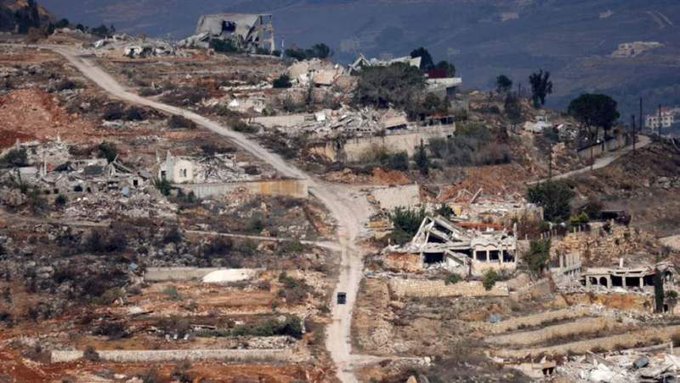
The southern Lebanese town of Adaisseh after the Israeli aggression on Lebanon (December 2024)
Al-Manar | December 17, 2024
The Israeli enemy has been procrastinating on withdrawal from southern border towns, hindering the deployment of the Lebanese Army, Al-Manar correspondent in south Lebanon reported on Tuesday.
Our correspondent said that it was planned that the Israeli enemy forces would withdraw from Al-Hamamis Hill in the border town f Khiam during the first phase of a coordination deal with the UNIFIL peacekeeping force.
“However, the Israeli enemy delayed the withdrawal and the Lebanese Army didn’t manage to enter the area,” Al-Manar’s Ali Shoeib reported.
Meanwhile, the reporter added that the Lebanese Army wasn’t able to enter the border town of Adaisseh in a bid to retrieve the bodies of the martyrs.
He noted that another bid in the town of Taybe was also hindered as the Lebanese Army leadership is waiting for a response from the UNIFIL, which is coordinating these missions with the Israeli enemy.
On the other hand, the Israeli forces repeatedly opened fire at houses in the border town of Naqoura and carried, Shoeb said, adding that the Israeli enemy forces also went ahead with blowing up houses in the border town of Kfar Kila.
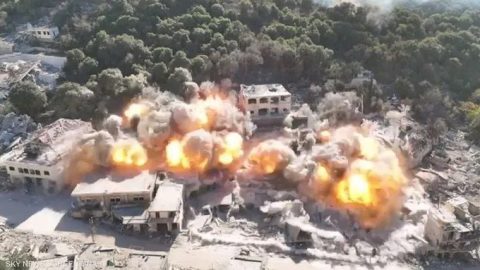
The Lebanese border towns were venue of epic battles between Israeli occupation forces and resistance fighters who heroically repelled the Zionist incursion into Lebanon throughout nearly two months (from October 1 till November 27.)
Lebanon has been subjected to brutal Israeli aggression on September 23, that killed more than 4,000 people and injured at least 12,000 others.
‘Israel’ expanding operations in southern Syria toward key dams
Al Mayadeen | December 17, 2024
Israeli occupation forces have partially withdrawn from the al-Raqad Dam area near Saida al-Golan in the southern countryside of Quneitra, a local Syrian source told Al Mayadeen on Tuesday.
The source reported that the withdrawing forces redeployed to Tel al-Saqi in the occupied Golan Heights, a position overlooking the Yarmouk Basin and southern Quneitra. However, the Israeli forces maintained a presence along the axis stretching from Barracks 74 to the valleys of Raqad and Taim, focusing their operations near key water sources and dams in southern Syria.
Simultaneously, Israeli occupation forces have installed advanced communication equipment on Jabal Qurs al-Nafl, west of Hader in Quneitra’s countryside. According to local sources, this strategic elevation directly overlooks the occupied town of Majdal Shams and critical Israeli supply routes toward the Lebanese border.
Continued encroachment
Earlier on Tuesday, an Al Mayadeen correspondent reported Israeli incursions into Saida in the occupied Golan and its neighboring village of al-Muqraz, located at the administrative border between Daraa and Quneitra. The occupation forces have also seized control of the Yarmouk Basin, including the Yarmouk River and the al-Wehda Dam, asserting dominance over key water resources in the region.
Despite these advances, the Israeli forces have been unable to occupy Beit Jinn, a stronghold of local resistance, and remain stationed in its surrounding areas. Additionally, they have expanded eastward near the villages of Kuwayya, al-Mariyah, and al-Qusayr, close to the Jordanian border.
Escalation of Israeli aggression
For the sixth consecutive day, the Israeli occupation has been advancing deeper into Syrian territory. It now controls the Syrian side of Mount Hermon, has taken over the “buffer zone” in the occupied Golan Heights, and is within 15 kilometers of the Damascus-Beirut international highway.
Furthermore, the occupation has seized major freshwater resources in southern Syria, particularly in the Yarmouk Basin, signaling a strategic shift toward controlling critical infrastructure.
Meanwhile, Israeli Security Minister Israel Katz visited Israeli occupation forces outposts on Mount Hermon in Syria on Tuesday, emphasizing the strategic importance of the area in countering threats from Hezbollah in Lebanon and factions in Syria.
He was accompanied by Prime Minister Benjamin Netanyahu, IOF Chief of Staff Herzi Halevi, Shin Bet Director Ronen Bar, and Northern Command Chief Maj. Gen. Ori Gordin.
Featured Video

The American Retreat from Vietnam
or go to
Aletho News Archives – Video-Images
From the Archives
Secret document reveals plans for civil war in Lebanon, Israeli false flags, and invasion
By Randi Nord | Geopolitics Alert | April 5, 2019
Beirut – During his visit with US Secretary of State, Mike Pompeo, Lebanese President Michael Aoun reportedly received a US-Israeli document detailing plans for creating a civil war in Lebanon with covert false flag operations and possible Israeli invasion.
Although the source of the document is Israeli and created in partnership with Washington, no one knows who presented it to Aoun. The Lebanese TV station, Al-Jadeed, initially reported the document on Lebanese TV and a video on its website. Geopolitics Alert translated the report for this article. … continue
Blog Roll
 Aletho News
- There’s a drought in academia: A drought in honest research on the subject of drought and other weather extremes
- Department of War Awards $20.7 Billion Contract to Raytheon for Air-to-Air Missiles
- ‘Distance yourselves from Israel’: IRGC urges US population to question govt policies
- America’s Greenland deal has a radioactive backstory
- The RAF Fairford ‘terror plot’: Unpacking escalation in the UK echo-chamber
- EU Council Advances Chat Control 2.0 Scanning Proposal
- Ex-Greek MEP files complaint against Israeli spyware firm over alleged Pegasus surveillance
- Troubling ideas throughout the Torah, Talmud, Mishneh Torah and Tanya
- ‘Grave, alarming’: Iran mission on Trump’s UNGA ‘annihilation’ threats
- Najaf airport to reopen to Iranian flights within 24 hours: Ambassador
- If Americans Knew
- New Report: “Scholasticide and Genocide in Gaza: Assessment, Testimonies and Legal Analysis”
- Ex-Biden officials are desperate for a Gaza scapegoat
- Israeli “settlers” Invade Al-Aqsa; Pour Boiling Water on 75-Year-Old
- Israel Has Kidnapped Another American Teenager
- US arms sales to Israel worth $21.6 billion in 20 months
- Three Palestinians Killed in Israeli Attacks on Gaza
- Revealed: German “Anti-Semitism Expert” Driving Crackdown on Palestine Solidarity is Former Israeli Spy
- Egypt’s Warning to Israel Before Oct 7
- Israel’s siege signals another cruel winter for 1.8 million Gazans – Daily Update
- Netanyahu Asked UAE Leader to Deny Report on Oct. 7 Warning in Secret Visit, Sources Say
- No Tricks Zone
- New Study: Earth And Venus Surface Warmth Largely Explained By Convection And Lapse Rate, Not CO2 Or Radiation
- 2025 Nature Paper Claiming Worsening Global Drought Gets RETRACTED …Heavily Flawed
- New Study: ‘Global Drought Shows No Detectable Recent Acceleration Under Climate Warming’
- Economic Masterminds: German Socialists Suggest Taxing Productivity Gains Stemming From Using AI
- The South China Sea Has Not Been Cooperating With The Climate Change Narrative
- Energy Crisis: Germany Enters Heating Season With Historically Low Gas Reserve Fill Levels
- New Study: The Antarctic Ice Sheet Gained Mass From 2020-2024 Due To Staggering Snow And Ice Accumulation
- Study: Ocean Heating Rates From Thousands Of Years Ago ‘Dwarf’ Modern Ocean Heating Rates
- Climate Extremists Target, Attack Large-Scale Power Grid Infrastructure In Germany!
- New Study: Antarctic Ice Melt Has Contributed Less Than 1 Centimeter To Sea Level Rise In The Last 30 Years

