Blinded to Syria
By Patrick Lawrence | Consortium News | December 15, 2024
Decades after deploying mass violence and rendering citizens grotesquely ignorant of the world, U.S.-led powers appear willing to risk world war, while reinventing a terrorist to lead what was a secular nation until last week.
I do not know anyone who was not shocked by the lightning speed with which Damascus fell to expensively armed jihadist militias last weekend.
I know very few people who do not understand that another domino has just fallen in the “seven-front war” Benjamin Netanyahu has boasted this year of waging across West Asia. I know very few people who do not recognize that terrorist Israel is well on the way to establishing itself as a dictatorial hegemon across the region.
I know very few people who do not understand that the longstanding project of the Zionist neoconservatives, who have more or less controlled U.S. foreign policy for decades, i.e., “remaking the Middle East,” is the design behind all that has occurred since the Israelis launched their attack on Gaza on Oct. 7, 2023.
I do not know anyone who has achieved the age of reason who does not recognize the U.S. hand in the stunning sweep through Syria of Hay`at Tahrir al–Sham, long-recognized as a terrorist organization. All one needs to grasp this is a little history.
But I know of no corporate or state-funded medium on either side of the Atlantic — the major dailies, the broadcast networks, NPR, PBS, the BBC — where you can read or hear about any of this.
Blinding Us
Mainstream media are doing exactly what they did as the U.S.–led “regime change” operation in Syria began in early 2012 at the latest and probably in the final months of 2011: They are making sure the events now unfolding in Syria are not quite illegible but nearly.
It is again a question of knowing the history. In the case of Hay`at Tahrir al–Sham and the other jihadists who knocked over the Assad regime as if it were made of Lego blocks, it is another exercise in dressing up a monster in a suit and tie.
The corporate press and broadcasters are now resolutely recasting the murderous fanatics who have seized control of Syria as legitimate “rebels.” Rebels, rebels, rebels: This is the approved terminology.
I see they have left off describing these Sunni zealots as the “moderate rebels” of yesteryear, that phrase having been hopelessly discredited last time around, but the drift is the same: These are civilized people out there trying to do the right thing.
My favorite in this line appeared in The Daily Telegraph several days before the Assad government collapsed: “How Syria’s ‘diversity-friendly’ jihadists plan on building a state.” I had to read this one twice, too.
Nowhere but nowhere in the West’s mass media can you find even a mention of the U.S.–Turkish-and-probably–Israeli support that made possible the swift sweep of Hay`at Tahrir al–Sham and its ever-bickering allies from its seat in the Idlib governorate through Hama and other cities to the center of Damascus.
This is, like the earlier years of the Western-backed terrorist attacks on the Assad regime, and like the proxy war in Ukraine, and like the Saudis’ U.S.–supported war against Yemen, and like the Israeli genocide against the Palestinians of Gaza, and like the Israelis’ attacks in Lebanon, sponsored military aggression we are not permitted to see without considerable effort to transcend official representations of reality.
Understanding Who the Americans Are
What happened, what is happening, what will happen: I do not know anyone who is not asking these questions, too.
We must go back and back and back further to understand what has just occurred in Syria and to understand why, and finally to understand who Americans are and who they have been for all the decades since the 1945 victories.
It is logical to begin this pencil-sketch of the past with the famous coups of the 1950s. These occurred in Iran, where the C.I.A., working with MI6, deposed Mohammed Mossadegh as Iran’s prime minister in August 1953, and in Guatemala, where an agency operation forced Jacobo Árbenz from the presidency a year later.
It is striking today to consider a few of the features of these operations. Stimulating various social and economic antagonisms to foment public unrest and an appearance of political disorder was key in both cases. Both coups removed popularly elected leaders and installed repressive puppets.
There was violence in both cases, but by later standards these operations were something close to surgical. Mossadegh withdrew to his farm in the Iranian countryside; Árbenz, a Swiss pharmacist by background, spent his last years wandering dejectedly through Europe.
An appearance of propriety was important back then. Most Americans were unaware that the C.I.A. had engineered the events in Tehran and Guatemala City. And in the Iranian case, something to note: Removing Iran’s first elected prime minister set in motion a wave of blowback that continues to break over U.S.–Iranian relations; in Guatemala it led to a civil war that endured for 36 years.
The C.I.A. considered the coup in Iran a useful model – Guatemala its next application. But in 1965 the agency began to do things very differently when it organized the coup that brought down Sukarno, independent Indonesia’s charismatic founding father and its first president.
The Jakarta Model
Vincent Blevins, a seasoned foreign correspondent, got this down better than anyone in The Jakarta Method: Washington’s Anticommunist Crusade and the Mass Murder Program that Shaped Our World (Public Affairs, 2020). With the Cold War approaching its worst years, the Indonesian coup was the first, as Blevins’s subtitle indicates, to submerge an entire nation in prolonged violence.
There are various figures for the number of deaths that resulted as the agency installed the dictatorial, bottomlessly corrupt Suharto in the presidential palace in 1967. Blevins puts it at a million or more. Along with the deaths, the nation’s previously lively political culture was extinguished until Suharto fell 32 years later.
The Jakarta Method was subsequently applied in various other circumstances, notably but not only in the 1973 coup that deposed Salvador Allende in Chile and installed Augusto Pinochet, a vicious dictator in the Suharto mold. Nine years later Zbigniew Brzezinski put a modified version to use in Afghanistan.
Blind to US Support for Jihadism
As Jimmy Carter’s relentlessly anti–Soviet national security adviser, Brzezinski persuaded Carter to back the mujahideen then fighting the Moscow-backed regime in Kabul. The result was the well-armed, well-financed force named al–Qaeda, led by Osama bin Laden.
And so we come, via the campaigns of mass violence in Iraq and Libya and the proxy war in Ukraine, to the Syrian operation. People who rely on mainstream media still have a hard time accepting that the U.S. and its trans–Atlantic allies backed al–Qaeda’s Syrian forces, the Islamic State, and their heinous offshoots in their war against the Assad regime.
There are no grounds whatsoever for this disbelief. The U.S. operation in Syria is a straight readout of Brzezinski’s Afghanistan strategy. Sharmine Narwani, the tenacious Beirut-based correspondent and the founding editor of The Cradle, reported the American op first-hand as it unfolded. She recounted what she saw in an impressively detailed interview I published in 2019. It is here and here in two parts.
It Wasn’t Over
By 2018–19, it was obvious that the C.I.A.’s Syrian operation, in my judgment its largest since the Cold War’s end, had failed after several years of Russia’s bombing campaign against the Islamic State. Everyone making this judgment, myself included, forgot to add four essential words: It had failed for the time being.
Hay’at Tahrir al-Sham was founded at the start of the covert U.S. intervention, in 2011–12. Its name translates as Organization for the Liberation of the Levant.
Liberating the Levant is a very good idea, but HTS does not mean this the way anyone opposed to the Western powers’ long and violent domination of West Asia would mean it. HTS shared with the Islamic State an ambition to establish a caliphate ruled by radical interpretations of Islamic law.
In May 2018 the State Department added HTS to its list of foreign terrorist organizations, FTOs in the parlance of the apparatchiks. It is a direct descendent of Jabhat al–Nusra, which was the worst of the worst among al–Qaeda’s shape-shifting affiliates operating in Syria.
By the time HTS made the list, Jabhat al–Nusra was already on it. They both remain on it as we speak.
HTS was founded by Abu Mohammad al–Jolani, a nom de guerre now all over the news: He has long led HTS and appears now to have plans to make himself Syria’s next president. When he spoke at a celebrated mosque in Damascus last week, he shed the public alias in favor of his real name, Ahmed al–Shara.
Jolani’s background is not to be missed. He was once an Islamic State commander who went on to found Jabhat al–Nusra and, after a violent split, HTS.
As the HTS leader, he was implicated in numerous cases of torture, violence, sexual abuse, arbitrary arrests, disappearances, and so on. Reflecting his singular malignity, the State Department had declared Jolani a “specially designated global terrorist” as far back as 2013.
That designation still stood in 2021. Then something odd, and in hindsight very revealing, occurred.
Rehabilitating Jolani
In April of that year PBS broadcast the first interview with Jolani ever to appear in any Western medium. It was conducted by Martin Smith, a longtime broadcast correspondent with a good reputation.
And there on camera was the specially designated terrorist in a blue blazer and a buttoned-down shirt, telling Smith he planned to build a “salvation government” in Syria.
Smith was not shy, to his credit, in his review of Jolani’s horrific record. But he gave his interview subject ample airtime to make his that-was-then-this-is-now argument.
There was no talk of a caliphate, despite how HTS still named itself. It was about sound local governance. Yes, this would be according to Sharia law, but it would be a kind-and-gentle Sharia law.
The Martin Smith interview, it is now evident, was highly significant for its timing and its implications for U.S. policy. It is almost certain that it signaled an already-in-train revival of the Syrian operation; certainly it marked the start of the preposterous reinvention of Jolani that is now ubiquitous in Western media.
It is a long way from those first postwar coups — large in ambition and implications but small in scale as they look to us now. Since the Jakarta Method was devised in the mid–1960s, mass murder programs have shaped our world just as Vincent Blevins insightfully put it.
Committed to Mass Violence
The questions noted at the start of this commentary remain those we must ask: What happened, what is happening, what will happen. Clarity on these matters arrives by degrees — not by way of official accounts or the corporate press, but in independent media. For now, two conclusions.
One, the U.S. and its trans–Atlantic allies are now thoroughly committed to mass violence. This means it is difficult to avoid concluding that the Western powers and Israel will turn to Iran once Syria as a functioning polity has been thoroughly disabled.
What has prompted the U.S. and Israel to exercise caution to date has been the risk of what would without doubt be a cataclysmic conflict that could tip into another world war.
With a six-decade history of mass violence behind them, these powers now appear willing to take this risk. There is little ground left to continue questioning this.
Two, we now witness the reinvention of a viciously intolerant terrorist given to waging holy wars as an acceptable presence at the head of what was a secular nation until earlier this month.
We must read this as the outcome — the successful outcome — of an eight-decade campaign to render the citizens of the Western powers grotesquely ignorant of the world in which they live.
The New York Times and other major dailies continue to lie by omission about U.S. support for Jolani and the organization he leads, even as both are officially designated terrorists. But something worth considering here: These media ran interesting photographs with their initial stories on the militias’ sudden offensive, showing rocket launchers and armored personnel carriers of obvious Western manufacture. Here is one such picture and here is another.
I see these pictures and the accompanying stories as mirrors. They show us exactly who we are, what we have become — and also the extent to which we are encouraged not to see either.
There are no true surprises in what we witness now in Syria. It is an old story. We have been blinded to it, along with many other things to which we have been blinded. Most fundamentally we have been rendered blind to ourselves.
Patrick Lawrence, a correspondent abroad for many years, chiefly for the International Herald Tribune, is a columnist, essayist, lecturer and author, most recently of Journalists and Their Shadows.
Israel massacres, expels displaced Palestinians sheltering in north Gaza school
The Cradle | December 15, 2024
Israeli army forces stormed a school housing displaced Palestinians in northern Gaza on 15 December, opening fire and killing at least 40 civilians, while forcing dozens to flee.
All the men who were sheltering in the Khalil Oweida school in Beit Hanoun were abducted, while the rest were forced to evacuate at gunpoint. Several others were injured in the attack on the school.
According to WAFA news agency, the displaced women and children were forced to head to an Israeli checkpoint on the Salah al-Din axis leading to Gaza City.
Anadolu Agency (AA) reported, citing eyewitnesses, that the bodies of the victims were spread out across the Khalil Oweida schoolyard and nearby streets.
“The terrorist occupation army’s storming of Khalil Awida School in Beit Hanoun … and committing a massacre against the displaced people there, by direct shooting … and then arresting all the displaced youths, is a reinforcement of the ethnic cleansing and forced displacement operations taking place in the northern Gaza Strip,” Hamas said in a statement.
Israeli forces in Gaza have repeatedly targeted schools packed with displaced civilians.
The attack was the latest in a string of recent massacres committed by Israeli forces in Gaza. Israeli troops “committed five massacres against families” in Gaza over the past 24 hours, killing at least 46, WAFA reported on Sunday.
The battered Gaza Strip has been subject to a severe lack of humanitarian aid due to Israel’s closure of all border crossings, as Tel Aviv has stepped up its attacks and total siege – particularly in the north – where over 100,000 people have been forcibly expelled and thousands killed.
This comes as part of the unofficial implementation of the Generals’ Plan, which aims to make northern Gaza uninhabitable through mass destruction, killing, and expulsion. Israel aims to completely empty out north Gaza and transform the area into an isolated military zone.
As part of this plan, Israel is also waging a brutal war against medical facilities in northern Gaza. The few remaining hospitals are under siege and constant attacks by Israel, particularly Beit Lahia’s Kamal Adwan Hospital – which has been raided numerous times by the Israeli military.
Israel bombed the vicinity of Kamal Adwan Hospital once again on 15 December, as the medical facility faces imminent collapse along with the rest of the area’s health sector. Two Palestinians were killed in the attack.
Israel to deploy remotely operated machine guns against Palestinians in occupied West Bank
The Cradle | December 15, 2024
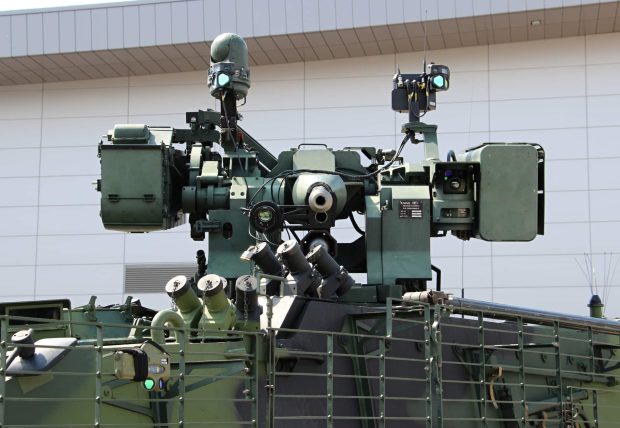
The Israeli army is preparing to deploy automated, remotely monitored machine guns to protect illegal Jewish settlements in the occupied West Bank, Israeli Army Radio reported on 15 December.
The automated weapons, developed by Rafael Combat Systems, will be installed on watch towers around dozens of settlements and near their entrances. They will be controlled remotely from command centers “to prevent armed attacks and infiltration operations.”
The same system was installed on the Gaza border in 2008 and operated by spotters in bases. However, it failed to prevent fighters from the Islamic Resistance movement, Hamas, from approaching and breaching the barrier fence to attack settlements and Israeli military bases on 7 October 2023.
During Operation Al-Aqsa Flood, Qassam Brigades fighters reportedly used attack drones to disable the automated weapons during the first hours of the operation.
The army will first deploy the weapons in locations it defines as ‘high-risk,’ and expand their deployment over time to include additional locations.
According to the report, the 636th Reconnaissance Unit of the Army’s West Bank Division will operate the systems.
Israeli soldiers and settlers have escalated their attacks on Palestinians in the West Bank since the start of Israel’s genocidal war on Gaza last year.
The Israeli army and settlers have killed 812 Palestinians and injured 6,500 in the West Bank since that time.
National Security Minister Itamar Ben Gvir has provided over 120,000 firearms to Jewish settlers in the West Bank since the outbreak of the Gaza War.
“Over 120,000 weapons were distributed to eligible citizens, while tens of thousands more received conditional approvals,” Ben-Gvir, leader of the far-right Jewish Power Party, said on his X account in October.
“We intend to continue arming Israel. That’s what we did, and that’s what we’ll continue to do!”
Ben Gvir and fellow Jewish supremacist politician and minister have announced their desire to use the Jewish settlers to expel the indigenous Palestinian population from the occupied West Bank and annex it to Israel.
After Donald Trump’s election to the US presidency in November, Ben Gvir, himself a resident of the Kiryat Arba settlement, declared that “this is the time for sovereignty” over the West Bank.
On 9 December, following the fall of Bashar al-Assad’s government in Syra, Bezalel Smotrich called for increased Jewish settlement and establishing “facts on the ground” to ensure a Palestinian state would never be established.
‘Israel’s’ support for Syrian opposition exposed
By Kit Klarenberg | Al Mayadeen | December 14, 2024
In the wake of ultra-extremist militants of Hay’at Tahrir al-Sham seizing Damascus, Zionist entity premier Benjamin Netanyahu gave a smug address from the Golan Heights, Syrian territory illegally occupied ever since 1967. Along the way, he took personal credit for the fall of Bashar al-Assad’s government and the Syrian Arab Army’s defeat, while pledging that the ground on which he stood would be part of “Israel “for eternity”. Ever since, Israeli occupation forces have pushed ever deeper into Golan, unimpeded and unopposed.
Tel Aviv’s criminal seizure of yet further territory from its neighbors was an absolutely inevitable upshot of Syria’s collapse. However, some Western journalists and politicians have expressed dismay – in many cases, the same figures were cheering al-Assad’s fall just 24 hours prior. Consternation has also widely abounded over the foreign-dominated and controlled opposition groups that overran Damascus, effusively praising the Zionist entity’s assistance in their offensive against the SAA.
Speaking to Israeli TV on December 2, one rebel fighter thanked Tel Aviv for striking Hezbollah and other Resistance groups, stating the opposition was “very satisfied” with the support. They added, “We love Israel and we were never its enemies… [Tel Aviv] isn’t hostile to those who are not hostile toward it. We don’t hate you, we love you very much.”
‘Striking deeper’
While never acknowledged in the mainstream, the Zionist entity’s sinister alliance with extremist opposition groups arrayed against Damascus has long laid in plain sight. A September 2018 investigation by the US empire house journal Foreign Policy spelled out in detail “Israel’s secret program to back Syrian rebels.” It documented how, since 2013, Tel Aviv “armed and funded at least 12 rebel groups” in the country. The ostensible purpose was to “prevent Iran-backed fighters and militants of the Islamic State from taking up positions near the Israeli border.”
The entity’s “military transfers” to anti-Assad opposition groups were vast. They “included assault rifles, machine guns, mortar launchers, and transport vehicles.” The material was funneled via the illegally occupied Golan Heights. “Israel” even “provided salaries to rebel fighters… and supplied additional money the groups used to buy arms on the Syrian black market.” Initially, arms transferred were “mostly US-manufactured,” but these were later “switched” to “non-American weapons… apparently to conceal the source of the assistance.”
Every step of the way, “Israel’s” backing of the Syrian opposition ratcheted. Foreign Policy attributes this ever-aggressive stance to Tel Aviv’s failed “appeals” to the US and Russia “to secure a deal that would ensure that Iranian-backed militias would be kept away from southern Syria.” This prompted the entity to “[begin] striking deeper inside Syrian territory, targeting not just individual weapons shipments from Iran to Hezbollah but also Iranian bases across the country.”
In providing this largesse, Tel Aviv “relied on relationships it developed with individual commanders” of extremist militias, sending “assistance directly to them.” Representatives of these factions “would communicate with Israeli officials by phone and occasionally meet them face to face” in the Golan Heights. “When commanders switched groups and locations, Israeli assistance followed them” – and the entity’s chosen proxies frequently served as distributors of Zionist-supplied weaponry “to other groups,” giving them “outsized influence” in the dirty war.
Foreign Policy records, “As a result of Israel’s humanitarian and military assistance, many residents of southern Syria came to perceive it as an ally.” An anonymous opposition fighter told the outlet, “Israel is the only one with interests in the region and a little bit of humanity and [provides] assistance to civilians.” However, “As troops loyal to Assad, aided by Russian and Iranian forces, reasserted control over more and more areas of Syria,” Tel Aviv cut a secret deal with Moscow, to the opposition’s detriment.
Under its auspices, SAA forces returned to “areas adjacent to the Golan Heights” while Russia promised “to keep Iran-backed militias 80 kilometers” from the area “and not to start hindering Israeli strikes on Iranian targets across Syria.” Despite this, Tel Aviv didn’t desert its murderous surrogates. As government forces closed in, “rebels reached out to their Israeli contacts and asked for asylum.” They and “their immediate family members” were duly permitted to flee to “Israel”, Jordan, and Turkey, with Tel Aviv’s assistance and protection.
With eerie foresight, Foreign Policy concluded that “Israel’s” policy of backing the rebels would contribute to significant and enduring unresolved security problems not only in Damascus but throughout West Asia more widely:
“[This] raises questions about the balance of power in Syria as the civil war there finally winds down. With the Iranian forces that helped Assad defeat the rebels showing no inclination to withdraw from Syria, the potential for the country to become a flash point between Israel and Iran looms large. Without deft diplomacy, confrontations in Syria, protests in Gaza, and tensions over the Iran nuclear deal could plunge the Middle East into chaos.”
‘Military capabilities’
Foreign Policy was at pains to portray “Israel’s” assistance to the Syrian opposition as being predominantly informed by a desire to crush ISIS. For example, the outlet claimed Tel Aviv “provided fire support to rebel factions” fighting an Islamic State affiliate near the Yarmouk River. This purportedly extended to drone strikes targeting ISIS commanders “and precision-missile strikes against the group’s personnel, fortifications, and vehicles during battles with the rebels.” Meanwhile, the Zionist entity “did not extend similar fire support for rebel assaults on regime forces.”
Yet, such an exculpatory narrative is at glaring odds with multiple public admissions by Israeli officials. For example, in April 2017, former entity Security Minister Moshe Ya’alon revealed that “recently”, ISIS had “apologized” after “[opening] fire” on Tel Aviv’s forces in the Golan Heights. This contrition was expressed by the terror group despite the IOF responding to this broadside by bombarding Islamic State fighters with airstrikes and tank fire, killing four of them.
One might reasonably ponder why, despite these casualties, ISIS felt the need to say sorry. An obvious explanation is the hyper-militant faction did not wish to offend Tel Aviv, lest the entity’s long-running operation to provide medical assistance to insurgents wounded in the Syrian dirty war in field hospitals dotted across Golan be terminated. From 2012 onward, UN peacekeeping forces consistently testified to witnessing injured Al Qaeda, al-Nusra, and ISIS fighters being treated by Israeli military doctors across the region.
Along the way, documentary filmmakers even captured video evidence of this practice. Once tended to, these belligerents were sent straight back into battle by their Zionist protectors to fight Hezbollah and the Syrian Arab Army. These astonishing scenes went largely unremarked upon in the Western media although in May 2016, ex-Mossad chief Efraim Halevy proudly boasted that Tel Aviv was committed to a strategy of “the enemy of my enemy is my friend” in its crusade to neutralize Assad:
“It’s always useful to deal with your enemies in a humane way. When you have people who are wounded, considerations of whether to take them in are not simply whether it’s politically useful… I didn’t say there was no tactical [consideration]. I don’t think there’s going to be blowback… Al Qaeda to the best of my recollection hasn’t specifically targeted Israel… As Hezbollah fighters are concerned, we have a different account.”
Fast forward to today, and ever since al-Assad’s fall, “Israel” has relentlessly blitzed SAA sites in Syria. Entity officials boast the “historic” campaign has “destroyed most of the former [Assad] regime’s strategic military capabilities,” decimating up to 80% of the fallen government’s “strategic weapons stockpiles.” Markedly, there has been no attempt whatsoever by HTS to deter or respond to this bombardment, despite Damascus now being completely defenseless against future incursions from its adversaries. Group spokespeople have moreover actively refused to denounce the attacks.
Nonetheless, longtime Syrian “revolution” activists have expressed shock at “Israel’s” onslaught against the “newly liberated” country and further illegal “annexation” of its territory, demanding Tel Aviv cease its inexorable assaults forthwith. One wonders whether such public reactions are truly borne of ignorance and naivety about “Israel’s” rapacious expansionism. The reality may be that the opposition knew all along precisely what would be unleashed following al-Assad’s ouster and still welcome it. After all, they were coordinating directly with the Zionist entity at every step of their struggle.
Israeli forces cut off water, power to several towns in Syria’s Quneitra
Press TV – December 15, 2024
Israeli tanks and armored vehicles have rolled into several towns in Syria’s Quneitra, destroying streets, as well as water supply networks and electricity poles in the country’s southwestern province.
Reports said on Sunday that a large number of Quneitra residents had refused to heed a call by the Israel military to evacuate.
Thus, the reports added, the Israeli forces damaged water supply networks and power lines in a deliberate attempt to cut off life support to the areas that they had newly occupied.
In the town of al-Hamidiyah, the occupation troops cut down the trees on both sides of roads and destroyed power poles.
Early on Sunday, the Israeli occupation launched airstrikes targeting the outskirts of the Syrian capital, Damascus.
According to the Israeli media, the Zionist military destroyed missile warehouses and launchers near Qastal in the Qalamoun area of Damascus’ countryside.
On Saturday, the Israeli soldiers, supported by the regime’s air force, invaded an empty command center of the Syrian army in al-Hamidiyah and searched for alleged weapons.
The so-called Syrian Observatory for Human Rights said late Saturday that the Israeli army had fired 61 missiles at targets in Syria in less than five hours.
Israel started its push to grab more Syrian land on December 8, after foreign-backed militants led by Hay’at Tahrir al-Sham (HTS) announced the fall of President Bashar al-Assad’s government following a rapid two-week onslaught.
The Israeli forces seized the so-called buffer zone, which separates the occupied Golan Heights from the rest of Syria, in violation of a UN-brokered 1974 disengagement agreement.
They occupied the summit of Jabal al-Shaykh which provides an observation point for areas in Syria and Lebanon.
They further advanced beyond the so-called buffer zone toward Damascus, with the regime’s warplanes conducting nearly 500 aerial assaults on Syria.
The Israeli military said its attacks destroyed Syria’s navy and 90 percent of the country’s surface-to-air missile systems.
Netanyahu Pushes Golan Heights Expansion Plan Amid Regional Tensions
Sputnik – 15.12.2024
TEL AVIV – Israeli Prime Minister Benjamin Netanyahu’s government has unanimously approved a plan for the development of the Golan Heights, including strengthening local settlements and doubling the population in the region, the prime minister’s office said on Sunday.
“The government unanimously approved prime minister Benjamin Netanyahu’s plan to promote demographic growth in the settlements in the Golan Heights and Katzrin, with a total budget of more than 40 million shekels [$11 million],” the statement read.
The office also said that in light of the ongoing conflict and the recent opening of a new front in Syria, Netanyahu had submitted the first amendment to his plan to promote demographic growth in the Golan due to the “desire to double the population of the Golan Heights.”
The plan to develop the Golan Heights includes initiatives in the areas of education, renewable energy, and the establishment of a student village. It also includes an organizational development program designed to assist the Golan Regional Council in welcoming new residents.
“The strengthening of the Golan Heights is essential for the security and stability of the State of Israel. It is especially important in the current situation. We will continue to maintain, develop, and settle the area,” Netanyahu said, as quoted by the office.
Earlier, Israeli Prime Minister Benjamin Netanyahu stated that “the Golan Heights will forever remain an integral part of Israel.”
Israel is actively strengthening its defenses on the Golan Heights amid the fall of Syrian President Bashar al-Assad and the capture of a significant part of the country by armed opposition forces. On Sunday, Netanyahu said the agreement reached shortly after the 1973 Yom Kippur War (also known as the Ramadan War) was no longer valid because the Syrian forces had left their positions. Netanyahu ordered the Israel Defense Forces to occupy the buffer zone.
How ex-Daesh and al-Qaeda leader al-Jolani became West’s blue-eyed boy in Syria

By Alireza Akbari | Press TV | December 15, 2024
Only a day after West-backed militant groups led by Hay’at Tahrir al-Sham (HTS) took control of Damascus, ending Bashar al-Assad’s long reign, HTS leader Abu Muhammad al-Jolani stood triumphantly on a hill overlooking the Syrian capital.
Wearing army fatigues, Ahmed al-Sharaa, popularly known as Jolani, looked on as plumes of smoke billowed into the sky—a grim spectacle of destruction wrought by Israeli bombings following the ouster of Assad’s democratically-elected government in Damascus.
The haunting scene evoked an eerie parallel to Emperor Nero, who infamously watched Rome burn while playing his lyre—portraying an image of power and apathy.
As the Israeli regime grabbed more Syrian land beyond the occupied Golan Heights and launched unprecedented airstrikes on Damascus, HTS militants gleefully roamed the streets, celebrating the “conquest,” and unleashed a brutal campaign of throat-slitting and terrorizing minorities.
The tumultuous events that eventually led to the overthrow of the Assad government began on November 27, when videos surfaced of militant groups in Aleppo making rapid advances.
These groups swiftly and dramatically escalated their advances, capturing strategic military bases in Idlib and Hama before marching toward the capital Damascus.
On December 8, they delivered a televised address from Damascus, declaring the end of Assad’s 24-year reign—a seismic shift in the region’s power dynamics with all eyes on Jolani as the leader.
Who is al-Jolani?
Abu Muhammad al-Jolani was born in Riyadh, Saudi Arabia, in 1982 to a Syrian family originally from the occupied Golan Heights of Syria, which has been under Israeli occupation for years.
His family returned to Syria in 1989, settling in Damascus’s affluent Mezzeh district. Jolani pursued media studies in Damascus before relocating to Iraq in 2003, just prior to the US invasion.
In Iraq, he joined the al-Qaeda terrorist group and became a key figure in the group.
He was captured by American forces in 2006 and spent five years imprisoned at Camp Bucca before being released in 2011. After that, he moved back to Syria and gained prominence as a militant leader.
Jolani’s journey through the ranks of Takfiri terrorist groups was spectacular as he became a close aide to top al-Qaeda leaders including Osama bin Laden and Ayman al-Zawahiri.
After his release from Camp Bucca in 2011, where he forged connections with future Daesh leaders, Jolani emerged as a key figure in the global Takfiri terrorist movement.
He initially served as a Daesh commander in Iraq’s Nineveh and Mosul provinces before being handpicked by Daesh chief Abu Bakr al-Baghdadi in 2012 to establish a Syrian affiliate at the outset of the West-backed militancy against the Assad government in the Arab country.
Jolani founded the Nusra Front as Daesh’s Syrian offshoot, leveraging the chaos to advance his agenda. However, a power struggle with al-Baghdadi over control of the group led to a split in 2013.
Jolani severed ties with Daesh and fortified his influence in Syria’s Idlib governorate, aligning the Nusra Front with al-Qaeda to retain the loyalty of hardline elements within his ranks.
While the split signaled a shift in allegiance, according to experts, it was less about ideology and more a personal rift. Jolani continued to espouse the Salafi ideology but sought to differentiate himself through a political veneer, setting him apart from figures like al-Zarqawi and al-Baghdadi.
Terror designation
The US State Department designated Jolani as a Specially Designated Global Terrorist in May 2013. By 2017, he was among the most wanted terrorists globally, with a $10 million bounty by the US government for information leading to his capture.
In an audio statement on September 28, 2014, Jolani declared his intent to fight the United States and its allies, urging his forces to reject Western assistance in their battle against Daesh.
Yet, just two years later, in July 2016, Jolani broke his pledge of allegiance to al-Qaeda leader al-Zawahiri, aiming to rebrand his militant organization and broaden its alliances.
This strategic pivot marked a shift in Jolani’s focus—from global ambitions to governance in Syria.
Following the establishment of the HTS militant group in 2017, the group took control of large swathes of Idlib, where they established a rudimentary governing structure.
HTS began collecting taxes and issuing identity cards to locals. However, these efforts were marred by authoritarian practices, including the suppression of dissent and the arrest of political opponents.
Despite Jolani’s public commitment to protecting minorities, his group adopted high-handed measures against religious and ethnic minorities, especially those who spoke about discrimination.
While HTS made rapid strides in consolidating power in the region bordering Turkey, its track record of human rights abuses in Idlib continued to be an area of concern.
The group has been known for systematically silencing dissent, targeting rivals, and using disproportionate force against those who opposed his authoritarian practices.
Concerns have also grown over the presence of foreign mercenaries in HTS, particularly those in its elite Red Brigades, which include members from Central Asia, Chechnya, and France.
Bigger political aspirations
Despite his Takfiri-militant roots, Jolani’s bigger political aspirations kept him in the news for years, as he continued to harbor ambitions of capturing Damascus from his hideouts in Idlib, financially and militarily backed by the United States, the Israeli regime and some regional countries.
Now, with HTS and its allies controlling significant territory in Syria, questions loom over how they will govern the country. Around 100,000 Syrians have already gathered on the border to enter Lebanon, according to reports, desperate to leave their home country.
Fears persist about the treatment of minorities, dissidents, and women under their rule, as many Syrians and the international community remain wary of Jolani’s true intentions.
Despite growing concerns over HTS rule, fueled by viral videos showing the group’s violent tactics, both the UK and the US are reportedly reconsidering its designation as a terrorist organization.
The British government is actively weighing the removal of HTS from its list of designated terrorist groups, particularly in light of the group’s pivotal role in the fall of the Assad government.
UK government minister Pat McFadden has suggested that such a move could be “relatively swift,” given the rapidly changing dynamics in Syria.
Similarly, US officials are debating the merits of removing the $10 million bounty on Jolani.
After years of lobbying for delisting, HTS appears to have gained traction with Western powers, particularly following its instrumental role in Assad’s ousting, a goal it shared with Western powers.
For years, the US and its Western allies had tried to dislodge the Assad government, using transnational mercenary forces as well as terrorist groups without much luck.
al-Jolani finally accomplished what his Western backers couldn’t for years despite massive efforts.
In his first detailed interview on Saturday, he emphasized engagement with Western nations and confirmed that the channels of communication with Western embassies, including talks with the British government to restore its diplomatic representation in Damascus, are underway.
He once again asserted that his regime has no intention of engaging in a conflict with the Israeli regime, despite Benjamin Netanyahu decimating the Arab country’s military muscle in a few days.
Has Bibi Achieved His Dream of Obliterating the Arab World?

By Mike Whitney • Unz Review • December 14, 2024
Take a look at the map above. It explains everything.
This is roughly the situation on the ground today. The majority of Syria’s landmass is controlled by 5 groups: Al Qaida (HTS), the Kurds (SDF), the IDF (Israel), the Turks, and remnants of the Syrian Army (SAA). Of course, the situation is extremely fluid so some of the territory is likely to change hands in the near future as rival groups fight among themselves. But here’s what won’t change: A government will not emerge that is capable of stitching together a unified, contiguous, viable centrally-governed Syrian state. That’s not going to happen. The various armies are too powerful for any one group to crush the others and reestablish a government that rules all of Syria’s previously controlled territory.
Why does that matter?
Because we need to acknowledge that Israel has accomplished what it sought from the very beginning; they not only enlisted allies to help them topple Assad, but they also obliterated the Syrian state. Syria is gone; it no longer exists. And that has been Israel’s goal for more than 40 years.
So, we shouldn’t view the events of the last week as random or spontaneous, because they are neither. Everything that has taken place aligns closely with a strategic blueprint produced by a Zionist intellectual (Oded Yinon) more than four decades ago and which—according to biographer Israel Shahak—concocted “an accurate and detailed plan…. for the Middle East which is based on the division of the whole area into small states, and the dissolution of all the existing Arab states.” Full Stop.
This is where readers need to pause for a moment and honestly consider whether this accurately explains the endless fighting and turmoil we’ve seen in the Middle East for the last two decades?
The answer is: It does. Iraq, Libya, Lebanon, Syria etc. These are not just countries; they are agenda items on a Zionist checklist for regional domination. So, stop thinking that the wars have something to do with Assad or oil or pipelines or Hamas or even Israeli security. Because they don’t. These are wars aimed at establishing Israeli hegemony across the Middle East. Let’s look at the document itself which is titled A Strategy for Israel in the Nineteen Eighties by Oded Yinon:
The Moslem Arab World is built like a temporary house of cards put together by foreigners without the wishes and desires of the inhabitants having been taken into account. … every Arab Moslem state nowadays faces ethnic social destruction from within, and in some a civil war is already raging. All of the Arab states east of Israel are torn apart, broken up and riddled with conflict… This national ethnic minority picture extending from Morocco to India and from Somalia to Turkey points to the absence of stability and a rapid degeneration in the entire region. When this picture is added to the economic one, we see how the entire region is built like a house of cards, unable to withstand its severe problems… A Strategy for Israel in the Nineteen Eighties, Oded Yinon, voltairenet

So, in the opening paragraphs, the author identifies the vulnerabilities within the current societies that can be exploited for Israel’s strategic advantage. The focus, of course, is on “ethnic minorities” that can be incited to exacerbate existing divisions within the society in order to weaken the larger body politic leading to regime change. Here’s the kicker:
The Western front… is in fact less complicated than the Eastern front. Lebanon’s total dissolution into five provinces serves as a precendent for the entire Arab World… The dissolution of Syria and Iraq later on into ethnically or religiously unique areas such as Lebanon, is Israel’s primary target on the Eastern front in the long run, while the dissolution of the military power of those states serves as the primary short term target. Syria will fall apart in accordance with its ethnic and reliegious strtucture, into several states such as in present day Lebanon, so that there will be a Shi’ite Alawi state along its coast, a Sunni state in Damascus hostile to its northern neighbor, and the Druzes who will set up a state, maybe even in our Golan, and certainly in the Hauran and in northenr Jordan. This state of affairs will be the guarantee for peace and security in the area in the long run, and that aim is already within our reach today… A Strategy for Israel in the Nineteen Eighties, Oded Yinon, voltairenet
Repeat: “This state of affairs will be the guarantee for peace and security in the area in the long run.” In other words, inciting ethnic and religious violence against other groups within the society, is the operational strategy for achieving regional dominance. In order to establish Israeli security, Arabs must be encouraged to kill each other.
Are we clear about that?
Regarding the Palestinians, there’s this little nugget:
Genuine coexistence and peace will reign over the land only when the Arabs understand that without Jewish rule between the Jordan and the sea, they will have neither existence nor security. A nation of their own and security will be theirs only in Jordan. A Strategy for Israel in the Nineteen Eighties,
Keep in mind, this was written in 1982 which means—that among the politicos in Netanyahu’s party—there was never any intention of exchanging land for peace or fulfilling their obligations under US Resolution 242 to evacuate the occupied territories. It was always a ruse aimed at confusing credulous nitwits in the US.
Economist Jeffrey Sachs has confirmed much of what we’ve stated here. He has recently been quite outspoken in a number of interviews on YouTube where he has laid blame for all the recent wars in the Middle East on Benjamin Netanyahu. Here’s Sach’s in a recent piece at Consortium News:
The fall of Syria this week is the culmination of the Israel-U.S. campaign against Syria that goes back to 1996 with Netanyahu’s arrival in office as prime minister. The Israel-U.S. war on Syria escalated in 2011 and 2012, when former U.S. President Barack Obama covertly tasked the C.I.A. with the overthrow of the Syrian Government in Operation Timber Sycamore. ….
Syria’s fall came swiftly because of more than a decade of crushing economic sanctions, the burdens of war, the U.S. seizure of Syria’s oil….. and most immediately, Israel’s attacks on Hezbollah… Netanyahu’s ambition to transform the region through war, which dates back almost three decades, is playing out in front of our eyes…
The long history of Israel’s campaign to overthrow the Syrian government is not widely understood, yet the documentary record is clear…
Israel’s war on Syria began with U.S. and Israeli neoconservatives in 1996, who fashioned a “Clean Break” strategy for the Middle East for Netanyahu as he came to office… The core of the “clean break” strategy called for the Israel (and the U.S.) to reject “land for peace,” the idea that Israel would withdraw from the occupied Palestinian lands in return for peace…
... Netanyahu’s strategy was integrated into U.S. foreign policy. Taking out Syria was always a key part of the plan. This was confirmed by General Wesley Clark after 9/11. (The role of the Israel Lobby is spelled out in Ilan Pappé’s new book, Lobbying for Zionism on Both Sides of the Atlantic)…
The U.S. has by now led or sponsored wars against Iraq (invasion in 2003), Lebanon (U.S. funding and arming Israel), Libya (NATO bombing in 2011), Syria (C.I.A. operation during 2010s), Sudan (supporting rebels to break Sudan apart in 2011), and Somalia (backing Ethiopia’s invasion in 2006).
A prospective U.S. war with Iran, ardently sought by Israel, is still pending….. The U.S. and Israel are high-fiving that they have successfully wrecked yet another adversary of Israel and defender of the Palestinian cause, with Netanyahu claiming “credit for starting the historic process.”...
American interference, at the behest of Netanyahu’s Israel, has left the Middle East in ruins, with over a million dead and open wars raging in Libya, Sudan, Somalia, Lebanon, Syria, and Palestine, and with Iran on the brink of a nuclear arsenal, being pushed against its own inclinations to this eventuality. US & Israel Destroyed Syria & Called it Peace, Jeffrey Sachs, Consortium News

These are Israel’s wars, and they are prosecuted to pursue Israeli interests not American interests. The US military (and political class) has been hijacked by the maneuverings of strongarm lobbyists who know how to work the levers of power to achieve their own ends. Their rate of success speaks for itself. Much of the Middle East lies in ruins which was the plan from the get-go.
But now comes the hard part, because nothing has really been resolved in Syria. Yes, Assad is gone and, yes, the Syrian state has disintegrated. But how long will it take before Turkey is fighting the US-backed Kurds in the East, or before Israeli and Turkish interests clash in central or southern Syria or before HTS proves to be the unreliable terrorist organization it is known to be and refuses to follow its marching orders from Washington and Tel Aviv? So, yes, the invaders may be congratulating themselves this week “for a job well done”, but the Syrian conflagration is not over yet, not by a long-shot.
There was an important development that took place last week that provides a window into future goings-on in the battered country, although the statement was downplayed by most of the media. On Wednesday, officials of Hayat Tahrir-al Sham (HTS) announced that Mohammed al-Bashir had been appointed as Syria’s interim prime minister. Al-Bashir, who has been running the Idlib province, has been chosen to lead a small cabinet whose job will be to make sure the government agencies, banks and public services continue operate without interruption. More importantly, al-Bashir, who speaks English, is likely the designated technocrat chosen by Washington to jumpstart the sale of the country’s state-owned assets and businesses, its natural resources, and anything else of value. Judging from past experience, he will probably oversee a sharp reduction in government spending, as well as dramatic cutbacks in education, public safety and health care. He will also seek hefty loans from the IMF for reconstruction that will be diverted to foreign accounts for his family and cronies leaving ordinary Syrians with an ocean of red ink they can never hope to repay. Sound familiar?
Unfortunately, Bashir’s debut did not go as well as expected. Here’s the story from NBC News:
When Syria’s new interim prime minister, Mohammad al-Bashir, chaired a Cabinet meeting in Damascus on Tuesday, hanging behind him was the flag of the country’s suddenly victorious opposition. Next to it, however, was a second banner popular with the region’s Sunni Islamist fighters, featuring the large Arabic letters of the Shahada, an Islamic declaration of faith.
As a new Syria fast emerges from the ruins of the Assad regime, the world is watching for hints of what that might look like — and that second flag has concerned those hoping for a future of moderation and tolerance…
HTS is banned as a terrorist organization in the United States and elsewhere and grew out of a branch of Al Qaeda. Its leader, Abu Mohammad al-Jolani, said a decade ago that there would be no room for religious minorities in the Islamist Syria of which he dreamed about. He also suggested that he could bring terrorism to the West unless it withdrew from the Middle East’s wars.
More recently, however, Jolani, who now uses his real name, Ahmad al-Sharaa, has undergone something of a rebrand, trimming his beard, donning Westernized green fatigues and espousing tolerance for all of Syria’s myriad faiths. Nevertheless plenty of observers are reserving judgment until these words become actions…
Seeing Syria’s corridors of power welcome a flag “indicating Islamist-Salafist leanings” has “put people on alert,” Sukkar said. Although he does not think deploying the emblem was a “wise” move, he sees it as more reflective of the rebels’ origins in Idlib rather than anything else…
The classic worry among Western foreign policy watchers was that Assad might be toppled but replaced by something that is not much better: an extremist terror group…
Displaying the flag in an image meant to represent Syria’s new transition government shows how HTS and Jolani are still “deeply entrenched in their Salafist-Sunni ideology and worldview”…
With the group now making more moderate noises, and also in a position of considerable influence, the United States is exploring removing HTS’ terrorist designation, two current administration officials and a former senior U.S. official told NBC News. Although Washington will watch closely the militant group’s moves from its new political vantage point. Why a photo of Syria’s interim leader could hint at trouble ahead, NBC News
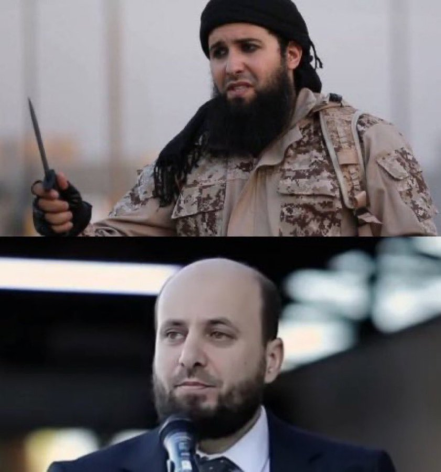
Mohammed al-Bashir before and after his Western Facelift
Let’s see if I got this right: The Biden administration replaces Assad with a terrorist organization but is suddenly surprised when it discovers the group is led by terrorists. Is that it?
Indeed, it is. As you can see, none of this resolves the basic crisis created by the removal of Assad. Instead, the main proponents of regime change—Turkey, the US and Israel—have merely transformed Syria into an even bigger battleground where their own competing interests will soon play out by way of mortal combat.
How long will it be before Turkey locks horns with Israel or the United States? How long before sectarian war engulfs the country?
Not long, I’d wager. And for the people who thought that toppling the “evil dictator” would bring peace and security. They’d better think again.
Israel deliberately targeted captives in Gaza to ‘get rid of them’: Hamas
Press TV – December 14, 2024
The Israeli military has recently pounded a location in the Gaza Strip “deliberately and repeatedly” to eliminate regime soldiers held captive by resistance groups, according to a statement by Hamas’s armed wing.
Al-Qassam Brigades spokesman Abu Obeida said on Saturday that the regime’s forces “targeted a location where some enemy captives were held, bombing it multiple times to ensure that they were killed.”
He said they bombed the place “with the intent to kill the captives and their guards.”
According to the statement, the resistance fighters “made attempts to rescue the Israeli prisoners, successfully extracting one of them, but his fate remains unknown.”
In a separate post on Telegram, Qassam Brigades released a footage showing a wounded Israeli captive, who was struggling to move amid the rubble most probably caused by the regime’s airstrike.
In a message along the footage, it said that prime minister Benjamin Netanyahu and the Israeli military’s chief of staff Herzi Halevi “are seeking to get rid of their captives in Gaza by all means.”
Hamas held captive around 250 people during its unprecedented operation against the occupied territories on October 7, 2023. The resistance released 105 of the captives during a week-long truce last November.
Six captives were killed in an Israeli airstrike on the southern Gaza Strip in September.
Hamas said at the time that Netanyahu “is directly responsible for the killing of dozens of captives due to bringing the ceasefire efforts to a failure.”
It has repeatedly said that there is no alternative other than “a ceasefire, the withdrawal of the occupation forces, and the implementation of a prisoner exchange agreement” in exchange for the release of the Israeli captives.
Netanyahu has long been obstructing mediation for a truce and a deal to release the captives still held by Palestinian groups in Gaza.
Israel Gives Biden His Marching Orders
Syrian land will be annexed into “Greater” Israel
By Philip Giraldi • Unz Review • December 13, 2024
My former CIA colleague Larry Johnson has a real ability to clarify the significance of the constantly growing deep dark hole that Joe “Mumbles” Biden, he of failing mental capacity, has hurled the American people into. Larry wrote on December 12th that “There is still plenty of time before Donald Trump is inaugurated for Joe Biden’s team of cretins to start World War III. I think the biggest risk is that Israel may be emboldened to attack Iran and try to destroy sites, and may be encouraged to do so by the Biden lackeys. In short, American interference, at the behest of Netanyahu’s Israel, has left the Middle East in ruins, with over a million dead and open wars raging in Libya, Sudan, Somalia, Lebanon, Syria, and Palestine, and with Iran on the brink of a nuclear arsenal, being pushed against its own inclinations to this eventuality. The collapse of the Assad regime has prompted a punishing military response from Israel, which has launched airstrikes at military targets across Syria and deployed ground troops both into and beyond a demilitarized buffer zone for the first time in 50 years.”
Given the destruction and partitioning of Syria, it has become impossible to consider United States foreign policy without some acceptance that it is driven and, in a sense, directed by Israel and Israel’s formidable domestic lobby in the US. “The Lobby,” as it is commonly referred to, controls both Congress and the White House on key issues and manages the media narrative in such a fashion as to make Israel the permanent victim, never the aggressor. Even though Israel is now marching in triumph across what remains of Syria and has indicated that it will be sticking around as an occupier, the move is being described as “temporary” and “defensive” by White House spokesmen. The Lobby’s success rests on the corruption that lots of money can buy, obvious to nearly everyone in politics, but a forbidden topic, sometimes referred to as an antisemitic “trope,” i.e. “Jews and money.” Israel’s role in managing the Joe Bidens and Donald Trumps is largely exercised in the broader Middle East but it also includes passionately supporting Volodymyr Zelensky’s Ukraine, a process derived in part from Jewish mythologizing and obtaining revenge for the alleged “pogroms” carried out in imperial Russia. Subsequent Jewish dominance of the Soviet intelligence and security services, which saw the killing of millions of Christians in Russia, Ukraine and Eastern Europe, are carefully excluded from the narrative.
In the latest bit of “mowing the grass” by the Israeli military, the country’s new Defense Minister Israel Katz told the press that the Israel Air Force (IAF) had carried out more than 480 strikes across Syria during the two days after the initial invasion, deliberately destroying most of Syria’s strategic weapon stockpiles. Meanwhile, the Israeli navy totally destroyed the Syrian fleet based at Latakia overnight. Katz hailed the operation as “a great success.” Israeli Prime Minister Benjamin Netanyahu, on the day before, had called the rapid defeat of Bashar al-Assad’s regime as “a new and dramatic chapter… The collapse of the Syrian regime is a direct result of the severe blows with which we have struck Hamas, Hezbollah and Iran… we are changing the face of the Middle East.”
When informed of the initial invasion of al-Assad’s Syria by Israeli, Turkish, insurgent and US forces, Donald Trump said that the conflict was none of our business and it would be best to keep out of it. Hopefully that will be the policy after January 20th’s inauguration, but one recalls that Trump’s record of pandering to Israel is almost as bad as Biden’s, and he was the one who decided (admittedly under pressure from the Pentagon) to continue in 2017 the military occupation of a third of Syria that included its oil resources and its best agricultural land. Add in the crippling US and European sanctions on Damascus and one might argue that since that time Syrians have been poor and starving, causing refugee flows and hostility towards the al-Assad government that contributed to the success of the recent uprising.
To be sure, many Syrians are celebrating the fall of an admittedly repressive, authoritarian, and corrupt Bashar al-Assad government. But other Syrians, particularly from hitherto protected minority groups like Christians, Alawites and Shiites, are now living in fear of or fleeing from the violent sectarian insurgents that have taken the place of President al-Assad. Christian Churches have already been looted and desecrated and warned not to hold Christmas services, not to sponsor Christmas parades, and not to display the image of St. Nicholas.
To be sure, fearing what is to come is legitimate as the “rebel” leader of the al-Qaeda derived Hayat Tahrir al-Sham (HTS) Terror group, Abu Mohammad al-Jolani, who now goes by his given name Ahmed al-Shara, is a founder of al-Qaeda in Syria, al-Nusra, and a former deputy to ISIS leader Abu Bakr al-Baghdadi. The US State Department has listed him as a terrorist as well as HTS as a terrorist group, and has placed a $10 million bounty on al-Jolani’s head, which presumably will soon be removed by Joe Biden. There is plenty of blood on al-Jolani’s hands and little in the way of evidence that he will not opt to slaughter those who he sees as his enemies, much of the killing being guided by the extreme religious groups that make up his followers. Indeed, there are already reports of group killings, including numerous soldiers in the Syrian Arab Army who surrendered rather that fight the insurgents.
Al-Jolani now claims that his extremism was just a “phase” and he has several times confirmed that he wants good relations with Israel, clearly a condition imposed by the US to allow him to remain in power. He has even suggested that Israeli air support enabled his warriors to move quickly from their bases in the north to Damascus. But al-Jolani has never actually apologized for or disowned the atrocities committed on his watch in 2011-3 when he was actively killing fellow Syrians. This includes August 2013 massacres in some of the Alawite areas of Latakia, which included “the systematic killing of entire families,” an international investigation later determined. One observer also reported that the insurgents were devoted to “sectarian mass murder” This is the legacy of the new “inclusive” government in Syria. According to one other ominous report, it appears that Sharia law has already been announced by the newly installed justice minister, Shadi Alwaisi.
So, what is in it for the United States? Nothing but a curt thank you from Prime Minister Benjamin Netanyahu, who clearly connived with Joe Biden’s Special Envoy Amos Hochstein, an Israeli by birth, to set the ball rolling towards Syria through adroit use of an attack on southern Lebanon to disarm Hezbollah followed by a phony ceasefire in Lebanon that gave Netanyahu a free hand and empowered Israel to invade and overthrow its neighbor Syria, parts of which will undoubtedly be annexed to help create Eretz or “Greater” Israel. It was and is all part of a plan by the US and Israel to reshape the Middle East to benefit the Jewish state and you can bet that Iran is the next target. And a delusional Joe Biden took credit for it all in his usual haphazard way, claiming after the regime change that Assad’s “main allies” — Iran, Hezbollah, and Russia — “are far weaker today than they were when I took office.” Their inability to save Assad was “a direct result of the blows that Ukraine, Israel have delivered upon their own self-defense, with unflagging support of the United States.”
Sure Joe, what bullshit. At the end of the day, to bring down Syria the US spent billions of dollars arming an insurgency that they knew was dominated by al-Qaeda in a government replacement scheme that benefited only Israel and Turkey and which targeted a country that in no way threatened the United States. It sure makes sense to me and I hope you will be comforted by it when you are hauled off to prison after you leave office and are prosecuted for exceeding your constitutional authority by involving the United States in two unnecessary wars. Some might call it treason!
Philip M. Giraldi, Ph.D., is Executive Director of the Council for the National Interest, a 501(c)3 tax deductible educational foundation (Federal ID Number #52-1739023) that seeks a more interests-based U.S. foreign policy in the Middle East. Website is councilforthenationalinterest.org, address is P.O. Box 2157, Purcellville VA 20134 and its email is inform@cnionline.org.
West shamelessly whitewashes barbarism in Syria
Strategic Culture Foundation | December 13, 2024
One week after the dramatic collapse of the Syrian government of President Bashar al-Assad, it is too early to give a precise prognostication of how the Arab country and the wider region will emerge politically.
But already, there are grim signs of the nation surging in bloody conflict and barbarism. Predictably, the West is covering up its guilt for creating another epic horror, with its news media shamelessly propagandizing and denying the reality of Syria’s new rulers as terrorist factions.
Syria is facing a fate similar to Libya in 2011. The North African country was turned into a killing field by a NATO regime-change aggression under the cynical guise of “liberation.” NATO-backed jihadists brutally murdered Libyan leader Muammar Gaddafi, and the former oil-rich country has been wrecked as a failed state, riven by warlordism ever since without a functioning national government.
Syria’s former president Assad escaped to Moscow and has been granted asylum by his Russian ally. Apart from that difference, Syria’s future looks ominously like Libya’s. Cruelly, that is rather fitting. The overthrow of Libya in 2011 was used by the United States and its Western allies to mount the regime-change war on Syria that also began in 2011, as recounted in our SCF editorial last week.
Thirteen years on, the takeover of Damascus by the terror group Hayat Tahrir al-Sham (HTS) is unleashing murderous reprisals, internecine warlordism, and sectarian hatred. The U.S. and its Western allies are strenuously covering up the huge imperial crime that has befallen Syria, as with Libya before.
In an audacious denial of reality, Washington and its European partners are talking up a “new beginning” for Syria. It’s a charade of optimism aimed at lulling the world into acceptance of heinous Western criminality.
This outpouring of Western optimism is while the Western-backed Israeli regime immediately launched a blitzkrieg on its northern neighbor, viewing the chaotic events in Syria as an opportunity to annex more land. The Israeli military extended its illegal occupation of the Golan Heights and carried out a massive bombing campaign across Syria.
U.S. Secretary of State Antony Blinken made a hurried tour of the region this week, no doubt to ensure an orderly carving up of Syrian territory and resources between Washington and its allies Turkey and Israel – all of whom have worked for years to pursue regime change in Damascus.
While Washington is urging the formation of a non-sectarian government in Syria that “respects religious minorities and women’s rights” – the cringemaking rhetoric of public relations – the reality on the ground told a different story.
The black flags of Wahhabi Islamism supported by HTS and its other al Qaeda-type associates were hoisted in Damascus and other cities. There are palpable fears among Syrian Shia and Alawite Muslims, as well as Christians, that they will be subjected to a reign of terror, as was seen during the years of U.S.-led proxy war from 2011 onwards with beheadings of infidels and apostates, among other atrocities.
Credible videos have shown HTS supporters executing unarmed captives and shouting obscenities about their victims’ perceived religious affiliation. There have been appalling scenes of barbarism where corpses are dragged through streets tied to trucks. Mothers holding the bodies of their slaughtered sons have been abused by jostling crowds in deranged bloodlust.
In an incredible wave of psyops, Western news media organizations have been whitewashing the events in Syria as a kind of “liberation from the tyranny of Assad rule.”
There have been multiple reports of crowds celebrating in the streets of Damascus and Aleppo, tearing down symbols of Bashar al-Assad and his father Hafez. However, the Western media have omitted or downplayed any reports that might indicate a descent into barbarism and sectarian killings.
If there was a prize for propaganda, the British state-owned BBC might have won it with this article headlined: “From Syrian jihadist leader to rebel politician. How Abu Mohammed al-Jolani reinvented himself.”
The truth is it is the Western media, like the BBC and CNN, that have “reinvented” al-Jolani.
The years of al-Jolani carrying out mass killings as a commander in Al Qaeda, Islamic State, Al Nusra as well as HTS have suddenly been shoved down the memory hole, and he is now presented as a statesman supposedly leading Syria to a brighter future.
His belated words about respecting religious minorities and pluralism are reported with cloying gullibility by the Western media. Washington and other Western governments are moving to recognize the new Syrian regime by delisting HTS as a terrorist group and indulging al-Jolani’s rhetoric about reconciliation and tolerance as somehow plausible.
Of course, Washington is euphoric about its apparent success in Syria. Damascus has long been a target for regime change, going back to the Eisenhower administration more than 70 years ago when the Arab state was perceived as being too independent.
More recently, as former U.S. Senator Richard Black explained in this 2016 article, Syria became a renewed target for Washington’s regime change in 2007 when then-President GW Bush’s administration decided Bashar al-Assad had to go. To achieve that illegal result, the U.S. and its regional allies deployed murderous proxies, one of which was Hayat Tahrir al-Sham – the new ruler in Damascus.
The covert proxy war continued under Obama, Trump, and Biden. Russia and Iran’s intervention to defend their Syrian ally managed to impede the regime-change objective, but, in the end, they did not succeed for various reasons, as adduced in a SCF commentary this week.
For over a decade, the Western media have systematically and blatantly lied about Syria to cover up for the U.S.-led imperial aggression against that country. They lied about Assad’s alleged despotism when, in reality, Syrians enjoyed religious and social freedoms. They lied about Assad using chemical weapons when it was the Western-backed jihadist terrorists who used them in false-flag provocations, as Seymour Hersh reported.
The overthrow of Assad appears to be a great victory for the Western imperialist agenda and a blow to Russia and Iran. Washington and its allies are in a celebratory mood over the spoils of victory.
But the signs of bloody disintegration are impossible to conceal even for the lying Western media. In the short term, the Western powers and their propaganda media are trying to present the new rulers of Syria as somehow reformed and benign. This is while Israel annexes territory and U.S. and Turkish-backed factions begin fighting over strongholds.
Syria’s descent into untold mayhem has begun, and in the usual Orwellian fashion, the Western culprits are trying to sell the infernal outcome as a liberation. This is typical of the whitewashing deception that comes as a matter of routine following every imperial regime-change operation. It never ends well.
The people of Syria and the region are facing more turmoil, chaos, conflict, and suffering. The criminal Western imperialist axis is emboldened, but lies are never a sound foundation for the future.
Featured Video

The American Retreat from Vietnam
or go to
Aletho News Archives – Video-Images
From the Archives
Secret document reveals plans for civil war in Lebanon, Israeli false flags, and invasion
By Randi Nord | Geopolitics Alert | April 5, 2019
Beirut – During his visit with US Secretary of State, Mike Pompeo, Lebanese President Michael Aoun reportedly received a US-Israeli document detailing plans for creating a civil war in Lebanon with covert false flag operations and possible Israeli invasion.
Although the source of the document is Israeli and created in partnership with Washington, no one knows who presented it to Aoun. The Lebanese TV station, Al-Jadeed, initially reported the document on Lebanese TV and a video on its website. Geopolitics Alert translated the report for this article. … continue
Blog Roll
 Aletho News
- There’s a drought in academia: A drought in honest research on the subject of drought and other weather extremes
- Department of War Awards $20.7 Billion Contract to Raytheon for Air-to-Air Missiles
- ‘Distance yourselves from Israel’: IRGC urges US population to question govt policies
- America’s Greenland deal has a radioactive backstory
- The RAF Fairford ‘terror plot’: Unpacking escalation in the UK echo-chamber
- EU Council Advances Chat Control 2.0 Scanning Proposal
- Ex-Greek MEP files complaint against Israeli spyware firm over alleged Pegasus surveillance
- Troubling ideas throughout the Torah, Talmud, Mishneh Torah and Tanya
- ‘Grave, alarming’: Iran mission on Trump’s UNGA ‘annihilation’ threats
- Najaf airport to reopen to Iranian flights within 24 hours: Ambassador
- If Americans Knew
- New Report: “Scholasticide and Genocide in Gaza: Assessment, Testimonies and Legal Analysis”
- Ex-Biden officials are desperate for a Gaza scapegoat
- Israeli “settlers” Invade Al-Aqsa; Pour Boiling Water on 75-Year-Old
- Israel Has Kidnapped Another American Teenager
- US arms sales to Israel worth $21.6 billion in 20 months
- Three Palestinians Killed in Israeli Attacks on Gaza
- Revealed: German “Anti-Semitism Expert” Driving Crackdown on Palestine Solidarity is Former Israeli Spy
- Egypt’s Warning to Israel Before Oct 7
- Israel’s siege signals another cruel winter for 1.8 million Gazans – Daily Update
- Netanyahu Asked UAE Leader to Deny Report on Oct. 7 Warning in Secret Visit, Sources Say
- No Tricks Zone
- New Study: Earth And Venus Surface Warmth Largely Explained By Convection And Lapse Rate, Not CO2 Or Radiation
- 2025 Nature Paper Claiming Worsening Global Drought Gets RETRACTED …Heavily Flawed
- New Study: ‘Global Drought Shows No Detectable Recent Acceleration Under Climate Warming’
- Economic Masterminds: German Socialists Suggest Taxing Productivity Gains Stemming From Using AI
- The South China Sea Has Not Been Cooperating With The Climate Change Narrative
- Energy Crisis: Germany Enters Heating Season With Historically Low Gas Reserve Fill Levels
- New Study: The Antarctic Ice Sheet Gained Mass From 2020-2024 Due To Staggering Snow And Ice Accumulation
- Study: Ocean Heating Rates From Thousands Of Years Ago ‘Dwarf’ Modern Ocean Heating Rates
- Climate Extremists Target, Attack Large-Scale Power Grid Infrastructure In Germany!
- New Study: Antarctic Ice Melt Has Contributed Less Than 1 Centimeter To Sea Level Rise In The Last 30 Years

