The Israel-Palestine war is Washington’s fault
By Robert Inlakesh | RT | October 10, 2023
The administration of US President Joe Biden and decades of failed American policy decisions in West Asia set the stage for the eruption of the horrifying violence we see today in Palestine and Israel. Through sidelining the Palestinian cause for statehood and instead seeking a symbolic normalization deal between Israel and Saudi Arabia, Washington overlooked its own regional strategy.
In the early hours of Saturday morning, the armed wing of Hamas, the Qassam Brigades, launched an unprecedented military operation against Israel. Scenes instantly flooded social media of Palestinian fighters gunning down Israelis in cities such as Ashkelon, blowing up military vehicles, and killing and capturing hundreds of Israeli soldiers. It was a surprise offensive the likes of which hadn’t been seen in over 50 years. It also represented a colossal failure for the Israeli government, military, and intelligence and security services, causing Prime Minister Benjamin Netanyahu to declare war on the Gaza Strip.
In the US, condemnation from politicians of the attack was unanimous and bipartisan, as elected officials expressed their outrage at the loss of Israeli life. However, in all of these statements, not a single one recognized their own government’s role in the attack. Washington, along with most of the collective West, has been imposing sanctions on the Palestinian Authority (PA) for nearly 17 years. The peace process between Israelis and Palestinians – aimed at reaching a ‘two-state solution’ whereby Israel and Palestine would exist side by side as independent, mutually-recognized states – has been effectively dead for around two decades, with the last failed attempt to pressure the Israeli government to negotiate coming under former US President Barack Obama.
In 2006, the legislative elections held in the Occupied Palestinian Territories (OPT) resulted in a landslide victory for Hamas. Failed US presidential candidate Hillary Clinton was recorded as having stated at the time that “we [the US] should have made sure that we did something to determine who was going to win.” While the US did not interfere, the American government decided it would sanction Gaza and cut off the flow of aid to the PA after the elections did not favor the Fatah Party it was financing.
Former US President Jimmy Carter, who brokered the 1979 Camp David Accords, an agreement that normalized relations between Egypt and Israel, said the following about the approach of the US government at the time: “If you sponsor an election or promote democracy and freedom around the world, then when people make their own decision about their leaders, I think that all the governments should recognize that administration and let them form their government.”
Not only did Washington actively oppose the democratic elections in the OPT, it went a step further and provided arms to Palestinians from the Fatah Party, plotting a coup that would use them to overthrow the Hamas government that was formed inside Gaza. The plan failed dramatically and Hamas kicked Fatah out of Gaza after a bloody civil war, completely taking over the territory, to which the Israeli government responded by imposing an all-inclusive military blockade.
Unlike other global powers such as Russia and China, the US never entertained the idea of giving Hamas the chance to govern as Carter had suggested. Instead, every American government has refused to engage with Hamas, deeming it a terrorist organization, but then ignoring the Palestinian political party completely and not formulating any solution to the situation that has been ongoing inside Gaza. In fact, the US government considers every single major Palestinian political party or movement as a terrorist organization, other than the mainstream branch of Fatah that partially controls the West Bank.
The Declaration of Principles, the first agreement in the Oslo Accords, was signed on the White House lawn over 30 years ago. The accords were supposed to solve the conflict in a span of five years, but failed due to America’s inability to function as a truly neutral peace broker. During the administration of US President Donald Trump, Washington abandoned the two-state solution altogether, through the pursuance of normalization deals between Arab nations and Israel. The issue of Palestinian statehood, which the UN agrees should be solved through a two-state solution, was sidelined as a non-issue and the one bargaining chip possessed by the Palestinians, Arab-Israeli normalization, began to be taken off of the table.
How did the Palestinian political parties respond to normalization in 2018? They overwhelmingly chose non-violent struggle, including in Gaza, where Hamas endorsed the ‘Great March of Return’, a mass protest movement which lasted around a year. Most of the protesters were peaceful, but it was the relatively small groups of Palestinians committing sabotage and anti-Israeli aggression at the border fence that made the news. In response, Israeli forces killed hundreds of Palestinians and injured almost 10,000. On the Israeli side, there was not a single dead soldier or civilian, while Israeli snipers targeted women, children, journalists, disabled people, and medical workers, according to a UN human rights report on the demonstrations. How did the US react to hundreds of thousands of unarmed Palestinian protesters marching on the separation fence between Gaza and Israel? It ignored them and continued to pursue Arab-Israeli normalization.
Under the Biden administration, the two-state solution was also sidelined and the plight of Palestinians was ignored as insignificant. Instead of seeking a solution to the violence which has been steadily escalating to levels not seen in 20 years, during the course of the past two years – especially in the West Bank – Biden has chosen to look the other way and has pursued Saudi-Israeli normalization instead. A deal between Saudi Arabia and Israel would also have the potential to collapse the Iranian-Saudi rapprochement, brokered earlier this year by China, in addition to potentially dragging Washington into an open confrontation with Yemen. Instead of seeking to fulfill the foreign policy pledges made at the start of his term in office, Biden has abandoned the idea of reviving the Iran nuclear deal and of ending the war in Yemen. He also decided to try and inflict a death blow on the Palestinian cause for statehood.
What Hamas just did from Gaza would never have happened if the US had pursued a somewhat rational approach to the region. It could even have been prevented if the US had presented a political plan to de-escalate rising tensions in the occupied territories. Instead, the American government decided to overlook the armed groups in Gaza while attempting to completely dismantle their cause. And all of this for what? A fancy photo op that Biden can use to steer the Democratic Party to victory in the presidential election in 2024, by claiming that he brought peace to the Middle East. Due to the current conflict, normalization doesn’t seem to be on the table anytime soon anyway, which would mean Hamas’ offensive has not only dealt a blow to Israel, but also to the US.
Now that Israel is at war with Gaza, what is the US doing? It is condemning one side, while arming Israel and greenlighting any action it takes. Initially, Washington even refused to urge a ceasefire, in contrast to the push for one from Moscow and Beijing. The White House refuses to acknowledge its role in creating the current violence and carries on with the exact same rhetoric and policy decisions that led to the horrifying war we see today.
Robert Inlakesh is a political analyst, journalist and documentary filmmaker currently based in London, UK. He has reported from and lived in the Palestinian territories and currently works with Quds News. Director of ‘Steal of the Century: Trump’s Palestine-Israel Catastrophe’.
Israel’s Hannibal Directive: Israeli Attack Will Likely Result in 120 Hostage Deaths
By Richard Silverstein | Tikun Olam | October 9, 2023
The latest Gaza death toll is 1,000 Israeli dead and 700 Palestinians. Hamas fighters continue to attack southern Israel and the IDF has conceded that it has not blocked all of the 22 sites where militants blew up its security fence. It also concedes that Palestinian fighters continue to enter Israel from them. The army also conceded that the Palestinian resistance inside Israel continues unabated.
Israel has called 300,000 reservists for active duty. Tens of thousands of troops are massing outside Gaza preparing to invade the enclave. IDF spokesperson, Jonathan Conricus declared that Israel will occupy Gaza and ensure Hamas will never again control it. To do so, Israel will have to reoccupy it and station thousands of troops. They in turn will be targeted by Hamas, which Israel cannot succeed in eradicating.
Israel occupied southern Lebanon for 20 years and lost hundreds of soldiers to Hezbollah attacks. Israeli occupation of Gaza would repeat the quagmire.
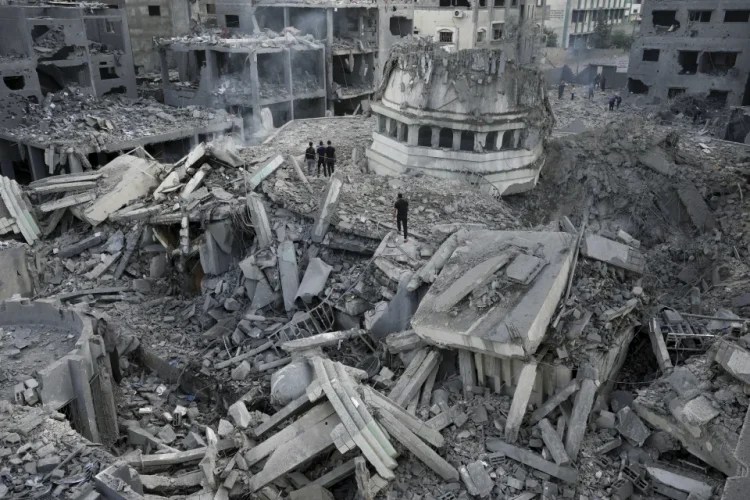
The Yassin mosque in Gaza, destroyed by IAF missiles (AP Photo/Adel Hana)
Bibi Netanyahu has threatened to turn Gaza to “rubble.” Defense Minister Yoav Gallant has called Hamas “human animals” and denied Gazans food, water, electricity and fuel. This is collective punishment and forbidden under Geneva Convention. It is a war crime.
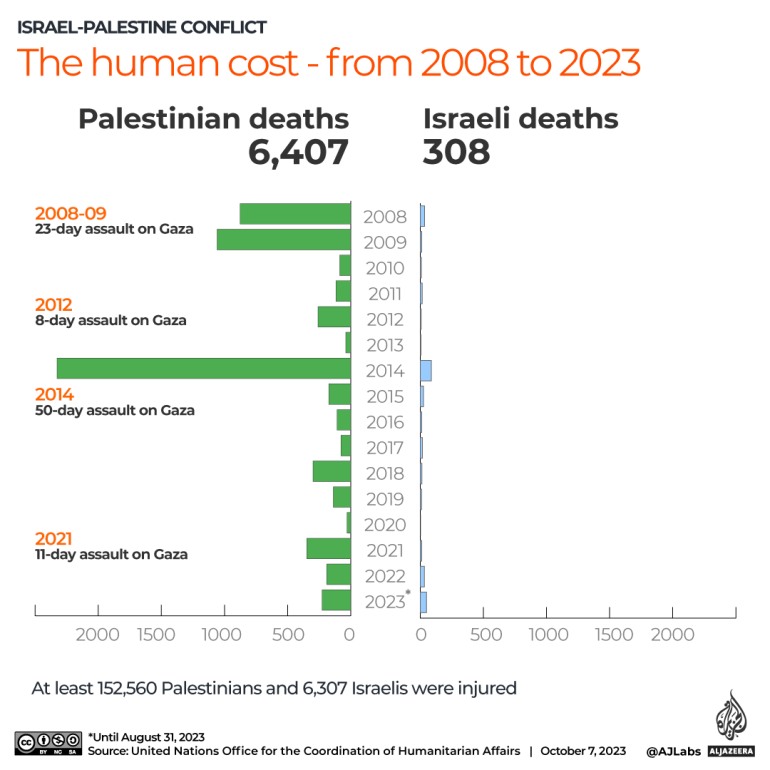
The International Criminal Court has already opened a file against Israel for alleged war crimes during the last major invasion in 2014.Then, it killed 2,300 Palestinians. The ICC has not yet agreed to open a formal investigation after several years of delay. The world awaits action. Holding war criminals accountable, whether Palestinian or Israeli, is critical to maintaining the credibility of international law. Israel is shredding it by the day.
Palestinian militant groups hold up to 120 Israelis hostage in Gaza. Netanyahu has not announced any effort to free them or exchange them for Palestinian prisoners. Instead, he speaks of all-out war. Hamas, on the other hand, has threatened to execute one hostage for every Palestinian killed or house destroyed.
Hamas says that it is detaining hostages in its underground tunnels. The IAF has already dropped bunker buster bombs to destroy them. If what Hamas says is true, then Israel is killing its own citizens. If it unleashes a full-scale exterminationist assault, then all the Israeli hostages will die. Either at the hands of Hamas, of from IDF assault.
 This is reminiscent of the IDF’s Hannibal Directive, a policy calling for the killing of Israeli soldiers who fall captive to Palestinian militants. Israel prefers a dead soldier to a live one it will be forced to exchange for Palestinian prisoners. Israel’s imminent attack will likely kill its own citizens, and is a version of this horrible Directive. As this Haaretz makes clear, Netanyahu has no intent to negotiate for the hostages’ release. He has given them up for lost. Abandoned them. It’s a cynical, morally bankrupt approach characteristic of him.
The Biden administration has ordered a naval task force to the eastern Mediterranean and declared readiness to offer whatever weapons Israel needs to obliterate Gaza. Though meant as show of strength, it is really a confirmation of the impotence of Israeli policy. We claim to support a tw0-state solution. Yet we are accessories to mass murder of Palestinians. We are all-in for Israel. Palestine can go to hell (and it will, if the Israelis have anything to say about it).
Israel is an example of the worst of humanity. Of the depths of depravity to which our species can sink. Israel’s apologists raise bitter cries over the murder of children and women, while refusing to acknowledging that many times more Palestinian children and women have died under Israeli onslaught. As I said in an earlier post, this is terror for terror. Hamas declares that if every Palestinian is a legitimate target, then every Israeli will be as well. It is a cold, brutal calculation. But Israel has no monopoly on brutality. It will suffer what it metes out.
10 reasons why India’s stance on Gaza is unsustainable
BY M. K. BHADRAKUMAR | INDIAN PUNCHLINE | OCTOBER 9, 2023
The Indian reaction to the massive eruption of violence between Hamas and Israel on Saturday belies ground realities and ignores the geopolitical environment in that region and globally in which this cataclysmic event merits careful appraisal. It will prove to be unsustainable and can damage the country’s interests and standing globally.
One, Indian policy has blatantly tilted toward Israel. What has been a matter of speculation assumed habitation and a name when Prime Minister Narendra Modi’s tweet on Saturday underscored India’s “solidarity” with Israel.
The resonant expression signifies a historic departure from India’s consistent stance on the Palestine issue, which followed, quintessentially, the footfalls of Gandhiji who had the prescience and vision to oppose the creation of Israel on Palestinian homelands in the cruel manner in which the Western powers imposed that geopolitical construct on West Asia.
What prompted this radical shift on an issue where angels fear to tread remains a riddle wrapped in a mystery inside an enigma.
Two, Delhi had the benefit of a “preview” of what is to follow in Gaza in the coming weeks or months. Prime Minister Benjamin proclaimed that the “enemy will pay an unprecedented price” and promised that Israel would “return fire of a magnitude that the enemy has not known.” He declared war on Gaza.
Netanyahu’s capacity for mindless violence is a legion. Yet, Delhi rushed in to react at an emotional, subjective level.
Three, the possibility of a ground offensive and even occupation of Gaza is real. Simply put, India’s patented mantra that ‘this is not an era of wars’ obliges it to mark distance from Netanyahu. But instead, India risks taking a virtual partisan in the carnage that is to follow — politically, morally, diplomatically.
At such a crucial juncture, at the very least, our government being a ‘Vishwa Guru’ who tirelessly propagates the notion of Vasudhaiva Kutumbakaam (The World is One Family), gets exposed, warts and all. India’s role should be of a unifier rather than divider.
Four, India’s reaction is clearly at odds with the sentiments of the Global South. For, other than the ‘collective West’, India becomes a lone ranger in the Global Majority that stands shoulder to shoulder with Israel. Empathy with victims of violence is one thing, but political support for the collective West (which is what this entails, in reality, in the prevailing climate in world politics) is another thing.
Two days after Vladimir Putin praised Modi’s India sky-high as a stellar example of a civilisation state role model in a multipolar world in a landmark speech addressing an elite audience, distinguishing it from the predatory neo-colonial Western powers, India negated his thesis.
There is no question that the Indian stance exposes the paradox of its self-appointed claim to be the leader of the Global South. When the crunch time came, Indian elites showed their true colours.
Five, Israel’s reaction, which is already under way, is expected to be massive, unremitting and ruthless. An Israeli occupation of Gaza is a high probability, howsoever foolish that might eventually turn out to be. Israeli Defence Minister Yoav Gallant’s chilling words vowing to “change the reality in Gaza” will mean that increasingly, it will become difficult for the countries of the region and the Global South —and even the ‘friends of Israel’ in the US and Europe — to remain passive.
India has dug itself a foxhole from where it will be difficult to come out saving face and battered reputation and credibility.
Six, troubling questions arise in regard of India’s credentials to be a UN Security Council permanent member. Whose interests, after all, does India represent other than its self-interests? This becomes a daunting question for which there are no easy answers. Succinctly put, the fruits of decades of hard work by successive Indian leaderships and diplomats are being squandered away.
Seven, all wars come to an end through negotiations. But this incoming war will be a long and wide-ranging one. The wily politician in Netanyahu, who is under immense pressure domestically, facing personal legal charges and holding on to power with the help of ultra-nationalist and right-wing partners, will seize the opportunity to salvage his reputation as Israel’s great protector and rally the political and security establishment in his country, which is deeply divided, and shall be in no hurry to sit at the negotiating table with Hamas.
On the other hand, American intention will be to claw its way up the greasy pole of West Asian politics after the Iran-Saudi rapprochement. In a major display of force, a vast armada of warships and planes is slouching toward East Mediterranean. How this force projection will pan out remains to be seen.
The temptation will be there to reimpose US hegemony in West Asia and to project President Biden as a decisive leader at a time when, on the one hand, his re-election bid in the 2024 election is wide open and, on the other hand, the spectre of a humiliating defeat in Ukraine haunts his presidency.
Suffice to say, the political interests of Biden and Netanyahu are coalescing and the stench of Israel’s war will likely touch the heavens and may even engulf other countries in the region as time passes. The Indian leadership will be hard-pressed to demonstrate its friendship and bonhomie with Netanyahu in an apocalyptic scenario.
Eight, Modi government might as well say goodbye to the grand idea of building an Indo-Arab economic corridor to Europe in a foreseeable future. That means, Haifa Port, which was acquired by the Adani Group in a “strategic purchase” at a reported cost of $1.13 billion with Netanyahu’s blessing, will be underperforming. Smart economic diplomacy entailed fostering Arab-Israeli amity.
Nine, Indian government has blithely ignored that Israel is a state sponsoring terrorism. Optics matter in politics and international affairs, and at a time when India’s own credentials are under Western scrutiny, it is doubly important that it is careful in its words and behaviour. There is an old saying, ‘Show me your friends and I will show you your future!’ If the intention is to fly on the wings of the Israeli lobby in North America — or to catch Biden’s eye — it smacks of naïveté, to say the least.
Finally, India should know that in the final analysis, sins are forgotten and forgiven when a political movement that might have had uses of violence in its toolbox commands the overwhelming support of the masses. Indeed, that is how it should be. By that yardstick, Hamas passed the litmus test decades ago, much before the BJP formed a government in 2014.
Hamas today is the unquestioned leader of Palestinian aspirations, towering head and shoulders above peer groups and is a mainstream interlocutor for the regional powers. It even has a representative office in Moscow. Clearly, the Indian reaction, which tends to view the current development as a ‘stand alone’ event of terrorism, is anachronistic.
An enduring Palestinian settlement will have to be inclusive and will include Hamas after the audacity of hope it has displayed. The BJP leadership should educate its provincial leaders with tunnel vision on international affairs that Islamism is not to be equated with terrorism in the global commons, especially the politics of the Muslim Brotherhood to which Hamas belongs.
West promoting deceptive narrative on Hamas operation: Malaysia’s ex-PM

Malaysia’s long-serving former Prime Minister Mahathir Mohamad (Reuters)
Press TV – October 9, 2023
Malaysia’s former Prime Minister Mahathir Mohamad has censured Western states and their media outlets for their hypocrisy toward the recent Palestinian operation against Israel.
In a Monday post on X, formerly known as Twitter, Mahathir said the narrative run by certain Western states was far from truth given the “seven decades” of atrocities by Israel against the Palestinians.
“With that narrative, they stoked fear in the Western community, claiming that it is an attack on democracy and peace-loving people and that the United States in particular felt justified to extend military support to Israel to retaliate against Palestinians attacks.”
“Instead of addressing the conflict for what it actually is, they chose to continue with their deceptive narrative that it is an attack on Israel by terrorists,” Mahathir said.
“They are outright lies which have been perpetuated unashamedly by Western leaders and their media.”
“The truth is actually very simple, the Israelis had been committing war crimes, massacres, genocide and unthinkable atrocities against the Palestinians.”
“These are not one-off acts but rather systematically conducted without respite throughout the seven decades.”
‘West an active partner to Israeli apartheid, genocide’
Mahathir said Washington and its Western allies have been active partners to Israeli crimes against the Palestinians.
“The Western powers and the US are party to apartheid, genocide and crimes against humanity for as long as they support the heinous Israeli regime.”
The former Malaysian prime minister said the Western camp remains silent when Israeli settlers forcefully seize Palestinian land and farms across the occupied territories.
“The Palestinians are chased out of their land and any attempt to seek some form of restitution from the Israeli authorities are met with violence backed most times by the Israeli forces.”
“The Palestinians, pushed to the corner, while Gaza was turned into an open-air prison, attempted sporadic retaliations, which in turn were met with the full force of the IDF with weapons supplied by superpowers in particular the US,” Mahathir said, referring to the Israeli military.
“This episode is not any different from previous retaliations except that probably this time around they are more focused with a bit more assistance externally.”
Mahathir said peace will not be achievable until the Palestinians are granted full rights. “With that, any attempt towards finding a just and fair solution for the Palestinians becomes an exercise in futility.”
The Organization of Islamic Cooperation (OIC) has condemned Israel’s ongoing attacks on the people in Palestine. The OIC says the principal cause of the latest bloody conflict is the regime’s disregard for the legitimate rights of the Palestinians.
Israel has launched deadly airstrikes on the besieged Gaza Strip.
The bombardment came after the Palestinian resistance movement Hamas began a multi-pronged operation from Gaza into the occupied territories in response to weeks of violence against the Palestinians in the occupied West Bank and the continued presence of Israeli extremists in the al-Aqsa Mosque.
Israel airstrikes have destroyed seven Gaza mosques since Saturday
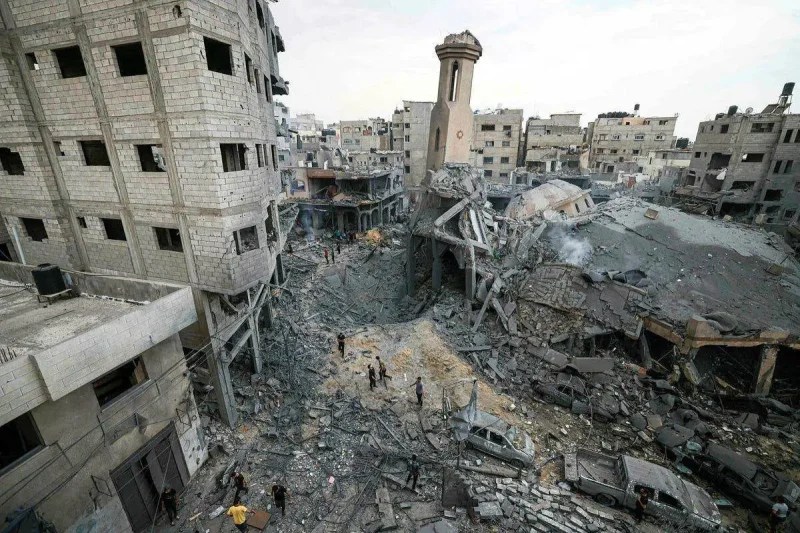
Israeli warplanes blow up the Yarmouk Mosque in Gaza city on October 09, 2023 [Mohammed Asad/Middle East Monitor]
MEMO |October 9, 2023
Israeli attacks have destroyed seven mosques in the Gaza Strip since Saturday, Anadolu Agency reports.
Israeli warplanes attacked the Al Abbas Mosque in central Gaza with many rockets.
The attacks have now led to the destruction of seven mosques, with the most recent being the Al-Abbas Mosque.
Israel had previously hit the Al-Susi, Al-Yarmouk, Al-Amin Muhammad, Ahmed Yassin, Al-Habib Mohammad, and Al-Garbi mosques in Gaza.
The Israeli army’s intensified attacks on the Gaza Strip continue.
The Gaza-based Resistance group, Hamas, launched Operation Al-Aqsa Flood against Israel early Saturday, firing a barrage of rockets. It said the surprise attack was in response to the storming of Al-Aqsa Mosque in Occupied East Jerusalem and increased settler violence.
In retaliation, the Israeli army launched Operation Swords of Iron against Hamas in the Gaza Strip.
At least 800 Israelis have been killed and over 2,300 others wounded in the fighting, according to the Israeli Ministry of Health.
The Palestinian Health Ministry said that over 560 Palestinians died and over 2,900 were wounded.
Palestinian operation puts Netanyahu between rock and hard place: Ex-diplomat
By Alireza Hashemi | Press TV | October 9, 2023
The military operation by the Palestinian resistance movement Hamas has placed the embattled Israeli premier Benjamin Netanyahu in a dilemma of whether to save his own political future or the illegitimate regime itself, says a former Iranian diplomat.
In an interview with the Press TV website, Abolfazl Zohrevand, a former Iranian ambassador to Afghanistan and Italy, said the Al-Aqsa Storm (also known as Al-Aqsa Flood) operation has put Netanyahu and his far-right cabinet between a rock and a hard place.
Hamas stunned the regime in Tel Aviv with a multi-pronged attack early Saturday, launching thousands of missiles into the occupied territories within a span of 20 minutes and at the same time launching a ground attack against Israeli settlements and military bases near the coastal strip.
The Israeli death toll is staggering, with some reports putting it at above 1,000, besides hundreds of others – soldiers and settlers – who are held as prisoners of war by Hamas in the Gaza Strip.
Zohrevand said the Israeli regime can opt for a very tough response to the Palestinian resistance operation but such a response might lead to an existential threat to the regime.
“Israel can’t do much to punish the Palestinians through air strikes. Such strikes usually fail to hit Hamas’s underground infrastructure and only leave high civilian casualties,” he stated.
“Netanyahu has to start a ground invasion of Gaza, like what he did recently with the Jenin camp in the occupied West Bank,” the former diplomat said, referring to the July Israeli raid into the Jenin camp.
However, he hastened to add that such an operation could end in a humiliating defeat for the regime.
“If Israel decides to engage in a major operation, we should expect weeks-long clashes in the region. Israel isn’t made for long battles. Also, its military is not well prepared as the whole regime is in a state of chaos. The fact that it was caught completely off guard by the operation is a testimony to this,” Zohrevand stressed in a conversation with the Press TV website.
“On the other hand, Palestinians are prepared for such an invasion and they hold the upper hand as Gaza is their home. Palestinians are now sending a message that enough is enough. They’re highly motivated to fight the regime. So the odds for Israel’s success are not high.”
He said the Israeli military action would put the existence of the regime at risk.
“This war can easily spread to the West Bank and other regions. Also, there’s a real possibility that the regime might face a major operation by Lebanon’s Hezbollah. It’s really hard for the regime to handle two fronts. I personally believe the regime won’t start such an operation,” Zohrevand said.
Hamas has already said the operation will be extended to the West Bank.
The Lebanese movement Hezbollah has also staged attacks in solidarity with Palestinians, firing artillery shells and guided missiles at Israeli positions in the occupied Shebaa farms on Sunday.
The former Iranian diplomat noted that Netanyahu might want to accept mediation efforts by Turkey or Egypt and halt its ongoing operation, but that will put his political future in real danger.
“If he decides to stop the Israeli operation, his cabinet won’t last long as it is filled with extremist elements that came to power on a promise of crushing Palestinian resistance and annexing all the Palestinian lands once and forever,” he remarked.
“For Netanyahu, it boils down to a decision whether to save the regime or save his own cabinet or save the regime. He’s in a no-win situation.”
Debunking The Conspiracy Theory That Netanyahu Wanted Last Weekend’s Attacks To Happen
BY ANDREW KORYBKO | OCTOBER 9, 2023
Hamas’ sneak attack on Israel over the weekend prompted speculation among some on social media that the latter knew about these plans in advance but allegedly had an interest in letting them happen. According to proponents of this conspiracy theory, embattled Prime Minister Netanyahu wanted to unite his politically divided people and/or establish the pretext for destroying Hamas, ergo why he supposedly let these attacks unfold. That doesn’t make much sense though if one really thinks about it.
It’s fashionable nowadays to claim that leaders sometimes provoke foreign conflicts to distract from domestic political problems, but that’s arguably not the case with the latest Israeli-Hamas war. In fact, Netanyahu was pursuing the exact opposite approach up until last weekend as suggested by credible reports over the months that he was engaged in secret talks with Saudi Arabia over recognizing Israel. This was aimed at uniting Israelis around him and unlocking their country’s geo-economic potential.
Had these efforts borne fruit, then not only would his fiercest opponents have been forced to praise him for this diplomatic achievement, but Israel could then have profited from its central role in the India-Middle East-Europe Economic Corridor (IMEC) that was unveiled last month. Both goals required Saudi recognition of Israel, which Netanyahu hoped to obtain without recognizing Palestine’s independence, but that’s now in doubt since Riyadh might freeze these talks after Israel’s bombing of Gaza.
Those who claim that he knew about Hamas’ plans in advance but still let them happen are either unaware of his secret talks with Saudi Arabia, downplay their grand strategic importance, or think that they were all a ruse in preparation of this convoluted plot to establish the pretext for destroying Hamas. About that dimension of their conspiracy theory, it’s difficult to imagine that security-obsessed Netanyahu would let his country’s enemies inflict such unprecedented damage to Israel for that purpose.
He could always have simply exploited comparatively minor rocket fire to justify a disproportionate bombing campaign against that group without having to first lose literally hundreds of civilians and soldiers. Hamas’ breaching of the border barrier was also a strong blow to the Israeli psyche from which its people might never recover after having assumed that its construction would forever protect them. The same goes for that group doubling the territory under its control during the climax of its attacks.
Observers can still be opposed to the border barrier in particular, Israeli policy towards Palestine in general, and Netanyahu personally while also acknowledging that he’s such a security-obsessed leader that it doesn’t make sense to claim that he’d let Hamas powerfully undermine all three for any reason. He looks extremely weak after what happened, Israeli policy towards Palestine is now questioned from both sides like never before, and the border barrier is no longer deemed to be a credible defense.
These three outcomes represent the sum of Netanyahu’s worst nightmares, not to mention the likely failure of his plans to obtain Saudi recognition of Israel that would in turn unlock his country’s geo-economic potential via IMEC, all of which indisputably contradict Israeli interests. It remains unclear exactly how all of Israel’s security systems failed at the same time during last weekend’s attacks, nor has anyone explained the intelligence failures up until then either, but that’s indeed what happened.
The conspiracy theory speculating that Netanyahu knew about all this in advance but still let it happen doesn’t stand up to scrutiny as proven in this piece and is pretty much only predicated on the false perception that Israel’s intelligence services are omnipotent. They’re run by humans though and are therefore naturally imperfect, yet those who claim otherwise impart godlike power to the Mossad. This gives Israel too much credit while denying Hamas’ independent ability to organize attacks of this scale.
Israel has no one to blame but itself for war with Palestinians: Lawmaker
Press TV – October 8, 2023
Israel has no one to blame but itself for the war with the Palestinians, says a lawmaker of the regime, insisting that the illegal occupation of the Palestinian land has caused the situation to escalate.
Ofer Cassif, a member of the Knesset and leftist Hadash coalition, told Al Jazeera on Sunday that his party had repeatedly warned the regime authorities that the way they treated the Palestinians would have serious repercussions.
“We have been warning time and time again… everything is going to erupt and everybody is going to pay a price… And unfortunately, that is exactly what happened,” said Cassif, whose party has four seats in the 120-member parliament.
The “fascist” regime, he said, “supports, encourages, and leads pogroms against the Palestinians.”
“There is an ethnic cleansing going on. It was obvious the writing was on the wall, written in the blood of the Palestinians.”
Some sources say more than 750 Israelis have been killed since early Saturday, when the Palestinian resistance movement Hamas launched massive rocket attacks and a ground operation from its bases in the Gaza Strip into the occupied territories.
Hamas says Operation al-Aqsa Storm is a response to Israel’s growing acts of aggression against the Palestinians, especially in the occupied West Bank, and its support for the recurrent presence of settlers in the al-Aqsa Mosque in the occupied Quds.
Scores of Palestinians have been killed in Israeli attacks on Gaza, a besieged enclave on the Mediterranean, since the regime started to respond to Hamas attacks on Saturday.
Iron Dome’s ‘Inefficiency’ Revealed by Israeli-Palestinian Conflict Escalation – Expert
By Andrei Dergalin – Sputnik – 08.10.2023
The massive attack launched by Hamas militants against Israel on October 7 was accompanied by a series of rocket launches, many of which managed to bypass Israeli defenses and hit their targets.
Israel’s Iron Dome air defense system is widely regarded as one of the best in the world. That said, it apparently failed to completely negate the Palestinian rocket barrage on Saturday.
Commenting on this failure, Russian military historian and Museum of Air Defense Forces’ Director Yuri Knutov pointed out that while Iron Dome is a very advanced and sophisticated air defense system, it has drawbacks that can be exploited by any enemy.
For one, a single Iron Dome battery can protect a relatively small area (about 150 square kilometers).
Secondly, Knutov noted, Iron Dome is extremely effective when dealing with a small number of incoming targets all of which approach from the same direction.
“In case of a more intensive barrage, involving at least about 100 rockets, the Iron Dome usually fails to do its job and up to 90 percent of the rockets bypasses it and strike the intended targets,” he claimed.
The historian also observed that Hamas militants deliberately launched mass rocket salvos from different directions, apparently in order to overwhelm the Israeli Iron Dome defenses.
“When it (an Iron Dome system) intercepts the first salvo, when it is dealing with those rockets, it is unable to deal with the second salvo that was fired practically a minute after the first one. And so the rockets from the second, third and fourth salvos reach their targets practically unopposed,” he said, arguing that this tactic essentially capitalizes on Iron Dome’s “inefficiency.”
Furthermore, a single Iron Dome interceptor missile costs at least $20,000 while Palestinian jury-rigged rockets – the threat Iron Dome systems usually have to deal with – cost only about $2,000-$3,000 apiece, Knutov added.
Knutov did, however, praise the Iron Dome’s radar unit capabilities and the interceptor missiles this air defense system uses, describing both of them as quite “interesting.”
He also noted that Iron Dome can determine whether an incoming missile poses a threat to a populated area or a military facility and refrain from wasting ammo on a projectile that would otherwise crash in a deserted area.
What Does Iron Dome Do?
Iron Dome is an Israeli-made air defense system designed to intercept and destroy ballistic missiles and artillery shells fired from distances of 4 to 70 kilometers.
Developed during the late 2000s by Israeli defense contractor Rafael Advanced Defense Systems, the Iron Dome was first deployed in 2011 and has since been actively used by IDF to counter rocket strikes conducted by Palestinian militants.
An Iron Dome battery typically consists of several launcher units (the payload of each consists of 20 interceptor missiles), a radar unit and a control unit.
Israeli Intelligence Services’ Failure & Merkava Fiasco
According to Knutov, the fact that Hamas militants managed to prepare thousands of rockets for this attack in secret, not to mention train all those militant squads that launched incursions into Israeli territory on October 7, effectively means that Israel’s intelligence agencies failed to do their job properly.
Meanwhile, Hamas militants displayed what looks like special operations tactics, with teams of militants using paragliders and executing amphibious landings in order to bypass Israeli forces and storm Israeli military bases, Knutov said.
He also described reports about an Israeli Merkava main battle tank, “which was portrayed as the best tank of in the world and which was equipped with Trophy active protection system and with dynamic protection,” being disabled by a Palestinian militant armed with a fairly antiquated anti-tank weapon as surprising.
“The first tank was taken out with an old RPG-7 grenade launcher loaded with a shaped charge that punched straight through the tank’s frontal armor,” he said.
The fact that neither the vaunted Trophy system nor Merkava’s armor and dynamic protection managed to save the tank from destruction essentially means that all of them are not as good as advertised, to put it mildly, Knutov suggested.
US Deploying Carrier Strike Group to Eastern Mediterranean Amid Hamas Attacks – Pentagon
Sputnik – 08.10.2023
WASHINGTON – The United States is deploying the USS Gerald R. Ford Carrier Strike Group to the Eastern Mediterranean to bolster US regional deterrence efforts in response to the Hamas attack on Israel, US Defense Secretary Lloyd Austin said on Sunday.
“I have directed the movement of the USS Gerald R. Ford Carrier Strike Group to the Eastern Mediterranean. This includes the U.S. Navy aircraft carrier USS Gerald R. Ford (CVN-78), the Ticonderoga-class guided missile cruiser USS Normandy (CG 60), as well as the Arleigh-Burke-class guided missile destroyers USS Thomas Hudner (DDG 116), USS Ramage (DDG 61), USS Carney (DDG 64), and USS Roosevelt (DDG 80),” Austin said in a statement.
The United States maintains ready forces globally to further reinforce this deterrence posture if required, the US defense chief also said.
The US will be rapidly providing the Israel Defense Forces with additional equipment and resources, including munitions, which will begin arriving in the coming days, Austin added.
Hamas Attacks, What Does It Mean?
By Ian Welsh | October 7, 2023
For once I was taken by surprise. I didn’t expect this attack and despite my low opinion of the Israeli military, would not have expected it to be so successful.
Hamas actually captured the Israeli southern command base briefly. It was retaken with massive air strikes (meaning Israel was willing to hit its own people.) In the initial 12 hours or so they wiped the floor with local Israeli forces.
This is the most successful Palestinian military operation I can think of.
Hamas could not, of course, hold the ground it took and is retreating to Gaza. Israel has declared war and stated that they will invade Gaza.
A ground invasion will be extremely bloody, Gaza is one of the most densely populated places on Earth, and Hamas has had plenty of time to prepare. Bombing and shelling urban areas does not make invasion significantly easier.
Let’s draw out some specific points:
Complete Mossad Intelligence Failure
Mossad, the Israeli intelligence agency, has a fearsome reputation, but they either wanted the attack to happen (which is unlikely) or they were caught completely by surprise. This is an embarrassment, to vastly understate the case.
Israeli Military Weakness
As I have said repeatedly, and as the last war with Hezbollah showed, the Israeli army, no matter how many weapons or men or planes it has, is weak and incompetent. This is not the military of 1967 or even 1980, when the legend of Israeli military brilliance was created.
This is due to serving primarily as an occupation army. All occupation armies, fighting against the weak, become weak, brutal bullies incompetent at fighting real opposition.
The Israeli army was slow to respond, a general was captured and a command base. This is, again, humiliating.
Humiliation
Humiliation is the word of the day. Just as a bully whose victim manages to get in a few good punches has to be brutal in response, so Israel will lash out massively.
Context
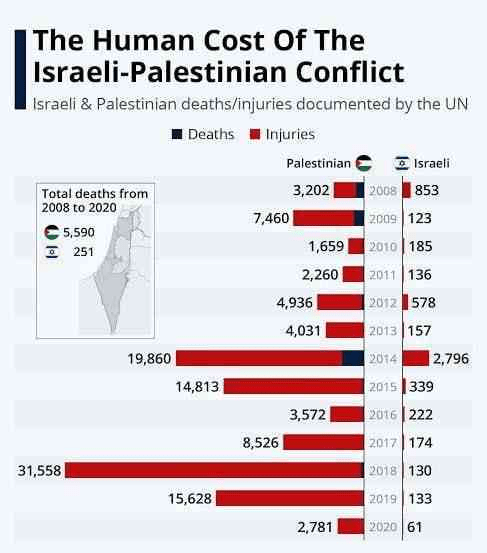
This is one reason why Hamas lashed out. No one could be expected to endure this, year on year, and not want to strike back. It is also why, while I have sympathy for anyone hurt or killed, I have no patience with crocodile tears from Israeli supporters, acting as if they haven’t been doing worse to Palestinians for years.
The Hezbollah Question
is whether they’ll attack. The answer seems to be “probably” as Hezbollah has said that if there is a ground invasion of Gaza, they will declare war. Hezbollah is no joke, they are battle hardened, have between 40K and 150K missiles, a drone force, and their own private comms system.
Israel is moving forces to the Lebanese border as we speak. Militarily speaking, if I were Hezbollah, I might attack sooner rather than later.
The Iran Question
Iran is Hamas and Hezbollah’s sponsor. It is VERY unlikely Hamas did this without Iranian greenlighting and if that’s so, the plan isn’t “do one attack, then get hammered.”
The “Iron” Dome
Israel’s missile defenses cracked under Hamas’s missile barrage. There is no question, if Hezbollah attacks, the Iron Dome will not shoot down most missiles. This time it won’t be Lebanon’s heartland being bombed mercilessly while Tel Aviv is spared, there will be carnage in both homelands.
Nukes
In some ways this is the bottom line. Israel has nukes. If they did not, I would expect Iran to join in and if I were Egypt, I might invade. Israel is weak and humiliated. But as long as they have nukes, other countries will shy off from direct war unless they think they have a way of taking out those nukes.
Diplomatic Damage
Israeli-Saudi Arabia negotiations are dead for the time being and other Arab allies will not be able to do anything but condemn Israel. There are massive demonstrations in support of Hamas in Turkey, Egypt and many other Muslim countries.
Ethnic Cleansing and Occupation
Israel has a huge problem, in that it has a massive population of non-citizens, and those non-citizens are out-breeding the citizenry, except for the ultra-orthodox Jews who do not serve in the military. This is an ulcer, and many Israeli politicians have been clear they want to just get rid of the Palestinians. They can’t genocide them, because it would destroy the Holocaust trump card, but many would love ethnic cleanse them. This may be an opportunity.
This is also an issue because if Israel wants to directly run Gaza, the occupation will be a bloody guerilla war, an endless bleeding ulcer.
If they don’t want to run it, they have to find a friendly quisling force, like the Palestinian authority, to do it for them, and at least right now, there’s no one to take that role. Hamas are more moderate than the other main Gaza factions.
The Ukraine Connection
Of significant amusement is that it appears that much of the weaponry used by Hamas is from stockpiles sent to Ukraine and sold on the black market. This spread of weaponry was predicted and lo.
Imperial Overstretch
Usually when Israel is in trouble the US airlifts in massive arms and munitions to help them, as they did in the 2006 war. But right now the shelves are almost bare because of Ukraine.
Balance of Forces
Hamas is obviously still the massive underdog. They are praying for Hezbollah to join in, and perhaps they want Israel to invade so they can fight a ground war against Israel on their own ground. The smart money is still on Israel.
But do not underestimate Hezbollah, and don’t underestimate how nasty this could get if Hezbollah does intervene. As noted above, they will be able to strike Israel’s heartland. If Israel attacks into Lebanon in response, with ground assets, my money is Hezbollah and if I were Hezbollah I would want that. Defeat the attack, then counter-attack into Israel.
If Hezbollah has to attack on the ground because Israel won’t oblige them I honestly don’t know how it will go.
But, while smaller and less well equipped, Hezbollah is the superior military with higher morale. If I were Israeli, I would not be sanguine.
Concluding Remarks
I won’t cavil, I think Hamas is justified in this attack. I also think the argument that settlers are civilians is weak (though by settlers I do not mean all Israelis.) Israel is an apartheid religious-ethnic state which stole another people’s land and continues to brutalize them.
The only humane solution, one which allows Israel to continue to exist, is a single state with everyone as full citizens.
Alas, that is not on the table.
In the long run, Israel as an ethic religious state, like the Crusader States, is doomed.
The only question is how many people have to suffer before Israel becomes a nation whose very basis is not completely unjust.
(Oh, and if Iran joins in.)
Featured Video

Houthis Don’t Have to Conquer Saudi Arabia to Make It Pay
or go to
Aletho News Archives – Video-Images
From the Archives
A Lesser “Grade” of Human
By Michael Hoffman | Revelation of the Method | January 3, 2024
Will the more than 100 Iranians killed by terrorist bombs today be mourned in the West as victims of terrorism? Certainly not. Allied doctrine has it that the killing of Israeli or American civilians is a crime of cosmic proportions, while shedding the blood of “enemy” women and children is perfectly acceptable; indeed commendable.
The West does not memorialize the hundreds of thousands of civilians bombed by the U.S. in Serbia, Iraq, Afghanistan and every major German city 1943-1945. America’s fire-bombing of the city of Tokyo by General Curtis LeMay in March 1945 was followed by Harry Truman’s atomic incineration of Hiroshima and Nagasaki in August of that year. Truman never had a moment of doubt or regret over the murder of more than a 100,000 Asian children, mothers and non-combatant boys and men. It was business as usual for the “noble” Allies during the “Good War.”
In the West human rights signifies passionate concern only for civilians designated as truly human: Israelis first, then Americans and British, followed by their satraps.
This inhumanity is the legacy of Talmudic ideology, beginning with tractate Sanhedrin 57a from 400 A.D., concerning liability for capital punishment: “If a Jew murders a gentile, he is exempt.”
This teaching of contempt was reiterated in the dogma of Chabad Lubavitch founder Rabbi Shneur Zalman in the 18th century. … continue
Blog Roll
 Aletho News
- Houthis Don’t Have to Conquer Saudi Arabia to Make It Pay
- MOE: Nearly 22,000 Students and Education Workers Killed
- Guterres in Islamabad: Genocide, cowardice, and the cage of Imran Khan
- Johnson, Marandi say Yemen holds upper hand over Saudi Arabia
- False flags won’t save aggressors, Iran FM spokesman says
- The Makkah Pact Enters Into Force: The End of American Dominance or Its New Form?
- NATO’s top generals gather in Kiev
- EU’s continuing expansion – greater threat to Russia
- US Senator Murphy says Pentagon denied him entry to US base in Qatar
- Israel expands “incitement” charge to target Palestinian education and memory
- If Americans Knew
- Three Years of Genocide: How America’s Israel-First Media Filtered Out the Truth
- Israeli war chief briefs ministers on potential war against Palestinian Authority
- New Report: Israel Killed nearly 21,000 Palestinian Students and Education Workers in Past Three Years
- Israel’s flailing chatbot army
- Five Palestinians Killed, Others Injured by Israeli Fire in Gaza
- Israel is rewriting the Palestinian curriculum in East Jerusalem to erase Palestinian identity
- Three years of genocide: Israel turned prisons into killing grounds and torture sites
- Three years of genocide. Words fail. Daily Update
- ‘I’d rather die than go back’: A Palestinian teen’s 10-month nightmare in Israeli jail
- How Jared Kushner’s firm’s investment in an Israeli company could be a major conflict of interest
- No Tricks Zone
- New Study: 50 Years Of The Most Aggressive ‘Net Zero’ Policies Can Only Affect The Global Climate By 0.03°C
- US September “Heat” Was No Record…Many Records Set Decades Ago
- Latest European Green Energy Debacle; Portugal’s Largest Flagship Solar Park Insolvent!
- Green Energy Debacle: German Expert Professor Fritz Vahrenholt Warns Of Severe Economic And Social Consequences
- Two More Paleo Reconstructions Affirm Meters-Higher Sea Levels Across Ireland, Brazil 7000-6000 Years Ago
- New Study: Earth And Venus Surface Warmth Largely Explained By Convection And Lapse Rate, Not CO2 Or Radiation
- 2025 Nature Paper Claiming Worsening Global Drought Gets RETRACTED …Heavily Flawed
- New Study: ‘Global Drought Shows No Detectable Recent Acceleration Under Climate Warming’
- Economic Masterminds: German Socialists Suggest Taxing Productivity Gains Stemming From Using AI
- The South China Sea Has Not Been Cooperating With The Climate Change Narrative

