Hundreds of Palestinian children ethnically cleansed by Israel as world remains silent

An Israeli soldier detains a Palestinian boy during an anti-Israel protest in al-khalil in the Israeli-occupied West Bank, on November 29, 2019. (Via Reuters)
By Robert Inlakesh | Press TV | October 8, 2020
Israel has demolished hundreds of Palestinian homes, this year, leaving hundreds more without a place to live. Yet despite the fact that Israel is set for a record number of home demolitions in East Jerusalem al-Quds, the International Community not only refuses to act but also remains silent.
In East Jerusalem al-Quds alone, since 2004, Israeli home demolitions have left 3,459 Palestinians homeless (including 1,847 minors), which is concerning enough, without the added stress to local Jerusalemite Palestinians of this year being on track to break all previous records for the number of home demolitions since 1967.
What the refusal to confront this issue shows is the complete lack of care from the international community and also when it is properly investigated, that house demolitions in of themselves, reveal that inside of Israel itself, there is no democracy for Palestinians.
In order to understand the issue of house demolitions, we have to differentiate between the succinctly three different circumstances under which Palestinians experience this form of ethnic cleansing. The three key areas are inside of what is now Israel, inside of East Jerusalem al-Quds and inside of the West Bank. The Gaza Strip is not included due to the fact that these demolitions are not undertaken in the same way, but rather occur primarily due to airstrikes.
House demolitions in East Jerusalem al-Quds
So far this year, according to Israeli Human Rights Group B’Tselem, 89 housing units and 27 non-residential buildings were ordered to be demolished in East Jerusalem al-Quds by the Israeli regime. Israel is in fact on track for a record number of house demolitions in the occupied territory this year, according to Israeli paper Haaretz, which will inevitably cause a record number of homeless cases.
Something key to understanding cases of home demolitions in East Jerusalem al-Quds is the ongoing effort to Judaize the city. Palestinians living in East Jerusalem al-Quds do not have Israeli citizenship or Palestinian citizenship, but rather Jerusalem ID cards. If Palestinians choose to live outside of the territory for more than 7 years or claim citizenship of any country (normally Jordan), they can also be stripped of this right to their ID and be expelled. As a result of such policies, significant numbers of Palestinian Jerusalemites have been forced out of Jerusalem al-Quds. Also on top of this is the issue of illegal settlement expansion, with hundreds of thousands of settlers moving into the area.
Despite the oppressive policies, Palestinians make up 40% of the total population of Jerusalem al-Quds, yet are only granted roughly 7% of the total building permits for the city.
The issue of Israeli issued building permits is the main reason for the forced destruction of Palestinian properties in Jerusalem al-Quds. Palestinians have to pay, often unaffordable, prices to apply for permits, yet the approval is near impossible even when they do pay. The reason it is nearly impossible, is because of Israeli implemented building schemes, under which Israel has designed a system built to bolster Jewish construction and prohibit Palestinian construction.
Israel occupied East Jerusalem al-Quds in 1967, later formally annexing it in 1980, meaning that Israel imposes its own law of Palestinians living in the territory and has even built a wall through areas which constitute part of the East Jerusalem al-Quds territory. However, the Israeli application of its own laws over Palestinians is in violation of International Law as the territory is still considered as occupied territory, meaning that the laws of occupation apply to the area.
When Palestinians build and are not granted a permit, or start construction whilst the permit is processing – sometimes delayed until years later before a decision is made by Israel to destroy the home – or are told an old building has not got updated papers, the building is ordered to be demolished.
When Israel orders a home demolition, the pain does not end there, Palestinians are required to pay for the Israelis to forcibly evict their family and demolish their home. This has forced many to pay for bulldozers themselves in order to destroy their own home, so that they do not have to pay for Israel to do it, which often carries a fee double or triple the amount. For Palestinians who cannot afford demolition costs, they are forced to destroy their own homes by hand.
House demolitions in al-Naqab
According to a report released in June, by ‘The Negev Coexistence Forum for Civil Equality’, during the years 2017, 2018 and 2019, Israel ordered the demolition of 2,000 homes in the al-Naqab (Negev in Hebrew).
Key to this issue is the fact that Bedouin Palestinians living in the Naqab are Israeli citizenship holders, some of which serve in the occupation army, yet are still persecuted and pushed out of their home lands. At this point, Palestinian Bedouin’s can only inhabit 12% of their ancestral homelands and if they live in villages “unregistered” by the Israeli regime, they are “transferred” to overcrowded villages and camps, reminiscent of the way in which native Americans were crowded into reservations.
This year alone, hundreds of Bedouins have been made homeless, compounded by the fact that the pandemic is affecting these communities badly and they are still being crammed into overcrowded camps.
Some villages have even been demolished over 100 times. The 17th of September for instance was the last time an entire village was demolished for the 178th time in a row.
House demolitions inside West Bank
From the start of 2020 until the 31st of August, 78 housing units were demolished in the West Bank, leaving 320 people homeless, including 166 minors according to Human Rights Organization B’Tselem.
In the West Bank, according to the United Nations, roughly 1.5% of building permits are approved by Israel, making it nearly impossible to obtain one. This is despite the fact that Israeli settlements and outposts continue to rapidly expand into West Bank territory. If a Palestinian does wish to attempt to attain a permit, it will often cost roughly around $30,000 US just to file the application, a price most just cannot afford, or even for those who can afford the price, it’s too much of a gamble.
Often used propaganda, by Israel and its supporters, suggests that house demolitions are primarily done as a reaction to “Palestinian terrorism” and therefore they argue it’s justified. However, this is not the case. In fact, when Israel does blow up the homes of Palestinians in the West Bank, after the Palestinian in question has been alleged to have committed a violent attack against an Israeli occupation soldier or illegal settler, it is not him who suffers for it.
Palestinians that either attempt to attack an Israeli, or are wrongly accused of it, are almost always shot and killed by the occupation forces. Following this, the family is not able to even grieve in peace, as family homes, sometimes housing multiple families are blown up leaving the entire family homeless. This policy has been described by Israeli Human Rights Group B’Tselem as follows: “Demolishing the homes of relatives of Palestinians who harmed or attempted to harm Israeli civilians or security personnel is prohibited collective punishment, and is one of the most extreme measures used by Israel. Over the years Israel has demolished hundreds of homes, leaving homeless thousands of people who had done no wrong and were not suspected of any wrongdoing. It is an immoral and unlawful policy. The fact that the High Court of Justice has upheld it does not make it legal, rather, it makes the justices accomplices to the crime.”
Despite the fact that these Israeli policies of house demolitions, ultimately aimed at ethnically cleansing Palestinians, are ongoing and have grown more aggressive over the past year, the story is relatively untouched by West Media and largely ignored by the International Community.
Robert Inlakesh is a journalist, writer and political analyst, who has lived in and reported from the occupied Palestinian West Bank. He has written for publications such as Mint Press, Mondoweiss, MEMO, and various other outlets. He specializes in analysis of the Middle East, in particular Palestine-Israel. He also works for Press TV as a European correspondent.
Israel sets its sights on the Red Sea and Bab El-Mandeb
Dr Adnan Abu Amer | MEMO | October 6, 2020
Day after day, the magnitude of the Israeli benefits from normalisation with the Gulf become clearer, especially on the military and strategic levels. The latest benefit is talk about establishing Israeli military bases in the Gulf, the Red Sea and Bab El-Mandab, or benefiting from the Emirati bases scattered in these areas, and the military benefits for Israel brought about by controlling these international seaports.
The Emirati-Israeli agreement included many clauses with security and military aspects, which stipulate bilateral cooperation in these areas, and their commitment to take important measures to prevent the use of their territories to carry out a hostile or “terrorist” attack targeting the other party, and that each side will not support any hostile operations in the territory of the other party. It also stipulates bilateral security coordination and strengthening the military security relationship.
These carefully worded texts have increased the assumptions regarding the possibility of Israel benefitting from the Emirati military bases in the region, whether in the Gulf, Bab El-Mandab, or the Red Sea. This may lead to the establishment of Israeli military base in the Emirates, as well as its use of Emirati waters, and the possibility that it will continue down this path to increase its foothold in Socotra, the Bab El-Mandab Strait and Djibouti.
It is worth noting that the possibility of establishing Israeli military bases in the Gulf, or Israel benefiting from the Emirati military bases, is not easy, but very dangerous. This is because as much as it may give hope to the Gulf states, and the UAE in particular, to defend itself against the threat of any imagined attack from Iran, it, at the same time, exposes it to danger. This is because the fulfilment of this premise means that Israel can strike Iranian targets in the Gulf waters, or in the heart of Iran itself, which will be matched by Iran targeting these Israeli bases in the Gulf.
The agreement allows Israel to get geographically closer to Iran and allows it to improve ties with the Gulf which is a strategic area in terms of trade and oil.
Iran will not stand idly by and remain silent regarding the Emirati-Israeli move, which means the situation in the Gulf region is likely to grow tense and suffer. Iran is present everywhere through the Revolutionary Guard and its sleeping armed cells.
Security of maritime navigation in the Gulf is a purely Israeli interest within the strategy of “curbing the Iranian threat” and strengthening the relationship with the Gulf states, former Israeli Foreign Minister, Yisrael Katz, has said.
Israel aims to gain control over the most important sea straits in the region, which belong to the Emirati and Saudi bases, which enhances the expansion of Israel’s military and strategic influence.
A document by the Israeli Ministry of Intelligence revealed that the agreement with Abu Dhabi paves the way for intensifying military cooperation between them in the Red Sea. This is because it is interested in expanding security cooperation in the region, leading to strengthening the military alliance between them. This includes intensive Israeli military movement, especially through the countries of the Horn of Africa, most notably Ethiopia, at a time when Israeli arms companies are seeking to increase their exports to the Emirates.
US Secretary of State, Mike Pompeo, announced that the UAE and Israel had agreed to build a security and military alliance against Iran to protect American interests and the Middle East, and to increase security and intelligence cooperation to confront what he referred to as “terrorism”.
But Israel has not left Yemen out of its view, the country offers a gateway to the Bab El-Mandab Strait. Tel Aviv aims to crack down on the Palestinian resistance to prevent it from receiving the weapons that reach it from Iran through the Red Sea, reaching the Sinai, and then the Gaza Strip.
As long as the most important provisions of the Emirati-Israeli agreement are related to security and military relations, Israel will work to exploit the agreement to increase its influence in the Gulf. Meanwhile, the UAE is looking for control in the Gulf with the support of the US and Israel, so there is joint Israeli and Emirati work in Yemen to establish joint military bases and areas of influence, specifically on the island of Socotra, which would allow it to completely control the path that passes from India to the West, and penetrates into Africa, which is a strategic location for Israel.
Israel founders were ‘thieves’, Israeli historian says

MEMO | October 6, 2020
Early Jewish settlers in Palestine “looted Arab property”, a new book by an Israeli historian has said, adding “authorities turned a blind eye”.
In what has been described as the “first-ever comprehensive study” by an Israeli historian, Adam Raz described “the extent to which Jews looted Arab property” during the Jewish gangs’ attack in 1948 on Palestinians and their homes, and explains why Ben-Gurion said “most of the Jews are thieves.”
Writing in Haaretz, Ofer Aderet’s review of Raz’s book was entitled: “Jewish soldiers and civilians looted Arab neighbors’ property en masse in ’48. The authorities turned a blind eye.”
Another senior writer at Haaretz, Gideon Levy, commented that the words “most of the Jews are thieves”, “wasn’t uttered by an antisemitic leader, a Jew hater or a neo-Nazi, but by the founder of the State of Israel, two months after it was founded.”
Levy said that the Israeli authorities “turned a blind eye and thus encouraged the looting, despite all the denunciations, the pretense and a few ridiculous trials.”
“The looting served a national purpose: to quickly complete the ethnic cleansing of most of the country of its Arabs, and to see to it that 700,000 refugees would never even imagine returning to their homes” he explained.
The Israeli writer added: “Even before Israel managed to destroy most of the houses, and wipe from the face of the earth more than 400 villages, came this mass looting to empty them out, so that the refugees would have no reason to return.”
Levy also said that the looters “were motivated not only by ugly greed to possess stolen property right after the war was over, property belonging in some cases to people who were their neighbors just the day before, and not only by the desire to get rich quick by looting household items and ornaments, some of them very costly…, but they served, consciously or unconsciously, the ethnic purification project that Israel has tried in vain to deny all through the years.”
“Almost everyone took part” in the looting, he added, which “was the small looting, the one that proved if only for a moment that ‘most of the Jews are thieves,’ as the founding father said. But that was mini-looting compared to the institutionalized looting of property, houses, villages and cities – the looting of the land.”
“Denial and repression” were part of the reasons why heads of Jewish community allowed the looting of Arab property in Palestine. He said: “Thirst for revenge and drunkenness with victory after the difficult war might perhaps explain, even partially, the participation of so many.”
Levy said that “the looting reflects not only momentary human weakness but is intended to serve a clear strategic goal – purifying the country of its inhabitants – words fail.”
Concluding his article, Levy said: “Anyone who believes that a solution will ever be found to the conflict without proper atonement and compensation for these acts, is living in an illusion.”
He asked Israel to “think about the feelings of the descendants, the Arabs of Israel and the Palestinian refugees, who are living with us and alongside us. They see the pictures and read these things – what crosses their minds?”
He answers: “They will never be able to see the villages of their ancestors: Israel demolished most of them, to leave not a shred,” noting that “one small stolen souvenir from the home that was lost might cause a tear to fall.” Adding: “Just ask the Jews enraged over any stolen Jewish property.”
Israel army recruits ex-intelligence officers to spy on Arab Israelis
MEMO | October 6, 2020
The Israeli army is recruiting former intelligence officers from the Shin Bet to spy on Palestinians living in Israel under the pretext of combating the coronavirus, Israel’s Walla news site revealed.
The site quoted senior sources in the Home Front Command as saying that the army has contacted former officers in the Shabak, who are known for their knowledge of Arabs living in Israel, and asked them to join a new “security body” tasked with tracking coronavirus infections.
A former army officer, who had been contacted by the army, told the news site that while the official aim of the new “security body” is to help obtain information about coronavirus infections within the Palestinian community in Israel, he fears the new body has greater plans for the future.
A member of the Israeli Knesset, MK Aida Touma-Solomon of the Arab Joint List said the report paves the way for more legal violations against Arab citizens.
Israel views the Palestinians who remained in their homes in historic Palestine and who later became citizens of Israel as a demographic threat.
The former Director of Israel’s internal security service Shin Bet, Yuval Diskin, publicly said that his apparatus would pursue every Israeli- Arab who refused to recognise Israel as a Jewish state while Prime Minister, Benjamin Netanyahu, has repeatedly described them as “demographic time bomb”.
Today, Palestinian citizens of Israel represent 21 per cent of the country’s population.
Netanyahu’s Dirty Laundry Tells All
If you can steal a whole country, what’s a little laundry?
By Philip Giraldi • Unz Review • October 6, 2020
Staff in Washington D.C.’s Blair House, where the U.S. president houses his V.I.P. foreign guests, report that they have begun counting towels and robes after visitors depart. Soap and shampoo resupply is also being closely monitored and a metal detector has been installed in the downstairs breakfast room to prevent silverware losses. The heightened security comes in the wake of revelations regarding the all-too-frequent visits by Israeli Prime Minister Benjamin Netanyahu, who has been accused of regularly arriving at Blair House with multiple suitcases and bags containing many months’ worth of his dirty laundry, all of which he has washed, dry cleaned and pressed at U.S. taxpayer expense. While most visitors choose to deal with their soiled linen as a private matter, Bibi evidently is quite happy to have his washed for him in Washington.
Apart from the Netanyahu behavior demonstrating his complete contempt for his hosts, the prime minister appears to have an established track record when it comes to questionable behavior. He and his wife Sara have been the targets of several long-running corruption investigations in Israel, some of which remain unresolved. It is the latest in a series of crimes involving Israeli leaders, which have included the rape conviction of former President Moshe Katsav.
But more to the point, it is difficult to avoid the belief that the Jewish state and its hundreds of front organizations operating in the United States are basically both corrupting and impoverishing the United States one bite at a time. My father used to have a typical New Jersey expression describing someone who is obnoxiously persistent in trying to taking advantage of you. He called such behavior “getting pecked to death by a duck.” Lacking a sharp beak, one hardly notices the duck’s endeavors until it kills you. Israel and its proxies are the duck that is bleeding the United States one peck at a time.
There are, of course, the big-ticket items that make the news briefly like the more than $4 billion in annual military assistance that Israel gets, mostly guaranteed for the next ten years. Israel is now seeking $8 billion more on top of that to thank it for making friends with the United Arab Emirates and Bahrain in a politically motivated White House ceremony. Israel enjoys a number of tax breaks, co-production arrangements and trade concessions that almost certainly amount to more than $10 billion annually in a one-way cash flow to America’s “best friend and greatest ally.” The 1985 United States free trade agreement with Israel alone has benefitted the Jewish state by $144 billion, which is the U.S. deficit on the trade between 1985 and 2015.
One might note in passing that Israel is quite capable of defending itself, to include a nuclear arsenal and the means to deliver it, while its Jewish citizens enjoy a European standard of living, to include free public education through college and state provided medical care that is in part funded by American taxpayers.
But it is on the duck pecking level that the penetration and corruption of the United States becomes clearer. It seems that every week one notes a couple of articles here and there that reveal how Israel and its friends wield tremendous power at all government levels and also in the media. One that resonated in the past couple of weeks described how Ron DeSantis, Florida’s governor, has signed a bill authorizing the state’s department of motor vehicles to issue car license plates bearing the legend “Florida Stands With Israel.” The Israeli-American Council (IAC) immediately praised the “heartwarming expression of solidarity” which “affirms the strong bond between the State of Florida’s citizens and the Jewish State of Israel. This kind of warmth is why Florida has always been a leading destination for Israeli-Americans.”
Now, DeSantis is no novice when it comes to the sucking up to Israel game. He has been playing the Israel and anti-Semitism cards throughout his political career. In 2018, as a Congressman running for governor, he attacked his opponent Tallahassee Mayor Andrew Gillum during their gubernatorial race as not being a “friend of Israel.” Earlier, as a Congressman, DeSantis sponsored in 2013 the Palestinian Accountability Act which called for the withholding of U.S. aid to the Palestinian Authority until it recognizes Israel as a Jewish state. In 2017, he co-founded the Congressional Israel Victory Caucus.
When DeSantis ran for governor, he predictably promised to be the most pro-Israel governor in America and that the “first delegation [he] would lead would be to the state of Israel.” He then took his entire cabinet with him as part of a 75-person taxpayer funded delegation on a six-day boondoggle at the end of May 2019, meanwhile boasting that “Today I’m pleased to report that I’m keeping that promise. Our delegation will bring business, academic and political leaders to help strengthen the bond between Florida and Israel.” He held a meeting of his Cabinet in the American Embassy in Jerusalem during his visit, the first time that such a meeting has ever been held by a state government on foreign soil. During the meeting he ostentatiously signed a legislative bill “combating anti-Semitism.”
And now one can buy license plates extolling the parasitic relationship with Israel, surely a unique expression of dual loyalty not exhibited by any other state in the union. The Florida relationship is also a perfect example of how Israel’s friends go about setting up mechanisms that will benefit the Jewish state. Israel will be selling its products and services to Florida, enabled by a government in place that is promoting the process and will steer contracts in its direction. In return, Florida will get little or nothing as Israel is a tiny market and has no particular need of anything that the Sunshine State produces.
All such trade agreements are designed to enrich Israel. Another interesting example of how this works at the state level and the abuse that it can produce has recently surfaced in Virginia, where a so-called Virginia-Israel Advisory Board (VIAB) has actually been funded by the Commonwealth of Virginia taxpayers to promote and even subsidize Israeli business in the state, business that currently runs an estimated $500 million per annum in favor of Israel. Grant Smith of the Institute for Research: Middle Eastern Policy (IRMEP) has done considerable digging into the affairs of VIAB. He has observed how “VIAB is a pilot for how Israel can quietly obtain taxpayer funding and official status for networked entities that advance Israel from within key state governments.”
And then there is Congress, where a bill has been introduced that will enable Israel to block any U.S. arm sales to the Middle East that it does not approve of, a nearly complete surrender of American sovereignty to the Jewish state. And there is also the Congressman Brad Sherman of California story. Brad, who is Jewish, would very much like to replace recently defeated coreligionist congressman Eliot Engel as chairman of the House Foreign Affairs Committee. The committee, of course, deals with Israeli issues and Engel was widely regarded as one of the Jewish state’s staunchest friends in Congress. So what did Brad do? He approached a number of Jewish groups to help the process along. In a zoom event hosted by the Democratic Majority for Israel (DMFI) he confirmed that “You went to bat for Eliot Engel in a huge way, and demonstrated that you understood how important that chairmanship is… And I won’t compare myself to my good friend Eliot Engel, except to say that when it comes to having one’s heart in the right place, Eliot and I are in the exact same place.” If Brad succeeds, and he probably will, whose interests will he be serving in an important government office? Some might regard such behavior as treasonous.
Also out of California comes the story of some new legislation to combat the scourge of anti-Semitism, much in the media of late together with the shocking news that many Americans are unable to name even a single so-called Nazi death camp or to parrot alleged “facts” about the holocaust. What is described as “holocaust education” is already mandatory in a number of states where studying the American Revolution is apparently optional. Jewish groups have infiltrated boards of education to “advise” on suitable textbooks, which present a positive narrative relating to Israel while also depicting claimed Jewish victimhood. It is now also likely that holocaust education will become mandatory nationwide due to recent congressional passage of the Never Again Education Act.
At the end of August, California Assembly Bill 331 “took a major step toward [California] becoming the first state in the country to mandate completion of an ethnic studies course as a requirement for high school graduation.” Reports of “anxiety and outrage” in the Jewish community over the first draft of the bill had led the members of the 16 member California Legislative Jewish Caucus to quickly move to insert “guardrail” language into the text. The new language will “… prohibit the teaching of any curriculum that promotes bias, bigotry or discrimination, including against Jews or Israelis.”
The issue might seem relatively clear cut, but there was of course a hidden agenda, which was to block any consideration of the plight of the Palestinians or the Boycott, Divestment and Sanctions movement (BDS), which, it was feared, would become part of the curriculum. And the inclusion of “Israelis” as a protected group pretty effectively prohibits any discussion of Israel at all, except, presumably, in positive terms. In California schoolrooms one can criticize the behavior of the United States or Mexico but anything negative about Israel will be forbidden. And California is not alone. Twenty-nine states currently either ban or otherwise punish the promotion of BDS, largely due to the effective lobbying by Israeli partisans at the legislative level in those states.
So everywhere anyone turns, there is Israel, Israel, Israel. So, what’s a little dirty laundry between the “best friends” in the whole wide world? Maybe. But alternatively, it just might be that we Americans are getting pecked to death and all the Trumps and Bidens do is grin and smile while our country is being systematically screwed by a foreign country aided by a domestic lobby that is only in the game to take whatever it can. Wake-up America!
Philip M. Giraldi, Ph.D., is Executive Director of the Council for the National Interest, a 501(c)3 tax deductible educational foundation (Federal ID Number #52-1739023) that seeks a more interests-based U.S. foreign policy in the Middle East. Website is https://councilforthenationalinterest.org, address is P.O. Box 2157, Purcellville VA 20134 and its email is inform@cnionline.org.
Gantz: During Next War with Hezbollah, ‘Israel’ Will Strike Governmental Targets in Lebanon
Al-Manar | October 5, 2020
The Israeli minister of defense, Benny Gantz, threatened to strike governmental targets in Lebanon during any upcoming war with Hezbollah, considering that ‘Israel’ can no longer differentiate between the resistance military posts and the residential buildings which house missiles.
In an online interview with Saudi, Emirati and Bahraini journalists, Gantz said that the normalization deals with the Gulf countries will reinforce the fight against Iran, adding that the best approach to confront Tehran is to exert the heavy pressures and impose tough sanctions on it.
Gantz pointed out that no one can accept the demands of the Palestinians in the context of the ‘peace’ negotiations, adding that the normalization deals would reinforce the Zionist-Palestinian settlement.
Israel constantly meddled in Yemen’s internal affairs under slain dictator: Army spokesman
Press TV – October 4, 2020
The spokesman for Yemeni Armed Forces, Brigadier General Yahya Saree, says Israel constantly intervened in the internal affairs of the Arab country during the reign of slain dictator, Ali Abdullah Saleh.
Speaking at a press conference broadcast live from the capital Sana’a on Sunday evening, Saree highlighted that the Yemeni nation is confronting a Saudi-led military aggression, which seeks to accomplish the desired objectives of the Tel Aviv regime.
“Yemen has long been at the main target of US-Israeli plots and the ongoing onslaught clearly proves this. The Armed Forces call upon Yemenis from all walks of life to raise their awareness about the real intentions of foreigners. Our struggle is nothing but a fateful battle for liberation and independence,” he said.
Saree noted that there were secret relations between Saleh’s government and Israel, which dated back to the year 2000, stating that there were even mutual visits between officials from both sides.
The high-ranking Yemeni military official then showed a number of documents indicating that Israeli authorities wished to control not only the strategic Bab-el-Mandeb strait, which connects the Red Sea to the Gulf of Aden, Yemeni islands and the port of Hudaydah, but also wanted to be in charge of Yemen’s economic, cultural, agricultural, security and military sectors.
Saree added that Saleh’s regime started to normalize ties with the Israel many years ago, and reached a high level of communication and coordination with Israel at various arenas in 2007.
“On July 14 of that year, Israeli diplomat Bruce Kashdan arrived in Sana’a according to available documents on an unannounced visit, which lasted 48 hours. During that trip, the Israeli official met with Yemeni military and security top brass who are relatives of Saleh,” Saree underlined.
He added, “The Israeli official left Sana’a International Airport on July 16, 2007. The visit had been arranged by Yemeni officials, and the United Arab Emirates (UAE) played the leading role in it. The Israeli diplomat had earlier visited Yemen on February 2, 2005.”
Saree noted that the visits to Sana’a were not simply aimed at normalization between Yemen and Israel, but sought close trade cooperation, entry of Israeli products into the Yemeni market and their promotion, as well as discussion on the implementation of joint projects.
One of the most important discussions in the field of civil aviation was an agreement that would allow Israeli airliners to cross Yemen’s airspace, Saree pointed out.
The top military official went on to say that an Israeli parliamentary delegation paid a visit to Sana’a in early March 1996, and that the delegates enjoyed a remarkable reception and met with several high-ranking political and security officials.
“On March 30, 2000, Ali Abdullah Saleh confirmed that he had met with Israeli President Ezer Weizman. The Israeli media broke the news of the meeting only ten minutes afterwards, putting the former Yemeni president to shame.
“Before that, specifically on January 31, 1997, Saleh confirmed to an Arab official that there were visits by Israeli officials to Yemen,” Saree commented.
The spokesman for the Yemeni Armed Forces then warned against Israel’s plan to naturalize tens of thousands of Yemeni-born Jews, emphasizing that such scenarios pose a grave threat to Yemen’s national security.
Yemeni people have strongly condemned the UAE and Bahrain over signing contentious US-mediated normalization deals with Israel.
Israeli Prime Minister Benjamin Netanyahu signed the deals with Emirati Foreign Minister Sheikh Abdullah bin Zayed Al Nahyan and Bahrain’s Foreign Minister Abdullatif Al Zayani during an official ceremony hosted by US President Donald Trump at the White House on September 15.
Palestinians, who seek an independent state in the occupied West Bank and Gaza, with East Jerusalem al-Quds as its capital, view the deals as betrayal of their cause.
Palestinian President Mahmoud Abbas protested the normalization deals with Israel, saying they will be fruitless as long as the United States and Israel do not recognize the rights of the Palestinian nation and refuse to resolve the issue of Palestinian refugees.
Will Lebanon be the next US-NATO humanitarian war?
By Steven Sahiounie | Mideast discourse | October 2, 2020
The waters off Lebanon are the scene of a gathering Armada of French and American naval ships. What appeared at first to be a humanitarian response to the devastating Beirut Port explosion on August 4, is now feared to be the prelude of the next US-NATO humanitarian war.
French President Emmanuel Macron blamed Hezbollah and all of the Lebanese politicians Sunday and warned of a new civil war. “I’m ashamed of the Lebanese political leaders. Ashamed,” Macron repeated.
He accused them of “collective betrayal” while putting their parties and personal greed above the needs of the Lebanese people.
Some political observers now believe that Lebanon may well be going the way of Somalia, as evidenced by the characteristics of a failing state, such as lack of governance, corruption and incompetence, chronic humanitarian problems, and persistent social tensions.
Prime minister-designate Moustapha Adib stepped down September 26, and Lebanon’s Central Bank reserves may soon dry up and the government would no longer be able to subsidize basic goods such as fuel, medicine, and wheat.
Macron has been pressing Lebanese politicians to form a Cabinet made up of technocrats that can work on urgent reforms, and Macron has traveled twice to Beirut since August 4, while making it a personal mission to try to repair the devastated country, which some see as a neo-colonial farce.
Macron criticized the Lebanese system of sectarian politics, “as if competence was linked to religious confession.”
He lambasted Hezbollah demanding to know its characteristics and identity, and he criticized Lebanese political leaders from all parties and dynasties. Each Lebanese faction has found a foreign godfather and has ended up as a pawn in a regional and international chess game. Tens of billions of dollars have reportedly been looted by politicians and deposited in European and American banks.
US-NATO Humanitarian wars
In 1999 NATO updated its ‘Strategic Concept’ to allow members to defend not only other members but also conduct ‘non-Article 5 Response Operations’. It would be under this mechanism that a US-NATO military operation, along with an Arab Gulf coalition, would be used to attack, invade and defeat Hezbollah in Lebanon.
Since 2002, it was agreed that NATO forces could be sent “wherever they are needed,” regardless of the location, and in 2006 the NATO Response Force (NRF) of 25,000 troops has been fully operational.
US President Bill Clinton and NATO waged the humanitarian war on the former Yugoslavia, which broke a larger nation into ‘bite-sized’ pieces.
Critics of the US-NATO bombing of Yugoslavia have argued that certain attacks forming part of the campaign violated international humanitarian law. Noam Chomsky argued that the main objective of the US-NATO war was to force Yugoslavia into the Western economic system since it was the only country in the region that stood alone in defiance of the US world domination.
Hezbollah targeted by US-NATO war machine
Hezbollah’s prominence in the Lebanese government caused foreign donors and investors to stay away, because of US sanctions targeted on anyone with ties to the group, based on their designation as a terrorist group.
Hezbollah’s leader, Sayyed Hassan Nasrallah, said on Tuesday, “We welcomed President Macron when he visited Lebanon and we welcomed the French initiative, but not for him to be judge, jury and executioner, and ruler of Lebanon.”
Nasrallah has headed the group since 1992 as Secretary-General; however, its military wing is considered as a terrorist organization in 21 countries, as well as by the Arab League and the European Union.
Hezbollah’s 1985 manifesto listed its objectives as the expulsion of “the Americans, the French and their allies definitely from Lebanon, putting an end to any colonialist entity on our land”.
In 2008, the Lebanese government unanimously recognized Hezbollah’s existence as an armed organization and guarantees its right to “liberate or recover occupied lands”.
Hezbollah is an armed resistance group, as well as a political party that has seats in Parliament through free and fair elections. Their ally in Parliament is the ‘Amal Movement’, and together they hold the majority of Parliamentary seats. In a democracy, the majority rules and this is why recently Hezbollah and Amal insisted on choosing the Finance minister, which became a conflict point in the view of Macron.
Hezbollah is resisting the Israeli occupation of Shebaa Farms, an area in the far south of Lebanon. Moreover, Hezbollah also is resisting the Israeli occupation of Palestine. At one time, all of the Arab world demanded the rights for the Palestinian people, who have lived under brutal military occupation since 1948, and the UN has ratified resolutions calling for a 2-state solution, where Palestine would be given the land of the 1967 borders, and both Israel and Palestine would live side by side in peace.
In 2017, Ron Prosor, former Israeli ambassador to the UN said Hezbollah was then “10 times as strong now as it was in 2006, and its military infrastructure permeates Lebanon.” He added that Lebanese President Michel Aoun has also “embraced” Hezbollah’s arsenal as “a principal element of Lebanon’s defense.”
Many critics tried to blame Hezbollah for the Beirut Port blast on August 4, but the Lebanese officials and locals admitted that Hezbollah had no access to the Port, or authority over it. Even officials known to be antagonistic of Hezbollah admitted that the blame would not plausibly stick on Hezbollah. The exact cause is not known, but it may have been an accident borne of corruption and ineptitude, or it could be sabotage, according to President Michel Aoun. MP Machnouck, member of the Sunni-led ‘Future Party’ stated he was convinced Israel was responsible.
The elimination of Hezbollah is Israel’s top priority
A former director of Israel’s Counter-Terrorism Bureau, Brig. Gen. Nitzan Nuriel, said that another war between Israel and Hezbollah was “only a question of time.”
Hezbollah is the only force that Israel has faced that has caused the Israeli Defense Forces to retreat without success. Defeating Hezbollah is a top Israeli priority.
Under the Obama Administration’s Middle Eastern policy, Iran became a negotiations partner, while pressuring Israel to conclude a peace agreement with the Palestinians.
Netanyahu recently gave a virtual speech to the UN Security Council, in which he displayed a detailed map of Beirut, and he predicted the location of where a future explosion would occur, and he blamed Hezbollah for having a weapons factory and warehouse at the location, which was a residential area. During the Netanyahu speech, Nasrallah was also giving a live televised speech in Lebanon and was told what Netanyahu had claimed. He immediately invited all media to go to the location that Netanyahu portrayed in his map, and inspect for themselves if there were any weapons or warehouse present. Later, the media arrived, and live local TV coverage showed that in fact, the location was a cooking gas canister factory. This confirmed the Israeli accusation was false and led experts to assume a direct connection between the Port blast, and the Israeli proposed blast in Netanyahu’s map.
The Israeli occupation of Lebanon
Israel occupied the south of Lebanon for 23 years, during which men, women, and children were imprisoned in Khiam Prison, where they were routinely tortured, abused and many died. Hezbollah aligned with many other Lebanese resistance groups, who resisted the occupation vociferously until Israel gave up and left in 2000. The south of Lebanon is populated by both Shite Muslims and Christians. The steadfastness of Hezbollah is remembered by those Lebanese citizens. However, the North of Lebanon was never occupied and lived free of fear, oppression, and intimidation which may have influenced many Lebanese citizens to either support or reject Hezbollah. As they say, “Your view depends on where your seat is.”
Using ISIS as ground troops by US-NATO
Recently, the Lebanese Army fought fierce battles against Radical Islamic terrorists near Tripoli in the north, in the area of Wadi Khalid.
In 2016, Efraim Inbar, an Israeli scholar, and the director of the Begin-Sadat Center for Strategic Studies wrote, “The continuing existence of ISIS serves a strategic purpose,” and added that ISIS “can be a useful tool in undermining” Iran, Hezbollah, Syria, and Russia and should not be defeated. He wrote, “Stability is not a value in and of itself. It is desirable only if it serves our interests,” and stressed that the West’s “main enemy” is not ISIS; it is Iran.
Saudi Arabia part of the Coalition against Hezbollah
The King of Saudi Arabia rarely gives speeches; however, he made a televised speech in which he accused Hezbollah of the Beirut Port blast, apparently unaware that that accusation has been debunked. This is the same King who summoned Prime Minister Saad Hariri from Lebanon to be kidnapped and forced to resign in Saudi Arabia. It was President Macron who personally negotiated Hariri’s freedom.
It appears that Saudi Arabia will be among the first Arab countries to send support for a US-NATO attack on Lebanon to eliminate Hezbollah.
Steven Sahiounie is an award-winning journalist and political commentator.
US Bipartisan Bill Would Allow Israel Veto on Arms Sales to Arab Countries
Palestine Chronicle | October 4, 2020
Lawmakers at the US House of Representatives introduced a bipartisan bill on Friday that could allow the occupying state of Israel to veto any American arms sales to the Arab countries.
The proposed bill “would require the President to consult with the Israeli government to ensure [qualitative military edge] concerns are settled” in respect to weapons sales to Middle Eastern countries, read a statement by the office of lead sponsor Representative Brad Schneider.
The proposed legislation also asks the US President to inform the Congress of the potential impact of the planned deal on Israel’s military superiority in the region, no later than 60 days after receiving a request to sell arms and military equipment to countries in the Middle East.
Most of the sponsors are members of the Democratic Party, including Jewish lawmakers Schneider, Elaine Luria, Max Rose, Josh Gottheimer, Ted Deutch and Debbie Wasserman Schultz.
The bill came in the aftermath of the UAE-Israel normalization deal on August, under which the UAE would purchase cutting-edge weaponry such as F-35 fighter jets.
Daniel Korski: The Intelligence-Linked Mastermind Behind the UK’s Orwellian Healthtech Advisory Board

By Johnny Vedmore |
Unlimited Hangout| October 1, 2020
As a futuristic, hi-tech dystopia increasingly takes shape around us, the concept of the Panopticon is more relevant than ever as it functions as the underpinning of the ever-growing mass surveillance grid.
For those who are not so familiar with 18th century social philosophy, a Panopticon was originally the design of a prison building by an English philosopher named Jeremy Bentham. The Panopticon prison’s architecture would allow one guard in a central guard tower to observe every inmate without those prisoners knowing that they were being observed, and so those incarcerated were left to assume that they were actually being observed all of the time. This prison would, in theory, allow that singular guard to maintain order over every inmate.
Much later, in the 20th century, the famous French philosopher, Michel Foucault, would use the concept of Bentham’s original Panopticon as a way to describe and explore “disciplinary power”. According to Foucault’s work, disciplinary power had been successful due to its utilisation of three technologies; hierarchical observation; normalising judgment; and examinations. Hierarchical observation refers to the fact that the observer in a Panopticon can be of any hierarchical position within the observing body, meaning that a prison guard, supervisor, or a governor could be the person viewing the inmates. Foucault would also insist that the normalisation of judgement is imperative for disciplinary power to exist. The final principle, the examination, is used to combine the first two principles of the observations and the resulting judgements to help decide on whether further actions should be taken or punitive measures be applied.
Among the most notable of Foucault’s analyses of the utility of the Panopticon is the following quote from his book Discipline and Punish: “The major effect of the panopticon is to induce in the inmate a state of consciousness and permanent visibility that assures the automatic functioning of power.” In other words, the uncertainty of whether or not an individual is being constantly watched induces obedience in that individual, allowing only a few to control the many.
In addition to Foucault, the concept of the Panopticon has been vigorously studied over the past few centuries and it has special relevance in understanding modern forms of mass surveillance. The aim of many of the modern day state surveillance apparatus function under a similar doctrine to the original ideology behind the invention of the Panopticon.
The British GCHQ, the US’s NSA, the Israeli’s Unit 8200, among many others, are the all seeing eyes of national intelligence agencies who have longed for a way to watch their populations remotely, i.e. online, without their citizens knowing whether or not they’re actually being observed. One man has striven to be at the center of the growing global Panopticon, from his base in the Panopticon’s birthplace — Britain. His name is Daniel Korski.
The Creator
When I first came upon the NHS Healthtech Advisory Board, a body created in 2018 to “advise” the UK’s Health and Social Care Secretary Matt Hancock, its members opened my eyes to some of the darker actors involved in designing our tech-guided futures. One of the panelists on Matt Hancock’s team of tech pioneers, who are seeking “to transform technology in the NHS [National Health Service],” was Nicole Junkermann.
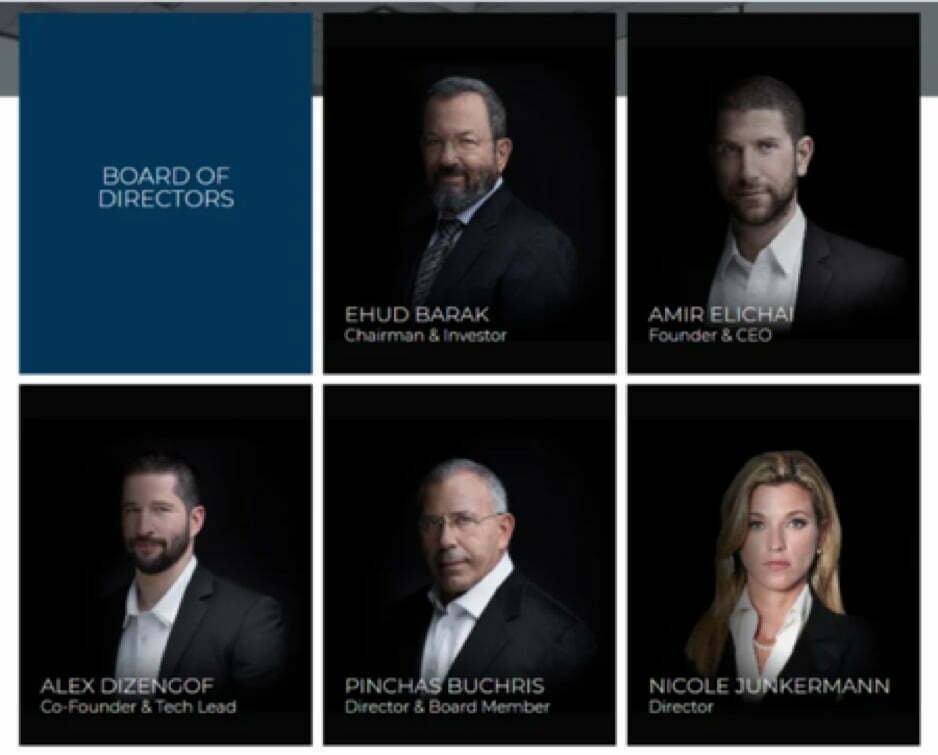
The Israeli Intelligence-Linked Team behind Carbyne911 (including Nicole Junkermann)
Junkermann’s multiple links with Jeffrey Epstein, which appear to have begun around 2002, exposed her as someone who couldn’t be trusted with the future direction of the UK’s healthcare system. Furthermore, Junkermann’s connections with Ehud Barak, Peter Thiel, and Jeffrey Epstein via her investment in the Israeli intelligence-linked surveillance company Carbyne911, made her entry into the United Kingdom’s government advisory panel very problematic for everyone involved. But she was not the only interesting character intimately involved in this particular government project.
While the Healthtech Advisory Board has been hailed since its creation as the brainchild of Matt Hancock, he was actually guided to the project by the man who was, and is, the real mastermind behind the board’s founding, a man who has been helping to quietly write the history of Britain from behind the scenes for the last two decades. He is somebody you’ve probably never heard of, even though his impact on public policy is felt not only in the United Kingdom, but globally.
This man has been a senior advisor to the US State Department, an advisor to Hamid Karzai in post-invasion Afghanistan, the team leader of the Basrah Reconstruction Team in post-invasion Iraq, the Head of Political-Military Affairs for the Office of the High Representative to Bosnia-Herzegovina, and a Committee Specialist for the House of Commons Defence Committee. If that weren’t enough, he was also a founding member of the European Council on Foreign Relations, an advisor to the Vice President of the European Commission, a special advisor to UK Prime Minister David Cameron, deputy head of policy at 10 Downing Street. Yet, even these are just some of the public offices he has held. This man’s name is Daniel Korski and he should be notorious.
Described as a “Foreign Policy Writer” and a “Post Conflict Expert”, Daniel Korski is currently only in his early forties and yet his experience is vast. How does one get the opportunities which have been afforded to Mr Korski? Do you need to be a member of a special club from a very young age? Everything about Korski points to military intelligence, so to find him on the same advisory board as a Mossad-linked Epstein associate isn’t too much of a shock, but it does deserve further scrutiny.
This is especially true now that Daniel Korski has left public office and set up a venture capital firm which specifically funds government-related tech startups. While Korski wants to publicly appear to have left government work, it is pretty clear that, upon further inspection, he hasn’t drifted too far from the authorities. So, let us look at Mr Korski’s history in more detail and work our way forward towards his more current projects. In doing so, I truly believe that you will not be able to deny his continuing role as an intelligence operative. You will also be shown evidence of his dystopian side projects and connections to one of the largest growing, government-backed mass surveillance projects in the world. This is an introduction to Daniel Korski, one of the creators of the current digital panopticon.
Daniel Korski’s Curious Past
Henryk Korski, grandfather of Daniel Korski eluded the Nazi’s whilst living in Poland in the 1940s. After the war, he would join the Polish Communist Party and by the mid-to-late 60s he was working in the Ministry of Foreign Trade. But a decade later, when his grandson Daniel was born, the whole family had already relocated to Copenhagen. If you were to go by Daniel Korski’s Wikipedia page then you would be told that his family were expelled from Poland in the late 1960s. But, if you were to look behind the scenes at Korski’s Wikipedia pages history then you’d discover that someone disagreed with that description of events.
On 21st April 2013 someone edited this part of Daniel’s Wiki page. This editor wanted people to know: “Korski is the son of Polish Jewish refugees, who fled persecution.” I decided to see if I could trace the I.P. Address of the person who made this change. I managed to track the computer to Brussels in Belgium and the edit was made while Daniel Korski was living in the Belgian capital when working as an advisor to the Vice President of the European Commission. It’s also just before he left that post and headed off to become a special advisor to the then Prime Minister of the United Kingdom, David Cameron. It seems that Daniel Korski wanted everyone to believe that his parents had fled persecution in Poland, but was this true?
Daniel Korski himself would eventually head to Twitter to show people the evidence that his parents were Jewish refugees fleeing persecution. He would post two images of official court documents sealed in plastic sleeves and describe it as evidence of a pogrom. For those who are unaware, a pogrom is described as “an organized massacre, especially of Jews”. But do the documents supplied by Daniel Korski provide any evidence of a massacre of Jewish people? The straight answer is a definite no. The court papers Korski so proudly presents on Twitter do not mention Judaism at all, but they do mention Henryk Korski’s stance on the war between Israel and Egypt. The documents, which were written in Polish, relate to a court case involving Henryk Korski and his employer.
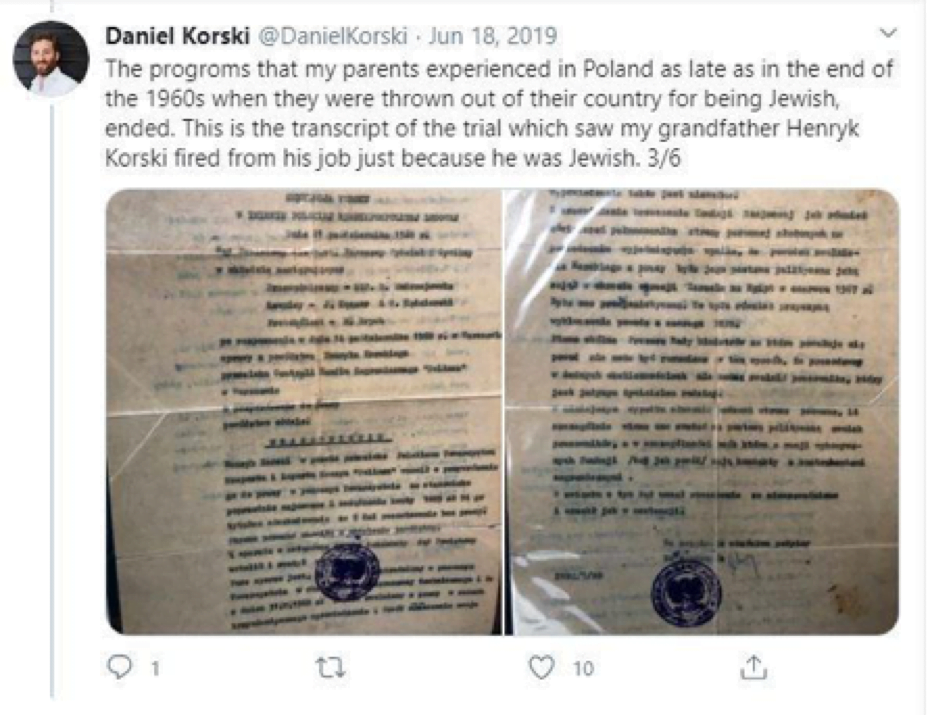
Henryk demanded to be reinstated into his previously held position in the Polish Ministry of Foreign Trade and compensation to be paid for the wages he had been denied. The court refused Mr. Korski’s application and the Korski family would soon move to Denmark, a decision which Henryk himself said turned out to be a lucky move. There is no massacre of Jews in Poland at this time and there is no pogrom involving Korski’s family either. In fact the last recorded pogrom happened in 1946. Instead, Daniel Korski is caught misleading the public in an attempt to appear as though his parents were Jewish refugees fleeing the threat of death in communist Poland. Is it any wonder then that in the same year as Daniel Korski was making up parts of his family’s history, he would also be appointed as vice president of the United Kingdom’s Jewish Leadership Council.
Daniel Korski grew up in Denmark, so how did he become such an important part of the British government? Korski didn’t start studying for his degree until 1997 when he was 20 years old. He would attend the London School of Economics and Political Science (LSE) and would later attend Cambridge University for his Masters. He was either well connected or very talented, maybe even both, as by the age of 25 he was working for ex-Liberal Democrat leader Paddy Ashdown as Head of Political-Military Affairs while Ashdown was serving in the office of High Representative for Bosnia-Herzegovina. Korski would hold that position between 2002 until 2004 and he would then go on to be the Committee Specialist for the UK House of Commons Defence Committee. That short term position would be followed by his first official role overseas on behalf of the British government. In 2005, Korski would be in Kabul, Afghanistan, where he was officially advising the Karzai government on counter-narcotic operations. He would also soon become part of the UK Government’s “Stabilisation Unit” for the war-torn country.
His next appointment, in 2007, was a move to Iraq as the team leader for the Basrah Provincial Reconstruction Team and during this work in Afghanistan and Iraq, Korski became a senior advisor to the US State Department. With all this experience, we are able to see that Daniel Korski, who was still only 30 years old, had very clear intelligence connections. So it will come as no surprise that in 2009 Daniel Korski helped to found the European Council on Foreign Relations where he would also be named a “Senior Policy Fellow”. Korski would, soon after the creation of the European CFR, become an advisor to the vice president of the European Commission, Catherine Ashton, also referred to as Baroness Ashton of Upholland.
In 2013, Korski would return to the UK as a special advisor to the David Cameron government. In May 2015, he would take up the position as deputy head of policy at 10 Downing Street and would stay in that position until Cameron stood down following his defeat in the EU referendum. The Brexit defeat hit everyone involved in the Cameron administration like a hurricane. Many of the politicians who orchestrated the lacklustre campaign for Britain remaining part of the EU immediately stepped down and some went into hiding.
Quite amazingly for any advisor to a Conservative government, Daniel Korski had managed to get through almost 15 years in leading Whitehall positions without being involved in a single sex scandal; at least that’s what he thought. Yet, on 14th November 2017, the Telegraph, in an article entitled “David Cameron aide denies groping television writer at Downing Street event,” the paper named Daniel Korski as the man who allegedly groped producer Daisy Goodwin. The article states:
“Daniel Korski, who left his post as special adviser following the Brexit vote, admitted that he had met the TV producer in Number 10 on two occasions, but said that any accusation of inappropriate behaviour was “not only totally false but also totally bizarre”
Ms Goodwin, 55, has claimed that she was “summoned” to Downing Street to discuss a proposed TV show when Mr Cameron was Prime Minister and an official told her she looked like a Bond girl before putting his hand on her breast as she went to leave.” Korski, by the time the sexual assault accusation had been made public, had started his own venture capital firm called simply “Public” or Public.io. Even though he was officially outside government at the time, Korski’s capitalist venture would specifically focus on tech startups designed for government applications. They set up base at an address in 1 Horseguards Avenue, Westminster, just opposite the HQ for the UK Ministry of Defence. Public.io also owns Eva Health Technology, previously named Microtest Ltd, which supplies patient management systems for healthcare professionals, including everything from simple customer booking software through to documentation software for vaccines.
In 2018, Korski would become Chairman and Co-Founder of the Govtech Summit, which is planned to be held each year in Paris and is a global stage to pitch next-generation technologies to governments from around the world. Govtech is a place where Daniel Korski and his Public.io business partner, Alexander de Carvalho, can introduce the world to such tech startups as Ehud Barak’s Carbyne, a company frequently advertised by Public.io and Govtech even though they are not direct investors in the Israeli firm. It was also in 2018 that the Healthtech Advisory Board, supposedly the idea of Matt Hancock, was formed and began to bring together such people as Nicole Junkermann and Daniel Korski to help create the future blueprint for the hi-tech “transformation” of the UK’s public health sector.

Some members of the Healthtech Advisory Board, (Rear) Daniel Korski, Parker Moss, Nicola Blackwood, Nicole Junkermann (Front) Dr Ben Goldacre and Matt Hancock
But Korski, since leaving official government employment, has been involved in other activities too. One of his other enterprises is with a man who already has a foothold in the mass surveillance business via a government application and who intends to repeat his early successes on a global scale, as well as many other interesting characters. Please, take your predesignated seats, strap yourself in and welcome to Daniel Korski’s Panopticon.
Enter the Panopticon
Nicole Junkermann and Daniel Korski have many common interests in the big tech sector. In 2017 and 2018, they both began to invest in and focus on mass surveillance technology and future healthcare-related tech with great intensity. If one didn’t know any better, one might come to the conclusion that both Junkermann and Korski had inside knowledge of a coming healthcare crisis, such as a pandemic. Conveniently for Korski’s and Junkermann’s investment portfolios, the current pandemic has become an excuse for government to take away our current civil liberties and implement widespread mass surveillance technologies on an unwitting public.
While Junkermann was personally investing with Epstein and Thiel in Ehud Barak’s Carbyne911, Korski was supporting similar projects in the UK. On 26 March 2018, Daniel Korski became the director of the UK registered company Panopticon Technologies Limited. If you were to go to their previous website, Panopticon.Tech, then you’d be met by a dead link, but the Wayback Machine captured their original site twice in 2018.
The founding team at Panopticon Technologies included:
- Sir Mark Rowley QPM who is described as “one of the most respected and decorated police leaders in the UK”. Rowley had led the national police counter terrorism effort as Assistant Met Commissioner in the UK.
- Alastair Aitken CBE, who helped restructure the Army in the UK, informed by his three decades of experience in the UK military. He was also heralded as helping to redesign US military strategy and was involved in every complicated war zone over the last three decades.
- Mark Austin, a former global board member of PricewaterhouseCoopers and senior executive at IBM. An expert in finance, technology and corporate governance.
- Dale Murray, a partner in the digital strategy consultancy Founders Technology. She was a co-founder of Omega Logic as well as being another advisor to David Cameron on the “Business Taskforce”.
- Max Chambers, who is also part of Korski’s Public.io and was a former senior advisor to David Cameron. He was principal adviser on all aspects of home affairs policy, including security, immigration, counter-extremism, policing and criminal justice.
There are two other important players who also played major parts in the creation of Panopticon Technologies. One is Mike Iiams, the CEO and President of Alcohol Monitoring Systems Inc., one of the leading electronic monitoring companies globally. The second is a man named Alasdair James Eli Truett. These last two men should be examined in greater detail.
SCRAM Systems and Mike Iiams
Alcohol Monitoring Systems Inc. was founded in Colorado by Michael Leonard Iiams among others. Iiams would go on to be a very successful President and CEO of Alcohol Monitoring Systems/SCRAM for almost 20 years. His name would also be on the patent as one of the inventors of the SCRAM Systems Bracelet, a useful technology designed specifically for use by professional law enforcement. America has a well-developed law enforcement technologies industry and it also has plenty of problem drinkers. Police departments all over the country are equipped with some of the most state-of-the-art equipment available. One of the first successful forms of police technology to be widely adopted by many states was an alcohol detection system, which was used to track problematic drinkers who would commit offences while under the influence. This system was a simple tool in dealing with crimes related to alcohol abuse.
In 1985, Dr. Daniel J. Brown of Indiana University School of Medicine published studies on the subject of measuring volatile substances through the skin including sensing alcohol in sweat. By 1991, the first patent was filed for the Secure Continuous Remote Alcohol Monitor (SCRAM) System. In 2005, the SCRAM system was monitoring 1,700 offenders a day and the program was active in 30 states. Over the following decade and a half, improvements in technologies have seen the addition of further functions on top of the capabilities of the original device. By the rollout of the 4th generation of this technology, it had reduced in size and included the introduction of GPS tracking that would also allow the police to monitor people on house arrest.
Today, this technology has developed into a multifaceted tracking bracelet that allows officers to monitor suspects via a tablet or a mobile phone and it is being rolled out globally. Mike Iiams inclusion into Korski’s Panopticon Technologies came just before SCRAM Systems tagging technology won UK Home Office backing for its use in tackling Britain’s problem drinkers. In 2020, national rollouts were announced in Wales, England, and the Netherlands with the intention to continue its expansion into other countries. According to Public Health England, alcohol-related crime costs the UK economy more than £21.5bn a year and the Ministry of Justice has declared that the Alcohol Abstinence Monitoring Requirement (AAMR) can be imposed by courts in accordance with community-based orders, which allows for the use of these “next-generation” SCRAM Systems bracelets, referred to in the UK as “peace tags”.
Although Mike Iiams is not listed as a director of Panopticon Technologies in the official UK companies database, he is listed as someone with significant control of the company with shares of over 25%. Iiams has also worked for the accounting firm Peat, Marwick, Mitchell & Co. in Alaska, during the building of the TransCanada pipeline, and has been in a senior executive role with JD Edwards, which is now part of Oracle.
Alasdair James Eli Truett
The other person of significance, who was at one point a director at Panopticon Technologies alongside Korski, is Alasdair Truett. Truett’s involvement in the project makes for a fascinating addition to PT, as his background is in military intelligence. Truett’s LinkedIn shows him simply as an officer in the British Army for over 20 years between 1997 and 2017, but the title of officer seriously understates Lt Col Alasdair Truett MBE’s experience.
In the British Army, “Alasdair was advising, planning and executing domestic and overseas intelligence and security policy and operations,” as described on the homepage of Cerebra Global Strategy. His profile goes on to tell us:
“He has operated at the political, strategic and tactical levels for national intelligence, national influence, small and large scale wars and counter-terrorism. Since 2017, Alasdair has provided advice and commercial services to leaders in governments and corporates on a spectrum of matters to do with national, corporate and personal intelligence, security and leadership.”
Truett was not just your average garden variety grunt with a gun on the British Army payroll, Lieutenant Colonel Alasdair Truett was in fact a very focused specialist in the field of military intelligence. Truett claims to have only been at Panopticon Technologies for its first 7 months of operation, afterwards he would found both Fortisat, followed by Cerebra Global Strategy Ltd.
In a Cyber Unplugged podcast entitled Social Engineering: The Threat Is Coming From Inside The House, Truett describes Fortisat as “a national security advisory and business intelligence company that looks at ‘human network intelligence’ and offers advice to governments on emerging technologies that will enhance their national security.”
Flash in the Pan(opticon)
So, why has Panopticon Technologies recently gone dark? Although it is still an active company, the pulling of the Panopticon.Tech website seems to suggest that the enterprise is on hold, or about to be abandoned. But these data hungry lobbyists for government mass surveillance often work in the shadows.
What do we know about Panopticon Technologies? They described themselves as “a new, ethical, tech-enabled UK security company” and have stated that “we are passionate about new technology and providing immigration, police, intelligence and probation officers with high quality hardware and software to enhance their day-to-day work in monitoring offenders and protecting the public.” But their method, described as using “new behavioural and compliance models powered by cutting-edge analysis,” may have been too much for supporters to bear after the Cambridge Analytica scandal.
Korski and his Public.io, led by Max Chambers, may have been rash to launch PT so publicly in the first place. For a Panopticon to be successful, the inmates must know that there is the potential for them to be observed and that is very much the society we find ourselves in today. In this vast cyber-Panopticon, the masses are being observed by the few, and people like Daniel Korski, Alasdair Truett, Nicole Junkermann, Ehud Barak, and Mike Iiams lobby governments to expand and normalise their own homeland mass surveillance programmes. It only takes one government to agree to private companies being responsible for the mass surveillance of their populations for this trend to begin to take a permanent place in our societies. Now, with Covid-19, there are many excuses to implement panopticonic technologies to further the observation power of the few over the many.
Korski has positioned himself to be one of the most influential players in the modern UK government tech sector. He has used his many UK government connections to benefit himself financially and has been eager to remain publicly affiliated with the ruling UK Conservative government since leaving Whitehall. Korski’s Public.io venture capital firm is located at the heart of the UK MoD and is just a stone’s throw away from the UK Parliament. His entry into military intelligence at such a young age suggests he was recruited by an intelligence agency before attending university. He would start studying for his first degree later than most, at the age of 20, leaving us with a small two year gap in his timeline.
Before he’d even reached his thirties, and with no obvious experience in fighting the war on drugs, Korski would become a counter-narcotic operations advisor to the relatively recently installed Afghani leader, Hamid Karzai. Karzai’s brother, Wali Karzai, would later be revealed to have been on the payroll of Western intelligence agencies and also one of Afghanistan’s most prominent, and notorious drug traffickers. His drug trafficking activities were allegedly protected by his brother’s government and his CIA benefactors.
Korski was also heavily involved in the UK government’s stabilisation and reconstruction projects in both Afghanistan and Iraq. He was even acting as a senior advisor to the US Department of Defense just before he would help create the European Council on Foreign Relations. His intelligence links led him to become one of the most important advisors during the David Cameron government.
His links with military intelligence have become clearer since he’s officially left the halls of power, with Korski’s Panopticon Technologies bringing some of the leading advocates for government overreach who also have deep links to military intelligence. Alasdair Truett, Alastair Aitken, Mark Rowley and Max Chambers have all had leading roles in the creation of the modern intelligence networks in the UK for both homeland security and global intelligence strategies. Korski’s work on the Govtech summit has been keenly supported by French President Emmanuel Macron, former UK Prime Minister Tony Blair and Matt Hancock. Korski’s work has also been a vehicle for the normalisation of the use of public big data by private companies.

Daniel Korski listens to Canadian PM Justin Trudeau at Govtech Summit 2019
The NHS Healthtech Advisory Board gives us a brief glimpse inside the on-going creation of the modern digital panopticon. It let us see some of the intelligence-linked tech sector giants vying for opportunities to gain access to mass national databases. Junkermann’s Carbyne911 and Korski’s Panopticon Technologies are the monsters lurking in the shadows of the big tech world. They are constantly circling the part of the public sector that they see as soft targets, because control over the data from the public sector means access to every piece of private information from every citizen. Korski and Junkermann may have beautiful smiles and a charming way about them, but they are simply cogs in a machine leading us towards a dystopian future.
So, who is Daniel Korski actually working for? His deep love and support for the European Union suggests that his whole-hearted allegiance is to the European project. But with his globalist back story, his establishment connections, and his association with both public and private intelligence agencies, Daniel Korski would be a useful asset for any power with a similar agenda of creating a digital Panopticon.
Johnny Vedmore is a completely independent investigative journalist and musician from Cardiff, Wales. His work aims to expose the powerful people who are overlooked by other journalists and bring new information to his readers. If you require help, or have a tip for Johnny, then get in touch via johnnyvedmore.com or by reaching out to johnnyvedmore@gmail.com
Mercenaries from Sudan, Senegal arrive on Yemen’s Socotra
MEMO | October 2, 2020
Sudanese and Senegalese troops have arrived on the Yemeni Island of Socotra, reported the Yemen Press Agency yesterday. A batch of some 600 soldiers from the two African countries turned up on the island amid earlier reports that the UAE had requested forces belonging to the Southern Transitional Council (STC) return back to Aden on the mainland, with others moving onto the Hadramaut province.
At the start of the year Sudan announced it had begun reducing the number of its troops deployed in Yemen. Senegal, a Sunni Muslim majority country is the only non-Arab country to be involved in the US-backed, Saudi-led coalition and – along with Sudan – has been since the formation of the coalition in 2015.
According to a local source, Socotra Post reported that an Emirati ship has arrived at a port of the island, carrying an unknown cargo, two weeks after the arrival of a “suspicious Emirati ship” suspected of unloading military and communications equipment. It is speculated that the shipments may be used to complete the construction of a military and intelligence base on the island. There are already concerns that Israel, which has normalised relations with the UAE and is growing closer to Sudan is working with the UAE to set up a spy base on the Yemeni island.
The Post also reported that 21 local and three international lawyers have joined a human rights group in working to file a lawsuit against the internationally recognised Yemeni government over its failure in fulfilling its duty to protect the sovereignty of the Socotra Archipelago as the UAE consolidates its influence on the island.
Featured Video

The Search for Truth: Charlie Kirk’s Assassination One Year Later
or go to
Aletho News Archives – Video-Images
From the Archives
The 9/11 “Double-Cross” Conspiracy Theory
BY LAURENT GUYÉNOT • UNZ REVIEW • SEPTEMBER 6, 2022
Is it true that “9/11 was an inside job”? Yes, insofar as Israel is “inside” the U.S. But for the 9/11 truthers who have identified Israel as the main perpetrators, “9/11 was an inside job” is at best a half-truth, and at worst an integral part of the Zionist operation, like a secondary flag sewn as a lining under the false flag of Islamism. Victor Thorn (1963-2017) wrote in his book 9/11 made in Israel: The Plot Against America (2011): “In essence, the ‘9-11 truth movement’ was created prior to Sept. 11, 2001 as a means of suppressing news relating to Israeli complicity. . . . The slogan ‘9-11 was an inside job’ was quite possibly the greatest example of Israeli propaganda ever devised.” In milder terms, it is “controlled opposition”.
A genuine truth movement would have pointed to Israel as the prime suspect from the start. From day one, it was obvious who would benefit. … continue
Blog Roll
 Aletho News
- Hormuz and the Looming Economic Catastrophe
- Dhubab offensive, media blitz and the rapid unraveling of Saudi-backed coalition’s new gambit
- Putin Conveys to Trump Iran’s Vision on Possible Conflict Resolution – Kremlin
- The Search for Truth: Charlie Kirk’s Assassination One Year Later
- ‘Harsh reality’: Iran says France seeks monopoly on power and intimidation, not peace for all
- When Will This White House Madness End?
- Huckabee aide goes to ‘unusual lengths’ to portray ‘Israel’ positively
- Trump Announces Diesel Supply Deal With Putin Following Phone Call
- MEP blasts ‘Euro-Gestapo’ for lecturing Russia on democracy
- Syria May Send Troops to Saudi Arabia Amid War with Ansar Allah
- If Americans Knew
- Israeli forces kill another child in Gaza – Daily Update
- Gaza ceasefire exists in name only, say more than 100 organizations
- Nearly 2 Million in Gaza Need Urgent Shelter Assistance as Winter Looms: IOM Chief Warns
- Suppressing Palestinian resistance: US charity under fire for AI monitoring of Gaza classrooms
- Thousands Are Held in Israeli Torture Camps. This Is What Happens Inside
- Israel puts Gaza’s sick, injured, newborn in peril – Daily Update
- Report claimed Mark Levin used by Israeli government to influence Trump
- Over 2,000 Gazans have died awaiting medical evacuation amid Israel’s continued siege
- How a U.S. Diplomat Suppressed and Altered Reports Critical of Israel
- 5 Palestinians Die from Israeli Strikes in Gaza as Relentless Attacks Continue
- No Tricks Zone
- New Study: 50 Years Of The Most Aggressive ‘Net Zero’ Policies Can Only Affect The Global Climate By 0.03°C
- US September “Heat” Was No Record…Many Records Set Decades Ago
- Latest European Green Energy Debacle; Portugal’s Largest Flagship Solar Park Insolvent!
- Green Energy Debacle: German Expert Professor Fritz Vahrenholt Warns Of Severe Economic And Social Consequences
- Two More Paleo Reconstructions Affirm Meters-Higher Sea Levels Across Ireland, Brazil 7000-6000 Years Ago
- New Study: Earth And Venus Surface Warmth Largely Explained By Convection And Lapse Rate, Not CO2 Or Radiation
- 2025 Nature Paper Claiming Worsening Global Drought Gets RETRACTED …Heavily Flawed
- New Study: ‘Global Drought Shows No Detectable Recent Acceleration Under Climate Warming’
- Economic Masterminds: German Socialists Suggest Taxing Productivity Gains Stemming From Using AI
- The South China Sea Has Not Been Cooperating With The Climate Change Narrative

