10K More U.S. Troops Deploy as Trump Weighs New Iran Strikes /Suliaman Ahmed
Daniel Davis / Deep Dive – October 3, 2026
Fatuous False Flags
By Craig Murray | October 2, 2026
Rather than abandoning the plainly nuts Fairford narrative, Burnham and his government are doubling down on the claim it is an Iranian terror plot.
It remains quite possible the men were indeed fuel thieves, simply stealing fuel from farms. They appear to have been equipped for fuel theft and all they were carrying was petrol. It is worth a footnote that there is a very real history of US military personnel, and indeed British personnel, selling military fuel from bases. Stolen red diesel meant for HMS Bulwark fuelled fairground rides throughout England, which I think is rather lovely. But if the Fairford Five were fuel thieves, farms are more probable as the target.
We should pause here to acknowledge that USAF Fairford is falsely designated RAF Fairford, itself a propaganda lie, just like “RAF Lakenheath” or “RAF Mildenhall”. The UK is full of US military bases, on which US law applies. (My birth certificate gives my father’s occupation as “Clerk USAF”. He was employed at Mildenhall at the time).
It is a classic example of state propaganda that the petrol discovered in the Fairford vans was described by counter terror police as a potential accelerant for a bomb.
Well yes, petrol is that. It has however, rather more obvious uses too. The same technique was used at the height of the War on Terror propaganda in the Great Easter Bomb Plot, that never was. Police rounded up and arrested many young Muslims across the Manchester region, which was front-page news. They were all later released without charge.
But at the time of arrest the police announced they had found a potential bomb-making ingredient in a kitchen.
Well, they had. It was a bag of sugar. Sugar is indeed a potential bomb-making ingredient. Yet most of us have a bag in the kitchen. At least it did not take the police ten days to find the bag of sugar in the kitchen, unlike when they searched Charlie Rowley’s flat for a vial of novichok, and it took them ten days to “find” a bottle of perfume sitting on the kitchen counter.
For Fairford, on balance I think a false flag gone wrong is a little more likely than just fuel thieves. We know the men had no bombs and no guns, which makes the terrorist narrative rather hard for the government to sustain. But if they were patsies set up in a false flag, there would be plenty of things already on the base that go bang which could have been used to create the “terrorist incident” around them.
Two key points make me think this was a false flag. Firstly the lady farmer who called 999 was adamant there were more men that the five arrested and bailed. The others would have been the spycops – agents provocateurs – who would have been quietly spirited away from the scene. That also fits with the released information that it was one of the men who phoned in a warning about the “attack”.
It looks to me like a false flag spectacular had been planned, with US involvement as claimed by Trump and possibly Israeli knowledge as claimed by Netanyahu. This operation by the security services was viewed as over the pay grade of local police (who might be inconveniently honest) who were not in the picture. It all went horribly wrong for the government when an alert local farmer called the local police, and when a participant also called it in. That could have been one of the recruited “terrorists” who got cold feet, or one of the agents panicked they had lost contact with their line of command.
The use of recruited patsies to carry out false flags is now better understood. I have been writing about it since before the Newburgh bomb plot which was a particularly egregious example. In the United States there has been more awareness of and reaction to agent provocateur incited plots than in the UK.
For anyone sceptical, here is a summary of Newburgh:
In May 2009 the FBI arrested four poor men from Newburgh, New York, and announced it had foiled a plot to bomb two synagogues in the Bronx and shoot down military planes at Stewart Air National Guard base. The plot, the targets, the inert bombs and the disabled Stinger missile were all supplied by the Bureau. The recruiter was Shahed Hussain, a Pakistani fraudster who had become an informant to avoid deportation after a driving-licence scam. Paid nearly $100,000, he spent more than a year fishing at a Newburgh mosque, posing as a wealthy Jaish-e-Mohammed agent, before latching onto James Cromitie, a Walmart stocker and petty drug dealer.
Hussain offered heavenly reward and as much as $250,000. Cromitie brought in three others: Onta Williams, David Williams and Laguerre Payen. Hussain drove them across a state line to inspect the fake weapons, which federalised the charges and carried a 25-year minimum. They were convicted in 2010.
The sentencing judge, Colleen McMahon, said she believed beyond a shadow of a doubt that there would have been no crime except that the government instigated it, planned it and brought it to fruition. In 2023 she ordered the release of three of them, calling it an FBI-orchestrated conspiracy and writing that the real lead conspirator was the United States. She freed Cromitie in 2024 on the same basis, describing him as a small-time grifter with no history of violence and Hussain as a villain who had lured him with promises of both heavenly and earthly rewards.
The Golders Green ambulances arson was a classic of this false flag genre. Four young Muslims were recruited, in this case online rather than in person, by someone they never saw who was almost certainly a Mossad agent. They were offered money to attack the ambulances, which they did. The attack is then blamed on Iran through a claim on a Telegram channel on behalf of an “Iranian organisation”, Harakat Ashab al-Yamin al-Islamia, which is a Mossad fabrication.
HAYI first became known to the world through simultaneous press releases on 16 March by five Israeli government outlets in Israel, US and UK (including BICOM) and an article by the Israeli front “Foundation for Defending Democracy”. The FDD’s Nick Stewart travels with Kushner and Witkoff as part of the US negotiating team on the Middle East.
There are numerous reasons for doubting the real existence of HAYI. None of its material is in Farsi. All of its “attacks” have been minor arson attacks on pointless targets that hurt nobody. The grammar, calligraphy and imagery of its materials are all wrong.
The UK state itself has now debunked some of the Mossad HAYI narrative. On 29 April, when Essa Suleiman stabbed three men, the entire media blocked out the first Muslim victim and claimed an antisemitic terrorist attack on the two in Golders Green. The HAYI Mossad run “Iranian” Telegram channel immediately put out a statement claiming responsibility for the attack. But yesterday police and prosecution were forced to drop the claim it was a terrorist attack at all. The stabbing of the Muslim is charged as attempted murder, though still ignored by the media. So “HAYI” claimed responsibility for a non-existent terrorist incident.
A false flag can be, but is not necessarily, the state planting a bomb and then blaming someone else. It can be more complex – the state recruiting people to plant bombs. Those people may believe they are genuinely part of an ideological campaign, or may just be doing it for money.
The opaque Starmer rent-boy arson plot, in which Ukrainian male models burnt property associated with Keir Starmer, remains unclear, largely because any discussion of what lay behind the attacks was banned by the judge in the trial. But the media, with government encouragement, continually relays the story that the arsonists were recruited online by a man known as “El Money”. An interesting twist here is that the media constantly refer to him as Russian-speaking. But the evidence in court is that he spoke both Russian and Ukrainian.
Almost all adult Ukrainians can speak Russian. The number of Russians who speak Ukrainian is very small. Yet El Money is now routinely portrayed as Russian.
Which brings us to the whole question of Russian “hybrid attacks”, where we are asked to believe the narrative of the security services of states whose leaders are openly promoting war with Russia, about desultory and mysterious attacks. The rather sorry Leipzig drone is a good example. We have a more recent claim of Russian arson from Estonia, a state which has instituted massive discrimination against the 29% of its population who speak Russian.
Not only has Estonia closed Russian schools, libraries, theatres, churches, cinemas and university courses, it even refuses passports to people born and bred in Estonia, whose parents were born and bred in Estonia, if they cannot speak Estonian. That is totally contrary to numerous UN, Council of Europe and OSCE instruments on protection of minority linguistic rights.
It is one thing to insist on language qualification for citizenship for new immigrants. Many countries do. It is quite another thing to deny citizenship to a native linguistic minority. Estonia was part of Russia from 1721 to 1919 and of the Soviet Union from 1941 to 1991. It has Russian speakers.
So I decline to believe the Estonian government on Russian “hybrid attacks”.
Which brings us to the amazing “FlyDubai” hijacking and the heroic plumber who knew how to rescue a plane from a death dive because he watched Air Crash Investigation.
There are real problems with this narrative. One is that the plane is said to have dived approximately 15,000 feet in about 30 seconds. This is said to be confirmed by independent flight trackers.
The force was so enormous that the rudder ripped off the plane.
Picture a dive of 500 feet – that is more than a 40 storey building – per second. Picture that. 500 feet in a second. Imagine yourself falling that fast. The forces would be enormous inside the cabin. Anybody not strapped in would be lifted right out of their seats and probably hit the ceiling. Many would be injured. Any unfastened object, including major ones like food trollies, would be hurled about with great force. Baggage lockers would come unlocked as the weight of the bags inside was hurled up. Remember this dive ripped the rudder off. It would be impossible for anyone not strapped into their chair to keep their footing or seat.
We have a great many videos from on board the plane but nothing like this is shown. No video shows this kind of extreme situation, and the cabin at the end of the flight is remarkably undisturbed.
There is also a problem with that flight-tracking data. As pointed out by this commercial pilot on CNN, a plane can’t easily slow down in mid-air. He is disbelieving of how quickly the flight trackers show the plane returning to normal speed. He is also deeply sceptical of the ability to control the plane after the rudder came off due to loss of hydraulic fluid, and of the chances of the airframe staying together. Now compare that to the lack of cabin tumult.
I have seen it argued that if you entered the dive very gently and carefully without sudden change of pitch, and exited it similarly smoothly, then you would avoid extreme G-forces and the cabin might be relatively undisturbed. Even if so, it is hard to imagine the kind of smooth transition into the dive in the circumstances we are told were occurring in the cockpit, with the co-pilot deliberately putting the plane in a death dive while fighting with the pilot.
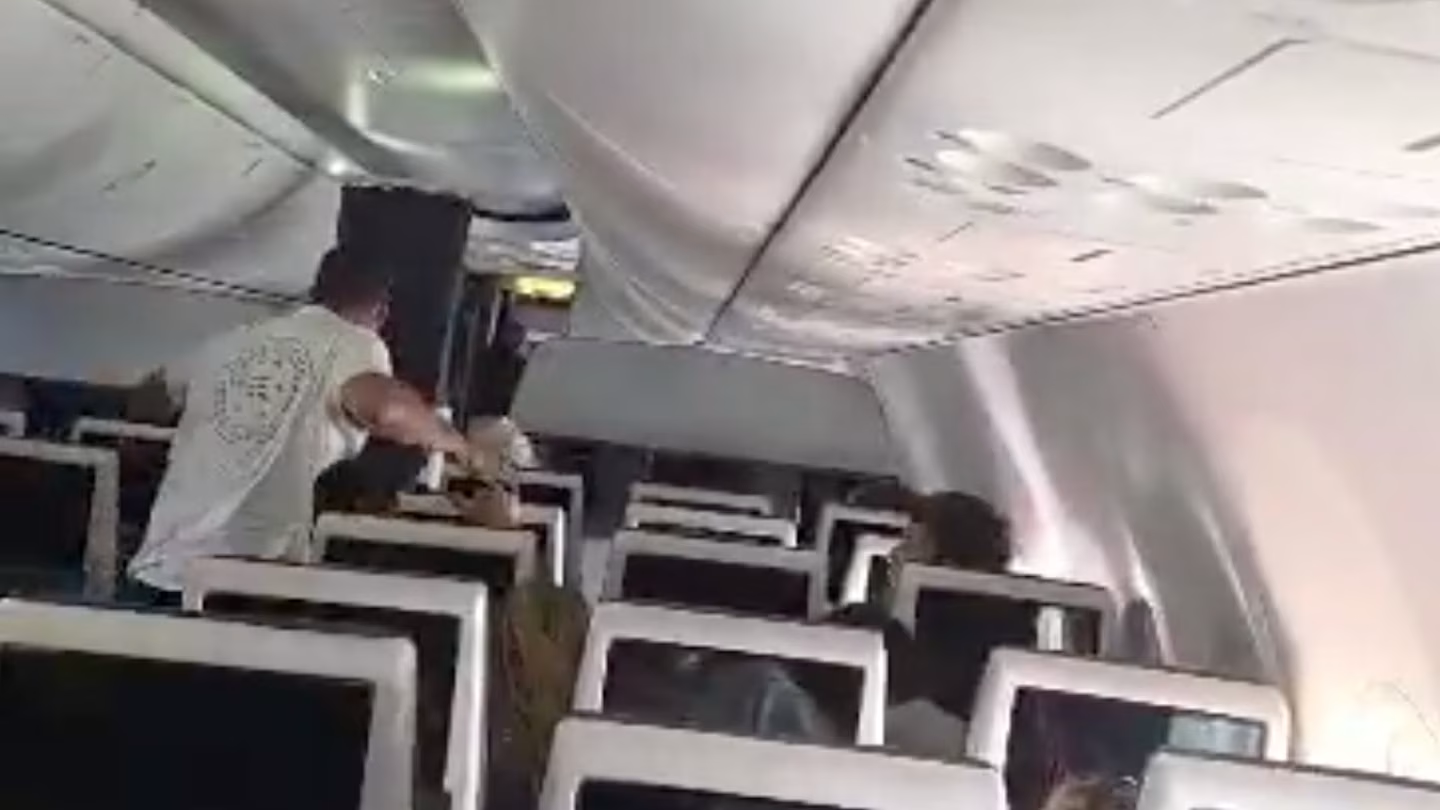
The smooth transition out of the dive in the official story was achieved by a plumber who knew what to do from watching Air Crash Investigation. I don’t think I need to comment on that.
We will never find out the truth about FlyDubai. The plane diverted to Saudi Arabia. The copilot who is being painted as an Islamic extremist will be isolated there and tortured by the Saudis. Netanyahu has already said Israel will join the interrogation. Do not believe any confession or evidence from the co-pilot.
The plane was a Boeing, so the USA will join the initial investigation alongside UAE, Saudi Arabia and Israel. A more potent coalition of Zionist evil does not exist. We will certainly have faked flight data recorder and cockpit voice recorder evidence coming from that shower.
I do feel something has snapped in people’s willingness to believe official narratives. The Skripal narrative was even more crazy than any of these, but most people still trusted government. Thankfully that faith has been seriously shaken.
Reporting of the RAF Fairford arrests blows the idea of a ‘free press’ out of the water
When the establishment media jettisons even the semblance of critical distance from the state
By Jonathan Cook | September 30, 2026
It’s easy to forget that the western media – the so-called “free press” – likes to distinguish itself from media in authoritarian regimes on the basis that, unlike them, it asks critical questions of the powerful, reports facts objectively, and formulates its analyses dispassionately.
They do propaganda, we do news – or so the western media argues.
The feverish coverage since five men were arrested in the early hours of Sunday morning close to RAF Fairford in the UK is blowing a very big hole in that claim.
Here are the known facts so far.
Three white vans, bearing the logo of a genuine fuel transit company, were spotted by a local farmer on the road outside her property as she returned from a party. Police arrived promptly and arrested the men, who were all British nationals in their twenties.
On Tuesday, it emerged that one of the arrested men actually called the police earlier – seemingly the reason officers were on the scene so quickly.
Although the men were initially arrested on explosives charges, no “viable” explosives were found. Although they were arrested on terrorism charges, which allow for 14 days of detention, they were released on bail under normal criminal laws in less than two days.
It has also emerged that the men had several empty “barrels” in their vans, plus one that contained what police described disturbingly as an “accelerant”.
Actually, that was simply a reference to petrol. The stuff that goes into vehicles to make them accelerate.
British prime minister Andy Burnham held a rare national emergency Cobra meeting over the incident.
Meanwhile, the Trump administration got involved because RAF Fairford, despite its name, is in reality a US air base from which American planes are waging an illegal war of aggression against Iran, with the UK’s blessing.
US Secretary of state Marco Rubio has said the incident “clearly involves the hands of a foreign actor”. When asked whether Iran was that actor, Trump replied: “It might be.” He added: “I know the answer… I can be very specific, but I’d rather not say.”
According to a report in the New York Times, “American and British intelligence services worked with Israel and Western countries to discover the threats against US bases, including ones in Germany.” [my emphasis]
Despite these sparse facts, the British media have uniformly rushed to a single conclusion: that this was almost certainly part of an Iranian terror plot to target the US airbase and its planes. The only room for debate allowed is whether the five men were witting or unwitting actors in that plot.
As the Guardian reported in its Wednesday edition, referring to this as a “complex investigation”: “An Iranian link to the bizarre events in the Gloucestershire countryside over the weekend is seen as increasingly likely.”
As context, let us note the following: that British and US officials have every interest in trying to hype this incident as an Iranian “terror plot”, whatever the actual evidence suggests.
Why? Because the US is waging an illegal war on Iran, and the UK is allowing it to do so from British soil. Under the rules of war, Iran has every right to attack RAF Fairford.
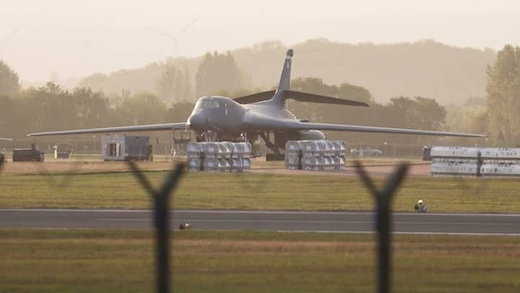
If the British state and billionaire-owned media were actually serving as a truly “free press”, they would be offering the context that RAF Fairford is a legitimate military target and that any attack on it by Iran would not constitute terrorism.
Of course, none have done so.
Instead, they have loyally regurgitated the British and US security services spin of a “terror plot” – based on no tangible evidence at all – that paints Britain and the US as the victims of a sinister and unwarranted act of Iranian aggression.
But context aside, an objective, sceptical media – a “free press” – would be reserving judgment on what had happened. It would be asking difficult questions. It would be offering plausible counter-narratives.
Again, none of this is happening. In the British media, there has been a lemming-like rush towards accepting uncritically the very conclusions that best serve British and US state interests.
The constant highlighting of a terrorism connection to the arrested men – for which there is no apparent evidence – is precisely the kind of coverage you would expect from state media in an authoritarian regime. This is about whipping up a public mood of fear, not about transparent fact-finding.
Notably, unlike the British media, the New York Times report does allow for another possibility, even if it instantly ignores it and then joins the British media in treating what evidence there is as proof of an Iranian terror plot.
The Times opens with a question: “The potential ambiguities – were the men Iranian operatives, petty gas thieves, or both? – added to the confusion surrounding the arrests that the authorities have yet to fully explain.”
“Petty gas thieves”! Men in vans with empty barrels close to a farm in the middle of the night. Is it possible they could simply be criminals?!
In fact, this conjecture has been all over social media since the first reports of the men being arrested surfaced. As new details have emerged, those suspicions have only grown.
And yet Britain’s “free press” has uniformly ignored this counter-theory in favour of the US and British security services’ narrative.
Doubtless, British journalists covering this incident would call the idea that this was simply a criminal group caught in the act unhelpful “speculation”.
But how is their no-more-plausible, and possibly less plausible, theory that this was an Iranian terror plot not equally speculation – if in their case, speculation that happens to be extremely helpful to the British and US security establishments?
There are other theories we could posit too, given the known facts. Israel, which originally pushed for the illegal and disastrous war on Iran, has been looking for a way to persuade the Trump administration to return to a full-scale bombing campaign.
Flydubai scenario: Netanyahu’s plot to drag US to war with Iran, stay in power

Press TV – October 1, 2026
The Flydubai plane incident appears to have been part of a scenario concocted by Israeli prime minister Benjamin Netanyahu and UAE President Sheikh Mohamed bin Zayed Al Nahyan.
Its aim, observer say, is to divert attention from the growing scandal over Netanyahu’s handling of the October 7 Hamas operation, shore up his position ahead of Israel’s October 27 election and create a pretext for a new confrontation with Iran.
The scenario unfolded days after Netanyahu’s reported secret visit to Abu Dhabi, where he met bin Zayed amid mounting political pressure over allegations that the UAE leader had warned him in advance of an impending Hamas operation.
According to the account, the purpose of the arrangement was to manufacture a dramatic security incident involving an Israeli-heavy Flydubai flight, portray it as a terrorist attack, introduce an Iranian connection into the narrative and use the resulting alarm to reinforce Netanyahu’s security credentials and build support for renewed military action against Tehran.
The Flydubai Boeing 737, carrying 174 passengers, most of them Israeli settlers, made an emergency landing in Saudi Arabia on Wednesday following what was described as a violent confrontation between the pilot and co-pilot in the cockpit.
Netanyahu and his war minister, Israel Katz, immediately characterized the incident as a “terrorist” attack. Netanyahu subsequently compared it to the September 11 attacks, claimed the Omani co-pilot had undergone “radical indoctrination” and suggested that Iran could have been involved.
Yet no public evidence has established an ideologically-motivated attack or an Iranian connection.
Indeed, early Israeli media reports offered entirely different explanations, including a personal dispute or an attempted suicide by the co-pilot. Israel’s Channel 12 reported on Thursday that the Saudi investigation had found no indication of terrorism at that stage.
The timing, however, gave the episode a clear political value for Netanyahu.
Israeli media have reported that Netanyahu is under pressure ahead of the October 27 election, while the controversy surrounding the October 7 Hamas operation continues to raise questions about his regime’s warnings and preparedness.
Haaretz reported on September 9 that bin Zayed had spoken to Netanyahu roughly 10 days before the October 7 operation and warned him of a threat from then-Hamas leader Yahya Sinwar, who was reportedly preparing a “huge surprise.”
Bin Zayed had also previously alerted Israel’s Shin Bet intelligence agency, according to the report.
Netanyahu’s reported secret visit to Abu Dhabi therefore assumed particular significance. Israeli media reports said the purpose of the visit was to ask bin Zayed to deny reports that he had warned Netanyahu about the looming Hamas threat.
Against this backdrop, the alleged Flydubai scenario provided Netanyahu with an opportunity to shift the political narrative from questions over the October 7 failures to a new story about “terrorism”, Iranian threats and the need for renewed confrontation.
Netanyahu repeatedly raised the possibility of an Iranian connection despite acknowledging that Israel had received no specific intelligence warning about the flight and that investigators had found no evidence linking Tehran to the incident.
He told CNN that he had spoken with US President Donald Trump about the incident and its wider implications for global aviation. Trump separately confirmed that the two had discussed the matter at length.
The objective, according to the account, was not simply to generate domestic political headlines. By bringing Iran into the story, Netanyahu could potentially create a new security crisis capable of drawing Washington into another confrontation with Tehran.
Analysts have nevertheless warned against making such a connection.
Dani Citrinowicz, an Iran affairs researcher at Israel’s so-called Institute for Security Studies, warned against linking the incident to Iran.
According to Maariv, he said there was a difference between preparing for possible scenarios and creating the impression that another war was imminent.
He warned that if Tehran concluded Israel was preparing an attack, it could take pre-emptive action, which Israel might then interpret as confirmation of its original assessment, producing a cycle of escalation.
Citrinowicz described the situation as “playing with fire” and warned that statements by Israeli officials could become a “self-fulfilling prophecy.”
Other analysts have reportedly described the attempt to connect the incident to Iran as sounding like “a Hollywood screenplay.”
Flydubai itself has urged against premature speculation until the investigation is completed and suspended flights between Dubai and Tel Aviv while the investigation continued.
The Netanyahu-bin Zayed arrangement therefore presents the incident not as an isolated aviation crisis, but as a politically constructed scenario with three interconnected objectives: diverting attention from the October 7 scandal, strengthening Netanyahu’s position ahead of the election and creating a new pretext for confrontation with Iran.
Netanyahu has said Israel will determine within days whether the co-pilot had links to Iran, adding, “We will get to the bottom of it.”
The central question surrounding the episode, therefore, is not what happened inside the cockpit, but the deliberate construction of a security narrative around the flight designed in advance to transform an unexplained aviation incident into a potential pretext for a new war with Iran.
Can the U.S. Afford to Annihilate Iran? /Seyed M. Marandi
Daniel Davis / Deep Dive – October 1, 2026
British state targets Palestine Action with yet another crooked trial
The Grayzone | October 1, 2026
Once again, the British state is exploiting anti-democratic terrorism measures to secure convictions of Palestine Action defendants who targeted an Israeli weapons plant. UK media is currently forbidden from reporting on the trial.
From October 5th, an eight-week-long trial of nine Palestine Action activists known as the Instro 10 will begin at London’s Old Bailey. The defendants are accused of criminal damage, burglary – trespass including criminal damage – and violent disorder.
In keeping with several recent cases brought against the activist collective, which the British state proscribed as a terrorist entity in July 2025, the jury and public are not allowed to know – and the British media is prohibited from reporting – that if activists are convicted of any offenses, they could be sentenced as terrorists.
Palestine Action is a direct action protest group which successfully forced four weapons plants run by the Israeli state-owned company Elbit Systems to close. In several cases, juries acquitted activists after they argued that the property damage they caused saved countless lives in the besieged Gaza Strip, where Israel stands accused of committing genocide. Having suffered millions in damage as it was repeatedly forced to cease production, Elbit and the British state began conspiring to crack down on the activists. This resulted in the effort to stack the legal deck against Palestine Action defendants.
This June, four activists received prison terms ranging from nearly five to over eight years due to the subsequently applied “terrorist connection” label. The judge prohibited the defendants from discussing their motives or arguing that their actions were intended to prevent far graver crimes being perpetrated by Elbit’s weapons.
By denying defendants particular legal defenses, British authorities are attempting to rubber-stamp convictions, and ramming through sentences that are far harsher than for criminal offenses. Had the Instro 10 been publicly charged with “terrorist” offenses, they would have had an opportunity to effectively argue their case properly in open court. But under the new, nakedly undemocratic rules, they are muzzled by judicial decree.
The Instro 10’s names are Nasser Akhtar, Elliot Wilson, Maximillian Dixon, Nirad Abrol, Seirol Davies, Xavi Davies, Eoin O’Meara, Hannah Davidson, Yulia Brigadirova.
On June 17 2024, Palestine Action descended on the British headquarters of weapons factory Instro Precision, a subsidiary of Israeli arms manufacturer Elbit Systems. Instro’s CEO is Dagan Yogev, an Israeli military veteran who was a major during Tel Aviv’s 2006 assault on Lebanon. After leaving the IDF, he worked in senior positions within Elbit’s Israeli headquarters. Instro produces targeting equipment which has been used in genocidal assaults on Gaza and Southern Lebanon.
Seven Palestine Action members broke into the factory, inflicting reportedly in excess of £1 million ($1.32 million) in damage. Two days later, an Instro Precision state export license to Israel was cancelled, perhaps due to the firm’s inability to fulfill the order in the wake of Palestine Action’s visit.
The seven activists responsible were arrested on-site, and released on bail within 24 hours. Counter-terror police were not involved at any stage. By this point too, not a single Palestine Action activist had been accused of terrorism, or charged under the Terrorism Act.
Unbeknownst to Palestine Action, a secret meeting occurred within 10 days of Instro Precision being struck, at which the Crown Prosecution Service discussed “the resource implications” of PA’s proscription as a terrorist organization with senior British counter-terror officers. In other words, prosecutors and police were weighing the potential financial windfall they would reap by designating Palestine Action as a terrorist group.
The Grayzone has reviewed heavily redacted records of the meeting. They contain powerpoint charts replete with a “threat matrix” indicating how citizen political activity is categorized by authorities as “high level aggravated activism,” or “terrorism.” The former activity is defined as activism involving “unlawful behaviour that has… a significant negative impact on UK businesses.”
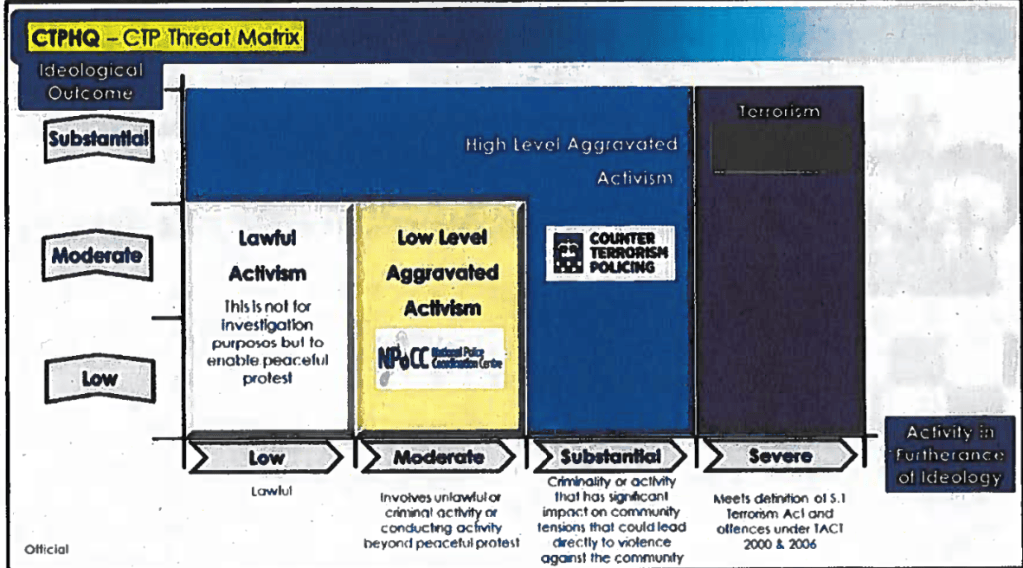
In March 2025, around the time Britain’s Proscription Review Group met to determine whether Palestine Action should be proscribed as a terrorist group, British authorities brought charges against activists who targeted the Instro factory. Initially, they were accused of the same crimes as the Filton Six: aggravated burglary, criminal damage and violent disorder, with a “terrorist connection” covertly applied on the basis of serious property damage. But in July, when then-Home Secretary Yvette Cooper announced PA’s proscription, she cited the Instro case as an example of “violence” perpetrated by the group.
Despite the highly politicized terror designation, a British court was forced to drop charges of aggravated burglary against the Instro 10, indicating that neither police nor prosecutors possessed any evidence Palestine Action intended to harm any person. Indeed, during its five years of operation, PA has conducted hundreds of direct actions without injuring a single person.
This August, as Palestine Action appealed its proscription in the UK, the administration of US President Donald Trump designated the group as a global “terrorist” threat. This appears to have been, at least in part, an effort to bolster the dubious case against the philanthropist and Palestine Action supporter Fergie Chambers, who faces extradition to the US from Spain for supporting “foreign terrorist organizations.”
From Washington to London, governments are stripping away their patina of liberal democracy to protect their relationship with Tel Aviv. Counter-terror legislation is now the weapon of choice in their war on citizens who seek to obstruct Israel’s genocide machine.
Americans are paying the price to preserve Israel’s nuclear hegemony
By Jamal Kanj | MEMO | October 1, 2026
Since the start of the latest made-for-Israel war, Donald Trump and his surrogates have repeatedly promised Americans that it would be a few weeks and oil prices would soon crash below prewar levels. Instead, it was every promise that crashed. When those promises failed to materialize, the message shifted: the war is worth the price to stop Iran from becoming a nuclear power.
But what if Iran did become a nuclear power? How would that pose a greater threat to the U.S. than North Korea or Russia already do? Or is the real concern not a risk to America, but a challenge to the regional hegemony of a foreign nuclear power, Israel?
For more than thirty years, according to Israel’s fiction, Iran was on the verge of becoming a nuclear-armed state. That fictitious deadline has come and gone repeatedly, yet Benjamin Netanyahu has been recycling the same lie since 1992. The Israeli lies and deceit persisted even though, unlike Israel, Iran’s nuclear program was subject to strict international monitoring.
Still, Trump, at Netanyahu’s urging, walked away from an agreement that imposed some of the most stringent and verifiable restrictions ever placed on a country’s nuclear program. Now Americans are being asked to pay in blood and billions of dollars for abandoning a diplomatic agreement that had kept Iran’s nuclear program under unprecedented international scrutiny and helped contain the very threat now being used to justify the war.
The hypocrisy is impossible to overlook. Iran has been subjected to relentless demands for transparency and inspections, while Israel’s own nuclear arsenal, built in part with materials stolen from the U.S., remains shielded from any international inspection.
Yet somehow Iran’s ambitious know-how is the existential nuclear threat, not Israel’s nuclear bombs.
American consumers have long been the victims of a disinformation campaign, and now they are being forced to pay the price for a war sold to them on false pretenses. The most recent misinformation claiming the Strait of Hormuz is open and oil is flowing. The president said it on Fox, and the outgoing White House press secretary told Fox & Friends that the U.S. is essentially controlling the strait and that it remains open. These claims leave only two possibilities: either the statements are outright lies, or oil companies are gouging the consumer.
The UK Maritime Trade Operations Centre reported that commercial traffic through the strait remains about 75 percent below pre-conflict levels. It also tallied dozens of projectile strikes on vessels in just the past two months.
Three quarters less traffic is not a sign of an open strait. Shipowners and insurers know this, so do traders and so the climbing numbers at the gas pump.
The market has already made its judgment, and every American who fills a tank can see it. It is past time for Washington to stop lying.
For the average consumer, the pump is where it felt. Regular gasoline was below $3 a gallon before the U.S. was dragged into another one of made-for-Israeli wars. Families are paying more to get to work, truckers are paying more to move goods, and those costs show up in the price of groceries.
Meanwhile, American oil companies are pumping at record levels. Exxon and Chevron are producing record volumes from oil fields on American soil, thousands of miles from the Strait of Hormuz. Their production costs have not changed. What has changed is Israel’s war surcharge consumers are being forced to pay.
Chevron reported the largest quarterly net profit in its history, $12.1 billion. Exxon made $14.5 billion in the same quarter, about $160 million a day. Refining has become more lucrative. Gross refining margins more than doubled, soaring from a typical $20 crack spread to as much as $60.
Meanwhile, Trump dangles a pie-in-the-sky deal with Venezuela as a distraction from consumers’ mounting anxiety, while his administration stands by as oil companies exploit overseas crises for record profits. These companies have no reason to lower prices when war has handed them a windfall. This is what a war of choice looks like on the ground: American consumers are forced to pay the price, while oil executives in Texas turn a crisis into a lucrative business opportunity.
American consumers deserve more than false promises. If the Strait is open, then oil prices should be coming down. If it is not, then stop treating consumers as an audience whose emotions must be managed rather than citizens entitled to hear the truth. Since the war started, every week, like millions of Americans, I fill my gas tank, and the Israeli war tax is higher than it was the week before.
No, Mr. President, that is not “worth the price” to pay for a war fabricated in Israel, a repeat of the made-for-Israel war in Iraq 23 years ago.
This is not a war to end Iran’s fictitious nuclear power. It is a war paid for by taxpayers’ money and American blood to ensure that Israel remains the only absolute nuclear power in the Middle East.
Resistance factions are necessary to ensure a permanent US Iraq withdrawal
By Robert Inlakesh | Al Mayadeen | October 1, 2026
US President Donald Trump has officially announced a formal withdrawal of American troops from Iraqi territory, yet the economic, social and diplomatic hold on the nation remains. If US troops are going to be permanently booted out, it necessitates an Iraqi national resistance that is capable of operating as a guarantor.
On October 21, 2011, former US President Barack Obama announced that the United States had withdrawn its remaining occupying forces from Iraqi territory. Then, only two and a half years later, the US re-deployed its forces back into the country under the guise of fighting the Daesh insurgency.
Iraq, having experienced a regime change operation followed by a brutal occupation and nationbuilding project, was left incapable of defending itself from the ISIS takeover, let alone pushing back against the United States redeploying its forces. First, the Obama administration deployed forces that it said were there to protect its diplomatic staff, in addition to advisors to the Iraqi armed forces.
Later it would expand this presence, expanding its “Operation Inherent Resolve” into Syrian territory, providing it with supply routes and a platform from which to de facto occupy northeastern Syria. The US operation in Syria and Iraq helped them eventually achieve their longtime goal of regime change in Damascus by depriving the Syrians of their access to the nation’s oil resources and fertile agricultural lands.
In 2020, Donald Trump had agreed to remove his forces from Iraqi territory, re-iterating this pledge during a meeting with then Iraqi PM Mustafa al-Kadhimi. The following year, former President Joe Biden then declared the official end of his nation’s combat mission inside the country. Only now, in 2026, and after extensive attacks on US military facilities by the Islamic Resistance in Iraq, has the pledge to withdraw American forces been followed through on.
When the US and Saudi Arabia recently blamed Iraqi forces for carrying out an attack on Riyadh’s East-West Pipeline, launching a large-scale bombing campaign across the country, some Iraqi officials instead issued statements against Iraq’s armed factions that had vehemently denied involvement in the incident.
The Trump administration is openly pushing for the disarmament of all military factions within the country, a project Washington has also sought to impose on all Resistance groups across the region. The United States has not allowed for there to be a reasonable integration of Resistance forces like Hezbollah in Lebanon with the Lebanese Armed Forces, nor allowed time for formal agreements to be struck in Iraq of a similar nature. Their goal is simply to disband these groups and then exert control over the armed forces of Lebanon and Iraq, leaving them all but defenseless and without access to strategic weapons capable of deterring violations of national sovereignty.
In the case of Baghdad, the nation’s government was a construct of US occupation; Washington still holds the economic cards that are capable of pressuring any leadership, no matter how well-intended its goals are, while it maintains an enormous soft-power pull through its extensive NGOisation project inside the country. Iraq was not allowed to rebuild its nation’s military following the toppling of Saddam Hussein’s rule in 2003, leaving it defenseless against ISIS terrorism a decade later.
On the ground, this is why there was a need for the Hashd al-Shaabi (Popular Mobilisation Forces) to emerge. It was the Hashd that was chiefly responsible for defeating the terrorist invasion and purging its militants from Iraqi cities. Many of these groups that fought under the banner of the Hashd then went on to develop considerable military power and an extensive arsenal.
As revealed during the Ramadan War earlier this year, the Israeli Mossad was able to develop bases inside Iraqi territory, while numerous militant groups still exist across the country’s territory, including various armed factions that are backed by the CIA and the Mossad.
If the Islamic Resistance in Iraq is disbanded and disarmed, then Iraq will be in the exact same defenseless position that allowed for ISIS to sweep through the nation so rapidly and seize so much territory, leaving behind a trail of blood in their wake. This poses a threat to not only Iraq, but other neighbouring countries, including Iran. It threatens Syria’s fragile status quo too.
An Iraq without the Islamic Resistance would be like a Lebanon without Hezbollah, completely left at the mercy of the United States and their Israeli allies. Washington and Tel Aviv have a project that aims to totally dismantle regional sovereignty; this is why they have dedicated trillions of dollars and countless resources to destroying the armed forces of both Iraq and Syria over a period of nearly 30 years now. They are not about to simply sit by and allow Iraq and Syria to rebuild capable militaries, allowing them to follow the will of their people and to defend their own national interests.
The United States still maintains its air defence systems inside Iraqi territory, can use the country’s airspace at will and, as we saw only months ago, will launch airstrikes across the nation at the drop of a hat.
In order to deter a return of American occupation forces, under the guise of fighting whatever future threat they choose to use, there must be an Iraqi military force that is capable of acting in defense of the country, both on the ground and through the use of its long-range munitions if need be. A nation without a real military force cannot enjoy sovereignty. And a nation that is not able to go against the will of the United States, will serve as its proxy and will suffer the blowback that is inherent in complicity.
The US withdrawal from Iraq did not happen without a long history of resistance against its forces and public opinion that also opposes American interference. Protecting the achievement of ridding the country of the majority of US forces takes real military deterrence. Otherwise, the Israelis and the US will simply use the country’s territory for whatever projects they wish.
How Israel destabilizes the Middle East: Denying sovereignty and the right to exist
By Buğra Sarı | MEMO | October 1, 2026
Israel’s pursuit of security increasingly rests on a destabilizing proposition: that its neighbours become less threatening when their capacity to exercise sovereignty is diminished. Since the Hamas-led attacks of October 7, 2023, this approach has become particularly visible across several distinct arenas. Military operations, territorial incursions and restrictions on political and economic autonomy suggest a conception of security dependent on keeping others vulnerable. The consequences extend beyond individual confrontations. When states cannot control their territory, rebuild institutions or protect their populations, the regional conditions necessary for durable security begin to erode.
The argument is not that Israel created every conflict in the Middle East. Authoritarian rule, sectarian violence, armed groups and competing regional interventions have all contributed to the region’s instability.
The question is whether the means Israel uses to pursue its own security deepen that instability. Repeatedly weakening neighbouring states and political communities may bring short-term military gains, but it can also erode their ability to contain violence and maintain order, making the region more dangerous—including for Israel itself.
This pattern can be understood as the denial of sovereignty. Sovereignty involves more than diplomatic recognition: it requires institutions capable of governing, providing services and exercising legitimate authority over the use of force. When these capacities are persistently degraded, formal independence becomes increasingly hollow.
The cases differ in their circumstances and severity, but together they reveal a troubling hierarchy: Israeli freedom of military action repeatedly takes precedence over other societies’ ability to govern and secure themselves.
Syria offers a particularly revealing example. Following the collapse of Bashar al-Assad’s regime in December 2024, Israel launched extensive attacks against Syrian military infrastructure and moved into the separation zone established under the 1974 disengagement agreement. Israel justified the destruction of military assets as necessary to prevent advanced weapons from falling into extremist hands. Yet the targets included airfields, air-defence systems and naval facilities—capabilities relevant to the functioning of a state, whatever government eventually controls them.
The longer-term problem is that preventing a hypothetical future threat can obstruct the reconstruction of an already devastated country. Syria needs accountable security institutions capable of controlling territory, containing armed factions and protecting communities. Destroying military capabilities without a credible framework for rebuilding legitimate state authority risks leaving those functions unfulfilled. In July 2025, Israeli strikes on Damascus, including the defence ministry, further demonstrated Israel’s willingness to impose military limits on the new authorities.
Syria’s transitional authorities must themselves answer for abuses and protect minorities; state consolidation cannot justify repression. Nevertheless, externally imposed military vulnerability is no substitute for accountable governance.
A government expected to prevent threats from emerging within its territory must have the capacity to exercise authority there. Undermining that capacity can preserve the fragmentation through which armed groups survive.
Lebanon exposes a related contradiction. Hezbollah’s independent military power has long constrained the Lebanese state’s authority and its ability to determine questions of war and peace. Reducing that parallel authority could, under appropriate political arrangements, strengthen state sovereignty. But Israeli military action does not automatically transfer power from Hezbollah to the Lebanese government. Bombardment, displacement and violations of Lebanese territory can weaken the institutions expected to assume responsibility for national security.
The distinction is crucial: weakening an armed organization and strengthening a state are separate outcomes. In March 2026, UN Secretary-General António Guterres called both for respect for Lebanon’s sovereignty and for stronger support to its armed forces so that they could become the country’s sole military force. That combination identifies what repeated unilateral intervention overlooks: security requires an institutional successor capable of governing after military operations end.
Where that capacity remains inadequate, another cycle becomes possible. Armed groups invoke external attacks to justify retaining their weapons; the state struggles to establish authority; Israel cites the continuing armed presence to justify further intervention. Hezbollah bears responsibility for its own decisions, but Israeli policies can reinforce the conditions sustaining its claim that the Lebanese state cannot protect the population.
The attack on Doha on September 9, 2025 extended this logic into the diplomatic sphere. Qatar was mediating negotiations involving Israel and Hamas when Israel struck Hamas representatives on its territory. The UN High Commissioner for Human Rights condemned the attack as a breach of international law and an assault on mediation. The significance exceeded the violation of Qatari sovereignty: even a state facilitating negotiations could find its territory treated as an extension of the battlefield.
Mediation depends on practical assurances that communication with an adversary will remain possible. Targeting interlocutors in a mediating country makes those assurances harder to provide. It raises the costs of hosting negotiations and can undermine channels needed for ceasefires, hostage releases and humanitarian arrangements. Military reach may expand while opportunities for a political settlement contract.
Israel’s recognition of Somaliland in December 2025 raises a different sovereignty question along the region’s Red Sea periphery. Somaliland has maintained separate institutions for decades, and its claim to recognition has its own history. Nevertheless, Israel’s recognition challenged Somalia’s internationally recognized territorial framework. The African Union rejected the move and warned that such recognition could undermine peace and stability.
Recognition is not equivalent to bombardment, and the cases should not be collapsed into a single legal category. Their connection is political: the territorial arrangements on which other governments rely become subject to unilateral decisions shaped by Israeli interests. In an already contested regional environment, such decisions risk adding another dispute to fragile processes of state consolidation.
The confrontation with Iran illustrates the danger of extending preventive military logic to a powerful regional adversary. On February 28, 2026, Guterres condemned the use of force by the United States and Israel against Iran and Iran’s subsequent retaliation across the region. He warned that these actions undermined international peace and security. The escalation demonstrated how efforts to eliminate threats militarily can expose additional countries to attack.
Iran’s support for armed groups and its own military conduct cannot be excluded from this assessment. Nevertheless, degrading an adversary’s capabilities does not necessarily resolve the political incentives driving confrontation. It may instead encourage dispersal, rearmament or greater reliance on asymmetric methods. Tactical destruction can coexist with a more dangerous strategic environment.
The Palestinian case represents the most profound expression of this problem because it concerns both collective self-government and the conditions of human survival. In the West Bank, withholding revenues owed to the Palestinian Authority weakens the institutions expected to administer daily life.
The World Bank documented how the suspension of transfers in 2025 intensified fiscal distress, reduced salary payments and placed pressure on essential services. These measures undermine the practical foundations of Palestinian self-government.
A political authority cannot provide credible governance indefinitely while lacking reliable access to its own revenues. Weakening public administration also weakens its legitimacy, potentially benefiting actors who argue that institutional politics offers no meaningful route to Palestinian rights. The resulting dysfunction can then be invoked as evidence that Palestinians are incapable of governing themselves. Restrictions on capacity thus risk producing the very incapacity used to justify continued control.
In Gaza, the destruction has reached beyond institutional viability. The devastation of housing, healthcare, water systems and livelihoods, compounded by restrictions on humanitarian access, has endangered the material conditions necessary for life. In August 2025, a joint statement by UN agencies confirmed famine in Gaza Governorate and described a crisis involving starvation and preventable deaths. The issue was no longer merely whether Palestinians could build a state, but whether civilians could survive.
Hence, in Gaza, the denial of sovereignty has escalated into a denial of survival. In September 2025, the UN Independent International Commission of Inquiry concluded that Israel had committed genocide against Palestinians in Gaza. Earlier, on November 21, 2024, the International Criminal Court issued an arrest warrant for Benjamin Netanyahu, finding reasonable grounds to believe that he bore criminal responsibility for the war crime of starvation as a method of warfare and the crimes against humanity of murder, persecution and other inhumane acts. These findings expose the devastating human consequences of denying a population access to the essentials of life. The systematic destruction of civilian infrastructure and deprivation of food, water and medical care undermine Palestinians’ ability to survive as a community in their homeland. Viewed through this analysis, the genocide identified by the UN commission represents the most extreme manifestation of denial: a progression from obstructing a people’s capacity to govern themselves to destroying the conditions necessary for their continued existence.
Taken together, these cases suggest a self-reinforcing cycle. Military intervention and institutional weakening can generate insecurity, displacement and political fragmentation. Those conditions create opportunities for armed actors, whose activities then provide further grounds for intervention. This is a causal risk, not an inevitable outcome of every operation. Its importance lies in the contradiction between immediate military advantage and the requirements of lasting security.
Breaking that cycle requires a different measure of success: whether policies leave behind institutions capable of governing, populations able to live securely and diplomatic arrangements that reduce incentives for violence. Protecting Israeli civilians and respecting neighbouring societies’ sovereignty are mutually reinforcing necessities.
A regional order built around one state’s freedom to intervene and everyone else’s enforced vulnerability cannot offer durable peace. By denying others the capacity to govern—and, in Gaza, devastating the conditions necessary to survive—Israel risks perpetuating the insecurity from which it seeks protection.
No Vote, No Representation, No State: Democracy, Israeli Style
Palestine This Week | Middle East Monitor | September 30, 2026
This week’s MEMO review examines claims about Netanyahu’s advance knowledge of 7 October, his provocative UN speech and Israel’s sweeping West Bank closure. We discuss calls to free Marwan Barghouti, moves to bar Arab-led parties from Israeli elections, Trump’s rejection of Iran’s proposal and allegations of election interference involving Israeli firms.
Chapters:
00:00 Introduction & Overview
01:41 Claims of Netanyahu’s Advance Knowledge of 7 October
18:14 Netanyahu’s UN Speech: Props, Provocations and Defiance
22:58 Israel’s West Bank Closure and Its Impact on Palestinians
26:30 Growing Calls to Free Marwan Barghouti
29:40 Israel’s Political Opposition and the Two-State Solution
35:00 Arab Party Disqualifications: Democracy and Apartheid
38:07 Trump Rejects Iran’s Proposal: What Was on Offer?
41:42 Meta’s Restrictions on Lula and Allegations of Israeli Election Interference
Subscribe to our YouTube channel: https://tinyurl.com/447fpn8k
Visit our website: https://www.middleeastmonitor.com/
Zionist Bought Senate Blocks Information About American Citizens Killed By Israel

By Justin K.P. | The Dissident | September 30, 2026
The U.S. Senate just voted 47-51 against a bill introduced by the Senators Chris Van Hollen, Tim Kaine and Bernie Sanders which would have “forced Secretary of State Marco Rubio to submit to Congress, within 30 days, a report on what information is available about the killings of the nine US citizens, the status of US and Israeli investigations into the killings, the number of US citizens currently held in Israeli prisons, the treatment of Palestinian children in Israeli prisons, and a description of the steps the US government has taken to reduce violence in the West Bank.”
In other words, the Zionist occupied Senate voted against releasing information about Israel killing American citizens in order to protect Israel.
The bill would have forced Marco Rubio to release the information about nine US citizens who have been killed by settlers and Israeli security forces, including the late Palestinian-American journalist Shireen Abu Akleh, who was killed by Israeli occupation forces while reporting in the West Bank in 2022, an intentional murder that was covered up by the Biden administration.
The Biden administration covered up for Israel, claiming that her murder was the “result of tragic circumstances during an IDF-led military operation against factions of Palestinian Islamic Jihad”.
But later, the whistleblower Colonel Steve Gabavics, who worked at the time for the Office of the U.S. Security Coordinator in Jerusalem and led the investigation into Shireen Abu Akleh, revealed that his team found she was intentionally targeted, but the U.S. covered it up to protect Israel.
In an interview with Democracy Now!, he noted, “We were able to disprove very quickly the assertion that there was a Palestinian gunman in front of Shireen Abu Akleh, that the IDF had shot at, and they had accidentally shot her instead… the indications of everything we read from the reports that we got from the IDF on their locations, and proximity to where the event happened, what we got from the investigation from the Palestinian Authority, and our investigation, to us it was very clear that the (IDF) individual in the vehicle who took the shot, would have had a clear line of sight and would have had visibility of Shireen Abu Akleh walking down the middle of the street for a period of time before he took the shots”.
But he revealed that the Biden administration covered up this information, saying, “After we had completed this we were on regular video calls, classified and unclassified with the state department … I indicated that the evidence to me indicated that there would have been enough if we actually built a criminal case to have enough information and facts to beyond a reasonable doubt, for a conviction at some level. We were pushing for the fact that they needed to formally admit the fact that it was not an accident, that a (Israeli) soldier killed Shireen Abu Akleh, that it was an intentional shooting, and unfortunately, that was not what came out … When the actual statement came out, that was absolutely not what I expected… I was shocked … all the data indicates the exact opposite, it was not fog of war… This was not what we had found”.
He added, “It all came down to not trying to anger the Israelis by holding them accountable for intentionally killing an American citizen”.
Yet again, AIPAC-bought members of the Senate want to continue the cover-up of the Israeli murder of American citizens in order not to anger Israel and its lobby.
While Gaza dominates the UN, these are the people keeping it alive
By Ramzy Baroud | MEMO | September 30, 2026
When I first saw footage of Gaza doctor Munir al-Bursh and his family kneeling beside the white-shrouded body of his son, surrounded by mourners, I thought it was an old video. It was not.
My conclusion, however, was understandable. In December 2023, only months after the start of the Israeli genocide in Gaza, the al-Bursh family was targeted in an Israeli attack. Dr. Munir, director-general of Gaza’s Ministry of Health, was wounded. So were other members of his family. His daughter, Jinan, only 13, was killed.
That same day, Gaza’s beloved doctor was back at work, joining the many doctors across the Strip trying to save lives as Israel’s killing machine claimed them by the thousands.
Alas, the latest footage was not old footage resurfacing. It was a new coffin, a new funeral, another child buried by the same family. This time, the attack took place during what some in the media continue to call the ‘Gaza ceasefire.’
On September 19, an Israeli drone strike killed al-Bursh’s eldest son, Basir, outside a tent west of Jabaliya refugee camp.
“We were together side by side,” the grieving father recalled. Basir had warned him: “The Israelis are targeting both of us.” Moments later, his son stepped outside the tent and was killed.
One can be forgiven for confusing Gaza’s present with its recent past. The scenes emerging today are almost indistinguishable from those that preceded the so-called ceasefire of October 2025. The sequence repeats itself with terrible familiarity: Israeli strikes, shelling and sniping; Palestinians killed; the bereaved carrying their dead through Gaza’s destroyed streets, searching among the ruins for somewhere to bury them.
Al-Bursh’s story is part of this terrible continuum, but its significance extends beyond his personal loss. Throughout the genocide, he and other Palestinian doctors became Gaza’s de facto spokespeople. They counted the dead and wounded, documented hunger and destruction, and chronicled the collapse of the medical system from within its hospitals.
In the process, they became Gaza’s highest moral authority, more credible than politicians or self-proclaimed leaders.
And the world listened. Gaza’s doctors forged a bond with global civil society that no political institution could manufacture.
Perhaps that helps explain the staggering price Gaza’s medical community has been made to pay. According to the World Health Organization, more than 1,700 healthcare workers have been killed since 2023, amid at least 920 attacks on healthcare.
Dr. Hussam Abu Safiya, like Dr. al-Bursh, became a symbol of that medical resistance. The director of Kamal Adwan Hospital remained at his post through siege and repeated Israeli attacks before Israeli forces detained him in December 2024. He remains imprisoned without charge or trial, amid reports from his lawyer of beatings and deteriorating health.
Dr. al-Bursh, meanwhile, remains steadfast despite repeated blows that would have broken many others. His wife, too, embodies sumud, the Palestinian tradition of steadfastness nurtured at home and passed from one generation to the next.
Even in the immediate aftermath of his son’s killing, al-Bursh continued warning about Gaza’s collapsing healthcare system. Indeed, hospitals have been forced to suspend scheduled surgeries and outpatient services, while severe shortages of fuel, medicines and equipment continue.
“The limited quantities of fuel reaching the enclave barely keep health facilities alive,” al-Bursh warned a day after his son’s murder.
His statement came as world leaders gathered thousands of miles away, in New York, for the 81st session of the United Nations General Assembly.
And once again, Palestine echoed through speech after speech, though this time the language carried a new urgency.
Spanish Prime Minister Pedro Sánchez condemned “the genocide that Netanyahu continues to perpetrate in Gaza.” UN Secretary-General António Guterres described Israel’s mass extermination as involving “a scale of killing and destruction unlike anything I have witnessed” during his tenure. Even French President Emmanuel Macron called Gaza “a spectacle that shames us all,” asking: “What is our credibility worth if we remain inactive on Gaza?”
Then came Israeli Prime Minister Benjamin Netanyahu.
Dozens of delegates walked out as he approached the podium, leaving row upon row of empty seats, while protests continued outside the UN. Netanyahu responded by calling those who departed “moral cowards.”
One might pause here and speak of tides turning, currents changing and a world slowly loosening the decades-long grip of Israel and its American benefactor.
But Gaza does not have the luxury of time. While the words reverberate through the halls of the United Nations, children are still killed in front of their families. Mass funerals remain part of Gaza’s daily rhythm.
Approximately 1.7 million people remain displaced, many under inadequate shelter, without sufficient clean water or sanitation. Hospitals remain crippled. And above this landscape of ruin, the drones still circle.
Between today and the next UN General Assembly lies an entire year—365 days in which those words can either acquire meaning or become yet another entry in the long archive of speeches on Palestine. However, there is time for rhetoric to become policy: for sanctions to be imposed, boycotts activated, meaningful aid delivered and those responsible for war crimes held accountable.
Until then, Dr. Munir al-Bursh and thousands of Gaza’s men and women will continue to hold the fort amid shattered hospitals, destroyed homes and an exhausted population.
Their resilience is extraordinary. But Gaza cannot be expected to endure simply because it has proved capable of enduring.
In New York, Palestine is spoken of from the podium. In Gaza, Palestinians are still being carried to their graves.
It is time to close the distance between words and action, once and for all.
Featured Video
Iran’s Next Strike May Not Explode. It Could Shut You Down
or go to
Aletho News Archives – Video-Images
From the Archive
Zionism’s Violent Legacy
By Donald Neff | Washington Report On Middle East Affairs | January 1996
On January 4, 1948, Jewish terrorists drove a truck loaded with explosives into the center of the all Arab city of Jaffa and detonated it, killing 26 and wounding around 100 Palestinian men, women and children.[1] The attack was the work of the Irgun Zvai Leumi – the “National Military Organization,” also known by the Hebrew letters Etzel – the largest Jewish terrorist group in Palestine. The Irgun was headed by Revisionist Zionist Menachem Begin and had been killing and maiming Arabs, Britons and even Jews for the previous ten years in its efforts to establish a Jewish state.
This terror campaign meant that at the core of Revisionist Zionism there existed a philosophical embrace of violence. … continue
Blog Roll
 Aletho News
- Trump’s Iran war is on an Israeli leash
- Saudi oil boss issues global supply warning
- Riyadh Says Its Oil System Is Intact. The Numbers Say Otherwise.
- Trump and Netanyahu Want to “Finish the Job” on Iran
- US ‘one-sided dictation’ not Iran’s beliefs makes rational talks impossible: Baghaei
- Iran’s Next Strike May Not Explode. It Could Shut You Down /Col Doug Macgregor
- Iran: US political targets legitimate if assassinations return
- Iraq shuts key border crossing with Iran under US pressure: Report
- Undersea Internet cables could be targeted in retaliation for attacks on Iran: IRGC deputy chief
- EU sending ‘biased’ observers to interfere in Serbian election – president
- If Americans Knew
- The Israel Lobby’s Changing Fortunes
- AIPAC has become such a political liability that it’s shifting to a more “nimble” approach to buying politicians
- At least 160 Israeli settler attacks in 2 weeks
- Will Gaza’s Ancient Christian Community Disappear Forever?
- Israel’s vision of regional security rests on keeping Arab states weak
- Heidi Levine recounts how Palestinian youths helped save her in settler attack
- DAILY UPDATE: Latest essential news on Palestine, Israel, & region
- Trump’s Intensifying Sabotage of the ICC, for Israel’s Sake
- Israeli military detain US and UK volunteers in West Bank including Democratic NY politician Brad Lander
- Americans at National Conservatism Conference held in Israel this year criticize Israel
- No Tricks Zone
- E-Cars Reduce CO2 Emissions By Only 41% Compared To Internal Combustion Engine Vehicles
- Predictions Made By Renowned Climate Professor Over Past Decades Have Been Proven To Be Poor
- New Study Suggests Large Regions Of The Pacific Ocean Have Been Cooling For The Last 80 Years
- Germany’s Green Energy Debacle: High Energy Costs Force Kahla Porzellan to Close After 182 Years!
- New Study: 50 Years Of The Most Aggressive ‘Net Zero’ Policies Can Only Affect The Global Climate By 0.03°C
- US September “Heat” Was No Record…Many Records Set Decades Ago
- Latest European Green Energy Debacle; Portugal’s Largest Flagship Solar Park Insolvent!
- Green Energy Debacle: German Expert Professor Fritz Vahrenholt Warns Of Severe Economic And Social Consequences
- Two More Paleo Reconstructions Affirm Meters-Higher Sea Levels Across Ireland, Brazil 7000-6000 Years Ago
- New Study: Earth And Venus Surface Warmth Largely Explained By Convection And Lapse Rate, Not CO2 Or Radiation

