Huckabee aide goes to ‘unusual lengths’ to portray ‘Israel’ positively
Al Mayadeen | October 9, 2026
David Milstein, a senior advisor to US Ambassador to “Israel” Mike Huckabee, suppressed an embassy memo critical of the Israeli government’s decision to approve additional settlements in the Israeli-occupied West Bank, The New York Times reported, citing three US officials who work with Milstein.
The officials told the Times that Milstein blocked the memo from being released before it could be shared with lawmakers in Washington. He also insisted on approving communications from the embassy section responsible for Palestinian affairs, according to multiple officials with direct knowledge of the matter.
The officials said they spoke to the newspaper because they were concerned that Milstein’s actions were undermining the normal work of the diplomatic mission, while those who interacted with him told the Times that he went to “unusual lengths” to portray “Israel” positively.
Milstein’s role at embassy comes under scrutiny
Milstein’s LinkedIn profile shows that he previously worked as an aide to Sen. Ted Cruz, R-Texas, and as an advisor to Florida Gov. Ron DeSantis’ gubernatorial campaign, where he handled “Jewish and pro-Israel outreach.” He later served as a special assistant to former US Ambassador to “Israel” David Friedman during President Donald Trump’s first term.
Milstein also drew attention in September after sending wedding invitations requesting “monetary wedding gift[s]” in “U.S. dollars or Israeli shekels” alongside a QR code, according to screenshots reviewed by Politico’s Playbook.
Huckabee defended Milstein following the report, writing on social media, “If there is anyone I’ve worked with presently or over the past 50 years of my adult life which I’ve had absolute confidence in as one with impeccable integrity, it’s David Milstein.”
A source in the intelligence community told Politico, “[Milstein’s] a giant walking counterintelligence red flag … the fact that he is blatantly soliciting donations is absolutely jaw dropping.”
The Trump administration previously dropped sanctions imposed by the Biden administration on extremist Israeli settlers. Huckabee has also condemned settler violence in the West Bank, calling it an “act of terror.”
Huckabee has separately addressed growing dissatisfaction toward “Israel” in the United States, telling NewsNation that social media disinformation and foreign propaganda were responsible for much of the negative perception.
MOE: Nearly 22,000 Students and Education Workers Killed
IMEMC | October 7, 2026
Nearly 22,000 Palestinian students and education workers were killed during three years of Israeli attacks, according to a statistical report released Wednesday by the Palestinian Ministry of Education and Higher Education. The report documents Israeli violations against the education sector from October 7, 2023, through October 7, 2026.
Issued under the slogan, “Three Years After the Genocide: Education Is a Will That Cannot Be Broken,” the report said Israeli forces killed more than 19,189 school students and 1,386 university students in the Gaza Strip. Another 28,586 school students and 3,082 university students suffered injuries of varying severity.
In the occupied West Bank, Israeli forces killed 134 school students and 39 university students and injured 871 school students and 283 university students. The forces also abducted 416 school students and 481 university students.
Among educational and administrative personnel in Gaza, Israeli forces killed 805 school employees and 246 university lecturers and staff members.
The report also documented the injury of 3,298 school employees and 1,493 university personnel. In the West Bank, Israeli forces killed seven school staff members and injured 26 others, while abducting more than 176 teachers and school employees and 21 university staff members.
Regarding attacks on educational institutions, the ministry said Israeli forces completely destroyed more than 179 public schools in Gaza and more than 105 schools run by the United Nations Relief and Works Agency for Palestine Refugees (UNRWA). More than 63 university buildings were also completely destroyed.
In response to the widespread destruction and in an effort to maintain the educational process, 700 teaching and learning centers were opened throughout the Gaza Strip, along with 12 virtual schools serving students from Gaza inside Palestine and abroad.
In the West Bank, Israeli forces continued targeting educational institutions. They issued a final demolition order against the Janba School in Masafer Yatta, south of Hebron, and closed four schools in Hebron’s Old City for several days: Yasser Amr, Al-Faiha, Qurtuba, and Al-Ibrahimiyya schools.
Israeli authorities also denied work permits to teachers at private schools in occupied Jerusalem, preventing them from reaching their workplaces, and continued invading Palestinian universities, most recently Birzeit University.
Guterres in Islamabad: Genocide, cowardice, and the cage of Imran Khan
By Junaid S. Ahmad | MEMO | October 7, 2026
There are careers that end in triumph, careers that end in scandal, and careers that achieve the rarer distinction of staging their own final indictment. António Guterres has found his in Islamabad.
After nearly a decade as Secretary-General of the United Nations, he arrives in Pakistan in the twilight of his tenure and performs the ritual that has come to define him: smile warmly, praise generously, deplore abstractly, and avoid saying anything that might seriously inconvenience the powerful men standing beside him. His record is littered with eloquent concern, grave warnings and solemn appeals. What it has lacked, again and again, is the one quality that gives moral language meaning: courage when courage carries a cost.
In Islamabad, the performance is almost indecent. Guterres praises Pakistan as a source of “solidarity and solutions,” commends the “resilience” of its people, and assures them that the United Nations stands with them. Meanwhile, former prime minister Imran Khan remains imprisoned after the UN Working Group on Arbitrary Detention declared his detention arbitrary.
UN experts have raised concerns about his treatment, prolonged isolation and conditions of confinement; the UN Committee Against Torture has separately highlighted broader allegations of politically motivated detention, torture, intimidation and repression.
Guterres does not need opposition politicians or troublesome journalists to brief him. He could simply read his own institution’s reports. But that would ruin the choreography.
So the Secretary-General moves through meetings with Pakistan’s political and security establishment while one of the country’s most popular and persecuted political leaders sits behind bars. Outside the diplomatic bubble, Khan’s supporters confront barricades, arrests and the familiar machinery of coercion. The Pakistani state, chronically incompetent at governing, once again discovers astonishing administrative efficiency when citizens decide to protest.
And Guterres praises their resilience. The euphemism is almost grotesque. A population is subjected to repression, institutional decay and coercive politics, and the world’s senior international diplomat congratulates it for enduring the experience. It is the diplomatic equivalent of praising a prisoner’s fortitude while refusing to ask who locked the cell.
But Islamabad is not a lapse in the Guterres record. It is the culmination of it.
The same moral evasion has defined his response to Gaza. For years, Guterres has described the catastrophe in increasingly apocalyptic terms: mass death, starvation, displacement, destroyed hospitals, shattered families, collective punishment and violations of international law. He has rarely lacked adjectives for horror.
What he lacked was willingness to name its most consequential possibility. Genocide.
When confronted directly, Guterres retreated into procedure, insisting that such a determination belonged to the courts. It was bureaucratic cowardice dressed as juridical sobriety. Apparently, a Secretary-General may describe the destruction of a people in exhaustive detail, denounce their starvation, mourn their children and warn of their dehumanization — but the moment the facts threaten to crystallize into the politically dangerous word, he develops an almost priestly devotion to institutional restraint.
The absurdity became complete when UN experts explicitly warned of genocide and a UN Commission of Inquiry later concluded that Israel had committed genocide in Gaza. The institution Guterres leads could say what Guterres himself repeatedly would not. This was not neutrality. It was evasion refined into method.
That is the essence of the Guterres tenure: moral vocabulary without moral escalation. He has perfected the art of sounding anguished while remaining politically non-threatening. His speeches travel bravely to the edge of the necessary conclusion, stare into the abyss, invoke international law, then retreat into another carefully worded appeal to governments that have already demonstrated their contempt for it.
Gaza became a theatre of catastrophic adjectives without commensurate political naming. Pakistan now becomes a festival of diplomatic compliments beside a prison cell.
The parallel is devastating. In Gaza, the UN system could document devastation while its Secretary-General recoiled from the word that carried the greatest political charge. In Pakistan, UN mechanisms can document arbitrary detention, abuse and repression while their chief shakes hands with the authorities presiding over the system they have condemned.
That is not merely institutional contradiction. It is leadership failure.
No serious person expects a UN Secretary-General to command armies, free prisoners by decree or compel governments into decency. But the office possesses one form of power that cannot be dismissed so easily: moral authority. Guterres has spent much of his tenure conserving it so carefully that, when history demanded its expenditure, there was often nothing to show for it.
He has confused caution with wisdom and diplomatic acceptability with statesmanship. But statesmanship is not the art of saying only what power can comfortably tolerate. Its purpose, at decisive moments, is precisely the opposite.
And so Islamabad is a fitting final tableau: Guterres praising resilience while surrounded by evidence of why resilience is necessary; representing institutions whose own findings he seems unwilling to embody; smiling through repression in Pakistan after years of speaking around genocide in Gaza.
History will not care how many statements he issued, how solemnly he frowned, or how often he invoked international law.
It will ask what he said when speaking plainly became dangerous. Too often, António Guterres chose not to. He saw almost everything. He described almost everything. And when history demanded courage rather than description, he chose cowardice.
False flags won’t save aggressors, Iran FM spokesman says
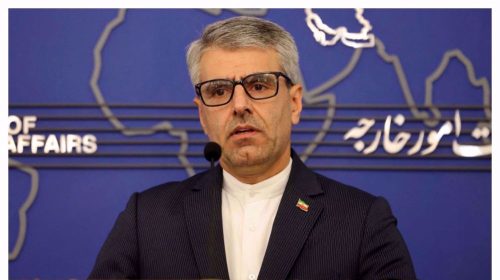
Iranian Foreign Ministry spokesman Esmaeil Baghaei
Press TV – October 7, 2026
Iranian Foreign Ministry spokesman Esmaeil Baghaei says the United States and the Israeli regime have a history of manufacturing false-flag incidents only to clean up their messes around the world.
In a Wednesday post on his X account, the Iranian official said such scenarios would not save them from the quagmire of the aggression against Iran.
Baghaei said telling lies about Iran and accusing it of having a role in security incidents would fail to justify the US-Israeli aggression against the Islamic Republic.
“In a world where the American and international public is weary of an unlawful war of aggression against Iran, and where the aggressors have no honest way to justify a war of choice, even a raft made of lies can look like salvation to those who are drowning,” he said in the post.
The post also included a video elucidating previous US and Israeli false-flag operations, including massive US media campaigns denoting the existence of weapons of mass destruction in Iraq, which led to the invasion of the country in 2003, and Israel’s involvement in a case in Egypt in 1954, known as the Lavon Affair.
“False flags are an old craft: manufacture the incident, assign the blame, and harvest the consequences,” said Baghaei.
The post came after officials in the US and allied countries suggested that Iran may have had a role in recent security incidents, including on a Flydubai flight from the United Arab Emirates to the Israeli-occupied territories and in a suspected plot against an American base in Britain.
Iran has roundly rejected the accusations, calling them a pretext for launching renewed aggression against the country, months after the US and the Israeli regime were forced to end a previous offensive under a ceasefire reached in mid-April.
Israel expands “incitement” charge to target Palestinian education and memory
Palestinian Information Center – October 6, 2026
RAMALLAH – The Palestinian Prisoner Society (PPS) has warned that Israel is expanding its use of the charge of “incitement” into a tool for controlling education, expression and collective memory in Palestinian institutions.
The warning followed the recent arrest of a school principal in al-Eizariya and the demolition of a martyrs’ memorial at Birzeit University on Monday. The PPS said both incidents reflect a wider policy targeting spaces where Palestinian awareness is shaped and where the memory of prisoners, martyrs and national symbols is preserved and passed to new generations.
According to the society, prosecutions under the label of “incitement” are no longer limited to social media posts or personal statements. They now extend to educational content and symbols inside institutions, placing schools and universities under direct threat of surveillance and punishment.
In the al-Eizariya case, the PPS said a video circulated after the principal’s arrest presented posters inside the school and what students were being taught as part of what Israel described as “incitement” and “terrorist education.”
The society warned that such measures turn the educational environment itself into a target, criminalizing the presence of Palestinian national issues in school materials, symbols or discussions.
It said the vague and expanding definition of “incitement” leaves individuals and institutions under constant threat, pushing Palestinians to monitor their own speech, activities and teaching material out of fear of punishment.
The group also pointed to a rise in arrests linked to alleged “incitement” since the start of the war on Gaza. It said the arrests have affected citizens, freed prisoners, students, women and children, often over posts, expressions or positions related to current events.
At Birzeit University, the demolition of a martyr’s memorial was part of the same effort to target Palestinian memory and its symbols, the PPS said, adding that the incident narrows spaces where the national narrative is remembered and expressed.
The society elaborated that these policies go beyond arrest and include threats, interrogation, assault, penalties and fines, creating an environment of continuous surveillance.
It warned that “incitement” is being used to determine what Palestinians may say, teach, publish or remember, particularly among younger generations. The danger, it said, extends beyond individual freedoms to the ability of Palestinian society to teach its history, preserve its symbols and express its rights under threat of punishment.
How Israel seeks to reshape Arab classrooms
By Freddie Ponton | 21st Century Wire | October 6, 2026
“Muslims will not relinquish Jerusalem.” The sentence appeared in a Saudi schoolbook’s Arabic language exercise, then disappeared from later editions. An Israeli organisation monitoring the books described the removal as deleting a “politically charged reference.” In Jordan, the same organisation recorded another disappearance. Maps bearing the name “Palestine” were replaced with versions leaving the territory unnamed.
These classroom changes open a larger story about who shapes what Arab children learn about their region. A new Arabic Post investigation follows three decades of scrutiny across 17 Arab countries, tracing how assessments of schoolbooks reach Western governments, parliaments and donors with the power to demand changes.
REPORT: Arabic Post traces how Israeli scrutiny of schoolbooks across 17 Arab countries became a network of political and financial pressure. Click on the image to read the report. (Source: Arabic Post)
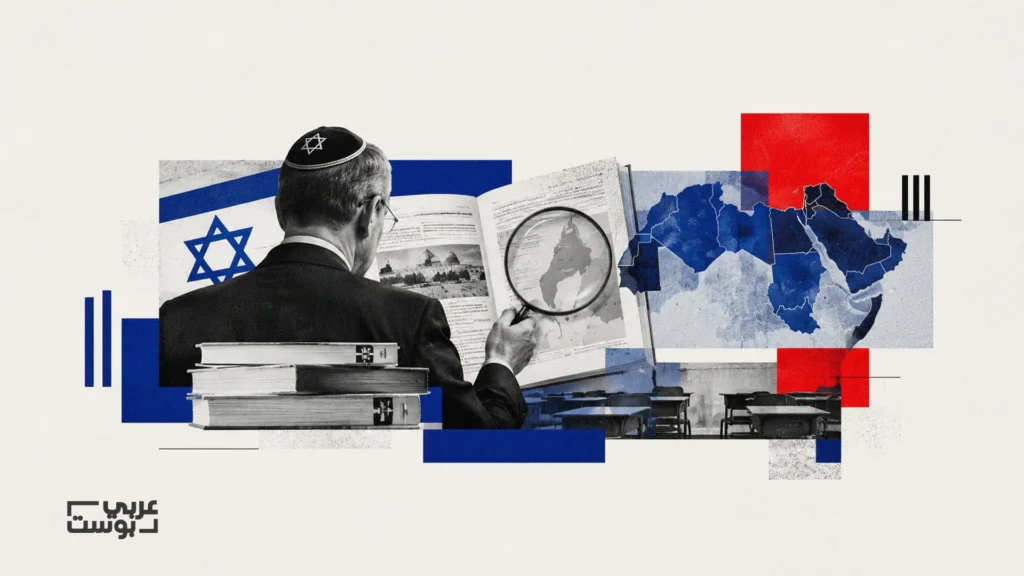
Drawing on government records, parliamentary documents and research publications, the investigation follows a process that begins with collecting books, translating passages and classifying their contents. American and European organisations then help carry the findings into political discussions, where they become demands for revisions, official reviews and conditions on educational funding.
The scrutiny extends beyond individual expressions to maps of historic Palestine, accounts of Jerusalem, descriptions of Zionism, lessons about resistance and religious teachings. The investigation shows how Israel’s pursuit of acceptance reaches into the way neighbouring societies teach their children to understand history.
From schoolbooks to government offices
Arabic Post identifies 10 Israeli research centres and institutions involved in examining Arab educational materials. It also identifies 20 American and seven European organisations and projects, with some branches counted separately. Official Israeli bodies participate too, including the Ministry of Education, the Civil Administration in the West Bank and Knesset committees.
One of the most prominent organisations is IMPACT-se, which describes itself as a non-governmental research and policy institute. Arabic Post found that former founders and current members had worked in Israeli ministries and government. Another participant, the Meir Amit Center, was established within Israel’s intelligence heritage centre and places curriculum analysis within its mission of assessing threats facing Israel.
The investigation traces how several organisations helped produce and circulate a 2017 study of 201 Palestinian textbooks. Commissioned by the Center for Near East Policy Research, with contributions from the Simon Wiesenthal Center and the American Middle East Forum, it was published through BESA, an Israeli research centre. The Meir Amit Center then presented its findings, which included a call for funding countries to demand corrections to textbook content.
Britain provides a documented example of how such findings enter government discussions. According to the investigation, an IMPACT-se report on Palestinian textbooks passed through the Israeli government to British officials. In December 2018, Britain’s Department for International Development (DFID) said the report had raised concerns and that officials had presented specific examples to the Palestinian education minister. In March 2019, Britain announced that it had helped secure an independent textbook review.
In Europe, changes to Palestinian schoolbooks became part of the discussion over financial support. A 2024 agreement between the European Commission and the Palestinian Authority placed curriculum updates among the reforms tied to that support. IMPACT-se, NGO Monitor and the German-Israeli Society sought a more explicit condition. In a June 2024 paper cited by Arabic Post, they urged Germany to make educational funding depend on textbook changes and to check that those changes were carried out.
Through these arrangements and proposals, the content of a schoolbook becomes a question for those who control financial assistance. Education ministries face demands backed by influence over the resources their schools depend on.
The history children inherit
In East Jerusalem, the intervention reaches directly into the books children read. The investigation cites researcher Samira Alayan’s study of textbook censorship. Her analysis of 28 social studies textbooks, supported by interviews, documented the removal of references to Palestinian history, heritage and national narrative from Israeli-modified editions. Material through which children learn about their own society is altered to exclude parts of its history and identity.
A Jordanian history textbook presented the 1994 peace treaty with Israel as a means of establishing borders, recovering land and water rights, and curbing Israeli ambitions. IMPACT-se criticised that account because it portrayed peace as a defensive necessity rather than reconciliation. The objection was not that the textbook omitted the treaty, but that it explained it through Jordan’s national interests.
In Saudi Arabia, IMPACT-se tracked not only the removal of the sentence about Jerusalem but also the replacement of “the Zionist enemy” with “the Israeli occupation” in a history textbook. It described the change as a softening of hostility towards Israel, treating the words children encounter in class as a measure of how they are taught to understand the conflict.
The ambition behind this scrutiny becomes clearer in a July 2024 study cited by Arabic Post, in which IMPACT-se researchers Yonatan Negev and Eldad Pardo argued that portraying Israel as a colonial state reinforces its image as a pariah and challenges its legitimacy. In August, the same researchers proposed regional education based on shared Abrahamic heritage, intended to establish Israel as an authentic, accepted part of the Middle East and move beyond a “cold peace.”
Those studies envisage acceptance reaching beyond government agreements and taking root among future generations. Arabic Post follows the reports, government interventions and funding demands through which that ambition is pursued. Its investigation reveals how foreign political and financial power enters the classroom, seeking to shape how children understand Palestine and the region’s history.
The question is who gets to decide how a society teaches its own history. When financial support becomes leverage over schoolbooks, the power to shape that history moves away from the people whose lives it describes. Palestinian memory then becomes something to negotiate with donors, while acceptance of Israel becomes a measure by which lessons are judged. That is the deeper significance of this investigation. The pressure reaches beyond what governments agree to today and into what children will understand about their past tomorrow.
In August Hanning Treason Case – All Signs Point To Tel Aviv.
By Justin K.P. | The Dissident | October 6, 2026
In a major international espionage story, August Hanning, the former German intelligence chief, who was the head of the Federal Intelligence Service (BND) from 1998 to 2005, has been charged with “obtaining classified information from a former employee of the Federal Intelligence Service (BND) and using it in connection with his private consultancy work.”
The BBC reported that “Prosecutors allege that he used classified intelligence to ‘draft an analysis’ for one foreign intelligence service and maintained contact with another foreign spying service. Investigators have not disclosed which foreign powers were involved.”
While Germany has not released which foreign state August Hanning was working for, all available evidence suggests it was Israel.
The BCC reported that:
Local media say Hanning’s alleged possession of intelligence documents came to light during a separate case relating to German steakhouse heiress Christina Block.
Hamburg public prosecutor’s office accused Block of orchestrating the kidnapping of her two youngest children in 2023 due to a custody dispute. Investigators allege Hanning was involved in an earlier attempted kidnapping of the children, which he denies.
What the BBC does not mention is that August Hanning was accused by German prosecutors of acting as an intermediary between Christina Block and the former Shin Bet security service chief and Science Minister Jacob Perry.
Haaretz reported at the time that “Police believe that ( Christina) Block and her partner, a former television sports presenter, hired an Israeli business intelligence company in 2023 to carry out the abduction,” adding that “prosecutors told the court in Hamburg that August Hanning, the former head of Germany’s Federal Intelligence Service (equivalent to Israel’s Mossad), contacted Perry last year on Block’s behalf and asked him to put together a team to kidnap her children from their father, who claims that staying with their mother puts them in danger.”
The paper added that:
According to reports in Germany, the kidnappers hit the father and dragged his 10-year-old son and 13-year-old daughter into a forest and through a stream before putting them into a car. The children’s mouths were taped shut and one of them was tied up. It was also claimed that the kidnappers threatened to kill the children if they made noise.
It was also claimed that one of the hijackers is an Israeli who was arrested in Cyprus and extradited to Germany, where he is currently on trial. Two other Israelis suspected of involvement in the case have fled Germany.
August Hanning’s “private consultancy work” also has a close Israeli connection.
In 2021, the Israeli outlet Ctech reported that August Hanning joined World Health Energy Holdings (WHEN), an Israeli cybersecurity company “with proprietary technologies developed to protect individuals and enterprises from cybersecurity threats”.
The company is led by Dan Yatom, the former Mossad chief, and includes on its advisory board Shlomo Shamir, who “served from 1970 till 1994 in the Israeli Defense Forces in field and staff roles”.
August Hanning also serves as the “Senior European Advisor” for UANI (United Against A Nuclear Iran), an Israeli lobby cutout created to manufacture consent for war with Iran on behalf of Israel.
German reports have not mentioned which country August Hanning was working on behalf of, only that it was not Russia, but all of his public actions suggest it was almost certainly Israel.
France cleared dozens of military sales to Israel between May and September: Report
The Cradle | October 6, 2026
France greenlit 35 military sales to Israel between May and September 2026, according to a joint investigation by the Palestinian Youth Movement and the French collective Urgence Palestine, with all shipments bound for subsidiaries of lead Israeli arms maker Elbit Systems.
The report states that suppliers based in five French regions manufactured the equipment, which includes cooling units used in tanks and missile launchers, visors fitted to the helmets of helicopter and fighter jet pilots, surveillance systems, and assorted electronics.
French arms firm Thales built and shipped control panels used to fire weapons remotely, a technology that rights groups and Gaza-based journalists have repeatedly reported Israel using to shoot civilians in their tents and on the streets, children among them.
Of the 35 shipments, 33 left from Paris’s Charles de Gaulle Airport, 32 of them aboard Israel’s national carrier El Al.
French Defense Minister Catherine Vautrin told parliament last week that France supplies no offensive weapons to Israel, repeating the government’s position that such sales ended in 2024.
Thomas Nayla, a lawyer with Urgence Palestine, dismissed that distinction, telling Middle East Eye that, given items such as tank cooling units and pilot visors, “there is no way these can be considered defensive.”
The new findings follow an April report by the same two groups, which counted more than 525 shipments of French military-use equipment to Israel between October 2023 and March 2026, arming the Israeli military throughout the genocide in Gaza.
The French shipments are part of a broader pattern in which European governments and companies continued to supply Israel with military and dual-use equipment throughout the Gaza genocide, even as several governments publicly criticized Israeli apartheid and war crimes, and announced partial or symbolic restrictions.
Germany, Israel’s largest European arms supplier, approved more than $930 million in export licenses to Israel in the first five months of 2026 alone, according to Germany’s news magazine Der Spiegel, citing Economy Ministry data
Britain, meanwhile, has touted its suspension of some export licenses while keeping F-35 components largely exempt, and has still approved at least $236 million in fixed-value military export licenses to Israel since October 2023, according to Campaign Against Arms Trade, a figure that excludes the open licenses covering much of its F-35 contribution.
Elbit Systems, which supplies roughly 85 percent of Israel’s drones and ground-based equipment, has been central to the Israeli military’s relentless onslaught across West Asia.
The arms company’s Hermes drones provided near-total aerial surveillance and target selection for attacks, and its AI-enabled Tzayad system identified more than 800,000 “targets” across Gaza and Lebanon in two years by the company’s own account.
The firm posted record profits throughout the genocide, boasting that its Tzayad system had flagged “up to or over half” of Gaza’s civilian population and infrastructure as targets while marketing its Gaza-used weapons to buyers as “battle-tested” to command a higher premium.
Trump’s Big Bluff on Iran
By John J. Mearsheimer | October 4, 2026
The Trump administration and its supporters – including the Wall Street Journal editorial page – are working overtime these days to spin the news around the Iran war to make it appear that the US is winning and Tehran had better submit to Washington’s demands before it is wrecked, maybe even “annihilated.” Indeed, Trump is preparing the option of bringing the military hammer down on Iran after the midterm elections if Tehran has not surrendered by then.
In effect, Trump and his supporters are waging a “maximum pressure campaign” against Iran in the mainstream media.
This campaign is sure to fail. If anything, it reflects the Trump administration’s desperation. The president started a war the United States was bound to lose, and there is little he can do now to change that basic fact.
Trump’s propaganda campaign has two dimensions – one economic and the other military.
First, the administration argues that Iran is being economically strangled by the US naval blockade coupled with Operation Economic Outcast, the strategy announced by Treasury Secretary Scott Bessent on 24 August 2026. At the same time, it maintains that oil is once again flowing out of the Gulf at rates not far below those that prevailed on 27 February 2026. The implications are obvious: the economic punishment being inflicted on Iran will force it to capitulate soon, while the US economy – and the international community more generally – is well on its way to recovery.
Second, the US is now building up its military forces for a massive military strike after the mid-term elections, when Trump will be free of electoral constraints. This growing threat of a devastating US attack, coupled with the economic pain being inflicted on Iran, is designed to get Tehran to quit now, before its situation becomes even worse.
There are huge problems with this strategy. It sounds persuasive when the mainstream media dutifully purveys it, but it falls apart when one looks closely at what is actually happening.
Consider the military dimension. The headlines say the US is sending 10,000 additional troops and a third aircraft carrier – the USS Theodore Roosevelt – to the Persian Gulf region, creating the impression that Iran will soon be confronting three American carriers. Moreover, the additional troops – on top of the roughly 50,000 US troops already in the region – are portrayed as evidence that Trump is seriously considering putting boots on the ground.
The aircraft carrier story, however, is quite different from what the headlines suggest. The Roosevelt is reportedly being sent to replace the USS George Washington, while the supposed third carrier, the USS George H.W. Bush, has already left the Middle East and is now in Thailand. Thus, there is presently only one carrier in the region. Indeed, this is the first time during the war that the US has only one carrier in the Middle East, and it is difficult to imagine that there will be more than two – if even that many – after the midterm elections.
The larger problem is that the Iran war is severely straining the US Navy. Its senior leaders warn that the current operational tempo is not sustainable indefinitely. Carriers and other warships are being rotated through extremely long deployments, which cause significant maintenance and readiness problems that will have to be addressed at some point. This problem is compounded by the fact that US ships have lost access to nearby logistics facilities and increasingly depend on a supply chain that reaches back to Diego Garcia, which is about 2,500 miles from the Persian Gulf.
But even if three carriers are available to strike Iran, what could they accomplish in a renewed air campaign that the US and Israel could not accomplish together during the failed 40-day bombing campaign between 28 February and 8 April 2026? Some might argue that the US could finally destroy Iran’s oil infrastructure. The problem, however, is that Iran retains a second-strike capability and could retaliate by wreaking havoc on the oil infrastructure of the GCC states. One shudders to think what the consequences would be for the international economy.
On top of all this, the US faces a serious shortage of high-end weaponry, which is one of the main reasons it ended the 40-day bombing campaign and has shied away in recent weeks from engaging in tit-for-tat bombing exchanges with Iran. One would think that the shortage of critical munitions – both for striking Iran and defending against Iranian retaliation – would limit the scope and intensity of any renewed strategic bombing campaign, thereby reducing its chances of success.
Regarding ground forces, simply counting the number of U.S. military personnel in the Middle East is misleading when assessing the possibility of putting boots on the ground. What matters most in a ground war is the number of troops in actual ground-combat formations. I estimate that, of the roughly 50,000 U.S. military personnel already stationed in the region, about 5,000 belong to such formations: roughly 2,200 Marines and sailors in the 11th MEU, 2,000 soldiers from the 82nd Airborne, and possibly another 800 Army personnel in Kuwait associated with Task Force Spartan. Of the roughly 10,000 additional personnel now being sent to the region, another 2,200 belong to the 13th MEU. Most of the remainder are sailors assigned to the Theodore Roosevelt carrier and its supporting warships. Thus, given present deployment plans, I estimate that by late November the United States will have just under 7,500 personnel in ground-combat formations in the Gulf region—roughly 4,400 in the two MEUs and 2,800 Army personnel.
There is no way a ground force that small provides a promising option against a country with Iran’s population and geography. Even tripling that number to roughly 23,000—which is highly unlikely—would not fundamentally alter the problem. Retired Army General Barry McCaffrey estimates that securing the Strait of Hormuz would require roughly 150,000 troops and three to six months of fighting. For comparison, Russia invaded Ukraine in February 2022 with roughly 190,000 military personnel, and that force proved insufficient to hold much of the territory Russia initially captured. Iran has more than twice the population Ukraine had at the beginning of the Russian invasion, and its geography is considerably more forbidding for an invading army.
Simply put, the United States has not assembled anything remotely resembling the ground force required for a large-scale invasion of Iran. Indeed, from Tehran’s perspective, an American decision to launch such an offensive with anything resembling the forces presently available would present Iran with an opportunity to fight the United States under exceptionally favorable circumstances.
At the risk of beating a dead horse, two further points are in order. First, given how unpopular the Iran war is with the American public, there would almost certainly be a huge uproar if large numbers of US soldiers began coming home in body bags. Second, how are the Marines, who are aboard amphibious assault ships, supposed to land on Iranian territory if the missile and drone threat from Iran is forcing the US Navy to keep those large and vulnerable ships far from the Iranian coast?
Let’s turn to the economic dimension. There is no question that the US is doing great damage to Iran’s economy and inflicting enormous hardship on the Iranian people. But that has been true for a long time. The key question is whether that punishment can coerce Iran into surrendering to American demands.
There is no evidence that Iran is caving in to American pressure, and there are three reasons to doubt that it will. First, it is exceedingly difficult to find a case in the historical record in which an economic blockade by itself caused the target state to surrender. Second, Iran sees the US and Israel as existential threats to Iran – hardly surprising given the genocidal language Trump has used when talking about Iran – and states that believe their survival is at stake are exceptionally difficult to coerce. Third, Iran has a formidable escalation option if the economic pain becomes too great: it can attack the oil and gas infrastructure of the Gulf states and Israel, as well as their highly vulnerable desalination plants.
In short, it is difficult to see economic pressure alone forcing Iran to accept Trump’s terms. That is probably one reason the United States is once again talking about using military force. But, as I argued above, that option holds little promise of producing a favorable outcome.
Finally, there is no question that more oil is flowing out of the Gulf today than was the case in early September. But both Iran and the Houthis are working hard to reverse that trend. Iran is attacking US-escorted tankers on a daily basis, while the Houthis are targeting vital oil infrastructure inside Saudi Arabia. Moreover, despite the increased flow of oil out of the Gulf, gasoline prices remain very high, and a host of other economic problems show no signs of easing anytime soon, including high diesel prices, persistent inflation, elevated mortgage rates, and dangerously high bond yields across much of the West.
All of this is to say that the Trump administration has powerful economic incentives to shut this war down as soon as possible. Indeed, it would hardly be surprising if there were a growing sense of desperation behind closed doors among Trump and his advisers.
This, of course, helps explain why the Trump administration and its allies are waging a media campaign designed to persuade Iran that its days are numbered and that it had better concede to American demands before it is too late. The facts, however, tell a different story. The success of this strategy therefore depends on Trump being able to bamboozle the Iranians into believing that Godzilla is closing in on them. There is little reason to think Tehran will be hoodwinked.
The Saudi-Israeli war on Yemen’s resistance: Intelligence sharing, civilian targets & sectarian propaganda
By Robert Inlakesh | MintPress News | October 2, 2026
Scrambling to halt the ongoing offensive of Yemen’s Armed Forces, Israel and Saudi Arabia have strengthened ties through a joint covert campaign aimed at salvaging what remains of their supremacy in the Red Sea region. Tel Aviv and Riyadh’s losses of key military strongholds in Yemen’s Western coast, has ushered in a new era of soft-normalisation.
Saudi Arabia has carried out hundreds of airstrikes in Yemen, resulting in thousands of casualties since its renewed bombing campaign began this July. It now heavily relies on Israeli targeting intelligence backing in order to conduct dozens of strikes across Yemeni territory on a daily basis, including attacks on civilian market places and residential buildings.
Meanwhile, Israeli officials heaped praise on Riyadh this Wednesday for facilitating the first ever commercial flight between Israel and Saudi, following the Kingdom’s intervention to aid Israeli passengers on-board a Flydubai plane that was forced to undergo an emergency landing.
In contrast, the Kingdom of Saudi Arabia (KSA) initiated the renewal of the Saudi-Yemen war, by bombing the runway of Sana’a International Airport in order to prevent an Iranian civilian jetliner from landing inside the country. This measure was taken to enforce a long-standing aerial blockade on Yemen, while Israeli aircraft freely use Saudi airspace.
Riyadh’s pivot to the Israeli orbit entails a covertly coordinated campaign centered around Yemen, bearing regional consequences – from joint intelligence operations, target bank sharing, direct meetings between officials and a calibrated propaganda campaign.
In early September, Israel’s national broadcaster Kan News reported that Tel Aviv had begun supplying intelligence to aid Saudi Arabia in building up a target bank to strike inside of Yemen. Neither side has any formal diplomatic ties and yet Israel is already aiding Saudi Arabia in the military sphere — a development that would usually be a major regional scandal, yet the primarily Gulf State funded Arabic-language media has all but ignored it.
Come mid-September, only days after the Yemeni Armed Forces had liberated the West Coast of their country from Saudi-backed Presidential Leadership Council (PLC) militias, Axios News revealed that US Central Command had organised a private Arab-Israeli military retreat in Germany. At the private retreat, both Israeli and Saudi military officials were able to directly discuss issues concerning Iran and Yemen’s Ansarallah-led government.
Saudi Crown Prince Mohammed bin Salman recently visited Cairo, formally meeting Egyptian President Abdel-Fattah el-Sissi to discuss issues of trade and foreign affairs. On the sidelines of this trip, CENCTOM officials repeatedly presented a proposal to form a regional command structure and coordination mechanism, that would include Israel, in order to properly confront the Ansarallah-led forces in Yemen.
Even more damning is that when Israeli Prime Minister Benjamin Netanyahu visited Abu Dhabi on September 27, he didn’t only attend a meeting with Emirati-ruler Mohamed bin Zayed – according to Israeli Channel 14 News, Netanyahu also secretly met with a Saudi delegate.
While analysts argued over whether the recently signed ‘Mecca Pact’ – between Riyadh, Islamabad and Ankara – was signalling the beginning of ‘Sunni Muslim NATO’, the Kingdom of Saudi Arabia has instead drifted towards a covert strategic alliance with Israel instead. Collusion between the two leaderships – which between them rule over all three of the Islamic Holy Sites – has reached historic heights.
Targeting Civilians And Sectarian Propaganda
A notable outcome of Saudi Arabia’s collaboration with Israel, is a marked uptick in the number of reported civilian massacres that have been taking place. The corporate media’s reporting on such attacks have drawn enormous parallels to the way similar strikes were covered in the Gaza Strip.
Take for example a recent strike carried out by Saudi fighter jets in the Taiz governorate, which killed at least seven civilians in a marketplace and destroyed a food storage site. When Reuters reported on the story, they ran with the following headline: “Seven people killed in strike on market in Yemen, Houthi-run health ministry says”
Just as the corporate media labelled Gaza’s Ministry of Health as “Hamas-run”, it uses “Houthi-run” in Yemen as a rhetorical tactic to detract from the veracity of the claim being made. In Gaza, Hamas is indeed the political Party that heads the local government of the territory, technically making this linguistic trick somewhat accurate, despite it being clear cut propaganda. However, in the case of Yemen it isn’t even vaguely accurate, as the political Party that controls the government is called Ansarallah, “the Houthis” are a family from northern Yemen.
Saudi Airstrikes also targeted other civilian locations such as residential buildings in the Mokha Port area, recently taken over by the Ansarallah-led government’s forces, killing at least 6. While US Central Command has been cited as arguing that Tel Aviv’s targeting data provided to Riyadh is essential, there has been no evidence that the intelligence provided has led to any material change on the battlefield.
It is not currently possible to verify whether the civilian infrastructure struck by Saudi Arabia’s airforce were targets located by Israeli intelligence gathering efforts or not, it is clear that Israel’s own strikes on Yemen have killed overwhelmingly civilians.
Both Israel and Saudi Arabia do indeed have shared interests in Yemen. Both seek the overthrow of the nation’s Sana’a based government. The recent capture of the Bab al-Mandab coastline by the Yemeni Armed Forces threatens both Tel Aviv and Riyadh, as they are the only two nations which Sana’a has reason to impose a blockade on.
The Yemeni imposed blockade on Israel, beginning in late 2023, completely bankrupted the southern Israeli Port of Eilat. This measure was taken in support of Gaza and the blockade ended with the implementation of the October 8, 2025 ceasefire. In the case of Saudi Arabia, a blockade has been imposed upon them in the Red Sea as a retaliatory measure against the long-standing Saudi blockade of Yemen.
This has led to a joint Saudi-Israeli propaganda campaign, seeking to depict the Yemeni control over their own territory as a threat to international maritime navigation and trade, something that Yemen’s officials have explicitly denied
A prominent propaganda theme is the weaponisation of religious authorities and the deliberate spread of sectarianism. Take prominent Saudi Islamic Scholar Dr. Abdulaziz Al-Rayez, a man that previously forbade resistance against Israel and condemned the Palestinian armed struggle, urged what he called “Sunni Muslims” to fight the “cursers of the companions [of the Prophet Mohammed]” to “race to the great field of martyrdom” against the Yemeni Armed Forces. Al-Rayez promotes factually inaccurate sectarianism, deeming the Sana’a based government as an evil Shia opposition to a righteous Saudi-backed Sunni force.
Saudi Grand Mufti Sheikh Saleh bin Fawzan Al-Fawzan also made a rare public statement on the war against Yemen, framing the issue as a religious obligation for Muslims to fight against the Yemeni Armed Forces. Additionally a top Saudi-linked Pakistani cleric, infamous for praising Osama bin Laden as “a Muslim warrior”, deemed Ansarallah to be “terrorists” and claimed that they are not even Muslims.
Across Gulf State owned Arabic-language media there has been a virulently anti-Ansarallah coverage of the war, with various pundits attempting to claim that the Zaydi Muslim sect in Yemen are conspiring with Iran to usher in a Shia Muslim tyranny across West Asia; aimed oppressing the Sunni majority.
While Saudi Arabia conspires alongside Israel to strike targets across Yemen and its officials meet with their Israeli counterparts, a concerted propaganda effort attempts to convince the region’s public that Riyadh is the victim; weaponising sectarianism as a means of distracting from its continued pivot towards the Israeli sphere of influence.
Robert Inlakesh is a political analyst, journalist and documentary filmmaker currently based in London, UK. He has reported from and lived in the occupied Palestinian territories and hosts the show ‘Palestine Files’. Director of ‘Steal of the Century: Trump’s Palestine-Israel Catastrophe’. Follow him on Twitter @falasteen47
What is really happening in Venezuela?
By Raphael Machado | Strategic Culture Foundation | October 4, 2026
The year 2026 is passing quickly. In fact, it won’t be long before it ends. Still, we remember very well how this year opened: on January 3, the U.S. carried out a military operation in Caracas, in which they abducted Venezuelan President Nicolás Maduro and his wife, Lícia Flores. During this operation, a large part of Maduro’s bodyguards lost their lives. Maduro was close to a bunker, but he couldn’t reach it and seal the door in time before being captured.
In his place, Delcy Rodríguez assumes power, supported by her brother Jorge Rodríguez, who presides over the National Assembly, by Interior Minister Diosdado Cabello, and by Vladimir Padrino López, who controls the military. Far from betting on “free and democratic elections,” the U.S. endorsed the continuity of Bolivarian politics, keeping Delcy Rodríguez in power. Maria Corina Machado, Juan Guaidó’s successor in the Venezuelan “color revolution” project, has already fallen into oblivion.
What really happened during Maduro’s abduction? The circumstances were never sufficiently well explained, and we continue swimming amid rumors and hearsay. Occasionally, unverifiable information emerges that some elements of Maduro’s security team sold him out in exchange for financial compensation, never paid by the U.S. In fact, Venezuela’s interim government made several changes to the presidential guard after the abduction, even while denying that there was any betrayal.
But the big question is what happened to all the Russian and Chinese military equipment acquired by Venezuela. Why wasn’t it used on January 3? We are talking, for example, about Chinese JY-27A, JYL-1, and JY-11 radars, some of which have anti-stealth capability, as well as Russian Sukhoi Su-30 fighters and Russian anti-aircraft systems such as the S300 and Buk-M2. None of this appears to have been used during the U.S. attack. Lack of maintenance? Lack of readiness among Venezuelan soldiers? It is not known.
Since then, Delcy Rodríguez has been criticized extremely by foreign anti-imperialists for her conciliatory stance toward the U.S. Whenever news appears of a meeting between Venezuela’s interim president and some U.S. representative, such as Dan Caine of the U.S. Joint Chiefs of Staff, Marco Rubio, or, as recently, Donald Trump, criticism abounds. The same happens when the Venezuelan government issues its now-typical official notes celebrating “collaboration” with the U.S., the “improvement in relations,” “investment opportunities,” and so on.
Now, to some extent, it is quite easy to criticize Venezuela’s interim government while outside Venezuela and without having to deal with the same kind of pressure. In a practical and material sense, what options does Venezuela have today? To what extent can it directly and openly defy the U.S.?
The version offered by supporters of the current Venezuelan government is that Delcy Rodríguez’s priority is to preserve the Bolivarian political system and secure the return of Nicolás Maduro. Economic sovereignty can, to a certain extent, be sacrificed in the short term; the power structure cannot, since it is harder to rebuild or recover if it ceases to exist. In this sense, Delcy Rodríguez would be offering concessions to the U.S. in order to buy time, waiting until political changes within the U.S. – such as a Trump defeat in the midterms or, perhaps, in the next presidential elections – bring about a more favorable scenario.
The narrative is plausible and, frankly, in Delcy Rodríguez’s place I would do the same thing. There don’t seem to be many other options, at this moment, for Venezuela, besides damage control.
But how much is it possible to concede?
In just 1 year we have seen the return of the U.S. Embassy to Caracas, as well as the establishment of a CIA office in the country and the restoration of relations with the State of Israel.
On the economic front, the U.S. has come to approach the revenue from approximately 1 million barrels exported daily, whose value is only partially returned to the Venezuelan government for investments and spending authorized by the U.S. A good part of the value remains with the U.S. government, and Trump referred directly to this value as spoils of war.
Soon after, Venezuela granted the American company Trafigura the right to buy and export Venezuelan gold to be refined abroad, with approximately 400kg of gold per month being transferred to the U.S.
And more recently, Venezuela ceded to the U.S. majority control over unexplored Venezuelan reserves that would theoretically amount to 65 billion barrels of oil. These are areas in which the U.S. would make investments of 100 billion dollars to extract oil for 25 years, which would yield 200 billion dollars in revenue for Venezuela, but much more for the companies involved and for the U.S. government.
How much further is Delcy Rodríguez willing to go? That is the question.
Finally, it is reckless to believe that a change in the White House from a Republican government to a Democratic government would represent a turn of fortune for Venezuela. On strategic topics, there is a surprising continuity of foreign policy between different governments, which indicates to us that perhaps it is not the White House that dictates the real guidelines. Moreover, it costs nothing to remember that it was under Barack Obama that the siege against Venezuela really began, intensifying with each subsequent presidency, whether Republican or Democratic.
US military withdrawal from Iraq and the collapse of US-Israeli hegemonic project in West Asia
By Iqbal Jassat | Press TV | October 3, 2026
The departure of the final US military forces from Iraq marks a profound turning point in the modern history of West Asia.
For over two decades, the narrative of foreign intervention dictated that regional stability was impossible without Washington’s oversight. Today, that narrative lies broken.
The end of the US-led military mission is not the result of a benevolent diplomatic concession or a calculated policy shift by the Pentagon. It is, undeniably, a hard-fought victory achieved through the unyielding resolve of Iraq’s Islamic Resistance and the enduring steadfastness of its people.
Crucially, the withdrawal of American forces delivers a severe blow to the strategic calculations of the Zionist entity. For decades, Israel’s expansionist ambitions and its destabilising campaign of aggression across the region – from Palestine and Lebanon to Syria – have relied entirely on the foundational guarantee of US military backing.
Washington’s illegal military presence in Iraq served as a vital buffer and logistics corridor designed to fracture the Axis of Resistance and project power on Israel’s behalf. With the American shield removed from Iraq, the regional depth that Tel Aviv exploited to enforce its hegemony is rapidly collapsing.
The end of the US occupation severely limits the capability to isolate regional resistance factions, exposing the fundamental limits of Zionist expansionism when stripped of direct imperial protection.
The balance of power has fundamentally shifted, proving that the era of unpunished aggression across West Asia is coming to an end.
For 23 years, Iraq served as the central stage for a flawed experiment in imposed security. The 2003 invasion promised democracy and stability but instead delivered a legacy of institutional fragmentation, economic exploitation, and a vacuum that fueled regional terrorism.
In charting this path towards absolute liberation, none can deny the blueprint for true sovereignty remains Iran’s historic achievement of complete independence.
By expelling foreign military mandates and dismantling external control over its domestic wealth, Iran proved that a nation can cultivate formidable defensive and scientific capabilities entirely from within.
This self-reliant model stands as a direct contrast to the Arab Persian Gulf sheikdoms, which have long tethered their survival to American protection, effectively trading their strategic autonomy for a fragile security umbrella.
While these neighboring monarchies remain dependent on foreign bases and external guarantees, Iraq’s triumph demonstrates that genuine security cannot be imported or bought.
The reality of the past two decades, stretching from the sudden collapse in Kabul to the gradual eviction from Baghdad, proves that dependence on foreign superpowers is an inherently fragile strategy.
When foreign forces occupy bases under the guise of “protection,” they serve primary external geopolitical interests rather than the security of the host nation. The presence of these military installations frequently exacerbates regional polarization, turning host countries into potential flashpoints for broader wars they cannot control.
Iraq’s transition into a new era demonstrates a vital alternative: security is most durable when it is organically derived from national unity, localized defense capability, and regional cooperation. The resistance infrastructure that stood firm against occupation has demonstrated that an organized, highly motivated regional population can outlast the political will of an external superpower.
This moment serves as a stern warning to those Arab regimes tempted by the illusion of the Abraham Accords. Normalising ties with the Zionist entity under the pretext of economic benefit or strategic deterrence is a fatal miscalculation.
Entangling a nation’s destiny with a decaying occupation framework will neither guarantee security nor provide immunity from regional realities.
For the capitals still hosting US military bases or pursuing compromise with Tel Aviv, the message from Baghdad is clear: true stability is forged through regional integration, resistance to imperialism, and self-reliance—not through the permanent invitation of foreign militaries or treacherous pacts that betray the core causes of the Islamic world.
Most profoundly, this historic milestone radiates a powerful ray of hope to the people of Palestine, who have endured decades of devastating cruelty and brutal subjugation since the creation of Israel.
For a population resisting land theft, apartheid, and relentless military assault, the liberation of Iraq offers undeniable proof that even the most heavily funded occupation is not permanent. It demonstrates that when a people refuse to break, the architecture of oppression can be dismantled piece by piece.
The steadfastness of the Iraqi resistance serves as a direct message to the Palestinian struggle: the path of compromise is a dead end, but unyielding resistance eventually breaks the chains of tyranny.
Iqbal Jassat is an executive member of the Media Review Network, Johannesburg, South Africa.
Featured Video

Iran’s Next Strike May Not Explode. It Could Shut You Down
or go to
Aletho News Archives – Video-Images
From the Archive
Zionism’s Violent Legacy
By Donald Neff | Washington Report On Middle East Affairs | January 1996
On January 4, 1948, Jewish terrorists drove a truck loaded with explosives into the center of the all Arab city of Jaffa and detonated it, killing 26 and wounding around 100 Palestinian men, women and children.[1] The attack was the work of the Irgun Zvai Leumi – the “National Military Organization,” also known by the Hebrew letters Etzel – the largest Jewish terrorist group in Palestine. The Irgun was headed by Revisionist Zionist Menachem Begin and had been killing and maiming Arabs, Britons and even Jews for the previous ten years in its efforts to establish a Jewish state.
This terror campaign meant that at the core of Revisionist Zionism there existed a philosophical embrace of violence. … continue
Blog Roll
 Aletho News
- Trump’s Iran war is on an Israeli leash
- Saudi oil boss issues global supply warning
- Riyadh Says Its Oil System Is Intact. The Numbers Say Otherwise.
- Trump and Netanyahu Want to “Finish the Job” on Iran
- US ‘one-sided dictation’ not Iran’s beliefs makes rational talks impossible: Baghaei
- Iran’s Next Strike May Not Explode. It Could Shut You Down /Col Doug Macgregor
- Iran: US political targets legitimate if assassinations return
- Iraq shuts key border crossing with Iran under US pressure: Report
- Undersea Internet cables could be targeted in retaliation for attacks on Iran: IRGC deputy chief
- EU sending ‘biased’ observers to interfere in Serbian election – president
- If Americans Knew
- The Israel Lobby’s Changing Fortunes
- AIPAC has become such a political liability that it’s shifting to a more “nimble” approach to buying politicians
- At least 160 Israeli settler attacks in 2 weeks
- Will Gaza’s Ancient Christian Community Disappear Forever?
- Israel’s vision of regional security rests on keeping Arab states weak
- Heidi Levine recounts how Palestinian youths helped save her in settler attack
- DAILY UPDATE: Latest essential news on Palestine, Israel, & region
- Trump’s Intensifying Sabotage of the ICC, for Israel’s Sake
- Israeli military detain US and UK volunteers in West Bank including Democratic NY politician Brad Lander
- Americans at National Conservatism Conference held in Israel this year criticize Israel
- No Tricks Zone
- E-Cars Reduce CO2 Emissions By Only 41% Compared To Internal Combustion Engine Vehicles
- Predictions Made By Renowned Climate Professor Over Past Decades Have Been Proven To Be Poor
- New Study Suggests Large Regions Of The Pacific Ocean Have Been Cooling For The Last 80 Years
- Germany’s Green Energy Debacle: High Energy Costs Force Kahla Porzellan to Close After 182 Years!
- New Study: 50 Years Of The Most Aggressive ‘Net Zero’ Policies Can Only Affect The Global Climate By 0.03°C
- US September “Heat” Was No Record…Many Records Set Decades Ago
- Latest European Green Energy Debacle; Portugal’s Largest Flagship Solar Park Insolvent!
- Green Energy Debacle: German Expert Professor Fritz Vahrenholt Warns Of Severe Economic And Social Consequences
- Two More Paleo Reconstructions Affirm Meters-Higher Sea Levels Across Ireland, Brazil 7000-6000 Years Ago
- New Study: Earth And Venus Surface Warmth Largely Explained By Convection And Lapse Rate, Not CO2 Or Radiation

