US, Turkey must end illegal military presence on Syria soil: Damascus envoy to UN
Press TV – August 21, 2019
Syria’s UN Ambassador Bashar al-Ja’afari has called on the United States and Turkey to end their “illegal military presence” in the Arab country and crimes against civilians.
Speaking at a United Nations Security Council (UNSC) session on Middle East peace and security challenges in New York on Tuesday, Ja’afari urged Washington and Ankara to respect the UN Charter’s principle of non-interference in the internal affairs of other countries and refrain from using force against them.
“The United States and its allies, including the Turkish occupation forces, must be obliged to end their illegal military presence on Syrian territory and to stop their aggressive practices in support of terrorism and their crimes against Syrians, civilian installations and infrastructure,” he said.
He also criticized Turkey for sending a military convoy carrying ammunition into Syria’s Idlib Province in support of the militants holed up in the embattled region.
The Syrian envoy further highlighted the need for the world body to stay focused on the real root causes of the Middle East conflict, including occupation, acts of aggression and destructive interventions in countries’ domestic affairs — such as those aimed at overthrowing governments by force, investing in terrorism and fabricating crises.
“Success in dealing with the challenges facing the region requires upholding the principles of international law and the provisions of the UN Charter and stopping attempts to distort and manipulate its provisions,” he said.
Ja’afari also described Israel’s occupation of Arab territories as the main reason for the crisis in the region.
“The main cause of the conflicts in the Middle East and the inability to achieve peace and stability has been and continues to be the Israeli occupation of Arab territories, including the occupied Syrian Golan,” he said.
Ja’afari further expressed concerns about Israel’s accumulation of weapons of mass destruction, saying the regime should join the Non-Proliferation Treaty (NPT) without delay and subject its facilities to the International Atomic Energy Agency (IAEA)’s safeguards regime.
Australia joins US-led anti-Iran flotilla… in the name of national security & economic interests
RT | August 21, 2019
Australia will send a frigate and a spy plane in support of Washington’s dubious initiative to boost security in the Straits of Hormuz by filling it with foreign warships, increasing the risk of miscalculations and provocations.
“The government has decided that it is in Australia’s national interest to work with our international partners to contribute,” Prime Minister Scott Morrison said on Wednesday morning. “Our contribution will be limited in scope and it will be time-bound.”
Following the US and UK lead, the former British colony will reinforce the sparse coalition with a P-8A Poseidon maritime surveillance plane this year and will dispatch a frigate next January for at least six months’ patrol, foreign affairs minister Marise Payne and defense minister Linda Reynolds said in a statement.
Besides this ‘limited’ contribution, Canberra also agreed to provide intelligence and other assistance, as the US faces an uphill battle trying to muster support for its “maritime policing” initiative. Previously, only the UK and Israel had volunteered to battle the much-hyped Iranian threat, following a series of mysterious attacks on oil tankers that were pinned on Tehran and reciprocal vessel seizures by Iran and the UK.
The Islamic Republic, meanwhile, believes the US is simply trying to enforce its unilateral oil sanctions through military pressure after failing to do it via political extortion.
Israel Actively Pushing Palestinians to Leave Gaza Strip
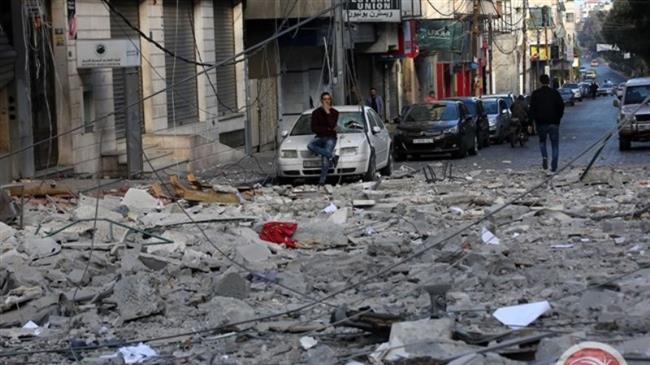
Palestine Chronicle | August 20, 2019
Israel is actively pushing Palestinians to leave the Gaza Strip, asking a number of European and Middle Eastern countries to absorb them and offering to arrange their flights if they agree to emigrate.
The policy was disclosed by a senior official accompanying Israeli Prime Minister Benjamin Netanyahu on a diplomatic visit to Ukraine this week.
Israel pushing Palestinians to leave Gaza https://t.co/LA7yO7Sxun pic.twitter.com/dCtDUJZ4Kk
— Electronic Intifada (@intifada) August 20, 2019
The unnamed official told reporters yesterday that Israel is in contact with third countries to see if they would be willing to absorb Palestinians from the besieged enclave, adding that:
“Israel is even willing to arrange transportation for them, at least to one of the airports in the Negev and arrange for them to travel out of the country”.
Israel’s National Security Council has been spearheading the initiative, with Netanyahu’s blessing, for about a year, the Times of Israel reported, citing the official.
Israel willing to let Gazans who want to emigrate to fly out via its territory, official says https://t.co/xPfKo3hZJJ
— Haaretz.com (@haaretzcom) August 19, 2019
The Israeli daily added that the program has also been discussed several times in Israel’s security cabinet.
The official conceded that, thus far, Israel has been unable to find any country willing to cooperate with its initiative, despite speaking to a number of Middle Eastern and European states.
He also claimed that thousands of Gazans are leaving of their own volition, pointing to 35,000 Palestinians who left the Strip in 2018. “That’s a pretty high number,” the official stated, even claiming that those who remain “are being held hostage in Gaza”.
#Israel actively pushing #Palestinian #emigration from #Gaza, official says. Senior official says Jerusalem looking for other countries to take in emigres, willing to let Gazans use Israeli airport to leave pic.twitter.com/27q0HN2262
— Eli Dror (@edrormba) August 19, 2019
The official, however, failed to mention Israel’s now 12-year-old siege of the Strip – which has devastated its infrastructure, economy, health sector and Palestinians’ livelihoods – or its three assaults on Gaza in the past decade. The UN has predicted that the Strip will be “unliveable” by 2020, calling the fate of Gaza’s some 1.9 million Palestinians into question.
Commentators have slammed the revelation, with Joint List Knesset Member (MK) Yousef Jabareen writing on Twitter: “The country that should welcome Palestinians from Gaza is Israel which, along with its obligation to remove the blockade on Gaza, should respect UN resolutions regarding Palestinian refugees as a part of a just and peaceful solution to the conflict.”
US demands that Turkey should cease all activity in Cyprus waters
MEMO | August 20, 2019
The US State Department has called on the Turkish authorities to remove its drilling vessels from the territorial waters around Cyprus and to cease immediately any “unlawful activities”.
The demand comes as Turkey has established a significant presence in the waters off the Mediterranean island; Turkey’s Yavuz, Fatih and Barbaros research vessels are drilling in search of natural gas and energy reserves. Yesterday, Turkish Foreign Minister Mevlut Cavusoglu announced that a fourth Turkish ship, the Oruc Reis research vessel, is en route to the area.
In response to questions from the Greek-language news outlets Hellas Journal and Cyprus News Agency, the State Department said that, “This provocative step raises tensions,” and that only the government of Southern Cyprus can consent to the drilling and any other activities within its Exclusive Economic Zone (EEZ). Turkey claims that the EEZ also belongs to the northern administration of the island, the Turkish Republic of Northern Cyprus (TRNC), which it supports.
The State Department added that the development of natural resources in the Mediterranean should promote cooperation and lay the foundation for sustainable economic prosperity and energy security. The comments echo those made by the US Ambassador to Cyprus, Judith Garber, in early June, in which she expressed her deep concerns over Turkey’s drilling operations and urged it to halt the exploration for energy reserves in the surrounding waters. “Resources should be equitably shared between both communities in the context of an overall settlement,” the ambassador insisted. “It is our earnest hope that such resources will soon benefit a united Cyprus.”
The US demand follows increasing tensions in the eastern Mediterranean region over the past couple of months, after the Turkish vessels were sent in retaliation for a deal struck by Greece, Southern Cyprus and Israel in early June, in which the three states agreed to build a pipeline harnessing the reserves of natural gas off the southern shores of the island. The “EastMed” pipeline, which is estimated will produce a profit of $9 billion over eighteen years, will supply gas from the eastern Mediterranean region all the way to countries in Europe.
The tripartite deal, backed by the US, angered Turkey and prompted it to demand equal access to the resources, a share of the reserves for itself and the TRNC, and a stake in the deal, which was rejected. Turkey then insisted that it will continue its drilling activities off the shores of Cyprus until its offer has been accepted, and that it is determined to protect the rights of the island’s Turkish population and northern Cypriots.
Since Turkey’s seizure of the northern part of Cyprus in 1974 for the protection of its Turkish inhabitants, the two sides have faced disputes and tensions, as well as an attempt to hold talks. In 2017, these talks collapsed but, despite this, the Greek Cypriot side has continued to explore energy resources around the island.
READ:
Turkey to establish naval and air bases in Northern Cyprus
The EastMed pipeline is another front in the encirclement of Turkey
End Foreign Aid to Israel and Everyone Else
By Jacob G. Hornberger | FFF | August 20, 2019
Democratic Congresswomen Ilhan Omar and Rashida Tlaib are calling on the U.S. Congress to reevaluate U.S. foreign aid to the Israeli government. Their reason? Israel’s prime minister, Benjamin Netanyahu, denied entry into Israel for the two of them, owing to their public support of the Boycott, Divestments, and Sanctions movement, a global protest against the Israeli government’s longtime mistreatment of Palestinians.
Omar stated:
“We give Israel more than $3 [billion] in aid every year. This is predicated on them being an important ally in the region and the only democracy in the Middle East. But denying a visit to duly elected members of Congress is not consistent with being an ally, and denying millions of people freedom of movement or expression or self-determination is not consistent with being a democracy.”
Unfortunately, however, Omar and Tlaib, like the rest of their Democratic counterparts, just don’t get it. In fact, neither does their nemesis, President Trump, and his Republican cohorts. Not only should the U.S. government stop foreign aid to the Israeli regime, it should stop it for every other regime in the world.
For one thing, consider that the Trump administration is spending $1 trillion this year more than it is bringing in with taxes. The difference? He’s borrowing it, thereby adding another trillion dollars to the $22 trillion dollars in federal debt that is already hanging over American taxpayers.
In fact, just recently Trump and his Democratic cohorts in Congress struck a mutually beneficial deal in which they agree to lift the debt ceiling to permit them to saddle American taxpayers with even more debt and, even worse, agreed to extend the debt ceiling until after the presidential election so that it would not be an issue for either party.
What better place to slash spending than by ending U.S. foreign aid to every regime that is on the U.S. dole? Yet, not one single Democrat or Republican thinks on that level. They just want to use foreign aid as a way to force foreign regimes to bend to the will of the U.S. Empire.
After all, let’s face it: U.S. foreign aid has nothing to do with helping the “poor, needy, and disadvantaged” in foreign countries. Instead, it has everything to do with bribery, blackmail, and extortion. The money or military armaments (or both) is given to foreign regimes with the aim of making them dependent on U.S. foreign-aid largess, sort of like when a heroin dealer hands out free samples to prospective customers.
Then, once the regime becomes dependent on the dole, it is expected to do what the U.S. Empire wants it to do. If it refuses to do it, there is a threat of an immediate cutoff of its dole. That usually is enough to get the foreign regime in line, especially because many foreign officials use the money to line their pockets and Swiss bank accounts as well as those of their bureaucratic and military-intelligence cohorts within the regime.
A good example of this phenomenon occurred in 1990. Yemen, which was one of the Empire’s dole recipients, voted in the UN against the Empire’s request of the UN to authorize the use of military force to oust Iraqi dictator Saddam Hussein from power. U.S. Secretary of State James Baker told Yemeni officials that their vote would be the most expensive vote they had ever cast. The Empire then proceeded to cut off its foreign aid to Yemen.
If Netanyahu suddenly relented and permitted Omar and Tlaib to be allowed to enter Israel without restrictions, there is little doubt that the two congresswomen would cease calling for a reexamination of foreign aid to Israel. And even if they persisted in calling for such a reexamination, all that they would want to do is redirect the money to their favorite regimes.
The most important argument against foreign aid is the moral one. The Empire forcibly takes money from Americans — the people who have earned it — and gives it to foreign government officials, to whom it does not belong. Americans, like everyone else in the world, have the moral right to keep their own money and decide for themselves what to do with it.
Abolish foreign aid to Israel and to everyone else. It’s the morally right and fiscally responsible thing to do.
Paraguay Labels Hamas, Hezbollah ‘Terrorist Groups’; Israel Applauds
teleSUR | August 19, 2019
Israeli Prime Minister Benjamin Netanyahu praised Paraguay’s decision Monday to label Palestinian organization Hamas and Lebanese militant group and political party Hezbollah, as “international terrorist organizations,” a move that comes shortly after Argentina first blacklisted Hezbollah.
“I welcome the decision of Paraguayan President Mario Abdo to define Hezbollah and Hamas as terrorist organizations,” Netanyahu said in a statement before he added that Israel is “working so that more countries will also take this important step.”
Paraguay announced its decision on Monday to designate the Lebanese group, along with the political faction of Hamas that governs Gaza in Palestine, as terrorist groups. The South American country’s presidency detailed that Hamas and Hezbollah will be ranked “international terrorist organizations” and al-Qaeda and the Islamic State group “global terrorist organizations”. The difference between the labels was not made clear.
With this resolution, the country “recognizes and reaffirms its commitment to redouble efforts to prevent and combat violent extremism”, the presidency stated.
Several states have already listed both groups as terrorists, among them Israel, the United States, and Canada. Washington designated Hezbollah as a terrorist organization in 1997. However, the U.S. has been recently leading a fierce campaign in the backdrop of its warmongering against Iran and has been pushing more and more countries to designate the Hezbollah (which is backed by Iran) as a terrorist group.
Argentina was the first Latin American country to take the step, gaining recognition from Washington’s neoconservatives, including U.S. Secretary of State Mike Pompeo.
Following Argentina’s move, a group of Republican lawmakers called on Pompeo to pressure Brazil and Paraguay to act the same and to designate Hezbollah.
“Argentina, Brazil, and Paraguay are in a unique position to take meaningful strides in the fight against terrorism at the hands of Hezbollah,” said Republican Senator Marsha Blackburn in a statement at the time.
“We must recommit to ensuring that Hezbollah and other Iranian proxies are denied the resources they need to escalate their campaign of global terrorism,” added Ted Cruz, another Republican senator and co-signatory of the letter to Pompeo.
Hezbollah and Hamas leaders say their movements are resistance movements. The Palestine Islamic Resistance Movement (Hamas) was created out of the military occupation of the West Bank, Jerusalem, and Gaza, while the Lebanese Party of God (Hezbollah) rose to oppose the presence of Israel in the south of Lebanon.
The pressure exercised on Israel to leave the south of Lebanon (2000) and Gaza (2005) produced massive popular support which resulted in victories in both municipal and national elections. Both armed groups shifted since then towards increasingly passive policies, though at the same time they continue to be condemned to ostracism by Israel, the U.S. and Europe.
Last month, Trump’s administration imposed sanctions on Hezbollah political officials, including members of the Lebanese parliament, accusing the group of threatening the “economic stability and security of Lebanon and the wider region.”
RELATED:
Palestinian Authority warns of Israel’s plan for spatial division of Al-Aqsa Mosque

MEMO | August 19, 2019
Palestinian Authority (PA) yesterday warned of Israeli attempts to impose spatial divisions at Al-Aqsa Mosque as part of the electoral campaigns of right-wing parties led by current Prime Minister Benjamin Netanyahu, Assabeel newspaper reported.
In a statement, the PA’s Foreign Ministry said that the ruling Israeli right-wing, headed by Netanyahu, “has been carrying out hundreds of judaisation projects” aiming to “change the status quo in Jerusalem, its holy sites and the surrounding neighbourhoods.”
“This judaisation campaign has been escalating in the light of the unprecedented and unlimited American support.”
“Israel believes it is almost completing its mission regarding the future of Jerusalem, so that it is taking punitive measures and putting pressure on Jerusalemites in order to push them out of the city,” the statement continued.
It is also working to impose temporal divisions at the Al-Aqsa Mosque compound “ahead of reaching a point to completely demolish it.”
This, it said, was Israel’s “open war” against Al-Aqsa, Jerusalem and Jerusalemites.
Police raid Aqsa Mosque’s Bab al-Rahma, seize furniture

Days of Palestine – August 18, 2019
Israeli occupation police, on Saturday evening, stormed Al-Aqsa Mosque’s Bab al-Rahma prayer area and confiscated some furniture items.
Local sources said that Israeli police officers desecrated the Bab al-Rahma prayer area and embarked on carrying away shoe cabinets and patterned wood panels.
The sources added that the officers threatened Aqsa guards with arrest if they tried to prevent them from carrying out the confiscations.
The Israeli police had already removed furniture from the same prayer area recently, raising fears among the Jerusalemites about Israeli intents to reclose the place and turn it into a synagogue.
FCO Speeds Up Planning to Move UK Embassy to Jerusalem
By Craig Murray | August 18, 2019
Following US National Security Adviser John Bolton’s talks with Boris Johnson and his ministers in London last week, FCO officials have been asked to speed up contingency planning for the UK to move its Embassy in Israel from Tel Aviv to Jerusalem, with an eye to an “early announcement” post Brexit.
The UK is currently bound by an EU common foreign policy position not to follow the United States in moving its Embassy to Jerusalem. As things stand, that prohibition will fall on 1 November. FCO officials had previously been asked to produce a contingency plan, but this involved the construction of a £14 million new Embassy and a four year timescale. They have now been asked to go back and look at a quick fix involving moving the Ambassador and immediate staff to Jerusalem and renaming the Consulate already there as the Embassy. This could be speedily announced, and then implemented in about a year.
Johnson heads the most radically pro-Israel cabinet in UK history and the symbolic gesture of rejection of Palestinian rights is naturally appealing to his major ministers Patel, Javid and Raab. They also see three other political benefits. Firstly, they anticipate that Labour opposition to the move can be used to yet again raise accusations of “anti-semitism” against Jeremy Corbyn. Secondly, it provides good “red meat” to Brexiteer support in marking a clear and, they believe, popular break from EU foreign policy, at no economic cost. Thirdly, it seals the special link between the Trump and Johnson administrations and sets the UK apart from other NATO allies.
Bolton also discussed the possibility of UK support for Israeli annexation of areas of the West Bank to “solve” the illegality of Israeli settlements on occupied territory. My FCO sources believe this is going to be much more difficult politically for the Cabinet to agree than simply moving the Embassy, due to lack of support on their own backbenches.
This is an insight into the future of British foreign policy if the Johnson government, and the UK, both survive. In the massive defeat of the UK at the UN General Assembly two months ago over the illegal occupation of the Chagos Islands, the UK was in a voting block with only the USA, Israel, Australia, Hungary and the Maldives, against the rest of the world. The Maldives had a particular maritime interest there, but the leadership of the others – Donald Trump, Viktor Orban, Scott Morrison, Benjamin Netanyahu and now Boris Johnson – constitute a distinct and extreme right wing bloc. These are very worrying times indeed.
Tlaib and Omar’s Denial of Entry by Israel Is Not a “Freedom of Speech” Issue
By Rima Najjar – Global Research – August 18, 2019
For how long will discourse on the plight of the Palestinian people be hostage to the notion that “impartial observers”, i.e., the silent majority on Israel, must be addressed in a manner that accounts for “where they are, not where we’d like them to be”? And who defines where these people are in the first place?
According to Robert Cohen, UK Jewish blogger on Israel/Palestine, this is the truism that we ought to embrace — “impartial observers” are not ready to step out of their preconceived notions. Cohen’s critical remarks on Facebook regarding Israel’s ban of Reps. Ilhan Omar (D-Minn.) and Rashida Tlaib (D-Mich.) from visiting Israel and the occupied West Bank conclude with:
“Meanwhile, most impartial observers will wonder in what sense does Israel think of itself as a liberal democracy and upholder of free speech?”
Do we really believe that what “most impartial observers” will be concerned about upon hearing the news of Israel’s ban of Tlaib and Omar is the state of Israel’s “liberal democracy” rather than, say, Israel’s Jewish Nationalism and its devastating impact on the Palestinian people?
The Boycott, Divestment and Sanctions (BDS) Movement also issued a statement that referenced the lack of democratic values in the action of Israel’s government against the two U.S. Representatives, specifically the suppression of free speech:
The Palestinian-led BDS movement condemns the far-right Israeli government’s McCarthyite decision to prevent Congresswomen Tlaib and Omar from visiting the Occupied Palestinian Territory over their support for Palestinian freedom. We call for cutting US military aid to Israel.
To me, Tlaib and Omar being denied entry into Palestine/Israel is not a freedom of speech issue (as in McCarthyism in Israel’s right-wing government). It is an issue of Israel and all its governments past and present denying and subjugating the Palestinian people since 1948. What needs to be highlighted is freedom, justice and equality for the Palestinian people, not freedom of speech in so-called democracies.
Palestinian-American legal scholar and human rights attorney Noura Erekat got it right. She commented on Facebook:
The fact that Palestinians can’t welcome Rashida #Tlaib & Ilhan #Omar on their own should indicate clearly to the world the lack of parity by Israel — an apartheid state- & Palestinians — a stateless people whom they continue to control, cage, & oppress. We are alive because of our resistance.
The belief or idea that this story “lends itself” to references to Israel’s long-running falsehood of “the only democracy in the Middle East” is outrageous, because Israel’s values and orientation have long been exposed as apartheid Jewish supremacist. Nobody is concerned or “wonders” about Israel’s so-called “liberal and democratic values” except so-called liberal Zionists.
And yet we persist in using terminology and purveying notions (directly and indirectly) coined for us by Zionist propaganda guidelines. As Palestine Legal posted in reference to similar current discourse on Israel/Palestine:
Using the IHRA’s poor definition of antisemitism, [Israel advocates] have succeeded in completely changing the discourse: rather than talk about the occupation, the Nakba, or its violation of national, human and civil rights, the dominant public discourse now revolves around what is or is not forbidden when it comes to criticism of Israel, and to what extent said criticism is antisemitic.
Withholding clear, unambiguous language from our forums continues to embolden racist apologists for Israel and agitators such as the following:
… In a discussion tinged with racism, Jewish power brokers in Detroit have vowed to get Rep Rashida Tlaib (D-MI) out of office at any cost — “for Jewish reasons”…
Many “impartial observers” are fed up with the use of language in reports that beam insidious subliminal messages at us. A few days ago, after coming across report after report of unspeakable crimes against Palestinians committed by Israeli Jews colonizing the West Bank who were being uniformly referred to as “Israeli settlers”, I posted the following meme.

The meme resonated with many. Some wrote suggesting other names:
- Illegal racist terrorists in Palestine
- Jewish colonizers at least…
- Extremist colonists
- Prefer squatters
- Prefer fascists
- Fascist squatter colonizers.
- Illegal SQUATTERS
- Zionist supremacists
- They are terrorists
Our language on current events concerning Israel/Palestine must project a decolonial future in Israel. Otherwise, we will never be able to shift the political paradigm in all of historic Palestine to one democratic secular state. A “reformed” Zionist reality, as in a “truly democratic” Jewish state, is a contradiction in terms. It is high time we moved on to a post Zionist reality.
Rima Najjar is a Palestinian whose father’s side of the family comes from the forcibly depopulated village of Lifta on the western outskirts of Jerusalem. She is an activist, researcher and retired professor of English literature, Al-Quds University, occupied West Bank.
Kashmir Caged: A Fact-Finding Report

Army patrol on the road | Image courtesy Kavita Krishnan
By Jean Drèze, Kavita Krishnan, Maimoona Mollah and Vimal Bhai | Indian Cultural Forum | August 14, 2019
We spent five days (9-13 August 2019) traveling extensively in Kashmir. Our visit began on 9 August 2019 – four days after the Indian government abrogated Articles 370 and 35A, dissolved the state of Jammu and Kashmir, and bifurcated it into two Union Territories.
When we arrived in Srinagar on 9 August, we found the city silenced and desolated by curfew, and bristling with Indian military and paramilitary presence. The curfew was total, as it had been since 5th August. The streets of Srinagar were empty and all institutions and establishments were closed (shops, schools, libraries, petrol pumps, government offices, banks). Only some ATMs and chemists’ shops – and all police stations – were open. People were moving about in ones and twos here and there, but not in groups.
We travelled widely, inside and outside Srinagar – far beyond the small enclave (in the centre of Srinagar) where the Indian media operates. In that small enclave, a semblance of normalcy returns from time to time, and this has enabled the Indian media to claim that life in Kashmir is back to normal. Nothing could be further from the truth.
We spent five days moving around and talking to hundreds of ordinary people in Srinagar city, as well as villages and small towns of Kashmir. We spoke to women, school and college students, shopkeepers, journalists, people who run small businesses, daily wage labourers, workers and migrants from UP, West Bengal and other states. We spoke to Kashmiri Pandits and Sikhs who live in the Valley, as well as Kashmiri Muslims.
Everywhere, we were cordially received, even by people who were very angry about the situation or sceptical of our purpose. Even as people expressed their pain, anger, and sense of betrayal against the Government of India, they extended warmth and unstinting hospitality to us. We are deeply moved by this.
Except for the BJP spokesperson on Kashmir Affairs, we did not meet a single person who supported the Indian government’s decision to abrogate Article 370. On the contrary, most people were extremely angry, both at the abrogation of Article 370 (and 35A) and at the manner in which it had been done.
Anger and fear were the dominant emotions we encountered everywhere. People expressed their anger freely in informal conversation, but no-one was willing to speak on camera. Anyone who speaks up is at risk of persecution from the government.
Many told us that they expected massive protests to erupt sooner or later (after restrictions were relaxed, after Eid, after 15 August, or even later), and anticipated violent repression even if the protests were peaceful.
A summary of our observations
-
There is intense and virtually unanimous anger in Kashmir against the Indian government’s decision to abrogate Articles 370 and 35A, and also about the way this has been done.
-
To control this anger, the government has imposed curfew-like conditions in Kashmir. Except for some ATMs, chemists’ shops and police stations, most establishments are closed for now.
-
The clampdown on public life and effective imposition of curfew have also crippled economic life in Kashmir, that too at a time of the BakrEid festival that is meant for abundance and celebration.
-
People live in fear of harassment from the government, army or police. People expressed their anger freely in informal conversation, but no-one was willing to speak on camera.
-
The Indian media’s claims of a rapid return to normalcy in Kashmir are grossly misleading. They are based on selective reports from a small enclave in the centre of Srinagar.
-
As things stand, there is no space in Kashmir for any sort of protest, however peaceful. However, mass protests are likely to erupt sooner or later.
Reactions To The Government’s Treatment of J&K
-
When our flight landed, and the airlines staff announced that passengers could switch on our mobiles, the entire flight (with mostly Kashmiris in it) burst into mocking laughter. “What a joke”, we could hear people say – since mobile and landline phones and internet have all been blocked since 5 August!
-
As soon as we set foot in Srinagar, we came across a few small children playacting in a park. We could hear them say ‘Iblees Modi’. ‘Iblees’ means ‘Satan’.
-
The words we heard over and over from people about the Government decisions on J&K were ‘zulm’ (oppression), ‘zyadti’ (excess/cruelty), and ‘dhokha’ (betrayal). As one man in Safakadal (downtown Srinagar) put it, “The Government has treated us Kashmiris like slaves, taking decisions about our lives and our future while we are captive. It’s like forcing something down our throats while keeping us bound and gagged, with a gun to our heads.”
-
In every lane of Srinagar city, every town, every village, that we visited, we received an extensive schooling from ordinary people, including school kids, on the history of the Kashmir dispute. They were angry and appalled at the manner in which the Indian media was whitewashing this history. Many said: “Article 370 was the contract between Kashmir’s leadership and India’s. Had that contract not been signed, Kashmir would never have acceded to India. With Article 370 gone, India no longer has any basis for its claim over Kashmir.” One man in the Jahangir Chowk area near Lal Chowk, described Article 370 as a ‘mangalsutra’ (sacred necklace worn by married women) symbolising a contract (analogous to the marital contract) between Kashmir and India. (More on people’s reactions to the abrogation of Articles 370 and 35A below)
-
There is widespread anger against the Indian media. People are imprisoned in their homes, unable to communicate with each other, express themselves on social media, or make their voices heard in any way. In their homes, they watch Indian TV claim that Kashmir welcomes the Government decisions. They seethe with rage at the erasure of their voices. As one young man in Safakadal put it, “Kiski shaadi hai, aur kaun naach raha hai?! (It’s supposed to be our wedding, but it’s only others who are dancing!) If this move is supposed to be for our benefit and development, why not ask what we ourselves think about it?”
Reactions To The Abrogation Of Article 370 and 35A
-
A man in Guree village (Anantnag district) said: “Hamara unse rishta Article 370 aur 35A se tha. Ab unhone apne hi paer par kulhadi mar di hai. In Articles ko khatm kar diya hai. Ab to ham azad ho gaye hain.” (Our relation with them (India) was through Article 370 and Article 35A. Now they have themselves committed the folly of dissolving these Articles. So now we are free.” The same man raised slogans of “We want freedom” followed by slogans of “Restore Articles 370 and 35A.”
-
Many described Article 370 and 35A as Kashmir’s “pehchan” (identity). They felt that the abrogation of these Articles is a humiliating attack on Kashmir’s self-respect and identity.
-
Not all demanded restoration of Article 370. Many said that it was only the parliamentary parties who had asked people to have faith that India would honour the contract that was Article 370. The abrogation of Article 370 only discredited those “pro-India parties”, and vindicated those who argued for Kashmir’s “azaadi” (independence) from India, they felt. One man in Batamaloo said: “Jo india ke geet gate hain, apne bande hain, ve bhi band hain! (Those who sang praises of India, India’s own agents, they too are imprisoned!” A Kashmiri journalist observed, “Many people are happy about the treatment the mainstream parties are getting. These parties batted for the Indian State and are being humiliated now.”
-
“Modi has destroyed India’s own law, its own Constitution” was another common refrain. Those who said this, felt that Article 370 was more important to India (to legitimise its claim to Kashmir) than it was to Kashmir. But the Modi Government had not only sought to destroy Kashmir, it had destroyed a law and Constitution that was India’s own.
-
A hosiery businessman in Jahangir Chowk, Srinagar said, “Congress ne peeth mein choora bhonka tha, BJP ne saamne se choora bhonka hai.” (Congress had stabbed us from the back, BJP is stabbing us up front). He added, “They strangled their own Constitution. It’s first step towards Hindu Rashtra.”
-
In some ways, people were more concerned about the effects of the abrogation of 35A than that of 370. It is widely recognised that Article 370 retained only nominal, symbolic autonomy and had already been diluted. With 35A gone, though, people fear that “State land will be sold cheap to investors. Ambani, Patanjali etc can come in easily. Kashmir’s resources and land will be grabbed. In Kashmir as it stands now, education and employment levels are better than in the mainland. But tomorrow Kashmiris will have to compete for Government jobs with those from other states. After one generation, most Kashmiris won’t have jobs or be forced to move to the mainland.”
“Normalcy” – Or “Peace Of The Graveyard”?
Is the situation in Kashmir “normal” and “peaceful”? The answer is an emphatic NO.
-
One young man in Sopore said: “This is bandook ki khamoshi (the silence at gunpoint), kabristan ki khamoshi (the peace of the graveyard).”
-
The newspaper Greater Kashmir had one (front) page of news and a sports page at the back: the two inside pages were full of cancellation announcements of weddings or receptions!
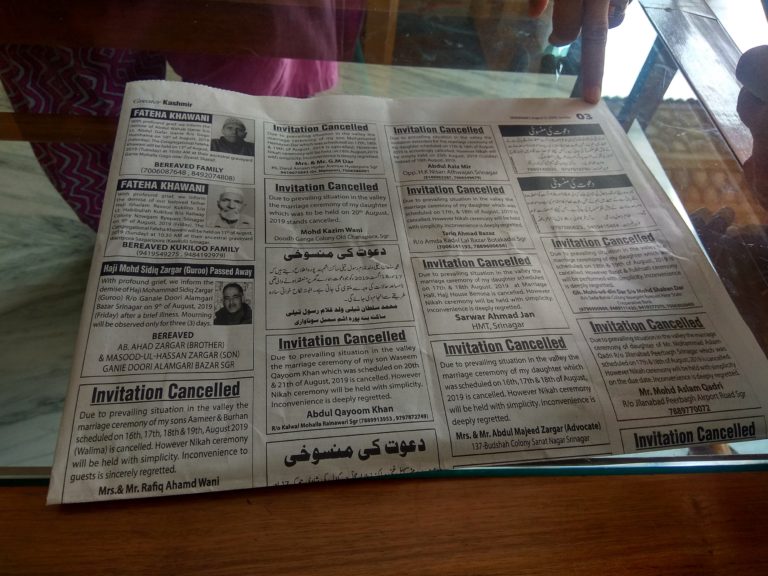
Invitations cancelled I Image courtesy Kavita Krishnan
-
Between 5-9 August, people had suffered for lack of food, milk, and basic needs. People had been prevented even from going to hospitals in case of sickness.
-
The Government claim is that only Section 144 has been imposed, not “curfew”. But in reality, police vans keep patrolling Srinagar warning people to “stay safe at home and not venture out during the curfew”, and tell shops to close their shutters. They demand that people display “curfew passes” to be allowed to move about.
-
All of Kashmir is under curfew. Even on Eid, the roads and bazaars were silent and desolate. All over Srinagar, mobility is restricted by concertina wires on streets, and massive paramilitary deployment. Even on Eid, this was the case. In many villages, azaan was prohibited by the paramilitary and people were forced to do namaaz prayers at home rather than collectively at the mosque as it usual on Eid.
-
In Anantnag, Shopian and Pampore (South Kashmir) on the day of Eid, we only saw very small kids dressed in Eid finery. Everyone else was in mourning. “We feel like we’re in jail”, said a woman in Guree (Anantnag). Girls in Nagbal (Shopian) said, “With our brothers in police or army custody, how can we celebrate Eid?”
-
On 11 August, on the eve of Eid, a woman at Sopore told us she had come to the bazaar during a brief respite in the curfew, to buy a few supplies for Eid. She said: “We were prisoners in our own homes for 7 days. Even today, shops are closed in my village Langet, so I came to Sopore town to shop for Eid and to check on my daughter who is a nursing student here.”
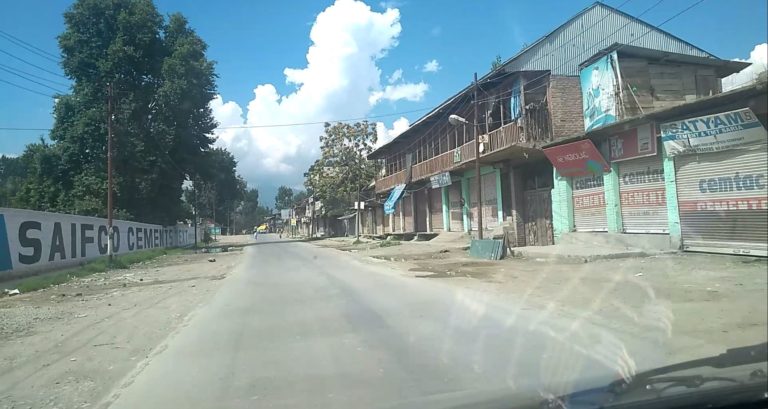
Eid in Pulwama | Image courtesy Kavita Krishnan
-
“It’s Army rule not Modi rule. There are more soldiers here than people”, said a young baker at Watpura near Bandipora. His friend added, “We’re afraid, because the army camp nearby keeps imposing impossible rules. They insist we have to return within half an hour if we leave home. If my kid isn’t well, and I have to take her to the hospital, it may take more than half an hour. If someone visits their daughter who lives in next village, they may take more than half hour to return. But if there’s any delay, they will harass us.” The CRPF paramilitary is everywhere, outside nearly every home in Kashmir. These are clearly not there to provide “security” to Kashmiris – on the contrary, their presence creates fear for the people.
-
Sheep traders and herders could be seen with unsold sheep and goats. Animals they had been rearing all year long, would not be sold. This meant they would incur a huge loss. With people unable to earn, many could not afford to buy animals for the Eid sacrifice.
-
A shopkeeper from Bijnore (UP) showed us the stacks of unsold sweets and delicacies going waste, since people could not buy them. Shops and bakeries wore a deserted look on the eve of Eid, with their perishable food items lying unsold.
-
An asthmatic auto driver in Srinagar, showed us his last remaining dose of salbutamol and asthalin. He had been trying for the past several days to buy more – but the chemists’ shops and hospitals in his area had run out of stocks. He could go to other, bigger hospitals – but CRPF would prevent him. He showed us the empty, crushed cover of one asthalin inhaler – when he told a CRPF man he needed to go further to get the medicine, the man stamped on the cover with his boot. “Why stamp on it? He hates us, that’s why”, said the auto driver.
Protests, Repression, and Brutality
-
Some 10,000 people protested in Soura (Srinagar) on 9 August. The forces responded with pellet gun fire, injuring several. We attempted to go to Soura on 10 August, but were stopped by a CRPF barricade. We did see young protestors on the road that day as well, blockading the road.
-
We met two victims of pellet gun injuries in SMHS hospital in Srinagar. The two young men (Waqar Ahmad and Wahid) had faces, arms and torso full of pellets. Their eyes were bloodshot and blinded. Waqar had a catheter in which the urine, red with blood from internal bleeding, could be seen. Their family members, weeping with grief and rage, told us that the two men had not been pelting stones. They had been peacefully protesting.
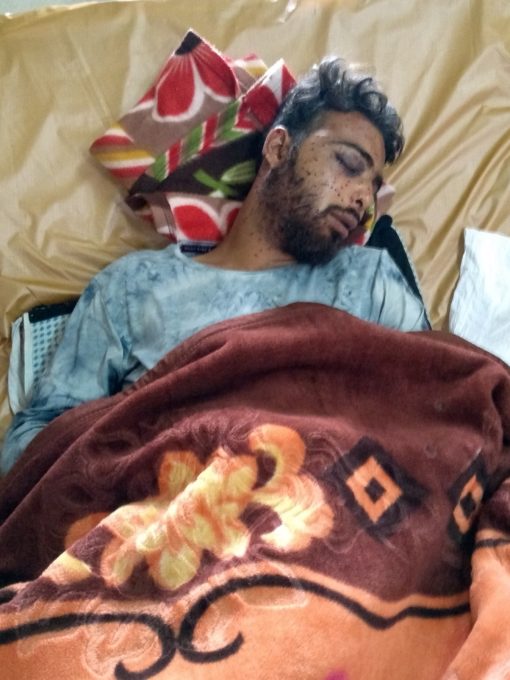
Pellet gun victim | Image courtesy Vimal Bhai
-
On 6 August, a graphic designer for the Rising Kashmir newspaper, Samir Ahmad, (in his early 20s) had remonstrated with a CRPF man near his home in the Manderbag area of Srinagar, asking him to allow an old man to pass. Later the same day, when Samir opened the door to his house, CRPF fired at him with a pellet gun, unprovoked. He got 172 pellets in his arm and face near the eyes, but his eyesight is safe. It is clear that the pellet guns are deliberately aimed at the face and eyes, and unarmed, peaceful civilians standing at their own front doors can be targets.
-
At least 600 political leaders and civil society activists are under arrest. There is no clear information on what laws are invoked to arrest them, or where they are being held.
-
A very large number of political leaders are under house arrest – it is impossible to ascertain how many. We tried to meet CPIM MLA Mohd Yusuf Tarigami – but were refused entry into his home in Srinagar, where he is being under house arrest.
-
In every village we visited, as well as in downtown Srinagar, there were very young schoolboys and teenagers who had been arbitrarily picked up by police or army/paramilitary and held in illegal detention. We met a 11-year-old boy in Pampore who had been held in a police station between 5 August and 11 August. He had been beaten up, and he said there were boys even younger than him in custody, from nearby villages.
-
Hundreds of boys and teens are being picked up from their beds in midnight raids. The only purpose of these raids is to create fear. Women and girls told us of molestation by armed forces during these raids. Parents feared meeting us and telling us about the “arrests” (abductions) of their boys. They are afraid of Public Security Act cases being filed. The other fear is that the boys may be “disappeared” – i.e killed in custody and dumped in mass graves of which Kashmir has a grim history. As one neighbour of an arrested boy said, “There is no record of these arrests. It is illegal detention. So if the boy “disappears” – i.e is killed in custody – the police/army can just say they never had him in custody in the first place.”
-
But the protests are not likely to stop. A young man at Sopore said: “Jitna zulm karenge, utna ham ubharenge” (The more you oppress us, the more we will rise up) A familiar refrain we heard at many places was: “Never mind if leaders are arrested. We don’t need leaders. As long as even a single Kashmiri baby is alive, we will struggle.”
The Gag On Media
-
A journalist told us: “Newspapers are printing in spite of everything. Without the internet, we do not get any feed from agencies. We were reduced to reporting the J&K related developments in Parliament, from NDTV! This is undeclared censorship. If Govt is giving internet and phone connectivity to police but not to media houses what does it mean? We had some people come to our offices, speaking on behalf of Army and CRPF, asking “Why are you publishing photos of the curfew-affected streets?”
-
Kashmiri TV channels are completely closed and unable to function.
-
Kashmiri newspapers that carry the barest mention of protests (such as the one on Soura) are made to feel the heat from the authorities.
-
Foreign press reporters told us that they are facing restrictions on their movement by the authorities. Also, because of the lack of internet, they are unable to communicate with their own main offices.
-
When we visited Press Enclave in Srinagar on 13 August, we found the newspaper offices closed and the area deserted except for a few stray journalists, and some CID men. One of the journalists told us that papers could not be printed till at least 17 August, because they have run out of newsprint which comes from Delhi.
-
As mentioned above, one graphic designer working with a newspaper suffered pellet gun injuries, during a completely unprovoked attack by CRPF
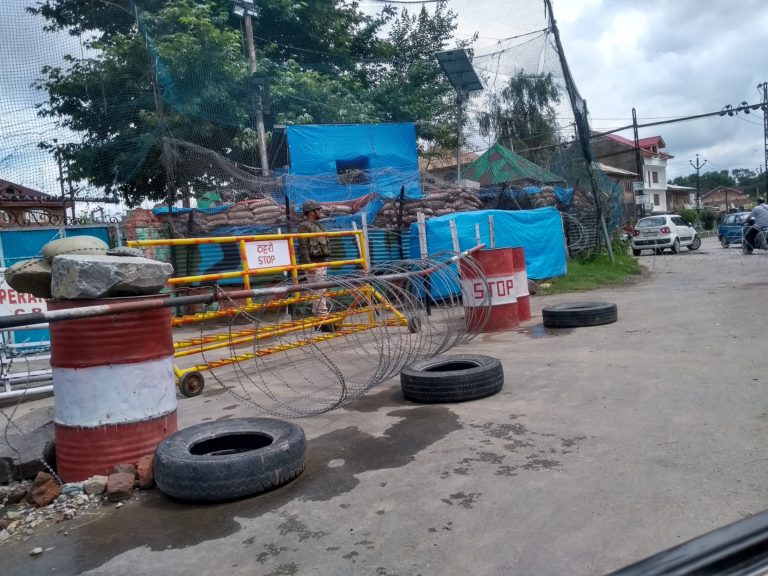
A checkpoint in Srinagar | Image courtesy Vimal Bhai
Does Kashmir Lack Development?
In an op-ed in the Times Of India (August 9, 2019), former Foreign Secretary and Ambassador Nirupama Rao wrote: “A young Kashmiri told this writer a few months ago her birthplace was in the “stone age”; that in terms of economic development, Kashmir was two hundred years behind the rest of India.”
We struggled to find this “backward”, “stone age” Kashmir anywhere at all.
-
It is striking how in every Kashmiri village, we found young men and women who go to college or University; speak Kashmiri, Hindi and English fluently; and are able to argue points of Constitutional and international law in relation to the Kashmir conflict with factual accuracy and erudition. All four of the team members are familiar with villages in North Indian states. This high level of education is extremely rare in any village in, say, Bihar, UP, MP, or Jharkhand.
-
The homes in rural Kashmir are all pucca constructions. We saw no shacks like the ones that are common in rural Bihar, UP, Jharkhand.
-
There are poor people in Kashmir, certainly. But the levels of destitution, starvation and abject poverty seen in many North Indian states, is simply absent in rural Kashmir.
-
We met migrant labourers from North India and West Bengal at many places. They told us that they feel safe and free from xenophobic violence that they face in, say, Maharashtra or Gujarat. Daily wage migrant labourers told us “Kashmir is our Dubai. We earn Rs 600 to Rs 800 per day here – that is three or four times what we earn in other states.”
-
We found Kashmir refreshingly free of communal tension or mob lynchings. We met Kashmiri pandits who told us they felt safe in Kashmir, and that the Kashmiris always celebrate their festivals together. “We celebrate Eid, Holi, Diwali together. That is our Kashmiriyat. It is something different, special,” said one Kashmiri Pandit young man.
-
The myth of the “backward” Kashmiri woman is perhaps the biggest lie. Kashmiri girls enjoy a high level of education. They are articulate and assertive. Of course, they face and resist patriarchy and gender discrimination in their societies. But does BJP, whose Haryana CM and Muzaffarnagar MLA speak of “getting Kashmiri brides” as though Kashmiri women are property to be looted, have any right to preach feminism to Kashmir? Kashmiri girls and women told us, “We are capable of fighting our own battles. We don’t want our oppressors to claim to liberate us!”
The BJP Spokesperson’s “Warning”
We met BJP spokesperson on Kashmir affairs, Ashwani Kumar Chrungoo at the office of Rising Kashmir, a Kashmir newspaper. The conversation was initially cordial. He told us he had come to Kashmir from Jammu to persuade people to support the abrogation of Article 370. His main argument was that since the BJP had won a 46% vote share in J&K and had won an unprecedented majority in Parliament, they had not only a right but a duty to keep their promise of scrapping Article 370. “46% vote share – that’s a license”, he said.
He refused to acknowledge that this 46% vote share while winning only three Lok Sabha seats (Jammu, Udhampur and Ladakh) was possible only because the voter turnout in the three other LS seats (Srinagar, Anantnag and Baramulla) was the lowest in the whole country.
Should a Government impose an unpopular decision on people of Kashmir who have not voted for that decision, at gunpoint? Chrungoo said, “In Bihar when Nitish Kumar imposed prohibition, he didn’t ask the alcoholics for their permission or consent. It’s the same here.” His contempt for the people of Kashmir was evident from this analogy.
Towards the end of the conversation, he became increasingly edgy when confronted by facts and arguments by us. He got up and wagged a finger at Jean Dreze, saying “We won’t let anti-nationals like you do your work here. I am warning you.”
Conclusion
The whole of Kashmir is, at the moment, a prison, under military control. The decisions taken by the Modi Government on J&K are immoral, unconstitutional and illegal. The means being adopted by the Modi Government to hold Kashmiris captive and suppress potential protests are also immoral, unconstitutional, and illegal.
-
We demand the immediate restoration of Articles 370 and 35A.
-
We assert that no decision about the status or future of J&K should be taken without the will of its people.
-
We demand that communications – including landline telephones, mobile phones and internet be restored with immediate effect.
-
We demand that the gags on the freedom of speech, expression and protest be lifted from J&K with immediate effect. The people of J&K are anguished – and they must be allowed to express their protest through media, social media, public gatherings and other peaceful means.
-
We demand that the gags on journalists in J&K be lifted immediately.
Jean Drèze, economist
Kavita Krishnan, Communist Party of India (Marxist-Leninist) and AIPWA
Maimoona Mollah, All India Democratic Women’s Association (AIDWA)
Vimal Bhai, National Alliance of People’s Movements (NAPM)
Baghdad Says it Will Down Any Vehicle Violating Iraqi Airspace After Depot Blast
Sputnik – August 16, 2019
Iraqi Prime Minister Adil Abd Mahdi, following a mysterious blast that hit a munitions depot in Baghdad, has ordered the air defences to immediately bring down any aerial vehicle that will violate the country’s airspace, the government’s press service said on Thursday.
The decision came after a blast hit the ammo depot in the Iraqi capital on Monday, leaving one civilian killed and dozens injured.
Though the causes of the explosion remain unknown, the incident has given rise to a number of theories, including that Israel might have been allegedly behind the airstrike on the depot belonging to the Iran-backed Popular Mobilization Forces.
“The prime minister ordered to revoke all special flight permits in Iraqi airspace for reconnaissance aircraft, reconnaissance aircraft with weapons, fighters, helicopters, unmanned aerial vehicles of all kinds available to the Iraqi and non-Iraqi sides”, the press service said following the Iraqi National Security Council meeting.
The council also ruled that flight permits would now be issued exclusively by the commander-in-chief of the Iraqi Armed Forces, i.e. Mahdi, or officials authorized by him.
“All authorities are required to comply with this order. Any flights that violate this regulation will be considered an aggression, which our air defence will immediately respond to”, the statement added.
It is noteworthy that the decision also comes amid the Turkish Air Force’s regular raids against the Kurdistan Workers Party’s positions in Iraq, which the latter has repeatedly slammed as an assault on its sovereignty.
Featured Video

Seyed M. Marandi: US-Iran War Inevitable: Kuwait and Bahrain May Fall
or go to
Aletho News Archives – Video-Images
From the Archives
Oil and the Israel Lobby
Reknowned economist M. Shahid Alam offers this excellent critique of Noam Chomsky’s defective analysis of the relative influence of Oil versus the Israel lobby over US foreign policy: … continue
Blog Roll
 Aletho News
- ICC ignored ‘very well-documented’ NATO crimes – ex-Libyan minister
- SNSC secretary dismisses US response to Iran’s conditions as ‘inadequate’
- Sanaa says Taiz roads open, secure for residents, warns Saudi forces
- Iraqi resistance group urges Saudi leadership to admit defeat, lift Yemen siege
- Trump’s Retreat: How Al-Aqsa Flood Took Down the US Empire
- Israel’s Military Actions in Lebanon Grossly Violate International Law — Lavrov
- Seyed M. Marandi: US-Iran War Inevitable: Kuwait and Bahrain May Fall
- Leaders Condemn Ansarallah Attack on Saudi Arabia While Ignoring Illegal War Against Yemen
- Leaked: Britain’s Covert Iraqi Psyops Network
- Yemeni Armed Forces Warn Airlines Against Using Saudi Airports, Exempt Mecca and Medina
- If Americans Knew
- How Israel Conquered the Latin American Right
- Agents search Rep. Omar’s Washington home in criminal probe as she vows she won’t ‘be silenced’
- “The Rule Was: ‘Shoot Everyone You See'”
- Israel goes ballistic over Nobel Laureate Navi Pillay
- U.S. May Join Yet Another Middle Eastern War — TCN
- Yellow Line moves again as Israel closes in on trapped Gazans – Daily Update
- Israeli Attacks Kill Seven Palestinians in Gaza Including Six-year-old Girl
- Gaza: Ceasefire Anniversary Marks Year of Failed Promises
- The American Conservative: Mike Huckabee Should Resign
- A C-Section in Shackles: A Palestinian Woman’s Harrowing Birth in Israeli Detention
- No Tricks Zone
- Germany’s Green Energy Debacle: High Energy Costs Force Kahla Porzellan to Close After 182 Years!
- New Study: 50 Years Of The Most Aggressive ‘Net Zero’ Policies Can Only Affect The Global Climate By 0.03°C
- US September “Heat” Was No Record…Many Records Set Decades Ago
- Latest European Green Energy Debacle; Portugal’s Largest Flagship Solar Park Insolvent!
- Green Energy Debacle: German Expert Professor Fritz Vahrenholt Warns Of Severe Economic And Social Consequences
- Two More Paleo Reconstructions Affirm Meters-Higher Sea Levels Across Ireland, Brazil 7000-6000 Years Ago
- New Study: Earth And Venus Surface Warmth Largely Explained By Convection And Lapse Rate, Not CO2 Or Radiation
- 2025 Nature Paper Claiming Worsening Global Drought Gets RETRACTED …Heavily Flawed
- New Study: ‘Global Drought Shows No Detectable Recent Acceleration Under Climate Warming’
- Economic Masterminds: German Socialists Suggest Taxing Productivity Gains Stemming From Using AI

