Long Before Epstein: Sex Traffickers & Spy Agencies
By Elizabeth Vos | Consortium News | August 23, 2019
The alleged use of sexual blackmail by spy agencies is hardly unique to the case of Jeffrey Epstein. Although the agencies involved as well as their alleged motivations and methods differ with each case, the crime of child trafficking with ties to intelligence agencies or those protected by them has been around for decades.
Some cases include the 1950s -1970s Kincora scandal and the 1981 Peter Hayman affair, both in the U.K.; and the Finders’ cult and the Franklin scandal in the U.S. in the late 1980s. Just as these cases did not end in convictions, the pedophile and accused child-trafficker Jeffrey Epstein remained at arms’ length for years.
“For almost two decades, for some nebulous reason, whether to do with ties to foreign intelligence, his billions of dollars, or his social connections, Epstein, whose alleged sexual sickness and horrific assaults on women without means or ability to protect themselves… remained untouchable,” journalist Vicky Ward wrote in The Daily Beast in July.
The protection of sex traffickers by intelligence agencies is especially interesting in the wake of Epstein’s death. Like others, Epstein had long been purported to have links with spy agencies. Such allegations documented by Whitney Webb in her multi-part series were recently published in Mintpress News.
Webb states that Epstein was the current face of an extensive system of abuse with ties to both organized crime and intelligence interests. She told CNLive! that: “According to Nigel Rosser, a British journalist who wrote in the Evening Standard in 2001, Epstein apparently for much of the 1990s claimed that he used to work for the CIA.”
Vicky Ward, who wrote on Epstein for Vanity Fair before his first arrest, and claimed the magazine killed one of her pieces after Epstein intervened with editor Graydon Carter, said in a Tweet that one of Epstein’s clients was Adnan Khashoggi, an arms dealer who was pivotal in the Iran Contra scandal and was on the Mossad (the Israeli intelligence agency) payroll. This was also noted in a book “By Way of Deception” by former Mossad agent Victor Ostrovsky.
A former Epstein friend reported in @Salon last week that Epstein claimed “he worked for governments to recover money looted by African dictators. Other times those dictators hired him to help them hide their stolen money.” https://t.co/pYkOlFGoyY
— Vicky Ward (@VickyPJWard) July 16, 2019
The Times of Israel reported that Epstein was an “active business partner with former prime minister Ehud Barak” until 2015, adding: “Barak formed a limited partnership company in Israel in 2015, called Sum (E.B.) to invest in a high-tech startup…. A large part of the money used by Sum to buy the start-up stock was supplied by Epstein.”
Webb wrote he “was a long-time friend of Barak, who has long-standing and deep ties to Israel’s intelligence community.” On the board of their company sat Pinchas Bukhris, a former commander of the IDF cyber unit 8200.
Epstein’s allegedly protected status was revealed by Alexander Acosta, the former U.S. attorney in Miami who gave Epstein an infamously lenient plea deal in 2007. Acosta, who was forced to resign as President Donald Trump’s labor secretary because of that deal, reportedly said of the case: “I was told Epstein ‘belonged to intelligence’ and to leave it alone.”
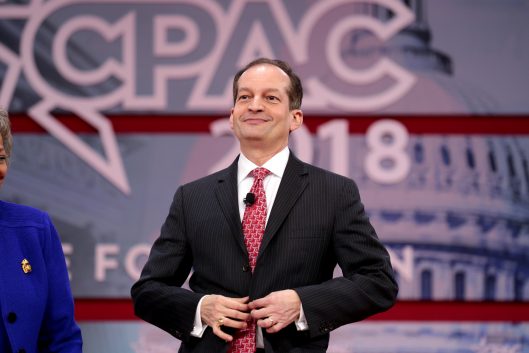
Alexander Acosta: “Told to leave it alone.” (Flickr/Gage Skidmore)
Kincora Boy’s Home
Several cases in the unsavory history linking intelligence agencies and sex scandals put the allegations against Epstein in context. Among these was the U.K. Kincora Boy’s Home, where at least 29 boys were reported to have been targeted at the Belfast, Northern Ireland, facility from the mid-1950s until the late 1970s, until it was shut in 1980. It also involved the alleged protection of child sexual abusers at the home and among their clients.
The Irish Times wrote that “destitute boys were systematically sodomised by members of Kincora staff and were supplied for abuse to prominent figures in unionist politics. The abusers – among them MPs, councillors, leading Orangemen and other influential individuals – became potentially important intelligence assets.”
The Belfast Telegraph also quoted former Labour Party MP Ken Livingstone, who said: “MI5 weren’t just aware of child abuse at Kincora Boys’ Home – they were monitoring it. They were getting pictures of a judge in one case, politicians, a lot of the establishment of Northern Ireland going in and abusing these boys.”
Three staff were eventually convicted of sexually abusing minors, which included the housemaster William McGrath, a loyalist “Orangeman” and allegedly an MI5 agent, according to the Belfast Telegraph in July 2014.
Although the U.K.’s Historical Institutional Abuse inquiry ultimately found “no credible evidence” to support the allegations, two former U.K. intelligence officers maintained their claim of MI5’s involvement: Brian Gemmell says he alerted MI5 to the abuse at Kincora and was told to stop his investigation; and a former army intelligence officer, Colin Wallace, “consistently claimed that MI5, RUC special branch and military intelligence knew about the abuse at Kincora and used it to blackmail the pedophile ring to spy on hardline loyalists,” according to The Guardian.
The Irish outlet, An Phoblacht, wrote: “The systematic abuse of young boys in the Home and the part played by the British intelligence organisations to keep the scandal under wraps ensured that one side of the murky world of Unionist paramilitarism and its links to the crown forces was kept out of the public domain for years.”
In the U.S., the New York State Select Committee On Crime in 1982 investigated nationwide networks of trafficking underage sex workers and producing child pornography. Dale Smith, a committee investigator, noted that call services using minors also profited from “sidelines,” besides the income from peddling prostitution. Smith said they sold information “on the sexual proclivities of the clients to agents of foreign intelligence.” Presumably, this information could be used to blackmail those in positions of power. Smith added that one call service sold information to “British and Israeli intelligence.”
The Hayman Affair
Another U.K. scandal included allegations that Sir Peter Hayman, a British diplomat and deputy director of MI6, was a member of the Pedophile Information Exchange (PIE).
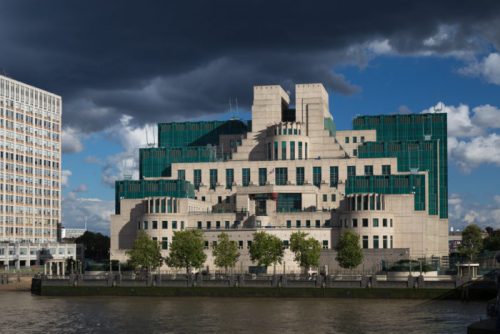
London headquarters of British Secret Intelligence Service.
(Laurie Nevay, CC BY-SA 2.0, Wikimedia Commons)
Police discovered that two of the roughly dozen pedophiles in his circle had been writing to each other about their interest in “the extreme sexual torture and murder of children,” according to the The Daily Mail.
In 2015, The Guardian reported that former Prime Minister Margaret Thatcher had been “adamant that officials should not publicly name” Hayman, “even after she had been fully briefed on his activities…. formerly secret papers released to the National Archives shows.”
Still, Hayman was unmasked as a subscriber to PIE in 1981 by M.P. Geoffrey Dickens, who also reportedly raised the national security risk of Hayman’s proclivities, implying they were a potential source of blackmail sought by intelligence agencies.
The British tabloid The Mirror reported that intelligence agencies, including the KGB and CIA, kept their own dossiers on U.K. establishment figures involved with PIE and the abuse of minors, to blackmail the targets in exchange for information.
Hayman was never charged for his association with PIE: The U.K. attorney general at the time, Sir Michael Havers, defended the decision and denied claims that Heyman was given special treatment.
Labour Party MP Barbara Castle allegedly gave a dossier she compiled on pedophiles in positions of power to U.K. journalist Don Hale in 1984 when he was editor of the Brury Messenger. Hale alleged that soon afterward, police from the “Special Branch, the division responsible for matters of national security,” raided his office and removed the Castle dossier. They then threatened him with a “D-notice,” which prevented him from publishing the story on the threat of up to 10 years in prison.
The Finders Cult
Another group accused of trafficking children, which had links to intelligence agencies, was the “Finders” cult. In 1987, The Washington Post reported that two members were arrested in connection with the alleged abuse of six children. Investigators found materials in Madison County, Virginia, which they said linked to a “commune called the Finders.”
Besides nude photographs of children, a Customs Service memo written by special agent Ramon Martinez refers to files “relating to the activities of the organization in different parts of the world, including “London, Germany, the Bahamas, Japan, Hong Kong, Malaysia, Africa, Costa Rica, and Europe.”
Martinez’s memo notes that a Finders’ telex ordered the purchase of two children in Hong Kong. Another expressed interest in “bank secrecy situations.” The memo also documents high-tech transfers to the U.K., numerous properties under the Finders’ control, the group’s interest in terrorism, explosives, and the evasion of law enforcement.
Martinez describes the swift end to his investigation. He wrote that on April 12, 1987, he arrived at the Metropolitan Police Department and was told that all the data was turned over to the State Department which, in turn, advised MPD that “all travel and use of passports by the holders was within the law and no action would be taken. Then he was told that the investigation into the Finders had become a CIA internal matter. The MPD report was classified, not available for review” and “No further action will be taken.”
Martinez was not the only person with unanswered questions. The U.S.News & World Report wrote that N. Carolina Rep. Charlie Rose (Dem.), chair of the House Administration Committee, and Florida’s Rep. Tom Lewis (Rep.) asked “Could our own government have something to do with this Finders organization and turned their backs on these children? That’s what the evidence points to,” says Lewis, adding that “I can tell you that we’ve got a lot of people scrambling, and that wouldn’t be happening if there was nothing here.”
The leniency shown by the State Department and the fact that the CIA would designate the investigation of the Finders group as “an internal matter” raises serious questions. What motive might have driven the CIA to associate with or protect a child abuse ring?

Harry S. Truman State Department building. (Paco8191, CC BY 3.0, Wikimedia Commons)
The Franklin Scandal
The Franklin Scandal erupted in 1988, centering on a child-trafficking ring operating in Omaha, Nebraska, by Lawrence E. King Jr., a former vice chairman of the National Black Republican Council: It was alleged that children were provided to politicians in Washington, D.C., and elsewhere, among other illegal activities.
The late former state Sen. John Decamp alleged in his book “The Franklin Coverup” that a special committee of the Nebraska Legislature launched a probe to investigate the affair, which involved King being indicted for embezzling money from the Franklin Credit Union. The committee hired former Lincoln, Nebraska, police officer Jerry Lowe, whose reports suggested that King was involved in “guns and money transfers to Nicaragua,” and was linked with the CIA.
James Flanery, an investigative reporter at The World Herald who reported on the scandal, told associates that King was “running guns and money into Nicaragua,” and that the CIA was heavily involved.”
Like many scandals before and since, the Franklin case ended with no prosecution of the perpetrators. However, Paul Bonacci, one of the alleged victims, was indicted for perjury. He had alleged that he was sexually abused as a minor in Nebraska and around the country where he was flown by Lawrence King.
In 1999, the Omaha World Herald reported Bonacci was awarded $1 million in damages due to his lawsuit against King and other alleged perpetrators. Decamp, who was Bonacci’s attorney, told the newspaper “Obviously, you don’t award $1 million if you don’t think he (Bonacci) was telling the truth.”
Given the history of child trafficking rings that were allegedly connected with or enjoyed the protection of intelligence services, it is possible that similar claims about Jeffrey Epstein are something the authorities, though unlikely given these other instances, should investigate.
Elizabeth Vos is a freelance reporter and regular contributor to Consortium News.
West Bank IED Attack Kills And Injures Israelis- A Closer Look
By Robert Inlakesh | 21st Century Wire | August 23, 2019
Earlier this Friday morning an IED attack, conducted inside the occupied West Bank, killed one Israeli and injured two others.
The incident has been blamed on unidentified Palestinians, who were said to have planted the IED the night prior to the incident, before detonating it upon the arrival of the Israeli settlers to the location.
The attack took place at the site of the Ein Buben Spring, located in between the Palestinian village of Deir Ibzi and the illegal Israeli settlement of Douleb.
A female Israeli has been confirmed dead, with two men injured, one currently on life support in critical condition and the other suffering moderate wounds. The three Israelis had originated from Lod – formerly the Palestinian towns of Lydda and Ramle – and had reportedly been visiting the spring, entering it from the ever expanding neighboring settlement.
As usual, the Israeli and Western press are treating this incident as if it has no link to anything occurring in the area prior to the attack.
Back in 2017 I lived in the occupied West Bank and visited the spring of Deir Ibzi many times. I remember being driven there with Palestinians friends to hang out. The first time I went I was confronted by Israeli soldiers who stopped our car and pointed guns in our faces and continued to linger in the area, watching us, for hours after the incident.
Another time I had visited, we had to quickly leave as armed settlers emerged over the hills and were heading in our direction.
I was told by people in the village of Deir Ibzi, that they fear the day when the Israelis will completely take the site for themselves.
The site, of course being home to a fresh water spring, has been a part the lives of those living in Deir Ibzi and the neighboring villages for generations. Until now, there has been no violent resistance like this recent attack, despite the illegal settlement expansion on the area and the violent forcing of the native population from their land.
Israel considers of all the West Bank as simply being part of Israel and call the land Judea and Sumaria. To Israel, there are no illegal settlers or illegal land grabs, they simply consider their actions as being reasonable expansion on God given Jewish land.
The eldest of the Israelis injured in the attack, currently being treated in Hadassah Hospital in Jerusalem, is a Rabbi and was reported to be a decorated occupation force veteran.
Due to the constant Israeli settler and occupation force attacks upon Palestinians, in the West Bank, as well as a rise in attacks upon the Al-Aqsa compound in Jerusalem, we now see a string of violent attacks against Israeli soldiers and settlers in the West Bank.
This year so far, approximately 100 Palestinians have been killed by Israeli forces and with the lack of action from the international community, to end the violations of international law, the siege, the occupation etc. Palestinians now have their backs to the wall.
No peace talks or peaceful demonstrations have worked. So now, due to the lack of action taken for the Palestinians, the Palestinian people are resulting to the last and only option left for them, violent resistance.
The mainstream media will paint these attacks as horrid terrorist incidents, but the reality is, this is what happens when a people have no other options.
Today, according to the Gaza Health Ministry, 152 Palestinians were injured in Gaza’s Great Return March protests, 60 were shot with live ammunition. Over 310 Palestinians have been killed in these marches since the 30th of March, 2018, with around 40,000 people being injured. So why aren’t these acts of mass murdered labelled terrorism? Are only Arabs and Muslims able to commit a terrorist act, should this perhaps be the new definition for the word?
Under international law, the Palestinian people reserve the right to armed resistance. So why is it always a terrorist attack, in the eyes of the so-called objective mainstream media, when a Palestinian decides to resist? And why isn’t Israeli settler terrorism reported as such, when 6 year old Palestinians are run down and murdered by Israeli religious fanatics?
***
Author Robert Inlakesh is a special contributor to 21WIRE and European correspondent for Press TV. He has reported from on the ground in occupied Palestine.
Israel tech ‘facilitating press freedom abuses around the world’
MEMO | August 23, 2019
Israel has been charged with enabling attacks on media freedom around the world by the Committee to Protect Journalists (CPJ), after export controls on surveillance technology were eased.
Citing a Reuters report, CPJ noted that Israeli officials have confirmed that – thanks to a rule change by the Defence Ministry – Israeli surveillance companies “are able to obtain exemptions on marketing license for the sale of some products to certain countries”.
According to Reuters, “the change took effect about a year ago”.
CPJ stated that:
Israeli-exported technology undermines press freedom globally by allowing authorities to track reporters and potentially identify their sources.
One example given by the press freedom watchdog was the Mexican government deploying Pegasus malware, sold by Israeli firm NSO Group, to infiltrate the mobile phones “of at least nine journalists”.
Pegasus was also used by Saudi Arabia to spy on the associates of journalist Jamal Khashoggi before he was murdered in the kingdom’s consulate in Turkey in October last year.
“Over and over again, we see Israeli technology facilitating press freedom abuses around the world, by lending a hand to governments that want to track and monitor reporters,” said CPJ Advocacy Director Courtney Radsch in Washington, D.C.
“An unregulated surveillance industry is bad for press freedom. The Israeli government should heed the UN Special Rapporteur’s call to respect human rights in its export policies.”
UN Special Rapporteur for Freedom of Expression David Kaye described Israel as “a major player in the surveillance technology market” in a June 2019 report which urged “a global moratorium on such exports until a human rights compliant regime was put in place”.
Israeli cluster bomb from 2006 war kills Lebanese man in south
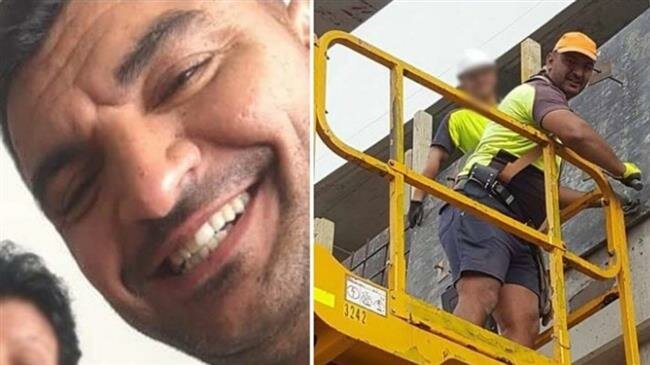
Ali Nehme Hamzeh, who was killed on August 22, 2019 in an explosion of an Israeli cluster bomb left over from the 2006 war on Lebanon. (Photo by National News Agency)
Press TV – August 22, 2019
A young Palestinian man has lost his life when a cluster bomb dropped during Israel’s military aggression against Lebanon in the summer of 2006 detonated in the country’s south.
Lebanon’s official National News Agency reported that the man, identified as Ali Nehme Hamzeh, was working on a bulldozer in a field near the village of Majdal Selm on Thursday, when the bomb exploded.
He was taken to the nearby Tibnin Governmental Hospital, but succumbed to his wounds.
Southern Lebanon is littered with hundreds of unexploded Israeli cluster bombs, and the Lebanese army together with the UN and other international organizations are working to purge the area of the deadly ordnance.
According to the United Nations, the Israeli army dropped some four million cluster bombs on Lebanon during the July-August 2006 war, mostly during the last 48 hours of the conflict.
More than 400 people, 90 percent of them civilians and a third under the age of 18, have been killed by the munitions, while dozens more have been maimed.
Cluster bombs are a type of explosive weapons that blow up in the air and scatter dozens of sub-munitions over a large area.
Cluster munitions are banned in most countries due to the indiscriminate nature of the weapons.
About 1,200 Lebanese, most of them civilians, lost their lives during Israel’s 33-day war on Lebanon back in the summer of 2006.
According to a 629-page report of the Winograd Commission, appointed by the Israeli regime itself, Hezbollah fighters involved in defending Lebanon against the Israeli war defeated the enemy, and Tel Aviv was compelled to withdraw without having achieved any of its objectives.
The Winograd Commission was set by former Israeli prime minister Ehud Olmert in September 2006 to examine the events during Israel’s 33-day war on Lebanon. It was chaired by retired judge Eliyahu Winograd.
The commission was formed in the wake of public criticism and protest over the fact that the Israeli military had effectively lost the war by failing to achieve its aim of freeing two soldiers captured by Hezbollah fighters.
UN Security Council Resolution 1701, which brokered a ceasefire in the 2006 war, calls on Israel to respect Lebanon’s sovereignty and territorial integrity.
US officials confirm Israel behind Iraq air strikes
MEMO | August 23, 2019
US officials have confirmed that Israel was behind recent airstrikes on alleged weapons depots in Iraq, which were ostensibly being used by Iran to transfer arms to Syria.
Senior US officials yesterday told the New York Times that Israel has carried out “several strikes [in Iraq] in recent days”, the most recent of which took place on Monday near the Balad Airbase, north of Iraqi capital Baghdad.
The US-based newspaper also quoted a “senior Middle Eastern intelligence official” who said that Israel had struck a separate base north of Baghdad on 19 July. The official claimed that the base was being used by Iran’s Revolutionary Guards Corp (IRGC) to transfer weapons to Syria, where Iranian-backed groups are engaged in the country’s protracted civil war.
He added that a “cargo of guided missiles with a range of 125 miles” was destroyed during the attack.
The same official also revealed that the 19 July strike was launched from “within Iraq”, raising questions as to how Israeli aircraft were based in a country with which they currently have no formal diplomatic relations.
The US officials’ comments confirm weeks of speculation that Israel was responsible for the multiple attacks on Iraqi targets which have taken place in recent months.
In the past three months, four attacks on weapons depots have taken place. Three of these bases were being used by the Popular Mobilisation Forces (PMF), an umbrella organisation of Shia paramilitary groups technically under the authority of the Iraqi Security Forces, though many operate semi-autonomously.
Meanwhile the fourth was being used by Iraq’s federal police, the New York Times explained.
On Wednesday the PMF blamed the US and Israel for attacking its bases in Iraq, saying in a statement that the US had allowed four Israeli drones to enter Iraq. The statement added that the group has “accurate information” which proves the US brought the Israeli drones into Iraqi territory to work as part of the US fleet stationed in the country.
The US Pentagon, however, strenuously denied its involvement in the affair, dismissing the PMF’s statement entirely.
Israeli Prime Minister Benjamin Netanyahu further added to speculation of US-Israeli involvement yesterday, saying that he had given the armed forces a “free hand” to deal with the alleged Iranian threat.
In an interview with Israel’s Russian-language outlet Channel 9, Netanyahu was asked whether Israel would operate against Iranian targets in Iraq if needed. The prime minister replied: “We are operating – not just if needed, we are operating in many areas against a state that wants to annihilate us. Of course, I gave the security forces a free hand and instructed them to do anything necessary to thwart Iran’s plans.”
The attacks represent a new front for Israel, having previously focused on targeting Iranian positions in Syria. Though Israel has maintained an official policy of non-intervention in the Syrian civil war and often remained silent in the face of air strike accusations, in January then Chief of Staff of the Israeli army Gadi Eisenkot admitted Israel had in fact struck Syria “thousands of times”.
Israel’s military intelligence threatened in February to expand its operations to Iraq, claiming “Iran may use Iraq as a launching pad to target Israel” after its positions in Syria were destroyed. This, Israel claimed, “would call for a response from Tel Aviv”. US President Donald Trump also expressed similar ideas, telling American news station CBS that he would keep US personnel in Iraq to “keep an eye” on Iran.
Former Iraqi prime minister Haider Al-Abadi slammed these suggestions, stressing that “Iraqi sovereignty must be respected [since] we are not proxies in conflicts outside the interests of our nation”. Iraq’s President Barham Salih echoed this sentiment, calling on the US not to pursue its own policy priorities because “we live here”.
READ ALSO:
Epstein: The Maxwell Connection
By George Galloway | RT | August 21, 2019
As Jeffrey Epstein’s accomplice Ghislaine Maxwell appears to have fallen off the face of the Earth, it’s little remembered in the media how I fought a long war against her father Robert and the part I played in his downfall.
It would be scarcely worth recalling at this distance if it did not shed light, or rather a cloud of suspicion, over Maxwell’s favourite child Ghislaine, now at the centre of a dark and fascinating story as bizarre as any which enveloped her late father.
I first met Robert Maxwell when he was an enormously powerful and fiercely intimidating media mogul in the early 1980s. It was in the green room of the BBC’s then flagship program Question Time, hosted by Sir Robin Day – then the doyen of BBC grandees.
“Ah, Mr Galway (sic),” boomed Mr Maxwell, “the PLO man.” At which point he punched me so hard in the solar plexus I doubled over, tears in my eyes. As was the wont of the British establishment at the time, my fellow participants and Sir Robin himself averted their eyes and pretended not to see.
At the time and for nearly a decade, I was closely associated with the then-British satirical magazine Private Eye, writing regularly and providing stories and leads for others, regularly attending the legendary Private Eye lunches at the Soho waterie The Coach and Horses, presided over by the founder and editor of the magazine, Richard Ingrams.
About a year after Maxwell striking his first blow, I submitted a story to Private Eye which, embellished by others, was published and upon which he sued and fought an epic court battle with us. He won.
Although the editor Richard Ingrams spent a night in the cells for refusing to name me as the source, it was soon obvious to Maxwell that it was me and we began a war of attrition which lasted until his death.
In October of 1991, the Pulitzer Prize-winning author and celebrity journalist Seymour Hersh caused to be delivered to my home late one Saturday night a file of papers, a synopsis of a book he had written in which he made serious allegations against Maxwell. So fearsome was Maxwell’s power at the time, he had obtained pre-publication injunctions against anyone publishing any word of it, against anyone printing it, against anyone distributing it, against anyone selling it. In Britain, the Hersh book did not exist.
But I – as a member of the British Parliament – enjoyed the ancient right of legal privilege on anything I said in the Parliament or published on the Order Paper. Moreover, so could anyone else reporting fairly anything I said or wrote there. And so I did.
Inter-alia I accused Maxwell of being a thief, of stealing his own employee’s pension funds, of being an agent of the Israeli intelligence service Mossad, and of betraying the whereabouts in London of the brave Israeli Jewish whistleblower Mordechai Vanunu, causing him to be kidnapped, drugged, and delivered, his jaws wired like Hannibal Lector to ensure his silence, to Israel where he eventually served decades in solitary confinement and even now is not free to talk or travel.
My allegations exploded like a nuclear bomb in the life of Robert Maxwell.
He ordered his journalistic minions (whose pensions he had stolen) to “Piss all over Galloway” and micturate they promptly did.
On the front page of all SIX of his national newspapers, they called me “a jackal” of “scavenging in the dung-heap” a “friend of Arab terrorists” (“Ah, Mr Galway (sic) the PLO man”) and above all of having lied and lied about their proprietor.
Within weeks, the missing pensions were exposed, Maxwell was dead, having fallen, jumped, or been pushed off the back of his yacht – the Lady Ghislaine – off the Canary islands, and Maxwell was given a full Israeli-state funeral on the Mount of Olives presided over by the Israeli president, prime minister and no less than seven former and serving heads of the Mossad. In the eulogy, tribute was paid to the “extraordinary service” Mr Maxwell had given to Israel. The full story of which exact “services” he had provided were buried with him in Jerusalem.
The fateful yacht was called the Lady Ghislaine because his daughter was his favourite child (other daughters were available) and she was his favourite child for a reason. Of all her siblings, Ghislaine Maxwell was the one who was most like him.
Ghislaine Maxwell’s father’s body was lost to the deep and murky waters of international intrigue. Where she will turn up is as yet unknown. What “extraordinary service” she performed and for whom equally remains to be seen.
Lindsey Graham’s Blank Check. Why a Defense Agreement With Israel Would Be a Disaster for Americans
By Philip Giraldi | Strategic Culture Foundation | August 22, 2019
Two world wars began because of unconditional pledges made by one country to come to assistance of another. On July 5, 1914, Kaiser Wilhelm II of Germany pledged his country’s complete support for whatever response Austria-Hungary would choose to make against Serbia after the June 28th assassination of Archduke Franz Ferdinand of Austria by a Serbian nationalist during an official visit to Sarajevo, Bosnia. This fatal error went down in history as Germany’s carte blanche or “blank check,” assurance to Austria that led directly to WW I.
In September 1939, World War II began when Great Britain and France came to the assistance of Poland after the German Army invaded, fulfilling a “guarantee” made in March of that year. What was a regional war, and one that might have been resolved through diplomacy, became global.
One would think that after such commitments were assessed by historians as the immediate causes of two world wars, no one would ever consider going down that road again. But that would be reckoning without Republican Senator Lindsey Graham who has been calling for a “defense treaty” with Israel since last April. In his most recent foray, Graham announced late in July that he is seeking bipartisan support for providing “blank check” assurances to Israeli Prime Minister Benjamin Netanyahu and is hoping to be able to push a complete defense treaty through the Senate by next year.
In making his several announcements on the subject, Graham has been acting as a front man for both Israeli Prime Minister Benjamin Netanyahu and also for The Jewish Institute for the National Security of America (JINSA), which wrote the basic document that is being used to promote the treaty and then enlisted Graham to obtain congressional support.
Speaking to the press on a JINSA conference call, Graham said the proposed agreement would be a treaty that would protect Israel in case of an attack that constituted an “existential threat”. Citing Iran as an example, Graham said the pact would be an attempt to deter hostile neighbors like the Iranians who might use weapons of mass destruction against Israel. JINSA President Michael Makovsky elaborated on this, saying, “A mutual defense pact has a value in not only deterring but might also mitigate a retaliatory strike by an adversary of Israel, so it might mitigate an Iranian response (to an attack on its nuclear facilities).”
JINSA director of foreign policy Jonathan Ruhe added that “An Israeli strike on Iran’s nuclear program would not activate this pact, but a major Iranian retaliation might. – An Israeli unilateral attack is not what the treaty covers, but rather massive Iranian retaliation is what we are addressing.”
Israel has long been reluctant to enter into any actual treaty arrangement with the United States because it might limit its options and restrain its aggressive pattern of military incursions. In that regard, the Graham-JINSA proposal is particularly dangerous as it effectively permits Israel to be interventionist with a guarantee that Washington will not seek to limit Netanyahu’s “options.” And, even though the treaty is reciprocal, there is no chance that Israel will ever be called upon to do anything to defend the United States, so it is as one-sided as most arrangements with the Jewish state tend to be.
As the agreement between the two countries would be a treaty ratified by the Senate, it would be much more difficult to scrap by subsequent administrations than was the Iran nuclear deal, which was an executive action by President Obama. And clearly the statements by Graham, Makovsky and Ruhe reveal this treaty would serve as a green light for an Israeli attack on Iran, should they opt to do so, while also serving as a red light to Tehran vis-à-vis an ironclad US commitment to “defend” Israel that would serve to discourage any serious Iranian retaliation. Given that dynamic, the treaty would be little more than a one-way security guarantee from Washington to Jerusalem.
Furthermore, in outlining what circumstances would trigger US intervention on Israel’s behalf, the JINSA/Graham document cites, inter alia, “the threat or use of weapons of mass destruction.” It also allows Netanyahu to call for assistance after defining as threatening any incident or development “that gives rise to an urgent request from the Government of Israel.” It appears then that Netanyahu could demand that the US attack Iran should he only perceive a threat, however vague that threat might in reality be.
Israeli Prime Minister Benjamin Netanyahu has been claiming Iran is “three to five years” and “possibly weeks” away from a nuclear weapons capability since 1992 and pushing Washington to attack Iran so he obviously would welcome such a treaty for strategic reasons as well as to shore up his upcoming re-election bid. President Trump, with whom Graham has discussed how the agreement would work, has a similar interest in appearing strong for Israel to help his own campaign in 2020.
It is worth noting that in 2010 Netanyahu ordered the Israel Defense Force (IDF) to prepare to strike Iran but ‘Israel’s security chiefs refused: Gabi Ashkenazi, the head of the IDF, and Meir Dagan, the head of the Mossad at the time, believed that Netanyahu and the Defense Minister Ehud Barak were trying to “steal a war” and the order was not carried out. The attacks were also rejected by two ministers, Moshe Yaalon and Yuval Steinitz, which left Netanyahu without the necessary majority to proceed.
Ashkenazi claimed in a 2012 interview about the episode that he was convinced that an attack would have been a major strategic mistake. Meir Dagan said in 2012, after leaving his role as Mossad chief, that a strike would be “a stupid thing” as the entire region would undoubtedly be destabilized, requiring repeated Israeli and American interventions.
And there are other issues arising from a “defense treaty.” Defense means just that and treaties are generally designed to protect a country within its own borders. Israel has no defined borders as it is both expansionistic and illegally occupying Palestinian land, so the United States would in effect be obligated to defend space that Israel defines as its own. That could mean almost anything. Israel is currently bombing Syria almost daily even though it is not at war with Damascus. If Syria were to strike back and Graham’s treaty were in place, Washington would technically be obligated to come to Israel’s assistance. A similar situation prevails with Lebanon and there are also reports that Israel is bombing alleged Iranian supply lines in Iraq, where the US has 5,000 troops stationed.
The real problem is that the Trump administration is obsessed with regime change in Iran, but it has so far been unable to provoke Iran into starting a conflict. Graham’s proposed treaty just might be part of a White House plan to end-run Congress and public opinion by enabling Israel to start the desired war, whereupon the US would quickly follow in to “defend Israel,” obliged by treaty to do so. What could possibly go wrong? The correct answer is “everything.”
How Israel’s Labor Engineered the Illegal Jewish Colonies in Palestine
By Ramzy Baroud | MEMO | August 22, 2019
Following the Israeli victory in the 1967 war, it became impossible for Zionist ideologues to mask the true nature of their state – an unwavering colonial regime with an expansionist agenda.
While Zionism was undoubtedly a colonial enterprise from the onset, many Zionists refused to perceive themselves as colonists. “Cultural Zionists”, “Reform Zionists” and Labor Zionists” advocated similar political agendas to “Revisionist” and other extreme forms of Zionism. When put to the test, the difference between left and right Zionism proved mere ideological semantics. Both groups laboured to sustain the same cognitive dissonance – victims in search of a homeland and colonists with a racist, violent agenda.
That self-serving intellectual paradigm remains effective to date, most delineated in the supposedly conflicting political discourses of the Israeli rightwing parties (Likud, and other religious and far-right nationalist parties) and the ‘left’ (Labor and others). For Palestinians, however, both political streams are two sides of the same coin.
After the decisive Israeli victory in the war of June 1967, Jewish nationalism took on a new meaning. Israel’s ‘invincible army’ was born, and even cynical Jews began to view Israel as a victorious state, which was now a regional, if not international force to be reckoned with. Equally important, it was Israel’s so-called ‘left’ and other ‘soft-Zionists’ who fully engineered that most reprehensible period in history.
The Israeli occupation of Sinai, the Golan Heights, East Jerusalem, the West Bank and Gaza, and the destruction of the combined armies of Egypt, Syria and Jordan, thrilled most Israelis, encouraging many to develop an imperial outlook and wholly embrace a colonial project based on a conviction that their army was the strongest in the Middle East. The same expansionist instincts helped to sanctify the Zionist principle that ‘never again should Eretz-Yisrael be divided’.
In fact, as Professor Ehud Sprinzak argued (as cited in Nur Masalha’s book “Imperial Israel and the Palestinians: The Politics of Expansion”), following the Israeli victory in 1967, the concept of imperial expansion, and the rejection of the ‘division’ of Eretz-Yisrael became a “most energetic and influential tenet in modern Zionism”. Regardless of whether Israel fully anticipated such massive territorial expansion or not, the country seemed determined to quickly fortify its gains, rebuffing any call for a return to the armistice lines of 1949.
Although religious Jews were intoxicated by the idea that biblical “Judea and Samaria” ‘returned’ to its long-estranged owners, the first movement to capitalise on the territorial gains was, in fact, a secular elite organisation named the Movement for the Whole Land of Israel (WLIM).
The official founding conference of WLIM was held shortly after Israel’s victory. Although founded and dominated by Labor party activists, WLIM cut across party lines and ideological divides, united in their determination to preserve all of Palestine, as all of Israel. As for the unwanted population, those who were not expelled were to be duly subdued.
As Egypt and other Arab countries decried their ill-fated war, Palestine was completely taken over making Palestinians captives in their own land. Just as Israel celebrated its victory over official Arab armies, Israeli soldiers filmed themselves grinning and flashing victory signs at the so-called “Western Wall”, as well as in and around Arab Jerusalem’s holy sites. Palestinians still braced themselves for the worst.
Indeed, as Baruch Kimmerling writes in his book “The Palestinian People: A History”, that “was the moment in Palestinian history most bereft of hope”, Palestinian refugees who dreamed of returning to pre-1948 Palestine faced a momentous setback, a new Nakba, indeed, for the refugee problem was now exasperated and compounded by the war and the creation of 400,000 new refugees. Israeli bulldozers promptly moved into many parts of the newly conquered Palestinian territories – as they did in other occupied Arab lands – demolishing historical realities, and constructing new ones, as it does today.
![An elderly Palestinian and a child during the Nakba [Hanini/Wikipedia]](https://i1.wp.com/www.middleeastmonitor.com/wp-content/uploads/2018/11/2018-10-6_nakbaOldman_girl_nakba.jpg?resize=933.5%2C622&quality=75&strip=all&ssl=1)
An elderly Palestinian and a child can be seen during the Nakba [Hanini/Wikipedia]
Shortly after the war, Israel sought to fortify its occupation, firstly by rejecting peace overtures made by Egypt’s new president, Anwar Sadat, starting as early as 1971, and secondly, by unleashing settlement construction throughout the West Bank and Gaza.
The early settlements had strategic military purposes, for the intent was to create sufficient facts on the ground to alter the nature of any future peace settlement; hence, the Allon plan, named after Yigal Allon, a former general and Labor party minister in the Israeli government who took on the task of drawing an Israeli vision for the newly conquered Palestinian territories.
The plan sought to annex more than 30 per cent of the West Bank and all of Gaza for “security purposes”. It stipulated the establishment of a “security corridor” along the Jordan River as well outside the “Green Line,” a one-sided Israeli demarcation of its borders with the West Bank. The plan envisioned the incorporation of the Gaza Strip into Israel and was meant to return parts of the West Bank to Jordan as a first step toward implementing the “Jordanian option” for Palestinian refugees, i.e. ethnic cleansing coupled with the creation of an ‘alternative homeland’ for Palestinians.
The plan failed, but not in entirety. Palestinian nationalists ensured that no alternative homeland was ever to be realised, but the seizure, ethnic cleansing and annexation of occupied land was a resounding success. What was also important and consequential is that the Allon plan provided an unmistakable signal that the Labor government of Israel had every intention of retaining at least large parts of the West Bank and all of Gaza, and had no intention of honouring United Nations Security Council Resolution 242.
To capitalise on the government’s alluring settlement policies in the West Bank, a group of religious Jews rented a hotel in the Palestinian town of Hebron (Al-Khalil) to spend Passover at the “Cave of the Patriarchs”, and simply refused to leave. This sparked the biblical passion of orthodox religious Israelis across the country who referred to the West Bank by its biblical designation, Judea and Samaria. Their move also ignited the ire of Palestinians who watched in complete dismay as their land was conquered, renamed and later settled on by outsiders.
In 1970, to ‘diffuse’ the situation, the Israeli government constructed the Kiryat Arba settlement at the outskirt of the Arab city, which invited even more orthodox Jews to Hebron. Allon’s plan may have been intended for strategic purposes, but soon after, what was strategic and political, intermingled with what became religious and spiritual.
In the final analysis, Palestinians were losing their land at a rapid speed, a process that would lead to major Israeli population transfers, initially to occupied East Jerusalem – which was itself illegally annexed shortly after the 1967 war – and eventually, to the rest of the occupied territories. Over the years, the strategic settlement growth was complemented by the religiously motivated expansion, championed by a vibrant movement, exemplified in the founding of Gush Emunim (Bloc of the Faithful) in 1974. The movement was determined to settle the West Bank with legions of Jewish fundamentalists.
Allon’s plan also extended to include Gaza and Sinai. Allon wished to establish a “finger” of territories to serve as a buffer between Egypt and Gaza. ‘Buffer’ was in this context, a codename for illegal Jewish settlements and military outposts at the southern end of the Gaza Strip and adjacent areas of northern Sinai, a region that Israel dubbed the Rafiah Plain.
In early 1972, thousands of men, women and children, mostly Palestinian Bedouins, were driven from their homes in southern Gaza. Despite living in the area for generations, their presence was an obstacle before an Israeli army blueprint that would soon incorporate half of Gaza. They were evacuated without being permitted even to haul their possessions, however modest. The Israeli army claimed that ‘only’ 4,950 people were ethnically cleansed from the area. But the tribes’ leaders contended that more than 20,000 were forced from their homes and land.
Allon had then entrusted Ariel Sharon and other military leaders to break up the newly occupied territories into mini regions, infiltrated by strategic settlements and military bases to weaken local resistance and cement Israeli control.
“(Sharon) recounts standing on a dune (near Gaza) with cabinet ministers”, wrote Gershom Gorenberg, “explaining that along with military measures, to control the Strip, he wanted ‘fingers’ of settlement separating its cities, chopping the region in four. Another ‘finger’ would thrust through the edge of Sinai, helping create a ‘Jewish buffer zone between Gaza and Sinai to cut off the flow of weapons’ and divide the two regions in case the rest of Sinai was ever returned to Egypt.”
The rest is history. Although the demographic made up of the settlers largely shifted to the right in recent days, and their political influence on Tel Aviv increased exponentially, those settlers now numbering around 600,000 living in over 200 settlements, are the hideous creation of Israel’s ‘left’ with the full backing and support of the right, all serving the original cause of Zionism that remained true to its founding principles – a colonial movement that can only be sustained through violence and ethnic cleansing.
The Saker Interviews Professor Marandi

The Saker • Unz Review • August 22, 2019
Introduction: first, several friends recently suggested that that I should interview Professor Seyed Mohammad Marandi; then I read this most interesting text on Moon of Alabama and I decided to ask Professor Marandi to share his views of the current situation in Iran, the Persian Gulf and the rest of the Middle-East who very kindly agreed to reply to my question in spite of his most hectic and busy schedule. I am most grateful to Prof. Marandi for his time and replies. Crucially, Prof. Marandi debunks the silly notion that Russia and Israel are allies or working together. He also debunks that other canard about Russia and Iran having some major differences over Syria. Prof. Marandi, who is currently in Iran, is superbly connected and informed, and I hope that with this interview some of the more outlandish rumors which were recently circulated will finally be seen for what they are: utter, total, nonsense. Enjoy the interview!
The Saker: It is often said that there is an “axis of resistance” which comprises Syrian, Hezbollah, Iran, Russia and China. Sometimes, Venezuela, Cuba or the DPRK are added to this list. Do you believe that there is such an “axis of resistance” and, if yes, how would you characterize the nature of this informal alliance? Do you think that this informal alliance can ever grow into a formal political or military alliance or a collective security treaty?
Professor Marandi: I definitely believe there is an Axis of Resistance that currently includes Iran, Syria, Iraq, Gaza, Lebanon, parts of Afghanistan, and Yemen. I do not think that we can include the DPRK in any way or form. I believe that Russia could be considered to a certain degree as aligned or affiliated to this resistance, but that this is not something many would feel the need to acknowledge. At certain levels, there is a lot of overlap between Russian and Chinese policy and the policies of the countries and movements in this region that are affiliated to this Axis of Resistance. The same is true with countries such as Venezuela, Bolivia, and Cuba, which I do not consider to be similar to North Korea at all. Just as almost everywhere else, American policy in the Korean Peninsula is ugly, hegemonic and malevolence, but the nature of the DPRK government is fundamentally different from that of Venezuela or Cuba, whether the Americans or Europeans like to acknowledge that or not. Others can interpret the Axis of Resistance to include or exclude certain countries, but it is pretty clear that Iran and Russia have similar policy objectives when it comes to certain key issues. Nevertheless, Russia has a close relationship with the Israeli regime whereas Iran considers it to be an apartheid state, almost identical to that of apartheid South Africa. Or for example the Syrian government position regarding Israel is different from that of Iran’s. The official Syrian position is that the West Bank and Gaza Strip must be returned to the Palestinians, in accordance with UN Security Council resolutions, and that the occupied Golan Heights have to be handed back to the Syrian people, which are legitimate demands. But the Iranian position is different, Iran firmly believes that Israel is a colonial and apartheid regime and that it is morally unacceptable for it to exist in its present form. Therefore, at least officially, there are substantial differences. So people can interpret the Axis of Resistance in different ways. It is important to keep in mind that despite Syria, Iran, Turkey and Qatar are also moving closer together partially thanks to US, Saudi, and UAE hostility towards the Muslim Brotherhood. What is important is that there is a growing consensus about key issues in this region and what the major problems are, and I think that as time goes on this loose alliance of countries and movements is growing more influential and more powerful. I cannot say whether there will be a formal or open collective security treaty or military alliance created by any of these countries in the near or foreseeable future and I do not see such a necessity. However, I think this convergence of ideas is very important and I think that the formal and informal links that exist between these countries is in many ways more important and more significant than formal political or military alliances or security treaties.
The Saker: In recent months a number of observers have stated that Russia and Israel are working hand in hand and some have gone as far as to say that Putin is basically a pawn of Netanyahu and that Russia is loyal to Israel and Zionists interests. Do you agree with this point of view? How do Iranian officials view the Russian contacts with the Israelis, does that worry them or do they believe that these contacts can be beneficial for the future of the region?
Professor Marandi: That is nonsense. The US and Israeli regimes are culturally and ideologically bound to one another, whereas the Americans have a deep antipathy towards Russia. That is why the Russians have a very different position on Syria than do the Americans and Israelis. The Israelis alongside the US, the EU, the Saudis, and some of Syria’s neighboring countries, supported ISIS, Al Qaeda, and other extremist entities and attempted to tear Syria apart. As explained earlier, the Russian view of Israel is different from Iran. There are many Russian Jewish immigrants in Israel and they constitute a large segment of the colonists in Palestine and they are largely utilized for the further subjugation of the Palestinian people and ethnic cleansing. Generally speaking, Russian interests are in sharp conflict with those of the United States, Israel’s strongest ally. In addition, Russia’s close relationship with Syria dates back to the cold war and the relentless US pressure on China and Russia has also acted as a strong catalyst to quicken their convergence with one another as well as with Iran on key issues. The Chinese and Russians know quite well that the United States, the Europeans, and regional countries have extensively used extremists in Syria to undermine the state and that those forces could later be used to undermine security in Central Asia, Russia, and China. A large number of Russian, Chinese, and Central Asians have been trained to fight in Syria, and this is a major threat to their collective security. The United States could use these and other extremists in an attempt to impede the potential success of the Belt and Road Initiative or other plans for Asian integration. Thus, there is a sharp and growing conflict between the Russians and the Americans.
The Israeli regime constantly tells the Russians and the Chinese that they are the gateway to Washington and that if they maintain strong ties with Israel, the Israelis can help them solve their problems with the United States. I do not think there is much truth to that, because this growing conflict is about the fate of US global dominance and there is nothing the Israelis can do to change that. Nevertheless, this has been used as an incentive for the Russians and the Chinese to maintain better relations with the Israeli regime.
In any case, Russia does not have to maintain identical views with Iran, Syria, Hezbollah, Lebanon, Iraq, or Yemen. Differences exist, but strong relationships exist nevertheless. All of these countries recognize that if the Americans are able to undermine any of them, whether it is Syria, Iran, Russia, or China, then that would only encourage the United States to be more aggressive towards the remaining countries that impede US foreign policy objectives or exist as potential rivals whether regionally or globally. So even though their political structures are different, even though their foreign policies are different, the similarities that exist are quite striking as well as the common threats. Again, to a large degree this coalition is a result of US and Western foreign policy, which has strong undercurrents of Eurocentricism, tribalism, and racism.
Not only has this pressure brought these countries and movements closer to one another, but it has also created a deeper understanding among them. The Russians understand Iran better today than they did 5 years ago, partially as a result of their cooperation in Syria. This greater understanding enhances the relationship, and helps to dispel many of the misunderstandings or myths that may exist about one another due to Eurocentric narratives and orientalism.
Hence, Iran is not concerned about Russian-Israeli relations. Obviously, in an ideal world Iran would like Russia to break relations with the Israeli regime for its apartheid nature. But reality is reality, and Iranian relations with Russia are very good and at times I am sure the Iranians send certain warnings to the Israelis through the Russians.
The Saker: How is Russia viewed in Iran? Are most Iranians still suspicious of Russia or do they believe that they have a viable and honest partner in Russia? What are the main reservations/concerns of patriotic Iranians when they think of Russia?
Professor Marandi: Historically, the Iranians have had serious problems with the Russians. The Russians and the Soviet Union interfered extensively in Iranian internal affairs and they undermined Iran’s sovereignty. But ever since the collapse of the Soviet Union the image of Russia has changed. Especially since Russia began fighting alongside Iran in Syria in 2015, Russia’s image has improved significantly. When we look at polls, Russia’s image is pretty good compared to Western countries.
Western governments own or fund dozens of Persian language media outlets These outlets, such as VOA and BBC Persian among others, are constantly spouting anti-Russian propaganda. Obviously they have an impact and that couples with historical Iranian concerns about Russia, but despite all that, the Russian image is relatively favorable and that says a lot.
The Saker: How about Turkey? Iran and Turkey have had a complex relationship in the past, yet in the case of the AngloZionist war against Syria, the two states have worked together (and with Russia) – does that mean that Turkey is seen as a viable and honest partner in Iran?
Professor Marandi: Iran’s relationship with the Turkish government is complicated, especially, because of the constant policy changes that have occurred IN TURKEY over the past few years. This has made the government seem unreliable in the eyes of many. Having said that, Turkey is very different from Wahhabi influenced regimes in the Arabian Peninsula. Turkish Islamic tradition has striking similarities with Iran’s Islamic culture and because of its strong Sufi tradition, Turkey is much closer to Iran than it is to, for example,Wahhabi Saudi Arabia.
The global Wahhabi menace has grown as a result of Saudi financial support, as well as the support of other countries in the Persian Gulf region. Turkish society has been more resistant, although ever since the military conflict in Syria and due to extensive funding from the Persian Gulf, there has been growing concern about growing sectarianism in Turkey, not unlike what happened in Pakistan in the 1980s.
Ironically, before the conflict in Syria President Erdogan had a closer personal relationship with President Assad than did the Iranians. They and their families would spend vacations together.
In any case, Turkey has a very strong economic, political, and cultural relationship with Iran, and some of the rising anti-Shia and takfiri sentiments that have been on the rise in Turkey were stunted by the Saudi and Emirati support for the attempted coup in Turkey. Subsequently, their open antagonism towards the Muslim Brotherhood and Qatar, their support for the coup in Egypt, their policies in Sudan and Libya, and of course the murder of Jamal Khashoggi, have all had a beneficial impact on Iranian-Turkish relations. As a result, Turkey has grown much more distant from Iran’s regional antagonists, while Turkish support for the Palestinian cause is another element that brings Iran and Turkey closer together. American support for PKK terrorists in Syria has also angered the Turks adding push to Turkish-Iranian convergence. Even Turkish policy towards Syria is evolving, although it is impossible for the government to make a radical change, because of years of attempts at regime change.
The Saker: Next, turning to Iraq, how would you characterize the “balance of influence” of Iran and the USA in Iraq? Should we view the Iraqi government as allied to Iran, allied to the USA or independent? If the Empire attacks Iran, what will happen in Iraq?
Professor Marandi: The relationship between Iraq and Iran is significantly more important than the relationship between Iraq and the United States. Iran and Iraq are allies, but this alliance does not contradict the notion of Iraqi independence. Iraq’s regional policy is not identical to Iran’s. But the two countries have very similar interests, a very close relationship, many Iraqi leaders have spent years in Iran, and the bulk of the Iraqi population lives close to the shared border of over 1,200 km between the two countries. So trade, pilgrimage, and tourism are key to both countries. The religious similarities and the holy sites that exist in Iran and Iraq are a huge incentive for interaction between the two countries. There are many Iraqi students studying in Iran and many Iranian’s working in Iraq. The fact that Iranians made many sacrifices when fighting ISIS in Iraq and many Iraqis were martyred in the war against ISIS and Al Qaeda in Syria is a strong indication of where things stand despite US pressure.
The Arba’een pilgrimage that takes place every year where millions of Iranians and Iraqis make the walk towards Karbala, side by side, with tens of thousands of Iraqi and Iranian volunteers helping pilgrims along the way is, I think, a further sign of the close relationship.
While the U.S presence in Iraq continues to be hegemonic, Iran has not sought to prevent Iraq from having normal relationships with other countries. However, the U.S continues to seek control over Iraq through the world’s largest embassy, its military presence, and its influence over the bureaucracy. The United States continues to have much say over how the country’s oil wealth is spent.
Still, despite the US colonial behavior, its continued theft of Iraqi oil wealth, and its thuggish behavior, the Iraqis have been able to assert a great deal of independence. In the long run, this continued US behavior is only going to create further resentment among Iraqis. The empire rarely takes these realities into account, they seek to accumulate influence and wealth through brute force, but in the long term it creates deep-rooted anger and hostility which, at some point, will create great problems for the empire, especially as this anger and unrest is growing across the region, if not across the globe.
It is highly unlikely that the regime in Washington will attack Iran, if it does it will bring about a regional war, which will drive the United States out of Iraq, Afghanistan, Lebanon, and Syria. Saudi Arabia and the Emirates would, swiftly collapse and the price of oil and natural gas would go through the roof, leading to a global economic meltdown even as millions of people will be streaming towards Europe.
The Saker: It is often said that Russia and Iran have fundamentally different goals in Syria and that the two countries regularly have tensions flaring up between them because of these disagreements. Is that true? In your opinion, how are Russian and Iranian goals in Syria different?
Professor Marandi: The news that we sometimes hear about serious tensions existing between the Iranians and the Russians in Syria is often nonsense. There are clear reasons for people to exaggerate small incidents or to fabricate them altogether, but the relationship is quite good. Iran does not intend to have any military bases in Syria, whereas the Russians do feel the need to preserve their military presence in Syria through long-term agreements.
But ultimately, Iran would like to help enable Syria to acquire the military capability to retake the occupied Golan Heights. Iran does not intend to initiate any conflict with the Israeli regime inside Palestine. That is not an objective in Lebanon and that is not an objective in Syria. As in Lebanon, where the Iranians supported Hezbollah to restore the country’s sovereignty and to drive out the Israeli aggressors and occupiers, the Iranians have the same agenda in Syria. They want to support the Syrians so that they will be able to restore full sovereignty. I don’t believe the Golan Heights is a priority for the Russians.
The Saker: For a while, Iran let the Russian Aerospace Forces use an Iranian military airfield, then when this became public knowledge, the Russians were asked to leave. I have heard rumors that while the IRGC was in favor of allowing Russian Aerospace Forces to use an Iranian military airfield, the regular armed forces were opposed to this. Is it true that there are such differences between the IRGC and the regular armed forces and do you think that Iran will ever allow the Russian military to have a permanent presence in Iran?
Professor Marandi: That is a myth. The Russians were not asked to leave. There were no differences between the IRGC and any other part of the armed forces. This was a decision made by the Supreme National Security Council and the President and all the major commanders in the military were involved in this decision. Actually, the airbase does not belong to the guards it belongs to the air force and a part of the base was used for Russian strategic bombers that were flying to Syria to bomb the extremists. This cooperation ended when the Russians were able to station adequate numbers of aircraft in Syria, because the flights over Iran were long and expensive, whereas the air campaign launched from bases inside Syria was much less expensive and much more effective. Iran was very open about its relationship with the Russians, and openly permitted the Russians to fire missiles over Iranian airspace. There were those who were opposed to the Russian presence in the Iranian airbase. A small segment of Iranian society that is pro-Western and pro-American complained about it in their media outlets, but they had absolutely no impact on the decision-making process. According to polls, an overwhelming majority of Iranians supported Iran’s activities in Syria, and the Supreme National Security Council was under no pressure to its decision. However, Iran does not plan to allow any country to have permanent bases in the country and that is in accordance with the constitution of the Islamic Republic of Iran. The revolution in Iran was about independence, dignity, sovereignty and indigenous values, and the removal of American hegemony over Iran was very much a part of that. The Iranians will not give any bases to foreign powers in future, and neither the Russians nor the Chinese have ever made such requests. There are absolutely no differences regarding Iran’s regional policies between the IRGC and the rest of the military, both were a part of the decision-making process when the Russians were allowed to fire missiles over Iranian territory and both were part of the process in allowing Russian aircraft to use Iranian airspace. The Russian bombers were providing air support for Iranian troops and Iranian affiliated troops on the ground.
The Saker: Both Ayatollah Ali Khamenei and Hezbollah Secretary General Hassan Nasrallah have made repeated statements that the days of the racist ZioApartheid regime in occupied are numbered. Do you agree with their point of view and, if yes, how do you see such a regime change actually happening? Which of the One State solution or a Two State solution do you believe to be more realistic?
Professor Marandi: I do not believe the two-state solution is possible because the Israeli regime has colonized too much of the West Bank. Actually, through acts of selfishness and petty short-term gain, the regime has damaged itself enormously. As a result of the colonization of the West Bank, even the European elites and diplomats who would privately admit that the Israeli regime pursues apartheid policies and who would always speak of hope for a two-state solution, admit that the two state solution is dead. All Palestinians are treated as sub humans, whether they reside in the West Bank or not. They are a subjugated nation, whether they are Israeli citizens or not. However, there is no longer any hope that those who live in the occupied West Bank will gain freedom, even though we predicted the Israelis would never voluntarily relinquish the West bank. This is the most important challenge that the regime faces in the future. By colonizing the West Bank and despite official western media and government narratives, it is increasingly seen by the international community as the apartheid regime that it is. It is delegitimizing itself in the eyes of larger numbers of people.
In addition to that, it can no longer behave with impunity. The 2006 war in Lebanon where the Israeli armed forces were defeated by Hizbullah was a turning point. Before then, the Israelis had created an image that they were invincible. But now even in Gaza, they are unable to carry out their objectives when they periodically attack the territory and its civilians. The Israelis are now more easily contained especially since the Syrian government has been able to restore order and expel ISIS and al-Qaeda from areas neighboring Israeli forces on the occupied Golan Heights, despite the Israelis supporting the extremists. The Israelis have been contained regionally, at home they are increasingly seen as an apartheid regime. Its regional allies are also on the decline and regionally. Saudi Arabia and the UAE are the only countries that can be considered as effective allies and they are facing a potential terminal decline. Therefore, regionally the regime is becoming more isolated. I do not believe that under such circumstances, the Israeli regime can last for very long. Just as the apartheid regime in South Africa collapsed under the burden of its own immoral existence, the Israeli regime will not last. There will be no two-state solution, the only realistic and moral solution is for Palestine to be united and for the indigenous population to have its rights restored, whether they are Palestinians, Jews or Christians or anyone else who is indigenous to the land.
The Saker: Iran is an Islamic Republic. It is also a majority Shia country. Some observers accuse Iran of wanting to export its political model to other countries. What do you make of that accusation? Do Iranian Islamic scholars believe that the Iranian Islamic Republic model can be exported to other countries, including Sunni countries?
Professor Marandi: I do not think that there is any validity to that accusation. Iran has a very excellent relationship with Iraq, but it has not imposed its model on the country. In fact, Iran helped create the current constitution of that country. The same is true for Lebanon and Yemen. Iran is constantly accused by its antagonists, but in the most inconsistent ways. Elsewhere they claim that Iran is afraid of their model being exported because they are fearful of rivals. Iran has always been attacked from all sides often using self-contradictory arguments. On the one hand, the so-called regime is allegedly immensely unpopular, it is corrupt, it is falling apart, and it is incapable of proper governance. Yet on the other hand, Iran is a growing threat to the region and even the world. This is paradoxical, how can Iran be incompetent and collapsing on the one hand, yet a growing threat to the whole world on the other hand? This simply does not make sense. Nevertheless, I have seen no evidence that Iran has tried to impose its model on other countries or on movements that are close to it. If it was not for Iran’s support, ISIS and al-Qaeda would have overthrown Syria with its secular government and secular constitution. Iranians firmly believed that the terrorist forces supported by Western intelligence services as well as regional regimes were the worst case scenario for the Syrian people. Did they impose their model?
The Saker: thank you for all your answers!
Jewish Settlers Rule the Roost in Israel, But at What Price?
By Ramzy Baroud | Dissident Voice | August 21, 2019
Israeli Jewish settlers are on a rampage in the occupied Palestinian West Bank. While settler violence is part of everyday routine in Palestine, the violence of recent weeks is directly linked to the general elections in Israel, scheduled to be held on September 17.
The previous elections, on April 9, failed to bring about political stability. Although Israeli leader Benjamin Netanyahu is now the longest-serving prime minister in the 71-year history of the country, he was still unable to form a government coalition.
Tarnished by a series of corruption cases involving himself, his family and aides, Netanyahu’s leadership is in an unenviable position. Police investigators are closing in on him, while opportunistic political allies, the likes of Avigdor Lieberman, are twisting his arm with the hope of exacting future political concessions.
The political crisis in Israel is not the outcome of a resurrected Labor or invigorated central parties, but the failure of the Right (including far-right and ultra-nationalist parties) to articulate a unified political agenda.
Illegal Jewish settlers understand well that the future identity of any right-wing government coalition will have lasting impact on their colonial enterprise. The settlers, however, are not exactly worried, since all major political parties, including that of the Blue and White, the centrist party of Benjamin Gantz, have made the support for Jewish colonies an important aspect in their campaigns.
The decisive vote of the Jewish settlers of the West Bank and their backers inside Israel became very clear in the last elections. Subsequently, their power forced Gantz to adopt an entirely different political stance since April.
The man who, on April 7 (two days before the last elections), criticized Netanyahu’s “irresponsible” announcement regarding his intention to annex the West Bank, is now a great supporter of the settlements. According to the Israeli news website Arutz Sheva, Gantz vowed to continue expanding the settlements “from a strategic point of view and not as a political strategy”.
Considering the shift in Gantz’ perspective regarding the settlements, Netanyahu is left with no other option but to up the ante, as he is now pushing for complete and irreversible annexation of the West Bank.
Annexing the West Bank, from Netanyahu’s viewpoint, is a sound political strategy. The Israeli prime minister is, of course, oblivious to international law which sees Israel’s military and settler presence as illegal. But neither Netanyahu, nor any other Israeli leader, for that matter, have ever cared about international law whatsoever. All that truly counts for Israel is Washington’s support, which is often blind and unconditional.
According to the Times of Israel newspaper, Netanyahu is now officially lobbying for a public statement by US President Donald Trump to back Israel’s annexation of the West Bank.
Although the White House refused to comment on the story, and an official in Netanyahu’s office claimed that it was “incorrect”, the Israeli right is on the fast track of making that annexation possible.
Encouraged by US Ambassador David Friedman’s comment that “Israel has the right to retain some of the West Bank”, more Israeli officials are speaking boldly and openly regarding their intentions of making that annexation possible.
Netanyahu had, himself, hinted at that possibility in August during a visit to the illegal settlement of Beit El. “We come to build. Our hands will reach out and we will deepen our roots in our homeland – in all parts of it,” Netanyahu said, during a ceremony celebrating the expansion of the illegal settlements to include 650 more housing units.
Unlike Netanyahu, former Israeli justice minister and leader of the newly-formed United Right, Ayelet Shaked, didn’t speak in code. In an interview with the Jerusalem Post, she called for the full annexation of Area C, which constitutes nearly 60 percent of the West Bank. “We have to apply sovereignty to Judea and Samaria,” she said, referring to the Palestinian land using biblical designations.
Public Security, Strategic Affairs and Information Minister Gilad Erdan, however, wants to go the extra mile. According to Arutz Sheva and the Jerusalem Post, Erdan has called for the annexation of all illegal settlements in the West Bank and the ouster of Palestinian Authority (PA) President Mahmoud Abbas as well.
Now situated at the center of Israeli politics, Jewish settlers are enjoying the spectacle as they are being courted by all major political parties. Their increased violence in the West Bank is a form of political muscle-flexing, an expression of dominance and a brutish display of political priorities.
“There’s only one flag from the Jordan to the sea – the flag of Israel,” was the slogan of a rally involving over 1,200 Jewish settlers who roamed the streets of the Palestinian city of Hebron (Al-Khalil) on August 14. The settlers, together with Israeli soldiers, stormed al-Shuhada street and harassed Palestinians and international activists in the beleaguered Palestinian city.
Just a few days earlier, an estimated 1,700 Jewish settlers, backed by Israeli police, stormed the Al-Aqsa Mosque compound in occupied East Jerusalem. According to the Palestinian Red Crescent, over 60 Palestinians were wounded when Israeli forces and settlers attacked worshippers.
The violent scene was repeated in Nablus, where armed women settlers stormed the town of al-Masoudiya and conducted “military training” under the protection of the Israeli occupation army.
The settlers’ message is clear: we now rule the roost, not only in the West Bank, but in Israeli politics as well.
All of this is happening as if it is entirely an Israeli political affair. The PA, which has now been dropped out of American political calculations altogether, is left to issue occasional, irrelevant press releases about its intention to hold Israel accountable according to international law.
But the guardians of international law are also suspiciously absent. Neither the United Nations, nor advocates of democracy and international law in the European Union, seem interested in confronting Israeli intransigence and blatant violations of human rights.
With Jewish settlers dictating the political agenda in Israel, and constantly provoking Palestinians in the Occupied Territories, violence is likely to grow exponentially in the coming months. As is often the case, this violence will be used strategically by the Israeli government, this time to set the stage for a final and complete annexation of Palestinian land, a disastrous outcome by any count.
Iraqi Paramilitary Force Accuses US of Military Base Attacks
Sputnik – August 21, 2019
An ammunition depot at Iraq’s al-Saqr military base was hit by an explosion on 12 August, killing one person and leaving 13 injured. Weeks earlier, a similar blast took place at Amerli base.
Iraqi paramilitary force Hashd al-Shaabi has stated that Washington is responsible for the attacks on the country’s military bases, according to AFP.
“We announce that the first and last entity responsible for what happened are American forces, and we will hold them responsible for whatever happens from today onwards,” the paramilitary group said in a statement.
Earlier, a member of the Security and Defence Committee in the Iraqi Parliament, Karim Alaiwi, told Lebanese broadcaster al-Mayadeen that the explosions that rocked two Iraqi military bases held by the country’s Shi’ite paramilitaries were the result of unmanned Israeli airstrikes.
“We have proof that Israeli air forces hit several targets in Iraq, including the al-Saqr and Amerli bases. Israel claims that the Popular Mobilisation Forces have connections to Iran and Lebanon’s Hezbollah,” the lawmaker claimed.
According to Alaiwi, the Jewish state is vying to weaken the militias through such airstrikes and even kill their members. He noted that Iraqi airspace is controlled by the US Air Force, indicating that Israel could not have struck the bases without Washington knowing it.
However, the Iraqi planes failed to detect drones in the sky over the bases, the official noted.
Previously, al-Mayadeen reported, citing sources familiar with the matter, that three unmanned aerial vehicles were spotted just before the explosion at the al-Saqr base.
On Tuesday, several blasts rocked a position held by Iraqi Shi’ite paramilitaries next to Balad airbase.
On 12 August, an ammunition depot at al-Saqr military base, controlled by the Iraqi militia, was hit by a blast which left 1 dead and 13 more injured. The specially-protected “green zone”, where government buildings and diplomatic missions are located, was struck. A source in the Iraqi security forces revealed that residential areas had also been put in harm’s way. On July 19, similar explosions occurred at Amerli’s base, with a number of media reporting a drone strike.
Subsequently, the Prime Minister of Iraq ordered the removal of all ammunition depots outside the Iraqi capital.
Featured Video
Seyed M. Marandi: US-Iran War Inevitable: Kuwait and Bahrain May Fall
or go to
Aletho News Archives – Video-Images
From the Archives
Oil and the Israel Lobby
Reknowned economist M. Shahid Alam offers this excellent critique of Noam Chomsky’s defective analysis of the relative influence of Oil versus the Israel lobby over US foreign policy: … continue
Blog Roll
 Aletho News
- ICC ignored ‘very well-documented’ NATO crimes – ex-Libyan minister
- SNSC secretary dismisses US response to Iran’s conditions as ‘inadequate’
- Sanaa says Taiz roads open, secure for residents, warns Saudi forces
- Iraqi resistance group urges Saudi leadership to admit defeat, lift Yemen siege
- Trump’s Retreat: How Al-Aqsa Flood Took Down the US Empire
- Israel’s Military Actions in Lebanon Grossly Violate International Law — Lavrov
- Seyed M. Marandi: US-Iran War Inevitable: Kuwait and Bahrain May Fall
- Leaders Condemn Ansarallah Attack on Saudi Arabia While Ignoring Illegal War Against Yemen
- Leaked: Britain’s Covert Iraqi Psyops Network
- Yemeni Armed Forces Warn Airlines Against Using Saudi Airports, Exempt Mecca and Medina
- If Americans Knew
- How Israel Conquered the Latin American Right
- Agents search Rep. Omar’s Washington home in criminal probe as she vows she won’t ‘be silenced’
- “The Rule Was: ‘Shoot Everyone You See'”
- Israel goes ballistic over Nobel Laureate Navi Pillay
- U.S. May Join Yet Another Middle Eastern War — TCN
- Yellow Line moves again as Israel closes in on trapped Gazans – Daily Update
- Israeli Attacks Kill Seven Palestinians in Gaza Including Six-year-old Girl
- Gaza: Ceasefire Anniversary Marks Year of Failed Promises
- The American Conservative: Mike Huckabee Should Resign
- A C-Section in Shackles: A Palestinian Woman’s Harrowing Birth in Israeli Detention
- No Tricks Zone
- Germany’s Green Energy Debacle: High Energy Costs Force Kahla Porzellan to Close After 182 Years!
- New Study: 50 Years Of The Most Aggressive ‘Net Zero’ Policies Can Only Affect The Global Climate By 0.03°C
- US September “Heat” Was No Record…Many Records Set Decades Ago
- Latest European Green Energy Debacle; Portugal’s Largest Flagship Solar Park Insolvent!
- Green Energy Debacle: German Expert Professor Fritz Vahrenholt Warns Of Severe Economic And Social Consequences
- Two More Paleo Reconstructions Affirm Meters-Higher Sea Levels Across Ireland, Brazil 7000-6000 Years Ago
- New Study: Earth And Venus Surface Warmth Largely Explained By Convection And Lapse Rate, Not CO2 Or Radiation
- 2025 Nature Paper Claiming Worsening Global Drought Gets RETRACTED …Heavily Flawed
- New Study: ‘Global Drought Shows No Detectable Recent Acceleration Under Climate Warming’
- Economic Masterminds: German Socialists Suggest Taxing Productivity Gains Stemming From Using AI


