Will Trump’s Hawks Dare to Risk Israel?
By Alastair CROOKE | Strategic Culture Foundation | 11.03.2019
It was the eleventh, and perhaps the most important meeting between President Putin and PM Netanyahu on 27 February, writes the well-informed journalist, Elijah Magnier: “The Israeli visitor heard clearly from his host that Moscow has no leverage to ask Iran to leave – or, to stop the flow of weapons to Damascus … Moscow [also] informed Tel Aviv about Damascus’s determination to respond to any future bombing; and that Russia doesn’t see itself concerned [i.e. a party to such conflict] ”.
This last sentence requires some further unpacking. What is going on here is the mounting of the next phase of the Chinese-Russian strategy for containing the US policy of seeding hybrid disorder – and of pouring acid in to the region’s ‘open wounds’. Neither China nor Russia wish to enter into a war with the US. President Putin has warned on several occasions that were Russia to be pushed to the brink, it would have no choice but to react – and that the possible consequences go beyond contemplation.
In short, America’s recent wars have clearly demonstrated their political limitations. Yes, they are militarily highly destructive, but they have not yielded their anticipated political dividends; or rather, the political dividends have manifested more as an erosion of US credibility, and of its appeal as a ‘model’ for the world to mimic. There is now no ‘New’ Middle East that is emerging anywhere that casts itself in the American mold.
Trump’s foreign policy-makers are not old-style ‘liberal’ interventionists, seeking to slay the region’s tyrannical monsters’, and promising to implant American values: that wing of US neo-conservatism – perhaps unsurprisingly – has assimilated itself to the Democratic Party and to those European leaders desirous of striking (a supposedly morally ‘virtuous’) pose in contra-distinction to Trump’s (supposedly amoral) transactional approach.
Bolton et al however, are of the neoconservative school that believes that if you have power, you use it, or lose it. They simply do not trouble themselves with all those frills of promising democracy or freedom (and like Carl Schmitt, they see ethics as a matter for theologians, and not a concern for them). And if the US cannot, any longer, directly impose certain political outcomes (on their terms) on the world as it used to, then the priority must be to use all means to ensure that no political rival can emerge to challenge the US. In other words, instability and bleeding open-wounds become the potent tools to disrupt rival power-blocks from accumulating wider political weight and standing. (In other words, if you cannot ‘make’ politics, at least disrupt others’ attempts so to do.)
So, how does this play out in President Putin’s messaging to Netanyahu? Well, firstly this meeting occurred almost immediately following President Assad’s visit to Tehran. This latter summit took place in the context of increasing pressures on Syria (from the US and the EU) to try to undo the Syrian success in liberating its land (obviously with much help from its friends). The explicit aim being to hold future Syrian reconstruction hostage to the political reconfiguring of Syria – in the manner of America and Europe’s choosing.
The earlier Tehran summit took place, too, against the back drop of a crystallising mindset for confrontation with Iran in Washington.
The Tehran summit firstly adopted the principle that Iran represented Syria’s strategic depth; and concomitantly, Syria is Iran’s strategic depth.
The second item on the agenda was how to devise a scaffolding of deterrence for the northern tier of the Middle East that might contain Mr Bolton’s impulse to disrupt this sub-region, and attempt to weaken it. And through weakening it, weaken Russia and China (the latter having a major stake in terms of security of energy supply and of the viability of an Asian trading sphere).
President Putin simply outlined the principles of the putative containment plan to Netanyahu; but the Israelis had already got the message from others (from Sayyed Nasrallah and from leaks from Damascus). Its essentials are that Russia intends to stand above any regional military confrontations (i.e. try not get pulled in, as a party to it). Moscow wants to keep ‘doors open’. The S300 air defence system is installed in Syria (and is ready), but Moscow, it seems, will preserve constructive ambiguity about its rules for engagement for these highly sophisticated missiles.
At the same time, Syria and Iran have made plain that there will henceforth be a response to any Israeli air attack on “significant strategic” Syrian defences. Initially, it seems, that Syria likely would respond by launching its missiles into occupied Golan; but were Israel to escalate further, these missiles would be targeted on strategic military targets in the depth of Israel. And if Israel escalated yet further in response, then the option would exist for Iranian and Hizbullah’s missiles to be activated too.
And just to tie the pieces together, Iran is saying that its advisers effectively are everywhere in Syria where Syrian forces are. Which is to say that any attack affecting Syrian forces may be construed by Iran as an attack on Iranian personnel.
What is being constructed here is a complex, differentiated deterrence, with ‘constructive ambivalence’ at all levels. At one level, Russia deploys full ambiguity over the rules of engagement for its S300s in Syria. At another level, Syria maintains some undefined ambiguity (contingent on the degree of Israeli escalation) over the geographic siting of its response (Golan only; or the extent of Israel); and Iran and Hizbullah maintain ambiguity over their possible engagement too (by saying their advisors can be everywhere in Syria).
Netanyahu returned from his meeting with Putin saying that Israel’s policy of attacking Iranian forces in Syria was unchanged (he says this every time) – despite Putin having made it plain that Russia is not able to enforce an Iranian departure on the Syrian government. It was – and is – Syria’s right to choose its own strategic partners. The Israeli PM has however now been formally forewarned that such attacks will be met with a possible reaction that will badly disconcert his public (i.e. missiles landing in the depth of Israel). He knows too, that the existing Syrian air defence systems, (even absent S300 support), are operating with a very high degree of effectiveness (whatever Israeli commentators may claim). Netanyahu knows that Israel’s ‘Iron Dome’ and ‘David’s Sling’ missile defences are not highly rated by the US military.
Will Netanyahu risk further significant attacks on Syrian strategic infrastructure? Elijah Magnier quotes well-informed sources saying: “It all depends on the direction the Israeli elections will take. If Prime Minister Benjamin Netanyahu estimates his chances are high enough to win a second term, then he will not venture any time soon into a new confrontation with Syria and its allies. The date of the next battle will be postponed. But, if he believes he will lose the election, then the possibility of his initiating a battle becomes very high. A serious battle between Israel on one hand, and Syria and Iran on the other hand, would be sufficient enough to postpone the elections. Netanyahu doesn’t have many choices: either he wins the election and postpones the corruption court case against him; or, he goes to jail”.
This thesis may sound compelling, but the calculus on which it rests may prove to be too narrow. It is clear that the differentiated deterrence ploy, outlined by Putin – though framed in terms of Syria – has a wider purpose. The present language used by the US and Europe signal plainly enough that they are largely finished with military operations in Syria. But, in parallel to the disavowal of further military operations in Syria, we have also seen a consolidation of the US Administration mindset towards some sort of confrontation with Iran.
Whereas Netanyahu was always vociferous in calling for confrontation with Iran, he is not known in Israel as a military risk taker (calling for ‘mowing the Palestinian grass’ carries no political risk in domestic Israeli politics). And too, the Israeli military and security establishment have never relished the prospect of outright war with Iran, unless conducted with the US fully in the lead. (It would always be highly risky for any Israeli PM to launch a possibly existential war across the region, without having a sound consensus within the Israeli security establishment.)
Yet Mr Bolton too, has long advocated ‘bomb Iran’ (i.e. in his NYT op-ed of March 2015). Until recently, it was always assumed that it was Netanyahu who was trying to coat-trail the Americans into leading a ‘war’ with Iran. Is it sure that these roles have not become reversed? That it is now John Bolton, Mike Pence and Pompeo who are seeking not all-out war, but to put maximum hybrid pressures on Iran – through sanctions, through fomenting anti-Iranian insurgencies amongst ethnic minorities in Iran, and through Israel regularly poking at Iran militarily, in the hope that Iran will overreact, and fall into Mr Bolton’s trap for ‘having Iran just where he wants it’?
This is the point of the deterrence package – it is all about ‘containing’ the US. The initiative is constructed, as it were, with all its deliberately ambivalent linkages between actors, to signal that any US attempts to foster chaos in the Greater Levant or in Iran, beyond a certain undefined point, now risks embroiling its protégé, Israel, in a much wider regional war – and with unforeseeable consequence. It is a question not so much whether Netanyahu ‘will risk it’, but will Bolton dare ‘risk Israel’?
Whose Interests Are Served by the US Occupation of East Syria: America’s or Israel’s?
By Mike Whitney • Unz Review • March 11, 2019
What is Israel’s stake in east Syria? Has Israel influenced Washington’s decision to maintain a long-term military presence in Syria? How does Israel benefit from the splintering of Syria into smaller statelets and from undermining the power of the central government in Damascus? Did Israel’s regional ambitions factor into Trump’s decision to shrug off Turkey’s national security concerns and create an independent Kurdish state on Syrian sovereign territory? What is the connection between the Kurdish independence movement and the state of Israel?
The Pentagon does everything in its power to conceal the number and location of US military bases in a war zone. That rule applies to east Syria as well, which means we cannot confirm with absolute certainty how many bases really exist. Even so, in 2017, a Turkish news agency, “Anadolu Agency published an infographic on Tuesday showing 10 locations in which US troops were stationed. Two airbases, eight military points in PKK/PYD-controlled areas.”
According to a report in Orient.Net : “The 8 military sites, according to the agency, host military personnel involved in coordinating the aerial and artillery bombardments of US forces, training Kurdish military personnel, planning special operations and participating in intensive combat operations.” (“AA’s map of US bases in Syria infuriates Pentagon”, orient.net )
The location of these bases is unimportant, what is important is that there has been no indication that Washington has any plan to close these bases down or to withdraw American troops. In fact, as the New York Times reported just weeks ago, the number of US troops has actually increased by roughly 1,000 since Trump made his withdrawal announcement in mid-December. We think that is especially significant in view of Trump’s surprising comments last week, that he now agrees “100%” with maintaining a military presence in Syria. His sudden reversal shows that the opponents of the “withdrawal plan” have prevailed and the US is not going to leave Syria after all. It’s also worth noting that Trump administration has made no effort to implement the “Manbij Roadmap” which requires the US to coordinate its withdrawal with the Turkish military in order to maintain security and avoid a vacuum that could be filled by hostile elements. Ankara and Washington agreed to this arrangement long ago in order to expel Kurdish militants (who Turkey identifies as “terrorists”) from the area along the border. It appears now that Trump will not honor that deal, mainly because Trump intends to be in Syria for the long-haul.
But, why? Why would Trump risk a confrontation with a critical NATO ally (Turkey) merely to hold a 20 mile-deep stretch of land that has no strategic value to the United States? It doesn’t make sense, does it?
Now in earlier articles we have argued that influential think tanks, like the Brookings Institute, have played a critical role in shaping Washington’s Syria policy, and that indeed is true. Just take a look at this short excerpt from a piece by Brookings Michael E. O’Hanlon titled “Deconstructing Syria: A new strategy for America’s most hopeless war”. Here’s an excerpt:
“… the only realistic path forward may be a plan that in effect deconstructs Syria…. the international community should work to create pockets with more viable security and governance within Syria over time… The idea would be to help moderate elements establish reliable safe zones within Syria once they were able…. Creation of these sanctuaries would produce autonomous zones that would never again have to face the prospect of rule by either Assad or ISIL….
The interim goal might be a confederal Syria, with several highly autonomous zones… The confederation would likely require support from an international peacekeeping force… to help provide relief for populations within them, and to train and equip more recruits so that the zones could be stabilized and then gradually expanded.” (“Deconstructing Syria: A new strategy for America’s most hopeless war”, Michael E. O’Hanlon, Brookings Institute)
Strategic planners and think-tank pundits have long sought to break up Syria, that’s old news. What’s new is the emergence of powerful neocons operating in the White House and State Department (John Bolton, Jared Kushner, Mike Pompeo) who, we suspect, are using their influence to shape policy in a way that is sympathetic to Israel’s regional ambitions. It’s worth noting, that Zionist plans to dismember surrounding Arab states to ensure Israeli superiority, date back more than 30 years. The so called Yinon plan was a fairly straightforward strategy to balkanize the Middle East’s geopolitical environment to enhance Israeli regional hegemony while “A Clean Break” was a more recent adaptation which emphasized “weakening, containing or even rolling back Syria” and “removing Saddam Hussein from power in Iraq.” In any event, many right-wing Israelis seem to think that chopping up sovereign Arab states into smaller bite-sized pieces, governed by tribal leaders or Washington’s puppets, will unavoidably boost Tel Aviv’s power across the Middle East.
But how does the US military occupation of east Syria fit in with all this?
Well, the US occupation effectively creates an independent Kurdish state in the heart of the Arab world which helps to weaken Israel’s rivals. That’s why some have referred to emerging Kurdistan as a “second Israel”. Here’s how Seth Frantzman, a research associate at the Rubin Center for Research in International Affairs in Herzliya, explains it:
“Israel would welcome another state in the region that shares its concerns about the rising power of Iran, including the threat of Iranian-backed Shia militias in Iraq,” says Frantzman. “Reports have also indicated that oil from Kurdistan is purchased by Israel.” (“Why Israel supports an independent Iraqi Kurdistan”, CNN)
While its true that Kurdish oil may provide an added incentive for long-term occupation, the real goal is to block a “land corridor” from opening (that would connect Beirut, to Damascus, to Baghdad to Tehran) and to further undermine Iran’s growing influence in the region. Those are the real objectives. In fact, US military operations in Syria are actually part of a broader campaign directed at Iran, a campaign that undoubtedly has the full support of neocons Pompeo and Bolton.
Check out this lengthy quote from a piece by Rauf Baker at The Begin-Sadat Center for Strategic Studies which helps to put the whole Israel-Kurdistan issue into perspective:
“Since declaring “Rojava” in northern and northeastern Syria in 2013, the Democratic Union Party (PYD) and its military arm, the People’s Protection Units (YPG), both of which are linked to the PKK, have built a uniquely viable entity amid the surrounding bedlam. (Note: The PKK, is on the State Departments list of terrorist organizations and has been conducting a war on Turkey for more than 3 decades.)
The ancient proverb “the enemy of my enemy is my friend” could be useful to Israel in this grim scenario. The Syrian regime continues to uphold its traditional anti-Israel stance, and is in any case largely dependent on Iran, Hezbollah, and the other Shiite militias, all of which want Israel destroyed….
The Syrian Kurdish parties opposing PYD are openly linked to Ankara, which is ruled by a president, Recep Tayyip Erdoğan, who is obsessed with power and whose ideology considers the entire State of Israel to be illegitimately occupied by Jews. Moreover, he has recently established a rapprochement with Tehran – a worrying development…
Iran is now closer than ever to securing a land corridor that will connect it to the Mediterranean through Iraq, Syria, and Lebanon. This corridor will expand its sphere of influence from the Strait of Hormuz in the east to the Mediterranean in the west, and will ensure that Israel is surrounded by land and sea…
Should Israel strengthen its relationship with the Syrian Kurds, its gains would extend beyond strategic, political, and security benefits. Rojava’s natural resources, especially its oil, can contribute to Israel’s energy supply and be invested in projects such as an oil pipeline through Jordan to Israel. US troops are stationed at several military bases in Rojava, which could offer an alternative to Incirlik Air Base in Turkey...
It appears abundantly clear that the Kurds are the most qualified, if not the only, candidate in Syria on which Israel can count for support… Israel should act swiftly to support the emerging Kurdish region in Syria...
It is very much in Israel’s interest to have a reliable and trustworthy friend in the new Syria. If Jerusalem hopes, together with its ally in Washington, to prevent Tehran from establishing its long-sought land corridor, it will need to strengthen its influence in the Syrian Kurdish region to serve as a wall blocking Iran’s ambitions.” (“The Syrian Kurds: Israel’s Forgotten Ally”, Rauf Baker, BESA Center)
So, the question is: Whose interests are really served by the US occupation of east Syria: America’s or Israel’s?
Palestine cuts staff pay over Israeli tax deductions
MEMO | March 10, 2019
The Palestinian government will pay civil servants half of their salaries after Israel withheld tax money collected on its behalf, according to the Palestinian finance minister.
“The government will pay 50 per cent of the salaries,” Shukri Bishara told a press conference in the West Bank city of Ramallah on Sunday.
He said the government has also applied a host of austerity measures, including halting the appointment of new civil servants, promotions and additional allowances.
“The government needs to borrow around $50-60 million a month from the local market to meet its obligations towards its employees and state institutions,” he said.
Last month, the Ramallah-based government refused to accept deducted tax revenues collected by Israel on behalf of the Palestinian Authority (PA).
The move came after the Israeli government decided to deduct some 502 million Israeli shekels (roughly $138 million) from the Palestinian tax money, citing that the amount was being paid by Ramallah to the families of Palestinians involved in attacks against Israeli targets.
Palestinian President Mahmoud Abbas has decried by the Israeli measure, saying his government would continue to pay monthly stipends to the families of Palestinian prisoners and martyrs.
Israel collects around $175 million each month in taxes on Palestinian imports and exports on behalf of the PA, for which tax revenue represents the main source of income.
Pakistan Must Resist Demands From “Friends”
The Perfectionistas | March 9, 2019
Someone needs to send the Pakistani government a copy of the picture book If You Give a Mouse a Cookie.
In it, a pestering mouse asks a boy for a cookie, and after he obliges, the rodent gets pushier with his demands until he’s moved into the exhausted boy’s house.
Similarly, Pakistan is surrounded by a nest of mice, actually wolves in sheep’s clothing, pressuring the nuclear-armed country through a carrots-and-sticks policy to oblige to their demands to join the anti-Iran coalition. These countries include America, Israel, Saudi Arabia, and United Arab Emirates, all bent on waging war with Iran and aware they can’t do it without cooperation from Pakistan.
Prime Minister Imran Khan’s government has so far resisted pressure to join the war path but future prospects look precarious, unfortunately, as the government shows signs of capitulating under stress and altering policies to oblige outsiders.
This week, for example, under global pressure to reign in terrorists, the government seized hundreds of institutions run by banned outfits and apprehended their leaders. That’s the right thing to do, of course, but should be done on principle not under pressure.
Buckling under pressure sends signals to others that, if enough force is applied, Pakistan will come around and do as told.
High on the American-Israeli-Saudi axis to-do list for Pakistan right now is normalizing relations with Israel, something most Arab countries have done de facto but are waiting for 200-million strong Pakistan to do first so they can declare it officially. Pakistan’s founder Muhammad Ali Jinnah refused to recognize Israel in 1947, and that has remained the country’s policy.
While getting Pakistan to change course on Israel is a tall order, especially with Pakistani officials accusing Israelis of involvement in India’s foiled attacks on Pakistan last month, the pressure is on nonetheless, and has been intensified since Khan, whose ex-wife has Jewish roots, took office last year.
Khan insists normalization with Israel is not on the table but some in his government have already succumbed to the normalization narrative.
Last month Pakistan’s Foreign Minister Shah Mehmood Qureshi told an Israeli news portal that “Pakistan is interested in advancing its relations with Israel,” according to media reports, and in November MNA Asma Hadid tried coaxing colleagues to support Israel during a meeting of the National Assembly. The media also claims that the Pakistani government allowed a plane carrying a senior Israeli official to fly into Islamabad from Tel Aviv last fall. And although the Pakistani passport says it is “valid for all countries of the world except Israel,” a Pakistani Jew was allowed to fly to Israel for the first time in January.
Others pushing Pakistan to establish diplomatic ties with Israel include:
- Military men: Pakistan’s former President Retired General Pervez Musharraf told reporters in Dubai last month that “there is no harm to establish a relationship with Israel” as it will help “counter India,” buttressing the arguments of those who say India’s attacks were the “sticks” to get Pakistan to normalize relations with Israel.

- Media: Pakistan’s English-language newspaper Daily News editorialized last week that Pakistan should explore ties with Israel as the two “are not enemies.”
- Lobby: The Pakistan Israel Alliance (PIA) of London “seeks to build bridges and better understanding between Israelis and Pakistanis,” according to its Facebook page. PIA offers ways of “maintaining relations” off-the-record, including the pre-revoluton Iranian model (recognize Israel secretly like the Shah of Iran), Jordanian model (close political and military ties without official recognition), or Chinese model (establish military contacts before political relations), according to a February 2018 post on its Facebook page.
- Literature: PIA’s publishing arm Pak Israel News releases books in Urdu celebrating Zionism, such as “Zionism, Israel, and Palestinians” and “The State of Israel: In War and Peace and Islamic Terrorism.”
Even if Pakistan does sell its soul and recognizes Israel, demands on the country–like those on the boy in If You Give a Mouse a Cookie–will not stop until Pakistan too is weakened to the point of collapse. These demands include helping the American-Israeli-Saudi axis wage war on Iran and the nuclear disarmament of Pakistan. Scholar Syed Jawad Naqvi predicts Pakistan will eventually be pressured to shut its nuclear program and sell its technology to Saudi Arabia.
Pakistan can learn from the disastrous affects of capitulating to outside pressures from Iran. Iran’s economy is in shambles after agreeing to curb its nuclear program under a 2013 deal with the US and five other countries. Not only did the the US start putting demands on Iran’s missile program next but it then backed out of the agreement altogether and imposed stringent sanctions on the Iranian nation.
Iran’s Supreme Leader Imam Ali Khamanei had warned its politicians that acquiescence to demands will lead to attempts to “bring the country’s decision-making… centers under their control.”
“The point is Iran doesn’t follow arrogant powers,” Khamanei said in 2016. “In this war, willpowers are fighting. The stronger willpower will win.”
Pakistan, too, must strengthen its resolve and resist outside pressures. That is the only way to fail the best-laid schemes of mice and men.
Israel citizen to contest Guatemala presidency
MEMO | March 8, 2019
An Israeli is to stand in the upcoming presidential election in Guatemala, the Times of Israel reported.
Yitzhak Farhi, who grew in the Central American country, is among the founders of the National Advancement Party (PAN) which fielded two presidents in the 1990s.
The 58-year-old moved to Israel 12 years ago but will be moving back to Guatemala to fun in the June elections. If he fails in his bid to serve as government chief, Farhi plans to return to Israel, he told Ynet News.
Guatemala opened its embassy to Israel in occupied Jerusalem in early May. The move came after the US announced that it would be moving its embassy from Tel Aviv on the 70th anniversary of the Palestinian Nakba, when nearly a million Palestinians were forced out of their homes to make way for the creation of the state of Israel. Israel celebrates this as its independence day.
See also:
Over 30 New York scholars and activists spied on by former Mossad agents

Palestine Legal | February 28, 2019
NEW YORK — Palestine Legal confirmed today that a 2017 attempt to scare New Yorkers believed to support boycotts for Palestinian rights with bogus ‘cease and desist’ letters was the work of ex-Mossad agents. The Mossad is Israel’s foreign spy agency.
The New Yorker’s Adam Entous reported on how a private Israeli intelligence firm called Psy-Group spied on supporters of Palestinian rights. “The company said that its operatives drew up lists of individuals and organizations to target,” wrote Entous.
The article profiles UC Berkeley lecturer Hatem Bazian, who was targeted by Psy-Group along with eight other Palestinian rights activists.
Before expanding to California, the campaign initially targeted boycott supporters on college campuses in New York, according to the article.
One such attempt was the now-defunct blacklist website outlawbds.com, whose operatives sent dozens of fake letters threatening students, professors and grassroots activists with “legal proceedings” if they did not “cease and desist” from supporting boycotts, divestment and sanctions (BDS) for Palestinian rights. The New Yorker article identifies Psy-Group as the operators of the site.
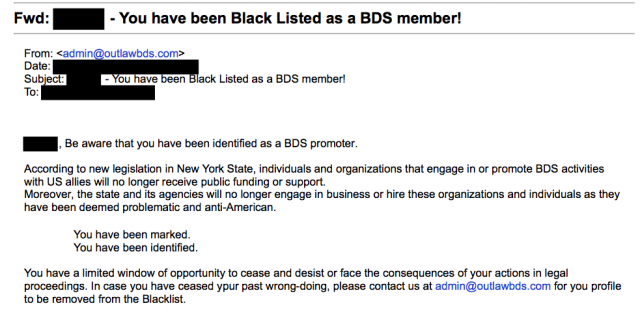
Screenshot of Psy-Group email
“It’s scary to think that ex-Mossad agents were behind this spying,” said senior staff attorney Radhika Sainath, who advised over 30 individuals targeted by the letters. “The Mossad itself has a history of surveilling, sabotaging and assassinating Palestinian activists around the world.”
The people targeted by former Israeli intelligence agents with Psy-Group include faculty at Columbia University, New York University, multiple City University of New York (CUNY) campuses as well Black, Jewish, and Palestinian volunteers from groups such as Adalah-NY and Jewish Voice for Peace.
“It is disgraceful that professors and students in American public universities are being spied on and intimidated by the former agents of a foreign nation,” said CUNY professor Sarah Schulman, who was targeted by Psy-Group. “Fortunately, the commitment of grassroots Americans to Palestinian rights is increasing everyday, and no level of threatening covert operations can stop it.”
Though outlawbds.com and Psy-Group no longer exist, the tactics and methods they employed —anonymous blacklisting websites, fake profiles used to target or influence people, and smear campaigns—are all still in use by other anti-Palestinian groups, some of which potentially share information with the Israeli government. The largest example is the blacklist site Canary Mission, which has targeted hundreds of students and faculty who advocate for Palestinian rights.
While it is unclear what relationship Psy-Group had with active Israeli intelligence or government agencies, coordinating with a foreign government to secretly spy on people in the US may violate federal laws. The Israeli government has itself encouraged and funded such activities to covertly undermine the movement for Palestinian rights.
Dual Loyalty as Racism
By Eve Mykytyn | March 8, 2019
The US House of Representatives just passed a resolution that declared, “whether from the political right, center, or left, bigotry, discrimination, oppression, racism, and imputations of dual loyalty threaten American democracy and have no place in American political discourse.” The key words in this resolution are “dual loyalty” which make clear that this otherwise banal condemnation of racism was made in direct response to Representative Ilhan Omar’s controversial statement: “I want to talk about the political influence in this country that says that it is OK for people to push for allegiance to a foreign country.”
Apparently, the House resolution was a disappointment to some. The New York Times reports that this ‘all-inclusive’ approach was criticized for not “solely condemn[ing] anti-Semitism.” Representative Ted Deutch asked “Why are we unable to singularly condemn anti-Semitism? Why can’t we call it anti-Semitism and show we’ve learned the lessons of history?”
It is bizarre that Mr. Deutch seemingly objects to condemning racism per se. Would Mr. Deutch prefer that the House pass separate resolutions condemning prejudice against each of the ever growing list of identity groups? The House would be so busy debating these resolutions that they would accomplish nothing else, although admittedly, that might be a positive outcome.
Omar has not retracted her statements. In response to criticism from representative Nita Lowy, Omar tweeted, “I should not be expected to have allegiance/pledge support to a foreign country in order to serve my country in Congress or serve on committee.”
Omar’s point has been substantiated by the reaction it has provoked. Omar claimed that accusations of anti-Semitism tend to be used to silence critics of Israel. In response, she was called a “Jew hater.”
Representative Juan Vargas tweeted, “It is disturbing that Rep. Omar continues to perpetuate hurtful anti-Semitic stereotypes that misrepresent our Jewish community. Additionally, questioning support for the U.S.-Israel relationship is unacceptable.”
Omar is condemned for criticizing dual loyalty by those who insist upon loyalty to Israel. As journalist Jordan Weisman noted, “If Israel’s most devoted U.S. backers are really so concerned over dual loyalty smears, maybe they should think more carefully about how they’re encouraging them. “
Delaying publication of the settlement blacklist exposes the UN’s false narratives on human rights
By Ramona Wadi | MEMO | March 7, 2019
The UN is openly flaunting its priorities and, sadly, human rights are far from a major concern for the international organisation. Since its creation post-World War Two, and having established itself as the platform which determines what constitutes a human rights violation and which countries can be considered as perpetrators, several trends have emerged within the UN which reduces the seriousness of people being deprived of their legitimate rights.
This has been achieved by creating ample space for reports on human rights violations to be disseminated, while refusing to insist upon accountability and justice. Ironically, the increasing awareness regarding human rights violations is actually creating widespread impunity, as the UN promotes itself as a platform for reporting about violations while intentionally failing to take action.
Last month, for example, a UN report said that Israel “may have” committed war crimes against Palestinians participating in the Great March of Return demonstrations; it was publicised heavily, despite a predictable outcome. Israel will not be held accountable and those celebrating the UN’s recognition of Israel having possibly committed war crimes will not be vindicated by a thorough follow-up and prosecution. Another wave of silence will descend until the UN issues another report that reaches the same conclusion. We will never see an international court having the opportunity to test the evidence from both sides to judge whether “may have” is to become “has”, and appropriate action is to be taken.
On Tuesday, it was revealed that UN Human Rights Commissioner Michelle Bachelet has delayed the publication of a report exposing companies and institutions that do business with Israeli settlements due to “factual complexity”. According to Bachelet, “Further consideration is necessary to fully respond to the [human rights] council’s request.”
In response to Bachelet’s decision, PLO Committee Member Hanan Ashrawi noted, “The issue of corporate responsibility to respect human rights is neither a novelty nor an anomaly in the rules-based international system.”
Publishing the UN blacklist of companies had already been delayed by Bachelet’s predecessor in 2017. Israel has lobbied extensively for the report to remain unpublished, fearing the repercussions if firms listed in the report were to be targeted by boycotts.
The Times of Israel described the report as “highly controversial”, yet neither Israel nor its apologists deem colonialism and its nefarious activities to be controversial, which is the least that can be said about the shocking level of violence unleashed by the Israelis on Palestine and the Palestinians. The truth is that there is nothing at all “controversial” about publishing a report detailing how companies and colonialism thrive upon human rights violations, unless you have something to hide.
 What is controversial, though, is Bachelet’s decision to delay publication. The former President of Chile is no stranger to controversy when it comes to her country’s human rights record, despite her own suffering at the hands of the Pinochet dictatorship. The application of the anti-terror laws to the indigenous Mapuche communities was most widespread during her two terms of office. As UN High Commissioner, she also failed to voice any substantive statement over the murder of Mapuche youth Camilo Catrillanca, killed on his own land by a special force known as the Comando Jungla.
Israel might find it has an ally at the UN in Bachelet, who is clearly no novice when it comes to the targeting of indigenous populations. Her expression of “regret” at Israel’s dismissal of the UN report documenting Israel’s use of violence at the Great March of Return protests is meaningless.
When it comes to human rights violations, rhetoric stands alone, especially when it comes to premeditated violence. There is no other institution like the UN that can create a spectacle out of violence and human rights rhetoric which fuels international attention, knowing full well that any reactions — any expressions of “regret” — will be temporary and have no effect.
The blacklist is another matter altogether. Bachelet is contributing to the impunity desired by Israel in order to retain its economic benefits from the occupation of Palestine. Settlements and human rights violations are an acceptable rhetorical subject, whereas settlements and the profits for the state therefrom as collaborators in violations are a red line for Israel and the UN. By delaying publication of this report, Bachelet is sending a clear message to the Palestinians: Israel and its business links are to be protected at all costs, even if that means sacrificing more of the indigenous Palestinian population.
Netanyahu Threatens to Deploy Israeli Navy to Enforce US Oil Sanctions on Iran
Sputnik – March 7, 2019
Earlier, despite threats to bring Tehran’s crude oil exports down “to zero,” Washington granted ‘temporary waivers’ on Iranian oil to major importers including China, India, Italy, Japan, South Korea, Greece, and Turkey, as well as Taiwan. Unless they are renewed, these waivers may expire in May.
Israeli Prime Minister Benjamin Netanyahu has threatened to deploy the Israeli Navy to help tackle suspected Iranian efforts to smuggle out oil via maritime routes to skirt US sanctions.
“Iran is trying to circumvent the sanctions through covert oil smuggling over maritime routes, and to the extent that these attempts widen, the Navy will have a more important role in blocking these Iranian actions,” Netanyahu said, speaking to graduates of the Israeli Naval Academy in Haifa on Wednesday, according to the Jerusalem Post.
“I call on the entire international community to stop Iran’s attempts to circumvent the sanctions by sea, and of course, by [other] means,” Netanyahu added.
The prime minister did not clarify how the Israeli Navy, whose fleet consists mostly of coastal patrol ships, missile boats, corvettes and support ships, would tackle the suspected Iranian oil smuggling, or whether Israeli efforts would include preparedness for direct armed confrontation at sea. At present, the Israeli Navy operates primarily in the Mediterranean Sea, as well as the Gulf of Aqaba and the Red Sea.
Boarding merchant vessels in international waters without the flag state’s permission is illegal under the Convention on the High Seas, and may be interpreted as an act of aggression.
Tehran has repeatedly warned that it may resort to closing the Strait of Hormuz, a key strategic waterway through which roughly 20 percent of the world’s oil passes, if it is provoked into doing so and its oil exports interfered with. Oil exports are a vital lifeline for Iran’s economy, with the country exporting some $40.1 billion of crude oil in 2017, contributing to nearly 5 percent of total world supplies.
Israel cuts off water supply for 2600 Palestinians in Jordan Valley

Ma’an – March 6, 2019
Israeli forces and the Israeli Civil Administration cut off water supply for dozens of Palestinians living in communities in Bardala village in the Jordan Valley in the northern occupied West Bank, on Wednesday.
Mutaz Bisharat, an official who monitors settlement activity in Tubas/Jordan Valley, told Ma’an that Israeli forces cut off water supply for 60% of residents of the Bardala village; that is 2600 people.
Israeli forces also cut off water supply for 1800-2000 dunams of Palestinian agricultural lands that must be continuously irrigated.
Bisharat added that Israel claims that water sources supplying residents with water are illegal, stressing that the water comes from water wells in the village and inside Palestinian lands.
He pointed out that as Israeli forces cut off water supply for Palestinians, they construct water wells for Israeli settlers.
Bisharat called upon international and humanitarian institutions to immediately intervene to stop Israeli violations of human rights.
The Jordan Valley forms a third of the occupied West Bank, with 88 percent of its land classified as Area C — under full Israeli military control.
Water allocations are very necessary for the increase of agricultural production, in order to support the economic growth of many Palestinian farmers.
Jordan Valley residents mostly live in enclaves closed off by Israeli military zones, checkpoints, and more than 30 illegal Israeli settlements.
Featured Video

Seyed M. Marandi: US-Iran War Inevitable: Kuwait and Bahrain May Fall
or go to
Aletho News Archives – Video-Images
From the Archives
Oil and the Israel Lobby
Reknowned economist M. Shahid Alam offers this excellent critique of Noam Chomsky’s defective analysis of the relative influence of Oil versus the Israel lobby over US foreign policy: … continue
Blog Roll
 Aletho News
- ICC ignored ‘very well-documented’ NATO crimes – ex-Libyan minister
- SNSC secretary dismisses US response to Iran’s conditions as ‘inadequate’
- Sanaa says Taiz roads open, secure for residents, warns Saudi forces
- Iraqi resistance group urges Saudi leadership to admit defeat, lift Yemen siege
- Trump’s Retreat: How Al-Aqsa Flood Took Down the US Empire
- Israel’s Military Actions in Lebanon Grossly Violate International Law — Lavrov
- Seyed M. Marandi: US-Iran War Inevitable: Kuwait and Bahrain May Fall
- Leaders Condemn Ansarallah Attack on Saudi Arabia While Ignoring Illegal War Against Yemen
- Leaked: Britain’s Covert Iraqi Psyops Network
- Yemeni Armed Forces Warn Airlines Against Using Saudi Airports, Exempt Mecca and Medina
- If Americans Knew
- After Oct 7, IDF policy allowed civilian casualties for even the lowest-ranking targets
- Israel’s Destruction of Southern Lebanon Intensified After the Cease-Fire
- The Last-Minute Decision That Gave Israel Its Name
- The American Conservative: How Trump Made the World Go Nuclear
- Meet the US generals and admirals advancing Israeli policy
- Opinion: Why news organizations should boycott Israel
- The Israeli witch hunt of Sami Abu Shehadeh exposes the lie of the ‘Jewish and democratic’ state
- No state has a ‘right’ to exist – least of all Israel
- Testimonies about Gaza’s civilian death toll expose Israel’s atrocities – Daily Update
- How Israel Conquered the Latin American Right
- No Tricks Zone
- New Study Suggests Large Regions Of The Pacific Ocean Have Been Cooling For The Last 80 Years
- Germany’s Green Energy Debacle: High Energy Costs Force Kahla Porzellan to Close After 182 Years!
- New Study: 50 Years Of The Most Aggressive ‘Net Zero’ Policies Can Only Affect The Global Climate By 0.03°C
- US September “Heat” Was No Record…Many Records Set Decades Ago
- Latest European Green Energy Debacle; Portugal’s Largest Flagship Solar Park Insolvent!
- Green Energy Debacle: German Expert Professor Fritz Vahrenholt Warns Of Severe Economic And Social Consequences
- Two More Paleo Reconstructions Affirm Meters-Higher Sea Levels Across Ireland, Brazil 7000-6000 Years Ago
- New Study: Earth And Venus Surface Warmth Largely Explained By Convection And Lapse Rate, Not CO2 Or Radiation
- 2025 Nature Paper Claiming Worsening Global Drought Gets RETRACTED …Heavily Flawed
- New Study: ‘Global Drought Shows No Detectable Recent Acceleration Under Climate Warming’

