The Mediterranean Pipeline Wars Are Heating Up
By Viktor Katona | Oilprice.com | December 28, 2018
Things have been quite active in the Eastern Mediterranean lately, with Israel, Cyprus and Greece pushing forward for the realization of the EastMed pipeline, a new gas conduit destined to diversify Europe’s natural gas sources and find a long-term reliable market outlet for all the recent Mediterranean gas discoveries. The three sides have reached an agreement in late November (roughly a year after signing the MoU) to lay the pipeline, the estimated cost of which hovers around $7 billion (roughly the same as rival TurkStream’s construction cost). Yet behind the brave facade, it is still very early to talk about EastMed as a viable and profitable project as it faces an uphill battle with traditionally difficult Levantine geopolitics, as well as field geology.
The EastMed gas pipeline is expected to start some 170 kilometers off the southern coast of Cyprus and reach Otranto on the Puglian coast of Italy via the island of Crete and the Greek mainland. Since most of its subsea section is projected to be laid at depths of 3-3.5 kilometer, in case it is built it would become the deepest subsea gas pipeline, most probably the longest, too, with an estimated length of 1900km. The countries involved proceed from the premise that the pipeline’s throughput capacity would be 20 BCM per year (706 BCf), although previous estimates were within the 12-16 BCm per year interval. According to Yuval Steinitz, the Israeli Energy Minister, the stakeholders would need a year to iron out all the remaining administrative issues and 4-5 years to build the pipeline, meaning it could come onstream not before 2025.
The idea of EastMed was first flaunted around 2009-2010 as the first more or less substantial gas discovery in the Eastern Mediterranean, the Tamar gas field in Israel’s offshore zone, paved the way for speculations about an impending gas boom. Then came the 535 BCm (18.9 TCf) Leviathan in 2010 and the 850 BCm (30 TCf) Zohr discovery in offshore Egypt five years later and suddenly it seemed that an Eastern Mediterranean gas expansion is inevitable. Yet over the years, the operators of Leviathan have already allocated part of their total gas volumes to domestic power generating companies and most notably NEPCO, the Jordanian electric power company (1.6-2BCm per year). Egypt has been concentrating on meeting domestic needs and getting rid of LNG imports, moreover once it bounces back to gas exporter status in 2019, it will only use its own 2 LNG terminals in Damietta and Idku. Related: Has Oil Hit Rock Bottom?
Thus, a pertinent question arises – whose gas would be used to fill the EastMed pipeline? If the pipeline starts in offshore Cyprus, then it would be logical to expect that Cyprus’ gas bounty would be somehow utilized. Yet Cyprus has been lagging behind Egypt and Israel in its offshore endeavors and so far lacks a clear-cut giant field to base its supply future on. The two discoveries appraised heretofore, the 6-8 TCf Calypso operated by ENI and the 4.5 TCf Aphrodite operated by Noble Energy, are not enough to support the construction of a relatively expensive gas pipeline – all the more so as Noble has signed a provisional deal to send Aphrodite gas to Egypt’s Idku LNG terminal, most likely by means of a subsea gas pipeline. If we are to judge the viability of the EastMed on the current situation, there is only Calypso and Israel to fill the pipeline, as Greece’s gas export plans are close to zero on the probability scale.
The subsea section from Cyprus’ offshore zone to the island of Crete lies in depths of 3km and is stretched across a seismically active zone. But there is even more – should Turkey claim rights on Cyprus’ offshore hydrocarbon deposits (in February 2018 it sent warships to scare away ENI’s drilling rig that was on its way to xxx), the project is all but dead. This is far from an implausible scenario as President Erdogan stated that Turkey would never allow for the extortion of natural resources in the East Mediterranean by means of excluding Ankara and Northern Cyprus. Cognizant of the risks inherent in an East Mediterranean gas pipeline, there has been no interest from oil and gas majors to participate in the project. This is worrying as the $7 billion are expected to be financed from private investors, of which there is a palpable dearth – despite the EU’s 35 million funding to promote what it sees as a Project of Common Interest. Related: Wall Street Sees Oil Price Recovery In 2019
Yet even for the European Union, the EastMed gas pipeline presents a bit of a headache as its commissioning would render the Southern Gas Corridor, comprising so far only of Trans Adriatic Pipeline (TAP) with a 10 BCm per year throughput capacity, irrelevant by creating a sort-of competitor. The price of the natural gas to be supplied via the EastMed pipeline might become the biggest obstacle of them all – if the cost of producing offshore Mediterranean gas turns out to be $4-5/MMBtu as expected, the addition of further transportation costs to it all would place EastMed supplied at the bottom range of European gas supply options (Russian gas supply is alleged to be profitable with price levels as low as $4/MMbtu). All this might change if any of the East Mediterranean countries were to discover a giant gas field, altering the economics of production or possibly even liquefaction.
In fact, 2019 will witness several key wells being drilled across Cyprus, Egypt and possibly even Israel. ExxonMobil’s testing of Block 10 in offshore Cyprus would largely point to the overall attractiveness of Cyprus as an oil and gas producing country – the drilling has already started, with results expected in Q1 2019. The ENI-operated Noor offshore field in Egypt, adjacent to Zohr, is a much hotter prospect with BP buying into it lately – most likely it will outshine all the other drilling sites in the Eastern Mediterranean, however, if a big discovery is confirmed, it would be most likely used for Egyptian purposes which run counter to the EastMed gas pipeline. Thus, EastMed’s only hope is that Israel 2nd international licensing round, results to be announced in July 2019, will elicit a couple of Leviathan-like finds that would make pipeline construction profitable. Until then, the prospects are rather bleak.
UNESCO should cry no tears over Israel’s departure
By Dr Daud Abdullah | MEMO | January 2, 2019
There will be no tears now Israel and the US have withdrawn from the United Nations Educational, Scientific and Cultural Organisation (UNESCO). Both countries have undermined the organisation’s credibility and brought it into disrepute – UNESCO will be better off without them.
UNESCO is governed by several international accords, to which all members are treaty-bound to adhere. The 1954 “Hague Convention for the Protection of Cultural Property in the Event of Armed Conflict” is arguably the most important international instrument for the protection of cultural property – defined as monuments of architecture, art or history; archaeological sites; buildings of historical or artistic interest; works of art; manuscripts, important books and archives, as well as scientific collections.
Both The Hague Convention and its Protocol have been incorporated into international customary law; their provisions are, therefore, binding on all parties to conflict, regardless of whether or not they are signatories to these instruments. In recent years, the protection of cultural heritage has been deemed so important that the Statute of the International Criminal Court (ICC) has recognised the destruction and seizure of buildings dedicated to religion, education, arts, science or charitable purposes, as well as historic monuments, a war crime.
Yet throughout its 70-year history, Israel has shown an alarming disregard for UNESCO’s rules and ideals, seeking exemptions and privileges not granted to any other member state. Its real grievance with UNESCO is that it wants the organisation to remain silent and, in doing so, endorse its theft and destruction of Palestinian cultural heritage.
Israeli soldiers and civilians have stolen innumerable objects of historical, cultural and archaeological importance to Palestine. Bizarrely, on the same day that Israel announced its withdrawal from UNESCO, one of the country’s leading daily newspapers, Haaretz, published an article under the title “Israel Displays Archaeological Finds Looted from West Bank”. This was in reference to a Civil Administration exhibition currently being held at the Bible Land Museum in Jerusalem.
As a contracting party to The Hague Convention, Israel is obliged “to prohibit, prevent and, if necessary, put a stop to any form of theft, pillage or misappropriation of, and any acts of vandalism directed against, cultural property”. Yet, with the backing of the US, it chooses to do just the opposite.
The theft of archaeological items is bad enough, but their wilful destruction is far worse. Israel’s construction of the Separation Wall – which encircles its settlements across the occupied West Bank – has often required large-scale archaeological excavation. Palestinian officials believe that an estimated 1,100 archaeological landmarks have been ruined or destroyed by the construction of the wall.
Furthermore, as a matter of policy Israel refuses to share with Palestinian researchers the data and objects obtained from its excavations in the occupied territories. Although Israel signed the UNESCO “Recommendation on International Principles Applicable to Archaeological Excavations” in 1956, it has refused to ratify the 1970 “UNESCO Convention on the Means of Prohibiting and Preventing the Illicit Import, Export and Transfer of Ownership of Cultural Property”. Instead, it continues to argue that international law does not prohibit excavation in occupied territories.
Around 53 per cent of the archaeological sites in the occupied West Bank are located in Area C, in which Palestinians are prohibited from conducting exploration, restoration and development. Unsurprisingly, during the first five years of the Oslo Accords (1993-98), only nine out of the 171 excavation permits issued by the Israeli Staff of Antiquities were granted to Palestinian academic institutions.
All told Israel has, for its own partisan reasons, never been a committed member of UNESCO. Its discomfort always lay in the fact that it could not persuade the organisation’s members to acquiesce to its theft and destruction of Palestinian cultural heritage. Disagreement and divorce seemed inevitable, given that UNESCO has declared some of the sites affected by Israel’s occupation as World Heritage sites.
Contrary to the Israeli-US claim, UNESCO has never adopted a policy of singling-out Israel for criticism or censure – the only reason it has been subjected to scrutiny is because it has, for decades, refused to act in accordance with UNESCO’s rules.
Were UNESCO to turn a blind eye to Israel’s looting and vandalising of Palestinian cultural heritage, this would be nothing less than a dereliction of duty. Furthermore, to appease Israel would set a dangerous precedent for rogue states and non-state actors to act with similar impunity. Instead of weeping over their departure, UNESCO must now feel deeply relieved that it will no longer be called upon to act against its principles, values and interests.
Thousands of West Bank farmers denied access to their lands in 2018
Palestine Information Center | January 3, 2019
OCCUPIED JERUSALEM – Israel has drastically reduced the number of Palestinian farmers who are allowed to work their lands located between the separation barrier or wall and the Green Line, according to Israeli official data.
According to Haaretz newspaper, in 2018, 72 percent of Palestinian requests for farming permits were rejected, compared to 24 percent in 2014.
There are also very few permits issued for relatives of the plot owner who work with him and paid laborers.
This information was sent by the Israeli army’s civil administration to Hamoked—the center for the defense of individual human rights—in response to a freedom of information law request, according to the newspaper.
However, that information lacks valuable data concerning, for example, the number of seasonal, short term permits which Hamoked believes often replace the long term permits.
The statistics correspond to reports submitted by farmers to Hamoked, to Machsom Watch activists and to Haaretz about bureaucratic obstacles that have been added over the past four years to get the permits to cultivate their land.
The land between the barrier and the Green Line, which Israel refers to as the “seam zone,” totals 137,000 dunums (33,853 acres), a report released by Haaretz pointed out.
Since the start of 2018 through November 25, the civil administration approved only 1,876 requests for farming permits of the 7,187 requests submitted, which constitutes an unprecedented refusal rate of 72 percent. This compares to a refusal rate of 24 percent in 2014, when the number of requests totaled 4,288, and the number of permits issued was 3,221.
Hamoked, has been assisting farmers who are denied permits since 2009, said the obtained data confirm that “contrary to the high court of justice ruling that recognizes the residents’ right to work their lands with their families and employees, the army is acting systematically to deprive the Palestinians of this basic right, to restrict the entry of Palestinian farmers into the seam zone and to gradually dispossess them of their land.”
PA bows to US, Israel pressure to extradite Palestinian who sold land to Jews
MEMO | January 3, 2019
The Palestinian Authority (PA) plans to extradite a Palestinian-American it convicted for selling Jerusalem land to Israeli Jews, bowing to US and Israeli pressure.
Issam Aqel, a resident of the Beit Hanina neighbourhood of Jerusalem, was sentenced earlier this week to life imprisonment for selling land to Israeli Jews without the permission of Palestinian authorities. The Higher Offences Court in Ramallah, in the occupied West Bank, convicted Aqel of “attempting to sever parts of Palestinian land and annex it to a foreign state,” handing him a “life sentence with hard labour”.
Yet today the PA appears to have bowed to months of US pressure to extradite Aqel – who is a dual Palestinian-American national – with the US and the PA agreeing Aqel will be sent to America at the end of legal proceedings. His lawyer is expected to file an appeal against the court’s ruling, the Times of Israel reported, citing a senior Palestinian official who spoke to Israel’s public broadcaster Kan on condition of anonymity.
The Israeli daily added that though many details of Aqel’s extradition have yet to be finalised, the Palestinian official claimed the PA was eager to get Aqel “off its hands”, saying: “We want to finish this saga. He has become a burden upon us.”
The US has put pressure on the PA to release Aqel since he was first arrested in October. In November, US Ambassador to Israel David Friedman took to Twitter to condemn Aqel’s imprisonment, saying: “Akel’s [sic] incarceration is antithetical to the values of the US & to all who advocate the cause of peaceful coexistence, we demand his immediate release.”
According to conservative US news site CNSNews, Israel lobby groups have also pushed the US to pressure the PA, with one group – the National Council of Young Israel – urging the US to suspend aid to the PA until Aqel was freed. The group’s president, Farley Weiss, said that “[PA President] Mahmoud Abbas and the Palestinian Authority cannot expect handouts from the US while they exploit an American by locking him up and throwing away the key”.
Israel has supported the US in this pressure, with the Israeli Civil Administration – which administers the occupied Palestinian territories – in November freezing security coordination with the PA in Jerusalem in protest against Aqel’s detention. A week previously, Israel had withdrawn the VIP travel card of Palestinian Attorney General Ahmed Barrak, after he ordered an amendment to Aqel’s detention. Israel also detained the PA’s Jerusalem governor, Adnan Ghaith, over his efforts to combat the transfer of Jerusalem properties to Israeli Jews. Ghaith was eventually released on 2 December but was banned from entering the occupied West Bank for six months.
Relations between the US and the PA grew increasingly strained in 2018 after a string of punitive measures taken by the US administration under President Donald Trump, including cutting funding to UNRWA, threatening to withhold aid unless a peace deal with Israel is agreed, downgrading its Jerusalem Consulate and unilaterally declaring the city Israel’s capital.
Senior Israel official in ‘shock’ over Trump’s Iran policy
MEMO | January 3, 2019
US President Donald Trump has been rebuked by a senior Israeli official for giving mixed messages over Iran and Syria. The unnamed official cited in the Times of Israel, is said to be “in shock” after Trump implied that Iran “can do what they want” in Syria.
The controversial remark was made during a cabinet meeting where Trump is reported to have said: “They [Iran] can do what they want there, frankly,” while suggesting Tehran was removing its troops from the country.
Explaining his comments, Trump said that Iran had been weakened by the US’ decision to leave the 2015 nuclear deal and the reintroduction of fresh sanctions. “Iran is no longer the same country,” he said. “Iran is pulling people out of Syria. They can do what they want there, frankly, but they’re pulling people out. They’re pulling people out of Yemen. Iran wants to survive now.”
His comments were rebuked in Tel Aviv. “It is sad that he is not attentive to intelligence materials,” the unnamed Israeli source said. “I am quite simply in shock,” the source continued. “Trump simply does not know what is happening in Syria and the Iranian entrenchment there.”
Israel has made no secret of the fact that it sees Iran as a major threat to its security. They have repeatedly warned that America’s absence would open the door for Tehran to create a so-called “land bridge” from Iran, through Iraq and Syria, into Lebanon and to the Mediterranean Sea.
Trump however spooked his Israeli allies by announcing his decision to withdraw US troops from Syria. His surprise announcement was met with shock and resignation of members of his administration.
US Secretary of State Mike Pompeo was forced to explain Trump’s decision to Israel by insisting that cooperation with Israel over Syria and Iran will continue. Even Trump appeared to back down from his earlier comments saying that there was no time frame for US exit from Syria. Explaining his decision, which appears to be a retreat, he said the US will get out of Syria “over a period of time” in order to protect the US-backed Kurdish fighters in the country.
Imperialism Abhors a Void: Guest: Sarah Abed
The Rabbit Hole | January 3, 2019
Cindy Sheehan’s Soapbox
Guest: Sarah Abed
Topic: US “Withdrawal” from Syria
On this episode of Cindy Sheehan’s Soapbox we discussed Trump’s announcement to withdraw US troops from Syria, the media’s reaction, and the impact this will have on Kurdish militias and Syria’s ultimate fight against imperialism.
Below are some of the points that I made during our chat (this is not a full transcript) or some thoughts I would like to expand on.
Cindy asked what I make of Trump’s announcement to withdraw 2,000 troops from Syria.
My response:
Trump had stated during his campaign and his presidency and even prior to that during Obama’s presidency in 2013 that he did not think we should be in Syria, nor should we be bombing Syria, that it was a waste of money and lives and that the Arab League and neighboring countries should be the ones to step up to the plate.
I think this was one of the reasons that many people voted for him, because of his non-interventionist foreign policy, which was in stark contrast to that of Hillary Clinton.
In April, of this year he had announced that he wanted to pull the US out of Syria and then just days later there was an alleged chemical weapons attack that was pinned on the Syrian government in Douma, to which Trump responded with attacking multiple targets along with his allies the UK and France.
This of course derailed his plan to pull out US troops, which is the exact outcome that the terrorists that staged the whole theatrical performance had wanted. And we have seen this sort of thing happen time and time again during the war. Whenever the Syrian army and government have made significant progress new allegations and attacks are made against them in corporate media in order to garner international support for military, political intervention as well as increased sanctions.
There are other factors at play with this latest withdraw announcement which was made on December 19th, in addition to standing by his America first promise, campaign statements, saving money and lives, there’s the fact that Turkey’s president Erdogan had threatened to attack the Kurdish militias on his border, if the US didn’t have them removed. He sees the YPG (People’s Protection Units) which was rebranded at the request of the US into the SDF (Syrian Democratic Forces) as an extension of the PKK (Kurdistan workers party) which is a terrorist group that has been in conflict with the Turkish state for decades.
As I had written about back in March the Olive branch operation in Afrin proved that NATO alliances are stronger than any other alliances and that the US will choose Turkey over the Kurds and that’s what we are seeing happen right now. Some have also speculated that Israel may have given the US a heads up that it would be engaging in an intense bombing campaign and that US troops should be sent home so that they are not caught in the crosshairs.
Cindy asked what I make of the reaction by democrats, liberals, celebrities etc.
My response:
It would be comical if it wasn’t actually dangerous. In their blind opposition to anything and everything that Trump says these overnight analysts and pundits started claiming that if US troops were to withdraw from Syria then Kurds would be annihilated by Turkey or succumb to some other equally horrible fate.
What we have seen over the past few days however is that leaders of Kurdish militias have actually reached out to the Syrian government and asked that they step in and take back Manbij and all the territory under their control west of the Euphrates in order to protect them against Turkey. This is a clear shift in their political alliance away from the US and towards Syria and Russia. Turkey will not directly confront the Syrian army so Trump’s announcement could actually signify a big step towards peace in this almost eight-year western imposed insurrection.
The US entered Syria illegally and has since set up over a dozen military bases and supported the Kurdish militias during the last few years only. Prior to using the Kurdish militias as a tool to create chaos and division in Syria, the US was predominately supporting the hardcore Al Qaeda-linked terrorists in the Free Syrian Army and an assortment of other alphabet soup groups who they affectionately referred to as “moderate rebels” to topple the secular Syrian government.
Had the US not supported the Kurdish militias they would have not had the motivation to turn against the Syrian state. During the beginning of the war, the Kurds were fighting with the Syrian army against terrorists, by the way some still are and many Kurds in Syria are not in agreement with the separatist ambitions of the Kurdish militias.
I want to stress the fact that before 2011 Kurds, Arabs, and Christian minorities lived peacefully in Syria and till now they are NOT the majority. They do not have any justifiable claims to the north eastern region (which also happens to be the most agriculturally and oil rich part of the country) or any other part of Syria. They are a nomadic people and I do not mean that in a condescending way at all but to illustrate that they came into Syria in waves to escape mistreatment in neighboring countries and were treated fairly and given equal rights. Not all Kurds envision a unified Kurdistan that would span four different sovereign countries (Turkey, Iraq, Syria, and Iran). Most Kurdish movements and political parties are focused on the concerns and autonomy of Kurds within their respective countries. Within each country, there are Kurds who have assimilated and whose aspirations may be limited to greater cultural freedoms and political recognition.
It’s also worth noting that only Israel is their main and really only supporter and their plans for an independent Kurdistan align almost perfectly with Israel’s greater Israel plan. They have historically been used by Israel and NATO.
Cindy asked about the demands being made that Russia or Iran should withdraw from Syria if US troops are to be withdrawn.
My response was basically that Russia, Iran, and Hezbollah are there with the Syrian government’s permission. Whereas the US, UK, France, and Turkey are there illegally and need to leave. Cindy noted and I agreed that it’s a false equivalency and a logical fallacy.
We also spoke about fasting to raise awareness #illuminateYemen for the entirely man-made and avoidable Saudi war and genocide that’s been going on for over three years and nine months. We discussed the latest developments and how Saudi Arabia is outsourcing their front line fighters with children and men from Dafur, Sudan and paying their families $10,000.
My response:
Fasting for seven days was a very humbling experience. The war on Yemen is truly heartbreaking especially because it is entirely man-made and avoidable. It’s so important for us to continue to raise awareness and get people to talk about it to literally everyone they know. For the past 3 years and nine months the murderous Al Saud regime, has been bombing civilians using weapons bought from the US, UK, and Germany, what they are doing is nothing short of committing genocide and deliberately starving Yemeni’s them through blockades. Tens of thousands have been killed since it began.
There was actually a report in the New York Times today that Saudi Arabia was recruiting children from Darfur to fight on the front lines and paying their families $10,000. Sudan has been part of the Saudi-led alliance, and deployed thousands of ground troops to Yemen. In the NYT report they said that five Sudanese fighters who had returned from Yemen told them that that children made up 20-40 percent of their units in Yemen.
The fact that House of Saud is on the UN human and woman’s rights council while also being the leading violator in crimes against humanity and the main sponsor of terror in the world shows the western worlds blatant hypocrisy. A United Nations-sponsored peace agreement was signed in Sweden earlier this month, and was agreed upon by both sides to implement a ceasefire in Hodeida. The panel will be meeting again on January 1 to discuss “detailed plans for full redeployment”. Every effort needs to be made for this conflict to end.
More Reckless Behavior by Israel: Netanyahu Plays by His Own Rules
By Philip M. GIRALDI | Strategic Culture Foundation | 03.01.2019
As has become the normal practice, Christmas Day’s air raid by Israel directed against targets near Damascus was largely ignored by the US media. Given the fact that Israel has bombed Syria more than two hundred times, the attack itself, which wounded three soldiers at a warehouse, was not particularly notable. But what was significant was the fact that it was the second time that Israel has used other planes to mask the approach of its own warplanes to the target. On this occasion, the masks consisted of two civilian airliners making their approaches to the airports in Beirut and Damascus. Fortunately, the Syrian Arab Air Defense Forces made the decision to delay the deployment of surface-to-air missiles and electronic jamming “to prevent a tragedy” and air traffic control was able to divert one of the passenger jets landing at Damascus to the reserve military airport in Khmeimim in southern Latakia.
Syrian anti-aircraft crews did manage to intercept and shoot down fourteen of the sixteen incoming missiles that were launched by six Israeli F-16 warplanes using US-made GPS-guided GBU-39 Small Diameter Bombs (SDBs). If the Syrian air defenses had been more reckless and gone after the F-16s themselves, they might have hit an airliner by mistake and hundreds of lives could have been lost.
The Russian Ministry of Defense, which was able to reconstruct the attack from radar imaging, condemned the incident, stating that “Provocative acts by the Israeli Air Force endangered two passenger jets when six of their F-16s carried out airstrikes on Syria from Lebanese airspace.” The terse Russian announcement reveals that beyond endangering hundreds of civilians, Israel had committed several war crimes in its action, which the Israeli government claimed was intended to destroy a shipment of Iranian-made Fajir-5 rockets, which was allegedly on its way to Hezbollah.
As Israel is not at war with Iran or Syria or Lebanon and it persists in attacking targets in Syria based on its own perception of threats, it meets the United Nations definition of an aggressor. And its violation of Lebanese air space to stage the attack on Syria was also an act of aggression. Both would normally be condemned in the UN Security Council but for the American veto protecting Israel.
Analysts have confirmed that the Israelis carried out the strikes in Syria by deliberately using scheduled airline departures and arrivals as cover to foil the improved and upgraded Syrian air defenses. Security sources in the region now believe that any civilian flights entering or leaving Damascus or Beirut are potentially in danger due to the Israeli tactics, which clearly accept endangering civilians to mask the movements of the warplanes.
The Israelis also used a Russian intelligence plane as a mask off the coast of Syria back in September, with fatal results for the crew after Syrian air defenses responded to the attack. Israel, of course, claimed innocence, insisting that it was the Syrians who shot down the Russian aircraft while the Israeli jets were legitimately targeting a Syrian army facility “from which weapons-manufacturing systems were supposed to be transferred to Iran and Hezbollah.”
The Russian aircraft was returning to base after a mission over the Mediterranean off the Syrian coast monitoring the activities of a French warship and at least one British RAF plane. As a large and relatively slow propeller driven aircraft on a routine intelligence gathering mission, the Ilyushin-20 had no reason to conceal its presence. It was apparently preparing to land at its airbase at Khmeimim when the incident took place.
Syrian air defenses were on high alert because Israel had attacked targets near Damascus on the previous day, including a Boeing 747 on the ground that Israel claimed to be transporting weapons.
The Israelis used four F-16 fighter bombers to stage the surprise night attack targeting sites near Latakia, close to the airbase being used by the Russians. They came in from the Mediterranean Sea using the Russian plane to mask their approach as the Ilyushin 20 would have presented a much larger radar profile for the air defenses.
The Israelis might have been expecting that the Syrians would not fire at all at the incoming planes knowing that one of them at least was being flown by their Russian allies. If that was the expectation, it proved wrong and it was indeed a Syrian S-200 ground to air missile directed by its guidance system to the larger target that brought down the plane and killed its fourteen crew members.
There was also a back story. The Israelis and Russian military had established a hotline precisely intended to avoid accidents. Israel reportedly used the line but only one minute before the incident took place, leaving no time for the Russian plane to take evasive action.
The Russian Ministry of Defense was irate. It saw the exploitation of the intelligence plane by the Israelis as a deliberate high-risk initiative. It warned “We consider these provocative actions by Israel as hostile. Fifteen Russian military service members have died because of the irresponsible actions of the Israeli military. This is absolutely contrary to the spirit of the Russian-Israeli partnership. We reserve the right for an adequate response.”
It’s the same old story. Israel does risky things like attacking its neighbors because it knows it will pay no price due to Washington’s support. The downing of the Russian plane and the current endangering civil aviation has created a situation that could easily escalate. What Israel is really thinking when it seeks to create anarchy all around its borders is anyone’s guess, but it is, to be sure, in no one’s interest to allow the process to continue.
SYRIA: The Western Rogue States Must Confess their Crimes Against Humanity and be held Accountable

Christmas 2018 in Damascus, Old City, without mortars from Eastern Ghouta since its liberation in April 2018. (Photo: Vanessa Beeley)
By Vanessa Beeley | 21st Century Wire | January 2, 2019
The West and its allies in the Gulf States, Turkey and Israel have waged an eight year war against the Syrian people. The West has besieged, starved and deprived the Syrian people of humanitarian aid while pouring “aid” into the areas controlled by their extremist sectarian proxy armies.
The West has violated international law and it has enabled the destruction of Syria’s history, heritage and cultural footprint. The West has behaved as a collective rogue state without conscience and without pity for a people its media has systematically dehumanised to enable such a crime to take place.
Despite this war of attrition and despite battling disproportionate force, the Syrian people have refused to capitulate or to abandon their secularism in favour of an extremist tyranny that would destroy their society and persecute the minority communities into extinction. Christmas 2018 has demonstrated the victory of Syrian unity over the regime change project incubated in the West which is now a failed campaign lying in tatters at the feet of the self determination of the Syrian people, the valiant defence by the Syrian Arab Army and the steadfastness of the Syrian Government and its President, Bashar Al Assad.
In Aleppo I spoke with Pastor Ibrahim Nseir of Aleppo’s Presbyterian Church, whom I had also interviewed in 2017. The following is a mixture of quotes and paraphrase from our conversation on New Year’s Eve 2018/19.
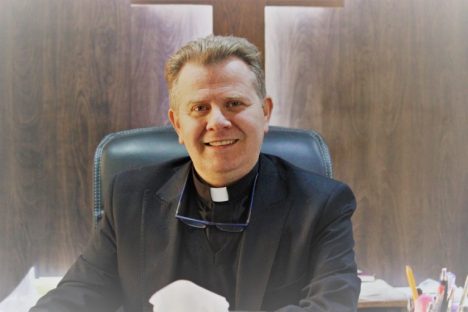
Reverend Ibrahim Nseir, Presbyterian Church, Aleppo. December 31st 2018. (Photo: Vanessa Beeley)
The Presbyterian Church in the Old City of Aleppo was destroyed by the Western-backed terrorist groups in November 2012. An article in the Mennonite World Review in July 2018 described the destruction of the church – “In the old city of Aleppo, Syria, Ibrahim Nseir stands on the pile of rubble that used to be his church. The building where his congregation worshiped is now broken stones and dust. It’s a sunny day, the bright sky a stark contrast to the destruction on the ground.”
After eight years of resistance against the threat of persecution and mass exodus of Christians from Aleppo, Nseir remains defiant and upbeat about the future of Aleppo and Syria. Of the 300,000 Syrian Christians in Aleppo, only 30,000 remain. This is the legacy of sectarian oppression that has been imprinted upon Syria by Western hegemony and it will take generations for it be turned around.
Nseir described the rebuilding process for the Presbyterian Church as difficult but he insisted that it would be rebuilt from its original stones to preserve its historical identity. For Nseir the priorities for Aleppo and Syria are to address the economic situation which has clearly taken a hit on many levels and is suffering in a typical post-war slump. Education is another top priority for this intelligent and enthusiastic Reverend. The intention is to create a center for retreats and conferences at the current Presbyterian Church offices in the center of Aleppo, including a student dormitory.
“We will increase educational capacity by 1000 in the very near future and continue to build upon this progress” Nseir told me.
Education, according to Nseir, is the greatest weapon against extremism and is the only way to re-habilitate children who spent seven of their formative years under occupation of extremist and sectarian factions who worked hard to brainwash almost an entire generation of Syria’s children.
“Ethically the West and the East are responsible for Syria’s destruction. This is not a “Christian” issue, it is a World issue.” Nseir insisted.
The role of the Western media in manufacturing consent for the collective punishment of the Syrian people was clearly a primary cause of the devastation that Nseir and other faith leaders across Syria are now dealing with:
“Western media played more than a negative role, they literally urged the terrorists to take action against the Syrian people by providing false information and blinding people in the West to what was really happening in Syria for eight years. This should never be forgotten.”
Nseir stressed that the healing process for children traumatised by the war would not be easy.
“How do you erase the hatred and horror planted in the brains of 7-10-year-old children by these fanatics? What do you expect from children who have played football with the head of a Syrian Arab Army soldier or who have witnessed the violent abuse of their mother by these terrorists or have seen their father executed by the armed groups? This is the greatest challenge for Humanity and for Syria to put right these terrible wrongs.”
Nseir spoke of the shocking estimated figures of 82,000 children whose father is unknown, referring to the huge number of young women raped or forced into multiple marriages by the terrorist groups and their fighters. How do these children regain their identity and re-integrate into Syrian society? The rebuilding of schools and hospitals must be a priority. The terrorists destroyed “the most developed hospital in the Middle East, Al Kindi” in 2013 and since then, and the destruction of more hospitals across Syria by the terrorist groups, Nseir told me Syria has seen an increase in Cancer and new diseases. Nseir also suggested that this may be attributed to the weapons used by the US Coalition proxies and the U.S itself, which include depleted uranium.
Another important challenge, according to Nseir, is the environmental one. Syria needs to rebuild its natural environment which has also been hugely affected by the conflict. 100,000 trees have been destroyed in Aleppo alone which could lead eventually to desertification of the province if not dealt with. The Governor of Aleppo has recently planted 2,000 new trees but this is an issue that must be addressed with urgency for Nseir.
Nseir strongly believes that Western people should come to Syria independently to see the truth for themselves and report the truth as they see it without any agenda. The Church and the media in the West have maintained a sectarian, divisve narrative which is confusing for people in the West and far from reality.
Nseir addressed the position and status of Syria in the Middle East and described how it has not changed, all that has changed is the perception of Syria portrayed by the media and world leaders who have aligned themselves with the West’s criminal project to partition Syria into sectarian statelets and to remove the elected Syrian government from power by force:
“What has changed since 2011 in reality? Nothing. Syria has always been the protector of the Middle East before 2011, during the conflict and now. The only thing that has changed is the positions of those who turned against Syria, betrayed Syria and who now wish to come back to Syria for protection. We see the Gulf States now change their stance and the UAE has re-opened its embassy in Damascus. The Arab League will welcome Syria back into its fold. Nothing has changed, Syria has remained the same while others have been opportunists and traitors.”
The fact that Syria will forgive its betrayers is testament to what has given Syria victory over its enemies throughout history. With regards to the West, Nseir is not so forgiving:
“The West must go beyond simply stopping its financing of terrorism and the supply of weapons. The West must confess to its crimes against the Syrian people in order to be forgiven. The West must lift the economic sanctions which are a siege upon the Syrian people and it must allow the Syrian people to rebuild in peace without meddling in their affairs. The Syrian people will rebuild according to what the Syrian people want not what the East or the West want. The West has sold the idea that this war was against President Assad but in reality it was against the will of a nation and the people of that nation must be respected”.
Nseir confirmed that the western NGOs are nothing more than political instruments and devices who further the cause of war but he insisted that the West must effectively pay reparations to Syria and expect nothing in return. This is the only way the West can be forgiven by Syria.
Nseir told me that his church will be establishing a medical and health center in the coming months which will be open to everyone in Aleppo to offer medical check-ups and treatment for free. Staff will be trained to deal with the children afflicted by the effects of the war and the terrorist occupation and the plan is to eventually set up special schools to continue the work of rehabilitation for these children. This will enable the coming generations to stand against radicalism and terrorism in the future.
“The West has a duty to respect our dignity and territorial integrity. The Syrian Arab Army has saved the image of our God of Peace, Love and Unity – this has been a spiritual war in Syria not only a military war. The God of love has been embodied by the SAA and our allies and has been victorious over the God of terrorism and hatred. The whole world will change after this war and after Syria’s victory. Syria will be a transformational catalyst for all of Humanity. Syria was never going to be defeated, you only have to study our history to know this. Our society has always embraced diversity and this is the essence of our country. Fanaticism was never going to survive breathing the pure oxygen of our humanity. Actually this demonstrates the stupidity of leaders in the West – to even imagine that extremism has a place in our culture”. Nseir told me.
Nseir ended our talk by stating that the crisis in Syria must be an alarm bell for the country and for its leaders.
“We must re-prioritise our schedule, our agenda and make sure it is not only political but that we address all issues – religious, educational, health care. We must rethink our priorities to ensure a future of peace and stability. At the end I believe strongly that all the negative consequences of this terrible war will be transformed into positive consequences if we address them in the right way. Out of adversity are born the greatest opportunities for the future of Syria and Humanity.”
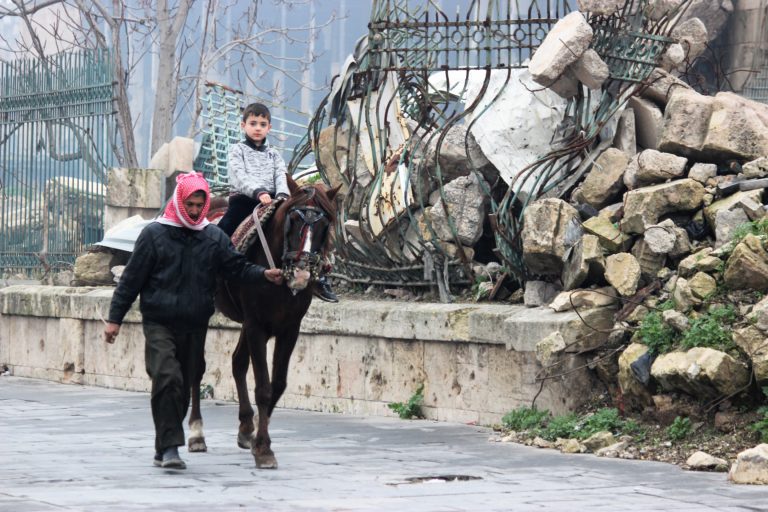
Horse rides on offer at the foot of the Citadel in the Old City of Aleppo. (Photo: Vanessa Beeley)
***
Vanessa Beeley is an independent journalist, peace activist, photographer and associate editor at 21st Century Wire.
Israel arrested 175 Palestinian women, girls in 2018
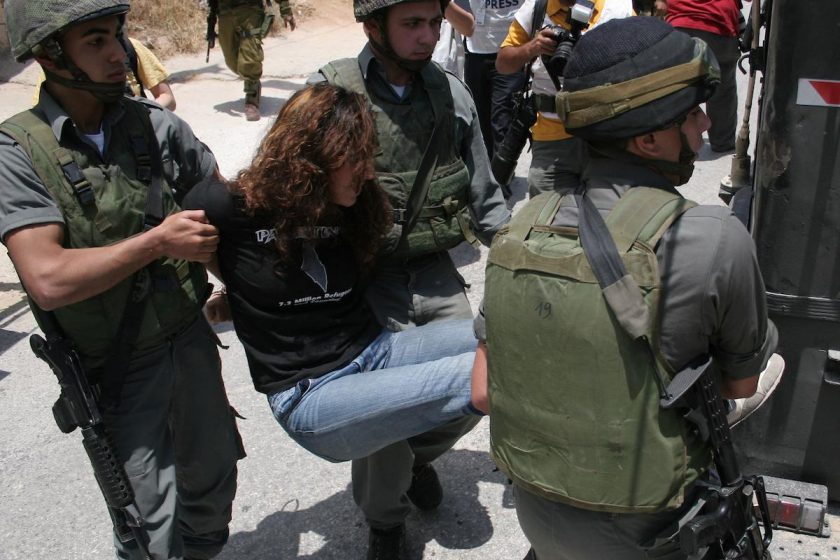
Israeli soldiers arrest a woman protester during a demonstration against Israel’s controversial separation barrier which crosses the Palestinian territories in the West Bank town of Beit Jala, near the town of Bethlehem, on 27 June 2010 [Mamoun Wazwaz/Apaimages]
MEMO | January 2, 2019
Israeli occupation forces arrested 175 Palestinian women and girls in 2018 and summoned hundreds in for interrogation, the Palestine Prisoners’ Centre for Studies said yesterday.
In a statement reported by the Safa News Agency, the Director of the centre Riyadh Al-Ashqar said that the Israeli occupation escalated its aggression on Palestinian women and girls this year in order to punish them for their participation in anti-occupation activities.
He also said that the Israeli occupation arrested female relatives of male prisoners, describing this as a “form of illegal punishment”.
Al-Ashqar documented the detention of 15 females who’s male relatives are being held in Israeli detention including Bayan Faroun. The twenty-four-year-old was handed a 40 months prison term. She is the fiancé of Ahmed Azzam who was sentenced to six-years in jail.
Female prisoners face harsh conditions in jail, Al-Ashqar said, including violation of their rights, humiliation and a lack of access to health care.
Nineteen Palestinian Journalists Are Still Imprisoned By Israel
IMEMC News – December 31, 2018
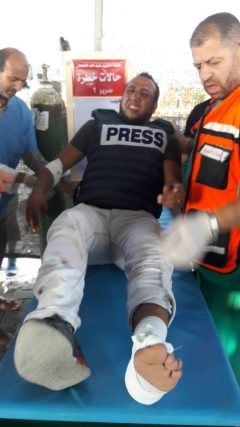 The Palestinian Information Ministry has reported that there are nineteen Palestinian journalists who are still imprisoned by Israel, in direct violation of various treaties and International Law.
In a press statement Monday, the Ministry said that the Israeli occupation and its military courts are ongoing with their serious violations against the journalists and various media outlets in occupied Palestine.
It said that many journalists have also been forced under house arrest, others were forced out of their towns, in addition to facing high fines by the Israeli military courts for performing their duties.
The Ministry also said that some of the abducted journalists were shot and injured, while others are sick, in need of specialized medical treatment but are denied that right.
The soldiers also invaded and violently searched many media outlets across the West Bank, and confiscated equipment.
The Information Ministry stated that Israel’s violations are ongoing attempts to silence the Palestinian media outlets and the journalists, and urged the International Federation of Journalists, Reporters Without Borders, and various related organizations around the world to intervene and stop the escalating abuses against the media and the Freedom of the Press in occupied Palestine.
It is worth mentioning that the soldiers have also killed Palestinian Photojournalist Yasser Mortaja, and journalist Ahmad Abu Hussein, in the Gaza Strip, in addition to wounding dozens of journalists, during the Great Return March processions.
Majority of UN condemnations directed at Israeli crimes
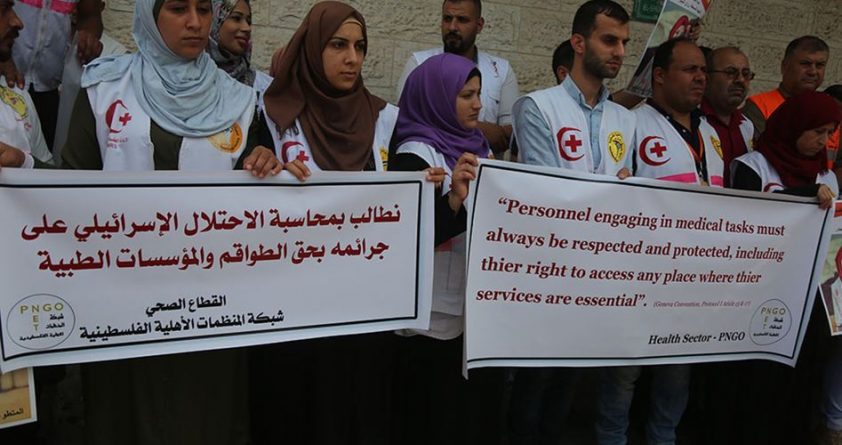
Palestine Information Center – January 1, 2018
OCCUPIED JERUSALEM – Over the course of 2018, the United Nations has voted to adopt some 27 condemnations — the vast majority of which were directed at Israel.
According to Hillel Neuer, executive director of United Nations Watch, 21 of the 27 condemnations were aimed at Israel.
Iran, Syria, North Korea, Russia, Myanmar and the United States each received one.
The Islamic Resistance Movement Hamas had none.
Weeks ago, the UN refused to pass a U.S.-led resolution that would have condemned Hamas for allegedly firing on Israel.
Featured Video
Saudi Led Destruction of Yemen’s heritage
or go to
Aletho News Archives – Video-Images
From the Archives
Israel: Strategic Ally or Liability?
By Stephen Sniegoski | My Catbird Seat | June 12, 2010
The claim that Israel serves as a valuable ally for the United States is made by both pro-Zionists and much of the anti-war and anti-Zionist Left that is influenced by Noam Chomsky. As a result of the Gaza flotilla massacre, which has caused a world-wide uproar against Israel, the value of Israel to the United States is being publicly questioned in more mainstream foreign policy forums. … continue
Blog Roll
 Aletho News
- The Houthis Are Not an Iranian Proxy
- Europe’s Energy Hypocrisy, Russian LNG Profits and US Dependence
- ICC ignored ‘very well-documented’ NATO crimes – ex-Libyan minister
- SNSC secretary dismisses US response to Iran’s conditions as ‘inadequate’
- Sanaa says Taiz roads open, secure for residents, warns Saudi forces
- Iraqi resistance group urges Saudi leadership to admit defeat, lift Yemen siege
- Trump’s Retreat: How Al-Aqsa Flood Took Down the US Empire
- Israel’s Military Actions in Lebanon Grossly Violate International Law — Lavrov
- Seyed M. Marandi: US-Iran War Inevitable: Kuwait and Bahrain May Fall
- Leaders Condemn Ansarallah Attack on Saudi Arabia While Ignoring Illegal War Against Yemen
- If Americans Knew
- It’s a Genocide, I’m Into It’: Seinfeld Mocks Protest over Palestinian Children Killed
- Universities fire dozens amid pressure from Zionist billionaires
- Gaza’s buildings are collapsing on top of us. But there’s nowhere else to shelter
- Israel kills four-year-old Gaza child – Daily Update
- After Oct 7, IDF policy allowed civilian casualties for even the lowest-ranking targets
- Israel’s Destruction of Southern Lebanon Intensified After the Cease-Fire
- The Last-Minute Decision That Gave Israel Its Name
- The American Conservative: How Trump Made the World Go Nuclear
- Meet the US generals and admirals advancing Israeli policy
- Opinion: Why news organizations should boycott Israel
- No Tricks Zone
- New Study Suggests Large Regions Of The Pacific Ocean Have Been Cooling For The Last 80 Years
- Germany’s Green Energy Debacle: High Energy Costs Force Kahla Porzellan to Close After 182 Years!
- New Study: 50 Years Of The Most Aggressive ‘Net Zero’ Policies Can Only Affect The Global Climate By 0.03°C
- US September “Heat” Was No Record…Many Records Set Decades Ago
- Latest European Green Energy Debacle; Portugal’s Largest Flagship Solar Park Insolvent!
- Green Energy Debacle: German Expert Professor Fritz Vahrenholt Warns Of Severe Economic And Social Consequences
- Two More Paleo Reconstructions Affirm Meters-Higher Sea Levels Across Ireland, Brazil 7000-6000 Years Ago
- New Study: Earth And Venus Surface Warmth Largely Explained By Convection And Lapse Rate, Not CO2 Or Radiation
- 2025 Nature Paper Claiming Worsening Global Drought Gets RETRACTED …Heavily Flawed
- New Study: ‘Global Drought Shows No Detectable Recent Acceleration Under Climate Warming’

