Russia-gate Spreads to Europe
By Robert Parry | Consortium News | November 16, 2017
Ever since the U.S. government dangled $160 million last December to combat Russian propaganda and disinformation, obscure academics and eager think tanks have been lining up for a shot at the loot, an unseemly rush to profit that is spreading the Russia-gate hysteria beyond the United States to Europe.

British Prime Minister Theresa May
Now, it seems that every development, which is unwelcomed by the Establishment – from Brexit to the Catalonia independence referendum – gets blamed on Russia! Russia! Russia!
The methodology of these “studies” is to find some Twitter accounts or Facebook pages somehow “linked” to Russia (although it’s never exactly clear how that is determined) and complain about the “Russian-linked” comments on political developments in the West. The assumption is that the gullible people of the United States, United Kingdom and Catalonia were either waiting for some secret Kremlin guidance to decide how to vote or were easily duped.
Oddly, however, most of this alleged “interference” seems to have come after the event in question. For instance, more than half (56 percent) of the famous $100,000 in Facebook ads in 2015-2017 supposedly to help elect Donald Trump came after last year’s U.S. election (and the total sum compares to Facebook’s annual revenue of $27 billion).
Similarly, a new British study at the University of Edinburgh blaming the Brexit vote on Russia discovered that more than 70 percent of the Brexit-related tweets from allegedly Russian-linked sites came after the referendum on whether the U.K. should leave the European Union. But, hey, don’t let facts and logic get in the way of a useful narrative to suggest that anyone who voted for Trump or favored Brexit or wants independence for Catalonia is Moscow’s “useful idiot”!
This week, British Prime Minister Theresa May accused Russia of seeking to “undermine free societies” and to “sow discord in the West.”
What About Israel?
Yet, another core problem with these “studies” is that they don’t come with any “controls,” i.e., what is used in science to test a hypothesis against some base line to determine if you are finding something unusual or just some normal occurrence.
In this case, for instance, it would be useful to find some other country that, like Russia, has a significant number of English speakers but where English is not the native language – and that has a significant interest in foreign affairs – and then see whether people from that country weigh in on social media with their opinions and perspectives about political events in the U.S., U.K., etc.
Perhaps, the U.S. government could devote some of that $160 million to, say, a study of the Twitter/Facebook behavior of Israelis and whether they jump in on U.S./U.K. controversies that might directly or indirectly affect Israel. We could see how many Twitter/Facebook accounts are “linked” to Israel; we could study whether any Israeli “trolls” harass journalists and news sites that oppose neoconservative policies and politicians in the West; we could check on whether Israel does anything to undermine candidates who are viewed as hostile to Israeli interests; if so, we could calculate how much money these “Israeli-linked” activists and bloggers invest in Facebook ads; and we could track any Twitter bots that might be reinforcing the Israeli-favored message.
No Chance
If we had this Israeli baseline, then perhaps we could judge how unusual it is for Russians to voice their opinions about controversies in the West. It’s true that Israel is a much smaller country with 8.5 million people compared to Russia’s 144 million, but you could adjust for those per capita numbers — and even if you didn’t, it wouldn’t be surprising to find that Israel’s interference in U.S. policymaking still exceeds [by many orders of magnitude] Russian influence.
It’s also true that Israeli leaders have often advocated policies that have proved disastrous for the United States, such as Prime Minister Benjamin Netanyahu’s encouragement of the Iraq War, which Russia opposed. Indeed, although Russia is now regularly called an American enemy, it’s hard to think of any policy that President Vladimir Putin has pushed on the U.S. that is even a fraction as harmful to U.S. interests as the Iraq War has been.
And, while we’re at it, maybe we could have an accounting of how much “U.S.-linked” entities have spent to influence politics and policies in Russia, Ukraine, Syria and other international hot spots.
But, of course, neither of those things will happen. If you even tried to gauge the role of “Israeli-linked” operations in influencing Western decision-making, you’d be accused of anti-Semitism. And if that didn’t stop you, there would be furious editorials in The New York Times, The Washington Post and the rest of the U.S. mainstream media denouncing you as a “conspiracy theorist.” Who could possibly think that Israel would do anything underhanded to shape Western attitudes?
And, if you sought the comparative figures for the West interfering in the affairs of other nations, you’d be faulted for engaging in “false moral equivalence.” After all, whatever the U.S. government and its allies do is good for the world; whereas Russia is the fount of evil.
So, let’s just get back to developing those algorithms to sniff out, isolate and eradicate “Russian propaganda” or other deviant points of view, all the better to make sure that Americans, Britons and Catalonians vote the right way.
Investigative reporter Robert Parry broke many of the Iran-Contra stories for The Associated Press and Newsweek in the 1980s.
With anti-BDS laws and a pro-Israel parliament, Zionist hasbara is winning in Italy
By Romana Rubeo and Ramzy Baroud | MEMO | November 15, 2107
A proposed law awaiting consideration by the Italian parliament is set to punish those calling for a boycott of Israel. In the past, such an initiative would have been unthinkable. Alas, Italy — a country with historic sympathies for the Palestinian cause — has shifted its politics in a dramatic way in recent years. Most surprisingly, though, is that the Left is as implicated as the Right in the rush to please Israel, at the expense of Palestinian rights.
The sad reality is that Italy is moving into the Israeli camp. This is not only pertinent to political alignment, but in the reconfiguration of discourse as well. Israeli priorities, as articulated in Zionist hasbara (official propaganda) have now become part of the everyday lexicon of Italian media and politics. As a result, the Zionist agenda is now Italy’s political agenda too.
Italy’s anti-Fascist, anti-military occupation and revolutionary past is being overlooked by self-serving politicians, who are susceptible ever more frequently to the pressures of a burgeoning pro-Israel lobby.
Re-writing history
During the so-called “First Republic” (1948 to 1992), Italy was considered to be the West European country most sympathetic to the Palestinian struggle, not only because of a widespread feeling of solidarity among Italians, but also because of the political environment at the time. Italian leaders were perfectly aware of the country’s unique position in the Mediterranean zone. While they were keen to display loyalty to the Atlantic Alliance, they also established good relations with the Arab world. Maintaining this balance was not always easy and led to what are being perceived as “radical choices”, which are now being disowned and criticised.
The pro-Israel trend has been in motion for years. In a famous interview with the Israeli newspaper Yedioth Ahronoth in 2008, former Italian President Francesco Cossiga declared, “Dear Italian Jews, we sold you out.”
Cossiga was referring to the so-called “Lodo Moro”, an unofficial agreement which was allegedly signed in the 1970s by the then Italian Prime Minister Aldo Moro and the leadership of the Popular Front for the Liberation of Palestine (PFLP). The deal supposedly allowed the Palestinian group to coordinate its actions throughout Italian territory, in exchange for it keeping Italy off its operational target list. The “Lodo Moro” is often used in Israeli hasbara to highlight Italy’s supposed failures in the past, and to continue associating Palestinians with terrorism.
In his interview, Cossiga went further, blaming the PFLP for the Bologna terrorist bombing and massacre, which devastated the city’s main railway station in 1980, killing 85 people. Cossiga’s words may have pleased Israel, but were baseless. The [false flag] attack was actually the work of an Italian neo-fascist organisation. Unfortunately, his nonsensical allegation was not an isolated example; it remains representative of the general change of attitude towards Palestine and Israel, one that is largely predicated on re-writing history.
Then and now
In 1974, the Italian government advocated for Palestinian leader Yasser Arafat’s participation in the UN General Assembly. In 1980, it committed to the EEC Declaration of Venice, which recognised the Palestinian “right to self-determination”. As expected, this was strongly opposed by Israel and the US.
Throughout the 1980s, the attitude of successive Italian governments was openly pro-Palestinian, which often led to foreign policy clashes with Israel and its American benefactors, especially during the so-called Crisis of Sigonella in 1985. During a speech at the Italian parliament, socialist Prime Minister Bettino Craxi went as far as defending the Palestinian right to armed struggle. In 1982, the Italian President Sandro Pertini used his traditional end of year address to the nation to talk at length about the horror of the Sabra and Shatilla massacre of Palestinian refugees.
While centre-left political forces supported Palestine to keep good relations with Arab countries, left-wing parties were mainly motivated by the anti-imperialist struggle, which then resonated within Italian intellectual circles. However, this has changed; Italy is now living in its “post-ideological age”, where morality and ideas are flexible, and can be reshaped as needed to conform with political interests.
Today, left-wing parties don’t feel the need to stand up for oppressed nations. They are too beholden to the diktats of globalisation, and are thus driven by selfish agendas which, naturally, brings them closer to the US and Israel.
While neo-liberal politics has ravaged much of Europe in recent years, Italy has proven that it is not the exception. In October 2016, Italy abstained from the vote on the UNESCO resolution condemning the Israeli occupation of Palestinian East Jerusalem. Even that half-hearted move angered Israel, prompting the Israeli ambassador in Rome to protest.
The Italian Prime Minister moved quickly to reassure Israel, speaking harshly about UNESCO’S proposal. “It is not possible to continue with these resolutions at the UN and UNESCO that aim to attack Israel,” insisted Matteo Renzi. One year earlier, Renzi had officially reaffirmed Italy’s commitment to Israel in the Israeli Knesset (parliament), when he declared, “Supporters of ‘stupid’ boycotts [of Israel] betray their own future.”
During his inaugural speech, Italy’s current President Sergio Mattarella addressed the “menace of international terrorism” by mentioning the 1982 attack in front of the Great Synagogue in Rome. His words “deeply touched Italian Jews,” according to the right-wing Jerusalem Post.
Rising Zionist influence
Zionist groups constantly try to sway Italian public opinion. Their strategy is predicated on two pillars: infusing Israel’s sense of victimhood (as in “poor little Israel fighting for survival among a sea of Arabs and Muslims”) and using the anti-Semitism card against anyone who challenges the Israeli narrative.
The hasbara weapons are working, as Italian politics and even culture (through the media) are increasingly identifying with Israel. Worse still, the pro-Israel feeling is now also completely acceptable among left-wing political parties.
According to Ugo Giannangeli, a prominent criminal lawyer who has devoted many years to defending Palestinian rights, the Italian parliament is working on several laws whose sole purpose is to win Israel’s approval. One of these initiatives is Draft law 2043 (Anti-discrimination Act). It ought to be called the Anti-Boycott, Divestment and Sanctions [BDS] Act. The signatories compare the boycott of Israel with “disguised anti-Semitism”. If approved, the legislation will sanction exemplary punishment for BDS campaigners in Italy.
Among the signatories of the draft law is Emma Fattorini, a member of the Italian Democratic Party as well as the “Committee for the protection and promotion of human rights”. Palestinian rights, of course, are of no concern to Fattorini at the moment; they are nowhere to be found in her “human rights” agenda.
Another signatory is Paolo Corsini, who abandoned the Democratic Party and moved to the left-wing MDP – Articolo 1. Corsini was also the rapporteur of the “Agreement between Italy and Israel on public safety”, already ratified by the Italian parliament. The agreement strengthens the relationship between the two countries in a more effective way, in exchange for Israel’s sharing of information on public order and how to control mass protests.
Only a few voices are being raised against Italy’s political and cultural subordination to Israel. Italian politician Massimo D’Alema, a former Foreign Minister, has criticised the change in Italian policies. In an interview with the Huffington Post, he was critical of Italy and Europe over their willingness to please Israeli leaders. He called on the left to reclaim its historic role in support of the Palestinian people.
Activists and progressive politicians can learn from the Italian experience: solidarity with Palestine begins at home. There is a need for strong opposition to any attempts to criminalise BDS, as well as strong countermeasures against pernicious Israeli hasbara that is penetrating every aspect of society on a daily basis.
How the Israel Lobby Works in Britain
By Brian CLOUGHLEY | Strategic Culture Foundation | 15.11.2017
The government of the United Kingdom is in a state of turmoil, mainly because it lacks authority as a result of holding an election in which the Conservative party was unexpectedly dealt a severe blow to its pride and popularity. Since then its indecision and incompetence have been complicated by scandal, of which the latest involved enforced resignations of two cabinet ministers, one because he indulged in sexual harassment, and the latest, the Overseas Aid minister, Ms Priti Patel, because she told lies to the prime minister about a visit to Israel.
Ms Patel admitted that her actions “fell below the high standards expected of a secretary of state” which was certainly the case, because she told lies; but her low standard expeditions appear to have involved some intriguing antics. It was reported that in August she went on “a secret trip to Israel with a lobbyist, during which she held 12 meetings, including one with Benjamin Netanyahu, the Israeli prime minister, without informing either [Prime Minister] May or Boris Johnson, the foreign secretary.” It is amazing that she could have imagined that British intelligence services would not report her movements and meetings in the daily brief, but this did not stop her telling the Guardian newspaper that “Boris knew about the visit. The point is that the Foreign Office did know about this, Boris knew about [the visit to Israel]. It is not on, it is not on at all. I went out there, I paid for it, and there is nothing else to this. It is quite extraordinary. It is for the Foreign Office to go away and explain themselves.”
But it wasn’t the Foreign Office that had to explain things, because this was yet another squalid deception by a grubby little politician — for whatever reason she may have had to try to disguise her motives. Her assertion that “I went on holiday and met with people and organisations . . . It is not about who else I met, I have friends out there,” didn’t ring true, and the media discovered a whole raft of deceit.
Not only did she have a dozen meetings with “friends” in Israel, but, as revealed by the Sun newspaper, “on September 7, Ms Patel met Israeli Minister for Public Security Gilad Erdan for talks in the House of Commons. Then, on September 18, she met Israel’s Foreign Ministry boss Yuval Rotem while in New York at the UN General Assembly. Ms Patel would not last night [November 6] disclose what the meetings were about. She had seen both men in Tel Aviv in August . . .”
She was accompanied on her holiday in Israel by a British peer, Lord Polak, who attended all her meetings with Israel’s best and brightest, including Prime Minister Netanyahu. And Polak went with her to New York, with his flight being paid for by the Israeli consulting firm ISHRA, which “offers a wide range of client services.” Polak was also present when she had discussions with the Israeli Minister for Public Security at the House of Commons before she went to New York.

Lord Polak
Lord Polak didn’t have far to walk to the House of Commons because he is a member of the adjacent House of Lords, Britain’s unelected upper chamber of Parliament, which is a travesty of democracy. It makes a mockery of social equality and far too many of its members are generous donors to political parties or failed politicians who have been “kicked upstairs” to well-recompensed relaxation as compensation for years of political toadying. There are 800 members of the House, making it the second-largest legislative assembly in the world, after China’s National People’s Congress (although it has to be borne in mind that China has a population of 1.3 billion as against Britain’s 65 million).
In short, the House of Lords is a farcical disgrace. But it still has much influence, because there is a great deal of money sloshing around, and there are people and political parties who control this money — like the Conservative Friends of Israel (CFI), an organisation that the Financial Times (FT) reports has “an estimated 80 per cent of Tory MPs as members.” And it is no coincidence that Lord Polak “spent a quarter of a century as head of the CFI . . . He quit as director in 2015 to join the House of Lords, but has remained the group’s honorary president.”
CFI is a wealthy organisation which the FT notes “has given £377,994 [495,000 US dollars] to the Conservative party since 2004, mostly in the form of fully-funded trips to Israel for MPs.” Not only that, but it gives large individual donations to Conservative members of parliament — and does anyone imagine for a moment that any politician so favoured is going to say a single word against Israel in any forum in any context?
They’ve been bought.
The CFI’s deep-pocket generosity includes holding an annual London dinner, at which last December the prime minister not only referred to Lord Polak as “the one and only Stuart Polak” but noted there were over 200 legislators present and declared she was “so pleased that the CFI has already taken 34 of the 74 Conservative MPs elected in 2015 to Israel.”
Money is the most important feature of UK-Israel relations, and May was thrilled about “our countries’ biggest-ever business deal, worth over £1 billion, when Israeli airline El Al decided to use Rolls Royce engines in its new aircraft.” It all comes down to money, and Israel, in receipt of oceans of cash from the United States, can splurge it where it wants.
Last year it was announced that the US “will give Israel $38 billion in military assistance over the next decade, the largest such aid package in US history, under a landmark agreement signed on [September 14]” which includes an annual amount of $3.3 billion in “foreign military financing.”
Britain can’t give Israel any money, as it is itself in a poor financial situation, but it tries to make up for lack of cash by unconditional political support. It doesn’t matter to Britain’s government that Israel is in violation of nearly 100 UN Security Council resolutions, almost all of them requiring its withdrawal from illegally occupied Arab lands. Don’t expect the United Kingdom to criticise the Israeli fiefdom.
The love-fest between Britain’s Conservative party and the state of Israel is not only unhealthy but suspiciously personal. There is little wonder that the British government has done its best to sweep the sordid Patel affair under the carpet, and that the intrigues of Lord Polak are being kept very quiet indeed.
Lord Polak is chair of the advisory board of TWC Associates, a “boutique consultancy specialising in the development of political strategy”, which lists among its clients several Israeli defence companies, including Elbit Systems which specialises in defence electronics.
In 2012 it was disclosed that TWC and Elbit Systems were involved in the appalling British “Generals for Hire” scandal when Elbit’s UK chairman told undercover Sunday Times reporters that TWC could gain access to government “from the prime minister down.” In this particularly revolting instance of corruption the British retired Lieutenant General Richard Applegate, then Chairman of TWC, boasted that TWC had enormous influence, through its connections with Conservative Friends of Israel. He declared that “We piggy back on something, and please don’t spread this around, to do with basically Conservative Friends of Israel… do a series of discreet engagements using advisers to gain access to particular decision makers.” Just as Ms Patel was doing in Tel Aviv and London and New York, with the shadowy but authoritative guidance of the creepy Polak.
There is a lot that is wrong in the United Kingdom at the moment, but the Israeli scandal is the most squalid pantomime yet to be revealed in the tenure of the present administration. The prime minister is desperate to conceal her government’s intimate association with Israel, and is achieving success by deflecting media attention away from the machinations of the Israeli lobby and selecting other targets. Her attack on Russia in a bizarre diatribe at a London banquet on November 13 was indicative of panic, but the headlines were obtained and the grubby Israel drama faded away into the background.
In the words of Prime Minister Theresa May on November 2, just as news of the Patel scandal was breaking, “We are proud to stand here today together with Prime Minister Netanyahu and declare our support for Israel. And we are proud of the relationship we have built with Israel.”

May and Netanyahu in London on November 2
The British public will never know what Patel, Polak and all the other agents of influence were scheming to achieve, or what fandangos they may get up to in the future, but we can be certain that the Britain-Israel alliance will continue to prosper.
Iran’s UN envoy slams Canada’s double standards on human rights

Canadians protest in support of indigenous women
Press TV – November 15, 2017
A senior Iranian diplomat has blasted Canada for proposing a “politically-motivated” UN resolution on the situation of human rights in Iran, while Ottawa, itself, has long been involved in a broad range of human rights abuses at home and elsewhere.
Iran’s Deputy Permanent Representative to the UN Es’haq Al-e Habib was reacting to a Canada-drafted human rights resolution, which was adopted Tuesday against Iran by the Third Committee of UN General Assembly with 83 votes in favor, 30 against and 68 abstentions.
Speaking during the session, Al-e Habib rejected the document as “politically-motivated” and said “double standards are an integral part of Canada’s foreign policy.”
“We regret that few unscrupulous Governments continue challenging integrity and credibility of the United Nations through pushing for this politically-motivated resolution that only underscores how selective, irrelevant and subjective UN decisions could sometimes become,” he added.
He pointed to some examples of Canada’s non-compliance by its international human rights obligations, including Ottawa’s discriminatory policies against indigenous people and its support for the Israeli regime.
“Ottawa along with very few others in the whole world have consistently and unconditionally supported Israel despite all the gross, abhorrent and systematic violations of human rights committed by that regime. This level of hypocrisy and double standard is mind-boggling,” the Iranian envoy pointed out.
Al-e Habib also referred to Canada’s discriminatory policies against its own indigenous people, adding, “While police brutality, forced disappearances and murder of the indigenous people are well documented, indigenous women and girls continue to suffer from the institutionalized discrimination and violence.”
“Canada should have realized thus far that such a pointless and futile exercise is a disservice to the human rights cause, a harmful measure against the UN human rights mechanisms and a disrespect to the wisdom of the people who closely monitor Canada’s selective stances on human rights situations,” the Iranian envoy said.
Saudi Arabia rights violations
During the session, Al-e Habib also lashed out at Saudi Arabia for supporting the Canada-drafted resolution against Iran, while Riyadh itself has been blatantly violating human rights both at home and in different parts of the world.
The Iranian envoy noted that Saudi Arabia kills more children in Yemen than al-Qaeda, Daesh and al-Nusra put together around the globe, adding, “Saudi regime being a partner in the global fight against terrorism and intolerance is blatant mockery of humanity, human rights, justice and peace.”
“Spending billions of dollars buying beautiful arms and Western public relation corporations cannot hide the real face of Saudi, whose money also fuels sectarianism in the Persian Gulf, Middle East and the world,” he said.
Al-e Habib went on to enumerate some instances of rights violations by Saudi Arabia, including Riyadh’s crackdown on all forms of dissent across the country, particularly in the eastern city of Awamiyah, mainly populated by minority Shia Muslims.
He highlighted the slavery of hundreds of thousands of female migrant workers inside Saudi Arabia, the systemic violation of human rights of minorities there.
The Iranian official also drew attention to the Saudi massacre of thousands of Yemeni civilians during its military campaign against the impoverished country as well as the number of the kingdom’s nationals, who have joined Takfiri terror outfits such as al-Qaeda, Daesh and al-Nusra Front.
AIPAC is grooming high school students
By Kathryn Shihadah | If Americans Knew | November 14, 2017
Washington D.C. was the site on October 29th – 31st for AIPAC’s annual matchmaking event, pairing up Israel and a fresh batch of American high school students.
The 2017 Schusterman High School Summit treated 400 high schoolers from all over the US to three days of training on AIPAC’s position on Iran, settlements, and other issues, plus kosher meals, fun activities, and a chance to lobby their congressmen. As an added bonus, students attended a college fair, in which they could see what pro-Israel kids do after high school, and talk to pro-Israel college students about pro-Israel universities.
One high school student, Nava, described her experience:
[We] spent three days learning about Israel’s relationship with the US and how Israel needs people to stand up for it. [We] were given tools on how to stand against issues such as Hezbollah, Iran, and BDS… and why it’s important to stand up against hate.
Kineret wrote in an online journal about her experiences at the 2011 Schusterman High School Summit:
We learned that it is not as simple as “Arabs hate Israel,” but that there are many underlying problems that cause the uneasy relationships in the Middle East and around the world.
Kineret also described an afternoon of inspirational speakers – an African American, a Catholic young woman, a Muslim young man who got involved in Hillel during college, and a Hispanic non-Jewish young woman. Clearly, anyone can be passionate about Israel, and everyone is welcome to join the party.
Summit attendees are expected to go back home and be “effective pro-Israel political activists on and beyond their school campus.”
The American Israel Political Action Committee is one of the most powerful lobbies in Washington, and it’s not by accident. AIPAC is highly organized with deep pockets and a dedicated army of workers. The organization’s revenue in 2014 was over $77 million with almost 400 paid employees. (A “sister organization,” the American Israel Education Foundation – which sponsors educational, non-lobbying activities, including trips to Israel for congressmen, had revenue of over $55 million).
The largest conference of the year, the AIPAC Policy Conference, had about 20,000 attendees last year. Significantly, 4,000 of them were students.
AIPAC makes a great effort to identify, woo, and win young advocates for Israel. Each year, several events are organized for high school and college students. The events are smallish, with about 400 slots each, and publicized among Jewish day schools, synagogues, youth groups and student leadership organizations. Competition is fierce to prove who loves Israel the most even before the events begin: applicants are asked to list involvement in AIPAC activities; one expectation is that candidates be “devoted to AIPAC’s mission.”
Once students arrive at the conferences, their experience is immersive: they interact with AIPAC senior staff, meet with AIPAC leadership development professionals, study the AIPAC legislative agenda, and learn AIPAC lobbying techniques.
Retired Jewish journalist Henry Norr likens these events to “child abuse,” pointing out that AIPAC has never been about truth, justice, or real education, but only Israel’s to-do list. Norr further states, “I can only hope that these kids will realize that they’re being used and check other sources… if they want to learn the truth about Israel and the Palestinians.”
You Never Told Me, If Not Now, and Breaking the Silence are a few places where young people can get started on learning facts instead of propaganda. Other useful sites, from a more general perspective, are If Americans Knew, the Washington Report on Middle East Affairs, and The Link.
India takes part in first ever military drill with Israel
MEMO | November 14, 2017
Indian troops took part in the first ever joint military exercise with their Israeli counterparts yesterday.
Elite Indian pilots and rescue soldiers from the Garud Unit, which is said to be the equivalent of Israel’s 669 Unit, took part in the biannual Blue Flag drill at the Palmachim air base in central Israel. Over 70 aircraft from seven countries took part, including India for the first time in its history.
The military drill, which included over 1,000 personnel, was billed as having a “profound strategic meaning” said Col Itamar, commander of the Ovda base in Israel. Holding the exercise in Israel, according to Ovada was a major diplomatic achievement.
India’s decision to take part in the drill is another sign of New Delhi’s blossoming ties with Israel under Prime Minister Narendra Modi. Earlier in the year Modi visited Israel, making a historic break from its support for the Palestinians. Previous Indian Prime Ministers, including the country’s founder and revered leader Mahatma Gandhi, had opposed the Zionist state, believing it to be a colonial enterprise. The leader of the Indian independence movement against the British was strongly opposed to the idea of a Jewish national home in Palestine.
Gandhi’s opposition to the idea of an ethno-religious nation state was widely known. His towering presence directed India’s tradition of supporting Palestinian self-determination, which continued late into the 20th century where New Delhi could be seen voting against Israel frequently at the UN.
Under Modi, however, India has taken a different course. The right wing Hindu nationalist, alleged to have been the mastermind behind the massacre of Muslims in Gujarat while serving as the chief minister of the state, has cemented a deep alliance between Tel Aviv and New Delhi. His bond with Netanyahu is described by critics as a political marriage between two men who harbour virulent nationalism tinged with racism and bigotry.
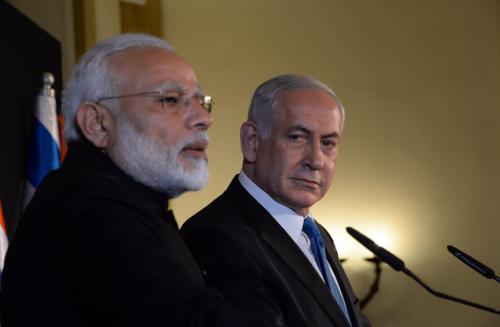
Benjamin Netanyahu and Narendra Modi hold a joint press conference following their meeting in Jerusalem on 5 July 2017 [Haim Zach/GPO / Handout /Anadolu Agency]
Israel’s ability to forge such relationships also highlights its status as being the global leader in the military industry. Israel’s culture of deep militarism and years of experience supressing the political rights of the Palestinians has enabled it to export its technology of control and domination to others. Its unique experiences have also made the country an invaluable asset to governments around the world that too are confronted with new security challenges.
Despite its status as a relatively small arms dealer compared to the likes of the USA and Russia, Israel’s security exports are unmatched in terms of quality. Israel has managed to carve out a niche in the security industry, selling its experience and expertise in policing, urban warfare, surveillance, intelligence. Analysts describe this as “full spectrum domination”.
Israel’s unique role in security – what some would call suppression – can be seen from the Contras in Latin America, to the riots in Ferguson, North America; from the massacres in Bosnia and Rwanda to the killings of Rohinga Muslims in Burma. There are numerous instances in which Israel and Israeli security companies have led the way in the pacification of the people through the export of arms, surveillance technology, intelligence and security advice.
The innocence of those who fear and the guilt of those who hate
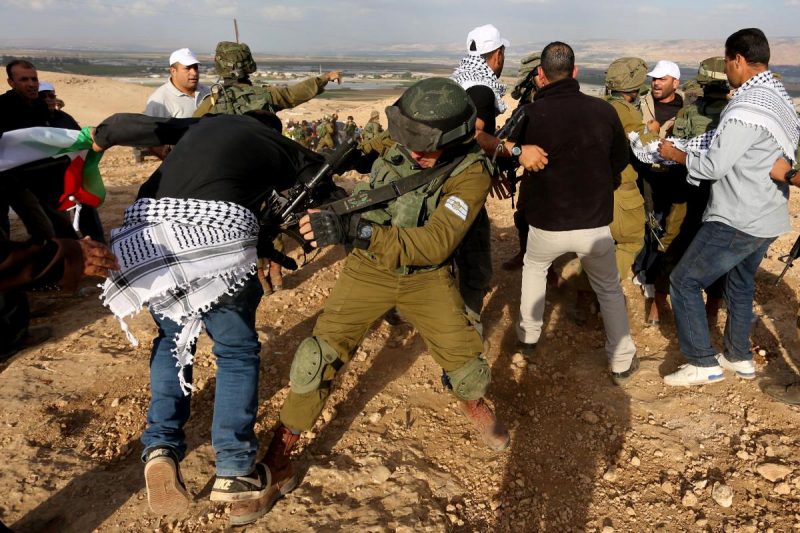
Israeli security forces brutally arrest Palestinian protesters in West Bank [Issam Rimawi – Anadolu Agency]
Dr Samah Jabr| MEMO | November 14, 2017
In our stressful state of occupation, there is, among other ills, an essentialist view of Israeli and Palestinian characteristics. In the many public talks that I have given to Westerners about the violation of the rights of Palestinians, one question almost invariably comes up: “What about the fears of the Israelis?” Similarly, how many times have we heard Western media and even the President of the United States speak of “Palestinian hatred”? These words take for granted the guilt of those who “hate” and the innocence of those who “fear”. However, the reality is that we cannot understand concerns regarding the fears of the Israelis without dissecting the accusations of “Palestinian hatred”.
One problem in this dichotomy is its assumption of a fixed, static state, as if the fears of the Israelis and the hatred of the Palestinians are inborn, permanent traits with no variation among group members. The presumption of eternal and unanimous characteristics serves to maintain the oppressive relationship between the occupier and the occupied and to obstruct political change. To find a way out, the essentialism must be contextualised and deconstructed.
Let us begin by clarifying the disproportionality of the fears of the Israelis with regard to the realistic harm that Palestinians have brought upon them. Israel has long had one of the most powerful armies in the world; it gives “lessons in security” to other nations and exports arms to them for the purpose of oppressing others. Moreover, in order to foster its violent occupation and suppress the natural reflexive resistance on the part of the natives of Palestine, Israel has caged unarmed Palestinians behind walls and appointed colluding Palestinians to maintain order and silence within these cages. By means of long-term and sophisticated strategies to damage Palestinian collective identity, Israel has infiltrated every Palestinian neighbourhood with spies and collaborators. In every previous confrontation, the number of Palestinian casualties has been 100 times the number of Israeli casualties. Thousands of Palestinians are in Israeli prisons, not the other way around; thousands of Palestinian, not Israeli, homes have been demolished by Israeli bulldozers; and yet it is the unarmed and stateless Palestinians who are asked to be considerate of Israeli fears.
In view of these facts, it is unjust and insulting when the question of “Israeli fears” is addressed to a Palestinian, insofar as the question itself reveals deep denial of the longstanding history of Israeli violence. The plea for empathy and understanding, when addressed to the victims of Israeli occupation, is absurd, yet the expectation is that Palestinians must demonstrate understanding and offer reassurance for their oppressors’ fears. The failure to do so is taken as further evidence of “Palestinian hatred” and confirmation that the Israelis are right to fear them.
I understand very well the traumatic fears caused by the history of the Jews in Europe during the 20th and previous centuries, but why should I, a Palestinian, be called upon to soothe these past fears when I am busy with the traumatic present of occupied Palestine? How can I experience deep empathy for this historical European tragedy when the Israeli threats to my existence and security continue to upstage past events in demanding my urgent attention?
Furthermore, the fear of the Israelis is not simply innocent traumatic heritage; it is a suspect political instrument; a wicked manipulation justifying their cruel treatment of the Palestinians. The invocation of Israeli fears silences protest against the occupation, insisting that all Israelis are implicated in the occupation regardless of their individual hesitations about it. And more evil yet is the fact that this manipulated fear cannot be soothed until the Palestinians disappear completely.
The pretence of fear provides an excuse for crime and absolves “frightened” criminals of responsibility; it falsely attributes the responsibility to the “frightening” victims of the crime instead. Is this not what is implied by the misnomer “Islamophobia?” Why is prejudice and crime directed at Jews called anti-Semitism when prejudice and crime against Muslims — many of whom are also Semites — is not called anti-Muslim hate and a crime? It is called instead the minimising term “Islamophobia”, implying that the hate, racism and criminality of the perpetrator is justified because he or she suffers from anxiety and irrational fears about Islam.
To be fair, a degree of fear on the part of Israelis is appropriate; it’s the fear that a tiny proportion of their violence might come back to haunt them, rarely as rockets or a bombing, more often as a Palestinian youth may attempt to punish the Israelis by throwing a stone or pursuing an Israeli soldier with a screwdriver. These things may happen as long as the United Nations and the Palestinian leadership fail to hold the Israelis to account for their crimes.
Attributing fear to the Israelis recruits empathic identification with them, whereas attributing the degrading trait of hatred to the Palestinians provokes repulsion and aversion to them. While there is hatred for the state of Israel among Palestinians, this does not go beyond the adaptive and inevitable hatred that any oppressed and colonised group holds for the collective group that has perpetrated endless crimes against them. Palestinians do not hate Israelis as Jews but as participants in the system responsible for their political oppression. Palestinians are not born with hate in their hearts; hate develops as an appropriate reaction to the totality of the heinous experiences of life under occupation. The people of Palestine are not known for their anti-Semitism; they have welcomed pilgrims from Africa and refugees from Armenia. Many Muslim and Christian Palestinians were married to Jews living in Palestine before the occupation. Like any nation, though, the people of Palestine hate the theft of their land, the pain and the humiliation that the occupation has inflicted upon them. This is, surely, legitimate hate, serving the function of distinguishing harm from safety and motivating resistance to oppression rather than submission to despair.
To expect Palestinians to be free of hate or other negative feelings towards Israel is like expecting a raped woman to have empathy towards her rapist. This would be an example of Stockholm syndrome — a dissociation at best — and more psychologically dangerous than hate itself. This syndrome will eventually result in an internalisation of that hate which would then express itself destructively within the oppressed community.
What Israel actually fears is its own dark “Shadow,” its enormous but disowned and projected violence and hatred for the Palestinians.
It was not fear, but hatred that permitted Israel to commit massacres which evacuated Palestinian villages and towns by force, and which motivates soldiers to kill handcuffed prisoners and unconscious, wounded Palestinians. It is hatred that incites Jewish settlers to burn Palestinians alive and uproot the ancient olive trees of Palestine. Hate speech is articulated by Israeli soldiers who call Palestinians, “beasts on two legs”, “drugged cockroaches” and “crocodiles who want more meat.” This is hate speech which not only encourages hateful acts committed in the name of the occupation but also legitimises ethnic cleansing. Isn’t that what we must do with cockroaches; get rid of them?
Instead of blaming the Palestinians for their hatred and excusing the Israelis for their fear, a constructive move forward would be to help Israel to distinguish reality from fantasy. This would mean admitting Israeli’s own hatred, as well as its greed, and acknowledging that ending the heinous occupation is the only remedy for its fears.
The resumption of PA security coordination with Israel is no surprise
By Ramona Wadi | MEMO | November 14, 2017
Palestinian Authority leader Mahmoud Abbas is not one to miss an opportunity to collaborate with Israel. At sporadic intervals, the suspension of security coordination with Israel was implemented temporarily only when Palestinians were protesting over Israeli violence or, for example, surveillance at Al-Aqsa Mosque. Despite congratulatory statements regarding Abbas’s decision to suspend what he has called “sacred” coordination with the occupation authorities, there was still doubt over its implementation; there were even occasional comments that security coordination had resumed even as the PA was still congratulating itself over the “suspension”.
Last week, all doubts were dissipated as the PA confirmed that it had resumed security coordination with Israel two weeks earlier. In terms of accuracy, the time frame can be contested, given that reports as early as August had already confirmed such collaboration. In light of the reconciliation agreement between the PA and Hamas, it is thus ever more pertinent to question the underlying motives behind such a deal, which has the potential to open up Gaza to Israel.
According to comments on Press TV, Hamas spokesman Fawzi Barhoum declared the movement’s “surprise” at the announcement. Security coordination “is the equivalent of the greatest danger to the Palestinian people, its unity and its legitimate rights, including the right to resist the occupation,” he said. Barhoum also described the move as distorting “the reputation” of the Palestinian people, their struggles and history.
While Barhoum’s comments show an understanding of the implications, claiming to be surprised was surely an exaggeration. Had Gaza not been forced to seek a compromise with Fatah, it is possible that the current political scenario would not be defined by a reconciliation agreement, particularly one which so far is seeking to overturn the resistance with which Hamas has been identified and which sets the movement apart from other political factions due to being forced into situations necessitating defence in the enclave.
Within the same time frame of the security coordination announcement, senior Hamas official Mousa Abu Marzook also stated that responsibility for Palestinians in Gaza now rests entirely with the PA as a sign of credibility to eliminate internal division. The problem is that the emphasis on internal division is being isolated from the repercussions upon Palestinians. If the current trend continues, Palestinian leaders will be making the same mistakes as the international community by separating the political from the humanitarian, thus creating different levels of responsibility, visibility and accountability.
If the PA determines the course of the reconciliation agreement, security coordination will ultimately provide Israel with access to the Gaza Strip unless Hamas decides on an alternative course of action, which is to refute the entire facade of “unity” that has been shaped by Mahmoud Abbas. Coercion has been a primary factor influencing the reconciliation agreement, compounded with the international isolation of Gaza, its people and Hamas. Security coordination is another form of coercion which will determine additional levels of oppression for Palestinians, including those in Gaza.
For many years, Abbas has sought to maintain different forms of violence in Gaza and the occupied West Bank, using deprivation and security coordination respectively. Under such circumstances, Hamas will be in dire need of further evaluation and a different strategy.
Read Also: What prisoners mean to the Palestinian Authority
PA’s security coordination with Israel greatest threat to unity
Israeli occupation forces seize former prisoner, raid village

Samidoun Palestinian Prisoner Solidarity Network – November 14, 2107
Israeli occupation forces seized at least 14 Palestinians throughout occupied Palestine in pre-dawn raids on Monday, 13 November, including former prisoner and long-term hunger striker Tareq Qa’adan, a prominent leader of the Palestinian Islamic Jihad Movement.
Qa’adan, 45, was seized after a 1:30 am raid on his home in the town of Arrabeh, south of Jenin. Occupation forces ransacked his home and interrogated him on the spot before seizing him. He has spent over 10 years in Israeli prions in previous detentions – mostly imprisoned without charge or trial – and is related to many other current and former prisoners; his sister, Mona Qa’adan, is also a freed prisoner and prominent activist.
Khader Adnan, prominent former prisoner and long-term hunger striker, said that evidence indicates that the Israeli occupation intends to transfer Qa’adan to administrative detention, imprisonment without charge or trial. He said that he is confident that imprisonment will not break Qa’adan’s will, and that “he adheres firmly to the defense of the Palestinian cause and homeland, even when the price is his freedom.”
The Islamic Jihad movement issued a statement on the detention of Qa’adan, saying that “this unjust detention…comes amid a wave of targeting and escalation by the occupation against the movement and our steadfast people…Our people have known him as a solid national leader who defends the rights of his people and the fundamentals of his cause. He is known for his positive and strong relationships with all political and national forces and their leaders, who has spent long years in detention in the occupation prisons and a hero of the battles of the open hunger strike.”
This was followed on Tuesday morning, 14 November, by raids across the occupied Palestinian West Bank in which Israeli occupation forces seized 18 Palestinians. In Deir Abu Mashaal village west of Ramallah, occupation fores once again engaged in collective punishment of Palestinian families. They stormed the home of the family of Baraa Saleh Atta, killed by occupation forces after he participated in an armed action in which several Israeli police were killed. They confiscated tens of thousands of shekels from the village and arrested Baraa’s brother Nidal. The stolen funds are those that were raised to help support the families of the three young men, whose homes were sealed off and demolished by occupation forces; the Israeli occupation accused that these funds were “supporting terrorism.”
They also raided the towns of Qabatiya, Zababdeh and Maysaloon near Jenin, while in Tulkarem, they seized former prisoner Muath Jaroun, ransacking his home. They also stationed themselves once again at Kadoorie University, where the presence of armed Israeli occupation forces has become a regular threat and barrier to education for Palestinian students.
Congressional Progressive Caucus Seeks Ban On US Financing Child Torture By Israel
U.S. lawmakers seek to prohibit taxpayer funds from supporting human rights violations against Palestinian minors in Israeli military detention system

No Way to Treat a Child campaign – November 14, 2017
Washington, D.C. – Members of Congress on Tuesday introduced a bill prohibiting U.S. financial support of abuses against Palestinian children in the Israeli military detention system, putting violations under the magnifying glass of U.S. taxpayers.
The Promoting Human Rights by Ending Israeli Military Detention of Palestinian Children Act requires the Secretary of State to certify annually that no funds obligated or expended in the previous year by the United States for assistance to Israel have been used to support the ill-treatment of Palestinian children detained by Israeli forces from the occupied West Bank.
Rep. Betty McCollum (D-MN) brought the bill to the floor, with eight original co-sponsors, including Rep. Raúl Grijalva (D-AZ) and Rep. Mark Pocan (D-WI), co-chairs of the Congressional Progressive Caucus.
An estimated 10,000 Palestinians between the ages of 12 and 17 in the West Bank have been subject to arrest, detention, interrogation, and/or imprisonment under the jurisdiction of Israeli military courts since 2000. This bill was drafted in response to widely documented rights violations carried out by Israeli military and police against children within the military detention system, including torture or cruel, inhumane, or degrading treatment.
“Despite ongoing engagement with UN bodies and repeated calls to abide by international law, Israeli military and police continue night arrests, physical violence, coercion, and threats against Palestinian children,” said Khaled Quzmar, general director of Defense for Children International – Palestine. “These practices remain institutionalized and systemic rather than last resort measures, and we call on the U.S. to halt its support of these violations.”
The bill aims to establish, as a minimum safeguard, a U.S. demand for basic due process rights for and an absolute prohibition against torture and ill-treatment of Palestinian children arrested and prosecuted within the Israeli military court system.
Israel has the dubious distinction of being the only country in the world that systematically prosecutes an estimated 500 to 700 children each year in military courts that lack fundamental fair trial rights and protections.
In every annual report on Israel and the occupied territories released since 2007, U.S. authorities have openly acknowledged the prevalence of torture and ill-treatment of Palestinian children and the denial of fair trials rights in the Israeli military detention system.
In 2013, UNICEF released a report titled Children in Israeli Military Detention: Observations and Recommendations. The report concluded that “ill-treatment of children who come in contact with the military detention system appears to be widespread, systematic and institutionalized throughout the process.”
Despite sustained engagement by UNICEF and repeated calls to end night arrests and ill-treatment of Palestinian children in Israeli military detention, Israeli authorities have persistently failed to implement substantive reforms to end violence against child detainees.
Featured Video
Matt Bracken: US Plans Massive MOAB Strike on Iran?
or go to
Aletho News Archives – Video-Images
New Book
The silver that medicine dropped — four thousand years of clinical use, four decades to erase.
Colloidal Silver — First Edition, 2026, Paperback
Lies are Unbekoming | October 16, 2026
Silver was medicine. Not alternative medicine. Not folk medicine. Medicine. In surgery. In obstetrics. In the burn ward. In water treatment. In the household medicine chest. Every physician before 1938 knew this.
By the 1870s, silver nitrate was standard in surgical wound care across the leading hospitals of Britain, Germany, and the United States. Colloidal silver preparations — Collargol, Argyrol, Protargol — entered European and American practice through the 1890s and early 1900s and became standard antiseptics in military field medicine. By the time Fleming grew his first penicillin mould in 1928, silver was the first-line antimicrobial of the Western pharmacopoeia. The Lancet and the British Medical Journal carried the clinical reports in volume. The practice ran continuously through the Victorian era, the Edwardian era, the First World War, the interwar period. By 1980, almost all of it was gone.
What has not been treated at book length, until now, is how a four-thousand-year clinical record disappeared from mainstream medicine within four decades of the Flexner Report — and what the honest account of silver looks like once that record is reassembled.
Colloidal Silver reconstructs the pre-1938 record from The Lancet, the British Medical Journal, and the primary literature of the era; recovers Robert Becker’s bioelectric framework from the regeneration research the pharmaceutical model buried; and places silver inside a practical terrain-paradigm guide to its current place — in water, on the body, inside the body, and in the chronic conditions where antibiotics have failed. … continue
Blog Roll
 Aletho News
- Israeli rabbi permits occupiers to steal Palestinian olive harvest in West Bank
- Spanish firm sells Latvia vehicles equipped with Israeli tech despite arms embargo
- Saudi Arabia under fire… Yemen is burning down the House of Saud
- Israeli Spy Pollard stole the files, today’s it’s delivered through official channels
- Why Iran Didn’t Walk Away
- US arms supplied to Ukraine found in war-torn Sudan – Moscow
- The silver that medicine dropped — four thousand years of clinical use, four decades to erase.
- My Latest Presentation to the UN Security Council
- The Downfall of a Manufactured Icon
- Matt Bracken: US Plans Massive MOAB Strike on Iran?
- If Americans Knew
- NPR investigation finds evidence of widespread fraud at mall kiosks tied to Israeli skincare brand
- Tucker Carlson exposes Israeli Lies about the Oct 7th attack, Charlie Kirk, and the U.S.
- Israel has detained thousands of Palestinian children since Oct 7th – over half spent time in solitary, many uncharged
- Israeli Analysis: Is Netanyahu Planning an ‘October Surprise’ Attack Before Israel’s Election?
- Israeli settlers brutally attack Palestinians and Washington Post female photographer, 65
- Words Have Changed, Occupation Continues: The Reality of the Gaza Ceasefire
- Gaza’s child amputees are growing faster than their prosthetics allow
- Israel keeps Palestinians struggling just to survive–Daily Update
- Israeli firm used online ads to run vast spy operation, researchers say
- No, the world zionist movement is not an antisemitic conspiracy theory
- No Tricks Zone
- New Study Suggests Large Regions Of The Pacific Ocean Have Been Cooling For The Last 80 Years
- Germany’s Green Energy Debacle: High Energy Costs Force Kahla Porzellan to Close After 182 Years!
- New Study: 50 Years Of The Most Aggressive ‘Net Zero’ Policies Can Only Affect The Global Climate By 0.03°C
- US September “Heat” Was No Record…Many Records Set Decades Ago
- Latest European Green Energy Debacle; Portugal’s Largest Flagship Solar Park Insolvent!
- Green Energy Debacle: German Expert Professor Fritz Vahrenholt Warns Of Severe Economic And Social Consequences
- Two More Paleo Reconstructions Affirm Meters-Higher Sea Levels Across Ireland, Brazil 7000-6000 Years Ago
- New Study: Earth And Venus Surface Warmth Largely Explained By Convection And Lapse Rate, Not CO2 Or Radiation
- 2025 Nature Paper Claiming Worsening Global Drought Gets RETRACTED …Heavily Flawed
- New Study: ‘Global Drought Shows No Detectable Recent Acceleration Under Climate Warming’

