Israel has revoked citizenship for hundreds of Israeli Arabs
MEMO | August 26, 2017
The Israeli authorities have revoked the citizenship of hundreds – maybe thousands – of Israeli Arabs in the southern Negev region over the past two years, Israeli daily Haaretz revealed Friday.
According to the newspaper, Israel’s Interior Ministry has changed the status of these Israeli Arabs from “citizens” to “inhabitants”, which has led to the forfeiture of many of their basic rights.
Reacting to the report, Talab Abu Arar, an Israeli Arab member of the Knesset (Israel’s parliament), demanded that the ministry reverse the move.
According to Abu Arar, the citizenships were surreptitiously stripped by the ministry’s office in the city of Beersheba (the Negev’s largest city) when Israeli Arab residents applied to renew their national ID cards or passports.
In a statement, Juma Azbarga, an Israeli Arab Knesset member from the Joint Arab List coalition, asserted: “We will not sit idly by in the face of attempts to gradually expel us from our homeland… and delegitimize our existence.”
“The revocation of our citizenship makes us vulnerable to abuse and restricts our freedom of movement,” he added, pointing out that non-citizens lack the right to vote or run in general elections.
Describing the move as “contrary to Israeli law itself”, Azbarga added: “Our citizenship is derived from our presence in our homeland and our history — it does not depend on the whim of a few rogue officials.”
The Possible Education of Donald Trump
By Robert Parry | Consortium News | August 25, 2017
Despite the chaos and ugliness of the past seven months, President Trump has finally begun to turn U.S. foreign policy away from the neoconservative approach of endless war against an ever-expanding roster of enemies.
This change has occurred largely behind the scenes and has been obscured by Trump’s own bellicose language, such as his vow to “win” in Afghanistan, and his occasional lashing out with violence, such as his lethal Tomahawk missile strike on a Syrian airfield.
Some Trump advisers also have downplayed the current shift because it may fuel the Democrats’ obsession with Russia-gate as a much-desired excuse to impeach Trump. Every peaceful move that Trump makes is called a sop to Russia and thus an excuse to reprise the dubious allegations about Russia somehow helping to elect him.
Yet, despite these external obstacles and Trump’s own erratic behavior, he has remained open to unconventional alternatives to what President Obama once criticized as the Washington “playbook,” i.e. favoring military solutions to international problems.
In this sense, Trump’s shallow understanding of the world has been a partial benefit in that he is not locked into the usual Washington groupthinks – and he personally despises the prominent politicians and news executives who have sought to neuter him since his election. But his ignorance also prevents him from seeing how global crises often intersect and thus stops him from developing a cohesive or coherent doctrine.
Though little noted, arguably the most important foreign policy decision of Trump’s presidency was his termination of the CIA’s covert support for Syrian rebels and his cooperation with Russian President Vladimir Putin to expand partial ceasefire zones in Syria.
By these actions, Trump has contributed to a sharp drop-off in the Syrian bloodshed. It now appears that the relatively secular Syrian government of President Bashar al-Assad is regaining control and that some Syrian refugees are returning to their homes. Syria is starting the difficult job of rebuilding shattered cities, such as Aleppo.
But Trump’s aversion to any new military adventures in Syria is being tested again by Israeli Prime Minister Benjamin Netanyahu, who is threatening to attack Iranian and Hezbollah forces inside Syria.
Last week, according to Israeli press reports, a high-level delegation led by Mossad chief Yossi Cohen carried Netanyahu’s threat to the U.S. government. The Israeli leader surely has raised the same point directly in phone calls with Trump.
Tiring of Bibi
I was told that Trump, who appears to be growing weary of Netanyahu’s frequent demands and threats, flatly objected to an Israeli attack and brushed aside Israel’s alarm by noting that Netanyahu’s policies in supporting the rebels in Syria contributed to Israel’s current predicament by drawing in Iran and Hezbollah.
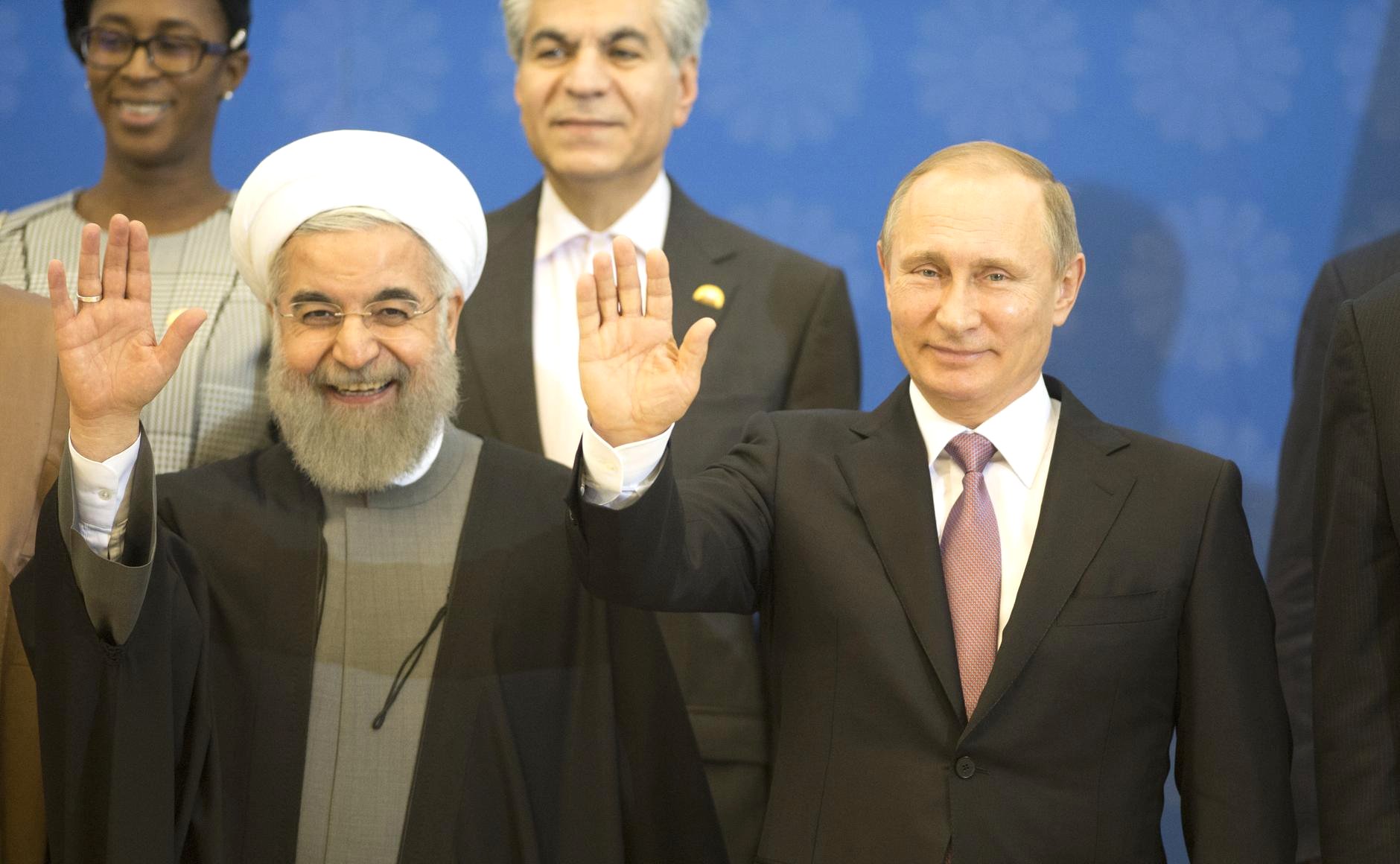
This week, Netanyahu personally traveled to Sochi, Russia, to confront Putin with the same blunt warning about Israel’s intention to attack targets inside Syria if Iran does not remove its forces.
A source familiar with the meeting told me that Putin responded with a sarcastic “good luck!” and that the Russians thought the swaggering Netanyahu appeared “unhinged.”
Still, a major Israeli attack on Iranian positions inside Syria would test Trump’s political toughness, since he would come under enormous pressure from Congress and the mainstream news media to intervene on Israel’s behalf. Indeed, realistically, Netanyahu must be counting on his ability to drag Trump into the conflict since Israel could not alone handle a potential Russian counterstrike.
But Netanyahu may be on somewhat thin ice since Trump apparently blames Israel’s top American supporters, the neocons, for much of his political troubles. They opposed him in the Republican primaries, tilted toward Hillary Clinton in the general election, and have pushed the Russia-gate affair to weaken him.
President Obama faced similar political pressures to fall in line behind Israel’s regional interests. That’s why Obama authorized the covert CIA program in Syria and other aid to the rebels though he was never an enthusiastic supporter – and also grew sick and tired of Netanyahu’s endless hectoring.
Obama acquiesced to the demands of Official Washington’s neocons and his own administration’s hawks – the likes of Secretary of State Hillary Clinton, CIA Director David Petraeus, his successor John Brennan, and United Nations Ambassador Samantha Power.
The Syrian conflict was part of a broader strategy favored by Washington’s neocons to overthrow or cripple regimes that were deemed troublesome to Israel. Originally, the neocons had envisioned removing the Assad dynasty soon after the invasion of Iraq in 2003, with Iran also on the “regime change” menu. But the disastrous Iraq War threw off the neocons’ timetable.
‘Regime Change’ Chaos
The Democratic Party’s liberal interventionists, who are closely allied with the Republican neocons, also tossed in Libya with the overthrow and murder of Libyan leader Muammar Gaddafi in 2011. Then, weapons from Gaddafi’s stockpiles were shipped to Syria where they strengthened rebel fighters allied with Al Qaeda’s Nusra Front and other Islamist groups.
Faced with this troubling reality – that the U.S.-backed “moderate rebels” were operating side by side with Al Qaeda’s Syrian affiliate and its allies – Washington’s neocons/liberal-hawks responded with sophisticated propaganda and devised clever talking points to justify what amounted to indirect assistance to terrorists.
The “regime change” advocates portrayed a black-and-white situation in Syria with Assad’s side wearing the black hats and various anti-Assad “activists” wearing the white hats (or literally White Helmets). The State Department and a complicit mainstream media disseminated horror stories about Assad and – when the reality about Al Qaeda’s role could no longer be hidden – that was spun in the rebels’ favor, too, by labeling Assad “a magnet for terrorists” (or later in cahoots with the Islamic State). For years, such arguments were much beloved in Official Washington.
But the human consequences of the Syrian conflict and other U.S.-driven “regime change” wars were horrific, spreading death and destruction across the already volatile Middle East and driving desperate refugees into Europe, where their presence provoked political instability.
By fall 2015, rebel advances in Syria – aided by a supply of powerful U.S. anti-tank missiles – forced Russia’s hand with Putin accepting Assad’s invitation to deploy Russian air power in support of the Syrian army and Iranian and Hezbollah militias. The course of the war soon turned to Assad’s advantage.
It’s unclear what Hillary Clinton might have done if she had won the White House in November 2016. Along with much of the U.S. foreign policy establishment, she called repeatedly for imposing a “no-fly zone” in Syria to stop operations by the Syrian air force and Russia, a move that could have escalated the conflict into World War III.
But Trump – lacking Official Washington’s “sophistication” – couldn’t understand how eliminating Assad, who was leading the fight against the terrorist groups, would contribute to their eventual defeat. Trump also looked at the failure of similar arguments in Iraq and Libya, where “regime change” produced more chaos and generated more terrorism.
Pandering to Saudis/Israelis
However, in the early days of his presidency, the unsophisticated Trump lurched from one Middle East approach to another, initially following his son-in-law Jared Kushner’s grandiose thinking about recruiting Saudi Arabia to an “outside-in” strategy to settle the Israel-Palestine conflict, i.e., enlisting the Saudis to pressure the Palestinians into, more or less, letting Israel dictate a solution.
Kushner’s “outside-in” scheme was symbolically acted out with Trump making his first overseas visit to Saudi Arabia and then to Israel in May. But I’m told that Trump eventually cooled to Kushner’s thinking and has come to see the Israeli-Saudi tandem as part of the region’s troubles, especially what he views as Saudi Arabia’s longstanding support for Al Qaeda and other terror groups.
Perhaps most significantly in that regard, Trump in July quietly abandoned the CIA’s covert war in Syria. In the U.S., some “regime change” advocates have complained about this “betrayal” of the rebel cause and some Democrats have tried to link Trump’s decision to their faltering Russia-gate “scandal,” i.e., by claiming that Trump was rewarding Putin for alleged election help.
But the bottom line is that Trump’s policy has contributed to the Syrian slaughter abating and the prospect of a victory by Al Qaeda and/or its Islamic State spinoff fading.
So, there has been a gradual education of Donald Trump, interrupted occasionally by his volatile temper and his succumbing to political pressure, such as when he rushed to judgment on April 4 and blamed the Syrian government for a chemical incident in the remote Al Qaeda-controlled village of Khan Sheikhoun.
Despite strong doubts in the U.S. intelligence community about Syria’s guilt – some evidence suggested one more staged “atrocity” by the rebels and their supporters – Trump on April 6 ordered 59 Tomahawk missiles fired at a Syrian air base, reportedly killing several soldiers and some civilians, including four children.
Trump boasted about his decision, contrasting it with Obama’s alleged wimpiness. And, naturally, Official Washington and the U.S. mainstream media not only accepted the claim of Syrian government guilt but praised Trump for pulling the trigger. Later, Hillary Clinton said if she were president, she would have been inclined to go further militarily by intervening with her “no-fly zone.”
As reckless and brutal as Trump’s missile strike was, it did provide him some cover for his July 7 meeting with Putin at the G-20 summit in Germany, which focused heavily on Syria, and also for his decision to pull the plug on the CIA’s covert war.
Saudi-backed Terror
I’m told Trump also has returned to his pre-election attitude about Saudi Arabia as a leading supporter of terror groups and a key provocateur in the region’s disorders, particularly because of its rivalry with Iran, a factor in both the Syrian and Yemeni wars.
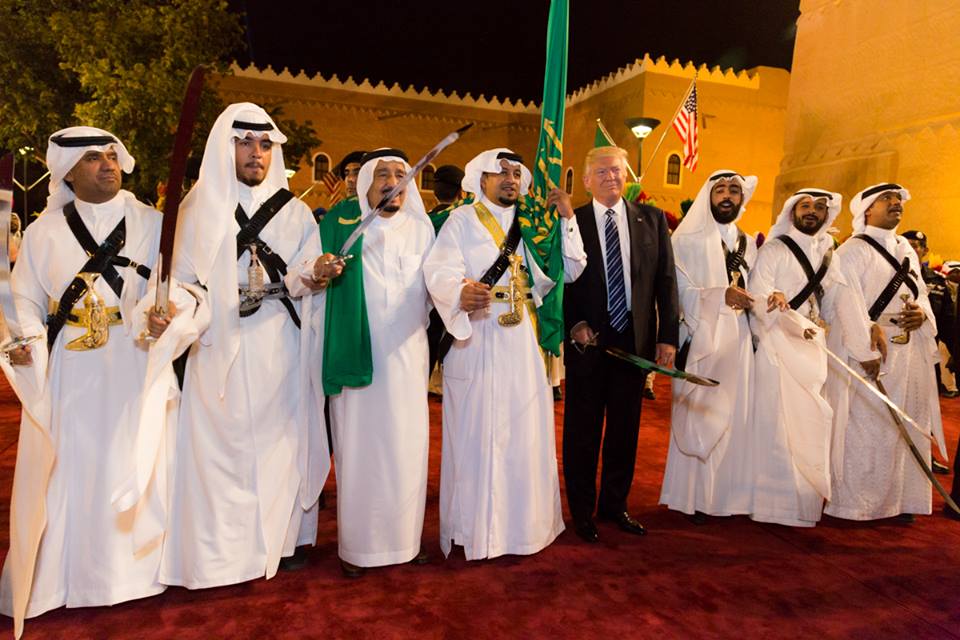
(Official White House Photo by Shealah Craighead)
Though Trump has recited Washington’s bipartisan (and benighted) mantra about Iran being the principal sponsor of terrorism, he appears to be moving toward a more honest view, recognizing the falsity of the neocon-driven propaganda about Iran.
Trump’s new coolness toward Saudi Arabia may have contributed to the recent warming of relations between the Sunnis of Saudi Arabia and the Shiites of Iran, a sectarian conflict dating back 1,400 years. In a surprising move announced this week, the two countries plan an exchange of diplomatic visits.
Even in areas where Trump has engaged in reckless rhetoric, such as his “fire and fury” warning to North Korea, his behind-the-scenes policy appears more open to compromise and even accommodation. In the past week or so, the tensions with North Korea have eased amid backchannel outreach that may include the provision of food as an incentive for Pyongyang to halt its missile development and even open political talks with South Korea, according to a source close to these developments.
On Afghanistan, too, Trump may be playing a double game, giving a hawkish speech on Monday seeming to endorse an open-ended commitment to the near-16-year-old conflict, while quietly signaling a willingness to negotiate a political settlement with the Taliban.
One alternative might be to accept a coalition government, involving the Taliban, with a U.S. withdrawal to a military base near enough to launch counterterrorism strikes if Al Qaeda or other international terror groups again locate in Afghanistan [likely an air base from which to threaten Iran – Aletho News ].
Many of Trump’s latest foreign policy initiatives reflect former White House strategist Steve Bannon’s hostility toward neoconservative interventionism. Secretary of State Rex Tillerson, the former Exxon-Mobil chief executive, also shares a more pragmatic approach to foreign affairs than some of his more ideological predecessors.
Albeit still in their infancy, these policies represent a new realism in U.S. foreign policy that, in many ways, paralleled what President Obama favored but was often unwilling or unable to see through to its logical conclusions, given his fear of Netanyahu and the power of the neocons and their liberal-hawk allies.
Still, some of Obama’s most important decisions – not to launch a major military strike against Syria in August 2013 and to negotiate an agreement with Iran to constrain its nuclear program in 2013-15 – followed a similar path away from war, thus drawing condemnation from the Israeli-Saudi tandem and American neocons.
As a Republican who rose politically by pandering to the GOP “base” and its hatred of Obama, Trump rhetorically attacked Obama on both Syria and Iran, but may now be shifting toward similar positions. Gradually, Trump has come to recognize that the neocons and his other political enemies are trying to hobble and humiliate him – and ultimately to remove him from office.
The question is whether Trump’s instinct for survival finally will lead him to policies that blunt his enemies’ strategies or will cause him to succumb to their demands.
Investigative reporter Robert Parry broke many of the Iran-Contra stories for The Associated Press and Newsweek in the 1980s.
Racist Organization receives Bonanza of “Anti-Racism” Donations
By Alison Weir | Dissident Voice | August 25th, 2017
In the wake of Charlottesville, numerous Americans have come forward to oppose racism in a variety of ways. In some cases this has taken the form of donations.
As a result, some allegedly anti-racist organizations have seen a financial bonanza. The main one seems to be the Anti-Defamation League (ADL), which saw a 1,000% spike in donations – more than half by first-time donors.
There’s one problem. The ADL is a major supporter of racism.
On its website, the ADL claims it works to “secure justice and fair treatment to all.”
Unfortunately, that is far from the truth. The fact is that the ADL works to maintain oppression and discrimination against Palestinian Muslims and Christians.
The ADL’s number two focus, listed right after its claim to speak out against “bigotry, discrimination and injustice,” is to “stand up for the Jewish State of Israel.”
Israel was created – as documented by Israeli historians and numerous others – by a war of ethnic cleansing of the Muslim and Christian population that made up the large majority of the inhabitants.
It then instituted a system built on discrimination against Muslims, Christians, and other non-Jews.
For the past 69 years Israel has oppressed Palestinians in diverse ways, confiscating their land, destroying their homes, killing numerous children, and imprisoning at least one member of 70 percent of all Palestinian families.
In addition, Israel has waged wars of aggression against Egypt, Syria, and Lebanon. It has urged wars against Iraq, Iran, and others.
And the ADL has been in the forefront of supporting Israel. It has also used its $57 million budget to smear those who support fairness, justice, and equality for Palestinians.
The sad fact is that donations to the ADL, rather than fighting racism, will be used to enable it.
People may wish to ask for their money back and give it to someone who actually helps people – and whose executive director isn’t paid close to half a million dollars.
Alison Weir is executive director of If Americans Knew, president of the Council for the National Interest, and author of Against Our Better Judgment: The Hidden History of How the U.S. Was Used to Create Israel. She can be reached at: contact@ifamericansknew.org.
Israel prevents Palestinian students from entering school in Al-Aqsa Mosque

MEMO | August 25, 2017
Israeli police prevented 160 Palestinian secondary school students from entering the Shari’ah School in Al-Aqsa Mosque on Thursday, under the pretext that their school books are based on the Palestinian curriculum, Quds Press has reported. The police had already prevented the delivery of schoolbooks at the premises two days ago, citing the same pretext about the curriculum.
According to Raed Da’na, the Director of Preaching and Guidance at Al-Aqsa, the books were distributed outside the mosque because Israeli police object to the presence of “Palestinian flags and pictures of protests” alongside the text. The Israelis even said that book covers which have the Palestinian flag on them must be torn up if students want to enter the mosque to attend their school, he revealed.
Da’na added that Israeli security forces confiscated the ID documents of Najih Bukairat, the head of the Aqsa Academy for Sciences and Heritage, and Robain Muhaisin, a Palestinian teacher, before taking them to a police station in the Old City of occupied Jerusalem. The vehicle used to distribute the school textbooks was impounded.
In a related incident, Israeli police and border guards stormed into the Aytam [Orphans] Islamic School, located in the Old City, and arrested two students, according to the Quds Media Centre. A Quds Press correspondent said that this happened while dozens of Jewish settlers were storming around Al-Aqsa Mosque. Sixty-five settlers were accompanied and protected by Israeli security forces, she added. They ordered Al-Aqsa’s guards to stay away from the settlers as they entered the mosque.
Guards attached to the Noble Sanctuary usually accompany Jewish settlers once they enter the compound through the Magharbeh Gate and stay with them until they leave through the Silsela Gate, making sure that they do not do anything that would constitute a violation of the mosque’s sanctity. For this, the guards are subjected to threats and restrictions from Israeli police officers.
‘Israel sees Iran as obstacle to its policies’
Press TV – August 25, 2017
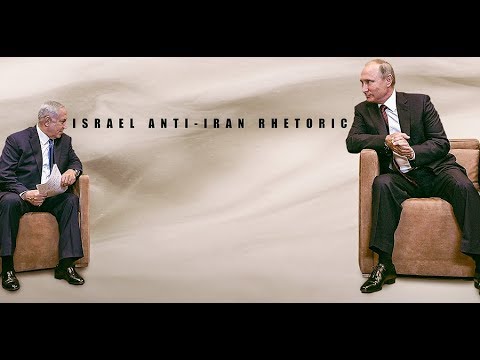
Prime Minister Benjamin Netanyahu has said that Israel felt threatened by Iran’s growing influence in the Middle East. Netanyahu expressed his Iranophobic view in a meeting with Russian President Vladimir Putin in Russia’s Black Sea resort of Sochi on Wednesday. Press TV has asked Scott Rickard, former American intelligence linguist from Tampa, Florida, and Brent Budowsky, a columnist at The Hill from Washington, to give their thoughts on the issue.
Rickard said Tel Aviv is concerned about the fact that the regime could not carry out its old project to spread sectarian divisions and pave the way for dismemberment of the countries in the Middle East region because of the Iranian-led resistance against Israeli policies, not only in the occupied territories of Palestine but also in the whole region.
“Iran is not a threat to Israel whatsoever. The threat that Israel sees is the fact that their Oded Yinon Plan is being put to a hold by Iran,” the intelligence linguist said on Thursday night.
“They (the Israelis) look at Iran as a threat only because they have no influence on their governments and Iran is autonomous and is not under the Zionist influence,” he added.
Since the victory of the Islamic Republic of Iran in 1979, Tehran has been critical of Israel’s policies in the region, whereas “no leaders [of other states] even dared to speak out against Zionism,” Rickard argued.
“Considering Iran a threat in the region is really a fantasy,” which is a propaganda campaign to demonize the Islamic Republic, he said.
During the meeting in Sochi, Netanyahu tried to illustrate a negative portrait of Iran’s support for the Syrian government, but Russian Ambassador to the UN Vasily Nebenzya disappointed Israel by saying that Iran plays a very constructive role in Syria.
Rickard went on to say that the Israelis are trying to sway public opinion by using false intelligence about the Iranian role in Syria.
The analyst opined that the Israeli regime is “not worried about Iran as much as they are worried about the failure of their effort alongside their allies in trying to topple” the Syrian government.
Tel Aviv is afraid of witnessing that “Iran, Russia and Syria have built up a formidable defense” and have shown great resolve and great restraint against being attacked by Israel, he explained.
Iran and Russia alongside the Lebanese Hezbollah movement have played a major role in supporting the Syrian armed forces to defeat Takfiri terrorists and foiling a US-Israeli plot to partition Syria.
Budowsky, the other guest on the panel, said Netanyahu and President Putin were “establishing some understanding of each other’s position to try to avoid any mistakes that could escalate militarily.”
Israel, which has been reportedly aiding and abetting terrorist groups to topple the government in Damascus, considers Iran’s support for President Bashar al-Assad’s fight against the spread of terrorism a threat to its intervention.
The columnist said that Israel is concerned about having Iran near the occupied territories of Palestine as a result of Iranians’ presence in Syria. – Video
Israel charges Palestinian cleric Sheikh Salah with incitement of terror
Press TV – August 24, 2017
The Tel Aviv regime has indicted Sheikh Raed Salah, a cleric who supported Palestinian protests over Israel’s controversial security measures imposed last month at a holy site in occupied Jerusalem al-Quds.
The Israeli court formally charged Salah on Thursday with incitement of terror over speeches he delivered encouraging Palestinians to protest for the right of holding prayers inside the Haram al-Sharif compound, which is home to the revered al-Aqsa Mosque, the third holiest site in Islam.
Israel had earlier in the week extended Salah’s detention, nearly a week after he was arrested. Prosecutors had demanded the renewed detention, saying they intended to bring charges against the 58-year-old cleric.
Israel’s security measures, which came after the July 14 deadly shooting and killing of two Israeli policemen, sparked some unprecedented protests and sit-in gatherings in occupied East Jerusalem al-Quds as Palestinians refused to accept the restrictions for nearly two weeks.
Israel was later forced to remove metal detectors and cameras installed at the gates and Palestinians ended sit-ins and prayers outside the mosque.
Salah had served for nine months in Israeli jails before he was released in January. He was previously charged with “incitement of violence” and “incitement of racism.” His latest arrest sparked condemnations in the occupied territories as his supporters said it was part of a political witch hunt aimed to silence dissent.
Israelis have also banned Salah’s group, the Islamic Movement in Israel, in 2015 for allegedly stoking violence.
Israeli forces detain Addameer field researcher during overnight raid
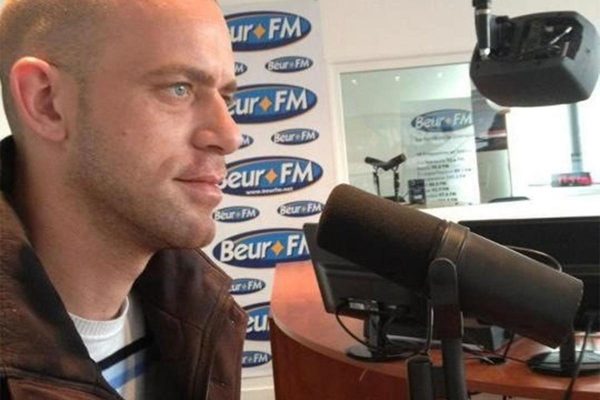
French-Palestinian activist Salah Hamouri. [Photo: twitter.com | salah_hamouri]
Ma’an – August 24, 2017
BETHLEHEM – A field researcher for prisoners’ rights group Addameer was detained during an overnight raid on Wednesday from his home in the occupied East Jerusalem neighborhood of Kufr Aqab, according to the group.
Salah Hammouri, 32, who holds dual Palestinian-French citizenship, was detained and transferred to Israel’s interrogation center at the Russian compound, where his detention was then extended until Sunday.
An Israeli police spokesperson told Ma’an that he was “not familiar” with the case.
According to Addameer, Hammouri was a former prisoner of Israel for seven years, and was released as part of the Wafa al-Ahrar prisoners exchange deal in 2011.
Addameer added that the East Jerusalem resident was banned from entering the occupied West Bank until Sept. 2016, and that his wife is currently banned by Israeli authorities from entering Palestine or Israel.
The group said it considers the detention “an attack against Palestinian civil society organizations and human rights defenders.”
“It also constitutes one arrest in the context of continuous arrest campaigns against Palestinians,” Addameer said, before demanding Hammouri’s release and the release of all Palestinian political prisoners.
Hassan Safadi, a Palestinian activist and media coordinator for Addameer, has also been held in administrative detention — Israel’s controversial policy of imprisonment without charge or trial — for more than a year.
Safadi has been held by Israel since May 1, 2016 after being detained at the Allenby Bridge between the occupied West Bank and Jordan, when he was interrogated by the Israeli army for 40 days.
Israeli authorities later sentenced the 25-year-old Palestinian to six months of administrative detention in June 2016, and has since renewed the administrative detention order twice — once in Dec. and a second time in June this year.
Israel’s widely condemned policy of administrative detention allows internment without charge or trial in maximum six-month long renewable intervals based on undisclosed evidence that even a detainee’s lawyer is barred from viewing.
According to prisoners’ rights group Addameer, 6,128 Palestinians were detained by Israel as of July, 450 of whom were held in administrative detention. The group has estimated that some 40 percent of Palestinian men will be detained by Israel at some point in their lives.
Netanyahu To Putin: Iran Must Leave Syria Or “We Will Act”
By Tyler Durden | Zero Hedge |August 24, 2017
For Netanyahu and other Israeli officials the chief concern was never the black clad death cult which filmed itself beheading Americans and burning people alive. “Let the Sunni evil prevail,” they say.
Israel is threatening to escalate military action in Syria against perceived Iranian interests. This week Netanyahu declared, “we will act when necessary according to our red lines” while hinting he prefers ISIS presence in Syria as opposed to Iran aligned fighters at his border. This comes as ISIS is now crumbling, and at a time when most world leaders of nations driving the external proxy war in Syria have toned down their rhetoric regarding the future fate of the Assad government.
After years of a regular drumbeat of bellicose statements emanating from the West and repeat talk of “Assad must go”, “red lines”, and years of constantly failed predictions that “regime demise is imminent,” there now seems a general acceptance that the Syrian government has emerged victorious in the 6-year long conflict. Not only did Trump this summer order the closure of the CIA’s regime change program which targeted Assad, but it appears even Gulf nations – lately embroiled in their own inter-GCC political civil war and airing of dirty laundry – have been forced to temper their rhetoric. Turkey also has reluctantly shifted its priorities in Syria after its well-known and documented regime change machinations – which included facilitating the transfer of tens of thousands of foreign jihadists (the core of which joined ISIS) across its southern border – have largely backfired. International media too, generally reflecting undeniable geopolitical realities, have bluntly headlined stories with “And the winner is: Assad” and “We have to accept that Assad will win in Syria” and “How Assad is Winning”.
But it appears Benjamin Netanyahu didn’t get the memo. On Wednesday the Israeli Prime Minister told Russian President Putin that Israel would not tolerate an Iranian presence in Syria and further signaled willingness to go to war in Syria to curtail Iranian influence. “Iran is already well on its way to controlling Iraq, Yemen and to a large extent is already in practice in control of Lebanon,” Netanyahu told Putin, adding further that, “We cannot forget for a single minute that Iran threatens every day to annihilate Israel. Israel opposes Iran’s continued entrenchment in Syria. We will be sure to defend ourselves with all means against this and any threat.”

Image source: Sputnik International
The two leaders met for three hours in the Black Sea resort of Sochi – their sixth such meeting since September 2015. Putin did not respond publicly to the provocative words on Syria during the portion of the meeting open to reporters. Netanyahu later told Israeli reporters covering the meeting that:
Bringing Shi’ites into the Sunni sphere will surely have many serious implications both in regard to refugees and to new terrorist acts. We want to prevent a war and that’s why it’s better to raise the alarm early in order to stop deterioration.
Netanyahu’s reference to “the Sunni sphere” came after he summarized the closed door part of the discussion as dealing with “Iran’s attempt to establish a foothold in Syria in the places where ISIS was defeated and is leaving.” Netanyahu’s comments are a reflection of an extremely disturbing view which has become so prominent within Israeli defense circles as to be considered establishment: that ISIS is ultimately preferable to Iran and Assad. This is to say that continued ISIS presence in Syria and Iraq is a viable option and possibly better than pro-Iranian or even Russian spheres of influence in the Israeli prime minister’s mind. Of course, this “lesser evil is ISIS” view is nothing new. In Israel, for example, there are even “respected” think tanks tied in with major public universities which openly call for allowing ISIS to thrive in Syria.
The Begin-Sadat Centre for Strategic Studies, for example, which is one of Israel’s most internationally visible and influential think tanks (and located on the campus of Israel’s second largest university), published a policy paper last year which made a direct appeal to Israel’s Western partners with the unambiguous message contained in the essay’s title: “The Destruction of Islamic State is a Strategic Mistake.” Author and Director of the Begin-Sadat Centre, Efraim Inbar, argued against a Western military campaign to destroy ISIS while envisioning the group as an effective tool in sowing terror and chaos in Iran and Syria, with the added benefit of keeping Russia bogged down in defense of the Assad government. Inbar spelled this out clearly:
The continuing existence of IS [Islamic State] serves a strategic purpose. The American administration does not appear capable of recognizing the fact that IS can be a useful tool in undermining Tehran’s ambitious plan for domination of the Middle East.
While acknowledging the Islamic State’s utter genocidal brutality, the paper concluded:
The Western distaste for IS brutality and immorality should not obfuscate strategic clarity.

A policy paper published by an influential Israeli think tank which contracts with NATO argues that ISIS is a “useful tool” for Israel’s strategic defense.
Various current and former Israeli defense officials have echoed this point of view over the years, including former Israeli Ambassador to the US Michael Oren, who in 2014 surprised the audience at Colorado’s Aspen Ideas Festival when he said in comments related to ISIS that, “the lesser evil is the Sunnis over the Shias.” Oren, while articulating Israeli defense policy, fully acknowledged he thought ISIS was “the lesser evil”. Likewise, for Netanyahu and other Israeli officials the chief concern was never the black clad death cult which filmed itself beheading Americans and burning people alive, but the possibility of, in the words of Henry Kissinger, “a Shia and pro-Iran territorial belt reaching from Tehran to Beirut” and establishment of “an Iranian radical empire.”
Former Israeli Ambassador Michael Oren: “Let the Sunni evil prevail.”
Of course, such a perspective also tends to assume that Syrian and Iraqi sovereignty is non-existent (but instead seen as a mere extension of Iran and Russia), even as both countries now stand in better position in terms of operational sovereignty with Syria having liberated Aleppo and Iraq having regained Mosul. And that’s perhaps why there’s increasingly uninhibited truth-telling in Israel, the Gulf, and D.C. these days: the party is over in terms of the hoped for regime change in Syria. Perhaps now there’s simply more blunt and open talk wherein assumptions are laid bare as introspective strategists realign their talking points while still eyeing the ultimate neocon prize of regime change in Iran.
Though still rarely acknowledged in international reports, Israel has engaged in overt acts of war in Syria since at least 2012 and 2013, when it launched a massive missile attack against a Syrian defense technology facility in Jamraya outside of Damascus. In 2016 Israel went so far as to target Damascus International Airport, killing a well-known Hezbollah commander. In a significant admission last week, the head of Israel’s air force acknowledged nearly one hundred IDF attacks on convoys inside Syria over the course of the past 5 years. Earlier this summer Netanyahu himself was caught on a hot mic bragging that Israel had struck Syrian targets at least “a dozen times”. And this is to say nothing of Israel’s covert support to al-Qaeda linked groups in Syria’s south, which has reportedly involved weapons transfers and treatment of wounded jihadists in Israeli hospitals, the latter which was widely promoted in photo ops involving Netanyahu himself. As even former Acting Director of the CIA Michael Morell once directly told the Israeli public, Israel’s “dangerous game” in Syria consists in getting in bed with al-Qaeda in order to fight Shia Iran.
Perhaps the biggest blow to Israeli plans for rolling back Iranian presence in Syria came mid-summer of this year, when Trump agreed to a southwest Syria ‘de-escalation zone’ with Russia, which would necessarily involve Iranian cooperation. The agreement implicitly acknowledges Iran’s troop presence in Syria as legitimate, and as reported at the time further “ignored Israel’s positions almost completely.” But analysts are in general agreement that the US-Russia brokered deal has been relatively successful and a step in the right direction. Even the Reuters report on this week’s Netanyahu-Putin meeting seemed to acknowledge the deal’s effectiveness:
Russia has so far shown forbearance toward Israel, setting up a military hotline to prevent their warplanes or anti-aircraft units clashing accidentally over Syria.
But given that Israel has already invested itself so heavily in the push to remove Assad while routinely launching attacks on Hezbollah with impunity, it is unlikely to disengage from Syria anytime soon, even as close Western allies publicly change their tune. Netanyahu’s brazen words to Putin that ‘preventative’ escalation in Syria to destroy what Israeli defense officials commonly call the “Iranian land bridge” (or the so-called ‘Shia crescent’) may in reality be empty diplomatic posturing, yet it does reveal increased Israeli desperation as even the West is seeming to ignore Netanyahu’s repeatedly declared “red lines”.
Regardless, Netanyahu remains the Syria regime change lobby’s best hope. Already, within less than 24 hours of Netanyahu’s Russia visit, neocon columnists are calling for him to unilaterally “take action”:
If he really expects others , especially Putin, that he means business this time, he will have to go beyond words and into actions, as clearly Israel could not and should not allow Iran to turn South Syria into another South Lebanon.
With ISIS folding, refugees returning to their homes, stability taking root over large swathes of Syria, and successful de-escalation zones holding over parts of the country, it appears that only Netanyahu (along with terror groups like ISIS) is left unhappy in the region. Yet Syria continues on its current hopeful trajectory and path to recovery.
Mossad accused of assassinating Palestinian in Sweden
MEMO | August 23, 2017
 The Israeli intelligence service Mossad has been accused of assassinating a Palestinian man living in Sweden, according to Israeli daily Haaretz.
Mohammad Tahsin Al-Bazam, a former Gaza resident, was found shot in the head in the Swedish town of Limmared on Saturday. His family is believed to have ties to Hamas, prompting Palestinian sources to suspect Israeli involvement in his death.
A statement released on Sunday by the Swedish police confirmed that as yet they could not ascertain a motive for the intrusion.
“Reports said several people wearing masks entered the apartment through a balcony and shot the man inside. They disappeared after the shooting as quickly as they arrived.”
After the shooting Al-Bazam was taken to a local hospital, and then flown to a larger facility in Gothenburg, but died of his injuries.
Al-Bazam’s brother served in Hamas’ military wing and as a bodyguard to the group’s Prime Minister Ismail Haniyeh. His father is currently the spokesman for Hamas’ Homeland Security Office in Gaza, but stated in an interview that his son had been living in Sweden for over a decade and was not involved in political activity.
Hamas believes Mossad to be responsible for the deaths of numerous of its members over the years, including the assassination of a senior member, Mazen Fuqaha in March. Israel has never confirmed or denied reports but states that it reserves the right to fight alleged terrorists even beyond its borders.
US Zionists say McMaster is hostile to Israel and pro Hamas
MEMO | August 23, 2017
Conservatives in America are leading a campaign to convince US President Donald Trump to fire his National Security Adviser, Israel Today reported on Tuesday. They accuse H R McMaster of being hostile to Israel and pro-Hamas, Hezbollah and the Iranian nuclear deal.
One of the leading figures of the campaign is Morton Klein, the head of the Zionist Organisation of America (ZOA), as well as the billionaire Zionist Sheldon Adelson. The ZOA and supporters of Israel in the White House are afraid that McMaster will use his position to disrupt Trump’s pro-Israel policies.
Adelson, the Israeli newspaper pointed out, was a major donor for Trump’s presidential campaign. While it said that he has denied that he was involved in a campaign criticising McMaster, it added that he had acknowledged in an email to Klein that he did not know much about the National Security Adviser but now supports efforts to remove him from the White House.
Featured Video

John Mearsheimer Talking Iran with Iran
or go to
Aletho News Archives – Video-Images
New Book
The silver that medicine dropped — four thousand years of clinical use, four decades to erase.
Colloidal Silver — First Edition, 2026, Paperback
Lies are Unbekoming | October 16, 2026
Silver was medicine. Not alternative medicine. Not folk medicine. Medicine. In surgery. In obstetrics. In the burn ward. In water treatment. In the household medicine chest. Every physician before 1938 knew this.
By the 1870s, silver nitrate was standard in surgical wound care across the leading hospitals of Britain, Germany, and the United States. Colloidal silver preparations — Collargol, Argyrol, Protargol — entered European and American practice through the 1890s and early 1900s and became standard antiseptics in military field medicine. By the time Fleming grew his first penicillin mould in 1928, silver was the first-line antimicrobial of the Western pharmacopoeia. The Lancet and the British Medical Journal carried the clinical reports in volume. The practice ran continuously through the Victorian era, the Edwardian era, the First World War, the interwar period. By 1980, almost all of it was gone.
What has not been treated at book length, until now, is how a four-thousand-year clinical record disappeared from mainstream medicine within four decades of the Flexner Report — and what the honest account of silver looks like once that record is reassembled.
Colloidal Silver reconstructs the pre-1938 record from The Lancet, the British Medical Journal, and the primary literature of the era; recovers Robert Becker’s bioelectric framework from the regeneration research the pharmaceutical model buried; and places silver inside a practical terrain-paradigm guide to its current place — in water, on the body, inside the body, and in the chronic conditions where antibiotics have failed. … continue
Blog Roll
 Aletho News
- Pharma- and Gates-Funded GAVI Seeks to Assure Parents
- John Mearsheimer Talking Iran with Iran
- Inside Bill C-22, Canada’s Patriot Act.
- China’s FM: Palestinian cause is ‘greatest injustice of the century’
- US sympathy for Palestinians surpasses support for Israelis
- Israeli rabbi permits occupiers to steal Palestinian olive harvest in West Bank
- Spanish firm sells Latvia vehicles equipped with Israeli tech despite arms embargo
- Saudi Arabia under fire… Yemen is burning down the House of Saud
- Israeli Spy Pollard stole the files, today’s it’s delivered through official channels
- Why Iran Didn’t Walk Away
- If Americans Knew
- NPR investigation finds evidence of widespread fraud at mall kiosks tied to Israeli skincare brand
- Tucker Carlson exposes Israeli Lies about the Oct 7th attack, Charlie Kirk, and the U.S.
- Israel has detained thousands of Palestinian children since Oct 7th – over half spent time in solitary, many uncharged
- Israeli Analysis: Is Netanyahu Planning an ‘October Surprise’ Attack Before Israel’s Election?
- Israeli settlers brutally attack Palestinians and Washington Post female photographer, 65
- Words Have Changed, Occupation Continues: The Reality of the Gaza Ceasefire
- Gaza’s child amputees are growing faster than their prosthetics allow
- Israel keeps Palestinians struggling just to survive–Daily Update
- Israeli firm used online ads to run vast spy operation, researchers say
- No, the world zionist movement is not an antisemitic conspiracy theory
- No Tricks Zone
- New Study Suggests Large Regions Of The Pacific Ocean Have Been Cooling For The Last 80 Years
- Germany’s Green Energy Debacle: High Energy Costs Force Kahla Porzellan to Close After 182 Years!
- New Study: 50 Years Of The Most Aggressive ‘Net Zero’ Policies Can Only Affect The Global Climate By 0.03°C
- US September “Heat” Was No Record…Many Records Set Decades Ago
- Latest European Green Energy Debacle; Portugal’s Largest Flagship Solar Park Insolvent!
- Green Energy Debacle: German Expert Professor Fritz Vahrenholt Warns Of Severe Economic And Social Consequences
- Two More Paleo Reconstructions Affirm Meters-Higher Sea Levels Across Ireland, Brazil 7000-6000 Years Ago
- New Study: Earth And Venus Surface Warmth Largely Explained By Convection And Lapse Rate, Not CO2 Or Radiation
- 2025 Nature Paper Claiming Worsening Global Drought Gets RETRACTED …Heavily Flawed
- New Study: ‘Global Drought Shows No Detectable Recent Acceleration Under Climate Warming’

