Ben Gurion’s Plan for Regional Conquest and Israeli Empire
By Richard Silverstein | Tikun Olam | September 1, 2016

Ben Gurion’s 1948 vision of Israeli empire
Odeh Bisharat, one of Haaretz’s few Israeli-Palestinian columnists (Sayeh Kashua is another), published an incisive article on what he calls “the end of the road” for Zionism. But the first paragraph, which comprised a quotation from David Ben Gurion (the full archival passage in Hebrew is here), really opened my eyes. At the first meeting of the Haganah military command after statehood was declared on May 15, 1948, he told the assembled leadership his strategic goals for the coming war. This grandiose vision dispels a long-standing claim by proponents of the Israel-as-victim view, who argue that Israel’s enemies have commenced all the wars against it and that the “Jewish state” has only acted in self-defense:
“We must immediately destroy Ramle and Lod. … We must organize Eliyahu’s brigade to direct it against Jenin in preparation for [conquering] the Jordan Valley. … Maklef needs to receive reinforcements and his role is the conquest of southern Lebanon, through bombing-support against Tyre, Sidon and Beirut. … Yigal Allon must strike Syria from the east and from the north. … We must establish a Christian state whose southern border will be the Litani [River]. We will forge an alliance with it. When we break the strength of the [Jordanian] Legion and bomb Amman we will eliminate Transjordan too, and then Syria falls. And if Egypt still dares to fight, we will bomb Port Said, Alexandria and Cairo.
… That is how we will end the war – and make a reckoning on our forefathers behalf with Egypt, Assyria and Aramea.”
Pro-Israel advocates will chalk this up to the braggadocio of a national leader preparing the troops for battle. He offers them a vision full of victories and maximalist territorial gain. It cheers them for the difficult battle ahead. Defenders may argue that Ben Gurion had to have been realistic enough to know that the new state had little chance of achieving such objectives.
But in my reading of Ben Gurion, there are two separate personalities: one of the pragmatist who accepts half a loaf instead of the whole; the other the ambitious politico-military strategist harboring imperial visions of Israel’s future (including the ethnic cleansing of the Palestinian inhabitants of the new state). But even the pragmatist is only pragmatic in the moment. Ben Gurion makes clear that his pragmatism is only temporary until Israel is in a position to realize its maximalist goals.
The irony here is that it is Israeli advocates who continually claim that conspiring Palestinian militants only accept Israel on an interim basis until they are powerful enough to eradicate it. Therefore, Israel may never trust such enemies and never make peace with them; because a knife in the back is the only future Israel can expect from them. We can see that it is Israel that the Arab states had reason to distrust.
Another bitter irony is the claim by Israel and anti-Iran forces in the U.S. and elsewhere, that Iran has a nefarious plan to spread Shia hegemony throughout the Middle East to Iraq, Syria, Lebanon, and the Gulf region. In truth, Ben Gurion shows that Iran is a piker by comparison. He envisioned a Greater Israel not just from the river (Jordan) to the sea (Mediterranean), but a Davidic imperium spreading its influence from Syria to Egypt. Even those Arab states Israel permitted to remain would be little more than vassals of this new regional Goliath.
Just think how Ben Gurion’s successors implemented most of the strategic vision he proclaimed that day: a Christian state in southern Lebanon; the fall of Syria; Israeli bombardment of Arab capitals in Beirut, Damascus and elsewhere. The only elements of his plan that were unrealized (conquest of Jordan and the pacification of Egypt) weren’t necessary because both states sued for peace.
Today’s radical settlers, with their considerably ‘pared-down’ vision of a pure, racialist Judean state, rid of Palestinians, from the Jordan to the sea are inheritors of Ben Gurion’s legacy.
Bisharat quotes another telling statement from a pre-State Zionist leader who could be describing current Israeli strategy of sabotaging peace negotiations with the Palestinians. This was written in 1937:
“It turns out that we have put out our hand for peace, but took it back right away, when the other side expressed its interest in accepting it. This dangerous game did not help to raise our honor in their eyes as honest people, and the accusation that they blame us for, that we are conducting two-faced politics: On one hand we pretend as if we are asking for an agreement, and on the other hand we only want to gain time – is not baseless.”
This clearly explains Netanyahu’s Bar Ilan speech of 2009 in which he pretends to embrace a two-state solution (under severe pressure from the Bush administration to do so). The few times since when the Israeli leader has trotted out his affirmation of a two-state solution were times when he was under great duress and had to throw a sop to foreign interlocutors like the Obama administration. Clearly, Bibi’s heart is not in it, nor does he believe it.
California Lawmakers OK Bill Penalizing Companies Boycotting Israel
teleSUR – September 1, 2016
Both houses of California’s legislature have now approved a bill to ban state government agencies from awarding contracts to companies that choose to join the international boycott against Israel’s continued occupation of Palestine.
The bill, AB 2844, if passed, would be a serious attack on the worldwide Boycott, Divestment and Sanctions movement against Israeli apartheid and its treatment of Palestinians.
Companies who choose to boycott Israel, would be accused of being in violation of the state’s civil rights law and would not be permitted to accept a California government contract of $US100,000 or more.
The bill, which has eight different amendments, was eventually passed 60 to 0 in the assembly, and will now go to Governor Jerry Brown for has to decide whether to veto or sign the bill into law by the end of September.
BDS and civil rights advocates have urged Brown to veto the bill, while supporters of the bill have made much of the trade ties between the U.S. and Israel, as well as Israel’s positive treatment of LGBTQ persons as a reason for supporting AB 2844 – ignoring Israel’s long history of oppressing and collectively punishing Palestinians.
“AB 2844 is both an attack on the constitutional rights of Californians and a waste of taxpayer money, estimated to cost upwards of $140 million annually, according to the California Department of Finance, which opposes it,” read a statement from the Coalition to Stop AB 2844, which includes over 100 civil society organizations.
“Government should not be in the business of punishing supporters of BDS, whether corporations, universities, organizations or individuals, by denying them contracts,” said Nasser Barghouti from the U.S. Campaign to End The Israeli Occupation.
A number of other states, including New York and New Jersey, have passed similar laws to outlaw the boycott of Israel.
Israel shuts down Palestinian radio station amid escalation in press violations
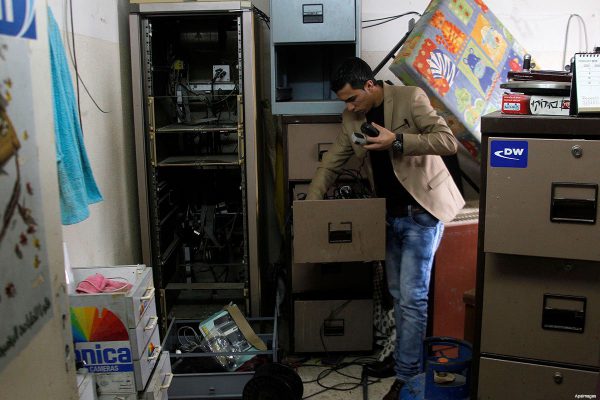
A Palestinian journalist checks damages after Israeli forces raided offices of local Palestinian Al-Khalil radio overnight in Hebron on November 21, 2015
Ma’an – August 31, 2016
HEBRON – Israeli forces raided and ransacked a Palestinian radio station early Wednesday morning in Dura City in the southern occupied West Bank district of Hebron, detained five of the station’s employees, and ordered it closed for three months, amid a documented escalation of violations against media freedoms by Israeli forces in the occupied Palestinian territory.
Locals told Ma’an that Israeli forces raided al-Sanabel radio station, destroyed its contents, and confiscated transmission and broadcast equipment.
Israeli forces left a closure order on the door of the radio station.
Locals added that Israeli forces detained head of the radio station Ahmad al-Darawish, as well as radio employees Muhammad al-Sus, Nidal Amro, Muntaser Nassar, and Hamed al-Nammura after raiding their homes.
Spokesperson for the Israeli army Avichay Adraee said in a statement in Arabic that Israeli forces, police, and civil administration authorities closed al-Sanabel upon a military order that claimed that the radio station broadcast programs inciting against Israel.
Adraee added that the five detainees were transferred for interrogation.
News of the closure came after Palestinian press freedoms watchdog MADA released a report on Saturday saying Israeli violations against media freedoms in the occupied Palestinian territory increased by 17 percent during the first half of 2016.
MADA General Director Moussa Rimawi said in the semi-annual report that while the total number of violations by both Israeli and Palestinian authorities declined from 224 cases in the first half of 2015 to 198 in the first half of this year — a rate of 12 percent — Israeli violations continued to climb, as Palestinian authorities committed 41 percent less violations during the same period.
A total of 133 violations committed by Israel were recorded during the period.
The most common types of violations committed by Israel were physical attacks, arrests, confiscation of equipment, prevention of coverage, and detentions.
The report highlighted that Israeli authorities in March closed two media institutions — Falastin al-Yawm and TransMedia Production Company — after ransacking and confiscated equipment from their offices.
Meanwhile, some 23 journalists and media workers were detained between January and June of 2016.
The report also noted an escalation of the Israeli practice of detaining Palestinians for social media activity, with Israeli authorities alleging that a wave of unrest that swept the occupied Palestinian territory last October was encouraged largely by “incitement.”
Palestinians have instead pointed chiefly to the frustration and despair brought on by Israel’s nearly 50-year military occupation of the Palestinian territory and the absence of a political horizon.
MADA said in the report that they were “gravely concerned regarding all systematic attacks and violence against journalists and media workers by the Israeli occupation, and urges state members to do their utmost to prevent violence against journalists, to ensure accountability, and bring to justice perpetrators of crimes against media freedoms.”
Secretive ‘Children of Israel’ backs Trump at $25,000-per-head California fundraiser
RT | August 31, 2016
Republican presidential nominee Donald Trump headlined a $25,000-per-ticket fundraiser at the California home of Saul Fox, a private equity CEO and secret donor behind the “Children of Israel.”
Forty people attended the Monday fundraiser including former New York Mayor Rudy Giuliani, who arrived with Trump.
The visit was the billionaire’s first visit to San Jose since a clash between his supporters and protesters in the Silicon Valley city.
Fox is one of the many political donors who use so-called ‘ghost corporations’ to conceal their identity.
It was revealed only earlier this month that he was the main donor behind ‘Children of Israel,’ who have donated $734,000 to the Republican party so far this year, according to The Intercept.
This includes a $400,000 donation to the Super PAC Stand for Truth, which supported Ted Cruz’s presidential run, as well as $334,000 to the RNC.
Shaofen Gao, a realtor in Silicon Valley with no history of making political contributions, was listed as the registered agent for Children of Israel in mid-2015, but a later filing revealed that the sole person behind the money was Fox.
Fox hasn’t commented on why he channeled the money through the company, keeping his identity hidden. In addition to the company’s donations, Fox himself has also donated to the GOP.
Most recently, he donated $100,000 to speaker of the House Paul Ryan’s aptly-titled fundraiser “Team Ryan” as well as a $25,000 donation to Trump’s joint fundraising committee.
Fox’s 2016 donations also include $2,700 to Mike Huckabee’s presidential bid and the $5,400 maximum to the campaigns of both Cruz and Marco Rubio.
Since the Supreme Court’s Citizens United v FEC decision in 2010, the 2016 election cycle has seen an unprecedented influx of corporate donations with one out of every €8 collected by super PACs coming from ‘ghost corporations,’ according to the Washington Post.
In 2015, Children of Israel gave $50,000 to Pursuing America’s Greatness, a super PAC supporting Huckabee’s run, as well as $100,000 to a pro-Huckabee group.
Israeli army continue to flout regulations on child detainees
MEMO | August 29, 2016
Following numerous complaints and legal action concerning pain and injury caused by the use of single plastic hand ties by the Israeli military on detainees, including children, the office of the Military Advocate General announced the introduction of new procedures for the use of restraints in 2010. The nature of the complaints prior to the introduction of the new procedures relating to the use of plastic ties included swelling, ties cutting into wrists and severe pain.
Under the new procedures introduced in 2010, hands should be tied from the front, unless security considerations require tying from behind. Three plastic ties should be used; one around each wrist and one connecting the two; there should be the space of a finger between the ties and the wrist; and the restraints should avoid causing suffering as much as possible. The officer in charge is responsible for ensuring compliance.
According to international juvenile justice standards restraints should only be used if the child poses an imminent threat to him or herself, or to others and all other means have been exhausted. Restraints may be used as a precaution against escape during transfer but only for as long as is strictly necessary and must not cause unnecessary pain or suffering. According to UNICEF and a UK report, single plastic hand ties should be prohibited in all circumstances, as should blindfolds.
Approximately three years after the introduction of the new procedures, UNICEF reported that “the ill-treatment of children who come in contact with the military detention system appears to be widespread, systematic and institutionalized throughout the process”. In reaching this conclusion UNICEF found that children continued to be painfully hand tied and blindfolded on a routine basis contrary to international standards and Israeli military regulations.
In May 2013, the military authorities responded to UNICEF’s findings by issuing a letter to the heads of all Brigades, Divisions, Police and Military Police operating in the West Bank reminding all units of existing standard operating procedures and policies in relation to the arrest of minors. Existing standard operating procedures stipulate that: hand-tying should be done at the discretion of the head of forces and always with three plastic ties in accordance with the 2010 regulations.
According to evidence collected by Military Court watch (MCW) in 2016, 90 percent of children continue to be restrained upon arrest, generally with plastic hand ties, and 85 percent report being blindfolded. In situations where plastic hand ties are used, many children continue to report experiencing pain. In 67 percent of cases where restraints are used, the military regulations for their use continue to be disregarded.
Although UNICEF and the UK reports also recommended that children should never be restrained while attending court except in extreme and unusual circumstances, children continue to be shackled by the ankles during their appearances in the military courts. … Full article
If Israel wants to be treated like a normal state, it should act like one

By Professor Kamel Hawwash | MEMO | August 29, 2016
Israel is not a normal state, but has craved to be treated as such ever since its creation in historic Palestine, against the will of the indigenous Palestinian people, in 1948. It sometimes claims its legitimacy from the UN partition plan, the terms of which bear no resemblance to the area currently controlled by the state; at other times Israelis refer to Biblical connections, which they claim to extend over the whole of Palestine. Exceptionally, proponents of Israel claim that only the followers of Judaism and no other faith are entitled to a state or homeland in the land of their choosing, regardless of who inhabited that land when they claimed it.
To this day, Israel remains a state without declared borders; it is the illegal occupier of another people’s land, whose rights under occupation it has flouted for the past 49 years. Israel claims to be a Western-style “democratic” state but only certain inhabitants of the land it has controlled since 1967 – basically all of historic Palestine – have a right to vote in its elections. It claims to want peace based on a two-state solution but has been implementing policies to ensure that there will only ever be one state, Israel, the borders of which are those of historic Palestine, and where people are defined by a sophisticated system of identity cards, driving cars with differently coloured number plates. It operates different laws for different people; civil law for Israelis but military law for Palestinians in the occupied territories. The law applied to Israeli citizens discriminates between Jews and non-Jews. This discrimination extends to land purchase, which gives Jews rights over non-Jews.
So Israel is clearly not a normal state, because a normal state does not build homes and towns for one ethnic group, to the exclusion of others. Israel does this by building illegally Jewish-only settlements on occupied Palestinian land. Further, in some towns within its nominal border, it allows “admissions committees” to decide whether residents will allow other citizens to live there; it is usually Jewish citizens who make these decisions and non-Jewish citizens who are excluded.
A normal state does not regularly demolish the homes of the people it occupies, or evict their occupants so that it can move its ethnically-chosen citizens into them. Israel does this.
A normal state does not besiege an occupied area for over ten years. Israel has done this with Gaza, the most densely populated place on earth. It controls the entry and exit of goods and people.
A normal state does not then attack the people living under siege repeatedly with the most destructive weapons on earth, short of nuclear warheads. Israel does.
A normal state does not repeatedly attack neighbouring states with impunity. Israel has done this to Iraq, Syria and Lebanon.
A normal state does not exist in one continent but play its sport in another. Israel does; it is in Asia but plays football in Europe.
A normal state does not violate agreements it signs, as Israel has done with the Oslo agreement and repeated ceasefire agreements with the Palestinians in Gaza.
A normal state does not carry out extrajudicial killings against the people living under its military occupation. Again, Israel does this with impunity.
A normal state does not treat children in the territory it occupies with the cruelty that Israel displays; it abducts children in the night and takes them before military courts in shackles.
The list of abnormal acts that Israel carries out is endless and developing on an almost daily basis. It is therefore hypocritical of it and its leaders to claim that it should be treated as a normal state.
This expectation was tested recently in incidents at the Rio Olympic Games involving the Lebanese team and an Egyptian judo player. The games had not even started when what turned out to be a misguided decision by the organisers became a major incident as teams were making their way to the Maracanã Stadium for the opening ceremony. In this now well-documented incident the Lebanese team refused to share a bus with their Israeli counterparts. Israel saw this as discrimination. “How could they let something like this happen on the eve of the Olympic opening ceremony?” complained one Israeli official. “Isn’t this contrary to what the Olympics stand for? … I’m in shock from the incident.” Those not familiar with the Arab-Israeli conflict would see no problem in any two teams from either end of the globe, let alone neighbours, sharing a bus.
However, this almost paled into insignificance compared to the now famous shunning by Egyptian Judoka Islam El-Shehabi of the extended hand of his Israeli opponent Or Sasson, after his defeat in the qualifying rounds of the 100 kg competition. El-Shehabi himself, who had come under pressure at home not to compete, said: “I have no problem with Jewish people or any other religions or different beliefs but for personal reasons you can’t ask me to shake the hand of anyone from this state, especially in front of the world.” Although the Egyptian’s appearance for the bout was seen as progress by many, this was not the official line. The International Olympic Committee (IOC) said El-Shehabi’s action was “contrary to the rules of fair play” and against the spirit of friendship exemplified by the games. He was reprimanded by the IOC and sent home by his team.
However, a normal state would not withhold the Olympic kit of the representatives of the people it occupies and ban their officials from travel, as Israel did. Furthermore, it would not restrict the movement of its sporting teams both within the occupied territories and to the outside world. Israel does this all the time. Its soldiers recently fired tear gas into a stadium where a Palestinian football match was taking place.
Away from the sporting arena, Israel claims that it faces discrimination in many ways, particularly from UN bodies. It insists that the UN Human Rights Council singles it out for special and disproportionate treatment. However, which other state violates so many aspects of international law and international humanitarian law, and has done so since its creation? The answer is simple: not one.
Israel is currently facing a campaign by the Boycott, Divestment and Sanctions (BDS) movement, which was called for by Palestinian civil society to place pressure on the state to behave in a “normal” way by adhering to international law. The BDS campaign was launched because of the failure of the international community to pressure Israel to conform to “normal” behaviour. Its call for an end to the occupation, equal rights for all citizens and the right of return for Palestinian refugees is peaceful, legal and highly moral. However, Israel has once again cried wolf and claims that BDS is not only discriminatory but also “anti-Semitic” because it targets “the only Jewish state” in the world. The fact is that there would be no need for a BDS movement if Israel behaved like a “normal” state.
Hence, if Israel really does want to be treated like a normal state it must first behave like one. It is currently so far away from such a designation that it merits being seen as the pariah, the rogue state that it is. Its leaders choose this status by their decisions to act in the ways that it does, not its critics. Israel should begin the process of change or risk further isolation and condemnation as even its most loyal allies begin to see what an embarrassment it is to them.
How the occupied mentality syndrome works
Saudi Arabia on the American chessboard – Part 3
By B. J. Sabri | American Herald Tribune | June 27, 2016
Read part 2: “The occupied mentality Syndrome“
Previously I argued whether Saudi Arabia’s repeated involvements in U.S. interventions and wars stem from free national will or in response to a specific condition. For starters, in Saudi Arabia there is no national will. In Saudi Arabia, the national will is the will of the Al Saud clan. Still, when a major Arab state allies itself with a superpower that committed unspeakable crimes against humanity in almost every Arab country, then something is wrong. This fact alone should compel us to examine the U.S.-Saudi relation for one exceptional reason. As a result of the U.S.-Saudi wars, hundreds of thousands of people in Afghanistan, Iraq, Iran, Libya, Syria, Yemen, and Somalia have lost their lives. Millions became displaced in their own homelands. And millions more rendered refugees.
Attributing the Saudi policies to the bonds of “partnership” with the U.S. is frivolous. There are no bonds between these two thugs except those of business, military deals, secret plots, and wars. Proving this point, bonds such as these have no space for the American and Saudi peoples to share significant cultural or societal exchanges. If partnership is not the reason for the Saudi contribution to the U.S. strategy of empire and imperialism, then another reason must exist.
This leads to three possibilities. (1) The Saudis are exercising their supreme national rights to do whatever they want. Or, (2), they are responding to inducement. Or, (3), they are complying with applied pressure. While the first possibility cannot be taken seriously, the remaining two possibilities are plausible. This means the Saudi participation in the U.S. wars—by proxy and directly—must have origins in factors other than the fluid concepts of alliance and partnership.
By the way, yielding to pressure is not new in international relations. In the age of today’s imperialism, the U.S. use of the UNSC to impose its policies is an example. If impositions fail, then the U.S. acts unilaterally. Examples: the imposition of the no-fly zone in Iraq 1991-2003 and the invasion in 2003. In the era of classical colonialism during 19th century, Britain’s gun boat diplomacy to force the opening of China to foreign trade is another example. Again, when a nation succumbs to another nation, that succumbence is never ordinary.
I also argued that succumbence to power is the result of protracted material, mental, and emotional processes performing as one element. From this premise I went on to coin the term: Occupied Mentality Syndrome (OMS) to describe such an element. Unlike other forms of mentalities (national, group, personal, and so on), the mentality I am debating is atypical. Driven by subjective factors but influenced by politically construed constraints—real or imagined—, this mentality has special traits. It competes with ideology, it conforms to pressure, it lays the blame on others, and it discards accountability.
Although such traits may not appear all at once, the presence of any one of them in a given situation is a reason to suspect that an OMS is lurking behind. Most interesting, those afflicted by this syndrome accept what comes next as a normal outcome of free deliberation. This is an anomaly. It is so because those who endorse it only calculate value versus detriment.
But calculations gutted from analysis, congruency of purpose, or the study of variables lead to contentious decisions. It is no mystery that decisions with far-reaching negative consequences impacting others could lead to tension or even open hostility. How does the Saudi regime get away from the impact of their decisions?
The usual act has been to reject any responsibility without discussion—as it happened with Iraq’s war against Iran. In doing so, the Saudi regime takes cues directly from Niccolò Machiavelli. Explanation: after converting the deliberation process into a justificatory procedure, the Saudi regime moves to the next phase: conferring legitimacy to already made decisions. Here is how they do it: make the decisions appear as if they were the result of (1) the collective national will—through the regime’s talking heads, preachers, and media,—and (2) purported adherence to the “Islamic Sharia”. The bogus legitimacy ruse that ensues is ludicrous. A tyrannical and obscurantist regime has now the authority to move forward with its decisions by calling on its citizens to observe a Quranic verse—taken out of context—calling on Muslims to obey their rulers.
To test the validity of the OMS concept, let me reprise my argument about how the Iranian Revolution and the Soviet invasion of Afghanistan shaped the mindset of the Saudi regime. Although the outcome of the 18-month long anti-Shah demonstrations was predictable, it, nevertheless, caught the U.S. and Saudi Arabia unprepared for his downfall. With the Shah gone, a psycho-political “drama” unfolded. The United States lost one of Nixon’s two pillars (the other is Saudi Arabia) in the Middle East; Israel lost its only ally in the Muslim world; Al Saud lost their inner confidence. The mere idea of a Khomeini-style revolution sweeping Saudi Arabia was enough to induce convulsive spasms in all those concerned with power, money, and oil.
Afghanistan was a different story. While the United States was mostly concerned with the Soviet power and on how to respond to the invasion, Saudi Arabia was literally terrified about the potential spread of “godless” Communism. . . . Thus was born the “special relationship” between U.S. ruling circles and a reactionary, absolutist clan.
What do we understand from the U.S.-Saudi relation?
Marked differences between the U.S. and Saudi polities make it intuitive that such a relation is no more than an opportunistic convergence between two regimes. Said differently, what we have here is a forum for massive business encounters and ideological boastings that both regimes struggle to call “alliance”. Generally, in the pre-9/11 period that relation had two sets of motives. While the American set is trite—empire-building, hegemony, oil, wars, and Israel—, the Saudi’s is issue-focused. (1) The clan must have the absolute primacy over Saudi life and society. (2) The clan defines its quest for security and survival in U.S. imperialistic context. That is, whatever the U.S. needs, the Saudi regime can supply in exchange for the clan’s needs.
It would be interesting to imagine the following scenario. The subject is Afghanistan. Was it ever possible for the Saudi regime to pursue a course independent from the objectives of the United States policy because they run against the legitimate interests of the Saudi people? To debate this point: was the spending of over $3.2 billion (indexed for that period) on the anti-Soviet Afghan war of any benefit to the Saudi society?
Let us make another supposition. Because Al Saud think of their clan as being the most powerful on earth, then a pressing question comes to mind. If they were that powerful, why did they not take alternative measures to counter U.S. pressure in the decades before 9/11? For instance, they could have purchased technology, weapons, and advanced commodities—and even “protection” from any industrial country other than the United States. [1] Or, with all the money they had, they could have started an autonomous national industrialization process like that of India, Iran, Turkey, China, South Korea, and others.
Ironically, even if the Saudi regime had the means to undertake that process, it would not have moved to implement it. Explanation: advanced statecraft mechanisms leading to independent decision making in any sector of the national life are unavailable because of the despotic nature of the regime. Not only that, but achieving sovereignty means also sovereignty for the people. This would surely curtail the power of the clan due to increased popular participation in the setting of national priorities.
Let us consider another point: the Saudis have always bragged that their “alliance” with the U.S. is unbreakable. This has an implication: the preventive imprisonment of their critical judgment and free will. Explanation: while the Saudis are unwilling to break with the U.S., the U.S. can discard them at will and play them at any given time—as happened recently with the story of the 28 pages never published from the 9/11 report. Tentative conclusion: from the clan’s perspective, it appears that whatever the U.S. wants can be addressed and accepted. Still, my earlier supposition that Saudi Arabia had the means and will to be independent from the United States has merit, It means, any U.S. pressure on the Saudis for burden sharing would be useless if the Saudis resist and go somewhere else for their needs.
If a counter-argument suggests that the Saudi spending in Afghanistan was worth it to deter a potential Russian aggression, then a reasoned rebuttal could be as follows. Fact 1: we know that the U.S.-Saudi relation revolves around deterring hypothetical “threats” against the kingdom. Fact 2: but we also know that neither the USSR, nor any other regional or international power has ever threatened to attack or invade Saudi Arabia. Amusingly, the only rumored threat of invasion came from Saudi Arabia’s “ally”, the United States (and from Britain) consequent to the Arab oil embargo in 1973. Conclusion: Al Saud had no impelling reasons to finance the U.S. imperialist enterprise in Afghanistan—even if they loathed the Soviets.
My argument: the Saudi regime has been concealing the primary motive feeding their “alliance” with the United States. Yet, it is not that difficult to guess what the clan thinks. Being a superpower with massive Zionist and Israeli influence, the United States offered the best guarantee for the survival of the regime on two fronts.
On the domestic front, the U.S. may help the regime survive if domestic unrest becomes unstoppable. The American-authorized French intervention to quell the Mecca uprising in 1979 is an example. As for The Zionist and Israeli component in American politics viewed from a Saudi angle, this is intuitive too. Like all Arab regimes, deluding themselves that the U.S. has a sovereign Arab policy, the Saudis thought of their U.S. relation as a buffer against America’s ally and protégée: Israel.
Furthermore, whereas Saudi motives are clan-based, those of the United States are system-based. This means, they are global, rationalized, and originate from how the ruling circles view the role of the United States in the world. Still, motives need forces to have effect. Consequently, the motives of a political state are the same motives of the ideological and material forces that drive it. For instance, in post-WWII United States, such forces worked as one construct to drive the purpose of U.S. hegemony. The economics, politics, and ideology of militarized capitalism, imperialism, colonialism, and Zionism are a few examples of such forces.
I mentioned colonialism as a force in the making of the United States. Does this apply to the United States of today? Here is how I see it. With military bases in over 160 countries, with bases count ranging from 761 to 900 plus, with military personnel in excess of 156,000, with a land mass of over 2,202,735 hectares (approx. 5,443,076 acres) occupied by the U.S. military, and with $150 billion annual budget, the United States is nothing but a global colonialist power whose bases are nothing less than outposts for a colonialist enterprise in progress. See deployment map in the article: These are all the countries where the US has a military presence. [2], [3], [4], [5], [6] [Note: I included several links to the issue of bases because some data differ from one source to another. Besides, the cited articles could offer an integrated view of the subject.]
Three motives define the course of U.S. power. These are (1) the determination to expand the spheres of U.S. influence, (2) the relentless intent to dominate geostrategic regions, and (3) wars as economic enterprises. How does the United States implement its domination project? The U.S. has an impressive array of tools and gadgets. Limited sampling: planned hostility, military interventions against countries resisting U.S. demands, wars against independent-minded countries that U.S. rulers love to call “rogue states”, seizure of foreign assets in the U.S., economic sanctions against “disobedient” states, applying U.S. laws on foreign states, dubbing adversaries as terrorists, harassment of big rival powers . . .
If examined in the context of classical colonialism, the U.S. domination of Saudi Arabia has all the signs of a colonialist dependency model. In this model, the periphery depends on the center in a way designed to consecrate the primacy of the center. But Saudi Arabia has never been a U.S. colony. This is true but irrelevant. The changing nature of modern dependency uses revamped practices. In one such practice, Washington makes the decisions and Riyadh implements them as if they were its own. The examples of Libya, Syria, and Yemen are instructive.
Keeping this in mind, I contend that many facts of the U.S.-Saudi relation point into the direction of multiple forms of dependency. The U.S. as a “protector” of the clan, massive Saudi purchase of U.S. arms, financial deals, and U.S. military presence in the kingdom are just the most prominent forms. One crucial aspect of the relation deserves stringent analysis. The U.S.-Saudi “alliance” goes beyond dependency, beyond petrodollar deposits, beyond investments in the U.S. economy, beyond the purchase of weapons, and beyond buying of treasury bonds. I am referring to a subject often overlooked: Saudi Arabia as a destructive interventionist tool in the hands of U.S. imperialists and Zionists.
To recap, stating that the U.S.-Saudi coupling is an alliance makes no sense. The alliance notion has different requirements, defining clauses, and formal obligations. Not even the claim of partnership is valid. Partnership takes its name from concepts such as equal sharing of burden, profits, and losses. This is not the case between the United States and Saudi Arabia. What we have here is an opportunistic platform between two different regimes pursuing separate agendas.
Again, prior to the collapse of the Soviet Union, U.S. aims included the opposition to Communism, containing Arab hostility to the U.S. and Israel, securing cheap oil, and providing basing rights for the U.S. military. On the Saudi side, preventing potential Iranian-style Islamic and progressive national revolutions in the region was the top concern. After the collapse of the Soviet Union, things changed. Generally, while the Saudis are obsessed with keeping the status quo in their regional milieu, the Americans are maneuvering their regional marionettes and intervening directly to alter the socio-structures and political assets of the entire region known as the Middle East.
Countless facts during the past 35 years attest that Saudi Arabia’s foreign policy coincided with or was in response to the U.S. world agenda. As a result, we can draw a preliminary conclusion. From 9/11 forward, the disoriented Saudi regime has been devotedly executing what the United States wants it to do in exchange for not complicating its life. With that, Saudi Arabia has become the material accessory and financing tool of the United States and Israel to remake (destroy) the Arab homeland according to the U.S. and Israeli plans. Iraq, Syria, and Libya are examples. [7], [8]
It is natural that an event such as 9/11 would have traumatized the clan and drove them to panic and despair. This is not only due to the nationality of some of the alleged attackers but also because Wahhabism, the creed of the Saudi state, has taken a post among the accused. For one, 9/11 worsened the socio-political instability of the clan and amplified their notorious arrogance. But 9/11 alone cannot explain the real reasons behind the intensified proclivity of the regime for violence toward the few remaining Arab states that still reject U.S. hegemony and Israeli settler colonialism.
However, in Saudi contest, the principal effect of 9/11 was “surgical”. It exposed the ugly face of Saudi barbarity by externalizing its warring enmity toward Iran and any Arab nation that opposes U.S. hegemony and the criminal practices of the Wahhabi state. That proclivity for violence and that foaming anti-Arab and anti-Iranian enmity were the means with which Al Saud thought they could placate post-9/11 United States and appease Israel in the process. Involving the Saudi ruling family in 9/11 was a master stroke of a strategy. With it, the United States has skillfully exploited the primal fear of the Saudi regime from losing power. And just like that, with one unsubstantiated accusation, the United States seized the grand moment—the prey was ready to be devoured.
It is beside the point to state that analyses meant to explain post-9/11 Saudi actions and policies must consider the determination of the Saudi regime to take whatever is needed to appease the United States. After 9/11 the Saudis thought they could silence the hyper-imperialist bully by withdrawing their recognition of Afghanistan under the Taliban rule. It did not work out. Then they moved, as requested by the United States, to cut off funding to religious organizations and Wahhabi-inspired schools in many countries. It did not work out either. Afterwards, they offered King Abdulla’s initiative to recognize Israel. Still, it did not work out. . . .
Here is what the crude mentality of Al Saud failed to comprehend. The appeasement the hyper-empire was thinking of was much wider, much deeper, and has no end—it is the unconditional Saudi willingness to play along with the U.S. plans and strategies.
I maintain, therefore, that explaining the Saudi post-9/11 wars and interventions against selected Arab states is ineffective without proper investigative tools. What we need are approaches that would enable us to see below, above, and around the appearances of events.
Another significant outcome of 9/11 was tangible: the transformation of Saudi Arabia from an American “ally” into a near hostage pliable for blackmail. For instance, the Saudi regime voiced concern and even some opposition to the planned U.S. invasion of Iraq in 2003. Still, they were unable to stop the U.S. from using their territory, airports, ports, and military facilities for that purpose. But when the invasion took its course, they mightily supported it. This is duplicity, of course; but I do not have to debate that such behavior says more than it could hide. Simply, it indicates fear from opposing U.S. moves.
I hold, therefore, that the radical change in Saudi Arabia’s post-9/11 regional conduct (the war against Libya, Syria, Yemen, Iraq; the harassment of Lebanon; the anti-Iran bellicosity; the tryst with Israel) was not in response to pressing Saudi needs, or to sudden wakening of the regime’s dormant “democratic values”. By extracting meanings out of statements, and by reading deeply into the cumulative consequences of the Saudi actions and their purpose, the answer should dispense with theoretical uncertainties. That is, those radical changes were in response to U.S. pressure or other forms of hard persuasion including implicit blackmail.
In which way did Iraq’s war against Iran confirm the U.S. scheme for the Middle East? What role did Al Saud play in that war? How does all this relate to and corroborate the occupied mentality syndrome?
Next: Part 4
Notes
- I should mention that Saudi Arabia has purchased missiles from China, as well as advanced weapons from Germany, Italy, Britain, Japan and other countries. Still, none of these deals would have been completed without the United States approving them first. The U.S. approval is motivated. First, U.S. military industry licenses the making of its weapons abroad and has deals to manufactures other weapons in partnership with many countries. Second, by submitting the weapons sale to its preventive approval, the United States establishes equal control on buyers and sellers. And this is how hegemony works. (Read: Why Did Saudi Arabia Buy Chinese Missiles? This is an imperialist view by the Foreign Policy Magazine. Pay attention to how Jeffrey Lewis explains the conditions that made the purchase possible. He writes, “Apparently with the approval of the George W. Bush administration.” [Italics mine]. Needless to say, the word “apparently” should have been omitted. . . .
- Gilbert Achcar, Greater Middle East: the US plan, Le Monde Diplomatique
- Mahdi Darius Nazemroaya, Plans for Redrawing the Middle East, Uruknet, 18 November 2006.
- David Vine, The United States has Probably More Foreign Military Bases than Any Other People, Nation, or Empire in History, The nation, 14 September, 2015
- David Vine, Where in the World Is the U.S. Military? Politico Magazine, July/August, 2015
- Julia Zorthian and Heather Jones, This Graphic Shows Where U.S. Troops Are Stationed Around the World, Time, 16 October 2015
- Tom Engelhardt, The US Has 761 Military Bases Across the Planet, and We Simply Never Talk About It, AlterNet, 7 September 2008
- Louis Jacobson, Ron Paul says U.S. has military personnel in 130 nations and 900 overseas bases, POLITIFACT, 14 September, 2011
Whitewashing Israeli War Crimes, the NYT Turns its Back on Survivors and Critics
By Barbara Erickson | TimesWarp | August 26, 2016
So it’s settled, according to The New York Times: Israel was not at fault in a strike that killed 10 civilians near a United Nations school in the 2014 assault on Gaza, nor was it guilty of breaking the law in other instances that left innocent victims dead during that conflict.
This, at least, is what the Israeli military claims, and in a one-sided story in the Times this week, Isabel Kershner takes the Israeli military findings at face value, never questioning its conclusions or seeking commentary from outside sources.
She opens her piece with a summary of the military’s own account of the strike on the school, recounting it as established fact without attribution. Kershner goes on to say that the army also declared itself innocent of deliberately causing civilian deaths in two other attacks during the 51-day offensive: a strike on the Bureij refugee camp and the death of 12 members of one family in Rafah. The three cases were among seven closed without charges this week.
The school was hit, according to the army account, because militants targeted by an air-to-ground missile happened to pass by the site too late for the Israeli army to correct its aim; the Bureij bombing was “justified and legal” because the building hit was being used by Hamas as a control center; and the Rafah deaths were caused by “errant mortar fire” from Gaza militants.
Her story makes no mention of other instances that raised international outrage, such as the mortar attack that killed four boys playing soccer on a beach, the massacre in the Shujaiya neighborhood of Gaza City and the excessive and deadly bombardment of eastern Rafah after Palestinians captured an Israeli soldier.
The article likewise fails to include any comments by outsiders on the military decision to close seven cases. Kershner did not seek responses from Gaza residents or from human rights groups that have also investigated and documented the Israeli attacks.
Other media outlets, however, included these outside perspectives: The Guardian, for instance, sought reactions from Gaza residents affected by the strikes, and the International Business Times quoted extensively from an Amnesty International staff person.
But the Times finds no reason to look for sources beyond the Israeli military, which happens to be the entity under investigation. At the same time, it shows little concern for what the people of Gaza experience.
This week’s story, for example, concludes with two paragraphs about Israeli air and tank strikes on the beleaguered strip this week. A total of 50 bombardments hit the enclave after militants fired a single rocket toward the town of Sderot.
Kershner’s story tells us only what “Israeli analysts” have to say about the strikes. The targeted sites were “empty,” she reports, and “no deaths were reported.” Other news sources, however, state that four people were injured.
The Times insists that it provides full and fair accounts, that it is neutral and balanced, but its editors and reporters fail to follow even minimal journalistic standards in reporting on Israel. Those accused of war crimes are allowed to speak for themselves without the annoyance of outside observers to challenge any aspect of their claims. Those who bear the brunt of these alleged crimes have no voice at all.
Follow @TimesWarp on Twitter
Israeli commander threatens to ‘disable all youth in the camp’ as 2 Palestinians shot in Duheisha

A file photo of a group of Palestinian youth after being treated for gunshot injuries by Israeli forces (Photo: BADIL)
Ma’an – August 26, 2016
BETHLEHEM – Two Palestinian youths were injured with live fire during clashes with Israeli soldiers in al-Duheisha refugee camp in southern Bethlehem early Friday morning, as reports emerged of an Israeli army commander making repeated threats in recent weeks to make “all youth in the camp disabled.”
Local sources said that two youths were shot and injured in the legs during clashes that erupted after Israeli forces raided the camp in Friday’s predawn hours.
Sources added that Israeli soldiers raided and searched the house of the incarcerated Palestinian Muhammad al-Seifi, detaining his mother and sister by locking them inside their home to pressure Muhammad’s younger brother Naba to turn himself into Israeli authorities.
Israeli forces also blew off the door of the Ibdaa Cultural Center near the entrance to the camp and occupied the rooftop of the building, from where Israeli snipers fired live ammunition and tear-gas canisters at local youth.
Violent clashes in al-Duheisha are common and break out nearly every time Israeli army forces enter the camp, which is located in Area A and should be under full Palestinian Authority control according to the Oslo agreements.
In a response to a request for comment, an Israeli army spokesperson told Ma’an that the Israeli army was not involved, and claimed Israeli border police were behind it, despite the area being located outside of police jurisdiction in Area A of the occupied West Bank.
When contacted by Ma’an, Israeli police spokesperson Micky Rosenfeld said he was not aware of the raid, saying it “made no sense” that police would be involved, and confirmed that al-Duheisha fell under the Israeli army’s jurisdiction in terms of raids. When contacted a second time, an Israeli army spokesperson insisted again that the army was not behind the raid and could not say who had been.
‘I will make all the youth of the camp disabled’
The clashes come in the wake of reports documented by BADIL, the Resource Center for Palestinian Residency and Refugee Rights, of an Israeli army commander making repeated threats during and after raids, and during interrogations, to disable all Palestinian youth in al-Duheisha.
The commander is reportedly responsible for the al-Duheisha area, and known to locals as “Captain Nidal.”
Local youth in al-Duheisha told BADIL that Captain Nidal has made statements such as: “I will make all the youth of the camp disabled,” “I will have all of you walking with crutches and in wheelchairs,” “I will make half of you disabled, and let the other half push the wheelchairs,” and “I will make all of you stand in line at the ATM waiting for your disability subsidies and assistance.”
One of the injured youth told BADIL that Captain Nidal told him to tell his friends that “Nidal will make all of you disabled.”
According to BADIL, which is based in Bethlehem, 30 Palestinians have been shot with live ammunition in the camp since the beginning of the year, the majority in their legs and knees.
They added that al-Duheisha had been raided at least three times by Israeli forces between the end of July and mid-August, during which time 18 Palestinian youth between 14 and 27 years old were shot in their legs — eight of which shot directly in the knee and several more in both legs — causing both permanent and temporary disabilities.
An Israeli army spokesperson could not immediately be reached for comment on the reports of the threats made by the commander.
“These threats indicate that these actions are not accidental or isolated incidents, but rather result from a systematic Israeli military policy aimed at suppressing resistance, terrorizing Palestinian youth, and permanently injuring them and/or causing significant damage to their physical and mental well-being,” BADIL said in their statement.
The reported threats come amid what BADIL called an intensification of the “systematic targeting” of Palestinian youth in the occupied Palestinian territory — particularly in refugee camps — since the beginning of 2016.
“This targeting has taken the form of injuries and arbitrary killings by the use of live ammunition by the Israeli army in the context of arrest campaigns, military raids, and random wide searches which usually trigger clashes,” the statement said.
BADIL’s statement also highlight a recent Israeli military incursion in the Hebron-area refugee camp al-Fawwar that lasted some 20-hours, during which an unarmed Palestinian teen was shot dead and dozens others were hospitalized.
“These cases of intentional wounding, when added to the comparable actions happening in refugee camps such as Aida, al-Arroub, Qalandia, Amari, and the West Bank at large, prove that these incidents amount to a systematic policy and an implementation of Captain Nidal’s threats.”
“These willful and grave breaches of international law trigger the obligations of third party states and other mandated agencies to put an end to this climate of impunity under which Israeli forces and its officials operate.”
BADIL’s collection of testimonies came as the latest report amid years of well documented cases of abuse and mistreatment of Palestinian children by Israeli forces in the occupied territory, including in East Jerusalem, which is under Israeli police jurisdiction.
Featured Video

Trump asks Iran not to retaliate after he strikes Pickaxe Mountain
or go to
Aletho News Archives – Video-Images
Book Review
‘Why Fauci Must Rot in Prison’: A Tale of Two Diaries
By Jill Erzen | The Defender | October 13, 2026
Dr. Anthony Fauci’s private diary reveals a “mind-numbing” contradiction between what the former top U.S. infectious disease official knew about COVID-19 and what he told the public, senior White House adviser Peter Navarro, Ph.D., said last week on “American Thought Leaders.”
In his new book, “Why Fauci Must Rot in Prison,” due out Oct. 20, Navarro compares Fauci’s private entries to his own pandemic-era diary, and uses what he calls “a tale of two diaries” to argue that Fauci should face criminal prosecution.
“I show, actually, how a prosecution can and should happen … at the state level, most likely,” Navarro said. “He should wind up in prison, and we’ve got the receipts in this book to put him there.”
Navarro said Fauci repeatedly acknowledged important facts in private, then publicly pursued policies that contradicted those facts — with devastating consequences.
“What he says many times privately in his diary is so at odds with both his public behavior and public statements that it’s mind-numbing,” Navarro said.
Navarro examines the lasting damage caused by lockdowns and other pandemic policies, and the ongoing toll of long COVID.
His book also addresses questions about vaccine safety, including why healthy young people faced COVID-19 vaccination mandates despite concerns about myocarditis, and why women were not warned about miscarriage risks linked to the shots. … continue
Blog Roll
 Aletho News
- How Iran’s two-week retaliatory strikes exposed cracks in US military architecture in Persian Gulf
- The mother of all propaganda: Why the hype over US MOAB strike against Iran is nothing but theater
- Iran says it possesses technology behind US 14-ton GBU bunker-buster
- Trump asks Iran not to retaliate after he strikes Pickaxe Mountain – w/ Prof. Marandi
- Vice President J.D. Vance’s Deceptive ‘Antiwar’ Campaign Speech
- Iran: Palestinians’ rights must not be compromised in Gaza’s future; US, Israel to blame for Hormuz situation
- Ongoing tales of Syrian chemical weapons
- Moscow blasts UN for ignoring torture of Russian POWs
- Millions of Books Could Have Been Destroyed in Lebanon During Israeli Bombings
- Moscow warns of ‘hunt for Russians’
- If Americans Knew
- Netanyahu’s spin on latest settler attack is laughable – Daily Update
- Israeli soldiers debunk Israel’s talking points
- In West Bank, Israeli settlers are totally out of control – Daily Update
- NPR investigation finds evidence of widespread fraud at mall kiosks tied to Israeli skincare brand
- Tucker Carlson exposes Israeli Lies about the Oct 7th attack, Charlie Kirk, and the U.S.
- Israel has detained thousands of Palestinian children since Oct 7th – over half spent time in solitary, many uncharged
- Israeli Analysis: Is Netanyahu Planning an ‘October Surprise’ Attack Before Israel’s Election?
- Israeli settlers brutally attack Palestinians and Washington Post female photographer, 65
- Words Have Changed, Occupation Continues: The Reality of the Gaza Ceasefire
- Gaza’s child amputees are growing faster than their prosthetics allow
- No Tricks Zone
- Predictions Made By Renowned Climate Proifessor Over Past Decades Have Been Proven To Be Poor
- New Study Suggests Large Regions Of The Pacific Ocean Have Been Cooling For The Last 80 Years
- Germany’s Green Energy Debacle: High Energy Costs Force Kahla Porzellan to Close After 182 Years!
- New Study: 50 Years Of The Most Aggressive ‘Net Zero’ Policies Can Only Affect The Global Climate By 0.03°C
- US September “Heat” Was No Record…Many Records Set Decades Ago
- Latest European Green Energy Debacle; Portugal’s Largest Flagship Solar Park Insolvent!
- Green Energy Debacle: German Expert Professor Fritz Vahrenholt Warns Of Severe Economic And Social Consequences
- Two More Paleo Reconstructions Affirm Meters-Higher Sea Levels Across Ireland, Brazil 7000-6000 Years Ago
- New Study: Earth And Venus Surface Warmth Largely Explained By Convection And Lapse Rate, Not CO2 Or Radiation
- 2025 Nature Paper Claiming Worsening Global Drought Gets RETRACTED …Heavily Flawed

