A new Nakba looms as Israel plans ethnic cleansing of Palestinian village in the Negev
MEMO | October 15, 2012
Anger and worry prevails amongst the people of Umm Al-Hayran, a Palestinian village in the Negev Desert following a decision by the Israeli Building Council to expel villagers in order to build a settlement for extremist Jews. An appeal by the humanitarian groups on behalf of the villagers was refused last week by the Israeli National Council for Planning and Construction.
Around 1,000 people will be affected by the latest bout of Israeli ethnic cleansing of Palestinians from their land. The District Committee for Planning and Construction in Beersheba has approved a proposal for a Jewish settlement called “Hayran” on the land belonging to Umm Al-Hayran village. This will not be the first time that the families in Umm Al-Hayran have been expelled by the Israelis. They used to live in the Zebala Valley in the Negev from where they were expelled by the nascent Israeli state; in 1956 they were uprooted again and forced to move to the site of Umm Al-Hayran. The current threat first arose in 2004, when the Israeli state accused the villagers of living illegally on state land.
Israel doesn’t “recognise” villages occupied by around 90,000 Bedouin living in Southern Palestine. As a result, their homes are regarded as “illegal” by the state and they can be demolished at any time.
Residents of such “unrecognised” villages do not receive any basic services or amenities provided by the state, including electricity, proper roads, health facilities, schools or water supplies.
Commenting on the latest decision, lawyer Suhad Beshara of the Legal Centre for Arab Minority Rights in Israel (Adala) said that the decision made by the appeal committee is part of the official policy of confiscating Bedouin land in the Negev. The intention is not only to provide land for Jews but also to be able to gather together the Bedouin communities in one place. According to Ms. Beshara, the authorities’ decision confirms that the villagers of Umm Al-Hayran have no rights in the village to which the Israeli government itself moved them in 1956.
The Palestinian law specialist clarified that the village of Umm Al-Hayran was established in its current location by order of the Israeli military authorities in 1956 after the army expelled its people by force from their homes in the area of Zebala valley. “They have established themselves with proper homes,” she said, “and they have invested all their efforts in order to resume their social and tribal lives which were shaken every time they were expelled from their land.” Today, a hundred and fifty families, totalling one thousand people, live in the village, all from the Abu Alqean tribe.
“We’re ready to die defending our land,” said the Mayor of the village, Saleem Abu Alqeaan. “They want to expel us and claim that our buildings are illegal, and they deprive us of all services; they even denied us drinking water in order to push us to leave the village and expel us.”
Mayor Abu Alqean added that the villagers refuse to accept the decision and that they will not leave their land even if the Israelis use force to expel them: “We have sworn to die on this land and we will not leave it this time, like previous times, and we will defend our land and our village with all our might and with all our means, because if they succeed in getting us out, the same tactics will be applied to other villages in the Negev which are not recognised by Israel.”
Commenting on the decision of the Israelis to name the proposed settlement “Hayran”, the mayor accused the Israeli government of trying to hijack Palestinian history in the area. “They want to make it look as if there is an old Israeli presence in the Negev,” he added.
Knesset Member Ibrahim Sarsoor, the head of the United Arab Bloc for Reform, condemned the government’s move. “This is yet another attack on the Arab presence in the Negev of the kind which has been taking place since the establishment of the Israeli state in 1948,” said Sarsoor. “It poses a serious threat to the already poor relations between Jews and Arabs in Israel.”
He pointed out that there is a systematic Israeli policy of uprooting the Arab presence in the Negev Desert. The latest decision, he insisted, shows how the Israeli government can act against its Arab citizens with impunity and with no just, legal or moral reason.
Stressing that the expulsion decision is “the biggest witness to the racism of Israeli governments’ policies towards the Arabs”, Sarsoor said that it confirms that ethnic cleansing of the indigenous population is an integral part of Israel’s Zionist ideology. “In short,” he concluded, “it is a policy of apartheid, pure and simple.”
Related articles
- EU support for Israeli crimes makes it unworthy of Nobel Peace Prize (altahrir.wordpress.com)
- New Palestinian Nakba in Umm Al-Hieran village in the Negev (occupiedpalestine.wordpress.com)
Arson Attack on Olive Trees in Qaryut
October 14, 2012 | International Solidarity Movement, West Bank

Latif Ali with one of her trees that were destroyed
Last night in the West Bank village of Qaryut, 12 Palestinian owned olive trees were irreparably destroyed in a late night arson attack by Israelis from the illegal West Bank settlement of Eli.
The attack follows an incident last week, on the night of October 8th, in which settlers cut the branches from 130 trees with chainsaws. The branches will take some ten years to regrow, during which time the eight farmers who owned the trees will be without this crucial source of income.
The attacks seem to have been carried out so as to maximize economic impact. Many Palestinian olive farmers are financially dependent on the olive harvest, which begun earlier this week. In last night’s attack, the settlers seem to have targeted the oldest and most fruitful trees. They set fire to hollows in their trunks, which kills the tree. Growing a new one to their size takes hundreds of years.
The timing, too, maximized the impact of the attack. For the last two years, the Israeli government has run a permissions system for Palestinians harvesting olives in areas near to West Bank settlements: although the farmers own both the land and the trees, they have to apply for Israeli permission to access the land. Permission is usually granted for impossibly short periods of time: in this case, the Qaryut farmers were able to harvest for either two or three days (traditionally harvest lasts between four and six weeks). The first attack came the night before the first permissions began in the area, thereby devastating the harvest the night before it started.
Such incidents are not uncommon. During the last two harvests, a reported 300 trees were destroyed in Quryat alone. In 2009, the village suffered violent attacks by settlers from Eli and another nearby illegal settlement Shilo (more here and here). Such attacks are commonplace across the West Bank during olive harvest, when the symbolic and economic importance of the crop make their farmers frequent targets for settler violence.
Related articles
- Rights groups raise alarm over settler attacks on olive trees (alethonews.wordpress.com)
- Zionist settlers chainsaw Palestinians olive trees (occupiedpalestine.wordpress.com)
- Two Palestinians Injured After Being Attacked By Settlers Near Nablus (imemc.org)
- Jewish extremists cut down over 120 olive trees (altahrir.wordpress.com)
- Settlers uproot 300 olive trees near Ramallah (gazasolidarity.blogspot.com)
- Settlers destroy 18 olive trees Burin (alethonews.wordpress.com)
Norway: Organizations supporting settlements no longer tax-deductible
Ma’an – 26/09/2012
BETHLEHEM – Donations to a Norwegian organization that funds illegal Israeli settlements will no longer be tax-deductible following a decision by the Norwegian government.
The Norwegian Ministry of Finance announced the decision to remove Karmel-instituttet from the list of organizations eligible for tax-deductible donations on Thursday under pressure from Norwegian People’s Aid and the Norwegian Union of Municipal and General Employees, NPA said in a statement.
“We are very pleased that the Ministry of Finance has made this decision, based on the fact that Karmel provides funds to the illegal Israeli settlements,” said Liv Tørres, the secretary-general of NPA.
The Norwegian Ministry of Finance said they intended to ensure the system of tax deductions did not benefit organizations that actively support or contribute to acts that are in contravention of international law, NPA added.
According to the groups, Karmel-instittuttet had funded three study centers and around half the homes in the illegal Alonei Shilo settlement.
That settlement is illegal under both international and Israeli law.
Jewish Settlers Invade Palestinian Home In Hebron, Attack Family Members
By Saed Bannoura | IMEMC & Agencies | September 20, 2012
A group of armed extremist Israeli settlers of the Avraham Avino illegal Israeli settlement, invaded a Palestinian home in the southern West Bank city of Hebron, and attacked two family members including an eight years old child on Wednesday.
The settlers initially hurled stones and empty bottles at the home of Nidal Al-Oweiwy, and climbed on its rooftop before invading the home through it roof door, the Arabs48 news website reported.
The extremist settlers then proceeded to attack Sally, Nidal’s 8-year-old daughter, and his son Sa’id, leading to various cuts and bruises.
They also destroyed the homes’ furniture and shattered the glass of several doors and windows in addition to damaging the water tanks on its rooftop.
Local sources reported that, Israeli soldiers deployed in the area, did not attempt to stop the settlers.
This is not the first attack against the home, and a number of nearby homes, as the settlers are trying to occupy them.
It is worth mentioning that, several days ago, another son of Nidal, identified as Tha’er, 20, who was kidnapped by the army, was released and forced under house arrest after the army forced his father to pay a 4000 NIS fine.
The family of Al-Oweiwy said that despite all attacks and violations practiced against them by the army and the extremist settlers, they will never leave their home and will never sell it to the settlers.
Settler groups repeatedly tried to force the family into selling their home to them, and when the family refused, the settlers started attacking their home in an attempt to scare them away, local sources said.
Related articles
- Jewish Settlers Deface Mosque Near Hebron (alethonews.wordpress.com)
- Soldiers Physically Attack Palestinian Youth In Hebron (alethonews.wordpress.com)
- Jewish Settlers Empty Palestinian Well, Flood Farmlands (alethonews.wordpress.com)
- Hebron: Over 30 detained (alethonews.wordpress.com)
- French activist injured as Israeli troops attack Hebron (alethonews.wordpress.com)
- Jewish Settler’s Vehicle Rams Child in Hebron Hit and Run (alethonews.wordpress.com)
- Hebron man walks down street for first time in years (alethonews.wordpress.com)
- Four Residents, Including Two Children, Kidnapped By The Army In Hebron (imemc.org)
- Settler attack in Aqraba leaves 3 injured, 1 hospitalized (alethonews.wordpress.com)
Settler attack in Aqraba leaves 3 injured, 1 hospitalized
September 19, 2012 | International Solidarity Movement
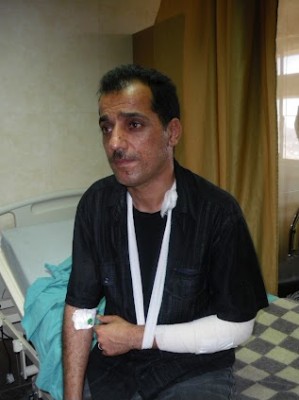 On Monday 17, September, six Israeli settlers from the illegal settlement of Itamar attacked three members of the Benijaber family, who were walking home to the Palestinian village of Aqraba from their olive groves.
Maher Hashem Mostafa Benijaber reported that he, his brother Omar and cousin Hafed were set upon by six men, three of whom were armed with semi-automatic rifles. The attack occurred just before 7 p.m., around 600 metres from their home. The settlers punched and kicked the three men, as well as beat them with rocks and sticks. They also tried to block the path back to the village so Maher and his family could not escape.
Omar managed to escape, calling neighbours for help. Meanwhile, the attack on Maher and Hafed continued. After the arrival of other residents, the Israeli attackers fled the scene. Maher then attempted to walk back to the village, but collapsed, lost consciousness, and had to be carried.
Maher Hashem Mostafa Benijaber in the hospital being treated for injuries after settlers attacked him on his way home.
Maher, Omar and Hafed all required medical treatment at the local clinic in Aqraba for the injuries they sustained during the beating, and Maher was hospitalized overnight in Nablus. All three men suffered injuries to their arms, head, back and legs, consistent with a sustained beating with sticks. When asked what he thought about the latest attack, Maher said, ‘if no-one had come to help, they would have killed me.’
The family contacted the Israeli army via the Palestinian Police and District Coordination Office to report the attack, however the army instead visited Yanoun village, which is also near Itamar settlement. Despite being informed that they had gone to the wrong village, they never attended the scene of the attack in Aqraba or spoke to Maher.
The attack on the Benijaber family is just the latest of many on the village of Aqraba. Four days previously, an elderly shepherd was attacked and forced to flee from his fields back to the village. The attacking settlers then stole some of his sheep. Such attacks on Palestinian villages are commonplace throughout the West Bank, and there is effectively impunity for settlers who carry them out. According to the Human Rights Watch 2012 report, “The Israeli government generally took no action against Israeli settlers who destroyed or damaged mosques, homes, olive trees, cars, and other Palestinian property, or physically assaulted Palestinians.” Illegal settlements such as Itamar continue to be encouraged to expand with the support of Israeli government and occupation forces.
Maher’s room at Rafidia Hospital happens to be across the corridor from Akram Taysir Daoud, who suffered a similar attack in the village of Qusra on 15th September and remains in hospital. Report at: www.palsolidarity.org/2012/09/qusra-man-left-for-dead-after-settler-attack/
Related articles
- Three injured from tear gas after settlers raid in Qusra (alethonews.wordpress.com)
Jewish Settlers Deface Mosque Near Hebron
By Saed Bannoura | IMEMC & Agencies | September 12, 2012
A group of extremist Israeli settlers defaced, on Tuesday at dawn, a mosque in Emresh village, south of Doura town, near the southern West Bank city of Hebron.
The settlers came from Etnael illegal settlement, built on privately-owned lands that belong to the residents in the area.
The settlers wrote racist graffiti that read “Death to Arabs”, “Price Tag”, and several other racist graffiti.
Extremist settlers are behind hundreds of attacks that not only target the residents and their lands, but also have targeted graveyards, mosques and churches in different parts of Palestine.
Last week, a group of extremist Israeli settlers attacked the Latrun Christian Monastery in occupied Jerusalem, and wrote racist graffiti describing Jesus as a “Monkey”, and other graffiti against the Christian religion in general.
Last month, several extremist Israeli settlers invaded the Awarta village, east of the northern West Bank city of Nablus, and wrote racist graffiti on the walls of several homes, and the deface the local mosque.
Earlier in February this year, extremist Israelis wrote “Death to Christians” on the walls of a Jerusalem church, and slashed the tires of vehicles parked in the area.
The attacks fall under the “Price Tag” attacks carried out by extremist Israeli settlers against the Palestinian people, their lands and property, such attacks have been carried out against several mosques, including some that were completely burnt, and several churches.
Related articles
- Soldiers Physically Attack Palestinian Youth In Hebron (alethonews.wordpress.com)
- Hebron man walks down street for first time in years (alethonews.wordpress.com)
- Jewish Settlers Empty Palestinian Well, Flood Farmlands (alethonews.wordpress.com)
Hebron man walks down street for first time in years
September 10, 2012 | International Solidarity Movement, West Bank
 Hashem Azzeh in front of the graffiti on his door
Photos: EA Phelie Maguire
On Sunday 9th September, Hashem Azzeh walked down the street outside his house for the first time in years.
Hashem lives with his artist wife Nasreen and their four children (14, 9, 4 and 2 years old) on a hillside in the Tel Rumeida district of Hebron. The street outside Hashem’s house is barred to Palestinians and overseas visitors, with an army checkpoint at the end of the street to enforce the ban. To reach their house, the family have to go via a treacherous back route, clambering over walls and around other properties on the way.
Despite all the harassment and violence, Hashem remains determined to stay in his house, and today said he wanted ‘an adventure’. Hashem and five ISM volunteers from the UK, Italy and the USA clambered up from the house to the street, then walked the 200 or so metres to the checkpoint at the end of the street. The Israeli soldier at the checkpoint appeared astonished to see Hashem and international volunteers come along the street from the ‘wrong’ direction and immediately started radioing for back-up. When the soldier asked Hashem why he was walking on the street, Hashem replied, ‘I am walking to my house’.
Hashem’s family have faced years of harassment from residents of the illegal Israeli settlement on the hillside just above their house. The settlement happens to be home to some of the most fanatical settlers in Hebron, including American-born extremist Baruch Marzel.
Over the years, Hashem’s family have faced attacks on their property by settlers, with Israeli soldiers standing alongside doing nothing to intervene. Settlers have also poisoned his water supply, and killed his olive trees, fruit trees and vines. When Hashem installed his own water tank, the settlers shot it full of holes in yet another attack.
As well as attacks on their property, the family have faced regular physical violence. Hashem’s nephew had his teeth knocked out by rocks, and his brother was also smashed in the face with rock and suffered damage to his teeth and nose. Nasreen has had two miscarriages. An ISM activist, 77 year old Australian academic Mary Baxter, also faced violence in the past, when accompanying Hashem’s children to school in 2005. She and the children were attacked, and Mary had four bones in her back broken and is now disabled as a result.
Related articles
- Soldiers Physically Attack Palestinian Youth In Hebron (alethonews.wordpress.com)
- Hebron: Over 30 detained (alethonews.wordpress.com)
- Hebron: settler illegally enters Palestinian home (occupiedpalestine.wordpress.com)
- Hebron: Palestinian streets closed for Israeli settlers (alethonews.wordpress.com)
- French activist injured as Israeli troops attack Hebron (alethonews.wordpress.com)
- Jewish Settler’s Vehicle Rams Child in Hebron Hit and Run (alethonews.wordpress.com)
- Hebron: Settlers gas attack Palestinians, victim arrested and refused aid (occupiedpalestine.wordpress.com)
- Soldiers Kidnap Girl, Her 12-Year-Old Brother In Hebron (imemc.org)
Soldiers Physically Attack Palestinian Youth In Hebron
By Saed Bannoura | IMEMC & Agencies | September 04, 2012
Israeli soldiers physically attacked, on Monday at night, a Palestinian nonviolent activist after stopping his vehicle, in Hebron city, in the southern part of the West Bank. The soldiers forced him out of his car and brutally attacked and kicked him.
Tamer al-Atrash, media spokesperson of the Youth Coalition Against Settlements, stated that several soldiers stopped his car and forced him out of it before they started shouting at him, in addition to kicking and punching him.
Al-Atrash said that he recognized the soldiers who attacked him as he previously filmed them while they were assaulting a number of residents in the Tal Romedia neighborhood in Hebron.
“This is an act of revenge; it seems they think they are settling a score”, Al-Atrash stated. “We always expose their violations and abuse practiced against the civilians on a daily basis in Tel Romeida”.
Israeli settlers illegally reside in the neighborhood in privately-owned Palestinian property, in Tal Romeida and in several parts of the city.
Settlers who reside in the heart of the occupied city of Hebron are responsible for dozens of attacks against the residents and their property.
Related articles
- French activist injured as Israeli troops attack Hebron (alethonews.wordpress.com)
- Hebron: Over 30 detained (alethonews.wordpress.com)
- Jewish Settler’s Vehicle Rams Child in Hebron Hit and Run (alethonews.wordpress.com)
- Hebron: Palestinian streets closed for Israeli settlers (alethonews.wordpress.com)
Jerusalem Development Authority Implicated in Boycotted Film Funding
By Jinjirrie | Kadaitcha | September 4th, 2012
In the vein of its previous documentary project presenting a montage of 24 hours of life in Berlin, the German Zero One film production company has been planning a similar venture on Jerusalem.
Berlin-based Zero One Film will work alongside Palestinian producer Daoud Kuttab and newly founded Israeli prodco 24 Communications. The latter is a joint venture between Israeli prodcos Pie Films and Inosan, which worked on the original version of HBO hit In Treatment.
Medienboard Berlin Brandenburg and Jerusalem Film Fund are backing 24h Jerusalem and the producers hope to secure the remaining €400,000 (US$500,000) of its €2.4m budget at MipTV this week.
Palestinian directors have now pulled out of the project – they were unaware of the presence of the Israeli production company, nor of backing from the Jerusalem Film Fund, which is in turn funded by the Jerusalem Development Authority. Current activities of the JDA include expropriating Palestinian land in East Jerusalem for parks. The JDA received “40 million NIS in 2005 to develop green spaces around the Old City of Jerusalem”.
Designating urban space as a national park is not only easier but cheaper too, the state having no obligation to compensate owners.
The Jerusalem municipality leaves the creation of these parks to the National Planning Authority (in the Ministry of Interior), Bimkom noted, which deals more with the protection of nature and heritage than the rights of Jerusalem’s residents.
…The disparity between the management of space for West Jerusalemites compared to their counterparts in the east is stark, with national parks notably absent from the west.
“The Palestinian residents of Jerusalem are crowded and they suffer from extreme neglect and shortage of public infrastructure,” Bimkom architect, Efrat Bar-Cohen, said in a statement.
“The residents are in desperate need of space by which they can improve their quality of life, even if slightly.”
The building of the park will have ramifications beyond the strangling of Issawiya and A-Tur residents.
It will stretch into the E1 area of the West Bank, which represents an important reserve of space for Palestinian development, creating a string of Jewish Israeli-only settlement between the Old City and Ma’ale Adumim settlement.
Elad Kandl is director of the Old City projects at the Jerusalem Development Authority, whose website describes their work as rehabilitating and conserving the Old City.
He expressed succinctly Israel’s aim of curbing Palestinian development in Jerusalem. “When you make it a national park,” he told The Jerusalem Post in reference to open space, “you keep the status quo.”
The JDA, which operates under the 1988 Jerusalem Development Authority Law, was established to further entrench Israeli control over the city and is also involved in the Jerusalem light rail project.
Indeed, the Prime Minister’s Office and the mayor of Jerusalem sponsored a JDA program to work toward this goal. On its website the JDA is very clear about the role of the Jerusalem light rail project, stating that “The investment in the light railway project was one of the government’s key strategies to empower Jerusalem as a capital.”
The JDA is also an instrumental actor in the proposed construction of 1,400 new housing units in the Gilo Jewish settlement colony, located near Bethlehem in occupied East Jerusalem.
In this light, the involvement of the JDA in the 24h Jerusalem project clearly designates the film as unacceptable normalisation with the Israeli occupation.
The Palestinian Campaign for the Academic and Cultural Boycott of Israel (PACBI) has defined normalization specifically in a Palestinian and Arab context “as the participation in any project, initiative or activity, in Palestine or internationally, that aims (implicitly or explicitly) to bring together Palestinians (and/or Arabs) and Israelis (people or institutions) without placing as its goal resistance to and exposure of the Israeli occupation and all forms of discrimination and oppression against the Palestinian people.” [2] This is the definition endorsed by the BDS National Committee (BNC).
One Palestinian participant in the 24h Jerusalem project, Enas aL-Muthaffar, made clear his objections to the film project in an open letter on August 25th. He reveals that he was not informed at all about the Israeli production partner. Nor were the Palestinian directors to be involved in the editing process.
To whom It May Concern,
When Kuttab Productions first contacted me early July, it failed to mention that Israel is part of this project, although I specifically inquired about this issue. And then again, you sent me an email on July 9th, which also failed to mention that Israel is in fact part of your film production. I only knew about Israel being a co-producer of Jerusalem 24 when I asked specific technical questions about the characters, crew and the editing phase. I was surprised to know that the selected filmmakers are only requested to film on September 6th and that we have no say in the editing phase. Then, you said: The editing phase will happen in Germany where the Palestinian and the Israeli films will be edited in one feature length documentary. This is not information that can simply be passed on in such a way!
I reject to be part of Jerusalem 24: a German/ Israeli/ Palestinian co-production for the following two main reasons:
· I respect and support Palestinian civil society campaign for Boycott, divestment and sanctions against Israel until it complies with International law and respects Palestinian rights.
· I refuse to be part of a peace propaganda machine that continues to ignore Israel’s cruel colonization of Palestine.
There is a longer list of reasons related to the current steps undertaken by Israel that aim at changing the demographic, social and cultural composition of the city of Jerusalem – to name few:
· Advocating the largest act of de-population of East Jerusalem since 1967.
· Continuing expansion of illegal settlements.
· Renewal of closure of East Jerusalem Institutions.
· Building restrictions and home demolitions.
· Revoking residency rights and denying family reunification.
· Continued illegal diggings under al-Aqsa mosque compound.
There is no way in which I can separate my art from who I am, from my life, from my duty to resist everything and anything that doesn’t acknowledge my right to exist on my land in freedom and dignity.
Regards,
Enas I. aL-Muthaffar
Enas’ stance is confirmed in an Al Akbar piece [Google translation]:
Yesterday, I sent a group of Palestinian institutions and individuals working in the field of culture and art message to «Book of production» declare the absolute rejection of various forms of normalization with the occupier and «standing in the face of attempts to penetrate the cultural front as the line of the clash with the basic occupation, and intellectuals were and will remain the spearhead in the clash of cultures and civilizations with brute occupation force.
Haidar Eid further affirms terms of the PACBI boycott relevant to the joint film project [Google translation]:
That all meetings and projects that combine between the Palestinians and the Israelis must be placed in the proper context against the occupation and other forms of Israeli oppression of the Palestinians, and most importantly that these meetings be pro-boycott by directives issued by the National Committee of the province.
According to Amira Hass, 20 directors, including Israelis, have now pulled out of the film project in support of the cultural boycott and filming, scheduled for September 6, has been halted.
Related articles
- Israeli settlers move into Silwan home (alethonews.wordpress.com)
- Analysis: Is Israel’s permit policy political, or economic? (alethonews.wordpress.com)
- Israel to Annex More of East Jerusalem (alethonews.wordpress.com)
- New Israeli military complex planned in Jerusalem (alethonews.wordpress.com)
- Army To Demolish Homes In Silwan (imemc.org)
- Settlers Hurl Stones At Palestinian Homes In Jerusalem (imemc.org)
Israel threatens to demolish ‘illegal’ Bedouin school
RT | September 3, 2012
Israel has threatened to demolish a Bedouin encampment in the West Bank that contains a school, claiming that the community was built without appropriate permits and was hindering the development of new Israeli settlements.
The Khan Al-Ahmar elementary school was built in 2009 with the help of local and international humanitarian groups. The clay-and-tires structure employed 11 teachers, and instructed students belonging to some five neighboring Jahalin Bedouin tribes. Israeli authorities have issued a demolition order, claiming that the encampment containing the school was built illegally.
Demolishing the school would force the children to trek across the desert to Jericho for class, the closest place where education facilities are located. The Israeli military claimed that they will not destroy the school or the encampment until an alternate learning institution for the students is located.
According to UN reports, Tel Aviv has ordered the demolition of around 3,000 structures, including homes, cisterns, solar-power generators and 18 schools, including the Khan al-Ahmar Mixed Elementary School. Only 360 such demolitions have been carried out so far.
Israeli authorities believe that moving the indigenous population to planned communities will lift them out of poverty. Bedouin communities argue that their culture and its centuries-old traditions are being jeopardized by Jewish expansion.
The children of the Jahalin tribe previously attended school in Jericho, about 20 kilometers away, but school bus service was often unreliable. Locals now say that they may have no other choice: “We’ll go to school until it’s demolished,” the Washington Post cited 10-year-old Islam Hussein as saying,
Khan al-Ahmar is one of 20 Bedouin communities that are scheduled for relocation. Bedouin families have lived there since 1951, when refugees fled the Negev region during Israel’s war for independence. The West Bank is currently home to 300,000 Israeli settlers,
In September 2011, the Israeli government approved the ‘Prawer Plan,’ which called for the mass expulsion of the Arab Bedouin community in the Naqab desert. At the beginning of 2012, Tel Aviv announced a plan to establish ten new settlements along the disputed Green Line.
More than 70,000 Bedouins in 35 villages live in territory claimed by Israel. The settlements are considered to be ‘unrecognized’ by the Israelis, and the inhabitants are often referred to as ‘trespassers on state land.’
Related articles
- Palestinian Bedouin kids return to school, despite Israeli demolition order (altahrir.wordpress.com)
- Army Demolishes Four Homes In the Negev (imemc.org)
- Israeli occupation forces seize two farm tractors used to supply Bedouins with water (alethonews.wordpress.com)
- What The Netanyahu Government Will Demolish In The West Bank (andrewsullivan.thedailybeast.com)
- Bedouins forced to leave their homes to make way for Israeli maneuvers (alethonews.wordpress.com)
26 attacks by Jewish settlers documented in August
Palestine Information Center – 01/09/2012
RAMALLAH — Different human rights organizations were able to document last August 26 attacks by extremist Jewish settlers against Palestinians and their property in the West Bank and noted that there were other attacks not documented for many reasons, according to Haaretz newspaper.
These attacks were reported by B’Tselem, OCHA, Coexistence, and There is Law, organizations active in the occupied Palestinian lands.
The newspaper explained that in four different arson attacks, 19 Palestinians sustained injuries and the most dangerous one happened when Jewish settlers threw a Molotov cocktail at a Palestinian car boarded by six passengers from Nahalin village from the same family. All six Palestinians were admitted to the hospital, two of them were in serious condition and the others suffered moderate burn injuries.
The newspaper also mentioned other incidents in which Palestinians sustained injuries during attacks by settlers. Different arson attacks were reportedly carried out by Jewish extremists on Palestinian homes and cars in different West Bank areas.
Related articles
- Renegade Jewish Settlers (alethonews.wordpress.com)
- Jewish Settler’s Vehicle Rams Child in Hebron Hit and Run (alethonews.wordpress.com)
- Jewish settlers spray toxic substance, kill herd of sheep (alethonews.wordpress.com)
- Jewish Settlers Empty Palestinian Well, Flood Farmlands (alethonews.wordpress.com)
- Number of Jewish settlers in West Bank doubled in 12 years (alethonews.wordpress.com)
Featured Video

BRITAIN’S WARNING: PREPARE FOR WAR
or go to
Aletho News Archives – Video-Images
From the Archive
How Ukraine Tortured and Slaughtered Donbass
By Kit Klarenberg | Al Mayadeen | July 11, 2024
Almost immediately after the proxy war erupted, ISIS-tier footage of the torture and murder of Russians in Ukrainian custody emerged.
On July 6th, the New York Times published an astonishing investigation: In Ukraine, Killings of Surrendering Russians Divide an American-Led Unit. The article documents in grim detail how Chosen Company, an international volunteer battalion for Kiev, routinely executes Russian prisoners of war. It is the very first mainstream admission that this practice – a brazen breach of the Geneva Conventions, and a grave war crime – is widespread among Ukraine’s fighters, both foreign and homegrown. … continue
Blog Roll
 Aletho News
- Israel Demolishes Home Of Lebanese Journalist Whose Viral Film Exposed Pager Attack
- Record Oil, Empty Tanks: The UAE’s Miracle Recovery
- Burnham tackles Britain’s poverty with aggression in Yemen
- Peace in Ukraine: the easy way – or the hard way
- Trump & the Rrrrussians
- US taxpayer money laundered back through Ukraine – Musk
- Before COVID, an NIH lab chief proposed making a SARS-like bat virus more infectious
- Gates, Bourla on Trial in Netherlands Accused of ‘Great Reset’ Scheme at Vaccine Injury Hearing
- BRITAIN’S WARNING: PREPARE FOR WAR
- “Historic Russia”: The Land Putin Will Not Give Back
- If Americans Knew
- An error has occurred; the feed is probably down. Try again later.
- No Tricks Zone
- Two New Studies Find Thwaites Glacier Melt Cannot Be Driven By Human Activity Or A Warming Ocean
- E-Cars Reduce CO2 Emissions By Only 41% Compared To Internal Combustion Engine Vehicles
- Predictions Made By Renowned Climate Professor Over Past Decades Have Been Proven To Be Poor
- New Study Suggests Large Regions Of The Pacific Ocean Have Been Cooling For The Last 80 Years
- Germany’s Green Energy Debacle: High Energy Costs Force Kahla Porzellan to Close After 182 Years!
- New Study: 50 Years Of The Most Aggressive ‘Net Zero’ Policies Can Only Affect The Global Climate By 0.03°C
- US September “Heat” Was No Record…Many Records Set Decades Ago
- Latest European Green Energy Debacle; Portugal’s Largest Flagship Solar Park Insolvent!
- Green Energy Debacle: German Expert Professor Fritz Vahrenholt Warns Of Severe Economic And Social Consequences
- Two More Paleo Reconstructions Affirm Meters-Higher Sea Levels Across Ireland, Brazil 7000-6000 Years Ago

