Two Palestinians wounded in violent Israeli raid on Kafr Qaddum, Settlers pitch tent in Bethlehem

Palestine Information Center – April 26, 2020
WEST BANK – Two Palestinian young men were badly injured during violent clashes on Saturday with the Israeli occupation forces in Kafr Qaddum town, east of Qalqilya.
Local activist Murad Shetaiwi said that a large number of Israeli troops stormed the town from different sides and embarked on intensively firing live and rubber bullets at local youths.
Shetaiwi added that two young men suffered rubber bullet injuries, one in his neck and the other in his face.
He also said that soldiers deliberately fired live ammunition at water tanks on rooftops of some houses, causing damage to them.
Every week, Palestinians and foreign activists stage a weekly march in the town of Kafr Qaddum to protest Israel’s closure of the village’s main street and settlement activities.
The Israeli occupation army blocked off the road after expanding the illegal Israeli settlement of Kedumim in 2003, forcing village residents to take a bypass road in order to travel to Nablus, which has extended the travel time to Nablus from 15 minutes to 40 minutes, according to Israeli rights group B’Tselem.
In a separate incident, a horde of extremist Jewish settlers on the same day deployed a tent on Palestinian land in al-Khinzeer area in Jab’a village, south of Bethlehem.
Recently, Jewish settlers living in illegal West Bank settlements escalated their violations in different areas of Bethlehem, where they set up a prefabricated house in the Palestinian area of Khilat al-Nahla and planted saplings on plots of land in the south of the city as part of their attempts to seize more lands.
Israel settlements turn Palestinian house into cage
![The Gharibs' house in Beit Ijza, caged by a fence and surrounded by the Israeli settlement of Givon Hahadasha, as seen here in a 2018 sattelite image, west of Jerusalem [screen grab from Geomolg]](https://i0.wp.com/www.middleeastmonitor.com/wp-content/uploads/2020/04/20200404_Satellite_Image_Givon-Hahadasha.jpg?resize=1200%2C800&quality=85&strip=all&ssl=1)
The Gharibs’ house in Beit Ijza, caged by a fence and surrounded by the Israeli settlement of Givon Hahadasha, as seen here in a 2018 satellite image. [screen grab from Geomolg]
MEMO | April 4, 2020
Palestinian Saadat Sabri Gharib, 38, had never imagined that his house, which was built by his father in 1979, would be turned into a very narrow cage surrounded by barbed wire and surveillance cameras.
Gharib’s house is located in the Biet Ijza neighbourhood, west of occupied Jerusalem. It was surrounded by about 100 dunams of land owned by Gharib’s father. However, the Israeli settlers stole all of this land and kept the house, which is only 500-metres square.
Gharib told Anadolu Agency, that since 2008, his house has been turned into a very small cage surrounded with concrete walls and located in the middle of an Israeli settlement. It has only a very narrow passage with 12 cameras monitoring it.
Gharib, his mother, his wife and three children live in this house. “Our house is a real prison,” he explains, adding: “It is surrounded with wires from all sides. It was built in the middle of a wide area of land, but today it is a small prison in the middle of Giv’on Hahadasha settlement.”
“We are subjected to stone throwing, live bullet shooting, insulting and burning,” Gharib, who owns all the documents that prove the ownership of the land, revealed.
“However, we had seven demolition orders, but I fought in the Israeli courts and stopped them,” stating that 40 dunams were stolen by the Israeli occupation authorities in 1979 and 60 dunams were isolated from his house by the apartheid wall in 2007. “We do not access them except once a year with permission from the Israeli occupation,” Gharib explains, noting that his house is monitored 24/7.
In 1979, the settlers offered his father a large amount of money for the land, but he refused and said: “If you give me all of Israel’s money, I would never concede an inch of my land.”
Later on, the Israeli occupation stole it with its settlement power.
Putting pressure on Gharib in order to leave his house, the Israeli occupation prevents him from planting any trees near his house, from carrying out any renovation works or from making any repairs.
Gharib points out:
“A few months ago, the water tank was damaged and I wanted to change it, but Israel refused. They want to push us to leave our house. But if the house was demolished, I would live in a tent. I will never leave my family’s house to the settlers.
“We live a very difficult life. The gate of the passage leading to my house is controlled by the Israeli occupation and could be closed any time. In 2008, it was closed for three consecutive months, but we fought until it was opened 24 hours a day.”
Around 900 Palestinians live in Beit Ijza, which was part of Jerusalem before the 1967 Israeli occupation of the West Bank. Since the creation of the Palestinian Authority in 1993, Beit Ijza became part of the Palestinian Governorate of Jerusalem Suburbs.
This neighbourhood is one of many others which were isolated from Jerusalem by the apartheid wall, so they were connected with the occupied West Bank through tunnels or bridges.
According to the Palestinian Bureau of Statistics, more than 50,000 Palestinians holding Jerusalem’s ID cards were isolated by the apartheid wall and deprived from living in Jerusalem.
In 2002, Israel decided to build a 710-kilometre wall to separate the occupied West Bank from Israel and the illegal Israeli settlements in the depths of the occupied territories.
Israel settlers attack Palestinian farmers in Jordan Valley

MEMO | March 16, 2020
While Palestinians are busy fighting the outbreak of the coronavirus, Israeli occupation settlers have increased their attacks in the occupied Jordan Valley, Al Mugtama Magazine reported yesterday.
The armed settlers carried out a wide-scale campaign of attacks on the Palestinian herders and farmers. They stole scores of animals and damaged wide swathes of farmlands.
“The situation in the Jordan Valley is very difficult,” Mahmoud Bsharat, who has received an expropriation order for his farm, told the magazine.
He said that the “gangs of settlers” cut trees and steal cattle, as well as opening fire at the Palestinian shepherds. They also steal tractors from Palestinian farmers and damage their farms.
Activist Aref Daraghmeh told the magazine that Jewish settlers carried out 45 attacks over the past few days in the Jordan Valley, noting that they stole farming equipment in addition to damaging farms and homes.
He also said that the occupation imposed high fines on Palestinians and has been carrying out military drills that damage their crops.
This, Daraghmeh explained, was part of the settlers’ efforts to force Palestinians out of the area in preparation for its annexation by Israel.
The Palestinian Authority warned that Israel may use the state of emergency brought on by the COVID-19 to carry out its “colonial” plans in the occupied West Bank based on what was announced in the US ‘deal of the century’.
Israeli Forces Kill Palestinian Teenager near Nablus

Mohammad Hamayel, 15, was killed by Israeli gunfire near Nablus.
Palestine Chronicle | March 11, 2020
A Palestinian teen was killed on Wednesday by Israeli gunfire during confrontations that broke out at Mount Al-‘Arma, south of Nablus, Palestinian Health Ministry announced.
The Ministry announced that Mohammad Hamayel, 15, succumbed to his critical injury at the Rafida Government Hospital after being hit in the head with a round of live ammunition shot by Israeli forces at Mount Al-‘Arma, also known in Arabic as Jabal al-‘Arma.
On Wednesday morning, scores of Israeli military vehicles stormed the site, on the outskirts of Beita town, and assaulted Palestinians who gathered atop the mountain to fend off an Israeli settlers’ attempt to seize it.
The spokesman for the Health Ministry Tarif Ashour confirmed that medics at the Rafidia Government Hospital treated 17 casualties, including the head of the Anti-Wall and Settlement Committee Walid Assaf.
Jewish settlers overnight renewed their attempt to reach the top of the mountain, but hundreds of the residents of Beita, which lies south of Nablus, repelled their attempt.
Residents of Beita have continued their daily sit-ins atop the mountain since Friday, February 28, when settlers made the first attempt to seize the mountain and turn it into an Israeli religious tourist route.
The confrontation left 93 people injured by Israeli live fire and rubber bullets.
Jabal al-‘Arma, which spreads over 250 dunums, is one of the most archeological sites in Nablus, and the highest peak in Beita.
According to historians, it has been inhabited since the early Bronze Age, about 3,200 years ago.
Such features make the mountain a prime target for Jewish settlers as colonial settlements are often positioned above water reserves, effectively stealing water as well as land.
New settlement on Qalandia Airport Land to isolate East Jerusalem
By Madeeha Araj – PNN – February 24, 2020
The National Bureau for defending land and resisting settlements stated in its latest weekly report, that although the Israeli-American “Deal of the Century” proposes the right to establish a ‘special Palestinian tourism zone’ in the Atarot area (i.e. the old Qalandia Airport north of Jerusalem), to support Muslim tourism, the Israeli Ministry of Construction and Housing is planning to build a new settlement there, to be larger than “Ma’aleh Adumim” settlement in occupied East Jerusalem.
The Qalandia airport has been closed by Israeli authorities since the outbreak of the second Intifada, in the year 2000.
In an obvious escalation to isolate Jerusalem from its Palestinian surroundings, the Occupation Government decided to build the new settlement as the Israeli PM Netanyahu vowed to build 9,000 settlement units, commercial centers and a hotel, as well as water tanks and others, adding that the number of units will reach 11,000, by 2030. Thus, signs and marks were placed by the Israeli occupation, on 21 Palestinian homes in order to be demolished.
Within his campaign for the upcoming Knesset’s elections, the Israeli PM, Netanyahu, announced plans to build 5,200 new settlement units in Jerusalem, including 2,200 in the “Har Homa” settlement, and 3,000 settlement units in the “Givat Hamtus” settlement, which means increasing the number of settlers there up to 10.000 settlers. For his part, Minister of the Occupation Army, Naftali Bennett, decided to hold a meeting for the Higher Planning Committee affiliated to the Israeli Civil Administration, to approve the building of 1900 settlement units in the West Bank, in the Ramallah Governorate, of which 600 settlement units in the Eili settlement, and 534 units in the Shvut Rachel settlement.
It is also noted that the Israeli Government plans to control Areas B in the West Bank, as the Minister of the Israeli Occupation Army, Naftali Bennett decided to prevent the Palestinians from building in these areas under security pretext. Accordingly, the Israeli occupation forces started to build a 7-kilometer settlement road with a cost of NIS 100s of millions, including tunnels and bridges south of Nablus, extended from the Za’tara village through Hawara town, and Beita and Udala villages, which means confiscating about 406 dunums of 7 Palestinian villages.
For their part, a delegation from the American Congress visited settlements, and the Ibrahimi Mosque’s courtyard in Hebron, and the Jordan Valley in the West Bank, and the Gush Etzion’s pool as well. The delegation consisted of 2 Congress members, who said that these areas have to be part of Israel.
On the other hand, the UN Human Rights Office issued the black list of companies operating in settlements in the Palestinian territories occupied since 1967. For his part, Michael Link praised the decision, saying it is ‘an important step.’ Adding that because of settlements, thousands of Palestinian dunums were confiscated, thousands of homes and properties were destroyed, hundreds of thousands of Palestinian refugees were displaced, and several natural resources were leveled.
With regard to the giant American corporations that encourage settlement, the Financial Times newspaper conducted an extensive investigation on the Amazon corporation that provides free shipping to all Israeli settlements, but it does not provide the same free service to the Palestinians unless they include Israel as their country during the completion of the registration process. The newspaper pointed out during its investigation that the free shipping includes orders that exceed US$ 49, noting that the company started its activity there in last November. It stipulated that it provides the same free service to the Palestinians, in case they mentioned that they live in Israel.
Profiting from Loss: How Business in Illegal Israeli Settlements Continues Unchecked
UN efforts to protect Palestinian land from economic exploitation are failing, and exposing the hypocrisy of western states
By Jonathan Cook – The National – February 18, 2020
After lengthy delays, the United Nations finally published a database last week of businesses that have been profiting from Israel’s illegal annexation and settlement activity in the West Bank.
The UN High Commissioner for Human Rights, Michelle Bachelet, announced that 112 major companies had been identified as operating in Israeli settlements in ways that violate human rights.
Aside from major Israeli banks, transport services, cafes, supermarkets, and energy, building and telecoms firms, prominent international businesses include Airbnb, booking.com, Motorola, Trip Advisor, JCB, Expedia and General Mills.
Human Rights Watch, a global watchdog, noted in response to the list’s publication that the settlements violate the Fourth Geneva Convention. It argued that the firms’ activities mean they have aided “in the commission of war crimes”.
The companies’ presence in the settlements has helped to blur the distinction between Israel and the occupied Palestinian territories. That in turn has normalised the erosion of international law and subverted a long-held international consensus on establishing a viable Palestinian state alongside Israel.
Work on compiling the database began four years ago. But both Israel and the United States put strong pressure on the UN in the hope of preventing the list from ever seeing the light of day.
The UN body’s belated assertiveness looks suspiciously like a rebuke to the Trump administration for releasing this month its Middle East “peace” plan. It green-lights Israel’s annexation of the settlements and the most fertile and water-rich areas of the West Bank.
In response to the database, Israeli Prime Minister Benjamin Netanyahu threatened to intensify his country’s interference in US politics. He noted that his officials had already “promoted laws in most US states, which determine that strong action is to be taken against whoever tries to boycott Israel.”
He was backed by all Israel’s main Jewish parties. Amir Peretz, leader of the centre-left Labour party, vowed to “work in every forum to repeal this decision”. And Yair Lapid, a leader of Blue and White, the main rival to Netanyahu, called Bachelet the “commissioner for terrorists’ rights”.
Meanwhile, Mike Pompeo, the US secretary of state, accused the UN of “unrelenting anti-Israel bias” and of aiding the international boycott, divestment and sanctions (BDS) movement.
In fact, the UN is not taking any meaningful action against the 112 companies, nor is it encouraging others to do so. The list is intended as a shaming tool – highlighting that these firms have condoned, through their commercial activities, Israel’s land and resource theft from Palestinians.
The UN has even taken an extremely narrow view of what constitutes involvement with the settlements. For example, it excluded organisations like FIFA, the international football association, whose Israeli subsidiary includes six settlement teams.
One of the identified companies, Airbnb, announced in late 2018 that it would remove from its accommodation bookings website all settlement properties – presumably to avoid being publicly embarrassed.
But a short time later Airbnb backed down. It is hard to imagine the decision was taken on strictly commercial grounds: the firm has only 200 settlement properties on its site.
A more realistic conclusion is that Airbnb feared the backlash from Washington and was intimidated by a barrage of accusations from pro-Israel groups that its new policy was anti-semitic.
In fact, the UN’s timing could not be more tragic. The list looks more like the last gasp of those who – through their negligence over nearly three decades – have enabled the two-state solution to wither to nothing.
Trump’s so-called peace plan could afford to be so one-sided only because western powers had already allowed Israel to void any hope of Palestinian statehood through decades of unremitting settlement expansion. Today, nearly 700,000 Israeli Jews are housed on occupied Palestinian territory.
On Monday European Union foreign ministers were due to meet to discuss their response to the plan. Tepid criticism was the most that could be expected.
The actions of several European states continue to speak much louder than any words.
On Friday, Germany followed the Czech Republic in filing a petition to the International Criminal Court at The Hague siding with Israel as the court deliberates whether to prosecute Israeli officials for war crimes, including over the establishment of settlements.
Germany does not appear to deny that the settlements are war crimes. Instead, it hopes to block the case on dubious technical grounds: that despite Palestine signing up to the Rome Statute, which established the Hague court, it is not yet a fully fledged state.
So far Austria, Hungary, Australia and Brazil appear to be following suit.
But if Palestine lacks the proper attributes of statehood, it is because the US and Europe, including Germany, have consistently broken promises to the Palestinians.
They not only refused to intervene to save the two-state solution, but rewarded Israel with trade deals and diplomatic and financial incentives, even as Israel eroded the institutional and territorial integrity necessary for Palestinian self-rule.
Germany’s stance, like that of the rest of Europe, is hypocritical. They have claimed opposition to Israel’s endless settlement expansion, and now to Trump’s plan, but their actions have paved the way to the annexation of the West Bank the plan condones.
Back in November the European Court of Justice finally ruled that products made in West Bank settlements – using illegally seized Palestinian resources on illegally seized Palestinian land – should not be labelled deceptively as “Made in Israel”.
And yet European countries are still postponing implementation of the decision. Instead, some of them are legislating against their citizens’ right to express support for a settlement boycott.
Similarly, Europe and North America continue to afford the Jewish National Fund, an entity that finances settlement-building, “charitable status”, giving it tax breaks as it raises funds inside their jurisdictions.
The Israeli media is full of stories of how the JNF actively assists extremist settler groups in evicting Palestinians from homes in East Jerusalem. But Britain and other states are blocking legal efforts to challenge the JNF’s special status.
Soon, it seems, Europe will no longer have to worry about its hypocrisy being so visible. Once the settlements have been annexed, as the Trump administration intends, the EU can set aside its ineffectual agonising and treat the settlements as irrevocably Israeli – just as it has done in practice with the Israeli “neighbourhoods” of occupied East Jerusalem.
Then, the UN’s list of shame can join decades’ worth of condemnatory resolutions that have been quietly gathering dust.
Amazon Provides Free Shipping to Illegal Jewish Settlers, Charges Palestinians
Palestine Chronicle – February 15, 2020
In blatant defiance of international law, global e-commerce company Amazon is offering free shipping to illegal Jewish settlements in the occupied West Bank, but not to Palestinians living in the same area, according to the Financial Times.
The investigative report reveals that Amazon’s free shipping offer extends to nearly all Jewish settlements in the occupied West Bank, considered illegal under international law.
Palestinian customers who list their address as “the Palestinian Territories” are forced to pay shipping and handling fees starting from $24.
Amazon spokesman Nick Caplin told the Financial Times that Palestinians can only circumvent the issue by selecting Israel as their country.
“If a customer within the Palestinian Territories enters their address and selects Israel as the country, they can receive free shipping through the same promotion,” said Caplin.
Amazon was not included in the United Nations Human Rights Council’s database of companies operating in the illegal settlements released last week.
In ‘victory for international law’, UN releases list of firms linked to Israeli settlements
Press TV – February 12, 2020
The United Nations human rights office has released a report identifying companies with business ties to Israeli settlements in the occupied West Bank, a move hailed by Palestinians as a victory for international law.
The office said in a statement on Wednesday that it had named 112 business entities, including 94 based in Israel and 18 others in six different countries. It said it had reasonable grounds to conclude that the firms have ties with Israeli settlements.
“I am conscious this issue has been, and will continue to be, highly contentious,” said UN High Commissioner for Human Rights Michelle Bachelet on Wednesday.
The office said, “While the settlements as such are regarded as illegal under international law, this report does not provide a legal characterization of the activities in question, or of business enterprises’ involvement in them.”
The move was hailed by the Palestinian foreign minister, who described it as a victory.
“The publication of the list of companies and parties operating in settlements is a victory for international law,” Riyad al-Maliki’s office said in a statement.
The minister also called on UN member states and the UN Human Rights council to “issue recommendations and instructions to these companies to end their work immediately with the settlements.”
The newly released report drew condemnation from Tel Aviv, with Israel’s Foreign Minister Israel Katz saying in a statement, “The announcement by the UN Human Rights Office of the publication of a ‘blacklist’ of businesses is shameful capitulation to pressure from countries and organizations that are interested in hurting Israel.”
More than 600,000 Israelis live in over 230 settlements built since the 1967 Israeli occupation of the Palestinian territories of the West Bank and East Jerusalem al-Quds.
The UN Security Council has condemned Israel’s settlement activities in the occupied territories in several resolutions.
Palestinians want the West Bank as part of a future independent Palestinian state with East Jerusalem al-Quds as its capital.
Below is the full list of companies that do business in illegal Jewish settlements, as indicated in the OHCHR report:
Afikim Public Transportation Ltd.
Airbnb Inc.
American Israeli Gas Corporation Ltd.
Amir Marketing and Investments in Agriculture Ltd.
Amos Hadar Properties and Investments Ltd.
Angel Bakeries
Archivists Ltd.
Ariel Properties Group
Ashtrom Industries Ltd.
Ashtrom Properties Ltd.
Avgol Industries 1953 Ltd.
Bank Hapoalim B.M.
Bank Leumi Le-Israel B.M.
Bank of Jerusalem Ltd.
Beit Haarchiv Ltd.
Bezeq, the Israel Telecommunication
Corp Ltd.
Booking.com B.V.
C Mer Industries Ltd.
Café Café Israel Ltd.
Caliber 3
Cellcom Israel Ltd.
Cherriessa Ltd.
Chish Nofei Israel Ltd.
Citadis Israel Ltd.
Comasco Ltd.
Darban Investments Ltd.
Delek Group Ltd.
Delta Israel
Dor Alon Energy in Israel 1988 Ltd.
Egis Rail
Egged, Israel Transportation Cooperative Society Ltd.
Energix Renewable Energies Ltd.
EPR Systems Ltd.
Extal Ltd.
Expedia Group Inc.
Field Produce Ltd.
Field Produce Marketing Ltd.
First International Bank of Israel Ltd.
Galshan Shvakim Ltd.
General Mills Israel Ltd.
Hadiklaim Israel Date Growers Cooperative Ltd.
Hot Mobile Ltd.
Hot Telecommunications Systems Ltd.
Industrial Buildings Corporation Ltd.
Israel Discount Bank Ltd.
Israel Railways Corporation Ltd.
Italek Ltd.
JC Bamford Excavators Ltd.
Jerusalem Economy Ltd.
Kavim Public Transportation Ltd.
Lipski Installation and Sanitation Ltd.
Matrix IT Ltd.
Mayer Davidov Garages Ltd.
Mekorot Water Company Ltd.
Mercantile Discount Bank Ltd.
Merkavim Transportation Technologies Ltd.
Mizrahi Tefahot Bank Ltd.
Modi’in Ezrachi Group Ltd.
Mordechai Aviv Taasiot Beniyah 1973 Ltd.
Motorola Solutions Israel Ltd.
Municipal Bank Ltd.
Naaman Group Ltd.
Nof Yam Security Ltd.
Ofertex Industries 1997 Ltd.
Opodo Ltd.
Bank Otsar Ha-Hayal Ltd.
Partner Communications Company Ltd.
Paz Oil Company Ltd.
Pelegas Ltd.
Pelephone Communications Ltd.
Proffimat S.R. Ltd.
Rami Levy Chain Stores Hashikma Marketing 2006 Ltd.
Rami Levy Hashikma Marketing Communication Ltd.
Re/Max Israel
Shalgal Food Ltd.
Shapir Engineering and Industry Ltd.
Shufersal Ltd.
Sonol Israel Ltd.
Superbus Ltd.
Tahal Group International B.V.
TripAdvisor Inc.
Twitoplast Ltd.
Unikowsky Maoz Ltd.
YES
Zakai Agricultural Know-how and inputs Ltd.
ZF Development and Construction
ZMH Hammermand Ltd.
Zorganika Ltd.
Zriha Hlavin Industries Ltd.
Alon Blue Square Israel Ltd.
Alstom S.A.
Altice Europe N.V.
Amnon Mesilot Ltd.
Ashtrom Group Ltd.
Booking Holdings Inc.
Brand Industries Ltd.
Delta Galil Industries Ltd.
eDreams ODIGEO S.A.
Egis S.A.
Electra Ltd.
Export Investment Company Ltd.
General Mills Inc.
Hadar Group
Hamat Group Ltd.
Indorama Ventures P.C.L.
Kardan N.V.
Mayer’s Cars and Trucks Co. Ltd.
Motorola Solutions Inc.
Natoon Group
Villar International Ltd.
Greenkote P.L.C.
From a Blessing to a Curse: How UN Resolution 2334 Accelerated Israel’s Colonization in the West Bank
By Ramzy Baroud | Palestine Chronicle | December 18, 2019
Three years ago, the United Nations Security Council passed Resolution 2334. With fourteen members voting in favor and one abstention, the Resolution was the equivalent of a political earthquake. Indeed, it was the first time in many years that the international body roundly condemned Israel for its illegal settlement policies in the Occupied Palestinian Territories. Unlike previous attempts at holding Israel accountable, this time, the Americans did nothing to protect its closest ally.
What has happened since then, however, has been a testimony to the failure of the UN to furnish meaningful mechanisms that would force violators of international law, like Israel, to respect international consensus. In some way, 2334, although externally supportive of Palestinian rights, turned out to be one of the most costly decisions ever made by the international institution.
Immediately after the adoption of 2334 on December 23, 2016, Israel thumbed its nose at the whole world by announcing, twice in the following January, plans to construct thousands of new homes in illegal Jewish settlements in the occupied West Bank.
At the time, Israeli Prime Minister, Benjamin Netanyahu, and his then-Defense Minister, Avigdor Lieberman, rationalized the provocative moves as a “response to the housing needs” within the settlements. Nothing could have been further from the truth, as the subsequent three years demonstrated.
Now, it has become clear that the settlement expansion was part of a much larger strategy aimed at killing any chance of establishing a contiguous and viable Palestinian State and parting ways with the so-called “land for peace formula”, itself molded through years of American mediation and “peace process”.
The Israeli strategy was a complete success. Thanks to the blank cheque issued by the Trump administration to Israel’s right-wing government coalition, Israeli politicians are now openly plotting what was once nearly unthinkable: the unilateral annexation of major Jewish settlement blocks in the West Bank along with large swathes of the Jordan Valley.
Throughout the last three years, Washington has turned a blind eye to Israel’s sinister designs. Worse, it has fully embraced and validated the Israeli political discourse, while taking every necessary measure to provide a cover for Israeli actions. The declaration by US Secretary of State, Mike Pompeo, on November 18 that Jewish settlements “are not inconsistent with international law” is but one of many such positions adopted by Washington to pave the road for Israel’s insolence and violation of international law.
Retrospectively, President Obama had the chance to do more than merely abstaining from voting against a UN Resolution – which lacked any enforcement mechanism, anyway – by using the generous US financial aid to Israel as a bargaining chip. That way, he could have potentially forced Netanyahu to freeze settlement expansion altogether. Alas, Obama did the exact opposite – as he bankrolled the Israeli military and financed every Israeli war on Gaza. Instead, his belated move opened the stage for the Trump administration to unleash a cruel war on Palestinians and international law, as well.
It seems that the two-year term of US Ambassador to the UN, Nikki Hailey, was mainly dedicated to rectifying the supposed “betrayal” of the Obama administration of Israel. In the name of defending Israel against imaginary global “anti-Semitism”, the US severed its ties with several UN organizations, eventually isolating Washington itself from the rest of the world.
With the UN being designated as the common enemy by both Washington and Tel Aviv, international law was rendered irrelevant. Gradually, the US government fortified its protective shield around Israel, thus making 2334 and many other UN resolutions meaningless. In other words, the US managed to turn international consensus regarding the illegality of the Israeli occupation of Palestine into an opportunity for Tel Aviv to disown any commitment, not only to the UN, but to the so-called two-state solution, and the “peace process”, as well.
While Israel accelerated its settlement projects unhindered, the US ensured that the Palestinian leadership is denied the opportunity to fight back, even if symbolically, through the various international institutions and any available political and legal platform. This was engineered through systematic economic warfare, which saw the cutting of all aid to the Palestinian Authority in August 2018, followed, a week later, by stopping all funds to the UN organization responsible for the welfare of Palestinian refugees, UNRWA.
US-Israeli war on Palestinians was staged on two fronts. One front focused on the seizure of more Palestinian land, the building of new and the expansion of existing settlements, as a precursor of the imminent steps of annexing most of the West Bank. The other front witnessed the relentless US administration’s pressure on Palestinians through political and financial means.
Three years after 2334, a new status quo is upon us. Gone are the days of traditional American “peace-making” and its adjoining elaborate discourse centered on a two-state and other make-believe solutions. Now, Israel is single-handedly formulating its own “vision” for a future that is designed to meet the expectations of the country’s unhinged and ever-growing right-wing constituency. As for the US, its role has been relegated to the cheerleader, unfazed by such seemingly trivial matters as that of international law, human rights, justice, peace or even regional stability.
Shortly after being appointed as Israel’s new Defense Minister on November 9, Naftali Bennett has taken the dangerous and consequential decision of building a new Jewish settlement in the occupied Palestinian city of Al-Khalil (Hebron). Naturally, Jewish settlers rejoiced as they will finally see the destruction of the old Hebron market, which is older than Israel itself, and the potential for further settlement expansion and more annexation in the city.
At the same time, Palestinians are cringing, for a move against Hebron is the final proof that Israel is now operating in Palestine without the slightest fear of political or legal repercussions. Not only did UN Resolution 2334 fail to hold Israel accountable, it, in some way, facilitated further Israeli expansion in the West Bank, paving the road for the annexation that will surely follow.
– Ramzy Baroud is a journalist and the Editor of The Palestine Chronicle. He is the author of five books. His latest is “These Chains Will Be Broken: Palestinian Stories of Struggle and Defiance in Israeli Prisons” (Clarity Press, Atlanta). Dr. Baroud is a Non-resident Senior Research Fellow at the Center for Islam and Global Affairs (CIGA), Istanbul Zaim University (IZU). His website is www.ramzybaroud.net
Palestinian Foreign Ministry: Settlers Involved in Attacks Against Palestinians Must be Added to Terrorist List

IMEMC & Agencies – December 17, 2019
The Palestinian Foreign Ministry, on Monday, called on world governments to place Israeli settlers involved in attacking and terrorizing the Palestinian civilian population in the occupied territories on their terrorist lists and ban them entry into their countries, the Palestinian News and Info Agency reported.
In a statement, it said that settlers’ attacks against Palestinian civilians and property in the West Bank have multiplied in recent years, describing the groups that carry them out, namely the Price Tag and Youth of the Hills groups as “organized terrorism.”
It said the attacks include cutting and torching trees, seizure of land by force, slashing car tires, violent attacks of homes with the intent to hurt their occupants, vandalism of structures and equipment, destroying water networks and roads, hurling stones at cars driving on West Bank roads near the settlements, shooting at people, particularly at checkpoints.
Israeli reports documented 256 attacks against Palestinians in the occupied territories since the start of 2019, while many other attacks remain undocumented, explained the statement.
“The Ministry condemns in the strongest terms terrorism in all its forms and holds the Israeli government and its various arms, fully and directly responsible for this dangerous escalation in the attacks by settler organizations and their armed terrorist militias. The occupation forces support, train and protect the settlers as they carry out violent attacks against Palestinian civilians and their property, and even attack and repress the Palestinians to prevent them from defending themselves and confronting settler attacks,” it said, adding, “the occupier’s military and judicial agencies provide impunity for the settlers involved in committing these crimes. Rarely are settler terrorists arrested, especially in the Yitzhar settlement outpost, and if they are arrested, they will soon be released under various pretexts, or face bogus trials, which also end with their release and acquittal in order to continue their sabotage operations.”
Edited for IMEMC: Ali Salam
Hebron Plan is Israel’s Reminder to Palestinians that Settler Power knows no Limits
Proposed destruction of Hebron’s market to make way for a new settlement is Israeli government’s route to refashion its apartheid system as the rule of law
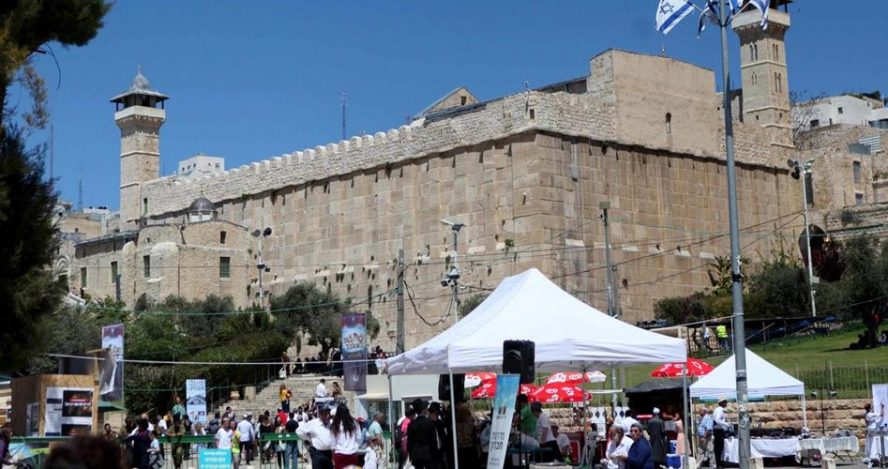
By Jonathon Cook | The National | December 10, 2019
US President Donald Trump told thousands of Israel’s supporters at a rally in Florida at the weekend that some American Jews “don’t love Israel enough”. It is certainly troubling that a US president insists a section of his country’s citizens – the Jewish population – be required to love a foreign state. But then Trump went further, muddying the waters about what constitutes “Israel”.
Echoing remarks made last month by Mike Pompeo, his secretary of state, he described the Jewish settlements in the West Bank as legal – thereby subverting a long-established principle of international law.
US Jews – and the rest of us, it seems – are expected not only to love Israel inside its internationally recognised borders but also to love the Jewish settlements that international law designates as a war crime. Those are the same settlements eating up ever more of the territory supposed to form the basis of a Palestinian state.
When Trump, like his predecessors, told his weekend audience that the US shared an “unbreakable” bond with Israel, what exactly was the “Israel” he referred to? Both the US and Israel have implied in recent declarations and actions that a central plank of the long-delayed Trump peace plan will be Israel’s annexation of the settlements – and with them most of the West Bank.
“Loving Israel” now is meant to include abandoning any hope of Palestinian statehood and accepting that Palestinians will live permanently under an Israeli version of apartheid, with inferior rights to Jews.
The Trump administration seems keen to press ahead with the peace plan – and annexation – but is being hampered by political chaos in Israel.
Mired in corruption scandals and having staged two inconclusive elections this year, Benjamin Netanyahu, the caretaker prime minister, is unable to cobble together a coalition to keep himself in power. The impasse is not over the occupation or the settlements but about who gets to dominate the next government: far-right religious settlers led by Netanyahu or right-wing, secular former army generals?
Nonetheless, Netanyahu is behaving as if Washington has given its blessing to annexation – even without a US peace plan.
That was what Pompeo’s statement last month backing the settlements amounted to. He offered one paltry safeguard, investing responsibility for monitoring and limiting settlement expansion in Israel’s supreme court. But this is the same court that has consistently failed to block settlement growth over five decades. It now includes two judges who actually live in settlements, as well as others who sympathise politically with the settlement project.
Meanwhile, in preparation for a likely third election campaign, the interim Netanyahu government has announced a splurge of new settlement building and boosted settler budgets.
In another fillip for the settlers last month, Netanyahu appointed one of their leaders, Naftali Bennett, to the sensitive role of defence minister. Bennett lost no time in unveiling his latest settlement plan last week, selecting an incendiary spot greatly prized by the settlers: the middle of Hebron, the West Bank’s largest Palestinian city.
For decades, life for Hebron’s 230,000 Palestinians has been forced to a virtual standstill by a few hundred Jewish religious extremists who have taken over the city centre, backed by more than 1,000 Israeli soldiers. Their ultimate goal is to wrestle away the city’s Ibrahimi mosque, the reputed burial site of Abraham, father of the world’s three main monotheistic religions.
After Baruch Goldstein, a settler, shot dead and wounded some 150 Muslim worshippers in 1994, Israel rewarded the settlers twice over.
First, it segregated the mosque site, splitting it into two. Half is now the Jewish Tomb of the Patriarchs. But in practice the Israeli army enjoys absolute control over who can pray there.
And next, Israel declared the surrounding area, including Hebron’s main commercial market, a closed military zone, thereby forcing the Palestinian merchants out. It has been a ghost town ever since, serving as a passageway between the settlement enclaves and the mosque.
For years, the closed market has stood as a potent, silent symbol of the way Israel has been tearing the city apart.
In February, Netanyahu gave the settlers another boost. He shuttered the international observer mission in Hebron, there to witness and record the abuse of Palestinians, especially at the checkpoints that litter the city centre. But still the settlers were not satisfied. They have long wanted to take over the Hebron market for themselves, to expand their enclaves.
So last week, Bennett granted their wish. He announced plans to destroy the market to make way for a settlement serving effectively as a bridge between the existing enclaves and the mosque site. The plan will double the number of settlers in Hebron and complete a wall of Jewish settlement dividing the city in two. This week Palestinian leaders called a citywide strike in protest.
As ever, the Israeli government has tried to put a surreal legal gloss on its criminality, apparently to spare the blushes of its US and European allies. Bennett’s advisers have insisted that Israel has legal title to the air above the roofs of the empty shops. This is where the settlers will supposedly be housed, after the shops have been demolished and rebuilt to support the new apartment blocks.
It emerged this week that Bennett had threatened Hebron’s municipality, warning it would lose property rights to the shops area too if it did not consent to the settler homes above.
Israel is reminding Palestinians that there are now no limits – military, legal, moral or diplomatic – to the settlers’ power. Israel will annex land where it chooses and deceptively refashion the resulting apartheid system as the rule of law.
The material losses to the Palestinians from Israel’s ever-growing settlement enterprise are devastating enough. This month, the United Nations Conference on Trade and Development issued a report estimating conservatively that the past 17 years of occupation alone had cost the Palestinians a whopping $48 billion – three times the current size of its economy.
That income would have generated two million job opportunities, freeing Palestinians from a miserable choice between life without work and, if they are issued a permit by Israel, precarious, exploitative casual labour in Israel or the settlements.
Equally significantly, the ever-expanding settlements have stripped Palestinians of their most basic freedoms, such as movement, and undermined their security and right to be treated with dignity.
And no one ought to love that.
Belgian Trade Delegation to Israel Cancelled
IMEMC & Agencies – December 7, 2019
The trade mission would have taken place from the 8th to the 11th of December, will not go forward, due to criticism from the political opposition and several activist organizations, leading to its discontinuation, the Palestine News Network (PNN) reported.
The delegation would have consisted of representatives from the Walloon and Brussels governments, which are separate political entities in Belgium, and numerous companies from the respective regions.
The Walloon government had already withdrawn from the delegation at an earlier stage, but now the Brussels government has done the same, effectively leaving the rest of the mission without political representation.
In the last couple of weeks, the general criticism towards the trade mission has grown. Specifically Israel’s disregard for international agreements concerning the blockade of the Gaza Strip, sparked the opposition’s distaste for the mission.
“We’re talking about participating in the Israeli colonization policy,”
said Stéphanie Koplowicz, member of the Flemish left-wing PVDA-party.
“The UN Human Rights Comittee has complained that over 200 companies do business in these illegal settlements. Does the government want to encourage Brussels’ companies to participate in this?”
Featured Video

Iran’s Next Strike May Not Explode. It Could Shut You Down
or go to
Aletho News Archives – Video-Images
From the Archive
Zionism’s Violent Legacy
By Donald Neff | Washington Report On Middle East Affairs | January 1996
On January 4, 1948, Jewish terrorists drove a truck loaded with explosives into the center of the all Arab city of Jaffa and detonated it, killing 26 and wounding around 100 Palestinian men, women and children.[1] The attack was the work of the Irgun Zvai Leumi – the “National Military Organization,” also known by the Hebrew letters Etzel – the largest Jewish terrorist group in Palestine. The Irgun was headed by Revisionist Zionist Menachem Begin and had been killing and maiming Arabs, Britons and even Jews for the previous ten years in its efforts to establish a Jewish state.
This terror campaign meant that at the core of Revisionist Zionism there existed a philosophical embrace of violence. … continue
Blog Roll
 Aletho News
- Trump’s Iran war is on an Israeli leash
- Saudi oil boss issues global supply warning
- Riyadh Says Its Oil System Is Intact. The Numbers Say Otherwise.
- Trump and Netanyahu Want to “Finish the Job” on Iran
- US ‘one-sided dictation’ not Iran’s beliefs makes rational talks impossible: Baghaei
- Iran’s Next Strike May Not Explode. It Could Shut You Down /Col Doug Macgregor
- Iran: US political targets legitimate if assassinations return
- Iraq shuts key border crossing with Iran under US pressure: Report
- Undersea Internet cables could be targeted in retaliation for attacks on Iran: IRGC deputy chief
- EU sending ‘biased’ observers to interfere in Serbian election – president
- If Americans Knew
- The Israel Lobby’s Changing Fortunes
- AIPAC has become such a political liability that it’s shifting to a more “nimble” approach to buying politicians
- At least 160 Israeli settler attacks in 2 weeks
- Will Gaza’s Ancient Christian Community Disappear Forever?
- Israel’s vision of regional security rests on keeping Arab states weak
- Heidi Levine recounts how Palestinian youths helped save her in settler attack
- DAILY UPDATE: Latest essential news on Palestine, Israel, & region
- Trump’s Intensifying Sabotage of the ICC, for Israel’s Sake
- Israeli military detain US and UK volunteers in West Bank including Democratic NY politician Brad Lander
- Americans at National Conservatism Conference held in Israel this year criticize Israel
- No Tricks Zone
- E-Cars Reduce CO2 Emissions By Only 41% Compared To Internal Combustion Engine Vehicles
- Predictions Made By Renowned Climate Professor Over Past Decades Have Been Proven To Be Poor
- New Study Suggests Large Regions Of The Pacific Ocean Have Been Cooling For The Last 80 Years
- Germany’s Green Energy Debacle: High Energy Costs Force Kahla Porzellan to Close After 182 Years!
- New Study: 50 Years Of The Most Aggressive ‘Net Zero’ Policies Can Only Affect The Global Climate By 0.03°C
- US September “Heat” Was No Record…Many Records Set Decades Ago
- Latest European Green Energy Debacle; Portugal’s Largest Flagship Solar Park Insolvent!
- Green Energy Debacle: German Expert Professor Fritz Vahrenholt Warns Of Severe Economic And Social Consequences
- Two More Paleo Reconstructions Affirm Meters-Higher Sea Levels Across Ireland, Brazil 7000-6000 Years Ago
- New Study: Earth And Venus Surface Warmth Largely Explained By Convection And Lapse Rate, Not CO2 Or Radiation

