The Façade of “Humanitarian Intentions” in Libya
Review of Paolo Sensini’s book, Sowing Chaos: Libya in the Wake of Humanitarian Intervention
By Edward Curtin | Global Research | August 10, 2016
It is rare for a historian to write a history of a significant issue and bring it into the present time; even rarer when the work coincides with the reemergence of that issue on the world stage. Paolo Sensini has done just that with Sowing Chaos: Libya in the Wake of Humanitarian Intervention (Clarity Press, 2016). It is a revelatory historical analysis of the exploitation and invasion of Libya by colonial and imperialistic powers for more than a century.
It is also timely since the western powers, led by the United States, have once again invaded Libya (2011), overthrown its government, and are in the process (2016) of creating further chaos and destruction by bombing the country for the benefit of western elites under the pretext of humanitarian concern.
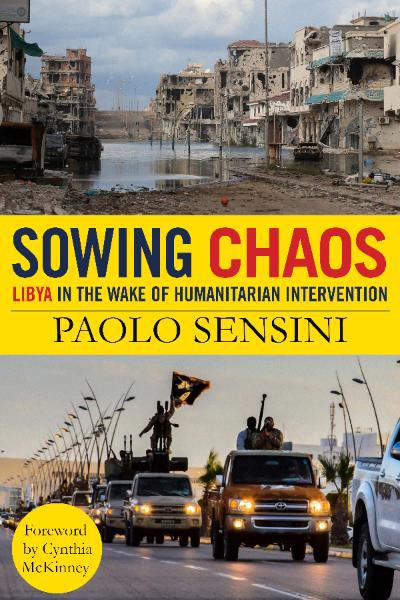 As with the history of many countries off the radar of western consciousness, Libyan history is a tragic tale of what happens when a country dares assert its right to independence – it is destroyed by violent attack, financial subterfuge, or both.
Although an Italian and Italy has a long history of exploiting Libya, a close neighbor, Sensini stands with the victims of colonial and imperial savagery. Not an armchair historian, he traveled to Libya during the 2011 war to see for himself what was true. Despite his moral stand against western aggression, his historical accuracy is unerring and his sourcing impeccable. For 234 pages of text, he provides 481 endnotes, including such fine sources as Peter Dale Scott, Patrick Cockburn, Michel Chossudovsky, Pepe Escobar, and Robert Parry, to name but a few better known names.
His account begins with Italy’s 1911 war against Libya that “Francesco Saverio Nitti charmingly described …. as the taking of a ‘sandbox’.” The war was accompanied by a popular song, “Tripoli, bel suol d’amore” (Tripoli, beauteous land of love). Even in those days war and love were synonymous in the eyes of aggressors.
This war went on until 1932 when the Sanusis’s resistance was finally crushed by Mussolini. First Italy conquered the Ottoman Turks, who controlled western Libya (Tripolitania); then the Sanusis, a Sunni Islamic mystical militant brotherhood, who controlled eastern Libya (Cyrenaica). This Italian war of imperial aggression lasted 19 years, and, as Sensini writes, “was hardly noticed in Italy.”
I cannot help but think of the U.S. wars against Afghanistan and Iraq that are in their 15th and 13th years respectively, and counting; they are not making a ripple on the placid indifference of the American people.
Sensini presents this history clearly and succinctly. Most of the book is devoted to the period following the 1968 overthrow of King Idris by the Free Unionist Officers, led by the 27 year old captain Mu’ammar Gaddafi. This bloodless coup d’état by military officers, who had all risen from the poorer classes, was called “Operation Jerusalem” to honor the Palestinian liberation movement. The new government, The Revolutionary Command Council (RCC), had “three key themes …. ‘freedom, socialism, and unity,’ to which we can add the struggle against western influences within the Arab world, and, in particular, the struggle against Israel (whose very existence was, according to Gaddafi, a confirmation of colonialization and subjugation).”
Sensini explains the Libyan government under Gaddafi, including his world theory that was encapsulated in his “Green Book” and the birth of what was called “Jamahiriyya” (State of the Masses). Gaddafi called Libya the “Socialist People’s Libyan Arab Jamahiriyya.”
Under Gaddafi there was dialogue between Christians and Muslims, including the establishment of diplomatic relations with the Holy See, and visits from Eastern Orthodox and Anglican religious leaders. Fundamentalist Islamic groups criticized Gaddafi as a heretic for these moves. Gaddafi described Islamists as “reactionaries in the name of Islam.” His animus toward Israel remained, however, due to the Palestinian issue. He promoted women’s rights, and in 1996 Libya “was the first country to issue an international arrest warrant with Osama bin Laden’s name on it.”
He had a lot of enemies: Israel, Islamists, al Qaeda, the western imperial countries, etc. But he had friends as well, especially among the developing countries.
A large portion of the book concerns the U.S./NATO 2011 attack on Libya and its aftermath. This attack was justified and sanctioned by UN Resolutions 1970 (2/26/11) and 1973 (3/17/11). These resolutions were prepared by the work of the International Commission on Intervention and State Sovereignty (ICISS) that in 2000-2001 produced a justification for powerful nations to intervene in the internal affairs of any nation they chose. Termed the “Responsibility to Protect” (R2P), it justified the illegal and immoral “humanitarian” attack on Libya in 2011. The ICISS, based in NYC, was founded by, among others, the Carnegie Corporation, the Simons, Rockefeller, William and Flora Hewitt, and John D. and Catherine MacArthur foundations, elite moneyed institutions devoted to American interventions throughout the world.
When the US/NATO attacked Libya, they did so despite the illegality of the intervention (an Orwellian term) under the UN Resolutions that prohibit arming of ‘rebels’ who do not represent the legal government of a country. On March 30, 2011 the Washington Post, a staunch supporter of US aggression, reported an anonymous government source as saying that “President Obama has issued a secret finding that would authorize the CIA to carry out a clandestine effort to provide arms and other support to Libyan opposition groups.” None of the mainstream media, including the Washington Post, noted the hypocrisy of reporting illegal activities as if they were legal. The law had become irrelevant.
The Obama administration had become the opposite of the Kennedy administration. Whereas JFK, together with Dag Hammarskjold the assassinated U.N. Secretary General, had used the UN to defend the growing third world independence movements throughout the world, Obama has chosen to use the UN to justify his wars of aggression against them. Libya is a prime example.
Sensini shows in great detail which groups were armed, where they operated, and who they represented. The US/NATO forces armed and supported all sorts of Islamist terrorists, including the Libyan Islamic Fighting Group (LIFG), led by Abu al-Laith al Libby, a close Afghan associate of Osama bin Laden, and al Qaeda’s third in command.
“These fanatical criminals (acclaimed as liberators by the mainstream media worldwide) were to form Libya’s emerging ruling class. These were people tasked to ensure a democratic future for Libya. However, the ‘rebel’ council of Benghazi did what it does best – ensuring chaos for the country as a whole, under a phantom government and a system of local fiefdoms (each with a warlord or tribal chief). This appears to be the desired outcome all along, and not just in Libya.”
Sensini is especially strong in his critical analysis of the behavior of the corporate mass media worldwide in propagandizing public opinion for war. Outright lies – “aligning its actions with Goebbels’ famous principle of perception management” and the Big Lie (thanks to Edward Bernays, the American father of Public Relations) – were told by Al Jazeera, Al Arabiya, and repeated by the western media, about Gaddafi allegedly slaughtering and raping thousands of Libyans. Sensini argues persuasively that Libya was a game-changer in this regard.
Here, the mass media played the part of a military vanguard. The cart, as it were, had been put before the horse. Rather than obediently repackaging and relaying the news that had been spoon fed to them by military commanders and Secretaries of State, the media were called upon actually to provide legitimation for armed actors. The media’s function was military. The material aggression on the ground and in the sky was paralleled and anticipated by virtual and symbolic aggression. Worldwide, we have witnessed the affirmation of a Soviet approach to information, enhanced to the nth degree. It effectively produces a ‘deafening silence’ – an information deficit. The trade unions, the parties of the left and the ‘love-thy-neighbor’ pacifists did not rise to this challenge and demonstrate against the rape of Libya.
The US/NATO attack on Libya, involving tens of thousands of bombing raids and cruise missile, killed thousands of innocent civilians. This was, as usual, explained away as unfortunate “collateral damage,” when it was admitted at all. The media did their part to downplay it. Sensini rightly claims that the U.S./NATO and the UN are basically uninterested in the question of the human toll. “The most widely cited press report on the effects of the NATO sorties and missile attacks on the civilian population is most surely that of The New York Times. In ‘Strikes on Libya by NATO, an Unspoken Civilian Toll’, conveniently published after NATO’s direct intervention had ceased. The article is truly a fine example of ‘embeddedness’:”
While the overwhelming preponderance of strikes seemed to hit their targets without killing noncombatants, many factors contributed to a run of fatal mistakes. These included a technically faulty bomb, poor or dated intelligence and the near absence of experience military personnel on the ground who could direct air strikes. The alliances apparent presumption that residences thought to harbor pro Gaddafi forces were not occupied by civilians repeatedly proved mistaken, the evidence suggests, posing a reminder to advocates of air power that no war is cost or error free.
The use of words like “seemed” and “apparent,” together with the oft used technical excuse and the ex post facto reminder are classic stratagems of the New York Times’ misuse of the English language for propaganda purposes.
Justifying the killing, President Obama “explained the entire campaign away with a lie. Gaddafi, he said, was planning a massacre of his own people.”
Hillary Clinton, who was then Secretary of State, was aware from the start, as an FOIA document reveals, that the rebel militias the U.S. was arming and backing were summarily executing anyone they captured: “The State Department and Obama were fully aware that the U.S.-backed ‘rebel’ forces had no such regard for the lives of the innocent.”
Clinton also knew that France’s involvement was because of the threat Gaddafi’s single African currency plan posed to French financial interests in Francophone Africa. Her joyous ejaculation about Gaddafi’s brutal death – “We came, we saw, he died” – sick in human terms, was no doubt also an expression of relief that the interests of western elites, her backers, had been served.
It is true that Gaddafi did represent a threat to western financial interests. As Sensini writes, “Gaddafi had successfully achieved Libya’s economic independence, and was on the point of concluding agreements with the African Union that might have contributed decisively to the economic independence of the entire continent of Africa.”
Thus, following the NATO attack, Obama confiscated $30 billion from Libya’s Central Bank. Sensini references Ellen Brown, the astute founder of the Public Banking Institute in the U.S., who explains how a state owned Central Bank, as in Libya, contributes to the public’s well-being. Brown in turn refers to the comment of Erica Encina, posted on Market Oracle, which explains how Libya’s 100% state owned Central Bank allowed it to sustain its own economic destiny. Encina concludes, “Hence, taking down the Central Bank of Libya (CBL) may not appear in the speeches of Obama, Cameron and Sarkozy [and Clinton] but this is certainly at the top of the globalist agenda for absorbing Libya into its hive of compliant nations.”
In five pages Sensini tells more truth about the infamous events in Benghazi that resulted in the deaths of US Ambassador Christopher Stevens and three American colleagues than the MSM has done in five years. After the overthrow of Gaddafi, in 2012 Stevens was sharing the American “Consulate” quarters with the CIA. Benghazi was the center of Sanusi jihadi fundamentalism, those who the US/NATO had armed to attack Gaddafi’s government. These terrorists were allied with the US. “Stevens’s task in Benghazi,” writes Sensini, “now was to oversee shipments of Gaddafi’s arms to Turkish ports. The arms were then transferred to jihadi forces engaged in terrorist actions against the government of Syria under Bashar al-Assad.” Contrary to the Western media, Sensini says that Stevens and the others were killed, not by the jihadi extremists supported by the US, but by Gaddafi loyalists who had tried to kill Stevens previously. These loyalists disappeared from the Libyan and international press afterwards. “The reports now focused on al-Qaida, Islamists, terrorists and protesters. No one was to mention either Gaddafi … or his ghosts.”
The stage for a long-term Western intervention against terrorists, who were armed by the US/NATO, was now set. The insoluble disorder of a vicious circle game meant to perpetuate chaos was set in motion. Sensini’s disgust manifests itself when he says, “Given its record of lavish distribution of arms to all and sundry in Syria, the USA’s warning that, in Libya, arms might reach ‘armed groups outside the government’s control’ is beneath contempt.”
Sowing Chaos: Libya in the Wake of Humanitarian Intervention is a superb book. If you wish to understand the ongoing Libyan tragedy, and learn where responsibility lies, read it. If the tale it tells doesn’t disgust you, I’d be surprised.
In closing, I would be remiss if I didn’t mention that former Congresswoman Cynthia McKinney, a stalwart and courageous truth teller, has written a fine forward where she puts Libya and Sensini’s analysis into a larger global perspective. As usual, she pulls no punches.
Copyright © Edward Curtin, Global Research, 2016
Italy ‘No Longer Sovereign State, It is on NATO’s, US’ Tight Military Leash’
Sputnik – 14.09.2016
Italy has been packed full of NATO and US military bases across the country, which serve as testing grounds for the US and the alliance; Sputnik Italy talked to Fulvio Grimaldi, Italian journalist, war correspondent and documentarian on the everyday damage these military facilities cause to the country.
“We fell victim to the self-restrictions contrary to our own interests. Europe is tormenting itself,” Grimaldi told Sputnik while commenting on the issue.
“It is in the interests of the US that Italy has imposed sanctions on Russia which have harmed Moscow less than Italian farmers and the country’s industry, which have subsequently found themselves in grave economic conditions,” he noted.
The journalist further acknowledged that his home country has been forcefully militarized. There are around 90 US bases in the country, let alone a lot more NATO bases on its territory, which are at the US disposal.
“We are a country overflowing with military bases, and this is a serious burden for our economy to the detriment of construction, maintenance of medical facilities, schools and land improvement,” the journalist said. These military facilities also put Italy at risk of becoming a potential target for those countries who will decide one day to stand up to NATO aggression.
The correspondent cites as an example the American Mobile User Objective System (MUOS), a modern satellite communications system located in Sicily, the largest Mediterranean island, which is capable of reaching out to Africa and the Middle East.
“It is a huge social and industrial burden for the island,” he said.
Another example is the US military facility on another large Italian island in the Mediterranean Sea, Sardinia, which serves as a testing range for the newly released weaponry which pollutes the environment and threatens the health of local residents.
The economic damage is also substantial. NATO military operations around the globe cost the Italian defense ministry 55 million euro ($61.7mln) per day. If you take into account the expenses of other related ministries, the daily cost rises to 80 million ($89.7mln).
“This is the contribution of the country which has no interest in the military operation in any country of the world, because it is facing no threats,” Grimaldi said.
The US military and political control over the Italian territory comes as the aftermath of the Second World War which deprived Italy of its sovereignty. “I see no reasons for optimism in such a situation.
What I actually see is the acknowledgment of similar subordination in other countries of the EU, and this aggressive strategy of NATO is leading us towards an epic failure,” the journalist said.
However he added that he is certain that one day the authorities will finally come to their senses and change their stance towards the alliance.
Italian imam posts photo of nuns on beach to discuss burqini ban, gets FB account blocked
RT | August 20, 2016
The imam of Florence has posted a picture of habit-wearing nuns splashing along the seashore on Facebook, calling for dialogue about burqini bans… but got his account blocked instead.
The post by Izzedin Elzir got some 2,700 shares, and came in response to the French southern cities – like Cannes and Nice – prohibiting the wearing of burqinis on the beach.
The day after the imam published his post, he awoke to find his account blocked.
“It’s incomprehensible. I have to send them an ID document to reactivate it. They wanted to make sure it’s my account – it’s a very strange procedure,” the indignant imam told La Repubblica.
On Friday, his account was back in, and the imam said he hopes it wasn’t blocked because of the picture, as it urges dialogue, and “we live in a society of law and freedom.”
He also noted that the burqini had only come into fashion among Muslim women over the past few years, and he expressed regret that “some politicians in France, instead of responding to the political and economic needs of their citizens, are focusing on how Muslims dress.”
Many online commenters tended to agree with the imam, saying that “The sea is for everyone,” and describing the ban as “a psychological tool against Muslims.”
However, others disagreed, “Don’t confuse the two different situations: these are women who have CHOSEN to religious life with the rules that it imposes, the ‘others’ are FORCED to dress even on the beach,” a comment read.
It’s not the first burqini-linked scandal this week. On Thursday, Austrian politician Ahmet Demir caused uproar after publishing a photo of two nuns and joking that they were “oppressed women” in burqas. Later, he took the post down and apologized, but defended his post saying that he was attempting to convey the message that “every woman should be able to wear what they want as long as they chose the clothes themselves.”
On Tuesday, Italy’s Interior Minister Angelino Alfano told Corriere Della Serra that Italy wouldn’t follow France’s suit and ban the burqini, but will step up regulations of imams and mosques.
Two days later, Italian authorities expelled the Tunisian imam Khairredine Romdhane Ben Chedli. The 35-year-old imam was lately absolved of terrorism-related charges, but still deemed unfit to remain in his post, the ANSA news agency said.
Libyan unity government rejects British troops for anti-ISIS mission
RT | April 13, 2016
British troops may not be deployed to Libya after all because the head of the North African state’s new unity government turned down the offer of Western soldiers to help eliminate Islamic State (IS, formerly ISIS/ISIL).
The move may come as a shock to some in the British establishment who had expected a request for soldiers now that the war-ravaged state’s UN-brokered unity government has assembled in Tripoli.
A UK government source told the Times on Wednesday the request had not materialized. The source felt the force structure being floated – an Italian-led brigade of 6,000 with a 1,000-strong British component – would exacerbate internal divisions.
Its aims would have been to tackle people-trafficking and train Libyan forces to fight IS.
Another unnamed source, a British minister, told the Times it was thought the head of the unity government, Fayez al-Sarraj, may wait until he is more established before requesting foreign military help.
Al-Sarraj and his government only arrived in the country a fortnight ago amid fears their entry would spark violence among the rival militias.
“The idea that the PM is yet able to give the green light to anything is premature, he needs to make sure he has the necessary support,” the minister told the Times.
“We are in a sensitive period. Nobody has drawn any firm conclusions. We’ve got a long way to go but there is a recognition things are extremely serious.”
European Council on Foreign Relations Libya specialist Mattia Toaldo told the paper that officials in the new administration are afraid of being seen as “foreign puppets” and hope “people in Europe will stop talking about this for a few weeks.”
Some military and political figures in the UK seem to have learned one tough lesson from the ill-fated campaigns in Afghanistan and Iraq, where US-appointed governments were treated with suspicion and substantial resistance ensued.
On April 1, as Al-Sarraj arrived in Tripoli, Commons Foreign Affairs Committee chair Crispin Blunt MP warned that although the UK has a “moral obligation” to clean up the “mess” it had left in Libya, any UK troop deployment would look like an “invading force.”
On Monday, the former British Army Colonel who briefly led a mission to Libya in the wake of the 2011 war, which removed the old regime, warned that if anything could unify the competing militias it would be a foreign military intervention.
Lieutenant Colonel Rupert Wieloch also told the Telegraph he questioned the wisdom of involving Italy, a former colonial ruler, in any Libya operation.
Italian Decision to Permit US Attack UAVs Contradicts Constitution
Sputnik – February 27, 2016
In an interview with Sputnik, military expert Antonio Mazzeo described Rome’s decision to allow armed US drones to fly from the Sigonella military base in Sicily to Libya as a gross violation of the Italian Constitution.
According to him, the move will further add to the militarization of the Sigonella base.
He said that even the deployment of unarmed Global Hawk drones to Sicily nine years ago, was not quite in line with the nation’s constitutional provisions limiting the use of Italian military facilities to self-defense, given that their task is to detect targets for bombers.
“Even if they do not carry missiles, they can be called a weapon of attack, destruction, and the first strike,” Mazzeo said. Article 11 of the 1948 Italian Constitution states that “Italy repudiates war as an instrument offending the liberty of the peoples and as a means for settling international disputes.”
His remarks came after Italian Defense Minister Roberta Pinotti confirmed earlier this week that the United States had been given permission to use the Sigonella base to carry out drone strikes on Daesh targets in Libya.
Hamas welcomes Italian academics’ call for BDS
Ma’an – January 30, 2016
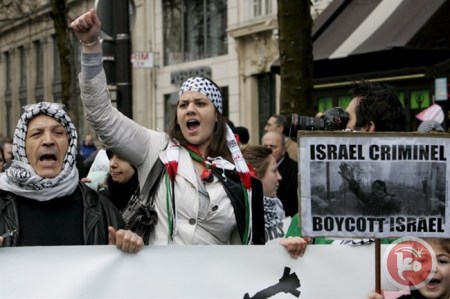 BETHLEHEM – The Hamas movement hailed on Saturday the announcement that academics from 50 Italian universities had signed a petition calling to boycott Israeli universities and research institutes.
According to prominent Italian publication L’Espresso, more than 160 Italian academics came out in support of the Palestinian boycott, divestment and sanctions (BDS) campaign.
The petition, reportedly the first large-scale BDS effort from Italian academia, said it was “a response to the known and well-documented complicity of Israeli academic institutions with Israeli state violence and the total lack of serious condemnation on their part since the foundation of the State of Israel.”
The BDS campaign specifically targeted Technion, the Israeli Institute of Technology in Haifa, for its prominent role in the Israeli military-industrial complex, and called on Italian universities to sever ties with the institution.
Hamas spokesman Sami Abu Zuhri welcomed the move on Saturday, saying the petition “illustrates the increasing state of isolation the occupation suffers as a result of its crimes.”
Israel has been struggling to tackle a growing Palestinian-led boycott campaign which has had a number of high-profile successes abroad in both academic and artistic fields.
The BDS movement aims to exert political and economic pressure over Israel’s occupation of the Palestinian territories in a bid to repeat the success of the campaign which ended apartheid in South Africa.
In recent years, some 1,200 academics in Spain, 343 British professors and lecturers and more than 200 South African academics have publicly come out in support of BDS.
Why the US anti-terror coalition is failing
By Finian Cunningham | American Herald Tribune | January 21 ,2016
There was an underwhelming sense when Pentagon boss Ashton Carter met this week in Paris with other members of the US-led military coalition supposedly fighting the ISIL terror group.
The US-led coalition was set up at the end of 2014 and in theory comprises 60 nations. The main military operation of the alliance is an aerial bombing campaign against terrorist units of IS (also known as ISIL, ISIS or Daesh).
At the Paris meeting this week, Secretary of Defense Carter was joined by counterparts from just six countries: France, Britain, Germany, Italy, Netherlands and Australia. Where were the other 54 nations of the coalition?
Carter and French defense minister Jean-Yves Le Drian patted themselves on the back about “momentum”in their campaign against the terrorist network. However, platitudes aside, there was a noticeable crestfallen atmosphere at the meeting of the shrunken US-led coalition.
One telling point was Carter exhorting Arab countries to contribute more. As a headline in the Financial Times put it: “US urges Arab nations to boost ISIS fight”.
Carter didn’t mention specific names but it was clear he was referring to Saudi Arabia and the other oil-rich Persian Gulf Arab states, including Kuwait, Qatar, United Arab Emirates and Bahrain.
When the US initiated the anti-IS coalition in 2014, fighter jets from the Sunni Arab states participated in the aerial campaign. They quickly fell away from the operation and instead directed their military forces to Yemen, where the Saudi-led Arab coalition has been bombing that country non-stop since March 2015 to thwart an uprising by Houthi revolutionaries.
But there is an even deeper, more disturbing reason for the lack of Arab support for the US-led coalition in Iraq and Syria. That is because Saudi Arabia and the other Sunni monarchies are implicated in funding and arming the very terrorists that Washington’s coalition is supposedly combating.
Several senior US officials have at various times admitted this. Democrat presidential hopeful Hillary Clinton labelled Saudi Arabia as the main sponsor of “Sunni extremist groups”in diplomatic cables when she was Secretary of State back in 2009, as disclosed by Wikileaks.
Vice President Joe Biden, while addressing a Harvard University forum in late 2014, also spilled the beans on the Persian Gulf states and Turkey being behind the rise of terror groups in the Middle East.
So there is substantial reason why the US-led anti-terror coalition in Iraq and Syria has not delivered decisive results. It is the same reason why Carter was joined by only six other countries in Paris this week and why there was a glaring absence of Saudi Arabia and other Arab members. These despotic regimes –whom Washington claims as “allies”–are part of the terrorist problem.
Not that the US or its Western allies are blameless. Far from it. It was Washington after all that master-minded the regime-change operations in Iraq and Syria, which spawned the terror groups.
In fact, we can go further and point to evidence, such as the testimony of Lt General Michael Flynn of the Defense Intelligence Agency, which shows that the US enlisted the terror brigades as proxies to do its dirty work in Syria for regime change.
The US and its Western allies conceal this collusion by claiming that they are supporting “moderate rebels”–not extremists. But the so-called moderates have ended up joining the terrorists and sharing their US-supplied weapons. The distinction between these groups is thus meaningless, leaving the baleful conclusion that Washington, London and Paris are simply colluding with terrorism.
US Republican presidential contenders and media pundits berate the Obama administration for not doing enough militarily to defeat IS. Or as Donald Trump’s backer Sarah Palin would say to “kick ass”.
The unsettling truth is that the US cannot do more to defeat terrorism in the Middle East because Washington and its allies are the source of terrorism in the region. Through their meddling and machinations, Washington and its cohorts have created a veritable Frankenstein monster.
The “coalition”that is actually inflicting serious damage to IS and its various terror franchises is that of Russia working in strategic cooperation with the Syrian Arab Army of President Bashar al-Assad. Since Russia began its aerial bombing campaign nearly four months ago, we have seen a near collapse of the terror network’s oil and weapons smuggling rackets and hundreds of their bases destroyed.
Yet Ashton Carter this week accused Russia of impeding the fight against terrorism in Syria because of its support for the Assad government. Talk about double think!
If we strip away the false rhetoric and mainstream media misinformation, Washington’s “anti-terror”coalition can be seen as not merely incompetently leading from behind.
The US, its Western allies and regional client regimes are in the front ranks of the terror problem.
Italy’s Lega Nord Party Urges Sanctions on Ankara, Riyadh for Funding Daesh
By Svetlana Alexandrova – Sputnik – 18.12.2015
The European Union should impose sanctions on Turkey and Saudi Arabia for financing the Islamic State (IS or Daesh in Arabic) jihadist group, instead of extending its anti-Russia sanctions, the leader of Italy’s Eurosceptic Lega Nord party, Matteo Salvini, told Sputnik Wednesday.
A UN Security Council Resolution to counter the financing of terrorism, targeting in particular Daesh, an organization outlawed in a number of states including Russia, was adopted Thursday. The resolution specifies that Daesh derives its main source of income from smuggled oil and obliges all states to oppose this illicit oil trade in the strongest terms. Russian Ambassador to the United Nations Vitaly Churkin said that Turkish companies found to be involved in this illicit oil trade might be sanctioned by the UN Security Council.
“Europe needs to impose sanctions against Turkey and Saudi Arabia instead of extending sanctions against Russia,” Salvini said.
Salvini added that his party does not believe that the Islamic coalition against extremists that was announced by Saudi Arabia earlier this week “will serve its alleged goals because it is the state that supports terrorism.”
Daesh controls large swathes of land in oil-rich Syria, Iraq and Libya. Earlier this month, the Russian Defense Ministry presented evidence showing that Daesh has been smuggling oil across the porous Syria-Turkey border in large volumes.
Salvini is currently in Moscow and is set to meet on Friday with the head of Russia’s upper house of parliament’s International Committee, Alexei Pushkov, Deputy Chairman of the Federation Council Committee on International Affairs Andrey Klimov, as well as with the representatives of the United Russia Party.
Sicilians Stage Anti-NATO Military Drills Rally
Sputnik – 31.10.2015
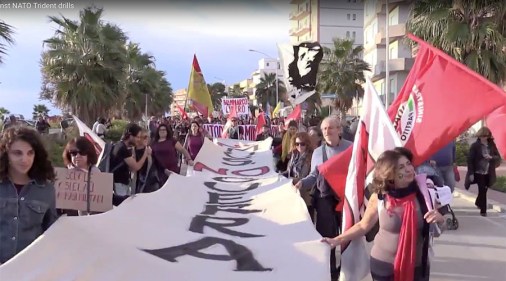 Protesters in the Italian island of Sicily demonstrated against the North Atlantic Treaty Organization’s (NATO) Trident Juncture-2015 exercises on Saturday less than 10 miles from a NATO base.
The military alliance’s largest exercises in over a decade involving over 36,000 troops from 30 NATO members and partner countries, Trident Juncture moved into an active phase across southwestern Europe in mid-October.
“We are against NATO, against war, against the enormous costs that go to the upkeep of military bases,” Chiara Paladino, one of the protest organizers, told RIA Novosti.
Paladino said around 1,000 people demonstrated in Marsala, south of the Vincenzo Florio Airport used as a NATO forward operating base. Anti-NATO protesters gathered from across the province of Trapani, including large Sicilian cities of Palermo, Catania, Messina and Ragusa, she said.
A similar anti-Trident Juncture and anti-NATO rally took place in the major Sicilian city of Palermo late on Friday.
The first phase of the Trident Juncture drills began October 3, running for two weeks in Canada, Norway, Germany, Belgium and the Netherlands. The second phase, which ends on November 6, is taking place in southern Europe – Spain, Italy, and Portugal – as well as in the Mediterranean Sea and the Atlantic Ocean.
Spanish and Portuguese demonstrators staged protests against NATO this month.
Photo © Ruptly
Featured Video
Marandi: Threat of Seizing Kharg Island & the Use of Nuclear Weapons
or go to
Aletho News Archives – Video-Images
Frlom the Archives
Iran War: United States Military Versus Israel Firsters
By James Petras | November 27, 2007
Why must Jewish organizations be and be seen as the loudest drum-beaters of all? Why can we not bring ourselves to say that military intervention is not on the table at all? Why not stash it under the table, out of sight and mount instead a diplomatic assault? – Leonard Fein, Forward
Introduction
As the White House and Congress escalate their economic sanctions and military threats against Iran, top military commanders and Pentagon officials have launched a counter-offensive, opposing a new Middle East War. While some commentators and journalists, like Chris Hedges (Truthdig, November 13, 2007), privy to this high stakes inter-elite conflict, attribute this to a White House cabal led by Vice President Cheney, a more stringent and accurate assessment puts the Zionist Power Configuration (ZPC) in the center of the Iran war debate.
There is a great deal riding in this conflict – the future of the American empire as well as the balance of power in the Middle East. Equally important is the future of the US military and our already heavily constrained democratic freedoms. The outcome of the continuous and deepening confrontation between top US military officials and the Israel Firsters over US foreign policy in the Middle East has raised fundamental questions over self-determination, colonization, civilian primacy and military political intervention, empire or republic. These and related issues are far from being of academic interest only; they concern the future of the United States. … continue
Blog Roll
 Aletho News
- How Zionist Control Is Hurting US Interests
- Iran warns it may target US missile launch sites in UAE cities
- American Military Failure in Afghanistan
- Friendly Skies of Georgia: Are Israeli-Linked Drones Launching False Flags from Georgian Territory?
- The Three Big Lies about Mammography Screening
- Ukrainian Embassy in Beirut sheltering top Mossad agent
- Palestinian family displaced after settlers violently attack them in Humsa, Jordan Valley
- The EU never learns – except for the wrong lessons
- Iran attacks on UAE leaves RSF militia high and dry
- Hosting Washington’s war: Bahrain faces the consequences
- If Americans Knew
- ‘Of Course’: IDF Drops Case Against Soldiers Accused of Raping Palestinian Prisoner
- Don’t Fall for the Regime Change Talk. Israel Is ‘Mowing the Lawn’ in Iran
- Will Israel and the US wreck the Gulf States along with Iran?
- US so far burned through ‘years’ of munitions in Iran war: Report
- How the Israeli Tail Wags the American Dog
- Outdated intel likely led to deadly U.S. strike on Iranian elementary school, sources say
- Pentagon insider says high U.S official Douglas Feith reported to Netanyahu
- In fond memory of Walid Khalidi, the historian of Palestine
- 6 more Americans killed, as Israel ‘mows the lawn’ in Iran – Not a ceasefire Day 154
- Are we on the precipice of World War III?
- No Tricks Zone
- New Studies: UK Sea Levels Were 4 Meters Higher Than Today During The Mid-Holocene
- Destructive Green New Deal: German Energy And Metal Group Warns Of Drastic Crisis
- New Study Documents A 20-Year Pause In Arctic Sea Ice Decline – Driven By Internal Variability
- Wake-up Call: Survey Shows Majority Of Germans Now Favor Postponing Climate Targets!
- Televised! Leading German Political Candidate Tells Schoolchildren CO2 Makes Sun Hotter!
- New Study: A Century Warming Of 1.1°C Is ‘Commonplace’ And ‘Not Unusual’ During This Interglacial
- New Study: ‘Internal Noise’ And Volcanic Forcing Can Trigger 10-15°C Warming Within Decades
- Glaciers Worldwide Are Suddendly Surging, Experts Blame Warming!
- Surprising Discovery: Sahara Is Greening…Billions Of Trees Where Once Thought To Be Barren
- New Research Reaffirms Clouds, Aerosols, And Surface Solar Radiation Are ‘Driving The Climate System’
 Aletho News