Knee Capped for Driving While Arab
By Maysa Abu Ghazala – Palestine News Network – March 5, 2011
On Thursday, February 24, 20-year-old Mohammad Gharib of al-Issawiya village near Jerusalem was driving home, bringing dinner from a restaurant in Jerusalem.

Mohammad Gharib – PNN
Mohammad took his youngest brother and his friend along for the ride. When they reached the intersection leading to the Ma’ale Adumim settlement, their car broke down.
“As I was trying to see what happened to the car, three settlers stopped and offered to help,” Mohammad recalled. “I thanked them and as I was speaking to them in Hebrew, they realized I was Arab. They started calling me names, then one of them pulled his gun and shot me in the knee.”
Mohammad was taken immediately to al-Maqasid hospital in Jerusalem, then moved to the Israeli hospital of Hadassah where doctors told him his knee was shattered and muscles torn.
“Doctors installed a device to make me walk,” he said, “but now I can’t leave my bed on my own”.
Mohammad said he filed a police report and told Israeli officers that he could identify the settler who shot him. He also demanded they work on his case quickly.
As of now, he is still lying in bed in pain and waiting for the police to arrest his attackers.
Related articles


Palestinian Women and Children Behind Zionist Bars
By Reham Alhelsi | A Voice From Palestine | April 17, 2010

On a beautiful March day, I was on the way to school in Jerusalem when the bus I was in was stopped at Ras Il-Amoud. The soldiers got into the bus, told everyone to get out and told the bus driver to turn and go back from where it came. Some passengers started arguing with the soldiers, explaining they had jobs or classes to go to, but the soldiers didn’t want to know about that and started shouting and beating those present with their clubs, including me. We were school children and were not a threat to armed soldiers, nevertheless a number of us were arrested for daring to tell the soldiers to stop beating us. We were handcuffed and loaded into military jeeps. On the way, we were forced to bend our heads down the whole trip and the only thing I could see were the boots of the soldiers.
When the jeep finally stopped, we were ordered by the soldiers to step down and as I looked around me I realized we were in a military camp. The soldiers told us then to stand in a certain place, turn our backs to them and kneel on the ground. We were still handcuffed. Opposite me I could see the mountains of Jerusalem and I realized we were in the Abu-Dees military camp which occupied one of the hills. We weren’t allowed to sit but half kneel which was very painful. And as we half-knelt there, near each other but not able to talk to each other, the soldiers started throwing small stones at us. They were laughing and talking in Hebrew while throwing the stones. I didn’t understand what they were talking about, but I figured they were betting who would hit which one of us and where. I don’t remember how long this “game” lasted, but I remember how painful the kneeling was, how painful the stones were when they hit my head and how I wondered what would happen to us, what they would do to us here alone in this military camp with no Palestinian around. Every now and then I would take a quick peek at the hills in front of us and I would think about my parents and what they were doing. We tried comforting each other silently by touching our feet. We didn’t talk for we weren’t allowed to do that, but whenever someone near me touched my foot with theirs, it was like telling me: don’t worry, we’ll get through this, and I would return the gesture.
After seemingly long hours, maybe in the afternoon, we were loaded back into the jeeps, ordered to lower our heads again and a new journey started. When this second journey ended, we were in one of the detention centres. The soldiers separated us from each other and I was taken to a small room where one female soldier searched me thoroughly several times. Then another male soldier came and took me to another room and told me to keep standing the whole time and if I sit I will be punished and that they will be watching me. While waiting I could hear shouting and a boy crying a room nearby. They were interrogating him and I knew my turn would be next. That day, I was a school pupil on my way to school, I got beaten by armed Israeli soldiers, was used as a “target” in their games and ended up in a detention centre. I was a child, a little girl, and was surrounded and beaten by no less that 5 or 6 fully armed soldiers to be then detained for “attacking the soldiers”. It didn’t matter that I was a child, it didn’t matter that I was a girl, to the Israeli soldiers I am a Palestinian, thus beating me and detaining me for no reason is allowed.
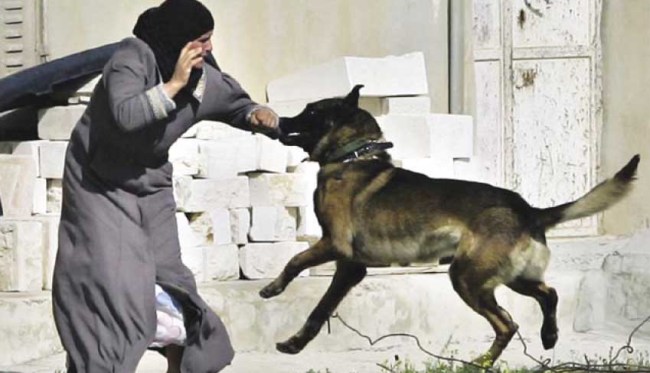
Photo – Multaqa.org

This is not an isolated case. Palestinian women and children are detained on almost a daily basis, and are physically and physiologically abused. They are beaten, humiliated and tortured during arrest, interrogation and detention. Their families are also harassed and sometimes other family members are arrested as well to extract a confession from the detainee. Palestinian children are interrogated by Israeli soldiers without the presence of a lawyer or a family member and later stand trial like adults. Families are often not allowed to see their children before or after trial.
Since 1967, Israel detained over 700,000 Palestinians including tens of thousands of children. Since the outbreak of Al-Aqsa Intifada in 09.2000, more than 8000 Palestinian children have been detained, of whom 337 are still in Israeli detention. According to “Defence for Children International/Palestine Section (DCI/PS)”, around 700 Palestinian children are detained yearly in Israeli jails. Of the over 8500 Palestinians currently detained in Israeli jails, at least 400 were children at the time of their arrest. Palestinian children are arrested from their homes, from schools, while playing in the streets or at checkpoints. They are blindfolded, shackled and taken into detention centers where they are separated from others. They are beaten, threatened and abused by the soldiers and interrogators, are not allowed to see a lawyer or a family member and are forced into singing papers in Hebrew which they don’t know. These children are prosecuted as adults in two military courts and by military officers who act both the prosecutor and the judge. Many of the children detained are subjected to administrative detention which means detention without charges or any trial. […]

One recent incident is that of Mohammad Al-Qunbar, a 14 year old from Jerusalem. On 15.03.2010 Mohammad was first hit by a police car, then beaten by the occupation police and detained despite his injury. The Israeli occupation police first claimed that Mohammad was hit by an “Arab” car, but pictures taken during the incident proved otherwise. Later, the boy testified he was threatened by investigators in the Maskubiyyeh with prison in case he revealed that he was hit by a police car. Mohammad said that an Israeli car came towards him and his friend, hit him the first time, turned and hit him a second time. Then those inside the car came out, arrested him and started beating him in the car while he was crying.
Children are also arrested during midnight raids. In recent years, mass arrests of Palestinian children have been reported. On 10.02.2010, and during a nightly military raid on Al-Jalazoun refugee camp in Ramallah, 19 children were detained from their homes. These were beaten and harassed and the families report that the IOF used excessive force during the arrests. The children were then taken to a detention centre and interrogated without the presence of a lawyer or any family member. According to the “Defence for Children International/Palestine Section (DCI/PS)” five of them were aged 14, seven were aged 15, four were aged 16 and three were aged 17. At least seven of them (aged 15 or less) were transferred to jails inside Israel which is, in addition to the illegality of detaining children, another violation of international law. During another similar midnight raid, this time in Silwan in Jerusalem, several Palestinian children aged 12 to 15 were detained. These were taken from their beds, handcuffed and transported to interrogation cells in the Maskubiyyeh and their parents were not allowed to accompany them. The children later testified that they were threatened and beaten during the interrogation. Similar midnight raids with mass arrests of children occurred in Tura Al-Gharbiyyeh on 19.01.2009, Azzun on 14.07.2009 and in Haris on 26.03.2009 where over 90 children were detained, beaten and threatened.
According to the Defence for Children International/Palestine Section (DCI/PS): [1]
90 Day: the period of time a Palestinian detainee, including a child, can be denied access to a lawyer and held in incommunicado detention (Military Order 378)
20 Years: the maximum sentence that can be imposed on a Palestinian, including a child, for throwing stones (Military Order 378)
188 Day: the length of time a Palestinian detainee, including a child, can be held in detention without charge (Military Order 378)
2 Years: the period of time a Palestinian detainee, including a child, can be held between indictment and trial.
Since 1967 more than 12,000 Palestinian women were detained by the Zionist entity. During the First Intifada 3000 women were detained and during Al-Aqsa Intifada more than 900 women were locked up behind Israeli bars. Currently, there are 35 Palestinian women detainees in the Israeli prisons Damon and HaSharon: among them 3 administrative detainees, 8 await trial, 23 sentenced of whom 5 are serving life sentences. Palestinian female detainees, like their brothers in detention, suffer from the brutality of the Israeli Prison Authority. They are punished for the slightest thing with isolation, are beaten, harassed, tied up for hours under hot sun or under rain, deprived of sleep, their rooms raided at night, continuously denied family visits and calls back home and letters are sent and brought only once every 3 months. Water is very dirty and food is inedible, thus the detainees are forced to buy their food and water from the prison canteen for very high prices. Some political prisoners are also locked up with Israeli criminals who abuse them. Their cells are over-crowded, damp, lack hygiene and are infested with insects.
The detainees are also denied appropriate and much needed medical treatment and most medications are expired; 13 detainees are in need of medical treatment. Amal Faiz Jum’a from Askar refugee camp suffers from womb cancer while Raja’ Al-Ghoul from Jenin refugee camp suffers from heart and blood pressure diseases and both don’t get the need treatment. Female detainees are only allowed to see a general doctor and no specialists, and some were forced to give birth while hand and leg cuffed such as Mirvat Taha and Manal Ghanim. Currently, there are at least 6 Palestinian mothers in detention. Others have their husbands or their brothers in Israeli detention as well, but are not allowed to visit them. Abir Odeh for example has 3 brothers in Israeli detention and Fatin Al-Shafi’ Al-Sa’di has a brother in jail.
Sources:
http://www.palestinebehindbars.org
http://www.waed.ps
http://www.dci-pal.org/
Footnotes
[1] http://www.dci-pal.org/english/camp/freedomnow/display.cfm?DocId=803&CategoryId=16
© http://avoicefrompalestine.wordpress.com
Featured Video

Macgregor: We Haven’t Seen the Worst of the Iran War Yet
or go to
Aletho News Archives – Video-Images
New Book
Breast Cancer: Before You Consent
A new Unbekoming paperback
Lies are Unbekoming | September 18, 2026
Peter Gøtzsche reviewed every randomised mammography screening trial ever conducted for the Cochrane Collaboration. Cochrane’s headline is that, assuming a 15% mortality reduction, one woman in 2000 avoids dying of breast cancer over ten years. Ten are overdiagnosed and treated. Two hundred experience false alarms.
But that headline assumes the reduction. When Gøtzsche looked only at the trials with adequate randomisation — the higher-quality ones — the reduction disappeared. No effect on breast cancer mortality. No effect on all-cause mortality.
This is the Cochrane finding, published in the establishment’s own database of systematic reviews.
No woman being asked to consent to a mammogram this week knows it.
That is why the new Unbekoming paperback exists. … continue
Blog Roll
 Aletho News
- US lawmaker blocks $2.8 billion weapons sale to Israel: Report
- Yemeni army claims responsibility for strikes on sensitive sites in Saudi capital, Aramco facilities in Yanbu
- Iran Judiciary issues indictments against 159 US, Israeli officials for assassination of Leader, commanders
- Turkiye revokes Iranian bank license under US sanctions campaign
- US-Denmark Agreement on Greenland Is ‘PR Stunt’ Ahead of Midterms
- Araghchi: Military intervention cannot create security; coercion cannot bring peace
- Fraud Squared
- Breast Cancer: Before You Consent
- Iran’s Plan to Shut Down AI in the Persian Gulf
- Israel seeks ‘compensation’ from Washington over Saudi F-35 sale
- If Americans Knew
- Inside Gaza’s death trap of collapsing, bombed-out buildings
- The everyday items Israel bans from Gaza every day
- Inside the siege, the ruined buildings of Gaza – Daily Update
- Debunking The Claim That Macklemore Has A “History Of Antisemitism”
- CPJ demands release of arrested Palestinian-US journalist near Bethlehem
- Robert Kraft: The Billionaire Friend of Netanyahu Pulling The Strings Behind the Macklemore/Ed Sheeran Blow Up
- Columbia Administered Fund Gives Big Money to Pro-Israel Groups
- Deportation Case of Palestinian Activist Salah Sarsour Tests First Amendment
- ‘We Will Not Forget’: Palestinians Mark 44 Years since Sabra and Shatila
- Why do we let Zionists decide what we can and can’t say?
- No Tricks Zone
- New Study: ‘Global Drought Shows No Detectable Recent Acceleration Under Climate Warming’
- Economic Masterminds: German Socialists Suggest Taxing Productivity Gains Stemming From Using AI
- The South China Sea Has Not Been Cooperating With The Climate Change Narrative
- Energy Crisis: Germany Enters Heating Season With Historically Low Gas Reserve Fill Levels
- New Study: The Antarctic Ice Sheet Gained Mass From 2020-2024 Due To Staggering Snow And Ice Accumulation
- Study: Ocean Heating Rates From Thousands Of Years Ago ‘Dwarf’ Modern Ocean Heating Rates
- Climate Extremists Target, Attack Large-Scale Power Grid Infrastructure In Germany!
- New Study: Antarctic Ice Melt Has Contributed Less Than 1 Centimeter To Sea Level Rise In The Last 30 Years
- Fear Of Debate: Alarmist German Climate Scientist Calls On Mainstream Media To Discredit Skeptic Voices
- End-Of-August Arctic Sea Ice Extent Hasn’t Fallen In 20 Years, Official Data Show!
 Aletho News