Honduras: Judge Suspends Case Against Indigenous Leader
Weekly News Update on the Americas | June 23, 2013
After an eight-hour hearing on June 13, a court in Santa Bárbara, the capital of the western Honduran department of the same name, suspended a legal action against indigenous leader Berta Isabel Cáceres Flores for the alleged illegal possession of a weapon. According to Cáceres’ lawyer, Marcelino Martínez, the court found that there was not enough evidence to proceed with the case. Cáceres, who coordinates the Civic Council of Grassroots and Indigenous Organizations of Honduras (COPINH), is now free to travel out of the country, although the case could still be reopened. Representatives from some 40 organizations came to the city on June 13 in an expression of solidarity with the activist.
Cáceres was arrested along with COPINH radio communicator Tómas Gómez Membreño on May 24 when a group of about 20 soldiers stopped their vehicle and claimed to find a pistol under a car seat. Cáceres and Gómez Membreño had been visiting Lenca communities that were protesting the Agua Zarca hydroelectric project. The leader of the military patrol, First Battalion of Engineers commander Col. Milton Amaya, explicitly linked the arrests to the activists’ political work: the Honduran online publication Proceso Digital reported that Amaya “accused Cáceres of going around haranguing indigenous residents of a border region between Santa Bárbara and Intibucá known as Río Blanco so that they would oppose the building of the Agua Zarca hydroelectric dam.”
According to SOA Watch—a US-based group that monitors the Western Hemisphere Institute for Security Cooperation (WHINSEC), formerly the US Army School of the Americas (SOA)—Amaya has studied at the school on two occasions. (Proceso Digital 5/26/13; Adital (Brazil) 6/14/13; Kaos en la Red 6/14/13 from COPINH, Radio Mundo Real, Honduras Libre, Derechos Humanos; SOA Watch 6/21/13)
Related articles
- US senators question aid to Honduras, citing extrajudicial killings (alethonews.wordpress.com)
- Honduras: Three Farmers Killed During Land Eviction (alethonews.wordpress.com)
Venezuela Promotes Breastfeeding over Baby Food, Corporate Media Spins Out of Control
By Tamara Pearson | Venezuelanalysis | June 20, 2013
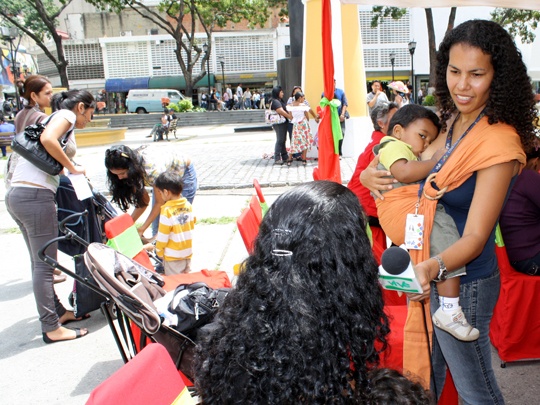
A Venezuelan public media journalist breastfeeds as she works. Public breastfeeding is fairly accepted in Venezuela (blog.chavez)
Venezuela’s national assembly is debating a reform to its breastfeeding law which could see baby food companies like Nestle fined in certain situations. The corporate media have reacted hysterically to the law, claiming that President Nicolas Maduro is “taking bottles from babies’ mouths”.
Though breastfeeding is widely promoted by the Venezuelan government, and public breastfeeding is relatively de-stigmatised, a study by Venezuela’s National Nutrition Institute (INN) between 2006 and 2008 showed that only 55% of mothers exclusively breastfed when their baby was born, going down to 20% when their baby was three months old, and 11% by six months.
The percentages have probably increased since then, with broad educational campaigns in public schools and health centres, and actions such as mass public breastfeeding in plazas, organised by the INN.
However, the low figures reflect the low confidence some mothers have in their ability to breastfeed, as well as the power of multinational infant formula companies in health centres. It is common practice to give infant formula to babies from the moment they are born, without the consent of parents, according to LactArte, a pro-breastfeeding collective in Venezuela. Companies give gifts and other promotions to health workers and health centres in order to create alliances with them, and give free samples of the products to new mothers, thereby creating dependent consumers of new born babies, or at least discouraging exclusive breast feeding.
What the law actually says
In 2007 Venezuela’s national assembly passed the Law of Protection, Promotion, and Support for Breastfeeding. The law regulates the way baby formula and baby food companies advertise and label their products, and how they interact with hospitals and clinics. However, the companies have been ignoring the law, as it doesn’t specify penalties. The reform to the law currently being discussed is looking at penalties of US$600 – $50,000, and also training for health professionals. Once the reform is passed in first discussion by the assembly, it will be subject to “street parliament” – discussion by collectives and Venezuelan citizens, to then be passed by the national assembly in second discussion.
The 2007 law argues that breastfeeding provides babies with “all the necessary nutrients” in their first six months, as well as “protecting them and immunising them from illness and contributing to the development of their breathing and gastrointestinal capacity”. It states that “mothers have the right to breastfeed their children, with the support and collaboration of the fathers… [who] should provide all the support necessary so that mothers can provide this human right… The state, with solidarious participation from organised communities, will promote, protect, and support exclusive breastfeeding…of children under six months of age and breastfeeding with complementary food … until the age of two”.
Concretely under the law, health workers and health centres must help mothers start breastfeeding within the first half hour of birth, and guarantee that the newborn is always near the mother after birth, except in exceptional medical situations. They should also educate mothers, fathers, and the family on the issue, and abstain from providing babies under the age of 6 months with food other than breast milk, except when there is a specific medical need. Health centres must create human milk “banks”.
Baby food and formula products must be in Spanish or Venezuelan indigenous languages (Nestle products for example, often aren’t), and they should inform of the risks of including such food in the baby’s diet too early. Publicity or labelling can’t create the impression that such food is equal to breast milk, and publicity of any kind discouraging breastfeeding is not allowed.
All food aimed at children under three must include labelling that clearly states its ingredients, including any GMO products, and milk formulas must including a warning that “breast milk is the best food for children under two years old”.
Samples, prizes, and promotions of baby food and formula are prohibited. Likewise, companies are prohibited from donating toys, books, posters or other products which promote or identify their company to health centres, and they are also prohibited from donating “gifts” to health centre workers and from sponsoring events or campaigns aimed at pregnant or breastfeeding women, fathers, health professions, families, and communities.
Breastfeeding rights in Venezuela
Last year, with the passing of the new labour law, women’s breastfeeding rights were further expanded. Post-natal leave was extended to six months, and articles 344-352 state that mothers have the right to two half hour breaks per day to breastfeed. If there is no breastfeeding room provided by the work place, that is extended to two 90 minute breaks, and all employers of more than 20 workers must maintain a nursery centre with a breastfeeding area.
For Luisa Calzada and Kaustky Garcia, of LactArte, breastfeeding is also an act of food sovereignty – that is, third world productive or economic independence from greedy transnationals. Garcia argued that such sovereignty has been “sabotaged” in Venezuela by the “transnational industry dedicated to the business of infant formulas”. Indeed the industry is huge here – visit any supermarket or corner shop and you’ll see full aisles or shelves of powdered baby milk formula and compote.
LactArte supports a boycott of Nestle, one of the main powdered milk formula companies here, producing the infamous Cerelac since 1886. They argue that there is“collusion” between the baby food industry and the medical industry, with the food transnationals enlisting an “army of health professionals” to sell baby formula.
According to Business Insider, infant formula is an $11.5 billion market. The International Baby Food Action Network (IBFAN) claims that Nestle, apart from distributing free samples of its products in maternity wards, also uses “humanitarian aid” to create markets, and offers gifts and sponsorship to influence health workers to promote its products. According to a 1982 New Internationalist article, Nestle makes mostly third world mothers dependent on its formula in three ways: “Creating a need where none existed, convincing consumers the products are indispensable, and linking products with the most desirable and unattainable concepts- then giving a sample”.
What the corporate media are saying
The 2007 law and the draft reforms do not ban the production or sale of baby food or formula, as national and international media have alleged, nor do they apply any fines to mothers or penalise any choices regarding her body that a mother may make. The penalties are only for health care centres and their workers, and baby food and formula companies.
However the corporate media over the last two weeks has completely distorted the issue. Fox News Latino headlined “Venezuela Wants To Ban Baby Bottles To Promote Breast-Feeding” and stated that “Motherly love has become a state affair in Venezuela”.
Growing Your Baby also headlined “Venezuela considering baby bottle ban”, and opened with the utterly misinformed and misleading question, “What would you do if you woke up one morning and learned that baby bottles were no longer being made or sold in your country? This question may become a reality for Venezuelan moms who may not have planned on breastfeeding”.
Reuters won the prize however for manipulation and sensationalism, with the headline “Venezuela considers taking bottles from babies’ mouths”, while other agencies have carried similar titles along the “banning” theme, with CNN’s article “Venezuela considering a ban on baby bottles” and Huffington Post ‘Venezuela considers baby bottle ban to encourage breastfeeding’. Al Jazeera went as far as to argue in its piece that “some mothers don’t want the government telling them how to feed their children”. If Al Jazeera had bothered to read the 2007 law, it would have discovered that is actually the point of the law – to stop companies interfering, through misleading information and other gimmicks, in the breastfeeding process.
Venezuelan corporate press and other Spanish language media have been equally manipulative. Here is a small selection of their headlines: EFE: “Venezuela is debating a law to prohibit baby bottles”, Semana: “Baby bottle and dummy: the new enemies of Chavismo”, El Pais: “The Venezuelan government wants to oblige mothers to breastfeed”, El Popular: “Venezuela: Nicolas Maduro wants to eliminate the use of baby bottles”, Noticias24 “They’ll prohibit baby bottles in health centres of Venezuela in order to force breastfeeding”, El Mundo, “Venezuela declares war on the baby bottle”, and Entornointeligente, “Goodbye to baby bottles for stimulating breastfeeding”.
Garcia argued that the media campaign to demonise the law and the proposed reforms is being pushed by the milk formula industry. She said it has had an impact in Venezuela, with “many women, even those not using baby bottles, feeling scared”.
“They are worried that the government is going to try to help them to breastfeed, that the government will take away their baby bottles and infant formulas, and is going to prohibit them from feeding their infants with baby bottles, but that’s absolutely false. First of all it’s unpractical, and secondly it is this government which has most given freedom and provided information so that families can freely chose the path they desire for their children,” she said.
The World Health Organisation recommends that babies be exclusively breast fed during the first six months, and in 1981 the 34th World Health Assembly adopted a resolution which included the International Code of Marketing Breast-Milk Substitutes. Funnily enough, it stated that food companies shouldn’t promote their products in hospitals, give free samples to mothers, or provide misleading information. One wonders if these international bodies were also accused of “stealing the bottle from babies mouths”, or is that sort of rubbish reserved for countries like Venezuela where a revolution is trying to get some justice at the expense of the poor transnationals?
Medical chief at Costa Rica state hospital arrested as part of organ trafficking investigation
InsideCostaRica | June 18, 2013
A chief doctor at a Costa Rican government-ran hospital was arrested today on suspicion of being part of an international organ trafficking network which specializes in selling kidneys to patients in Israel, according to the Attorney General’s Office.
Attorney General Jorge Chavarria told the press that the arrested is Francisco Mora Palma, head of Nephrology at Calderon Guardia Hospital, one of the largest state medical centers in the country.
“The patients who required the transplants were in Israeli territory, and some of the (trafficking) victims [had their kidney removed] here and others were transported to Israel. We have information that at least one person died after being operated on in Israel,” Chavarria said.
The prosecutor explained that the organization has branches in Israel and Eastern Europe, though did not elaborate, citing the ongoing investigation.
Authorities have identified at least three Costa Ricans who were paid in exchange for one of their kidneys.
In addition to Mora Palma, authorities have arrested a police officer identified by the last names Cordero Solano, who collaborated with the doctor to identify possible donors.
Besides the Calderon Guardia Hospital, authorities raided other locations, including two private clinics where transplants were conducted.
“This is extremely serious,” the prosecutor said, urging those who were trafficking victims to come forward to authorities without fear of losing the money they were paid. “What we need is information to dismantle this organization,” he said.
Related articles
- Organ trafficking & Israel – A message from Alison Weir (gilad.co.uk)
- Israeli arrested in Rome for organ trafficking (theuglytruth.wordpress.com)
- Israel police uncovers organ trafficking ring in north (theuglytruth.wordpress.com)
US senators question aid to Honduras, citing extrajudicial killings
Press TV – June 19, 2013
A number of US senators have questioned the Obama administration’s foreign aid to Honduras, pointing to growing reports of human rights atrocities in the Central American country that has long been regarded as a US-client state.
In a Tuesday letter to US Secretary of State John Kerry, 21 US senators cited “numerous recent killings and threats targeting [labor] union leaders, opposition figures, farmers, students, journalist and others,” emphasizing that officials of the US-backed government have been implicated in such criminal acts, which often go unpunished, The Los Angeles Times reports Wednesday.
“As the November 2013 [Honduran presidential] elections draw near, we are particularly troubled by reports of corruption and extrajudicial killings,” the senators wrote in the letter.
The development comes nearly four years after a US-sponsored military coup in Honduras, ousted its popular and democratically-elected President Manuel Zelaya, despite objections by many South American heads of state.
This is while many military and civilian officials involved in the brutal military coup still remain in power in the impoverished country, whose wealth and resources are almost entirely controlled by American corporations that operate under the protection of the country’s heavy-handed military and police forces, broadly trained by US instructors.
Honduras, according to the report, has one of the highest homicide rates in the Western Hemisphere due to a profound presence of drug traffickers, vicious gangs and brutal political killings in the country.
The growing violence has especially climbed since the US-backed military coup in the country, the report adds.
The ousted president’s wife, Xiomara Castro, was recently picked as an opposition candidate for president in the upcoming election, and “several people from her Free Party have been killed or attacked,” the report adds.
The senators further asked Kerry to submit to Congress a detailed analysis of whether the Honduran regime was doing something to “protect freedom of expression and association, the rule of law and due process” and to investigate death-squad-style killings involving government security forces.
According to the report, the United States suspended a portion of its aid to Honduras after the country’s top police commander was linked to numerous killings.
“All but about $10 million was resumed, but the Honduran government is supposed to meet a set of criteria that includes ensuring free speech, due process and the prosecution of authorities who commit human rights crimes,” it adds.
In their letter to the Secretary of State, however, the senators expressed doubts that such conditions were being met, urging Kerry to “ensure that no US assistance is provided to police or military personnel or units credibly implicated in human rights violations.”
Related articles
- State propaganda on NPR’s “Morning Edition” (alethonews.wordpress.com)
- The New York Times on Venezuela and Honduras: A Case of Journalistic Misconduct (alethonews.wordpress.com)
- Senator Menendez Meets with President Lobo to Discuss U.S. Funding for Honduras (alethonews.wordpress.com)
Land Grabs, the Latest Form of Genocide in Guatemala

By Leonor Hurtado – Americas Program – 12/06/2013
In a historic decision this May, Guatemala’s Supreme Court of Justice sentenced former dictator General Ríos Montt to 80 years in prison for the genocidal massacres of indigenous people in the 1980s. Many Guatemalans hoped that the judicial process against the top criminals of the country’s “dirty war” would finally bring justice—but ten days after the decision, the Constitutional Court reversed the judgment.
While the Guatemalan people protest this violation of the rule of law, the processes of genocide initiated 30 years ago by Ríos Montt’s massacres continue today by other means.
In the last decade, the expansion of oil palm plantations and sugarcane production for ethanol in northern Guatemala has displaced hundreds of Maya-Q´eqchi´ peasant families, increasing poverty, hunger, unemployment and landlessness in the region, according to a new Food First report by Alberto Alfonso-Fradejas, “Sons and Daughters of the Earth: Indigenous Communities and Land Grabs in Guatemala.”
There is a major contradiction here: at the same time that the former General Ríos Montt is convicted for genocide, the Guatemalan government allows the oligarchy, allied with extractive industries, to displace entire populations without concern for the human cost. In many cases, these land grabs result in the murder and imprisonment of rural people who resist the assault.
Genocide against the indigenous peasant population in Guatemala no longer has the face of a military dictatorship supported by the United States. Now it is the corporations, the oligarchy and the World Bank who push peasants off their lands.
In today’s Guatemala, land and resource control is increasingly in the hands of a small oligarchy of powerful families allied with agri-food companies. At the center of this power are fourteen families who control the country’s sugarcane-producing companies (AZAZGUA); five companies controlling the national production of ethanol; eight families that control the production of palm oil (GREPALMA); and members of the Coordinating Committee of Agricultural, Commercial, Industrial, and Financial Associations (CACIF).
Together these powerbrokers are accumulating land and wealth with the support of investment from international institutions such as the World Bank, the Inter-American Development Bank (IDB) and the Central American Bank for Economic Integration (BCIE). The convergence of multiple global crises—finance, energy, food and environment—has directed corporate investment into land-based resources such as agrofuels, minerals, pasture and food. The situation in Guatemala is extremely violent, part of a global trend where agrarian, financial and industrial interests are grabbing control of peasant lands and resources.
Can land grabs be considered genocide? In many ways, land grabbing is a new form of genocide. Ricardo Falla’s study “What Do You Mean There Was No Genocide?” analyzes the definition of genocide and its characteristics. According to Falla, of the five acts that define genocide, two were most prominent in Guatemala: “the massacre of the members of a group,” and “the intentional subjection of a group to living conditions which will lead to their total or partial physical destruction.”
The first genocide was against the Ixil peoples during the reign of Ríos Montt. The second genocide is enacted today through the privation of the Q´eqchi´ peoples’ means of survival through land grabs. Hundreds of families have been displaced. They do not have land on which to produce food or live, and they are denied their cultural and community identity. These conditions undermine their ability to survive, and lead to their displacement, and in many cases death.
The historic genocide trial this May came about through the peoples’ long struggle to defend their rights. The Ríos Montt conviction is a condemnation of impunity. The oligarchy did everything possible to impede the trial while continuing to displace the indigenous peasant population with the support of international investment and a legal system that favors land grabbing to the detriment of the people.
On May 20, the Constitutional Court overturned the conviction, with two of the five judges opposing the decision. Pablo de Greiff, UN Special Rapporteur for the Promotion of Truth, Justice, Reparation and Guarantees of Non-Recurrence stated, “No legal decision is inconsequential, even if it is revoked.” The Inter-American Court of Justice issued a statement criticizing the verdict for violating international obligations assumed by the state and preventing the people from seeking justice. Multiple organizations and authorities have spoken out against the court’s decision, arguing that it overstepped its bounds, violated legal provisions, and endorsed the corrupt mechanisms upon which impunity is built in Guatemala. The decision bolsters evidence that Guatemala’s top court lacks political independence and is tied to the country’s economic and ruling elite.
On May 24, thousands of people demonstrated and delivered a letter with more than a thousand signatures to the Court demanding that the decision be reversed. In Argentina, Chile, Honduras, Mexico, Nicaragua and Peru, thousands more marched in solidarity to the Guatemala embassy demanding justice.
If we fail to judge and condemn the massacres committed thirty years ago, what hope is there for the Mayan Q’eqchi’, Xinka, Mam, Kaqchikel and other indigenous peoples currently being displaced and massacred by extractive corporations with the support of the state and international institutions? The people continue to courageously resist and defend their lives, lands and identities. How shall we express our solidarity?
Leonor Hurtado is a fellow at Food First/Institute for Food and Development Policy. A native of Guatemala, she has spent decades defending human rights and indigenous rights, and supporting indigenous resistance to the expansion of extractive industries.
Photo: Caracol Producciones
Related articles
- Survivors Reluctant to Testify in New Genocide Trial (ipsnews.net)
- Guatemalans protest annulment of dictator’s genocide conviction (workers.org)
- Israel’s Hand in Guatemala’s Genocide (phantomreport.com)
State propaganda on NPR’s “Morning Edition”
By Justin Doolittle | Crimethink | June 12, 2013
On Wednesday’s episode of “Morning Edition” on NPR, a segment was devoted to exploring the extreme violence that has engulfed Honduras in recent years. Indeed, if measured by per capita murder rate, Honduras is now the most dangerous in the country in the world. There are many reasons why Honduran civil society has broken down like this, but let’s suspend that discussion for the moment in order to focus on one particular aspect of this story on NPR that was quite revealing.
At one point in the segment, Carrie Kahn, the NPR correspondent reporting from Honduras, said the following:
Last year, the U.S. Congress held up funding to Honduras over concerns of alleged human rights abuses and corruption, particularly in the Honduran police force. Part of the funds are still on hold.
This is an astonishing statement for someone who purports to be a journalist. Unless Ms. Kahn has psychic powers, she cannot know why the U.S. Congress held up funding to Honduras. She can only know why Congress said it was holding up funding to Honduras. There is often a profound difference between why politicians say they are implementing policy X and why they are actually doing it. As you might have heard, politicians are occasionally dishonest and insincere, and their decisions are informed by a number of factors that have nothing to do with their personal beliefs. For a journalist, someone who is supposed to adversarially cover politicians and express skepticism at everything they say, this kind of blind faith is inexcusable.
The problem, though, is that Ms. Kahn’s statement is actually quite a bit worse than that. Even if she had said, “the U.S. Congress held up funding to Honduras over what it claimed were concerns of alleged human rights abuses and corruption,” instead of just mindlessly repeating what the government claimed, that would still be wildly insufficient for any journalist who takes her profession even the slightest bit seriously. Why? Because the United States government provably does not base its decisions on allocating foreign aid on “concerns about human rights and corruption.” For decades, the U.S. has provided aid to some of the most repressive and corrupt governments on Earth. Going down the list would be trivial, but, for the sake of comparison, let’s stay relatively close by and just look at Colombia. The U.S. government ships hundreds of millions of dollars to the Colombian government every year; in FY 2012, $443 million was provided, making Colombia the leading recipient of U.S. aid in the hemisphere.
In a strange twist, though, Colombia is also widely considered to be the most repressive violator of human rights in the hemisphere, and corruption there is rampant. This is quite a conundrum. Ms. Kahn tells us that the U.S. withheld aid from Honduras “over concerns of alleged human rights abuses and corruption.” But the U.S. evidently has no such “concerns” in Colombia and continues to send hundreds of millions of dollars in annual aid. One is almost tempted to conclude that the U.S. government makes these decisions based not on noble and selfless “concerns” about human rights and corruption, but, rather, on what it perceives to be U.S. interests.
Ms. Kahn must know that the government claim she dutifully parroted is transparently fraudulent and, in fact, downright comical. She cannot be a working journalist and not know this. Presumably, she follows the news, she is knowledgeable regarding basic facts about U.S. aid, and she knows that the U.S. has always cheerfully sent aid to brutal regimes around the world. She’s not a wide-eyed poly-sci 101 student who is shocked to find out that U.S. government decisions are not invariably and solely based on considerations of Good and Evil. Ms. Kahn is a highly educated reporter, and she obviously does know these things, but the culture of obedience and submissiveness in American journalism is so profound that she probably doesn’t even consciously realize that she’s serving state power instead of doing journalism. The U.S. government told her that aid is being withheld to Honduras because of concerns about human rights and corruption, therefore aid is being withheld to Honduras because of concerns about human rights and corruption. That’s that. Then she goes on NPR, unquestioningly repeats government claims, and she’s done her job. We would call this “propaganda” if it happened in the Soviet Union, but it’s called “journalism” when it happens here.
Nicaragua: New Plans to Build Canal are Announced
By Kari Paul | The Argentina Independent | June 6, 2013
Rene Nuñez, president of Nicaragua’s national assembly, announced today that a Chinese investment firm will fund construction of a channel through Nicaragua, an alternative trade route to the Panama Canal.
The new channel will link the Pacific Ocean with the Caribbean Sea, and will be built by a “consortium of investors combined into one firm,” Nuñez, who declined to give more information on the group, said.
The government of Nicaragua’s President Daniel Ortega has introduced two bills to streamline the environmental impact study on the new works, so that the channel can be constructed as soon as possible.
“This is a project that is very important to the country, so we are pursuing it with urgency,” Nuñez said.
President Ortega said that the channel will serve as an alternative to the overcrowded Panama Canal, which is currently undergoing a US$5.2bn expansion project. He also stressed that the Nicaragua Canal will bring jobs to the impoverished in Nicaragua and other Central American countries.
Others oppose the canal, saying the government is pursuing it recklessly.
“I don’t know what is the rush, especially with such a sensitive topic,” said congressman Luis Callejas. “There should be a full consultation with the people, I do not understand why they are rushing the decision.”
Originally the channel was planned to go through the San Juan River, but now Ortega announced it would be built further north, through the waters of Lake Nicaragua.
“Lake Nicaragua should be a source of drinking water for Nicaragua and South America,” argued Environmental Affairs Chair Jaime Incer. He said the lake is currently protected as a “potable water reserve” by a law that Ortega himself passed.
The Nicaraguan National Assembly will debate the two bills on the project, taking into account the environmental impact, on Friday.
Corporate Media Drones on about Venezuela’s Defence Program
By Tamara Pearson | Venezuelanalysis | June 4th 2013
Merida – After President Nicolas Maduro attended a military display in Aragua state which included Venezuela’s three unarmed drones, some mainstream media have highlighted Venezuela’s defence program, stressing Venezuela’s relationship with Iran.
Maduro presided over a ceremony to hand over and display National Bolivarian Armed Forces (FANB) equipment last week. There was a demonstration of Venezuela’s Harpy System of Drone Planes.
The unarmed planes are operated by remote, can take photographs and be used for disaster situations, agricultural research and protection of the electrical grid, according to Defence minister Diego Molero.
Molero said that through the Simon Bolivar satellite, the drones can observe any part of Venezuela. He also presented the Gavilan project, for a drone plane which he said has been designed completely with Venezuelan technology.
Venezuela’s Harpy drones are small and can only be used for remote controlled long distance surveillance. They weigh 85kg, have a maximum flight distance of 100km and flight time of 90 minutes, a cargo capacity of 17 kg, and video cameras which can transmit in real time.
Venezuela’s Cavim (Venezuelan Military Industrial Company) manufactured the drones, with the help of Venezuelan military engineers who were trained in Iran. The system consists of three planes, a launcher, and a control unit.
Ciudad CCS reports that the government eventually hopes to have “at least a dozen” Harpies (Arpías in Spanish).
“We’re advancing in the development and management of military science and technology, for preserving peace and security in Venezuela,” Maduro said at the demonstration, adding that Venezuela is “prepared to resist any attack that could be fabricated overseas, against Venezuela”.
Minister for internal affairs at the time, Tareck el Aissami reported in September last year that Venezuela’s drones had detected a plane with a US registration number, allegedly transporting drugs, in Venezuelan territory. The first Harpy (Arpia-001) was manufactured in January 2012.
Media and U.S. response
Last week’s military demonstration led to some corporate media headlines over the following days about Venezuela “launching” its drones system. Media in and outside Venezuela have reported that the drones are for surveillance and to be used to “curb drug trafficking” but has also emphasised that Iran “helped to build them”.
Univision Noticias headlined with, “Venezuela will use drones to protect the country from any threat”. Fox News and AP reported that “Venezuela’s announcement comes as the United States has begun to use unmanned drones to hunt drug traffickers on both the U.S.’s southern border with Mexico and in the open waters of the Caribbean.”
Last year the U.S. said it would watch Venezuela’s drone development closely, with U.S. State Department spokesperson Victoria Nuland saying at the time, “Our concern, obviously, would be with any breaking of international sanctions on Iran. And we will be most vigilant in watching how this goes forward”.
Further, according to an April 2013 article by the InterAmerican Security Watch (IASW), which “monitors threats to regional security” and the Jerusalem Post, “the growing military ties between Iran and Venezuela… have raised concerns in both the US[sic] and Israel”.
The IASW also made the claim that “Iran’s extended reach in Latin America could pose a threat to US national security; Tehran’s strategies in the region could also threaten Jewish and Israeli interests”.
However, while Venezuela’s 3 small drones are unarmed and have not left Venezuelan territory, the U.S. has used armed and unarmed drones in Afghanistan, Pakistan, Iraq, Yemen, and Somalia, while Israel has used them in Lebanon. According to a February 2012 report by the Bureau of Investigative Journalism, U.S. drones had killed at least 2,413 civilians in Pakistan alone, between May 2009 and the date of the report.
Argentina to Nationalize Cargo and Passenger Trains
By Sabrina Hummel | The Argentina Independent | June 4, 2013
Minister of the Interior and Transport, Florencio Randazzo, is set to announce changes in the railway sector – most importantly the nationalisation of passenger and cargo trains.
The Brazilian company América Latina Logística (A.L.L) will see its concession revoked and the historic Tren de la Costa will return to state hands. A.L.L had already received a warning from the Auditor General’s Office for anomalies in its provision of services.
From 1990 up to 2012, the company amassed a debt of over $237m to the government, 866% in excess of its contract compliance. Payments over the last six months have stalled, allowing the government to rescind its concession.
Tren de la Costa, built at the end of the 20th century, served as a vital link between the neighbourhood of Belgrano and the port of Tigre. Following various changes in ownership, it converted to electric power in 1931.
It covers 15.5km and runs alongside the scenic Río de la Plata serving four provincial municipalities. It has a total of 11 stations with a standard fare of just $16m or $10 for those with a DNI.
A.L.L meanwhile operates two of the most important freight railway networks in all of the country: A.L.L Central (line San Martín) and A.L.L Mesopotámica (line Urquiza). A.L.L Central runs through the centre of Argentina, beginning in the province of Cuyo and passes through San Luis, Córdoba, Rosario, Santa Fe, and finally Buenos Aires. A.L.L Mesopotámica in turn runs through the provinces of Misiones, Corrientes, and Entre Ríos, linking them to Paraguay, Uruguay, and its own network in Brazil.
A.L.L is the largest operator of rail logistics in Latin America. A.L.L Argentina is the biggest rail operator in the country, spanning 8000km. It is also the second largest in terms of cargo volume, transporting more than 5m tonnes each year.
Randazzo was recently quoted saying, “in terms of policy and management decisions, the State is more competitive than the private sector”.
NATO Intends to Explode Latin American Unity, Leaders Warn
Prensa Latina | June 3, 2013
Managua – The supposed initiative to incorporate Colombia in a military group like the North Atlantic Treaty Organization (NATO) is an attack on Latin American and Caribbean unity, the governments of Nicaragua and Venezuela denounced today.
The statements by Presidents Daniel Ortega and Nicolas Maduro occurred on Sunday night during a massive event at Revolution Square in the capital, marking the visit of the South American leader.
“When the region seeks more unity through the Community of Latin American and Caribbean States (CELAC), it is worrying that initiatives are presented to try to divide and weaken the process”, noted Ortega.
“It is inadmissible and I want to believe that this is not actually happening, I find it hard to believe that President Juan Manuel Santos expressed his decision to join NATO,” highlighted the leader.
“Strength does not lie in filling our countries with foreign military bases, or joining organizations whose focus is bombing, murdering and destroying; that is NATO’s tradition and it has a “keep-on-doing-it” policy, noted the president.
“CELAC has commitments and if anyone breaks them, there will always be other leaders that rectify mistakes and strengthen unity of our peoples”, underlined Ortega.
Maduro warned that Colombia’s attempt contradicts the doctrine and the international law on which regional unity is based. “They want to put dynamite in the heart of the achievements of the unity of Latin America, the Caribbean and South America”, the leader pointed out.
Bolivia Calls UNASUR Summit to Discuss Colombia’s Inclusion in NATO
Prensa Latina | June 3, 2013
La Paz – The president of Bolivia, Evo Morales, described Colombia”s decision to join NATO as a threat to the region and called an extraordinary meeting of the Security Council of UNASUR.
During a ceremony in the southern city of Potosi, he considered that the decision of President Juan Manuel Santos to join the North Atlantic Treaty Organization (NATO) is a violation of the peace treaties signed by the Union of South American Nations (UNASUR) and involves a dangerous possibility of military intervention to the nations of Latin America and the Caribbean.
“We can not allow NATO to intervene Latin America. Having NATO is a threat to our continent, to Latin America and the Caribbean,” he said.
The president asked the General Secretariat of UNASUR to complete the formalities for the Security Council to convene an emergency meeting to take a joint position of rejecting the Atlantic Pact arrival to the region through Colombia.
He believed that the presence of that organization of military powers seeks to destabilize and undermine leftist governments in Latin America, primarily Venezuela, Ecuador, Nicaragua and Bolivia itself.
Brazil: Indigenous Group Member Killed After Police Eviction
By Laura Benitez | The Argentina Independent | June 2, 2013
Indigenous groups have re-occupied farm land in Mato Grosso do Sul, South of Brazil, after being evicted on Thursday.
The groups are claiming ownership over part of the farm as they say it forms part of their ancestral lands.
The groups have occupied the land, which is owned by a local politician, Ricardo Bacha, for over two weeks. During the eviction process on Thursday, one of the group members, Osiel Abriel was shot and killed by police.
According to press reports, police officers have claimed that the group became violent during Thursday’s eviction process.
Brazil’s justice minister José Eduardo Cardozo, has called an investigation into the death of Abriel which will determine if an excessive and unnecessary use of force and firearms were used.
“We will very accurately determine what happened. If there were abuses, those responsible will be punished, “he said.
On Friday, 250 people from the group returned back to the farm to re-occupy the land.
Local media have said that although the situation continues to be “tense”, there has been no violence since the re-occupation on Friday.
Related article
- Argentina: Violent Eviction of Indigenous Community Deemed Illegal (alethonews.wordpress.com)
Colombia: Piedad Córdoba Ratifies Intention to Run for President
Prensa Latina | June 1, 2013
 La Paz – While visiting this capital, Colombian ex senator Piedad Córdoba expressed her intention to run for president in the next elections in her country, according to press reports.
Cordoba visited the cities of Sucre and La Paz to film the next chapters of the program “Causa Justa” (Just Cause) to be broadcast by Telesur television network, and took the opportunity to ratify her position to become the first woman to be at the helm of Colombia.
According to the newspaper Cambio, Córdoba also extolled the transformations undergone by the Bolivian capital in the past few years: “you can really see progress in Bolivia, the big changes and improvements in La Paz!”, she said.
Cordoba, 58, has worked systematically for the rights of women, ethnic minorities and human rights in her country, besides being involved, in 2007, in efforts to reach an agreement between the Revolutionary Armed Forces of Colombia-People’s Army (FARC-EP) guerrillas and the then government of President Alvaro Uribe.
Since 2011, in the wake of her dismissal as senator by the Attorney General’s Office of Colombia, she started to work with Telesur in the Causa Justa program, which highlights conflicts hitting the region, as told by political, social and cultural figures, notes Cambio newspaper.
She is in Bolivia “for a second season of the program in order to film a documentary on discrimination, bilingual education and the indigenous presence of President Evo Morales,” added the source.
Related articles
- Colombia: FARC and Government Reach Agreement on Land Reform
- Colombia: extrajudicial executions killing still ongoing according to report
- Latest FARC Proposal for Peace Process in Colombia
- Colombia: President Santos Announces ‘Profound Changes’
- Colombia: Drummond Contractor Convicted in Unionists’ Deaths
- Imperialism and Violence in Colombia
Featured Video

US Marines Seized Panama in 1903
or go to
Aletho News Archives – Video-Images
From the Archives
Precedents for Pizzagate
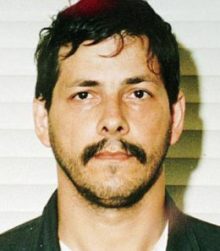
Marc Dutroux, Belgian pedophile, sadist, and serial killer with friends in high places
By Aedon Cassiel | Counter – Currents | December 23, 2016
To reiterate a point that should be clear to the more astute reader, my goal in this series (part 1, part 2) has not been to defend “Pizzagate” as such. My goal has been to defend the people who want to investigate it against specific accusations levied against them by people who think Pizzagate has revealed no intriguing information at all—for a specific reason, which I will be honing in and focusing on much more directly in this closing entry.
Whereas the mainstream critics of Pizzagate would have you believe that the dividing line is between paranoid conspiracy theorist followers of “fake news” and level-headed people who follow trustworthy news sources and rely on cold, hard reason to determine the truth, my goal has been to show that—whatever is or is not happening with Pizzagate itself—this framing of the issue is arrogant, insulting, and the product of extremely narrow tunnel vision. … continue
Blog Roll
 Aletho News
- The U.S. Sanctions Cuban Journalist For Reporting On The U.S. Blockade
- Israeli firms transform cars into intelligence devices: Reports
- Zionist-controlled companies to surveil British citizens
- THE CHILDREN GAMBIT
- A note on comment posting at Alethonews
- Trump stalls over Iran strike plan, Iran holds all the aces
- Zelensky’s Ceasefire for Elections is Strategic Gambit, Not Democratic Move
- US and Dutch pilots flying F-16s for Ukraine – Western media
- West’s Claims of Non-Involvement in Ukraine Conflict ‘Epitome of Hypocrisy’ – Expert
- Putin aide urges retaliation to ‘Western piracy’
- If Americans Knew
- Help end the injustice against Shadi
- Israel’s Favorite American President
- Israel’s “Yellow Line” Is a Death Trap for Palestinians. We Drove Into It.
- Why Israel’s expanding occupation in Syria presents a critical legal test
- Gaza is not a natural disaster. It is the victim of genocide enabled by global inaction
- Netanyahu’s plan to “end” US aid to Israel is to give even more money under a different name
- Israel ceased firing on Gaza for just 15 days of the “ceasefire” – Not a ceasefire Day 130
- In Gaza, “rats run over our faces” – Not a ceasefire Day 129
- Israel-backed border guards, GHF-linked aid – Not a ceasefire Day 128
- Israel battles Palestinian right of return, one Palestinian at a time – Not a ceasefire Day 127
- No Tricks Zone
- New Study: A 4°C Warmer Beaufort Sea Had ‘No Sea Ice’ 11,700 – 8200 Years Ago
- Unfudging The Data: Dutch Meteorological Institute Reinstates Early 20th Centruy Heat Waves It Had Erased Earlier
- German Gas Crisis…Chancellor Merz Allegedly Bans Gas Debate Ahead of Elections!
- Pollen Reconstructions Show The Last Glacial’s Warming Events Were Global, 10x Greater Than Modern
- Germany’s Natural Gas Storage Level Dwindles To Just 28%… Increasingly Critical
- New Study Rebuts The Assumption That Anthropogenic CO2 Molecules Have ‘Special’ Properties
- Climate Scientist Who Predicted End Of “Heavy Frost And Snow” Now Refuses Media Inquiries
- Polar Bear Numbers Rising And Health Improving In Areas With The Most Rapid Sea Ice Decline
- One Reason Only For Germany’s Heating Gas Crisis: Its Hardcore-Dumbass Energy Policy
- 130 Years Later: The CO2 Greenhouse Effect Is Still Only An Imaginary-World Thought Experiment
 Aletho News