Cuba Decries Strengthening of US blockade
Prensa Latina | July 29, 2013
The Cuban Ministry of Foreign Relations (Minrex) denounced today the United States has hardened the blockade on the island over the last weeks, using for this action the Office for Foreign Assets Control (OFAC) of the Treasury Department.
According to the information from the Ministry, on June 28, the OFAC fined one of the most important Italian banks, Intesa Sanpaolo S.p.A., compelling it to pay $2,949,030 dollars.
According to the probe carried out by OFAC, the bank handled 53 transfers in favor of Cuba, from 2004 to 2008.
The Cuban government says the extraterritorial application of this sanction is evidence of the impudence with which the United States treats its European partners and sets a negative precedent for other institutions that do business with Cuba.
Besides this, adds the official note, on July 22nd, the OFAC fined once again another company for violating blockade regulations against Cuba, this time with $5,226,120 dollars, the largest sum yet this year.
The victim this time was one of the main tour operator agencies in the US, American Express Travel Related Services Company. This is the second fine in less than one month and the fifth this year, stresses Minrex in an official note published in its digital website.
The OFAC announced this last sanction after concluding a detailed investigation consisting in the US obsession with preventing at all cost that US citizens travel freely to Cuba.
The fine was set off by the alleged sale of 14,487 air tickets to travel to Cuba from third countries, outside from the license given to American Express Travel for the groups of “people to people” travel.
At the same time, the Minrex note says the fines reinforce the extraterritorial application of the blockade on companies for their operations in third countries.
The fundamental objective of this criminal and inhumane policy is to keep on harming and bearing suffering on the Cuban people, concludes the communique.
The Detention of Evo Morales: A Defining Moment For Latin America?
By Emily Achtenberg | Rebel Currents | July 12, 2013
As the international uproar continues over last week’s grounding of Bolivian President Evo Morales’s plane in Europe, after U.S. officials apparently suspected whistle-blower Edward Snowden of being on board, many questions remain unanswered about the United States’ role and motives.
But one thing is certain: if the U.S. government was seeking to intimidate Morales and other Latin American leaders who might consider harboring Snowden, its strategy has completely backfired. Instead, the incident has bolstered Morales’s domestic and international standing, consolidated regional unity, and emboldened the bloc of leftist governments that seeks to counter U.S. dominance in the region. It has also dealt a damaging, and potentially fatal, blow to the future of U.S.–Latin American relations under the Obama administration.
The crisis was set off by Morales’s statement on July 2 in Russia, where he was attending an energy conference, that he would be willing to consider a petition by Snowden for asylum. Later that evening, on his return flight to Bolivia, Morales’s plane was denied entry into the airspace of France, Italy, Spain, and Portugal, forcing it to make an unscheduled landing in Vienna where it was diverted for 13 hours before receiving clearance to proceed.
In response to Bolivia’s persistent questioning, the four European countries have offered equivocal and somewhat contradictory—if not preposterous—explanations for their actions. France, which has apologized to Morales, says it didn’t realize that the Bolivian president was on the presidential jet. Portugal, originally scheduled as a refueling stop, says its airport wasn’t capable of servicing the plane. Italy now completely denies having closed its airspace.
Spain, after initially attributing the problem to the expiration of its flyover permit during Morales’s unexpected layover in Austria, later admitted that the United States had asked it to block the flight (although the United States has not acknowledged any role in the incident). At first, Spanish officials also claimed that the plane was searched for Snowden in Vienna at the behest of the United States—an action which, if taken without Bolivia’s permission, would constitute a violation of international law even more egregious than the denial of airspace to the presidential jet.
More recently, Spain has insisted (and Bolivia concurs) that it ultimately granted airspace permission upon Bolivia’s written assurance that Snowden was not on board the plane. Spain, which has sought to improve economic relations with Bolivia after being hit hard by Morales’s nationalization of its airport management and electric companies, has also offered to apologize.
The apparent willingness of four European governments to put U.S. interests ahead of international law and Bolivia’s rights as a sovereign nation—despite themselves being victimized by illegal U.S. spying activities—stands in sharp contrast to Latin America, where the detention of an indigenous president is seen as the latest grievance in a long history of colonial and imperial transgressions. Bolivian Vice President Alvaro García Linera has denounced the incident as an imperial “kidnapping.”
For many Bolivians, the episode is viewed as a deliberate effort by the U.S. government to punish Morales for his persistent anti-U.S. rhetoric and actions, including the expulsion of the U.S. Ambassador and Drug Enforcement Agency (DEA) in 2008, and, most recently, USAID. It also strikes a special nerve since the United States hosts, and has refused to extradite, some of Bolivia’s most wanted criminals, including neoliberal ex-president Gonzalo Sánchez de Lozada (Goni), facing charges of genocide in connection with the killing of 67 indigenous protesters during the 2003 “Gas Wars.”
Within hours of Morales’s detention, other leftist Latin American governments rallied in outraged solidarity with Bolivia. Argentine President Cristina Fernández labeled the incident “a remnant of the colonialism we thought had been overcome.” Ecuadorean President Rafael Correa tweeted, “We are all Bolivia!”
Along with expressions of support from ALBA, CELAC, Mercosur, and other regional blocs, UNASUR issued a statement condemning the action on July 4, signed by six heads of state (Bolivia, Argentina, Uruguay, Venezuela, Ecuador, and Suriname) who attended an emergency meeting. Governments from across the region’s political spectrum (including Mexico, Peru, Colombia, and Chile) closed ranks behind Morales.
On July 9, the OAS issued a consensus resolution expressing solidarity with Morales and demanding apologies and explanations from the four European nations (but not the United States.) Internationally, more than 100 UN member nations have collectively denounced the incident, bolstering Bolivia’s complaint before the UN High Commission on Human Rights.
The provocative detention of Morales undoubtedly precipitated the decision of three leftist Latin American governments—Bolivia, Venezuela, and Nicaragua (conditionally)—to offer asylum to Snowden, in open defiance of the United States. As journalist Stephen Kinzer has noted, with the U.S./ European rogue actions converting Snowden into a Latin American hero, the offer of asylum is politically popular in the region. This sentiment also stems from the regional legacy of dictatorship and political persecution, including the personal experiences of many leftist leaders. As Uruguayan President José Mujica (a former Tupamaro guerrilla) declared, “To all of us who have been persecuted, the right to asylum is sacred and must be defended.”
Broad regional support also makes it easier for any country offering shelter to Snowden to resist U.S. demands for extradition. As well, the mounting evidence of U.S. pressure on European and Latin American countries to deny sanctuary or transit assistance to Snowden, interfering with their sovereign decision-making processes, strengthens the case for asylum, legally and politically. U.S. officials have made it clear that any country aiding Snowden will be made to suffer, putting relations with the United States “in a very bad place for a long time to come.”
Still, in a region that remains heavily dependent on U.S. trade, the threat of U.S. retaliation through economic sanctions will be a major factor in the asylum calculus for any government, as illustrated by the recent case of Ecuador. After initially championing Snowden’s cause and apparently aiding his transit from Hong Kong to Moscow, Correa suddenly backed off after a phone call from Joe Biden, saying that Biden’s concerns were “worth considering.” While Correa has defiantly renounced Ecuador’s long-standing U.S. trade preferences as an instrument of “political blackmail,” he apparently hopes to replace them with an alternative set of duty-free waivers under the Generalized System of Preferences (GSP) program, an option that could be jeopardized by an asylum offer.
Similar considerations will no doubt be of concern to Venezuela and Bolivia, should either of their asylum offers materialize into reality (a complex proposition, given the many obstacles to achieving Snowden’s safe transit). While political relations between these countries and the United States have been polarized for some time—with the U.S. government still failing to recognize Nicolás Maduro’s April election—Venezuela still exports 40% of its oil to U.S. markets, and the United States remains as Bolivia’s third largest trading partner (after Brazil and Argentina). Bolivia also enjoys some of the same GSP trade preferences that Ecuador is seeking, which cover around 50% of its U.S. exports.
Still, the incident has greatly strengthened both Morales and Maduro domestically and internationally, corroborating their anti-imperialist worldviews. For Morales—newly characterized by García Linera as the “leader of the anti-imperialist presidents and peoples of the world”—the wave of solidarity responding to his personal victimization has consolidated his political popularity in a pre-election year. Recalling the 2002 presidential election when the U.S. Ambassador’s negative comments about candidate Morales catapulted him unexpectedly into second place, García Linera jokes that Obama has become Morales’s new campaign manager.
For Maduro, whose asylum offer is being promoted by Russia, the opportunity to champion Snowden’s cause and challenge the United States on a world stage, with substantial regional support, has allowed him to genuinely reclaim Hugo Chávez’s anti-imperialist mantle. “It provides the perfect opportunity for Maduro…to figure internationally, to show that he is a player among the big powers…and that he’s capable of challenging the United States,” says political analyst Eduardo Semetei.
In terms of overall U.S.-Latin American relations, the episode could be a defining moment for the Obama administration. As Kinzer notes, the downing of Morales’s jet may have reflected a genuine U.S. effort to capture Snowden—as opposed to a shot across the bow to intimidate Snowden’s potential supporters—but even so, the depth of misunderstanding as to how the incident would resonate in Latin America is telling. New daily revelations from Snowden’s data trove about massive U.S. spying programs in the region are adding fuel to the fire, further strengthening the leftist popular bloc—and confirming Glenn Greenwald’s assessment that the U.S. government has been its own worst enemy throughout this entire episode. It is difficult to imagine how the Obama administration can recover the region’s trust any time soon.
Related articles
- Spain apologizes for role in Morales jet ban (alethonews.wordpress.com)
- Evo Morales: No Need for US Embassy in Bolivia (alethonews.wordpress.com)
Brazil: US spying response insufficient
Press TV – July 16, 2013
Brazil says Washington has insufficiently responded to Brasilia’s request for an explanation over US spying programs, recently revealed by US intelligence whistleblower Edward Snowden.
Foreign Minister Antonio Patriota said Monday that some clarifications have been made however Brazilia views them as insufficient.
Patriota also reported that there had basically been nothing new since he appeared before Congress last week, saying he was awaiting a formal response from Washington.
Since the disclosure, the Brazilian government has set up a technical group, including representatives of the ministries of justice, defense, foreign affairs, science and technology as well as security experts, to investigate into the spying revelations.
On July 7, Brazilian newspaper O Globo published a report based on documents leaked by Snowden, showing the US National Security Agency has targeted most Latin American countries in their spying programs.
According to the report, Brazil along with Colombia, Venezuela and Mexico were among those of highest priority for the U.S. intelligence agency in Latin America.
In addition, the newspaper revealed that Washington also kept a base in Brasilia to intercept foreign satellite communications.
President Dilma Rousseff responded to the revelations that if the reports prove true, they would constitute a “violation of sovereignty and human rights.”
On July 12 during a summit, Presidents of Brazil, Bolivia, Argentina, Uruguay, and Venezuela together condemned the US for spying in the region.
Meanwhile, Latin American nations, Venezuela, Nicaragua and Bolivia have all offered asylum to Snowden, who is holed up at Moscow’s Sheremetyevo International Airport since June 23, when he landed in Russia from Hong Kong.
Related articles
- PressTV: Latin America united against US over espionage (jhaines6.wordpress.com)
- NSA Spying on Latin American Countries Included Targeting of Trade Secrets (alethonews.wordpress.com)
- Brazil expresses deep concerns over US spying activities (alethonews.wordpress.com)
Spain apologizes for role in Morales jet ban
Press TV – July 16, 2013
Spain has apologized to Bolivia for its parts in the recent incident, in which Bolivian President Evo Morales’ plane was forbidden to fly over some European countries on the rumors that US intelligence whistleblower Edward Snowden was onboard.
Ambassador Angel Vazquez delivered on Monday the official apology to the Bolivian Foreign Ministry in La Paz.
Varquez gave a statement acknowledging an “apology for the obstacle and the hardships caused to the president.”
France, Spain, Portugal and Italy all refused to allow Morales’ plane, which was flying home on July 2 from Moscow, to cross their airspace.
The presidential plane was forced to land in Vienna, Austria where it was searched by authorities on false rumors that US intelligence leaker Edward Snowden was on board.
The Bolivian Foreign Ministry accused the Europeans of bowing to US pressure when it banned Morales’ plane.
After the incident, Morales revealed that Spain’s ambassador to Austria had tried to conduct a search of the aircraft.
“We recognize publicly that perhaps the procedures used in the Vienna airport by our representative were not the most effective,” said Vaszquez.
“We regret this fact … the procedure was not appropriate and bothered the president (Morales), putting him in a difficult situation.”
The incident also caused strong condemnation from several countries in Latin American, including Brazilian President Dilma Rousseff, who called it a “provocation” that concerned” all of Latin America.”
Meanwhile, Venezuela, Nicaragua and Bolivia have all offered asylum to Snowden, who is holed up at Moscow’s Sheremetyevo International Airport since June 23, when he landed in Russia from Hong Kong.
Argentina Considers Taking Legal Action on US Espionage
By Kahina Boudarène | The Argentina Independent | July 15, 2013
Hector Timerman, Argentine Minister of Foreign Affairs, declared today that he will take to court a list with names of government officials allegedly spied upon by the US. The list was given to him on Friday, during the Mercosur summit.
“I can’t let the judiciary out of it,” said Timerman. ”I will briefly explain to the court what happened last Friday,” he said referring to the list he received with the names of people who have been spied on by the US government.
“I leave everything into justice’s hands,” added the minister.
Last Friday, during the Mercosur summit held in Montevideo, Uruguay, Timerman declared: “I received an hour ago, from a country present in this room, the names with the e-mail addresses and the passwords” of people that the US were spying on.
However, he refused to say who sent him the list. “They asked me to remain silent. This list has been given to me by a person that I trust.”
According to the minister, the list includes the names of “the governor of Buenos Aires, Daniel Scioli, as well as other regional representatives, secretaries, officials’ wives, and other actors of Argentine civil life.” Vice-President Amado Boudou is also mentioned.
That same day, member countries of Mercosur issued a resolution condemning the espionage activities carried out by the US government, as revealed by whistleblower Edward Snowden. The resolution states the intention of the member countries to work together for “cybernetic security”, something they describe as “an essential aspect to defend countries’ sovereignty”. They also demanded “an immediate stop to these actions” and “an explanations about [the US’s] motivations.”
“Crime prevention, as well as transnational crimes repression, including terrorism, must be done according to international law,” they added.
Related articles
- US Congress calls for sanctions against Argentina over growing Iran ties (alethonews.wordpress.com)
- S. American states to recall ambassadors from Europe over Bolivian plane incident (alethonews.wordpress.com)
US Training of Mexican Troops Has Escalated in Step With Mexico’s Murder Rate
By Bill Conroy | The Narcosphere | February 17, 2013
US training of Mexican military forces spiked in fiscal years 2010 and 2011, coinciding with a sharp rise in drug-war homicides in Mexico, an analysis of records made public under the Foreign Assistance Act show.
The training in those two years, funded by the US Department of Defense, and to a lesser extent by the US Department of State, covered a wide range of military skill sets and involved hundreds of training programs offered in the US to Mexican forces as well as dozens (at least 60) provided inside Mexico.
For example, in Mexico City during that two-year period, the US military provided to Mexican security forces training in, among other tactics, “asymmetrical conflict,” “anti-terrorism,” and “open-source intelligence” gathering. US military training also was provided in other parts of Mexico, including the state of Campeche, where infantry, marksmanship and intelligence programs were offered to Mexican troops; and in Chiapas, in fiscal 2011, infantry training was provided to Mexican Marines over two-week periods in April and September.
The latter training programs might be considered particularly sensitive for Mexican politics, given the Mexican state of Chiapas is home to the Zapatista Army of National Liberation (EZLN, in its Spanish initials).
The Zapatistas are a rebel indigenous group governing more than 1,000 rural communities that rose up in arms in 1994. However, since peace talks were initiated in 1995, the Zapatistas have not fired a shot and have converted to peaceful and civil resistance.
In the 1990s, under Mexican President Ernesto Zedillo, a member of the PRI Party, an unsuccessful, violent counter-insurgency campaign was waged against the Zapatistas that involved the use of both the Mexican military and civilian paramilitary forces — as part of an effort to destroy the indigenous movement and its autonomous communities.
On another sensitive front for Latin American/US relations, Foreign Assistance Act records reveal that US military training also was provided to Mexican soldiers in fiscal 2010 and 2011 by the US Department of Defense’s Western Hemisphere Institute for Security Cooperation (WHINSEC). The Institute was formerly the School of the Americas, which, in past decades, provided training to some of the most notorious violators of human rights in Latin America.
WHINSEC, now reportedly reformed and sensitive to human rights, offered at least 10 different training programs (some multiple times) to Mexican troops in fiscal 2010 and 2011 in subjects such as “counter-narco-terrorism,” “joint operations” and “counterdrug ops,” according to data provided to Congress under the requirements of the Foreign Assistance Act. … Full article
Related article
- Mexico: Nine Indigenous Prisoners Released in Chiapas (alethonews.wordpress.com)
Venezuela: An Ethical Foreign Policy?
By Ewan Robertson | Carnegie Council | July 10, 2013
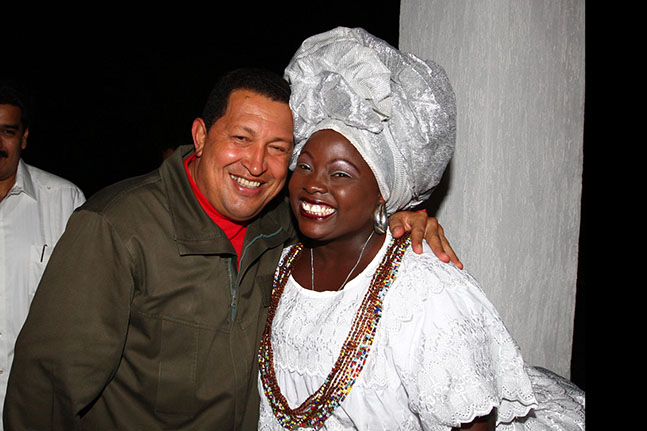
CREDIT: Manu Dias, (CC)
Venezuela’s foreign policy under the late President Hugo Chávez, and now his successor Nicolas Maduro, has been subject to sharply differing interpretations. Some observers see the oil-rich country’s foreign relations since Chávez’s election in December 1998 as shaped by a visionary who has promoted international solidarity with the oppressed, combated poverty, and pushed for a just world order free of uni-polar domination. For critics, however, Venezuela’s foreign policy has been incoherent, militaristic, and prejudicial to regional stability.
Does Venezuelan foreign policy include ethical considerations, as its supporters claim? The evidence suggests it does and that as a result we can be more optimistic about possibilities for incorporating ethics into international affairs than some scholars would have us believe.
The Ethical Dimension of Venezuelan Foreign Relations
To evaluate a possible ethical dimension to Venezuelan foreign policy, it is necessary to understand the ideology Chávez imbued in the country’s international affairs. Five concepts are central. The first two are the primacy of national sovereignty and Latin American and Caribbean integration. These are based on an understanding of foreign policy as a continuation of the Pan-American vision of Venezuela’s founder and 19th century independence hero Simon Bolivar, who also gives the name to Chávez’s “Bolivarian” political project. The third and fourth are the importance of international solidarity and south-south cooperation, which hold that Venezuela’s development should be based on mutual solidarity and cooperation with the countries of the global south. Finally, these concepts coalesce to form the pursuit of a multi-polar world order, which sees Venezuela’s international role in strengthening ties with emerging powers across different regions as part of a shift to a more balanced international system which will guarantee “world peace” and “universal well-being.” This implicitly involves an attempt to counter-balance the weight of the United States in international affairs.1
One example of Venezuela’s pursuit of these values is the Bolivarian Alliance for the Peoples of Our America (ALBA). This alliance of leftist Latin American nations founded by Venezuela and Cuba in 2004 has implemented regional development strategies based on the principles of “solidarity, cooperation and complementing.” Programs aiming to guarantee food security, universal literacy, free health and education, and decent housing are strongly marked by values of social justice and human development.2 Social programs promoted by the ALBA include the “Miracle Mission,” which provides free eye treatment and surgery to Venezuelan citizens and those of several Latin American countries. The program has treated around 1.2 million people in Venezuela since its launch in 2004.3
Development assistance and solidarity have also been evident in Venezuela’s outreach to the Caribbean, particularly with the PetroCaribe initiative. Launched in 2005, the program offers Venezuelan petroleum to Caribbean nations at a discount rate. Participating nations only pay a percentage of the oil’s market price up front, with the rest converted into low-interest, long-term loans. A portion of these loans can be amortised through payment in goods and services; for example, Cuba sends medical personnel to Venezuela in exchange for oil shipments. The loans also become important sources of capital spending for the region’s governments. Eighteen Caribbean states now participate in the program, and Venezuelan oil minister Rafael Ramirez estimated in 2011 that PetroCaribe covers 43 percent of participating nations’ energy needs.4 In the context of rising oil prices in the 2000s, a Council on Hemispheric Affairs (COHA) report on the scheme described it as “the most concrete proposal on the table to alleviate the region’s suffering.”5
Perhaps no other Caribbean nation has benefitted more from this kind of regional solidarity than Haiti. Following the devastating January 2010 earthquake, Venezuela pledged $2.4 billion in financial and relief aid, more than any other of 58 donors. This aid has included building power plants, shelters, a new hospital (in collaboration with Cuba), sending food and medical supplies, and assistance to develop Haiti’s agricultural sector.6 Venezuela even wrote off $400 million of Haiti’s PetroCaribe debt. This important reconstruction aid was given despite the fact that Haiti is by no means an ideological ally of Venezuela’s leftist government; its president, Michel Martelly, is close to Haiti’s business elite and the United States. Nevertheless Martelly has publicly thanked Venezuela for its solidarity and help since the earthquake, commenting in December 2011 that for Haiti, “cooperation with Venezuela is the most important right now, in terms of impact, direct impact.”7
Africa is another continent where relations seem to be driven as much by ideology and ethical values as by strategic interests. From 2005, Chávez began referring to Africa as a “motherland” and pursuing “south-south cooperation,” or mutual development strategies, in the region. Over the next six years Venezuela established diplomatic relations with all 54 African countries, opened new embassies, and signed over 200 cooperation agreements with the continent, where only 20 had existed beforehand.8 Many of these agreements contain a clear element of solidarity and humanitarian assistance. In 2009 Venezuela pledged $20 million to the West African ECOWAS group for malarial eradication programs, while in February 2013 it offered technical assistance and personnel training to the Sahrawi Democratic Republic to improve the population’s access to safe drinking water. Further, around 500 students from over 15 African countries study in Venezuela courtesy of government scholarships, many of these in medical courses, with the intention that after their studies these newly-trained professionals return to their home countries to provide much needed public services.9 A similar program is offered to Palestine, where Venezuela has also committed to build medical facilities.
Such attempts at greater cooperation with countries of the global south have led Venezuela to play a key diplomatic role in moves toward intensifying Latin American and south-south integration. In addition to founding the ALBA and PetroCaribe, Venezuela was also a founding member of the Union of South American Nations (UNASUR) in 2008, and played host to the founding conference of the Community of Latin American and Caribbean States (CELAC) in 2011, which brings together every nation in the Americas with the exception of the U.S. and Canada. Venezuela was also host to the II Africa–South America (ASA) summit in 2009, and is set to host the tri-annual summit of the Non-Aligned Movement in 2015, and thereafter become the president of the grouping of 130 developing nations. The country was also elected to serve on the UN Human Rights Council for 2013–2016 and is a mediator in peace talks underway between the FARC guerrilla group and the Colombian government. Taken together, these aspects of Venezuela’s foreign policy have led observers such as Venezuelan geographer and analyst Rosalba Linares to conclude that Bolivarian-era foreign relations aim to construct “a sovereign, democratic and more humanitarian multi-polar world, of greater social justice and fair trade in benefit of those most in need in Venezuela and the world.”10
The Pursuit of Strategic Interests
Of course, it would be mistaken to understand Venezuelan foreign relations as solely motivated by ethical or altruistic considerations. Even solidarity-based policies have clear “soft” benefits such as raising the government’s diplomatic and international standing. Venezuela’s foreign relations have also been shaped by concrete strategic interests. Chief among these are energy interests, which are woven throughout foreign policy, as Venezuela holds the largest crude oil reserves in the world. The Bolivarian government has sought to increase ties with other energy powers for the extraction of Venezuelan crude and to diversify its oil export markets. In the context of the deterioration of relations with the United States, strategic policy goals have also included creating a robust network of international alliances and securing alternative sources of financing, technological assistance, and military hardware.
In the first years of Chávez’s presidency the state oil company PDVSA was brought under greater government control. At the same time the government pushed for the revitalisation of OPEC, advocating the policy of production quotas to help ensure that world oil prices rose to levels favourable to exporting countries. The elevation of oil prices in the 2000s gave the Venezuelan government flexibility to pursue active energy diplomacy abroad while funding a wave of new social programs at home.
The government has built what it calls “strategic alliances” with several energy powers, including Russia and China. Russian energy giant Gazprom now works with PDVSA to explore gas deposits in the Gulf of Venezuela and Russian firms are active in the extraction of oil in Venezuela’s Orinoco Belt. Russia is also useful to Venezuela as a source of military hardware, with Chávez’s government becoming Russia’s biggest customer of military goods after India.11
Meanwhile China has provided Venezuela with a new market for its petroleum exports. Oil exports to China rose from almost zero in 2004 to 460,000 bpd in 2010, a number that officials want to increase to one million.12 The relationship has also resulted in over 300 bilateral agreements and 80 major projects, and has allowed the Venezuelan government access to financing and technology, the latter exemplified by the launching of Venezuela’s first satellites with Chinese assistance in 2008 and 2012.
Venezuela has formed a web of links with other countries enjoying oil and gas reserves, such as Iran, Syria, Brazil, and certain African countries. Given their relatively independent diplomatic stance in world affairs, strengthening ties with these nations has also fitted within the ideological goal of building “south-south cooperation” and a “multi-polar world order.”
Meanwhile relations with Venezuela’s traditional commercial partner and top recipient of crude exports, the United States, have been frozen at the charge de affairs level since 2010. Venezuelan officials blame this on the U.S. government’s belligerence and lack of respect for Venezuela’s independence and sovereignty, including support for and alleged involvement in the short-lived coup attempt to topple the Chávez administration in 2002. For its part, the United States has accused Venezuela of failing to sufficiently cooperate with counter-narcotics and anti-terrorism efforts, and of acting against U.S. interests by pursuing relations with “enemy” states such as Iran. Nevertheless, there are signs that the relationship is improving under the presidency of Nicolas Maduro, after Venezuelan foreign minister Elias Jaua met with Secretary of State John Kerry during an OAS summit in early June. “We would like to see our countries find a new way forward, to establish a more constructive and positive relationship,” said Kerry following the meeting. However, it remains to be seen whether the recent decision by President Maduro to offer asylum to ex-NSA intelligence leaker Edward Snowden will have an impact on efforts to improve bilateral relations.
Criticisms and Contradictions
Critics point to contradictions in the conduct of Venezuela’s foreign policy, and question the existence of an ethical dimension to Venezuelan foreign relations.
An accusation which emanates principally from the United States is that rather than seeking “world peace,” Venezuela in fact pursues an aggressive policy of building up its arms stockpile while forming alliances seen as threatening to U.S. national security. In September 2009 then-Secretary of State Hilary Clinton raised concerns over Venezuela’s arms purchases from Russia, arguing that the Chávez administration was engaging in a military build-up which could trigger a South American “arms race.” “They [Venezuela] outpace all other countries in South America [in military purchases] and certainly raise the question as to whether there is going to be an arms race in the region,” she said.13 Further, some conservative politicians and analysts have argued that Venezuela should be considered a “national security threat” due to its ties with countries regarded as hostile to the U.S, such as Iran and Syria.14
However, neither the figures nor events bear out fears that Venezuela is unduly arming itself or seeking military-style alliances with U.S. adversaries. According to the CIA World Factbook, in 2009 Venezuela put 1.4 percent of GDP toward military spending, the 5th highest in the region and less than the U.S., Colombia, and Chile. By 2012, military spending in Venezuela had halved as a percentage of GDP to 0.7 percent, with the country spending less than most major countries in the region, being only 153rd out of 173 countries measured globally for military spending.15 Venezuelan government officials meanwhile state that its international alliances are “about peace” and not in any way an aggression toward a third party. This point was highlighted during the visit from former Iranian president Mahmoud Ahmadinajad to Venezuela in January 2012. Nicolas Maduro, in his capacity of foreign minister, said to press at the time that bilateral ties between the two countries were part of a “peaceful relationship…we have a relationship of cooperation for development… and above all, for peace”.16
This appraisal of Venezuela’s diplomatic and defence policy appears to be shared by the U.S. military establishment. In August 2012 General Douglas Fraser, chief of U.S. Southern Command, said that although he would like greater cooperation from Venezuela against drug trafficking, he did not consider Venezuela a security threat to the United States. When asked if he thought Venezuela’s arms purchases constituted a danger to the U.S., Fraser replied, “From my standpoint, no…I don’t see them [Venezuela] as a national security threat.” Further, when asked whether Venezuela’s relationship with Iran amounted to a “military alliance,” the general disagreed, stating, “As I look at Iran and their connection with Venezuela, I see that still primarily as a diplomatic and economic relationship.”17 President Barack Obama has taken a similar stance, announcing in an interview in July 2012, “Overall my sense is that what Mr. Chávez has done over the last several years has not had a serious national security impact on us.”18
Thus the notion that Venezuelan military purchases and bilateral relationships represent a threat to the United States appears to be an overreaction from certain observers within U.S. political and media spheres, who confuse Venezuela’s independent foreign policy with one threatening U.S. security.
Others argue that there exists a contradiction in Venezuelan foreign policy between claims to pursue the values of democracy, humanitarianism, and solidarity, while supporting governments considered authoritarian or with poor human rights records. In 2011, political sociologist and author Gregory Wilpert argued that Venezuela ran a “significant” risk of losing legitimacy among progressives when Chávez continued to support former Libyan president Muammar Gaddafi against an insurgency in that country, a point that could be extended to several other of Venezuela’s allies in the Middle East.19
Another seemingly contradictory move by a government purporting to promote ethical values in its foreign policy is Venezuela’s decision to withdraw from the OAS’ Inter-American Court and Human Rights Commission (IACHR) in 2012, on the basis of the body’s alleged “shameful” bias against the Chávez administration. The decision is also part of a shifting focus toward Latin American autonomy and integration, with several states in the region pushing for the formation of new mechanisms to promote human rights within the UNASUR and CELAC. 20
A final question for Venezuela’s foreign relations is the extent to which policies pursued under Chávez will continue under the presidency of Nicolas Maduro, who was elected to power in April, following Chávez’s death in March. Maduro was Chávez’s foreign minister from 2006–2012, and in that role helped to build Venezuela’s contemporary foreign relations. The new president has pledged to continue these policies and his active foreign diplomacy over the previous three months seems to confirm this. Present challenges for Maduro include assuming the presidency of the Mercosur trade bloc this summer, and seeking productive relationships with the U.S. and Europe; steps toward which appear to have already been taken.
Between Ethics and Interests
In common with all nation states, over the past 14 years Venezuela has pursued clearly defined strategic and economic interests through its foreign policy. These have included developing greater links with other energy powers and ensuring access to sources of financing and military hardware. The government has also sought commercial, technological, agricultural, educational, health, and other forms of cooperation considered beneficial to Venezuela’s national development.
Although certain criticisms of contradictory behaviour can be levelled at Venezuela’s foreign relations, policymaking has followed a coherent logic. From technological cooperation with China to malaria eradication assistance in Africa, Venezuela’s new foreign relations have been built within an ideological framework embodied by the notions of “south-south cooperation” and a “multi-polar world.”
Further, while all nations could be said to act in their own strategic interests, not all have also placed norms of cooperation, solidarity and humanitarianism as a central focus of foreign policy. These values can be seen in agreements Venezuela has made with countries across all continents, but especially in the Americas and Africa. Even in the United States, PDVSA subsidiary CITGO aids around 100,000 low-income families during the winter with donated Venezuelan heating oil.21 Thus while it would be false to state that Venezuelan foreign policy is solely motivated by ethical considerations, it would be misleading to explain the country’s external relations without reference to these. This ethical dimension to Venezuela’s foreign policy is a demonstration that if the political will exists, governments can pursue such values within their foreign relations. In doing so, concrete and mutual benefits can be reaped for both the development of societies and the wellbeing of peoples.
NOTES
1 Chávez, H. (2012), Plan de la Patria: Programa del Gobierno Bolivariano 2013 – 2019, accessed at: http://www.minci.gob.ve/wp-content/uploads/downloads/2013/04/PLANDELAPATRIA-20133-4-2013.pdf.
2 Ullán de la Rosa, F.R. (2012), La Alianza Bolivariana para las Americas – Tratado de Comercio de Los Pueblos (ALBA-TCP): Análisis de un Proyecto de Integración Regional Latinoamericana con Una Fuerte Dimensión Altermundista, Estudios Politicos, no. 25, (Enero – Abril), pp131 – 170, Mexico, D.F. (p151-152).
3 Morales, M. (27/5/2013), Hija de Chávez Manejará Presupuesto Millonario en la Misión Milagro, El Nacional.
4 Rojas, R. (December, 2011), Venezuela Increasing Influence in Caribbean through PetroCaribe, Press TV.
5 Lai, K. (January, 2006), PetroCaribe: Chávez’s Venturesome Solution to the Caribbean Oil Crisis, Council on Hemispheric Affairs (COHA).
6 Information taken from, Wyss, J. (05/07/2010), Venezuela Leads the World in Earthquake Relief, Miami Herald; Edmonds, K. (February 2012), ALBA Expands its Allies in the Caribbean, North American Congress on Latin America (NACLA.org); Robertson, E (01/06/2012), Venezuela, Cuba and Argentina Sign Development Assistance Agreements with Haiti, Venezuelanalysis.com.
7 The Editors, (April, 2012), Haiti Using Funds from PetroCaribe to Finance Reconstruction, Council for Economic and Policy Research (CEPR).
8 Bolivar, R. J., (February, 2011), “Entrevista: Reinaldo José Bolívar, Viceministro de Relaciones Exteriores para África,” Encontrarte.
9 (14/01/2011), “Venezuela ha Firmado 200 Acuerdos de Cooperación con África,” Agencia Venezolana de Noticias.
10 Linares, R., (2010), “La Estrategia Multipolar de la Political Exterior Venezolana,” Aldea Mundial, Año 15, No. 15, Julio – Diciembre (2), pp51-62, (p60).
11 Rinna, A. (09/03/2013), “Russia’s Uncertain Position in Post-Chávez Venezuela,” Centre for World Conflict and Peace blog.
12 Ellis, R.E. (2010), “Venezuela’s Relationship with China: Implications for the Chávez Regime and the Region,” Centre for Hemispheric Policy, University of Miami, pp1-10; Cornejo, R. & Garcia, A.N. (2010), “China y América Latina: Recursos, Mercados y Poder Global,” Nueva Sociedad, No. 228 (Julio-Agosto), pp79-99 (p95); Manduca, P.C. (2012), “La Energía en la Política Sudamericana: Características de las Relaciones entre Brasil y Venezuela,” Revista Mexicana de Ciencias Políticas y Sociales,” no. 216, (Septiembre – Diciembre), pp81-100.
13 Labott, E. (16/09/2009), “U.S. Fears Venezuela Could Trigger Regional Arms Race,” CNN.
14 Noriega, R. (08/02/2013), “Hugo Chávez: An Uncounted Enemy,” The Washington Times.
15 Central Intelligence Agency: The World Factbook (Military Expenditures, Venezuela), accessed at: https://www.cia.gov/library/publications/the-world-factbook/rankorder/2034rank.html?countryname=Venezuela&countrycode=ve®ionCode=soa&rank=153#ve.
16 Pearson, T. (10/01/2012), “Iran-Venezuela Relationship “About Peace,” Venezuelanalysis.com.
17 (01/08/2012), ” Top US General: Venezuela Not a National Security Threat,” Associated Press.
18 Mazzei, P., Bolstad, E., (11/07/2012), “Mitt Romney, GOP howl over President Barack Obama’s remark about Hugo Chávez,” Miami Herald.
19 Wilpert, G, (06/03/2011), “Venezuela and Libya: An Interview with Gregory Wilpert,” Venezuelanalysis.com.
20 Britto Garcia, L. (12/05/2013), Avanza el Golpe Judicial, Aporrea.org.
21 Citgo Press, (31/01/2013), “Eighth Annual Citgo-Venezuela Heating Oil Program Launched,” Venezuelan Embassy, Washington.
Related articles
- US NSA Spied on Venezuela When President Chavez Died, Documents Reveal (alethonews.wordpress.com)
- Venezuela Reaffirms Commitment to Haiti’s Reconstruction | venezuelanalysis.com (rapadoo.com)
- PetroCaribe moves closer to Economic Zone (antiguaobserver.com)
- Toward a new Venezuela-Caribbean relationship (caribbean360.com)
Featured Video
EUROPE FEARS RUSSIA’S NEXT MOVE / Ian Proud
or go to
Aletho News Archives – Video-Images
New Book
New Book: No Autoimmunity The Body Doesn’t Attack Itself
Lies are Unbekoming | September 24, 2026
 The label for Humira, once the best-selling drug in the world, lists its risks in plain print. One of them, in the label’s own words, is new “autoimmune” disease.
A drug prescribed for a condition labelled autoimmune carries a warning that it can cause a condition labelled autoimmune. That contradiction sits in every box, on a folded paper almost nobody reads.
My new book starts there.
No Autoimmunity: The Body Doesn’t Attack Itself
For seventy years, “your body is attacking itself, and we don’t know why” has ended the conversation for people diagnosed with multiple sclerosis, lupus, rheumatoid arthritis, Hashimoto’s, Type 1 diabetes, Crohn’s and psoriasis. More than eighty conditions now carry the autoimmune label. The diagnosis comes with a prescription for life. It almost never comes with a question about cause.
This book asks the question and answers it from the framework’s own records: its drug labels, its journals, its regulatory filings, and its own experiments. … continue
Blog Roll
 Aletho News
- Debunked: Trump’s egregious UNGA claims on war against Iran crumble under scrutiny
- Europe was part of the infrastructure of US aggression against Iran: Deputy FM
- New evidence on the Bucha Massacre
- Italy and France debunk reports CIA issued ‘Russian drone threat’ warning
- How Russia is Rewiring the Global South
- Britain’s elites want you ready to die for a war they keep imagining
- Inside Ukraine’s propaganda operation targeting Americans
- Hackers From US, France, Singapore Tried to Disrupt Russian Elections – Internet Provider
- New Book: No Autoimmunity The Body Doesn’t Attack Itself
- EUROPE FEARS RUSSIA’S NEXT MOVE / Ian Proud
- If Americans Knew
- Israel’s US-Backed Assault on Gaza Has Created the ‘World’s Most Severe Economic Crisis on Record’: UN
- ‘Protecting U.S. Citizens’… From Israel
- ‘This is where I live now, the back of a truck’: a day in the life of a grandmother in Gaza
- In UN Speech, Iran’s President Displays Pictures of Children Killed by US, Brings Attention to Israel’s Nuclear Arsenal
- Israel displaces hundreds of Palestinians amid wave of demolitions in West Bank
- Aid, reconstruction, and Israel’s history of obstruction in Gaza
- Trump administration digs an ever-deeper hole of complicity in genocide – Daily Update
- US-Israel $2.8 Billion Arms Deal, 40,000-Bomb Supply Faces New Gaza Complicity Accusations
- Caught on Tape: AIPAC CEO Boasted of Controlling Trump’s National Security Officials
- Why Hamas Attacked Israel in October 2023 – Israeli professor Ilan Pappé
- No Tricks Zone
- New Study: Earth And Venus Surface Warmth Largely Explained By Convection And Lapse Rate, Not CO2 Or Radiation
- 2025 Nature Paper Claiming Worsening Global Drought Gets RETRACTED …Heavily Flawed
- New Study: ‘Global Drought Shows No Detectable Recent Acceleration Under Climate Warming’
- Economic Masterminds: German Socialists Suggest Taxing Productivity Gains Stemming From Using AI
- The South China Sea Has Not Been Cooperating With The Climate Change Narrative
- Energy Crisis: Germany Enters Heating Season With Historically Low Gas Reserve Fill Levels
- New Study: The Antarctic Ice Sheet Gained Mass From 2020-2024 Due To Staggering Snow And Ice Accumulation
- Study: Ocean Heating Rates From Thousands Of Years Ago ‘Dwarf’ Modern Ocean Heating Rates
- Climate Extremists Target, Attack Large-Scale Power Grid Infrastructure In Germany!
- New Study: Antarctic Ice Melt Has Contributed Less Than 1 Centimeter To Sea Level Rise In The Last 30 Years

