Brazil may reject US fighter jet deal over NSA spying scandal
RT | August 13, 2013
Brazilian officials have expressed reluctance to purchasing dozens of military planes from the US after it was revealed that the NSA not only closely monitored Brazilian energy and military affairs, but also mined for commercial secrets.
The US had planned to sell Brazil – a country in the process of revitalizing its Air Force – 36 fighter jets in a deal worth more than US$4 billion. But when US Secretary of State John Kerry meets with Brazilian President Dilma Rousseff on Tuesday, the leaders will not discuss the deal, a source near to the situation told Reuters.
Kerry traveled to Colombia before making his way to Brazil in an attempt to repair relations with Latin American nations after NSA leaker Edward Snowden disclosed documents showing that the US spied on communications related to the military, political and terror issues, and energy policies.
“We cannot talk about the fighters now…You cannot give such a contract to a country that you do not trust,” the source said.
Chicago-based Boeing Co. is competing for the $4 billion contract against France’s Rafale and Sweden’s Gripen, although the longer Brazil goes without choosing, the more likely it is that other competitors will enter the fray.
Rousseff delayed a decision on the fighter jets because of budget woes and widespread demonstrations protesting austerity and government corruption.
“I don’t expect the president to decide on the fighter contract this year, and next year is an election year so it might have to wait until 2015,” a Brazilian government source said.
Brazil’s Foreign Minister, Antonio Patriota, informed United Nations Secretary General Ban Ki-Moon of the nation’s situation as recently as last week.
Tuesday’s visit will be Kerry’s first trip to Brazil as Secretary of State.
But it’s not just Brazil that was reportedly upset over the NSA revelations. Even Colombia – one of Washington’s closest allies in the region – was unhappy about the information revealed. In Bogota, Kerry aimed to play down the rift during a press conference.
“Frankly, we work on a huge number of issues and this was in fact a very small part of the overall conversation and one in which I’m confident I was able to explain precisely that this has received the support of all three branches of our government,” Kerry told reporters. “It has been completely conducted under our Constitution and the law…The president has taken great steps in the last few days…to reassure people of the US intentions here.”
US Vice President Joe Biden has visited Brazil and Colombia, and President Barack Obama recently made a three-day trip to Mexico and Puerto Rico. Both trips have been portrayed as evidence of US politicking below the equator.
During his visit to Brazil, Biden said that stronger trade ties should usher in a new era of relations between Washington and Brasília.
How long that goodwill will last remains to be seen, according Carl Meacham, former Latin America adviser on the Senate Foreign Relations Committee and director of the Americas Program at the Center for Strategic and International Studies.
“I think the tone of the visit will be a bit tense because of these issues raised by the surveillance [program] and I think Secretary Kerry will have to speak to that,” he told AP.
Related article
Greenwald Testifies to Brazilian Senate about NSA Espionage Targeting Brazil and Latin America
By Mabel Duran-Sanchez | CEPR Americas Blog | August 10, 2013
This past Tuesday, investigative journalist Glenn Greenwald testified before the Brazilian Senate’s Committee on Foreign Relations and National Defense (CRE) at a public hearing on the clandestine surveillance activities of the U.S. National Security Agency (NSA) in Brazil.
Greenwald, who has published many top-secret NSA documents leaked to him by whistleblower Edward Snowden, explained how the agency’s surveillance programs go far beyond gathering intelligence related to terrorism and other national security threats, as the U.S. government has suggested. According to Greenwald, NSA spying has focused on foreign business interests as a means for the U.S. government to gain a competitive advantage in negotiations. Greenwald mentioned that he has information regarding instances of NSA surveillance of the Organization of American States (OAS) and secret intelligence documents on economic agreements with Latin American nations. He explained that this type of surveillance has helped the U.S. to make the agreements appear more appealing to Latin American countries. Brazil’s concern about this economic espionage is particularly understandable given that it is the U.S.’s largest trading partner in South America.
During the hearing, Greenwald made reference to a 2009 letter wherein Thomas Shannon, the former Assistant Secretary of State for Western Hemisphere Affairs (from November 2005 – November 2009) and current U.S. Ambassador to Brazil, celebrated the NSA’s surveillance program in Latin America and how it has helped advance U.S. foreign policy goals in the region. Greenwald wrote a detailed account of his findings in an article entitled “Did Obama know what they were thinking?” in the Brazilian print magazine, Época. In this piece, Greenwald explains that Shannon’s letter, addressed to NSA Director Keith Alexander, discusses how the spy agency obtained hundreds of documents belonging to Latin American delegations detailing their “plans and intentions” during the summit. Shannon asserted that these documents were instrumental in helping the Obama administration engage with the delegations and deal with “controversial subjects like Cuba” and “difficult counterparts” like former President of Venezuela, Hugo Chávez, and Bolivian President, Evo Morales. In the same letter Shannon encouraged Alexander to continue providing similar intelligence as “the information from the NSA will continue to give us the advantage that our diplomacy needs,” especially ahead of an upcoming OAS General Assembly meeting in which he knew discussions on Cuba’s suspension from the OAS would ensue.
Greenwald went on to explain the functioning of the NSA’s XKeyscore program to the Brazilian senators, which he referred to as the most frightening of all the programs revealed thus far. He also discussed the first U.S. secret surveillance program revealed to the world, PRISM. In the next 10 days, Greenwald said, he will have further reports on U.S. surveillance and “[t]here will certainly be many more revelations on spying by the U.S. government and how they are invading the communications of Bra[z]il and Latin America.”
When asked by the current CRE President, Senator Ricardo Ferraço, what the international community should do if the U.S. continues its mass surveillance programs, Greenwald said that although many governments around the world have expressed indignation, it has been a “superficial indignation.” He called on foreign governments to put pressure on the U.S. by granting Snowden asylum, which would be most effective if many countries were to do so.
According to Reuters, Greenwald also told reporters that “[t]he Brazilian government is showing much more anger in public than it is showing in private discussions with the U.S. government,” but that “[a]ll governments are doing this, even in Europe.” Although some Brazilian senators have questioned President Rousseff’s upcoming trip to Washington, yesterday, Foreign Minister Antonio Patriota told reporters that “the trip is still on.” Nevertheless, Patriota added that the NSA revelations are “an issue that cannot be left out of the bilateral US-Brazil agenda,” and that he would raise the issue when John Kerry travels to Brasilia early next week.
Related articles
Colombia: FARC Demands Democratisation of the Media
By Kahina Boudarène | The Argentina Independent | August 8, 2013
The Revolutionary Armed Forces of Colombia (FARC) presented a series of proposals today to promote the democratisation of media and communication in the country.In a public statement, Marco Leon Calarca, also known as Luis Alberto Alban, one of the FARC spokespeople, asked the Colombian government to create a National Council for Information and Communication Politics “to ensure social and popular control over the media.”
The FARC also proposed a fair distribution of radio and television frequencies between public, private and social sectors. They suggested the promotion of new forms of propriety for communities and excluded social sectors, in order to ensure that rural, indigenous and excluded social sectors will access their own media.
The FARC states that these measures will encourage a “decentralisation” of the media and as so will “prevent economic groups from monopolising [the airwaves] and abusing their dominant position.”
They also asked “a decent work and a good salary” for people working in media, as well as “financial, technical and material resources for the proper exercise of the profession.”
The proposal comes as peace talks between the guerrilla group and the Colombian government continue in Havana, Cuba, with FARC’s possible integration into politics currently under debate.
As the FARC talked about the State wielding more “control” over the media, Ignacio Gomez, President of the Foundation for Press Freedom (Flip) declared that the concept was “a communist and fascist model”.
Related article
An Interview With the FARC-EP Peace Delegation
The Colombian Negotiations
By HERNANDO CALVO OSPINA | August 7, 2013
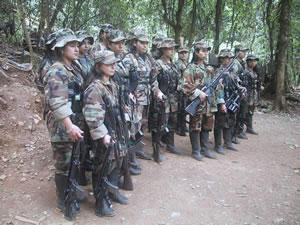 Havana, Cuba.
Even in Havana they get up early. “We get up at 4:30 to wake up the roosters so that they can start singing,” grins Ricardo Tellez, better known as “Rodrigo Granda.”I have an appointment at 7am to interview three members of the Secretariat, the highest authority of the FARC. They are at the forefront of the dialogues between the insurgent organization with the delegation of the Colombian government in Havana. In a great hall of a house in “El Laguito” (1), where they live, “Ivan Marquez” and “Pablo Catatumbo” arrive, too. Granda lights a cigarette and drinks his second cup of coffee. Marquez has a big Cuban cigar in his hand, which he`ll start “after breakfast”. Catatumbo is sipping coffee and says to me: “If the three of us are going to say almost the same, why would you interview me?”
It is the first time a journalist has the opportunity to talk to these three guerrilla leaders together.
Hernando Calvo Ospina: Commanders, you have been talking for seven months, negotiating with the government’s commission in this peace process. Are you still optimistic?
Ivan Marquez: The optimism of the FARC is determined by our willpower to find a political solution to this confrontation, which has lasted for almost fifty years. Because they haven´t been able to defeat us militarily, nor have we, we must seek an alternative. In addition, the circumstances, today’s realities, both in Colombia and on the continent, indicate that it is time to find a pacific solution. Wars are not eternal. And that´s why we make any necessary effort to come to an understanding with the government.
HCO: How does it feel to be so close to your enemy?
IM: In spite of sitting at the same table two groups with very different views, almost antagonistic, we have to tolerate and understand each other. At a negotiating table one should respect the other party, and I think that respect should be mutual. There are moments of algid, strong discussions, but soon things turn back to normal because we know that we must come to an understanding.
HCO: Negotiations in war move between two opponents. It seems to me that you put more emotion on it.
IM: You’re right. The government has always had a tendency to seek the subjugation of the guerrillas as a synonym for peace, not peace through structural changes. The oligarchy wants peace for free. We are making great efforts for them to understand that you need to generate an atmosphere for peace, and that it can be achieved through institutional and political transformations. We are sure that the most important thing for Colombia is to ensure real democracy, where the sovereign people can determine strategic policies, where the opinion of the people is taken into account without being stigmatized and murdered.
HCO: Maybe I’m wrong, but I think that at various times President Juan Manuel Santos has wanted to pull back.
Rodrigo Granda: I don´t think he wants to withdraw, but he does seem afraid. It’s as if he were afraid of former President Alvaro Uribe, of the cattle-breeders, of narco-paramilitary power and the obscure sector within the Armed Forces. Santos recoils despite having the support of a significant sector of industrialists, bankers and churches. For example, according to reports we have, Sarmiento Angulo (2), one of the most powerful men in Colombia, supports the dialogue process. Surveys say that 87% of Colombians also want peace. The correlation of forces in favor of peace is indisputable. Uribe aside, nobody speaks about war anymore. But it seems that Santos does not want to face those sectors led by Uribe, he wants to fight us militarily, and assumes intransigent positions that do not allow a correct development of the dialogues. We know that Uribe has prepared 13,000 paramilitaries, known unofficially as the “anti-land restitution army.” Is it that the Armed Forces and Santos don´t know about that? Of course they do! Is that what Santos is afraid of? Or is he taking it as part of a possible move against us?
HCO: Clearly Uribe tries to torpedo the negotiations. Do you think he wants to return to presidency?
RG: And he wants that to protect himself, because he’s afraid of being sent to Miami for drug trafficking, or to the International Criminal Court in The Hague for crimes against humanity. It would be favorable for him if the negotiations failed, so that he can appear before the country as the solution. Although he wasn´t able to resolve the “problem” of the guerrillas during the eight years he was in office. Pablo Catatumbo: Anyway, Santos and Uribe have the same idea about the negotiations: a peace process by submission. They are blind, deaf and quite wrong, but think they’re smart. And that is where we must continue with wisdom to prove that they are wrong, and that like this, the war will continue.
HCO: In statements you´ve made and documents I’ve read, you are asking for reforms in state institutions and the modernization of the State itself, which may be contradictory for a Marxist-Leninist communist guerrilla.
IM: At the table we are not proposing radical changes to the political or economic structures of the state. Over there, we don´t mention socialism or communism. We try to create conditions to reach an understanding with the government. A place where two different views can meet. We know that some leftist organizations, not only in Colombia, say that we became a reformist guerrilla.
We have made minimum proposals, for example the hundred proposals about the agrarian system, which as you´ve already said, are nothing more than a modernization of the Colombian countryside, but fact is that we are still living in feudalism there. Imagine that even this way, the government puts obstacles.
HCO: What has ever signed between the parties?
RG: We have signed some things, but they are not final signatures because nothing is agreed until everything is agreed. There are points on which we haven´t agreed yet, and we let them out to discuss them later on. Otherwise there won´t be any progress.
HCO: Dialogues in Havana, and strong military confrontations in Colombia …
RG: The government doesn’t want a ceasefire, so both parties have to dialogue under fire. We are having heavy confrontations every day, to an average of three per day. We have done large-scale military actions, which they hide to the nation. Now, both parties have decided that what happens in Colombia is not going to affect the Table.
We have made some gestures of peace, as was the unilateral truce for Christmas, although we had to defend ourselves against the attacks of the army. And what has been hidden is also in that same time span multinationals could increase their profits, they did not have our pressure. That’s why one of the major reasons for ending the guerrillas is that the transnationals can steal whatever they want without any problem.
HCO: So far, what has been the main government’s intransigence in negotiations?
IM: Without any doubt, the determination not to touch the property of the big land-owners, most of which has been obtained through violent dispossession. They`re afraid of that. Their representatives, when they talk to us, have said that that could “unleash the demons of paramilitarism.” They are afraid of cattle-breeders and landowners, to touch one third of the 30 million acres they own, although not even the cows occupy them.
But land reform without touching the big property isn’t reform. There must be set limits for land property. The government has not even thought about putting taxes as a punishment for unproductive land tenure. When we proposed taxing these big properties, the government responded that there is no reliable census; that nobody knows where they are or what their extension is. They suggest that first there should be a census, which can take up to 7 or 10 years. What they don’t say is that during this time the landowners can lease or sell the land to multinationals, which is their strategy.
HCO: If the Colombian government decided to negotiate with the FARC, it was because Washington agreed. You know that that is not an exaggeration of mine. What is the current political attitude?
IM: Recently, 62 U.S. congressmen, including two Republicans, led by Jim McGovern, signed a letter of support for the talks. This letter was sent to Secretary of State John Kerry. We welcomed this altruistic gesture. The White House and the State Department have also expressed their support. Of course, there are always different interests because the Colombian conflict produces money. The powerful arms industry doesn´t want to let loose of that business.
HCO: You are determined to stop the armed struggle. What should the government offer you for this to be achieved? And you, what would you become?
RG: President Santos, during the initial interchanges with us, said he wanted to open the floodgates to a real democracy in the country. That struck us because we have never said that the armed struggle is the only way to change the country. We got up in arms, and we still carry them, because violence has closed the doors to political participation. If the possibility of doing politics legally becomes real, without the constant threat of assassination, in equal conditions and with political reforms that could lead the country towards participatory democracy, we are there. Because there could be created a favorable correlation of forces for the revolutionary movement, which routs the necessary radical changes. We accept that challenge.
PC: You need to build a strong mass movement to impose changes, because the establishment doesn’t give away anything for free. That is a task for us, leftists and Democrats. It is important to create a power block of people who want a new Colombia. That is the challenge, and it´s not a small one.
But you see, as we talk about it at the conversation Table, the repression continues all around the country. The government hasn’t changed anything regarding the treatment of social protest: they are stigmatized, associated with the guerrillas to criminalize them and attack them with bullets. And if there is something we have very clear is that we are not willing to repeat the experience of the Patriotic Union, during which nearly 4000 members and leaders (3) were killed.
History, if it’s not manipulated, doesn´t lie: they have been the violent ones. When we remind the governmental team of these facts, they tell us that they are not here to talk about that. Why? What do they feel ashamed or afraid about? Without knowing the history of political violence in Colombia, how are we to know why we got to the current situation and how to resolve it?
IM: There are three items on the agenda to be discussed: guarantees to exercise political activity, political participation and bilateral and definitive ceasefire. The latter discusses the surrender of weapons and under what conditions. But let it be understood: that´s not handing over weapons. We cannot talk about these points until they are discussed in the table, and they will be the last ones on the agenda.
HCO: What will happen with the paramilitaries?
IM: They must definitively be eliminated; if not, there would be no certainty for an insurgent organization to incorporate into legal politics. That’s an insurmountable condition to reach a peace agreement. And it is the government who has to give the order to his generals to stop the state’s counterinsurgency strategy.
HCO: Are you determined to apologize for the suffering you have caused in this war?
PC: We have made mistakes, some serious, indeed. But whatever official propaganda says, aggression to the population has never been a strategy of the FARC. On the contrary, we have defended them against the army and its paramilitaries, mainly on the countryside.
I have no problem in saying to a woman or a family: “I feel sorry about the pain we have caused with the death of your loved one.” But this is much more complex. Are we going to apologize? Very well. Let´s also invite the economic associations that financed the war and paramilitaries; let´s invite all State institutions, because they guarantee repression and impunity; let´s invite the mass media, too, because they reproduced the stigmatization made by security agencies, which have led to the murders and massacres; the rightist political parties should also sit down and assume their great responsibilities; the former presidents of the republic who gave the orders. Not even the Catholic Church can deny its responsibility! And the governments of the United States, Israel, some European countries and others that have supported various criminal governments of Colombia cannot be left outside of this ceremony. All together, we can decide who the terrorists and murderers of the people are.
HCO: You point out, and rightly so, that the government, its armed forces and the mass media are responsible for psychological warfare and propaganda against the insurgency. But I think an important sector of the so-called intelligentsia have savaged the armed struggle they supported before.
PC: Most intellectuals in Colombia, and probably in the world, are suffering from cowardice, accommodations or both things. Almost all were put by the system in the matrix of lies, and are used to “theorize”, create and repeat falsehoods. Many of them spend time writing discourses against media manipulation, but when the system starts a campaign against someone or somebody, they start talking like parrots.
In Colombia, the system told them that the guerrillas are guilty of everything. Although many of them believed, or believe, they are from the left, they repeated in unison that we are responsible for violence, drug trafficking, kidnapping, poverty, rising gasoline and even the high price of the bananas. I assure you that if tomorrow the birds stop singing, these “intellectuals” repeat what the government and their media say: the guerrillas are to be blamed. They have fallen into such poverty regarding research and argumentation, that their analyses and theories don’t endure any discussion, at least with us. They think that if they discuss with us, we´ll kill them afterwards. They are not even capable of realizing that if that was true, in Colombia there would be very few “intellectuals” left right now. Their brain doesn’t have the capacity to see that those who safeguard their intellectual and political independence are those who are said by the government to be friends or accomplices of the subversion.
HCO: I must admit, and I´m about to end, that I’m not very optimistic about these dialogues. I believe that Colombia and Colombians deserve peace with social justice, but I know the Colombian State, I know the United States, who support that State and who ultimately decides. Hopefully the long night, imposed by State terrorism stops and finally dawns. I wish it with all my heart.
PC: Look, political conditions in Latin America have changed. Who could have imagined what happened in Venezuela and Bolivia with the arrival of Chávez and Evo? Who would have thought that other Latin American governments one day would demand respect for their sovereignty from the U.S.? There are unpredictable things, like the end of the Soviet Union for example.
In Colombia there is an accumulation of hunger, exclusion, injustice and repression. The time will come when people simply won´t take it anymore. There is an accumulation of ongoing processes that can make a leap any time. There is a boiling that could explode tomorrow.
Besides, Colombia is not an island. The neighboring countries are pressing the government because they are tired of the conflict that affects them. Venezuela received about 4 million displaced Colombians, Ecuador almost two million. We believe there are 13 to 15 million Colombians in neighboring countries, that is, the third part of the Colombian population. And these countries must provide housing, food and health. For how long? Apart from the budget they spend to protect their borders. Just because the Colombian government insists on not negotiating a conflict they will never win! We have asked the representatives of those nations to demand for peace, so that all our compatriots can return to their country.
We are optimistic. Revolutionaries must be optimistic, even in the worst situations. And we believe that peace will come to Colombia because we deserve it. The other possibility is total war. That´s why I say the moment has come, but that doesn’t mean it´s easy. This peace process is too complex, but we believe it is possible. We insist on striving for peace, so we will not fold our arms.
I do have hope, although I think the authorities and the Colombian oligarchy lack greatness and humility to start solving this conflict.
Hernando Calvo Ospina is a Colombian journalist. He can be reached through his website.
NOTES:
1. “El Laguito” is a residential complex in Havana. Their houses are separated by trees and gardens. In the center is a small lake. Since November 2012, the delegations of the FARC and the Colombian government are located in this peaceful scenery.
2. According to the magazine Forbes (edition 2012). Luis Carlos Sarmiento Angulo listed as the first billionaire in Colombia, and would rank 64 in the world.
3. The Patriotic Union was born in 1985, as a result of the talks between the government of Belisario Betancur and the FARC. According to the Colombian justice, there was a “political genocide” against the Patriotic Union.
Translation: http://en.firatnews.com/news/news/g…
The Murder of Tomas Garcia by the Honduran Military
School of the Americas Watch
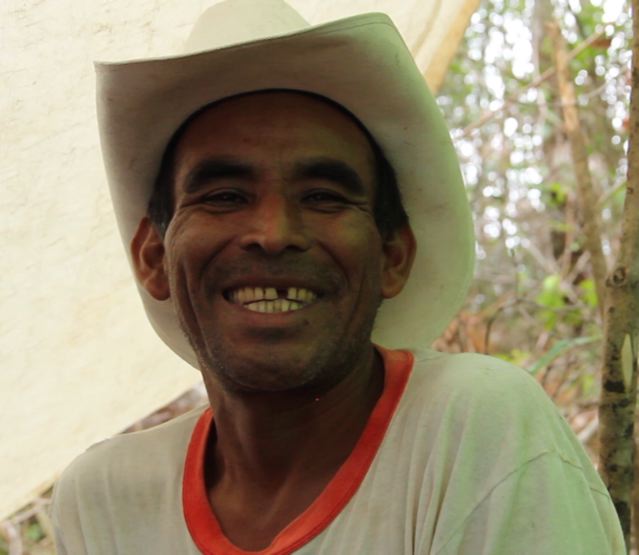 Tomas Garcia was a father of seven who would have turned 50 this December. He was a husband, father, brother, and community leader, serving as an auxiliar and on his community’s Indigenous Council. On Monday, July 15, his life was brutally taken away by the Honduran military when a soldier shot and killed him at close range in broad daylight in front of 200-300 people.He did not have a gun, he did not hurt anyone. His crime? Opposing the construction of a hydroelectric dam being constructed in his Indigenous Lenca community’s territory against their will, in violation of ILO Convention 169 and the Honduran government’s promises to consult Indigenous communities about projects in their territory.Why Tomas?He was one of the first to arrive, leading the delegation that had come to deliver a message to the companies constructing the dam at their installations in Rio Blanco. A soldier fired at him not once, not twice, at least three times from only 6 or so feet away, according to eyewitnesses.
Tomas had gone to the day’s activities with his 17-year old son who was also shot several times, receiving serious injuries in his back, chest, and arm and requiring hospitalization. Two others were also injured by the army’s bullets. According to eyewitnesses, a soldier who had been firing into the air lowered his M-16 and fired multiple shots directly at Tomas. Tomas had recently arrived at the company’s installations as one of those who was at the front of the delegation; the whole group had not even had time to arrive and many were still walking down the hill that leads to the offices. As one woman from the community explained, “We didn’t even have a conversation with them, they didn’t say anything to us. They didn’t even wait for us to say why we there, they didn’t wait for us to say what we had to say. We saw Tomas fall, he fell from shots, including to his head.”
The murder of Tomas Garcia by the Honduran armed forces is only the latest escalation in a systemic campaign of repression against the Rio Blanco Indigenous Lenca people to try to force them into accepting a hydroelectric dam being illegally constructed in their territory. Since April 1, the communities in the area, organized in the Indigenous Lenca organization COPINH, have been blocking the access road to the dam site. The access road, like the dam, is in their ancestral territory, surrounded by their fields of corn, beans, bananas, yucca, and lush forests that they have carefully stewarded for hundreds of years. At first, the Honduran National Police evicted them multiple times – despite them being on their own land. After each eviction, they simply returned to the site.Personnel of the companies building the dam — DESA and SINOHYDRO – threatened COPINH leaders. Community members started receiving death threats from employees of the company who live in the area. Armed men appeared at the site of the roadblock and lurked around at night.
Then on May 17, soldiers from the First Battalion of Engineers, commanded by SOA graduate Col. Milton Amaya, were deployed to the area and have stayed there ever since. They essentially serve as security guards for the dam companies, even driving company machinery to attempt to get it past the roadblock, and live, eat, and sleep at DESA/SINOHYDRO’s installations. Soldiers have repeatedly intimidated those who oppose the dam: they have harassed them, told them they were criminals, came into their yards, held an M-16 up to one of them, threatened women and children, and fired shots when community leaders walked by.i
 Having the police and military on their side only seems to have emboldened company employees to increase their threats and attacks on those who oppose the project. According to testimonies, employees of the company who live in the area attacked a man who had just come from the roadblock with machetes —cutting up his face and sending him to the hospital.They threw rocks at another, and threatened many in the community with death, including children. “I’m going to come to the Roble and you know how you’ll all end up. In pieces.” “I’m going to kill all of you.” ii Bullets passed above the site of the roadblock where people were sitting one Monday afternoon, people in ski masks appeared near the house of a family that is strongly against the dam, unknown figures lurked outside the house of the President of the Indigenous Council, and a known hit man arrived at the site of the roadblock.
In spite of all of this, the Indigenous Lenca people did not give up. Day after day, in the rain or in the heat, in spite of death threats and bullets that passed overhead, men, women, and children came to the roadblock to defend their land. After Tomas’ death, they continue to do so, now continuing forward in his honor, despite the intense accusations against them aimed at discrediting their struggle in the wake of Tomas’ murder.
To justify the death of Tomas Garica, DESA and the military launched a media campaign criminalizing COPINH and the Rio Blanco community. DESA issued a media release claiming that
“because of the violent intervention of the COPINH protestors, Mr. Tomas Garcia died and Mr. Alan Garcia Dominguez was injured. This morning, minor Cristian Anael Madrid Munoz also died, who is the grandson of one of the principal leaders of the zone and was doing agricultural work on his property when he was surprised by the protestors” and that “The actions which occurred today were deliberately premeditated by the principal leaders of COPINH.”
Reading DESA’s release and the corporate news accounts of what occurred, one would think that COPINH itself murdered Tomas Garcia instead of the Honduran military. Area residents who heard TV news accounts got the impression that COPINH was violent and threatening people, not that they were in fact the victims of threats and violence. DESA also accuses the protestors of a second death, which is said to have occurred in a separate location while community members were gathered around the body of Tomas Garcia at the company’s installations, in sight of the police and military. Community leaders report that the Police officer in charge even told them he was a witness that they were all still with him at DESA’s installations when gunshots were heard from up the hill, where Christian Madrid lives. But that doesn’t matter when DESA and Chinese owned SINOHYDRO – the world’s largest dam-building company — are losing money because the subsistence farmers of Rio Blanco refuse to let their river be privatized.
The attacks portraying the protestors as armed further contradict the reality one finds when one visits the zone. The dirt-poor Indigenous farmers of Rio Blanco have machetes and sticks, not guns.As one Indigenous Lenca woman and mother who is a leader in the struggle against the dam explained,
“We don’t have any guns. They do have guns because they are invading our land. They buy big guns to walk around threatening the lives of our compañeros, of all the members of Rio Blanco. They see us as an enemy and walk around with guns. Since they make money selling our land with that they can buy guns to take away the life of another person, another human life.We are all humans in this world… We have to respect each other’s faces. We are all the same.Regardless of how we look, we are children of God.”
The accusations of violence, murder, and possibly even terrorismiii against COPINH are a strategic escalation of the criminalization campaign aimed at destroying COPINH’s ability to resist the Agua Zarca Dam and numerous other projects planned for Indigenous Lenca territory. On May 24, soldiers from the First Battalion of Engineers detained Berta Caceres and Tomas Gomez of COPINH, claiming to have found a gun in their vehicle to try to criminalize them. It appears that soldiers themselves may have placed a gun in their vehicle to fabricate the charges. SOA graduate Milton Amaya, Commander of the First Battalion of Engineers, made accusations in the press. However, the soldiers couldn’t even keep their stories straight and the charges were provisionally dismissed on June 13th. Nevertheless, the state has appealed and is still trying to criminalize Berta. Now, COPINH and the Rio Blanco community have been criminalized and defamed in the press, in an effort to justify the murder of Tomas Garcia and potentially justify criminal charges against COPINH leaders or even more murders in the area. A similar tactic has been used in the Bajo Aguan, where SOA-graduate Col. Alfaro started a media campaign earlier this year accusing the campesinos (small farmers) of being armed and violent to justify the deaths in an area where over 100 small farmers have been murdered.
Why is the Honduran government so invested in breaking Indigenous Lenca resistance to the Agua Zarca Dam project in the remote western mountains of Honduras? The Agua Zarca Dam is not an isolated project but part of the overall scheme of privatization and looting of Honduras’ natural resources in the name of foreign investment. It is part of the “Honduras is open for business” scheme that was embarked upon following the 2009 military coup in Honduras to enrich the Honduran elite and multi-national corporations.Just months after the coup, the Honduran National Congress passed a General Water Law enabling the country’s water resources to be concession to third parties – enabling privatization of rivers.iv Then in 2010, the Congress approved a package of 41 hydroelectric dam projects throughout Honduras, including the Agua Zarca project and other dams in Indigenous territory.v They also passed a new mining law, which has yet to go into effect, and a law creating Special Development Regions, commonly known as model cities. And in July 2013, the Congress passed a law enabling the government to sell off “idle” resources, including natural resources, mining, energy, and more, in order to pay the internal debt.vi
All these laws passed by the post-coup governments are part of the drive to privatize and sell off natural resources – from water, to minerals, to the land itself– for exploitation and profit by corporations, especially foreign corporations. As Honduran President Porfirio Lobo explained at the signing of an agreement with SINOHYDRO to build three other dams on one of Honduras’ longest rivers, “I’m determined to promote these types of projects and make Honduras more open to all foreign investors.” While enriching business executives and investors around the world, this robs Honduran communities, especially Indigenous and campesino communities who live off the land, of the land and resources they depend on to survive.
And so the Honduran military has been dispatched to destroy the resistance of the Rio Blanco Indigenous people just as they have been dispatched to the Bajo Aguan where organized campesinos struggle for land.While Tomas Garcia lived with his wife and seven children in a small house with a dirt floor, the US was sending millions and millions into military aid in Honduras.Some of this aid probably found its way to the unit that used one of its M-16s to murder Tomas and terrorize the Lenca people for standing up for their rights. It is no accident that the military is used to enforce the turning over of Honduras’ natural resources to corporations; this is part of the US neoliberal agenda. US aid includes training, whether at the School of the Americas or by the US military on Honduran soil.For instance, Second Lt. Gonzalez, who was in charge of the soldiers stationed in Rio Blanco, reported he was trained in Special Operations by US military instructors. David Castillo, the Director of DESA, the company building the dam, attended West Point Military Academy and previously served as the Assistant to the Director of Intelligence of the Honduran Armed Forces.vii The military’s effort to criminalize the Rio Blanco community goes up to the highest levels – General Rene Osorio Canales, the Commander of the Honduran Armed Forces who was trained at the School of the Americas, spoke out to publicly justify the military’s murder of Tomas Garcia.viii
“When we heard the shots, we were humiliated.Because we don’t have guns. We have only machetes and wood.They are always accusing us of being armed, saying that we are guerrillas, that we are violent. That’s a lie. What we want is for them to withdraw and leave our territory and our rivers free.As Indigenous people we don’t want this dam to be built in our home.”
“We don’t want the dam built on our land because it affects us a lot. We like to harvest corn and beans, but we no longer could plant our crops. We don’t want the dam and we don’t want them to come violate our rights.”
“We are not criminals.We are people who grow corn.”
“Before the company came here we lived in peace.”
-Rio Blanco community members
[i] Interviews with Rio Blanco community members, May, June, July 2013.
[ii] Testimonies from community members who oppose the dam about threats from company employees who live in the area, June and July 2013.
[iii] http://copinhonduras.blogspot.com/2013/07/solidaridad-de-la-red-nacional-de.html#more
[iv]http://www.defensoresenlinea.com/cms/index.php?option=com_content&view=article&id=2523:comunidades-indigenas-lencas-en-rebelion-contra-depredacion-del-territorio&catid=58:amb&Itemid=181
[v] http://archivo.laprensa.hn/Negocios/Ediciones/2010/09/03/Noticias/Congreso-aprueba-41-proyectos-renovables
[vi] http://www.elheraldo.hn/Secciones-Principales/Pais/Ratificada-ley-para-vender-bienes
[vii] http://www.linkedin.com/pub/david-castillo/39/a55/6a2
[viii]http://www.defensoresenlinea.com/cms/index.php?option=com_content&view=article&id=2695:en-guerra-contra-el-pueblo&catid=42:seg-y-jus&Itemid=159
Photo of Tomas Garcia by Colectivo Ocote
Related article
Honduras: Expanding Palm Oil Empires In The Name Of ‘Green Energy’ And “Sustainable Development”
Written by Rights Action, Rainforest Rescue, Biofuelwatch, and Food First | August 6, 2013
From 6th-8th August, the Roundtable on Sustainable Palm Oil (RSPO) is holding its 4th Latin American Conference on so-called sustainable palm oil in Honduras [1]. Environmental and social campaigners have been shocked to learn that one event sponsor is the palm oil company Dinant Corporation, owned and controlled by Miguel Facusse, the largest landowner in Honduras. They are calling on World Wildlife Fund WWF and three other organisations to withdraw from and denounce the conference being held in Honduras due to the Dinant’s sponsorship of the event and the serious human rights implications [2].
Mr. Facusse was a key supporter and beneficiary of the June 2009 military coup in Honduras [3], has been associated with narco-trafficking [4], and, along with other large oil palm growers, has been linked to the targeted killing of more than 88 members and supporters of peasant organisations since June 2009 in the Aguan Valley [5], one of the main palm oil producing regions in Honduras.
Annie Bird from Rights Action states: “By holding its conference in Honduras and by allowing Dinant Corporation to sponsor the event and hold a stall, the RSPO is turning a blind eye to systemic and severe human rights abuses, including forced evictions of entire communities and over 88 killings for which palm oil companies, especially Dinant, are responsible. The RSPO Conference serves to reinforce the impunity with which the large-scale palm producers operate.”
RSPO is overwhelmingly dominated by the interests of large corporations like Nestlé, Rabobank and Unilever—all linked to cases of “land grabbing” in Asia, Latin America and Africa.” [6]
According to Tanya Kerssen, Research Coordinator for Food First, “The case of Dinant is emblematic of how large, elite-controlled companies use palm oil to expand their control over land and other resources. The RSPO is merely window dressing for this continued corporate expansion, which—whether classed as ‘sustainable’ or not—necessarily means the replacement of forests, biodiversity and food production with a large-scale monoculture crop for biofuel and unhealthy edible oils.” [7]
Guadalupe Rodriguez from Rainforest Rescue adds: “WWF and the three other organisations involved in this RSPO conference must pull out of and denounce this process. They must not, however indirectly, associate themselves with palm oil businessmen involved in repressing, evicting and killing peasants in Honduras’s Aguan Valley.”
The European Commission considers all biofuels from RSPO-certified palm oil to be sustainable and thus eligible for government support [8]. This is despite growing evidence by a large number of organisations, which shows that the RSPO has not been enforcing its own standards on its member companies and cannot guarantee environmental or social sustainability of palm oil [9].
Almuth Ernsting from Biofuelwatch states: “The RSPO Secretariat’s decision to hold a conference in Honduras and allow Dinant Corporation to contribute sponsorship and hold a stall further undermines any pretence that the RSPO’s aim is to make palm oil sustainable. Far from addressing any of the most serious impacts of palm oil production, the RSPO continues to serve as an instrument of greenwashing for the industry”.
NOTES
[1] The Roundtable on Sustainable Palm Oil is a stakeholder forum which provides voluntary certification for palm oil. The great majority of RSPO members represent industry interests. (Conference website: http://rspo2013.com/)
[2] See http://rightsaction.org/action-content/open-letter-world-wildlife-fund-solidaridad-network-snv-netherlands-development for an Open Letter to WWF, Solidaridad, SNV Netherlands Development Organisation and Forest Ethics on this issue.
[3] In June 2009, the democratically elected Honduran government of Manuel Zelaya was overthrown by a military coup. Manuel Zelaya’s government had begun listening to and acting on the demands of peasant organisations for land reform, including in the Aguan Valley region. The land reform process was ended by the military rulers after the coup. Since then, Dinant Corporation and their armed security forces have been collaborating with military forces and police forces in repressing local communities who have been trying to reclaim land controlled by Dinant. See for example: http://www.enca.org.uk/documents/ENCA56_Sep_2012.pdf .
[4] Published Wikileaks Cables revealed that the US embassy in Honduras has had evidence linking Miguel Facusse to drug trafficking since at least 2004 and that several aeroplanes with drugs have landed on his private property. See http://www.thenation.com/article/164120/wikileaks-honduras-us-linked-brutal-businessman#
[5] For a report by Rights Action about killings and other human rights abuses in the Aguan Valley, see http://rightsaction.org/sites/default/files/Rpt_130220_Aguan_Final.pdf .
[6] See, for example: “The bloody products of the house of Unilever” Rainforest Rescue, 2011. https://www.rainforest-rescue.org/mailalert/747/the-bloody-products-from-the-house-of-unilever
[7] For more on the link between palm oil expansion and corporate control, see Kerssen, Tanya. Grabbing Power: The New Struggles for Land, Food and Democracy in Northern Honduras. Food First Books, 2013.
[8] See http://www.rspo.org/news_details.php?nid=137
[9] Previously, over 250 organisations condemned the RSPO for ‘greenwashing’ of palm oil: http://www.biofuelwatch.org.uk/2008/rspo-declaration-english/ . More recently, the RSPO has been denounced for example by Greenpeace and Friends of the Earth; http://www.biofuelwatch.org.uk/2008/rspo-declaration-english/
Greenwald claims up to 20,000 Snowden documents are in his possession
RT | August 7, 2013
The journalist involved in the publication of leaks provided by whistleblower Edward Snowden said in a testimony to the Brazilian government that he possesses up to 20,000 secret US government files.
Glenn Greenwald testified before a Brazilian Senate foreign relations committee on Tuesday. The Brazil-based American reporter – who was approached by Snowden while the whistleblower still worked as a contractor for the NSA – has published details of US electronic surveillance programs taking place domestically and abroad.
“I did not do an exact count, but he gave me 15,000, 20,000 documents. Very, very complete and very long,” Greenwald told Brazilian lawmakers.
“The stories we have published are a small portion. There will certainly be more revelations on the espionage activities of the US government and allied governments… on how they have penetrated the communications systems of Brazil and Latin America,” he said.
In addition to his reporting for Britain’s Guardian newspaper, Greenwald has also been a fixture on O Globo, where the journalist shared the alleged details of US electronic surveillance of Brazil and virtually all of Latin America.
During his testimony, Greenwald alleged that Brazilian companies have agreements in place with American telecoms to collect data for the National Security Agency (NSA), and stressed that their complicity should be investigated by that country’s government.
O Globo recently published claims that Washington had at least at one time maintained a spy center in the capital of Brasilia, as part of a network of 16 similar facilities worldwide designed to intercept foreign satellite transmissions.
Allegations of widespread US surveillance of Brazil prompted US Vice President Joe Biden last month to call Brazilian President Dilma Rousseff to provide an explanation. US Ambassador to Brazil Thomas Shannon had earlier denied the NSA was tapping into telecoms in the country.
The additional files in Greenwald’s possession are believed to have been handed over when Snowden took refuge at a hotel in Hong Kong before fleeing to Moscow.
“The pretext [given by Washington] for the spying is only one thing: terrorism and the need to protect the [American] people. But the reality is that there are many documents which have nothing to do with terrorism or national security, but have to do with competition with other countries, in the business, industrial and economic fields,” Greenwald said on Tuesday.
On Monday, foreign ministers of the South American trade bloc Mercosur raised the issue of alleged NSA surveillance throughout Latin America with UN Secretary-General Ban Ki-moon.
The ministers discussed with Ban a statement adopted by the bloc on July 12 following a summit in Montevideo, Uruguay. The statement called for UN members to propose ways to halt spying and potentially pursue sanctions against the United States.
But doing so would be impossible under the current framework, as only the Security Council can impose legally binding sanctions and the US holds veto privilege over any such resolution as a permanent member of the council.
One of the most recent leaks provided by Snowden – published last month – refers to a secret surveillance system named XKeyscore which is allegedly used by the NSA to monitor internet traffic.
In his Tuesday testimony, Greenwald described the system as not only able to collect metadata “but also the content of emails and what is being discussed in telephone conversations. It is a powerful program which frightens.”
Mercosur complains to Ban Ki-moon on US global espionage and EU affront towards Bolivia’s Evo Morales
MercoPress |August 5, 2013
Mercosur foreign ministers warned UN Secretary General Ban Ki-moon of the serious implications which the United States global espionage system represents for the international community, during a Monday midday meeting at the UN headquarters in New York.
“We have expressed our concern and warning over the serious implications that these illegal procedures displayed by the government of the US have on the political stability of countries and the necessary mutual trust of the international community members”, said Venezuelan minister Elias Jaua at a press conference following the meeting with Ban Ki-moon.
Jaua was the spokesperson of the Mercosur group of foreign ministers, Antonio Patriota, from Brazil; Hector Timerman from Argentina and Luis Almagro, Uruguay, as well as associate member Bolivia’s David Choquehuanca, because Venezuela since last July holds the rotating chair of the South American trade block.
The ministers thus complied with the formal request from the last presidential summit of Mercosur in Montevideo in mid July, when there was an official release condemning US world espionage, which was revealed by the former intelligence officer and whistle-blower Edward Snowden currently with one year political asylum in Moscow.
“This practice is absolutely in violation of international rights for the safeguard of countries sovereignty and independence, and even more, is in violation of fundamental human rights of the citizens of our countries”, underlined Jaua.
When asked about the reply of Ban Ki-moon to the Mercosur statement, Brazilian minister Patriota said that the top US official “shared the concern” of the block. “UN Secretary General reacted in a way that showed awareness towards the message we transmitted from our presidents”, added Patriota.
During the meeting the ministers also expressed Mercosur ‘deep concern’ because of ‘the abuse and affront’ to Bolivian leader Evo Morales presidential immunity “when he was impeded air space free passage over several European countries under suspicion that his aircraft could be transporting Mr. Snowden”, when he was still stranded in the Moscow airport and hoping to be granted political asylum by some country.
The decision adopted by Spain, France, Italy and Portugal last 2 July “seriously endangered not only the dignity of president Evo Morales, but also his own physical safety since he had to over-fly with limited fuel and was forced to land in Vienna”, explained Jaua.
Snowden who is wanted by Washington for having leaked the existence of a US secret program that operates domestically and internationally to spy on phone and internet communications, was finally granted temporary asylum (one year) in Russia given the difficulties to fly to Latinamerica where several countries had offered to help him.
Precisely asylum was another issue addressed with Ban Ki-moon following on the strong pressure exercised by the US on several Latam countries (Bolivia, Nicaragua and Venezuela) which offered an alternative to Snowden.
“For us Latinamericans the right to asylum is a right all citizens can exercise as well as the right of States to be respected when they extend such a benefit, and it is a principle we are not willing to negotiate” said the Mercosur spokesperson emphatically, who then recalled that ‘this very principle helped to save many lives during the hard years of the military dictatorships suffered by many countries of the region”.
Finally the foreign ministers reiterated their standing concern on two recurring issues: the US blockade on Cuba and Argentina’s claim over Falklands/Malvinas sovereignty.
There is a demand that these two issues “definitively find a solution since they are highly sensitive and of great concern for the Latam region”.
Argentine President Cristina Fernandez was scheduled to meet Ban Ki-moon later in the day in advance of her speech to the Security Council on Tuesday, taking advantage of the fact that Argentina will be holding the presidency of the council during the month of August. The president arrived in New York on Monday morning.
Related article
- S. American states to recall ambassadors from Europe over Bolivian plane incident (alethonews.wordpress.com)
Colombia: Killings of Human Rights Activists Increase by 27%
By Alexandre Bachet | The Argentina Independent | August 5, 2013
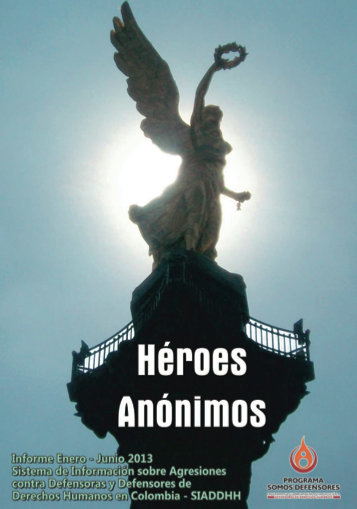 The non-governmental programme ‘Somos Defensores’ published a half-yearly report on Sunday showing a 27% increase in killings of human rights defenders and social leaders in Colombia.
Between January and June 2013, 37 human rights activists were murdered, according to the programme, which is supported by national and international NGOs. This represents a 27% increase compared with the same period of last year, when 29 activists were killed.
The report, called ‘Héroes Anónimos‘ (‘Anonymous Heroes’), states that most of the activists killed, 32 men and 5 women, were leaders of social and farmers’ organisations.
Diana Sánchez, spokeswoman for the programme, stated that “there is a lower number of aggressions [153 cases] compared to the same period last year [163 cases]” but “paradoxically, murders have increased, which is more serious.”
Sánchez explained that the first half of the year was marked by “a constant tension in political and human rights issues,” referring to the numerous protests that have taken place in Colombia this year. She also denounced that “there are armed groups and gangs (heirs to the paramilitary groups involved in drug trafficking) that when they feel that a [social] leader or an NGO threaten their mafias or their territories, they have no qualms about killing them.”
(photo courtesy of ‘Somos Defensores’)
Analysis from National Endowment for Democracy Used in The Atlantic, with Significant Errors and Omissions
By Stephan Lefebvre | CEPR Americas Blog | July 30, 2013
This month, readers of The Atlantic were treated to a lengthy article documenting alarming threats to democracy in certain Latin American countries with progressive and leftist heads of government. The piece, written by Kurt Weyland and titled “Why Latin America is Becoming Less Democratic,” is riddled with significant errors and mischaracterizations. Perhaps even worse, editors at The Atlantic didn’t make clear that the article was first published in a “journal” that is funded by the U.S. government.
The original article was published in the Journal of Democracy, which has long focused on providing analysis to justify U.S. government intervention abroad. The Journal of Democracy is an official publication of the National Endowment for Democracy’s (NED) International Forum for Democratic Studies. Although nominally a “nongovernmental” organization, the NED receives most of its funding from the U.S. Congress. In 1991, Allen Weinstein, who helped found and then became the NED’s acting president, told the Washington Post, “A lot of what we do today was done covertly 25 years ago by the CIA” [1].
Some examples of the NED’s work include using U.S. government resources to fund groups and individuals involved in the short-lived 2002 coup d’état in Venezuela, and two years later funding organizers of the recall effort against then-president Hugo Chávez. One of the NED’s core grantees is the International Republican Institute, which played a major role in overthrowing the democratically-elected government of Haiti in 2004.
These are just a few examples that highlight the NED’s disreputable history in Latin America, which would take far more space than a blog post to tell. While it clearly would have been worth noting the source of the article, the article itself is full of both factual errors and egregious mischaracterizations. To keep this post brief, I’ll only review a few of the most egregious errors here.
- Weyland writes: “Since the third wave reached Latin America in 1978, the region had seen only occasional threats and temporary interruptions of democracy in individual nations.”
This statement is only reasonable if one completely ignores the U.S. government’s role in the region, which constituted a threat to democracy that was neither “temporary” nor limited to “individual nations.” Throughout the 1980s, the U.S. conducted a massive and well-organized campaign, especially in Central America, using Cold War pretexts to install and support leaders who would foster favorable conditions for U.S. business interests.
In Nicaragua, the campaign involved massive illegal military aid to the contra paramilitary forces who used those weapons to kill health care workers, teachers and elected officials in their fight against the democratically-elected Sandinista government, bringing condemnation from the World Court, as well as Amnesty International, Americas Watch and other human rights groups and international bodies.
At the same time, the U.S.-backed Guatemalan General José Efraín Ríos Montt, massacred and tortured the people of Guatemala — with U.N. estimates indicating over 200,000 were killed or disappeared in acts of genocide. The same Cold War premise of fighting “communists” was used to justify large-scale atrocities in El Salvador and Honduras. Throughout the ‘70s and ‘80s, the U.S. supported brutal dictatorships in Chile, Argentina, Haiti, Brazil, and other countries, and militarily invaded Grenada (1983) and Panama (1989). More recently, of course, the U.S. supported coups in Venezuela, Honduras and Haiti.
It could not be more clear that democracy in Latin America is threatened and actually has been compromised on many occasions by the U.S.’s foreign policy, especially in the post-1978 period that Weyland names. Rewriting history to minimize and erase these events serves the interests of the U.S. government, so it is perhaps no surprise that publications like the Journal of Democracy carry out this work diligently, but when government propaganda makes its way into independent publications like The Atlantic without comment, it is cause for alarm, especially when there are numerous factual errors.
- Weyland writes that “Cristina Fernández de Kirchner of Argentina (2007-), whose fervent supporters take inspiration from Chávez, is eyeing constitutional changes and renewed reelection.”
Fact check: President Cristina Fernández has not said anything to this effect. She has proposed constitutional amendments focused on reforms to the judiciary, and she has already addressed the Argentine congress specifically, saying that she is not planning to pursue reforms that would allow her to run for a third consecutive term. Weyland would be right in noting that some of her supporters floated the idea of a third term, but Weyland’s claim as written is simply not true. If this seems like a minor point, consider that Honduran ex-president Manuel Zelaya’s support for a non-binding referendum on a constituent assembly was misreported in the media as a bid to extend his presidency and was used as a justification for his removal both within Honduras and internationally. Weyland perpetuates this myth, saying that Zelaya “was stopped” before he could “boost[] the presidency’s powers and pave[] the way toward indefinite reelection to that office.” By presenting the coup that removed Zelaya as an event that forestalled a nondemocratic turn, in particular saying nothing about events following the coup, much of Weyland’s argument supposedly in favor of democracy in Latin America is rendered moot.
- “That Venezuela had already fallen under nondemocratic rule was confirmed in October 2012 by Chávez’s unfair reelection, achieved with the help of intimidation tactics, tight restrictions on the opposition, and the massive misuse of the state apparatus.”
The 2012 elections in Venezuela were declared free and fair by election accompanying groups and by monitors such as the Carter Center, which noted that “the whole opposition leadership, including, most importantly, Capriles himself, unequivocally reject those claims [of election fraud favoring Chávez], stating that the results reflected the will of the electorate.” Journalists and human rights watchers monitoring the electoral process praised the system while giving detailed reports about what they saw.
- “With its electoral façade and progressive rhetoric about helping the excluded, the soft authoritarianism that is taking hold in parts of Latin America has an attractive face.”
In sweeping statements such as this one, Weyland casts doubt on both the electoral victories and the policies of progressive and left governments in Latin America. He suggests that the people’s will is not represented in the official outcomes of national elections, and even if left-wing politicians seem popular that is because they trick and/or intimidate citizens and do not deliver on promises to the poor and other disenfranchised sectors of society.
Actually, these are not elections whose legitimacy is seriously questioned by any but those on the extreme right. And the implication that progressive and left governments are limiting their policies to “progressive rhetoric,” is absurd. The overall trend in the countries that have elected progressive and left leaders has been the enactment of policy alternatives to neoliberalism, and their effect has been large reductions in income inequality, a reduction in poverty, and provision of health care, education and important services to many people who previously could not access them. These policies have included reforming and regulating the financial sector in Ecuador, investing oil profits into social missions in Venezuela, and successfully managing a large financial crisis and debt default in Argentina — resulting in only one quarter of negative economic growth followed by nine years of some of the highest growth in the region.
Weyland’s reference to an “electoral façade” betrays the central goal of the NED: what sociologist William Robinson refers to as “promoting polyarchy.” As opposed to experiments in direct democracy occurring on various levels in countries such as Venezuela and Bolivia, the NED ultimately promotes only representative forms of democracy, or polyarchy. In Robinson’s definition, this is “a system in which a small group actually rules, and mass participation in decision-making is confined to choosing leaders in elections that are carefully managed by competing elites.” In Venezuela, Chávez’s Bolivarian project did away with a polyarchic system, and across much of the continent NED-backed parties and candidates have failed in election after election. When Washington’s candidates don’t win, often the elections are depicted as illegitimate and sometimes the electoral process is attacked – as seen with the most recent Venezuelan election, or with the U.S.’ interference, via the OAS, in Haiti’s last presidential election.
- “As soon as [Chávez] was elected president of Venezuela, he set about revamping the country’s institutional framework. First, he called a constituent assembly.”
Weyland’s claims here come after stating that “graver and more sustained danger is coming from the leftist variant” of populism than the rightist version, but is the Venezuelan constituent assembly really evidence of anti-democratic tendencies? No again. Calling for a constituent assembly was exactly what Venezuelans elected Chávez to do. Ending the ossified political arrangement known as “Punto Fijo” – in which political parties routinely alternated in and out of power – and calling a constituent assembly were key campaign promises he made ahead of the 1998 elections. Chávez was fulfilling his campaign promises– a much more infrequent phenomenon in the U.S.
- “[Ecuadorean president Rafael] Correa also seized on a 2010 police rebellion—painted by him as a coup attempt—as a pretext for cracking down on independent social and political forces.”
Many observers both in and outside of Ecuador characterize the events of September 30, 2010 as an attempted coup d’état: after assaulting him with tear gas, rebelling police officers later held the president hostage in the hospital where he was being treated. The coup attempt was condemned as such by presidents and representatives of UNASUR, foreign dignitaries such as the president of Spain, and the OAS. Weyland and The Journal of Democracy may be taking the U.S. government’s line, one of the few countries that declined to recognize the events as a coup attempt, even though then-Secretary of State Clinton did issue a statement in expressing “our full support for President Rafael Correa.”
- “Bypassing or subjugating intermediate institutions such as firmly organized parties, the leader—often a charismatic figure—establishes face-to-face contact with large number of citizens. In earlier decades, mass rallies were crucial; now-a-days, television allows populists to reach their followers ‘in person.’ Chávez hosted a regular Sunday talk show.”
Calling for respect of “firmly organized parties” in Venezuela in the context of Chávez’s rise in politics obscures that one of the central political problems in Venezuela during the 90s was deep distrust in the main political parties and their “Punto Fijo” arrangement, which Robinson describes as a polyarchic system.
Furthermore, it is worth noting that President Obama has a weekly address on YouTube, and yet he is not derided as an illegitimate president because of his use of social media. Presidents and major politicians all over the world have Twitter and Facebook accounts that they use to communicate with constituents, and many even make appearances on talk shows. Is such “face-to-face contact” somehow nefarious?
- “In Bolivia, the Morales government shut the opposition out of decisive stages of the constitution drafting process.”
Weyland is again telling only half the story, which in this case is worse than none. The truth is that opposition legislators boycotted stages of the constitution drafting process because they disagreed with the direction in which things were going. Bolivia had elected its first indigenous president, with massive support from the country’s social movements, and he was facilitating a transformation of society to one in which a racial minority and tiny elite did not wield power over the majority of Bolivians. Evo Morales’s election drew comparisons to the symbolic end of apartheid in South Africa with the election of Nelson Mandela, and the new constitution was compared to the Freedom Charter.
It is not surprising that extreme elements in the opposition boycotted the process of installing a new constitution that cemented the rights of the indigenous majority, and it is misleading to describe these events as a “populist” power-grab.
This has been a brief review of some major claims that Weyland uses in arguing his point, namely that “democracy in the region is facing a sustained, coordinated authoritarian threat” from the progressive and left governments in Latin America. I have detailed not only mischaracterizations and significant omissions, but also argued for more independence in the practice of journalism. One of the responsibilities of a well-functioning press is to clearly indicate when articles are reused from sources funded mostly by the U.S. government.
[1] Ignatius, David. “Innocence Abroad: The New World of Spyless Coups.” The Washington Post. Sep 22, 1991: C1. Print.
Related articles
- Laughing at Snowden’s Asylum Requests (alethonews.wordpress.com)
- Washing U.S. Hands of the Dirty Wars: News Coverage Erases Washington’s Role in State Terror (alethonews.wordpress.com)
Bolivia: New Factory to Make Coca Products for Medicinal Use
By Marc Rogers | The Argentina Independent | July 30, 2013
Bolivian president Evo Morales today inaugurated the first factory for coca-based products, highlighting their health benefits and medicinal uses.
The new plant, opened in a suburb of La Paz, will process around 75,000 tonnes of coca leaf a year to make drinkable infusions, such as coca mate and teas.
Coca cultivation is illegal is much of world, but permitted in Bolivia. In January the UN agreed to exempt Bolivia from its 1961 ruling to criminalise the coca leaf, one that Morales called a “historic error“.
“It’s good for me,” said Morales of chewing the coca leaf at the inauguration of the new factory. “Many people are fighting diabetes with coca – that has been proven.” The president also pointed to a Harvard University investigation from the 1990s that found considerable health benefits could be derived from eating coca.
The factory will be administered by the Association of Coca Producers (Adepcoca), and was built with support from the national and city governments, as well as the EU.
Morales added that he would present the coca products to his Ecuadorian counterpart Rafael Correa on the fringes of the Bolivarian Alliance for the Americas (ALBA) summit to see about exporting the goods.
Colombia, Peru, and Bolivia are the world’s principal coca producers.
Related articles
- Brand Bolivia: The Coca Campaign (brandopia.typepad.com)
- No Love For McDonald’s In Globalization-Wary Bolivia (mintpressnews.com)
- The Cocaleros and the rise of Evo Morales (gtsociology.wordpress.com)
The Cocaleros and the rise of Evo Morales
By gthomas2219 · July 17, 2013
This essay will explore the impact that the Cocaleros and Evo Morales have had on Bolivia over the recent history. The impact of the Cocaleros will be shown in their central role in establishing a platform for Morales to rise to prominence on. Morales’s impact will be explored through examination of specific changes enacted in his time as President, specifically establishing a new constitution, reforming extraction of Bolivia’s vast gas reserves and reforms related to the coca plant. To begin certain contextual factors of Morales’s changes will be established.
Bolivia’s history is one of exploitation, whether it be the colonial Spanish exploitation of the vast silver deposits of Potosi’s Cerro Rico in the Sixteenth Century, or the exploitation of the vast natural gas reserves by multinational corporations (MNCs) throughout the late 1980s and 1990s (Artaraz, 2012). The historically continuous exploitation of Bolivia’s vast natural resource wealth has been felt by the Bolivian people as a lack of sovereignty (Dangl, 2007; Artaraz, 2012). Politics in Bolivia since the foundation of the republic in 1825 has proved difficult (Dunkerley, 2007). An incomplete revolution in 1952 was defeated by a military coup in 1964, by 1982 democracy had formally been re-established, however political power was concentrated in the hands of a minority elite, unrepresentative of the vast majority of Bolivians (Dunkerley, 2007; Morales, 2011; Artaraz, 2012). In response to the unrepresentativeness and corruption that was characteristic of Bolivian politics, especially since 1982, the general attitude of the population to politics was one of dissolution. However, the international perception of Bolivian politics during the 1990s was excellent, Bolivia was seen as a shinning example of neoliberalism, it had opened itself up to MNCs, it had low public spending and it was conforming to US War on Drugs through eradication of the coca crop (Dunkerley, 2007; Klein, 2011). This being said there has always been a strong thread of resistance running through Bolivian society. Emblematic of this until the 1980s were strong trade unions, particularly mining unions, however the closure of tin mines and the loss of over 20,000 jobs in 1985 wrought huge destruction (Dangl, 2007; Klein, 2011). The mining union’s loss was the Cocaleros’[1] gain as many newly unemployed miners moved east to the Chapare region and took their unionising skills with them (Artaraz, 2012).
The movement of miners to the coca growing area of El Chapare proved hugely significant for Bolivia. The miner’s background in unions helped structure the organisations of Cocaleros and their resistance to law 1008[2] and the eradication efforts of the government (Crabtree, 2005). The government stepped up eradication policy in 1997 with President Hugo Banzer advocating a ‘zero coca’ policy (Crabtree, 2005, p. 38). Not only attempting to defend their livelihoods the resistance of the Cocaleros was hugely symbolic for two reasons. One, the resistance represented a defence of a traditional Andean symbol – the coca leaf which has been a central symbol of Andean culture for centuries, and two, the fight against US imperialism and defence of Bolivian sovereignty (Crabtree, 2005; Dangl, 2007; Artaraz, 2012). It was through the organisation of the Cocaleros’ resistance that Evo Morales came to prominence, he rose up to become the leader of the largest Cocaleros union (Crabtree, 2011; Artaraz, 2012). The resistance of the Cocaleros transformed into active political participation throughout the 1990s, with a key moment coming in 1994 with the ‘Law of Popular Participation’ (PPL) (Artaraz, 2012, p. 46) being enacted. PPL decentralised power to newly created municipalities, which provided a base for limited representation of local groups (Klein, 2011; Artaraz, 2012). In 1995 the Cocaleros joined with other indigenous social movements to create the ‘Political tool for Sovereignty of Common People (IPSP)’ (Dangl, 2007, p.49). The established political parties and the electoral commission denied recognition of the IPSP as a political party and so the IPSP took on the name of MAS[3] (Movement for Socialism) in 1999 to be able to stand for election (Dangl 2007; Harten, 2011). The notion of a political tool as was the IPSP and MAS is crucial as it demonstrates the bottom-up design of MAS; the primacy of the social movements that make it up – it is for their use, not for politicians (Harten, 2011). MAS is a tool to use not to be used by. The first leader was Evo Morales.
Despite MAS and Morales’s lineage being directly traceable to the Cocaleros, since coming to power in 2005[4] they have widened their base to include all social and indigenous movements, as well as trying to curry favour with the urban middle class (Harten, 2011). Morales’s skill as a leader, and a central plank of MAS’s electoral success, is his ability to galvanise and shape a vast array of indigenous and social protest movements into a unified political project (Salman, 2007). Like the miner’s influence in organising the Cocaleros, Morales and MAS have taken the general anger and dissatisfaction of a wide array of social/indigenous protest movements and formed them into a coherent political articulation (Salman, 2007).
A key election pledge made by Morales before his victory in 2005 was to write a new constitution to enshrine the rights of the indigenous people of Bolivia, who despite making up the vast majority of the population [5] have been marginalised in Bolivian politics, and Bolivia in general throughout the country’s history (Artaraz, 2012). The new constitution, which was ratified in January 2009, casts Bolivia as a ‘plurinational’ state (Republica de Bolivia, 2009 in Albro, 2010, p. 78). The plurinational characterisation of the state highlights the rise in stature indigenous groups have experienced alongside the rise of Morales to the Presidency (Albro, 2010; Assies, 2011; Artaraz, 2012). A symbolic – as well as practical – codification of the new constitution is the classification of the coca leaf as not a drug in its natural form, the protection of this central symbol of Andean culture is also a direct challenge to US classification (Assies, 2011). Another strengthening of the legal recognition of indigenous people is shown in the codification of Andean ethics – ‘ama qhilla, ama llulla, ama suwa (don’t be lazy, don’t lie, and don’t be a thief)’ (Assies, 2011, p. 112); the new Bolivian constitution is not just a document to rule by, it is a document to live by – crucially an Andean indigenous life. The representation of indigenous groups by the constitution is also reflected in Morales himself as he straddles the two most prominent indigenous identities, the Aymara and the Quechua (Crabtree, 2011); his family background is Aymara, but he grew up within a Quechuan area and so is a potent figure for the raised stature of Bolivia’s indigenous population. Whilst physically embodying the indigenous identities of Bolivia, Morales’s politics are also of an indigenous nature, which can be classified as ‘sindicato democracy’ (Conzelman, 2010, p. 5). This is a democracy typified by high levels of direct community accountability; a focus on consensus; individual responsibility to the community; subordination of the individual to the community; economics that work for the community (Conzelman, 2010). The sindicato democracy of Morales, in the language of the liberal democratic tradition he has widened and strengthened the public sphere, he has established a non-exclusionary public sphere, he has empowered civil society (Fraser, 1997; Albro, 2010; Conzelman, 2010; Artaraz, 2012). As noted above, there has always been a strong theme of resistance in Bolivian politics, occurring within civil society, but the codification of indigenous rights within the new constitution has undoubtedly strengthened civil society (Assies, 2011). The pre-eminence of indigenous identity in the new constitution evidences the strengthening of sovereignty of Bolivia, it also points to the reclamation of Bolivia for Bolivians, what Postero (2010, p.19) has called ‘indigenous nationalism’, which is emblematic of Morales’s political project.
A significant sign of Morales’s impact since coming to power can be seen in the nationalisation of Bolivia’s vast reserves of natural gas (Kaup, 2010; Sivak, 2011). However this was not a total/traditional nationalisation, but a renegotiation of contracts between the state and MNCs (Kohl, 2010; Sivak, 2011). The state raised taxation and royalties charged to the companies from 18 per cent to 50 per cent, and in some particularly significant gas fields to 82 per cent for a short time, this initial extra rise was in order to recapitalise the state’s gas company YPFB (Kaup, 2010). What this demonstrates then is not a full or traditional nationalisation, but a significant imposition of the state within the economy – state capitalism rather than full socialism. The profits derived from the renegotiated contracts have been channelled into social welfare programmes such as education and health care (Kohl, 2010; Kaup, 2010; Crabtree, 2011).
The semi-nationalisation of gas, and the increased role of the state within the economy, points to the sindicato style of Morales’s political project. In this sense the economy is seen to work for the nation, profit for the community rather than individual profit. There has been criticism of this approach both from the left and right (Kaup, 2010). From the left are claims that Morales has not gone far enough, and that Bolivian gas should be totally nationalised (Kohl. 2010; Kaup, 2010). Bolivia’s contract with Brazil, which relies on Bolivian gas for up to 50 per cent of its total consumption, stipulates that 65 per cent of all daily Bolivian production be sent to Brazil (La Razón, 2007 in Kaup, 2010). Critics on the right claim that the sharp rise in rents charged by the State will discourage new investment and stifle current work, similar criticism is levelled at the use of the revenue for social programmes, arguing for its re-investment in the gas industry (Kaup, 2010). This demonstrates the tightrope that Morales must walk and his pragmatism in walking it. Regardless of criticism of Morales’s semi-nationalisation of gas, it has undoubtedly increased Bolivian sovereignty over one of its key natural resources and reduced the exploitation of the country by foreign actors; it has also greatly increased social welfare programmes that are vital in reducing social inequalities.
Another example of Morales’s pragmatism and the unique middle way between capitalism and socialism is the codification of private property and land laws set out in the 2009 constitution. Protection of private property is conditional on it having a ‘social-economic function’ (Assies, 2011, p. 115). Property must work for society, again evidencing the shift in relationship between the nation/civil society and the economy. Unlike in the neoliberal ideology where the economy is predominant to all other sectors of society, a predominance which is based upon the ultimate protection of private property and the rule of law, the social function required of private property in the 2009 Bolivian constitution predominates the social over the economic/legal (Plant, 2010; Wolff, 2013). In short the social-economic function demanded of private property points to a central theme of change under Morales, the subordination of the ‘rule of law’ to ‘the rule of the people’ (Wolff, 2013, p. 46). This subordination is unsurprising as it follows the logic of sindicato democracy. The fundamental nature of Bolivian politics has changed since Morales’s came to power. Under his Presidency the country has seen a diminishing of liberal political traits and a rise of what Wolff (2013) calls ‘post-liberal democracy’ (p.31), or as has been the case throughout the text sindicato democracy. The decline in the institutional role of traditional political organs such as the executive, judiciary ect. is reflected in the rise of participation outside of institutional boundaries seen in mobilisations rather than institutional participation through traditional methods – joining a political party (Wolff, 2013). To put it simply the post-liberal/sindicato democracy stemming from Morales’s rule is a much raw-er, more direct and less institutionally confined form of governance.
Whilst certainly not traditionally socialist, the political project embarked upon by Morales since his rise through the coca unions is one that can be characterised by its anti-neoliberal, perceptibly anti-American imperialistic neoliberalism (Sivak, 2011). Bolivia now does not receive any new loans from either the IMF or the World Bank, a sign of the rejection of the neoliberal conditions that these loans are based on and increased sovereignty of the country (Dangl, 2007; Sivak, 2011). A specific example of the rejection of American led policy, outside of the change in approach to coca growing, is seen in Morales’s decision to leave the ‘Free Trade Area of the Americas (FTAA)’ (Sivak, 2011, p. 145) which is a free trade agreement used by the US to exercise influence and stifle the growth of regional trade blocs that could potentially damage US business interests in the area. Relatedly Bolivia’s joining of the Bolivarian Alliance for the Americas (ALBA) and the People’s Trade Agreement (PTA) with Cuba and Venezuela can be seen to represent – in one instance – anti-American/anti-neoliberal policies (Dangl, 2007; Sivak, 2011). The PTA is a good example of the sindicato theme of Morales in that it is based on mutually beneficial trade, something that cannot be said of FTAA (Dangl, 2007).
Morales’s close link to coca has had a key structuring effect on his politics. Whilst rising to a position of power through the coca grower’s unions, since becoming President he has pursued a surprising policy approach to coca (Dangl, 2007; Sivak, 2011; Artaraz, 2012). His approach may be taken as another example of his pragmatism, or the reformist nature of Morales and MAS as opposed to revolutionary (Webber, 2010). On the one hand Morales has been sympathetic to his Cocaleros roots in that he has codified coca as not a drug, in its natural form, in the 2009 constitution (Assies, 2011). Morales has greatly expanded the internal, legal, market for coca, which has greatly benefited small farmers as it has widened their platform to sell their crops (Dangl, 2007; Kohl, 2010). Eradication initiatives whilst still in place have been qualitatively changed, no longer are they violent and forced but are now voluntary and achieved through social control when a farmer grows over the 1,600m2legal limit (Dangl, 2007; Sivak, 2011). The change in the nature of eradication has vastly reduced the violence in the El Chapare region (Dangl, 2007). However, it is the fact that eradication efforts are still in place that has surprised many. Morales has focused his anti-coca policy on combating coca farming for cocaine production, but despite this the US since the Bush administration has continued to withhold certification of Bolivia as an ally in the War on Drugs (Sivak, 2011). Most significantly, despite winning consecutive elections with an increased majority, Morales has not repealed law 1008, the US-backed drug laws that have been shown to disproportionately affect small scale farmers as opposed to growers of coca for cocaine (Crabtree, 2005; Dangl, 2007).
Whilst not impacting as significantly as expected on coca laws, Morales has undeniably impacted on Bolivia. A concrete manifestation of his impact is the 2009 constitution, which primarily codified the rights of indigenous people, it has raised their stature in the country and it is hard to envisage it ever declining. The nature of democracy has changed vastly; Morales has overseen a drastic shift from neoliberalism to Andean sindicato democracy, which has reversed the dominance of the economy and put civil society, the citizens in charge. The empowering of the nation is also clearly seen in the semi-nationalisation of Bolivia’s gas reserves, and the new mutually beneficial trade alliances with other Latin American countries. The exploitation that has characterised Bolivian history since it’s colonisation is rapidly declining. Morales has facilitated ownership of Bolivia for Bolivians and is a shinning example of the strengthening of indigenous people.
This essay has traced the impact of the Cocaleros and Evo Morales on Bolivia by first establishing context. The impact of the Cocaleros was seen in that it was here that Morales began to climb the ladder to presidency. The Cocaleros were also crucial to the formation of MAS, which has now become the dominant force in Bolivian politics. Morales’s impact has been specifically outlined in the reforms to the gas contracts, the change enacted in coca eradication, the writing of a new constitution, and a fundamental change to the nature of Bolivian politics. Whilst the essay has focused primarily on Morales he would undoubtedly not be where he is today without the Cocaleros organisations, ironically the neoliberalism that has been severely diminished by Morales and MAS played a central factor in strengthening the Cocaleros unions which provided the platform for the progress of MAS and Morales.
Bibliography
Albro, R. (2010) Confounding Cultural Citizenship and Constitutional Reform in Bolivia. Latin American Perspectives. 37 (3) pp: 71 – 90.
Artaraz, K. (2012) Bolivia: Refounding the nation. Pluto Press, London.
Assies, W. (2011) Bolivia’s new constitution and its implications. In: Pearce, A. J. (ed) (2011) Evo Morales and the Movimiento al Socialismo in Bolivia: The first term in context, 2006 – 2010. Institute for the Study of the Americas, University of London. pp: 93 – 116.
Conzelman, C. S. (2010) Agrarian Sindicato Democracy and Evo Morales’ new coca leaf politics: An Anthropological Perspective on Bolivian Strategic Culture. Florida International University: Applied Research Centre. [Online] Available: < http://strategicculture.fiu.edu/LinkClick.aspx?fileticket=tLdP8tRmruY%3D&tabid=95> Accessed: 18/04/2013.
Crabtree, J. (2005) Patterns of Protest: Politics and Social Movements in Bolivia. Latin American Bureau, London.
Crabtree, J. (2011) Electoral validation for Morales and the MAS (1999 – 2010). In: Pearce, A. J. (ed) (2011) Evo Morales and the Movimiento al Socialismo in Bolivia: The first term in context, 2006 – 2010. Institute for the Study of the Americas, University of London. pp: 117 – 142.
Dangl, B. (2007) The Price of Fire: Resource Wars and Social Movements in Bolivia. Ak Press, Edinburgh.
Dunkerley, J. (2007) Evo Morales, the ‘Two Bolivias’ and the Third Bolivian Revolution. Journal of Latin American Studies. 39 (1) pp: 133 – 166.
Fraser, N. (1997) Justice Interruptus: Critical Reflections on the “Postsocialist” Condition. Routledge, London.
Harten, S. (2011) Towards a ‘traditional party’? Internal organisation and change in the MAS in Bolivia. In: Pearce, A. J. (ed) (2011) Evo Morales and the Movimiento al Socialismo in Bolivia: The first term in context, 2006 – 2010. Institute for the Study of the Americas, University of London. pp: 63 – 91.
Hylton, F. (2006) The Landslide in Bolivia: Introduction to Alvaro Garcia Linera. New Left Review. 37 pp: 69 – 72.
Kaup, B. Z. (2010) A Neoliberal Nationalisation? The Constraints on Natural-Gas-Led Development in Bolivia. Latin American Perspectives. 37 (3) pp: 123 – 138.
Klein, H. S. (2011) The Historical Background to the rise of MAS, 1952 – 2005. In: Pearce, A. J. (ed) (2011) Evo Morales and the Movimiento al Socialismo in Bolivia: The first term in context, 2006 – 2010. Institute for the Study of the Americas, University of London. pp: 27 – 61.
Kohl, B. (2010) Bolivian under Morales: A work in Progress. Latin American Perspectives. 37 (3) pp: 107 – 122.
Morales, W. Q. (2011) From Revolution to Revolution: Bolivia’s National Revolution and the “Re-Founding” Revolution of Evo Morales. Latin Americanist. 55 (1) pp: 131 – 144.
Postero, N. (2010) Morales’s MAS Government: Building Indigenous Popular Hegemony in Bolivia. Latin American Perspectives. 37 (3) pp: 18 – 37.
Plant, R. (2010) The Neo-Liberal State. Oxford University Press, Oxford.
Salman, T. (2007) Bolivia and the Paradox of Democratic Consolidation. Latin American Perspectives. 34 (6) pp: 111 – 130.
Sivak, M. (2011) The Bolivianisation of Washington – La Paz relations: Evo Morales’ foreign policy agenda in historical context. In: Pearce, A. J. (ed) (2011) Evo Morales and the Movimiento al Socialismo in Bolivia: The first term in context, 2006 – 2010. Institute for the Study of the Americas, University of London. pp: 143 – 173.
Webber, J. R. (2010) Carlos Mesa, Evo Morales, and a divided Bolivia (2003 – 2005). Latin American Perspectives. 37 (3) pp: 51 – 70.
Wolff, J. (2013) Towards Post-Liberal Democracy in Latin America? A Conceptual Framework Applied to Bolivia. Journal of Latin American Studies. 45 (1) pp: 31 – 59.
[1] Coca farmers
[2] Passed in 1988, bringing various US influenced anti-drug laws together and setting a maximum area for coca growing (Crabtree, 2005).
[3] MAS was a defunct party in all but name (Harten, 2011)
[4] Morales won an unprecedented absolute majority in the Presidential election of December 2005, winning in total 54% of the vote (Hylton, 2006).
[5] ‘Nearly 62% of its [Bolivia] people are native speakers of an indigenous language’ (INE, 2003; World Bank, 2008 in Postero, 2010, p. 19).
Related articles
- No Love For McDonald’s In Globalization-Wary Bolivia (mintpressnews.com)
- Evo Morales: No Need for US Embassy in Bolivia (alethonews.wordpress.com)
- Bolivia: New Factory to Make Coca Products for Medicinal Use (alethonews.wordpress.com)
Featured Video
EUROPE FEARS RUSSIA’S NEXT MOVE / Ian Proud
or go to
Aletho News Archives – Video-Images
New Book
New Book: No Autoimmunity The Body Doesn’t Attack Itself
Lies are Unbekoming | September 24, 2026
 The label for Humira, once the best-selling drug in the world, lists its risks in plain print. One of them, in the label’s own words, is new “autoimmune” disease.
A drug prescribed for a condition labelled autoimmune carries a warning that it can cause a condition labelled autoimmune. That contradiction sits in every box, on a folded paper almost nobody reads.
My new book starts there.
No Autoimmunity: The Body Doesn’t Attack Itself
For seventy years, “your body is attacking itself, and we don’t know why” has ended the conversation for people diagnosed with multiple sclerosis, lupus, rheumatoid arthritis, Hashimoto’s, Type 1 diabetes, Crohn’s and psoriasis. More than eighty conditions now carry the autoimmune label. The diagnosis comes with a prescription for life. It almost never comes with a question about cause.
This book asks the question and answers it from the framework’s own records: its drug labels, its journals, its regulatory filings, and its own experiments. … continue
Blog Roll
 Aletho News
- Europe was part of the infrastructure of US aggression against Iran: Deputy FM
- New evidence on the Bucha Massacre
- Italy and France debunk reports CIA issued ‘Russian drone threat’ warning
- How Russia is Rewiring the Global South
- Britain’s elites want you ready to die for a war they keep imagining
- Inside Ukraine’s propaganda operation targeting Americans
- Hackers From US, France, Singapore Tried to Disrupt Russian Elections – Internet Provider
- New Book: No Autoimmunity The Body Doesn’t Attack Itself
- EUROPE FEARS RUSSIA’S NEXT MOVE / Ian Proud
- Big tech hands in its DSA censorship reports to the EU
- If Americans Knew
- Israel’s US-Backed Assault on Gaza Has Created the ‘World’s Most Severe Economic Crisis on Record’: UN
- ‘Protecting U.S. Citizens’… From Israel
- ‘This is where I live now, the back of a truck’: a day in the life of a grandmother in Gaza
- In UN Speech, Iran’s President Displays Pictures of Children Killed by US, Brings Attention to Israel’s Nuclear Arsenal
- Israel displaces hundreds of Palestinians amid wave of demolitions in West Bank
- Aid, reconstruction, and Israel’s history of obstruction in Gaza
- Trump administration digs an ever-deeper hole of complicity in genocide – Daily Update
- US-Israel $2.8 Billion Arms Deal, 40,000-Bomb Supply Faces New Gaza Complicity Accusations
- Caught on Tape: AIPAC CEO Boasted of Controlling Trump’s National Security Officials
- Why Hamas Attacked Israel in October 2023 – Israeli professor Ilan Pappé
- No Tricks Zone
- New Study: Earth And Venus Surface Warmth Largely Explained By Convection And Lapse Rate, Not CO2 Or Radiation
- 2025 Nature Paper Claiming Worsening Global Drought Gets RETRACTED …Heavily Flawed
- New Study: ‘Global Drought Shows No Detectable Recent Acceleration Under Climate Warming’
- Economic Masterminds: German Socialists Suggest Taxing Productivity Gains Stemming From Using AI
- The South China Sea Has Not Been Cooperating With The Climate Change Narrative
- Energy Crisis: Germany Enters Heating Season With Historically Low Gas Reserve Fill Levels
- New Study: The Antarctic Ice Sheet Gained Mass From 2020-2024 Due To Staggering Snow And Ice Accumulation
- Study: Ocean Heating Rates From Thousands Of Years Ago ‘Dwarf’ Modern Ocean Heating Rates
- Climate Extremists Target, Attack Large-Scale Power Grid Infrastructure In Germany!
- New Study: Antarctic Ice Melt Has Contributed Less Than 1 Centimeter To Sea Level Rise In The Last 30 Years

