NSA Spying on Latin American Countries Included Targeting of Trade Secrets
By Noel Brinkerhoff | AllGov | July 11, 2013
The United States has been accused of spying on numerous countries in Latin America in an effort to collect intelligence on trade secrets and military capabilities.
Using information provided by former National Security Agency (NSA) contractor Edward Snowden, a Brazilian newspaper, O Globo, published a story that said the U.S. spy agency has gathered data on telephone calls and emails from Brazil, Colombia, Mexico, Venezuela and others.
The account indicated that the NSA had collected military and security data on countries including Venezuela, while also carrying out surveillance operations to acquire trade secrets from within the oil industry in Venezuela and the energy sector in Mexico.
O Globo also published a story over the weekend saying Brazil was a major target of the NSA’s global spying on telecommunications, which involved the cooperation of American and Brazilian companies (which were not named).
It was additionally reported that the CIA and NSA jointly operated monitoring stations to gain foreign satellite data in 65 countries, including five in Latin America.
In response to the accusations, the U.S. ambassador to Brazil, Thomas Shannon, reportedly denied that Washington has been conducting surveillance operations on Brazilian communications.
News of the alleged spying upset many in Brazil and other Latin countries, which have a history of military governments—often supported by the United States—that spied on their own people.
Brazilian President Dilma Rousseff, who was jailed and tortured in the 1970s under the ruling junta, said her government would raise concerns with the U.N. Commission on Human Rights.
“Brazil’s position on this issue is very clear and very firm,” Rousseff told the media. “We do not agree at all with interference of this kind, not just in Brazil but in any other country.”
To Learn More:
U.S. Spy Spread Through Latin America (by Glenn Greenwald, and Kaz and Roberto Jose’ Casado; O Globo)
Capitals 4 Countries Also Housed the Office of the NSA and CIA (by Kaz and Roberto Jose’ Casado; O Globo)
U.S. and Britain Eavesdropped on World Leaders at 2009 Summits (by Noel Brinkerhoff, AllGov)
US NSA Spied on Venezuela When President Chavez Died, Documents Reveal (alethonews.wordpress.com)
US NSA Spied on Venezuela When President Chavez Died, Documents Reveal
By Tamara Pearson | Venezuelanalysis | July 9, 2013
Mérida – Brazilian daily O Globo, reporting jointly with Guardian journalist Glenn Greenwald informed today that according to the leaked National Security Agency (NSA) documents, the United States has also been spying on Venezuela’s petroleum industry. The information comes as governments confirm that whistleblower Edward Snowden has applied for asylum in Venezuela.
According to the leaked documents, the NSA also spied on other Latin American countries such as Mexico, Argentina, Colombia, and Ecuador.
O Globo reports that, “The United States doesn’t seem to be only interested in military affairs, but also in commercial secrets, such as Venezuela’s petroleum”.
According to the documents, NSA spied on Latin America through at least two programs, the Prism program from 2-8 of February this year, and the “Informant Without Limits” program from January to March.
One document describes Operation Silverzephyr, which accessed information through partnerships with private satellite and phone operators, focusing on Latin American countries. The document shows that the NSA agency collected information through telephone calls, faxes and emails, possibly using the program Fairview.
According to O Globo and the leaked NSA documents, Venezuela was also observed in 2008 through the X-Keyscore program, which identifies the presence of foreigners according to the language they use in emails. Further, in March this year it appears that Venezuela was a priority for the NSA’s spying. President Hugo Chavez died on 5 March, and presidential elections were called for 14 April.
U.S. reacts to Venezuela’s asylum offer
On Sunday U.S. legislators suggested sanctioning countries which grant asylum to Edward Snowden, who leaked the NSA documents to The Guardian. The chair of the U.S. House of Representative’s intelligence committee, Mike Rogers, said Latin American countries are “using Snowden as a public relations tool… we shouldn’t allow this… it’s a serious issue… some Latin American companies enjoy trade benefits from the United States and we’re going to have to revise that”.
Legislator Robert Menendez also said that any “acceptance of Snowden” would put that country “directly against the United States”. The Venezuelan government formally offered Snowden asylum on 5 July. Nicaragua and Bolivia have also done so.
“We’ve made very clear that he [Snowden] has been charged with felonies and as such, he should not be allowed to proceed in any further international travel other than travel that would result in him returning to the United States,” White House Press Secretary Jay Carney told reporters yesterday at his daily news conference.
Yesterday Maduro said that Venezuela has also formally received an asylum request from Snowden, who agencies report to have been in the Moscow airport since 23 June.
Russian legislator Alexei Pushkov also confirmed yesterday (via a Tweet that he later deleted) that Snowden had accepted Venezuela’s offer of political asylum. “It seems that that is the option he feels is safest,” Pushkov wrote. However, later today Wikileaks also tweeted that Snowden had not formally accepted asylum in Venezuela, but also deleted the tweets a few minutes later.
Evo Morales: No Need for US Embassy in Bolivia
Al-Manar | July 5, 2013
Bolivia’s president threatened Thursday to close the US embassy as leftist Latin American leaders joined him in blasting Europe and the United States after his plane was rerouted over suspicions US fugitive Edward Snowden was aboard.
President Evo Morales, who has accused Washington of pressuring European nations to deny him their airspace, warned he would “study, if necessary, closing the US embassy in Bolivia.”
“We don’t need a US embassy in Bolivia,” he said. “My hand would not shake to close the US embassy. We have dignity, sovereignty. Without the United States, we are better politically, democratically.”
Morales arrived home late Wednesday after a long layover in Vienna. He said his plane was forced to land there because it was barred from flying over four European nations over groundless rumours that Snowden was aboard, sparking outrage among Latin American leaders.
The Bolivian president’s air odyssey began hours after Morales declared in Moscow he would consider an asylum application from Snowden, who is holed up at a Moscow airport as he seeks to evade US espionage charges for revealing a vast Internet and telephone surveillance program.
In a show of support, the presidents of Venezuela, Argentina, Ecuador, Uruguay and Suriname met with Morales in the central Bolivian city of Cochabamba to discuss the incident. They demanded that the four European countries — Spain, France, Italy and Portugal — explain their actions and apologize, saying that the treatment of Morales was an insult to Latin America as a whole.
Brazil: Rousseff Offers Protesters a Plebiscite
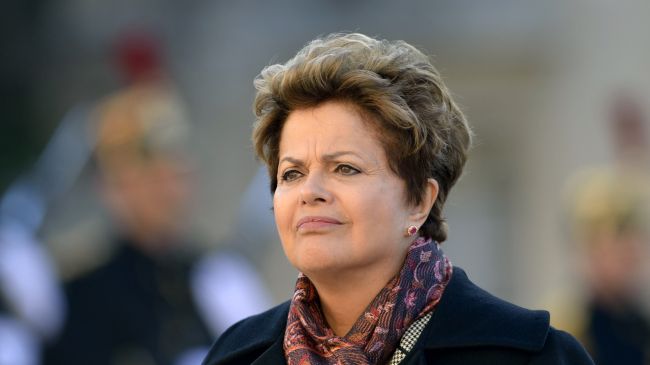
Weekly News Update on the Americas | July 1, 2013
On June 24 Brazilian president Dilma Rousseff began a week of meetings with various groups—youths, unionists, campesinos, political party leaders, state governors, congressional leaders and Supreme Court members—in response to the massive protests that broke out in the middle of the month [see Update #1181]. Rousseff initially proposed a plebiscite on holding a constituent assembly to reform the Constitution, but she quickly dropped the idea. Instead, she proposed a plebiscite that would allow voters to choose from various options in three areas: public financing of political campaigns, methods of electing legislators and voting by party list. The vote would be held by October.
In a note published on June 28, former president Luiz Inácio Lula da Silva (2003-2011) supported Rousseff’s proposal, which he said “has the merit of breaking the impasse on this decisive question, which for decades has entered and left the national agenda without accomplishing significant changes.” Rousseff and Lula are both members of the center-left Workers Party (PT). The opposition parties oppose the plan, which some analysts think could open the way to the sort of political transformation that center-left presidents have carried out in other Latin American countries. In the opposition’s counter-proposal, the National Congress would develop a reform plan and the government would then hold a referendum allowing voters to accept or reject the entire project. (El País (Madrid) 6/28/13 from correspondent; La Jornada (Mexico) 6/29/13 from AFP, DPA, Notimex)
For its own part, the National Congress responded to the protests with legislation, much of which had been stalled for months. On June 26 the legislators voted down a constitutional amendment that would have limited federal prosecutors’ authority to investigate crimes; many protesters considered the amendment an effort by politicians to stymie corruption investigations. In addition, the Senate passed a bill making corruption a crime as serious as murder or rape; the Chamber of Deputies is expected to pass it later. The Chamber passed a bill allocating 75% of revenues from oil production to education programs and the remaining 25% to healthcare.
Meanwhile, the protests continued, although on a smaller scale than the week before. On June 26 some 50,000 people demonstrated in Brazil’s third largest city, Belo Horizonte in the eastern state of Minas Gerais, while Brazil’s soccer team was playing the Uruguayan team; the allocation of funds to international sports competitions rather than education and health has been a major grievance in the demonstrations. Hooded youths threw rocks at the police, who used tear gas to keep the protesters 3 km away from the city’s Mineirão stadium. According to the authorities a young man was seriously injured and at least 24 people were arrested; looting was reported, along with two fires and damage to dozens of stores. In Brasilia, protesters kicked soccer balls towards the police line at the Congress building. (La Jornada 6/27/13 from Reuters, AFP, DPA, Xinhua)
One of the main triggers of the mass protests was a series of small demonstrations early in June by the Free Pass Movement (MPL), a São Paulo-based organization fighting an increase in transit fares. MPL was the first group scheduled to meet with Rousseff on June 24. Before the meeting, they issued an open letter to the president saying they were surprised by the invitation since “social movements in Brazil always suffered repression and criminalization…. We hope that this meeting will mark a change of position by the federal government that will extend to other social struggles: to the indigenous peoples, who, like the Kaiowá-Guaraní and the Munduruku, have suffered various attacks from large landowners and the public power; to the communities affected by evictions; to the homeless; to the landless; and to the mothers whose children were murdered by the police in the peripheral neighborhoods.” (Adital (Brazil) 6/24/13)
Related article
- Brazil protesters give Rousseff tenuous truce (thestate.com)
Ecuador snubs US trade ‘blackmail’ over Snowden, offers human rights training
RT | June 28, 2013
Ecuador renounced trade benefits which the US threatened to revoke over the Latin American country’s consideration of harboring NSA leaker Edward Snowden. It offered $23 million a year to fund human rights education for Americans instead.
The government of leftist President Rafael Correa came up with an angry response on Thursday after an influential US senator said he would use his leverage over trade issues to cut preferential treatment of Ecuadoran goods at the US market, should Ecuador grant political asylum to Snowden.
“Ecuador will not accept pressures or threats from anyone, and it does not traffic in its values or allow them to be subjugated to mercantile interests,” government spokesman Fernando Alvarado said at a news conference.
He added that Ecuador is willing to allocate $23 million annually, an equivalent of the sum that it gained from the benefits, to fund human rights training in the US. It will “avoid violations of privacy, torture and other actions that are denigrating to humanity,” Alvarado said.
US Senator Robert Menendez, who heads the Foreign Relations Committee in the Senate, said this week that Ecuador risks losing the benefits it enjoys under two trade programs because of its stance on the NSA whistleblower.
“Our government will not reward countries for bad behavior,” he said.
The US is Ecuador’s prime trade partner, with over 40 percent of exports going to the US market.
Both programs were due to expire by the end of next month and were subject to congressional review. Before the Snowden debacle arose, the US legislature was expected to scrap one of them while renewing another one.
Snowden has applied for political asylum, hoping to find protection from American prosecutors, who charged him with espionage over his leaking of classified documents on US surveillance programs.
He is currently thought to be staying in the transit zone of a Moscow airport. He became stranded in the Russian capital after arriving from Hong Kong, because the US annulled his travel passport as part of its effort to get him to American soil for trial.
‘Vitoria!’ Mass protests force Brazil congress to reject ‘bill of discontent’
RT | June 26, 2013
Brazil’s legislative body has thrown out a proposed constitutional amendment, which was a key grievance of protesters across the country. The government is also planning to introduce a range of political reforms to appease demonstrators.
In what in being seen as a victory for people power, the measure was defeated on Tuesday by Congress by 430 votes to nine; with the Rio Times saying the protests were “largely fueled by social media and citizen journalists.”
The amendment, known as PEC 37, would have limited the power of state prosecutors to investigate crimes.
The protesters had argued that PEC 37 might have opened the way to more corruption; a problem which is endemic in Brazil.
Brazil ranks 69 out of 174 countries on the 2012 Transparency International index, a score that indicates significant problems with corruption.
The defeat of PEC 37 will keep public prosecutors at the forefront of the fight against corruption. If the amendment had become law, it would have granted power to carry out criminal investigations exclusively to the police.
Critics to the bill argued that it would have prevented prosecutors from conducting fair, impartial and effective criminal investigations, particularly into organized crime and corruption, in which the police themselves have been embroiled. In December last year 63 police officers were arrested after a yearlong bribery investigation.
The police in Brazil are amongst the most corrupt in the world and have been mired in recent years in a number of corruption scandals.
Congress also voted Tuesday to funnel all revenue and royalties from newly-discovered oil fields off the Brazilian coast into education and health.
The new fields are among the largest finds in recent years and, once fully operational, are expected to produce tens of billions of barrels of oil; although they are located deep on the ocean floor and extracting the oil will require expensive new technology and carries huge risks.
Protestors also voiced their anger at other issues, which they say the government is mishandling, including soaring levels of corruption, poor public services and the huge cost of staging the 2014 World Cup and 2016 Summer Olympics, both to be held in Brazil.
The government, though, has promised a range of initiatives, which they say will combat corruption and improve public services.
A referendum proposing political reform is meant to address campaign financing and political representation, and the government says a vote may take place as soon as September 7.
A controversial plan to bring in foreign doctors to reverse a shortfall in the country is being pushed through despite the objections of Brazilian medical practitioners and an increase in public transport fares in many cities has also been scrapped. The President of the Senate, Renan Calheiros, has even proposed free transport for students.
Yet it is still unclear whether or not these hasty political concessions are having an impact. Protests are due to continue in the city of Belo Horizonte Wednesday, with tens of thousands of people expected to take part.
In a security nightmare for police, the demonstration will take place at the same time as the semifinal of the Confederation Cup between Brazil and Uruguay. One protest group has said it plans to protest outside the national team’s hotel.
Last Saturday there were violent clashes in Belo Horizonte during another protest and President Rousseff has warned against a repeat of violence.
Rafael Correa, the Press, and Whistleblowers
By ADAM CHIMIENTI | CounterPunch | June 25, 2013
Once again, we are witnessing a growing frustration with “tiny” Ecuador. The United States government is clearly not happy with what would be the latest diplomatic slap in the face coming from the South American country, i.e. the pending arrival of NSA whistleblower Edward Snowden in the coming days. Beyond the United States’ government though, the US press corps are also seemingly up in arms. Why are they so angry? Well, it appears that they are indignant over the perceived hypocrisy of President Rafael Correa.
According to an article from The Atlantic (and another similar one from NPR here), the Ecuadorian leader “has created a safe space for foreigners like Assange — and now possibly Snowden –[but] he doesn’t do the same for dissenters within his own country.” News agencies like NBC News and The Atlantic think this is “interesting” and want to know ‘Why Ecuador?’ Such inquiries naturally turn to the NGOs, who are also less than pleased with this unruly little country. Freedom House, the Committee to Protect Journalists and others are upset that this very week, the one-year anniversary of Assange being holed up in the Ecuadorian Embassy in London (and the same week that the Snowden asylum request is being reviewed), the Ecuadorian National Assembly has passed a Communications Bill that detractors claim is a major blow to a free press.
Claims of Hypocrisy
For several of the opposition figures and US-based observers, Ecuador’s new media legislation has sealed the deal on the stasi-like state that they imply or openly charge Correa has been dreaming about for years. In other words, transparency advocates like Assange and Snowden are compromising their credibility by associating with the Correa government. Ileana Ros-Lehtinen, the right-wing terrorist supporter/US Congresswoman representing Miami, has been busy tweeting as much. The Ecuadorian government, however, asserts that the bill is meant to place more media power in the hands of public groups and move away from privately owned media monopolies.
Meanwhile, the Council of Hemispheric Relations, Center for Strategic and International Studies, and the Heritage Foundation all say that Ecuador must be punished for this latest insult to the US government. James Roberts of Heritage lashed out at the South American leader on June 24, writing in the National Review Online:
“Rafael Correa has demonstrated a blatant disregard for international standards of justice. That kind of conduct may not be surprising from a man who seeks to don the mantle of Chávez, but it should not be rewarded with trade preferences.”
It doesn’t take much imagination to understand how a figure like Correa would have been dealt with a few decades back, but it appears that the more heavy-handed approach is not really possible at the moment, much to the dismay of the powerful and connected.
Returning to the issue of freedom, has the defiant president of Ecuador used the National Assembly to pass a law that NPR, The Atlantic and others tell us will be used to make the country less transparent and more hostile to journalists who only wish to be free to monitor the government and act as a check on state power? Well, let’s hold off on the most absurd elements of irony here for a moment and address the issue at hand.
About a Coup
It should certainly not be regarded as a good thing if the case was simply a cut-and-dry example of authoritarian overreach. Freedom of the press, as we are learning with the Snowden case, has seemingly never before been so important, or so contentious for that matter. However, the Ecuadorian issue is not so simple and it was certainly complicated after a day of crisis nearly three years earlier when factions of the National Police and armed forces attacked the president of Ecuador on September 30, 2010. The event was widely regarded as a coup attempt. What exactly went down is still somewhat unclear. There was a dramatic showdown between Correa himself and police officers that were angered by a supposed attempt to cut their pay. What is for certain, though, is that it was a countrywide, well-coordinated attempt to shut down the National Assembly, the two major airports in Guayaquil and Quito and eventually a hospital where the president was being treated for wounds. Furthermore, the plotters were also attacking journalists throughout the country, and most of these were pro-government reporters working for public media outlets.
The opposition press has taken an active role in attempts to discredit Correa since he first ran for president. He has elaborated on his views of the press and they are certainly not very congenial. In 2012, during a public TV interview in Spain, Correa said, “one of the main problems around the world is that there are private networks in the communication business, for-profit businesses providing public information, which is very important for society. It is a fundamental contradiction.”
One of the issues that NGOs and journalists have cited in their litany of complaints about Ecuador’s endangered freedom of the press actually stems from the 2010 police and military uprising. During the chaos that ensued during the alleged coup attempt, one reporter from the paper of record in Guayaquil took the opportunity to claim that Correa had ordered police to fire on a crowd of innocent onlookers caught up in the melee, presumably aiming to provoke anti-government sentiments. The claim turned out to be completely unsubstantiated. The government fined the journalist and his paper El Universo some $40 million for defamation but later withdrew the charges. Consider what might have happened in the US if the Los Angeles Times or Washington Post would have falsely claimed that Barack Obama had personally ordered military or police forces to fire on a crowd of protesters and innocent people were injured as a result somewhere in Washington, D.C It would be difficult to imagine a reporter and his editors ever committing such a stupid move, but if they had, there would have been some serious consequences. Alas, this is not really too shocking in the context of a sensationalist Latin American press.
Televised and Untelevised Revolutions
That dramatic Ecuadorian affair is reminiscent of the 2003 documentary film The Revolution Will Not Be Televised,directed by the Irish filmmakers Kim Bartley and Donnacha Ó Briai. The pair happened to be in Caracas, Venezuela during one of several 21st century Latin American coup attempts thus far. The film provided a key glimpse into the nature of media in the region, so often dominated by pro-US elites. It showed the efforts expended by private media outlets to incite anger and get people out in the streets in order to challenge the power of anti-Washington governments.
Right up until his death, it was a sort of requirement for US and European governments, journalists and NGOs to claim that Hugo Chávez Frías was a dictator for not renewing the license of RCTV. The outlet, owned by Marcel Granier, was one of the most virulent anti-government television stations operating on the state-owned airwaves and the Venezuelan government eventually forced them over to cable television. The criticism of the allegedly authoritarian leader served to cover up the very questionable coverage by corporate media. Indeed, one anti-Chávez commentator honestly noted six months ago that the idea that Chavez ever controlled the Venezuelan media was a myth. He pointed out that back in April 2002,
“Coup plotters collaborated with Venezuelan media figures before the coup. The media refused to show statements by officials condemning the coup d’état. When the coup d’état failed, the private Venezuelan networks refused to broadcast the news that Chávez had returned to power.”
“Correa is a Very Smart Guy”
The Venezuelan experience did not escape the attention of the rather astute and confident Correa. Neither did the fact that, only 15 months prior to the attempted coup in Ecuador, there was a successful coup in Honduras, removing the president of that country, Manuel Zelaya, by gunpoint in the middle of the night. This was considered to be illegal by President Obama himself, although soon after the offending and illegitimate new government of Roberto Micheletti was accepted by his administration and is still backed to this day by Washington (under current President Porfirio Lobo). This support comes despite a terrible record of human rights abuses and, yes, a genuine threat to a the flow of crucial information. Journalists have been censored and intimidated since the 2009 coup in Tegucigalpa and, what’s worse, have frequently been murdered by the government and its allies. Honduras consistently ranks as one of the most dangerous places in the world to be a journalist. The double standards are blatant and many would like to see the opinion-makers from the States take a closer look in the mirror.
Popular Support and Popular Media
Anyone who would have spent some time watching The Revolution Will Not Be Televised would have also learned what President Hugo Chávez, then only a mere three years into his presidency, meant to the millions of impoverished and the historically marginalized majority in Venezuela. This did not stop the State Department and its allies from focusing on how best to rid Venezuela of its president. (Incidentally, while doing an internship for the State Department in the fall of 2001, I was invited by the Public Diplomacy department to work on ideas on how to get the message out to Venezuelan people about the dangerous nature of President Chávez.) That coup attempt failed, as the one in Ecuador would eight and a half years later, mainly because the people staunchly backed the president of the Republic.
At the time of the 2002 coup attempt, Chávez was wildly popular and the same was true of Rafael Correa in September 2010; two weeks before the coup attempt, polls found that he had the support of 67% of respondents in the capital Quito and nearly 60% in his native Guayaquil, the second largest city. Correa actually got a nice bump in approval ratings after the whole affair and, more recently, he has just won a major reelection bid in February of this year precisely because he has brought political and economic stability to the country of 15 million people. Poverty has been reduced dramatically since Correa took office. Public works projects have resulted in huge improvements to the country’s infrastructure and, more importantly, there is a sense of independence from the yoke of neocolonialism so prevalent in years past.
It appears that Correa and the government may have some good reasons to increase the influence of publicly owned media companies and challenge private corporate media elites. This foray into press control is a dangerous game, however, especially since there appear to be some genuine concerns from indigenous and environmental activists who oppose the government’s expansive plans for an economy based primarily on extraction. Often, those who disagree with Correa are dismissed as childish Marxists, or more alarmingly, terrorists. There must be more attempts to reach a humane and considerate consensus on some of these crucial issues, especially as the Chinese enter the fray in search of resources to fuel their economic needs and a gateway into South America (and Ecuador recovers from two major oil spills so far this year). There are clearly opportunities, but also responsibilities to the environment and the people that live outside of the metropoles.
With such considerations in mind, is there a reason to agree with the opinion-makers in the US who would dub Correa as a dictator, increasingly revealing his dangerous nature?
One of Correa’s main antagonists is Martin Pallares, a senior political editor at one of the major national newspapers El Comercio. Pallares recently said, “I think freedom of press in Ecuador is gravely threatened by a system managed by the government. They have the objective to discredit the media, affect their credibility. And they also want to characterize the press like political adversaries and destabilization agents.” In a very important sense, the media should or even must by its nature act like political adversaries. Destabilization is a different story however. In the case of the coups in Latin America, there is typically interference by Western powers, especially the United States, and this often serves to destabilize governments Washington deems troublesome (through the funding of local civil society groups via the National Endowment for Democracy, USAID and, of course, the CIA). The message is often that these groups are just trying to further democratic causes, but this belies an obvious mission by colluding corporate and government powers that is evident throughout the many anti-democratic interventions and support of such leaders in postwar history (from Iran in 1953 to both the Maldives and Paraguay in 2012).
Felonious Journalists
Returning to the issue of irony, here you have several of the leading news outlets in the US reporting on the lack of media freedom in Ecuador, yet ignoring the major issues raised by leakers, journalists, and publishers such as Bradley Manning, Julian Assange, Glenn Greenwald and Edward Snowden. In effect, these major corporate outlets are legitimizing or are even themselves guilty of demonization of these individuals who have put everything on the line to get the public talking about some serious violations of human rights and privacy, and the dangerous encroachment of the corporate state. One has to wonder if the fact that many of these commentators themselves are getting paid major corporate money has anything to do with their take on the Snowden/Ecuador affair.
If you watched the Sunday morning talk show highlights, you should be able to draw your own conclusion. One jaw-dropping example of the corporate media’s lack of objectivity in this discussion was the meticulously staged interview that George Stephanopoulos did with General Keith Alexander, the man who has access to the personal data of nearly anyone he so chooses to target. There were several moments in which the responses to some of the host’s softball questions were so weak (lots of babbling about dots) that it was unbelievable that Stephanopoulos didn’t pounce. Yet, why he did not or would not do such a thing is evident considering the establishment’s treatment of the recently departed journalist Michael Hastings, loathed for his refusal to play footsie with the biggest fish in the game. That sort of behavior simply cannot be tolerated.
Also on the talk show rounds, there was David Gregory’s aggressive and ethically revealing accusation thrown at guest Glenn Greenwald in the form of a ‘tough question’. Gregory actually asked Greenwald why he shouldn’t be charged with a crime, and The Guardian columnist sharply replied that it was “pretty extraordinary that anybody who would call themselves a journalist would publicly muse about whether or not other journalists should be charged with felonies”, with no evidence of wrongdoing. But there you have the attitude that the establishment needs to maintain close ties; it mustn’t be overly adversarial and never threaten the stability of the government or a particular administration, even if that means sitting on stories such as the spying on US citizens, like The New York Times was guilty of in 2004 when it delayed publication of a story on government surveillance after being approached by the Bush Administration.
Indy (media) to the Rescue
Modern professional journalism often leaves us wanting for more. Thankfully, we have the independent media outlets that are often way ahead on exposing some of the more heinous crimes of the times. This helps millions around the world identify the mantras of the media elite in the United States: 1) the corporate bias is never to be exposed or acknowledged; 2) it should never be overly adversarial to the government; and 3) a “journalist” should always attempt to divert from important issues that arise from whistleblowing by attacking the whistleblower’s character.
Of course, all of these conventions go out the window when it comes to perceived enemies, in which case the media, NGOs, corporations and the US government always work together in delegitimization and destabilization efforts. Snowden has followed Assange’s lead and is headed to Ecuador not simply because, as The Atlantic has suggested, both parties feel persecuted or they want to ‘poke the US in the eye’. The reason why Ecuador has offered asylum and why Snowden was seeking it from them is because they believe that there is hope in the future, beyond the grossly excessive power of the United States and its presumed worldwide dominion. The whistleblowers and the Ecuadorian leaders, like countless others around the world, believe that the only hopeful way forward is to shatter the antiquated and dangerous notions inherent in establishment journalism, corporate supremacy, and US hegemony. I guess it is no surprise that the privileged classes vehemently disagree.
Adam Chimienti is a teacher and a doctoral student originally from New York. He can be reached at ajchimienti@gmail.com.
Related articles
- Huffington Post Misguidedly Attacks Rafael Correa
- Reporting Ahead of Ecuadorean Elections Fits a Familiar Narrative
- The Ecuadorian Coup: Its Larger Meaning
- Behind the Coup in Ecuador – The Attack on ALBA
- Target: Ecuador
- Ecuador Will Cease Participation In School Of The Americas
- Ecuador to maintain foreign policy, ties with Iran: FM
Protests in Brazil Reflect Ongoing Disparities
By Kyle Barron | NACLA | June 25 2013
Hundreds crammed into a room for over six hours, passing around the microphone so that everyone could weigh in. The protestors, mostly students, called the meeting in order to better articulate their message after Rio de Janeiro’s Mayor, Eduardo Paes, had requested to meet with one of the university groups. They emerged that Thursday night with five demands—”five points”—they felt would bring cohesion to the slogans splashed across the signs being waved in the street.
This meeting, or plenaria, took place on Tuesday, June 18, the day after the protests first surged and two days before over a million people took to the streets in over 100 cities across Brazil. While there is no uniformity to all the protests from city to city, and—as Kate Steiker-Ginzberg, a 23-year-old from Philadelphia who attended the plenaria insisted—there exists diversity among protestors within each city, the five points coming out of the plenaria address issues cutting across the various protests.
The first point addresses the 20-cent increase in transportation fare, what has been seen as the catalyst for the protests. While this may not sound like a significant fare hike, as Steiker-Ginzberg explains, it represents a “political miscalculation” on the part of the administration. The fare increase was implemented the same day as the Confederation Cup opened in Brazil. Since 2005, this international soccer tournament had served as a rehearsal for the World Cup, which will be held in Brazil next year. Many were frustrated that the price hike would go toward the extravagant sporting facilities instead of improving the dismal public transportation that is often slow, overcrowded, and dangerous—despite the relatively steep price Brazilians pay for their public transportation.
The fare hike was one among many contributing factors to these protests, and together with the other points addressed by the plenaria, reflects grievances that have been brewing across Brazil for quite some time. The second point concentrates specifically on the excessive spending on mega-events instead of on investment in health and education. Along with the World Cup, Brazil is slated to host the 2016 Olympics.
This taps into the broader question of who benefits from these mega-events. While the country is pouring massive amounts of public funds into the construction and improvement of stadiums, some people complain of the poor state of public infrastructure, hospital overcrowding, and low educational performance in Brazil. As soccer-player-turned-congressman Romário de Souza Faria criticizes, the money for the World Cup could have been used for “8,000 new schools, 39,000 school buses or 28,000 sports courts in the whole country.”
Cost benefit analysis of mega–events shows that these exorbitant affairs rarely deliver many of the economic outcomes promised. While it is estimated that Brazil will spend over $12.5 billion in preparation for the World Cup, it looks as though private interests are the ones poised to benefit most from these events. FIFA reported a profit of $202 million from the 2010 World Cup in South Africa. As their financial statement boasts, “The 2010 FIFA World Cup South Africa™ was a huge success, a fact that was reflected by its financial result.” Most of these profits are a result of selling broadcasting rights and sponsorships, with a smaller percentage coming from ticket prices. Similarly, the International Olympic Committee (IOC) garnered $250 million from the last Olympic games, the majority of those profits coming from television licensing.
Furthermore, Brazil has spent over $473 million in public funds on improvements to the Maracanã, Rio de Janeiro’s iconic soccer stadium, which will host the World Cup Final as well as stage the opening and closing ceremonies of the Olympic games. This investment was on top of the almost $300 million that had been spent on renovations to the stadium during the last 15 years. Earlier this year, after months of negotiations, Maracanã was privatized with the granting of a 35-year contract to a consortium of investors for a comparatively low price tag of $85 million. After public outcry over the deal, a judge reversed the ruling, citing irregularities and claiming that one of the companies involved in the deal had an unfair advantage in the process. Finally, on May 13, the judgment was reversed again, allowing the privatization to continue. Beyond the importance as the site for the most high-profile moments in the upcoming mega-events, the stadium has long been a cultural symbol for Brazil. According to Steiker-Ginzberg, “this major symbol of democracy and public space and class intermingling in the city is now being destroyed and privatized.”
The megalopolises of Rio and São Paulo are not the only places the public’s money is being spent. Throughout Brazil, $13.9 million will be put toward preparing for the World Cup and the Olympics. In many of these places, such as the northeastern city of Manaus, the excessive and over-budget spending does not seem justified. This is especially true considering that after the games are over, Manaus’s $246 million Amazonia Arena is predicted to be underutilized in the city of 2.3 million people. This could be true of other stadiums around Brazil as well—Brasília, Cuiabá, and Natal simply don’t have clubs with a following that would justify the investment over the long term.
The third concern of the plenaria focused on the criminalization of protests and the militarized response of the police to demonstrations. Social media has been rife with images of the riot police with Choque emblazoned on their shields, indicating they are “shock troops,” shooting rubber bullets, using pepper spray, and hurling seemingly endless canisters of tear gas at protestors. These crowd-control tactics have been so aggressive that some have termed this the Vinegar Revolution, in reference to the palliative effects the common kitchen staple has against tear gas. As Brazil and Security Policy expert Joseph Bateman explained in an interview with the Washington Office on Latin America, while other sectors throughout the government have opened up to civil participation since the end of the military dictatorship in 1985, the security sector has only just begun to do so, and “a lot of police still see their role as protecting the state, not protecting citizens.” This has been especially salient in São Paulo, where protests intensified in response to images of police brutality, particularly against journalists, that circulated on social media. Shock police shot a journalist, Juliana Vallone, at point-blank range in the face.
This violence against protestors is tied into the fourth point, which aims to democratize the media. There has been criticism that the major media networks, primarily O Globo, have been concentrating on the vandalism and violence of the protestors while largely ignoring the police brutality against the protestors. The fixation on the violent aspects of the protests is also at the expense of the reporting of the largely peaceful expression coming from the majority of protestors. As a university professor remarked after recently arriving for a visit to her native Rio de Janeiro, “it’s sad that some television stations only show the destruction and fail to show the people that want a better Brazil.”
The fifth point concerns the forced evictions and community removals resulting from the major urban transformation taking place in Brazil. In 2012 in São Paulo, 2,000 riot police were called in to suppress the uprising of more than 6,000 residents who refused eviction in the community of Pinheirinho. Many of these evictions throughout Brazil are being done in preparation for the World Cup and Olympics. Rio’s oldest favela, Providência, has lost its central square—the community’s only public space—to Olympic construction. Almost 5,000 residents are slated for eviction in this community alone. Altogether 170,000people throughout Brazil are facing removal or have already been evicted. The Popular Committee for the World Cup and the Olympics, a human rights group based in Rio, estimates that over 10,000 families will be affected in Rio de Janeiro alone because of these mega-events.
These forced evictions have been taking place amidst a major real estate boom throughout Brazil.

According to Forbes, Brazil is the country with the most rapidly increasing home prices in the world. In Rio, the rise in home prices has been four times greater than the rise in wages over the last five years. Donald Trump is investing in five skyscrapers in the city that, according to the developer’s website, will be the “largest urban office development in the BRIC [Brazil, Russia, India, and China] countries.”
Critics contend that many of these evictions are driven by economic incentives. The city of Rio de Janeiro has used a host of reasons to justify the demolition of the community of Vila Autódromo—from environmental and safety concerns to its use as a security or media zone for the Olympics. It is reported that the mayor of Rio de Janeiro, Eduardo Paes, entered into a partnership with private companies that will open up 75% of this site for private development after the Olympics. His reputation for these kinds of deals recently made headlines after a physical altercation with a constituent who accused him of catering to the interests of developers.
While the government does provide several forms of compensation to communities facing removal, the resettlement programs have systematically moved poor residents away from the high-value land and into peripheral areas of the city with little access to transportation or employment opportunities. Furthermore, O Estadão reported that the City of Rio de Janeiro paid $8.9 million for resettlement land to two companies—both contributors to Mayor Paes’s election campaign. After this was revealed, Paes revoked the deal.
On Saturday, June 15, communities affected by these evictions came together on the same day as the Confederation Cup opened, not far from Maracanã stadium for their own soccer tournament. The People’s Cup Against Removals was organized to “give a voice, to give time, to give space for those being excluded and for those being removed.” The stark contrast between the newly renovated stadium hosting the precursor to the World Cup and the small and humble field occupied by the People’s Cup players reflected the disparities at the heart of many of these protests. “I think that’s something that people woke up to,” remarked Steiker-Ginzberg, “the disparity between the investment in these stadiums and then people overflowing out of the public hospitals and ambulances not arriving on time . . . You can’t just reverse a 20 cent hike and expect everyone to get off the streets.”
Related
- Brazilian legend Romario questions 2014 World Cup (prosoccertalk.nbcsports.com)
- The Last Word: Mr Blatter, the party’s over (revoltadosvintecentavos.wordpress.com)
- Brazil: In The Eye Of The Storm – Video
Honduras: Judge Suspends Case Against Indigenous Leader
Weekly News Update on the Americas | June 23, 2013
After an eight-hour hearing on June 13, a court in Santa Bárbara, the capital of the western Honduran department of the same name, suspended a legal action against indigenous leader Berta Isabel Cáceres Flores for the alleged illegal possession of a weapon. According to Cáceres’ lawyer, Marcelino Martínez, the court found that there was not enough evidence to proceed with the case. Cáceres, who coordinates the Civic Council of Grassroots and Indigenous Organizations of Honduras (COPINH), is now free to travel out of the country, although the case could still be reopened. Representatives from some 40 organizations came to the city on June 13 in an expression of solidarity with the activist.
Cáceres was arrested along with COPINH radio communicator Tómas Gómez Membreño on May 24 when a group of about 20 soldiers stopped their vehicle and claimed to find a pistol under a car seat. Cáceres and Gómez Membreño had been visiting Lenca communities that were protesting the Agua Zarca hydroelectric project. The leader of the military patrol, First Battalion of Engineers commander Col. Milton Amaya, explicitly linked the arrests to the activists’ political work: the Honduran online publication Proceso Digital reported that Amaya “accused Cáceres of going around haranguing indigenous residents of a border region between Santa Bárbara and Intibucá known as Río Blanco so that they would oppose the building of the Agua Zarca hydroelectric dam.”
According to SOA Watch—a US-based group that monitors the Western Hemisphere Institute for Security Cooperation (WHINSEC), formerly the US Army School of the Americas (SOA)—Amaya has studied at the school on two occasions. (Proceso Digital 5/26/13; Adital (Brazil) 6/14/13; Kaos en la Red 6/14/13 from COPINH, Radio Mundo Real, Honduras Libre, Derechos Humanos; SOA Watch 6/21/13)
Related articles
- US senators question aid to Honduras, citing extrajudicial killings (alethonews.wordpress.com)
- Honduras: Three Farmers Killed During Land Eviction (alethonews.wordpress.com)
Venezuela Promotes Breastfeeding over Baby Food, Corporate Media Spins Out of Control
By Tamara Pearson | Venezuelanalysis | June 20, 2013
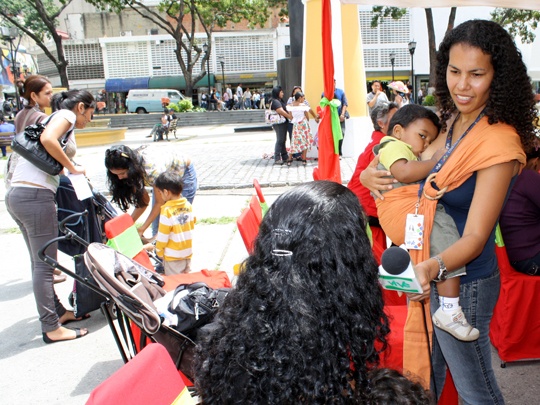
A Venezuelan public media journalist breastfeeds as she works. Public breastfeeding is fairly accepted in Venezuela (blog.chavez)
Venezuela’s national assembly is debating a reform to its breastfeeding law which could see baby food companies like Nestle fined in certain situations. The corporate media have reacted hysterically to the law, claiming that President Nicolas Maduro is “taking bottles from babies’ mouths”.
Though breastfeeding is widely promoted by the Venezuelan government, and public breastfeeding is relatively de-stigmatised, a study by Venezuela’s National Nutrition Institute (INN) between 2006 and 2008 showed that only 55% of mothers exclusively breastfed when their baby was born, going down to 20% when their baby was three months old, and 11% by six months.
The percentages have probably increased since then, with broad educational campaigns in public schools and health centres, and actions such as mass public breastfeeding in plazas, organised by the INN.
However, the low figures reflect the low confidence some mothers have in their ability to breastfeed, as well as the power of multinational infant formula companies in health centres. It is common practice to give infant formula to babies from the moment they are born, without the consent of parents, according to LactArte, a pro-breastfeeding collective in Venezuela. Companies give gifts and other promotions to health workers and health centres in order to create alliances with them, and give free samples of the products to new mothers, thereby creating dependent consumers of new born babies, or at least discouraging exclusive breast feeding.
What the law actually says
In 2007 Venezuela’s national assembly passed the Law of Protection, Promotion, and Support for Breastfeeding. The law regulates the way baby formula and baby food companies advertise and label their products, and how they interact with hospitals and clinics. However, the companies have been ignoring the law, as it doesn’t specify penalties. The reform to the law currently being discussed is looking at penalties of US$600 – $50,000, and also training for health professionals. Once the reform is passed in first discussion by the assembly, it will be subject to “street parliament” – discussion by collectives and Venezuelan citizens, to then be passed by the national assembly in second discussion.
The 2007 law argues that breastfeeding provides babies with “all the necessary nutrients” in their first six months, as well as “protecting them and immunising them from illness and contributing to the development of their breathing and gastrointestinal capacity”. It states that “mothers have the right to breastfeed their children, with the support and collaboration of the fathers… [who] should provide all the support necessary so that mothers can provide this human right… The state, with solidarious participation from organised communities, will promote, protect, and support exclusive breastfeeding…of children under six months of age and breastfeeding with complementary food … until the age of two”.
Concretely under the law, health workers and health centres must help mothers start breastfeeding within the first half hour of birth, and guarantee that the newborn is always near the mother after birth, except in exceptional medical situations. They should also educate mothers, fathers, and the family on the issue, and abstain from providing babies under the age of 6 months with food other than breast milk, except when there is a specific medical need. Health centres must create human milk “banks”.
Baby food and formula products must be in Spanish or Venezuelan indigenous languages (Nestle products for example, often aren’t), and they should inform of the risks of including such food in the baby’s diet too early. Publicity or labelling can’t create the impression that such food is equal to breast milk, and publicity of any kind discouraging breastfeeding is not allowed.
All food aimed at children under three must include labelling that clearly states its ingredients, including any GMO products, and milk formulas must including a warning that “breast milk is the best food for children under two years old”.
Samples, prizes, and promotions of baby food and formula are prohibited. Likewise, companies are prohibited from donating toys, books, posters or other products which promote or identify their company to health centres, and they are also prohibited from donating “gifts” to health centre workers and from sponsoring events or campaigns aimed at pregnant or breastfeeding women, fathers, health professions, families, and communities.
Breastfeeding rights in Venezuela
Last year, with the passing of the new labour law, women’s breastfeeding rights were further expanded. Post-natal leave was extended to six months, and articles 344-352 state that mothers have the right to two half hour breaks per day to breastfeed. If there is no breastfeeding room provided by the work place, that is extended to two 90 minute breaks, and all employers of more than 20 workers must maintain a nursery centre with a breastfeeding area.
For Luisa Calzada and Kaustky Garcia, of LactArte, breastfeeding is also an act of food sovereignty – that is, third world productive or economic independence from greedy transnationals. Garcia argued that such sovereignty has been “sabotaged” in Venezuela by the “transnational industry dedicated to the business of infant formulas”. Indeed the industry is huge here – visit any supermarket or corner shop and you’ll see full aisles or shelves of powdered baby milk formula and compote.
LactArte supports a boycott of Nestle, one of the main powdered milk formula companies here, producing the infamous Cerelac since 1886. They argue that there is“collusion” between the baby food industry and the medical industry, with the food transnationals enlisting an “army of health professionals” to sell baby formula.
According to Business Insider, infant formula is an $11.5 billion market. The International Baby Food Action Network (IBFAN) claims that Nestle, apart from distributing free samples of its products in maternity wards, also uses “humanitarian aid” to create markets, and offers gifts and sponsorship to influence health workers to promote its products. According to a 1982 New Internationalist article, Nestle makes mostly third world mothers dependent on its formula in three ways: “Creating a need where none existed, convincing consumers the products are indispensable, and linking products with the most desirable and unattainable concepts- then giving a sample”.
What the corporate media are saying
The 2007 law and the draft reforms do not ban the production or sale of baby food or formula, as national and international media have alleged, nor do they apply any fines to mothers or penalise any choices regarding her body that a mother may make. The penalties are only for health care centres and their workers, and baby food and formula companies.
However the corporate media over the last two weeks has completely distorted the issue. Fox News Latino headlined “Venezuela Wants To Ban Baby Bottles To Promote Breast-Feeding” and stated that “Motherly love has become a state affair in Venezuela”.
Growing Your Baby also headlined “Venezuela considering baby bottle ban”, and opened with the utterly misinformed and misleading question, “What would you do if you woke up one morning and learned that baby bottles were no longer being made or sold in your country? This question may become a reality for Venezuelan moms who may not have planned on breastfeeding”.
Reuters won the prize however for manipulation and sensationalism, with the headline “Venezuela considers taking bottles from babies’ mouths”, while other agencies have carried similar titles along the “banning” theme, with CNN’s article “Venezuela considering a ban on baby bottles” and Huffington Post ‘Venezuela considers baby bottle ban to encourage breastfeeding’. Al Jazeera went as far as to argue in its piece that “some mothers don’t want the government telling them how to feed their children”. If Al Jazeera had bothered to read the 2007 law, it would have discovered that is actually the point of the law – to stop companies interfering, through misleading information and other gimmicks, in the breastfeeding process.
Venezuelan corporate press and other Spanish language media have been equally manipulative. Here is a small selection of their headlines: EFE: “Venezuela is debating a law to prohibit baby bottles”, Semana: “Baby bottle and dummy: the new enemies of Chavismo”, El Pais: “The Venezuelan government wants to oblige mothers to breastfeed”, El Popular: “Venezuela: Nicolas Maduro wants to eliminate the use of baby bottles”, Noticias24 “They’ll prohibit baby bottles in health centres of Venezuela in order to force breastfeeding”, El Mundo, “Venezuela declares war on the baby bottle”, and Entornointeligente, “Goodbye to baby bottles for stimulating breastfeeding”.
Garcia argued that the media campaign to demonise the law and the proposed reforms is being pushed by the milk formula industry. She said it has had an impact in Venezuela, with “many women, even those not using baby bottles, feeling scared”.
“They are worried that the government is going to try to help them to breastfeed, that the government will take away their baby bottles and infant formulas, and is going to prohibit them from feeding their infants with baby bottles, but that’s absolutely false. First of all it’s unpractical, and secondly it is this government which has most given freedom and provided information so that families can freely chose the path they desire for their children,” she said.
The World Health Organisation recommends that babies be exclusively breast fed during the first six months, and in 1981 the 34th World Health Assembly adopted a resolution which included the International Code of Marketing Breast-Milk Substitutes. Funnily enough, it stated that food companies shouldn’t promote their products in hospitals, give free samples to mothers, or provide misleading information. One wonders if these international bodies were also accused of “stealing the bottle from babies mouths”, or is that sort of rubbish reserved for countries like Venezuela where a revolution is trying to get some justice at the expense of the poor transnationals?
Medical chief at Costa Rica state hospital arrested as part of organ trafficking investigation
InsideCostaRica | June 18, 2013
A chief doctor at a Costa Rican government-ran hospital was arrested today on suspicion of being part of an international organ trafficking network which specializes in selling kidneys to patients in Israel, according to the Attorney General’s Office.
Attorney General Jorge Chavarria told the press that the arrested is Francisco Mora Palma, head of Nephrology at Calderon Guardia Hospital, one of the largest state medical centers in the country.
“The patients who required the transplants were in Israeli territory, and some of the (trafficking) victims [had their kidney removed] here and others were transported to Israel. We have information that at least one person died after being operated on in Israel,” Chavarria said.
The prosecutor explained that the organization has branches in Israel and Eastern Europe, though did not elaborate, citing the ongoing investigation.
Authorities have identified at least three Costa Ricans who were paid in exchange for one of their kidneys.
In addition to Mora Palma, authorities have arrested a police officer identified by the last names Cordero Solano, who collaborated with the doctor to identify possible donors.
Besides the Calderon Guardia Hospital, authorities raided other locations, including two private clinics where transplants were conducted.
“This is extremely serious,” the prosecutor said, urging those who were trafficking victims to come forward to authorities without fear of losing the money they were paid. “What we need is information to dismantle this organization,” he said.
Related articles
- Organ trafficking & Israel – A message from Alison Weir (gilad.co.uk)
- Israeli arrested in Rome for organ trafficking (theuglytruth.wordpress.com)
- Israel police uncovers organ trafficking ring in north (theuglytruth.wordpress.com)
US senators question aid to Honduras, citing extrajudicial killings
Press TV – June 19, 2013
A number of US senators have questioned the Obama administration’s foreign aid to Honduras, pointing to growing reports of human rights atrocities in the Central American country that has long been regarded as a US-client state.
In a Tuesday letter to US Secretary of State John Kerry, 21 US senators cited “numerous recent killings and threats targeting [labor] union leaders, opposition figures, farmers, students, journalist and others,” emphasizing that officials of the US-backed government have been implicated in such criminal acts, which often go unpunished, The Los Angeles Times reports Wednesday.
“As the November 2013 [Honduran presidential] elections draw near, we are particularly troubled by reports of corruption and extrajudicial killings,” the senators wrote in the letter.
The development comes nearly four years after a US-sponsored military coup in Honduras, ousted its popular and democratically-elected President Manuel Zelaya, despite objections by many South American heads of state.
This is while many military and civilian officials involved in the brutal military coup still remain in power in the impoverished country, whose wealth and resources are almost entirely controlled by American corporations that operate under the protection of the country’s heavy-handed military and police forces, broadly trained by US instructors.
Honduras, according to the report, has one of the highest homicide rates in the Western Hemisphere due to a profound presence of drug traffickers, vicious gangs and brutal political killings in the country.
The growing violence has especially climbed since the US-backed military coup in the country, the report adds.
The ousted president’s wife, Xiomara Castro, was recently picked as an opposition candidate for president in the upcoming election, and “several people from her Free Party have been killed or attacked,” the report adds.
The senators further asked Kerry to submit to Congress a detailed analysis of whether the Honduran regime was doing something to “protect freedom of expression and association, the rule of law and due process” and to investigate death-squad-style killings involving government security forces.
According to the report, the United States suspended a portion of its aid to Honduras after the country’s top police commander was linked to numerous killings.
“All but about $10 million was resumed, but the Honduran government is supposed to meet a set of criteria that includes ensuring free speech, due process and the prosecution of authorities who commit human rights crimes,” it adds.
In their letter to the Secretary of State, however, the senators expressed doubts that such conditions were being met, urging Kerry to “ensure that no US assistance is provided to police or military personnel or units credibly implicated in human rights violations.”
Related articles
- State propaganda on NPR’s “Morning Edition” (alethonews.wordpress.com)
- The New York Times on Venezuela and Honduras: A Case of Journalistic Misconduct (alethonews.wordpress.com)
- Senator Menendez Meets with President Lobo to Discuss U.S. Funding for Honduras (alethonews.wordpress.com)
Featured Video
EUROPE FEARS RUSSIA’S NEXT MOVE / Ian Proud
or go to
Aletho News Archives – Video-Images
New Book
New Book: No Autoimmunity The Body Doesn’t Attack Itself
Lies are Unbekoming | September 24, 2026
 The label for Humira, once the best-selling drug in the world, lists its risks in plain print. One of them, in the label’s own words, is new “autoimmune” disease.
A drug prescribed for a condition labelled autoimmune carries a warning that it can cause a condition labelled autoimmune. That contradiction sits in every box, on a folded paper almost nobody reads.
My new book starts there.
No Autoimmunity: The Body Doesn’t Attack Itself
For seventy years, “your body is attacking itself, and we don’t know why” has ended the conversation for people diagnosed with multiple sclerosis, lupus, rheumatoid arthritis, Hashimoto’s, Type 1 diabetes, Crohn’s and psoriasis. More than eighty conditions now carry the autoimmune label. The diagnosis comes with a prescription for life. It almost never comes with a question about cause.
This book asks the question and answers it from the framework’s own records: its drug labels, its journals, its regulatory filings, and its own experiments. … continue
Blog Roll
 Aletho News
- Debunked: Trump’s egregious UNGA claims on war against Iran crumble under scrutiny
- Europe was part of the infrastructure of US aggression against Iran: Deputy FM
- New evidence on the Bucha Massacre
- Italy and France debunk reports CIA issued ‘Russian drone threat’ warning
- How Russia is Rewiring the Global South
- Britain’s elites want you ready to die for a war they keep imagining
- Inside Ukraine’s propaganda operation targeting Americans
- Hackers From US, France, Singapore Tried to Disrupt Russian Elections – Internet Provider
- New Book: No Autoimmunity The Body Doesn’t Attack Itself
- EUROPE FEARS RUSSIA’S NEXT MOVE / Ian Proud
- If Americans Knew
- Gaza winter nears as 162,000 tents become unusable, raising fears of humanitarian crisis
- Netanyahu says, “It’s the opposite of genocide”; UN says Gaza economy is world’s ‘most severe crisis on record’ – Daily Update
- Israel’s US-Backed Assault on Gaza Has Created the ‘World’s Most Severe Economic Crisis on Record’: UN
- ‘Protecting U.S. Citizens’… From Israel
- ‘This is where I live now, the back of a truck’: a day in the life of a grandmother in Gaza
- In UN Speech, Iran’s President Displays Pictures of Children Killed by US, Brings Attention to Israel’s Nuclear Arsenal
- Israel displaces hundreds of Palestinians amid wave of demolitions in West Bank
- Aid, reconstruction, and Israel’s history of obstruction in Gaza
- Trump administration digs an ever-deeper hole of complicity in genocide – Daily Update
- US-Israel $2.8 Billion Arms Deal, 40,000-Bomb Supply Faces New Gaza Complicity Accusations
- No Tricks Zone
- New Study: Earth And Venus Surface Warmth Largely Explained By Convection And Lapse Rate, Not CO2 Or Radiation
- 2025 Nature Paper Claiming Worsening Global Drought Gets RETRACTED …Heavily Flawed
- New Study: ‘Global Drought Shows No Detectable Recent Acceleration Under Climate Warming’
- Economic Masterminds: German Socialists Suggest Taxing Productivity Gains Stemming From Using AI
- The South China Sea Has Not Been Cooperating With The Climate Change Narrative
- Energy Crisis: Germany Enters Heating Season With Historically Low Gas Reserve Fill Levels
- New Study: The Antarctic Ice Sheet Gained Mass From 2020-2024 Due To Staggering Snow And Ice Accumulation
- Study: Ocean Heating Rates From Thousands Of Years Ago ‘Dwarf’ Modern Ocean Heating Rates
- Climate Extremists Target, Attack Large-Scale Power Grid Infrastructure In Germany!
- New Study: Antarctic Ice Melt Has Contributed Less Than 1 Centimeter To Sea Level Rise In The Last 30 Years

