Meet Ghislaine: Daddy’s Girl

BY WHITNEY WEBB |
UNLIMITED HANGOUT| DECEMBER 16, 2021
Absent from mainstream discourse on Ghislaine Maxwell’s ongoing trial is any mention of the ties, not only of herself, but her family, to Israeli intelligence. Those ties, forged by Ghislaine’s father Robert Maxwell, are critical to understanding Ghislaine’s history and her role in Jeffrey Epstein’s sexual blackmail and trafficking network.
The trial of Ghislaine Maxwell, the alleged madam of Jeffrey Epstein’s sexual blackmail and sex trafficking network, has attracted considerable mainstream and independent media attention, though not as much as one might expect given the level of media attention that surrounded Epstein’s 2019 arrest and death or given the public interest in the Epstein/Maxwell scandal and its broader implications.
Unsurprisingly, the broader implications of the Epstein/Maxwell scandal have been largely, if not entirely absent, from mainstream media (and some independent media) coverage of Ghislaine Maxwell’s trial as well as absent from the case itself. For example, despite physical evidence of sexual blackmail stored at Epstein’s residences being shown by the prosecution (with the names of those incriminated being notably redacted), the prosecution chose not to mention even the potential role of blackmail in Ghislaine Maxwell’s activities and motives as it related to her involvement in sex trafficking activities alongside Jeffrey Epstein. Not only that, but the names of Ghislaine’s close contacts and even some of her defense witnesses, along with considerable information about her role in Epstein’s network that is very much in the public interest, is due to be filed under seal and forever hidden from the public, either due to “deals” made between the prosecution and the defense in this case or due to rulings from the judge overseeing the case.
Going hand in hand with the blackmail angle of this case is the specter of Ghislaine Maxwell’s family ties to intelligence agencies, as well as the intelligence ties of Jeffrey Epstein himself. Given that blackmail, particularly sexual blackmail, has been used by intelligence agencies – particularly in the US and Israel – since the 1940s and beyond, it is deeply troubling that neither the blackmail or intelligence angle has played any role in the prosecution’s case or in the mainstream media’s coverage of the trial.
To remedy this lack of coverage, Unlimited Hangout is publishing a 2-part investigative report entitled “Meet Ghislaine”, which is adapted from this author’s upcoming book on the subject. This investigation will detail key aspects of Ghislaine Maxwell’s links to intelligence agencies and sexual blackmail activities that are relevant to the case against her and perhaps explain the silence from the prosecution and their interest in sealing potentially incriminating evidence against Ghislaine from public scrutiny. Part 1 of this article will focus on Ghislaine’s father, Robert Maxwell, a “larger than life” figure who straddled the worlds of both business and espionage and whose daughters inherited different aspects of his espionage contacts and activities as well as his influence empire following his 1991 death.
The Making of a Maxwell
To understand Ghilaine Maxwell’s history, one must start with a hard look at the rise of her father, Robert Maxwell. Born in what is now part of Ukraine, “Robert Maxwell” was the last in a series of names he used, with Abraham Hoch, Jan Ludvick, and Leslie Du Marier among his earlier aliases. The name Robert Maxwell emerged at the behest of one of his superiors in the British military. Maxwell had joined the British military during World War II, having left the village of his birth prior to the war, when the Third Reich began its expansion. Maxwell’s parents and his siblings are believed to have died in the Holocaust.

Robert and Betty Maxwell pose at their 1945 wedding; Source
Robert Maxwell was involved with the British intelligence service MI6 during the war and, after the war, was befriended by Count Frederich vanden Huevel, who had worked closely with Allen Dulles during the war. Dulles went on to be the first director of the Central Intelligence Agency (CIA) and, during the war, was busy running interference for prominent Nazis and actively undermining FDR’s “total surrender” policy for senior Nazi leadership.
The chaos of postwar Europe allowed Maxwell to plant the seeds for what would become his future media empire. Thanks to his contacts with Allied Forces in postwar Berlin, he was able to acquire the publishing rights for prominent European scientific journals and, in 1948, those interests were folded into the British publishing company Butterworth, which had long-standing ties to British intelligence. In the early 1950s, the company was renamed Pergamon Press, and this company became the cornerstone of Maxwell’s media empire.
Pergamon’s access to prominent academics, scientists, and government not only led to Maxwell acquiring great wealth but also attracted the interest of various intelligence agencies— British, Russian, and Israeli among them—all of which attempted to recruit Maxwell as an asset or as a spy. When MI6 attempted to recruit Maxwell for the service, it concluded, after conducting an extensive background check, that Maxwell was a “Zionist—loyal only to Israel.” His subsequent relationship with MI6 was choppy and largely opportunistic on both sides, with Maxwell later laying some of the blame for his financial troubles on MI6’s alleged attempts to “subvert” him.
Maxwell was not officially recruited to work for Israeli intelligence until 1961, but his critical role in securing weapons and airplane parts for the 1948 war that created the state of Israel suggests a strong relationship with prominent politicians and military figures in the nation from its beginning, as this was certainly the case with other prominent businessmen who had helped arm Zionist paramilitaries before and during 1948. In the early 1960s, Maxwell was formally approached by Israeli intelligence to make use of his access to the variety of prominent businessman and world leaders that he had cultivated while growing his media empire.
A few years after being officially recruited as an asset of Israeli intelligence, Maxwell ran for public office, becoming a member of the British Parliament for the Labour Party in 1964. His bid for re-election failed, which left him out of office by 1970. Around that same time, he also lost control of Pergamon Press, though he reacquired it a few years later.
Having nearly lost everything, Maxwell devoted his time to consolidating control over his ever-growing web of interlocking companies, trusts, and foundations that now encompassed much more than media concerns, while also developing his ties to prominent politicians, businessmen, and their fixers, a group that Maxwell proudly referred to as his “sources.” Among these early “sources” were soon-to-be UK prime minister Margaret Thatcher; Israel’s biggest arms dealer and one of its powerful oligarchs, Saul Eisenberg; financial behemoths such as Edmund Safra; and master manipulators such as Henry Kissinger. Another early “source” was George H. W. Bush, who was then part of the Nixon administration and soon served as CIA director before becoming Reagan’s vice president and then US president himself.
Maxwell’s sources and influence extended well beyond the West, with many of his most prominent contacts found in Eastern Europe and in the Soviet Union. He had cozy relationships with dictators, intelligence officials, and even organized crime lords such as Semion Mogilevich, sometimes referred to as the “boss of the bosses” of the Russian mafia. It was none other than Robert Maxwell who orchestrated the entry of Mogilevich-connected companies into the United States, a move that was accomplished after Maxwell successfully lobbied the state of Israel to grant Mogilevich and his associates Israeli passports, thereby allowing them easier access to US financial institutions.
The expansion of Maxwell’s prominent contacts paralleled the growth of his media empire. By 1980, he had acquired the British Printing Corporation, which he renamed the Maxwell Communication Corporation. Just a few years later, he bought the Mirror Group, publisher of the British tabloid the Daily Mirror. This was followed by his acquisition of US publishers Prentice Hall and MacMillan and later the New York Daily News. Much of the money Maxwell used to acquire the Mirror Group and several of these other companies came from financial backers of Israeli intelligence. Money “borrowed” from Maxwell-owned media outlets such as the Mirror Group and its pension fund was used to finance Mossad activities in Europe and elsewhere; then, the funds were restored before the absence was noticed by company employees not privy to these operations. Maxwell later derailed this well-oiled system by dipping into these same funds to finance his own ostentatious and salacious habits.
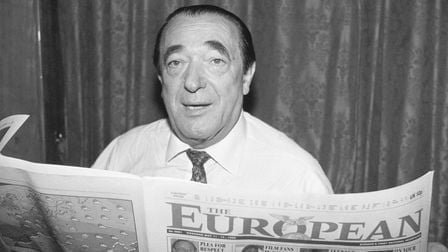
Robert Maxwell poses with the first edition of “The European” newspaper he founded in 1990; Source
During this period, Maxwell’s ties to Israeli intelligence deepened in other ways, particularly during the time when Yitzhak Shamir was prime minister. Shamir, previously a leader of the Zionist terrorist group known as Lehi or the Stern Gang, deeply loathed the United States, a sentiment he confided to Maxwell during one of Maxwell’s visits to Israel. Shamir told Maxwell that he blamed the Americans for the Holocaust because of US failure to support the transfer of European Jews to Palestine prior to the war. Shamir’s views on the US likely informed Israel’s more aggressive espionage targeting the US that emerged during this time and in which Maxwell prominently figured.
Maxwell and the PROMIS Affair
Maxwell’s prominent roles in the PROMIS software scandal and the Iran-Contra affair during the 1980s were facilitated by his purchase of numerous Israeli companies, several of which were either fronts or “providers of services” for Israeli intelligence. The most notable of these was Scitex, where Yitzhak Shamir’s son Nachum was a major executive throughout the 1990s and early 2000s, and Degem, a computer company with a large presence in Central and South America as well as Africa.
Even before Maxwell’s purchase of Degem, it had been used by Mossad as a cover for agents, and particularly assassins, who would use its offices as a cover before conducting kidnappings and murders of individuals linked to groups with ties to or sympathies for Israel’s enemies, particularly the PLO. Some of the most notable events occurred in Africa, where Mossad assassins used Degem as cover to launch killings of members of the African National Congress. In Latin America, Degem was also used as cover for the Mossad to infiltrate terrorist and nacroterrorist organizations such as Peru’s Sendero Luminoso (known in English as the Shining Path) and Colombia’s National Liberation Army or ELN.
After Maxwell’s purchase of Degem, it served as the main vehicle through which Israel conducted what was arguably its most brazen and successful espionage operation of the era—the bugging and then mass marketing of the stolen software program known as PROMIS.
Rafi Eitan, the notorious Israeli spymaster who served as Jonathan Pollard’s handler and who played a key role in the creation of the Talpiot program, was serving as the head of the (now defunct) Israeli intelligence service known as Lekem when he heard of a revolutionary new software program being used by the US Department of Justice. The program was known as the Prosecutors Information Management System, better known by its acronym PROMIS.

Rafi Eitan with Israeli politician Ariel Sharon in 1987; Source
Eitan had learned of PROMIS from Earl Brian, a longtime associate of Ronald Reagan who had previously worked for the CIA. PROMIS is often considered to be the forerunner of the PRISM software used by US and allied spy agencies today and was developed by former NSA official Bill Hamilton. Hamilton had leased the software to the US Department of Justice through his company, Inslaw Inc., in 1982.
Eitan and Brian hatched a plan to install a “trapdoor” into the software and then sell PROMIS throughout the world, providing Israel with invaluable intelligence on the operations of its enemies and allies while also netting Eitan and Brian massive profits. According to the testimony of former Israeli intelligence officer Ari Ben-Menashe, Brian provided a copy of PROMIS to Israeli military intelligence, which contacted an Israeli American programmer living in California. That programmer then planted a trapdoor or back door into the software.
Once the back door was installed, Brian attempted to use his company Hadron Inc. to market the bugged PROMIS software around the world. Having been unsuccessful at trying to buy out Inslaw, Brian turned to his close friend Attorney General Ed Meese, whose Justice Department abruptly refused to make payments to Inslaw that were stipulated by contract, essentially using the software for free. Hamilton and Inslaw claimed that this was theft. Some have speculated that Meese’s role in that decision was shaped not only by his friendship with Brian but also by the fact that his wife was a major investor in Brian’s business ventures.
Meese’s actions forced Inslaw into bankruptcy, and Inslaw subsequently sued the Justice Department, with the court finding that the Meese-led department “took, converted, [and] stole” the software through “trickery, fraud and deceit.” Meanwhile, with Inslaw seemingly out of the way, Brian sold the bugged software to Jordan’s intelligence service, which was a major boon for Israel, and to a handful of private companies. Eitan, nevertheless, was unsatisfied with Brian’s progress and quickly turned to the person he thought could most effectively sell PROMIS to governments of interest all over the world—Robert Maxwell.
Salesman and Spy
Through Degem and other fronts, Maxwell marketed PROMIS so successfully that Israeli intelligence soon had access to the innermost workings of innumerable governments, corporations, banks, and intelligence services around the world. Many of Maxwell’s biggest successes came in selling PROMIS to dictators in Eastern Europe, Africa, and Latin America. Following the sales, and after Maxwell collected a handsome paycheck, PROMIS, with its unparalleled ability to surveil anything from cash flows to human movement, was used by these governments to commit financial crimes with greater finesse and to hunt down and “disappear” dissidents.
In Latin America, Maxwell sold PROMIS to military dictatorships in Chile and Argentina. It was used to facilitate the mass murder that characterized Operation Condor, as the friends and families of dissidents and so-called subversives were easily identified using PROMIS. PROMIS was so effective for this purpose that, just days after Maxwell sold the software to Guatemala, this US-backed dictatorship rounded up twenty thousand “subversives” who were never heard from again. Of course, thanks to the back door in PROMIS, Israeli intelligence knew the identities of Guatemala’s disappeared before the victims’ own families. Both the US and Israel were also intimately involved in the arming and training of many of the Latin American dictatorships that had been sold the bugged PROMIS software. It is worth noting that Israel’s government and military-industrial complex was simultaneously involved in selling arms to many of these same governments.
Though Israeli intelligence immediately found obvious uses for the steady stream of sensitive and classified information, their biggest prize was yet to come. Eitan soon tasked Maxwell with selling PROMIS to top secret US government labs in the Los Alamos complex, including Sandia National Laboratories, which was and is at the core of the US nuclear weapons system. In order to plot how he would accomplish such a feat, Maxwell met with none other than Henry Kissinger, who told him that he needed to enlist the services of Texas senator John Tower, who was then head of the Senate Armed Services Committee. Kissinger has never been charged or even challenged for his role in facilitating a foreign-espionage operation targeting highly sensitive US national security information.
Maxell, using Mossad-derived money, paid Tower $200,000 for his services, which included opening doors — not just to the Los Alamos complex but also to the Reagan White House. PROMIS was then sold to the laboratories through a US-based company that Maxwell had purchased in 1981 and transformed into a front for Mossad. That company, called Information on Demand, was headed by Maxwell’s daughter Christine Maxwell beginning in 1985 until Robert’s death in 1991, during which period she helped sell the bugged PROMIS software to several Fortune 500 companies. Isabel Maxwell, sister to Ghislaine and Christine, would also work at the company before its closure in 1991.
After the attacks of September 11, 2001, Christine Maxwell teamed up with CIA official Alan Wade to market homeland-security software known as Chiliad to the US national security state, while Isabel would work closely at the intersection between Israeli intelligence and its private technology sector around that same period. Ghislaine, along with her two intelligence and technology-connected sisters, would hold a significant stake in a technology company that appears to be the actual origin of the Bill Gates-Jeffrey Epstein relationship, as explained in this Unlimited Hangout investigative report from May.
A few years after its acquisition by the Maxwells, Information on Demand was investigated by the FBI for its intelligence links beginning in 1983. However, that investigation was repeatedly shut down by higher-ups in the Meese-led Department of Justice, which, as previously mentioned, had been complicit in the whole sordid PROMIS affair. The investigation was shut down for good in 1985. The cover-up, oddly enough, continues today, with the FBI still refusing to release documents pertaining to Robert Maxwell and his role in the PROMIS scandal.
At the time, the halting of the FBI investigation green-lighted Information on Demand’s sale of PROMIS to Sandia National Laboratories, which provided Israeli intelligence with direct access to the core of the US nuclear weapons programs and nuclear weapons technology. This was a boon for Israel’s still-undeclared trove of nuclear missiles and warheads and helped ensure that Israel would remain the only nuclear power in the Middle East. Israel’s acquisition of nuclear weapons, seen in the light of the PROMIS scandal and the Pollard spy affair, shows that it was largely accomplished through trickery, deception and espionage rather than Israeli technical or scientific prowess.
This same year, 1985, is also when the CIA finally caught up with their Israeli equivalent and created its own back door into PROMIS, which it sold mostly to allied intelligence services in the UK, Australia, New Zealand, and elsewhere. It wasn’t nearly as successful as Maxwell, who sold an estimated $500 million in bugged PROMIS programs for Israel. The CIA, on the other hand, only sold around $90 million.
Heiress to an Espionage Empire
After Maxwell’s wild success in selling PROMIS on behalf of Israeli intelligence, he was recruited for another Israeli intelligence-driven operation—the Iran-Contra deal. It was through his Iran-Contra dealings that Robert Maxwell reportedly met Jeffery Epstein, whom he brought into the fold of Israeli intelligence that same year with the personal approval of the “higher ups” of Israeli military intelligence. The head of Israeli military intelligence at this time was Ehud Barak, who later come under fire for his well-documented and close ties to Epstein. The year 1985 was also the year when, conveniently enough, Epstein met Ohio billionaire Leslie Wexner and became intimately involved with his finances and affairs after Wexner’s previous fixer, Arthur Shapiro, was shot in the face in broad daylight before he was set to testify to the IRS on matters related to Wexner’s finances. Wexner would go on to co-found the Mega Group in 1991, several prominent members of which have close ties to Israeli political and intelligence figures and/or US-based organized crime networks like the National Crime Syndicate.
Epstein’s entry into this world was facilitated through his romantic ties to Ghislaine Maxwell, which had allegedly preceded Robert Maxwell’s successful efforts to bring him into the fold of Israeli military intelligence. Epstein was only one of several boyfriends Ghislaine is said to have had in the 1980s, but Epstein was certainly the most similar in terms of both behavior and “talents” to her father.
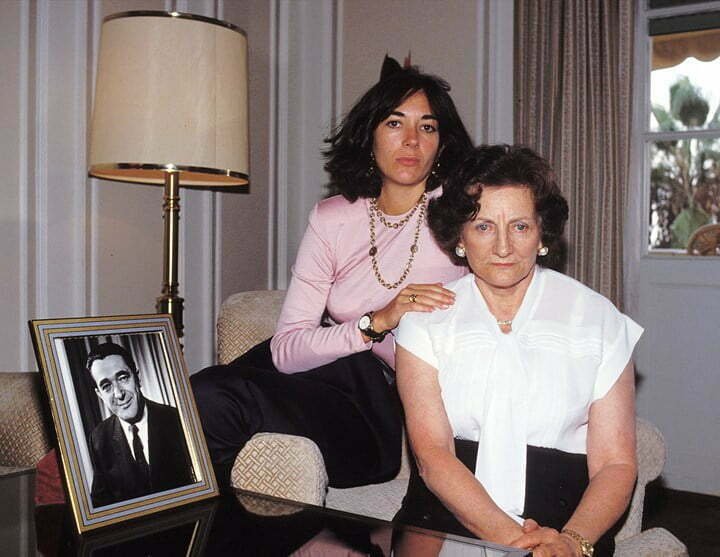
Ghislaine Maxwell and her mother Betty pose next to a framed picture of Robert Maxwell in Jerusalem, November 1991; Source
Ghislaine’s other boyfriends during and prior to this period certainly deserve mention. One of the more interesting was an Italian aristocrat named Count Gianfranco Cicogna, whose grandfather was Mussolini’s finance minister and the last doge of Venice. Cicogna also had ties to both covert and overt power structures in Italy, particularly to the Vatican, the CIA’s presence in Italy, and to the Italian side of the National Crime Syndicate. The other half of that syndicate, of course, was the Jewish American mob with its ties to the Mega Group, itself deeply connected to the Epstein scandal and whose members were frequent business partners of Robert Maxwell. It’s worth noting that Gianfranco Cicogna met a grisly end in 2012 when the plane he was flying exploded in a giant fireball during an air show, a morbid spectacle that can surprisingly still be viewed on YouTube.
Ghislaine and Robert Maxwell also had odd ties to the Harvey Proctor scandal in the United Kingdom, whereby a tabloid of Robert Maxwell’s—with Maxwell’s full approval—ran a story claiming that efforts were being made to blackmail Robert Maxwell with information regarding Ghislaine’s alleged relationship with the future Duke of Rutland. Maxwell clearly wanted the information linking Ghislaine to the duke put out into the public sphere, but the story is odd for a few reasons. The motive of the blackmailer was ostensibly to prevent Maxwell-owned papers from covering the Harvey Proctor scandal. But the son of the duke who was allegedly involved with Ghislaine was also a close friend and later the employer of Harvey Proctor.
The appearance of Harvey Proctor, a Conservative member of Parliament, in this tabloid spectacle is interesting for a few reasons. In 1987, Proctor pleaded guilty to sexual indecency with two young men who were sixteen and nineteen at the time, and several witnesses interviewed in that investigation described him as having a sexual interest in “young boys.” Later, a controversial court case saw Proctor accused of having been involved with well-connected British pedophile and procurer of children Jimmy Savile; he was alleged to have been part a child sex abuse ring that was said to include former UK prime minister Ted Heath. Savile’s close relationship with Prince Charles of the British Royal family is well known and, as will be mentioned shortly, Ghislaine is alleged to have been cozy with the Royals before Prince Andrew’s frequent public appearances with Ghislaine and Epstein, beginning around the year 2000.
Of course, the Maxwell-owned papers, in covering the alleged efforts to blackmail Robert Maxwell, did not mention the “young boys” angle at all, instead focusing on claims that distracted from the then-credible accusations of pedophilia by claiming that Proctor was merely into “spanking” and was “whacky”, among other things. It is hard to know exactly what was going on in this particular incident, but the whole bizarre affair paints an interesting picture of Ghislaine’s social circle at the time.
In this same 1985 period, Ghislaine also became involved with “philanthropy” tied to her father’s business empire by hosting a “Disney day out for kids” and benefit dinner on behalf of the Mirror Group for the Save the Children NGO. Part of the event took place at the home of the Marquess and Lady of Bath, a gala that was attended by members of the British Royal family. It’s worth noting that the Marquess of Bath at the time was an odd person, having accumulated the largest collection of paintings made by Adolf Hitler and having said that Hitler had done “great things for his country.” The same evening that the Ghislaine-hosted bash concluded, the Marquess of Bath’s son was found hanging from a bedspread tied to an oak beam at the Bath Arms in what was labeled a suicide.
The attendance of Royals at this Ghislaine-hosted gala was not some lucky break for Ghislaine or her “philanthropic” efforts, as Ghislaine had already been close to the royals for years, with subsequent employees and victims of Ghislaine having personally seen pictures of her “growing up” with the royals, a relationship allegedly facilitated by the Maxwell family’s ties to the Rothschild banking family. Ghislaine was heard on more than one occasion as describing the wealthy and influential Rothschilds as her family’s “greatest protectors,” and they were also among Robert Maxwell’s most important bankers, who helped him finance the construction of his vast media empire and web of companies and untraceable trusts.
It was also during this period that Ghislaine learned some unusual skills, including how to pilot airplanes, helicopters, and submarines, and became fluent in several languages.
Then, abruptly in 1991, Ghislaine and her entire remaining family saw their fortunes shift dramatically—at least in public—with the death of Robert Maxwell, a death that most of the Maxwell family and most of his biographers regard as a murder, an act allegedly performed by the very intelligence agency that employed him.
According to journalist John Jackson, who was present when Ghislaine and her mother Betty boarded her father’s yacht shortly after his death, it was Ghislaine who “coolly walked into her late father’s office and shredded all incriminating documents on board.” Ghislaine denies the incident, though Jackson has never retracted the claim, which was reported in a 2007 article published in the Daily Mail. If Jackson is to believed, it was Ghislaine – out of all of Robert Maxwell’s children – who was most intimately aware of the incriminating secrets of her father’s financial empire and espionage activities.
As Part 2 of this series will show, the evidence points to this being the case, particularly with Ghislaine’s entry into New York’s elite social circles having been planned by her father before his 1991 death. Of course, those social connections in New York, as well as those in Europe and elsewhere, would prove instrumental in the operation and protection of Jeffrey Epstein’s sexual trafficking and blackmail network. Ghislaine’s slippery behavior in the years that followed, including activities both related and unrelated to the sex trafficking of minors, show that Ghislaine inherited much more than her personality from her father as she, along with several of her siblings, played a key role in keeping alive various aspects of her father’s legacy, including his espionage activities.
Whitney Webb has been a professional writer, researcher and journalist since 2016. She has written for several websites and, from 2017 to 2020, was a staff writer and senior investigative reporter for Mint Press News. She currently writes for The Last American Vagabond.
Opposition candidate Xiomara Castro claims election victory in Honduras

Xiomara Castro of the opposition Liberty and Refoundation Party (Libre) and vice presidential candidate Salvador Nasrala after the closing of the general election, November 29, 2021. (Photo: Reuters)
Press TV – November 29, 2021
Leftist opposition candidate, Xiomara Castro, has claimed victory in Honduras’ presidential election, with preliminary results putting her in pole position against the ruling party candidate.
With 38% of the voting tally complete, the Liberty and Refundation Party (LIBRE) candidate is in the lead with over 53 percent votes. Her main rival, Nasry Asfura of the ruling conservative National Party, currently has nearly 34% of the vote, according to the National Electoral Council (CNE).
If Castro holds on to the lead, she would become the first female president of the Central American country, ending the conservative party’s 12-year stint in power.
“We win! We win!” Castro, 62, told cheering party supporters on Sunday evening. “Today the people have made justice. We have reversed authoritarianism.”
In a brief victory address, Castro vowed to form a government of “reconciliation,” and to strengthen direct democracy with referendums, adding that “there will be no more abuse of power in this country.”
“We can’t stay home. This is our moment. This is the moment to kick out the dictatorship,” said Castro, who is making third bid at the presidency. She is the wife of former President Manuel Zelaya, whose government was toppled by a civilian-military alliance in 2009.
The outgoing President, Juan Orlando Hernandez, was accused by a US court of having ties to powerful drug trafficking gangs. However, he has denied the allegations.
Hernandez has faced stiff opposition in Honduras since he claimed a second term in a highly-divisive election at the end of 2017, which sparked widespread protests after both sides declared victory.
Unlike Hernandez, who was a conservative US ally, Castro has said that she would have diplomatic relations with China.
According to the electoral council, the voting saw a historic turnout of more than 68 percent.
The election is the latest political flashpoint in Central America, a major source of growing US-bound migrants fleeing chronic poverty, unemployment and persecution.
The spiraling crisis of hunger and homelessness in Honduras has placed it among the world’s most violent countries.
Alongside the presidency, the country’s 128-member Congress, and officials for some 300 local governments, are also being voted in these elections.
Davos Billionaires Want to Save the Planet… Why Don’t Developing Countries Trust Them?
By Matthew Ehret | Strategic Culture Foundation | November 17, 2021
A miracle appears to be happening, as the multibillionaires of the World Economic Forum (WEF) appear to have grown consciences.
As if by magic, it appears that these gold collar elites no longer yearn for profit and power as they once had. As COP26 closes up its 12 day annual ceremonies, leading WEF-connected figures like Prince Charles, Jeff Bezos, Mario Draghi, Mark Carney and Klaus Schwab have announced a new system of economics that is based on virtue over profit!
According to the COP26 website, “95 high profile companies from a range of sectors commit to being ‘Nature Positive,’ agreeing to work towards halting and reversing the decline of nature by 2030.”
Prince Charles has boasted that he has coordinated 300 companies representing over $60 trillion to get on board with a global green transition, and after meeting with the Prince on November 2, Jeff Bezos announced his new $2 billion Earth Fund to protect nature’s ecosystems with a focus on Africa. Even Prime Minister Mario Draghi has joined Mark Carney on this new green path, as both men have moved beyond their old Goldman Sachs money worshipping days and embraced a better destiny. At the Nov 1 G20 Summit, Draghi embraced Prince Charles’ Green Markets Initiative and threw Italy’s full support behind the de-carbonization initiative.
The Prince himself (who also happens to be the nominal creator of the Great Reset Agenda launched in 2020), spoke as an enlightened statesman saying to the world’s leaders “as the enormity of the climate challenge dominates peoples’ conversations, from news rooms to living rooms, and as the future of humanity and Nature herself are at stake, it is surely time to set aside our differences and grasp this unique opportunity to launch a substantial green recovery by putting the global economy on a confident, sustainable trajectory and, thus, save our planet.”
Among the new array of financial mechanisms which we see being brought online in this war against humanity involve Bezos’ new Earth Fund, and Sir Robert Watson’s Living Planet Index (unveiled in 2018 at the World Economic Forum) and the new Rockefeller Foundation-sponsored Intrinsic Exchange Group (IEG) which seeks to turn global ecosystems worth an estimated $4 quadrillion into financial equity controllable by new private corporations (dubbed “natural asset companies”).
On its website, the IEG stated: “In partnership with the New York Stock Exchange, IEG is providing a word-class platform to list these companies for trading, enabling the conversion of natural assets into financial capital. The NAC’s equity captures the intrinsic and productive value of nature and provides a store of value based on the vital assets that underpin our entire economy and make life on earth possible… In 2021, we began seeking regulatory approval to bring the first natural asset transactions to the capital markets. Our vision is to bring to market hundreds of Natural Asset Companies representing several trillion dollars’ worth of natural assets.”
These new companies will become the stewards of new protected zones across the globe which the UN demands encapsulate 30% of the earth’s surface by 2030 and much more by 2050.
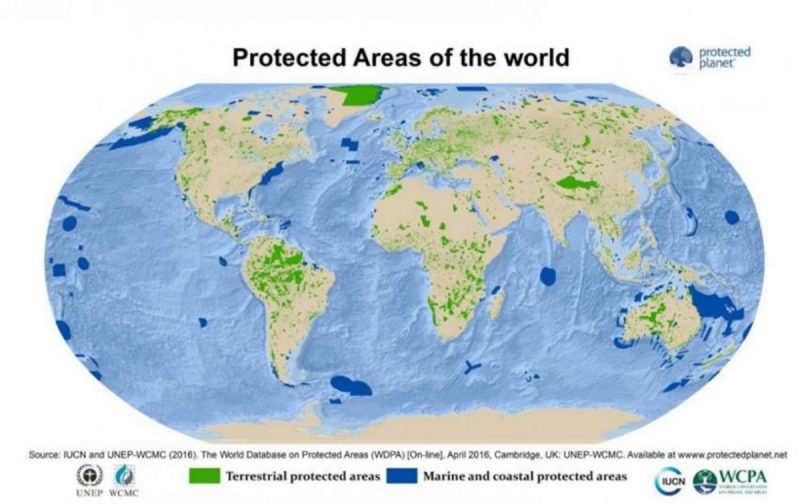
Is this time to rejoice, or is something darker at play?
To answer this question it is worth asking: Does this new virtue-driven order have anything to do with lifting people out of poverty or ending economic injustice?
Sadly, it is designed to do very much the opposite.
As we are coming to see, and as statesmen around the world are beginning to point out, this new order has more in common with oligarchical obsessions with controlling human cattle, and less to do with actually preserving the environment. The thousands of tons of CO2 emitted by private jets at Davos and COP26 represents on small aspect of this disingenuity.
Obrador Calls out the Game
On October 30, Mexico’s President Lopez Obrador called out this new virulent form of colonialism while presiding over a ceremony in celebration of the ongoing construction of the $6.7 billion high-speed Maya Train now being built in the southern regions of Mexico. The project which would dramatically uplift living standards in Mexico by driving the growth of industrial and infrastructure production has fallen far behind schedule due in large part to vast legal battles led by indigenous groups who have been used as proxies by foreign interests to defend Mexico’s ecosystems. In many of the legal cases opposing the project, the argument has been made that since several species of insect, fauna and even some leopards will be affected by the new railways, then the project must be ground to a halt and buried.

In his remarks to a journalist inquiring into the rail project, Obrador said:
“One of the things which they [the neoliberals] promoted in the world, in order to loot at ease, was the creation or promotion of the so-called new rights. So, feminism, ecologism, the defense of human rights, the protection of animals was much promoted, including by them. All these causes are very noble, but the intent was to create or boost all these new causes so that we don’t remedy—so that we don’t turn around and see that they were looting the world, so the subject of economic and social inequality would be kept out of the center of debate… The international agencies which supported the neoliberal model, which is a model of pillage where corporations grab national property, the property of the people—these same corporations financed, and continue to finance, environmentalist groups, defenders of ‘liberty.’ ”
Many people have been confused over these remarks since they cannot conceptualize how neoliberal monetarists that have parasitically driven the new age of pillage under globalization would also support such ‘new rights’ groups outlined by Obrador.
For nations of the global south who feel resentment that their rights to support their people by having their lands and resources kept off limits, they are told not to worry, since streams of money will be showered upon them from on high. Hundreds of billions of dollars worth of monopoly money will be sprayed onto the developing sector as rewards for remaining undeveloped. If that isn’t sufficient, then carbon exchange markets will be set up so that poor nations can sell their un-used carbon quotas to private polluting companies (perhaps the same companies controlling the African cobalt mines which seek a monopoly in controlling the renewable energy sector). That is another way they can make money which at least can keep them warm at night as kindling since the world’s poor will not have to worry about having nature-killing hydro electric dams mucking up their pristine environments.
Even in the west where Biden’s 30×30 executive order has been signed into action, farmers will be offered money to stop grazing on soon-to-be protected lands, while a supposedly grassroots-based WWF-connected American Prairie Reserve (with a $160 million endowment) can be seen pushing a program designed to take 5000 square miles of grazing land in Montana out of use and converted into a pure ecosystem.
As President Obrador has alluded to, today’s billionaire-funded conservation movement simply seeks to take earth’s ecosystems out of bounds of any human economic activity under a new global feudal system of controls.
Even the indigenous populations which such billionaires profess to admire as role models for global “good behavior” are being monetized by these new green indices, with monetary values being placed not only on keeping land and water untouched, but also the very cultural ecosystems of indigenous groups around the world receiving dollar values which wealthy green financiers will somehow be able to invest into. To the degree that such immutably fixed patterns of indigenous lifestyles remain unchanged by the toxic pollution of modern technology or infrastructure, the more these eco-assets will be worth for whomever professes to invest in them. This may not be scientific but it is sick.
The term ‘feudal’ is in no way used for hyperbolic purposes, as we can see a stark parallel to the 12th century Europe, except that today’s aspiring feudal lords manage such companies as Blackrock, Vanguard, Google, Microsoft, Amazon and State Street and seek to punish all serfs from infringing on properties which only the nobility may control. Blackrock alone manages over $9 trillion in assets and $21.6 trillion in technology platforms and along with Vanguard is fast becoming one of the largest real estate owners in the USA with Bill Gates having recently become the largest owner of American farmland.
The Deeper Imperial Roots of Conservationism
With this vast imperial landgrab in mind, one should not be surprised to discover that the modern conservation movement actually finds its origins not in Greenpeace activists fighting poachers as mythmakers have cooked up, but rather in the bowels of the British Empire. It was this empire that innovated “nature conservation” regions in India during the late 19th century specifically to keep the poor of India under control after having destroyed India’s once powerful textile sector. The practice was applied across India during the greatest density of famines struck southern India in 1876 killing tens of millions. It was amidst this darkness that British Imperial overlords took the opportunity to create “The Imperial Forestry Department’ in 1876 putting two fifths of India’s lands under “protection” and off limits to humans. This ensured no starving subject could use the protected zones which they had relied upon for survival for decades for food, or water.
The Nazi embrace of both Anglo-American funded science of eugenics on the one side and the Reich’s embrace of nature conservationism were also not unconnected. Herman Goring, who served as Minister for German Forests believed in a poisonous worldview that held that: 1) nature is pure and thus good due to its pure unchanging natural order while 2) humanity is impure and thus un-natural due to our aspirations for progress. This dangerous equation resulted in seemingly innocent programs launched by the Fuhrer and Goring to cleanse the German ecosystems of all foreign and thus un-natural fauna and flora in order to return the forests of Germany to their supposedly pure pre-industrial states. The worship of nature was an integral part of the new master race and the weeding out of impurities extended itself to human genetics following racial theories advanced by British eugenicists and anthropologists.
Julian Huxley’s New Eugenics Revolution
Upon Hitler’s defeat, the repackaging of eugenics took the form of British Eugenics Society Vice President Julian Huxley’s outline in the founding Manifesto for UNESCO where he said:
“At the moment, it is probable that the indirect effect of civilization is dysgenic instead of eugenic, and in any case it seems likely that the dead weight of genetic stupidity, physical weakness, mental instability and disease proneness, which already exist in the human species will prove too great a burden for real progress to be achieved. Thus even though it is quite true that any radical eugenic policy will be for many years politically and psychologically impossible, it will be important for UNESCO to see that the eugenic problem is examined with the greatest care and that the public mind is informed of the issues at stake so that much that is now unthinkable may at least become thinkable.”
Putting this new eugenics into practical action took on many heads of a hydra in the post WWII years. The particular hydra head most relevant to the thrust of this article took the form of another project Julian created in 1948 called the International Union for the Conservation of Nature (IUCN) followed soon thereafter by the World Wildlife Fund (WWF) in 1961 which he co-founded alongside two misanthropic princes named Philip Mountbatten and Bernhardt of the Netherlands.
Between 1959 and 1962 Julian had risen to become president of the British Eugenics Society and had put the finishing gloss on a new field of scientific misanthropic theology which he dubbed ‘Transhumanism’ alongside a Jesuit collaborator named Pierre Teilhard de Chardin.
If you haven’t guessed, Transhumanism was merely another form of re-packaged eugenics serving the spiritual needs of a new priesthood of elitist social engineers that would be expected to manage the gears of a new technocratic feudal machine. This neo-paganism is not intrinsically different from the cultish beliefs of the Nazi Thule society of the past which gave spiritual direction to the members of Hitler’s government.
The neo-Malthusian revival that these eugenicists would spearhead through the end of the 1960s took the form of a new array of international organizations which incorporated systems analysis, and cybernetics, which aimed to control nation states and ecosystems alike. This took the form of the World Economic Forum’s early embrace of the Club of Rome’s computer models outlined by Aurelio Peccei (and incorporated into Schwab’s second official Davos meeting in 1973). These new models aimed to impose fixed immutable limits to humanity’s growth potential beyond which no technology or scientific discovery could ever penetrate. The fact that these same multibillionaires managing the overhaul of the world economy as it transitioned into a neo-liberal looting operation were simultaneously funding the growth of this new array of “new rights” groups led by a growing armada of non-governmental organizations, ecology protection and human rights groups is not a coincidence.
Today’s involvement of both Julian Huxley’s WWF and IUCN (no renamed Conservation International) as partners with the Intrinsic Exchange Group should not make any honest lover of nature in any way comfortable.
Much more obviously remains to be said both about the history of conservationism, and how it is being used once again to conduct a new age of population control, or how it has been used to disrupt large scale infrastructure projects across the world for over 120 years, or how nature reserves across the global south have supported narco terrorist groups.
However, for the time being, it is sufficient to note that the world’s developing sector is generally not going to accept being sacrificed on the altar of a new Gaia cult managed by a priesthood of Davos billionaires. Based on the momentum we see being driven by the Greater Eurasian Partnership, the Belt and Road Initiative and ambitions from Latin American and African leaders to finally break free of centuries of imperial manipulation, it is becoming increasingly obvious that COP26’s utopic computer models are increasingly breaking down when confronted with the reality of humanity’s creative power to leap outside of the fixed rules of imperial games when a true crisis moves us into action.
No Mystery Why Some Countries Are Largely Flu/Covid-Free
By Stephen Lendman | November 20, 2021
Nigeria, Sierra Leone, Bolivia, Paraguay, Peru, Guatemala, Honduras, Macedonia, Uttar Pradesh, India, Zimbabwe, the Czech Republic, Slovakia, parts of Brazil, and other nations have the following in common:
They use known safe and effective ivermectin for treating and curing flu/covid.
As a result, the incidence of the viral illness in these countries is low.
Their success is in stark contrast to surging outbreaks, serious cases, hospitalizations and deaths throughout the US/West, Israel and in other heavily mass-jabbed countries.
Since discovered and approved for human use, around 4 billion doses of ivermectin have been prescribed worldwide.
The WHO includes it on its list of Essential Medicines.
In 2015, co-developer of the drug, Dr. Satoshi Omura, won a Nobel Prize in Medicine.
In February, British Ivermectin Recommendation Development (BIRD) — comprised of medical and scientific experts from over 15 countries — recommended global use of ivermectin as a verifiably safe and effective drug for preventing and treating flu/covid.
Evidence-Based Medicine Consultancy director and BIRD organizer Dr. Tess Lawrie stressed the following:
“Ivermectin is already in use around the world and can reach the poorest people long before other expensive COVID treatments will ever get to them.”
“Ivermectin has an ever-increasing evidence base that shows that it works.”
“Even the prestigious Institute Pasteur in France has confirmed that the evidence is sound.”
Front Line (Flu/Covid) Critical Care Alliance (FLCCC) president/chief medical officer Dr. Pierre Kory explained the following:
“When we examine the extensive evidence on ivermectin as a treatment for (flu/covid), we still see a significant reduction in the spread of (the viral illness), as well as a reduction in hospitalizations and deaths.”
“All science needs to be scrutinized. As some of the most published researchers in our fields, we are used to having our work examined by others.”
Peer-reviewed studies showed that when used as directed, ivermectin virtually eliminates flu/covid, most often in a few days.
Noted journalist and author, former Philadelphia Inquirer/Miami Herald reporter, six-time Pulitzer Prize nominee, two-time National Book Award nominee, National Headliner Award winner Michael Capuzzo wrote about “The Drug that Cracked (Flu)Covid,” stressing:
“Hundreds of thousands, actually millions, of people around the world, from Uttar Pradesh in India to Peru to Brazil, who are living and not dying” are alive and well thanks to ivermectin.
He “saw with (his) own eyes” the other side of the story that MSM suppress, adding:
He “wishes the world could see both sides” — notably that ivermectin is a virtual wonder drug for treating and curing flu/covid.
It’s safe, effective and cheap.
If used worldwide in lieu of toxic jabs — crucial to shun — flu/covid could be largely eliminated.
It’s not throughout the US/West, Israel and elsewhere with mass-extermination and destruction of freedom in mind.
AP News dubiously claimed that “scientists are mystified and wary (about why) Africa avoid(ed) (flu/covid) disaster (sic).”
Outbreaks are largely absent in dozens of African countries.
What AP News called “mysterious” is what it suppressed.
Widespread use of ivermectin rendered much of the continent largely flu/covid-free.
It’s where “fewer than 6% of the people” are jabbed, AP reported.
In its weekly reports, the WHO calls Africa “one of the least (flu/covid) affected regions in the world.”
What AP News should have explained, it suppressed.
Widespread use of ivermectin in many African countries prevented flu/covid outbreaks — and cured the viral illness safely, effectively, quickly and cheaply when they occurred.
Bolivian Coup Regime Sought to Assassinate Luis Arce

Bolivia’s Interior Minister Eduardo Del Castillo informs of an assassination attempt against Luis Arce in 2020 at a press conference on October 18, 2021. Photo: Ministerio De Gobierno
Kawsachan News | October 18, 2021
Bolivia’s Interior Ministry has revealed that Colombian mercenaries, who participated in the assassination of President Jovenel Moise in Haiti, entered Bolivia days before the 2020 election. Fernando Lopez, Defense Minister under Jeanine Añez, was in contact with mercenary groups, with whom he intended to carry out a second coup.
In a press conference, Interior Minister Eduardo del Castillo named Germán Alejandro Rivera García, a Colombian citizen who entered Bolivia on October 16, 2020 and who was later arrested for the assassination of Jovenel Moise. He was followed by Colombian citizen Arcángel Pretel Ortiz and Venezuelan citizen Antonio Intriago, who run the Miami-based ‘security firm’ Counter Terrorist Unit Security (CTU), which hired the mercenaries who murdered Moise.
The mercenaries stayed at the high-end Hotel Presidente in La Paz, just two blocks away from the presidential palace. The purpose of their meeting was to pursue leads with then Defense Minister Fernando Lopez for lucrative contracts for a hit on Luis Arce.
Castillo said, “Days before the elections, the paramilitaries who would go on to kill the President of Haiti, as well as mercenary contractors such as Mr. Arcángel Pretel and Mr. Antonio Intriago were in the country. According to the information we obtained, their intention was to end the life of President Luis Arce”.
Earlier in the year, leaked audios published by The Intercept revealed that Lopez was in contact with other Miami-based mercenaries to coordinate a second coup. In one audio, Lopez said, “The military high command is already in preliminary talks… the struggle, the rallying cry, is that [the MAS] wants to replace the Bolivian armed forces and the police with militias, Cubans, and Venezuelans. That is the key point. They (the police and armed forces) are going to allow Bolivia to rise up again and block an Arce administration. That’s the reality.”
President Luis Arce addressed the revelations today at a summit with social movement in La Paz, saying, “Our Interior Minister revealed this information at an opportune time, brothers; They wanted to make an attempt on my life. To those right-wing murderers, we are going to respond with a phrase from (historic Bolivian socialist leader) Marcelo Quiroga Santa Cruz: We know that sooner or later they will make us pay for what we are doing, we are willing to pay that price, we were always willing. We will never shy away from danger because there is something more fearsome than that enemy who is looking for a way to kill us. A guilty conscience is much worse, we would not bear ourselves if we did not fulfill our duty.”
Opus Dei Ignores Complaint of 43 Women Held in Slavery

Some of the women enslaved by Opus Dei. | Photo: Twitter/ @meneame_net
teleSUR | October 10, 2021
Between 1974 and 2015, the Opus Dei held 43 women working without pay and in conditions similar to slavery in Argentina, Paraguay, and Bolivia.
This Catholic lay and clerical organization recruited the women as teenagers by promising to provide them with an education. Subsequently, however, they worked without pay as janitors, chefs, and maids in the service of the Opus Dei members and their guests.
In a letter sent to Pope Francis earlier this year, the exploited women emphasized they were deceived because they did not expect to become servants of the elite “in the name of God.” They also requested that the Catholic authorities apologize, compensate them for the damages, and stop these types of labor practices.
Among those involved in this violation of labor rights are ex-Regional Vicar Victor Urrestarazu, the Opus Dai highest authority Monsignor Fernando Ocariz, and Auxiliary Vicar of Rome Mariano Fazio Fernandez.
The women’s complaint was submitted to the Abuse Section of the Congregation for the Faith Doctrine of the Vatican Tribunal. On Sept. 29, Ocariz signed a decree to carry out a change in the Opus Dei’s South American structures.
In order to “improve the promotion and coordination of apostolic work,” he created the La Plata Region Vicar, which comprises Uruguay, Paraguay, Bolivia, and Argentina.
This and other purely administrative changes, however, have not solved the underlying problem. So far, the Opus Dei has not done justice to 43 Latin American women it affected.
Argentine Court Dismisses Case Against Cristina Fernandez

Cristina Fernandez-Kirchner at a hearing, Buenos Aires, Argentina.
teleSUR | October 8, 2021
On Thursday, the 8th Federal Court dropped the case against Vice-President Cristina Fernandez, who was accused of covering Iran’s participation in the car bombing against the Argentine Jewish Mutual Association (AMIA) that took place in Buenos Aires in July 1994.
In 2013, the then President Fernandez signed a Memorandum of Understanding (MoU) directed towards Iran. This document’s intention was to agree on cooperation mechanisms to restart the investigation of the attack, which remained stagnant for years.
“Argentine and Iranian judicial authorities will meet in Tehran to proceed to questioning… of whom Interpol has issued a red notice. The Commission will have authority to pose questions to the representatives of either side. Each side has the right to give explanations or submit new documents during the meetings,” the MoU reads.
Although the Memorandum was never enforced, her critics argued that it was a tool aimed at interfering with the judiciary system and granting immunity to Interpol fugitives. Prosecutor Alberto Nisman iniciated a legal process in 2017, during the administration of President Mauricio Macri, a right-wing politician who is a staunch political adversary of Fernandez.
Featured Video
Chinese jet fuel and the myth of energy independence
or go to
Aletho News Archives – Video-Images
Book Review
Former Insiders Criticize Iran Policy as U.S. Hegemony
By GARETH PORTER | CounterPunch | February 27, 2013
“Going to Tehran” arguably represents the most important work on the subject of U.S.-Iran relations to be published thus far.
Flynt Leverett and Hillary Mann Leverett tackle not only U.S. policy toward Iran but the broader context of Middle East policy with a systematic analytical perspective informed by personal experience, as well as very extensive documentation.
More importantly, however, their exposé required a degree of courage that may be unparalleled in the writing of former U.S. national security officials about issues on which they worked. They have chosen not just to criticise U.S. policy toward Iran but to analyse that policy as a problem of U.S. hegemony. … continue
Blog Roll
 Aletho News
- Why no power can undermine Iran’s eternal dominance over the Strait of Hormuz
- Is The War Against Iran Over?
- Iran war will leave long-term ‘scar’ on Wall Street, investors warn
- How Iran decimated US power projection in West Asia: Military lessons of 40-day war
- Iran’s report details US-Israeli war crimes in targeting schools, hospitals, livelihoods
- NATO’s Slow Fracture: How Trump’s Iran War Exposed the Instrument of Hegemony
- Chinese jet fuel and the myth of energy independence
- Ukraine Sea Drone Fired From Libya Hit Russian Tanker in Mediterranean
- IRGC: Iranian forces launched no attacks during ceasefire hours
- Trump Administration Moves To Automate U.S. Military Draft Registration
- If Americans Knew
- TCN: Is Israel Blackmailing President Trump?
- Israel killed at least 303 Lebanese yesterday – who were they? Daily Update
- Amnesty: Urgent – Protect Lebanese civilians from brutal escalation in Israeli attacks
- Is The War Against Iran Over?
- Inside the Israeli army’s propaganda wing
- Hundreds of Gaza Amputees Stranded in Legal Limbo
- The gallows law: Israel moves toward executing Palestinian children
- Tucker Carlson: The Path to Peace requires ending ‘special alliance’ with Israel
- This is ceasefire? Israel’s biggest massacre yet in Lebanon, another journalist killed in Gaza – Daily Update
- Tucker Carlson on Israel: This Is the Behavior of an Ally? Really?
- No Tricks Zone
- An Inconvenient Tree: Uncovered In Alps… Europe Much Warmer Than Today 6000 Years Ago
- New Study Reports A 60% Slowdown In Greenland’s Ice Loss Rate In The Last Decade
- Low Intensity Tornado Wrecks Major Solar Farm, Creating A Potential Toxic Dump
- New Study Finds Warming Saves Lives…Cold Temperatures 12 Times More Deadly Than Excess Heat
- German Science Blog Accuses PIK Climate Institute Of Hallucinating Climate Tipping Points
- Devastating Assessment Of Comirnaty Vaccine By Former Senior Pfizer Europe Toxicologist
- New Study: CO2 Is ‘Effectively Negligible’ As An Explanatory Climate Change Factor Since 2000
- Former Pfizer Toxicologist Dr. Helmut Sterz Tells Bundestag Hearing Pfizer Vaccine Should Have Never Been Approved
- Energy Expert: Germany’s Nuclear Phaseout Was A “500 Billion Euro Mistake”
- New Research: South Australia’s Mid-Holocene Sea Surface Temperatures Were 4°C Warmer Than Today
 Aletho News