US Targets Nicaraguan Presidential Election
By Roger D. Harris | Dissident Voice | July 14, 2021
Before Henry Kissinger became a Clinton pal, liberals condemned him for saying: “I don’t see why we need to stand by and watch a country go communist due to the irresponsibility of its people. The issues are much too important for the Chilean voters to be left to decide for themselves.” The 1973 US-backed coup and bloodbath in Chile followed. Now Uncle Sam has a problem in Nicaragua, where independent polls predict a landslide victory for Daniel Ortega’s leftist Sandinista slate in the November 7th presidential elections.
The US government and its sycophantic media are working to prevent Ortega’s reelection. On July 12, the US slapped visa restrictions on one hundred Nicaraguan elected legislative officials, members of the judiciary, and their families for “undermining democracy.” A month earlier, the Biden administration imposed sanctions on President Ortega’s daughter, along with a military general, the head of the central bank, and an elected legislator.
These and other recent illegal US sanctions on Nicaragua are designed to promote regime change and are based on the ridiculous charge that this poor and tiny nation is a “extraordinary and unusual threat to the US national security,” when the opposite is the case.
The NICA Act of 2018, under the Trump administration, imposed sanctions, including blocking loans from international financial institutions controlled by the US. In August 2020, the Responsive Assistance in Nicaragua (RAIN) plan was revealed, which is a multi-faceted coup strategy by which the US contracted corporations to overthrow the Nicaraguan government. RAIN calls for a “sudden, unanticipated transition” government to forestall what they admit would otherwise be a Sandinista victory in a free election. In a seamless handoff from the Trump to the Biden administration, the pending RENACER Act would further extended “targeted sanctions.”
US intervention in Nicaragua and, indeed, in all of Latin America under the 1823 Monroe Doctrine has a long history continuing to the present. Back in 1856, US citizen William Walker tried to impose himself as head of a slave state in Nicaragua, only to be assassinated four years later. In 1912, the US began an occupation of Nicaragua, forcing the country to become a US protectorate. The US was ousted in 1933 in a war led by national hero Augusto C. Sandino, after whom the present revolutionary party was named. In the 1980s, the US government proxies, the Contras, fought the new Sandinistas after they overthrew the US-backed Somoza dictatorship.
Problematic premises
In the past, most US progressives opposed the imperialism of their government. But more recently, as Jeremy Kuzmarov of CovertAction Magazine observed: “United States warmakers have become so skilled at propaganda that not only can they wage a war of aggression without arousing protest; they can also compel liberals to denounce peace activists using language reminiscent of the McCarthy era.”
A recent Open Letter to the Nicaraguan Government from U.S. Solidarity Workers 1979-1990 reflects the US imperial talking points. This US open letter, dated July 1, is joined by one from Europeans, formerly active in solidarity with Nicaragua, and one from international academics, mainly in the field of Latin American studies. (Links to all three letters may be dodgy.) All three letters, likely coordinated, use similar language to make matching critiques and demands.
While other international activists from the 1980s still prioritize non-intervention and solidarity with the Sandinista government, the concerns expressed in the open letter should be respectfully evaluated. The open letter is based on the following problematic premises:
- The open letter claims the Ortega “regime” is guilty of “crimes against humanity.”
In fact, Nicaragua is by far the most progressive country in Central America under the Sandinista government.
Unlike the Guatemalans, Hondurans, and El Salvadorians in these US client states, Nicaraguans are not fleeing to the US in search of a better life. Poverty and extreme poverty have been halved in Nicaragua, and the UN Millennium Development Goal of cutting malnutrition has been achieved. Basic healthcare and education are free, and illiteracy has been virtually eliminated, while boasting of the highest level of gender equality in the Americas. Nicaragua, which enjoys the lowest homicide rate in Central America, also has the smallest police force with the smallest budget in the region. These are not the hallmarks of a dictatorship.
- The open letter claims the 2018 coup attempt was simply a “demonstration of self-determination.” While the open letter correctly notes that the events of 2018 reflected an element of popular discontent, it renders invisible the millions of dollars and many years of US sponsored subversion in Nicaragua.
Social media campaigns of false information orchestrated by US-sponsored groups fueled viciously violent protests. According to solidarity activist Jorge Capelán: “those who kidnapped, tortured, robbed, murdered and raped citizens here in Nicaragua in April 2018 were the coup promoters. They themselves recorded everything with their cell phones. They even set fire to murdered Sandinista comrades in the street.”
Benjamin Waddell, a signatory to the open letter, admitted “it’s becoming more and more clear that the US support has helped play a role in nurturing the current [2018] uprisings.” Dan La Botz, another Ortega-must-go partisan, provided the background: “US organizations such as USAID and the National Endowment for Democracy (NED), and no doubt the CIA had for decades, of course, worked in Nicaragua as they do everywhere in the world.”
No substantive progressive alternative was offered by the opposition in 2018, according to William Robinson, another signatory to the open letter. Rather, 2018 was an attempt to achieve by violent means what could not be achieved democratically at the ballot box.
- The open letter claims the Nicaraguan government “in no way represents the values, principles and goals of the Sandinista revolution.” This stance arrogates to foreigners the role of telling the Nicaraguan people how to evaluate their revolution. The electoral process in Nicaragua makes clear that the Nicaraguans think otherwise.
After successfully overthrowing the US-backed dictator Somoza and fighting the counter-revolutionary war against the US-backed Contras, the Sandinista’s lost the 1990 election. Notably, outgoing President Ortega without hesitation obeyed the electoral mandate, the first time in Nicaragua’s history that governing power was passed peacefully to another political party. After 17 years of neoliberal austerity, Daniel Ortega won the presidential election of 2006 with a 38% plurality and went on to win in 2011 with 63% and 72.5% in 2016. Ortega’s ever increasing electoral margins suggest the majority of Nicaraguans support him as the legitimate leader of the Sandinista revolution.
Problematic proposals
Using the same loaded language as the US government, the open letter calls on the “Ortega-Murillo regime” to release political prisoners currently being held, including “pre-candidates,” members of the opposition, and “historic leaders” of the Sandinista revolution; rescind the national security law under which these individuals were arrested; and negotiate electoral reforms.
Nicaragua has passed two recent laws: the Foreign Agents Law and the Law to Defend the Rights of the People to Independence, Sovereignty, and Self-Determination for Peace. These laws, which the open letter wants rescinded, criminalize promoting foreign interference in Nicaragua’s internal affairs, seeking foreign military intervention, organizing acts of terrorism, and promoting coercive economic measures against their country. These are activities, it should be noted, that are similarly prohibited in the US’s FARA Act, after which the Nicaraguan laws were modeled.
The recent actions of the Nicaraguan government prosecuting people who break their laws is a normal function of governance. That some of the accused perpetrators may have political aspirations does not immunize those individuals from arrest for unlawful activities.
The letter from the aforementioned academics claims that among those detained are the “most prominent potential opposition presidential candidates.” In fact, none of the 17 political parties in Nicaragua have chosen their candidates, and “most of those currently under investigation do not belong to any legally registered party.” In fact, Stephen Sefton reports from Nicaragua that “no leading figure from Nicaragua’s opposition political parties has been affected by the recent series of arrests of people from organizations that supported the 2018 coup attempt.”
One of the most prominent of those arrested is NGO director Cristiana Chamorro, charged with money laundering for receiving millions of dollars from the USAID, other US government agencies, and allied foundations for regime-change purposes. In her defense, she incredulously claimed that the US State Department had audited her and found everything to their liking.
The “historic leaders” of the Sandinista revolution are just that; people who had broken with the revolution long ago and since 1994 had collaborated with the US-allied rightwing opposition and NGOs. More to the point, they are being charged with illegal collusion with foreign powers.
The open letter calls for “negotiating electoral reforms,” but electoral law in Nicaragua as in the US is determined by the legislative process and not by negotiations among various power blocks. Nicaragua has implemented some but not all reforms mandated by the Organization of American States. The fourth branch of government, the Supreme Electoral Council (CSE), oversees elections. A third of the current CSE is composed of representatives of parties other than the ruling party, even though the Sandinistas hold a super-majority in the legislature.
The right of the Nicaraguan revolution to defend itself
While acknowledging “the long and shameful history of US government intervention,” the open letter does not acknowledge the right of the Nicaraguan revolution to defend itself. On the contrary, their implied endorsement of the 2018 coup attempt is a call for regime change by non-democratic means and an implicit pass for US interference.
The open letter’s finding that “the crimes of the US government – past and present – are not the cause of, nor do they justify or excuse” the behavior of the current government in Nicaragua is a door that swings two ways. Whatever the alleged wrongdoings the Ortega government, that still does not justify the US government’s regime-change campaign. The open letter is thunderously silent on current US intervention, notably the punishing NICA and RENACER acts.
The Nicaraguan government has prioritized the needs of poor and working people and has made astounding progress on multiple fronts. That is why they are being targeted for regime change, and why the Nicaraguans have taken measures to thwart US intervention.
The Trump administration specifically targeted the so-called “Troika of Tyranny” – Cuba, Venezuela, and Nicaragua – with repressive illegal sanctions aimed at regime change. That policy of US domination did not start with Trump, nor is it ending with the new US administration.
The imperialists are clear on who they target as their enemy; some elements on the left are less clear on who is their friend and whether Nicaragua has a right to defend itself. If the signers of the open letter believe, as they claim, “in the Nicaraguan people’s right to self-determination…of a sovereign people determining their own destiny,” then the November 2021 election should be protected, free from interference by the US, its international allies, and its funded NGOs.
Roger D. Harris is with the human rights organization Task Force on the Americas founded in 1985.
Mexican President Says Protests in Cuba Manipulated From Outside
Sputnik – July 12, 2021
Mexican President Andres Manuel Lopez Obrador said on Monday that US-funded organizations were behind the recent protests in Cuba.
On Sunday, Cuba witnessed its largest protests since 1994, fueled by anger over shortages of basic goods. Thousands of people demanded free elections and the resolution of social issues. According to local media, protests and gatherings took place in eight Cuban cities, including Havana. In response, government and Communist Party supporters held their own marches following President Miguel Diaz-Canel’s calls to take to the streets and repel provocations.
“I see that there is meddling. For example, yesterday I saw a social media post from a group called Article 19, which is an association of journalists in Mexico funded by the US government, the US embassy … They condemned President Diaz-Canel’s call for confrontation …,” Lopez Obrador told reporters.
The Mexican president expressed solidarity with the people of Cuba and said the only way out of this crisis was through dialogue, without the use of force, confrontation and violence.
“Mexico has always been in solidarity with Cuba and with all the peoples of the world, if the Cuban government deems it necessary and its people demand it, the Mexican government could help with medicines, vaccines, supplies and food, without the interventionist political manipulation … because health and food are fundamental human rights,” Lopez Obrador added.
The president further noted that the US economic embargo of Cuba should be brought to an end.
“If you want to help Cuba, the first thing that would have to be done is to lift the blockade of Cuba, as required by most of the countries of the world. It would be a true humanitarian gesture, no country in the world can be fenced off, blocked. This is worse than the violation of human rights,” Lopez Obrador stressed.
Bolivian President Luis Arce echoed his Mexican counterpart’s sentiment, saying that Cuba’s domestic affairs must be handled internally.
US restrictions on trade with Cuba date back to the island nation’s communist revolution in the late 1950s and involve at least half a dozen different US laws. Former President Barack Obama took steps to normalize bilateral relations, but many of those steps were reversed by the Trump administration.
Current President Joe Biden has promised that he would return Obama’s policy on Cuba but has yet to reverse his predecessor’s steps.
On June 23, the United States voted against a UN General Assembly resolution condemning the embargo on Cuba, which was adopted by the overwhelming majority of 184 other nations.
Nicaragua – Varieties of Neocolonial Solidarity
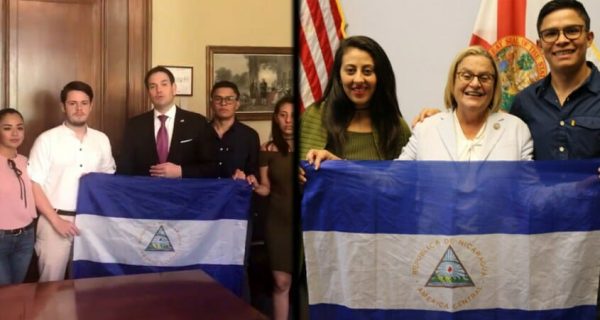
Nicaraguan student leaders lobbying for US intervention with Ileana Ros-Lehtinen and Marco Rubio
teleSUR | July 7, 2021
Just as in 2018, Nicaragua is once again the subject of the kind of mass international bad faith news coverage and perception management more usually associated recently with US and allied government offensives against Bolivia, Cuba, Iran, Syria and Venezuela. In Nicaragua’s case the current offensive is aimed at influencing the country’s elections scheduled for next November 7th. Currently, all the opinion polls show that, should President Daniel Ortega stand again for election, he and his FSLN party will win easily with over 60% support against around 20% for the the country’s right wing opposition.
The campaign against Nicaragua’s Sandinista government is clearly intended to encourage punitive coercive economic measures from the US and European Union governments aimed at influencing voter opinion in those November elections against President Ortega and the FSLN. Right now, the main false accusation is that “Ortega” has unjustly imprisoned over twenty opposition leaders, among them several presidential candidates. All US attempts to overthrow governments resisting US and allied government dictates depend on this kind of big lie. The standard big lie is that target governments are unpopular, repressive dictatorships. Invariably, the truth is very different if not the complete opposite.
For example, in 2009, the big lie in preparation for the coup against then Honduran President Manuel Zelaya was that the proposed Fourth Ballot referendum aimed to secure him re-election so as to impose a dictatorship. In Nicaragua’s case, the current big lie is that “Ortega” is arresting opposition leaders to prevent them defeating him in next November’s elections. These big lies only flourish in an essentially fascist culture of corporate dominated government in which truthful information is systematically suppressed and substituted by false beliefs.
Typical Western false beliefs or presuppositions are, for example, that the US and its allies are a force for good in the world, that Western culture is morally superior to others and that capitalism promotes optimal economic and social outcomes. These ridiculous false beliefs are fundamental tenets of Western intellectual life and public discourse. They make possible the kind of psychological warfare repeatedly unleashed against governments that obstruct the wishes of Western corporate elites and the governments they own.
An important component of Western psychological warfare shaping the moral dimension of any given disinformation assault is the essentially class based solidarity with the target country’s imperialist proxies. This neocolonial solidarity operates in reactionary and progressive varieties, both claiming a Western monopoly on freedom, democracy and defence of human rights. Both essentially agree that governments resisting Western demands deserve to be attacked one way or another.
The reactionary variety, prevalent mostly among the business and financial classes and related professionals, insists on abandoning international law in favour of intervention based on Western dictated rules. The progressive variety, prevalent mostly among non profit organizations, academics and other socially oriented professionals, agrees but is more diffident about the means of intervention deployed, demanding alibis to satisfy susceptibilities over humanitarian and human rights concerns. The right wing variety generally favors aggressive, overt or covert military-based solidarity with armed opposition rebellion, while the progressive variety favors smart-power coercive measures prioritizing solidarity with some version of opposition civil society or popular movements.
Nicaragua experienced the first right wing version of neocolonial solidarity during the Contra war of the 1980s when president Reagan declared, with more truth than he realized, that the CIA-run narco-terror campaign was “the moral equivalent of the founding fathers”. Subsequently, ever since the Sandinista FSLN party returned to government in 2007, Nicaragua has experienced principally the progressive version of smart power neocolonial solidarity developed under president Obama. That policy, supporting Nicaragua’s anti-Sandinista opposition, intensified under president Trump and continues unchanged now under “Biden”.
Self-evidently, these varieties of neocolonial solidarity thrive on their respective class loyalties and ideological susceptibilities. In 2018, a massive disinformation campaign covered up the Nicaraguan opposition’s extreme violence and their deliberate campaign of destruction. As Harold Pinter remarked in relation to the 1980s Contra War, even as the opposition violence of 2018 was happening, the murders, the extortion, the arson, the torture, it was made to seem that nothing happened. Now, when the Nicaraguan authorities have acted to preempt a repeat of that failed 2018 coup attempt, a furious psychological warfare assault is taking place to conceal the coup mongering opposition’s treasonous collusion with the US and EU country governments.
As regards progressive and left wing opinion in general, militant foreign supporters of Nicaragua’s ex-sandinista opposition have long been important protagonists covering up the ex.sandinistas’ anti-democratic collaboration with Western imperialist intervention. Even before the 2006 elections, the US authorities had coopted ex sandinistas as collaborators. But when Daniel Ortega and FSLN won those elections, successfully managed the crisis of 2008-2009 and then triumphed in the 2011 elections, US government support for the opposition switched to promoting efforts at outright regime change. Inside Nicaragua, the ex sandinistas, devoid of popular support, abused their non profit networks to camouflage their political opposition to the government and the accumulation of resources necessary to mount the 2018 coup attempt.
That systematic abusive subterfuge has been eliminated and its protagonists held to account. So now foreign supporters of the ex sandinista opposition again cloak their militant, aggressive, politically driven advocacy under phony human rights concerns. In 2018, they did so to cover up the violent role of the ex sandinistas in the failed coup attempt. Now, they falsely allege human rights abuses to cover up ex sandinista US collaborators’ treasonous criminality. The false human rights propaganda motif makes it possible for proponents of the progressive variety of neocolonial solidarity in North America, Europe and elsewhere, to work in parallel with their right wing counterparts. Even many supposedly left wing figures have written articles or signed declarations in support of the ex-Sandinista US collaborators and those people’s right wing allies in Nicaragua. They do so for three main reasons.
Firstly, many supposedly left-wing figures attacking the Nicaraguan authorities for defending Nicaragua’s independence and sovereignty have some degree of friendship with the ex-sandinistas now under investigation, so they defend them for essentially personal reasons. Secondly, it is likely that many supposed left wingers supporting the ex Sandinista US collaborators have been duped by the massive psychological warfare assault on Nicaragua without bothering to question it. A third main reason for that kind of neocolonial solidairty from people who should know better, is that they fear alienating their support networks and are simply signaling how virtuous they are so as to avoid criticism.
In any case, the current situation, just like the 2018 coup attempt, categorically defines where everyone’s loyalties lie. People genuinely committed to the principles of sovereign independence and self-determination recognize the Nicaraguan authorities are applying the country’s laws and criminal code to defend the country against US intervention aimed at overthrowing the elected government. People who believe the bogus human rights accusations and claims that the current criminal investigations are driven by electoral considerations are engaging in the kind of neocolonial solidarity regularly deployed to justify yet another operation of imperialist regime change. For anyone foolish enough to credit the ex sandinista leaders denials of complicity with the US government, this series of photographs should help disabuse them of that false belief.
‘They Make Unsubstantiated Accusations’: Venezuela Calls UN Report Fallacious
Orinoco Tribune | July 6, 2021
In a communiqué, the Bolivarian Republic of Venezuela rejected the fallacious content and highlighted the biased nature of a report published about the country’s situation by the Office of the United Nations High Commissioner for Human Rights, Michelle Bachelet, on July 1, 2021.
This report is the result of a Resolution promoted by a small group of governments with serious domestic human rights violations, that conspired to satisfy the policy of “regime”-change promoted by the US against Venezuela.
Despite the attacks, Venezuela is distinguished by its harmonious constitutional system that guarantees and defends human rights. The state provides a protective shield for its people against the barbarous criminal blockade imposed and directed from Washington and the European Union, that constitutes a serious crime against humanity.
It is especially worrying that this report is based on information provided by individuals with unknown motivations, and has not been duly verified with the authorities of Venezuela, despite the extensive facilities that the Venezuelan Government has provided for the performance of the OHCHR functions within the country.
On this occasion, based on a handful of alleged complaints of human rights violations, unverified accusations are made against the Venezuelan institutions, further manipulating the false narrative constructed to artificially supplement the file currently before the International Criminal Court, with the political objective of destabilizing the democratic institutions of Venezuela.
In addition to this, the report omits mention of the 26 visits made to detention centers and headquarters of intelligence agencies during which the Office of the High Commissioner has been able to interview hundreds of prisoners, according to its own guidelines of operation. In the Office’s conclusions, delivered to the State, the people interviewed confirmed that their personal integrity was respected during their incarceration.
Venezuela has asked the Office of the High Commissioner to share information with the national authorities on the alleged cases referred to in the report, in order to carry out rigorous investigations and determine their veracity and, if applicable, the corresponding responsibilities, in full consistency with its policy of absolute respect for human rights. Similarly, the Office of the High Commissioner has been invited to accompany the investigation processes developed by local authorities.
The Bolivarian Republic of Venezuela, in order to continue intensifying due cooperation with this office, ratifies its willingness to maintain channels of communication and dialogue with the Office of the United Nations High Commissioner for Human Rights, on the basis of strict adherence to the principles of objectivity, impartiality, non-politicization, respect for sovereignty, commitment to constructive dialogue, and—as required by international law—free from geopolitical agendas at the service of hegemonic powers.
America Leader of the Free World? How to Forget U.S. interference in Foreign Elections
By Philip Giraldi | Strategic Culture Foundation | July 1, 2021
After only five months in office, [proclaimed] President Joe Biden has already become notorious for his verbal gaffes and mis-spokes, so much so that an admittedly Republican-partisan physician has suggested that he be tested to determine his cognitive abilities. That said, however, there is one June 16th tweet that he is responsible for that is quite straightforward that outdoes everything else for sheer mendacity. It appeared shortly after the summit meeting with Russian President Vladimir Putin and was apparently intended to be rhetorical, at least insofar as Biden understands the term. It went: “How would it be if the United States were viewed by the rest of the world as interfering with the elections directly of other countries and everybody knew it? What would it be like if we engaged in activities that he engaged in? It diminishes the standing of a country.”
There have been various estimates of just exactly how many elections the United States has interfered in since the Second World War, the numbers usually falling somewhere between 80 and 100, but that does not take into account the frequent interventions of various kinds that took place largely in Latin America between the Spanish-American War and 1946. One recalls how the most decorated Marine in the history of the Corps Major General Smedley Butler declared that “War is a racket” in 1935. He confessed to having “…helped make Mexico, especially Tampico, safe for American oil interests in 1914. I helped make Haiti and Cuba a decent place for the National City Bank boys to collect revenues in. I helped in the raping of half a dozen Central American republics for the benefits of Wall Street. The record of racketeering is long. I helped purify Nicaragua for the international banking house of Brown Brothers in 1909-1912. I brought light to the Dominican Republic for American sugar interests in 1916. In China I helped to see to it that Standard Oil went its way unmolested.”
And there have been since 1900 other regime change and interventionist actions, both using military force and also brought about by corrupting local politicians with money and other inducements. And don’t forget the American trained death squads active in Latin America. Some would also include in the list the possibly as many as 50 Central Intelligence Agency and Special Ops political assassinations that have been documented, though admittedly sometimes based on thin evidence.
That Joe Biden, who has been at a reasonably high level in the federal government for over forty years, including as Vice President for eight years and now President should appear to be ignorant of what his own government has done and quite plausibly continues to do is astonishing. After all, Biden was VP when Victoria Nuland worked for the Obama Administration as the driving force behind efforts in 2013-2014 to destabilize the Ukrainian government of President Viktor Yanukovych. Yanukovych, an admittedly corrupt autocrat, nevertheless became Prime Minister after a free election. Nuland, who is the Assistant Secretary of State for European and Eurasian Affairs at the State Department, provided open support to the Maidan Square demonstrators opposed to Yanukovych’s government, to include media friendly appearances passing out cookies on the square accompanied by Senator John McCain to encourage the protesters.
A Dick Cheney and Hillary Clinton protégé who is married to leading neocon Robert Kagan, Nuland openly sought regime change for Ukraine by brazenly supporting government opponents in spite of the fact that Washington and Kiev had ostensibly friendly relations. As Biden’s tweet even recognized in a backhanded way, it is hard to imagine that any U.S. administration would tolerate a similar attempt by a foreign nation to interfere in U.S. domestic politics, particularly if it were backed by a $5 billion budget, but Washington has long believed in a global double standard for evaluating its own behavior. Biden clearly is part of that and also clearly does not understand what he is doing or saying.
Nuland is most famous for her foul language when referring to the potential European role in managing the unrest that she and the National Endowment for Democracy had helped create. The Obama and Biden Administration’s replacement of the government in Kiev was the prelude to a sharp break and escalating conflict with Moscow over Russia’s attempts to protect its own interests in Ukraine, most particularly in Crimea. That point of conflict has continued to this day, with a U.S. warships in the Black Sea engaging in exercises with the Ukrainian navy.
Biden was also with the Obamas when they chose to destabilize and destroy Libya. Nor should Russia itself be forgotten. Boris Yeltsin was re-elected president of Russia in 1996 after the Clinton Administration pumped billions of dollars into his campaign, enabling him to win a close oligarch-backed victory that had been paid for and managed by Washington. Joe Biden was a Senator at the time.
And then there is Iran, where democratically elected Mohammed Mossadeq was deposed by the CIA in 1953 and replaced by the Shah. The Shah was replaced by the Islamic Republic in turn in 1979 and the poisoned relationship between Washington and Tehran has constituted a tit-for-tat quasi-cold war ever since, marked by assassinations and sabotage.
And who can forget Chile where Salvador Allende was removed by the CIA in 1973 and replaced by Augusto Pinochet? Or Cuba and the Bay of Pigs invasion in 1961 where the CIA failed to bring about regime change in Havana? Can it be that Joe Biden cannot recall any of those “interventions,” which were heavily covered in the international media at the time?
And to make up the numbers, Joe can possibly consider the multiple “interferences in elections,” which is more precisely what he was referring to. As a CIA officer stationed in Europe and the Middle East in and 1970s through the early 1990s, I can assure him that I personally know about nearly continuous interference in elections in places like France, Spain, Portugal and Italy, all of which had prominent communist parties, some of which were on the verge of government entry. Bags of money went to conservative parties, politicians were bribed and journalists bought. In fact, during that time period I would dare to say there was hardly an election that the United States did not somehow get involved in.
Does it still go on? The U.S. has been seeking regime change in Syria since 2004 and is currently occupying part of the country. And of course, Russia is on the receiving end of a delegitimization process through a controlled western media that is seeking to get rid of Putin by exploiting a CIA and western intelligence funded opposition. China has no real opposition or open elections, nor can its regime plausibly be changed, but it is constantly being challenged by depicting it and its behavior in the most negative fashion possible.
Joe Biden really should read up on the history of American political and military interventions, regime changes and electoral interference worldwide. He just might learn something. The most important point might, however, elude him. All of the intervention and all of the deaths have turned out badly both for the U.S. and for the people and countries being targeted. Biden has taken a bold step to withdraw U.S. forces from Afghanistan, though it now appears that that decision might be in part reversed. Much better to complete the process and also do the same thing in places like Iraq, Somalia and Syria. The whole world will be a better place for it.
Brazilian court clears ex-President Lula of corruption charges in another legal win
RT | June 21, 2021
Brazil’s former leftist president, Luiz Inacio Lula da Silva, scored a fresh legal victory on Monday after a federal court acquitted him of passive corruption charges relating to alleged political favors, citing lack of evidence.
In 2017, Lula was accused of having granted political favors to automobile companies in exchange for donations of 6 million reals (around $1.2 million) to the campaign of his Workers’ Party (PT). The charges against the ex-president and other officials were filed after ‘Operation Zelotes’, which was launched by police to investigate alleged fraud and bribery in the sector.
But on Monday, federal judge Frederico Viana ruled that the case against the former president “lacks elements” that can substantiate any conviction against him and the other defendants.
“It is prudent and reasonable to pronounce an acquittal” of the ex-president, his former chief of staff, Gilberto Carvalho, and five other officials and businessmen, the judge said.
During his testimony last year, Lula denied the accusations, insisting that he never did any favors for the automobile firms.
In March, the court annulled all sentences handed to the 75-year-old political veteran under ‘Operation Lava Jato’ (‘Car Wash’) – a major anti-graft investigation in which three ex-presidents and numerous officials were indicted.
That ruling gave Lula the right to run for president again in 2022. He hasn’t yet announced plans to join the race, but recent polls put him ahead of Brazil’s current leader, Jair Bolsonaro, by 41% to 23% in the first round.
Lula remains highly popular in the country, which underwent a period of rapid economic growth during his years in office from 2003 to 2010, and saw millions escape poverty through his welfare programs.
Leaked tapes reveal Bolivian coup regime had plot to overturn 2020 election loss with US mercenary help
RT | June 17, 2021
Top cabinet officials in the caretaker government of Jeanine Anez plotted a second coup to stay in power in Bolivia, according to leaked documents. The plan allegedly involved hundreds of US mercenaries flown in from Florida.
Anez took power in Bolivia in November 2019, after mass protests backed by the country’s military and police forced Evo Morales to flee from the country rather than continue governing for a fourth presidential term after winning elections. The protests were triggered by claims of election fraud, which were promoted by the Organization of American States and were later proven to be groundless.
The new government used force to suppress dissenting people from Morales’ left-wing Movement towards Socialism (MAS) party and made a sharp right-wing turn. It also repeatedly delayed holding a new election, which was supposed to be the primary goal of Anez’ caretaker presidency.
Pressured by mass protests, she eventually agreed to hold the ballot last fall. MAS candidate Luis Arce, who served as Morales’ economy minister, won it in a landslide, avoiding a second round by getting 55.1% of the vote. Anez herself came a distant fourth.
As Arce was celebrating his victory, Anez and her ministers were plotting a second coup, which would allow them to overturn the will of the Bolivian people, the Intercept reported on Thursday, citing records of conversations and email exchanges detailing the conspiracy.
The key figures in the plan were Luis Fernando Lopez, who served as Anez’ defense minister, and Joe Pereira, a former civilian administrator with the US Army, according to the report. Pereira was supposed to recruit mercenaries in the US and help fly them to Bolivia. There they would join forces with elite military troops from the Bolivian army, police units and right-wing vigilante mobs to quash MAS supporters.
“I can get up to 10,000 men with no problem” Pereira bragged in one alleged conversation. “All special forces. I can also bring about 350 what we call LEPs, Law Enforcement Professionals, to guide the police.”
“If there’s something else I need, I will have them fly in as undercover, like if they were photographers, they were pastors, they were medics, they were tourists.”
The number of troops appears to be a boast on Pereira’s part. One of the US-based recruiters he turned to for help told the Intercept that one “couldn’t get 10,000 people even if Blackwater was back in business and going back to Iraq.” But email exchanges indicate the planning was in an advanced stage and that at least 250 contractors were ready to take part in the ‘Bolivia project’, before it was called off.
On the Bolivian side, officials had three Hercules C-130 transport aircraft that could airlift the hired guns and their weapons from the US. Pereira said he wanted to “pick up personnel in Southern Command in Homestead Air Force Base in Miami.” Two US military sources told the Intercept that the US Special Operations command was aware of the coup plot, but one source said that “no one really took them seriously.”
Some details of the conversations matched very closely the claims that Morales made in early November. He accused General Sergio Orellana, who was appointed commander of the Bolivian Armed Forces by Anez, of pressuring other top military officers into launching a military junta to prevent an Acre presidency. Lopez assured co-conspirators that Orellana was ready to initiate “the military operation” against MAS.
The plans were never put into action. Lopez apparently couldn’t secure support of enough military commanders and had a falling out with then-Interior Minister Arturo Murillo, who was in charge of the police. General Orellana and both ministers were among members of the Anez administration who fled Bolivia after Arce’s victory and before his inauguration.
Murillo was arrested by the FBI last month. He is suspected of taking a bribe to sign a contract for supply of tear gas from a Florida-based firm at an inflated price.
Anez was arrested and charged with crimes related to how she took power in Bolivia. Pereira is likewise held in a Bolivian jail awaiting trial on fraud charges.
The Intercept believes it was highly unlikely that the plot had some tacit approval or support of the US government. It seems closer in nature to the attempt to overthrow the Venezuelan government, which involved the private security company Silvercorp USA.
The incursion of US mercenaries, which took place in May 2020, ended in a humiliating failure and was dismissively dubbed by some media ‘Bay of Piglets invasion’, referring to the CIA-baked failed invasion of Cuba in 1961.
White House admits CIA involvement in “War on Corruption” which jailed Lula and elected Bolsonaro
Brasil Wire – June 3, 2021
In a White House ‘Background Press Call by Senior Administration Officials on the Fight Against Corruption’, a Biden administration official admitted that the CIA and other parts of the U.S. intelligence apparatus were involved in assisting the “War on Corruption” which jailed former president Luiz Inacio Lula da Silva and elected Jair Bolsonaro.
Read the full transcript here.
The admission will come as an embarrassment to a media who has for the most part omitted, minimised or denied U.S. involvement in anti-corruption actions across Latin America, despite it being a matter of public record for years.
In July 2017, Acting Assistant Attorney General Kenneth A. Blanco gave a speech at NATO think tank the Atlantic Council in which he bragged of FBI personnel informally involved in Brazilian anti-corruption operation Lava Jato and its prosecution of former president Lula. FBI personnel involved later boasted that it had “toppled presidents“. Lava Jato prosecutor Deltan Dellagnol described Lula’s 2018 arrest which kept him out of the election he was on course to win, as “a gift from the CIA“. The judge who prosecuted Lula, Sergio Moro, became Bolsonaro’s Justice Minister, and both made an unprecedented visit to CIA headquarters in Langley within months of taking office. Lava Jato’s origins can be traced back to 2008/09, where Moro and a blueprint for an operation of its type appear in State Department cables.
The role of anti-corruption as U.S. foreign policy tool in Latin America has expanded gradually since the 1990s, and has continued through successive Democrat and Republican administrations. Lava Jato was central to the ouster of president Dilma Rousseff, and pivotal to the election of Jair Bolsonaro, which were both undeniably advantageous to the United States government and business/banking sector, which is represented in Latin America by lobby and think tank Council of the Americas.
The June 3 press call was to mark a new national security study memorandum or NSSM on “Establishing the fight against corruption as a core U.S. national security interest“, which is being renewed under the Biden administration, and held by unnamed “senior administration officials”.
The following exchange left little to the imagination.
Journalist: “As you know, anti-corruption activists periodically urge the U.S. government to use its various assets and capabilities, including the intelligence community, to expose specific cases of corruption overseas, to name and shame corrupt officials — and the arguments they make are familiar — but also include not only, you know, a deterrent to corruption, but also a possible contribution to the promotion of democracy. Does the memorandum — does the program include any component that connects with that?”
Senior Administration Official: “What I can say on that front is that the memorandum includes components of the intelligence community. So, the work on that front, in part, remains to be seen, but they are included — the Director of National Intelligence and Central Intelligence Agency.”
“And so we’re just going to be looking at all of the tools in our disposal to make sure that we identify corruption where it’s happening and take appropriate policy responses.”
“And I’ll take the opportunity to mention that we’re also going to be using this effort to think about what more we can do to bolster other actors that are out in the world exposing corruption and bringing it to light.”
“So, of course, the U.S. government has its own internal methods, but, largely, the way that corruption is exposed is through the work of investigative journalists and investigative NGOs.”
“The U.S. government — to my point earlier, in terms of the support we’re already providing — in some instances provides support to these actors. And we’ll be looking at what more we can do on that front as well.”
The journalist asked for clarification: “What does the word “support” mean in that context?”
Senior Administration Official: “Well, sometimes it boils down to foreign assistance. There are lines of assistance that have jumpstarted investigatory journalism organizations. What comes to my mind most immediately is OCCRP, as well as foreign assistance that goes to NGOs, ultimately, that do investigative work on anti-corruption, as well.”
Evidence of the very nature that the official describes above has been dismissed by supporters of partisan anti-corruption campaigns for years.
The official was asked by a journalist specifically about Vice President Kamala Harris’s upcoming trip to Latin America, and: “if there were any corruption measures associated with that, or any, sort of, additional push related to that?”
The unnamed official responded: “I’m not going to characterize the views of the prior administration, but I would say, to your point: The essence of the memorandum we’re going to release today is that the U.S. government is placing the anti-corruption plight at the center of its foreign policy, so we very much want to prioritize this work across the board.”
The latest admission of CIA involvement in the U.S. led “fight against corruption”, of which Operation Lava Jato (Carwash) was the high-profile centrepiece, has grave implications for Brazilian democracy, and that of wider Latin America.
Brasil Wire has been covering this subject in depth since 2015: All articles on Lawfare in Brazil and U.S. involvement in it, 2015-2021.
Ten Killed During Protests in Cali, Colombia Over Past Day
Sputnik – 29.05.2021
At least 10 people were killed and 23 others were hospitalised during a day of protests in the city of Cali in southwestern Colombia, Security Minister Carlos Alberto Rojas Cruz said on Saturday.
“Yesterday, 10 people were killed in Cali, and in some areas in the south of the city, confrontations turned into a real urban war”, Rojas said live on the Caracol radio station.
According to him, many demonstrators sustained injuries during the rallies, with at least 23 of them admitted to the city’s hospitals.
“However, we know that there are many more of them”, the minister noted.
Local media and social networks voiced dismay over the recent series of videos showing people wearing civilian clothes shooting at protesters, and moving together with police officers. Activists demanded that the authorities explain these incidents.
“The presence of armed civilians on the streets of the city is unacceptable, it turns it into a field of military operations… The revealed facts require a quick and thorough investigation involving all law enforcement agencies”, Rojas said.
The city of Cali has been the epicentre of protests against tax hikes, rocking Colombia since late April even after the authorities discarded the initiative. Labour and student organisations demand social and health care reforms, demilitarisation of cities, and dissolution of Mobile Anti-Disturbance Squadron forces.
Rallies in Cali involve violent clashes between protesters and law enforcement troops. In the wake of the poor security situation, local authorities announced a night curfew. In addition, on Friday Colombian President Ivan Duque arrived in the province of Valle del Cauca, of which Cali is the capital, to hold a security council session and discuss the unrest with the regional government. He pledged to deploy more military personnel to the area.
Protest leaders publicly reject all forms of violence and declare them as peaceful marches, but numerous radical activists join the marches, vandalise properties and attack the police.
The Ministry of Defence of Colombia blames armed rebel groups, such as the Revolutionary Armed Forces of Colombia and the Army of National Liberation, for the violence during the demonstrations, claiming they seek to destabilise certain regions of the country for their purposes.
Bolivia to Request Extradition of Añez Regime’s Top Official
teleSUR | May 26, 2021
Bolivia’s Interior Minister Eduardo del Castillo confirmed that his country will ask the United States for the extradition of Rodrigo Mendez. He served as chief of staff to Arturo Murillo, who was interior minister in the coup-born regime led by Jeanine Añez (2019-2020).
He was arrested in Florida for requesting a bribe of US$582,000 to grant a contract for the purchase of tear gas ammunition for the coup-born regime.
The purchase from the Brazilian company Condor was for almost US$7 million. The acquisition was made through the U.S. company Bravo Tactical Solutions with an alleged overprice of US$2.3 million, which would have been used in bribes.
The U.S. Federal Bureau of Investigation (FBI) reported that Mendez allegedly received a second bribe payment up to US$714,000 in cash.
The evidence gathered from text messages, e-mails, and bank records revealed that Mendez was requested to write a letter to the Brazilian manufacturer to insist that the Añez regime would only buy the products through Bryan Berkman’s company.
Del Castillo explained that the extradition would be requested through Interpol channels and diplomatic notes to the U.S. State Department.
“We are sending the corresponding notes so that these people come to account to the Bolivian people,” he said, adding that Mendez and Murillo “took advantage of the opportunity to sow drug trafficking and corruption in our country.”
Featured Video
Chinese jet fuel and the myth of energy independence
or go to
Aletho News Archives – Video-Images
Book Review
Former Insiders Criticize Iran Policy as U.S. Hegemony
By GARETH PORTER | CounterPunch | February 27, 2013
“Going to Tehran” arguably represents the most important work on the subject of U.S.-Iran relations to be published thus far.
Flynt Leverett and Hillary Mann Leverett tackle not only U.S. policy toward Iran but the broader context of Middle East policy with a systematic analytical perspective informed by personal experience, as well as very extensive documentation.
More importantly, however, their exposé required a degree of courage that may be unparalleled in the writing of former U.S. national security officials about issues on which they worked. They have chosen not just to criticise U.S. policy toward Iran but to analyse that policy as a problem of U.S. hegemony. … continue
Blog Roll
 Aletho News
- What is fueling unrest across the EU?
- Why no power can undermine Iran’s eternal dominance over the Strait of Hormuz
- Is The War Against Iran Over?
- Iran war will leave long-term ‘scar’ on Wall Street, investors warn
- How Iran decimated US power projection in West Asia: Military lessons of 40-day war
- Iran’s report details US-Israeli war crimes in targeting schools, hospitals, livelihoods
- NATO’s Slow Fracture: How Trump’s Iran War Exposed the Instrument of Hegemony
- Chinese jet fuel and the myth of energy independence
- Ukraine Sea Drone Fired From Libya Hit Russian Tanker in Mediterranean
- IRGC: Iranian forces launched no attacks during ceasefire hours
- If Americans Knew
- DNC Shoots Down Resolutions Calling Out AIPAC and Limiting Arms to Israel
- TCN: Is Israel Blackmailing President Trump?
- Israel killed at least 303 Lebanese yesterday – who were they? Daily Update
- Amnesty: Urgent – Protect Lebanese civilians from brutal escalation in Israeli attacks
- Is The War Against Iran Over?
- Inside the Israeli army’s propaganda wing
- Hundreds of Gaza Amputees Stranded in Legal Limbo
- The gallows law: Israel moves toward executing Palestinian children
- Tucker Carlson: The Path to Peace requires ending ‘special alliance’ with Israel
- This is ceasefire? Israel’s biggest massacre yet in Lebanon, another journalist killed in Gaza – Daily Update
- No Tricks Zone
- An Inconvenient Tree: Uncovered In Alps… Europe Much Warmer Than Today 6000 Years Ago
- New Study Reports A 60% Slowdown In Greenland’s Ice Loss Rate In The Last Decade
- Low Intensity Tornado Wrecks Major Solar Farm, Creating A Potential Toxic Dump
- New Study Finds Warming Saves Lives…Cold Temperatures 12 Times More Deadly Than Excess Heat
- German Science Blog Accuses PIK Climate Institute Of Hallucinating Climate Tipping Points
- Devastating Assessment Of Comirnaty Vaccine By Former Senior Pfizer Europe Toxicologist
- New Study: CO2 Is ‘Effectively Negligible’ As An Explanatory Climate Change Factor Since 2000
- Former Pfizer Toxicologist Dr. Helmut Sterz Tells Bundestag Hearing Pfizer Vaccine Should Have Never Been Approved
- Energy Expert: Germany’s Nuclear Phaseout Was A “500 Billion Euro Mistake”
- New Research: South Australia’s Mid-Holocene Sea Surface Temperatures Were 4°C Warmer Than Today
 Aletho News