By Paul Antonopoulos | October 8, 2019
In an interview with DW Brasil, former Brazilian ambassador to Beijing, Marcos Caramuru, revealed the great interest Chinese companies have in potential infrastructure work in Brazil. Even with Brazilian President Jair Bolsonaro showing initial hostility towards China during his 2018 election campaign, his opinion appears to have changed given the huge sums involved in bilateral relations and the opportunities the Asian country can provide the economic struggling Latin American Giant.
Bolsonaro is commonly known as the ‘Tropical Trump’ for his open admiration of the U.S. President and his shared ideas and beliefs. Therefore, it was unsurprising that he said “The Chinese are not buying in Brazil… They are buying Brazil,” in the pre-election campaign.
Global Times speculated that “it’s inconceivable the new Bolsonaro government would give up on the Chinese market.” It also left a note of caution for the Brazilian leader who made another major antagonism towards China: “His trip to Taiwan during the presidential campaign caught the ire of Beijing. If he continues to disregard the basic principle over Taiwan after taking office, it will apparently cost Brazil a great deal … The Chinese island won’t bring any more benefits to Brazil, which Bolsonaro and his team must be aware of.”
Marcus Vinicius Freitas, a visiting professor at the China Foreign University in Beijing, explained that: “When the Chinese look at Brazil they actually see an amusement park where everything still needs to be done.” His assessment is in reference to the huge developmental and infrastructural opportunities that Brazil has, with many sectors remaining underdeveloped despite the domineering position Brazil has over the wider Latin American region. “There is no doubt that China has a menu of options for Brazil,” he added, citing Chinese technologies in road, subway, rail, viaduct and airport construction that could be of interest to Brazil.
There are also additional opportunities from agribusiness to commodities, the most attractive sector for Chinese capital is infrastructure and major works, especially in the area of gas, oil, renewable energy which will ensure growth on a sustainable and significant basis for the Brazilian economy.
However, despite the significant economic relationship between the two countries and the opportunities China can provide Brazil, it had not stopped Bolsonaro from aggravating Beijing. Therefore, it would be assumed that Bolsonaro would submit to Trump’s every demand in the midst of the U.S. president’s trade war with China. However, this has proven not to be the case with Brazil’s Vice President Hamilton Mourão saying in June that his country does not plan to ban Huawei from providing 5G equipment to telecoms in his country, signalling that Bolsonaro has said one thing during the election campaign, but acted in another way while president.
This would suggest that Bolsonaro’s government is following a different path than initially anticipated and the Brazilian president is not a complete U.S. puppet as often said by his critics. Although Trump told Bolsonaro during the latter’s visit to the White House earlier this year that Huawei was a security threat, the Brazilian Vice President emphasized that Brazil has no reason to distrust Huawei and that his country needs the Chinese technology to help its continued development.
As Beijing has been calling for a resolution to the Trump-initiated trade war, China’s ambassador to Brazil, Yang Wanming, accused the United States of bullying and lobbying its trading partners, affecting the entire global economy. He explains that the U.S. ruined market confidence, increased the risk of global recession and endangered emerging economies like Brazil.
And in this scenario, it would be important for Brasilia and Beijing to defend international cooperation and multilateralism. China’s GDP grew by ‘only’ 6.2% in the second quarter of 2019, which is the lowest economic growth recorded since 1992. This so-called economic ‘slowdown’ has served as a successful bait to trigger Western media.
As a result, Trump declared that his tariff war with China was working and said his protectionist measures had led to the exodus of companies from the Asian giant. However, if the measures were so successful Trump would not continue to threaten his partners from trading with China. The Bolsonaro government has seen that in this situation, siding with the U.S. is not in its interests.
Although Bolsonaro will continue to take on a very pro-Trump stance in Latin American affairs, especially against Cuba and Venezuela, he has demonstrated that he is unwilling to embroil Brazil in international issues besides those relating to Israel, serving the interests of the powerful Christian Evangelical lobby in the South American country.
In fact, an argument can be made that Brazil benefits from the ongoing trade war between the two Great Powers. China has continually been placing large orders of Brazilian soybeans, choosing the South American country to fill the supply gap after stopping U.S. purchases. Chinese buyers are increasingly looking for Brazilian soybeans.
China halted U.S. soybean imports as tensions between Beijing and Washington increased and turned to Brazil. For now, Brazil has been able to respond to China’s demand, but its supply is running low and Beijing is at risk of failing to meet its needs. With any end to the trade war, it is unlikely that China will revert and make the U.S. its most important soy purchaser, providing an opportunity for Brazil to consolidate its own position.
Whether it was through a sudden realization, or whether it was from internal pressures from Brazil’s powerful agricultural industry and other important advisers, Bolsonaro has certainly done a 180 towards his China rhetoric. With the status of Brazil’s role in BRICS questioned by experts last year because of Bolsonaro’s initial hostility towards China and his vivid support for Trump, his Foreign Minister Ernesto Araújo has fully embraced his country’s chairmanship of the organization. This demonstrates that no matter the motivating reason, Bolsonaro has certainly changed his China policy from hostility to openness and welcomeness as the Asian country can drastically improve Brazil’s economic situation.
Paul Antonopoulos is the director of the Multipolarity research centre.
October 8, 2019
Posted by aletho |
Economics | Brazil, BRICS, Latin America |
Leave a comment
Investigative journalism website Bellingcat released a bombshell report September 30, that claimed to uncover a network of “pro-Assad media” infiltrating Western journalism. The author, Charles Davis, alleged there was a “shadowy group” connected to the government of Syria that was financing the careers of both left- and right-wing journalists, bloggers and news outlets that toed an Assadist line. Named in the report as effective agents of Damascus were the likes of Wikileaks founder Julian Assange, investigative journalists Max Blumenthal, Rania Khalek and Whitney Webb, news outlets like MintPress News and independent journalists such as Caitlin Johnstone. Even the Green Party’s 2016 Vice-Presidential candidate Ajamu Baraka was framed as an Assad puppet. Thus, virtually the entire gamut of Western antiwar voices on Syria was declared to be deceiving the public, feeding them Syrian propaganda.
These are extraordinary claims. Yet the evidence provided was far from extraordinary. Indeed, the base of the evidence given was that many of these figures had accepted awards from a US-based organization dedicated, in their own words to “integrity in journalism” which, Davis insists, is a front to spread Assadist propaganda. Despite the lack of concrete evidence, the article caused waves on social media, with many seeing it as final proof of a worldwide conspiracy.
What Davis did not divulge, however, as was quickly pointed out by many he pointed the finger at, including Mint Press’ Mnar Muhawesh, was that Bellingcat itself is directly funded by some extremely shady organizations, including the Open Society Foundation and the US government’s National Endowment for Democracy (NED). That is the same NED that is currently bankrolling the protests in Hong Kong and has organized regime change operations in Nicaragua and Venezuela.
The NED was established as a buffer organization between the CIA and the organizations it was sponsoring. “It would be terrible for democratic groups around the world to be seen as subsidized by the CIA,” NED President Carl Gershman told the New York Times in 1986. “We saw that in the Sixties, and that’s why it has been discontinued.” One of the NED’s founders, Allen Weinstein, was even more frank: “A lot of what we do today was done covertly 25 years ago by the CIA”, he told the Washington Post.
Davis’ report was met with scathing criticism by those who it named as Assad agents.
“I find it terribly ironic that an article that accused MintPress and other anti-war news sites and journalists of receiving “shady state-linked funding” was published on Bellingcat, a site funded by the US government – currently an occupying power in Syria – and Google – the tech behemoth currently working overtime to censor independent media” replied Whitney Webb, when asked by the American Herald Tribune for a response to the allegations, adding that the attempt to paint the Serena Shim Award as “shady” was “quite dishonest” as the cash prize is funded by an all-American political action committee that opposes US interventionism abroad.
Max Blumenthal appeared equally unconcerned with the allegations. “I’ll take a token award from an anti-war non-profit over a byline in an interventionist PR operation literally backed by a CIA cutout that destabilizes socialist and independent nations around the globe any day” he told the American Herald Tribune, adding that “it almost seems that Charles Davis’ entire life is dedicated to attacking and denigrating me. He literally does nothing else”.
If Webb, Blumenthal and others are correct, this latest article is little more than an attempt to denigrate anti-imperialist, anti-war voices, along the lines of what the Atlantic Council has attempted to do. Since 2016, the Council, an offshoot of NATO, has published a series of investigations called “the Kremlin’s Trojan Horses” claiming virtually every political party in Europe that does not fully embrace neoliberal economics and an aggressive policy towards Russia is secretly infiltrated by and directed from Moscow. These parties include Labour and UKIP in the UK, PODEMOS in Spain, Syriza and Golden Dawn in Greece and the Lega Nord in Italy.
The Atlantic Council’s board of directors is a who’s who of neocon, interventionist foreign policy planners including Henry Kissinger, ex-Bush officials like Condoleezza Rice, Colin Powell and James Baker, Generals like David Petraeus and Wesley Clark, and a host of ex-CIA directors and senior tech executives. It was this organization that Facebook announced it was teaming up with to fight fake news. Thus, the Council is helping the social media giant to decide what America (and the rest of its 2.4 billion users) sees in their news feeds and what is likely Russian-sponsored fake news. When an organization like this decides what is news and what is not, it is state censorship by any other name. As soon as this partnership was in place, Facebook began deleting news and media channels from Iranian and Latin American (particularly Venezuelan) media that contradicted NATO’s official line on their countries. And Facebook was already working closely with the Israeli government to silence Palestinian voices on its platform.

Bellingcat’s founder, Eliot Higgins, for the record, was a senior fellow at the Atlantic Council between 2016 and 2019, where he published purportedly expert and independent reports into Russian aggression in Ukraine. Yet Bellingcat continues to present itself as a neutral observer in the cyberwar between Russia and the West.
And that is the trick. Under the guise of protecting us from supposedly extensive foreign, state-funded propaganda campaigns, we are, ourselves, being exposed to an even bigger, Western state-funded propaganda campaign, the extent of which is far greater than even the most lurid Russian fantasies of Bellingcat. Last year, for instance, it was exposed that the UK secret services have infiltrated media across Europe, building up “clusters” of sympathetic journalists in many nations in order to push certain lines crucial to their perceived interests. This “Integrity Initiative” as it is known, sprung into action in Spain, using their journalists to stir up a storm of controversy that managed to block the appointment of Colonel Pedro Baños to the position of head of Spanish national security. Baños, the Initiative had decided, was not sufficiently warlike on Russia, and needed to be blocked. Yet this blatant interference in foreign politics received scant attention in corporate media.
Ultimately, there is a new information war being waged in cyberspace, and the lesson to be drawn from this affair is to be very cautious of those decrying Russian propaganda while not also warning against the power of Google and the NSA, or calling for the release of whistleblowers like Chelsea Manning, Edward Snowden and Julian Assange. Cyberspace is the new battleground; and in war, truth is always the first casualty.
Alan MacLeod is a member of the Glasgow University Media Group. His latest book, Bad News From Venezuela: 20 Years of Fake News and Misreporting, was published by Routledge in April.
October 5, 2019
Posted by aletho |
Deception, Fake News, Mainstream Media, Warmongering, Russophobia | Atlantic Council, Latin America, Middle East, NED |
Leave a comment
Spanish Judge Baltasar Garzon: “Like Lula and Correa, Cristina Fernandez de Kirchner is being the object of a clear political persecution because she defends the people and faces immeasurable power structures.”
Federal Judge Claudio Bonadio on Friday asked Argentine’s Senate to take away Cristina Fernandez de Kirchner’s legislative immunity in order to put the lawmaker in preventive detention for alleged connections to the “Notebooks” corruption case.
For the second time in less than a year, former president Fernandez (2007-2015) must appear in federal court for her alleged connections to irregular public spending during her administration.
The judge’s decision comes just as Fernandez de Kirchner is running for vice president alongside Alberto Fernandez for the Oct. 27 elections, and polls and primaries show them as the favorites to win.
Prosecutor Carlos Stornelli accuses Fernandez de Kirchner of being the “boss” of an illicit ring of politicians who raised money from private companies in exchange for granting them public contracts. A ledger ‘notebook’ supposedly lists all the transactions. A former chauffeur of Fernandez de Kirchner allegedly recorded the sums of money that the former president and her husband, Nestor Kirchner, also a former head of state, received.
More than 170 people have already been processed in the Notebooks case, among them are the owners of large private businesses who have already been released.
During the previous legal proceedings related to the case, Fernandez de Kirchern’s lawyers denounced several irregularities, including biased statements made by other defendants, indiscriminate detentions, burned evidence and other constitutional and due process violations.
According to Judge Bonadino, the vice presidential candidate should appear at an oral trial in the near future, but his request for Cristina’s preventive detention cannot be executed until the Argentinian legislative removes Fernandez de Kirchner’s legal immunity as a sitting legislator.
If this were to happen before the next elections on Oct. 27, Argentina would experience an unprecedented political crisis, amid growing popular mobilizations which are being carried out in rejection of President Mauricio Macri’s neoliberal policies, rising unemployment, poverty and hunger.
September 22, 2019
Posted by aletho |
Civil Liberties | Argentina, Latin America |
Leave a comment
Ecuador’s minister of Defense Oswaldo Jarrin confirmed Thursday that ‘elite’ units of Ecuador’s military will begin training in Israel. Jarrin made the announcement as he hailed a new era of close Israel-Ecuador relations, a turn away from the approach of leftist former President Rafael Correa who cut military ties in 2010, in solidarity with Palestine.
The cooperation will be to ‘modernize’ Ecuador’s armed forces and to take ‘counter-terrorism’ courses, given by Israel’s military. Details also emerged about US$30 million worth of weapons that Ecuador has purchased from Israel in the last year alone.
Israeli officials have told Ecuadorean media that there is now a ‘flourishing relationship’ between the two countries.
Jarrin said this is because there is “now an environment of international cooperation that did not exist before”, in reference to the breakdown in relations that took place under the previous government of Rafael Correa.
During Correa’s period in office, he joined other leftist leaders in the region and formally recognized a Palestinian state and established diplomatic ties. There was also a long period of tension during that time, in 2010, Correa put an end to military cooperation with Israel and stopped the purchase of weapons.
Relations hit their lowest point in 2014, following Israel’s 50-day military campigan against Gaza in which over 1,500 Palestinian were killed. In protest, Ecuador, along with a number of Latin American countries, recalled their ambassador in Israel.
However, under current President Lenin Moreno, there has been a sharp turn in foreign policy. The country has begun a thawing of relations with the U.S. and Israel. The country has also joined in regional attacks on former allies of Ecuador, especially Venezuela, with President Moreno joining the so-called ‘Lima Group’ aimed at isolating Venezuela on the international stage.
Many analysts have also said this rapprochement with U.S. foreign policy interests, along with a new multi-billion-dollar IMF loan, were the driving forces behind Moreno’s decision to hand Julian Assange over to British authorities, where he is currently in prison and faces possible extradition to the U.S. to face charges related to his work exposing U.S. war crimes in Iraq and Afghanistan.
September 16, 2019
Posted by aletho |
Militarism | Ecuador, Israel, Latin America, Palestine |
Leave a comment
By Stephen Sefton | September 11, 2019
A fundamental dimension of contemporary psychological warfare has been dual-purpose corporate co-option of non-governmental organizations. In that psy-warfare dimension, NGOs serve both as disinformation partners with Western news media and too as false interlocutors in international forums and institutions, where they attack governments challenging the US elites and their allies. They actively subvert governments inside countries challenging the West, for example, in Latin America, Cuba, Venezuela, Nicaragua and Bolivia. But they also pervert due process in institutions like the UN, posing as civil society but in fact serving Western elite corporate imperatives, for example in international human rights and environmental mechanisms and forums.
Among these NGOs figure high profile human rights organizations like Amnesty International, Human Rights Watch, the International Federation for Human Rights and Avaaz along with environmental organizations from 350.org and the World Resource Institute to Global Witness and Greenpeace. An increasing interrelationship has developed between corporate NGO funding and the exploitation of people’s general willingness to volunteer for and support apparently good causes. Symbolic of this is the way World Economic Forum attendees like Kumi Naidoo move readily between top management from one NGO to another, in Naidoo’s case from Greenpeace to Amnesty International. From Libya and Syria to Venezuela and Nicaragua, Amnesty International has played a key role using false reports to demonize governments resisting the US and its allies.
As Cory Morningstar has pointed out, Greenpeace is a key player in promoting the corporate driven New Deal for Nature aimed at financializing what remains of the natural world, especially its biodiversity, as a way of engineering a “Fourth Industrial Revolution”. Western corporate greed underlies the identical patterns of news media and NGO misrepresentation and outright deceit supporting regime change offensives against Libya and Syria, or Venezuela and Nicaragua. Right now, that very same pattern of media and NGO manipulation is clearly at work preparing for an intervention to prevent Evo Morales being re-elected as President of Bolivia.
Bruno Sgarzini and Wyatt Reed have noted how Western media and NGOs have falsely attacked Evo Morales blaming him for not controlling the fires in Bolivia’s Amazon. This is exactly what happened in Nicaragua immediately prior to the coup attempt in 2018 when the Nicaraguan authorities were fighting a fire in the Indio Maíz Biological Reserve. That episode softened up Nicaraguan public opinion and set in motion social media networks involving thousands of youth activists trained for that purpose beforehand over several years with US and also European government funding. In mid-April 2018, barely a week after the Indio Maiz fire was extinguished, those networks launched a social media blitzkrieg of lies and inventions marking the start of the actual coup attempt. A practically identical process is well under way now in Bolivia, which holds presidential elections next October 20th.
The timing of the fires in Bolivia’s Amazon is extremely propitious from the perspective of the US authorities and their allies. It takes almost two months for the effects to wear off of the initial psy-warfare bitzkrieg of the kind waged against Nicaragua in 2018 and against Brazil’s Worker’s Party as part of Jair Bolsonaro’s successful 2018 election campaign that same year. Bolivia will almost certainly experience the same kind of psy-warfare assault via social media prior to the October elections. The campaign will be timed to optimize the effect of mass false accusations of government wrongdoing and corruption along with false media and NGO claims of security force repression. Opposition activists are likely to exploit peaceful demonstrations on indigenous peoples and environmental issues so as to commit murderous provocations, just as they did in Nicaragua and Venezuela.
All of these tactics are likely be deployed against Bolivia so as to destroy the current prestige and high levels of support for President Evo Morales. In Bolivia, as in Nicaragua and Venezuela, the governing progressive political movement enjoys around 35-40% core electoral support, the right wing opposition have around 25-30% with 30-40% of voters uncommitted. The Western elites know they need to motivate something over half of those uncommitted voters against Evo Morales so as to get the right wing government they so desperately need in Bolivia to try and make good the unmitigated debacle of Mauricio Macri’s right wing government in Argentina.
The intensity of any Western media and NGO campaign against Morales is likely to reach similar levels as their cynical campaigns of lies and defamation against Venezuela and Nicaragua. Should that offensive go ahead, as seems probable, the difference will be that this time Evo Morales and his team are alert and unlikely to be taken by surprise as the Nicaraguan authorities were by the vicious, sudden attack against them in April 2018. A likely variation in Bolivia’s case will be a higher profile of environmentalist NGOs working in tandem with their human rights counterparts feeding misrepresentations and downright lies into Western news media. For the US and European Union elites the regional geopolitical stakes are high enough to make an attack on Bolivia imperative.
(A longer version of this piece was published at Tortilla con Sal on September 4, 2019.)
September 13, 2019
Posted by aletho |
Deception, Environmentalism | Avaaz, Bolivia, Greenpeace, Latin America, Nicaragua, United States |
Leave a comment
“It does not matter whether the government is right or left-wing; impunity is maintained. Even with the previous governments it was discovered that the Armed forces burnt the archives with information and no steps were taken.” Former Revolutionary Left Movement (MIR) member and torture survivor Erika Hennings has experienced the trauma of state-enforced oblivion – she is still seeking the details about the extermination and disappearance of her husband, Alfonso Chanfreau.
Forty-six years since the US-backed military coup overthrew the democratically-elected, socialist government led by Salvador Allende, Chilean society remains fragmented and burdened with a legacy which all governments since the transition back to democracy have failed to challenge.
The neoliberal experiment unleashed upon Chile was violent – in 2011, the Chilean state recognised 40,018 people as victims of the Pinochet dictatorship, among them 3,065 who were killed and disappeared. The Chilean military’s pact of silence has hampered efforts to bring the perpetrators to justice, as well as forced Chileans to contend with gaps in their personal and collective memory.
Human rights lawyer and Communist Party deputy Carmen Hertz, whose husband Carlos Berger was one of the victims of the Calama Massacre in October 1973 – the last stop of the dictatorship operation known as the Caravan of Death, has also blamed the governments from the transition onwards for cultivating state impunity. Fragments of her husband’s remains were identified – together with the other Calama victims, Berger was mutilated, buried clandestinely and later exhumed for disposal into the ocean. The Chilean state, Hertz asserted, “has debt in truth, in justice, in reparation.”
The Chilean state, however, has no intention of facilitating the Chilean quest for justice and memory. Upholding impunity remains a prime concern for the government and the military. Oblivion, the act of forgetting which Pinochet insisted upon as the only means to move on from dictatorship crimes against humanity, is never far from Chileans’ consciousness. As a mechanism endorsed and implemented at state level, Chileans involved in memory and resistance activity are perpetually fighting against government efforts to erase remembrance.
Last Sunday, a march led by various human rights and memory group commemorating the victims of the Pinochet dictatorship in Santiago was violently disrupted by the Chilean police.
A recent cruel taunt by Brazilian President Jair Bolsonaro directed at former Chilean President Michelle Bachelet, whose father was murdered by the dictatorship, was mildly reprimanded by Chilean President Sebastian Piñera who, while denouncing the comment as regards subject matter, downplayed its significance by describing Bolsonaro’s dictatorship admiration as “different opinions”.
Bachelet, herself a torture victim, failed to maintain her promise to close the luxury prison of Punta Peuco, where former dictatorship agents serving multiple sentences lead privileged lives in incarceration. During her presidential terms, Bachelet made use of the Pinochet-era anti-terror law to target Mapuche communities and individuals involved in resistance. Although by no means an exception in resorting to the legislation, its use was most widespread during her tenure.
As part of his electoral campaign, Piñera had vowed changes to make the legislation easier to implement against the Mapuche. In November 2018, Mapuche youth Camilo Catrillanca was murdered by the Comando Jungla – a special force trained by the US and Colombia. Evidence related to the killing was destroyed and the witness, a minor, was beaten by the police.
In August this year, it was revealed that the Chilean military was spying on the Chilean investigative journalist and author Mauricio Weibel in 2016.
In another bizarre case, a former DINA agent pressed criminal charges against Javier Rebolledo, a Chilean investigative writer. Rebolledo’s research revealed detailed accounts of torture and sexual abuse perpetrated by DINA agents, among them Raul Quintana Salazar, who sued the author for purported defamation.
State-endorsed oblivion in Chile has made a travesty out of justice. Yet it has also ensured a strengthening of memory. The latter, however, faces one main hurdle in the form of governments normalising dictatorship violence. If governments in Chile continue to uphold the dictatorship pacts of silence, Chile’s memory will, with time, remain tethered to narrations which do not make it beyond diluted versions of history.
September 13, 2019
Posted by aletho |
Civil Liberties, Subjugation - Torture, Timeless or most popular | Chile, Human rights, Latin America |
Leave a comment
The “new guerrilla” movement led by former Revolutionary Armed Forces of Colombia, People’s Army (FARC-EP) Ivan Marquez announced to the public Saturday it is willing to engage in “dialogue” with a “coalition.”
An open letter signed “from the mountains of insurgent Colombia” by former high-ranking FARC commanders who are referring to themselves as the “New Power”, reiterates that the state’s failing to follow through with the 2016 Havana Peace Accords is what led the minority faction to return to arms. According to the ‘New Power’ that announced its rearmament Aug. 29 via a 32-minute Youtube video, the group took up weapons again because, “the history of betrayals suffered leaves no alternative.”
The former FARC commanders and soldiers in the split faction of around 30 people that “only an open process and an alternative humanist government can pave the way towards a scenario of coexistence in which the interests of the people and true development prioritized” for Colombia.
On Thursday morning a video was published by a minority of senior leaders of the former FARC announcing their split from the main organization and to rearm. Among those in the video was Jesus Santrich, a key FARC leader who has been missing since mid-July and Ivan Marquez, a once-senior commander who was integral in negotiating the peace accord, announcing a “new stage of armed struggle.”
In the ‘New Power’ letter, the authors recognize all those who participated in the peace accord that was negotiated over several years. “They became the moral fire of the cause of reconciliation.” They are “the great coalition of social justice and democracy that promotes a new dialogue to achieve true, final, stable and lasting peace,” the communique reads.
“Hopefully, total peace is achieved involving all armed actors that forges a New Alternative Government that saves the country from this general crisis,” say the dissident leaders who send a message to the Communist Party, the Patriotic Union and other nearby political factions: “As revolutionaries, sooner or later we will meet along the way.”
Marquez, Santrich and the other signatories say there are “men and women of this country, who believe that another Colombia is possible who have struggled and continue to fight with patience and intelligence for peace.” Among those on that list are Congressmen Ivan Cepeda, Alvaro Leyva, Roy Barreras, Gustavo Petro, Angela Maria Robledo and Angelica Lozano, among others.
The guerillas thank all social movements and guarantor countries that part in crafting the peace agreement and denounce the “Dominant Power Block—the oligarch class that sows wars to be freed by others.”
Also on Saturday, Colombia’s military announced it had killed, in total, 12 former FARC in a rural area in the southern department of Caqueta, near the border with Ecuador. Colombian Army General Nicacio Martínez said Saturday that the number of FARC dissidents who died in a large military operation rose to 12, three more than was first announced Friday following the Aug. 30 operation ordered by President Ivan Duque.
It’s still unclear how, or if, the Caqueta faction is related to the ‘New Power’ under Marquez.
The main ex-FARC constituency officially condemned the move on Thursday. In a tweet on their official account, they say unequivocally that “more than 90% of former guerrillas remain committed to the peace process.” The group did later that day say it was breaking with the Comprehensive System of Truth, Justice, Reparation and Non-Repetition (SIVJRNR), the institutions that form the basis of the Havana Peace Accords, which includes the Special Judicial Court, or JEP, set up to help the over eight million people affected by the 50-year civil conflict.
August 31, 2019
Posted by aletho |
Civil Liberties | Colombia, Latin America |
Leave a comment
or how to flip an average into a record without changing the data

My original article about the media presentation of the 2019 Amazon Rain Forest burning season produced a good deal more controversy than any of us anticipated. I don’t know how many times in the past four days OffG admins and editors have had to say “no, we aren’t claiming deforestation is a good idea”, but it’s been a few.
We also received our first DDoS attack in a couple of months the day after it was published. So, even the hackers were pissed off at us.
Surprising as it may be to those who favor knee jerk spontaneity over reading and reflection, I don’t think deforestation is a non-issue.
Which is why I said so in my previous article. And why OffG has repeated it numerous times since on our Twitter feed.
But let’s expand.
And put it in emphasis.
I, along with most other non-crazy people, believe the total or almost total destruction of the Amazon rain forest in order to build mahogany end tables or provide McDonald’s with cheap beef would be a crime of unprecedented dimensions.
(Maybe someone would like to cut and paste this as an automated tweet in response to anyone else who says “oh wow dude, so if you were on the Titanic you’d be like “what, there’s no problem?”)
I just also happen to think the importance of the subject doesn’t make buying into media memes about it, or lying about the data, somehow ok.
I don’t think it justifies hysteria, or uninformed rants from people who think indignation is a legitimate substitute for research data (“look how ANGRY I am, if this doesn’t fix things, nothing will!”).
I think that is –
a) often colonialist and patronizing, assuming the issue is so simple your massive western brain can grasp it simply by semi-digesting a couple of headlines over your cornflakes (“oh my God Janice, the Amazon is burning down, send that charity the Guardian are recommending some money and pass the milk”)
b) counter-productive, if not devastatingly destructive.
I’m not sure when the notion gained currency that exaggeration, lies and distortion were somehow appropriate if the event being lied about/exaggerated was “urgent” or “serious” enough, but it’s an idea antithetical to reason and truth.
The corollary also expressed, that demanding factual accuracy about such events is equivalent to denying their importance is equally, if not more disturbing.
It’s a mindset that invites manipulation and uncritical acceptance of authoritarian-inspired panic memes
But I’ll talk more about that another time. This is a follow up to the original article from August 23. There have been some interesting developments in the last few days and I think we should note them.
Firstly, as has been observed BTL on the original article, the three sources we cited underwent quite extensive revisions very shortly after our article was published.
Science20.com is the most noteworthy of these. On August 24, the day after we published our piece, the article we cited was completely re-written, presumably by its original author, identified as Robert Walker. In fact the changes implemented are so bizarre I want to look at them in some detail.
Here’s the original version we cited, now preserved only as an archive. This is the first part of the text:
NASA Say The Amazon Is Burning At Below Average Rates – Yet Many News Stories Say Record Rates???
Short summary: we have had wild fires for many years now in the Amazon, even in the tropical rainforest – mainly started by humans for forest clearing and ranching. It is not enough to impact significantly on the Paris agreement pledges yet though it is important in the long term if this continues for decades.
This image is beign shared with captions such as “The Amazon is burning at record rates – and deforestation is to blame”. NASA’s caption is that it is burning at less than average rates. Bit of a big difference there.
It shows smoke from fires in the Amazon region on 13th August 2019. These are not necessarily all forest fires. Some of these will be fires in pasture to stimulate new growth for the cattle.

So, go to the Global Fire Emissions Database. and this is what you see:
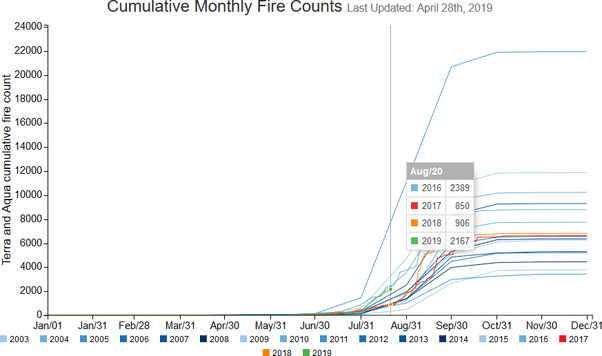 The green line for 2019 there is a bit hard to make out, so here is a zoom in, as you can see it is way below the top line which is for 2005, with only a few data points, and is also below the 2003 line.

The BBC is misreporting it as a “record”
Big difference between (sic) “record” and “Less than average”. By “record” all they mean is that there are more than for 2018. It’s also greater than for 2017, but less than for 2016. That is not how the word “record” is normally understood. (OffG emphasis)
The ranchers use fire for forest clearing, “slash and burn agriculture” as it is called. That is because it is much easier to convert forest into grassland by burning it than to do it by felling the trees. Once it is cut, the way they manage the pastures is to re-burn them every few years to clear out the brush and to get the grass to re-sprout.
So not all the fires you see are virgin forest. Many are controlled grassland fires, to get the grass to re-sprout. We do something similar in the UK where they do controlled burning of heather (muir burn) for grouse, sheep and deer. However, some of those fires get out of control (same sometimes happens for our moor fires) and burn the nearby forest at the forest edges.
So, not all the forest fires are deliberate clearing.
Also we do not risk losing the Amazon as a whole. That is something they used to think a few years back, but the research has moved on. A large part of the Amazon rainforest will remain through to 2100 even with high emissions – they survived the previous glacial minimum when it was warmer.
We do not need them for oxygen. This is just an urban myth. We have enough oxygen in the atmosphere already for thousands of years even if all the plants magically stopped producing oxygen.
The burnt areas do not become desert, but rather, regrow quickly as lower mass drier forests which given enough time over many decades and perhaps centuries would restore to tropical rainforest again – but in a warmer world some of them will turn to savannah with scattered trees, a habitat known as the Cerrada.
This is another article I’m writing to support people we help in the Facebook Doomsday Debunked group, that find us because they get scared, sometimes to the point of feeling suicidal about it, by such stories.
Do share this with your friends if you find it useful, as they may be panicking too.
This original version of the article is at pains to make certain things clear:
- it calls the media to task for describing the burning as “record”
- it says the Amazon as a whole is not under threat
- it says the Amazon is not needed for oxygen, and this is just an ‘urban myth’
- it says the burned areas do not become desert
- it asks readers to share the article with friends who may be panicking unnecessarily
But then, on August 24, Walker apparently had a complete change of heart, decided panicking might be a good idea after all, took down the above version, and replaced it with this one.
Is Amazon Rainforest Burning At Record Rates? What Is The Way Forward?
Short summary: we have had wild fires for many years now in the Amazon, even in the tropical rainforest – mainly started by humans for forest clearing and ranching. It is not enough to impact significantly on the Paris agreement pledges yet, though it is important in the long term if this continues for decades. It does of course have major and immediate impacts on forest residents, nature services and the biodiversity in Brazil.
This image is being shared widely, for instance in National Geographic’s “The Amazon is burning at record rates – and deforestation is to blame”. Similarly, the BBC is reporting it as ‘Record number of fires’ in Brazilian rainforest.
Yet, NASA’s own description for this photo says that it is burning at close to the average for the last 15 years. So, what is going on here?
It turns out that the earlier 13th August [the date is an error, the article was from August 16, and updated August 22 – OffG] article gives the number of fires since 1st January but they use 1st May as the start date for the August 19 update.
There’s been a rapid increase of fires in the second half of August still continuing as of 24th August. it was at average levels or below average through to early August but had a huge uptick and is now close to the 2016 levels from 1st January and if it continues likely crosses them soon. But if you count from 1st May it is already way above recent previous years and close to rates last seen over a decade ago.
The new fires are more intense, near roads and show all the signs of being deliberate fires for deforestation. In addition, local farmers in Para district organized a “day of fire” on August 10th to show to Bolsonaro that they are ready to work and that they need to use fire to do so. So there is a clear link here. Bolsonaro however, in response to pressure internationally and also locally within Brazil has responded instead by sending in the army to stop the fires and he says that it is his duty to protect the Amazon. He also said clearly that these fires are illegal. There is also an investigation underway into the “day of fire”.
If they can stop the illegal fires this could make a big difference to deforestation figures for this year and indeed future years. There are more sustainable ways to increase the productivity of Brazil using existing land without impacting on the forest…
APOLOGIES – UPDATE FROM NASA FROM 19TH AUGUST – THEY NOW CONFIRM INPE INSTEAD OF SAYING IT IS BELOW AVERAGE
Previous version of this article was mistaken. I have made a copy on my website here (the comments on this article are based on that earlier version):
He then goes on to add some stuff about Trump and the G7, which isn’t in the first version. But then, after paragraphs of this interpolation, he reverts, way down the page, to many of his original non-panic points (scroll down and you will see what I mean).
This is very odd editing and the result is a car crash of clearly conflicting intentions. It’s not that the new text is revising the data or denying the claims it previously made. In fact it does not do this at all. Instead it uses a frenzied avalanche of words and non sequitur to give the impression it’s denying the claims, while it ends up actually re-affirming them elsewhere on the page.
In so doing, it replaces the cogent data points and arguments it previously used with the same vague claims of loosely-defined exceptionality you can read in the MSM, that imply a weight of ‘record’ significance but never say what that significance actually is. Such as:
It turns out that the earlier 13th August article gives the number of fires since 1st January but they use 1st May as the start date for the August 19 update.
This is presented as if it were an explanation of why NASA was claiming the fires were average at the same time the mass media were hyping “record” fires. But it’s obviously no such thing, as I go into further on.
And this:
The new fires are more intense, near roads and show all the signs of being deliberate fires for deforestation.
Maybe so, but since they are still well within the 15 year average, what difference does this make in any environmental sense? None is the obvious answer. Certainly neither Walker nor anyone else citing these points attempt to suggest any.
Further down the page it still has an approximation of the sections quoted above that attempt to debunk the alleged myths about the Amazon being essential for oxygen-production etc, though the wording has been toned down. It carries the same videos that try to put forest fires in a historical perspective (worth watching if you have the time).
On the question of the comparative amount of burning, the first version says:
By “record” all they mean is that there are more than for 2018. It’s also greater than for 2017, but less than for 2016. That is not how the word “record” is normally understood.
The new version says:
it was at average levels or below average through to early August but had a huge uptick and is now close to the 2016 levels from 1st January and if it continues likely crosses them soon
This is the same information, just the spin has been changed. And this is confirmed by the fact the same 17-year graphs that appear in the first version, showing 2019 to be an average burn year are re-posted in this version, just further down the page and with a rider added drawing attention to the ‘sudden’ rise in August.
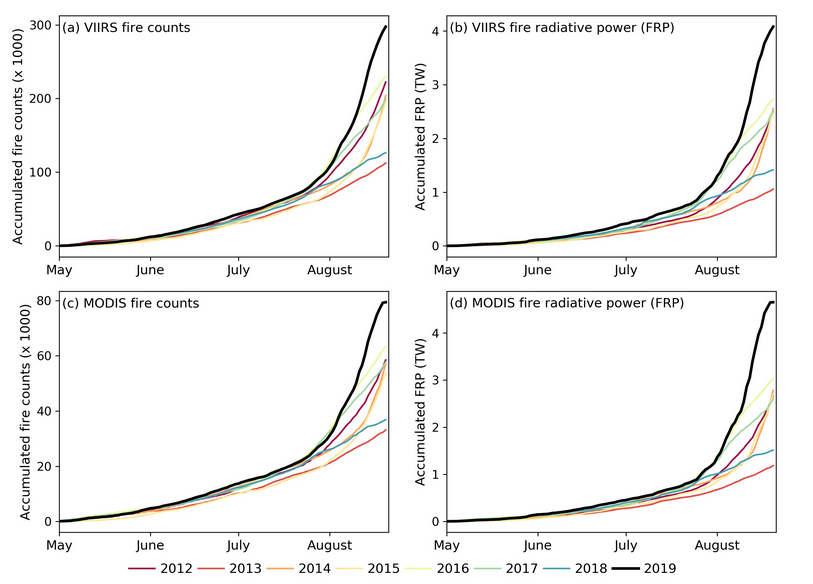
Prominently displayed in the new version are four graphs from globalfiredata.org, the other website we referenced in our original piece. This website had also been updated August 24, and the graphs added.

As we can see the thick black lines showing burning activity for 2019 are highly striking and certainly appear to support the media contention that 2019 is “record-breaking,” and eliminate all the doubts previously being expressed.
But on closer inspection, they have simply been constructed to make the 2019 burning look as “record” as the headlines were already claiming.
To achieve this two things have been done to the data.
1) the earlier years that are included in the other graphs from the same source, and which all had much higher burn rates than anything more recent, have been eliminated from these new graphs. The rather thin rationale for doing this is the VIIR/MODIS measure only goes back to 2012.
2) They start the sample in May rather than in January. No rationale is given for this at all, and it’s hard to see any beyond the fact that excluding the earlier months is the only way to make 2019 stand out as being “record” in line with media claims.
NASA’s website has made a similar journey over the same period.
This article, which we originally quoted, still says the burn activity in the Amazon is “close to average” and explains that a lot of farmers burn their land in the dry season.
As of August 16, 2019, an analysis of NASA satellite data indicated that total fire activity across the Amazon basin this year has been close to the average in comparison to the past 15 years. (The Amazon spreads across Brazil, Peru, Colombia, and parts of other countries.) Though activity appears to be above average in the states of Amazonas and Rondônia, it has so far appeared below average in Mato Grosso and Pará, according to estimates from the Global Fire Emissions Database, a research project that compiles and analyzes NASA data
This one, referenced by Walker and published just before his revised piece, might superficially appear to contradict the above claim, but – in a similar fashion to Walker’s piece – actually doesn’t if you look closely:
MODIS active fire detections in 2019 are higher across the Brazilian Amazon than in any year since 2010. The state of Amazonas is on track for record fire activity in 2019.
What NASA has done here in order to be able to claim a ‘record’ where previously there was an ‘average’ is simply switch from a fifteen-year analysis in the first article, to a nine-year one in the second. As I already pointed out above in relation to the revised graphs, this removes all the years of major burning this century and instantly shifts 2019 much further up toward the top of any comparative table.
Note also that NASA’s claim is not really true. Even within these somewhat distorted parameters 2019 is NOT higher than any year since 2010. As of today (August 27) 2016 is still just higher in total activity, and of course the earlier years of the 21st century were much higher again, but have been eliminated, apparently just for the purpose of making 2019 look a bit more “record-breaking”.
What we have here, in both the Sceince20.com article and in NASA’s ‘update’, is interpretation-manipulation being passed off as data-update. It’s hard to avoid the conclusion this is a direct attempt to make their pages fall in line with the current media hysteria.
Looking at the wider issue, it’s pretty clear an orchestrated campaign to create unique panic and fear about the Amazon forest fires was initiated, not because the 2019 fires were uniquely dangerous, but because public fear was perceived as useful for promoting an agenda.
What agenda? I think it’s too early to get a comprehensive answer there. Many straws blowing in the wind. It’s been suggested Bolsonaro, the new imperial puppet, may have been proving a little antsy and required pulling into line. Or that it’s a concealed attempt at strengthening his position while appearing to attack it.
There’s this little straw in the wind that shouldn’t be ignored:
An “international treaty” would certainly be a nice cover for exploitation of the Amazon’s riches. It can’t be discounted as one possible motive for fomenting a fake crisis where only an endemic problem exists.
Or this:
Or this:
There are no shortage of possibilities once the question “cui bono?” is asked.
If that question isn’t asked, if it’s outlawed as “unhelpful” or “conspiratorial”, we can become trapped in a refusal to interrogate. And that can lead to disaster.
Too many of us become utterly trusting as soon as our hot button subjects are on the front pages. People who know the media is utterly corrupt can still switch off their critical thinking when it starts to venture any opinion they can agree with.
Commentators who deride the absurd media lies about the Skripals or Corbyn or Syria or Russia still share the Environment page of the BBC or the Guardian, as if somehow honesty and integrity are guaranteed there.
George Monbiot, serial liar and lunatic when it comes to Syria or western foreign policy, is trusted to be an honest broker when he talks about climate change or veganism, or saving the whales.
It’s too easy for any one of us to tell ourselves the mainstream journalist who is saying what we want to hear must have a good and honest reason for saying it.
It’s so comforting to just shut off the critical awareness and drift on the cloud of manufactured ‘popular opinion’. Seductive to be in the majority for once. Reassuring to have someone do the thinking for us so we can, just for a bit, ride easy in their wake.
But the problem is then we end up signing up for Avaaz. Or cheering on the invasion of Iraq – because of those scary WMDs, or thinking thank goodness the G7 are going to do something about those terrifying “record” Amazon fires.
Because we forgot that the mass media and the body politic serve the super-rich, the financial institutions, the intelligence agencies and no one else.
And they always lie, because they always need to hide that simple fact.
*PS – I STILL don’t support the destruction of the rain forests.
Catte Black, OffG co-founding editor. Writer. Opinionated polemicist.
August 28, 2019
Posted by aletho |
Deception, Fake News, Mainstream Media, Warmongering, Science and Pseudo-Science | Latin America |
Leave a comment
Statistics indicate this is an average year for wildfires, so why the above-average hysteria?
Today on Twitter OffG stepped into the current panic-inferno and thick forest of screaming hashtags that is the “Amazon Forest Fire Crisis.” The results were thought-provoking.
The mainstream media message is very simple. There are “record” numbers of forest fires currently in the Amazon basin. It’s mostly Bolsonaro’s fault. The G7 – soon to be assembling – needs to act. (Business Insider and The Guardian are also both very keen we send money to some rainforest charities)
Now, I’m not a fan of Bolsonaro personally, and that goes for all of us at OffG. I’m equally very supportive of preserving the rain forests and wild spaces of the earth. So, the broad sweep of the message is something I’m inclined to be sympathetic toward.
But something isn’t sitting right. This is the mainstream media in full and united chorus, flooding the news space with this one single message. This means there’s a fairly major agenda, and it’s unlikely to be saving the Amazon for all the little future babies.
So, we thought we’d take a deeper look and tweeted this:
Three people immediately unfollowed us. A couple of others responded. Here’s one:
We replied to RP with the following:
RP’s hostility only increased, and they retweeted the same basic claim again, apparently in the belief it was new and revelatory and an answer to our questions:
In fairness, we also got some positive response, most notably from the always rational Robin Monotti Graziadei. We recommend taking time to read the whole thread.
Someone else then sent us a link to this article at Science20.com
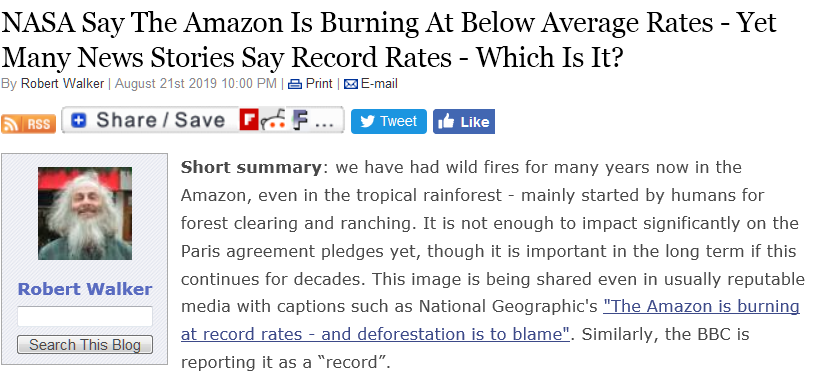
In this article you can find a quote from the Earth Observatory , which up until August 22 read as follows:
As of August 16, 2019, satellite observations indicated that total fire activity in the Amazon basin was slightly below average in comparison to the past 15 years. Though activity has been above average in Amazonas and to a lesser extent in Rondônia, it has been below average in Mato Grosso and Pará, according to the Global Fire Emissions Database”
(SIDEBAR: this text was changed on Aug 22 and now reads, significantly “As of August 16, 2019, an analysis of NASA satellite data indicated that total fire activity across the Amazon basin this year has been close to the average in comparison to the past 15 years.”, although the data on which this conclusion is based has not apparently changed. You can check the archived version for proof of the edit.)
On the same site (science20.com) you can also find this graph of “cumulative monthly fire data” for the Amazon basin (the original is at from GlobalFireData.org):
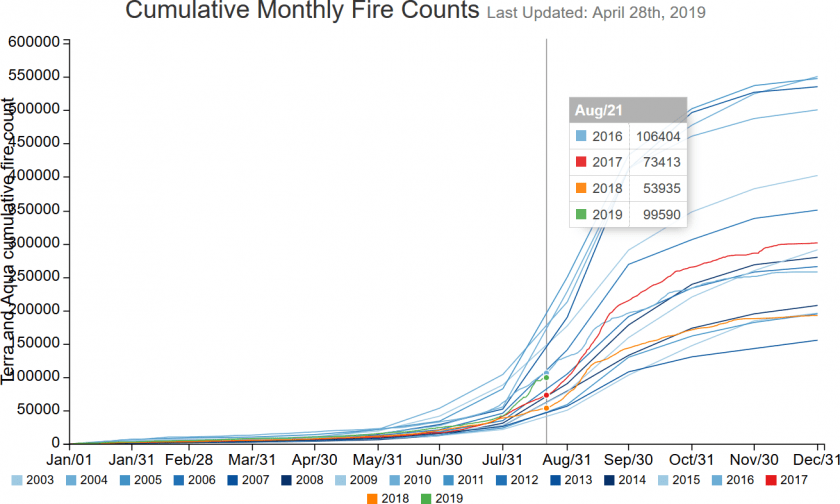
This clearly indicates that the current amount of burning in the Amazon basin in 2019 (the green line) is, as NASA originally said,somewhat below the average, and well below the previous extremes for the region.
This will be why, when you look close, the media articles are artfully talking about the number of fires, rather than the area of burning. There may well be more fires (or maybe that’s just been made up like so much else), but that’s a statistic without meaning if the total area covered is actually less than a fifteen-year average.
Now, we’re not about to take NASA as a final authority on this any more than any other single source. But given the amount of emphasis being put by the screaming media on how “unprecedented” the current burning is, and how deceptive this might turn out to be, it seemed important to us that this data was at least discussed. So we tweeted a ref to it.
This was one response:
Here is another. Visit our timeline for more.
It turns out the messy truth behind the blaring headlines is – yes, the Amazon is burning but not as much as in many recent times, and while Bolsonaro is not a nice man accusing him of burning the world down is probably a bit premature.
To be fair a few people shared or retweeted this information. But they were very few. Most simply ignored it, intent, like Greenwald and Media Lens, Naomi Klein et al in joining chorus with the shrieking mainstream doom-sirens.
Make a note of that #GreenNewDeal hashtag. We’ll be seeing a lot of that in the next week or so.
Before the inevitable “oh so you don’t care if all the possums DIE” type comments BTL, let’s make it ultra-clear, this isn’t about disparaging environmentalism or claiming it’s fine for the Amazon to burn (though actually it is, up to a point, and is an important part of the forest’s life cycle).
It’s about the fact so many of us – even many who think of themselves as sophisticated analysts – are still as much in the grip of authoritarian story-telling as our ancestors were when they heard tales of heaven and hell and believed them.
Thank goodness for a few lone voices of sanity, like Robin again:
Hmmm… is that Green New Deal the reason why this apparently fairly average year of burning has been morphed by the power of lies into the latest doomsday meme? Why exactly would so many corporate news outlets be so keen to sell us that?
Oh who cares, right? It’s hard. Memes are easy. Did you know that the Amazon produces 20% of our Oxygen? No, because it doesn’t. But that’s not stopping everyone repeating it.
A few cyberwarfare-generated hashtags, a few (sometimes misattributed) images and there is a mass belief-system unfolding before our eyes. Uncritical, rabid, rancid with fear, demanding solutions.
Just in time for the G7 summit – where I’m sure a Green New Deal “solution” will emerge right on cue, to universal cheers and a few more hashtags handed down to the proles to be spread about in the name of “standing up to the 1%”.
We have to do better, guys, or it’s over. We’re done.
Catte Black, OffG co-founding editor. Writer. Opinionated polemicist.
August 28, 2019
Posted by aletho |
Deception, Fake News, Mainstream Media, Warmongering, Science and Pseudo-Science | Green New Deal, Latin America |
Leave a comment
Israeli Prime Minister Benjamin Netanyahu praised Paraguay’s decision Monday to label Palestinian organization Hamas and Lebanese militant group and political party Hezbollah, as “international terrorist organizations,” a move that comes shortly after Argentina first blacklisted Hezbollah.
“I welcome the decision of Paraguayan President Mario Abdo to define Hezbollah and Hamas as terrorist organizations,” Netanyahu said in a statement before he added that Israel is “working so that more countries will also take this important step.”
Paraguay announced its decision on Monday to designate the Lebanese group, along with the political faction of Hamas that governs Gaza in Palestine, as terrorist groups. The South American country’s presidency detailed that Hamas and Hezbollah will be ranked “international terrorist organizations” and al-Qaeda and the Islamic State group “global terrorist organizations”. The difference between the labels was not made clear.
With this resolution, the country “recognizes and reaffirms its commitment to redouble efforts to prevent and combat violent extremism”, the presidency stated.
Several states have already listed both groups as terrorists, among them Israel, the United States, and Canada. Washington designated Hezbollah as a terrorist organization in 1997. However, the U.S. has been recently leading a fierce campaign in the backdrop of its warmongering against Iran and has been pushing more and more countries to designate the Hezbollah (which is backed by Iran) as a terrorist group.
Argentina was the first Latin American country to take the step, gaining recognition from Washington’s neoconservatives, including U.S. Secretary of State Mike Pompeo.
Following Argentina’s move, a group of Republican lawmakers called on Pompeo to pressure Brazil and Paraguay to act the same and to designate Hezbollah.
“Argentina, Brazil, and Paraguay are in a unique position to take meaningful strides in the fight against terrorism at the hands of Hezbollah,” said Republican Senator Marsha Blackburn in a statement at the time.
“We must recommit to ensuring that Hezbollah and other Iranian proxies are denied the resources they need to escalate their campaign of global terrorism,” added Ted Cruz, another Republican senator and co-signatory of the letter to Pompeo.
Hezbollah and Hamas leaders say their movements are resistance movements. The Palestine Islamic Resistance Movement (Hamas) was created out of the military occupation of the West Bank, Jerusalem, and Gaza, while the Lebanese Party of God (Hezbollah) rose to oppose the presence of Israel in the south of Lebanon.
The pressure exercised on Israel to leave the south of Lebanon (2000) and Gaza (2005) produced massive popular support which resulted in victories in both municipal and national elections. Both armed groups shifted since then towards increasingly passive policies, though at the same time they continue to be condemned to ostracism by Israel, the U.S. and Europe.
Last month, Trump’s administration imposed sanctions on Hezbollah political officials, including members of the Lebanese parliament, accusing the group of threatening the “economic stability and security of Lebanon and the wider region.”
RELATED:
US Blames Hezbollah Leader for 1994 Buenos Aires Attack
August 20, 2019
Posted by aletho |
Ethnic Cleansing, Racism, Zionism | Hamas, Hezbollah, Israel, Latin America, Palestine, Zionism |
Leave a comment

Presidential candidate Alberto Fernandez and his running mate former President Cristina Fernandez de Kirchner © Reuters / Agustin Marcarian
Argentinian President Mauricio Macri has conceded defeat in the primary elections after suffering a massive loss to the center-left nominee Alberto Fernandez and his running mate, former president Cristina Kirchner.
“We’ve suffered a bad election,” right-wing Macri said on Sunday night, but vowed to “redouble” his efforts to secure the ‘real’ elections in October.
The nationwide primary election, introduced in Argentina in 2011, is held simultaneously for all parties and serves as a good indication of how the presidential race would swing when people cast their vote in the general election on October 27. The Sunday vote landed the incumbent president with 32.36 percent of support, while Fernandez obtained 47.22 percent. Center-right Roberto Lavagna came in third with 8.39 percent.
Fernandez, who served as the chief of the Cabinet of Ministers during Nestor Kirchner’s presidency, vowed to create a “new” Argentina. “Argentinians realized we are the change, not them,” Fernandez said during his victory speech in Buenos Aires, promising “to end this time of lies and give a new horizon.”
Fernandez’s running mate, former head of state Cristina Kirchner, feels optimistic about their chances of winning the general election and their ability to improve the socioeconomic situation in Argentina.
“We know of the difficult moment that the country is going through, of millions of Argentines who have lost their jobs, we have talked with so many, we know what it is. This gives us the responsibility that we have to reach everyone to give them absolute peace of mind,” she said.
Argentina’s economy continues to sink, with inflation rising to 55 percent and poverty levels increasing to 32 percent, from around 26 percent the previous year. The massive $57 billion deal Macri secured last year with the International Monetary Fund has so far failed to improve the situation.
August 12, 2019
Posted by aletho |
Aletho News | Argentina, Latin America |
Leave a comment
Venezuela’s Vicepresident Delcy Rodriguez denounced Wednesday that a ship containing 25 thousand tonnes of Soya has been seized in the Panama Canal due to the U.S. blockade while calling on the United Nations to take action against the “serious aggression” that impede Venezuela “right to food”.
“Venezuela denounces before the world that a boat that holds 25 thousand tons of Soya, for food production in our country, has been seized in the Panama Canal, due to the criminal blockade imposed by Donald Trump,” the vice president said in a tweet.
“Venezuela calls on the UN to stop this serious aggression by Donald Trump’s govt against our country, which constitutes a massive violation of the human rights of the entire Venezuelan people, by attempting to impede their right to food.”
In a subsequent tweet, the Venezuelan senior official explained that the owner of the vessel carrying the merchandise of food was informed by the insurance company that it was prevented from moving that cargo to Venezuela.
The shipment seizure comes just days after Trump signed an executive order Monday that imposes a near-total blockade on government assets in that country, which includes an embargo against food suppliers, among other basic inputs. This is the first time in 30 years that Washington has taken such an action against a sovereign country.
August 7, 2019
Posted by aletho |
Economics, Subjugation - Torture, War Crimes | Latin America, United States, Venezuela |
Leave a comment


 Aletho News