Venezuela Faces Outside Threats, Says Russian Foreign Minister
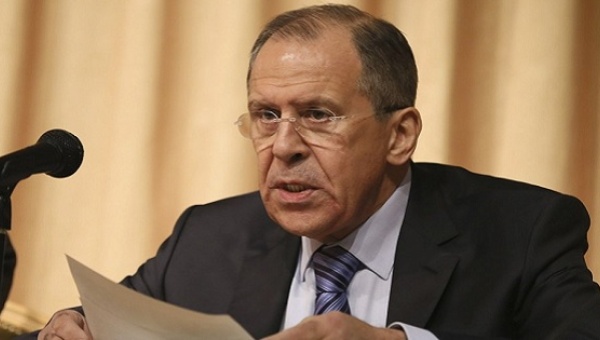
Russian Foreign Minister Lavrov reaffirms his country’s friendship with Venezuela. | Photo: PSUV
teleSUR – March 25, 2016
Russian Foreign Minister Sergei Lavrov said that his country has been closely following the situation in Venezuela and stressed that such is exacerbated by external interference.
“Venezuela is a friend country that they (opponents) are trying to destroy from outside,” Lavrov said Thursday during a meeting in Moscow with Venezuelan diplomats and Latin American students who are attending a course in diplomatic studies organized by the Russian Foreign Ministry.
At the meeting, the top diplomat explained the vision of Russia in Latin America and said he is pleased to see how Latin American countries have unanimously rejected coups led by right-wing opposition.
U.S. President Barack Obama issued an Executive Order March 9, 2015, declaring a “national emergency with respect to the unusual and extraordinary threat to the national security and foreign policy of the United States posed by the situation in Venezuela.” Obama then renewed that decree March 3, 2016, claiming that alleged conditions that prompted the first order had “not improved.”
All 33 members of the Community of Latin American and Caribbean States expressed their opposition to the U.S. government’s aggressive move and called for it to be reversed.
Murder Epidemic Halts Colombia’s Peace Process
By W. T. Whitney | CounterPunch | March 24, 2016
Paramilitaries and armed thugs have long sullied politics in Latin America, most notably in Colombia and recently in Honduras. A recent increase in politically motivated killings in Colombia coincided with final preparations for signing a peace agreement between the Revolutionary Armed Forces of Colombia (FARC) and the Colombian government, at war for 50 years. The much anticipated accord never materialized.
In Honduras the murder of longtime environmental and indigenous rights activist Berta Cáceres caps a wave of killings there of journalists, teachers, women, and especially of agrarian rights activists.
Governments and private parties serving predatory interests evidently regard terror at the hands of thugs or paramilitary forces as useful for maintaining dominion. Colombia’s paramilitary phenomenon warrants a look now because paramilitary attacks have brought Colombia’s peace process to a halt. Fortunately documentation of paramilitary offenses in Colombia provides much by way of details and particulars, more so than in Honduras, for instance. That’s because Colombian paramilitaries have long met resistance and gained special notoriety.
On March 23, after 40 months of talks in Havana, negotiators on both sides in the Colombian peace talks were to have announced a “Final Agreement,” one covering five agenda items they had set out to discuss. But an impasse developed over the last one, designated as “end of conflict.” It entails a “bilateral and definitive cease of fire and hostilities” and laying down arms.
FARC negotiators held back; an epidemic of killings during March revived long-held FARC concerns about the safety of ex-guerrillas in a time of peace. Others worry too.
The Executive Committee of the Patriotic Union (UP), a leftist political party, reported March 18 that in the previous three weeks “unknown armed men,” presumably paramilitaries, had carried out 11 politically motivated killings and “disappeared” three other people – whose bodies were found later.
Speaking to reporters, Aída Avella, the UP president, accused business leaders of financing the resurgence of paramilitaries. She also accused military leaders of being “immersed” in paramilitary operations. Avella herself went into foreign exile for 17 years in 1996 after a rocket destroyed the car in which she was a passenger.
In an open letter to Colombian President Juan Manuel Santos, Andrés Gil, a leader of the Patriotic March, condemned the assassinations. “[I]f we continue to be killed,” he wrote, “then the conclusion will be that really there’s no room for anyone on the left…. You will pass into history not as the president for peace but as the one who didn’t take the fight against paramilitaries seriously.”
Referring to the flood of paramilitary victims, the FARC peace delegation released a statement asking, “How can this be in the midst of a peace process now approaching the signing of a final accord?” Colombian authorities, the FARC said, “can no longer delay clearing away the phenomenon of paramilitarism.”
The FARC has reason to be alarmed. Many FARC guerrillas left the insurgency in 1985 in accordance with an agreement signed with President Belisario Betancur. They engaged in electoral politics as candidates for the UP party. That provoked a massacre; some say almost 5000 UP activists have since been murdered.
FARC negotiator Carlos Antonio Lozada may have been thinking of that experience when he told reporters March14 that, “[W]e have to take measures to avoid being betrayed and attacked as happened in the past.” He noted that the government recently dismissed a technical sub-commission report, already agreed upon, calling for “a bilateral and definitive ceasefire.”
The FARC negotiating team took the occasion of Secretary of State John Kerry’s visit with them on March 21 to seek help in regard to the paramilitary problem. Kerry had accompanied President Obama on his historic visit to Cuba. The negotiators released a communication saying, “Mr. Kerry, we ask through you that the United States help curb paramilitary violence, which in the midst of the peace process keeps mowing down the lives of defenders of human rights and social leaders.”
The request is not without irony. The United States provides funds for the Colombian army, known to facilitate paramilitary operations. And in the early 1960s U.S. military experts advised the Colombian government to utilize paramilitaries to augment its campaign then of pushing back against leftist guerrillas.
In a joint press conference February 4 with President Santos in Washington, President Obama introduced a U. S. plan called “Peace Colombia.” The two leaders had met to celebrate the upcoming peace accord and the end after 15 years of Plan Colombia, that U.S. mechanism for supporting counterinsurgency and drug-war efforts in Colombia.
For Voz newspaper editor Carlos Lozano, the name of the new venture signifies a “Pax Romana, or peace of the graveyard.” He lamented that “within Peace Colombia there’s not one entry for combating paramilitarism, which is the principal obstacle to peace in Colombia.”
Trivializing the FARC and thereby perhaps signaling the guerrillas’ irrelevance in a Colombia at peace, the New York Times recently headlined a reporter’s story thus: “Inside a Rebel Camp in Colombia, Marx and Free Love Reign.” It celebrated the collapse of communism by likening the supposed decline of the FARC to the fall of the Berlin Wall.
To the extent that such triumphalism extends to official U.S. attitudes, prospects for peace in Colombia are diminished.
Nevertheless, neither Colombia’s government nor the United States will likely have the final say in regard to disruptions at the hands of paramilitaries. Other forces, powerful and based on realities, are in play, and have been. A voice on their behalf is heard from, of all places, inside prison.
Political prisoner Húbert Ballesteros joined the Communist Party and Patriotic Union in 1986. More recently he’s been a leader of both the Fensuagro agricultural workers’ union and the CUT labor federation. Writing on March 12, he reflects upon “the killings in Antioquia, Sur de Bolívar, Arauca, Bogotá, and Cauca; the jailing of social leaders in Cauca, and the spread of paramilitary bands the length and breadth of the country.” According to Ballesteros, “We can no longer continue assuming that this oligarchy wants peace [other than] a cheap peace, a silencing of the guns.”
He knows what to do: “[W]hile we are building scenarios of peace, we must organize the people for resistance, and do so massively and convincingly so that this government understands that people are no longer content to live under its domination.” We must deal with “the true problems of the country, which are unemployment, poverty, corruption, and social and political marginalization.”
W.T. Whitney Jr. is a retired pediatrician and political journalist living in Maine.
Langley’s Latest Themed Revolution: the Yellow Duck Revolution in Brazil
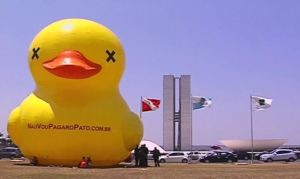
BY Wayne MADSEN | Strategic Culture Foundation | 24.03.2016
The latest themed revolution concocted by the Central Intelligence Agency’s «soft power» agents in the Brazilian federal and state legislatures, corporate media, and courts and prosecutors’ offices – all spurred on with the financial help of George Soros’s nongovernmental organizations – is the «Yellow Duck Revolution».
Large inflatable yellow ducks – said to represent the economic «quackery» of President Dilma Rousseff and her Workers’ Party government – have appeared at US-financed street demonstrations in Brasilia, Rio de Janeiro, and Sao Paulo. The main coordinators of these protests are found in Brazil’s largest corporate federations and corporate-owned media conglomerates and all of them have links to domestic non-profit organizations like Vem Pra Rua (To the Street) – a typical Soros appellation – and Free Brazil Movement, in turn funded by the usual suspects of the National Endowment for Democracy (NED), US Agency for International Development (USAID), and Soros’s Open Society Institute.
After trying to mount an electoral defeat of Brazil’s progressive leftist president, Dilma Rousseff, through a combination of presidential candidate assassination (the aerial assassination of Eduardo Campos in 2014 to pave the way to the presidency for the Wall Street-owned Green candidate Marina Silva, Campos’s vice presidential running mate), «rent-a-mob» street demonstrations, and corporate media propaganda, the Langley spooks are now trying to run Rousseff from office through a «Made in America» impeachment process. Aware that Rousseff’s progressive predecessor and mentor, Luiz Inacio Lula da Silva, has been targeted by Brazilian prosecutors on the CIA’s payroll, for arrest and prosecution for bribery, she appointed him to her government with ministerial rank and prosecutorial immunity. Lula only became a target because he signaled his desire to run for the presidency after Rousseff’s term ends in 2019.
The Workers’ Party correctly points out that the legislative impeachment maneuvers against Rousseff and the judicial operations against both Rousseff and Lula emanate from Washington. The same «color of law» but CIA-advanced operations were directed against presidents Cristina Fernandez de Kirchner in Argentina, Rafael Correa in Ecuador, Evo Morales in Bolivia, Nicolas Maduro in Venezuela, Fernando Lugo in Paraguay, and Manuel Zelaya in Honduras. In the cases of Lugo and Zelaya, the operations were successful and both leaders were removed from power by CIA-backed rightist forces.
Street protests against Rousseff have, since they began in 2014, taken on the typical Soros themed revolution construct. As with the disastrous Soros-inspired and CIA-nurtured Arab Spring protests in Egypt, Libya, Syria, and Tunisia and Euromaidan protest in Ukraine, the Vem Pra Rua movement and the associated Free Brazil Movement are basically nothing more than politically-motivated capitalist campaigns relying on Facebook, Twitter, and pro-insurrection television and radio networks, newspapers, and websites.
In addition to the inflatable yellow ducks, street protests have been marked by quickly-manufactured inflatable dolls of Lula in black and white prison garb and a placard cartoon drawing of Rousseff with a red diagonal «No» sign drawn through it. Street protest devices, which also include green and yellow banners and clothing, are telltale signs of significant amounts of money backing the psychological warfare gimmickry.
Brazilian prosecutors on Langley’s payroll arrested the popular Lula after staging a massive police raid on his house. Police also arrested the former First Lady of Brazil, Lula’s wife Marisa Leticia. Lula said he felt that he was kidnapped by the police. In 2009, Honduran troops actually kidnapped President Manuel Zelaya in the middle of the night and detained him in a military cell prior to expelling him from the country. That operation, like the one against Lula and Rousseff, was backed not only by the CIA and NSA, but by the US Southern Command in Miami. The Honduran coup was also backed by the Supreme Court of Honduras. To prevent a further political arrest of her predecessor, Rousseff made Lula her chief of staff, a cabinet position that affords Lula some protection from continuing prosecutorial harassment and legal proceedings by the federal court.
On March 16, Judge Sergio Moro, who is in charge of Operation «Lava-jato» («Car wash»), the two-year investigation of Petrobras and the alleged bribery involving Rousseff and Lula, released two taped intercepts of phone calls between the president and former president. The bugged phone conversation involved Rousseff’s plans to appoint Lula as her chief of staff, a Cabinet rank, as a way to afford him some protection from the CIA’s judicial-backed coup operation now in play. Rousseff previously served as Lula’s chief of staff. Classified National Security Agency documents leaked by whistleblower Ed Snowden illustrate how the NSA has spied on Rousseff’s office and mobile phones. President Obama claimed he ordered an end to such spying on world leaders friendly to the United States. Obama’s statement was false.
Judge Sergio Moro’s name appears in one of the leaked State Department cables. On October 30, 2009, the US embassy in Brasilia reported that Moro attended an embassy-sponsored conference in Rio de Janeiro held from October 4-9. Titled «Illicit Financial Crimes», the conference appears have been an avenue for the CIA and other US intelligence agencies to train Brazilian federal and state law enforcement, as well as other Latin American police officials from Argentina, Paraguay, Panama, and Uruguay, in procedures to mount bogus criminal prosecutions of Latin American leaders considered unfriendly to the United States. The State Department cable from Brasilia states: «Moro… discussed the 15 most common issues he sees in money laundering cases in the Brazilian Courts».
One item that was not on the agenda for the US embassy seminar was the NSA’s covert spying on the communications of Rousseff, Lula, and the state-owned Brazilian oil company Petrobras. In a technique known as prosecutorial «parallel construction», US prosecutors given access to illegally-intercepted communications, have initiated prosecution of American citizens based on the selective use of warrantless intercepts. If such tactics can be used in the United States, they can certainly be used against leaders like Rousseff, Lula, and others. The Operation Car wash intercepts of the Rousseff-Lula phone conversations that were released by Judge Moro to the media may have originated with NSA and its XKEYSCORE database of intercepts of Brazilian government and corporate communications conducted through bugging operations codenamed KATEEL, POCOMOKE, and SILVERZEPHYR.
In what could be called the «Obama Doctrine», the CIA has changed its game plan in overthrowing legitimate governments by using ostensibly «legal» means. Rather than rely on junta generals and tanks in the street to enforce its will, the CIA has, instead, employed prosecutors, judges, opposition party leaders, newspaper editors, and website administrators, as well as mobs using gimmicks – everything from inflatable yellow ducks, paper mâché puppets, and freshly silk screen-printed t-shirts, flags, and banners – as themed revolution facilitators.
As shown by the leaked State Department cables, the CIA has identified a number of agents of influence it can rely on for providing intelligence on both Rousseff and Lula. These sources have included the senior leadership of the Workers’ Party; officials of Petrobras eager to see their company sold off to the highest-bidding foreign vultures; Brazilian Central Bank executives; and Brazilian military intelligence officers who were originally trained by US intelligence and military agencies.
In addition to BRICS member Brazil, other BRICS nations have also seen the US increasing its efforts to organize themed revolutions. South Africa is on the target list, as are Russia and China.
Argentina and the Vultures: the Political Economy of the Settlement
By Mark Weisbrot | The Hill | March 14, 2016
After 15 years of court battles, injunctions, smear campaigns, lobbying, and other interventions, the vulture funds have finally won a tentative agreement with the new Argentine government. Vulture funds — the name preceded this particular dispute — are so called because they buy up defaulted debt for a very small fraction of its face value, then sue (and use other tactics) to collect an exorbitant return. In the case of Argentina, the chief vulture, American billionaire and major Republican campaign donor Paul Singer, will get an estimated 370 percent return; another vulture fund in the settlement did even better, with a return of 950 percent.
The agreement is tentative because President Mauricio Macri of Argentina still has to get the nation’s Congress, in which he does not have a majority, to change some laws in order to finalize the deal. And he will also have to reach agreement with some remaining “holdout” creditors. And now the vulture funds are appealing the judge’s order that would have allowed Argentina to issue new debt, presumably in an effort to extract even more concessions. But assuming it all works out, though, there are some important lessons to be learned from this long war over sovereign debt.
Argentina arguably had no alternative but to default in 2002, but the government also did the right thing by standing up to the IMF and its international creditors until it reached a deal (in 2003 and 2005) that would allow the economy to recover. International lenders — in this case a creditors’ cartel headed by the IMF — often succeed in getting a settlement that keeps the country trapped in recession, depression, or very low growth with an unsustainable debt burden; as well as numerous conditions (cuts to social spending, public pensions, public employment) that harm the majority of the debtor country’s citizens. Some of the worst recent examples of these abuses can be seen in countries like Greece and Jamaica, and will likely include Puerto Rico if there is a debt restructuring there.
By taking a hard line with its foreign creditors, Argentina reached an agreement with 93 percent of them that allowed the country to do very well over the ensuing 14 years. Instead of a prolonged depression as in Greece, or limping along from one crisis to the next, Argentina began an extraordinarily robust recovery just three months after its default and enjoyed very high growth — more than 90 percent in real GDP from 2002–2015. (There is some dispute over the exact number but it does not change the story.) This enabled Argentina to reduce poverty by about 70 percent and extreme poverty by 80 percent, in the decade 2003–2013.
So, even though the country would later run into economic trouble — in the world recession of 2009, but also in the last four years — there is no doubt that it pursued very successful economic policies, which it would not have been able to implement under a less favorable agreement with its creditors. Now, about the slowdown of the past four years, in which the economy has grown by about 1.1 percent annually: Part of the problem was that Argentina could not borrow on international markets, due to its inability to settle with the vulture funds. For Argentina’ detractors, this proves that the default and subsequent tough negotiation were wrong. But clearly that is not the case; the alternative offered by the IMF and the creditors was vastly worse.
The problem is really the vulture funds, and also the foreign policy goals of certain actors within the United States, who were against the prior government of Argentina. Here is Judge Thomas Griesa, of the Federal District court for the Southern District of New York, to whom the New York Times devoted a news article describing his incompetence: “Put simply, President Macri’s election changed everything.” This is from Griesa’s decision of February 19, explaining why he decided to conditionally lift the injunction he had imposed against Argentina in 2014, which the Financial Times editorial board generously described as “eccentric rulings,” and which prevented Argentina from making its debt payments. In other words, he much preferred the new, right-wing, pro-Washington government, as opposed to the prior, left government that he helped get rid of. Griesa’s unprecedented decision to take 93 percent of Argentina’s creditors hostage on behalf of the vulture funds was obviously political at the time. Now he has admitted it, to the chagrin of our legal system.
Argentina had appealed Griesa’s injunction to the U.S. Supreme Court, and the governments of France, Brazil and Mexico, and the Nobel Prize-winning economist Joseph Stiglitz filed briefs on its behalf. Interestingly, the IMF announced that it, too, would file a brief on behalf of Argentina. This was not because the IMF loved the Argentine government, but because Griesa’s decision was considered a threat to the stability of the international financial system. But the U.S. Treasury forced the IMF into an embarrassing retreat, most likely due to pressure from the vulture lobby and some anti-Argentina members of Congress, in particular from Florida, who could threaten to hold up legislation that the Fund needed.
Did I mention that the vulture fund chief Paul Singer is a major contributor to Florida Senator Marco Rubio, and is currently rumored to become finance chair for his presidential campaign?
The U.S. government also stopped blocking loans to Argentina at the World Bank and the Inter-American Development Bank, just after Macri was elected. Macri himself also has an interesting history with the U.S. State Department: In conversations with U.S. officials leaked by WikiLeaks, Macri chastised them for being “too soft” on the Argentine government and encouraging its “abusive treatment” of the U.S.
The main lesson from this whole episode is the importance of national economic sovereignty for middle-income countries like Argentina. This is what allowed Argentina to recover from disastrous economic policies implemented under IMF tutelage; and it was the infringement on this sovereignty by U.S. courts and other actors that made it difficult for Argentina to resolve the economic problems of the past few years. We will see how this new, less sovereign government fares going forward, now that it has settled with the vultures.
Justice for the Women of Sepur Zarco
Indigenous women win precedent-setting case against former soldiers in sex slavery trial in Guatemala
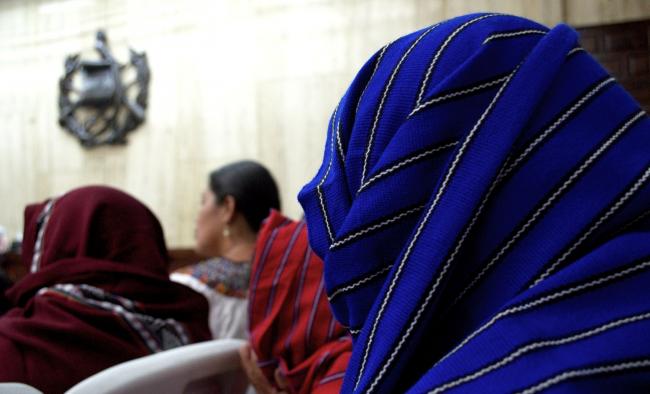
Women of Sepur Zarco, forced into sex slavery at the hands of the Guatemalan military in 1982, listen to trial proceedings at the Guatemalan Supreme Court (Photo by Quimy de Leon)
By Jeff Abbott and Julia Hartviksen – NACLA – 03/11/2016
Nearly 20 years since the signing of Guatemala’s 1996 Peace Accords, justice has finally been served for 15 Indigenous Q’eqchi’ Mayan women of Sepur Zarco, who were forced to become sex slaves for members of Guatemala’s military during the country’s long civil war.
On February 26, Guatemala’s Supreme Court sentenced two former military members, former Lieutenant Coronel Esteelmer Reyes and former Military Commissioner Heriberto Valdez Asij, to prison terms of 120 and 240 years, respectively, for crimes against humanity. Reyes was also found guilty of three assassinations, while Asij was deemed guilty for the forced disappearances of seven men. (Despite the significance of the guilty verdict, prosecutors from the Guatemalan Public Ministry had initially requested that Reyes and Asij be sentenced with 1290 years in prison for war crimes, plus 50 years in prison for each assassination charge.)
On March 2, the perpetrators were also ordered to pay reparations to the victims. Reyes will owe 500,000 Quetzales (about US $65,000) to each of the victim-survivors, and Asij has been ordered to pay 250,000 Quetzales (about US $32,500) for each of the seven forcibly disappeared men.
Judge Yassmín Barrios of the Guatemalan Supreme court made the historic decision following a short, emotional trial, which began February 1 in the Guatemalan Supreme Court in Guatemala City. The case, the first time in the world where a case of wartime sexual violence was tried in the national courts of the country where the violence occurred, represents a landmark legal decision in Guatemala and a major victory against the impunity for war crimes in the country.
The charges against Reyes and Asij relate to crimes committed in the year 1982, a time when both men were stationed at the Sepur Zarco military base in Alta Verapaz. During this period, the soldiers murdered men in the community, and forced women in the area to work as domestic servants and sexual slaves, subjecting them to degradation, abuse, and rape. In 2010, 12 of those women, all of Mayan Q’eqchi’ descent, brought the case before a mock tribunal meant to address sexual violence during Guatemala’s 36-year-long war. In 2011, the case was brought before a criminal court. Grassroots organizations and international NGOs alike fought to bring the case to the Guatemalan Supreme Court, amidst repeated attempts to derail their efforts.
Lily Muñoz, a sociologist who worked as an independent consultant assisting the legal organization, Mujeres Transformando el Mundo (MTM) on the case, explained the significance of the historic ruling. “It represents justice for war crimes that were committed against women,” she said.
Though the case represents a landmark legal decision for Guatemala, Sepur Zarco is not an exceptional case of sexual violence perpetrated by the military during the war. “This case serves as a precedent not only here in Guatemala, but also on the global scale,” said Lily Muñoz, a sociologist who worked as an independent consultant assisting the legal organization, Mujeres Transformando el Mundo (MTM) on the case.
The case’s success has led to more than 30 Achi’ women from the community of Rabinal, Baja Verapaz, who also suffered from sexual violence at the hands of the military, to begin mobilizing for legal justice for crimes of sexual violence as a tactic of war.
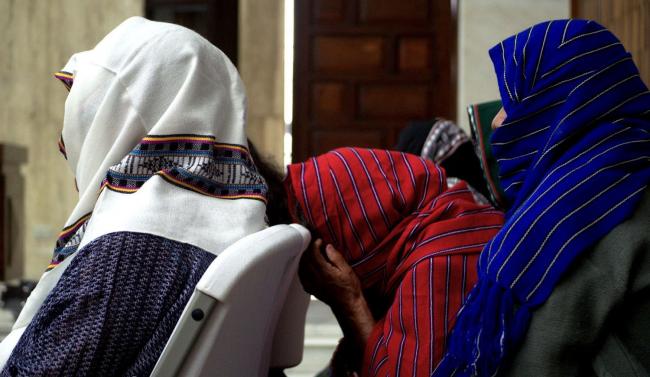
Survivors of the Sepur Zarco sex slavery case at the Supreme Court trial (Photo by Quimy de Leon)
This case also illustrates the gendered dimensions of such brutality – a brutality that preyed upon the vulnerability of indigenous women in rural Guatemala at the height of the internal armed conflict. “It is particularly interesting that sexual violence against women was a part of the sentence, and in the context of an armed conflict. This marks such violence as a war crime, as a crime against humanity. It’s a war crime, but it is a specifically gendered crime, that was tried in the national court of the country where the crimes were committed,” Muñoz said.
She continued: “The military men created conditions of extreme vulnerability for the women of Sepur Zarco. They took their husbands away from them, and they robbed them of their lands and livelihoods – in short, everything they required for social reproduction – and then later, of their sexuality and their ownership over their own bodies.”
As Muñoz explained, Judge Barrios drew on the testimony of a Brazilian anthropologist, Dr. Rita Laura Segato in coming to a decision in the case. Dr. Segato had argued in her testimony that “In the context of the Guatemalan internal armed conflict, women’s bodies were converted into military objects.”
The anthropologist argued that, in this way, that women’s bodies came to represent the “social body,” and for that reason, “the soldiers violated and ‘profaned’ women’s bodies.”
Following Dr. Segato, Muñoz explained that the military sought to “break the community, physically and morally” and did so through sexual violence against women. In this sense, the violence perpetrated against women carried lasting physical, emotional and psychological aspects, and also symbolic meaning for the victim-survivors and other community members. In reading the sentence, Judge Barrios recognized these long-term, destructive impacts the violence of the Sepur Zarco base had on the women who brought the case forward.
The case itself represents a historic shift for the Guatemalan courts, whereby claims of violence brought forth by indigenous women have been recognized by the mainstream justice system, a system that has consistently silenced their voices. “This case has shown that we can trust the testimonies of the (indigenous) women,” said Ada Valenzuela, the director of the Union Nacional de Mujeres Guatemaltecas (UNAMG). “Even 30 years later, the testimonies of the women were supported through other testimonies, and evidence.”
Despite the fact that the women’s faces were covered during the trial for the purposes of anonymity, it was the women themselves who pushed for the case to move forward, despite being told that it would likely not win. “The women from Sepur Zarco said that if this case were to go to court, then they wanted to go,'” Valnezuela said. “And we decided that we were going to accompany these women in this process. This was a very valiant decision.”
The women were also accompanied by a coalition of Guatemalan feminist organizations in Guatemala, known as the Alliance to End Silence and Impunity, which includes UNAMG, MTM and the Equipo de Estudios Comunitarios y Acción Psicosocial (ECAP). UNAMG and ECAP have worked to provide psychological support for the victims of the internal armed conflict and the women of Sepur Zarco since 2004.
The case also complicates the characterization of the simplified but still all too common narrative of Guatemala’s civil war in which Marxist guerrillas are presented as fighting against state. In fact, in many cases, it was poor rural campesinos, organizing to gain ownership of their own land who suffered the most intense brutality of the conflict.
According to Muñoz, all of the women’s husbands were involved in negotiations with the National Institute for Agrarian Transformation (INTA) to gain legal ownership over land they had lived on for centuries. Many of these lands have since been transformed into fincas for the production of sugar cane and oil palm.
“The conditions that began the war have been maintained today,” said Valenzuela. “The inequality, the question of land, the question of opportunity, (among others), are continuing today. According to Valenzuela, Sepur Zarco “has woken up the women of Guatemala. [It] represents hope for justice for other women who suffered violence during the war.”
Jeff Abbott is an independent journalist currently based out of Guatemala. He has covered human rights and social moments in Central America and Mexico. His work has appeared at VICE News, Truthout, and the Upside Down World. Follow him on twitter @palabrasdeabajo.
Julia Hartviksen is a PhD Candidate at the Gender Institute, at the London School of Economics and Political Science. Her research focuses on the materiality of violences against women, and the gendered impacts of oil palm in Guatemala’s Northern Transversal Strip. Follow her on twitter @_yulinka_.
Colombia, Honduras Are Most Unequal Countries in Latin America
teleSUR – March 10, 2016
Latin America has five of the world’s most unequal countries, with Honduras and Colombia being the region’s top two, according to statistics released by the World Bank Wednesday.
Using data from December, the World Bank calculated that Latin America is not the poorest region in the world, but is home to some of the world’s most unequal countries.
Among them are Honduras (6), Colombia (7), Brazil (8), Guatemala (9) and Panama (10), which all rank within the world’s top 10 most unequal countries.
The results were found by calculating each country’s Gini coefficient, what measures the income distribution in each nation, whereby nations approaching 0 have total equality and those approaching 100 have total inequality.
Colombia’s Gini coefficient ranked at 53.5, the same as 2012, while Honduras’ was 53.7 and plummeting dramatically, according to news reports.
In the current situation, the top 10 percent of Colombia’s richest people earn four times more than the bottom 40 percent of the population. Additionally, 77.6 percent of land in the country is owned by only 13.7 percent of the country’s inhabitants.
In Honduras, 64.5 percent of the population is living in poverty while 42.6 percent live in extreme poverty (less than US$2.5 a day), according to World Bank statistics.
The Honduras Killing Field

Slain Honduran environmental activist Berta Caceres
By Dennis J Bernstein | Consortium News | March 8, 2016
An apparent resurgence of death-squad violence in Honduras, including the March 3 murder of prominent Honduran indigenous rights activist Berta Cáceres, is a harsh reminder of Secretary of State Hillary Clinton’s role in defending a 2009 coup that ousted leftist President Manuel Zelaya and cleared the way for the restoration of right-wing rule in the impoverished Central American nation.
Caceres, the recent winner of the prestigious Goldman Environmental Prize, was murdered in her hometown of La Esperenza, Intibucá, in the highlands near the Salvadoran border. Her good friend and close associate, Gustavo Castro, was shot twice but survived the assassination and is now being held against his will by the Honduran Government.
Castro held Cáceres in his arms as she lay dying and played dead to avoid his own execution. He has since been forcibly stopped from leaving Honduras.
The Honduran Government has characterized the killing of Cáceres as a common burglary gone bad, but her friends and close associates reject the government claims as preposterous and part of an emerging cover-up.
In a statement, COPINH, the indigenous rights group that Cáceres was closely associated with, characterized her close-range murder as an assassination. In a press release the day after the murder, the group talked about the multiple death threats that Caceres faced prior to her slaying.
“In the last few weeks, violence and repression towards Berta, COPINH, and the communities they support, had escalated,” COPINH stated. “In Rio Blanco on February 20th, Berta, COPINH, and the community of Rio Blanco faced threats and repression as they carried out a peaceful action to protect the River Gualcarque against the construction of a hydroelectric dam by the internationally-financed Honduran company DESA.
“As a result of COPINH’s work supporting the Rio Blanco struggle, … Berta had received countless threats against her life and was granted precautionary measures by the Inter-American Commission for Human Rights. On February 25th, another Lenca community supported by COPINH in Guise, Intibuca was violently evicted and destroyed.”
Cáceres received the Goldman Environmental Prize after she led a high-profile, peaceful campaign to stop one of the world’s largest dam builders from pursuing the Agua Zarca Dam, which would have effectively cut off the ethnic Lenca people from water, food and medicine. When Caceres won the Goldman Prize last year, she accepted in the name of “the martyrs who gave their lives in the struggle to defend our natural resources.”
Friends, co-workers, intellectuals and activists are outraged by the killing and many track this and many other murders of activists in Honduras back to the tenure of Hillary Clinton as Secretary of State. They say Clinton’s lead role in supporting the 2009 oligarch-backed coup that drove the elected progressive President Zelaya from power. Zelaya’s ouster opened the door to a restoration of right-wing rule and out-of-control “free trade.” Honduras soon became the murder capital of the world.
When the Honduran military removed Zelaya from power, the international community – including the United Nations, the Organization of American States and the European Union – condemned the coup and sought Zelaya’s restoration. But Secretary of State Clinton allied herself with right-wing Republicans in Congress who justified Zelaya’s removal because of his cordial relations with Venezuela’s leftist President Hugo Chavez.
In her memoir, Hard Choices, Clinton took credit for preventing Zelaya from returning to Honduras, as if it were a major victory for democracy instead the beginning of a new era of death-squad violence and repression in Honduras.
“We strategized on a plan to restore order in Honduras,” Clinton wrote, “and ensure that free and fair elections could be held quickly and legitimately, which would render the question of Zelaya moot.” In other words, rather than support the right of the elected president to serve out his term, Clinton allowed his illegal ouster to lead to an interim right-wing regime followed by elections that the Honduran oligarchs could again dominate.
Since then, the violence in Honduras has spiraled out of control driving tens of thousands of desperate Hondurans, including unaccompanied children, to flee north to the United States where Clinton later supported their prompt deportation back to Honduras.
On Tuesday, I spoke with Beverly Bell from Other Worlds who worked closely with Berta Cáceres and Gustavo Castro. She was deeply concerned about the safety of Castro and other close associates of Cáceres. She described the situation as follows:
“One person saw the assassination, Gustavo Castro Soto, coordinator of Otros Mundos Chiapas / Friends of the Earth Mexico. A Mexican, Gustavo had come to Berta’s town of La Esperanza to provide her with peace accompaniment, and spent the night at her house on her last night of life. Gustavo himself was shot twice and survived by feigning death. Berta died in his arms.
“Gustavo was immediately detained in inhumane conditions by the Honduran government for several days for ‘questioning’. He was then released and accompanied by the Mexican ambassador and consul to the airport in Tegucigalpa. He was just about to go through customs when Honduran authorities tried to forcibly grab him. The Mexican government successfully intervened, and put Gustavo into protective custody in the Mexican Embassy.”
But according to Bell, the matter didn’t end there: “The Honduran government issued a warning that Gustavo may not leave the country. In a gross violation of international sovereignty, the Honduran government has reclaimed Gustavo from the Embassy, taking him back to the town of La Esperanza for questioning.”
In a March 6 note to close friends, Gustavo Castro wrote, “The death squads know that they did not kill me, and I am certain that they want to accomplish their task.” Shortly after the murder of Berta Cáceres, I interviewed her close friends Beverly Bell, Adrienne Pine and Andres Conteris.
The interviews follow in two parts below, first the interview with Beverly Bell and Adrienne Pine, an associate professor at American University and a Fulbright Scholar who has been doing research in Honduras for nearly two decades. She is the author of Working Hard, Drinking Hard: On Violence and Survival in Honduras.
The second interview is with Conteris, a producer with Democracy Now! Spanish language programming, who lived for years in Honduras and was there throughout the military coup in 2009. He worked as a human rights advocate in Honduras from 1994 to 1999 and is a co-producer of “Hidden in Plain Sight,” a documentary film about U.S. policy in Latin America and the School of the Americas.
DB: Beverly let me start with you. … There was more than one person shot, correct, Beverly Bell?
BB: There were actually three people shot … in addition to Berta, who was shot fatally. Her brother was also shot and a third person, who will be familiar with many of your listeners, and that is Gustavo Castro, who is the coordinator of the social and economic justice group, Otros Mundus, “other worlds” in Spanish, in Chiapas, who has also worked very closely with Berta for years. He spent the night in Berta’s house, as part of a peacekeeping team, which Berta had had for many years now, off and on, because her life has always been so at risk.
And he was shot in the ear, he is okay from that, but the concern that you mention is Gustavo went down this morning to give his testimony to the local court, and he is a very inconvenient witness to them. … So there is an international alert out right now to guarantee Gustavo Castro free passage back to Mexico, together with his wife.
DB: Now, that’s a double-edged sword, because if they hold him, he’s in danger, his life is in danger. And if they release him, his life is in danger. His life is in danger as being a witness to the murder, right?
BB: That’s absolutely correct. In Honduras, pretty much anybody’s life is in danger for anything that relates to peace, to justice, to indigenous rights, to participatory democracy, and notably to opposing the role of the U.S. We are working with peace accompaniment teams right now to try and guarantee Gustavo’s safe passage to Mexico, if the government doesn’t let him go. …
DB: We know that the United States government, Hillary Clinton played a key role in overthrowing the duly elected president, leading us down this path of regular mass murder of human rights activists, and anybody who resists sort of free trade government so what can we say? Has the U.S. expressed its deep concern about the killing?
BB: Yes, cynically and sickly, the U.S. came out … lamenting the murder of Berta Cáceres. And yet, we know that the U.S. has funded to the tune, well this year alone of more than $5,500,000 in military training and education. We know that many of the people who have threatened Berta’s life over the years have been trained at the School of the Americas.
We know that the U.S. government has stood fiercely by the horrible succession of right-wing governments that followed the overthrow of the democratically elected government of Zelaya. And as you mentioned, Hillary Clinton was deeply involved in that. In fact, she even bragged about it in her recent book.
DB: I know, that is shocking that she is proud, this self-declared human rights activist and sophisticated diplomat was proud to brag in her book that she played the key role in keeping Zelaya from going back and assuming his legitimately won presidency. So this is your, as we have called her before, the deposer in chief. And, on that note, let’s bring into the conversation anthropologist Adrienne Pine, who has spent many years, written extensively about Honduras. Adrienne I know that you’re at an airport now, but let me get your initial response to what happened here.
AP: Well, with Bertita, it’s hard to talk about her in the past tense. She’s one of the most amazing activists and advocates I’ve ever met. And also, one of the most compassionate, wonderful people. The fact that they would kill her really sends a message. I mean this is an intentional message that all Hondurans, I think, would understand as such that nobody is safe. Berta, has a sort of, what those of us in the international solidarity community had considered…she had just some sort of protection because she was so well known, because she had won the Goldman prize.
And, of course, we have learned since the coup, the U.S. supported military coup, and I think Beverly laid that out very well, we’ve learned that the international protective measures actually don’t count for much, in Honduras. But this is really ramping up of the criminalization of activism that has occurred since the U.S.-supported military coup in 2009, and it really speaks to the incredible impunity that reigns right now in what is in fact a military dictatorship, a U.S.-supported military dictatorship. That, I think you’re right, it would not have been possible without the direct intervention of Hillary Clinton, as Secretary of State.
Berta Cáceres blood is on Hillary Clinton’s hands.
DB: And, of course, Donald Trump could not have been more violently right-wing when it comes to what happened in Honduras. He could have never out-done her. Because she was more sophisticated, and understood better how to solidify the right-wing, representing corporate America, and make sure that things continued ever since the Monroe Doctrine. Let me come back to you, if I could, I’m getting a little bit angry, Beverly Bell. Let me ask you to talk a little bit about Berta. How you met her, when’s the last time you spoke with her?
BB: I spoke with her, I guess, a couple of months ago, and it was the same content as so many of our conversations have been over the last 15 years, or so, that we’ve worked with each other, which was yet another threat. And how we were going to get protection for her, from what was a long, long, long journey of hideous oppression. She has been terrorized, she just a week or two ago, she and a whole team of people who were at the site of a river which the Honduran government and a multi-national corporation had been trying to dam, but which had been blocked by the organization that she headed, the Council of Popular and Indigenous Organizations of Honduras or COPINH.
A bunch of them were put into a truck and taken away. And it was certainly shaky hours there for a while until they emerged free. So just to answer your question, I have worked with Berta, very, very closely for about 15 years. I’m sitting right now in a house in Albuquerque where she used to live with me. We have fought together, like so many others, against the World Bank, against the U.S. government, against so-called free trade accords, against Inter-American Development Bank, against the Honduran government, against the Honduran oligarchy.
Basically Berta has stood for pretty much anything that any of your listeners would believe is right. She has been at the forefront for decades of the movement for indigenous rights, for indigenous sovereignty, for the environmental protection of land and rivers, for women’s rights, for LGBQ rights in a country that has grossly persecuted and assassinated LGBQ activists. She is, as Adrienne said, just the most extraordinary person, certainly one of the most that I have ever known and it is impossible to speak of her in the past tense.
And, in fact, I have refused to because Berta’s spirit has impacted so many people around the world. If you could be in my in-box today and see the countries from which condolences and denunciations have come, it’s amazing who she has touched, and that spirit will live on in the fight of all of us, for justice, for indigenous rights, for a world that is not tyrannized by the U.S. government, by trans-national capital, and by the elites of various countries.
DB: I’m sure, Beverly Bell, her spirit will be on the tongues and in the hearts of many women as they celebrate, if you will, International Women’s Day. … I’m sure she had some plans for that. It’s an amazing assassination. It’s troubling. Adrienne Pine, when is the last time you saw Berta? What did she mean to you?
AP: It’s so hard for me to accept. I think, like Beverly said she was somebody who I stood with side by side on more times than I could count … protesting the U.S. military base. We’ve been tear gassed together. And she’s helped me through a number of very dangerous situations. It’s hard. It’s hard to lose somebody who was not just such an amazing leader, but also such a good friend, and not just to me but to so many people.
Bertita lives on, with all of us. And I think the most important thing right now if you look at the social network…Beverly is right. My in-box is exploding with condolences, as well. And if you look at the social networks right now, Honduras is ready to rise up, at the murder of somebody who was so dear, so beloved by so many people. And I think one of the things that’s special about Berta which Beverly also mentioned is that she has a much longer trajectory than many of the activists, in Honduras. I mean, she has been on it for many decades fighting the forces that only recently following the coup the massive number of Hondurans came out to join her to fight the forces of corporatization, destruction of indigenous land, the violence of the patriarchy as Beverly mentioned. I mean she has been right all along.
And people in Honduras are furious. There are lots of different protests around the country that have been organized. There’s a protest in Washington, D.C. tomorrow, at the State Department, that’s been organized. And I think it’s going to be pretty big. She’s just moved people around the world, so deeply. And I think if Honduras is giving a signal that nobody is safe in Honduras then around the world we need give a signal that this regime cannot stand, any longer. And the U.S. has to stop supporting it.
DB: And, Adrienne, say a little bit more about the way in which she resisted. … I mean, it’s important for people to understand that in the face of so many threats…the idea that she won the Goldman Environmental prize here, given out here with huge fanfare in San Francisco. I mean, it really is clearly a message to everybody on the ground. But say a little bit more about what she meant to the people on the ground, how she worked with people. What were some of the actions that she helped to organize? You mentioned some protests and demonstrations, but is there one issue? This was about this dam. I guess resisting this dam was huge in Honduras. It means a lot to the corporate 1%, and a lot to the people who were resisting it.
AP: Well, absolutely. I mean the Aqua Zarca Dam, that Berta and her organization, COPINH. managed to successfully stop was an incredible victory for the Lenca people, and for the people of Honduras against the corporatization that is part and parcel of the U.S.-supported military coup of 2009, which was fundamentally a neo-liberal coup, and which vastly increased vulnerability of the already most marginalized groups, that Berta herself was part of, the indigenous groups of Honduras.
And so as somebody who had been organizing to resist this kind of government and corporate intrusion on sovereign indigenous lands and waters for decades, Berta was a natural leader. After the coup, when those forces became even stronger, against the participatory democracy, in Honduras, and Berta really stood alone in that. She was a woman leader among mostly male leaders.
And you’ve got a social movement that has traditionally been male led and there were a whole lot of feminists during the resistance movement that stood up against that. But Berta was just amazing. She held her own in very male-dominated forum, and it was through her inclusive insistence on fighting the patriarchy alongside the fight against the predatory violence of capitalism and neo-liberal capitalism, and U.S. militarism.
I mean, she tied it altogether in a way that very few Honduran leaders have managed to do. And yet she was uniquely not about her ego. I mean, she was somebody who gave so much to so many people. And I think that’s why in the protests people weren’t afraid to go up to her. She would … it’s hard to put into words. I mean I’m devastated by this loss and I’m not the primary mourner. I think there are thousands of people today who are devastated just as much as I am.
DB: And back to you Bev Bell. So maybe describe a little bit from your perspective what this loss looks like.
BB: As Adrienne said it’s huge. There are two indigenous movements in Honduras, and both of them have really been about the construction of indigenous identity. Which is to say that both the Garifuna people, that is the afro-indigenous people who reside on the Atlantic coast, and the Lenca people of which Berta was one, had had their indigenous identity stamped out. And Berta, and remarkably another woman, Miriam Miranda, who has also been terrorized and persecuted, who was head of the Garifuna indigenous movement had been able to shape together, with so many other people whom they pulled into participatory leadership, as Adrienne said.
They really were not about the sort of top down leaders that we see, well certainly in the U.S. government, but also in so many social movements, and in the NGO context in the U.S. They really were about empowering everybody, and led with humility. It’s huge. There is not anyone else in COPINH who is anywhere close to the capacity or the stature of Berta.
Most campesinos indigenous peoples are denied the right to education. They’re denied a lot of things that would allow them to also become leaders. That Berta who grew up in a very, very humble home, was able to become a leader was remarkable and really was due to her mother who was a fierce fighter. She was the mayor of the town, and the governor of the state, in a time when women were neither of those things.
And Berta grew up, for example, listening to underground radio from Cuba and Nicaragua that they had listened to, secretly, during the revolutions there. She was very engaged in the revolution in El Salvador. She has just had an incredible history that is really unparalleled. So the loss is huge. It’s irreparable, and as we said it’s not just a loss for Honduras, but for social movements everywhere, because Berta was all over.
I mean, she just met with the Pope in Italy, a couple of weeks ago. She was a leader in global social movements, not just Honduran ones, and not just indigenous ones. However, it is important to say and I know that Berta would say this: That the social movements in Honduras are strong. She loved to say that Honduras is known for two things. First, for having been the military base for the U.S.-backed Contra, and secondly for Hurricane Mitch. But in fact Honduras holds another fact which is that it is home to an extraordinary movement of feminists, of environmentalists, of unionists, of many sorts of people. And they are much stronger because of the life of Berta Cáceres. And that is not hyperbole. She single-handedly helped shape the strength of that social movement. But they will live on, and they are a part of the legacy of Berta Cáceres.
DB: Well, I know Adrienne it’s not going to be the last word on this subject. But, for the moment, what do you think you’re going to be doing in the context of fighting this fight, and standing with your friend and friends, where you’ve worked so long…how you’ve worked so long within Honduras. I swear there’s a traffic jam between my heart and my mind here, but final words, from you for now.
AP: You know I think we need to stand by the people of Honduras, who have been given a clear message that their lives are at risk, if they stand up for their own rights. And in part, a big part of what that means is standing up for democracy here in the United States. And if we had had a democratic system, and if we had been able to decide for ourselves as a people if we wanted to allow that coup to stand, I don’t think that would have happened.
And instead Hillary Clinton who is now running for president, is…and she proudly made sure that that coup would stand. I think we need to fight here at home for democracy, just as strongly as it is fought in Honduras, and in solidarity with people around the world. I mean, this is a call to action. We have to honor Berta’s life, by continuing to fight, and fighting even stronger. …
DB: It’s a tragedy that is has to be in this context and I hope we can continue this dialogue about these important issues and I’m sure there are going to be many people on the ground who are going to need these microphones, who are going to need the support of all of us, to resists this policy that was really instituted by Hillary Clinton, as Secretary of State.
ANDRES THOMAS CONTERIS
DB: We are now joined by Andres Conteris who is the founder of Democracy Now en Espanol, and who was in Honduras during the 2009 coup, all through the coup. We spoke to him many times, several times from the palace as the coup was in progress. …
AC: It’s a very difficult day because of the news that we’re talking about, and the horrible assassination of dear Bertita.
DB: Tell us a little bit about your time with her, your impression of what her work was like, what she was like?
AC: Well, I’m very glad to follow both Beverly and Adrienne, who have spoken very eloquently about Berta’s life. I go back a little bit further because I lived in Honduras from 1994 to 1999. And when I met Berta was in May of 1997. I can recall it very clearly. And it has to do very much with the context of what just happened today, in Honduras.
At that time there was a horrible assassination of an indigenous leader, in Honduras. He was part of the nation of the Chorti, the Mayan Chorti people. It’s 1 of 8 different indigenous communities in the nation, in Honduras. … His name was Candido Amador. He was assassinated in May of 1997 and what Berta, and her partner, Salvador, at the time, and other indigenous leaders did is, they gathered all indigenous nations in Honduras at that time, and they organized the most amazing pilgrimage to the capital.
And, Dennis, it was so awesome to be there at the time, and to see the stalwart nature in which these people were willing to risk everything, and leave their communities, and not even know how they would get back home. And go and camp in front of the presidential palace. It was incredible. And that is the context in which I met Berta. And she was such a leader of her people. And the entire indigenous peoples that gathered together, and collaborated with one another very closely to resist this kind of repression, that slaughtered Candido Amador at that time.
And what happened, Dennis, was truly amazing. The President, because he was going to go to receive this human rights prize had to do everything to get rid of them. And he ordered a military eviction, a forced, militarized, brutal repression against the indigenous who were camped out in front of his presidential palace. But they refused to leave the capital. And they only moved 2 miles away, and then just continued to camp out there.
And that put him, the president, in a dilemma whereby he was then forced to negotiate. And this is where Berta’s skills just really came forward. She was part of a negotiation of an accord that the president signed. And representatives from each of the indigenous nations also signed it. And what they did is they put together what they called a commission of guarantees or a guarantors commission, which was an signed by international leaders and human rights leaders in order to guarantee the compliance of this accord.
I was invited by Berta and Salvador to be part of that guarantors commission. And as part of it, then, in the following months one of the clear memories that I have is that the government, of course, was not living up to the agreements that it had promised for education, for electrification, for health. And most of all, for land for the indigenous people. And they were not living up to these accords. And so I was part of non-violent training of the indigenous who were rising up. And they engaged in occupations of embassies, like the Costa Rican embassy for one. And they also did a blockade of the tourist attraction that is most popular in Honduras which are the Mayan ruins.
And I spent the night with the Chorti people and with Berta Cáceres, in front of those ruins, blocking them so that tourists could not go, so the government would be forced to negotiate in a much more honest way, with the indigenous. And that is how I knew Berta, living her life in her country. She was always there accompanying her people. She would make sure that everyone had enough to eat and she would not tend to herself until she knew …
Well what Berta would do is just make sure that the people were really as cared for as much as possible. And this she showed in so many clear ways. But one thing that needs to be said is that she was not only a leader of her people, a leader in the environmental movement, a strong model for women, a strong model for indigenous leaders, but she was an amazing mother herself. She’s a mother of four children, and one of whom I was just with last week. It’s her oldest, her name is Olivia.
And I was there in the town La Esperanza where Berta was assassinated. And Olivia is turning out to be the spitting image of her mother, in so many ways. She’s 26 years old. She’s the age now when I met Berta in 1997. And Olivia is now basically becoming one of the women leaders, one of the indigenous leaders that is leading her people. And it’s just incredible and impressive to see that.
I remember joking with Olivia just last week about her mother, Berta, being concerned for her during the coup, because she was at the university protesting the violent military coup. And, Berta, of course, was concerned, as a mother for her daughter. And her daughter said “Hey, you lived out in El Salvador, for instance, the revolution. Give me a chance to live out my revolution during my age.”
So, of course, Berta wanted to do that but she also is a mother and she’s got two children who are studying medicine in Buenos Aires. Another, a daughter, who is in Mexico City, studying. And then her oldest daughter, Olivia, is there in La Esperanza working with indigenous people and organizing them.
DB: A huge, huge loss, that the family is probably devastated. We know that people are rising up right now in Honduras and the loss to the community is hard to evaluate.
AC: It’s really unspeakable. I’ve not been able to talk to Mama Berta, who is Berta’s mother, who I saw last week. Mama Berta, as Beverly shared was the Mayor of La Esperanza, the Governor of the Department…but also Mama Berta is this incredible midwife. She helped to give birth to probably over 1,000 people over the decades. And she is an incredible woman herself. And I cannot imagine how devastated she is right now, with this incredibly horrible, horrible news. …
One other thing before I go, and it’s important to point out that there’s a petition going around on social media to sign to make sure that the U.S. Congress guarantees an international investigation into this brutal murder and also, Senator [Patrick] Leahy has already signed a statement with regard to this assassination. You know, Berta was in Washington, D.C. and met with over 30 members of Congress, many of whom she met personally including Senator Boxer.
So Berta’s name is familiar in Washington. And so this should be a very important event that causes change in U.S. policy towards Honduras, which I’m so glad both Adrienne and Bev mentioned the complicity of Hillary Clinton in the coup in Honduras. And not pressuring, at all, this horrible regime of Juan Orlando Hernandez, who is very, very complicit in the horrible human rights violations against LGBT, against women, against journalists, and against Indigenous and against others in the country.
It’s been documented that Honduras is near the murder capital of the world, outside of hot wars going on. And it’s very much related to the militarized situation that this man, Juan Orlando Hernandez, who came to power in an illegitimate way. Hillary Clinton did not denounce that, she did not denounce the coup strong enough.
DB: Did not denounce? … She made sure that the coup was sustained and it is really troubling Andreas, on the one hand her work as deposer in chief sent people running out of the country, and turned it into the murder capital. …
Dennis J Bernstein is a host of Flashpoints on the Pacifica radio network and the author of Special Ed: Voices from a Hidden Classroom. You can access the audio archives at www.flashpoints.net.
UN to Mauricio Macri: Free Indigenous Leader Milagro Sala
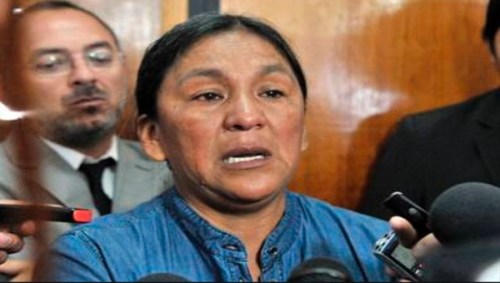
Photo: LaVoz.com.ar
teleSUR | March 6, 2016
The United Nations is calling for an explanation of the ongoing two-month detention of Milagro Sala, an Indigenous lawmaker and activist in Argentina.
Sala has been in detention for nearly two months after protesting a local governor’s threat to her social programs.
The Centre of Legal and Social Studies, Amnesty International, and Argentine lawyers collective Andhes submitted a request to the United Nations Working Group on Arbitrary Detention in February and to the Inter-American Court of Human Rights in January to guarantee her freedom and the right to freedom and expression. Argentine President Mauricio Macri supports the arrest of Sala, who faces embezzlement charges after being jailed by Macri ally and Juyjuy Governor Gerardo Morales for public disturbance.
Sala was protesting Morales’ proposed changes to the Indigenista Tupac Amaru organization, which she founded and runs, that provides social services to tens of thousands. Her arrest drew large protests for her release, but she was denied a habeas corpus plea.
“Organizing collective action does not mean ‘inciting crimes,’ a massive demonstration is not ‘public disturbance’ and to oppose a government decision is not ‘an act of sedition.’ They are all democratic freedoms,” said the Buenos Aires Provincial Commission for Memory.
Argentina’s Office of Institutional Violence, Procuvin, deemed Sala’s arrest illegal last week, finding that “the two judges and the prosecutor who participated in this process have committed crimes under the penal code.” The investigation for “illegal deprivation of liberty and aggravated breach of trust” came after a request by Mercosur, for which Sala is a lawmaker.
Last week, Macri sent officials to offer Sala house arrest, but she refused the “extortion.” The visit came right before the president met with Pope Francis, who sent Sala rosary beads following her appeal for help.
Cuban Doctors Have Saved 87,000 Lives in Bolivia Since 2006
teleSUR | March 5, 2016
Cuba is known for sending medical personnel overseas as part of its medical brigade program which was launched during the 1959 Revolution.
The Bolivian Health Ministry thanked Cuban doctors and the Cuban government Friday for the solidarity offered to their country as part of Cuba’s medical internationalism over the past 10 years.
Ariana Campero, the head of agency of the decade-long program, congratulated the local partners and conveyed greetings from President Evo Morales. “Thank you very much to Fidel Castro, Commander Raul Castro and the Cuban people. We are sending you all an embrace of solidarity from Bolivia.”
According to Dr. Pavel Noa, the national coordinator of the mission, the most important results that protrude from the mission encompass more than 63 million consultations offered to the Bolivian people, 179,282 surgical interventions performed and a total of 86,983 lives saved.
Medical workers are often believed to be Cuba’s most important export, having served in countries all over the world and in particular in Latin America, Africa and, more recently in Oceania.
Dr. Alina Ochoa, head of Medical Assistance Brigade, stressed the importance of cooperation in the healthcare sector and said the aim was to ensure the health of the Bolivian people. “Cuba has a long and successful history in providing medical staff worldwide, which was ratified in Bolivia with the presence of more than 700 collaborators.”
The representative of the Pan American Health Organization, Luis Fernando Leanes, acknowledged the work of the Cuban mission, which he described as wonderful and very important. “How nice to be in this country and see Cubans and Bolivians working together for peace and welfare”, he said.
Cuba´s efforts in providing medical services to the poor have been acknowledged internationally as it was among the first countries to respond when the World Health Organization called for medical staff to help with the Ebola crisis. Fidel Castro proudly described the 12,000 medical volunteers who signed up as “an army of white coats”.
Honduran protesters clash with police over activist killing
Press TV – March 5, 2016
Fresh protests have broken out in Honduras during a mourning ceremony for an indigenous environmental activist who was recently shot dead after receiving numerous death threats.
More than 1,000 people converged on Friday at the memorial service for renowned environmentalist Berta Caceres as her coffin was turned over to her family at a labor union headquarters.
The ceremony, however, turned into a protest rally, with the participants shouting “Justice!”
Reports say clashes erupted between the protesters and security forces, who intervened to disperse the crowd.
The demo came less than a day after rock-throwing students clashed with riot police at the University of Honduras in the capital Tegucigalpa amid outrage over the government’s failure to protect the high-profile activist who had repeatedly been threatened with assassination.
She was shot dead in the early hours of Thursday at her home in the western town of La Esperanza.
A 45-year-old mother of four, Caceres gained prominence for leading the indigenous Lenca people in a struggle against a hydroelectric dam project that would have flooded a massive region of native lands and cut off water supplies to hundreds of local people.
She continued with her efforts against the project despite receiving numerous death threats, winning the 2015 Goldman Environmental Prize.
The family of Caceres has accused government officials of trying to mask her death as a random murder, insisting that she was assassinated due to her efforts against environmental destruction by major mining and hydroelectric companies.
Meanwhile, the Civic Council of Indigenous and People’s Organization (COPINH), which was founded by Caceres, revealed that other members had received death threats from “hit men” allegedly hired by energy company DESA, whose hydroelectric project is being opposed by the group.
“In the past six months, Berta had been the target of constant, intensifying threats, shots fired on her car, and verbal and written threats from the army, the police, the mayor (in the project site) and DESA,” the COPINH said.
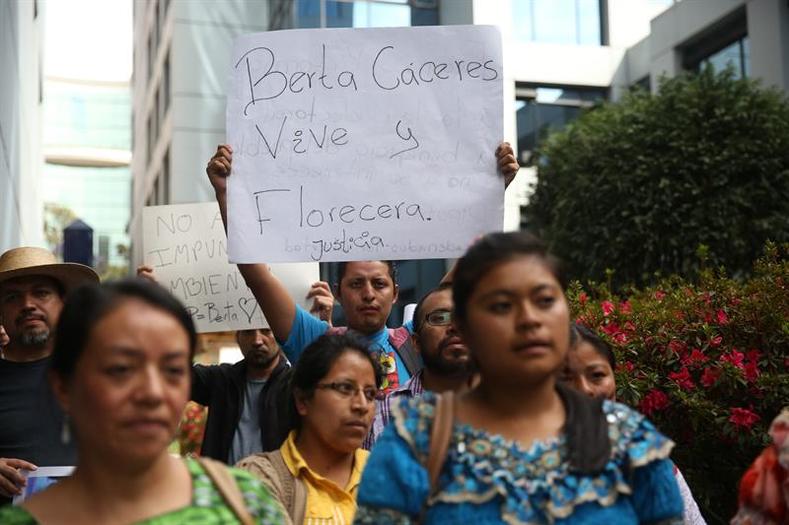
Demonstrators in Guatemala City carry a sign reading “Berta Caceres lives and will flourish” after news of her assassination and in solidarity with Honduran movements on March 3, 2016. Photo:EFE
Featured Video
Ian Proud: Economic Reset with Russia to Save Europe
or go to
Aletho News Archives – Video-Images
From the Archives
Jack Ruby: Israel’s Smoking Gun
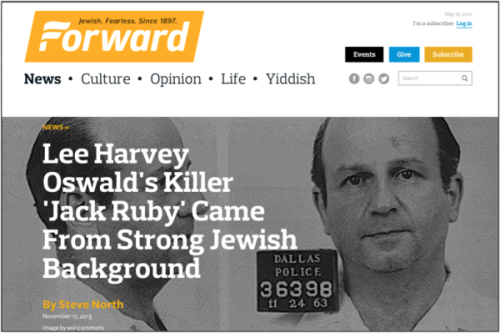
BY LAURENT GUYÉNOT • UNZ REVIEW • NOVEMBER 13, 2021
By a strange paradox, most Kennedy researchers who believe that Oswald was “just a patsy” spend an awful lot of time exploring his biography. This is about as useful as investigating Osama bin Laden for solving 9/11. Any serious quest for the real assassins of JFK should start by investigating the man who shot Oswald at pointblank in the stomach at 11:21 a.m. on September 24, 1963 in the Dallas Police station, thereby sealing the possibility that a judicial inquiry would draw attention to the inconsistencies of the charge against him, and perhaps expose the real perpetrators. One would normally expect the Dallas strip-club owner Jack Ruby to be the most investigated character by Kennedy truthers. But that is not the case. … continue
Blog Roll
Recent Comments


 Aletho News
- Ian Proud: Economic Reset with Russia to Save Europe
- Senator Rand Paul Introduces Federal Bill to END Vaccine Makers’ Liability Shield
- The Hidden Map: US and Israel May Use Unexpected Neighbors to Attack Iran
- Trump, Netanyahu Agree to Target Iranian Oil Exports to China
- Russia open to discussing Ukraine’s ‘external governance’ – senior diplomat
- US Caribbean Buildup Near $3B — Report
- Munich Security Conference and the U.S. elephant in the room
- Epstein Pitched JPMorgan Chase on Plan to Get Bill Gates ‘More Money for Vaccines’
- Germany’s CDU Pushes Real-Name Social Media Mandate and ID Checks
- Patrik Baab: Europe’s New Iron Curtain – Freedom of Speech Dies
- If Americans Knew
- Israel-backed border guards, GHF-linked aid – Not a ceasefire Day 128
- Israel battles Palestinian right of return, one Palestinian at a time – Not a ceasefire Day 127
- Noor’s short life of unimaginable suffering
- Israel Destroyed Gaza’s Hospitals. Now It’s Banning Doctors Without Borders.
- Is Spite of What Zionists Say, It’s a Good Thing to Criticize Governments
- Palestinian mother, daughter recount strip searches, harsh conditions in Israeli detention
- Israel used weapons in Gaza that made thousands of Palestinians evaporate
- ADL’s Stats Twist Israel’s Critics Into Antisemites
- Why Is the World Silent When the Gaza Genocide Is Not Over?
- In Gaza: 8,000 bodies under rubble, 3,000 missing – Not a ceasefire Day 126
- No Tricks Zone
- Unfudging The Data: Dutch Meteorological Institute Reinstates Early 20th Centruy Heat Waves It Had Erased Earlier
- German Gas Crisis…Chancellor Merz Allegedly Bans Gas Debate Ahead of Elections!
- Pollen Reconstructions Show The Last Glacial’s Warming Events Were Global, 10x Greater Than Modern
- Germany’s Natural Gas Storage Level Dwindles To Just 28%… Increasingly Critical
- New Study Rebuts The Assumption That Anthropogenic CO2 Molecules Have ‘Special’ Properties
- Climate Scientist Who Predicted End Of “Heavy Frost And Snow” Now Refuses Media Inquiries
- Polar Bear Numbers Rising And Health Improving In Areas With The Most Rapid Sea Ice Decline
- One Reason Only For Germany’s Heating Gas Crisis: Its Hardcore-Dumbass Energy Policy
- 130 Years Later: The CO2 Greenhouse Effect Is Still Only An Imaginary-World Thought Experiment
- New Study Affirms Rising CO2’s Greening Impact Across India – A Region With No Net Warming In 75 Years
 Aletho News