Cuba Blames US for Cuban Migrant Crisis in Central America
teleSUR | November 18, 2015
Cuba blamed the U.S. on Tuesday for the situation of more than 1,000 Cuban migrants in Central America, pegging the crisis on U.S. Cold War-era immigration policy put in place during the early years of the U.S. blockade on Cuba.
“The Foreign Ministry wishes to emphasize that these citizens are victims of the U.S. government’s politicization of immigration issues,” said a government statement on a Cuban news broadcast.
The Cuban government statements come amid a recent spike in number of Cuban migrants crossing Central America en route to the U.S. Many Cubans, some wishing to reunite with their families, fear that the renewal of U.S.-Cuban relations could bring an end to a decades-old policy allowing landed Cuban migrants to stay in the U.S.
But more than 1,000 Cuban migrants have become stuck in Central America, facing challenges of tightened borders first at the Panama-Costa Rica crossing, then at the Costa Rica-Nicaragua border. Nicaragua tightened its borders Sunday and accused Costa Rica of fomenting a “humanitarian crisis” in the region.
Under the U.S.’s 1966 Cuban Adjustment Act, any Cuban who enters the U.S. is able to gain permanent residency after being present in the U.S. for one year. The act, amended in 1995 to not admit to the U.S. any Cubans found at sea, became known as the “wet-foot, dry-foot” rule.
The Cuban government considers this rule a provocation, while critics say the policy not only promotes dangerous forms of travel, but is also an incentive for human trafficking by criminal groups.
“This policy stimulates irregular emigration from Cuba toward the United States and constitutes a violation of the letter and the spirit of migration accords that are in force and through which both countries assume an obligation to guarantee legal, safe and orderly emigration,” said the Cuban government statement.
Cuba said it has been in contact with Central American countries on the Cuban migration route to discuss how to best remedy the migrant situation.
Ecuador Rejects HRW Report as “Manipulative”
teleSUR – November 12, 2015
In a statement released Wednesday, Ecuador’s governing party, Alianza PAIS, rejected the “latest political intervention against the government of Ecuador by the U.S.-based organization Human Rights Watch (HRW) in its report released on 10 November 2015.”
The report made unsubstantiated claims that “the administration of President Rafael Correa has expanded state control over media and civil society” and argued that security forces used “excessive force” against “peaceful” protests this year. It left out important context, such as the calls by the leaders of those protests to get rid of the democratically elected and very popular left wing government. The report criticized Ecuador because the well known US political tool, USAID shut their offices this year, and claimed the government has “broad powers to limit free speech.” Finally, the report took a political position on Ecuador’s internal legislative decisions.
“This organization repeatedly ignores the unprecedented advances in human rights that have occurred in Ecuador while manipulating human rights discourse to unjustly attack the nation’s elected government. It is not the first time HRW releases partisan reports against Latin America’s progressive governments,” Alianza PAIS stated.
Allianza PAIS accused HRW of misrepresenting the sizes of demonstrations, minimizing opposition violence, and of misrepresenting the state of emergency declared with the eruption of the Cotopaxi volanco – portraying that measure as a repressive tool.
“The sources of HRW’s funding, including corporate funding, contribute to its political bias while its board members and advisers have links with the financial, military and political sectors, the latter criticized by significant figures including Nobel laureates,” Alianza stated.
Our Brand Is Impunity: Why is the U.S. Harboring Bolivia’s Most Wanted Fugitive?
New film Our Brand is Crisis doesn’t tell us how a president who authorized the massacre of indigenous Bolivians has lived with impunity in the US for 12 years
By Emily Achtenberg – Rebel Currents – 10/29/2015
Our Brand Is Crisis, a new feature film produced by George Clooney and “inspired by true events,” tells the story of a presidential campaign in a fictional Latin American country that is besieged by social unrest.
In real life, the country is Bolivia, the year was 2002, and the candidate was Gonzalo Sánchez de Lozada (“Goni”), a deeply unpopular former president who was propelled to victory by the nefarious campaign strategies of prominent U.S. polling and marketing consultants Greenville Carville and Shrum. Goni, a U.S.-educated millionaire mine owner, won the election with only 22% of the popular vote.
What the film doesn’t show is what happened less than a year later. In October 2003, Goni authorized the violent repression of indigenous citizens who were protesting the privatization of Bolivia’s oil and gas reserves, and the proposed export of cheap gas to the U.S. through Chilean ports. The results were 68 dead and 400 injured, including onlookers and children. Most of the violence took place in El Alto, the indigenous city overlooking La Paz that was the epicenter of Bolivia’s “Gas War.”
The massacre sparked a popular uprising that led to Goni’s resignation, followed by a chain of events culminating in the 2005 election of Evo Morales as Bolivia’s first indigenous president. Goni and his defense minister Carlos Sánchez Berzaín fled to the US, where they have lived for 12 years in comfort, relative obscurity, and with full impunity, shielded by successive Republican and Democratic administrations.
Bolivians, though, have not forgotten. This past month, in what has become an annual ritual, families, survivors, and friends of the victims marched in El Alto, together with hundreds of supporters from popular and neighborhood organizations, to commemorate the events of “Black October” and demand that the perpetrators of violence be brought to justice.
Beyond his infamous responsibility for Black October, Goni is equally despised in Bolivia for overseeing a radical neoliberal program of privatization, austerity, and deregulation at the behest of the US government and international financial institutions. While helping to reduce hyperinflation, these free-market reforms also led to rising unemployment, deepening poverty, and transnational corporate control of Bolivia’s economy.
In 2004, after a concerted campaign by the victims’ families and human rights groups, more than two-thirds of the Bolivian Congress—including many members of Goni’s own party—voted to authorize a “trial of responsibility” for the perpetrators of the Black October violence. Seventeen former military and government officials, including Goni and Sánchez Berzaín, were charged with serious human rights crimes, including homicide, torture, and “genocide in the form of a bloody massacre.” Seven have been tried and convicted in Bolivia, receiving prison sentences of 3-15 years in a landmark 2011 case. However, under Bolivian law, those who fled into exile cannot be held legally accountable unless the government succeeds in extraditing them.
The Bolivian government’s initial petition for the extradition of Goni and Sánchez Berzaín, filed in 2008, was rejected by the U.S. State Department in 2012, seemingly because some charges lacked equivalency in U.S. law. A revised request, filed in July 2014, is still pending.
The obstacles to success remain formidable, including Goni’s long-standing dual citizenship, advanced age (85), and, especially, his close ties to powerful US politicians and business tycoons. In addition to his relationship with top Democratic political operatives James Carville, Stan Greenberg, and Bob Shrum (detailed in the original Our Brand is Crisis, an excellent 2005 documentary by Rachel Boynton), Goni was advised in his 2002 campaign by Mark Feierstein, who currently serves as Obama’s Senior Director for Western Hemisphere Affairs at the National Security Council. Greg Craig, Goni’s former attorney, coordinated Bill Clinton’s legal defense during his impeachment trial and later became Obama’s White House Counsel.
Last April, Goni was a featured speaker in a lecture series at Mercer University’s Center for Undergraduate Research on Public Policy and Capitalism, financed by the Koch brothers. More than 300 US solidarity activists, academics, and representatives of civil society organizations protested the event in a letter to the university president, requesting that video testimonies offered by the Black October victims’ families also be aired to provide a more balanced perspective.
Underlying the conflict over extradition is the fraught political relationship between Bolivia and the US that has persisted throughout the Morales era, characterized by mutual distrust and a tendency on both sides to exploit ideological differences for domestic political gain. The two countries have not had formal diplomatic relations since 2008, when Morales expelled U.S. Ambassador Philip Goldberg for suspected consorting with conservative opposition leaders who were actively seeking to destabilize his government—a suspicion subsequently borne out by Wikileaks cable revelations—and the US responded in kind.
In 2013, Morales also expelled USAID for meddling in domestic political affairs, an accusation that gained widespread traction due to the agency’s lack of transparency in funding. A few months later, the grounding of Morales’s presidential jet in Europe when the U.S. suspected that fugitive Edward Snowden might be on board substantially undermined a new “framework agreement” for bilateral relations negotiated by the parties in 2011.
Morales has repeatedly clashed with the U.S. over drug policy. In 2008, he expelled the U.S. Drug Enforcement Agency (DEA), symbol of the repressive U.S. War on Drugs, to embark on a new anti-drug trafficking strategy that acknowledges Bolivia’s traditional uses of coca and enlists the powerful coca growers’ unions in regulating their own activity through social control.
Despite a recent United Nations report documenting the success of this policy, in the form of a significant reduction in Bolivia’s coca-growing acreage, the U.S. has continued to “decertify” Bolivia for “failing demonstrably” to curb illegal drug trafficking. This means that the U.S. will likely continue to deny previously-granted trade preferences for Bolivia’s manufacturing exports, an economic sanction that Bolivia deeply resents. Recent revelations that the US has secretly indicted several top government officials and their associates as a result of a DEA drug sting have reinforced Morales’s suspicions that a vengeful DEA is working to undermine his administration.
Still, with the recent U.S.-Cuba thaw setting a new standard for diplomatic pragmatism in the region, there is good reason to anticipate that U.S.-Bolivia relations will improve. As with Cuba, a primary motivating factor is likely to be the availability of new markets for U.S. businesses in Bolivia, now that, with the end of the commodities boom, the Morales government has stepped up its efforts to attract foreign capital.
Just this past week, Morales showcased investment opportunities in Bolivia’s hydrocarbons, mining, energy, manufacturing, and tourist sectors at a New York City conference, “Investing in the New Bolivia.” The event, sponsored by the London-based Financial Times (FT), drew more than 150 corporate and financial representatives from the U.S .and around the world, with 34 companies (including Seattle-based Boeing) expressing significant interest.
Despite Morales’s warnings that foreign companies must partner with the government and not meddle in domestic politics —important differences from the neoliberal Goni era— Bolivia’s new pro-business climate could go a long way towards countering the recent history of ideological and rhetorical conflict between the two countries. Even so, with Goni’s still powerful bipartisan connections, it’s hard to say whether improved economic and political relations could elevate the status of Bolivia’s extradition request on the bilateral agenda. It’s also unclear whether extradition is still a top priority for the Morales government, or has been superseded by other nationalist causes—such as Bolivia’s demand for the return of its seacoast from Chile—that have gained new political traction.
Meanwhile, a civil suit filed against Goni in 2014 by the families of Black October victims, seeking compensatory and punitive damages under the Alien Tort Statute and the Torture Victim Protection Act, is progressing slowly through the US courts. Last May, Goni was forced to submit to a 6-hour deposition, an emotional experience for the families— and the first and only time he has appeared in a judicial forum to account for his crimes. The families are also pursuing claims in the Bolivian courts to allow the assets of those convicted of Black October crimes to be auctioned off and paid to them as reparations.
Here in the US, solidarity activists have launched a parody website to tell the true story of state violence and impunity that lies behind the fictionalized Our Brand is Crisis. It includes video testimonies from the families of Black October victims and survivors and a petition demanding Goni’s extradition.
Emily Achtenberg is an urban planner and the author of NACLA’s blog Rebel Currents, covering Latin American social movements and progressive governments
White Helmets: War by Way of Deception
By Vanessa Beeley | thewallwillfall | October 23, 2015
“The Ivy League bourgeoisie who sit at the helm of the non-profit industrial complex will one day be known simply as charismatic architects of death. Funded by the ruling class oligarchy, the role they serve for their funders is not unlike that of corporate media. Yet, it appears that global society is paralyzed in a collective hypnosis – rejecting universal social interests, thus rejecting reason, to instead fall in line with the position of the powerful minority that has seized control, a minority that systematically favours corporate interests.” ~ Cory Morningstar
In his recent speech Hezbollah leader, Sayyed Nasrallah, alluded to a multi-phase “soft war” which relies upon the mass media complex to disseminate propaganda and bias, propelling the Middle East into, primarily, a sectarian crisis before descending even further into regionalism and finally a devastating individualism.
Cory Morningstar’s body of work does more than any other to expose the bare bones of the non-profit propaganda industry that governs both our reactions – and inactions, through a network of multi-layered and multi-faceted media manipulation campaigns, of which the end result is mass thought control. She explains:
“The 21st century NGO is becoming, more and more, a key tool serving the imperialist quest of absolute global dominance and exploitation. Global society has been, and continues to be, manipulated to believe that NGOs are representative of “civil society” (a concept promoted by corporations in the first place). This misplaced trust has allowed the “humanitarian industrial complex” to ascend to the highest position: the missionaries of deity – the deity of the empire.”
In a paper entitled, Foreign Aid and Regime Change: A Role for Donor Intent, written just prior to NATO intervention in Libya, Prof. Sarah Blodgett Bormeo describes the “democratization” process for target nations. Unwittingly or wittingly, Bormeo perfectly outlines the role played by NGOs in this process. Bormeo even goes so far as to pinpoint the lack of impartiality rife among NGOs large and small, the majority of whom, receive their funding directly from western government and major corporation sources – all of whom have a vested interest in the outcome of their NGO’s activities and ‘intervention’ in a particular location. Bormeo emphasises the importance of “picking winners” in this scenario, as opposed to respecting and supporting the will of the people in any sovereign nation.
“Thus, it is possible that aid donors, in an effort to avoid further entrenching an “authoritarian” [my edit: this status is decided by donor] regime and perhaps increase the likelihood of democratization, channel funds through NGOs and civil society organizations in authoritarian states.”
In this short video below, we are introduced to the US military’s symbiotic relationship with NGOs in countries [in this instance, Iraq] where the policy is to Induce Pacification & Advance Western Ideologies. NGOs are cynically used to “soften” cultures and render entire communities dependent upon foreign aid in order to facilitate “Democratization”.
In this role, and dependent upon their donor support, NGOs cease to be the neutral, unbiased ‘humanitarian’ organisations they publicly purport to be, and instead become actual covert tools for foreign intervention and regime change. By default, they are assimilated into the Western modus vivendi of “waging war by way of deception” and their purpose is to alter public perception of a conflict via a multitude of media and “marketing” channels.
Following this formula, let’s examine, once more, the role of the Syria Civil Defence aka,’The White Helmets’ currently operating in Syria and take a closer look at their financial sources and mainstream media partners in order to better determine if they are indeed “neutral” as media moguls proclaim these “humanitarians” to be.
White Helmets: Follow the Money
The White Helmets were established in March 2013, in Istanbul, Turkey, and is headed by James Le Mesurier, a British “security” specialist and ‘ex’ British military intelligence officer with an impressive track record in some of the most dubious NATO intervention theatres including Bosnia and Kosovo, as well as Iraq, Lebanon, and Palestine. Le Mesurier is a product of Britain’s elite Royal Military Academy at Sandhurst, and has also been placed in a series of high-profile pasts at the United Nations, European Union, and U.K. Foreign and Commonwealth Office.
The origins of The White Helmet’s initial $300k seed funding is a little hazy, reports are contradictory but subsequent information leads us to conclude that the UK, US and Syrian opposition [Syrian National Council] are connected. Logistical support has been provided by given by Turkish elite natural disaster response team, AKUT.
A further $13 million was poured into the White Helmet coffers during 2013 and this is where it gets interesting. Early reports suggest that these “donations” came from the US, UK and SNC with the previously explored connections to George Soros in the US.
Soros in Syria: ‘Humanitarian’ NGO Deployed For Regime Change, Not Aid
However, subsequent investigations reveal that USAID has been a major shareholder in the White Helmet organisation.
The website for the United States Agency for International Development (USAID) claims that “our work supports long-term and equitable economic growth and advances U.S. foreign policy objectives by supporting: economic growth, agriculture and trade; global health; and, democracy, conflict prevention and humanitarian assistance.”
In a USAID report update in July 2015 it is clearly stated that they have supplied over $ 16m in assistance to the White Helmets.

The USAID track record as a primary US Government/CIA regime change facilitator is extensively documented. From South America to the Ukraine and in the Middle East, USAID serve a malevolent and ultimately destructive role in the dismantling of sovereign nations and their reduction to Western hegemony vassal states, as always, all in the name of freedom and democracy.
“The United States does not lack institutions that continue to conspire, and that’s why I am using this gathering to announce that we have decided to expel USAID from Bolivia” ~ Bolivian President Evo Morales
“USAID and NED are in the business of “Democracy Promotion” which uses public money (from U.S. taxpayers) for secretive operations with the intention to support pro-U.S. governments with the help of political and social movements abroad. The goal is regime change.” ~ Timothy Alexander Guzman
With recent developments in Syria and as a consequence of the Syrian Government requested Russian intervention, we have seen a scramble to justify the shambolic US foreign policy and its clandestine terror operations in Syria. We have previously established the White Helmet connections to this US regime change operation and their undisputed exclusive integration into the Al Nusra and Free Syrian Army [Muslim Brotherhood] and even ISIS networks and strongholds.
Humanitarian’ Propaganda War Against Syria – Led by Avaaz and The White Helmets
After RT and Sott.net among others, exposed the gaping holes in White Helmet propaganda over recycled photographs tweeted even before the alleged Russian bombing had occurred, the propaganda “war” ramped up. The Russian involvement in Syria, did not only betray the US military deception, it also brought some heavyweight media giants of its own into the fray who set about de-constructing the Western media and NGO indoctrination that had, for so long, been largely unchallenged.
At this point the London Telegraph went into damage limitation mode. It published an article expounding the White Helmet humanitarian role in Syria but with admissions of UK Government “majority” funding and that the White Helmets are embedded with ISIS (“in at least one ISIL held area”), claims previously vehemently denied but rendered indisputable after discovery of the photo showing an ISIS mercenary posing directly in front of a White Helmets depot located deep in ISIS held territory south of Yarmouk.

“The Foreign Office is currently the largest single source of funding. It is an irony that if Britain does effectively become an ally of Assad, and starts raids against Isil in Syria, it will be bombing from the air and paying for the bodies to be dug out on the ground. The White Helmets are also operating in at least one Isil-held area.”
Interestingly, the Telegraph stated clearly that the UK Foreign Office is the “largest single source of funding” for the White Helmets which may be perceived as an attempt to draw fire away from the USAID funding which still outstrips official figures released by the British Gov’t who “gifted” £ 3.5 million in equipment to “civil defence teams” in Syria [Report March 2015]. However, the British Government also committed to an additional £ 10m to “increase coordination between the Syrian Interim Government and civil defence teams” to be funded by: UK Government’s Conflict, Security and Stability Fund (CSSF).
It should also be noted here that although cries of ‘regime change!’ from both Washington and London have been muted since Russia entered the Syria conflict, both Washington and London have been supporting their own parallel, hand-picked ‘interim government’ for Syria since at least 2012.
So, with millions in hard cash and equipment being invested into the White Helmets by US & UK donors who have a very clear regime change objective in Syria, it becomes increasingly difficult to perceive their role as anything other than donor-biased propaganda merchants and a ‘humanitarian’ extension of a clandestine terror operation allied to the NATO proxy armies in the region.
White Helmet Leadership
James Le Mesurier: James Le Mesurier has been portrayed as a Humanitarian maverick hero, miraculously in the right place (Istanbul) at the right time, just as the need arose for the formation of a Syria Civil Defence team, perhaps coincidentally, only a few months prior to the now infamous and universally (except for a few diehard propagandists) discredited Ghouta ‘chemical weapon’ attack in August 2013, an event which has already been proven beyond a doubt to be a false flag attack, as well as subsequent accusations levied at the Syrian Government which narrowly failed to precipitate the NATO desired ‘No Fly Zone’.
However, when we delve deeper into the life and times of Le Mesurier we see that it was no happy accident that he was in Istanbul at this juncture. As Sandhurst Military Academy’s top student and recipient of the Queen’s Medal, his chequered career took him from OHR [Office of High Representative] in Bosnia to intelligence co-ordinator in NATO’s newly won prize, Kosovo. We’re told that Le Mesurier left the British Army in 2000 and joined the UN serving as deputy head of the Advisory Unit on ‘Security and Justice’, and Special Representative of the Secretary General’s security policy body within the UN mission in Kosovo. His career then took him to Jerusalem where he worked on implementing the Ramallah Agreement, then to Baghdad as a special advisor to Iraqi Minister of Interior, and to the UAE to train their gas field protection force, and later to Lebanon during the 2006 war. In 2005 he was made Vice President for Special Projects at private mercenary firm Olive Group, and in January 2008 he was appointed as Principal for Good Harbour International, both based in Dubai.
Le Mesurier is also the founder of Mayday Rescue, a “non profit” organisation providing SAR [search & rescue] training to civilians enduring conflict. According to Mesurier’s own biography on the website, Mayday Rescue was founded in 2014, after he had established Syria Civil Defence/White Helmets.

A quick flick through the other Mayday team members reveals some very interesting connections.
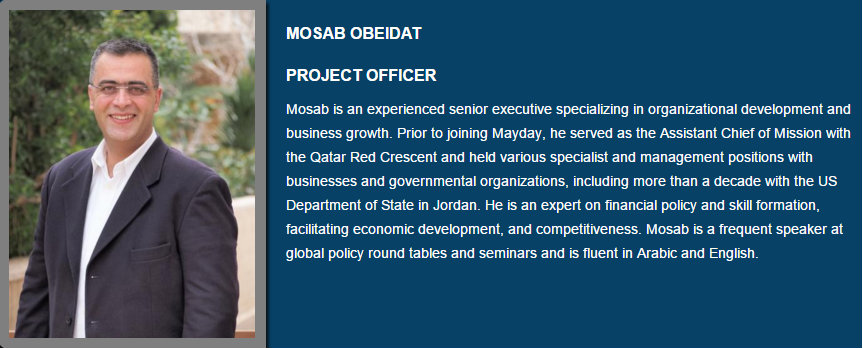
Mosab Obeidat, previous Assistant Chief of Mission with the Qatar Red Crescent, one of whose officials, Khaled Diab was accused of supplying $ 2.2 m to secure arms for the terrorist groups in Syria. Details of this transaction and its exposure can be found in this Al Akhbar article from June 2013.
At least three other members of the team were a part of the Syrian “revolution” including Farouq al Habib, one of the 3 most prominent White Helmet leaders who was also a leader of the Homs uprising against the Syrian government and according to his testimony, was tortured by the Syrian “regime” security forces in 2012 for smuggling a journalist into Syria to “cover” the “peaceful protests”. Habib was a founder member of the ‘Homs Revolutionary Council’ (the CIA have been linked to nearly all ‘Revolutionary Councils in Syria) before fleeing to Turkey in 2013 (A more in-depth analysis of his anti-Syrian government testimony will be presented in Part II of this article).

Le Mesurier is heavily involved in several organisations not mentioned in this article, but for the purposes of demonstrating that the White Helmets should not be considered impartial or neutral as they claim, we will focus on those that best substantiate that argument.
Both Olive Group and Good Harbour International are experts in private “security”. Taken from Sourcewatch on Olive Group:
“Olive Security was founded in 2001 by Harry Legge Burke. Olive lends their quick success to strong relations in the government and military industry. Harry Legge-Burke is an ex-Welsh Guard, and a former aid to chief of defence staff Sir [Charles Guthrie]. He can claim Prince William as a skiing partner and his sister was a nanny to the royal children.
Iraq: Olive were on the ground since the invasion began in 2003, and were able to deploy 38 former SAS employees within two days of the invasion’s completion in 2004
Jonathan Allum, Olive’s former director and co-owner, is also the son of Tony Allum, who is the chairman of the engineering company Halcrow and also the head of the UK government’s Iraq Industry Working Group. It was in the latter position that Tony Allum went to Washington to meet with Bechtel leaders, where he suggested, among other UK companies, Halcrow and Olive as companies worth considering for subcontracted work, all stemming from Bechtel’s $680 million contract with USAID. They were considered and contracts followed, though both Legge-Burke and Allum deny one had anything to do with the other”
In May 2015 Olive Group merged with Constellis Holdings, in whose portfolio we can also find Academi, previously the notorious Blackwater Group [ Nisour Square massacre, Iraq 2007]. Taken from The Atlantic July 2012: Post 9/11, Bush enabled the CIA to subcontract assassinations allegedly targeting Al Qaeda operatives. Blackwater was awarded this contract.
“Running operations through Blackwater gave the CIA the power to have people abducted, or killed, with no one in the government being exactly responsible.”
The CIA can no longer hide its Blackwater/Academi connections, especially after this week’s Wikileaks data dump of CIA director John Brennan’s emails, whose contact list included now spy chief Robert Richer at his Blackwater contact address.
The outsourcing of intelligence operations was in full-swing. What Bush initiated, Obama ran with, awarding Blackwater/Academi a $ 250m contract in 2010 to offer “unspecified” services to the CIA, thus maintaining the apparatus for “unaccountable” covert assassinations.
It is true that James Le Mesurier only joined Olive Group in 2005 and left them in 2008, but his involvement with them and their subsequent merger with Constellis and by default, Blackwater/Academi, gives a degree of valuable insight into the elite intelligence and Pentagon circles that Le Mesurier moved in prior to working for Good Harbour International and creating Syria Civil Defence (not forgetting the USAID funding & influence that underpins both Olive and SCD/White Helmets).
In 2008, Le Mesurier joined Good Harbour International, another private “security” expert organisation, whose CEO is none other than former terror advisor to the Bush administration, the Terror Czar himself, Richard A Clarke.

The jury is still out on whether Clarke was indeed the “whistleblower” he fashioned himself as, post 9/11, or a merely a high-level gatekeeper who aided in preventing a full and detailed investigation into Bush and Rumsfeld’s roles in 9/11.
Patrick Henningsen, a political analyst and writer for 21st Century Wire believes the latter is more likely:
“On first glance, one might buy into the mainstream media’s characterization of him, but it’s more likely that Richard Clarke is not a whistleblower at all. While appearing to oppose the Bush administration from a safe enough distance, I believe his role was inserted into the mix in the period of 2004-2005 in order to VALIDATE the bin Laden mythology and help to portray al Qaeda as an organic, independently run terror organization. He also claimed that Bush and Rumsfeld committed war crimes, but this means nothing because everyone knows that no US official will ever face ‘war crimes’ charges in any court of law anywhere on the planet. It’s effectively a straw man narrative that distracts from the real scandal in the US which is that the entire premise of the war on terror is completely contrived. Clarke’s ‘whistleblower’ status gives him brilliant cover from too much public scrutiny. I remain skeptical of his whole public narrative. He was, is, and always will be an insider.”
What is perhaps even more telling, is Clarke’s reported close ties with Israeli-US operative Rita Katz of the SITE Intelligence Group, another supposedly independent, albeit ‘private’ intelligence firm located in Bethesda, Maryland, a stone’s throw away from CIA headquarters. SITE are said to be responsible for the media release of the harrowing ISIS execution videos, al Qaeda videos, and their credibility has been extensively questioned.
Katz’s long term working relationship with Clarke began before 9/11 when she and her research associate Steve Emerson were commissioned by Clarke to identify Islamic radicals within the US. Over time, Katz’s relationship with Clarke blossomed into a much more extensive one that included regular briefings at both the Clinton and Bush White Houses.
“One of SITE’s founders, Rita Katz, is a government insider with close connections to former terrorism czar Richard Clarke and his staff in the White House, as well as investigators in the Department of Justice, Department of the Treasury, and the Department of Homeland Security, according to SourceWatch. Her father was executed in Iraq as an Israel spy, a fact that suggests a connection to Israeli intelligence.” ~ Mark Taliano
This background on Le Mesurier should at least make us question the media portrayal of an affable, debonair and philanthropic leader of a civilian humanitarian mission. His military & intelligence roots, the fact that despite working for OHR in Bosnia, no visible record of his employment can be found there, his private security-centric career path, his appearance in Istanbul at just the right moment to partner USAID, the UK government & Syrian opposition in creating just the sort of “democratization” enabling NGO as described in our introduction, MUST at least cause us to doubt the transparency and neutrality of the White Helmets in Syria.
In addition, the White Helmet leadership consisting of known Syrian opposition protagonists such as Raed Saleh and Farouq al Habib must make us more cynical about the claims of impartiality and lack of bias and for those who will defend the “peaceful” revolution narrative upheld by Habib and Saleh, please take the time to read Professor Tim Anderson’s in depth analysis of events in Syria pre NATO intervention.
“I have seen from the beginning armed protesters in those demonstrations … they were the first to fire on the police. Very often the violence of the security forces comes in response to the brutal violence of the armed insurgents” – Jesuit priest Father Frans Van der Lugt, January 2012, Homs Syria
“The claim that armed opposition to the government has begun only recently is a complete lie. The killings of soldiers, police and civilians, often in the most brutal circumstances, have been going on virtually since the beginning.” – Professor Jeremy Salt, October 2011, Ankara Turkey
Our presentation of the White Helmets as regime change propagandists & terrorist allies in this article will be further explored and verified in Part II.
“Existing soft power initiatives and agencies, particularly those engaged in development and strategic communications, must be reinvigorated through increased funding, human resources and prioritization. Concurrently, the U.S. government must establish goals, objectives and metrics for soft power initiatives. Furthermore, the U.S. government can better maximize the effectiveness of soft power instruments and efforts through increased partnerships with NGOs. By providing humanitarian and development assistance in areas typically inaccessible to government agencies, NGOs are often able to access potential extremist areas before the government can establish or strengthen diplomatic, developmental or military presence, including intelligence.” — Joseph S. Nye, former US assistant secretary of defence, June 2004
Ecuador Using Oil Revenue to Build 400 New Schools by 2017

President Rafael Correa high-fives a boy during his tour of a new school built in the province of Azuay, Ecuador, Oct. 20, 2015. | Photo: Ecuadorean Presidency
teleSUR – October 22, 2015
Ecuador announced Wednesday that the government intends to build 400 new schools by 2017.
Half of the schools will be the state of the art “Millennium Educational Units” that include scientific laboratories, a library, a multi-purpose auditorium, an administrative wing and ample classrooms. The rest will be prefabricated units that can be constructed much faster and will be built in areas with the most urgent need for new schools.
“There is no better way to achieve true freedom than quality education,” President Rafael Correa said Tuesday during a ceremony to inaugurate a new school in the province of Azuay.
The new Millennium Educational Unit opened in Azuay replaces 13 much smaller schools that were sorely lacking in supplies and space needed to provide a quality education.
According to the Andes news agency, the funding for this particular school came from royalties from a nearby mining project. The stated objective of the Correa government is to take the income generated from extraction projects and invest it into strategic sectors such as education in order to move the country away from its dependence on non-renewable resources.
Ecuadorean law also stipulates that a portion of the income generated by extraction projects be reinvested into the region where the project is located.
Correa says his government had invested at least US$20 billion in education over the past eight years of his administration. The Ministry of Education provides free school supplies, books, uniforms, and meals in order to reduce barriers for low-income students, with a goal of achieving a 100 percent attendance rate.
The political opposition and right-wing press have criticized the Correa government over its spending. During the inauguration ceremony Correa replied saying, “Ecuador does not spend a lot, it invests a lot, which is different.”
The country has already built 57 of the Millennium Educational Units, with a further 48 under construction. The schools are intended to have a lifespan of 100 years. The prefabricated schools have a shorter lifespan at 25 years but take only 11 weeks to build.
Putin and the Press: The Demonology School of Journalism
By James Petras | October 11, 2015
The major influential western print media are engaged in a prolonged, large-scale effort to demonize Russian President Putin, his politics and persona. There is an article (or several articles) every day in which he is personally stigmatized as a dictator, authoritarian, czar, ‘former KGB operative’ and Soviet-style ruler; anything but the repeatedly elected President of Russia.
He is accused of hijacking Russia from the ‘road to democracy’, as pursued by his grotesquely corrupt predecessor Boris Yeltsin; of directing the bloody repression of the ‘freedom loving Chechens’; of jailing innocent, independent, and critical oligarchs and robber barons; of fomenting an uprising in the ‘democratic, newly pro-Western’ Ukraine and seizing control of Crimea; of backing a ‘bloody tyrant’ in Syria (elected President Bashar Assad) in a civil war against ISIS terrorists; of running the Russian economy into the ground; and of militarily threatening the Baltic and Eastern European NATO member countries.
In a word, the media have propagated an image of an ‘out-of-control autocrat’, who makes a mockery of ‘democratic’ norms and ‘Western values’, and who seeks to revive the ‘Soviet (aka Evil) Empire’.
The corollary is that ‘Western powers’, despite their peace-loving propensities and fraternal attempts to bring Russia into the democratic ‘fold’, have been ‘forced’ to now surround Russia with NATO military bases and missiles; to finance a violent coup in the Ukraine (on Russia’s frontier) and arm the Ukrainian putsch government and neo-fascist militias to ‘restore democracy’ and violently suppress ethnic Russian ‘separatists’ in Eastern Ukraine. We are told that US and EU sanctions against Russia were carefully crafted ‘diplomatic’ measures designed to punish the Moscow ‘aggressor’.
In reality, the Western media has relentlessly demonized Vladimir Putin in a campaign to further NATO military expansion and undermine the Russian economy and its national security. The goal is ultimately to force a ‘regime change’, restoring the neo-liberal elites who had pillaged Russia’s economy during the 1990s and whose brutal economic policies led to the premature death of over 6 million Russians due to deprivation and the collapse of the healthcare system.
Putin: Demon or Realist, Autocrat or Democrat, Vassal or Independent Leader?
The Western media has backed every oligarch, gangster, and fraudster who has gone on trial and been convicted during Putin’s term in office. The propagandists tell us the reason for this affinity between the Western media and the gangster-oligarchs is that these convicted felons, who claim to be ‘political dissidents’ and critics of Putin’s rule, have been dispossessed, and jailed for upholding ‘Western values’.
The Western media conveniently ignore the well-documented studies on the source of the gangster-oligarchs’ wealth: The violent and illegal seizure of multi-billion dollars-worth of natural resources (aluminum, oil and gas), banks, factories, pension funds and real estate. During the Yeltsin period the oligarchs controlled thousands of armed gangsters and engaged in internal warfare during which thousands were killed, including top government regulators, police officials and journalists who dared to oppose or expose their pillage and property grabs.
Putin’s prosecution of a mere fraction of the most notorious oligarch-gangsters has won the support of the vast majority of Russian citizens because it represents a return to law and order and the return of stolen public wealth.
Only the Western media has dared to refer to these convicted felons as ‘political victims and reformers’. They did so because the oligarchs had become the most loyal and submissive assets in the US and EU governments’ efforts to convert Russia into an irreversibly weak vassal state.
The Western media constantly refer to President Putin as the ‘authoritarian ruler’, despite the fact that he has been repeatedly elected by large majorities in competitive elections against Western backed and funded candidates. His popularity is attested to by opinion polls conducted by Western agencies.
In 2015, President Putin’s support soared to over 85%. The pro-Western Russian neo-liberal politicians scored in the low single digits according to the same independent polls.
Clearly the Russian public does not want to return to the poverty and chaos of the Western-backed gangster politics of the 1990s.
Whatever reservations working and middle class Russians have over President Putin’s style of decision-making, they clearly value his crackdown on gangster-controlled elections, Chechen terrorism, and his restoration of Russian military defense of its frontiers, including the annexation of Crimea, following the US-engineered coup in Ukraine.
Every day, the Western media recycle reports of the ‘decline and demise’ of the Russian economy, blaming ‘statist’ mismanagement of the economy by Putin. They claim ‘declining living standards’, the ‘negative growth’ of the economy and the ‘growing isolation’ of an ‘expansionist’ Russia in the face of Western sanctions.
These media claims are laughable. Readily available data demonstrate that living standards of the vast majority of Russian citizens have significantly increased under President Putin’s administration, especially after the utter collapse under the free marketers of the 1990s. Russian workers receive their pay, pensioners their pensions, enterprises their loans – on time. During the ‘free market’ days of Boris Yeltsin, workers went up to a year without pay, pensioners were selling their heirlooms in the street to survive and enterprises paid extortionate interest rates to oligarch-gangster controlled banks! Comparative data, easily obtained, are deliberately ignored by the mass media because it doesn’t fit the demonological narrative.
The mass media present the neo-liberal ‘opposition’ and ‘liberal critics’ as Russian democrats defending ‘Western values’. They forget to mention that these ‘liberal critics’ have been directly funded by Western foundations (National Endowment for Democracy, Soros Foundation, etc.) and Russian non-governmental organizations (NGO’s) with longstanding ties to US and EU governments, intelligence agencies and exiled Russian billionaires. The so-called ‘Russian’ democratic opposition revealed their abject servility to Western interests when they openly supported the Ukrainian coup and Kiev’s bloody assault on ethnic Russian-Ukrainians in the eastern ‘Donbas’ regions of Donetsk, Luhansk and Odessa. Whatever shreds of respectability and credibility the ‘democratic opposition’ retained with the Russian public, up to that point, was lost. They were seen for what they are: propaganda arms of Western imperialism and mouth-pieces for neo-fascists.
The Western mass media charge Putin’s government with the same crimes that their own governments commit. After the US State Department’s Victoria Nuland admitted to channeling $5 billion to fund the 2014 coup in Ukraine and after the Polish regime boasted of training far right street fighters, whose mob violence served as a pretext for the coup, and after neo-fascist coalition partners in Odessa of burned alive four dozen ethnic Russian-Ukrainian citizens opposed to the coup, the Western mass media accused Putin of ‘intervening’ in Ukraine. This was because Russia had convoked a referendum in Crimea, in which over 80% of the electorate voted to secede from the illegitimate Ukrainian coup regime and rejoin Russia.
In truth, the Putin government is a victim of the Western power grab in the Ukraine, with Russia having to absorb hundreds of thousands of ethnic Russian refugees driven out of the Donbas, yet the Western media portray Putin as the executioner. Meanwhile the Western coup-makers and their far-right allies are depicted as victims… forced to bomb and decimate the Donbas region.
The charade continued. The Western media portray the subsequent punitive, economic sanctions imposed by the expansionist US and EU on Russia as a result of Putin’s ‘aggression’, referring to Russia’s defense of Crimea’s self-determination and the rights of the millions of bilingual ethnic Russian citizens of Ukraine.
The absurdity and convoluted nature of Western demonological propaganda has reached new even more bizarre heights with their hysteria against Russia’s military support of the secular Syrian government against ISIS and other jihadi terrorists.
The Western mass media have launched a global campaign charging that the Russian air force bombs ‘non-ISIS military bases’, presumably the bases of Western-backed ‘friendly’ jihadi terrorists. This ridiculous ‘reportage’ and its accompanying ‘photos’ were published before the Russian air strikes even took place!!
Apparently timing doesn’t matter in Washington’s ‘alternative universe of lies’!
NATO passed its political line to the media that Russian support for the legitimate regime of President Assad must be discredited; that the Russian presence is ‘provocative’ and responsible for ‘creating tensions’ in the region – after years of Western-sponsored jihadi terrorism against Syria!
Obedient to its masters, the Western media breathlessly ‘reported’ that the Russians were ‘really’ engaged in Syria in order destroy the pro-Western ‘fighters’, leaving ISIS alone.
No credible evidence for this propaganda was ever presented. They trotted out aerial photos of wreckage, which had likely been lifted from previous US bombings.
The media’s clumsy execution of the Pentagon’s line managed to embarrass even the US Secretary of Defense, Ashton Carter, who backed off of such claims and called for an explanation from Russia. Even Secretary Kerry, who now seeks to secure Putin’s military support for the US against ISIS while withdrawing Russia’s political backing of President Assad, has cautioned the media to modify its line, now that the US favors ‘greater coordination’ with Russia — but under US leadership. The media has recently conformed to this line, although it has not managed to explain how Washington could now work with the demonic President Putin.
Conclusion
Western media is engaged in an intense long-term propaganda campaign to demonize President Putin. Its role is to convince world public opinion and world leaders to blindly follow the US and EU, as well as their ‘allies’ and vassal states, in a campaign to degrade and undermine Russia, and consolidate a unipolar empire under US tutelage.
The Western mass media is important; but it must be remembered that the media is an instrument of imperial state power. Its lies and fabrications, its demonization of leaders, like President Putin, are one part of a global military offensive to establish dominance and to destroy adversaries.
The more intense the imperial campaign, the riskier the power grab, the greater the need to demonize the victims.
This explains how the escalation of the rabid anti-Putin propaganda campaign coincides with the single biggest Western power grab — the Ukraine coup (‘regime change’) — since West Germany annexed East Germany, and NATO and the EU incorporated the Baltic States, Eastern Europe and the Balkans into the West’s strategic alliance. The West’s bloody break-up of the Yugoslav federation was part of this strategic program.
The problem with the Western demonization of adversaries, whether it is Russia, Iran and China today, or earlier Cuba, Libya and Yemen in the past, is that Washington and the EU face severe economic crises at home and military defeats abroad by armed Islamic and nationalist resistance movements.
The US had invested hundreds of billions of dollars to prop up a shaky puppet regime in US-occupied Iraq, yet the US-trained and supplied Iraqi Army fled as the Baathist-Islamist ‘ISIS’ quickly over-ran half the country.
US troops have occupied Afghanistan for fourteen years, losing tens of thousands of lives and limbs and yet the nationalist-Islamist Taliban can easily take over Afghanistan’s third largest city, Kunduz (population 300,000), and occupies three quarters of the rest of the countryside.
Libya and Somalia are a disaster. And still Washington allocates a half billion dollars to train pro-Western mercenaries to overthrow Syria’s President Assad – mercenaries who give up their arms or join ISIS the moment they cross the border from Jordan or Turkey. The US trained mercenaries have handed over untold millions of dollars worth of heavy and light weapons and armored carriers to ISIS and Al Qaeda. The EU and the US face the dismal reality that Libya, Somalia and Syria are over-run by anti-Western Islamic fighters.
In Asia, China is demonized in the Western media, portrayed as being on the verge of collapse, facing a hard landing, even as China grows at 7%. The Western media wring their collective hands over the crisis in China while Beijing finances two new international development banks for $100 billion, raises its contribution to the IMF and brings 50 countries, including most of the EU but minus the US and Japan, into a new infrastructure lending institution.
Two big questions face the US and EU:
Why do the Western media launch a campaign of demonization that doesn’t correspond to reality? What is the goal of such demonization, which objectively undermines the possibility of forming tactical alliances to end the US’ military losses, political defeats and diplomatic isolation? The US needs Russia to defeat ISIS.
For Moscow, the fight against ISIS is crucial to Russian national security: thousands of Chechen terrorists (some trained by the US) are fighting with ISIS and threaten to return to the Caucuses and terrorize Russia. Unlike the US public’s opposition to Washington’s role in forcing ‘regime change’ in Syria, the Russian public supports Moscow’s military support for the Syrian government because the Chechens’ campaign of terror within Russia, especially the 2004 massacre of hundreds of school children, teachers, and parents in Beslan, is seared into their memory – a fact conveniently ignored by Western media when it ‘sympathizes’ with Chechen ‘freedom fighters’.
In reality, Washington should have a common interest to ally with Russia in the fight against ISIS in Syria and Iraq. However Obama is committed to ousting Assad (Russia’s ally) to expand US dominance in the Middle East in partnership with Israel and Saudi Arabia. Clearly there are insurmountable contradictions between short-term military objectives (fighting ISIS) and strategic imperial political imperatives (consolidating US-Israeli hegemony over the Middle East and Iran).
Washington has moved to end its isolation in Latin America by re-establishing diplomatic relations with Cuba. Meanwhile, Washington retains the economic blockade of Cuba and its huge US military base in Guantanamo. Cuba is seen as a tactical political ally in ‘moderating’ the leftist government of Venezuela and pressuring the Colombian FARC to disarm, even as Washington deepens its military presence in the continent.
Obama signed off on a nuclear agreement with Iran (but the crippling sanctions and blockade remain in place) in order to secure Tehran’s support for the war against ISIS in Iraq and the Taliban in Afghanistan. Temporarily, the Western mass media has ‘toned-down’ its demonological reporting on Iran and Cuba, for tactical purposes.
The Obama regime has adopted a ‘good cop/bad cop’ (or schizophrenic) posture with Russia on Syria – Secretary of State John Kerry speaks of joint co-operation with Moscow while Secretary of Defense Ashton Carter proposes to militarily confront ‘Russian aggression’. The media hasn’t made the switch because they don’t know which orders to obey or which line to ‘parrot’.
In the meantime, the domestic economic crisis deepens, ISIS advances, the Taliban approaches Kabul, the Russians are arming and defending President Assad and millions of refugees, fleeing the war zones, have over- run Europe. European border wars are raging. And Obama wrings his hands in impotence. Demonology offers no allies, no solutions and no positive path to peace and co-existence.
US Hedge Fund Threatens Peru over Military Regime’s Debt
teleSUR | October 10, 2015
A U.S. hedge fund is threatening to sue Peru for payment of US$5.1 billion in unpaid bonds issued by the country’s former military government.
The fund, Gramercy, purchased the defaulted debt in 2008 for pennies on the dollar and is now demanding full repayment.
The tactic is similar to one employed by another U.S. hedge fund, Elliot Management, which has tried to use the U.S. legal system to compel the government of Argentina to repay the full amount of its own defaulted bonds.
“It’s ironic that this threat is coming amidst global meetings in Peru that continue to try and stop this kind of predatory behavior,” said Jubilee USA executive director Eric LeCompte, referring to the annual meetings of the World Bank and International Monetary Fund currently taking place in Lima.
Firms that try to collect defaulted debt in this manner are disparagingly referred to as “vulture funds.”
Gramercy is specifically threatening to sue Peru through a tribunal system known as the Investor State Dispute Settlement mechanism, or ISDS.
Peru’s finance minister, Alonso Segura, said on Friday that the government would oppose any legal action outside its borders. “That’s not going to happen,” he said. “This issue will be dealt with by Peruvian laws.”
The ISDS is comprised of special legal tribunals, often established through “free trade” agreements, that allow corporations in one country to collect on debts in another. Critics argue the system prevents country’s from overcoming crippling debts—in Peru’s case, debts incurred by an unelected military regime.
An ISDS-style trade tribunal is reportedly part of the recently signed Trans-Pacific Partnership, which includes Peru and 11 other Pacific Rim nations.
As an alternative to the ISDS, the Union of South American Nations is currently reviewing a proposal to establish a regional Arbitration Center, which would analyze and propose mechanisms to reform arbitration proceedings that could take into account the broader needs of the society and continent as a whole.
Mexican Marines Place Community Under Siege, Disappear Two People
teleSUR | October 8, 2015
Mexican marines raided a small community in the northern state of Durango and opened fired on homes with no known reason, while two young males were forcibly disappeared, neighbors told Sinaloan newspaper RioDoce.
“The troops of the Ministry of the Navy arrived in the community of El Verano and began firing at houses,” the witness said, according to RioDoce.
The newspaper said the El Verano inhabitant told them that about 15 families live in the community, still “besieged” by the marines.
The unidentified person that spoke with RioDoce said they were unaware if there were any victims, but said they saw a funeral home hearse driving through the small community.
Those forcibly disappeared were identified as Jesus Felix and his cousin Octavio Almodovar.
RioDoce said there were unconfirmed reports that a naval helicopter had been gunned down near El Verano.
A witness, identified as Lorena Silvas, said, “There are many complaints by people of other small communities near the municipality of Tamazula near El Verano, and they say there too many abuses being committed by the marines.”
Silvas said there are reports of marines carrying out raids on homes without search warrants, where they “take with them everything they find.”
The U.N.’s high commissioner for human rights, Zeid Ra’ad Al-Hussein, called on the Mexican government Wednesday to remove all military forces from public safety operations.
Al-Hussein said that impunity in Mexico is extremely commonplace, with 98 percent of reported crimes never resolved and in most cases not even investigated. He also said that 151,233 people have been murdered in Mexico from December 2006 to August 2015, while over 27,000 remain disappeared.
In June, various news outlets reported that marines had fired on civilians — including minors — in Tamazula.
Cadena Cinco reported that marines attacked a family traveling in a vehicle during which at least two people died, according to local officials. The president of the Commission for the Defense of Human Rights of Sinaloa, Leonel Aguirre, explained then that marines planted guns on various young males to justify the attack and deaths.
Misrepresentation of the Colombian Conflict
By Matt Peppe | Just the Facts | October 4, 2015
A week and a half ago news emerged from Havana that the FARC (Revolutionary Armed Forces of Colombia) and the Colombian government had reached a framework for a final peace agreement to be signed within six months. This was hailed as a breakthrough in the half-century-old conflict and an opportunity to bring peace to the people of Colombia. But by adopting the government’s narrative, mainstream media have failed to recognize the primary cause of the violence and the inevitability that it will continue in the future.
The decades-long policy of the Colombian government has been a national security strategy of counterinsurgency, developed in the late 1950s under the sponsorship of the US military. The goal of the US government was to maintain a business-friendly political system that would implement economic policies amenable to multinational corporations and foreign capital. Resistance to such policies was deemed subversion, and people who sympathized with such resistance were branded as internal enemies to be eliminated or neutralized by military means.
The narrative of the national security doctrine holds that if the insurgent threat is eliminated, then peace will be restored. The implicit assumption is that the FARC rebels have always been the side standing in the way of peace. According to this interpretation, when the FARC initiated their military operations the state was acting for the benefit of the nation as a whole by organizing a counter response.
But this narrative is historically inaccurate. The Colombian conflict is not a battle of society at large against a group of guerillas, but a battle of a small group of elites controlling the state apparatus against the majority of the population.
“As in many other Latin American countries, we can find the seeds of present-day social inequality and strife in the concentration of Colombia’s land and resources under the control of a tiny minority, matched by the progressive dispossession of the majority of people, which originated with colonialism in the sixteenth century,” explains Jasmin Hristov in her book Blood and Capital: The Paramilitarization of Colombia. [1]
After the FARC developed as the armed wing of the Communist Party in Colombia, the counterinsurgency doctrine – developed by the US military and codified in manuals distributed as early as the 1960s – taught the US’s Colombian counterparts to view any advocacy for social justice or democratic reform as a form of Communist insurgency. In addition to armed rebels, clergy, academics, labor leaders, human rights workers, and other members of civil society became potential insurgent targets.
To further extend their reach into Colombian society, the government legally authorized paramilitarism in 1965 with Plan Lazlo to form “civilian defense forces” armed and incorporated into the Colombian military system. [2] These forces serve the government’s goal of preserving the status quo by carrying out their dirty work through the use of death squads, assassinations, torture, intimidation and disappearances while providing cover and the appearance of distance from the state itself.
The Colombian conflict cannot be understood without recognizing the true nature of the actors involved and the interests they represent. “The paramilitary has never been, and is even less so now, a third actor (the state and the guerillas being the other two), as portrayed in mainstream security discourses,” writes Hristov. [3]
Writing in the New York Times after the peace agreement was announced, Ernesto Londoño declared the “three-way fight among guerilla factions, government forces and right-wing paramilitary bands that often acted as proxies for the state had killed more than 220,000 people and displaced an estimated 5.7 million.”
Dan Kovalik, Professor of International Human Rights at the University of Pittsburgh School of Law, disputes the notion that paramilitaries merely occasionally serve as proxies: “It is impossible to talk about the paramilitaries as separate from the Colombian state, for the Colombian state helped create the paramilitaries, and human rights groups have concluded year after year that the state has provided them with weapons, logistical support and has carried out joint operations with them, Even federal courts confronted with this questions under the Alien Tort Claims Act have concluded that the paramilitaries are sufficiently integrated with the state that their misdeeds constitute state action.”
Aside from inaccurately describing the fighting, Londoño’s statement uses statistics about the cumulative violence without describing who holds responsibility for the deaths and displacements. Later in his editorial, Londoño implicitly blames the FARC for the majority of the violence: “Dozens of victims traveled to Havana to speak about abuses they endured at the hands of the guerilla leaders. Some implicated government forces in brutal acts… The special war tribunals the government intends to start adjudicating crimes will be dismissed as kangaroo courts by those who would have favored a military defeat of the FARC.”
If one accepts the national security narrative that most violence by the government amounts to collateral damage as a result of reaction to insurgent aggression, then guerillas would be responsible for the majority of deaths and injuries. But this is hardly the case.
Kovalik notes that “human rights groups have consistently concluded that the Colombian state and its paramilitary allies commit the lion’s share of the human rights violations in that country – in the worst years, at least 80% of the abuses can be attributed to these forces.”
US Government Intervention and Plan Colombia
Londoño also credits US policy with providing the impetus to achieving peace: “Washington’s forceful intervention in the war, an intervention that began in the late 1990s, enabled the Colombian government to weaken the FARC and ultimately set the stage for peace negotiations.”
Washington’s counterinsurgency policy is seen not only as an instrument for peace, but as the primary factor enabling its achievement. This is stunning historical revisionism that portrays the instigator and sponsor of massive violence that has lasted decades as an honest broker for ending this violence.
In reality, Washington’s intervention began 40 years earlier than Londoño claims, and it created the war that has raged ever since. By any objective measure, US policy in Colombia has been an abject failure. Under US direction, funding and training, the Colombian state has had one of the worst human rights records in the hemisphere. Many human rights organizations attest to this, and have demanded an end to US military aid to Colombia.
“Year after year US policy has ignored the evidence and the cries of the United Nations, Colombian and international non-governmental organizations and the people of Colombia. Plan Colombia is a failure in every respect and human rights in Colombia will not improve until there is a fundamental shift in US foreign policy,” writes Amnesty International USA.
A Human Rights Watch report declared that: “all international security assistance should be conditioned on explicit actions by the Colombian Government to sever links, at all levels, between the Colombian military and paramilitary groups. Abuses directly attributed to members of the Colombian military have decreased in recent years, but over the same period the number and scale of abuses attributed to paramilitary groups operating with the military’s acquiescence or open support have skyrocketed.”
Bogotá professor and historian Renán Vega Cantor, in a study of U.S. involvement in Colombia, writes that: “State terrorism that has been perpetual in Colombia since the end of the 1940s feeds off the military support and financing of the United States, as much as the interests of the dominant Creole classes, to preserve their wealth and power and deny the fulfillment of elemental economic and social reforms that are redistributive.”
What the New York Times and the mainstream media miss in their analysis is that the current neoliberal Colombian sociopolitical system necessitates the continuance of violence to accommodate capital.
“The guerilla was not the cause of the Colombian conflict but rather one of its symptoms, and simultaneously became a contributing factor in the sense that its very existence has provided the ideological substance for the pretext and justification behind state-sanctioned violence and militarization, Thus unfortunately the presence of the guerilla has been used by the powerful to legitimate the onslaught on social forces that challenge the power of the dominant classes,” writes Hristov in her latest book, Paramilitarism and Neoliberalism: Violent Systems of Capital Accumulation in Colombia and Beyond. [4]
Hristov says that in order for the government to meet FARC’s demands, they would have to invest in social programs at the expense of the military-security apparatus currently in place. But since these systems serve the neoliberal economic restructuring that funnels land and resources from the masses to the tiny elite minority, it would be naive to assume this will happen.
“Even in a post-FARC era the state would always have a pretext, such as BACRIM [criminal bands with roots in nominally disarmed paramilitary groups] or the existence of other guerilla groups, to maintain its high level of militarization,” Hristov writes. [5]
The portrayal of the Colombian conflict in the New York Times and other mainstream media replicates state propaganda, in the form of the national security doctrine, while failing to account for the inherent violence of the economic system in Colombia that has driven the perpetual militarism and coercion in the country.
While any agreement offering the prospect of decreased bloodshed is encouraging, the fact that the Colombian state continues to abide by the Washington Consensus and its neoliberal socioeconomic model sadly signifies that the country is inevitably headed for continued violence, dispossession, and suffering by the vast majority of the population.
When the Colombian government and the western media recognize that Washington intervention exacerbates the violence, rather than helps minimize it, then possibly Colombia can begin to extricate itself and pursue a course that will enable the Colombian people to achieve lasting peace and social justice.
References
[1] Hristov, Jasmin. Blood and Capital: The Paramilitarization of Colombia. Ohio University Press; 1 edition, 2009. Kindle edition.
[2] Ibid.
[3] Ibid.
[4] Hristov, Jasmin. Paramilitarism and Neoliberalism: Violent Systems of Capital Accumulation in Colombia and Beyond. London: Pluto Press, 2014. (pg. 153)
[5] Hristov, 2014 (pg. 157)
Matt Peppe writes about politics, U.S. foreign policy and Latin America on his blog. You can follow him on twitter.
Argentina Accuses U.S. of Stonewalling Requests to Hunt down Ex-Spy Chief Hiding in Miami
By Noel Brinkerhoff | AllGov | October 2, 2015
The government of Argentina is getting fed up with the United States after repeated efforts to track down its ex-spy chief, believed to be hiding in Miami, have resulted in silence from Washington.
Argentinian officials have made eight formal requests to the Obama administration for help locating Antonio Stiuso, who led the now-disbanded intelligence secretariat until January, when he fled Argentina. According to media reports, Stiuso is in Miami but there has been no official confirmation of that.
Stiuso has been implicated in the death of prosecutor Alberto Nisman, who was killed in his home in January only days after he accused President Cristina Fernández of conspiring to cover up alleged Iranian involvement in a 1994 bomb attack on a Jewish community center in Buenos Aires that killed 85 people, according to The Guardian. Fernández in turn has accused Stiuso of orchestrating Nisman’s death to incriminate her and destabilize her government.
Argentina wants Stiuso handed over, and Fernandez’s government has warned the Obama administration that its lack of cooperation in the matter could jeopardize the two countries’ relationship.
“We ask ourselves sometimes: ‘Is the United States ready to allow the bilateral relations between it and Argentina to worsen for a man they all say has no importance, no strategic value for the United States?’” Anibal Fernández, Argentina’s cabinet chief of staff, told reporters.
Another official, Oscar Parrilli, head of Argentina’s Federal Intelligence Agency, said the U.S. ambassador to Buenos Aires may be summoned to explain “the absolute lack of response and in some ways complicity in this situation.”
A spokesman for the U.S. embassy in Buenos Aires said, according to Reuters, “We don’t comment on requests for assistance in criminal matters and we respond to these requests through established judicial channels.”
To Learn More:
Argentina Warns U.S. to Cooperate in Heightened Search for Fugitive Spy Chief (by Uki Goñi, The Guardian )
Argentina Intensifies Effort to get Ex-Spy Chief, Blasts U.S. (by Peter Prengaman, Associated Press )
Argentina Slams U.S. for Failing to Help in Hunt for Ex-Spymaster (Reuters )
The Shady History of Argentina’s Intelligence Secretariat (by Uki Goñi, The Guardian )
Argentina Government Accuses U.S. of Smuggling Spy Equipment (by Noel Brinkerhoff, AllGov )
Time for President Obama to Free Simon Trinidad
By Tom Burke | teleSUR | September 24, 2015
September 24 marks the day one year ago when the National Victims Table was set up as an important part of the Colombian peace process. Exactly one year later, the Revolutionary Armed Forces of Colombia – People’s Army (FARC-EP) and the Colombian government of Manuel Santos are announcing an agreement on victims and justice, a bilateral ceasefire, and a signing date for the peace agreement.
It is a big step forward for the Colombian peace process, with the issues of prisoners, setting aside arms, and then implementation to be agreed upon next. Although the number of Colombian political prisoners is around 7000, there is one prisoner who stands out because he is held under cruel and unusual circumstances. That is FARC negotiator Simon Trinidad (aka Ricardo Palmera).
Held for 11 years as a political prisoner of the U.S. Empire, the 65-year-old Trinidad is in solitary confinement at the Florence Supermax in Colorado, the “Guantanamo of the Rockies.” Trinidad is a good man who embodies the struggle of the Colombian people for freedom, and the FARC say that without him, they will not sign an agreement.
It is President Barack Obama who can set Simon Trinidad free, to take his rightful place at the Colombian peace negotiations. President Obama can send a loud and clear message that the U.S. backs the peace process. For President Obama, the time to act is now, and it is likely to add momentum to the peace process.
Earlier this week, I marched with thirty-five activists from nine U.S. cities on a rural highway in the Rocky Mountains to demand, “Free Simon Trinidad! Peace for Colombia!” We marched to the modern underground dungeon where prisoners can be held with no human contact for years on end. Across from the guardhouse of the Colorado supermax, we held signs saying, “President Obama free Simon Trinidad!” and “Send Simon Trinidad to peace talks!”
As we marched back up Highway 67 to the small town of Florence, I kept thinking how strange it is, surreal in fact, that our efforts to end the U.S. war and intervention brought us to this place. The scenery is beautiful and breathtaking, but when you think of the men being held underground with no access to sunlight or fresh air, and no other human to talk to, the prison seems doubly vicious, consciously dehumanizing. Only the strongest of people, someone like Simon Trinidad, can persevere under these conditions.
With September 24 being the starting date of the National Victims Table, that date has great significance for me and my friends who organize solidarity with Colombia and Simon Trinidad in particular. For I am one of the Antiwar 23, raided by the FBI in Chicago, Minneapolis, and Grand Rapids, five years ago today. Over 100 FBI agents raided seven homes, scaring our children, and taking away our computers, phones and boxes of whatever else they wanted. When I left our house to write a press release, I realized I was being followed. I drove to my wife’s job where the FBI subpoenaed us to the grand jury in Chicago. It was shocking. Like all of the Antiwar 23, we refused to appear. No witch hunts for us.
I don’t like to think of myself as a victim, but the U.S. government did target us because of our effective organizing. The U.S. government claimed the Antiwar 23 were sending money and providing material support to the FARC and PFLP. The FBI said we faced 15-year prison sentences. However, when the U.S. government spy could not find any evidence, she and her FBI handlers attempted to create a crime. It did not work. We are still organizing solidarity, such as the campaign for a Palestinian American women’s leader “Justice for Rasmea Odeh”.
Over time we learned that the U.S. government political repression began when we protested outside the four trials of Colombian revolutionary Simon Trinidad. Our small group of solidarity activists did our part to expose the injustice of the four trials of Simon Trinidad and the U.S. government was angry with us. We protested and reported to the media on the unfair procedures and rulings. We were there in the courtroom when the cheating Judge Hogan was forced to step down after the first trial. We helped turn what should have been the triumph of the Empire, into a shameful display of corruption.
Today, I find September 24 to be a day for reflection and for re-dedication to the cause of stopping U.S. war and intervention in Colombia and everywhere else too. Plan Colombia is a colossal failure and needs to be brought to an end. We will continue to act in solidarity with the people of Colombia for a lasting peace with justice. We say “Free Simon Trinidad! Peace for Colombia!” Now is the time for President Obama to act.
Tom Burke is the spokesperson for the National Committee to Free Ricardo Palmera (Simon Trinidad)
Background: Who is Simon Trinidad?
Peace in Sight: Historic Agreement between Colombia and the FARC
By Miguel Salazar | Council on Hemispheric Affairs | September 24, 2015
On Wednesday, September 23, 2015, Colombian President Juan Manuel Santos and FARC leader Rodrigo Londoño pledged to end the country’s internal conflict by March 26, 2016.
Ever since La Violencia—Colombia’s infamous civil war lasting from 1948 to 1958—the polarization of the country’s political parties and ideological factions has led to an escalation of a deep-seated violence throughout Colombia. The Revolutionary Armed Forces of Colombia (Fuerzas Armadas Revolucionarias de Colombia, FARC) was initially formed as an armed peasant movement in 1964 that demanded comprehensive land and social reforms. Since then, the government and right-wing paramilitaries have waged a violent conflict against the FARC in rural Colombia that has resulted in a total of 220,000 deaths and over 5.7 million displacements.[i]
Negotiations between the FARC and the Colombian government have been ongoing since 2012, but Wednesday marked President Santos’ first appearance at the peace talks, and the beginning of a more visible role as a major force for concluding the peace accord. The two sides have agreed to create special tribunals to try former FARC combatants as well as government troops and rightist paramilitaries. Those found guilty of human rights violations will be required to pay reparations to their victims and will face a maximum sentence of eight years under special conditions, if they voluntarily opt to cooperate with the judicial process.[ii] Combatants who do not cooperate and are convicted could face much longer sentences. Those who sign the peace deal, accept responsibility, face charges and pay reparations will be safe from extradition if they are wanted by the United States on drug trafficking charges.[iii]
Pressured into the peace talks by the Colombian public, Bogotá has spent billions of dollars on efforts to combat the FARC (the 2015 budget for armed forces and police is $12.2 billion),[iv] while the United States has contributed over $9 billion for military operations since the birth of Plan Colombia in 2000.[v] Meanwhile, the FARC have suffered from sharply diminishing membership numbers (16,000 in 2001 to 7,000 in 2013) over the past decade and a half.[vi]
However, this momentous agreement comes with historical antecedents. The FARC recently demanded an inclusion of right-wing paramilitary groups in the current peace talks.[vii] These were agreed to by President Santos on Wednesday.[viii] Previous administrations have attempted to implement comprehensive demobilization and reinsertion programs with guerrilla groups but have failed due to the exclusion of paramilitary forces. In Colombia’s last peace agreement, the Betancur administration (1982-1986) legalized guerrilla members that accepted the amnesty as political actors in 1985, and the FARC subsequently demobilized and established the Patriotic Union (Unión Patriótica, UP), their political party. However, over 3,000 UP members paid dearly for this tactical mistake; having put down their weapons and rejoined civic life, they were later assassinated by paramilitary elements.[ix]
This changed with the election of President Álvaro Uribe (2002-2010), who refused to negotiate with the FARC and instead opted for supporting talks with the United Self-Defense Forces of Colombia (Autodefensas Unidas de Colombia, AUC), the largest paramilitary group in the country,[x] which has subsequently splintered off into several small criminal gangs.[xi] Since the demobilization of the AUC under Uribe, however, Colombian diplomats had not engaged in peace talks with the FARC until 2012.
COHA is cautiously optimistic about the shift in character of the Colombian government that has allowed for the promise of peace. However, insufficient funding, an inadequate monitoring of demobilized combatants, and a lack of consultation with host communities in the past have impeded Colombia from successfully maintaining peace. Although it has yet to be seen whether these agreements will prove to be successful in the long-term, President Santos’s government and the FARC are to be lauded for having taken a crucial step toward sustainable peace in Colombia.
[i] “World Report 2015: Colombia.” Human Rights Watch. 2015. Web.
[ii] Acosta, Nelson, and Daniel Trotta. “Colombia, FARC Rebels Vow to End 50-year War within Six Months.” Reuters. September 23, 2015. Web.
[iii] Lander, Rose. “Colombia Govt, FARC Agree to Maximum Prison Sentences for War Crimes.” Colombia Reports. September 23, 2015. Web.
[iv] Muñoz, Sara Schaefer. “Colombia Unlikely to Cut Defense Budget If FARC Deal Is Reached, Officials Say.” The Wall Street Journal. January 20, 2015. Web.
[v] Arsenault, Chris. “Did Colombia’s War on Drugs Succeed?” Al Jazeera. May 22, 2014. Web.
[vi] Renwick, Danielle, and Stephanie Hanson. “FARC, ELN: Colombia’s Left-Wing Guerrillas.” Council on Foreign Relations. December 1, 2014. Web.
[vii] Alsema, Adriaan. “The FARC’s Biggest Fear: Colombia’s Paramilitary Groups.” Colombia Reports. July 10, 2015. Web.
[viii] Acosta, Nelson, and Daniel Trotta. “Colombia, FARC Rebels Vow to End 50-year War within Six Months.” Reuters. September 23, 2015. Web.
[ix] Laplante, Lisa J, and Kimberly Theidon. “Transitional Justice in Times of Conflict: Colombia’s Ley De Justicia Y Paz.” Michigan Journal of International Law 28, no. 49 (2006): 59-61.
[x] Ibid: 61-62.
[xi] McDermott, Jeremy. “The BACRIM and Their Position in Colombia’s Underworld.” InSight Crime. May 2, 2014. Web.
Featured Video
Ian Proud: Economic Reset with Russia to Save Europe
or go to
Aletho News Archives – Video-Images
From the Archives
Magic Hour for Gates
By Gary Jordan | Wake The F*** UP | March 15, 2021
Bill Gates wants to know everything about you.
He wants to control every aspect of your life.
His insatiable thirst for the supervision and scrutiny of every human being alive has sparked a US$1 billion investment that will blanket the earth in video surveillance satellites, providing real-time feedback with a mere one-second delay. He advocates for Orwellian digital tools to track your every move and has bankrolled US$1.7 billion to provide artificial intelligence that will be used to scan each and every visitor to major event venues worldwide. He wants to do away with end-to-end encryption, so he can snoop on your private conversations. He wants to know when and where you travel and who you travel with. He wants you to eat whatever he says you should eat, drink whatever he says you should drink, think how he wants you to think and know only what he wants you to know. Plus he wants to dictate what goes inside your body.
But he doesn’t want you to know a lot about him.
For instance… continue
Blog Roll
Recent Comments


 Aletho News
- Apple Just Bought A Sinister ‘Pre-Speech’ Tech Company Implicated In Genocide
- Israel’s new West Bank registration process declares Palestinian land ‘state property’
- Two children killed in Palestinian Authority ambush in West Bank; Hamas slams attack as ‘black mark’
- Israel Needs Time Before Another Iran War—Here’s Why
- US seizes oil tanker for ‘defying Trump’s quarantine’
- Ian Proud: Economic Reset with Russia to Save Europe
- Senator Rand Paul Introduces Federal Bill to END Vaccine Makers’ Liability Shield
- The Hidden Map: US and Israel May Use Unexpected Neighbors to Attack Iran
- Trump, Netanyahu Agree to Target Iranian Oil Exports to China
- Russia open to discussing Ukraine’s ‘external governance’ – senior diplomat
- If Americans Knew
- In Gaza, “rats run over our faces” – Not a ceasefire Day 129
- Israel-backed border guards, GHF-linked aid – Not a ceasefire Day 128
- Israel battles Palestinian right of return, one Palestinian at a time – Not a ceasefire Day 127
- Noor’s short life of unimaginable suffering
- Israel Destroyed Gaza’s Hospitals. Now It’s Banning Doctors Without Borders.
- Is Spite of What Zionists Say, It’s a Good Thing to Criticize Governments
- Palestinian mother, daughter recount strip searches, harsh conditions in Israeli detention
- Israel used weapons in Gaza that made thousands of Palestinians evaporate
- ADL’s Stats Twist Israel’s Critics Into Antisemites
- Why Is the World Silent When the Gaza Genocide Is Not Over?
- No Tricks Zone
- Unfudging The Data: Dutch Meteorological Institute Reinstates Early 20th Centruy Heat Waves It Had Erased Earlier
- German Gas Crisis…Chancellor Merz Allegedly Bans Gas Debate Ahead of Elections!
- Pollen Reconstructions Show The Last Glacial’s Warming Events Were Global, 10x Greater Than Modern
- Germany’s Natural Gas Storage Level Dwindles To Just 28%… Increasingly Critical
- New Study Rebuts The Assumption That Anthropogenic CO2 Molecules Have ‘Special’ Properties
- Climate Scientist Who Predicted End Of “Heavy Frost And Snow” Now Refuses Media Inquiries
- Polar Bear Numbers Rising And Health Improving In Areas With The Most Rapid Sea Ice Decline
- One Reason Only For Germany’s Heating Gas Crisis: Its Hardcore-Dumbass Energy Policy
- 130 Years Later: The CO2 Greenhouse Effect Is Still Only An Imaginary-World Thought Experiment
- New Study Affirms Rising CO2’s Greening Impact Across India – A Region With No Net Warming In 75 Years
 Aletho News