Venezuela Rejects “Media Manipulation” of Brazilian Senator Visit
Ministry of Popular Power for Foreign Relations, Bolivarian Republic of Venezuela | June 19, 2015
Communique
Caracas – The government of the Bolivarian Republic of Venezuela publicly rejects the attempts made by the national and international rightwing to pull a political media manoeuvre based on lies propagated about the visit of a group of Brazilian senators who arrived in the country with the singular aim of destabilising Venezuelan democracy and of generating confusion and conflict between brother countries.
The first substantial lie reported in the media was to falsely claim that the Venezuelan government had denied airplane landing permission to this committee, when it had not, in fact, received any such request.
The second substantial lie was to blame the national government for blocking the main road which connects the (national) airport to the country’s capital city. In reality, a truck containing flammable material had overturned which prevented free transit on this freeway. This even delayed the transfer of an high security prisoner extradited by the Colombian government for his responsibility in the murder of a journalist during the terrorist acts which took place in the barricades last year.
The third substantial lie was to state that the security and physical wellbeing of these rightwing Brazilian senators was compromised. There is audiovisual and photographic material which shows the senators interacting with political activists in relation to the upcoming elections that will take place this year in Venezuela. In the same way, the national government assigned a special security dispatch made up of more than 30 officials on motorbikes, patrols and security bodies who accompanied this group the whole time. Likewise, it also coordinated with the embassy of the Federal Republic of Brazil.
It is notable that figures of the extreme rightwing, who took part in state coups in Venezuela, participated in the entire agenda of these representatives of the international opposition, who are the authors and promoters of these fairytales in the media and which attempt to bring the Bolivarian Republic of Venezuela’s long recognised democratic tradition into disrepute.
The Venezuelan Bolivarian Republic of Venezuela reiterates its friendly and co-operative ties based on mutual respect, non-interference in internal State matters and the self-determination of the people with its sister federal Republic of Brazil. As well as its unshakable commitment to maintaining these ties in spite of any divisive scheme against our countries.
Translated by Venezuelanalysis
Bolivia’s New Oil Discovery Triples Reserves
teleSUR | June 19, 2015
Bolivia has tripled its oil reserves, President Evo Morales announced Thursday, after state-owned energy company YPFB made a significant oil discovery in the eastern department of Santa Cruz.
“This oil reserve marks the first new discovery in 23 years. This is an example of the positive outcomes from nationalization. With this reserve we now have 44 million barrels of oil reserves,” announced Morales.
During his speech, the Bolivian leader went on to criticize foreign nongovernmental organizations that aim to obstruct natural resource exploration projects. “It is unacceptable to me that there are NGOs and foundations operating under the pretext of defending the indigenous movement. I want to make it clear that NGOs and foundations that obstruct natural resource exploration must leave Bolivia,” Morales stated.
According to company officials, YPFB is planning to invest a total of US$3 billion in Bolivia from 2015-2019 towards oil exploration projects.
Due to increased revenues from gas and oil exports, the Bolivian government has since 2006 dramatically increased social spending in the area of health, education, pensions, and poverty alleviation programs by 45 percent.
Cycles of Oppression, Cycles of Liberation: The Nasa People of Colombia Are Dispossessed Once Again

By Natalia Fajardo | Toward Freedom | June 8, 2015
An intense struggle for dignity and the right to land is being waged right now in the green mountains of south western Colombia, and chances are, you haven´t heard of it. While the scant mainstream media coverage of the country focuses on soccer or peace talks between government and armed guerrilla groups, it ignores that same government’s attacks against communities defending their territory.
On May 28th, one thousand riot police officers entered a sugar cane plantation called La Emperatriz in the municipality of Caloto, in the state of Cauca, to evict nearly 300 members of the Nasa indigenous people. The indigenous community members had peacefully replaced the sugar monocrop for beans and corn, as part of the process they call the Liberation of Mother Earth. This follows other recent evictions in the nearby town of Corinto, which left many civilians wounded, and clashes since February that resulted in the killing of Nasa youth Guillermo Pavi.
These confrontations occur in the midst of the community’s historic effort to defend their right to a dignified life by recovering land stolen from them – land which has been falsely promised to be returned.
Why Liberation? Why These Lands?
The Nasa people inhabited a large portion of southwestern Colombia long before the Spanish invasion. However, over decades of deceit and violence, the most fertile areas were taken over by wealthy landowners and the Nasa were displaced to higher elevations. Seferino Zapata, an elder from Caloto, explains, “We were taken to the mountain, but we fought. I took part in the struggles in the 80s, when we had to pay to work the land for food. We recovered this very land where I now sit.”
But these land takeovers have cost lives. According to Arcadio Mestizo, a leader of the indigenous reserve Huellas Caloto, on a night in 1991 the police and paramilitaries carried out the massacre known as El Nilo, killing 20 adults and children. While the slaughter occurred about 4 kilometers from the plantation, it was planned the night before at La Emperatriz.
The largehacienda of La Emperatriz, once used to raise livestock and grow rice, now hosts the exclusive cultivation of sugarcane by the transnational company Incauca, owned by the millionaire emporium Ardila Lule and currently under investigation for price fixing. Cane production has significant environmental impacts, such as biodiversity loss and toxic residues. La Emperatriz is just a sample of the economic reality of a region which has been transformed into a ‘green desert’ where sugarcane grown to produce biofuels replaced subsistence crops that fed thousands.
Following a ruling in 2000 by the Inter-American Commission on Human Rights, the Colombian state accepted its responsibility in the 1991 El Nilo massacre and agreed to transfer 15,600 hectares of land, including La Emperatriz, to the Huellas Caloto indigenous community. Trusting the agreement, the Nasa people suspended land takeovers. But time went by and the land promised by the government did not come through.
The Huellas Caloto indigenous leader Arcadio Mestizo explained, “In 2005, we re-started this struggle, now calling it Liberation of Mother Earth, and we began with La Emperatriz.”
Although in 2010 the government completed the transfer of the number of hectares of land promised, they are not the lands agreed upon, and much of it is not suitable for agriculture. So the Nasa vowed to “liberate” La Emperatriz hacienda.
The latest wave of liberation began in March, with the Nasa occupation of land, cultivation of maize, beans and cassava, and the construction of basic structures.
However, community leader Emer Pinzón said that in the morning this past May 28, the owner of La Emperatriz ordered their removal: “Riot police came in with their full war machinery ” and encountered 300 Nasa members armed with courage, shovels and stones to defend their efforts and dreams.
“The police brought, tanks, tractors and tear gas, and in four hours destroyed over two months of work,” Pinzón added. In addition to the constant threats by paramilitary groups, Pinzón reported that, during the eviction, riot police warned through megaphones, “this one will be worse than El Nilo.”
Mestizo added, “There is the 1991 precedent, and now we see us going in circles, but today the oppression happens in broad daylight, and fully institutionalized. [A massacre] can certainly happen again.”
This violence against civilians comes amid peace negotiations between the government and the FARC guerrillas.
Constanza Cuetia, a member of the Nasa community´s communications team, reflected, “The war is very much present in our communities. Targeted assassinations and recruitment of civilians continued during the ceasefire. In addition, the peace talks do not get to the heart of the conflict. The government’s delegate to the talks said that the [neoliberal] economic model will not be challenged in the negotiations.” Indeed, the government has justified the violent evictions defending the right to private property of a few, while ignoring the right of many for a dignified life.
However, resistance is strong. “These lands, as taught by our grandparents, belonged to our ancestors,” Pinzón said. “We will take it back for our youth, at any cost.”
Liberation as a Cure
The spokespeople of this community make it clear that the main reason for the liberations is not unfulfilled land agreements; this is only one ingredient in the recipe of reasons for why the Nasa struggle. “We do this to reclaim our land, but also to defend our social rights,” Mestizo explained.
Abel Coicué, a community leader, added, “we liberate these lands, both of the mountains and the lowlands, because they are ancestral and we have a right to them.”
‘’Everything done on the land sickens the earth further, and this disease is treated [by] liberating Mother Earth,” Paulina, a Nasa leader from nearby Corinto, noted. “It is about sowing spaces of freedom and life that allow us to live in balance and harmony.”
This strategy of liberation becomes even more urgent in light of the many “diseases” these territories face. “We have a major threat coming: mining, for which we must prepare,” Mestizo said. “Mining creeps in more quietly than sugarcane, and sometimes the community does not see it, but we have learned that mining companies, such as [South African] Anglogold Ashanti, have requested mining permits over our land, regardless if it is on a protected area or an indigenous reserve.’’
The Nasa people invite us to understand that their struggle is everyone’s struggle, and to take our part in it. ‘’This is not an issue for indigenous people in Cauca, Colombia, but it is a fundamental issue for all of humanity, whose main battlefield is here,” Mestizo explained. “We must understand and own this struggle, putting pressure on the capitalist who dispossess and abuses, and on the government that supports it.”
Click here to view a slideshow of this community and its struggle
Jeb Bush’s Tangled Past
By Chelsea Gilmour | Consortium News | June 12, 2015
Making lots of money was very important to Jeb Bush. In 1983, he was famously quoted by a Miami News reporter saying, ”I’d like to be very wealthy, and I’ll be glad to let you know when I think I’ve reached my goal.” But the manner in which he has acquired his wealth, currently estimated between $8 million and $10 million, has raised many red flags and even allegations of wrongdoing.
Trading on his family name, Jeb Bush wove a spider’s web of business partners and deals based on family connections and (sometimes shadowy) business transactions. His associates ranged from Miami organized crime figures to Washington and Wall Street insiders. He experimented in various areas from real estate to international sales to investing in an NFL team.
By all accounts, Jeb Bush is a hard worker putting in long hours. But he is also a privileged individual whose success has its foundations in his family name. And his tangle of business affairs since 1974 is nothing if not entitled and convoluted.
Following graduation from the University of Texas at Austin in Latin American Studies in 1973, Jeb Bush went to work with the international division of the Texas Commerce Bank. As the St. Petersburg Times reported, an executive at the bank, James A. Baker III, was a close friend of Jeb’s father and would later run George H.W. Bush’s presidential campaign before becoming the Secretary of the Treasury under Ronald Reagan and Secretary of State under Bush Sr.
Three years later the 24-year old Jeb was sent to oil-rich Caracas, Venezuela, to open a new operation of the bank, managing hundreds of millions of dollars. While there, he rubbed elbows with executives such as Lady Bird Johnson, the widow of President Lyndon Johnson, a director of the bank.
In 1979, Jeb Bush quit his banking job and moved his family back to the United States to help on his father’s presidential campaign. Though he worked as an unpaid volunteer on the campaign, he received some compensation for his time: he forged a robust network of political and business connections which would serve him well over the next decades in his self-proclaimed quest to make money.
After the 1980 election – which made his father Vice President – Jeb Bush moved to Miami, Florida, where he became involved in the business and political world of the city, dominated at the time by wealthy Cuban émigrés. Bush became associated with Armando Codina, a Cuban real-estate investor and Republican supporter of George H. W. Bush. Because of Codina’s personal affinity towards the Bushes, Codina offered Jeb a business partnership in his real-estate company.
With no prior real-estate experience and for no initial investment, Bush received 40 percent of the profits and had his name on the company, Codina Bush Group. In return, Codina got the prestige carried by the Bush family name. Their alliance would set Bush on track to build his wealth and business reputation.
By 1983, Bush had earned enough to start making small investments in the acquisition of properties with Codina. One of their first ventures was Museum Tower, located at 1390 Brickell Ave., on Miami’s “Banker’s Row.” Bush invested $1,000. By 1990 he sold out for about $346,000.
But the building proved to be a headache for Bush and Codina, as a third-party investor, who had borrowed over $4 million from a local savings and loan company, defaulted on the loan. A 1990 New York Times article describes how the savings institution became insolvent and eventually had to be bailed out by the federal government. Bush and Codina are quoted as being unaware that the funds for the $4 million repayment of the loan came from taxpayer money.
The Cuban Connection
Jeb Bush’s connections with other prominent Cuban-American businessmen and politicians in Miami before and during his Florida governorship are extensive. Some of these alliances have raised eyebrows and occasionally got him into trouble.
As the Guardian recounted from the 2002 book, Cuba Confidential: Love and Vengeance in Miami and Havana by Ann Louise Bardach, Jeb Bush, in 1984, “began a close association with Camilo Padreda, a former intelligence agent under the Batista dictatorship, overthrown by Fidel Castro. Jeb Bush was then the chairman of the Dade county Republican party and Padreda its finance chairman.” Later, Padreda would be convicted of “defrauding the housing and urban development department of millions of dollars during the 1980’s.”
In 1984, Bush was approached by Miguel Recarey Jr., the owner of International Medical Centers (IMC), a large health maintenance organization. The Tampa Bay Times described Recarey as a charming yet volatile personality who openly bragged about his connection to the crime boss Santo Trafficante Jr. Recarey allegedly approached Bush to help him acquire an office building, but received an additional bonus — numerous calls by Bush to Washington to request a waiver of Medicare rules that were threatening IMC’s profits.
Bush was paid $75,000 compensation for helping obtain a property. But sources told the St. Petersburg Times that it was repayment for Bush’s political help, as IMC never purchased a building shown by Codina-Bush – and Recarey received his sought-after federal waiver. In addition, two months before Bush placed calls to Washington, “in September of 1984, the Dade County GOP received a $2000 contribution from IMC,” reported the Miami News.
Two years later, IMC was shut down because it was insolvent and Recarey was accused of stealing millions of government dollars, along with multiple charges of bribery and fraud against the government. The Miami News reported in 1991, “By the time the organization collapsed in mid-1987, IMC and Miguel Recarey were receiving a $30 million check from the federal government each month. In fact, IMC was the biggest Medicare fraud scheme in American history.”
Recarey fled the country and remains an international fugitive. According to a Tampa Bay Times article last March, Recarey has been working as a technology executive in Madrid, Spain.
There was another facet to the Bush-Recarey relationship, described by the Guardian via Bardach’s 2002 book on the Cuba-Miami link. “In 1985, Jeb Bush acted as a conduit on behalf of supporters of the Nicaraguan contras with his father, then the vice-president, and helped arrange for IMC to provide free medical treatment for the contras.”
The Miami News continued, “When the Iran-contra scandal began to break in October 1986, the CBS Evening News and the Herald quoted unnamed officials as saying that Jeb had served as his father’s chief point of contact with the contra rebels. Jeb’s denials were narrow. He did not deny being his father’s liaison to the contras, only that he had not participated ‘directly’ in the illegal contra resupply effort directed from the White House.”
Contra Ties
Robert Parry, who in the mid-1980s was an Associated Press reporter investigating the Reagan-Bush administration’s secret support for the Contras, confirms Jeb Bush’s association with Contra supporters operating out of Miami. Parry recalls that one Nicaraguan businessman with close ties to both Jeb Bush and the Contras told Parry that Jeb Bush was getting involved with a pro-Contra mercenary named Tom Posey, who was organizing groups of military advisers and weapons shipments.
In 1988, Posey was indicted along with several other individuals on charges of violating the Neutrality Act and firearms laws, charges that were dismissed in 1989 when a federal judge ruled that the United States was not at peace with Nicaragua.
Jeb Bush was also instrumental in helping Cuban-American politician Ileana Ros-Lehtinen get elected to Congress in 1989 when he became her campaign manager. Besides managing and handling strategy, Jeb helped raise funds, including imploring then-President George H.W. Bush to appear at a Miami fundraiser for the congressional hopeful.
President Bush was quoted as saying, “I am certain in my heart I will be the first American president to step foot on the soil of a free and independent Cuba.” Returning the favor now, Ros-Lehtinen has publicly endorsed Jeb Bush for the 2016 presidential election.
There is also the troubling history of the Bush family connection to the Cuban drug kingpin, Leonel Martinez, as reported by the Miami News. Martinez left Cuba following the communist overthrow to continue his capitalist ventures and eventually became one of the most successful cocaine and marijuana importers in Miami during the 1980s. He was also a generous benefactor of the Republican Party.
“Between 1984 and 1987, Martinez and his wife Margarita donated at least $14,200 to political organizations controlled by the Bush family,” including the Dade County GOP, of which Jeb became chairman in 1984, and the vice presidential campaign fund of George H.W. Bush. A photograph of Martinez and Bush Sr. shaking hands shows the value placed on Martinez’s contributions.
When Martinez was finally arrested in 1989 for possession of 300 kilos of cocaine he entered a plea deal. The Washington Post reported another layer of connection to the Bushes:
“Formal approval of the plea bargain had to be provided by Dexter Lehtinen, the top federal prosecutor in Miami — who owed his job to Jeb and George Bush. Lehtinen, a former Republican state legislator with little prosecutorial experience, is married to Ileana Ros-Lehtinen, the congresswoman from Miami. In July 1990, while Leonel Martinez’s case was still under consideration by Lehtinen’s office, his wife’s campaign received a $500 campaign contribution from Margarita Martinez, Leonel’s wife.”
The Post continued that, while it is not assumed the Bushes were aware of the source of Martinez’s money during the 1980s, the connection was troubling at a time when Vice President George H.W. Bush was head of the federal anti-drug task force. The Bushes also did not attempt to return any of the money contributed by Martinez after they learned of its source.
Jeb Bush was integral, too, in securing a number of “pardons” of Cubans involved in terrorist acts. One example was his intervention to help release Cuban terrorist Orlando Bosch from prison and grant him U.S. residency. A notorious right-wing Cuban terrorist, Bosch was convicted of firing a rocket at a Polish ship en route to Cuba and was implicated in many other acts of terrorism, including the 1976 mid-air bombing of a Cubana Airlines plane, killing 73 civilians.
The Cubana Airlines bombing and several other major acts of right-wing Cuban terrorism occurred while George H.W. Bush was CIA director and was working closely with anti-communist Cuban exiles employed by the CIA, including Felix Rodriguez, a close associate of Bosch’s alleged co-conspirator in the Cubana bombing Luis Posada Carriles.
In its 2002 review of Bardach’s book, The Guardian wrote, “Bosch’s release, often referred to in the US media as a pardon, was the result of pressure brought by hardline Cubans in Miami, with Jeb Bush serving as their point man.” And, in July 2002, while Jeb Bush was Florida’s governor, he “nominated Raoul Cantero, the grandson of Batista, as a Florida supreme court judge despite his lack of experience. Mr Cantero had previously represented Bosch and acted as his spokesman, once describing Bosch on Miami radio as a ‘great Cuban patriot’.”
During George W. Bush’s presidency, “[o]ther Cuban exiles involved in terrorist acts, Jose Dionisio Suarez and Virgilio Paz Romero, who carried out the 1976 assassination of the Chilean diplomat Orlando Letelier in Washington, [were also] released.”
In addition to the release of convicted Cuban terrorists, according to the Guardian, Bardach’s book suggests, “[t]he Bush family has also accommodated the demands of Cuban exile hardliners in exchange for electoral and financial support.” George W. Bush’s presidential adviser Karl Rove “‘has urged him to fully accommodate hardliners in return for electoral victories for both his brother and himself’, Bardach’s book says. For their help, many hardline Cuban-Americans have received plum jobs in the current administration.”
Swiss Bank
The Saint Petersburg Times reported that from 1986 to 1987 Bush sat on the board of the Private Bank and Trust, a secretive, Swiss-owned institution that managed wealthy foreigner customers’ investments for a fee. In 1991, the bank was shut down by federal regulators for “making investments contrary to client instructions and putting funds in companies affiliated with or managed by the bank.”
Bush denied any knowledge of nefarious financial activity while he was there. Yet rumors of the bank’s clientele included Latin American drug cartel leaders, presidents, generals and manufacturing oligarchs, which deepen suspicions of Bush’s connection to illicit dealings in Latin America, highlighted by his support of the Nicaraguan Contras in the 1980s.
In 1987, Bush became Florida’s secretary of commerce through an appointment by Gov. Bob Martinez (no relation to Leonel). Martinez was helped in his election bid by the Dade County Republican Party of which Bush was chairman from 1984 to 1994. Bush left the state position after a year to help with his father’s presidential campaign, but during his short-lived tenure as commerce secretary, he furthered his network of business and political connections.
One such connection was businessman David Eller, a Republican fundraiser and owner of MWI Corp., a water pump company. In 1988, Bush and Eller formed Bush-El. Corp. to market and sell water pumps internationally through MWI, most notably in Nigeria. According to the St. Petersburg Times, over the next few years Bush invested no money in the company yet made nearly $650,000. Eller later donated large sums to the Florida GOP and Bush’s gubernatorial campaign.
Again, a legal controversy marred Jeb Bush’s mix of politics and business. The federal government brought a lawsuit against MWI alleging fraud and bribery. The lawsuit involved the sale of water pumps to Nigeria, with a $74 million loan from the Export-Import Bank of the United States.
Originally, Bush had been enlisted to secure loans from Nigerian banks but, when the loans fell through, MWI turned to the federal government’s Ex-Im Bank. Bush asserts he stopped working on the transaction at this point, because it conflicted with his own rule not to work with U.S. government agencies. But the New York Times revealed Bush continued to be involved in the deal.
According to the Tampa Bay Times, “The government contends that in applying for Ex-Im loans, MWI fraudulently concealed that the deal would include a ‘highly irregular’ $28 million in commissions for the company’s Nigerian sales agent. The Justice Department argues Ex-Im never would have approved the deal had Ex-Im known of that payment.”
The government alleged that Mohammed Indimi, the recipient of the sales commission, had used the money to pay bribes. According to Forbes, by 2014 Indimi was the 37th richest man in Africa as the founder of a privately held oil exploration and production company.
Bush, Eller and MWI denied any wrongdoing by Bush or special benefits bestowed by his connections. Bush called it “patently absurd” to suggest he played a part in securing Ex-Im loans. But the deal prompted lingering questions about Bush’s use of familial influence and was referenced disparagingly by opponents in his gubernatorial bids. It may cause further allegations of cronyism and unlawful dealing in his 2016 presidential campaign.
The Lawless Link
In 1989, Bush began a series of real-estate ventures with another acquaintance, Richard Lawless, a former CIA officer who supposedly helped secure the release of American hostages in Lebanon in 1988 under Vice President George Bush. As reported by the St. Petersburg Times, during Jeb Bush’s term as state commerce secretary, “Lawless’s consulting firm — U.S. Asia Commercial Development Corp. — won a state contract worth $160,000 to promote Florida exports in Asia.”
Later, Bush and Lawless sought to sell property to wealthy foreign investors. Bush was paid by Lawless to find properties. Bush formed, among a number of other private companies, Uno and Uno Dos as “investment vehicles for different deals.” Lawless formed U.S. Asia Florida and a number of similarly named companies.
The Bush-Lawless connection raised more troubling questions about Jeb Bush’s merger of his business dealings with his father’s connections from the intelligence world. In 1988, the New York Times reported that in the aftermath of the Iran-Contra scandal, which involved secret sales of weapons to Iran with some profits diverted to support the Contra war in Nicaragua, more secret contacts with Iran may have continued involving an intermediary representing Vice President Bush in efforts to gain the release of American hostages in Lebanon. According to former Iranian President Abolhassan Bani-Sadr, that intermediary was Richard Lawless.
White House spokesman Marlin Fitzwater said: ”There is a fellow named Lawless. He is over there. What he’s up to, nobody knows. But he doesn’t represent the United States. . . . He does not represent the Vice President or the President or anybody else.”
But the Times reported that Lawless “had worked in the operations directorate of the Central Intelligence Agency until several years ago [and] that Mr. Lawless had served in the United States Embassy in South Korea in the years when Donald P. Gregg had been the C.I.A. station chief there. Mr. Gregg is now the national security adviser to Mr. Bush.” Lawless denied contacting Iran as part of a hostage deal on behalf of Vice President George Bush.
The Petway Tie
From 1989 to 1994, Bush was involved in other business dealings that were called into question. One deal, described by the St. Petersburg Times, was a 1993 investment in the soon-to-be NFL team, the Jacksonville Jaguars, through an acquaintance from his secretary of commerce days, Thomas Petway III. Petway, a Republican fundraiser, had worked on Jeb Bush’s gubernatorial campaign finance committee and would later become the co-chairman of President George W. Bush’s 2004 reelection campaign in Florida.
The Jaguar transaction produced another lawsuit, asserting Petway had pushed aside investors in favor of Bush, whom he offered special monetary rewards. The St. Petersburg Times reported, Bush “sold his Jaguars stake back to the ownership group in June 1997. ‘I just told them to pay me back for what I put in,’ Bush said. The transaction netted Bush a taxable gain of about $58,000.”
The Jacksonville Jaguars deal wasn’t Bush’s only profit from the association with Petway. In 1995, Petway facilitated a meeting between Bush and Paul Kahn, owner of Ideon Corp., a company that sold credit card protection services. Bush was offered $50,000 a year to become a board member, plus stock options. It was not their first meeting, as Kahn had held a fundraiser for Bush’s unsuccessful 1994 gubernatorial campaign.
But it became apparent that Ideon was in trouble; Kahn proved to be an inept owner and the company suffered huge losses. He left the company in 1996. According to the St. Petersburg Times, “Bush and the seven other directors agreed to sell Ideon to CUC International. Lawsuits filed against the Ideon board for stock manipulation and weak oversight were settled early [in 1998] for $15-million, all paid by CUC.”
In 1990, Bush and partner Armando Codina tried their hand in a new area of business when they purchased a shoe-importing business called Oriental Trading Corp. The intention was to sell the shoes to small stores using credit, but the venture broke down when lenders would no longer issue credit to the company. The investor group cashed out in 1993 and Bush, after investing $100,000, walked away with a net profit of $244,000.
One of Bush’s biggest real estate deals was the sale of IBM’s Boca Raton office park in 1996. The St. Petersburg Times reported the massive complex consisted of 2-million square feet of space sprawling on 565 acres of land with an assessed value of $100 million. In 1997, it was sold at $46.1 million, less than half the assessed value, to Blue Lake Ltd., a Florida company that included Republican fundraiser Mark Guzzetta. Jeb Bush had been best man at Guzzetta’s wedding and Guzzetta became finance co-chairman of Bush’s 1998 gubernatorial campaign.
The Lehman Link
Bush was elected Governor of Florida in 1998 and served two consecutive terms. When he left the Governor’s office in 2007, his wealth had diminished from $2 million to $1.3 million. He began working to restore his finances and started by creating two consulting firms, Jeb Bush and Associates, with his son Jeb Bush Jr., and Britton Hill Partners LLC.
Jeb Bush became a paid consultant for banking giant Lehman Brothers (later Barclay’s) and joined the board of a number of companies, receiving sizable salaries with each appointment. Bush’s post-governorship business relations included a larger network of partners yet were no less convoluted and problematic than his earlier dealings.
The New York Times noted last year that in board fees and stock grants from publicly traded companies, Jeb Bush earned $3.2 million. At one time, he sat on the board of six different companies. His work as a consultant with Lehman Brothers and Barclay’s generated millions of dollars. And additionally Bush received handsome compensation from his numerous speeches and public appearances. According to the Times, he received an average of $50,000 per speech, delivering more than 100 speeches since 2007.
In 2007, Bush joined Lehman Brothers, the global financial services company, as a paid consultant to its private equity business. A year later, Lehman Brothers filed for bankruptcy, touching off the 2008 financial crash that led to massive bank bailouts from the federal government and cost the jobs of millions of Americans. But Bush was not among them.
Barclay’s, the British multinational bank and financial services company, purchased Lehman Brothers’ North America Division and Bush shifted to Barclay’s payroll for an excess of $1 million a year until he left the company at the end of 2014.
Jeb Bush also joined the board of directors of Tenet Healthcare Corp. in April 2007. Though himself a strong critic of the Affordable Care Act, Bush’s relationship with Tenet, which enthusiastically supported the legislation and is estimated to receive up to $100 million in new revenue from the Act, has proved rewarding.
A Securities and Exchange Commission filing from 2014, published by ThinkProgress, notes Jeb Bush’s total income from Tenet for the year as $298,500, with $128,500 in fees and $170,000 in stock awards. The New York Times notes that Bush has earned more than $2 million from his tenure as a board member at Tenet.
But Tenet has had its share of problems, too. A ThinkProgress link to the Journal Enquirer of Connecticut estimated in 2013 that Tenet “has paid more than $1 billion over the last decade to settle a series of fraud, overbilling, kickback, and other allegations by its biggest customer: the federal government. Tenet Healthcare Corp. also agreed to pay more than half as much — $641 million — to settle hundreds of civil lawsuits as well as an additional $80 million to pay back taxes after an IRS audit.”
The article also notes that in September 2003, U.S. Sen. Charles Grassley observed, “Tenet appears to be a corporation that is ethically and morally bankrupt.” Grassley wrote in a letter that “in the annals of corporate fraud, Tenet (formerly National Medical Enterprises) … more than holds its own among the worst corporate wrongdoers.” Bush resigned from Tenet on Dec. 31, 2014, to focus on the 2016 presidential elections.
An Investor Scheme
In November 2007, Bush began work with InnoVida Holdings, a manufacturer of building materials, which was owned by Claudio Osorio, a Miami businessman whose previous company, CHS Electronics, ended in bankruptcy in 2001, according to the South Florida Business Journal. The 2007 contract between Jeb Bush and Associates and InnoVida agreed to pay Bush $15,000 a month plus reasonable expenses as a member of the board of directors. From 2007 to 2010 Jeb Bush and Associates were paid a total of $468,901.
Bush left the company in 2010 and the following year InnoVida filed for bankruptcy protection. In 2012, the Securities and Exchange Commission charged InnoVida and Osorio with “defrauding investors in an offering fraud scheme” and Osorio ultimately pleaded guilty to two counts of conspiracy to commit fraud and one count of conspiracy to commit money-laundering. Court records published by Thinkprogress show that in 2013, Jeb repaid $270,000 to InnoVida creditors “in order to avoid the expense and uncertainty of litigation … and to enhance the funds payable to creditors.”
Bush joined the board of Swisher Hygiene in 2010, at a time when company executives acknowledged their “financial statements were unreliable and their accounting practices were inadequate” reported the New York Times. This caused stock prices to drop dramatically and shareholders to file lawsuits against Bush and his colleagues.
The documents of one lawsuit, which named Bush, accused the defendants of “sustained and systematic failure to exercise their oversight responsibilities,” and was combined with other lawsuits, prompting Swisher Hygiene to agree “to a class-action settlement …, with no admission of fault,” according to ThinkProgress.
Britton Hill Partners was formed in 2008, but information didn’t emerge regarding the company until 2013, when a filing was made to the Securities and Exchange Commission under a law requiring a company to file a notice after managing more than $100 million.
As reported by Bloomberg News, the company was known as Britton Hill Holdings by 2013 and its board consisted of Bush and three other associates: two former employees of Swiss-based international bank Credit Suisse, David Savett and Ross Rodrigues, who worked in natural gas trading and leveraged finance, respectively, and one former banker from Lehman Brothers, Amar Bajpai.
A jumble of private equity funds and investors emerged after Britton Hill Holdings made their 2013 SEC filing. Bloomberg News reported that in addition to the original Florida based company were at least three other private equity funds: BH Logistics, BH Global Aviation Holdings based in Delaware, and BH Global Aviation in the United Kingdom, whose location essentially served as a tax-haven since the U.K. eliminated taxes on income earned outside the country. There are also at least eight limited partners involved in the Britton Hill funds, including former cronies from Bush’s days as governor and private equity funds based in China.
The funds generally invest in energy production and exploration and aviation technology. Two instances of corporate nepotism emerged by which Britton Hill partners were subsequently named to the board of the companies they had invested in. As outlined by Bloomberg News, these companies are Inflection Energy and Dorian LPG. After BH Global Aviation Holdings invested in Inflection Energy, a company exploring for natural gas in the Appalachian mountain range, Inflection named Bajpai to its board of directors. Later, David Savett was named to the board of Dorian LPG, a liquid petroleum gas shipping company, after BH Logistics bought 1.4 million shares of the company.
Over the past two years Jeb Bush’s business activity through the Britton Hill companies ramped up significantly, with the companies securing large investments from numerous financers. This whirlwind of activity has provoked questions regarding Bush’s presidential campaign strategy, as one would normally be pulling out of such business ventures before running for office, rather than getting more deeply involved. Holding a leadership role in such a variety of investments could raise issues of conflicts of interest.
White House Beckons
Jeb Bush’s litany of troubling business ventures and roster of dubious partners have prompted a number of unanswered questions. One puzzle is how he manages to repeatedly get involved with corrupt and/or soon-to-be defunct companies and then pulls out just before a lawsuit is brought against the company. Or how he has largely avoided legal liability over allegations of corporate malfeasance.
Also, how involved was he in the Iran-Contra affair through his various associations in Miami, including right-wing Cuban exiles such as Bosch associate Luis Posada, who worked closely on the Contra war with former CIA officer Felix Rodriguez, who, in turn, was in frequent contact with Donald Gregg, Vice President George H.W. Bush’s national security adviser?
Other Bush business crossovers to that scandal include Miguel Recarey Jr. and Richard Lawless. And if Bush was willing to bend the rules and call in political favors for his (sometimes less-than-esteemed) business associates in the past, what’s to stop him from doing the same if he reaches the White House?
The Washington Post reported, “Bush has spoken openly about his business experience while visiting early primary states, telling potential supporters that despite his years in politics, he’s also ‘signed the front side of a paycheck.’ He uses the line to suggest that his business experience makes him a rarity among the field of potential presidential candidates.”
But his business dealings might also have a downside for his 2016 presidential bid as he tries to maintain the shroud of secrecy that has surrounded them so far. Bush may face problems as Mitt Romney did during the 2012 campaign regarding his private equity funds, as Bloomberg News suggested last year. Bush’s business connections and investors, including his recent multi-million dollar deals with Chinese companies, may be dissected.
But one thing is certain: old alliances and family connections will continue to serve Bush in the future as he taps into the network of donors and political operatives who served his father and brother in their presidential elections. He also is turning to his own network of supporters.
The Wall Street Journal reported Bush is enlisting the help of past associates to lead his finance and fundraising teams for a presidential bid, including Thomas Petway, Mark Guzzetta and Armando Codina. And the Washington Post showed that, despite repeated assertions of being his “own man,” 19 of the 21 campaign foreign policy advisers to Jeb Bush worked in his father’s and/or brother’s administration.
The Guardian on Nicaragua : high-intensity disinformation warfare
Tortilla con Sal | June 1, 2015
Among NATO’s psychological warfare outlets the UK Guardian occupies a special place as the fake-progressive mouthpiece of neocolonial English language news media. In recent years, Guardian writers and editors have been persistent propaganda shills for Nazi militias and death squads in Ukraine and for Al Qaeda and related terror groups in both Libya and Syria. No surprise then that it should also have an almost endless record of propaganda attacks against the main member countries of ALBA – Bolivia, Cuba, Ecuador, Nicaragua and Venezuela.
The latest disinformation offering has been an article by Nina Lakhani in the Guardian’s development pages targeting Nicaragua’s education system. The article’s title “Poverty in Nicaragua drives children out of school and into the workplace” could be applied to almost any country in the majority world as well as to countries in North America and Europe. It’s also worth noting that the Guardian’s development pages are funded by the Bill and Melinda Gates Foundation.
A recent survey of projects funded by the Microsoft tycoons’ NGO between 2003 and 2013 in Africa found out that only 12% of the USD 3 billion granted went directly to the target populations. The rest was invested in research centers for the expansion of European and US-American agribusiness corporations. Self-evidently, the Guardian has a vested interest in promoting a neocolonial perspective skewed in favour of corporate funded non-governmental views and against sovereign governments, especially anti-imperialist governments like those of the ALBA countries.
This particular Guardian article offers a helpful concrete example of how certain kinds of anti-ALBA country propaganda can work while still staying within the bounds of apparently progressive ideas and argument. Nicaragua’s Sandinista government education has transformed education in Nicaragua in many positive ways despite very significant difficulties. But the Guardian article tries to make the absolutely false case that Nicaragua has practically abandoned a large number of it’s school age population and lacks a serious commitment to improving the country’s education system. The article uses various propaganda tricks that depend entirely on readers’ likely ignorance of Nicaragua and the region.
Nina Lakhani starts her false argument with quotes from childen in Bluefields, a city on Nicaragua’s impoverished Caribbean Coast. One quote goes “My family can’t afford the books”. But nowhere in her article does Nina Lakhani report that in January 2007, the very first decision of the incoming Sandinista government under Daniel Ortega was to make health and education services free. No child in Nicaragua’s public school system needs to pay for their schoolbooks. School directors breaching the principle of free education face dismissal. Does Lakhani offer a quote from a local school director? Of course not.
Similarly, Nina Lakhani’s disinformation exercise completely omits reporting mass national programmes by Nicaragua’s Sandinista government to guarantee at least one meal a day for children in school, to ensure the poorest children have shoes and a backpack for their books, to rehabilitate classrooms and classroom furniture, to consolidate literacy skills and to improve dental health. Apart from those important omissions, perhaps the most reprehensible feature of the Guardian article is that it cites figures that are mostly five years or more out of date.
This use of obsolete statistics effectively ignores the Nicaraguan government’s massive efforts to improve school attendance, diminish desertion, improve academic performance and promote better academic standards. Readily available World Bank data for some indicators is slightly more up to date and allows a fair comparison with Nicaragua’s neighbours. While it is certainly true that available recent statistics are patchy and make it hard to compare like with like, that does not mean a more current view is out of reach. In any case, data isolated from any comparative context are grossly misleading and are a long-standing disinformation specialty of corporate media writers on foreign affairs.
So Nina Lakhani’s false use of out-of-date data looks even more dishonest when Nicaragua’s indicators according to the World Bank for the period 2006 to 2013 are compared with its regional neighbours’. For example, in the area of primary education, Nicaragua’s indicators are generally better than those in Guatemala, somewhat behind Honduras and El Salvador and all four countries lag behind Costa Rica. However, in terms of indicators relating to secondary education, Nicaragua has generally similar or better indicators than Guatemala, Honduras and El Salvador and again all four lag behind Costa Rica.
Nina Lakhani’s insistence on the importance of reducing child labour so as to ensure good education for all children is certainly correct. But that is true throughout Central America, whose countries share many social characteristics derived from their history of colonial and neocolonial domination and economic under-development. In particular in Nicaragua, the school year has historically been scheduled around the coffee harvest from mid-December to late February when thousands of rural families migrate en bloc as families to pick coffee. As in most of Central America, Nicaraguan law allows children to start work at 14.
Since 2011, the Nicaragua government has implemented a series of measures aimed at preventing under-age children from working. In 2012 the government began an annual campaign coordinated by local municipal authorities, the Education Ministry, the Health Ministry and relevant labour unions to ensure children under 14 years old, accompanying their families picking coffee in Nicaragua’s main coffee growing areas, attend classes and educational activities. The national confederation of workers in the informal sector also works with the government in urban centres to keep school age children from working selling with their parents on the streets.
Child labour is a serious problem throughout Central America. But Lakhani’s article suggests the Nicaraguan government’s policy on child labour represents a unique failure. To make her false case, she cites old figures from the 2005 census that she compares with unreliable current estimates from Nicaragua’s business sector. Lakhani writes “Nicaragua has ratified multiple international treaties and has strong national policies, but government claims that it is reducing child labour are not supported by any published evidence.” But Lakhani applies a different standard to a business sector estimate “that there are between 250,000 and 320,000 child workers, with one in three under 14.”
The link her report offers is to a video with off the cuff remarks at a press conference by business organization President José Adán Aguerri. His claim too is unsupported by any recent published evidence, but still Lakhani gives it more weight than government claims. By contrast, the Chair of the National Assembly’s Commision for Women Youth, Children and the Family, Carlos Emilio López, announced in 2013 a 10% drop in child labour in Nicaragua since 2005. Nina Lakhani mentions no reliable evidence to falsify that assertion.
She mentions an anecdotal case study by La Isla Foundation of 26 children in the sugar cane plantations aged between 12 and 17 which is virtually meaningless in the national context, but may perhaps reflect to some degree the reality in the sugar industry throughout the region, not just in Nicaragua. In that regional context, Nicaragua has a better record at protecting vulnerable children than its neighbours. In fact, the International Labour Organization representative in Nicaragua said in June 2014, “In the 2005 census, 53% of children working did not go to school, now that percentage is less than 15%.”
That statement by the ILO should be taken together with recent government data for education indicating substantial increases in matriculation numbers, lower figures for academic desertion, and better academic results generally. Likewise, Nicaragua’s Ministry of the Family’s mass campaign to help families ensure their children go to preschool is helping hundreds of thousands of children to get better early schooling. Bearing all that in mind, it is fair to say that the recent statements from the relevant responsible officials about the government’s committed implementation of education and family policies categorically contradict the Guardian’s misleading report. Nina Lakhani seems deliberately to omit highly relevant context supporting the government’s education policies in relation to child labour.
When she cites the most recent US government report saying, “The [Nicaraguan] government’s enforcement of labour laws is inadequate, and plans to combat child labour and protect children have not been fully implemented”, one has to assume she is making an extremely bad joke. The United States government, has overseen the fall of much of its child population into deep poverty for many years now and has zero authority to lecture another country about its record on child welfare. All the Central American governments are working to reduce child labour, Nicaragua’s Sandinista government especially.
Nina Lakhani’s baseless claim that the Nicaraguan government is failing to reduce child labour is not just grossly unfair given available evidence that she has chosen to ignore. A look at the budgetary history of Nicaragua’s spending on education since January 2007 also serves to confirm the falsity of the Guardian’s report. This calculation of education spending in Nicaragua includes both spending assigned to universities and the budget of Ministry of Education. It does not include :
-
spending by the Ministry of the Family to support pre-school education;
-
spending by the Ministry of Health to support children with special needs or dental health
-
spending in schools by the government’s sports and culture institutions;
-
in some years it may not include all spending on vocational and technical education;
-
spending to guarantee school meals or shoes and backpacks for school
Last year of the Presidency of Ing. Enrique Bolaños Geyer
| Year | Education spending in C$ (millions) | % national budget | % GDP |
| 2006 | 4, 608.4 | 20.1 | 03.98 |
Comandante Daniel Ortega Saavedra became President in January 2007
| Year | Education spending in C$ millions | % national budget | Inflation adjusted increase | % GDP |
| 2007 | 5,501.40 | 22.00 | 08.61 | 04.30 |
| 2008 | 6,250.00 | 21.80 | 02.21 | 04.52 |
| 2009 | 7,526.00 | 23.10 | 00.51 | 05.34 |
| 2010 | 7,250.80 | 23.00 | -07.64 | 04.74 |
| 2011 | 7,900.40 | 22.00 | 03.17 | 04.65 |
| 2012 | 9,364.40 | 22.10 | 08.21 | 05.01 |
| 2013 | 10,553.80 | 22.00 | 04.08 | 05.14 |
| 2014 | 12,766.40 | 22.80 | 11.38 | — |
| 2015 | 14,439.10 | 23.60 | 05.93 | — |
(Budget data from Ministerio de Hacienda y Crédito Público. Inflation data calculated from various IMF reports. GDP data calculated from World Bank data.)
This represents an increase of education spending of 36% in real terms since 2006, well outstripping the development of the school age population which, like Costa Rica’s, has in fact been declining slightly year by year in contrast to Honduras, El Salvador and Guatemala where the school age population is slightly increasing year by year. Here are World Bank data on Nicaragua’s population of children and adolescents under 18 years of age :
|
Age group |
2006 |
2007 |
2008 |
2009 |
2010 |
2011 |
2012 |
2013 |
2014 |
|
Ages 0-14 |
2050489 |
2039137 |
2027692 |
2017376 |
2009063 |
2003075 |
1999212 |
1996346 |
n/a |
|
Ages 10-18 |
1213061 |
1217077 |
1218835 |
1217850 |
1213924 |
1206832 |
1197091 |
1186169 |
1176045 |
(Data from World Bank: http://databank.worldbank.org/data/download/EdStats_excel.zip)
As regards the above table of budget allocations, note the period 2008 to 2011. Major events in this period were the massive inflationary pressures leading to dramatically higher oil and food prices. Also in 2009 the US government and the European Union cut a total of over US$100m in development cooperation funding to the Nicaraguan government in response to the opposition campaign led by right-wing leader Eduardo Montealegre and his social democrat allies falsely alleging fraud in the November 2008 municipal elections. That mendacious campaign was supported by political opinion across the political spectrum in North America and Europe, including neo-colonial progressives and leftists.
It was only through 2011 that the government was able to make good the budgetary difficulties of the three years 2008-2010. Government spending figures tend to conceal the huge deficiencies of Nicaragua’s education system as of January 2007. The new Sandinista government had to overcome the enormous deficit in capital spending accumulated over 16 years of systematic denial of resources and corruption, preceded by a decade of war. In January 2007, that 26 year period had left Nicaragua’s schools unable even to deliver the complete primary school curriculum to large areas of the country, never mind comprehensive provision for secondary or technical and vocational education.
In January 2007, preschool care was almost entirely private. Secondary education was in the early stages of effective privatization. Public vocational and technical training was grossly under-resourced. Nationally, school infrastructure needed a programme of complete overhaul and renewal. Teacher salaries were desperately inadequate, as were resources for teacher training. That same year, 2007, saw the start of the global economic crisis with oil reaching US$147 a barrel in early 2008 and the worst economic collapse in North America and Europe since the 1930s.
None of that essential context figures anywhere in the Guardian’s report by Nina Lakhani on Nicaragua’s education system and its link to child labour. Her report glibly evades all that essential history. Instead, she shifts from disinforming her readers about Nicaragua’s education system to remarks reflecting an ideological disagreement between international education bureaucrats. But her earlier faithless, heavily prejudiced depiction of Nicaragua’s education dilemmas offers no legitimate insight into that debate. Her Guardian report quotes Manos Antoninis, “a senior analyst at Education for All global monitoring report“.
Manos Antoninis argues, “While raising the compulsory age of schooling is unlikely to immediately impact on completion rates in Nicaragua, it would send a powerful message that the state believes in the importance of education, which in turn would impact the way families perceive their own responsibility in keeping children in school.” His remarks are quoted in such a way as to reinforce Nina Lakhani’s false argument that the Nicaraguan government neither really believes in the importance of education nor devotes the resources necessary to improving Nicaragua’s education system.
The Guardian cites an opposing theoretical view, without explaining that this view, offered by Philippe Barragne-Bigot, Unicef representative in Nicaragua, in fact reflects the current policy of the Nicaraguan government. Philippe Barragne-Bigot argues “Quality, flexible education and jobs will keep children in school, not a change in the law.” But Nina Lakhani categorically fails to report the significance of these remarks by UNICEF’s representative in Nicaragua. Nicaragua’s Sandinista government is very deliberately prioritizing improving the quality of education in Nicaragua, broadening the range of study and training opportunities available to adolescents and young adults and prioritizing employment creation.
All these policy measures are integral components of Nicaragua’s national development strategy whose overwhelming priority is to reduce poverty. But the Guardian never even mentions the wide-ranging, complex national development policy the government is trying to implement. Instead, the Guardian report gives Manos Antoninis the last word:
“Countries that don’t educate their children to second school level don’t stand a chance. But the sudden expansion of secondary education could serve the elite, so policies must target the neediest,” said Antoninis. He added: “The inter-generational effect is chilling. A lack of education not only scuppers a child’s chances, but also the chances of their children. Failing to make an effort in this generation, also fails the next.”
And that’s it. Nina Lakhani’s article ends there, leaving the reader with the impression that Nicaragua’s Sandinista government is a clear example of a government “failing to make an effort” for the education of the country’s children and youth. The falsity of Nina Lakhani’s report in the Guardian is beyond travesty. More than any other country in the region, with the possible exception of El Salvador, Nicaragua is very much targeting the neediest among its population as it works to strengthen the whole of its historically devastated public education system.
On May 19th this year, the government’s policy coordinator, Rosario Murillo, announced that enrollment in the public education system came to “a grand total 2,143,721 students between Pre-school, Primary level, Secondary level, Special Education, Teacher training, Workshop-Classrooms for Young people and Adults, Literacy tutoring, Technical education and training”, apart from university level education. Earlier in the year, Rosario Murillo also confirmed the distribution of almost 90,000 text books in indigenous peoples languages, free, for school students on Nicaragua’s Caribbean Coast.
The reality of educational policy in Nicaragua overwhelmingly contradicts Nina Lakhani’s disingenuous fake-progressive argument that the Sandinista government has failed Nicaragua’s children. Perhaps the most egregious outright falsehood in the Guardian’s account is its report as a current fact that “The UN children’s agency, Unicef, estimates that 500,000 Nicaraguan children aged three to 17 are not in the educational system.” That is grotesquely unfair both to UNICEF and the Nicaraguan government because the link leads to a 2012 report using figures from 2010 that were probably out of date even then, despite the crisis between 2008 and 2010, and much more so now, five years after that crisis, in 2015.
For us at Tortilla con Sal we feel particularly bitter at the Guardian’s mendacious report on education and child labor in Nicaragua because much of the community work of our collective’s members is with families on extremely low incomes. Since 1998, we have worked with a programme serving 40 young women from very impoverished rural families each year training to be primary school teachers. Since 1999, we have worked on a programme that each year has helped over a hundred low income women, mostly single mothers, return to school to finish their secondary education. Over the last four years we have worked on a program to address domestic violence among families in low income rural and urban areas.
This close grass roots engagement has permitted us to witness the great sacrifices people in Nicaragua on very low incomes will make to ensure their children get an education that will improve their economic opportunities. We have also witnessed how year by year the government’s education and child protection policies improve systematically and incrementally, often making a dramatic difference to different sectors of the country’s impoverished majority. That process throws up many complex dilemmas over trade-offs, the most obvious being that of young family members opting to start work so as to increase their family’s income and go back to education later.
By quoting UNICEF’s country representative in Nicaragua, the Guardian’s Nina Lakhani opened the door a fraction towards a view of the flexible, quality education system Nicaragua’s Sandinista government led by Comandante Daniel Ortega is trying, despite innumerable difficulties, to promote. But she and her editors then immediately slammed it shut. They had to.
Nina Lakhani had to close down that view because it contradicts her own self-evident prejudices against Nicaragua’s government. Her Guardian editors’ had to deny it because their sinister psy-warfare imperative is to erase any reality contradicting their neocolonial propaganda line. In sum, Nina Lakhani’s article in the Guardian is grossly unfair and disingenuous. Contrary to her phony conclusion, Nicaragua’s education system is a very successful example of how a government committed to ALBA’s emancipatory socialist vision can overcome, in favour of the impoverished majority, the intractable problems inherited from decades of neocolonial subjugation and war.
Monsanto Bites Back
By Don Quijones • WOLF STREET • May 24, 2015
Monsanto, the U.S. agribusiness giant that controls a quarter of the entire global seed market, could soon be even bigger and more powerful than it already is, following renewed speculation over its interest in Swiss agrichemicals firm Syngenta. The logic behind the deal is clear: Monsanto ranks as the world’s largest purveyor of seeds while Swiss-based Syngenta is the world’s largest pesticide and fertilizer company.
A Monsanto-Syngenta tie-up would “deliver substantial synergies that create value for shareholders of both companies”, said Monsanto president and COO, Brett Begemann, adding that cash from these side deals would make an acquisition easier to finance. It would also be the largest-ever acquisition of a European company by a U.S. rival.
The target, Syngenta, seems somewhat less enthusiastic. It is the second time in as many weeks that Monsanto has tabled an unsolicited offer for its Swiss competitor. The first time, on May 8, Syngenta politely but firmly rebuffed Monsanto, saying that the offered price of $45 billion undervalued the company. In response to the latest offer Syngenta said a sell-off of its seeds business would not be enough to allay regulators’ concerns about the tie-up.
The 2 C’s: Consolidation and Concentration
If the deal is consummated, the two companies combined would form a singular agribusiness behemoth that controls a third of both the globe’s seed and pesticides markets, as Mother Jones reports:
To make the deal fly with US antitrust regulators, Syngenta would likely have to sell off its substantial corn and soybean seed business, as well its relatively small glyphosate holdings, in order to avoid direct overlap with Monsanto’s existing market share, the financial website Seeking Alpha reports.
By all measures you would think the global seeds market is already concentrated enough. According to Silvia Ribeiro, a researcher for the Action Group on Erosion, Technology and Concentration (Grupo ETC), never before in the long history of human agriculture and food have we faced such heightened concentration of power and ownership of the global seed industry, the primary link of the global food chain:
In 2014, just six American and European companies – Monsanto, Dupont, Syngenta, Dow, Bayer and Basf – control 100% of the GM seeds planted in the world. All of them were originally chemical manufacturers.
It wasn’t always that way. Indeed, such concentration of the seed industry is a wholly new phenomenon. Thirty-five years ago, there were thousands of seed manufacturers and not a single one of them controlled more than 1% of the global market. Fifteen years later, the top ten companies had captured 30% of the market, yet Monsanto was not among them.
Now Monsanto alone, after having acquired a huge portfolio of seed companies such as Agroceres, Asgrow, Cristiani Burkard, Dekalb, Delta & Pine and the seeds division of Cargill North America, controls 26% of the entire global market of all seeds, not just GMOs. Monsanto, second-placed Dupont, and third-placed Syngenta combined control 53% of the market.
Such concentration of ownership has granted a handful of Western corporations and the governments with which they are inseparably intertwined vast control over one of the world’s primary resources, food. And now Monsanto wants to strengthen that control.
On the Back Foot
The irony is that just weeks ago Monsanto was on the back foot. Facing an unprecedented global consumer backlash, the company decided to roll out a social media and marketing campaign in a bid to win over consumers in key international markets, including China, France, India, Argentina and Brazil.
Here’s more from Reuters:
The “discover Monsanto” campaign encourages consumers to “be part of the conversation,” ask questions and learn about the company’s genetically engineered seeds and its key herbicide products. A corresponding television advertising campaign, underway since November, declares that to Monsanto “food is more than just a meal, it’s love.”
The outreach effort comes as the company’s key products face heightened regulatory scrutiny and a consumer backlash in Monsanto’s top market, the United States. Some U.S. states are mulling mandatory genetically modified labeling laws and advocacy organizations are pressuring regulators to restrict glyphosate use.
Monsanto’s glyphosate-induced headaches began when the International Agency for Research on Cancer (IARC), a component of the UN’s World Health Organization United Nations, declared that the chemical, one of the active ingredients in Monsanto’s flagship product Roundup, is “probably carcinogenic”. Roundup is the world’s biggest selling weedkiller. According to some estimates, Roundup and Roundup Ready seeds account for as much as half of the corporation’s revenues.
Matters were not helped when Patrick Moore, a high-profile GMO advocate, botched an interview with French media outlet Canal+ in spectacular foot-in-mouth fashion (here’s the link). Moore insisted that Roundup isn’t remotely toxic, arguing that you can “drink a whole quart of it” without it hurting you. However, when invited to put his words to the test by downing a glass of the liquid weed killer, Moore replied that he was not stupid – not once but twice!
The Global Pushback
The fallout has been relentless. The company has been implicated in litigation cases as far away as China, the world’s second largest market for seeds. Even before the scandal, the Chinese government had already begun blocking GMO imports, while Russia has effectively banned all GMO products. In Germany, a number of states have called for a blanket EU-ban on Monsanto’s Roundup.
As for Latin America, one of Monsanto’s fastest growing markets, the rural resistance continues to intensify. As I reported last year in Seed Wars: Latin America Strikes Back Against Monsanto, rural communities are rising up against government legislation that would apply brutally rigid intellectual copyright laws to the crop seeds they are able to grow.
And thanks to the glyphosate scandal governments finally have reason to act. Just yesterday Colombia’s National Drug Council voted to suspend glyphosate spraying on illicit coca cultivations. According to Food & Water Watch, since 2003 Colombia and the US together have spent an estimated $100 million purchasing the chemical from Monsanto for the destruction of coca crops.
In Argentina, one of the world’s largest producers of genetically modified soy bean and corn, 30,000 Argentinean doctors and healthcare professionals signed a letter demanding the prohibition of glyphosate. As the BBC reported last year, in the northern province of Chaco, the minister of Public Health wants an independent commission to investigate cases of cancer and the incidence of children born with disabilities.
Ruthless Resourcefulness
However, even as myriad nations line up to ban Monsanto’s GM products, you can be sure that Monsanto will not take it lying down. As its recent history shows, the company is doggedly persistent. It is also ruthlessly resourceful.
For the moment everything hinges on the success of its hostile takeover of Syngenta. If the deal goes through, the company will expand its influence across myriad new markets. It will also get much closer access to Europe, a market that it had publicly (though certainly not privately) given up on in 2013. By resettling in Switzerland, Monsanto will also be able to significantly reduce its U.S. tax bill as well as hold greater sway over Brussels, which recently authorized 17 new GMOs for food and feed purposes.
According to research by Corporate Europe Observatory, no industry has lobbied the European Commission more fiercely for the passage of the EU-US trade deal (TTIP) than the agribusiness sector, which many rightly fear will open the floodgates to GMOs. In other words, growing public opposition to GMOs may not be enough on its own to stop GMO markets from growing.
As Ulson Gunnar reported in the NEO article Monsanto’s Covert War on European Food Security, Monsanto and friends continue to use covert means to expand their less popular markets, most recently launching GMO operations in war-ravaged Ukraine, which in 2013 was ranked third in global corn production and sixth in wheat production:
With the EU itself relaxing some of its regulations regarding GMOs, likely without the consent of a population increasingly conscious of the risks and actively seeking organic alternatives, biotech conglomerates hope to make GMO products spread from what will be the completely unregulated fields of Ukraine, into Europe and to become as ubiquitous and unavoidable as they are in America.
On Sunday masses of people in hundreds of towns and cities across the world turned out to vent their frustration against a company that has come to symbolize so much that is wrong with today’s world. Meanwhile Monsanto will continue to go about its business, pulling the strings of government and striving to impose its will in the world’s markets and on the world’s people.
US Prosecutors are Good Imperial Soldiers
By Joe Emersberger – TeleSUR – May 27, 2015
Juan Forero’s latest article in the Wall Street Journal (WSJ), co-authored by José de Córdoba, ran with the headline “Venezuelan Officials Suspected of Turning Country into Global Cocaine Hub”. The article was immediately cited by the BBC, UK Guardian, and Reuters among others. Here are five things readers should notice about the article.
1) The let the scoundrel speak tactic was used.
The WSJ article provides a kind of fake balance that is very common in the corporate media. You could call it the “let the scoundrel speak” approach. An official from a government that has been widely ridiculed and demonized by the media for years is quoted rejecting US government allegations. Venezuelan General Motta Dominguez is quoted by the WSJ as saying “We all know that whoever wants his green card and live in the US to visit Disney can just pick his leader and accuse him of being a narco. DEA tours will attend to them.”
This tactic helped the media sell the Iraqi WMD hoax to the US public while claiming its reporting was balanced. Officials from Saddam Hussein’s government were regularly quoted denying US claims that they were hiding WMD – truthfully as many people would learn only after a war was waged that would kill at least half a million Iraqis. Critics whom most readers would have found way more credible – like former weapons inspector Scott Ritter or leaders of the anti-war movement – were simply ignored.
2) Highly relevant history was buried.
Years before US troops kidnapped Haiti’s democratically elected president (Jean Bertrand Aristide) in 2004, US prosecutors had been targeting officials around him – the same tactic they are now using against Nicolas Maduro’s government in Venezuela. As I explained here, long after those allegations against Aristide’s government were exposed as baseless they continue to resurface from time to time – when the US fears that Aristide or his Lavalas movement may be mobilizing. The WSJ – through its reporter Mary Anastasia O’Grady – was especially aggressive in promoting those allegations.
Imagine if the Venezuelan government had kidnapped the democratically elected president of another country. The only thing the western media would debate is how quickly and heavily to bomb Venezuela in retaliation, but the US government perpetrates a coup and the western media notices nothing. Never mind remembering that US prosecutors contributed to the coup in Haiti. The entire coup and its gruesome aftermath have been erased from history.
3) Key facts about US prosecutors were ignored
I asked Brian Concannon, a US attorney who has prosecuted landmark human rights trials in Haiti during the 1990s, to comment on the WSJ article’s claim that “The Obama administration isn’t directing or coordinating the investigations, which are being run by federal prosecutors who have wide leeway to target criminal suspects.”
Concannon replied “The US Attorneys for each judicial district are appointed by the President, and can be removed by the President for almost any non-discriminatory reason. It is true that the prosecutors have wide leeway, but it is equally true that they take direction from the Attorney General and President. The Bush Administration got in trouble in 2006 for firing seven US Attorneys who either investigated Republican candidates for election malfeasance or failed to adequately pursue Democrats. There was a scandal and some DOJ people were forced to resign, but no one was prosecuted and I believe that none of the fired Attorneys got their jobs back. “
Some partisan bickering highlights the facts Concannon mentioned. For example, Republicans were irate when Bill Clinton fired almost all US Attorneys in 1993. However, in the case of Venezuela – as in the case of foreign policy in general – the differences between Republican and Democrat presidents have been negligible. It may be true that the Obama administration is not “directing or coordinating the investigations” because, under both Bush and Obama, prosecutors who target Venezuelan officials are giving their bosses exactly what they want: ammunition they can use to try to discredit and isolate the Venezuelan government.
Recalling the debunked allegations against Aristide, Concannon said “There was such a bi-partisan antipathy towards Aristide, especially in the intelligence and DOS [State Department] communities, that the prosecutors didn’t need a big push to take the case up. Law enforcement and intelligence agencies could just hand over evidence (manufactured or not), the DOS could pass along its ‘reports’, etc. “
4) Colombia and the USA are depicted as regional good guys who are above suspicion.
The WSJ article said “Under pressure in Colombia, where authorities aggressively battled the drug trade with $10 billion in U.S. aid since 2000, many Colombian traffickers moved operations to neighboring Venezuela, where U.S. law-enforcement officials say they found a government and military eager to permit and ultimately control cocaine smuggling through the country.
Venezuela doesn’t produce coca, the leaf used to make cocaine, nor does it manufacture the drug. But the U.S. estimates that about 131 tons of cocaine, about half of the total cocaine produced in Colombia, moved through Venezuela in 2013, the last year for which data were available.”
Colombia produces cocaine for nearly all the US market, but the governments of the USA and Colombia are assumed to be squeaky clean by the WSJ and their claims are reported with deference. What the Colombian government did with billions of dollars in U.S. aid since the 1990s is amass a horrific human rights record – the worst in the region if you exclude USA whose foreign aggression puts it in a separate category. As for drug related corruption within the US government, the tragic tale of Gary Webb illustrates how the corporate media can destroy journalists who dare to explore the wrong kind of suspicions.
5) One can’t even assume the WSJ will convey publicly available information accurately.
This piece of mine exposes the extremely deceptive reporting one of the WSJ article’s authors, Juan Forero, did regarding Venezuela’s health care system. To the extent his work could be checked by readers, it didn’t check out. It is worth remembering while reading an article that quotes anonymous US officials.
From Reagan to Obama: Forced Disappearances in Honduras
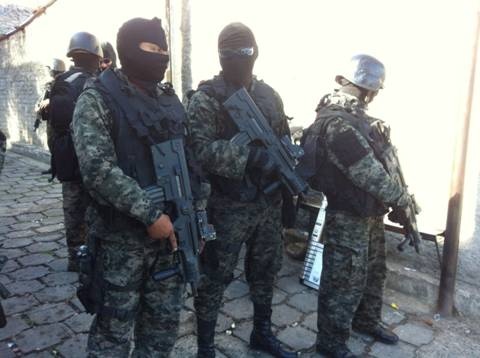
Honduran military police on patrol in Tegucigalpa, Honduras. (Photo: Karen Spring)
teleSUR | May 25, 2015
The 1980s saw widespread political violence and countless forced disappearances in many countries in Latin America, and Honduras was no exception.
Hundreds of political opponents of the 1980s U.S.-backed regime were kidnapped, tortured, and assassinated by the CIA-trained secret army unit Battalion 316, while at the same time Honduras served as a military base and training ground for U.S. counterinsurgency strategy in the region, especially in neighboring El Salvador and Nicaragua.
With the Reagan Administration turning a blind eye to the brutality of Battalion 316, intentionally downplaying or denying its violence in order to continue backing Honduras financially and using the country as a key U.S. military outpost, the details of this death squad’s operations did not become clear until years later. A historic expose published in the Baltimore Sun in 1995, which included interviews with ex-Battalion 316 torturers and details from declassified U.S. government documents, revealed the full extent of the secret unit’s atrocities and its close links to Washington.
However, torture and disappearances aren’t just a tragic reality of the past in Honduras. Human rights defenders have drawn disturbing parallels between Battalion 316 and the present day situation in Honduras, saying the current level of human rights abuses and political repression is just as bad, if not worse than the era of forced disappearances in the 1980s.
In the wake of the 2009 U.S.-backed coup ousting democratically elected President Manuel Zelaya, forced disappearance, torture, and targeted assassinations re-emerged as state terror tactics to intimidate and repress a broad-based resistance. Conspicuous and even conscious links to 1980s tactics since the 2009 coup, as well as ongoing U.S. complicity, show a continuity of state sponsored terror, with new elements for the post-coup context.
Cold War Anti-Communism, Battalion 316, and Spreading Terror with U.S. Support
As U.S. President Ronald Reagan took office in January 1980, the Sandinista revolutionary government was in power in Nicaragua and revolutionary forces were struggling for political control in El Salvador. Honduras was undergoing its so-called transition to democracy with a return to civilian rule. The U.S., already supporting the Guatemalan military’s bloody counterinsurgency efforts for over a decade, played a key role in backing the counter-revolutionary factions of the political struggles gripping the region in civil war, namely Salvadoran government forces and the Nicaraguan Contras.
While Honduras did not have a mass revolutionary guerrilla movement like its neighboring Central American countries, political opposition was criminalized to contain the threat of an armed, popular uprising. Much of this violent work was carried out through forced disappearances by the death squad Battalion 316, the special unit of the Honduran military responsible for political torture and assassinations, with the collaboration of other military branches, special forces, and police.
According to the Honduran human rights organization COFADEH, formed in the 1980s by family members of the disappeared, Battalion 316 was responsible over 180 forced disappearances between 1980 and 1988, and many more were kidnapped and tortured.
Forced disappearance refers to the practice of secretly abducting and murdering victims, making them disappear from society without a trace. Bodies of the disappeared are often carefully hidden, or rendered unrecognizable, to instil fear without the identity of the victim or the perpetrator becoming known..
Battalion 316’s terror was simultaneously covert and public, carried out by disguised agents at times in broad daylight, intended to instill fear and make an example of their victims. Suspected political dissidents were kidnapped, detained in secret jails, and tortured. Sometimes remains of victims were found in ditches. According to the Baltimore Sun expose, torture techniques included electric shock, suffocation, freezing temperatures, and psychological torture as part of interrogation, which sometimes involved CIA agents. Berta Oliva, director of the Committee of Relatives of the Disappeared in Honduras (COFADEH), has said that at least one prisoner was skinned alive in a clandestine Battalion 316 jail.
While the numbers of people disappeared in Honduras was considerably less than in many other Latin American countries during the same period, the hundreds killed and disappeared created a broader fear and terror campaign that had the intended outcome of disempowering the Honduran left.
According to Adrienne Pine, Professor of Anthropology at American University, it’s hard to overstate Battalion 316’s impact.
“The highly publicized disappearance, torture and murder of just under 200 activists, students, journalists and professors in the early 1980s created an atmosphere of terror, effectively crushing any possibility for civic or democratic engagement in Honduras,” she told teleSUR. “As such, it laid the groundwork for the implementation of U.S.-led neoliberal economic policies, of which the Honduran military itself was a primary beneficiary.”
Battalion 316, led in its most brutal years from 1982-1984 by School of the Americas and Argentine-trained head of the Honduran armed forces General Gustavo Alvarez Martinez, was a right-wing project designed to aid the Cold War fight against the alleged threat of communism in the region. Many Battalion agents were graduates of the U.S. School of the Americas (renamed in 2001 to the Western Hemisphere Institute for Security Cooperation) military training center for U.S. allies in Latin America, specializing in Cold War counterinsurgency training. The Battalion itself was trained and financed by the CIA. Meanwhile, Honduras received tens of millions of dollars in U.S. funding throughout the decade, reaching its height of US$77.4 million in 1984.
The secret military unit also received training in Chile under dictator General Augusto Pinochet, as well as from Argentine counterinsurgency forces, at the time deep in their own dirty war against leftist dissidents that claimed some 30,000 victims in Argentina by early the 1980s.
U.S. Ambassador under the Reagan Administration, John Negroponte, is documented to have met frequently with Battalion 316 leader Alvarez Martinez. However, the violence and human rights abuses perpetrated by Alvarez Martinez’s forces are conspicuously absent from the hundreds of cables of records of their correspondence. In 1983, the U.S. awarded Alvarez Martinez the Legion of Merit for “encouraging the success of democratic processes in Honduras,” exposing the true face of U.S. hypocrisy.
U.S. denial of the violent situation in Honduras enabled the ongoing use of the country as a strategic U.S. military base from which to execute counterinsurgency strategy in the region, while the supposed threat of an armed insurgency in Honduras justified the existence of Battalion 316 and its terror.
State Terror Returns: Post-Coup Fear Tactics and Forced Disappearances
After the 2009 military coup against democratically elected President Manuel Zelaya, the ousted president said in an exclusive interview with Democracy Now! that Battalion 316 was “already operating” in Honduras under a different name and using “torture to create fear.”
“There was a tremendous resurgence (after the coup) of death squad activity and assassinations of human rights defenders, trade unionists, campesinos, activists of the resistance of all sorts including journalists, lawyers,” Dana Frank, professor of History at the University of California Santa Cruz, told teleSUR. “It was very rare in the 20 years before the coup for these kinds of assassinations to happen … but it shot up dramatically after the coup.”
The post-coup links to Battalion 316 terror were palpable, both in the vast increase in human rights abuses, including torture, assassinations, and forced disappearances, as well as the direct connections of Battalion 316 personnel offering their expertise to the coup regime.
Former head of the Battalion 316, School of the Americas graduate Billy Joya, became a prominent coup regime spokesperson, advisor, and aide to de facto president Roberto Micheletti. According to COFADEH, many other retired Battalion 316 agents also became government advisors.
Pine, author of “Working Hard, Drinking Hard: On Violence and Survival in Honduras,” said that the numbers of state-sponsored disappearances, tortures, and extrajudicial killings since the coup have far exceeded those of the 1980s.
With striking similarity to the fear campaign of the 1980s, COFADEH documented in 2010, along with dozens of other death threats and assassinations, that a former Battalion 316 agent publicly threatened resistance activist Candelario Reyes with forced disappearance and death, saying that killing such a “communist dog” would make the “best example” for other resistance activists.
“You can see the continuity with some of these individuals including the references to the 80s that are conscious references,” said Frank. “It’s terror, it’s deliberately spreading terror.”
Harkening back to 1980s terror was a deliberate strategy to instil fear in perceived political threats. In 2012, COFADEH human rights defender Dina Meza received a series of threats of death and sexual violence by text message signed with the initials CAM, standing for Comando Alvarez Martinez, early 1980s head of Battalion 316 responsible for grave human rights abuses. According to Amnesty International, CAM was used as a pseudonym in numerous death threats against journalists and activists in the wake of the coup.
According to Frank, an expert on human rights and U.S. foreign policy in Honduras, the clearest and most alarming examples of post-coup strategies that follow the model of Battalion 316 are the TIGRES special units of the police force and FUSINA inter-agency task forces that bring together military, police, military police, prosecutors, and other government officials under military control.
FUSINA was initially headed by School of the Americas graduate Colonel German Alfaro, former commander of Battalion 15, the military unit in the Aguan Valley region implicated in dozens of post-coup murders of campesino activists. Trained by the FBI, DEA, and U.S. Marines, FUSINA is not only troubling for its conglomeration of agency functions under a military mandate, but also for its U.S.-enhanced intelligence capacities.
COFADEH denounced TIGRES as a “crude resurrection” of Battalion 316’s political disappearances, murder, and “criminal behaviour.”
These new constellations of state and military power, designed and deployed to create fear and contain political dissent, have again had a deep social and political impact in Honduras.
“A combination of the ‘soft power’ of USAID and NED-funded (so-called pro-democracy) programs on the one hand, and death squads within the police, the military, and now the military police have succeeded in destroying the post-coup resistance movement,” explained Pine. “This is what makes possible the neoliberal plunder of the country currently underway.”
A Different Pretext for Familiar Terror Tactics
But while there are clear continuities between the 1980s and post-coup strategies, there are also important differences.
Despite the fact that the armed left was a very small faction in Honduras, particularly in comparison to the revolutionary uprising in neighboring countries, Battalion 316’s violence was committed in the name of counterinsurgency. As Frank explains, the broad based nature of the post-coup popular resistance means that the victims of extrajudicial killings and forced disappearances have been from a more diverse cross-section of society than the 1980s campaign against suspected revolutionary leftists.
Now, with the pretext of an alleged communist armed struggle no longer relevant, post-coup repression, including use of these historical counterinsurgency tactics, and U.S.-backing of a violent regime is framed in different terms.
“The pretext now is drug trafficking,” said Frank. “The drug war has been the frame within which the United States government has legitimated support for repression by state security forces in Honduras and increased funding for them.”
And while the U.S. goal of maintaining a regional base of power amidst the threat of emerging or consolidating leftist alternatives remains much the same, the political context in the region has significantly changed.
“The larger context is the many democratically elected center and center-left governments all over Latin America that the United States is threatened by because they aren’t going to pay obeisance to United States power,” said Frank. “The United States wanted to lock down its power in Honduras so that it can maintain what has long been the most captive nation in Latin America.”
In the process, the U.S. also promotes the interests of transnational corporations that are making a killing from state-sponsored death squads that suppress resistance and pave the way for capitalist exploitation of land, labor, and indigenous and campesino resources.
“With the consolidation of neoliberal corporate capital, Honduran and U.S. politicians are more beholden to their sponsors than they were three decades ago,” explained Pine. “Hondurans today suffer not just from the terror of death squads but from the ravages of three decades of the implementation of neoliberal policy made possible by death squads, which makes them that much more vulnerable.”
COFADEH: Seeking Justice, Truth, and Respect for Human Rights
Bertha Oliva, director of COFADEH, lost her husband Tomas Nativi to forced disappearance by Battalion 316. Nativi was taken from their home by masked agents in 1981 and has never been seen again.
Over the year after Nativi’s disappearance, Oliva came to realize that she was not alone, and others had similar experiences of family members being disappeared. In 1982, 12 of these families came together to form COFADEH with the clear objective of bringing back alive family members who had been disappeared. In the majority of cases throughout the 1980s while Battalion 316 was operating, COFADEH did not succeed in their goal.
After the 1980s, COFADEH broadened its scope as an organization not only committed to seeking justice for the families of the disappeared and truth for Honduran society, but also representing and defending victims of human rights abuses, documenting cases, and providing training to raise awareness about human rights.
The creation of COFADEH was, in its own words, a “concrete action” in the face of the inactivity of the state to ensure “the right of victims to live and to have due process, among other rights that have been violated.”
COFADEH has continued to play a key role in documenting and denouncing human rights abuses and demanding justice, particularly once again in the years since the coup.
Colombians Tired of US Planes Dumping Tons of Monsanto’s Roundup on Them to Fight the Drug War
By Matt Agorist | The Free Thought Project | May 6, 2015
For over two decades now, US planes have been dumping tons of pesticides over Colombian coca fields.
Originally the Colombian government wholeheartedly supported the ridiculous notion of mass killing all vegetation in attempt to cull the drug trade. However, it is no longer a secret that the health effects of long-term exposure to glyphosate are less than desirable.
Just last month, the World Health Organization was forced to admit that glyphosate is “probably carcinogenic to humans.”
The recent acceptance by the mainstream that Monsanto’s Roundup causes a slew of negative health effects has sparked fear and infighting among the Colombian government.
According to the AFP,
Health Minister Alejandro Gaviria said last week that Colombia should “immediately suspend” spraying — a move vehemently opposed by Defense Minister Juan Carlos Pinzon, who said it would “give criminals the upper hand.”
The row erupted just as US Deputy Secretary of State Antony Blinken paid a visit to Colombia, which the United States sees as one of its closest allies in the region.
The politicians who are fear-mongering about stopping the program are likely scared of losing the hundreds of millions in funds received annually from the US to combat the cultivation of this plant.
Daniel Mejia, the head of Colombia’s Center for Research on Security and Drugs explained why they are worried about the program. “We carried out a study that showed fumigating caused dermatological and respiratory problems and provoked miscarriages,” he said.
Even if dumping massive amount of carcinogenic pesticides from airplanes was a good idea, it’s not effective. According to the United Nations Office on Drugs and Crime, this program has aided Colombia in reducing its coca fields from more than 140,000 hectares (346,000 acres) in 2001 to 48,000 hectares in 2013. However, they conveniently left out the increase seen last year.
The amount of land under coca cultivation in Colombia jumped 39 percent in 2014 to 112,000 hectares (about 27,000 acres), according to the Office of National Drug Control Policy.
Cocaine trafficking in Latin American region has caused a slew violence and turmoil, including the Colombian civil war. However, this turmoil is a direct result of prohibition spearheaded by the United States.
Colombia never had a cocaine trafficking problem until the US-funded war on drugs began its destructive path across South America.
During the 1980s, Peru, Bolivia and Colombia were responsible for 65%, 25% and 10% of the world’s coca production respectively. By 2000, however, the US “war on drugs” in neighboring Andean countries had turned Colombia into the world’s largest cocaine producer by far, representing 90% of the total, according to a report from the from the Woodrow Wilson International Center for Scholars.
The coca plant is one of the most beneficial and astonishingly resilient plants in the world. Resistant to drought and disease, coca needs no irrigation and the alkaloids it contains provide a myriad of medicinal uses. From its analgesic effects to digestive aid, coca’s positive influence in medicine is vast.
The plant has played an important role in history dating back to the Pre-Inca period.
According to a study published by Harvard University in 1975, (Nutritional Value of Coca Leaf (Duke, Aulick, Plowman 1975)) chewing 100 grams of coca is enough to satisfy the nutritional needs of an adult for 24 hours. Thanks to the calcium, proteins, vitamins A and E, and other nutrients it contains, the plant offers even better possibilities to the field of human nutrition than it does to that of medicine, where it is commonly used today.
However, the state cares not about the benefit of such a plant, only that it can be turned into a white powdery substance and snorted to stimulate long and often nonsensical conversations. Instead of cultivating the plant for its benefits, the immoral war on drugs drops carcinogens from airplanes to stop its growth.
The president of Colombia, Juan Manuel Santos, is avoiding any stance on the aerial spraying program whatsoever. According to the AFP, his staff said the final authority on the matter is the National Narcotics Council, which falls under the Justice Ministry. In the meantime, however, the spraying continues.
Following the Money: The New Anti-Semitism?

By Jim Lobe and Charles Davis | LobeLog | May 1, 2015
In the 1976 docudrama about the Watergate affair and the fall of Richard Nixon, All the President’s Men, Bob Woodward’s source at the FBI, Deep Throat, tells him to “follow the money.” To the Washington Post editorial board in 2015, doing just that is problematic—and probably anti-Semitic. Or at least that’s their charge in a piece published last Friday entitled, “Argentina’s President Resorts to Anti-Semitic Conspiracy Theories,” the Post opens by asking:
What do lobbyists at the American Israel Public Affairs Committee and the director of a Washington think tank have to do with hedge-fund manager Paul Singer and the Argentine prosecutor, Alberto Nisman, who died mysteriously in January? Well, according to Argentine President Cristina Fernandez de Kirchner, they are all part of a “global modus operandi” that “generates international political operations of any type, shape and color.”[Links added]
The Post’s problem is that Kirchner posted a “rant” on her website highlighting the fact that Paul Singer—whose hedge fund, Elliott Management, is seeking to force Argentina to repay the full amount of its defaulted debt—has contributed a whole lot of cash to the same neoconservative organizations in Washington that have been tarring the South American nation as a deadbeat ally of Iranian-backed terrorism. These same groups have also uncritically promoted the work of prosecutor Alberto Nisman, who in 2006 issued a highly controversial 900-page indictment charging seven senior Iranian officials with ordering the 1994 bombing of the Jewish community center in Buenos Aires, the Argentine Israelite Mutual Association (AMIA), that killed 85 people. Nisman died in his apartment from a bullet to the head January 18, the night before he was set to testify before the Argentine congress in support of new charges that Kirchner and her foreign minister, Hector Timerman, had conspired with Tehran to quash international arrest warrants against those same Iranians, including Supreme Leader Ayatollah Ali Khamenei and then President Ali Hashemi Rafsanjani, in exchange for a favorable trade agreement.
Making the Links
In 2013, Inter Press Service (IPS) ran a two-part feature by Charles (here and here) on the links between Singer and Nisman’s neoconservative fan club in the United States. The Argentine press and the president herself recently cited this work. The Post, however, plays dumb: “How do Singer, AIPAC and Mark Dubowitz of the Foundation for Defense of Democracies [FDD] come into this?” it asks.
Mr. Singer—or “the Vulture Lord,” as Ms. Kirchner called him—won a court battle on behalf of holders of Argentine debt last year; Ms. Kirchner chose to default rather than pay. Mr. Dubowitz’s think tank has published papers on Argentine-Iranian relations, while AIPAC has criticized the Obama administration’s preliminary nuclear deal with Iran. Confused?
Conspicuously and no doubt consciously missing from the Post’s retelling is the fourth sentence of Kirchner’s “rant”: “[Singer] contributed to the NGO Foundation for the Defense of Democracies (FDD), $3.6 million from 2008 to 2014.” By leaving this out, the Post is better able to pretend the only link between Singer and Dubowitz and Nisman is their Judaism.
Argentina, whose politics are reputedly as byzantine and Machiavellian as any country’s, does indeed have a history of anti-Semitism. Not only did it offer a refuge to fleeing Nazis after World War II, but the military junta that took power in 1976 included elements that extolled the Third Reich, as eloquently retold by perhaps the most famous survivor of the junta’s torture chambers, Jacobo Timerman (the foreign minister’s late father) in his 1981 book, Prisoner Without a Name, Cell Without a Number.
Kirchner may indeed have a political interest in claiming that an international conspiracy is defaming her government, but the evidence for such a conspiracy in this case is much stronger than the Post suggests. As noted above, millions of dollars have flowed from Singer’s pockets to the various neoconservative groups whose advocacy of confrontation with Iran has extended to attacking Argentina, in particular over its ties to the Islamic Republic.
Singer, who sits on the board of the hawkish Republican Jewish Coalition, turns out to be a generous funder of not only FDD, but AIPAC and the American Enterprise Institute (AEI), as well as a number of other right-wing groups and politicians that have stoked hostility toward Iran. In 2010, for example, his personal and family foundations contributed a combined $1 million to the American Israel Education Foundation, the fundraising wing of AIPAC and the sponsor of its congressional junkets to Israel. The $3.6 million he gave to FDD between 2008 and 2011, meanwhile, makes him the group’s second largest donor during those three years. So, it’s pretty clear that what ties AIPAC and FDD together is not only their anti-Iran efforts, but also Paul Singer’s largesse. And that’s the link Kirchner highlights but the Post leaves out.
Make no mistake: Singer and Elliott Management stand to make as much as $2 billion if they can collect full value on the debt they bought for pennies on the dollar after the country’s 2001 default. About 93 percent of Argentina’s bondholders agreed to accept a fraction of what they were originally owed (a fact the Post also conveniently omitted). But Singer—who has done this sort of thing before with other nations that have defaulted on their debt—sued in U.S. court to recover the full amount, a move the Kirchner government has fought every step of the way. The Obama administration and the International Monetary Fund, as well as most of Latin America and Washington’s closest European allies, have also sided with Argentina, viewing Singer’s actions as a threat to the international financial system.
The Iranian “Connection”
What has this got to do with Nisman, though? His allegations of Iranian direction in the 1994 bombing in Buenos Aires—and subsequent charges that the Kirchner government was trying to cover up that involvement so as to not undermine its growing economic relations with the Tehran—proved quite useful in another arena: the court of public and congressional opinion. According to IPS’s Gareth Porter, Nisman’s 2006 indictments were based virtually entirely on the testimony of a long-discredited former Iranian intelligence officer and several members of the cult-like Mujahedin-e Khalq (MEK), an Iranian opposition group that fought alongside Saddam Hussein’s forces in the Iran-Iraq war.
But the claims have undoubtedly been useful to Singer’s cause. “We do whatever we can to get our government and media’s attention focused on what a bad actor Argentina is,” Robert Raben, executive director of the American Task Force Argentina (ATFA) explained to The Huffington Post. ATFA, a group Singer helped create with other hold-out creditors in 2007, spent at least $3.8 million dollars over 5 years doing whatever it could to paint Argentina as a pariah, according to IPS. Connecting the Kirchner government to Iran has clearly furthered that purpose.
“Argentina and Iran: Shameful Allies” was the headline of one ATFA ad that ran in Washington newspapers back in June 2013 as the Obama administration was considering whether to file an amicus brief with the U.S. Supreme Court in Argentina’s favour. The ad featured adjoining photos of Kirchner and outgoing President Mahmoud Ahmadinejad connected by the question, “A Pact With the Devil?”
“What’s the TRUTH About Argentina’s Deal with Iran?” asked another very flashy full-page ad featuring unflattering photos of Kirchner and Hassan Rouhani published in the Post’s front section shortly thereafter. The ad included excerpts of letters denouncing the joint investigation from members of Congress, including Mark Kirk (R-IL) who received more than $95,000 from employees of Singer’s firm, Elliott Management, in the 2010 election. The signer of one letter urging the administration against siding with Argentina, former Rep. Michael Grimm (R-NY)—who after his re-election in 2014 pleaded guilty to federal tax evasion and resigned shortly thereafter—received $38,000 in campaign contributions from Elliott in 2012, nearly twice as much as his next largest donor.
Singer’s generosity also appears to have produced results in the think tank world, with Dubowitz’s FDD leading the way. In May 2013, as ATFA was running the Kirchner-Ahmadinejad ad, FDD release an English-language summary of a new “ground-breaking” report by Nisman detailing “Iran’s extensive terrorist network in Latin America.” (In an extended exchange with ProPublica here and here, Jim pointed out the summary’s many serious holes, leaps of logic, and other weaknesses.) The report triggered a flood of op-eds by FDD fellows and fellow-travellers at other neo-conservative organizations, as well as a series of hearings held by the House Homeland Security Subcommittee. According to FDD’s vice president, Toby Dershowitz, the report provided:
a virtual road map for how Iran’s long arm of terrorism can reach unsuspecting communities and that the AMIA attack was merely the canary in the coal mine. …The no-holds-barred, courageous report is a ‘must read’ for policy makers and law enforcement around the world and Nisman himself should be tapped for his guidance and profound understanding of Iran’s terrorism strategy.
Nisman’s death, on the eve of his testimony before the Argentine Congress about his charges against Kirchner and Timerman (since dismissed by two courts), produced another outpouring of articles by FDD fellows recalling the prosecutor’s tireless efforts to document Iran’s alleged involvement in the AMIA bombings and Kirchner’s purported courtship of Iran. Within a month, FDD announced the establishment of an “Alberto Nisman Award for Courage.” “We must pay careful attention to the detailed Iranian playbook he left behind and from it, heed important lessons in counter-terrorism and law enforcement,” Dershowitz said in the announcement. (For an interesting take on Nisman’s work, see “Why Nisman is No Hero in Argentine Bombing Case” by Argentine journalist Graciela Mochkofsky published last month in The Forward.)
Although FDD clearly lent itself with gusto to Singer’s efforts to tar Argentina and Kirchner with the Iranian brush, AIPAC has been more reserved. It has focused on the issue of Iranian terrorism in its own tireless drive to promote sanctions legislation and a policy of confrontation against the Islamic Republic. In 2010, however, the same year in which Singer and his foundation contributed $1 million to the premier pro-Israel lobby, Nisman was featured on a panel entitled, “Dangerous Liaisons: Iran’s Alliances With Rogue Regimes” at the group’s annual policy conference.
AEI Joins In
As for AEI, Singer would find it attractive not only for its pro-Israel hawkishness and long-standing hostility toward Iran and leftist governments everywhere, but also to its domestic agenda: a hands-off policy toward Wall Street. In other words, he may have had several reasons to give the group $1.1 million in 2009—its second-biggest donor that year—and another $1.2 million over the next two. Whatever his reasons, those who received those millions surely (and demonstrably) knew well enough not to upset their benefactor. And AEI fellow Roger Noriega, a former senior Bush administration official, has certainly pushed the Argentina-Iran/Nisman connection.
As Charles reported in 2013, Noriega has himself been paid at least $60,000 by Elliott Management since 2007—the same year AFTA was founded—to lobby on the issue of “Sovereign Debt Owed to a U.S. Company.” In 2011, he published an article on AEI’s website citing Nisman’s AMIA indictment and denouncing Iran’s offer to cooperate with Argentina in investigating the AMIA bombing as “shocking, in light of Tehran’s apparent complicity in that attack.” The article—“Argentina’s Secret Deal With Iran?”—cited secret documents suggesting that Tehran and Buenos Aires had recently renewed their cooperation on nuclear development as part of a deal “brokered and paid for” by Venezuela’s Hugo Chavez.
Two years later, Noriega and Jose Cardenas, a contributor to AEI’s “Venezuela-Iran Project,” co-authored a seven-page policy brief on AEI’s website entitled “Argentina’s Race to the Bottom,” which, among other things, charged that Kirchner’s government was “casting its lot with rogue governments like those in Venezuela and Iran.” Noting that two-way trade with Iran had grown from $339 million in 2002 to $18.1 billion in 2011, the article asserted:
…[T]he Kirchner government has been turning its back on its historical alliances and increasingly tilting its economic relationships toward countries of dubious international standing where rule of law is less of a concern.
And a week after FDD announced its Nisman Award for Courage, Noriega was back at it with an article headlined “Argentina’s Kirchner Reeling from Scandal.” The piece called for a “credible international investigation into Nisman’s case… to ensure that his 10-year search for the truth was not in vain and that justice is attained not only for his family but also for the victims of the 1994 AMIA bombing.” In a veiled reference to Singer’s quest, he wrote:
From ongoing battles with bondholders playing out in a New York courtroom to pressuring critical news outlets through threats and intimidation to failed attempts to jumpstart a flagging economy, the Kirchner administration cannot end soon enough for many Argentines. Candidates lining up to replace Kirchner in the October elections will likely position themselves as far away from the kirchnerista record as possible. A new administration will have ample opportunity – and likely significant public support – to chart a new economic course. That means reconciling with international financial institutions and markets, restoring trust among foreign investors, and rooting out corruption.
Perhaps Noriega is simply interested in tarring Argentina with the Iranian brush in keeping with his long-standing crusade against any Latin American government that defies Washington’s writ. But like others engaged in this campaign, he and his organization have been paid generously by a very wealthy individual with a clear financial stake in seeing that Argentina’s current government is excised from the community of respectable nations, at least until it pays what he thinks he is owed.
If the Post had “followed the money,” it perhaps would not have been so “confused” by the connections Kirchner highlighted between Singer and those who have attacked her government over its allegedly nefarious relations with Iran. Ignoring Deep Throat’s advice and acting as if that trail of money doesn’t exist allowed the paper to better roll out the powerful charge of anti-Semitism. In truth, it’s not the president of Argentina’s supposed bigotry that offends, though, but the powerful enemies she’s made (and how much they’re worth).
Facebook’s Internet.org, the Anti-Net Neutrality in Action
By Steve Straehley | AllGov | April 26, 2015
The idea sounds great—provide Internet access for the millions of people in developing areas that don’t have it. But in the process of putting that knowledge at the fingertips of that under-served community, Facebook founder Mark Zuckerberg’s Internet.org has drawn a bright line between the haves and have-nots.
Zuckerberg’s plan, developed with manufacturers such as Nokia, Ericsson, Qualcomm and Samsung, allows free access via mobile phones in developing areas only to certain parts of the Internet. Surprise—Facebook is one of the applications able to be reached by way of the Internet.org app. Wikipedia is also available as are weather and a few other sites. But if you want to go to a site not on the app, you must either pay a fee or you’re out of luck.
Latin American leaders, such as Colombian President Juan Manuel Santos, have applauded the Internet.org strategy, according to the Electronic Frontier Foundation (EFF). But others, including Carolina Botero, executive director of the Karisma Foundation in Bogotá, have reservations. Karisma supports the positive use of technology as it pertains to human rights. Botero said: “We have serious concerns that Internet.org is presented as a public policy strategy for universal access to the Internet. This initiative compromises everyone’s rights and blurs the government’s obligation to reduce the digital divide for its citizens for compromised access to certain applications. No matter how interesting they are, these services are associated with a commercial interest of a multinational which the state is directly supporting.”
Zuckerberg claims that because Internet.org doesn’t specifically block sites or charge sites more to run faster, the app conforms with net neutrality principles. But more businesses are starting to see it the other way and are opting out of the program, among them a group of Indian publishers.
“We support net neutrality because it creates a fair, level playing field for all companies—big and small—to produce the best service and offer it to consumers,” The Times Group, one of the publishers that withdrew from Internet.org, said in a statement. Other Indian companies to opt out of Internet.org are travel website Cleartrip and information site Newshunt. “What started off with providing a simple search service has us now concerned with influencing customer decision-making by forcing options on them, something that is against our core DNA,” Cleartrip said in a statement, according to The Wall Street Journal.
“The problem runs deeper than simply which sites to which poor users should have subsidized access,” wrote EFF’s David Boagado and Katitza Rodriguez. “It lies in the very concept that Facebook and its corporate partners, or governments, should be able to privilege one service or site above another. Despite the good intentions of Facebook and the handful of allied companies, Internet.org effectively leaves its users without a real Internet in the [Latin American] region.”
The result is “having access to only a sliver of what is supposed to be the worldwide web,” wrote Issie Lapowsky at Wired. “As we’ve said before, this creates ‘an Internet for poor people.’”
Zuckerberg’s response, basically, is that half a loaf is better than none. “Arguments about net neutrality shouldn’t be used to prevent the most disadvantaged people in society from gaining access or to deprive people of opportunity,” he wrote April 17 in a Facebook post. “Eliminating programs that bring more people online won’t increase social inclusion or close the digital divide. It will only deprive all of us of the ideas and contributions of the two thirds of the world who are not connected.”
To Learn More:
Does Internet.org Leave Latin Americans Without A Real Internet? (by David Bogado and Katitza Rodriguez, Electronic Frontier Foundation)
Mark Zuckerberg Can’t Have It Both Ways on Net Neutrality (by Issie Lapowsky, Wired )
Indian Companies Pull Out of Internet.org amid Battle over Net Neutrality (by Aditi Malhotra, Wall Street Journal )
Supreme Court Upholds Cyber Freedom in India (by Karan Singh, AllGov India )
Featured Video
Ian Proud: Economic Reset with Russia to Save Europe
or go to
Aletho News Archives – Video-Images
From the Archives
Magic Hour for Gates

By Gary Jordan | Wake The F*** UP | March 15, 2021
Bill Gates wants to know everything about you.
He wants to control every aspect of your life.
His insatiable thirst for the supervision and scrutiny of every human being alive has sparked a US$1 billion investment that will blanket the earth in video surveillance satellites, providing real-time feedback with a mere one-second delay. He advocates for Orwellian digital tools to track your every move and has bankrolled US$1.7 billion to provide artificial intelligence that will be used to scan each and every visitor to major event venues worldwide. He wants to do away with end-to-end encryption, so he can snoop on your private conversations. He wants to know when and where you travel and who you travel with. He wants you to eat whatever he says you should eat, drink whatever he says you should drink, think how he wants you to think and know only what he wants you to know. Plus he wants to dictate what goes inside your body.
But he doesn’t want you to know a lot about him.
For instance… continue
Blog Roll
Recent Comments
poisonedwater on The “NO LIABILITY”… poisonedwater on Nuland leaves sense of forebod… rediscover911com on FOR WESTERN MEDIA, ISRAEL’S BO… michael on Nuland leaves sense of forebod… Bill Francis on Fluoride Expert Squares Off Ag… Rose Marie Mondor on Nuland leaves sense of forebod… papasha408 on ADL defines genocide and civil… Amber Smith on Nearly two million at risk as… rediscover911com on ADL defines genocide and civil… Thomas Lee Simpson on Israeli soldier: We bombed civ… Victor G. on Israel Keeps Killing Civilians… Victor G. on US congressman says there are…


 Aletho News
- Macron, Merz, and von der Leyen Defend Expanded Speech Controls
- Keir Starmer-tied think tank paid PR firm to target The Grayzone
- ‘Israel’ threatens to genocide Gaza if Hamas refuses disarmament
- Apple Just Bought A Sinister ‘Pre-Speech’ Tech Company Implicated In Genocide
- Israel’s new West Bank registration process declares Palestinian land ‘state property’
- Two children killed in Palestinian Authority ambush in West Bank; Hamas slams attack as ‘black mark’
- Israel Needs Time Before Another Iran War—Here’s Why
- US seizes oil tanker for ‘defying Trump’s quarantine’
- Ian Proud: Economic Reset with Russia to Save Europe
- Senator Rand Paul Introduces Federal Bill to END Vaccine Makers’ Liability Shield
- If Americans Knew
- In Gaza, “rats run over our faces” – Not a ceasefire Day 129
- Israel-backed border guards, GHF-linked aid – Not a ceasefire Day 128
- Israel battles Palestinian right of return, one Palestinian at a time – Not a ceasefire Day 127
- Noor’s short life of unimaginable suffering
- Israel Destroyed Gaza’s Hospitals. Now It’s Banning Doctors Without Borders.
- Is Spite of What Zionists Say, It’s a Good Thing to Criticize Governments
- Palestinian mother, daughter recount strip searches, harsh conditions in Israeli detention
- Israel used weapons in Gaza that made thousands of Palestinians evaporate
- ADL’s Stats Twist Israel’s Critics Into Antisemites
- Why Is the World Silent When the Gaza Genocide Is Not Over?
- No Tricks Zone
- New Study: A 4°C Warmer Beaufort Sea Had ‘No Sea Ice’ 11,700 – 8200 Years Ago
- Unfudging The Data: Dutch Meteorological Institute Reinstates Early 20th Centruy Heat Waves It Had Erased Earlier
- German Gas Crisis…Chancellor Merz Allegedly Bans Gas Debate Ahead of Elections!
- Pollen Reconstructions Show The Last Glacial’s Warming Events Were Global, 10x Greater Than Modern
- Germany’s Natural Gas Storage Level Dwindles To Just 28%… Increasingly Critical
- New Study Rebuts The Assumption That Anthropogenic CO2 Molecules Have ‘Special’ Properties
- Climate Scientist Who Predicted End Of “Heavy Frost And Snow” Now Refuses Media Inquiries
- Polar Bear Numbers Rising And Health Improving In Areas With The Most Rapid Sea Ice Decline
- One Reason Only For Germany’s Heating Gas Crisis: Its Hardcore-Dumbass Energy Policy
- 130 Years Later: The CO2 Greenhouse Effect Is Still Only An Imaginary-World Thought Experiment
 Aletho News