Colombian President Santos Announces New Military Leadership
teleSUR | July 7, 2015
Colombian President Juan Manuel Santos announced changes to military leadership Monday, with newly appointed heads of the country’s army, navy, and air force.
Santos said changes in command are “normal” and “necessary” procedures within the country’s armed forces.
Santos named General Alberto Mejia as army commander, Admiral Leonardo Santamaria as navy commander, and General Carlos Buenos as air force commander. The government also ratified Juan Pablo Rodriguez as general commander of the military and Rodolfo Palomino as head of the national police.
Santos thanked outgoing commanders Jaime Lasprilla, Hernando Wills, and Guillermo Leon for their service with the army, navy, and air force as he announced the changes.
The military leadership shakeup comes just days after the Colombian government signaled openness to exploring the possibility of a bilateral ceasefire in ongoing peace negotiations with the Revolutionary Armed Forces of Colombia (FARC), marking a shift from the government’s previous position.
Recently, the armed conflict between government forces and the FARC has escalated as the government stalled on accepting a ceasefire. The FARC suspended its unilateral ceasefire after the government massacre in the Cauca region killed 27 rebels.
The new leadership also comes just two weeks after Luis Carlos Villegas took over as the Colombia’s new minister of defense.
Palm Oil Industry Tied to Ecocide in Guatemalan River

By Jeff Abbott | Upside Down World | July 6, 2015
The Pasión River in northern Guatemala is a disaster area. Beginning on June 6, residents along the river in the municipality of Sayaxché, Peten, began to find millions of fish, their primary source of food and income, floating dead in the river. Community members quickly accused the Palm firm, Reforestadora de Palma del Peten, S.A (REPSA) of contaminating the river. Communities have called the pollution of their river an “ecocide.”
“Unfortunately, there has been a massive pollution of our river,” said Rigoberto Lima, a community representative from Sayaxché. “We need to put an end to the problem of palm in northern Guatemala.”
The Public Ministry of Guatemala initially declared a red alert on June 11; days after the fish first began to appear floating in the river. The Public Ministry initially confirmed that the disaster was caused by run off of the pesticide Malathion into the river, but in the weeks after, they would take back the accusations against the palm company.
However, these accusations were supported by a toxicological study preformed by University of San Carlos, which found elevated levels of the pesticide, and other agro-chemicals in the river. The report determined that the local palm industry was responsible for the contamination.
The contamination affects 106 kilometers of river, and 65 communities. These poor communities have all been forced to rely more and more on the river for their sustenance because of the expansion of palm in the region.
Communities have called on the government to perform an investigation into the pollution of the river.
Late in the evening of June 23, nearly 45 members of communities along the Pasión River arrived to Guatemala City to denounce the pollution of their river. Following a late afternoon press conference, the community members began a sit-in outside the offices of the Presidential Commission Against Discrimination and Racism in Guatemala City to condemn and repudiate the contamination of their river by the palm company. They also demanded that the company be temporarily shut down for threatening life, and that they be allowed to be involved in the investigation of what occurred in Pasión River in order to ensure transparency.
The following day, members of the Public Ministry visited the encampment. Community members expressed frustration at being treated with disrespect and contempt by the state and the firm.
Denial of Responsibility
On June 17, the company, the mayor of Sayaxché, and community members gathered in Guatemala City to sign a document stating that the company “was not responsible for the death of the fish,” and that there “was no ecocide.” In exchange for the signing of the document, the company agreed to provide the communities with water, the improvement of town streets, and the construction of wells.
The document also states that the company is committed to taking better care of the river, but they stress, “They are not the cause of the killing of fish.”
REPSA is a subsidiary of the powerful Grupo Olmeca, Guatemala’s largest palm oil producer, which is owned by the powerful Molina family. The conglomerate was the first to begin the production of African palm in the late 1980s, and today cultivates nearly 46,000 hectares of land in Escuintla, Ocós in San Marcos, and Coatepeque in Quetzaltenango, and Sayaxché.
Those affected by the pollution do not agree with this declaration.
Continuous Pollution
This isn’t the first time that communities in Guatemala have accused the palm industry of polluting their rivers.
Communities in the Municipality Chisec, Alta Verapaz filled a complaint in the Guatemalan Public Ministry against the Ixcan Palm Company in 2013, for the contamination of their river. The following year, communities in Peten also filed a complaint in the Public Ministry against the pollution of their river. In both cases, the Pubic Ministry failed to investigate the contamination.
“This is not the first time that the fish have died in our rivers,” said Margarita, a representative from the Organization of Women of Alta Verpaz. “In 2013, there was massive death of fish in the rivers of northern Chisec. We have made denouncements against the palm firms in the region.”
The Public Ministry and Environmental ministry have called previous contaminations “accidents,” which have not resulted in new regulations.
The failure of the government ministries to respond to the concerns of the communities has increased frustrations with the expansion of palm across the FRANJA of Guatemala, which stretches from Huehuetenango in the west to Izabal in the east. These frustrations have led communities to demand that the government begin to regulate the industry, and end the expansion.
“The palm companies cannot keep expanding,” said Margarita. “They cannot continue to keep sowing, buying, and accumulating more land. We have demanded that the government put in place a law that caps the amount of land used for palm, and allows for us poor farmers to have access to land.”
Expansion of Palm Across Guatemala
The first palm plants were brought to Guatemala in the late 1980s and have since spread like a virus across Guatemala and Central America. The expansion was strengthened especially in the years after the signing of the Central American Free Trade Agreement, which guaranteed multinational companies with security in their investments into sectors such as palm oil.
The fruit of the palm is a high-yielding oil plant, which has gained a significant importance in the processed food industry. Palm oil production has spread because of the increased demand in the United States and Europe as vegetable oil used in a wide range of products including soaps and waxes, as well as popular food products such as Nutella, and Ben & Jerry’s Chubby Hubby Ice Cream. Increasingly the production has been promoted as a renewable biofuel, which has further brought people into the industry.
The bunches of palm oil berries, commonly called Racimos, contain roughly 2,300 berries, and are harvested by hand. From there they are loaded onto a truck, and taken to the processing plant.
The expansion has exasperated the crisis over land that has historically plagued the region; in Guatemala, 3 percent of the population owns nearly 85 percent of arable land.
According to statistics from the Guatemalan National Bank, production of palm oil has spread by nearly 270 percent since 2006. This expansion has been partially influenced by a campaign by the Guatemalan Ministry of the Economy to attract foreign direct investment. In 2011, the ‘Invest in Guatemala” campaign was launched, in which the ministry claims that “88 percent of fertile land is vacant.”
But as production of palm has expanded, small farmers have been pushed further and further to the margins.
“We need the fish,” said Juan Choy. “We are living without land. People are migrating to Mexico and the United States, and families are disintegrating. Where are we supposed to produce? There is no land. The cost of meat has skyrocketed, and our maize is coming from Mexico.”
Jeff Abbott is an independent journalist currently based out of Guatemala. He has covered human rights, social moments, and issues related to education, immigration, and land in the United States, Mexico, and Guatemala. Follow him on twitter @palabrasdeabajo
Honduras Bleeding
The Coup and Its Aftermath
By ERIC DRAITSER and RAMIRO S. FUNEZ | CounterPunch | June 29, 2015
June 28 marked the six year anniversary of the military coup in Honduras – the day that a democratically elected left wing government was ousted by a US-backed, US-trained cabal of generals and right wing politicians and landowners. It could correctly be called a “Quiet Coup” primarily because it took place with very little fanfare from the corporate media which, to the extent that it covered it at all, did so mostly from a distorted perspective which spread more misinformation than truth. Today, six years (and many innocent lives, and billions of dollars) later, this shameful moment in recent history still remains largely forgotten.
Perhaps it was the lingering euphoria felt by liberals and so-called progressives in the months after Obama’s election and inauguration. Perhaps it was the still new economic crisis and subsequent bailout and financial turmoil. Perhaps it was plain old imperialistic, neocolonial disregard for Latin America and the rights of the people unfortunate enough to be living in “America’s backyard.” Whatever the reason, the fact remains that the Obama administration and those who supported it, then and now, are complicit in an ongoing political, economic, and social tragedy in Honduras.
But why bring it up now, other than to mark the anniversary of the coup? For starters, because one of the primary participants and benefactors happens to be the likely Democratic Party presidential candidate: Hillary Clinton. Also, far from being a discrete episode of US imperialism’s sordid past, the coup and its legacy remain a driving force in Honduran politics and society today. The beneficiaries and participants are all still either in government or have shifted to the private sector, and continue to enrich themselves at the cost of the poor and working people of the country [though alleged coup orchestrator Miguel Fucase just died]. The coup government of Honduras continues to wage a brutal campaign of ethnic cleansing against minority communities to benefit itself and its patrons from the US and elsewhere.
Perhaps most importantly, the coup of 2009 reveals the extent to which the United States remains a neocolonial, imperial power in Latin America, and reminds us of just what countries like Venezuela, Bolivia, and Ecuador have been struggling against. It illustrates in the starkest terms the human cost of Washington’s policies, not in books about a historical period, but in images and videos of a country under its thumb today. It reminds us just how real the struggle still is.
The Coup and the US Role
The 2006 election of José Manuel Zelaya, known as “Mel” to his friends and supporters, was a watershed moment in the history of Honduras. A country that, like its neighbors, suffered under a succession of US-backed right wing governments, had finally elected a man whose politics were of the people, rather than of the military and business interests. Despite coming from a wealthy family, and having been elected under the Partido Liberal (Liberal Party) banner, Zelaya’s politics shifted significantly to the left once he assumed office.
Not only did Zelaya commit the great sin of forging ties with the late Venezuelan President Hugo Chavez and his ALBA (Bolivarian Alliance for the Peoples of Our America) and PetroCaribe blocs, but Zelaya challenged the political status quo in the country, promising to represent the poor and working class in a country traditionally dominated by wealthy landowners and the military. As journalist, author, and former adviser to the Permanent Mission of Honduras at the United Nations, Roberto Quesada, told Counterpunch in an exclusive interview:
When Zelaya came into power, even though he was in a traditional party, he changed the traditional politics of the Liberal Party and made it into a people’s party. He turned the presidential palace into a house for the people…For the first time those without voices were given a voice…He wanted to introduce the Cuarta Urna [Fourth Ballot Box Referendum]. For the first time the Honduran people could decide what they wanted and change the constitution [because]…the constitution of 1982 was in favor of the right wing and was not in the interests of Hondurans.
And so it seemed in 2009 that Honduras, like Venezuela, Bolivia, Ecuador, and Nicaragua before it, would legally and democratically break free of the political and corporate hegemony of the US. Clearly this was something that Washington, even with the newly elected president of “Hope” and “Change” in the White House, could not abide. Enter: then newly appointed Secretary of State Hillary Clinton.
Clinton has since admitted openly, and quite brazenly, her central role in legitimizing, supporting, and providing political cover for the illegal, and internationally condemned, coup against Zelaya. As Counterpunch contributor Mark Weisbrot has noted, Clinton stated clearly in her book Hard Choices that, “In the subsequent days [after the coup] I spoke with my counterparts around the hemisphere, including Secretary [Patricia] Espinosa in Mexico… We strategized on a plan to restore order in Honduras and ensure that free and fair elections could be held quickly and legitimately, which would render the question of Zelaya moot.”
What exactly was the plan? Aside from providing diplomatic cover by not openly calling it a military coup, Clinton employed her longtime associates Lanny Davis and Bennett Ratcliff who whispered sweet nothings in the ears of the right people in Washington and on Wall Street, including in a laughable op-ed in the Wall Street journal, thereby paving the way for new “elections” in Honduras, in order to, as Clinton put it, “render the question of Zelaya moot.” Lanny Davis, as has been noted by a number of journalists, is a direct representative of powerful business elites in Honduras.
Davis himself explained this fact in an interview just weeks after the coup when he stated, “My clients represent the CEAL, the [Honduras Chapter of] Business Council of Latin America… I do not represent the government and do not talk to [interim] President [Roberto] Micheletti. My main contacts are [billionaires] Camilo Atala and Jorge Canahuati. I’m proud to represent businessmen who are committed to the rule of law.” Indeed, Davis quite candidly exposed himself as an agent of powerful oligarch financiers and landowners who, until the election of Zelaya, had always maintained firm control of the reins of government in Honduras.
Essentially then, Clinton and her henchmen played the key role in facilitating an illegal coup against a democratically elected government in the interests of their billionaire friends inside Honduras, and the geopolitical agenda of the United States in the region. Though she is busy employing populist rhetoric in her presidential bid these days, Clinton has done yeoman’s work for the right wing, anti-democratic forces of Latin America, and the Empire broadly speaking. Of course, none of this should come as any surprise to people who have followed Clinton, and US imperialism in Latin America for that matter.
Equally unsurprising is the US role in the training and backing of the Honduran generals who carried out the coup on that early morning in late June 2009. As School of the Americas Watch (SOAW) noted at the time:
The June 28 coup in Honduras was carried out by the School of the Americas (SOA) graduates Gen. Romeo Vásquez Velásquez, the head of the of the Joint Chiefs of Staff of the Honduran military and by Gen. Luis Prince Suazo, the head of the Air Force… SOA-trained Honduran Army Attorney Col. Herberth Inestroza justified the military coup and stated in an interview with The Miami Herald ‘It would be difficult for us, with our training, to have a relationship with a leftist government. That’s impossible.’ Inestroza also confirmed that the decision for the coup was made by the military… According to information that SOA Watch obtained from the US government through a Freedom of Information Act request, Vasquez studied in the SOA at least twice: once in 1976 and again in 1984…The head of the Air Force, General Luis Javier Prince Suazo, studied in the School of the Americas in 1996.
The School of the Americas (since renamed Western Hemisphere Institute for Security Cooperation, aka WHINSEC) is a US military institute located at Fort Benning, Georgia infamous for graduating a literal who’s who of Central and South American military dictators, death squad leaders, and other assorted fascists who left their bloody marks on their respective countries. It’s been called the “School of Dictators” and a “coup factory,” and it seems that Honduras in 2009 was merely the latest victim of its illustrious alumni. Indeed, this was not the first time for Honduras, as both General Juan Melgar Castro (military dictator, 1975-1978) and Policarpo Paz Garcia (death squad leader and then military dictator, 1978-1982) were graduates of the School of the Americas. Needless to say, the legacy of the United States in Honduras is a bloody and shameful one.
Honduras: A US Military Foothold in Central America
One should not be fooled into believing that since 2009 and the US-backed coup and subsequent regime change, somehow the US has not been involved militarily inside Honduras. Indeed, just weeks ago the US military announced that it would be sending a contingent of US Marines to Honduras, ostensibly to “provide assistance during hurricane season.” However, the reality is that the US is merely continuing, and indeed expanding, its ongoing military partnership and de facto occupation of Honduras and a number of other key Central American countries.
In an exclusive interview with Counterpunch, the US Coordinator of the National Popular Resistance Front (FNRP) and Refoundation Party (LIBRE), Lucy Pagoada succinctly explained, “The coup forced us to wake up to the reality of Honduras. I lived in Honduras until I was 15 years old. I’ve never seen my country so militarized as the way it has become after 2009. It has turned into a large military base trained and funded by the US. They even have School of the Americas forces there… There have been high levels of violence and torture since the coup against the resistance and the opposition.” According to Pagoada and other activists both in Honduras and in the US, the country has essentially become an annex of the US military, acting as a staging area for a variety of Washington’s military operations in the region.
This conclusion is confirmed by a report from the North American Congress on Latin America (NACLA) which noted:
The steady increase of U.S. assistance to [Honduran] armed forces [is] an indicator of tacit U.S. support. But the U.S. role in militarization of national police forces has been direct as well. In 2011 and 2012, the Drug Enforcement Administration’s Foreign-deployed Advisory Support Team (FAST)… set up camp in Honduras to train a local counternarcotics police unit and help plan and execute drug interdiction operations… Supported by U.S. helicopters mounted with high caliber machine guns, these operations were nearly indistinguishable from military missions, and locals routinely referred to the DEA and Honduran police agents as “soldados” (soldiers). According to the New York Times, five “commando style squads” of FAST teams have been deployed across Central America to train and support local counternarcotics units…In July 2013, the Honduran government created a new “elite” police unit called the Intelligence Troop and Special Security Group, or TIGRES (Spanish for “tigers”). The unit, which human rights groups contend is military in nature, has been deployed in tandem with the new military police force and has received training in military combat tactics from both U.S. and Colombian Special Forces units.
For those with even a cursory understanding of how US support for the contra death squads of Central America in the 1970s and 1980s actually worked, the description above should bear a chilling resemblance. Essentially, US military and covert assets provide the arms, training, and coordination for a patchwork of well-organized units whose function is to terrorize communities whose real crime, far from involvement in drug trafficking, is either opposition to the government or having the misfortune of living on valuable real estate prized by the same business interests that Mrs. Clinton and her cronies represent.
Of course, the US military presence has a regional dimension as Washington attempts to use its assets to reassert and/or maintain control over the entire region which it has seen steadily slipping from its grasp since the election of Hugo Chavez more than 15 years ago, and the subsequent rise of Evo Morales in Bolivia, Rafael Correa in Ecuador, and Daniel Ortega in Nicaragua. But, from the strictly Honduran perspective, this military cooperation is intended to provide the Honduran military, now doubling as internal police and security forces, with the necessary support to carry out ethnic cleansing operations and killing of political opponents in order to make the country safe for business.
Cleansing Honduras for the Sake of Profit
The military operations in Honduras are aimed primarily at enriching the oligarchs running the country since the ouster of Zelaya in 2009. The goal is to ethnically cleanse prime real estate, either through eviction or brute force, in order to free it up for privatization. One of the means by which this is taking place is through the so called “Ciudades Modelos” (Model Cities) program which promotes tax-free business havens for newly privatized land seized from indigenous communities.
One of the communities most deeply affected is the Garifuna, an Afro-indigenous nation whose land stretches hundreds of miles of prime real estate on the Honduran Carribbean coast which the corrupt government of President Hernandez, and his financial backers in Tegucigalpa (the Honduran capital) and the US, envisions as a money-making tourist zone. TeleSur noted in 2014 that the Barra Vieja Garifuna community was under eviction threat by the Honduran government which prized their land for the “further development of the Bahia de Tela tourist project and the building of the five star Indura Beach and Golf Resort. In a business alliance, the Honduran government holds 49 percent of the shareholds for the project while 51 percent is in the hands of private business.” New York City alone is home to roughly 250,000 Garifuna people from Honduras, Nicaragua, Guatemala, and Belize; they have to watch as their families and friends back in Honduras continue to face persecution at the hands of a right wing government serving business interests from the US and elsewhere.
But of course, the Garifuna are not alone, as many other indigenous communities in Honduras face unspeakable repression at the hands of the militarized Honduran government and its 21st Century version of death squads. As Lucy Pagoada recounted in her interview with Counterpunch, “Margarita Murillo, an indigenous woman, dedicated her life to the defense of the land and the workers. She was killed with seven bullets by her home in the department of Yoro… She was a leader of the resistance.”
Indeed, the brutal assassination of Murillo in August 2014 was yet another chilling reminder of the war waged by the Honduran government on peasants and indigenous people in the country who refuse to be displaced in the interests of the business elites. Murillo, who had just recently been named President of the Asociativa Campesinos de Producción Las Ventanas (Window Production Peasants Association), had been an advocate for her fellow indigenous peoples and the poor, and had been involved in mediating a land dispute between a number of local families and a group of wealthy landowners in the area. She was shot execution-style by a group of three men in ski masks.
Murillo’s assassination was far more than simply a murder motivated by a local land-grab. Rather, it was a clear warning to the resistance movement in Honduras that any organized effort to fight back against the government and the wealthy landowners backing it would be met with brute force. This is the sort of message that the people of Honduras, especially those who lived through the 1970s and 1980s, understand all too well. In fact, such violence, and the despair that it produces, has driven many Hondurans, especially from the Garifuna community, to flee to the US in search of a better life.
Maria Vives is an administrative assistant with the Give Them to Eat ministries of the Bronx Spanish Evangelical Church. Speaking with Counterpunch she recalled:
We have a soup kitchen and food pantry. We help people on an emergency basis… Three Garifuna women showed up last summer and expressed needs—they were frustrated. They have [sic] been caught crossing the border and ankle bracelets have [sic] been put on them. They were shackled… Word spread that we were helping people in need and soon we had a total of almost 50 or 60 women who show up with their children… They have several reasons for leaving Honduras. For the violence, they were killing off a lot of people in the neighborhood because they wanted to take over their lands. Some were scared their children would join gangs. As soon as the children reach a certain age they were recruited to join the gang. I know one mother in particular who brought over her three children because one of them was being recruited into the gang.
Although the corporate media constantly referred to the “child immigration crisis” during its brief coverage in 2014, the reality was that it was a refugee crisis, and that those children, at times accompanied and at times unaccompanied, were fleeing precisely the sort of repression described above. Whether Garifuna or members of other indigenous or peasant communities, those children and families sought refuge in the US, refuge from the horrors perpetrated against them in Honduras; of course, all with the tacit approval and covert participation of the US Government.
As we mark the sixth anniversary of the 2009 coup against the legal government of Honduras, we must be sure to not simply recognize the event as yet another despicable example of US imperialism and its support for repressive governments in Latin America. We must instead recognize that that singular event set into motion a series of events which have led to the political and social crisis ongoing in Honduras today. As Roberto Quesada told us, “We can’t talk about the coup as if it is in the past. It continues to leave the country in a state of chaos.”
Eric Draitser is the founder of StopImperialism.org and host of CounterPunch Radio. He is an independent geopolitical analyst based in New York City. You can reach him at ericdraitser@gmail.com.
Ramiro S. Fúnez is a Honduran-American political activist and independent journalist based in new York City. You can reach him at ramirofunez@gmail.com.
Argentine court orders seizure of Falklands/Malvinas ‘illegal’ oil drillers’ assets
RT | June 28, 2015
Argentina has ordered the seizure of assets belonging to foreign drilling companies operating in the vicinity of Falklands / Malvinas Islands, saying they have failed to obtain the necessary permissions from Buenos Aires to conduct exploration.
A federal judge in Tierra del Fuego, Lilian Herraez, has ordered authorities to seize the assets of five companies drilling for oil in the Falklands worth $156 mn. The measure was ordered following a request of a prosecutor from the Office of Economic Crime and Money Laundering (PROCELAC).
According to the prosecution, the order to seize assets was issued for “illegal activities of exploration, search and eventual extraction of hydrocarbons in proximity to the Falkland Islands” because the companies in question failed to obtain permits issued by “the competent authority in Argentina.”
According to a legal brief, the order involves halting the activities of the semi-submersible “Eirik Raude” rig and the floating dock“Noble Frontier”. Herraez also ordered the seizure of all vessels.
The five companies mentioned are: Premier Oil Plc, Rockhopper Exploration Plc, Falkland Oil and Gas Ltd, Noble Energy Inc and Edison International Spa. Three of them are UK based, one is American and the fifth is French-owned, based in Italy.
It remains unclear how these companies’ assets are supposed to be appropriated from territory officially under the jurisdiction and sovereignty of the United Kingdom. The companies in question do not generally hold any assets in Argentina or use Argentine waters, a source told Reuters.
However, the Argentine prosecutor’s office said it “had identified the assets of the foreign companies and discovered that one of them, the US firm Noble Energy, has a local office registered in Argentina.” Authorities will move to freeze those assets, it said.
“The foreign ministry will be notified of the court order so that by diplomatic means and in compliance with international treaties it can be carried out,” the prosecutor’s office said in a statement.
In April, a group of British exploration companies found oil and gas in an area north of the Falkland Islands. The oil was discovered by the Eirik Raude floating drilling rig as part of an eight month exploration campaign. Argentina has predictably not been happy about the exploration activity, which is bound to further inflame tensions over the island’s disputed ownership.
In Argentina, the Falkland Islands are known as the ‘Islas Malvinas.’ The dispute between the UK and Argentina over the sovereignty of the islands has reemerged in recent years under President Cristina Fernandez de Kirchner.
Iran gives Venezuela $500 million credit line
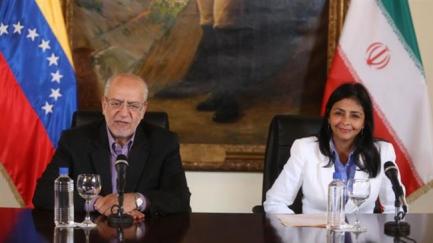
Iran’s Minister of Industry Mohammad Reza Nematzadeh and Minister for Foreign Affairs of Venezuela Delcy Rodriguez talk to reporters in Caracas
Press TV – June 27, 2015
Iran has agreed to a $500 million credit line for Venezuela to finance joint investments there, President Nicolas Maduro has announced.
He made the announcement after meeting Iranian Minister of Industry, Mine and Trade Mohammad Reza Nematzadeh in Caracas where the two sides signed six agreements to expand financial, economic, industrial and technological cooperation.
Among the agreements, there are plans for joint production of commodity goods, including detergents and other hygiene materials in Venezuela and Iran’s sales of medical drugs and surgical equipment to the country.
Maduro said the two countries had also agreed to a “comprehensive plan” to develop a joint program in nanotechnology in which Iran is among the top seven countries.
He said the deals would ensure a higher level of cooperation and deepen the bonds between the two nations.
Moreover, Iran agreed to transfer its expertise to Venezuela in combating an “economic war” on the Latin American country, Maduro said, apparently referring to Iran’s experience in facing years of US-led sanctions.
“We are facing an economic war of monumental proportions; a brutal war (but) we are here attending to our people,” Maduro said as he invoked the vision of the late President Hugo Chavez for “the government’s union with the people and struggle against imperialism”.
The Venezuelan head of state also hailed relations with Iran as “an example of alliance between two brother nations”.
“Today we have mutual trust in our relations and we work together with results. Working with Iran has gone well and our cooperation has been a great success since Hugo Chavez began a strategic alliance and brotherhood with Iran,” Maduro said.
Relations between Iran and Venezuela — both critics of US policies — have expanded in recent years. Iran is involved in a series of joint ventures worth several billion dollars in energy, agriculture, housing, and infrastructure sectors in Venezuela.
Iran’s main industrial projects in Venezuela include a car assembly plant, a tractor manufacturing complex and a cement factory.
The Islamic Republic has also built more than 3,000 residential housing units for less privileged citizens in Venezuela, with 7,000 more to be completed.
Both countries are hugely rich in resources. Venezuela possesses the world’s biggest oil deposit while Iran owns the fourth largest oil and first largest gas reserves of the world.
Maduro has announced his intention to visit Tehran to attend a summit of Gas Exporting Countries Forum planned for Nov. 23.
Latin American Revolutions Under Attack
By ANDRE VLTCHEK | CounterPunch | June 26, 2015
Do not take the Latin American revolutions for granted.
They inspired the entire Planet. They brought hope to every corner of our scarred Earth. But now they are themselves in need of our support.
If left alone, they would thrive for decades and centuries. But the Empire is once again on the offensive. It is shaking with fury. It is ready to invade, to smash, burn to ashes all the hopes, all that which had been achieved.
Don’t believe in the “common wisdom” which proclaims that the rulers of the world simply “closed their eyes” more than a decade ago; that George W. Bush was “too busy” ravishing the Middle East, therefore “allowing” most of the Latin American countries to “sneak away” from the iron grip of the Empire.
Such “analyses” are as patronizing as they are false. The Empire never sleeps! What Latin America now has was built on its daring, its sweat, its genius and its blood – it fought against the Empire, courageously, for decades, losing its best sons and daughters. It fought for freedom, for justice and socialism.
The Empire was not “looking the other way”. It was looking straight south, in fury, but for some time it was too confused, too astounded, too shocked at what it was witnessing. Its “slaves” had risen and taken power back into their own hands. They showed to the entire world what freedom really is.
For some time, the Empire was paralyzed by rage and unable to act.
The Empire’s undeniable property, Latin America, inhabited by “un-people” born only in order to supply cheap labor and raw materials to the rich part of the world, was suddenly, proudly and publicly, breaking its shackles, declaring itself free, demanding respect. Its natural resources were now used to feed its own people, to build social housing, create public transportation systems, construct hospitals, schools and public parks.
But after the first wave of panic, the Empire began to do what it does the best – it began the killings.
It attempted to overthrow Venezuelan government in 2002, but it failed. The Venezuelan people rose, and so did the Venezuelan military, defending then President Hugo Chavez. The Empire tried again and again, and it is trying until now. Trying and failing!
“We are at war”, I was told by one of the editors of Caracas-based television network, TeleSUR, for which I made several documentary films. “We are literally working under the barrel of cannon”.
***
Ms. Tamara Pearson, an Australian revolutionary journalist and activist, who recently moved from Venezuela to Ecuador, explained the difficult situation in Venezuela, a country that is under constant attack from both the US, and the local comprador elites:
“People are suffering a lot. Basic food prices are high, much medicine is unavailable, and various services aren’t working. On one level, people are used to this – the business owners would cause shortages and blame the government before each of the many elections. But usually it’s less intense and lasts just a few months. But this has been going on and getting worse, since Chavez died – over two years now. There is no doubt that the US, and more so, Venezuelan and Colombian elites and business owners are a huge or even the main factor…”
All of revolutionary Latin America is “screaming”.
As I described in two of my recent books, “Exposing Lies Of The Empire” and “Fighting Against Western Imperialism”, the Empire is using similar destabilization strategy against all countries that are resisting its deadly embrace.
Its propaganda is mighty and omnipresent. CNN and FOX TV are beamed into almost all major hotels and airports of Latin America, even in some revolutionary countries like Ecuador. Almost all major newspapers of the continent, including those in Venezuela, Ecuador, Chile and Argentina, are controlled by the right wing business elites. Almost all of the foreign news coverage comes from European and North American sources, making the Latin American public totally confused about Islam, China, Russia, South Africa, Iran, even about their own neighbors.
The local elites continue to serve foreign interests, their loyalties firmly with North America and Europe.
Every left wing Latin American government has been facing bizarre protests and subversion actions conducted by the elites. Destabilization tactics have been clearly designed in far away capitals. They were mass-produced and therefore almost identical to those the West has been using against China, Russia, South Africa, and other “rebellious” nations.
Propaganda, disinformation and spreading of confusion have been some of the mightiest tools of the fascist right wing.
“Economic uncertainty” is an extremely powerful weapon. It was used first in Chile, in the 1973 coup against socialist President Salvador Allende. Pro-Western Chilean elites and businessmen created food shortages, and then blamed it on the socialist government, using El Mercurio and other daily newspapers as their propaganda tools.
Peter Koenig, former World Bank economist and now prominent dissident and critic of the world neoliberal regime, wrote for this essay:
Today Madame Bachelet, the socialist President of Chile has a hard time fighting against the Mercurio inspired Chilean oligarchs. They will not let go. Recently they invited the World Bank to assess the school reform package proposed by Bachelet, basically to return universities to the public sector. Of course, the ‘upper class’ of Chileans knew that the World Bank would come up with nothing less than predicting an economic disaster if the reform is approved. As a result, Bachelet made concessions – which on the other hand are not accepted by professors and teachers. It’s the first step towards chaos – and chaos is what the empire attempts to implant in every country where they strive for ‘regime change’.
But one of the “dirtiest” of their weapons is the accusation of corruption. Corrupt pro-Western politicians and individuals who misused tens, even hundreds of millions of dollars of the peoples money and destroyed the economies of their countries by taking unserviceable loans that kept disappearing into their deep pockets, are now pointing their soiled fingers at relatively clean governments, in countries like Chile and Argentina. Everything in “Southern Cone” and in Brazil is now under scrutiny.
Peter Koenig (who co-authored a book “The World Order and Revolution!: Essays from the Resistance” with leading Canadian international lawyer Christopher Black and me) shows how important it is, for the Empire, destabilization of Brazil, one of the key members of BRICS:
Brazil being a member of the BRICS is particularly in the crosshairs of the empire – as the BRICS have to be destabilized, divided – they are becoming an economic threat to Washington. Brazil is key for the non-Asian part of the BRICS. A fall of Brazil would be a major blow to the cohesion of the BRICS.
There are totally different standards for pro-Western fascist politicians and for those from the Left. The Left can get away with nothing, while the Right has been getting away literally with mass murder and with the disappearance of tens of billions of dollars.
It is, of course, the common strategy in all the client states of the West. For instance, one of the most corrupt countries on earth, Indonesia, tolerates absolute sleaze and graft from former generals, but when progressive socialist Muslim leader, Abdurrahman Wahid, became the President, he was smeared and removed in a short time, on “corruption” charges.
After centuries of the Monroe Doctrine, after mass murder committed in “Latin” America first by Europeans and then by North Americans and their rich local butlers, it will take long decades to fully eradicate the corruption, because corruption comes with the moral collapse of the colonial powers and the local elites. Financial greed is only its byproduct.
The great pre-colonial cultures of what are now Peru, Ecuador and Bolivia did not have corruption. Corruption was injected by Western colonialism.
And now, corruption under left wing, revolutionary governments still exists, since it is difficult to root out all the rats at once, but it is incomparably smaller than under the previous fascist right wing cliques!
***
The rich in Latin America are heartless, servile (to the Empire) and greedy in the extreme. Latin America has still the most unequal distribution of wealth on earth. True, it is much richer (and even its poor are richer, with some exceptions of Central America, Peru or Paraguay) than Africa or even in Southeast Asia, but this cannot be used as an excuse.
Even the most progressive socialist governments now in power would ever dare to touch, to slap the private enterprises too hard. From this angle, China with its central planning and controlled economy is much more socialist than Ecuador or Bolivia.
A few days ago, as I was flying from Ecuador to Peru, I read that the number of multimillionaires in Latin America was actually increasing, and so is the social gap between the rich and the rest of the societies. The article was using some anecdotal evidence, saying that, for instance, in Chile alone, now, more Porsche sports cars are sold than in the entirety of Latin America few years ago. As if confirming it, I noticed a Porsche auto dealership next to my hotel in Asuncion, the capital of the second poorest country in South America. I asked for numbers, but the Porsche manager refused to supply them, still proudly claiming that his company was “doing very well”.
So what do they – the “elites” – really want? They have money, plenty of money. They have luxury cars, estates in their own countries, and condominiums abroad. What more?
As in Thailand, Philippines, Indonesia or Kenya, and all over the West, they want power. They want to feel unique. They want to be admired.
The Socialist governments allow them to stay rich. But they force them to share their wealth and above all, they shame them. They are also trying to minimize the gap – through education, free medical care and countless social projects.
That is, of course, unacceptable to the elites. They want it all, as they always had it. And to have it all, they are ready to murder, to side with the darkest foreign interests, even to commit treason.
***
Increasingly, the interests of the local elites are very closely linked to foreign interests – those of the Empire and those of the private sector.
As I was told in Ecuador, by Ms. Paola Pabón, Assembly Member representing Pichincha area:
Behind the involvement of the US, are some ex-bankers such as Isaiah brothers, who lost power here, escaped courts and went to live in the United States, but there are also huge economic powers such as Chevron. It means that there are not only political interests of the US, but also private, economic ones.
Predominantly, the local elites are using their countries as milking cows, with very little or zero interest in the well being of their people.
That is why their protests against Latin American revolutions are thoroughly hypocritical. They are not fighting for improvements in their countries, but for their own, selfish personal interests. Those shouts and the pathetic hunger strikes of the “opposition” in Venezuela may appear patriotic, but only thanks to propaganda abilities to the Western mass media.
The elites would do anything to make all revolutions, all over Latin America, fail and collapse. They are even spending their own money to make it happen.
They know that if they manage to remove progressive forces from power, they could rule once again, totally unopposed, as their counterparts do in all other client states of the West – in the Middle East, Africa, South and Southeast Asia, and Oceania.
The temptation is tremendous. Most of the elites in Latin America still remember well, how it feels, how it tastes – to control their countries unopposed, and with full support from the West.
***
Eduardo Galeano, the great Uruguayan writer and revolutionary thinker, once told me: “I keep repeating to all those new leaders of Latin America: “Comrades, do not play with poor people’s hopes! Hope is all they have.”
It appears that hope has finally been takes seriously, in Bolivia, Uruguay, Venezuela, Ecuador, Chile, Argentina, Brazil, Nicaragua and elsewhere.
It was also taken seriously in Honduras, but hope was crushed by the US-orchestrated coup. In Paraguay, under a semi-progressive priest who preached liberation theology, hope was taken semi-seriously, but even that was too much in the country that had been ruled, for decades, by fascist cliques. In 2012, a constitutional coup followed by an appalling massacre of predominantly indigenous people, and fascism returned.
After these two setbacks, Latin America shook, but kept moving forward. Hugo Chavez died, or was murdered by the North, depending which theory you subscribe to. His demise was a tremendous blow to the entire continent, but still, the continent kept moving. “Here, nobody surrenders!” Chavez shouted, dying, but proud.
“President Correa of Ecuador is one of very few leaders of the “original project””, said Paola Pabón. “Lula in Brazil will not be able to stand for reelection, anymore, mainly due to corruption scandals. Mujica is not in power, anymore, and Cristina Fernandez will be retiring. Evo Morales does not have regional influence, and even Maduro does not have… For this reason, Ecuador is so important, strategically. If ‘they’ hit us, if there is a successful coup, it would be tremendous victory for them, to destroy a President with regional importance; who speaks for the region… and also, because Ecuador is one country where the government actually functions well.”
Walter Bustos, who used to work for this government, is alarmed by developments in Ecuador and the entirety of Latin America. Both he and Paula Pabón realize how fragile the Latin American revolutions are. While driving with me to an indigenous area of Riobamba, Walter lamented:
In case there is a military coup in Ecuador, the difference between here and Venezuela would be enormous: while in Venezuela, Chavez incorporated the military into his revolution, in case of citizens revolution in Ecuador, we have no security; we cannot count on support of the military in case there is some armed, political or economic attack against us.
Hugo Chavez was not only a great revolutionary, but also a tremendous strategist. He knew that any great revolution has to be fought, won, and then defended. Winning the battle is never enough. One has to consolidate forces, and uphold the victory. Chavez was first thinker, and then soldier.
Correa, Morales, Fernandez go forward, brave, proud but unprotected. Under their governments, the lives of ordinary people improve tremendously. That is what matters to them. They are decent and honest beings, unwilling to dirty themselves with intrigues, speculations and conspiracy theories.
But their great success will not gain them any recognition from the Empire, or from their own elites. The success of socialism is the worst nightmare for rulers of the world and their local butlers.
This is how President Salvador Allende died in 1973. He dismissed all rumors, and then all warnings that the coup was coming. “I am not going to arrest people just because of some suspicion that they may do something”, he used to say. After the coup took place, he died proudly, a true hero, committing suicide by marching towards the helicopter gunships and fighter jets that were bombarding the Presidential Palace of La Moneda. But he was not the only victim. As a result of the coup, thousands of Chilean people died, and tens of thousands were savagely tortured and raped. Chile did not die, but went into a horrific coma, from which it only recently manages to recover.
Henry Kissinger summarized the moral corruption/collapse of his country’s regime when he uttered his memorable phrase:
I don’t see why we need to stand by and watch a country go communist due to the irresponsibility of its people. The issues are much too important for the Chilean voters to be left to decide for themselves.
Despite his great intentions, President Salvador Allende failed his people. He underestimated the bestiality of the Empire, and the result were millions of broken lives.
Since then, the Empire’s selfishness and brutality only evolved. The more successful leaders like Correa become, the more real is the danger of a coup – of a devastating, deadly attack from the North, and subversion from within.
The fragility of Latin American revolutions is obvious. The elites cannot be trusted. They showed on many occasions how far they are willing to go, committing treason, collaborating with the West against their own nations: in Chile, Peru, Colombia, Mexico, Honduras, Venezuela, Paraguay and Bolivia, to name just a few cases.
Appeasing both the elites and the Empire, while fighting for social justice and true independence, is impossible. The elites want to have full control of their countries, while the Empire demands full submission. No compromise could be reached. The history speaks clearly about that. And the Empire demonstrated on countless occasions that Latin American democracy would be respected only if the people vote the way that suits Washington.
Latin America has to learn how to defend itself, for the sake of its people.
Its closer and closer cooperation with China and Russia is essential. A coherent regional defense agreement should follow.
The next few years will be crucial. The revolutions have to be institutionalized; they cannot depend only on charisma of its leaders.
Constant sabotages and coup attempts, like those in Venezuela, should not be tolerated. They lead to chaos and to uncertainty. They break countries economically and socially.
It is clear what the Empire and its servants are doing: they are trying to push Latin American revolutionary countries against the wall, as they pushed, in the past, North Korea. They are trying to make them “react”, so they could say: “You see, this is true socialism, this defensive, hermitic and paranoid system.”
The path will not be easy. It will be dangerous and long.
Latin America can only survive through international cooperation and solidarity. It would also have to fight legally, at home and abroad. Those who are committing treason and those who are interrupting development of the country should face justice.
The left wing governments that are ruling South American countries won democratic elections: much more democratic than those in Europe and the United States. If the individuals and groups act against the expressed will of their own people, they should be taken to courts.
If a powerful country tortures other countries and shows total spite for their people, it should face an international legal system. The United States demonstrated, countless times, that it considers itself well above the law. It even forced several government in Latin America and elsewhere, to give its military personnel immunity. One of these countries is Paraguay, historically flooded with CIA, DEA and FBI agents.
In order to legally restrain the Empire, huge international pressure would have to be built. Like in the case of Managua, which legally sued the US for many acts of terror committed against Nicaragua. The Empire will most likely refuse to accept any guilty verdict. But the pressure has to be on!
All this would be meaningless without dedicated, constant coverage of the events by independent or opposition media, be they huge new state-funded networks like RT, TeleSur, CCTV or Press TV, of progressive independent media like Counterpunch, VNN, or ICH. It is essential that Latin Americans demand information from these sources, instead of consuming the toxic lies spread through CNN en Español, FOX, EFE and other right wing Western sources.
The battle for the Latin American people and for their freedom is on. Do not get fooled, it has been on for quite some time, and it is very tough fight.
Latin America is one of the fronts of the integrated fight for the survival of our Planet.
People who admire this part of the world, all those who have been inspired by Latin American revolutions, should participate in the struggle.
The best sons and daughters of this continent are now fighting in their own, quixotic way, as they always did: frontally, with exposed heart, totally unprotected. But their fight is just, and they are in this battle in order to defend the people.
Their opponents are rich, deceitful and brutal. But they are also selfish and they fight only for their own interests. They are not loved by their nations. If they lose, Latin America will win!
Those countries defending themselves against the Empire should unite, before it’s too late. Now as Latin America is rising from its knees, it becomes clear who are its foes and who are real friends, real brothers and sisters!
This scarred but stunning continent of courageous poets, of dreamers and revolutionaries should not be allowed to fall. In Caracas, Quito and La Paz, they are fighting for entire humanity.
Andre Vltchek is a philosopher, novelist, filmmaker and investigative journalist. He covered wars and conflicts in dozens of countries. His latest books are: “Exposing Lies Of The Empire” and “Fighting Against Western Imperialism”.
Former Colombian Commander Investigated for Extrajudicial Killings
teleSUR | June 23, 2015
The former commander of Colombia’s National Army, General Mario Montoya, was called in for interrogation on Tuesday over his alleged role in thousands of extrajudicial killings that were carried by the country’s security forces to be presented as guerrilla fighters killed during clashes.
His interrogation is set for July 16. The scandal, dubbed False Positives, began in 2008 and is still being investigated by the Colombian authorities. But already more than 400 army commanders, 800 unit commanders and almost 3,000 soldiers have been formally indicted.
According to the Prosecutor’s Office, Montoya would be questioned given that the killings occurred under his authority, and could be charged for failing to effectively overview the actions that led to the killings. Another three retired commanders were also called for questioning by the Prosecutor’s Office.
Montoya has still pending charges, regarding his links to the now defunct paramilitary group Colombian Self-Defense Force (AUC), a group that killed tens of thousands of civilians throughout its existence. The false positives became such a common practice during the administration of former President Alvaro Uribe that by 2007, more than 40 percent of registered combat kills were in fact murdered civilians dressed in fatigue.
In exchange for the killings, generals were awarded vacations and cash prices. Uribe vowed to destroy the FARC guerrilla using military strength, instead of trying to negotiate with the group through peace talks as other presidents had done in the past.
It is estimated that around 3,000 civilians were extra-judicially murdered by the Colombian army.
Venezuela Rejects “Media Manipulation” of Brazilian Senator Visit
Ministry of Popular Power for Foreign Relations, Bolivarian Republic of Venezuela | June 19, 2015
Communique
Caracas – The government of the Bolivarian Republic of Venezuela publicly rejects the attempts made by the national and international rightwing to pull a political media manoeuvre based on lies propagated about the visit of a group of Brazilian senators who arrived in the country with the singular aim of destabilising Venezuelan democracy and of generating confusion and conflict between brother countries.
The first substantial lie reported in the media was to falsely claim that the Venezuelan government had denied airplane landing permission to this committee, when it had not, in fact, received any such request.
The second substantial lie was to blame the national government for blocking the main road which connects the (national) airport to the country’s capital city. In reality, a truck containing flammable material had overturned which prevented free transit on this freeway. This even delayed the transfer of an high security prisoner extradited by the Colombian government for his responsibility in the murder of a journalist during the terrorist acts which took place in the barricades last year.
The third substantial lie was to state that the security and physical wellbeing of these rightwing Brazilian senators was compromised. There is audiovisual and photographic material which shows the senators interacting with political activists in relation to the upcoming elections that will take place this year in Venezuela. In the same way, the national government assigned a special security dispatch made up of more than 30 officials on motorbikes, patrols and security bodies who accompanied this group the whole time. Likewise, it also coordinated with the embassy of the Federal Republic of Brazil.
It is notable that figures of the extreme rightwing, who took part in state coups in Venezuela, participated in the entire agenda of these representatives of the international opposition, who are the authors and promoters of these fairytales in the media and which attempt to bring the Bolivarian Republic of Venezuela’s long recognised democratic tradition into disrepute.
The Venezuelan Bolivarian Republic of Venezuela reiterates its friendly and co-operative ties based on mutual respect, non-interference in internal State matters and the self-determination of the people with its sister federal Republic of Brazil. As well as its unshakable commitment to maintaining these ties in spite of any divisive scheme against our countries.
Translated by Venezuelanalysis
Bolivia’s New Oil Discovery Triples Reserves
teleSUR | June 19, 2015
Bolivia has tripled its oil reserves, President Evo Morales announced Thursday, after state-owned energy company YPFB made a significant oil discovery in the eastern department of Santa Cruz.
“This oil reserve marks the first new discovery in 23 years. This is an example of the positive outcomes from nationalization. With this reserve we now have 44 million barrels of oil reserves,” announced Morales.
During his speech, the Bolivian leader went on to criticize foreign nongovernmental organizations that aim to obstruct natural resource exploration projects. “It is unacceptable to me that there are NGOs and foundations operating under the pretext of defending the indigenous movement. I want to make it clear that NGOs and foundations that obstruct natural resource exploration must leave Bolivia,” Morales stated.
According to company officials, YPFB is planning to invest a total of US$3 billion in Bolivia from 2015-2019 towards oil exploration projects.
Due to increased revenues from gas and oil exports, the Bolivian government has since 2006 dramatically increased social spending in the area of health, education, pensions, and poverty alleviation programs by 45 percent.
Cycles of Oppression, Cycles of Liberation: The Nasa People of Colombia Are Dispossessed Once Again

By Natalia Fajardo | Toward Freedom | June 8, 2015
An intense struggle for dignity and the right to land is being waged right now in the green mountains of south western Colombia, and chances are, you haven´t heard of it. While the scant mainstream media coverage of the country focuses on soccer or peace talks between government and armed guerrilla groups, it ignores that same government’s attacks against communities defending their territory.
On May 28th, one thousand riot police officers entered a sugar cane plantation called La Emperatriz in the municipality of Caloto, in the state of Cauca, to evict nearly 300 members of the Nasa indigenous people. The indigenous community members had peacefully replaced the sugar monocrop for beans and corn, as part of the process they call the Liberation of Mother Earth. This follows other recent evictions in the nearby town of Corinto, which left many civilians wounded, and clashes since February that resulted in the killing of Nasa youth Guillermo Pavi.
These confrontations occur in the midst of the community’s historic effort to defend their right to a dignified life by recovering land stolen from them – land which has been falsely promised to be returned.
Why Liberation? Why These Lands?
The Nasa people inhabited a large portion of southwestern Colombia long before the Spanish invasion. However, over decades of deceit and violence, the most fertile areas were taken over by wealthy landowners and the Nasa were displaced to higher elevations. Seferino Zapata, an elder from Caloto, explains, “We were taken to the mountain, but we fought. I took part in the struggles in the 80s, when we had to pay to work the land for food. We recovered this very land where I now sit.”
But these land takeovers have cost lives. According to Arcadio Mestizo, a leader of the indigenous reserve Huellas Caloto, on a night in 1991 the police and paramilitaries carried out the massacre known as El Nilo, killing 20 adults and children. While the slaughter occurred about 4 kilometers from the plantation, it was planned the night before at La Emperatriz.
The largehacienda of La Emperatriz, once used to raise livestock and grow rice, now hosts the exclusive cultivation of sugarcane by the transnational company Incauca, owned by the millionaire emporium Ardila Lule and currently under investigation for price fixing. Cane production has significant environmental impacts, such as biodiversity loss and toxic residues. La Emperatriz is just a sample of the economic reality of a region which has been transformed into a ‘green desert’ where sugarcane grown to produce biofuels replaced subsistence crops that fed thousands.
Following a ruling in 2000 by the Inter-American Commission on Human Rights, the Colombian state accepted its responsibility in the 1991 El Nilo massacre and agreed to transfer 15,600 hectares of land, including La Emperatriz, to the Huellas Caloto indigenous community. Trusting the agreement, the Nasa people suspended land takeovers. But time went by and the land promised by the government did not come through.
The Huellas Caloto indigenous leader Arcadio Mestizo explained, “In 2005, we re-started this struggle, now calling it Liberation of Mother Earth, and we began with La Emperatriz.”
Although in 2010 the government completed the transfer of the number of hectares of land promised, they are not the lands agreed upon, and much of it is not suitable for agriculture. So the Nasa vowed to “liberate” La Emperatriz hacienda.
The latest wave of liberation began in March, with the Nasa occupation of land, cultivation of maize, beans and cassava, and the construction of basic structures.
However, community leader Emer Pinzón said that in the morning this past May 28, the owner of La Emperatriz ordered their removal: “Riot police came in with their full war machinery ” and encountered 300 Nasa members armed with courage, shovels and stones to defend their efforts and dreams.
“The police brought, tanks, tractors and tear gas, and in four hours destroyed over two months of work,” Pinzón added. In addition to the constant threats by paramilitary groups, Pinzón reported that, during the eviction, riot police warned through megaphones, “this one will be worse than El Nilo.”
Mestizo added, “There is the 1991 precedent, and now we see us going in circles, but today the oppression happens in broad daylight, and fully institutionalized. [A massacre] can certainly happen again.”
This violence against civilians comes amid peace negotiations between the government and the FARC guerrillas.
Constanza Cuetia, a member of the Nasa community´s communications team, reflected, “The war is very much present in our communities. Targeted assassinations and recruitment of civilians continued during the ceasefire. In addition, the peace talks do not get to the heart of the conflict. The government’s delegate to the talks said that the [neoliberal] economic model will not be challenged in the negotiations.” Indeed, the government has justified the violent evictions defending the right to private property of a few, while ignoring the right of many for a dignified life.
However, resistance is strong. “These lands, as taught by our grandparents, belonged to our ancestors,” Pinzón said. “We will take it back for our youth, at any cost.”
Liberation as a Cure
The spokespeople of this community make it clear that the main reason for the liberations is not unfulfilled land agreements; this is only one ingredient in the recipe of reasons for why the Nasa struggle. “We do this to reclaim our land, but also to defend our social rights,” Mestizo explained.
Abel Coicué, a community leader, added, “we liberate these lands, both of the mountains and the lowlands, because they are ancestral and we have a right to them.”
‘’Everything done on the land sickens the earth further, and this disease is treated [by] liberating Mother Earth,” Paulina, a Nasa leader from nearby Corinto, noted. “It is about sowing spaces of freedom and life that allow us to live in balance and harmony.”
This strategy of liberation becomes even more urgent in light of the many “diseases” these territories face. “We have a major threat coming: mining, for which we must prepare,” Mestizo said. “Mining creeps in more quietly than sugarcane, and sometimes the community does not see it, but we have learned that mining companies, such as [South African] Anglogold Ashanti, have requested mining permits over our land, regardless if it is on a protected area or an indigenous reserve.’’
The Nasa people invite us to understand that their struggle is everyone’s struggle, and to take our part in it. ‘’This is not an issue for indigenous people in Cauca, Colombia, but it is a fundamental issue for all of humanity, whose main battlefield is here,” Mestizo explained. “We must understand and own this struggle, putting pressure on the capitalist who dispossess and abuses, and on the government that supports it.”
Click here to view a slideshow of this community and its struggle
Jeb Bush’s Tangled Past
By Chelsea Gilmour | Consortium News | June 12, 2015
Making lots of money was very important to Jeb Bush. In 1983, he was famously quoted by a Miami News reporter saying, ”I’d like to be very wealthy, and I’ll be glad to let you know when I think I’ve reached my goal.” But the manner in which he has acquired his wealth, currently estimated between $8 million and $10 million, has raised many red flags and even allegations of wrongdoing.
Trading on his family name, Jeb Bush wove a spider’s web of business partners and deals based on family connections and (sometimes shadowy) business transactions. His associates ranged from Miami organized crime figures to Washington and Wall Street insiders. He experimented in various areas from real estate to international sales to investing in an NFL team.
By all accounts, Jeb Bush is a hard worker putting in long hours. But he is also a privileged individual whose success has its foundations in his family name. And his tangle of business affairs since 1974 is nothing if not entitled and convoluted.
Following graduation from the University of Texas at Austin in Latin American Studies in 1973, Jeb Bush went to work with the international division of the Texas Commerce Bank. As the St. Petersburg Times reported, an executive at the bank, James A. Baker III, was a close friend of Jeb’s father and would later run George H.W. Bush’s presidential campaign before becoming the Secretary of the Treasury under Ronald Reagan and Secretary of State under Bush Sr.
Three years later the 24-year old Jeb was sent to oil-rich Caracas, Venezuela, to open a new operation of the bank, managing hundreds of millions of dollars. While there, he rubbed elbows with executives such as Lady Bird Johnson, the widow of President Lyndon Johnson, a director of the bank.
In 1979, Jeb Bush quit his banking job and moved his family back to the United States to help on his father’s presidential campaign. Though he worked as an unpaid volunteer on the campaign, he received some compensation for his time: he forged a robust network of political and business connections which would serve him well over the next decades in his self-proclaimed quest to make money.
After the 1980 election – which made his father Vice President – Jeb Bush moved to Miami, Florida, where he became involved in the business and political world of the city, dominated at the time by wealthy Cuban émigrés. Bush became associated with Armando Codina, a Cuban real-estate investor and Republican supporter of George H. W. Bush. Because of Codina’s personal affinity towards the Bushes, Codina offered Jeb a business partnership in his real-estate company.
With no prior real-estate experience and for no initial investment, Bush received 40 percent of the profits and had his name on the company, Codina Bush Group. In return, Codina got the prestige carried by the Bush family name. Their alliance would set Bush on track to build his wealth and business reputation.
By 1983, Bush had earned enough to start making small investments in the acquisition of properties with Codina. One of their first ventures was Museum Tower, located at 1390 Brickell Ave., on Miami’s “Banker’s Row.” Bush invested $1,000. By 1990 he sold out for about $346,000.
But the building proved to be a headache for Bush and Codina, as a third-party investor, who had borrowed over $4 million from a local savings and loan company, defaulted on the loan. A 1990 New York Times article describes how the savings institution became insolvent and eventually had to be bailed out by the federal government. Bush and Codina are quoted as being unaware that the funds for the $4 million repayment of the loan came from taxpayer money.
The Cuban Connection
Jeb Bush’s connections with other prominent Cuban-American businessmen and politicians in Miami before and during his Florida governorship are extensive. Some of these alliances have raised eyebrows and occasionally got him into trouble.
As the Guardian recounted from the 2002 book, Cuba Confidential: Love and Vengeance in Miami and Havana by Ann Louise Bardach, Jeb Bush, in 1984, “began a close association with Camilo Padreda, a former intelligence agent under the Batista dictatorship, overthrown by Fidel Castro. Jeb Bush was then the chairman of the Dade county Republican party and Padreda its finance chairman.” Later, Padreda would be convicted of “defrauding the housing and urban development department of millions of dollars during the 1980’s.”
In 1984, Bush was approached by Miguel Recarey Jr., the owner of International Medical Centers (IMC), a large health maintenance organization. The Tampa Bay Times described Recarey as a charming yet volatile personality who openly bragged about his connection to the crime boss Santo Trafficante Jr. Recarey allegedly approached Bush to help him acquire an office building, but received an additional bonus — numerous calls by Bush to Washington to request a waiver of Medicare rules that were threatening IMC’s profits.
Bush was paid $75,000 compensation for helping obtain a property. But sources told the St. Petersburg Times that it was repayment for Bush’s political help, as IMC never purchased a building shown by Codina-Bush – and Recarey received his sought-after federal waiver. In addition, two months before Bush placed calls to Washington, “in September of 1984, the Dade County GOP received a $2000 contribution from IMC,” reported the Miami News.
Two years later, IMC was shut down because it was insolvent and Recarey was accused of stealing millions of government dollars, along with multiple charges of bribery and fraud against the government. The Miami News reported in 1991, “By the time the organization collapsed in mid-1987, IMC and Miguel Recarey were receiving a $30 million check from the federal government each month. In fact, IMC was the biggest Medicare fraud scheme in American history.”
Recarey fled the country and remains an international fugitive. According to a Tampa Bay Times article last March, Recarey has been working as a technology executive in Madrid, Spain.
There was another facet to the Bush-Recarey relationship, described by the Guardian via Bardach’s 2002 book on the Cuba-Miami link. “In 1985, Jeb Bush acted as a conduit on behalf of supporters of the Nicaraguan contras with his father, then the vice-president, and helped arrange for IMC to provide free medical treatment for the contras.”
The Miami News continued, “When the Iran-contra scandal began to break in October 1986, the CBS Evening News and the Herald quoted unnamed officials as saying that Jeb had served as his father’s chief point of contact with the contra rebels. Jeb’s denials were narrow. He did not deny being his father’s liaison to the contras, only that he had not participated ‘directly’ in the illegal contra resupply effort directed from the White House.”
Contra Ties
Robert Parry, who in the mid-1980s was an Associated Press reporter investigating the Reagan-Bush administration’s secret support for the Contras, confirms Jeb Bush’s association with Contra supporters operating out of Miami. Parry recalls that one Nicaraguan businessman with close ties to both Jeb Bush and the Contras told Parry that Jeb Bush was getting involved with a pro-Contra mercenary named Tom Posey, who was organizing groups of military advisers and weapons shipments.
In 1988, Posey was indicted along with several other individuals on charges of violating the Neutrality Act and firearms laws, charges that were dismissed in 1989 when a federal judge ruled that the United States was not at peace with Nicaragua.
Jeb Bush was also instrumental in helping Cuban-American politician Ileana Ros-Lehtinen get elected to Congress in 1989 when he became her campaign manager. Besides managing and handling strategy, Jeb helped raise funds, including imploring then-President George H.W. Bush to appear at a Miami fundraiser for the congressional hopeful.
President Bush was quoted as saying, “I am certain in my heart I will be the first American president to step foot on the soil of a free and independent Cuba.” Returning the favor now, Ros-Lehtinen has publicly endorsed Jeb Bush for the 2016 presidential election.
There is also the troubling history of the Bush family connection to the Cuban drug kingpin, Leonel Martinez, as reported by the Miami News. Martinez left Cuba following the communist overthrow to continue his capitalist ventures and eventually became one of the most successful cocaine and marijuana importers in Miami during the 1980s. He was also a generous benefactor of the Republican Party.
“Between 1984 and 1987, Martinez and his wife Margarita donated at least $14,200 to political organizations controlled by the Bush family,” including the Dade County GOP, of which Jeb became chairman in 1984, and the vice presidential campaign fund of George H.W. Bush. A photograph of Martinez and Bush Sr. shaking hands shows the value placed on Martinez’s contributions.
When Martinez was finally arrested in 1989 for possession of 300 kilos of cocaine he entered a plea deal. The Washington Post reported another layer of connection to the Bushes:
“Formal approval of the plea bargain had to be provided by Dexter Lehtinen, the top federal prosecutor in Miami — who owed his job to Jeb and George Bush. Lehtinen, a former Republican state legislator with little prosecutorial experience, is married to Ileana Ros-Lehtinen, the congresswoman from Miami. In July 1990, while Leonel Martinez’s case was still under consideration by Lehtinen’s office, his wife’s campaign received a $500 campaign contribution from Margarita Martinez, Leonel’s wife.”
The Post continued that, while it is not assumed the Bushes were aware of the source of Martinez’s money during the 1980s, the connection was troubling at a time when Vice President George H.W. Bush was head of the federal anti-drug task force. The Bushes also did not attempt to return any of the money contributed by Martinez after they learned of its source.
Jeb Bush was integral, too, in securing a number of “pardons” of Cubans involved in terrorist acts. One example was his intervention to help release Cuban terrorist Orlando Bosch from prison and grant him U.S. residency. A notorious right-wing Cuban terrorist, Bosch was convicted of firing a rocket at a Polish ship en route to Cuba and was implicated in many other acts of terrorism, including the 1976 mid-air bombing of a Cubana Airlines plane, killing 73 civilians.
The Cubana Airlines bombing and several other major acts of right-wing Cuban terrorism occurred while George H.W. Bush was CIA director and was working closely with anti-communist Cuban exiles employed by the CIA, including Felix Rodriguez, a close associate of Bosch’s alleged co-conspirator in the Cubana bombing Luis Posada Carriles.
In its 2002 review of Bardach’s book, The Guardian wrote, “Bosch’s release, often referred to in the US media as a pardon, was the result of pressure brought by hardline Cubans in Miami, with Jeb Bush serving as their point man.” And, in July 2002, while Jeb Bush was Florida’s governor, he “nominated Raoul Cantero, the grandson of Batista, as a Florida supreme court judge despite his lack of experience. Mr Cantero had previously represented Bosch and acted as his spokesman, once describing Bosch on Miami radio as a ‘great Cuban patriot’.”
During George W. Bush’s presidency, “[o]ther Cuban exiles involved in terrorist acts, Jose Dionisio Suarez and Virgilio Paz Romero, who carried out the 1976 assassination of the Chilean diplomat Orlando Letelier in Washington, [were also] released.”
In addition to the release of convicted Cuban terrorists, according to the Guardian, Bardach’s book suggests, “[t]he Bush family has also accommodated the demands of Cuban exile hardliners in exchange for electoral and financial support.” George W. Bush’s presidential adviser Karl Rove “‘has urged him to fully accommodate hardliners in return for electoral victories for both his brother and himself’, Bardach’s book says. For their help, many hardline Cuban-Americans have received plum jobs in the current administration.”
Swiss Bank
The Saint Petersburg Times reported that from 1986 to 1987 Bush sat on the board of the Private Bank and Trust, a secretive, Swiss-owned institution that managed wealthy foreigner customers’ investments for a fee. In 1991, the bank was shut down by federal regulators for “making investments contrary to client instructions and putting funds in companies affiliated with or managed by the bank.”
Bush denied any knowledge of nefarious financial activity while he was there. Yet rumors of the bank’s clientele included Latin American drug cartel leaders, presidents, generals and manufacturing oligarchs, which deepen suspicions of Bush’s connection to illicit dealings in Latin America, highlighted by his support of the Nicaraguan Contras in the 1980s.
In 1987, Bush became Florida’s secretary of commerce through an appointment by Gov. Bob Martinez (no relation to Leonel). Martinez was helped in his election bid by the Dade County Republican Party of which Bush was chairman from 1984 to 1994. Bush left the state position after a year to help with his father’s presidential campaign, but during his short-lived tenure as commerce secretary, he furthered his network of business and political connections.
One such connection was businessman David Eller, a Republican fundraiser and owner of MWI Corp., a water pump company. In 1988, Bush and Eller formed Bush-El. Corp. to market and sell water pumps internationally through MWI, most notably in Nigeria. According to the St. Petersburg Times, over the next few years Bush invested no money in the company yet made nearly $650,000. Eller later donated large sums to the Florida GOP and Bush’s gubernatorial campaign.
Again, a legal controversy marred Jeb Bush’s mix of politics and business. The federal government brought a lawsuit against MWI alleging fraud and bribery. The lawsuit involved the sale of water pumps to Nigeria, with a $74 million loan from the Export-Import Bank of the United States.
Originally, Bush had been enlisted to secure loans from Nigerian banks but, when the loans fell through, MWI turned to the federal government’s Ex-Im Bank. Bush asserts he stopped working on the transaction at this point, because it conflicted with his own rule not to work with U.S. government agencies. But the New York Times revealed Bush continued to be involved in the deal.
According to the Tampa Bay Times, “The government contends that in applying for Ex-Im loans, MWI fraudulently concealed that the deal would include a ‘highly irregular’ $28 million in commissions for the company’s Nigerian sales agent. The Justice Department argues Ex-Im never would have approved the deal had Ex-Im known of that payment.”
The government alleged that Mohammed Indimi, the recipient of the sales commission, had used the money to pay bribes. According to Forbes, by 2014 Indimi was the 37th richest man in Africa as the founder of a privately held oil exploration and production company.
Bush, Eller and MWI denied any wrongdoing by Bush or special benefits bestowed by his connections. Bush called it “patently absurd” to suggest he played a part in securing Ex-Im loans. But the deal prompted lingering questions about Bush’s use of familial influence and was referenced disparagingly by opponents in his gubernatorial bids. It may cause further allegations of cronyism and unlawful dealing in his 2016 presidential campaign.
The Lawless Link
In 1989, Bush began a series of real-estate ventures with another acquaintance, Richard Lawless, a former CIA officer who supposedly helped secure the release of American hostages in Lebanon in 1988 under Vice President George Bush. As reported by the St. Petersburg Times, during Jeb Bush’s term as state commerce secretary, “Lawless’s consulting firm — U.S. Asia Commercial Development Corp. — won a state contract worth $160,000 to promote Florida exports in Asia.”
Later, Bush and Lawless sought to sell property to wealthy foreign investors. Bush was paid by Lawless to find properties. Bush formed, among a number of other private companies, Uno and Uno Dos as “investment vehicles for different deals.” Lawless formed U.S. Asia Florida and a number of similarly named companies.
The Bush-Lawless connection raised more troubling questions about Jeb Bush’s merger of his business dealings with his father’s connections from the intelligence world. In 1988, the New York Times reported that in the aftermath of the Iran-Contra scandal, which involved secret sales of weapons to Iran with some profits diverted to support the Contra war in Nicaragua, more secret contacts with Iran may have continued involving an intermediary representing Vice President Bush in efforts to gain the release of American hostages in Lebanon. According to former Iranian President Abolhassan Bani-Sadr, that intermediary was Richard Lawless.
White House spokesman Marlin Fitzwater said: ”There is a fellow named Lawless. He is over there. What he’s up to, nobody knows. But he doesn’t represent the United States. . . . He does not represent the Vice President or the President or anybody else.”
But the Times reported that Lawless “had worked in the operations directorate of the Central Intelligence Agency until several years ago [and] that Mr. Lawless had served in the United States Embassy in South Korea in the years when Donald P. Gregg had been the C.I.A. station chief there. Mr. Gregg is now the national security adviser to Mr. Bush.” Lawless denied contacting Iran as part of a hostage deal on behalf of Vice President George Bush.
The Petway Tie
From 1989 to 1994, Bush was involved in other business dealings that were called into question. One deal, described by the St. Petersburg Times, was a 1993 investment in the soon-to-be NFL team, the Jacksonville Jaguars, through an acquaintance from his secretary of commerce days, Thomas Petway III. Petway, a Republican fundraiser, had worked on Jeb Bush’s gubernatorial campaign finance committee and would later become the co-chairman of President George W. Bush’s 2004 reelection campaign in Florida.
The Jaguar transaction produced another lawsuit, asserting Petway had pushed aside investors in favor of Bush, whom he offered special monetary rewards. The St. Petersburg Times reported, Bush “sold his Jaguars stake back to the ownership group in June 1997. ‘I just told them to pay me back for what I put in,’ Bush said. The transaction netted Bush a taxable gain of about $58,000.”
The Jacksonville Jaguars deal wasn’t Bush’s only profit from the association with Petway. In 1995, Petway facilitated a meeting between Bush and Paul Kahn, owner of Ideon Corp., a company that sold credit card protection services. Bush was offered $50,000 a year to become a board member, plus stock options. It was not their first meeting, as Kahn had held a fundraiser for Bush’s unsuccessful 1994 gubernatorial campaign.
But it became apparent that Ideon was in trouble; Kahn proved to be an inept owner and the company suffered huge losses. He left the company in 1996. According to the St. Petersburg Times, “Bush and the seven other directors agreed to sell Ideon to CUC International. Lawsuits filed against the Ideon board for stock manipulation and weak oversight were settled early [in 1998] for $15-million, all paid by CUC.”
In 1990, Bush and partner Armando Codina tried their hand in a new area of business when they purchased a shoe-importing business called Oriental Trading Corp. The intention was to sell the shoes to small stores using credit, but the venture broke down when lenders would no longer issue credit to the company. The investor group cashed out in 1993 and Bush, after investing $100,000, walked away with a net profit of $244,000.
One of Bush’s biggest real estate deals was the sale of IBM’s Boca Raton office park in 1996. The St. Petersburg Times reported the massive complex consisted of 2-million square feet of space sprawling on 565 acres of land with an assessed value of $100 million. In 1997, it was sold at $46.1 million, less than half the assessed value, to Blue Lake Ltd., a Florida company that included Republican fundraiser Mark Guzzetta. Jeb Bush had been best man at Guzzetta’s wedding and Guzzetta became finance co-chairman of Bush’s 1998 gubernatorial campaign.
The Lehman Link
Bush was elected Governor of Florida in 1998 and served two consecutive terms. When he left the Governor’s office in 2007, his wealth had diminished from $2 million to $1.3 million. He began working to restore his finances and started by creating two consulting firms, Jeb Bush and Associates, with his son Jeb Bush Jr., and Britton Hill Partners LLC.
Jeb Bush became a paid consultant for banking giant Lehman Brothers (later Barclay’s) and joined the board of a number of companies, receiving sizable salaries with each appointment. Bush’s post-governorship business relations included a larger network of partners yet were no less convoluted and problematic than his earlier dealings.
The New York Times noted last year that in board fees and stock grants from publicly traded companies, Jeb Bush earned $3.2 million. At one time, he sat on the board of six different companies. His work as a consultant with Lehman Brothers and Barclay’s generated millions of dollars. And additionally Bush received handsome compensation from his numerous speeches and public appearances. According to the Times, he received an average of $50,000 per speech, delivering more than 100 speeches since 2007.
In 2007, Bush joined Lehman Brothers, the global financial services company, as a paid consultant to its private equity business. A year later, Lehman Brothers filed for bankruptcy, touching off the 2008 financial crash that led to massive bank bailouts from the federal government and cost the jobs of millions of Americans. But Bush was not among them.
Barclay’s, the British multinational bank and financial services company, purchased Lehman Brothers’ North America Division and Bush shifted to Barclay’s payroll for an excess of $1 million a year until he left the company at the end of 2014.
Jeb Bush also joined the board of directors of Tenet Healthcare Corp. in April 2007. Though himself a strong critic of the Affordable Care Act, Bush’s relationship with Tenet, which enthusiastically supported the legislation and is estimated to receive up to $100 million in new revenue from the Act, has proved rewarding.
A Securities and Exchange Commission filing from 2014, published by ThinkProgress, notes Jeb Bush’s total income from Tenet for the year as $298,500, with $128,500 in fees and $170,000 in stock awards. The New York Times notes that Bush has earned more than $2 million from his tenure as a board member at Tenet.
But Tenet has had its share of problems, too. A ThinkProgress link to the Journal Enquirer of Connecticut estimated in 2013 that Tenet “has paid more than $1 billion over the last decade to settle a series of fraud, overbilling, kickback, and other allegations by its biggest customer: the federal government. Tenet Healthcare Corp. also agreed to pay more than half as much — $641 million — to settle hundreds of civil lawsuits as well as an additional $80 million to pay back taxes after an IRS audit.”
The article also notes that in September 2003, U.S. Sen. Charles Grassley observed, “Tenet appears to be a corporation that is ethically and morally bankrupt.” Grassley wrote in a letter that “in the annals of corporate fraud, Tenet (formerly National Medical Enterprises) … more than holds its own among the worst corporate wrongdoers.” Bush resigned from Tenet on Dec. 31, 2014, to focus on the 2016 presidential elections.
An Investor Scheme
In November 2007, Bush began work with InnoVida Holdings, a manufacturer of building materials, which was owned by Claudio Osorio, a Miami businessman whose previous company, CHS Electronics, ended in bankruptcy in 2001, according to the South Florida Business Journal. The 2007 contract between Jeb Bush and Associates and InnoVida agreed to pay Bush $15,000 a month plus reasonable expenses as a member of the board of directors. From 2007 to 2010 Jeb Bush and Associates were paid a total of $468,901.
Bush left the company in 2010 and the following year InnoVida filed for bankruptcy protection. In 2012, the Securities and Exchange Commission charged InnoVida and Osorio with “defrauding investors in an offering fraud scheme” and Osorio ultimately pleaded guilty to two counts of conspiracy to commit fraud and one count of conspiracy to commit money-laundering. Court records published by Thinkprogress show that in 2013, Jeb repaid $270,000 to InnoVida creditors “in order to avoid the expense and uncertainty of litigation … and to enhance the funds payable to creditors.”
Bush joined the board of Swisher Hygiene in 2010, at a time when company executives acknowledged their “financial statements were unreliable and their accounting practices were inadequate” reported the New York Times. This caused stock prices to drop dramatically and shareholders to file lawsuits against Bush and his colleagues.
The documents of one lawsuit, which named Bush, accused the defendants of “sustained and systematic failure to exercise their oversight responsibilities,” and was combined with other lawsuits, prompting Swisher Hygiene to agree “to a class-action settlement …, with no admission of fault,” according to ThinkProgress.
Britton Hill Partners was formed in 2008, but information didn’t emerge regarding the company until 2013, when a filing was made to the Securities and Exchange Commission under a law requiring a company to file a notice after managing more than $100 million.
As reported by Bloomberg News, the company was known as Britton Hill Holdings by 2013 and its board consisted of Bush and three other associates: two former employees of Swiss-based international bank Credit Suisse, David Savett and Ross Rodrigues, who worked in natural gas trading and leveraged finance, respectively, and one former banker from Lehman Brothers, Amar Bajpai.
A jumble of private equity funds and investors emerged after Britton Hill Holdings made their 2013 SEC filing. Bloomberg News reported that in addition to the original Florida based company were at least three other private equity funds: BH Logistics, BH Global Aviation Holdings based in Delaware, and BH Global Aviation in the United Kingdom, whose location essentially served as a tax-haven since the U.K. eliminated taxes on income earned outside the country. There are also at least eight limited partners involved in the Britton Hill funds, including former cronies from Bush’s days as governor and private equity funds based in China.
The funds generally invest in energy production and exploration and aviation technology. Two instances of corporate nepotism emerged by which Britton Hill partners were subsequently named to the board of the companies they had invested in. As outlined by Bloomberg News, these companies are Inflection Energy and Dorian LPG. After BH Global Aviation Holdings invested in Inflection Energy, a company exploring for natural gas in the Appalachian mountain range, Inflection named Bajpai to its board of directors. Later, David Savett was named to the board of Dorian LPG, a liquid petroleum gas shipping company, after BH Logistics bought 1.4 million shares of the company.
Over the past two years Jeb Bush’s business activity through the Britton Hill companies ramped up significantly, with the companies securing large investments from numerous financers. This whirlwind of activity has provoked questions regarding Bush’s presidential campaign strategy, as one would normally be pulling out of such business ventures before running for office, rather than getting more deeply involved. Holding a leadership role in such a variety of investments could raise issues of conflicts of interest.
White House Beckons
Jeb Bush’s litany of troubling business ventures and roster of dubious partners have prompted a number of unanswered questions. One puzzle is how he manages to repeatedly get involved with corrupt and/or soon-to-be defunct companies and then pulls out just before a lawsuit is brought against the company. Or how he has largely avoided legal liability over allegations of corporate malfeasance.
Also, how involved was he in the Iran-Contra affair through his various associations in Miami, including right-wing Cuban exiles such as Bosch associate Luis Posada, who worked closely on the Contra war with former CIA officer Felix Rodriguez, who, in turn, was in frequent contact with Donald Gregg, Vice President George H.W. Bush’s national security adviser?
Other Bush business crossovers to that scandal include Miguel Recarey Jr. and Richard Lawless. And if Bush was willing to bend the rules and call in political favors for his (sometimes less-than-esteemed) business associates in the past, what’s to stop him from doing the same if he reaches the White House?
The Washington Post reported, “Bush has spoken openly about his business experience while visiting early primary states, telling potential supporters that despite his years in politics, he’s also ‘signed the front side of a paycheck.’ He uses the line to suggest that his business experience makes him a rarity among the field of potential presidential candidates.”
But his business dealings might also have a downside for his 2016 presidential bid as he tries to maintain the shroud of secrecy that has surrounded them so far. Bush may face problems as Mitt Romney did during the 2012 campaign regarding his private equity funds, as Bloomberg News suggested last year. Bush’s business connections and investors, including his recent multi-million dollar deals with Chinese companies, may be dissected.
But one thing is certain: old alliances and family connections will continue to serve Bush in the future as he taps into the network of donors and political operatives who served his father and brother in their presidential elections. He also is turning to his own network of supporters.
The Wall Street Journal reported Bush is enlisting the help of past associates to lead his finance and fundraising teams for a presidential bid, including Thomas Petway, Mark Guzzetta and Armando Codina. And the Washington Post showed that, despite repeated assertions of being his “own man,” 19 of the 21 campaign foreign policy advisers to Jeb Bush worked in his father’s and/or brother’s administration.
Featured Video
Integrity Initiative: UK-funded network framed dissent as Russian disinformation for years
or go to
Aletho News Archives – Video-Images
From the Archives
Why Saudi Ties to 9/11 Mean U.S. Ties to 9/11
By Kevin Ryan | Dig Within | September 27, 2015
Media interest in Saudi Arabian connections to the crimes of 9/11 has centered on calls for the release of the 28 missing pages from the Joint Congressional Inquiry’s report. However, those calls focus on the question of hijacker financing and omit the most interesting links between the 9/11 attacks and Saudi Arabia—links that implicate powerful people in the United States. Here are twenty examples. … continue
Blog Roll
 Aletho News
- EUROPE FEARS RUSSIA’S NEXT MOVE / Ian Proud
- Big tech hands in its DSA censorship reports to the EU
- ‘A Big Victory’ – Palestine Chronicle Wins Two-Year Legal Battle
- IAEA inspectors cannot return to Iran amid US threats: Russia
- Senate Rejects Iran War Powers Resolution Passed By House
- ‘We did not attack Pakistan with drones’: Afghan sources
- Iraqi Resistance faction links arms to sovereignty, questions US exit
- Cannon fodder no more… South Korea rejects Trump’s pressure to join his criminal war on Iran
- Neria Leiter Was A Legitimate Military Target
- Integrity Initiative: UK-funded network framed dissent as Russian disinformation for years
- If Americans Knew
- ‘This is where I live now, the back of a truck’: a day in the life of a grandmother in Gaza
- In UN Speech, Iran’s President Displays Pictures of Children Killed by US, Brings Attention to Israel’s Nuclear Arsenal
- Israel displaces hundreds of Palestinians amid wave of demolitions in West Bank
- Aid, reconstruction, and Israel’s history of obstruction in Gaza
- Trump administration digs an ever-deeper hole of complicity in genocide – Daily Update
- US-Israel $2.8 Billion Arms Deal, 40,000-Bomb Supply Faces New Gaza Complicity Accusations
- Caught on Tape: AIPAC CEO Boasted of Controlling Trump’s National Security Officials
- Why Hamas Attacked Israel in October 2023 – Israeli professor Ilan Pappé
- They see them, then kill them: Israeli quadcopters track, deliberately target civilians in Gaza
- Winter could turn Gaza’s treacherous, war-damaged buildings into deathtraps
- No Tricks Zone
- New Study: Earth And Venus Surface Warmth Largely Explained By Convection And Lapse Rate, Not CO2 Or Radiation
- 2025 Nature Paper Claiming Worsening Global Drought Gets RETRACTED …Heavily Flawed
- New Study: ‘Global Drought Shows No Detectable Recent Acceleration Under Climate Warming’
- Economic Masterminds: German Socialists Suggest Taxing Productivity Gains Stemming From Using AI
- The South China Sea Has Not Been Cooperating With The Climate Change Narrative
- Energy Crisis: Germany Enters Heating Season With Historically Low Gas Reserve Fill Levels
- New Study: The Antarctic Ice Sheet Gained Mass From 2020-2024 Due To Staggering Snow And Ice Accumulation
- Study: Ocean Heating Rates From Thousands Of Years Ago ‘Dwarf’ Modern Ocean Heating Rates
- Climate Extremists Target, Attack Large-Scale Power Grid Infrastructure In Germany!
- New Study: Antarctic Ice Melt Has Contributed Less Than 1 Centimeter To Sea Level Rise In The Last 30 Years

