Maduro Calls on US to Respect Venezuela
AVN | January 2, 2015
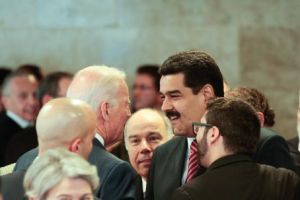 Caracas – Venezuela’s president Nicolas Maduro reaffirmed to the US government on Friday the need for respectful relations with Venezuela.
President Maduro made this clear to US Vice President Joseph Biden, in a brief meeting on Thursday during the inauguration of Brazil’s president, Dilma Rousseff, in the Planalto presidential palace in Brasilia, in the presence of Uruguayan President Jose Mujica, while greetings of foreign authorities were made to the Brazilian president.
“We ask the United States, what I told Vice President Biden and have said a thousand times, in public and in private, we want relationships of respect,” President Maduro told reporters transmitted by Telesur, after holding a bilateral meeting with Rousseff on Friday.
Maduro also mentioned sanctions the US government decided to apply, for alleged violations of Human Rights, against Venezuelan government officials who contributed to curb vandalism and terrorism promoted by political parties and sectors of the extreme right, which left 43 people killed.
Maduro described the sanctions as “a wrong step” and said Venezuela will seek, during future summits of the Community of Latin American and Caribbean States (CELAC) and the Americas, a scenario to try to make the United States have second thoughts on these measures against Venezuelans.
The Venezuelan government “is based on respect for international law. It is a government appreciated and supported throughout the continent, by Latin America and the Caribbean,” said the Venezuelan President noting that Biden had to realize, during the ceremony of Rousseff’s inauguration, the “cordiality and brotherhood” in relations between the South American countries.
“It is the great virtue of South America: the different political positions and different projects that we live today and work jointly, center-right, center-left and revolutionary governments cooperate permanently between each other,” he said.
“In South America we all fit in, and I think that’s what North America should understand,” he added.
Mexican Journalist Kidnapped in Veracruz State
teleSUR | January 3, 2015
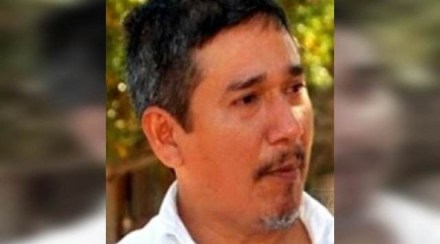
Mexican photojournalist and social activist, Moises Sanchez Cerezo, was reportedly kidnapped by an armed group at his home in the community of Medellin de Bravo in the turbulent state of Veracruz on Friday.
According to local media reports, Cerezo was taken at gunpoint along with his computer, camera and cell phone. Neighbor testimony outlined that the incident took place at 7:30 in the evening. They affirmed that three cars arrived with several armed men who entered the home of Cerezo then drove off with him in their custody.
Although the neighbors notified police, law enforcement showed up hours later.
Cerezo contributes to the local weekly La Union as well as participated in neighborhood security and watch groups to try to confront the widespread insecurity resulting from the presence of organized crime and corrupt local police officials.
Media rights watchdog groups have raised alarm over the number of journalists and media workers killed or targeted during the current administration of Enrique Peña Nieto. According to the International Center for Journalists (ICFJ), 13 journalists have been killed in Mexico in the past two years.
Mexico remains one of the most dangerous places in the world to practice journalism. Nearly 100 media workers have lost their lives or gone missing since the year 2000, and most of these cases are still unsolved, insufficiently probed, and few perpetrators arrested or convicted, according to the PEN American Center.
The Committee to Protect Journalists reported that since 1992, 73 percent of journalists killings in Mexico involved criminal groups with 8 percent involving the military.
Rapprochement Between the United States and Cuba and Sanctions Against Venezuela
By WILLIAM CAMACARO and FREDERICK B. MILLS | CounterPunch | January 2, 2015
In a historic address on December 17, 2014 on “Cuba policy changes” President Barack Obama declared, “our shift in policy towards Cuba comes at a moment of renewed leadership in the Americas.” This “renewed leadership,” in our view, seeks to gradually undermine socialism in Cuba, check waning U.S. influence in the region, and inhibit a growing continental Bolivarian movement towards Latin American liberation, integration, and sovereignty. To be sure, normalization of relations with Cuba and the release of Gerardo Hernández, Ramón Labañino and Antonio Guerrero were long overdue, and the reunification of Alan Gross with his family was an important and welcome gesture. The rapprochement between the United States and Cuba and the simultaneous imposition of a new round of sanctions by the U.S. against Venezuela, however, do not signal a change in overall U.S. strategy but only a change in tactics. As President of Venezuela Nicolas Maduro remarked in a letter to President Raul Castro “there is still a long road to travel in order to arrive at the point that Washington recognizes we are no longer its back yard…” (December 20, 2014).
From Embargo to Deployment of U.S. Soft Power in Cuba
The Obama gambit arguably seeks to move Cuba as far as possible towards market oriented economic reforms, help build the political community of dissidents on the island, and improve U.S. standing in the region, and indeed in the world. In a Miami Herald op-ed piece (December 22, 2014), John Kerry (Secretary of State), Penny Pritzker (Secretary of Commerce) and Jacob J. Lew (Treasury Secretary) wrote that normalization of relations between the U.S. and Cuba will “increase the ability of Americans to provide business training and other support for Cuba’s nascent private sector” and that this will “put American businesses on a more equal footing.” Presumably the op-ed is referring to “equal footing” with other nations that have been doing business for years with Cuba despite the embargo. The essay also indicates that the U.S. will continue its “strong support for improved human-rights conditions and democratic reforms in Cuba” by “empowering civil society and supporting the freedom of individuals to exercise their freedoms of speech and assembly.” Such a version of “empowering civil society” is probably consistent with decades of U.S. clandestine attempts to subvert the Cuban government, documented by Jon Elliston in Psy War on Cuba: The declassified history of U.S. anti-Castro propaganda (Ocean Press: 1999). It is also in line with more recent efforts, through USAID funded social media (phony Cuban Twitter) and a four year project to promote “Cuban rap music” both of which ended in 2012, designed to build dissident movements inside Cuba. In December 2014, Matt Herrick, spokesman for USAID, defended the latter unsuccessful covert program saying, “It seemed like a good idea to support civil society” and that “it’s not something we are embarrassed about in any way.” Moreover, a fact sheet on normalization published by the U.S. Department of State mentions that funding for “democracy programming” will continue and that “our efforts are aimed at promoting the independence of the Cuban people so they do not need to rely on the Cuban state” (December 17, 2014). The Cuban government, though, has a different take on the meaning of “independence of the Cuban people.” They emphasize “sovereign equality,” “national independence,” and “self determination.” In an address on normalization, Raul Castro insisted on maintaining Cuban sovereignty and stated “we have embarked on the task of updating our economic model in order to build a prosperous and sustainable Socialism” (December 17, 2014). Obviously the ideological differences between Washington and Havana will shape the course of economic and political engagement between these two nations in the months and years ahead.
Rapprochement Between the U.S. and U.S. Isolation in Latin America
Through normalization of relations with Cuba, the U.S. also seeks to end its increasing isolation in the region. Secretary of State John Kerry, in his Announcement of Cuba Policy Changes, remarked that “not only has this policy [embargo] failed to advance America’s goals, it has actually isolated the United States instead of isolating Cuba” (December 17, 2014). In October 2014, the United Nations General Assembly voted against the U.S. Cuba embargo for the 23rd year in a row, with only the U.S. and Israel voting in favor. The inclusion of Cuba in the political and, to a certain degree, economic life of Latin America, has also been part of a larger expression of Latin American solidarity that clearly repudiates regional subordination to Washington. Since the sixth Summit of the Americas in Cartagena (April 2012), the U.S. has been on very clear notice by the Community of Latin American and Caribbean States (CELAC) that there will be no seventh Summit of the Americas in Panama in April without Cuba, a condition to which Washington has ceded.
The flip side of Washington’s growing “isolation” has been the critically important regional diversification of diplomatic and commercial relations between Latin America and the BRICS nations (Brazil, Russia, India, China, and South Africa) and the construction of alternative development banks and currency reserves to gradually replace the historically onerous terms of the World Bank and the International Monetary Fund. The financial powerhouse of the BRICS nations is China. Over the past year, China has sent high level delegations to visit CELAC nations and in some cases these meetings have resulted in significant commercial agreements. As a follow up, there will be a CELAC–China forum in Beijing in January 2015 whose main objective, reports Prensa Latina, “is exchange and dialogue in politics, trade, economy and culture.” These ties with BRICS and other nations are consistent with the Chavista goal that the Patria Grande ought to contribute to building a multi-polar world and resist subordination to any power block on the planet. By bringing a halt to its growing isolation, Washington would be in a better position to increase its participation in regional commerce. The terms of economic engagement with most of Latin America, however, will no longer be determined by a Washington consensus, but by a North—South consensus. The Obama gambit, though, appears to be trading one source of alienation (embargo against Cuba) for another (sanctions against Venezuela).
Obama’s Gambit: Pushing Back the Bolivarian Cause at its Front Line–Venezuela
The Obama administration’s move to normalize relations with Cuba, while a welcome change of course, can be seen as a modification in tactics to advance the neoliberal agenda as far as possible in Havana while ending a policy that only serves to further erode U.S. influence in the region. Such diplomacy is in line with what appears to be a major U.S. policy objective of ultimately rolling back the ‘pink tide’, that is, the establishment, by democratic procedures, of left and center left regimes in two thirds of Latin American nations. It is this tide that has achieved some measure of progress in liberating much of Latin America from the structural inequality, social antagonism, and subordination to transnational corporate interests intrinsic to neoliberal politics and economics. And it is the continental Bolivarian emphasis on independence, integration, and sovereignty that has fortified the social movements behind this tide.
The Obama gambit, from a hemispheric point of view, constitutes a tactical shift away from the failed U.S. attempt to isolate and bring the Cuban revolution to its knees through coercion, to an intensification of its fifteen year effort to isolate and promote regime change in Venezuela. The reason for this tactical shift is that Venezuela, as the front line in the struggle for the Bolivarian cause of an increasingly integrated and sovereign Latin America, has become the biggest obstacle to the restoration of U.S. hegemony and the rehabilitation of the neoliberal regime in the Americas.
If this interpretation of U.S. hemispheric policy is near the mark, Obama’s grand executive gesture towards Cuba is immediately related to the context of Washington’s unrelenting antagonism towards Chavismo and, in particular, to the latest imposition of sanctions against Caracas. The reason for this is quite transparent. It has been Venezuela, more than Cuba, during the past fifteen years, that has played the leading role in the change of the balance of forces in the region on the side of sovereignty for the peoples of the Americas, especially through its leadership role in ALBA, CELAC, UNASUR and MERCOSUR, associations that do not include the U.S. and Canada. Argentine sociologist Atilio Boron, in an interview with Katu Arkonada of Rebelión (June 24, 2014), points out, “It is no accident… that Venezuela in particular is in the cross hairs of the empire, and for this reason we must be clear that the battle of Venezuela is our Stalingrad. If Venezuela succumbs before the brutal counter offensive of the United States…the rest of the processes of change underway on the continent, whether very radical or very moderate, will end with the same fate.” The latest U.S. sanctions against Venezuela can be viewed as one component of this counter offensive. It is to a closer look at the sanctions bill, signed into law by the president on December 18, 2014, that we now turn.
The “Venezuela Defense of Human Rights and Civil Society Act of 2014” (S 2142) not only targets Venezuelan officials whom U.S. authorities accuse of being linked to human rights abuses by freezing their assets and revoking their travel visas (Sec. 5 (b) (1) (A) (B)), it also promises to step up U.S. political intervention in Venezuela by continuing “to support the development of democratic political processes and independent civil society in Venezuela” (section 4 (4)) and by reviewing the effectiveness of “broadcasting, information distribution, and circumvention technology distribution in Venezuela” (section 6). One of the instruments of this support for “democratic political processes” has been the National Endowment for Democracy (NED). Sociologist Kim Scipes argues that, “the NED and its institutes are not active in Venezuela to help promote democracy, as they claim, but in fact, to act against popular democracy in an effort to restore the rule of the elite, top-down democracy” (February 28 – March 2, 2014). Independent journalist Garry Leech, in his article entitled “Agents of Destabilization: Washington Seeks Regime Change in Venezuela,” (March 4, 2014) examines Wikileaks cables that indicate similar efforts have been carried out in Venezuela by USAID’s Office of Transition Initiatives (OTI) during the past decade. Hannah Dreier (July 18, 2014), reported that “the State Department and the National Endowment for Democracy, a government-funded nonprofit organization, together budgeted about $7.6 million to support Venezuelan groups last year alone, according to public documents reviewed by AP.” The sanctions bill (S 2142), then, in light of these precedents, contains provisions that suggest an imminent escalation in the use of soft power to support the political opposition to Chavismo in Venezuela, though such funding has been banned by Caracas.
The current U.S. sanctions against Caracas are consistent with fifteen years of U.S. antagonism against the Bolivarian revolution. The measures send a clear signal of increased support for a Venezuelan political opposition that has suffered division and discord in the aftermath of their failed “salida ya” (exit now) strategy of the first quarter of 2014. The sanctions also undermine any near term movement towards normalization of relations between the U.S. and Venezuela. It is no surprise that provisions of the law that targets Venezuelan officials accused of human rights violations have gotten some limited traction inside this South American nation, with the executive secretary of the Venezuelan opposition Democratic Unity Roundtable (MUD), Jesús Torrealba, openly supporting this measure. This is probably not going to get the MUD a lot of votes. According to a Hinterlaces poll taken in May, a majority of Venezuelans are opposed to U.S. sanctions. There has also been a swift repudiation of sanctions by the Maduro administration and the popular sectors. On December 15, 2014, in one of the largest and most enthusiastic gatherings of Chavistas in the streets of Caracas since the death of Hugo Chavez, marchers celebrated the fifteenth year anniversary of the passage by referendum of a new constitution (December 15, 1999) and vigorously protested against U.S. intervention in their country. Even dissident Chavistas appear to be toning down their rhetoric and circling the wagons in the face of Washington’s bid to assert “renewed leadership” in the region.
There is no doubt that the Maduro administration is under tremendous pressure, from left Chavistas as well as from the right wing opposition, to reform and improve public security and deal effectively with an economic crisis that is being exacerbated by falling petroleum prices. What the government of Venezuela calls an “economic war” against the country has domestic and well as international dimensions. Although there is no smoking gun at this time that exposes a conspiracy, some analysts interpret the recent fall in oil prices as part of a campaign to put severe economic pressure on Iran, Russia and Venezuela, countries whose fiscal soundness relies a great deal on petroleum revenues. For example, Venezuelan independent journalist, Jesus Silva R., in his essay entitled “The Government of Saudi Arabia is the Worst Commercial Enemy of Venezuela,” argues that the Saudis and Washington are complicit in the “economic strangulation, planned from the outside, against Venezuela” (December 22, 2014). Whatever the cause of falling petroleum prices and despite the domestic challenges facing Caracas, it will most probably be the Venezuelan electorate that decides, through upcoming legislative elections, whether to give Chavismo a vote of confidence, not outside intervention or a fresh round of guarimbas and terrorist attacks perpetrated by the ultra right. For the large majority of Venezuelans reject violence and favor constitutional means of resolving political contests.
U.S. Sanctions Against Venezuela Evoke Latin American Solidarity with Caracas
The good will generated by rapprochement between the U.S. and Cuba has already been tempered by the almost simultaneous new round of sanctions imposed by Washington against Venezuela. It is important to recall, perhaps with some irony, that it was precisely the late Venezuelan President Hugo Chavez’s establishment of fraternal ties with a formerly isolated Cuba that drew, in particular, the ire of Washington and the virulent antagonism of the right wing Venezuelan opposition. Now it is Latin American and to a significant extent, international solidarity with Venezuela that may prove to be a thorn in Washington’s side. On December 12, 2014, ALBA issued a strong statement against the Senate passage of the sanctions bill, expressing its “most energetic rejection of these interventionist actions [sanctions] against the people and government of the Bolivarian Government of Venezuela.” The statement also warned “that the legislation constitutes an incitement towards the destabilization of…Venezuela and opens the doors to anticonstitutional actions against the legal government and legitimately elected President Nicolas Maduro Moros.” The communiqué also expressed solidarity with Venezuela adding that the countries of ALBA “desire to emphasize that they will not permit the use of old practices already applied to countries in the region, directed at bringing about political regime change, as has occurred in other regions of the world.” MERCOSUR issued a statement on December 17, 2014 that “the application of unilateral sanctions… violate the principle of non-intervention in the internal affairs of States and does not contribute to the stability, social peace and democracy in Venezuela.” On December 22, the G77 plus China countries expressed solidarity and support for the government of Venezuela in the face of “violations of international law that in no way contributes to the spirit of political and economic dialogue between the two countries.” On December 23, the Movement of Non-Aligned Nations stated that it “categorically rejects the decision of the United States Government to impose unilateral coercive measures against the Republic of Venezuela…with the purpose of weakening its sovereignty, political independence and its right to the self determination, in clear violation of International Law.” It is also important to recall that on October 16, 2014 the UN General Assembly elected Venezuela (by a vote of 181 out of 193 members) to a non-permanent seat on the UN Security Council with unanimous regional support, even crossing ideological lines. This UN vote came as a grave disappointment to opponents of the Bolivarian revolution and reinforced Venezuelan standing in CELAC. In yet another diplomatic victory, as of September 2015, Venezuela will assume the presidency of the Movement of Non-Aligned Nations for a three year term. Clearly, it is Washington, not Venezuela that has already become an outlier as the Obama administration launches its “renewed leadership in the Americas.” If these immediate expressions of solidarity with the first post-Chavez Bolivarian government in Venezuela are an indicator of a persistent and growing trend, then by the time of the upcoming seventh Summit of the Americas, April 10 – 11, 2015 in Panama, President Obama can expect approbation for Washington’s opening to Havana, but he will also face a united front against U.S. intervention in Venezuela and anywhere else in the region.
Note: Translations by the authors from Spanish to English of government documents are unofficial. Where citations are not present in the text, hyperlinks provide the source.
William Camacaro MFA. is a Senior Analyst at the Council on Hemispheric Affairs and a member of the Bolivarian Circle of New York “Alberto Lovera.”
Frederick B. Mills, Ph.D. is Professor of Philosophy at Bowie State University and Senior Research Fellow at the Council on Hemispheric Affairs.
Poll Confirms Massive Support for Ecuador’s Correa
teleSUR | December 30, 2014
A poll released Monday revealed that over 60 percent of Ecuadoreans approved of President Rafael Correa’s management of the country.
Correa’s support is “unprecedented” in Ecuador, said the president of the survey institute, Polibio Cordova in a press conference, as the Ecuadorean leader has maintained high levels of support since he was elected in 2007.
“This is an unprecedented case because the presidents used to start [their term] with a quite high level [of popularity] of around 68 percent, and within two or three years, they used to decrease by at least 30 percent, sometimes reaching a 30 or 32 percent of approval,” Cordova explained.
Only 32 percent disapprove of his administration, with eight percent not responding to the survey.
The poll was conducted between December 18-24 with a total of 2,168 participants in 15 cities of the country and an error margin of five percent.
Ecuador: CIA Justifies Reyes “Targeting” in 2008
Weekly News Update on the Americas | December 29, 2014
According to a secret study released by the Wikileaks group on Dec. 18, the US Central Intelligence Agency (CIA) considers the killing of Revolutionary Armed Forces of Colombia (FARC) second-in-command Raúl Reyes by Colombian forces in Ecuadorian territory on Mar. 1, 2008 [see Update #937] an example of ways that assassinations of rebel leaders “can play a useful role.”
In addition to the Reyes case, the paper reviews the use of “high-value targeting (HVT)”—the killing or capture of top leaders—in fighting rebels in Afghanistan, Algeria, Colombia, Iraq, Israel, Peru, Northern Ireland and Sri Lanka. HTV can have “negative effects,” the study concludes, but the practice can “contribute to successful counterinsurgency outcomes” if used strategically. The July 9, 2009 study, marked “secret” and “NOFORN” (“no foreign nationals”), is entitled “Making High-Value Targeting Operations an Effective Counterinsurgency Tool”; it apparently forms part of a “Best Practices in Counterinsurgency” series.
Reyes, the FARC’s chief spokesperson and negotiator, was killed when the Colombian military launched a nighttime air raid and then an incursion against a rebel encampment in Ecuador’s northeastern Sucumbíos province about three kilometers from the Colombian border. Some 19 FARC members were killed in the operation, as were four Mexican students who had been visiting the encampment while in Ecuador to attend a leftist conference. Although the Colombian government and the media treated the attack as a simple raid against a group of rebels, the CIA study refers to it as part of a number of “successful HVT strikes against top insurgent leaders in early 2008, in conjunction with earlier strikes against second and third-tier leaders and finance and logistics specialists.” Reyes’ death “is likely to have seriously damaged FARC discipline and morale, even among its leadership, according to a CIA field commentary.” As an example of the operation’s success, the CIA noted that “[p]ublic support for the Colombian government solidified in the wake of the killing… with President Alvaro Uribe’s approval rating increasing from the mid-70% range to as high as 84%.”
The study treats the Reyes killing as a strictly Colombian operation, although there have been reports that in fact the Colombians dropped US “smart bombs” and that an HC-130 airplane, used for refueling helicopters, took off from the US base then at Manta, Ecuador, just hours before the attack. The FARC itself claimed in a Mar. 14 communiqué that the US Southern Command had led the operation [see Update #940]. Theoretically US agencies are not allowed to participate in targeted assassinations. Executive Order 12333, signed by US president Ronald Reagan on Dec. 4, 1981, states that “[n]o person employed by or acting on behalf of the United States Government shall engage in, or conspire to engage in, assassination.” (La Jornada (Mexico) 12/19/14)
More Militarization Expected for 2015 in Honduras
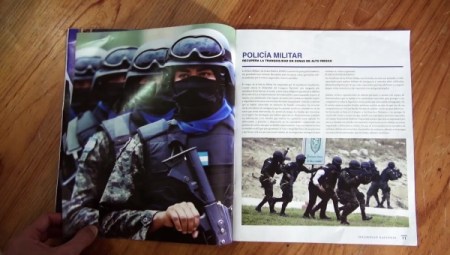
Government propaganda is based on repeating that security has improved with militarization
teleSUR | December 24, 2014
In Honduras, after one year of President Juan Hernandez’s term, there has been an increase in privatization, militarization and budget cutbacks in public services. It is expected this will continue next year, but social movements say that they will not sit idle.
According to leaders of the social and political movement, next year will see massive dismissals of public sector workers, reductions in health and education budgets, and the unity of the political opposition against President Hernandez.
Juan Barahona, coordinator of the National Resistance Front explained that, “We see that the budget which was recently approved in the National Congress, is a budget that in 2015 cuts millions off the health system, education, and millions off agrarian programs. There is not even a cent for wage increases or for new jobs. And as a response to this national budget, there is going to be a great deal of social protest, but also there is going to be strong repression and that’s why they (the government) are preparing themselves with the militarization of security forces.”
Repression
According to Barahona, in Honduras next year there will be more persecution of social movement leaders, stronger repression during public demonstrations, and more presence of military intelligence agencies in surveillance of government dissidents.
However, in the last two months of 2014, new fronts have been created in Honduras. The Rural Women’s front has been demanding cheap credit and true agrarian reform such as the titles of the land they have been working on. The Public Workers Front faces the privatization of public services and the dismissal of more than 8,000 workers. Also the opposition National Resistance Front is calling on people to go into the streets, and opposition political parties have pledged unity.
Salvador Nasralla of the Anti-Corruption Party said, “If we continue along this path, it is going to be a dictatorship. When there is a dictatorship people don’t have the right to an opinion. And we three opposition political parties believe that this is going to get worse.”
While the national media, which for the most part supports the government, claims that violence has been reduced and that the forthcoming decisions will bring solutions for the profound crisis in Honduras, everyday there are more and more expressions of discontent among the population. Confrontation is expected to be ongoing all through Honduras during 2015.
Ecuador ends deal with Germany on environmental issues
Press TV – December 20, 2014
Ecuador has terminated its environmental cooperation with Germany after German legislators tried to visit an Amazon rainforest recently opened for oil exploitation, the country’s foreign minister says.
“Ecuador unilaterally ends all cooperation with Germany on environmental issues,” Ricardo Patino said on Friday.
In 2012, Germany and Ecuador inked a cooperation deal worth 36 million euros ($44 million) to protect the environmentally sensitive rainforest known as Yasuni. They also signed another deal worth 7 million euros ($9 million) in other environment projects.
“If they think they had the right to doubt the word of Ecuador’s government on the issue of Yasuni because they were providing funds, we’ll give them their money back with interest,” Patino added.
He also noted that the Latin American country has not received the funds for the rainforest, and the money allocated for the other projects will be returned soon.
In 2007, Ecuadorian President Rafael Correa asked rich countries to donate $3.6 billion to help protect the Yasuni in exchange for pledges not to drill for the oil beneath it.
However, Correa allowed the national oil company to do drilling after his proposal was not welcomed by the other countries.
Earlier this month, Correa did not permit the German lawmakers to visit the Yasuni to observe oil production and talk to activists opposing the measure.
The Ecuador government assured that it will take every measure possible to protect the sensitive Amazon environment during the extraction process. However, the Correa government was not pleased that the German delegation wanted to meet with opposition groups first.
“We either have relations based on equality, or none at all,” Correa said in a statement to the German delegation, asking if Germany would likewise accept a delegation from Ecuador coming to their country to inspect their nuclear projects, for instance. Correa added that his country “stopped being a colony 200 years ago.”
UN Offers to Monitor Colombia Ceasefire
teleSUR | December 20, 2014
The United Nations has welcomed the FARC’s (Revolutionary Armed Forces of Colombia) declaration of an indefinite unilateral ceasefire in Colombia, and offered to help oversea it – if both parties involved agree.
“The United Nations has the competency,” Hochschild told reporters Thursday. He also stated that the U.N. has the willingness and the experience needed for the job.
The leftist rebel group called the indefinite earlier this week in Havana, Cuba marking the end of the last round of peace negotiations for the year.
The FARC and the Colombian government have been engaged in peace talks since November of 2012 to end the 50 years of civil war in the country. Although unilateral ceasefires have been called in the past, this is first time that no time limit has been set, leaving many optimistic that the two sides may be approaching an agreement.
One of the conditions for the ceasefire set by the FARC was that the situation be monitored by an outside body.
On Thursday, the Union of South American Nations (UNASUR) announced that they were open to overseeing the ceasefire. The leftist fighters also approached the Community of Latin American and Caribbean States (CELAC), the International Committee of the Red Cross and the Broad Front for Peace to oversea the ceasefire.
President of Colombia, Juan Manuel Santos, welcomed the ceasefire, however has refused to agree to it, stating fears that rebels would use the time to recalibrate and acquire arms.
The President has also refused to meet the FARC’s conditions for an outside monitoring body, saying the government itself could monitor the situation.
Earlier on Friday, the government accused the FARC of killing five soldiers during clashes in the southwestern state of Cauca. The attack reportedly happened only hours before the ceasefire was due to begin, however it is not clear who started the aggressions. The FARC has not accepted responsibility and has yet to comment on the matter.
According to the FARC, the ceasefire – which took effect at midnight on Saturday – must lead to a truce, and will only call it off if Colombian soldiers directly attack FARC troops.
Santos has said he is only willing to halt military actions if a peace agreement is signed.
Argentina sentences four ex-officers to life in prison
Press TV – December 19, 2014
A court in Argentina has handed down life sentences to four former military officers for committing crimes against humanity during the 1970s’ US-backed military dictatorship in the South American country.
On Thursday, the court in the capital, Buenos Aires, found the four guilty of “illegal deprivation of liberty, torture, rape and homicide,” involving 204 people out of the total 2,500 held at the Vesubio detention center between 1976 and 1978.
The four defendants are former colonels Federico Minicucci and Jorge Crespi, former intelligence officer, Gustavo Cacivio, and former colonel and prison official, Nestor Cendon.
The Vesubio detention center operated in the La Matanza district of Buenos Aires, until it was destroyed to prevent the Inter-American Commission of Human Rights from inspecting it during a country visit.
Famous comics writer, Héctor Oesterheld, author Haroldo Conti and filmmaker Raymundo Gleyzer were among those who died in the prison.
Former Argentine Major Ernesto “Nabo” Barreiro has recently broken his 31-year pact of silence by revealing the locations of graves of people who disappeared under the military regime during the so-called “Dirty War” from 1976 to 1983.
Barreiro said some two dozen people are buried inside two large earthen ovens at a military base outside the central city of Cordoba.
Previous Argentine governments have failed to investigate crimes committed during the almost seven-year dictatorship due to the so-called Full Stop law, which saw an end to prosecutions. However, the law was repealed ten years ago.
The US-backed dictatorship in Argentina jailed, tortured and murdered dozens of people and forced thousands to flee the country during the war.
Federal courts are seeking the whereabouts of an estimated 30,000 people who were killed or abducted and presumed killed during the dictatorship.
Featured Video
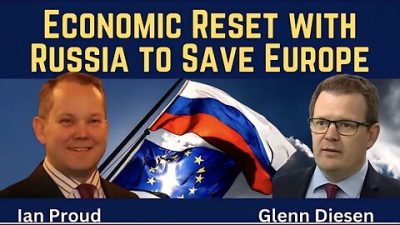
Ian Proud: Economic Reset with Russia to Save Europe
or go to
Aletho News Archives – Video-Images
From the Archives
Magic Hour for Gates
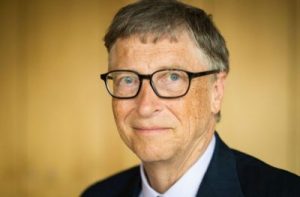
By Gary Jordan | Wake The F*** UP | March 15, 2021
Bill Gates wants to know everything about you.
He wants to control every aspect of your life.
His insatiable thirst for the supervision and scrutiny of every human being alive has sparked a US$1 billion investment that will blanket the earth in video surveillance satellites, providing real-time feedback with a mere one-second delay. He advocates for Orwellian digital tools to track your every move and has bankrolled US$1.7 billion to provide artificial intelligence that will be used to scan each and every visitor to major event venues worldwide. He wants to do away with end-to-end encryption, so he can snoop on your private conversations. He wants to know when and where you travel and who you travel with. He wants you to eat whatever he says you should eat, drink whatever he says you should drink, think how he wants you to think and know only what he wants you to know. Plus he wants to dictate what goes inside your body.
But he doesn’t want you to know a lot about him.
For instance… continue
Blog Roll
 Aletho News
- ‘Fox guarding the henhouse’: AMA, Vaccine Integrity Project to conduct their own vaccine safety and efficacy reviews
- Macron, Merz, and von der Leyen Defend Expanded Speech Controls
- Keir Starmer-tied think tank paid PR firm to target The Grayzone
- ‘Israel’ threatens to genocide Gaza if Hamas refuses disarmament
- Apple Just Bought A Sinister ‘Pre-Speech’ Tech Company Implicated In Genocide
- Israel’s new West Bank registration process declares Palestinian land ‘state property’
- Two children killed in Palestinian Authority ambush in West Bank; Hamas slams attack as ‘black mark’
- Israel Needs Time Before Another Iran War—Here’s Why
- US seizes oil tanker for ‘defying Trump’s quarantine’
- Ian Proud: Economic Reset with Russia to Save Europe
- If Americans Knew
- An error has occurred; the feed is probably down. Try again later.
- No Tricks Zone
- New Study: A 4°C Warmer Beaufort Sea Had ‘No Sea Ice’ 11,700 – 8200 Years Ago
- Unfudging The Data: Dutch Meteorological Institute Reinstates Early 20th Centruy Heat Waves It Had Erased Earlier
- German Gas Crisis…Chancellor Merz Allegedly Bans Gas Debate Ahead of Elections!
- Pollen Reconstructions Show The Last Glacial’s Warming Events Were Global, 10x Greater Than Modern
- Germany’s Natural Gas Storage Level Dwindles To Just 28%… Increasingly Critical
- New Study Rebuts The Assumption That Anthropogenic CO2 Molecules Have ‘Special’ Properties
- Climate Scientist Who Predicted End Of “Heavy Frost And Snow” Now Refuses Media Inquiries
- Polar Bear Numbers Rising And Health Improving In Areas With The Most Rapid Sea Ice Decline
- One Reason Only For Germany’s Heating Gas Crisis: Its Hardcore-Dumbass Energy Policy
- 130 Years Later: The CO2 Greenhouse Effect Is Still Only An Imaginary-World Thought Experiment
 Aletho News