South American union raps US sanction bid on Venezuela
Press TV – May 24, 2014
Twelve South American states have rejected an effort by US legislators to impose sanctions on Venezuela over alleged rights abuses.
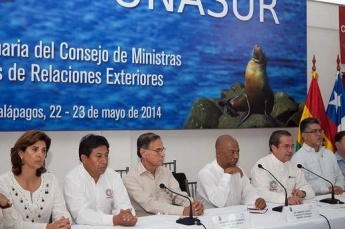
In a statement issued on Friday following a meeting in the Galapagos Islands in Ecuador, foreign ministers from the 12-member Union of South American Nations (Unasur) said that a bill proposed by American lawmakers against Caracas would violate Venezuela’s internal affairs and undermine attempts to defuse the crisis in the country.
Sanctions are obstacles for Venezuela, whose “people can overcome their difficulties with independence, and in democratic peace,” the statement said.
The US House of Representatives will vote on the legislation on Wednesday. The bill will order the administration of US President Barack Obama to ban visas and freeze the assets of Venezuelan officials involved in the alleged rights abuses in the past three months.
Venezuela has been the scene of protests against and in support of the administration of Venezuelan President Nicolas Maduro since February.
The protests broke out in the western city of San Cristobal, where students took to the streets to criticize the crime rate and inflation in the country. The demonstrations later spread to other cities including the capital Caracas.
Maduro says the unrest is a US-backed plan to topple his government.
Last week, Maduro urged opposition leaders to return to political talks aimed at ending street clashes in the country.
The move came after the Venezuelan opposition suspended the negotiations with the government on May 14 to protest against what it called the mass arrests of anti-government activists.
The opposition says it will not return to the negotiating table until the government accepts its demands, including amnesty for opposition prisoners.
The government, on the other hand, says the opposition is making impossible requests that are akin to blackmail.
Remember When Venezuela and Bolivia Kicked the U.S. DEA Out of Their Countries, Accusing It of Espionage? Looks Like They Were Right…
By Stephan Lefebvre | CEPR Americas Blog | May 22, 2014
In their latest article on U.S. government spying for The Intercept, Ryan Devereaux, Glenn Greenwald and Laura Poitras review and publish leaked documents that show that the U.S. government may have used the Drug Enforcement Administration (DEA) to aid the National Security Agency (NSA) to spy on U.S. citizens and non-citizens in foreign countries. The NSA is shown to have assisted the DEA with efforts to capture narcotraffickers, but the leaked documents also refer to “a vibrant two-way information sharing relationship” between the two intelligence agencies, implying that the DEA shares its information with the NSA to aid with non-drug-related spying. This may explain how the NSA has gathered not just metadata but also the full-take audio from “virtually every cell phone conversation on the island nation of the Bahamas.”
The authors write,
The DEA has long been in a unique position to help the NSA gain backdoor access to foreign phone networks. “DEA has close relationships with foreign government counterparts and vetted foreign partners,” the manager of the NSA’s drug-war efforts reported in a 2004 memo. Indeed, with more than 80 international offices, the DEA is one of the most widely deployed U.S. agencies around the globe.
But what many foreign governments fail to realize is that U.S. drug agents don’t confine themselves to simply fighting narcotics traffickers. “DEA is actually one of the biggest spy operations there is,” says Finn Selander, a former DEA special agent who works with the drug-reform advocacy group Law Enforcement Against Prohibition. “Our mandate is not just drugs. We collect intelligence.”
What’s more, Selander adds, the NSA has aided the DEA for years on surveillance operations. “On our reports, there’s drug information and then there’s non-drug information,” he says. “So countries let us in because they don’t view us, really, as a spy organization.”
While the documents accompanying the article reveal detailed information that has never before been available to the public, this is not the first time that the DEA has faced allegations of spying.
In 2005, President Hugo Chávez of Venezuela stopped cooperating with the DEA after accusing it of espionage in his country. At the time, a State Department spokesperson responded by saying, “the accusations that somehow the Drug Enforcement Agency is involved in espionage are baseless. There’s no substance or justification for them.” Using arguments that would change very little over the next nine years, a State Department official said at the time, “I think it’s pretty clear to us that the motivation for this is not the accusation itself or not what they state is the problem. The motivation is an effort to detract from the government’s increasingly deficient record of cooperation.”
Three years later, President Evo Morales expelled the DEA from Bolivia saying, “there were DEA agents who worked to conduct political espionage.” He also said, “we can control ourselves internally. We don’t need any spying from anybody.” The State Department spokesperson said in response, “the charges that have been made are just patently absurd. We reject them categorically”, and the news agency EFE reported that “Washington has repeatedly denied that the DEA has been involved in any activities in Bolivia apart from the war on drugs.”
Few of the press reports from 2005 or 2008 took these accusations seriously, and the State Department dismissed the allegations categorically, but in 2008, CEPR’s co-director Mark Weisbrot wrote that “To the Bolivians, the U.S. is using the “war on drugs” throughout Latin America mainly as an excuse to get boots on the ground, and establish ties with local military and police forces.” To this list, we can now add access to national phone and communication networks, and storage of the content of phone calls.
U.S. Senate Committee Approves Sanctions, Venezuela to Appeal to United Nations
By Z.C. Dutka | Venezuelanalysis | May 20th 2014
Earlier this afternoon in Washington, the Foreign Relations Committee of the U.S. Senate approved 13 to 2 the “Venezuelan Human Rights and Democracy Protection Act.” The bill includes sanctions on key individuals of the Venezuelan government and at least $15 million to “defend human rights… and strengthen the rule of law.”
The Menendez Bill
Committee chair, Democrat Robert Menendez, who played a lead role in the writing of the proposed legislation, plans to present the bill before the whole Senate within the coming weeks.
The legal measures proposed are in regards to recent anti-government protests that have reached levels of extreme violence in certain Venezuelan cities, resulting in 42 dead, 800 injured, and millions of dollars of public property damaged, including the burning of multiple universities.
Menendez said the US can’t “play the role of bystander” while Venezuelan president is going to “dangerous extremes to silence political dissent.”
“The U.S. should always be on the side of human rights around the world,” said another lead supporter, Florida Republican senator Marco Rubio.
Rubio has prepared list of Venezuelan military and government officials who would be targeted for sanctions if the bill were to pass. Among those listed are attorney general Luisa Ortega Diaz and the head of operations for the National Guard, Manuel Quevedo.
Earlier this month another piece of similar legislation, the Venezuelan Liberty and Democratic Solidarity Act, promoted by Florida congresswoman Ileana Ros-Lehtinen, passed the corresponding foreign committee of the U.S. Congress. It has yet to be addressed by Congress as a whole.
Roberta Jacobson, Assistant Secretary of State for Western Hemisphere Affairs, has attended the senate hearings and expressed concern on behalf of the White House.
“This is not a U.S.-Venezuela issue,” she said. “We have strongly resisted attempts to be used as a distraction from Venezuela’s real problems.”
She has displayed equal unease that the bill might distract from the important dialogue that is taking place between the Venezuelan government and the opposition.
Appeal to the UN
Even before the bill passed today’s Senate committee, Venezuelan foreign minister Elias Jaua expressed outrage at what he considers repeated US “interference” in Venezuelan affairs.
On Thursday Jaua announced his plan to present a formal claim to the United Nations, the Organization of American States (OAS), the Union of South American Nations (UNASUR), and the Community of Latin American and Caribbean States (CELAC).
“We’ve had enough of the United States assuming a role that belongs to multilateral bodies, Jaua said Thursday. “We must remember that as a free and independent nation we do not recognize the United States parliament… as a legislative [force] over Venezuela. There are basic principles of the United Nations Charter that must be respected.”
The minister has called a meeting with the UNASUR, to be held next week in Ecuador. He plans to bring with him a “dossier of all the declarations of interference posed by representatives of the United States, starting with president Obama, Secretary [of State John] Kerry, and others…”
The West’s Non-Linear Warfare and the Right for the Rest to Resist
By Andrew Korybko | Oriental Review | May 19, 2014
Nearly two weeks ago, Peter Pomerantsev, writing for Foreign Affairs, published an article about “How Putin Is Reinventing Warfare”. He alleges that Russia is engaging in “non-linear warfare”, strongly alluding that this poses a threat to the West. If one can read between the lines of his biased and subjective approach, he is in actuality describing a very real and objective development – the restoration of Russian power and global standing. His ire is likely due to Russia now being able to deflect international information and media assaults against it and its policies and finally promote the truth. Pomerantsev then goes on a peculiar ranting spiel where he alleges a convoluted metaphor of Russia conspiring to be a “corporate raider”, an exercise in exasperation which will likely only reach those with pre-existing anti-Russian beliefs. It is the end of his article, however, that forms the basis of this response to it. Pomerantsev uses the analogy of the West’s “global village” versus Russia’s “non-linear warfare” to make his final point in throwing mud at Russia. In reality, there is not one “global village”, but rather, many regional civilizational villages that are experiencing Western raids and “non-linear warfare”, and they have finally started to band together to stop the marauders.
The liberal end of history (aka “the global village”) does not exist outside of ideological fantasy, and the world is instead divided into civilizational zones (regional villages) united around certain actors (Russia, China, Islamic pillars, the West). This forms the basis of the running metaphor that will be utilized below to advance the claim of the West waging non-linear warfare against the Rest.
Repeated raids from Western marauders and bandits, whose village is the only one seeking to expand, loot, and plunder, has resulted in parts of the other villages being burnt down. In the past decade, the Islamic village experienced this the worst, with conflagrations decimating its Afghan, Iraqi, Libyan, and now Syrian neighborhoods. Currently, the Eurasian village is having to deal with a fire in Ukraine, one that was purposely set to spread to the Russian core. However, as a result of these repeated raids, the regional villages have formed self-defense forces and are now working together to put out the fires and stop the raiding. Experience has taught them how to successfully resist and defy the Western village. In the real world, the success of international media firms (RT, Press TV, CCTV, Telesur) shows that media and information assaults can in fact be deflected and that perception management and national PR initiatives are not under the sole monopoly of the West.
Pomerantsev’s claims that “(economic) interconnection also means that Russia can get away with aggression” could not be more opposite to the truth. The Western village is actually two large ones, the US and the EU, and the American village grew out of the EU one and now controls its creator. In this case, the suburb controls the center, so to speak. It is the interconnection between the Eurasian (Russian) and EU villages that serves as the real check on further US aggression against the former. When not marauding and raiding, the Western village also tries to infiltrate the others via NGOs and Color Revolutions. Once it flips some members of the village and/or installs its pick as village leader, these turncoat individuals can “open the gates from within”, promote mutiny, and lead to the annexation of the village into the Western-dominated expanding sprawl.
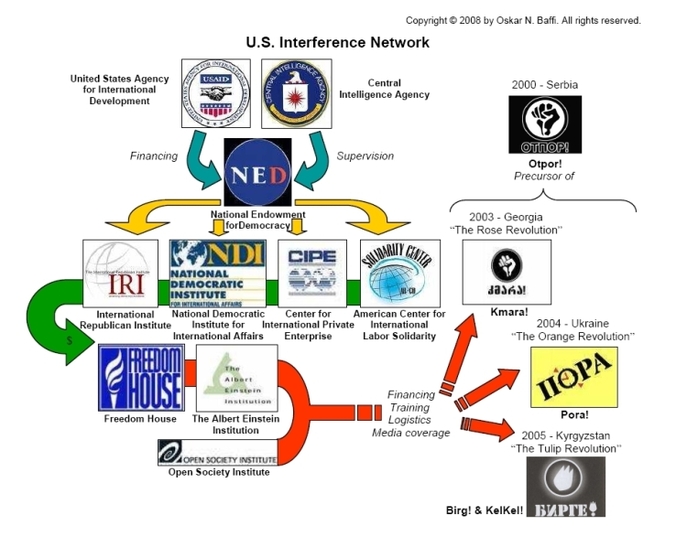
Pulling back from the metaphor, the Brzezinski Doctrine (“The Eurasian Balkans”) is the definition of non-linear warfare and subversive destabilization. It uses NGOs as destabilizing elements within the targeted states, and for this reason, foreign-funded NGOs are required to register as “foreign agents” inside the Russian Federation. Gene Sharp’s writings have also provided pivotal tactical advice in advancing the West’s non-linear warfare strategy. Taking the use of non-state actors even further, the West has a history of promoting militarized proxy groups to carry out its policies. This is most clearly seen in Kosovo, Afghanistan, Iraq, Libya, and Syria, although other countries have also been victims of this underhanded method of war. On the other hand, the West obviously engages in conventional warfare as well. Nowhere is this more evident than in the 2003 Iraq War. Mixing the two methods together is the new trend of American foreign policy. A non-linear campaign of militarized proxy destabilization culminated in a conventional NATO bombing in Libya. After this “success”, the West then turned its sights on Syria, but as a result of adroit Russian foreign policy maneuvers, non-linear warfare was stymied from mutating into its conventional form.
Pomerantsev’s article also uses fear mongering and heavy hype to scare the audience into thinking that Russia is proactively forming some kind of imaginary coalition against the West from within. If there happens to exist an overlap of perceived interests and objectives between Russia and domestic Western actors, it is because both parties arrived at the same conclusions after undergoing the same process – experiencing Western unipolar dominance and discriminatory targeting for two decades. For example, “Euro-scepticism” is also seen in Southeast Asia by the ASEAN members’ reluctance to form an EU-like union. The flower of New Leftism and resistance ideology in South America organically began to bloom in the 2000s, tended over by Hugo Chavez. In a similar fashion, the traditionally conservative societies of India, China, and Africa are just as disgusted as Russia’s by certain Western-centric values, such as the “bearded woman” of Eurovision. In laboratory conditions, the cause (Western dominance) has thus been proven to repeatedly result in similar effects all across the world, thereby confirming the hypothesis that Russia and others arrive at their conclusions on their own. There is no “contradictory kaleidoscope of messages”, as each actor’s resistance and defiance to the West, for various reasons and in differing forms, were a natural development.
To conclude, there are currently multiple civilizational liberation struggles playing out in the Pandora’s Box-setting of Western-led post-modernism. This is not a new page in the old historical story, but an absolutely new edition that is still being written. The Rest, absolutely diverse in their identity and overall mission, are coming together to stop the Western steamroller. They must work together to repel its aggression and safeguard the right to practice their identity and move forward with their historical mission as they individually deem fit. It is the democratic and sovereign choice of each civilization to be able to conduct itself how it pleases, but in order to get to that point, they must be liberated from the terror of the Western threat. These villages do not want to raze the Western one, so to speak, but they understand that the West will raze them if they can’t be annexed. In this manner, they are engaged in a do-or-die struggle, and at no time before in their histories has the situation been more dire. The Rest is slowly coalescing into providing a unified front against the Western menace, hoping to neutralize its raids and incursions so that they can once more go about their civilizational business in constructing and solidifying their societies. If, as Pomerantsev states, Russia and the Rest are anti-Western “raiders”, then yes, the future surely does belong to these resistant and defiant actors.
Andrew Korybko is the American Master’s Degree student at the Moscow State University of International Relations (MGIMO).
Argentina to appeal recent court ruling over AMIA case
Press TV – May 16, 2014
Argentina has vowed to appeal a decision by a federal court that rejected an agreement between the Latin American country and Iran over a joint probe into a bombing of a Buenos Aires Jewish center.
On Thursday, an Argentinean federal court struck down a 2013 agreement between the South American country and Iran to jointly investigate deadly attacks on a Jewish center in Argentina in 1994.
Alberto Nisman, a prosecutor in the investigation of the AMIA center explosion, in which 85 people were killed, had argued in his appeal to the court that the 2013 agreement constituted an “undue interference of the executive branch in the exclusive sphere of the judiciary.” The ruling by the federal court against the agreement said that it was illegal and ordered Argentina not to go ahead with it, according to the Reuters.
After the decision was announced, Argentina’s Foreign Minister Hector Timerman said that the ruling was “a mistake” and that the government will take the case to the country’s Supreme Court of Justice.
“I would like to say that the judges take stock in what their mistake means at a national level and at an international level,” Timerman said. “Regarding the decision, Argentina will appeal the mistake and, if necessary, take it to the nation’s Supreme Court of Justice,” he added.
Meanwhile, Justice Minister Julio Alak also said that a final decision was left to the Supreme Court. “The ultimate interpreter of the constitution will be the Supreme Court,” he said.
Under intense political pressure imposed by the US and Israel, Argentina formerly accused Iran of having carried out the 1994 bombing attack on the AMIA building. AMIA stands for the Asociacion Mutual Israelita Argentina or the Argentine Israelite Mutual Association.
Iran has categorically and consistently denied any involvement in the terrorist bombing.
Last January, Tehran and Buenos Aires signed a memorandum of understanding to jointly probe the 1994 bombing.
Colombian Army Escalates Attack on Communities near Tolemaida Military Base
By Luke Finn | Red Hot Burning Peace | May 14, 2014
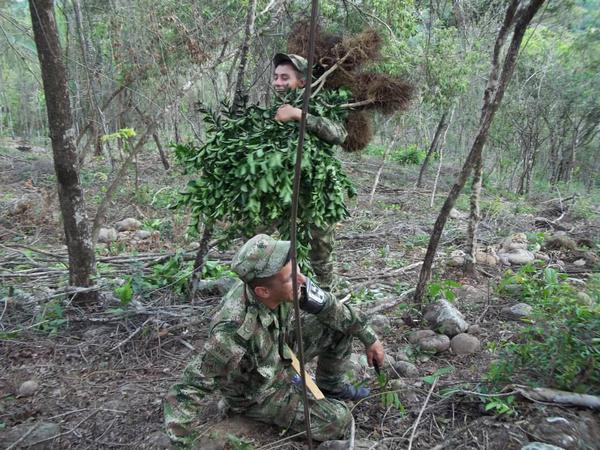
The communities of Yucala, Mesa Bajo, and Naranjala are facing a slow and deliberate process of displacement by a key army base used by the U.S. military in Colombia.
Seven military bases in Colombia fall under the U.S.-Colombia Defense Cooperation Agreement, which allows for U.S. Military access to Colombian bases, and one of those is Tolemaida, Cundinamarca. It was originally founded in 1954 by Colombia’s only ever dictator, General Gustavo Rojas Pinilla (though, of course, Colombia’s list of authoritarian rulers is much longer), and modeled on Fort Benning, Georgia, home of the School of the Americas (now WHINSEC), the infamous training ground for human rights abusers throughout the hemisphere. Like the School of the Americas, Tolemaida was to become primarily a center for training, here in anti-guerrilla (and more recently counter-insurgency) warfare, specifically through its lauded “Curso de Lanceros” course run by U.S. officers and taken by amongst others the armies of the United States, France, and Panama, as well as Colombians. Tolemaida has a permanent presence of U.S. soldiers.
The Tolemaida base is located on a plateau, overlooking the river Sumapaz, an area that amongst other things contains the largest páramo ecosystem in the world, noted even within Colombia for its bio-diversity. Prior to 1954, a community on the plateau, named their settlement “El Mirador,” or “La Mesa.” One man I met, who still remembered those days, told me proudly that they had both a butcher and a soccer field. But then came La Violencia and the new military base, and the communites moved further down the hillside to the veredas of Yucala, Naranjala, and Mesa Bajo, clearing the land and planting their crops.
The community has been in a state of near constant harassment ever since the base’s construction, and even more so as the base looks to expand. For example, back in the 1980’s the military cut electricity to the community. The 150 campesino families affected today, experience three main forms of harassment as part of the Colombian Army’s petty and vindictive campaign.
The first is the economic blockade of the community. The small road (in a state of severe disrepair) up the hillside, turns off the Pan-American highway, and Policía Militar from the base, are posted daily on the road. Thus, the military prevents the community’s access to large amounts of food, materials to repair houses, and materials to prepare their stable fruit crops. Not even a single bag of cement comes through. People are going hungry, there is no money coming into the community, and their houses are falling down around their ears.
The second is the deliberate destruction of community property. On a number of occasions over the last year soldiers have come down from the base and torn up irrigation systems and fruit trees. On June 19, 2013, over 150 fruit trees were uprooted. This carnage is a further attempt to put a stranglehold on the economic life of the community, and starve them out.

The third way, and perhaps the most shocking, is the deliberate contamination of the community’s water, constituting a sort of biological warfare. At the Cueca de la Quebrada Naranjala, the primary water source for the families, the Army has dumped the rubbish from the base, an estimated 30 tons. Battery packs, broken glass, and ceramics, slowly rotting camouflage patterned clothing and bedding, munitions boxes (labeled in English and produced in the United States), and electrical equipment of all sorts litters the fount of the stream, and in rainy season get washed down hill and collect in sodden clumps. The water is visibly toxic green in parts, orange in others, with an oily sheen, and chemical foam. The putrefaction fills your lungs and turns your stomach as you clamber over a mountain of rubbish in one of the most beautiful places in the country.
The charitable could imagine this to be merely neglectful and careless, were it not for the numerous complaints raised by the community, including two (ignored) petitions at local and national level, a new case in front of the Inter-American Commission on Human Rights, and the economic harassment they have faced. But rubbish is still being dumped, and as it stands this seems to be a deliberate attack on the psychological, moral, and physical well being of these fifth generation workers of this land.
The expanding military base (and not to mention the vacationing bogotanos who buy up fincas and build condominiums in the area) has squeezed the communities of Yucala, Naranjala, and Mesa Bajo from both sides in a campaign of outrageous malice. There is no explicit violence in the area, no guerrilla, paramilitary, or bandas criminales, just the economic and environmental violence of the state against this blameless community. The fatuous, meaningless motto of the Colombian Army is “Faith in the Cause”—but if we were to take this at face value, what cause is this? Another slogan is “Yes, there are Heroes in Colombia”—is poisoning wells ever heroic?
Luke Finn is a writer and international accompanier with Fellowship of Reconciliation Peace Presence in Colombia. He graduated from the Humanitarian and Conflict Response Institute, University of Manchester. Follow @Peace_Presence and on Facebook.
U.S. Bill Proposing Sanctions on Venezuela Passes House Foreign Affairs Committee
By Z.C. Dutka | Venezuelanalysis | May 9, 2014
Santa Elena de Uairen – A Human Rights bill proposed by Florida Republican Congresswoman Ileana Ros-Lehtinen, which includes sanctions on the Venezuelan government, cleared its first legislative hurdle this morning after passing the House Foreign Affairs Committee.
Individual Sanctions
The bill, known as the Venezuelan Liberty and Democratic Solidarity Act, will sanction individuals responsible for “serious human rights abuses” against those participating in the anti-government protests that have received widespread media attention since February. It also includes those individuals who have supported those acts, whether financially or otherwise, and those officials who called for the arrest of those “legitimately exercising their freedom of expression and assembly.”
The most recent draft presented to the Committee listed asset blocking and inadmissibility to the US as types of individual sanctions. It also included the possibility of a presidential waiver of the application of sanctions, if the U.S. president should consider national security interests call for it, or conditions in Venezuela have improved.
Democracy Promotion
Section 7 of the bill outlines a “Comprehensive Strategy to Promote Internet Freedom and Access to Information,” including the expansion of activities to “train HR, civil society, and democracy activists” and the expansion of proxy servers for said activists, as well as access to “uncensored news sources.”
Section 8 asks that US Secretary of State, John Kerry, submit a “comprehensive strategy outlining how the US is supporting the citizens of Venezuela” in seeking basic civil liberties, development of an independent civil society, and free and transparent elections.
Section 9 offers refugee status or political asylum in the US to Venezuelan political dissidents if requested, and a direct effort on behalf of the US state department to identify cases of “prisoners of conscience and HR abuses in Venezuela.”
The bill ends with Section 10, the Authorization of Appropriations for Assistance to Support Civil Society in Venezuela, which pledges a minimum of $5 million through USAID, and finally, a Sunset Clause of two years after the date of enactment of the legislation.
Response
Venezuelan president Nicolas Maduro has accused possible sanctions of being “encouragement to extremist groups,” those protestors who he believes have sparked violence in their widespread call for regime change. Members of the Venezuelan opposition coalition, the Democratic Unity Roundtable (MUD), have also expressed their misgivings at the prospect of sanctions.
This morning Roberta Jacobson, Assistant Secretary of State for Western Hemisphere Affairs, heard testimonies from Venezuelan opposition representatives regarding the alleged use of extreme force on behalf of Venezuelan security forces. She admitted to hearing a “diversity of opinions,” from “different oppositional factions” but that the majority asked that the U.S. not impose sanctions “yet.”
“They have asked us not to introduce sanctions at this time,” Jacobson said.
A caravan of Venezuelans, residents of South Florida, traveled to Washington D.C. yesterday to show support for the bill.
Only two committee representatives, Gregory Meeks and Karen Bass, voted against the bill this morning. In recent weeks, many Latin American leaders have expressed their distaste for the possibility of US interference in Venezuela.
Uruguayan president Pepe Mujica said, “When the entire world asks the U.S. to shelve its economic blockade policy against Cuba, voices emerge from within that government threatening sanctions against Venezuela. Are the lessons of history never learned? (…) the first thing that Venezuela and all of Latin America need is to be respected.”
Many sources believe the bill will reach the House floor the week of May 12th, and will likely be approved with little resistance. A number of organizations, including the Alliance for Global Justice, have organized petitions in attempts to prevent this from taking place.
Venezuelan Policeman Killed by Sniper While Clearing Protest Barricade in Caracas
By Z.C. Dutka | Venezuelanalysis | May 9, 2014
Santa Elena de Uairen – In the early hours of Thursday morning, Jorge Tovar, 24, a Venezuelan national police officer was shot dead in the neck by a sniper, according to official sources. The shooting occurred as police attempted to clear an encampment that blocked traffic set up by hardline anti-government protestors, or guarimberos, in the upperclass neighborhood of Los Palos Grandes, in eastern Caracas.
Injuries were sustained on both sides as protestors clashed with security forces. Two other police officers suffered bullet wounds, albeit nonfatal, allegedly by the same sniper. Justice Minister Miguel Rodriguez Torres reported that police have evidence of where the shots were fired shot from, but the shooter’s identity remains unknown, while a full investigation is being launched.
The police and national guard had organized that morning with the intention of clearing out the four remaining barricades in the Eastern area of Caracas.
Minister Torres said it was imperative these four guarimba camps be eliminated, “given the evidence that it was from these places that the most violent terrorist acts were committed: the torching of Metro trains and police vehicles, confrontations with molotovs and weapons against security forces.”
Some 243 barricaders were apprehended for questioning, although 12 were released hours later due to their juvenile status. A variety of weapons, including guns and homemade bombs, as well as illegal drugs, were found among protestors.
Among the arrested was a young man responsible for the burning of a National Guard vehicle, according to Rodriguez.
Later that day, near the scene of Tovar’s death, more hardline protestors attacked the Public Fund for Micro Finance Development (Fondemi) with explosives and stones.
Yesterday Venezuelan president Nicolas Maduro pledged a medal of bravery to the bus driver, Jonathon Jimenez, whose bus was assaulted by protestors wielding molotov cocktails last week. Jimenez still remains in the hospital with severe burns.
“Can it be called protest to throw a molotov at a worker? That’s something we should reflect on,” said Maduro yesterday afternoon.
Another worker, Victor Yajure, of the United Socialist Party (PSUV), was kidnapped by unknown assailants in front of his home in Iribarren, Lara state. According to those who reported the crime, Yajure was previously aware of a plot designed by anti-government student protestors to frame him for arson of the local university.
Colleagues of Yajure are convinced the kidnapping had political motives, and condemn oppositional governor Henry Falcon of “abetting violent acts” by permitting the protestors to “control the area” for three months, under the alleged protection of local police.
Evo’s Bolivia: Continuity and Change
By Linda C. Farthing and Benjamin H. Kohl
Out now. An accessible account of Evo Morales’s first six years in office, offering analysis of major issues as well as interviews with a wide variety of people, resulting in a valuable primer on Bolivia and Morales’s “process of change”.
In this compelling and comprehensive look at the rise of Evo Morales and Bolivia’s Movimiento al Socialismo (MAS), Linda Farthing and Benjamin Kohl offer a thoughtful evaluation of the transformations ushered in by the western hemisphere’s first contemporary indigenous president. Accessible to all readers, Evo’s Bolivia not only charts Evo’s rise to power but also offers a history of and context for the MAS revolution’s place in the rising “pink tide” of the political left. Farthing and Kohl examine the many social movements whose agendas have set the political climate in Bolivia and describe the difficult conditions the administration inherited. They evaluate the results of Evo’s policies by examining a variety of measures, including poverty; health care and education reform; natural resources and development; and women’s, indigenous, and minority rights. Weighing the positive with the negative, the authors offer a balanced assessment of the results and shortcomings of the first six.
The US, Cuba and Terrorism
By Robert Fantina | CounterPunch | May 2, 2014
The United States State Department, in its infinite wisdom, has once again designated Cuba as a state sponsor of terrorism. The newest Country Report on Terrorism, issued on April 30, 2014, includes Cuba in a list of nations that “repeatedly provided support for acts of international terrorism”. The island country in the Caribbean has been so designated since 1982.One reads about the U.S. calling any other nation a ‘sponsor of terrorism’ in shocked disbelief. That the U.S., the greatest purveyor of terrorism on the planet, has the audacity to accuse any other nation of sponsoring terrorism is beyond all credibility.
Just since the beginning of the new millennium, the U.S. has unleashed horrific terrorism on the people of Iraq and Afghanistan, resulting in the deaths of at least hundreds of thousands of men, women and children, and the displacement of millions, and is currently sending drones to Yemen and other nations, ostensibly to kill ‘terrorists’, but resulting in the deaths of thousands of innocent people. Is this not terrorism?
And what of the U.S.’s continued and unwavering financial support of Israeli terrorism against the Palestinians? Not only does the U.S. finance that apartheid regime, it blocks any attempt by the international community to put a halt to it.
So 1982 is the year that the U.S. first decided that Cuba was a state sponsor of terrorism. This, despite U.S. antagonism toward that country since 1959, when the repressive and widely hated, U.S.-supported regime of Fulgencio Batista was overthrown by a popular resistance movement, led by the young leftist, Fidel Castro. At that time, the U.S. controlled 80% of Cuban utilities, 90% of its mines and cattle ranches, and nearly all of its oil refineries. No wonder Mr. Castro has incurred the wrath of the U.S. since then: when the American bottom line is threatened, no efforts are too great to protect it.
And what has the U.S., that shining beacon of peace, freedom and democracy, been doing on the world stage since 1982, when it first singled out Cuba as a terrorist state? It has either invaded, or covertly or overtly worked for the overthrow of the governments of the following countries, sometimes on multiple occasions, and sometimes constantly:
Cuba
Nicaragua
Angola
Philippines
Iraq
Iran
Venezuela
Palestine
Afghanistan
Somalia
Haiti
If one were to go back just to the middle of the twentieth century, these countries could be added to the list:
Syria
Guatemala
Tibet
Indonesia
Democratic Republic of the Congo
South Vietnam
Brazil
Ghana
Chile
Turkey
Poland
Korea
El Salvador
Grenada
And what of ‘enhanced interrogation techniques’, including waterboarding, which the United Nations and every civilized country in the world, except for the U.S., condemns? By any but U.S. standards, these are acts of terrorism.
And while we’re talking about Cuba, let’s not forget Guantanamo, the U.S.’s, Cuban-based torture chamber. And the U.S. policy of ‘extraordinary rendition’, the practice of kidnapping suspected terrorists and sending them to foreign countries where prohibitions against torture don’t exist, can only be seen as terrorism.
So while the U.S. wages war, tortures political prisoners, holds prisoners for years without any concept of due process, destabilizes democratically-elected governments which displease it, and finances governments with long records of the most shocking human rights abuses, it actually has the nerve to accuse another country of supporting terrorism.
The Cuban response to this designation is milder than one might expect. A statement from that country’s foreign ministry said that Cuba “… energetically rejects the manipulation of a matter as sensitive as international terrorism by turning it into an instrument of policy against Cuba and it demands that our country be definitively excluded from this spurious, unilateral and arbitrary list.”
So what are the specific reasons the U.S. has for continuing to designate Cuba a sponsor of terrorism? It hardly matters, considering the U.S.’s own ongoing, horrific terrorist activities around the globe, but let’s note them anyway.
* Past support for the Basque separatist group ETA (Euskadi Ta Askatasuna ( Basque Homeland and Freedom), and
* Support for Colombia’s FARC (Fuerzas Armadas Revolucionarias de Colombia (Revolutionary Armed Forces of Colombia) rebels.
Yet the report concedes that Cuban ties to ETA ‘have become more distant’, and it points out that Cuba is hosting talks between the Colombian government and the FARC in Havana.
There are, of course, opposing views for why the U.S. actually has so designated Cuba:
Said Mauricio Claver-Carone, of the U.S.-Cuba Democracy PAC, an influential lobby group in Washington: Cuba “fails to meet the statutory criteria for being removed” (whatever that is).
Alana Tummino, director of policy at the Americas Society/Council for the Americas in New York, had a different view: “Sadly, unless the State Department has more evidence than it’s providing, it appears that political motivations have once again driven this determination.”
Can there be any doubt that political motivations are, in fact, behind the U.S.’s continuation of a policy that makes no logical sense? For nearly sixty years, the U.S. has embargoed, boycotted, sanctioned, blockaded and invaded Cuba, all because of ongoing resentment against the takeover by the government by Cubans from the Americans. The electoral vote in Florida is usually vital in presidential elections, and the importance of the Cuban-American voting bloc, although diminishing, is still worth courting. So such considerations as human rights, justice and statesmanship have no role in policy-making, when the goal is always re-election.
One looks in vain for any substantive change to U.S. policy towards Cuba.
Robert Fantina’s latest book is Empire, Racism and Genocide: a History of US Foreign Policy (Red Dill Press).
Confessed Brazilian Torturer Found Murdered
By Michael Uhl | This Can’t Be Happening | April 27, 2014
At approximately four o’clock this past Thursday afternoon, Paulo Malhaes, a retired officer who served in the ‘70s during the years of Brazil’s military dictatorship, was murdered at his small farm outside of Rio de Janeiro.
Malhaes had become infamous in recent weeks, as I wrote in this space recently [1], for his lurid testimony before the Brazilian Truth Commission, where he described in graphic detail how the bodies of opponents of the repressive regime had been disappeared after being killed under torture.
According to news reports, Malhaes, his wife and a house mate, in some reports described as a valet, had arrived at the farm around two p.m. and were confronted by three intruders already in their home. The wife, Cristina Malhaes, and the house mate, later identified by police only as Rui, were restrained and led off into one room, while the former lieutenant colonel was taken to another.
Cristina and Rui were later released unharmed as the assailants departed the scene by car. Neither of the survivors reported having heard a sound to suggest the Malhaes had been worked over or “tortured.” But when police examined Malhaes’ body Friday morning they found marks on his face and neck, and have tentatively concluded that he died from asphyxiation. The only items the murderers removed from the premises were a computer, a printer, and several weapons that had belonged to the victim.
The announcement of Paulo Malhaes’ murder, reported in front pages all over Brazil, has sent shock waves through the country, including among surviving junta participants. The big question being debated is which side did him in.
It’s certainly conceivable that a victim of the dictatorship, or a relative of someone who was disappeared, might have orchestrated Malhaes’s death in an act of vengeance long delayed. But this hypothesis is being given little credence, as is an alternative theory that Malhaes’ demise occurred in the course of a simple robbery unrelated to his notoriety.
The head of the Sao Paulo Municipal Truth Commission, Gilberto Natalini, suggested uncontroversially that Malhaes’ assassination “demonstrates that this page of Brazilian history has not yet been completely turned.”
His counterpart on the Rio de Janeiro Truth Commission, Wadih Damous, offers a darker theory, saying, “In my opinion, the murder of colonel Paulo Malhaes was an act of witness elimination. He was an important agent of political repression during the dictatorship, and a repository of information on what actually took place behind the scenes in that era.”
“He still had a lot to say,” agreed the former Minister of Human Rights, Maria do Rosario, “and could have been seen as a threat. True, he had already told what happened, but he didn’t reveal who did it.”
One Brazilian senator, Randolfe Rodrigues, speculated on how far those still operating in the “shadow of the dictatorship” might be willing to go “to erase the past.” He warned that the members of the various truth commissions had better start looking to their own security.
Featured Video
US Marines Seized Panama in 1903
or go to
Aletho News Archives – Video-Images
From the Archives
Precedents for Pizzagate
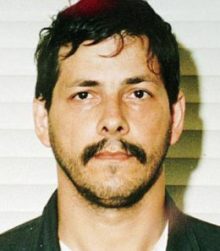
Marc Dutroux, Belgian pedophile, sadist, and serial killer with friends in high places
By Aedon Cassiel | Counter – Currents | December 23, 2016
To reiterate a point that should be clear to the more astute reader, my goal in this series (part 1, part 2) has not been to defend “Pizzagate” as such. My goal has been to defend the people who want to investigate it against specific accusations levied against them by people who think Pizzagate has revealed no intriguing information at all—for a specific reason, which I will be honing in and focusing on much more directly in this closing entry.
Whereas the mainstream critics of Pizzagate would have you believe that the dividing line is between paranoid conspiracy theorist followers of “fake news” and level-headed people who follow trustworthy news sources and rely on cold, hard reason to determine the truth, my goal has been to show that—whatever is or is not happening with Pizzagate itself—this framing of the issue is arrogant, insulting, and the product of extremely narrow tunnel vision. … continue
Blog Roll
 Aletho News
- A note on comment posting at Alethonews
- Trump stalls over Iran strike plan, Iran holds all the aces
- Zelensky’s Ceasefire for Elections is Strategic Gambit, Not Democratic Move
- US and Dutch pilots flying F-16s for Ukraine – Western media
- West’s Claims of Non-Involvement in Ukraine Conflict ‘Epitome of Hypocrisy’ – Expert
- Putin aide urges retaliation to ‘Western piracy’
- The Depth Charge in the Womb
- ‘Fox guarding the henhouse’: AMA, Vaccine Integrity Project to conduct their own vaccine safety and efficacy reviews
- Macron, Merz, and von der Leyen Defend Expanded Speech Controls
- Keir Starmer-tied think tank paid PR firm to target The Grayzone
- If Americans Knew
- Israel ceased firing on Gaza for just 15 days of the “ceasefire” – Not a ceasefire Day 130
- In Gaza, “rats run over our faces” – Not a ceasefire Day 129
- Israel-backed border guards, GHF-linked aid – Not a ceasefire Day 128
- Israel battles Palestinian right of return, one Palestinian at a time – Not a ceasefire Day 127
- Noor’s short life of unimaginable suffering
- Israel Destroyed Gaza’s Hospitals. Now It’s Banning Doctors Without Borders.
- Is Spite of What Zionists Say, It’s a Good Thing to Criticize Governments
- Palestinian mother, daughter recount strip searches, harsh conditions in Israeli detention
- Israel used weapons in Gaza that made thousands of Palestinians evaporate
- ADL’s Stats Twist Israel’s Critics Into Antisemites
- No Tricks Zone
- New Study: A 4°C Warmer Beaufort Sea Had ‘No Sea Ice’ 11,700 – 8200 Years Ago
- Unfudging The Data: Dutch Meteorological Institute Reinstates Early 20th Centruy Heat Waves It Had Erased Earlier
- German Gas Crisis…Chancellor Merz Allegedly Bans Gas Debate Ahead of Elections!
- Pollen Reconstructions Show The Last Glacial’s Warming Events Were Global, 10x Greater Than Modern
- Germany’s Natural Gas Storage Level Dwindles To Just 28%… Increasingly Critical
- New Study Rebuts The Assumption That Anthropogenic CO2 Molecules Have ‘Special’ Properties
- Climate Scientist Who Predicted End Of “Heavy Frost And Snow” Now Refuses Media Inquiries
- Polar Bear Numbers Rising And Health Improving In Areas With The Most Rapid Sea Ice Decline
- One Reason Only For Germany’s Heating Gas Crisis: Its Hardcore-Dumbass Energy Policy
- 130 Years Later: The CO2 Greenhouse Effect Is Still Only An Imaginary-World Thought Experiment
 Aletho News